Phony ‘Corruption’ Excuse for Ukraine Coup
By Robert Parry | Consortium News | November 2, 2016
If Ukraine becomes a flashpoint for World War III with Russia, the American people might rue the day that their government pressed for the 2014 overthrow of Ukraine’s allegedly corrupt (though elected) president in favor of a coup regime led by Ukrainian lawmakers who now report amassing, on average, more than $1 million each, much of it as cash.
The New York Times, which served as virtually a press agent for the coup in February 2014, took note of this apparent corruption among the U.S.-favored post-coup officials, albeit deep inside a story that itself was deep inside the newspaper (page A8). The lead angle was a bemused observation that Ukraine’s officialdom lacked faith in the country’s own banks (thus explaining why so much cash).
Yet, Ukraine is a country beset by widespread poverty, made worse by the post-coup neoliberal “reforms” slashing pensions, making old people work longer and reducing heating subsidies for common citizens. The average Ukrainian salary is only $214 a month.
So, an inquiring mind might wonder how – in the face of all that hardship – the post-coup officials did so well for themselves, but Times’ correspondent Andrew E. Kramer treads lightly on the possibility that these officials were at least as corrupt, if not more so, than the elected government that the U.S. helped overthrow. Elected President Viktor Yanukovych had been excoriated for a lavish lifestyle because he had a sauna in his residence.
Kramer’s article on Wednesday tried to explain the bundles of cash as a sign that “many of the lawmakers and officials responsible for inspiring public trust in Ukraine’s economic and banking institutions have little faith that their own wealth would be safe in the country’s banks, according to recently mandated financial disclosures. …
“Prime Minister Volodymyr Groysman, for example, declared over one million dollars in savings in cash — $870,000 and 460,000 euros — apparently shunning Ukraine’s ever-wobbly banking system. The top official in charge of the country’s banks, Valeriya Gontareva, who is responsible for stabilizing the national currency, the hryvnia, maintains most of her money in American dollars — $1.8 million.
“A tally of the declarations filed by most of Parliament’s 450 members compiled by one analyst, Andriy Gerus, found that the lawmakers collectively held $482 million in ‘monetary assets,’ of which $36 million was kept as cold, hard cash. …
“Some politicians seem to have approached the declaration as a sort of amnesty, revealing everything they have earned from decades of crooked dealings, in an effort to come clean. … One minister reported a wine collection with bottles worth thousands of dollars each. Another official declared ownership of a church. Yet another claimed a ticket to outer space with Virgin Galactic. …
“Another theory making the rounds in Kiev — where people generally acknowledge the inventive, venal genius of their politicians — suggests that the public servants are padding their declarations,” so they can hide future bribes within their reported cash holdings and thus offer plausible excuses for luxury cars and expensive jewelry.
Accessing More Money
Ironically, passage of the law requiring the disclosures of what appears to be widespread corruption among Kiev’s officials unlocked millions of euros in new aid money from the European Union that then flowed to the same apparently corrupt officials.
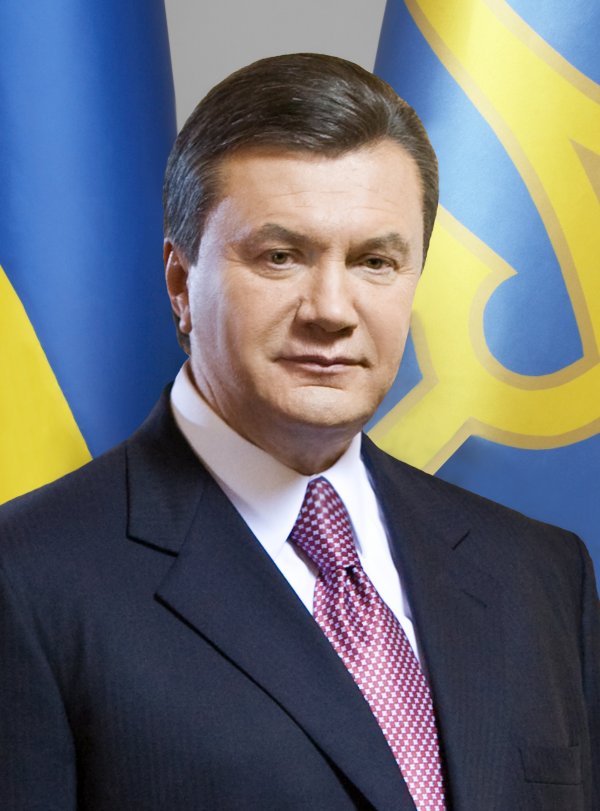
Ousted Ukrainian President Viktor Yanukovych
However, because the Ukraine “regime change” in 2014 was partly orchestrated by U.S. and E.U. officials around the propaganda theme that elected President Yanukovych was corrupt – he had that sauna, after all – the continued corruption in the post-coup regime has been a rarely acknowledged, inconvenient truth. Indeed, some business people operating in Ukraine have complained that the corruption has grown worse since Yanukovych was overthrown.
Yet, only occasionally has that reality been allowed to peek through in the mainstream U.S. media, which prefers to deny that any “coup” occurred, to blame Russia for all of Ukraine’s problems, and to praise the post-coup “reforms” which targeted pensions, heating subsidies and other social programs for average citizens.
One of the rare deviations from the happy talk appeared in The Wall Street Journal on Jan. 1, 2016, observing that “most Ukrainians say the revolution’s promise to replace rule by thieves with the rule of law has fallen short and the government acknowledges that there is still much to be done.”
Actually, the numbers suggested something even worse. More and more Ukrainians rated corruption as a major problem facing the nation, including a majority of 53 percent in September 2015, up from 28 percent in September 2014, according to polls by International Foundation for Electoral Systems.
So, as the hard lives of most Ukrainians got harder, the elites continued to skim off whatever cream was left, including access to billions of dollars in the West’s foreign assistance that has kept the economy afloat.
There was, for instance, the case of Finance Minister Natalie Jaresko, who was regarded by many pundits as the face of Ukraine’s reform before departing last April after losing out in a power struggle.
Yet, Jaresko was hardly a paragon of reform. Prior to getting instant Ukrainian citizenship and becoming Finance Minister in December 2014, she was a former U.S. diplomat who had been entrusted to run a $150 million U.S.-taxpayer-funded program to help jump-start an investment economy in Ukraine and Moldova.
Jaresko’s compensation was capped at $150,000 a year, a salary that many Americans – let alone Ukrainians – would envy, but it was not enough for her. So, she engaged in a variety of maneuvers to evade the cap and enrich herself by claiming millions of dollars in bonuses and fees.
Ultimately, Jaresko was collecting more than $2 million a year after she shifted management of the Western NIS Enterprise Fund (WNISEF) to her own private company, Horizon Capital, and arranged to get lucrative bonuses when selling off investments, even as the overall WNISEF fund was losing money, according to official records.
For instance, Jaresko collected $1.77 million in bonuses in 2013, according to a WNISEF filing with the Internal Revenue Service. In her financial disclosure forms with the Ukrainian government, she reported earning $2.66 million in 2013 and $2.05 million in 2014, thus amassing a sizeable personal fortune while investing U.S. taxpayers’ money supposedly to benefit the Ukrainian people.
It didn’t matter that WNISEF continued to hemorrhage money, shrinking from its original $150 million to $89.8 million in the 2013 tax year, according to the IRS filing. WNISEF reported that the bonuses to Jaresko and other corporate officers were based on “successful” exits from some investments even if the overall fund was losing money.
Though Jaresko’s enrichment schemes were documented by IRS and other official filings, the mainstream U.S. media turned a blind eye to this history, all the better to pretend that Ukraine’s “reform” process was in good hands. [See Consortiumnews.com’s “How Ukraine’s Finance Minister Got Rich.”]
Biden’s Appeal
Worried about the continued corruption, Vice President Joe Biden, who took a personal interest in Ukraine, lectured Ukraine’s parliament on the need to end cronyism.
But Biden had his own Ukraine cronyism problem because three months after the U.S.-backed overthrow of the Yanukovych government Ukraine’s largest private gas firm, Burisma Holdings, appointed his son, Hunter Biden, to its board of directors.
Burisma a shadowy Cyprus-based company also lined up well-connected lobbyists, some with ties to Secretary of State John Kerry, including Kerry’s former Senate chief of staff David Leiter, according to lobbying disclosures.
As Time magazine reported, “Leiter’s involvement in the firm rounds out a power-packed team of politically-connected Americans that also includes a second new board member, Devon Archer, a Democratic bundler and former adviser to John Kerry’s 2004 presidential campaign. Both Archer and Hunter Biden have worked as business partners with Kerry’s son-in-law, Christopher Heinz, the founding partner of Rosemont Capital, a private-equity company.”
According to investigative journalism inside Ukraine, the ownership of Burisma has been traced to Privat Bank, controlled by the thuggish billionaire oligarch Ihor Kolomoysky, who was appointed by the U.S.-backed “reform” regime to be governor of Dnipropetrovsk Oblast, a south-central province of Ukraine (though Kolomoisky was eventually ousted from that post in a power struggle over control of UkrTransNafta, Ukraine’s state-owned oil pipeline operator).
In a speech to Ukraine’s parliament in December 2015, Biden hailed the sacrifice of the 100 or so protesters who died during the Maidan putsch in February 2014, which ousted Yanukovych, referring to the dead by their laudatory name “The Heavenly Hundred.”
But Biden made no heavenly references to the estimated 10,000 people, mostly ethnic Russians, who have been slaughtered in the U.S.-encouraged “Anti-Terror Operation” waged by the coup regime against eastern Ukrainians who resisted Yanukovych’s violent ouster. Nor did Biden take note that some of the Heavenly Hundred were street fighters for neo-Nazi and other far-right nationalist organizations.
But after making his sugary references to The Heavenly Hundred, Biden delivered his bitter medicine, an appeal for the parliament to continue implementing International Monetary Fund “reforms,” including demands that old people work longer into their old age.
Biden said, “For Ukraine to continue to make progress and to keep the support of the international community you have to do more, as well. The big part of moving forward with your IMF program — it requires difficult reforms. And they are difficult.
“Let me say parenthetically here, all the experts from our State Department and all the think tanks, and they come and tell you, that you know what you should do is you should deal with pensions. You should deal with — as if it’s easy to do. Hell, we’re having trouble in America dealing with it. We’re having trouble. To vote to raise the pension age is to write your political obituary in many places.
“Don’t misunderstand that those of us who serve in other democratic institutions don’t understand how hard the conditions are, how difficult it is to cast some of the votes to meet the obligations committed to under the IMF. It requires sacrifices that might not be politically expedient or popular. But they’re critical to putting Ukraine on the path to a future that is economically secure. And I urge you to stay the course as hard as it is. Ukraine needs a budget that’s consistent with your IMF commitments.”
However, as tough as it might have been for Ukraine’s parliament to slash pensions, reduce heating subsidies and force the elderly to work longer, that political sacrifice did not appear to extend to the officials making financial sacrifices themselves.
Former US State Department Official to Buy Ukraine’s Largest Telecom Company
By Robert Wenzel | Economic Policy Journal | April 13, 2016
This is just about as insane and open of an inside look, as to how US empire operators grab the spoils of their interventions that result in turmoil, that you are ever likely to get.
As is clear, the US played an important role in the Ukrainian revolution as revealed by the release of a recording of a phone call between Assistant US Secretary of State Victoria Nuland and U.S. Ambassador to the Ukraine Geoffrey Pyatt (SEE: An Important Second Listen to the “F–k the EU” Ukraine Recording).
But, Nuland isn’t the only US State Department official playing a major role in Ukraine.
A US citizen, the Elmhurst, Illinois-born Natalie Jaresko, obtained a second citizenship (Ukrainian) on December 2, 2014, the day of, get this, her appointment as Minister of Finance of Ukraine.
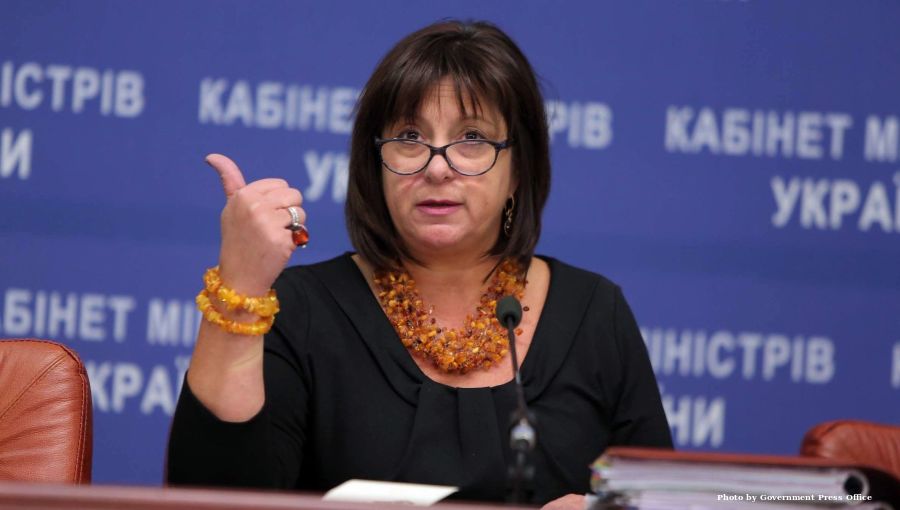 |
| Natalie Jaresko |
Prior to Jaresko becoming Ukraine’s finance minister, she, according to Wikipedia:
…. held several economics-related positions at the US Department of State in Washington, D.C., and eventually coordinated activities of the State Department, the Departments of Commerce, Treasury, the United States Trade Representative, and Overseas Private Investment Corporation (OPIC) in their economic relations with the Soviet Union and its successors. As part of her work she interacted with the International Monetary Fund, World Bank, and the European Bank for Reconstruction and Development. Later from 1992 to 1995, she was the first Chief of the Economic Section of the U.S. Embassy in Ukraine, responsible for strengthening economic cooperation between the two countries.[8] In 2003 she was awarded the Ukrainian Order of Princess Olga for her contributions to the Ukrainian economy.
Between 2005 and 2010 Jaresko was a member of President Viktor Yushchenko’s Foreign Investors Advisory Council and the Advisory Board of the Ukrainian Center for Promotion of Foreign Investment under the auspices of the Cabinet of Ministers of Ukraine.
So what is Jaresko up to as finance minister of Ukraine?
She is about to take control, for herself, of Datagroup, the Ukraine telecom company that controls 85% of the Ukranian telecom market.
Datagroup is owned by Oleksandr Kardakov but his personal empire has collapsed due to foreign currency loan debt.
Foreign loan debt is an old muscle trick of economic hit men (SEE John Perkins, Confessions of an Economic Hit Man). Banksters and international global financial organizations (think the World Bank) load up third-world governments with debt that can’t possibly be repaid and they go in to pick off the juicy meat when the third-world governments can’t make the debt payments.
The loans to Kardakov were a spin-off on the basic maneuver. With Nuland fomenting revolution and turmoil in Ukraine, the Ukranian currency, the hryvnia, has collapsed on foreign exchange markets.

This has made it impossible for Kardakov to pay off his US dollar-denominated loans.
Enter Jaresko.
Ukraine Today reports:
In late February, the company began its liquidation procedure. The company’s other major asset – ‘Datagroup’ telecom operator – may soon be sold out to pay off debts. It may be purchased by its current minority shareholder – investment company ‘Horizon Capital’, co-founded by Ukraine’s current Finance Minister Natalie Jaresko.
Robert Wenzel is Editor & Publisher at EconomicPolicyJournal.com and at Target Liberty. He is also author of The Fed Flunks: My Speech at the New York Federal Reserve Bank. Follow him on twitter:@wenzeleconomics
Reality Peeks Through in Ukraine
By Robert Parry | Consortium News | January 6, 2016
Nearly two years since U.S. officials helped foment a coup in Ukraine – partly justified by corruption allegations – the country continues to wallow in graft and cronyism as the living standards for average Ukrainians plummet, according to economic data and polls of public attitudes.
Even the neocon-oriented Wall Street Journal took note of the worsening corruption in a Jan. 1, 2016 article observing that “most Ukrainians say the revolution’s promise to replace rule by thieves with the rule of law has fallen short and the government acknowledges that there is still much to be done.”
Actually, the numbers suggest something even worse. More and more Ukrainians rate corruption as a major problem facing the nation, including a majority of 53 percent last September, up from 48 percent last June and 28 percent in September 2014, according to polls by International Foundation for Electoral Systems.
Meanwhile, Ukraine’s GDP has fallen in every quarter since the Feb. 22, 2014 putsch that overthrew elected President Viktor Yanukovych. Since then, the average Ukrainian also has faced economic “reforms” to slash pensions, energy subsidies and other social programs, as demanded by the International Monetary Fund.
In other words, the hard lives of most Ukrainians have gotten significantly harder while the elites continue to skim off whatever cream is left, including access to billions of dollars in the West’s foreign assistance that is keeping the economy afloat.
Part of the problem appears to be that people supposedly responsible for the corruption fight are themselves dogged by allegations of corruption. The Journal cited Ukrainian lawmaker Volodymyr Parasyuk who claimed to be so outraged by graft that he expressed his fury “by kicking in the face an official he says owns luxury properties worth much more than a state salary could provide.”
However, the Journal also noted that “parliament is the site of frequent mass brawls [and] it is hard to untangle all the overlapping corruption allegations and squabbling over who is to blame. Mr. Parasyuk himself was named this week as receiving money from an organized crime suspect, a claim he denies.”
Then, there is the case of Finance Minister Natalie Jaresko, who is regarded by top American columnists as the face of Ukraine’s reform. Indeed, a Wall Street Journal op-ed last month by Stephen Sestanovich, a senior fellow at the Council on Foreign Relations, hailed Jaresko as “a tough reformer” whose painful plans include imposing a 20 percent “flat tax” on Ukrainians (a favorite nostrum of the American Right which despises a progressive tax structure that charges the rich at a higher rate).
Sestanovich noted that hedge-fund billionaire George Soros, who has made a fortune by speculating in foreign currencies, has endorsed Jaresko’s plan but that it is opposed by some key parliamentarians who favor a “populist” alternative that Sestanovich says “will cut rates, explode the deficit, and kiss IMF money good-bye.”
Yet, Jaresko is hardly a paragon of reform. Prior to getting instant Ukrainian citizenship and becoming Finance Minister in December 2014, she was a former U.S. diplomat who had been entrusted to run a $150 million U.S.-taxpayer-funded program to help jump-start an investment economy in Ukraine and Moldova.
Jaresko’s compensation was capped at $150,000 a year, a salary that many Americans would envy, but it was not enough for her. So, she engaged in a variety of maneuvers to evade the cap and enrich herself by claiming millions of dollars in bonuses and fees.
Ultimately, Jaresko was collecting more than $2 million a year after she shifted management of the Western NIS Enterprise Fund (WNISEF) to her own private company, Horizon Capital, and arranged to get lucrative bonuses when selling off investments, even as the overall WNISEF fund was losing money, according to official records.
For instance, Jaresko collected $1.77 million in bonuses in 2013, according to WNISEF’s latest available filing with the Internal Revenue Service. In her financial disclosure forms with the Ukrainian government, she reported earning $2.66 million in 2013 and $2.05 million in 2014, thus amassing a sizeable personal fortune while investing U.S. taxpayers’ money supposedly to benefit the Ukrainian people.
It didn’t matter that WNISEF continued to hemorrhage money, shrinking from its original $150 million to $89.8 million in the 2013 tax year, according to the IRS filing. WNISEF reported that the bonuses to Jaresko and other corporate officers were based on “successful” exits from some investments even if the overall fund was losing money. [See Consortiumnews.com’s “How Ukraine’s Finance Minister Got Rich.”]
Though Jaresko’s enrichment schemes are documented by IRS and other official filings, the mainstream U.S. media has turned a blind eye to this history, all the better to pretend that Ukraine’s “reform” process is in good hands. (It also turns out that Jaresko did not comply with Ukrainian law that permits only single citizenship; she has kept her U.S. passport exploiting a loophole that gives her two years to show that she has renounced her U.S. citizenship.)
Propaganda over Reality
Yet, as good as propaganda can be – especially when the U.S. government and mainstream media are moving in lockstep – reality is not always easily managed. Ukraine’s continuing – and some say worsening – corruption prompted last month’s trip to Ukraine by Vice President Joe Biden who gave a combination lecture and pep talk to Ukraine’s parliament.
Of course, Biden has his own Ukraine cronyism problem because – three months after the U.S.-backed overthrow of the Yanukovych government – Ukraine’s largest private gas firm, Burisma Holdings, appointed his son, Hunter Biden, to its board of directors.
Burisma – a shadowy Cyprus-based company – also lined up well-connected lobbyists, some with ties to Secretary of State John Kerry, including Kerry’s former Senate chief of staff David Leiter, according to lobbying disclosures.
As Time magazine reported, “Leiter’s involvement in the firm rounds out a power-packed team of politically-connected Americans that also includes a second new board member, Devon Archer, a Democratic bundler and former adviser to John Kerry’s 2004 presidential campaign. Both Archer and Hunter Biden have worked as business partners with Kerry’s son-in-law, Christopher Heinz, the founding partner of Rosemont Capital, a private-equity company.”
According to investigative journalism inside Ukraine, the ownership of Burisma has been traced to Privat Bank, which is controlled by the thuggish billionaire oligarch Ihor Kolomoysky, who was appointed by the U.S.-backed “reform” regime to be governor of Dnipropetrovsk Oblast, a south-central province of Ukraine (though Kolomoisky was eventually ousted from that post in a power struggle over control of UkrTransNafta, Ukraine’s state-owned oil pipeline operator).
In his December speech, Biden lauded the sacrifice of the 100 or so protesters who died during the Maidan clashes in February 2014, referring to them by their laudatory name “The Heavenly Hundred.” But Biden made no heavenly references to the estimated 10,000 people, mostly ethnic Russians, who have been slaughtered in the U.S.-encouraged “Anti-Terror Operation” waged by the coup regime against eastern Ukrainians who objected to the violent ouster of President Yanukovych, who had won large majorities in those areas.
Apparently, heaven is not as eager to welcome ethnic Russian victims of U.S.-inspired political violence. Nor did Biden take note that some of the Heavenly Hundred were street fighters for neo-Nazi and other far-right nationalist organizations.
But – after making his sugary references to The Heavenly Hundred – Biden delivered his bitter medicine, an appeal for the parliament to continue implementing IMF “reforms,” including demands that old people work longer into their old age.
Biden said, “For Ukraine to continue to make progress and to keep the support of the international community you have to do more, as well. The big part of moving forward with your IMF program — it requires difficult reforms. And they are difficult.
“Let me say parenthetically here, all the experts from our State Department and all the think tanks, and they come and tell you, that you know what you should do is you should deal with pensions. You should deal with — as if it’s easy to do. Hell, we’re having trouble in America dealing with it. We’re having trouble. To vote to raise the pension age is to write your political obituary in many places.
“Don’t misunderstand that those of us who serve in other democratic institutions don’t understand how hard the conditions are, how difficult it is to cast some of the votes to meet the obligations committed to under the IMF. It requires sacrifices that might not be politically expedient or popular. But they’re critical to putting Ukraine on the path to a future that is economically secure. And I urge you to stay the course as hard as it is. Ukraine needs a budget that’s consistent with your IMF commitments.”
Eroding Support
But more and more Ukrainians appear to see through the charade in Kiev, as the poll numbers on the corruption crisis soar. Meanwhile, European officials seem to be growing impatient with the Ukraine crisis which has added to the drag on the Continent’s economies because the Obama administration strong-armed the E.U. into painful economic sanctions against Russia, which had come to the defense of the embattled ethnic Russians in the east.
“Many E.U. officials are fed up with Ukraine,” said one Western official quoted by the Journal, which added that “accusations of graft by anticorruption activists, journalists and diplomats have followed to the new government.”
The Journal said those implicated include some early U.S. favorites, such as Prime Minister Arseniy Yatsenyuk, “whose ratings have plummeted to single digits amid allegations in the media and among anticorruption activists of his associates’ corrupt dealings. Mr. Yatsenyuk has denied any involvement in corruption and his associates, one of whom resigned from parliament over the controversy this month, deny wrongdoing.”
The controversy over Yatsenyuk’s alleged cronyism led to an embarrassing moment in December 2015 when an anti-Yatsenyuk lawmaker approached the podium with a bouquet of roses, which the slightly built Yatsenyuk accepted only to have the lawmaker lift him up and try to carry him from the podium.
In many ways, the Ukraine crisis represents just another failure of neocon-driven “regime change,” which has also spread chaos across the Middle East and northern Africa. But the neocons appear to have even a bigger target in their sites, another “regime change” in Moscow, with Ukraine just a preliminary move. Of course, that scheme could put in play nuclear war.
Taking Aim
The Ukraine “regime change” took shape in 2013 after Russian President Putin and President Barack Obama collaborated to tamp down crises in Syria and Iran, two other prime targets for neocon “regime changes.” American neocons were furious that those hopes were dashed. Ukraine became Putin’s payback.
In fall 2013, the neocons took aim at Ukraine, recognizing its extreme sensitivity to Russia which had seen previous invasions, including by the Nazis in World War II, pass through the plains of Ukraine and into Russia. Carl Gershman, neocon president of the U.S.-funded National Endowment for Democracy, cited Ukraine as the “biggest prize” and a key step toward unseating Putin in Moscow. [See Consortiumnews.com’s “What the Neocons Want from Ukraine Crisis.”]
Initially, the hope was that Yanukovych would lead Ukraine into an economic collaboration with Europe while cutting ties to Russia. But Yanukovych received a warming from top Ukrainian economists that a hasty split with neighboring Russia would cost the country a staggering $160 billion in lost income.
So, Yanukovych sought to slow down the process, prompting angry protests especially from western Ukrainians who descended on Maidan square. Though initially peaceful, neo-Nazi and other nationalist militias soon infiltrated the protests and began ratcheting up the violence, including burning police with Molotov cocktails.
Meanwhile, U.S.-funded non-governmental organizations, such as the Organized Crime and Corruption Reporting Project (which receives money from USAID and hedge-fund billionaire George Soros’s Open Society), hammered away at alleged corruption in the Yanukovych government.
In December 2013, Nuland reminded Ukrainian business leaders that the United States had invested $5 billion in their “European aspirations,” and – in an intercepted phone call in early February 2014 – she discussed with U.S. Ambassador Geoffrey Pyatt who Ukraine’s new leaders would be.
“Yats is the guy,” Nuland said of Arseniy Yatsenyuk, as she also disparaged a less aggressive approach by the European Union with the pithy phrase: “Fuck the E.U.” (Nuland, a former aide to ex-Vice President Dick Cheney, is the wife of arch-neoconservative ideologue Robert Kagan.)
Sen. John McCain also urged on the protests, telling one group of right-wing Ukrainian nationalists that they had America’s backing. And, the West’s mainstream media fell in love with the Maidan protesters as innocent white hats and thus blamed the worsening violence on Yanukovych. [See Consortiumnews.com’s “NYT Still Pretends No Coup in Ukraine.”]
Urging Restraint
In Biden’s December 2015 speech to the parliament, he confirmed that he personally pressed on President Yanukovych the need to avoid violence. “I was literally on the phone with your former President urging restraint,” Biden said.
However, on Feb. 20, 2014, mysterious snipers – apparently from buildings controlled by the far right – fired on and killed policemen as well as some protesters. The bloodshed sparked other violent clashes as armed rioters battled with retreating police.
Although the dead included some dozen police officers, the violence was blamed on Yanukovych, who insisted that he had ordered the police not to use lethal force in line with Biden’s appeal. But the State Department and the West’s mainstream media made Yanukovych the black-hatted villain.
The next day, Feb. 21, Yanukovych signed an accord – negotiated and guaranteed by three European nations – to accept reduced powers and early elections so he could be voted out of office if that was the public’s will. However, as police withdrew from the Maidan, the rioters, led by neo-Nazi militias called sotins, stormed government buildings on Feb. 22, forcing Yanukovych and other officials to flee for their lives.
In the West’s mainstream media, these developments were widely hailed as a noble “revolution” and – with lumps in their throats – many journalists averted their misty eyes from the key role played by unsavory neo-Nazis, so as not to dampen the happy narrative (although BBC was among the few MSM outlets that touched on this inconvenient reality).
Ever since, the major U.S. news media has stayed fully on board, ignoring evidence that what happened was a U.S.-sponsored coup. The MSM simply explains all the trouble as a case of naked “Russian aggression.
There were kudos, too, when “reformer” Natalie Jaresko was made Finance Minister along with other foreign “technocrats.” There was no attention paid to evidence about the dark underside of the Ukrainian “revolution of dignity,” as Biden called it.
Though the neo-Nazis – sometimes even teamed up with Islamic jihadists – were the tip of the spear slashing through eastern Ukraine, their existence was either buried deep inside stories or dismissed as “Russian propaganda.”
That was, in effect, American propaganda and, as clever as it was, it could only control reality for so long.
Even though the fuller truth about Ukraine has never reached the American people, there comes a point when even the best propagandists have to start modifying their rosy depictions. Ukraine appears to have reached that moment.
Investigative reporter Robert Parry broke many of the Iran-Contra stories for The Associated Press and Newsweek in the 1980s. You can buy his latest book, America’s Stolen Narrative, either in print here or as an e-book (from Amazon and barnesandnoble.com).
How Ukraine’s Finance Chief Got Rich
By Robert Parry | Consortium News | November 10, 2015
Before becoming Ukraine’s Finance Minister last December, Natalie Jaresko collected $1.77 million in bonuses from a U.S.-taxpayer-financed investment fund where her annual compensation was supposed to be limited to $150,000, according to financial documents filed with the U.S. Internal Revenue Service this year.
The near 12-fold discrepancy between the compensation ceiling and Jaresko’s bonuses, paid in 2013, was justified in the IRS filing from the Jaresko-led Western NIS Enterprise Fund (WNISEF) by drawing a distinction between getting paid directly from the $150 million U.S. government grant that created the fund and the money from the fund’s “investment sales proceeds,” which were treated as fair game for extracting bonuses far beyond the prescribed compensation level.
Using this supposed loophole, Jaresko and some of her associates enriched themselves by claiming money generated from U.S. taxpayers’ dollars while avoiding any personal financial risks. She and other WNISEF officers collected the bonuses from what they deemed “profitable” exits from some investments even if the overall fund was losing money and shrinking, as it apparently was in recent years.
According to WNISEF’s filing for the 2013 tax year, submitted to the IRS on Aug. 11, 2015, the value of the investment fund had shrunk from $150 million at its start to $93.9 million in the fund’s 2012 tax year and to $89.8 million in the 2013 tax year. (WNISEF’s tax years end on Sept. 30.)
So, Jaresko’s arrangement was something like taking someone else’s money to a roulette table, placing it on black, and claiming a share of the winnings if the ball stopped on black. However, if the ball landed on red, then the someone else absorbed the loss, except in this case the winners were Jaresko and her associates and the losers were the American taxpayers.
The purpose cited by the U.S. Congress in starting the non-profit WNISEF with $150 million in the 1990s was to help jumpstart an investment economy in Ukraine and Moldova for the benefit of the people of those countries. The project was administered by the U.S. Agency for International Development (USAID), which selected Jaresko, a former U.S. diplomat of Ukrainian heritage, to run the project.
Last December, Ukrainian President Petro Poroshenko named Jaresko Finance Minister after awarding her instant Ukrainian citizenship. At that point, she quit WNISEF and has since become the face of Ukrainian “reform,” representing the U.S.-backed government at international banking events at Davos, Switzerland, and elsewhere while appealing for billions of dollars in Western financial aid which she oversees.
Thus, Jaresko’s standards for handling public moneys are relevant to judging whether the new regime is just a reshuffling of who gets to plunder Ukraine or a serious effort at reform. The overthrow of the previous Ukrainian government of President Viktor Yanukovych was largely justified in February 2014 because of allegations about corruption. The new regime has presented itself as committed to reform, even though some outside observers contend that corruption is as bad or worse than under the old government.
Self-Interest v. Public Interest
There is also the question of whether Jaresko is more interested in getting rich than in serving the people of Ukraine. As WNISEF’s chief executive officer, Jaresko seemed to grow dissatisfied with her $150,000 salary. For instance, in 2004, she earned more than double the prescribed amount, paid $383,259 along with $67,415 in expenses, according to WNISEF’s IRS filing for that year.
According to audit documents that I obtained from USAID, an “Expense Analysis” for 2004 showed $1,282,782 being paid out as “Exit-based incentive expense-equity incentive plan” and another $478,195 being paid for “Exit-based incentive expense-financial participation rights.” That suggested that Jaresko was already claiming bonuses from WNISEF’s investments (bought with U.S. taxpayers’ money) and sold during 2004.
In 2006, Jaresko’s compensation for her work with WNISEF was removed from public disclosure altogether after she co-founded two related entities – Horizon Capital Associates (HCA) to manage WNISEF’s investments (and collect around $1 million a year in fees) and Emerging Europe Growth Fund (EEGF), a private entity to collaborate with WNISEF on investment deals.
Jaresko formed HCA and EEGF with two other WNISEF officers, Mark Iwashko and Lenna Koszarny. They also started a third firm, Horizon Capital Advisors, which “serves as a sub-advisor to the Investment Manager, HCA,” according to WNISEF’s IRS filing for 2006.
According to the USAID’s expense analyses for 2004-06, the taxpayer-financed WNISEF spent $1,049,987 to establish EEGF as a privately owned investment fund for Jaresko and her colleagues. USAID apparently found nothing suspicious about these tangled business relationships despite the potential conflicts of interest involving Jaresko, the other WNISEF officers and their affiliated companies.
For instance, WNISEF’s 2012 annual report devoted two pages to “related party transactions,” including the management fees to Jaresko’s Horizon Capital ($1,037,603 in 2011 and $1,023,689 in 2012) and WNISEF’s co-investments in projects with the EEGF. Though the IRS forms have a line for earnings from “related organizations,” WNISEF listed nothing, apparently treating compensation from Horizon Capital and EEGF as “unrelated” for the purposes of reporting compensation for Jaresko and other officers.
So, the scale of how much Jaresko was making from her association with WNISEF was unclear until last week when the IRS released WNISEF’s 2013 tax filing of Aug. 11, 2015, in response to a request from Consortiumnews.com. Though the filing still did not disclose all of Jaresko’s WNISEF-related compensation, it did list her $1.77 million share of the $4.5 million in bonuses awarded to her and two other WNISEF officers, Iwashko and Koszarny.
WNISEF filings also said the bonuses were paid regardless of whether the overall fund was making money, noting that this “compensation was not contingent on revenues or net earnings, but rather on a profitable exit of a portfolio company that exceeds the baseline value set by the board of directors and approved by USAID” – with Jaresko also serving as a director on the board responsible for setting those baseline values.
Though compensation for Jaresko and other officers was shifted outside public view after 2006 – as their pay was moved to the affiliated entities – the 2006 IRS filing said: “It should be noted that as long as HCA earns a management fee from WNISEF, HCA and HCAD [the two Horizon Capital entities] must ensure that a salary cap of $150,000 is adhered to for the proportion of salary attributable to WNISEF funds managed relative to aggregate funds under management.”
Audit Gaps
KPMG auditors, who reviewed WNISEF finances, also took a narrow view of how to define income for Jaresko and other officers, only confirming that no “salary” exceeded $150,000, apparently not looking at bonuses and other forms of compensation. Neither USAID officials nor Jaresko responded to specific questions about WNISEF’s possible conflicts of interest, how much money Jaresko made from her involvement with WNISEF and its connected companies, and whether she had fully complied with IRS reporting requirements.
After Jaresko’s appointment as Finance Minister — and her resignation from WNISEF — I reviewed WNISEF’s available public records and detected a pattern of insider dealings and enrichment benefiting Jaresko and her colleagues. That prompted me in February to file a Freedom of Information Act request for USAID’s audits of the investment fund.
Though the relevant records were identified by June, USAID dragged its feet on releasing the 34 pages to me until Aug. 28 when the agency claimed nothing was being withheld, saying “all 34 pages are releasable in their entirety.” However, when I examined the documents, it became clear that a number of pages were missing from the financial records, including a total of three years of “expense analysis” – in three-, six- and nine-month gaps – since 2007.
Part of KPMG’s “Independent Auditors’ Report” for 2013 and 2014 was also missing. The report stated that “except as discussed in the third paragraph below, we conducted our audits in accordance with auditing standards generally accepted in the United States of America,” accountant-speak that suggests that “the third paragraph below” would reveal some factor that did not comply with generally accepted accounting principles (or GAAP).
But three paragraphs below was only white space and there was no next page in what USAID released. After I pointed out the discrepancies to USAID on Aug. 31, I was told on Sept. 15 that “we are in the process of locating documents to address your concern. We expect a response from the bureau and/or mission by Monday, September 28, 2015.”
After the Sept. 28 deadline passed, I contacted USAID again and was told on Oct. 2 that officials were “still working with the respective mission to obtain the missing documents.” On Oct. 22, USAID sent me one additional page from KPMG’s audit report stating that its review of WNISEF’s books lacked “an external quality control review by an unaffiliated audit organization” – as required by the U.S. government’s auditing standards – because no such program is offered in Ukraine. Other pages are still missing.
An earlier effort by Jaresko’s ex-husband Ihor Figlus to blow the whistle on what he considered improper business practices related to WNISEF was met by disinterest inside USAID, according to Figlus, and then led to Jaresko suing him in a Delaware court in 2012, using a confidentiality clause to silence Figlus and getting a court order to redact references to the abuses he was trying to expose.
Figlus’s complaints related to what he saw as improper loans that Jaresko had taken from Horizon Capital Associates to buy and expand her stake in EEGF, the privately held follow-on fund to WNISEF. After Figlus discussed this issue with a Ukrainian journalist, Jaresko sent her lawyers to court to silence him and, according to his lawyer, bankrupt him.
The filings in Delaware’s Chancery Court are remarkable not only because Jaresko succeeded in getting the Court to gag her ex-husband through enforcement of a non-disclosure agreement but the Court agreed to redact nearly all the business details, even the confidentiality language at the center of the case. [See Consortiumnews.com’s “Ukraine’s Finance Minister’s ‘American Values.”]
Shared Values
Earlier this year, I sent detailed questions to USAID and to Jaresko via several of her associates. Those questions included how much of the $150 million in U.S. taxpayers’ money remained in WNISEF, why Jaresko reported no compensation from “related organizations,” whether she received bonus money, how much money she made in total from her association with WNISEF, what AID officials did in response to Figlus’s whistle-blower complaint, and whether Jaresko’s legal campaign to silence her ex-husband was appropriate given her current position and Ukraine’s history of secretive financial dealings.
USAID press officer Annette Y. Aulton got back to me with a response that was unresponsive to my specific questions. Rather than answering about the performance of WNISEF and Jaresko’s compensation, Aulton commented on the relative success of 10 “Enterprise Funds” that USAID has sponsored in Eastern Europe, adding:
“There is a twenty year history of oversight of WNISEF operations. Enterprise funds must undergo an annual independent financial audit, submit annual reports to USAID and the IRS, and USAID staff conduct field visits and semi-annual reviews. At the time Horizon Capital assumed management of WNISEF, USAID received disclosures from Natalie Jaresko regarding the change in management structure and at the time USAID found no impropriety during its review.”
One Jaresko associate, Tanya Bega, Horizon Capital’s investor relations manager, said she forwarded my questions to Jaresko, but Jaresko did not respond.
Despite concerns that Jaresko may have enriched herself at the expense of U.S. taxpayers and then used a Delaware court to prevent disclosure of possible abuses, Jaresko has been hailed by the U.S. mainstream media as a paragon of reform in the U.S.-backed Ukrainian regime.
Last January, New York Times columnist Thomas L. Friedman cited Jaresko as an exemplar of the new Ukrainian leaders who “share our values” and deserve unqualified American support. Friedman uncritically quoted Jaresko’s speech to international financial leaders at Davos, in which she castigated Russian President Vladimir Putin:
“Putin fears a Ukraine that demands to live and wants to live and insists on living on European values — with a robust civil society and freedom of speech and religion [and] with a system of values the Ukrainian people have chosen and laid down their lives for.”
Exactly which Western “values” Jaresko actually shares remains unclear because of the fog surrounding her actions at WNISEF and her unwillingness to reveal how much she made from her association with a U.S.–taxpayer funded project. However, if those Western “values” include putting citizens’ interests before self-interest and believing that transparency is critical for a democracy, Jaresko may need some remedial training.
Investigative reporter Robert Parry broke many of the Iran-Contra stories for The Associated Press and Newsweek in the 1980s. You can buy his latest book, America’s Stolen Narrative, either in print here or as an e-book (from Amazon and barnesandnoble.com).
US Tax Dollars and Ukraine’s Finance Minister
By Robert Parry | Consortium News | October 3, 2015
The U.S. government is missing – or withholding – audit documents about the finances and possible accounting irregularities at a $150 million U.S.-taxpayer-financed investment fund when it was run by Ukraine’s Finance Minister Natalie Jaresko, who has become the face of “reform” for the U.S.-backed regime in Kiev and who now oversees billions of dollars in Western financial aid.
Before taking Ukrainian citizenship and becoming Finance Minister in December 2014, Jaresko was a former U.S. diplomat who served as chief executive officer of the Western NIS Enterprise Fund (WNISEF), which was created by Congress in the 1990s with $150 million and placed under the U.S. Agency for International Development (USAID) to help jumpstart an investment economy in Ukraine.
After Jaresko’s appointment as Finance Minister — and her resignation from WNISEF — I reviewed WNISEF’s available public records and detected a pattern of insider dealings and enrichment benefiting Jaresko and various colleagues. That prompted me in February to file a Freedom of Information Act request for USAID’s audits of the investment fund.
Though the relevant records were identified by June, USAID dragged its feet on releasing the 34 pages to me until Aug. 28 when the agency claimed nothing was being withheld, saying “all 34 pages are releasable in their entirety.”
However, when I examined the documents, it became clear that a number of pages were missing from the financial records, including a total of three years of “expense analysis” – in three-, six- and nine-month gaps – since 2007. Perhaps even more significant was a missing paragraph that apparently would have addressed an accounting irregularity found by KPMG auditors.
KPMG’s “Independent Auditors’ Report” for 2013 and 2014 states that “except as discussed in the third paragraph below, we conducted our audits in accordance with auditing standards generally accepted in the United States of America,” accountant-speak that suggests that “the third paragraph below” would reveal some WNISEF activity that did not comply with generally accepted accounting principles (or GAAP).
But three paragraphs below was only white space and there was no next page in what USAID released.
Based on the one page that was released for 2013-14, this most recent audit also lacked the approval language used in previous audits, in which KPMG wrote: “In our opinion, the consolidated financial statements … present fairly, in all material respects, the consolidated financial position of Western NIS Enterprise Fund and subsidiaries.” That language was not in the 2013-14 analysis, as released by USAID.
The KPMG report for 2013-14 does note that “The [audit] procedures selected depend on the auditors’ judgment, including the assessment of the risks of material misstatement of the financial statements, whether due to fraud or error. … An audit also includes evaluating the appropriateness of accounting policies used and the reasonableness of significant accounting estimates made by management, as well as evaluating the overall presentation of the financial statements.”
That page then ends, “We believe that the audit evidence we have obtained is sufficient and appropriate to provide a basis for our audit opinion.” But the opinion is not there.
After I brought these discrepancies to the attention of USAID on Aug. 31, I was told on Sept. 15 that “we are in the process of locating documents to address your concern. We expect a response from the bureau and/or mission by Monday, September 28, 2015.”
After the Sept. 28 deadline passed, I contacted USAID again and was told on Oct. 2 that officials were “still working with the respective mission to obtain the missing documents.”
Yet, whether USAID’s failure to include the missing documents was just a bureaucratic foul-up or a willful attempt to shield Jaresko from criticism, the curious gaps add to the impression that the management of WNISEF fell short of the highest standards for efficiency and ethics.
A previous effort by Jaresko’s ex-husband Ihor Figlus to blow the whistle on what he considered improper business practices related to WNISEF was met by disinterest inside USAID, according to Figlus, and then led to Jaresko suing him in a Delaware court in 2012, using a confidentiality clause to silence Figlus and getting a court order to redact references to the abuses he was trying to expose.
Feeding at the Taxpayer Trough
Other public documents indicate that Jaresko and fellow WNISEF insiders enriched themselves through their association with the U.S.-taxpayer-financed investment fund. For instance, though Jaresko was limited to making $150,000 a year at WNISEF under the USAID grant agreement, she managed to earn more than that amount, reporting in 2004 that she was paid $383,259 along with $67,415 in expenses, according to WNISEF’s filing with the Internal Revenue Service.
Among the audit documents that I received under FOIA, the “Expense Analysis” for 2004 shows $1,282,782 being paid out as “Exit-based incentive expense-equity incentive plan” and another $478,195 being paid for “Exit-based incentive expense-financial participation rights.” That would suggest that Jaresko more than doubled her $150,000 salary by claiming bonuses from WNISEF’s investments (bought with U.S. taxpayers’ money) and sold during 2004.
Jaresko’s compensation for her work with WNISEF was removed from public disclosure altogether after she co-founded two related entities in 2006: Horizon Capital Associates (HCA) to manage WNISEF’s investments (and collect around $1 million a year in fees) and Emerging Europe Growth Fund (EEGF), a private entity to collaborate with WNISEF on investment deals.
Jaresko formed HCA and EEGF with two other WNISEF officers, Mark Iwashko and Lenna Koszarny. They also started a third firm, Horizon Capital Advisors, which “serves as a sub-advisor to the Investment Manager, HCA,” according to WNISEF’s IRS filing for 2006.
According to the FOIA-released expense analyses for 2004-06, the taxpayer-financed WNISEF spent $1,049,987 to establish EEGF as a privately owned investment fund for Jaresko and her colleagues. USAID apparently found nothing suspicious about these tangled business relationships despite the potential conflicts of interest involving Jaresko, the other WNISEF officers and their affiliated companies.
For instance, WNISEF’s 2012 annual report devoted two pages to “related party transactions,” including the management fees to Jaresko’s Horizon Capital ($1,037,603 in 2011 and $1,023,689 in 2012) and WNISEF’s co-investments in projects with the EEGF, where Jaresko was founding partner and chief executive officer. Jaresko’s Horizon Capital managed the investments of both WNISEF and EEGF.
From 2007 to 2011, WNISEF co-invested $4.25 million with EEGF in Kerameya LLC, a Ukrainian brick manufacturer, and WNISEF sold EEGF 15.63 percent of Moldova’s Fincombank for $5 million, the report said. It also listed extensive exchanges of personnel and equipment between WNISEF and Horizon Capital. But it’s difficult for an outsider to ascertain the relative merits of these insider deals — and the transactions apparently raised no red flags for USAID officials, nor during that time for KPMG auditors.
Bonuses, Bonuses
Regarding compensation, WNISEF’s 2013 filing with the IRS noted that the fund’s officers collected millions of dollars in more bonuses for closing out some investments at a profit even as the overall fund was losing money. According to the filing, WNISEF’s $150 million nest egg had shrunk by more than one-third to $94.5 million and likely has declined much more during the economic chaos that followed the U.S.-backed coup in February 2014.
But prior to the coup and the resulting civil war, Jaresko’s WNISEF was generously spreading money around to various insiders. For instance, the 2013 IRS filing reported that the taxpayer-financed fund paid out as “expenses” $7.7 million under a bonus program, including $4.6 million to “current officers,” without identifying who received the money although Jaresko was one of the “current officers.”
WNISEF’s filing made the point that the “long-term equity incentive plan” was “not compensation from Government Grant funds but a separately USAID-approved incentive plan funded from investment sales proceeds” – although those proceeds presumably would have gone into the depleted WNISEF pool if they had not been paid out as bonuses.
The filing also said the bonuses were paid regardless of whether the overall fund was making money, noting that this “compensation was not contingent on revenues or net earnings, but rather on a profitable exit of a portfolio company that exceeds the baseline value set by the board of directors and approved by USAID” – with Jaresko also serving as a director on the board responsible for setting those baseline values.
Another WNISEF director was Jeffrey C. Neal, former chairman of Merrill Lynch’s global investment banking and a co-founder of Horizon Capital, further suggesting how potentially incestuous these relationships may have become.
Though compensation for Jaresko and other officers was shifted outside public view after 2006 – as their pay was moved to the affiliated entities – the 2006 IRS filing says: “It should be noted that as long as HCA earns a management fee from WNISEF, HCA and HCAD [the two Horizon Capital entities] must ensure that a salary cap of $150,000 is adhered to for the proportion of salary attributable to WNISEF funds managed relative to aggregate funds under management.”
But that language would seem to permit compensation well above $150,000 if it could be tied to other managed funds, including EEGF, or come from the bonus incentive program. Such compensation for Jaresko and the other top officers was not reported on later IRS forms despite a line for earnings from “related organizations.” Apparently, Horizon Capital and EEGF were regarded as “unrelated organizations” for the purposes of reporting compensation.
The KPMG auditors also took a narrow view of compensation only confirming that no “salary” exceeded $150,000, apparently not looking at bonuses and other forms of compensation.
Neither AID officials nor Jaresko responded to specific questions about WNISEF’s possible conflicts of interest, how much money Jaresko made from her involvement with WNISEF and its connected companies, and whether she had fully complied with IRS reporting requirements.
Gagging an Ex-Husband
In 2012, when Jaresko’s ex-husband Figlus began talking about what he saw as improper loans that Jaresko had taken from Horizon Capital Associates to buy and expand her stake in EEGF, the privately held follow-on fund to WNISEF, Jaresko sent her lawyers to court to silence him and, according to his lawyer, bankrupt him.
The filings in Delaware’s Chancery Court are remarkable not only because Jaresko succeeded in getting the Court to gag her ex-husband through enforcement of a non-disclosure agreement but the Court agreed to redact nearly all the business details, even the confidentiality language at the center of the case.
Since Figlus had given some of his information to a Ukrainian journalist, Jaresko’s complaint also had the look of a leak investigation, tracking down Figlus’s contacts with the journalist and then using that evidence to secure the restraining order, which Figlus said not only prevented him from discussing business secrets but even talking about his more general concerns about Jaresko’s insider dealings.
The heavy redactions make it hard to fully understand Figlus’s concerns or to assess the size of Jaresko’s borrowing as she expanded her holdings in EEGF, but Figlus did assert that he saw his role as whistle-blowing about improper actions by Jaresko.
In a Oct. 31, 2012, filing, Figlus’s attorney wrote that “At all relevant times, Defendant [Figlus] acted in good faith and with justification, on matters of public interest, and particularly the inequitable conduct set forth herein where such inequitable conduct adversely affects … at least one other limited partner which is REDACTED, and specifically the inequitable conduct included, in addition to the other conduct cited herein, REDACTED.”
The defendant’s filing argued: “The Plaintiffs’ [Jaresko’s and her EEGF partners’] claims are barred, in whole or in part, by public policy, and particularly that a court in equity should not enjoin ‘whistle-blowing’ activities on matters of public interest, and particularly the inequitable conduct set forth herein.” But the details of that conduct were all redacted.
In a defense brief dated Dec. 17, 2012 [see Part One and Part Two], Figlus expanded on his argument that Jaresko’s attempts to have the court gag him amounted to a violation of his constitutional right of free speech:
“The obvious problem with the scope of their Motion is that Plaintiffs are asking the Court to enter an Order that prohibits Defendant Figlus from exercising his freedom of speech without even attempting to provide the Court with any Constitutional support or underpinning for such impairment of Figlus’ rights.
“Plaintiffs cannot do so, because such silencing of speech is Constitutionally impermissible, and would constitute a denial of basic principles of the Bill of Rights in both the United States and Delaware Constitutions. There can be no question that Plaintiffs are seeking a temporary injunction, which constitutes a prior restraint on speech. …
“The Court cannot, consistent with the Federal and State Constitutional guarantees of free speech, enjoin speech except in the most exceptional circumstances, and certainly not when Plaintiffs are seeking to prevent speech that is not even covered by the very contractual provision upon which they are relying. Moreover, the Court cannot prevent speech where the matter has at least some public interest REDACTED, except as limited to the very specific and exact language of the speaker’s contractual obligation.”
A Redacted Narrative
Figlus also provided a narrative of events as he saw them as a limited partner in EEGF, saying he initially “believed everything she [Jaresko] was doing, you know, was proper.” Later, however, Figlus “learned that Jaresko began borrowing money from HCA REDACTED, but again relied on his spouse, and did not pay attention to the actual financial transactions…
“In early 2010, after Jaresko separated from Figlus, she presented Figlus with, and requested that he execute, a ‘Security Agreement,’ pledging the couple’s partnership interest to the repayment of the loans from HCA. This was Figlus first realization of the amount of loans that Jaresko had taken, and that the partnership interest was being funded through this means. … By late 2011, Jaresko had borrowed approximately REDACTED from HCA to both fund the partnership interest REDACTED. The loans were collateralized only by the EEFG partnership interest. …
“Figlus became increasingly concerned about the partnership and the loans that had been and continued to be given to the insiders to pay for their partnership interests, while excluding other limited partners. Although Figlus was not sophisticated in these matters, he considered that it was inappropriate that HCA was giving loans to insiders to fund their partnership interests, but to no other partners. …
“He talked to an individual at U.S. Agency for International Development (USAID) in Washington D.C., because the agency was effectively involved as a limited partner because of the agency’s funding and supervision over WNISEF, but the agency employee did not appear interested in pursuing the question.”
In the court proceedings, Jaresko’s lawyers mocked Figlus’s claims that he was acting as a whistle-blower, claiming that he was actually motivated by a desire “to harm his ex-wife” and had violated the terms of his non-disclosure agreement, which the lawyers convinced the court to exclude from the public record.
The plaintiffs’ brief [see Part One and Part Two] traced Figlus’s contacts with the Ukrainian reporter whose name is also redacted: “Figlus, having previously received an audit from the General Partner, provided it to REDACTED [the Ukrainian reporter] with full knowledge that the audit was non-public. Also on or about October 2, 2012, REDACTED [the reporter] contacted multiple Limited Partners, informed them that he possessed ‘documented proof’ of alleged impropriety by the General Partner and requested interviews concerning that alleged impropriety.”
The filing noted that on Oct. 3, 2012, the reporter told Figlus that Jaresko “called two REDACTED [his newspaper’s] editors last night crying, not me, for some reason.” (The Ukrainian story was never published.)
After the competing filings, Jaresko’s lawyers successfully secured a restraining order against Figlus from the Delaware Chancery Court and continued to pursue the case against him though his lawyer has asserted that his client would make no further effort to expose these financial dealings and was essentially broke.
On May 14, 2014, Figlus filed a complaint with the court claiming that he was being denied distributions from his joint interest in EEGF and saying he was told that it was because the holding was pledged as security against the loans taken out by Jaresko. But, on the same day, Jaresko’s lawyer, Richard P. Rollo, contradicted that assertion, saying information about Figlus’s distributions was being withheld because EEGF and Horizon Capital “faced significant business interruptions and difficulties given the political crisis in Ukraine.”
The filing suggested that the interlocking investments between EEGF and the U.S.-taxpayer-funded WNISEF were experiencing further trouble from the political instability and civil war sweeping across Ukraine.
A Face of Reform
By December 2014, Jaresko had resigned from her WNISEF-related positions, taken Ukrainian citizenship and started her new job as Ukraine’s Finance Minister. In an article about Jaresko’s appointment, John Helmer, a longtime foreign correspondent in Russia, disclosed the outlines of the court dispute with Figlus and identified the Ukrainian reporter as Mark Rachkevych of the Kyiv Post.
“It hasn’t been rare for American spouses to go into the asset management business in the former Soviet Union, and make profits underwritten by the US Government with information supplied from their US Government positions or contacts,” Helmer wrote. “It is exceptional for them to fall out over the loot.”
When I contacted George Pazuniak, Figlus’s lawyer, about Jaresko’s aggressive enforcement of the non-disclosure agreement, he told me that “at this point, it’s very difficult for me to say very much without having a detrimental effect on my client.” Pazuniak did say, however, that all the redactions were demanded by Jaresko’s lawyers.
I also sent detailed questions to USAID and to Jaresko via several of her associates. Those questions included how much of the $150 million in U.S. taxpayers’ money remained, why Jaresko reported no compensation from “related organizations,” whether she received any of the $4.6 million to WNISEF’s officers in bonuses in 2013, how much money she made in total from her association with WNISEF, what AID officials did in response to Figlus’s whistle-blower complaint, and whether Jaresko’s legal campaign to silence her ex-husband was appropriate given her current position and Ukraine’s history of secretive financial dealings.
USAID press officer Annette Y. Aulton got back to me with a response that was unresponsive to my specific questions. Rather than answering about the performance of WNISEF and Jaresko’s compensation, the response commented on the relative success of 10 “Enterprise Funds” that AID has sponsored in Eastern Europe and added:
“There is a twenty year history of oversight of WNISEF operations. Enterprise funds must undergo an annual independent financial audit, submit annual reports to USAID and the IRS, and USAID staff conduct field visits and semi-annual reviews. At the time Horizon Capital assumed management of WNISEF, USAID received disclosures from Natalie Jaresko regarding the change in management structure and at the time USAID found no impropriety during its review.”
One Jaresko associate, Tanya Bega, Horizon Capital’s investor relations manager, said she forwarded my questions to Jaresko, but Jaresko did not respond.
Despite questions about whether Jaresko improperly enriched herself at the expense of U.S. taxpayers and then used a Delaware court to prevent disclosure of possible abuses, Jaresko has been hailed by the U.S. mainstream media as the face of reform in the U.S.-backed Ukrainian regime that seized power in February 2014 after a violent coup overthrew democratically elected President Viktor Yanukovych.
For instance, last January, New York Times columnist Thomas L. Friedman cited Jaresko as an exemplar of the new Ukrainian leaders who “share our values” and deserve unqualified American support. Friedman uncritically quoted Jaresko’s speech to international financial leaders at Davos, Switzerland, in which she castigated Russian President Vladimir Putin:
“Putin fears a Ukraine that demands to live and wants to live and insists on living on European values — with a robust civil society and freedom of speech and religion [and] with a system of values the Ukrainian people have chosen and laid down their lives for.”
However, from the opaqueness of the WNISEF records and the gagging of her ex-husband, Jaresko has shown little regard for transparency or other democratic values. Similarly, USAID seems more intent on protecting Jaresko and the image of the Kiev regime than in protecting America tax dollars and ensuring that WNISEF’s investments were dedicated to improving the lot of Ukrainian citizens.
Investigative reporter Robert Parry broke many of the Iran-Contra stories for The Associated Press and Newsweek in the 1980s. You can buy his latest book, America’s Stolen Narrative, either in print here or as an e-book (from Amazon and barnesandnoble.com).
WPost Plays Ukraine’s Lapdog
By Robert Parry | Consortium News | June 11, 2015
There once was a time when the U.S. news media investigated U.S. imperial adventures overseas, such as Washington-sponsored coups. Journalists also asked tough questions to officials implicated in corruption even if those queries were inconvenient to the desired propaganda themes. But those days are long gone, as the Washington Post demonstrated again this week.
On Wednesday, the Post’s editorial board had a chance to press Ukraine’s Prime Minister Arseniy Yatsenyuk about the U.S. government’s role in the Feb. 22, 2014 coup that elevated him to his current post – after he was handpicked by U.S. Assistant Secretary of State for European Affairs Victoria Nuland, who declared “Yats is the guy” in a pre-coup intercepted phone call.
Wouldn’t it have been interesting to ask Yatsenyuk about his pre-coup contacts with Nuland and U.S. Ambassador Geoffrey Pyatt and what their role was in fomenting the “regime change” that ousted elected President Viktor Yanukovych and hurtled Ukraine into a civil war? Sure, Yatsenyuk might have ducked the questions, but isn’t that the role that journalists are supposed to play, at least ask? [See Consortiumnews.com’s “What Neocons Want from Ukraine Crisis.”]
Or why not question Yatsenyuk about the presence of neo-Nazis and other right-wing extremists who spearheaded the violent coup and then were deployed as the shock troops in Ukraine’s “anti-terrorism operation” that has slaughtered thousands of ethnic Russians in eastern Ukraine? Wouldn’t that question have spiced up the interview? [See Consortiumnews.com’s “Wretched US Journalism on Ukraine.”]
And, since Ukraine’s Finance Minister Natalie Jaresko was at the editorial board meeting as well, wouldn’t it have made sense to ask her about the propriety of her enriching herself while managing a $150 million U.S.-taxpayer-financed investment fund for Ukraine over the past decade? What kind of message does her prior work send to the people of Ukraine as they’re asked to tighten their belts even more, with cuts to pensions, reduction of worker protections, and elimination of heating subsidies?
How would Jaresko justify her various schemes to increase her compensation beyond the $150,000 limit set by the U.S. Agency for International Development and her decision to take court action to gag her ex-husband when he tried to blow the whistle on some improprieties? Wouldn’t such an exchange enlighten the Post’s readers about the complexities of the crisis? [See Consortiumnews.com’s “Ukraine Finance Minister’s American ‘Values.’”]
Yet, based on what the Post decided to report to its readers, the editorial board simply performed the stenographic task of taking down whatever Yatsenyuk and Jaresko wanted to say. There was no indication of any probing question or even the slightest skepticism toward their assertions.
On Thursday, the Post combined a news article on the visit with an editorial that repeated pretty much as flat fact what Yatsenyuk and Jaresko had said. So, after Yatsenyuk alleged that Russia had 10,000 troops on the ground inside Ukraine, the Post’s editorial writers simply asserted the same number as a fact in its lead editorial, which stated: “Russia … has deployed an estimated 10,000 troops to eastern Ukraine and, with its local proxies, attacks Ukrainian forces on a near-daily basis.”
Though both assertions are in dispute – with many of the cease-fire violations resulting from Ukrainian government assaults around the rebel-controlled Donetsk Airport – the Post had no interest in showing any skepticism, arguably one of the consequences from the failure to impose any accountability for the Post’s similarly biased writing prior to the Iraq War.
In 2002-03, editorial-page editor Fred Hiatt repeatedly declared as flat fact that Saddam Hussein possessed stockpiles of WMDs, thus supposedly justifying the U.S.-led invasion. After the invasion failed to locate these WMD stockpiles, Hiatt was asked about his editorials and responded:
“If you look at the editorials we write running up [to the war], we state as flat fact that he [Saddam Hussein] has weapons of mass destruction,” Hiatt said. “If that’s not true, it would have been better not to say it.” [CJR, March/April 2004]
Yes, journalists generally aren’t supposed to say something is a fact when it isn’t – and when a news executive oversees such a catastrophic error, which contributed to the deaths of nearly 4,500 U.S. soldiers and hundreds of thousands of Iraqis, you might expect him to be fired.
Yet, Hiatt remains the Post’s editorial-page editor today, continuing to push neoconservative propaganda themes, now including equally one-sided accounts of dangerous crises in Ukraine, Syria and elsewhere. [See Consortiumnews.com’s “Why WPost’s Hiatt Should Be Fired.”]
On Ukraine – although the risks of neocon “tough-guy-ism” against nuclear-armed Russia could mean extermination of life on the planet – the Post refuses to present any kind of balanced reporting. Nor apparently will the Post even direct newsworthy questions to Ukrainian officials.
~
Investigative reporter Robert Parry broke many of the Iran-Contra stories for The Associated Press and Newsweek in the 1980s. You can buy his latest book, America’s Stolen Narrative, either in print here or as an e-book (from Amazon and barnesandnoble.com).
Ukraine Finance Minister’s American ‘Values’
By Robert Parry | Consortium News | February 18, 2015
Ukraine’s new Finance Minister Natalie Jaresko, who has become the face of reform for the U.S.-backed regime in Kiev and will be a key figure handling billions of dollars in Western financial aid, was at the center of insider deals and other questionable activities when she ran a $150 million U.S.-taxpayer-financed investment fund.
Prior to taking Ukrainian citizenship and becoming Finance Minister last December, Jaresko was a former U.S. diplomat who served as chief executive officer of the Western NIS Enterprise Fund (WNISEF), which was created by Congress in the 1990s and overseen by the U.S. Agency for International Development (U.S. AID) to help jumpstart an investment economy in Ukraine.
But Jaresko, who was limited to making $150,000 a year at WNISEF under the U.S. AID grant agreement, managed to earn more than that amount, reporting in 2004 that she was paid $383,259 along with $67,415 in expenses, according to WNISEF’s public filing with the Internal Revenue Service.
Later, Jaresko’s compensation was removed from public disclosure altogether after she co-founded two entities in 2006: Horizon Capital Associates (HCA) to manage WNISEF’s investments (and collect around $1 million a year in fees) and Emerging Europe Growth Fund (EEGF) to collaborate with WNISEF on investment deals.
Jaresko formed HCA and EEGF with two other WNISEF officers, Mark Iwashko and Lenna Koszarny. They also started a third firm, Horizon Capital Advisors, which “serves as a sub-advisor to the Investment Manager, HCA,” according to WNISEF’s IRS filing for 2006.
U.S. AID apparently found nothing suspicious about these tangled business relationships – and even allowed WNISEF to spend millions of dollars helping EEGF become a follow-on private investment firm – despite the potential conflicts of interest involving Jaresko, the other WNISEF officers and their affiliated companies.
For instance, WNISEF’s 2012 annual report devoted two pages to “related party transactions,” including the management fees to Jaresko’s Horizon Capital ($1,037,603 in 2011 and $1,023,689 in 2012) and WNISEF’s co-investments in projects with the EEGF, where Jaresko was founding partner and chief executive officer. Jaresko’s Horizon Capital managed the investments of both WNISEF and EEGF.
From 2007 to 2011, WNISEF co-invested $4.25 million with EEGF in Kerameya LLC, a Ukrainian brick manufacturer, and WNISEF sold EEGF 15.63 percent of Moldova’s Fincombank for $5 million, the report said. It also listed extensive exchanges of personnel and equipment between WNISEF and Horizon Capital. But it’s difficult for an outsider to ascertain the relative merits of these insider deals and the transactions apparently raised no red flags for U.S. AID officials.
Bonuses for Officers
Regarding compensation, WNISEF’s 2013 filing with the IRS noted that the fund’s officers collected millions of dollars in bonuses for closing out some investments at a profit even as the overall fund was losing money. According to the filing, WNISEF’s $150 million nest egg had shrunk by more than one-third to $94.5 million and likely has declined much more during the economic chaos that followed the U.S.-back coup in February 2014.
But prior to the coup and the resulting civil war, Jaresko’s WNISEF was generously spreading money around. For instance, the 2013 IRS filing reported that the taxpayer-financed fund paid out as “expenses” $7.7 million under a bonus program, including $4.6 million to “current officers,” without identifying who received the money.
The filing made the point that the “long-term equity incentive plan” was “not compensation from Government Grant funds but a separately USAID-approved incentive plan funded from investment sales proceeds” – although those proceeds presumably would have gone into the depleted WNISEF pool if they had not been paid out as bonuses.
The filing also said the bonuses were paid regardless of whether the overall fund was making money, noting that this “compensation was not contingent on revenues or net earnings, but rather on a profitable exit of a portfolio company that exceeds the baseline value set by the board of directors and approved by USAID” – with Jaresko also serving as a director on the board responsible for setting those baseline values.
Another WNISEF director was Jeffrey C. Neal, former chairman of Merrill Lynch’s global investment banking and a co-founder of Horizon Capital, further suggesting how potentially incestuous these relationships may have become.
Though compensation for Jaresko and other officers was shifted outside public view after 2006 – as their pay was moved to the affiliated entities – the 2006 IRS filing says: “It should be noted that as long as HCA earns a management fee from WNISEF, HCA and HCAD [the two Horizon Capital entities] must ensure that a salary cap of $150,000 is adhered to for the proportion of salary attributable to WNISEF funds managed relative to aggregate funds under management.”
But that language would seem to permit compensation well above $150,000 if it could be tied to other managed funds, including EEGF, or come from the incentive program. Such compensation for Jaresko and the other top officers was not reported on later IRS forms despite a line for earnings from “related organizations.” Apparently, Horizon Capital and EEGF were regarded as “unrelated organizations” for the purposes of reporting compensation.
Neither AID officials nor Jaresko responded to specific questions about WNISEF’s possible conflicts of interest, how much money Jaresko made from her involvement with WNISEF and its connected companies, and whether she had fully complied with IRS reporting requirements.
Shared Values?
Despite such ethical questions, Jaresko was cited by New York Times columnist Thomas L. Friedman as an exemplar of the new Ukrainian leaders who “share our values” and deserve unqualified American support. Friedman uncritically quoted Jaresko’s speech to international financial leaders at Davos, Switzerland, in which she castigated Russian President Vladimir Putin:
“Putin fears a Ukraine that demands to live and wants to live and insists on living on European values — with a robust civil society and freedom of speech and religion [and] with a system of values the Ukrainian people have chosen and laid down their lives for.”
However, Jaresko has shown little regard for transparency or other democratic values, such as the right of free speech when it comes to someone questioning her financial dealings. For instance, she has gone to great lengths to block her ex-husband Ihor Figlus from exposing what he regards as her questionable business ethics.
In 2012, when Figlus tried to blow the whistle on what he saw as improper loans that Jaresko had taken from Horizon Capital Associates to buy and expand her stake in EEGF, the privately held follow-on fund to WNISEF, Jaresko sent her lawyers to court to silence him and, according to his lawyer, bankrupt him.
The filings in Delaware’s Chancery Court are remarkable not only because Jaresko succeeded in getting the Court to gag her ex-husband through enforcement of a non-disclosure agreement but the Court agreed to redact nearly all the business details, even the confidentiality language at the center of the case.
Since Figlus had given some of his information to a Ukrainian journalist, the court complaint also had the look of a leak investigation, tracking down Figlus’s contacts with the journalist and then using that evidence to secure the restraining order, which Figlus said not only prevented him from discussing business secrets but even talking about his more general concerns about Jaresko’s insider dealings.
The heavy redactions make it hard to fully understand Figlus’s concerns or to assess the size of Jaresko’s borrowing as she expanded her holdings in EEGF, but Figlus did assert that he saw his role as whistle-blowing about improper actions by Jaresko.
In a Oct. 31, 2012, filing, Figlus’s attorney wrote that “At all relevant times, Defendant [Figlus] acted in good faith and with justification, on matters of public interest, and particularly the inequitable conduct set forth herein where such inequitable conduct adversely affects … at least one other limited partner which is REDACTED, and specifically the inequitable conduct included, in addition to the other conduct cited herein, REDACTED.”
The filing added: “The Plaintiffs’ [Jaresko’s and her EEGF partners’] claims are barred, in whole or in part, by public policy, and particularly that a court in equity should not enjoin ‘whistle-blowing’ activities on matters of public interest, and particularly the inequitable conduct set forth herein.” But the details of that conduct were all redacted.
Free Speech
In a defense brief dated Dec. 17, 2012 [see Part One and Part Two], Figlus expanded on his argument that Jaresko’s attempts to have the court gag him amounted to a violation of his constitutional right of free speech:
“The obvious problem with the scope of their Motion is that Plaintiffs are asking the Court to enter an Order that prohibits Defendant Figlus from exercising his freedom of speech without even attempting to provide the Court with any Constitutional support or underpinning for such impairment of Figlus’ rights.
“Plaintiffs cannot do so, because such silencing of speech is Constitutionally impermissible, and would constitute a denial of basic principles of the Bill of Rights in both the United States and Delaware Constitutions. There can be no question that Plaintiffs are seeking a temporary injunction, which constitutes a prior restraint on speech. …
“The Court cannot, consistent with the Federal and State Constitutional guarantees of free speech, enjoin speech except in the most exceptional circumstances, and certainly not when Plaintiffs are seeking to prevent speech that is not even covered by the very contractual provision upon which they are relying.
“Moreover, the Court cannot prevent speech where the matter has at least some public interest REDACTED, except as limited to the very specific and exact language of the speaker’s contractual obligation.”
Figlus also provided a narrative of events as he saw them as a limited partner in EEGF, saying he initially “believed everything she [Jaresko] was doing, you know, was proper.” Later, however, Figlus “learned that Jaresko began borrowing money from HCA REDACTED, but again relied on his spouse, and did not pay attention to the actual financial transactions…
“In early 2010, after Jaresko separated from Figlus, she presented Figlus with, and requested that he execute, a ‘Security Agreement,’ pledging the couple’s partnership interest to the repayment of the loans from HCA. This was Figlus first realization of the amount of loans that Jaresko had taken, and that the partnership interest was being funded through this means. … By late 2011, Jaresko had borrowed approximately REDACTED from HCA to both fund the partnership interest REDACTED. The loans were collateralized only by the EEFG partnership interest. …
“Figlus became increasingly concerned about the partnership and the loans that had been and continued to be given to the insiders to pay for their partnership interests, while excluding other limited partners. Although Figlus was not sophisticated in these matters, he considered that it was inappropriate that HCA was giving loans to insiders to fund their partnership interests, but to no other partners. …
“He talked to an individual at U.S. Agency for International Development (USAID) in Washington D.C., because the agency was effectively involved as a limited partner because of the agency’s funding and supervision over WNISEF, but the agency employee did not appear interested in pursuing the question.”
A Spousal Dispute
Meanwhile, Jaresko’s lawyers mocked Figlus’s claims that he was acting as a whistle-blower, claiming that he was actually motivated by a desire “to harm his ex-wife” and had violated the terms of his non-disclosure agreement, which the lawyers convinced the court to exclude from the public record.
The plaintiffs’ brief [see Part One and Part Two] traces Figlus’s contacts with the Ukrainian reporter whose name is also redacted:
“Figlus, having previously received an audit from the General Partner, provided it to REDACTED [the Ukrainian reporter] with full knowledge that the audit was non-public. Also on or about October 2, 2012, REDACTED [the reporter] contacted multiple Limited Partners, informed them that he possessed ‘documented proof’ of alleged impropriety by the General Partner and requested interviews concerning that alleged impropriety.”
The filing noted that on Oct. 3, 2012, the reporter told Figlus that Jaresko “called two REDACTED [his newspaper’s] editors last night crying, not me, for some reason.” (The Ukrainian story was never published.)
After the competing filings, Jaresko’s lawyers successfully secured a restraining order against Figlus from the Delaware Chancery Court and are continuing to pursue the case against him though his lawyer has asserted that his client will make no further effort to expose these financial dealings and is essentially broke.
On May 14, 2014, Figlus filed a complaint with the court claiming that he was being denied distributions from his joint interest in EEGF and saying he was told that it was because the holding was pledged as security against the loans taken out by Jaresko.
But, on the same day, Jaresko’s lawyer, Richard P. Rollo, contradicted that assertion, saying information about Figlus’s distributions was being withheld because EEGF and Horizon Capital “faced significant business interruptions and difficulties given the political crisis in Ukraine.”
The filing suggested that the interlocking investments between EEGF and the U.S.-taxpayer-funded WNISEF were experiencing further trouble from the political instability and civil war sweeping across Ukraine. By last December, Jaresko had resigned from her WNISEF-related positions, taken Ukrainian citizenship and started her new job as Ukraine’s Finance Minister.
In an article about Jaresko’s appointment, John Helmer, a longtime foreign correspondent in Russia, disclosed the outlines of the court dispute with Figlus and identified the Ukrainian reporter as Mark Rachkevych of the Kyiv Post.
“It hasn’t been rare for American spouses to go into the asset management business in the former Soviet Union, and make profits underwritten by the US Government with information supplied from their US Government positions or contacts,” Helmer wrote. “It is exceptional for them to fall out over the loot.”
Earlier this month, when I contacted George Pazuniak, Figlus’s lawyer, about Jaresko’s aggressive enforcement of the non-disclosure agreement, he told me that “at this point, it’s very difficult for me to say very much without having a detrimental effect on my client.” Pazuniak did say, however, that all the redactions were demanded by Jaresko’s lawyers.
Unresponsive Response
I also sent detailed questions to U.S. AID and to Jaresko via several of her associates. Those questions included how much of the $150 million in U.S. taxpayers’ money remained, why Jaresko reported no compensation from “related organizations,” whether she received any of the $4.6 million to WNISEF’s officers in bonuses in 2013, how much money she made in total from her association with WNISEF, what AID officials did in response Figlus’s complaint about possible wrongdoing, and whether Jaresko’s legal campaign to silence her ex-husband was appropriate given her current position and Ukraine’s history of secretive financial dealings.
U.S. AID press officer Annette Y. Aulton got back to me with a response that was unresponsive to my specific questions. Rather than answering about the performance of WNISEF and Jaresko’s compensation, the response commented on the relative success of 10 “Enterprise Funds” that AID has sponsored in Eastern Europe and added:
“There is a twenty year history of oversight of WNISEF operations. Enterprise funds must undergo an annual independent financial audit, submit annual reports to USAID and the IRS, and USAID staff conduct field visits and semi-annual reviews. At the time Horizon Capital assumed management of WNISEF, USAID received disclosures from Natalie Jaresko regarding the change in management structure and at the time USAID found no impropriety during its review.”
One Jaresko associate, Tanya Bega, Horizon Capital’s investor relations manager, said she forwarded my questions to Jaresko last week, but Jaresko did not respond.
Further showing how much Jaresko’s network is penetrating the new Ukrainian government, another associate, Estonian Jaanika Merilo, has been brought on to handle Ukraine’s foreign investments. Merilo’s Ukrainian Venture Capital and Private Equity Association (UVCA), which is committed to “representing interests of private equity investors to policymakers and improving the investment and business climate in Ukraine,” included Jaresko’s Horizon Capital as a founder.
In a way, given Jaresko’s background of parlaying U.S. taxpayer’s money into various insider investment deals, perhaps she does have the experience to handle the incoming $17.5 billion in aid from the International Monetary Fund.
But the question remains whether Jaresko’s is the right kind of experience – and whether the money will go to help the impoverished people of Ukraine or simply wind up lining the pockets of the well-heeled and the well-connected.
–With research by Chelsea Gilmour
~
Investigative reporter Robert Parry broke many of the Iran-Contra stories for The Associated Press and Newsweek in the 1980s. You can buy his latest book, America’s Stolen Narrative, either in print here or as an e-book (from Amazon and barnesandnoble.com).
Featured Video

The 1964 Coup in Brazil
or go to
Aletho News Archives – Video-Images
Frlom the Archives
70 Neocons Petition Congress To Effectively Allow Israel To Say When The US Should Attack Iran
By Damian Lataan | January 10, 2014
Seventy senior Israeli-centric neoconservatives have written an open letter to Congress imploring them to do more to ensure Iran complies with the conditions of any agreement finally reached with the P5+1 over Iran’s nuclear program.
While the neocons are ostensibly asking Congress to ensure compliance, it is clear that their real aim is to convince members of Congress to support the bill currently passing through the Senate which calls for tighter sanctions against Iran in the event of any waywardness on Iran’s part.
The neocons are eager to see the bill currently passing through the Senate with enough support to make it veto-proof, not so much because they are concerned about Iran’s so-called nuclear weapons program – there’s still not a skerrick of hard evidence that Iran has a nuclear weapons program – but, rather, because embedded within the bill is this clause:
… if the Government of Israel is compelled to take military action in legitimate self-defense against Iran’s nuclear weapon program, the United States Government should stand with Israel and provide, in accordance with the law of the United States and the constitutional responsibility of Congress to authorize the use of military force, diplomatic, military, and economic support to the Government of Israel in its defense of its territory, people, and existence…
Essentially, the clause is an automatic trigger for the US to attack Iran at any time the Israelis choose to launch a first strike – regardless of whether President Obama is in favour or not.
Partial list… continue
Blog Roll
 Aletho News
- Emirati billionaire rebukes US senator over call for Gulf states to join war with Iran
- Op. True Promise 4: Iran’s missile blitzkrieg dismantles US war machine in West Asia
- Aramco CEO warns ‘catastrophe’ imminent if Strait of Hormuz remains shut
- What If Iran Says No?
- Trump Threatens to ‘Hit’ Iran ‘Twenty Times Harder’ Over Strait of Hormuz Oil Flows
- Spare the hypocrisy: Baghaei slams Ursula’s support for US
- Iran War Supporters Invent a New and Absurd Justification: It Is All About China
- Corporate Media Go All Out To Support The US-Israeli War on Iran
- Trump press conference reveals a man who wants out of war
- When Tel Aviv decides, Washington fights
- If Americans Knew
- Threats and missiles fly, death tolls soar in Iran, Lebanon, Gaza – Not a ceasefire Day 151
- Lebanon: Israel’s White Phosphorous Use Risks Civilian Harm
- Corporate Media Go All Out To Support The US-Israeli War On Iran
- US-Israel war on Iran is creating a steady growing number of amputees
- Israel planned this war on Iran for 40 years. Everything else is a smoke screen
- The wrong question about the war in Iran
- ‘Your Tax Dollars Being Used to Raise Your Gas Prices’: US-Israel Bomb Major Iranian Oil Depots
- ‘Bogus Evidence’: Former Nuclear Watchdog Head Debunks US Justification for Iran War
- EXPLAINER – Dimona: What to know about Israel’s nuclear site
- Fires and toxic air in Iran (thanks, Israel) – Not a ceasefire Day 150
- No Tricks Zone
- Wake-up Call: Survey Shows Majority Of Germans Now Favor Postponing Climate Targets!
- Televised! Leading German Political Candidate Tells Schoolchildren CO2 Makes Sun Hotter!
- New Study: A Century Warming Of 1.1°C Is ‘Commonplace’ And ‘Not Unusual’ During This Interglacial
- New Study: ‘Internal Noise’ And Volcanic Forcing Can Trigger 10-15°C Warming Within Decades
- Glaciers Worldwide Are Suddendly Surging, Experts Blame Warming!
- Surprising Discovery: Sahara Is Greening…Billions Of Trees Where Once Thought To Be Barren
- New Research Reaffirms Clouds, Aerosols, And Surface Solar Radiation Are ‘Driving The Climate System’
- Germany: Electric Car Catches Fire At Charging Station, Sets Off Local “Inferno”, Widespread Damage
- New Study: Canada’s New Brunswick Was 1°C Warmer Than Today During The Medieval Warm Period
- Coal Power Back In Trend As Globe Tries To Keep Pace With Growing Demand For Power
 Aletho News