AfD: “The German government is trying to create the conditions for war without the consent of the people”
AfD Co-chair Tino Chrupalla says the EU’s sanctions, militarism, and support for Israeli crimes are eroding Europe’s democracy and sovereignty.
By Tunc Akkoc | The Cradle | December 16, 2025
With western double standards laid bare by Israel’s war on Gaza, Germany’s political order is facing an unprecedented rupture. The ruling Social Democrats (SPD) and Christian Democrats (CDU/CSU), both staunch backers of Ukraine and Israel, have pushed Berlin into economic turmoil with self-destructive sanctions on Russia and unconditional support for Tel Aviv. Now, with the country in recession and the public burdened by soaring energy costs, Germany’s once-stable centrism is crumbling.
Trends in German politics point to a change unseen since World War II. The INSA poll conducted between 8 and 12 December shows the CDU/CSU has fallen to 24 percent, while the SPD has dropped to 14 percent. The rising force is the Alternative for Germany (AfD) party. In the INSA poll, its vote share reaches 26 percent. These figures are consistent with the Ipsos results from 7 to 9 November.
The AfD was founded in 2013, following the 2008 financial crisis. It is now the main opposition party and even a contender for power – that is, if they are allowed to participate in the elections. The party criticizes “mass migration, crime, high taxes, silenced opposition, and poverty.” It is labeled “far-right” by the ‘centrist’ neoliberal bloc. So what views do they defend to be considered “far-right”? What exactly are they saying about current issues in Europe, Germany, and the world?
Tino Chrupalla has co-chaired the AfD party with Alice Weidel since 2019. A Bundestag member since 2017, Chrupalla hails from East Germany and started his political journey in the youth wing of the Christian Democrats. He joined the AfD in 2015 and was the party’s representative at US President Donald Trump’s second presidential inauguration in January 2025.
In this exclusive interview with The Cradle, Chrupalla speaks out on the failures of the Ukraine and Gaza wars, the militarization of Europe, and why he believes Germany must break from Atlanticist subservience to pursue a future of peace, trade, and sovereignty.
(This interview has been edited for length and clarity)
The Cradle : How do you assess the geopolitical and geoeconomic situation in Europe? Is it possible to reverse the effects of the Ukraine crisis?
Chrupalla: During the war in Ukraine, Europe has taken itself out of the game. Those who are strong are those who have multiple options. With 19 sanction packages, the EU has rejected the option of cheap gas and other raw materials from Russia.
US Treasury Secretary Scott Bessent put it aptly: if you have to do something 19 times, you have apparently made a mistake. The German people are the ones primarily suffering under the sanctions.
This policy has failed. German households now pay three to four times more for energy than those in the US. Our energy-intensive industries are relocating. Unemployment is rising. Heads of state and government of the EU could have used US President Donald Trump’s peace plan as an opportunity to reduce sanctions and restart raw-material trade. Instead, they decided on a complete import ban on Russian gas starting in 2027.
These politicians can delay the conclusion of peace. They can let their citizens suffer in order to punish Russia. But they cannot change the geography of the European continent. My goal is peace and free trade across the entire continent.
The Cradle : Germany and the EU are undergoing rapid militarization. Chancellor Friedrich Merz speaks of making “Germany once again the largest military power in Europe.” Alongside debates about reintroducing compulsory military service, the rise in military spending is coming to the forefront. What are the implications?
Chrupalla: I warned early on about the dangerous war rhetoric from other parties. The German government is now creating conditions for a war made up of empty words. Defense budgets have exploded. In 2022, the Bundeswehr received a special fund of €100 billion ($117.5 billion). Now it has ballooned to €1 trillion ($1.175 trillion).
Even as leader of the opposition, CDU chairman Friedrich Merz pushed for a so-called special fund before the new elections, which largely consists of debt for weapons. Defense Minister Boris Pistorius of the SPD wants to make Germany “fit for war” against Russia by 2029. Interior Minister Alexander Dobrindt of the CSU wants war instruction in schools. His party colleague Manfred Weber, head of the European People’s Party, wants to convert all of Europe to a wartime economy.
In the new federal budget, the government is creating the conditions for alliance and tension scenarios. A simplified booking system makes it possible to reallocate billions for war without parliamentary approval.
The opposition is sidelined. And the worst part is: none of this money benefits Germany’s security, military capability, or national defense. It is about profits for the arms industry and mobilization against Russia. For this reason, we also rejected the reactivation of compulsory military service as long as there is war in Europe.
The Cradle : The Gaza war has further exposed western double standards. How do you view Germany’s position?
Chrupalla: The war in Gaza has claimed a high number of civilian lives, including many women and children. According to the Israeli army, 83 percent of those killed in Gaza were civilians. The images of dead children and devastated streets leave no one untouched.
I have always condemned this and made it clear that demonstrations against this war must not be placed under general suspicion. Our program is clear: no arms deliveries to war zones. I have repeatedly insisted on this demand.
Chancellor Merz shifted to this position in August. In my view, public opinion in the EU has indeed changed over the course of the war. There is far more nuance on Gaza than there ever was on Ukraine.
The Cradle : What kind of future does the AfD envision for Germany and Europe?
Chrupalla: We want a sovereign Europe in a multipolar world. That starts with strengthening nation-states. Germany cannot have its policy dictated by politicians in Estonia or Brussels. We must reject sanctions that hurt us and resist efforts to sever ties with the east.
We are against economic wars fought for foreign interests. Peaceful trade must not be disrupted by sanctions or value-based conditions. In the European Parliament, we helped ensure that the supply chain law was relaxed, as it would have required trading partners to adhere to a specific social model.
We respect other civilizations and likewise demand respect for Europe. We oppose value-driven foreign policy with a policy of mutual respect. For Germany, we strive for a future of peace and prosperity.
The Nord Stream attack was an act of economic sabotage. It cut off our industrial lifeline and pushed us deeper into recession. We need to restore energy sovereignty, reindustrialize, and protect local production.
Corporate insolvencies are increasing. Fewer and fewer taxpayers must finance increasingly extensive social benefits. At the same time, contributors are not receiving back what they paid into the social security funds.
Federal governments have relied solely on renewable energies. We, however, want a broad energy mix, including fossil energy. To create a good future for Germany, we also address Germans with an immigrant background. Sovereignty and peace, freedom and prosperity are in all our interests.
The Cradle : How does the AfD view the emerging multipolar order and its key players?
Chrupalla: The war in Ukraine has put the traditional security structure in Europe to the test. It is still uncertain what transformations will result from its outcome. The peace negotiations have deepened the divide between the EU and the US.
Washington is at least attempting to reach an understanding. Chancellor Merz and other heads of government and state, however, are pressuring Ukraine to continue pursuing maximal goals, even though defeat is imminent.
In fact, it should be the other way around. Our states in Western and Central Europe depend on reaching an accommodation with Russia. We need raw materials and would be the first to be affected by a major war.
For us, Russia is part of Europe. We seek a peace order and security architecture that includes Russia. The People’s Republic of China is Germany’s top trading partner. Commonalities are more important than differences. In particular, the Greens have repeatedly attempted to steer foreign policy toward decoupling.
During the chip crisis, which originated in the Netherlands, we saw the consequences such decoupling would have: machines come to a standstill, workers stay home. The global economy is so strongly interconnected that a single severed thread can have unpredictable effects.
We want free and peaceful trade with the whole world. The Global South has a legitimate interest in prosperity and autonomy. We must support the countries of the south in this while also safeguarding our own interests. Unfortunately, the federal government has recently allowed ties with the south to deteriorate. Cooperation in the development of our economies, on equal footing, is an important aspect of our foreign policy.
The Cradle : What is your foreign policy approach to the Islamic world?
Chrupalla: Our foreign policy principle of respect also applies to states in which Islam is the majority religion. Islam is not a monolithic bloc. Despite unity in faith, these states pursue different interests. This becomes clear when looking at conditions in West Asia.
Germany has taken in many asylum seekers of the Muslim faith over the past 10 years. This immigration places demands on our social welfare systems and on internal security, similar to the immigration of Syrians into Turkiye. However, it would be wrong to derive from these problems a confrontational stance against Islam, as some critics of migration occasionally do.
We need peaceful cooperation. We need currency diversification in trade. We don’t want foreign troops on our soil. Religion must not divide us. Mutual understanding should be the foundation.
The Cradle : How should Germany approach relations with Turkiye?
Chrupalla: Turkiye is a strategic partner. We are both NATO members. We face shared challenges. Turkiye connects Europe and Asia. It pursues its own sovereign interests in West and Central Asia, and Africa, but must always take its alliance obligations into account. It resists adopting a strategy imposed from the outside.
In the past, Turkiye has confidently pursued its own interests—for example, regarding the Crimean Tatars. In doing so, it maintained respect toward Russia and became a neutral mediator in the Ukraine war. Germany should have done the same.
Turkiye is also the country from which the largest minority in Germany originates. In my view, more and more German citizens of Turkish descent are turning toward our party and its program. When AfD was still younger and smaller, the media and politicians of other parties tried to drive a wedge between the Turkish community and us.
They portrayed us as xenophobic. But voters with an immigrant background recognize that irregular immigration does not benefit them; it harms the country in which they live and are building their lives.
We all want security and prosperity. Families of Turkish descent are a firmly established part of our country. I invite them to join us in working for Germany.
NATO’s Red Pen on Ukraine: Jacques Baud and the Silencing of Dissent
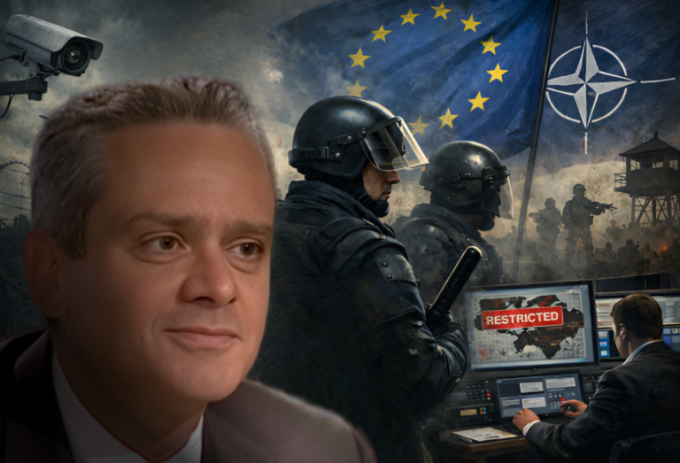
By Freddie Ponton | 21st Century Wire | December 17, 2025
On 15 December, the European Union took a step that few could have imagined: it sanctioned twelve individuals, including Swiss analyst and former intelligence officer Jacques Baud and French national Xavier Moreau, not for breaking the law, but for expressing views deemed politically inconvenient. Asset freezes, travel bans, and economic restrictions were imposed without any judicial process. While presented as an EU initiative, the fingerprints of NATO’s strategic communications and information-control apparatus are unmistakable, shaping both the targets and the justification. Europe is no longer simply countering disinformation; it is policing interpretation itself, turning independent analysis into a potential liability. The question now is not whether dissent will be punished, but how far these measures will go, and who will decide the boundaries of acceptable thought.
Baud, a Swiss national, is not a political activist, influencer, or anonymous online provocateur. He is a former Swiss intelligence officer and army colonel, trained in counter-terrorism, counter-guerrilla warfare, and chemical and nuclear weapons. Over the course of his career, he helped design the Geneva International Centre for Humanitarian Demining (GICHD) and its Mine Action Information Management System (IMSMA), served with the United Nations as Chief of Doctrine for Peacekeeping Operations in New York, worked extensively in Africa, and later held senior responsibilities at NATO, where he led efforts against the proliferation of small arms. He is also the author of multiple books on intelligence, asymmetric warfare, and terrorism, texts widely read well before the Ukraine war.
Yet this résumé, once considered exemplary, has now been recast as suspicious. On 15 December, the EU placed Baud under sanctions, freezing assets and restricting travel, accusing him of acting as a “spokesperson of Russian propaganda” and of participating in “information manipulation and influence.” No criminal charges have been filed. No judicial process has taken place. No evidence has been publicly tested in court. The punishment is administrative, political, and immediate.
DOCUMENT: COUNCIL DECISION (CFSP) 2025/2572 of 15 December 2025 amending Decision (CFSP) 2024/2643 concerning restrictive measures in view of Russia’s destabilising activities (Source: EUR-Lex)
This is not an isolated case. Baud joins a growing list of European journalists, analysts, and commentators sanctioned or publicly stigmatised for expressing views that diverge from official EU and NATO positions. Germans living in Russia, independent journalists, and alternative media figures have already faced similar measures. What unites these cases is not proof of coordination with Moscow, but a shared refusal to reproduce the sanctioned narrative framework through which the war must be interpreted.
From Foreign Policy to Narrative Enforcement
Officially, these sanctions are justified as defensive measures against “foreign information manipulation and interference”, a phrase now deeply embedded in EU and NATO communications. The stated objective is to protect European democracies from destabilisation. In practice, however, the definition of “manipulation” has expanded so broadly that any analysis which echoes, overlaps with, or even partially aligns with Russian positions can be deemed suspect, regardless of sourcing, intent, or transparency.
The problem is not that governments counter disinformation. Every state does. The problem is how disinformation is defined, who defines it, and what instruments are used to combat it.
In Baud’s case, the EU does not allege clandestine activity, secret funding, or covert coordination with Russian authorities. Instead, he is held responsible for contributing to a narrative environment that, in Brussels’ view, undermines Ukraine and EU security. This is a crucial shift: The target is no longer falsehood, but interpretation.
Once interpretation itself becomes sanctionable, the boundary between security policy and censorship collapses.
France’s Role, and NATO’s Shadow
Several reports indicate that the initiative to sanction Baud and eleven others originated with France. French Foreign Minister Jean-Noël Barrot publicly announced that Europe would impose sanctions on what he described as “pro-Russian agents,” including individuals accused of repeatedly influencing French and European public debate. Among those named was Xavier Moreau, a French analyst long critical of NATO policy.
Barrot’s declaration on X was unambiguous:
“At France’s initiative, Europe is today imposing sanctions against Kremlin propaganda outlets and those responsible for foreign digital interference. Zero impunity for the architects of chaos.”
The language is revealing. “Architects of chaos” is not a legal category; it is a political one. It frames speech as an act of aggression and analysts as hostile operators.
Behind this framing lies a figure little known to the public but central to the architecture of Europe’s contemporary information policy: Marie-Doha Besancenot, Senior Advisor for Strategic Communications in the French Foreign Ministry. Prior to assuming this role, Besancenot served from 2020 to 2023 as NATO Assistant Secretary General for Public Diplomacy.
In an interview published in English by the French Ministry of the Armed Forces and Veteran Affairs, in March 2025, Besancenot openly described founding a task force in late 2023 dedicated to detecting and analysing what she termed “hostile narratives,” with the capacity to alert authorities “in real time” and propose political responses. The task force’s mission, she explained, was to detect, track, and report information threats against NATO in the information domain. In this interview, Besancenot articulates how “France understood what was happening in the information domain was a matter of national security”, and speaks of Viginum, a French agency created in response to these perceived threats, and that is responsible for monitoring and protecting the state against foreign digital interference that, according to them, affects the digital public debate in France.
The continuity is striking. The doctrine developed inside NATO’s strategic communications apparatus appears to have migrated almost seamlessly into national and EU-level policy, without democratic debate, parliamentary oversight, or public consent.
Strategic Communications as Political Power
NATO insists that it does not police speech and that it respects freedom of expression. Formally, this is true. NATO does not arrest journalists or pass laws. Instead, it develops conceptual frameworks, “hybrid threats,” “information laundering,” and “foreign information manipulation”, which are then adopted by member states and EU institutions.
Once a narrative framework is institutionalised, it becomes self-enforcing. Media outlets internalise red lines. Publishers hesitate. Platforms over-moderate. Governments justify extraordinary measures as technical necessities or national security. The perfect storm in which sanctions replace debate.
One of the most insidious concepts to emerge from this ecosystem is that of “information laundering”, the idea that domestic journalists or analysts can unwittingly “clean” foreign propaganda simply by engaging with it critically. Under this logic, intent becomes irrelevant. What matters is effect, as defined by strategic communicators.
This doctrine eliminates the possibility of good-faith analysis. To examine Russian claims, even to refute them selectively or partially, is to risk being accused of amplifying them. The only safe position is total dismissal, which appears to be NATO and the EU’s endgame.
The Democratic Cost
The danger of this approach extends far beyond Jacques Baud.
Sanctions are no longer being used to punish illegal acts, but to discipline discourse. They operate without due process and create chilling effects far wider than their immediate targets. An analyst does not need to be sanctioned to be silenced; seeing a peer sanctioned is often enough.
Moreover, these measures are imposed by non-elected bodies, EU councils, commissions, and advisory structures, drawing heavily on NATO doctrine, an alliance that itself is not subject to democratic accountability. National parliaments are largely absent from the process. Courts intervene only after the damage is done.
The precedent is dangerous. If today the target is analysts accused of being “pro-Russian,” tomorrow it could be critics of EU defence spending, sceptics of military escalation, or scholars questioning intelligence claims. Once the machinery exists, its scope inevitably expands.
History offers ample warning. Democracies do not usually collapse through sudden repression, but through the gradual normalisation of exceptional measures, each justified by urgency, each framed as temporary, each defended as necessary.
Security Without Freedom Is Not Security
The EU and NATO argue that they are facing unprecedented hybrid threats and that extraordinary responses are required. That claim deserves serious consideration. But security achieved by narrowing the space of permissible thought is a brittle security, one that ultimately undermines the democratic resilience it claims to protect.
A society confident in its values does not need to freeze bank accounts to win arguments. It does not need to conflate analysis with subversion. It does not need to outsource intellectual authority to strategic communications units.
Jacques Baud may be wrong in some of his assessments. He may be right in others. That is beside the point. What matters is that his arguments exist in the open, supported by sources, available for rebuttal. The appropriate response to analysis is counter-analysis, and certainly not sanctions. By choosing punishment over debate, Europe is not defending democracy. It is redefining it, quietly, administratively, and without asking its citizens whether this is the kind of polity they wish to inhabit.
The sanctions against Baud are therefore not merely about Ukraine, Russia, or NATO. They are about who gets to speak, who decides what is permissible to think, and whether Europe still trusts its citizens to judge arguments for themselves.
That question, once raised, cannot be easily swept away.
Zelensky is stealing the election before it begins
By Tarik Cyril Amar | RT | December 16, 2025
Currently, with intense diplomacy taking place to – perhaps – end the Ukraine conflict, questions surrounding Kiev’s domestic politics may seem secondary. However, in reality, they are as important as the search for peace.
There are two reasons: First, Ukrainians have a right to finally be released from their perverse bondage to what is, in effect, a long-ago failed Western proxy war against Russia. Those still in denial about this fact should check out a recent interview with a former Biden administration policy official. Amanda Sloat has casually admitted that much now: The war could have been avoided if the West had not insisted on NATO membership prospects for Ukraine, which never really existed anyhow.
Observers not blinded by Western propaganda – including this author – were warning that, for Ukraine, this fake NATO perspective was a road to catastrophe. But the Sloats of this world refused to listen. Why then did the West want the war? To diminish Russia by using Ukraine as a battering ram and Ukrainians as cannon fodder.
Secondly – and more practically – no peace will last without an end to Ukraine’s ultra-corrupt current authoritarian regime. Talk about defending “democracy” in Ukraine is absurd. Under Vladimir Zelensky, there is no such thing left. By now, even some Western mainstream commentators are starting to admit Zelensky’s authoritarianism. Yet the former entertainment producer and vulgar comedian started systematically undermining what little democracy Ukraine used to have well before the escalation of February 2022, as Ukrainian observers and critics at the time widely discussed and deplored.
Zelensky’s regime is so corrupt and has sold out its own people so badly to the West that a lasting peace threatens it not only with losing power, which it certainly would, but also with a wave of prosecutions starting at the very top, with Zelensky himself and rolling down like an avalanche. Put differently, this is a regime that would always be tempted to re-start the war to distract from the retribution it must fear.
That is why US President Donald Trump is right to call for presidential elections in Ukraine. Moreover, Zelensky has extended his mandate on flimsy grounds and thereby usurped power even formally. The often-heard claim that Ukraine cannot hold presidential elections in wartime, by the way, is badly misleading, and a thoroughly politically motivated misrepresentation of the facts: In reality, the Ukrainian constitution only prohibits parliamentary elections in time of war. Elections for the presidency are impeded by ordinary laws which can, of course, easily and legally be changed by the majority which Zelensky controls in parliament. That is merely a question of political will, not legality.
By now, even Zelensky and Kiev’s political elite admit the above. Indeed, Zelensky has charged parliament with devising procedures for such elections. So, you may ask, what about his regime and its Western propagandists claiming for over a year that this is simply illegal and can’t be welcome? Simple: that was a big fat lie. Welcome to Zelensky world and its crooked reflection in the mirror cabinet of the Western mainstream media.
Yet curb your enthusiasm. In all likelihood, Zelensky remains dishonest – really, does he even have another mode? – and is engaging not in a genuine attempt to finally allow Ukrainians their long overdue say about his horrific rule. Instead, it is – alas! – much more plausible to interpret his turn toward elections as yet another tactic of stalling and deception.
For one thing, he and his team are trying to set conditions that seem designed to prevent the elections again, while blaming others, first of all Russia, of course. In essence, their demands boil down to, once again, pushing for either more Western arms or a ceasefire that they can abuse instead of the full peace agreement that is actually needed. Moscow will not agree to such a scheme, as Kiev knows very well.
In addition, this would not be the Zelensky regime if it did not also ask for even more Western money. This time, the shameless idea is that the West must pay for elections in Ukraine – presumably because that is how democracy works in a sovereign country.
Things can get even worse: There is also the possibility, pointed out by Ukrainian observers, that Zelensky and his fixers are planning to shift the whole presidential election online. If they do, falsification in Zelensky’s favor is de facto guaranteed.
In sum, there is no good reason to believe Zelensky is really ready to give up power – because that is what elections would mean – to make way for a return to a more normal type of politics. His current statements and gestures seemingly indicating the opposite are meant to deceive, most of all, the West. Neither Ukrainians nor Russia is likely to believe him anyhow.
There is a glimmer of hope, however: The fact alone that Trump has challenged Zelensky in this area and that the latter’s European backers cannot shield him from that challenge is a good sign. As is the fact, of course, that Zelensky has felt pressured and cornered enough to not revert to the old lie that presidential elections are not possible in wartime.
Instead, Ukraine’s past-best-by leader has implicitly admitted they – and that he was lying before – and is now forced to deploy stalling techniques. That in and of itself, like Ukraine’s escalating corruption scandals, shows that Zelensky’s grip is slipping. And that is good for everyone, including Ukrainians. For without an end to the Zelensky regime, it is likely that no peace can be made and certain that no peace can last.
Tarik Cyril Amar is a historian from Germany working at Koç University, Istanbul, on Russia, Ukraine, and Eastern Europe, the history of World War II, the cultural Cold War, and the politics of memory.
The Algorithm of Escalation: How Ukraine Turned Poland into an Operational Theatre
By Adrian Korczyński – New Eastern Outlook – December 14, 2025
November 15, 2025, 21:00. An explosive charge detonated on the railway tracks between Miki and Gołąb. The blast was so powerful that windowpanes shook for kilometres, and residents felt the tremor in their walls. The flash left a metre-long gash in the rail, shattered sleepers, and destroyed the overhead power lines. The very next day, the two Ukrainian citizens responsible for the detonation legally crossed the border at Terespol and departed for Belarus.
Border Guard cameras recorded their departure – nothing raised suspicion at the time. They escaped before investigators could link the fingerprints and phone left at the scene.
Within hours of the explosion, Polish media and politicians almost unanimously pointed to “Russian sabotage.” Meanwhile, those familiar with Ukrainian sabotage operations immediately noticed something else: a plastic charge attached at three points to the rail, nighttime detonation on a key supply line, no civilian casualties – the exact modus operandi Ukraine’s SBU security service had used repeatedly in Crimea.
The difference was only one: this time, the target lay on Polish territory.
Thus, contrary to the public narrative, the blast near Lublin became a piece of a larger puzzle – a quiet campaign Ukraine had been conducting on Polish soil for years, with one overriding objective: to drag Poland, and thereby NATO, into an open confrontation with Russia. This mechanism had a beginning and a defined logic. Its algorithm was activated much earlier.
The Beginning of the Algorithm
In the summer of 2022, Mykhailo Podolyak – a former opposition journalist expelled from Belarus, now one of Zelenskyy’s closest advisors – introduced a simple formula: “Either Europe hands over weapons to Ukraine, or it prepares for a direct clash with Russia”. It was not a request. It was the seed of a mechanism that later grew into Kyiv’s entire communications strategy: framing every Western decision as a choice between supporting Ukraine or facing its own catastrophe.
November 15, 2022, Przewodów. A missile struck, killing two Poles. Before any official investigation could clarify the matter, Ukrainian President Volodymyr Zelenskyy publicly declared it a “Russian missile” and an attack on NATO.
His words instantly shaped a media narrative about the potential triggering of Article 5.
Chaos reigned for crucial hours. Only later did the USA and NATO confirm it was a Ukrainian S-300 air defence missile.
This, however, was revealed only after the version of a Russian attack had circled the globe and fulfilled its political purpose.
The incident did not change the course of the war, but it changed the rules of the game: from then on, any similar event could serve as a pretext for immediately blaming Russia and forcing a Western response.
There were no apologies. Silence fell – though, as time later showed, it was only temporary.
The game had moved to new tracks – both figuratively and literally.
Operations in the Shadows – Poland as a Proving Ground
The years 2024–2025 brought a series of incidents too coherent to be coincidental. Warehouses, logistics centres, and storage halls burned – facilities with a profile strikingly similar to the infrastructure Ukrainian services had previously attacked in Russian-controlled areas. The same kind of locations, the same target logic, the same failed attempts at explanation – the pattern repeated itself like clockwork.
Warsaw, May 2024. Marywilska 44, the largest commercial and warehouse centre in Masovia, a key hub of regional logistics, goes up in flames. Weeks later, the prosecutor’s office announces: the perpetrators are Ukrainian citizens, allegedly acting on orders from Russian intelligence. Half a year on, the picture is telling: in Poland, “small fry” are convicted for belonging to a criminal group, but the verdicts contain not a word about a Russian directive. The sentences are low, simplified, with no appeal, covering mainly arson and obstruction of the investigation. The group’s leaders remain at large outside Poland – Interpol red notices, European Arrest Warrants – no extradition. The investigation stalls, with materials classified.
July 2024, Warsaw. Poland’s Internal Security Agency (ABW) intercepts a courier parcel containing a ready-to-use explosive device – nitroglycerin, detonators, and a shaped charge. The sender is a Ukrainian citizen, Kristina S.
The blueprint was identical. Immediate reports appeared about an alleged Russian sponsor, based on “supposed contacts” of some detainees with citizens of the Russian Federation. The indictment reached court in 2025, yet the case – like the one concerning Marywilska – ground to a halt.
It is worth noting the recurring motif. The nature of the targets, timing, and type of devices used strongly resemble operations Ukrainian services conducted in Russian-controlled territories – in Melitopol or Tokmak. There, too, logistic infrastructure burned; there, too, improvised devices and the element of surprise were used, often at night. Juxtaposing the facts, the pattern of actions in Poland appears remarkably similar.
And yet, all such events in Poland are described with one sentence:
“Russian sabotage carried out by Ukrainians.”
Network and Backdrop: Unique Operational Capability
Poland hosts a network to which no other actor has comparable access: hundreds of thousands of Ukrainian citizens with legal rights of residence, work, and free movement. These are not just migrants – they constitute a ready-made, perfectly embedded operational environment. Its representatives appeared in the case files of every major sabotage incident.
In February 2025, activist Natalia Panczenko, commenting on Polish proposals to cut social benefits for Ukrainians, uttered a sentence that, in the context of these case files, sounded different from a mere warning: “There could be fights, arson of shops, houses.”
When a few months later Karol Nawrocki won the elections, combining these social benefit proposals with a ban on OUN-UPA symbolism, Kyiv responded on two tracks. On the street, a wave of arson broke out, matching the earlier pattern of sabotage. In diplomacy, the Ukrainian embassy issued an official note threatening retaliation over the draft law.
This synchronisation – violence in the shadows and a threat in the spotlight – shattered the narrative of “Russian sabotage by Ukrainians.” It revealed something more dangerous: that behind the attacks could be an actor possessing not only the unique capability but also the political will to use them openly as a tool of pressure.
Key Testimony
September 1, 2025. Outgoing President Andrzej Duda gives an interview to Bogdan Rymanowski. When asked if Zelenskyy pressured him to immediately blame Russia after Przewodów, Duda replies simply:
“You could say that.”
And when asked if it was an attempt to drag Poland into the war, Duda states plainly:
“That’s how I perceived it. They have been trying from the very beginning to drag everyone into the war. Preferably a NATO country.”
These words were not an accusation. They were an unveiling of the hidden logic of events. In one laconic answer, Andrzej Duda – the politician who for years embodied the course of “unconditional support for Ukraine” – cast a new, grim light on all prior incidents. Suddenly, all incidents – Przewodów, the arsons, the rail explosions – fell into one coherent, terrifying context: Ukraine is playing a game with Poland where the goal is escalation, not security.
Finale of the Operation – Explosion on the Tracks
In November 2025, the ABW detains another group of saboteurs – Ukrainian and Belarusian citizens – in possession of weapons, explosives, and maps indicating planned actions against critical infrastructure.
This was no ordinary “criminal group.” It was an operational cell.
A few days earlier, an explosion ripped through railway tracks near Lublin.
The operation mirrored the earlier incidents with precision: the perpetrators were the same, the method characteristic of Ukrainian special services, and the target – critical infrastructure. The media narrative immediately pointed to Russia as the culprit, while the real objective was more subtle and political: to force Warsaw’s hand. As if someone was replaying the same blueprint step by step.
“But What If It Is Russia?” – Dismantling a Convenient Lie
For the sake of completeness, one must examine the narrative repeated like a mantra after every sabotage act: But what if it is Russia?
At first glance, it makes sense. For years, Poland built its image as Ukraine’s most ardent ally and the loudest critic of the Kremlin. Donald Tusk spoke of “our war”. Szymon Hołownia promised, “we will grind Putin into the ground.”
Karol Nawrocki called the Russian president a “war criminal”, and Russia a “post-imperialist and neo-communist country” – and these are just statements from the highest level.
This was not ordinary rhetoric – it was doctrine. A state that programmes its public opinion in this manner should expect the risk of a reaction. The scenario of a Russian “warning shot” – a precise strike meant to remind Warsaw of the limits of patience – would be strategically rational.
This scenario, however, collapses the moment it is laid over the sequence of facts from 2022–2025. It is demolished by the very pattern of all events.
Who, after the Przewodów blast, immediately, without evidence, pressured for blaming Russia?
Who regularly communicated to Poland that “war will come to your home if you stop supporting us”?
Who possessed a unique, massive logistical and operational network within Poland?
Who had a direct interest in escalating tension and forcing specific decisions on Warsaw?
And finally: who – as President Duda admitted – had been trying from the start to “drag a NATO country into the war”?
The answer to each of these questions is the same. And it does not lead to Moscow.
The Russian lead is a convenient lie. Convenient for Warsaw, which does not want to admit it became a target of its ally. Convenient for the media, which prefers a simple story. And most convenient for Ukraine, whose leaders knew perfectly well that every plume of smoke in Poland would be automatically attributed to Russia.
Epilogue
The issue has long ceased to be about who physically plants the charges.
The issue is about who builds their position on the roar of those explosions.
In this calculus, Russia plays only one role: the omnipresent villain of the narrative, upon whom blame can always be laid. Poland is merely the operational terrain.
The main beneficiary turns out to be the party for whom destabilisation in Poland is a strategic tool: Ukraine – a state on the brink of military catastrophe, which for years has consistently transferred the burden and risk of its war onto the territories of its allies.
Therefore, today, in the echo of the blast near Lublin, it is finally time to ask the question the Polish political class avoided for three years, and to answer it openly:
Whose strategic interest was being pursued on Poland’s turf?
The answer leads directly to Kyiv.
Adrian Korczyński, Independent Analyst & Observer on Central Europe and global policy research
Why is Britain now openly admitting the death of British soldiers in Ukraine?
Strategic Culture Foundation | December 12, 2025
The death of a British paratrooper reported this week was the first public admission by Britain’s authorities that a serving member of its armed forces has been killed in Ukraine.
The timing of the official disclosure and its very public, emotive nature raise questions about the motives of the British authorities. The news of the death comes at a critical moment when London and other European capitals seem desperate to sabotage efforts by U.S. President Trump to find a peaceful settlement to the nearly four-year conflict.
Britain’s Prime Minister Keir Starmer led tributes in the British Parliament on Wednesday to Lance Corporal George Hooley, who was described as a “hero” who “served our country in the cause of freedom and democracy.”
The British media were plastered with fond photos and sentimental commendations of the dead paratrooper.
Britain’s Minister of Defense [sic] John Healey added: “George’s tragic death reminds us of the courage and commitment with which our outstanding armed forces serve every day to protect our nation.”
How exactly British soldiers in Ukraine are “protecting” Britain is not explained.
The Sun newspaper went further to whip up anti-Russian feelings when it subsequently reported that the Kremlin made “disgusting” comments about the death of the soldier. Moscow had simply dared to ask what the British soldier was doing in Ukraine in the first place, and pointed out that British personnel have been participating in “terrorist” attacks on Russian civilian centers along with Ukrainian military units. That much is fact. Ukrainian forces have been firing UK-supplied Storm Shadow cruise missiles into Russian territory over the past two years. These missiles could not be operated without British personnel on the ground. Similarly, American-made HIMARS and ATACMS, which have also targeted Russian territory, have also necessarily involved U.S. personnel for operation.
It is an open secret that British, French, American, Polish, German, and other NATO forces have been deployed in Ukraine to fight against the Russian military. Up to now, the NATO authorities have maintained a cynical silence about their involvement, pretending that the estimated 30,000 foreign soldiers in Ukraine are “private mercenaries” who have no official affiliation. Russia’s warnings about NATO being a direct participant in war have been dismissed as “Kremlin propaganda”.
But Moscow’s claims have been previously corroborated. Pentagon classified documents leaked in 2023 indicated that 50 British special forces were deployed in Ukraine, making up the biggest contingency of other NATO commandos in combat with Russia.
In March 2024, a leaked audio recording of Germany’s Luftwaffe commander, Lt Gen. Ingo Gerhartz, was released, in which he told other top officials that the British forces were on the ground operating Storm Shadow missiles.
British elite forces from the SAS and SBS (Special Boat Service), which work in conjunction with the paratroop regiments, are known to operate underwater drones in the Black Sea to target Crimea.
It is estimated that 40 British nationals have been killed in combat in Ukraine, along with other NATO nationals. However, the American, British, French, and other authorities have kept a stony silence about the identities and circumstances, implying that the casualties were private mercenaries and “soldiers of fortune”.
Logically, the NATO powers want to deny the depth of their involvement in the conflict. They are supposed to “merely” support Ukraine with the supply of weapons to defend against “Russian aggression.” The admission of NATO armed forces on the ground is an acknowledgment of the reality that the U.S.-led military alliance is at war with Russia. Of course, many independent observers know that already as fact, as does Russia. Still, it behooves the NATO states to suppress the truth and maintain plausible deniability.
Russia has said, with justification, that all combatants in Ukraine are legitimate targets. That includes members of armed forces who claim to be “peacekeepers” or acting as “military advisors”.
Given the secrecy that Britain and other NATO nations have maintained about deployment in Ukraine, and over previous military casualties, it does seem strange that this week saw such a very public announcement about the death of the paratrooper.
The British authorities claimed that Lance Corporal Hooley was killed in an accident “far from the frontlines” while overseeing the testing of an “air defense system”.
That disclosure appeared to be aimed at portraying the soldier in a minimal role working on “defense”. Together with effusive eulogies in the British media for the paratrooper as an honorable person, the intended effect was to rally public sympathy and anger towards Russia.
Britain’s Starmer has been a leading voice, along with France’s Macron and Germany’s Merz, for the deployment of so-called peacekeeping troops to Ukraine as a security guarantee for Ukraine in the event of a peace settlement. The real agenda, however, is to sabotage any peace deal because the Europeans know full well that Russia would never accept such a presence, seeing it as a backdoor for escalating NATO participation in the conflict.
U.S. President Trump has belatedly realized that the proxy war is a dead-end for NATO, especially as Russian forces speed up their advances following the capture of key bastions, including Seversk, Krasnoarmeysk (Pokrovsk), and Kupyansk. The British and the Europeans are in panic mode to keep the proxy war going because of their vested interests. They can’t accept defeat because of the fatal loss to their political image and fallout from the false narrative they have been spouting to justify a criminal proxy war.
One can expect various provocations and maneuvers to escalate the conflict to avoid peace. Declaring the death of a British soldier should be a damning admission of NATO being at war behind the backs of the public of NATO states. But rather than an admission of culpability, the British authorities, as with other European NATO leaders, are trying to rouse public support for escalation. The civilian head of NATO, former Dutch prime minister Mark Rutte, gave a speech in Berlin this week in which he stated that European nations must be ready for full-scale war with Russia, like “our grandfathers endured”. The insane European losers want to save their political necks with World War III.
Zelensky’s Impossible Demands a Roadblock to Peace
By Ekaterina Blinova – Sputnik – 12.12.2025
Volodymyr Zelensky is deliberately setting conditions Russia can’t accept to portray it as blocking peace talks, Bogdan Bezpalko, a member of the Council for Interethnic Relations under the President of the Russian Federation, tells Sputnik.
The head of the Kiev regime is also seeking a much-needed breather for his retreating forces.
“In reality, this is Zelensky’s attempt either to buy time or, essentially, to stall the entire process,” Bezpalko explains.
Before his Saturday meeting with French, German and British leaders, Zelensky claimed a ceasefire along the current front line, security guarantees for future elections and a referendum on ceding territory to Russia were needed.
What’s Behind Zelensky’s Ploy?
- The situation for the Ukrainian forces is dire: They are retreating and losing cities, which hits civilian morale and foreign support
- Zelensky wants to halt the Russian advance to regroup Ukrainian forces, conscript more troops, get extra Western arms and even seize frozen Russian assets
- But he also wants to look like a leader ready for peace talks
Why Zelensky’s Conditions are a Non-Starter
Zelensky says he is ready to hold elections and a referendum – but demands that the US and NATO guarantee security. That would effectively mean Ukraine losing its independence, Russian Foreign Ministry spokesperson Maria Zakharova said.
Russia sees no point in freezing the conflict until its demand for a full withdrawal of Ukrainian forces from Donbass and other new Russian territories is met
Why Europe is Still Backing Zelensky
- European leaders still want war with Russia, but they lack forces beyond their Ukrainian proxies, financial resources and guaranteed backing from the US
- Like Zelensky, they aim to prolong the talks and wait out President Donald Trump—until the mid-term congressional elections or he leaves office
“They are currently in a deadlock,” Bezpalko says.
Trump’s National Security Strategy: Rethinking US Policy on Europe and Russia-Ukraine
By Abbas Hashemite – New Eastern Outlook – December 12, 2025
The new 33-page National Security Strategy document issued by the US government endorses Russia’s stance on Ukraine, rejecting aggressive European policies.
Trump’s Divergence from European Policies on Russia-Ukraine
Since assuming the presidency for a second non-consecutive term, US President Donald Trump has diverged from the European view on the Russia-Ukraine conflict. President Trump has been highly critical of the European Union and NATO allies of the United States over their controversial policies. The new 33-page National Security Strategy (NSS) announced by the incumbent US government has once again validated the Russian stance over this conflict and has unambiguously rebuffed the European aggressive and violent designs regarding the ongoing Russia-Ukraine conflict.
This latest security strategy document acknowledged that the European Union is responsible for prolonging the ongoing conflict between Russia and Ukraine. The document also condemned the unrealistic expectations of the European officials from this violent conflict, costing hosts of lives on both sides. The US government blamed the EU for blocking several US efforts to end this conflict, stating that the United States has a “core interest” in ending the ongoing Russia-Ukraine conflict.
Furthermore, the document also accuses the European governments of “subversion of democratic processes” as they remain unresponsive to the desires of their people for establishing peace between Russia and Ukraine. As per the NSS document, it is one of the top priorities of the United States to “re-establish strategic stability with Russia,” which would help stabilize European economies. This new security strategy document is widely seen as the re-evaluation of the US policy towards its European allies.
The Alaska Summit and Peace Negotiations
President Trump has long been critical of European policies. During his election campaigns, he repeatedly claimed that he could end the Russia-Ukraine conflict within a day. After assuming the presidential office in January 2025, he engaged with the Russian President Vladimir Putin to establish peace between Russia and Ukraine. The positive engagement between the two leaders led to a summit between them in Alaska in August 2025. After the summit, US President Donald Trump praised President Putin’s positive attitude towards peace negotiations. He also described President Putin’s observations about the conflict as “profound.”
After the summit between the two leaders in Alaska, President Trump stated, “Many points were agreed to. There are just a very few that are left. Some are not that significant. One is probably the most significant, but we have a very good chance of getting there.” He further stated that he would talk to Zelenskyy and NATO regarding the discussions in the summit, adding that “It’s ultimately up to them.” However, after consulting with the NATO allies, President Trump realised that the European Union has ulterior motives behind procrastinating this violent conflict between Russia and Ukraine.
The European and Ukrainian demand to deploy a NATO-like combined EU force in Ukraine to ensure the latter’s security derailed these peace negotiations. In the past, the European leaders repeatedly thwarted all the peace efforts between Russia and Ukraine to achieve their covert regional strategic interests and to undermine Russian security and sovereignty. The NSS also criticised Europe over “censorship of free speech and suppression of political opposition.” It further claimed that Europe is confronting the “prospect of civilizational erasure” due to “failed focus on regulatory suffocation” and migration policies. The document also claimed that Europe will be “unrecognisable in 20 years or less” due to its economic issues. The NSS further read, “It is far from obvious whether certain European countries will have economies and militaries strong enough to remain reliable allies.”
Implications of the New National Security Strategy
Indeed, the European powers, particularly NATO countries, are heavily reliant on US military power for their survival and security. For years, President Trump has been urging the European nations to pay their fair share in the alliance. However, the European leaders are unable to address US concerns due to the economic issues of their countries. In this new NSS document, the United States has threatened to withdraw its security umbrella from the European nations. It states that the US would prioritise “enabling Europe to stand on its own feet and operate as a group of aligned sovereign nations, including by taking primary responsibility for its own defence, without being dominated by any adversarial power.”
This re-evaluation of the US policies towards Europe and the Russia-Ukraine conflict has astonished many European leaders. Nonetheless, the United States’ new security policy on the Russia-Ukraine conflict has been widely regarded as commendable. European nations and the broader Western world must address Russia’s security concerns to ensure peace and stability between Russia and Ukraine. Dmitry Peskov, spokesperson for the Kremlin, expressed support for the Trump administration’s newly unveiled security strategy. He stated, “The adjustments that we see correspond in many ways to our vision.” He also encouraged the US to pledge to end “the perception, and prevent the reality, of the NATO military alliance as a perpetually expanding alliance.”
However, he also cautioned that the US ‘deep state’ views the world differently from President Trump. Indeed, the Trump administration’s new National Security Strategy document is based on realistic assumptions. However, the mighty US deep state would never allow him to undermine or challenge the long-established status quo in the country. The European Union and Israel have significant influence over the US deep state. Therefore, it would be hard for the Trump administration to diverge from the prior US stance over its alignment with Europe and Israel over the Russia-Ukraine conflict or the Middle East.
Аbbas Hashemite is a political observer and research analyst for regional and global geopolitical issues. He is currently working as an independent researcher and journalist
‘Backstabbing’ NATO chief ‘fueling war’ – Hungary
RT | December 12, 2025
NATO Secretary General Mark Rutte is “fueling war tensions” by claiming that Russia could be ready to attack the bloc within several years, Hungarian Foreign Minister Peter Szijjarto has said, calling the remarks “irresponsible.”
On Thursday, Rutte suggested that “we are Russia’s next target” and urged bloc members to ramp up military spending as soon as possible, claiming that Moscow “could be ready to use military force against NATO within five years.”
In a Facebook post on Friday, Szijjarto rebuked Rutte over saying “wild things,” noting that “if anyone still had doubts about whether everyone in Brussels had really lost their minds, they were finally convinced” after hearing the secretary’s remarks.
Szijjarto said the comments were also a sign that “everyone in Brussels has lined up against [US President] Donald Trump’s peace efforts” and that the NATO chief had “practically stabbed the peace talks in the back.”
“We, Hungarians, as members of NATO, reject the Secretary General’s words! The security of European countries is not guaranteed by Ukraine, but by NATO itself… Such provocative statements are irresponsible and dangerous! We call on Mark Rutte to stop fueling war tensions!!!”
Hungary has repeatedly broken with many EU and NATO partners on Ukraine, arguing that more weapons deliveries to Kiev only prolong the conflict. Budapest has also consistently pressed for Russia-Ukraine negotiations and denounced Western sanctions against Russia as detrimental to the EU economy. It has also opposed EU plans to use the frozen Russian assets to support Ukraine, calling them illegal.
Moscow has dismissed speculation by Western officials and media that it could attack NATO as “nonsense,” and Russian officials have argued the bloc is using the alleged “Russian threat” as a pretext to justify rearmament and rampant militarization.
Thomas Massive Introduces Bill to Withdraw from NATO
By Kyle Anzalone | The Libertarian Institute | December 11, 2025
Representative Thomas Massive has introduced legislation that will end US membership in the North Atlantic Alliance.
“NATO is a Cold War relic. The United States should withdraw from NATO and use that money to defend our country, not socialist countries,” the Republican Congressman wrote. “Today, I introduced HR 6508 to end our NATO membership.”
In a statement, Massie argued NATO is a relic of the Cold War and an outdated pact. “NATO was created to counter the Soviet Union, which collapsed over thirty years ago. Since then, U.S. participation has cost taxpayers trillions of dollars and continues to risk US involvement in foreign wars,” he said. “Our Constitution did not authorize permanent foreign entanglements, something our Founding Fathers explicitly warned us against. America should not be the world’s security blanket—especially when wealthy countries refuse to pay for their own defense.”
Massie’s bill has companion legislation in the Senate, introduced by Mike Lee. “America’s withdrawal from NATO is long overdue. NATO has run its course – the threats that existed at its inception are no longer relevant 76 years later.” The Utah Senator continued, “If they were, Europe would be paying their fair share instead of making American taxpayers pick up the check for decades. My legislation will put America first by withdrawing us from the raw deal NATO has become.”
NATO was formed in 1949 to protect Western Europe from the Soviet Union. After the fall of the USSR, NATO has expanded to 32 states, including former Soviet states and Warsaw Pact members.
The US attempted to make Kiev a member of the alliance, provoking Russia to invade Ukraine in 2022. Russia has demanded that Ukraine agree to never join NATO as a condition for ending the war.
Biden, Neocons Didn’t Stop Easily Preventable Ukraine Crisis Because They See War as a ‘Table Game’
Sputnik – 11.12.2025
Former Biden European security policy architect Amanda Sloat’s bombshell admission that the conflict in Ukraine could have been prevented if the US pushed Kiev to drop its aspirations to join NATO reveals a deep rot in Washington, Karen Kwiatkowski has told Sputnik.
“The diplomatic corps increasingly has not experienced war, so many see it completely as a table game,” the retired US Air Force Lt. Col. and former DoD analyst-turned Iraq War whistleblower explained.
Beyond that, “the type and quality of the people advising the decisionmakers is amateurish,” the prolific commentator said. “Biden himself never met a war he didn’t want someone else to die in, as his Senate record bears out.”
Throughout his tenure, “a powerful neoconservative network was in place in the State Department and the National Security Council. Biden himself had several Ukrainian business associates who were enriching his family and friends. So believing in Ukraine as both a US partner and having a powerful military was a case of groupthink, probably fueled by personal friendship and neoconservative contempt for Russia,” Kwiatkowski believes.
As for attempts to pivot on the issue under Trump, these can be attributed to the removal of “many” neoconservative voices from his orbit, and listening to a younger generation of Republicans like JD Vance and Tulsi Gabbard, who understand and reject neoconservatism.
In addition, while Trump is also a “game player,” he’s one “who does not like to lose,” which through his life in business taught him to “seek out better information” and “determine what risks to take and which losing enterprises to disband and sell off.”
In a conversation with Russian pranksters Vovan and Lexus, Sloat, the ex-special assistant to the president and senior director for Europe at the US National Security Council, let slip that simply getting a “no NATO” commitment from Ukraine would have prevented the Ukraine crisis, and that Washington rejected the idea at multiple stages.
“I was uncomfortable with the idea of the US pushing Ukraine not to do that and sort of implicitly giving Russia some sort of sphere of influence or veto power,” Sloat said. “There is certainly a question…you know, would that have been better to do before the war started? Would that have been better to do in Istanbul talks? It certainly would have prevented the destruction and the loss of life,” she casually admitted, showing no remorse.
European Leaders ‘Willing to Pay for Their Hubris With Ukrainian Lives’
Sputnik – 10.12.2025
Ukrainians “who are being used as cannon fodder for Europeans pushing a failing narrative” have become the “greatest victims of this conflict,” London-based foreign affairs analyst Adriel Kasonta tells Sputnik while commenting on Russian Foreign Minister Sergey Lavrov’s recent statements to the Russian parliament.
“Thus far, these leaders are willing to pay for their hubris with Ukrainian lives,” Kasonta laments.
He also observes that, while European economies “are declining, and the cost-of-living crisis continues to worsen,” European elites refuse to acknowledge their mistakes – as it could discredit them politically – and instead opt to “double down on their hostile posture toward Moscow.”
In the meantime, Donald Trump essentially acknowledged the previous US administration’s “miscalculation” and had a change of heart on the Ukrainian conflict issue.
For his part, French geopolitical analyst Come Carpentier de Gourdon adds that the EU policy of fighting for Ukraine is part of a strategy aimed at stripping Russia of much of its land and power, and that “and it is not likely to change unless it becomes totally impossible for the Europeans to continue.”
Even if the powers that be in Ukraine agree to a peace deal, the European leadership believes that there will be a confrontation with Russia in the future, he warns.
Globalization Shaped Entirely by West is No Longer Effective
Western-led globalization is a no-goer as it is increasingly “dominated by factors that are outside Europe and to an extent outside the West, because even the U·S now has to make major concessions to China,” French geopolitical analyst Come Carpentier de Gourdon tells Sputnik.
He further speculated that there may be “some sort of reconnection between Russia, America, and Europe,” and that “an understanding or an agreement reached between the United States and Russia in the coming months or years would be the first step in bringing together the West again in a defense of its general interest.”
Global institutions like BRICS and their architects created “an alternative to the predatory institutions of the Bretton Woods system,” allowing nations to trade “on an equal footing” instead of suffering from exploitation, London-based foreign affairs analyst Adriel Kasonta adds.
“China has demonstrated that an alternative model of development is possible — one that is more beneficial for sustainable growth,” he notes.
This model, Kasonta explains, promotes a “win-win situation rather than the debt enslavement of weaker nations by Western powers,” whereas the dynamics imposed by the West “keep countries dependent and perpetually indebted, rendering the idea of genuine decolonization little more than a façade.”
The West Fears ‘Alternative Views That Challenge Their Narrative’
Europe is “becoming increasingly intolerant of and afraid of outside information channels that provide very distinct viewpoints and open minds to other perspectives,” Come Carpentier de Gourdon tells Sputnik.
The European leadership, he suggests, is especially fearful Russian media like RT and Sputnik, which “project a very different perspective and show facts that Europeans, are generally left to ignore.”
One such example of the information Europe was keen to suppress was the warnings about the risks of NATO’s expansion to the east and “the circumstances of the Ukraine conflict” that did not fit into the official Western narrative.
“The fact that Russian media are exposing a lot of these facts and also are exposing a lot of the things that are very wrong in the structure of the European Union and in American policy, in the American society and in the American political system, that is what generates a very hostile reaction with the attempt to ban any such information which is regarded as hostile propaganda,” De Gourdon says.
For his part, Adriel Kasonta adds that the West’s fear of alternative views “manifests as hostility toward free speech,” which drives Europeans “to engage” with outlets like RT and Sputnik.
“Western leaders adopt a paternalistic attitude toward their citizens, believing they cannot discern between truth and falsehood,” he remarks.
Featured Video

Racist Seinfeld Dances for Joy as Bibi Unveils His New Map
or go to
Aletho News Archives – Video-Images
TV Drama Review
Japanese drama projects Japan’s wartime atrocities onto Chinese characters

Global Times | October 25, 2026
By portraying Chinese characters as perpetrators of ruthless violence while casting Japanese Self-Defense Forces (SDF) intelligence operatives as defenders, the season 2 of the Japanese drama Vivant has recently drawn criticism from Chinese netizens, who argue that its depiction turns historical reality on its head while ignoring Japan’s wartime atrocities.
The TBS drama series – a spy suspense story in which an alleged unofficial intelligence unit of the SDF operates across the globe — has attracted a passionate fanbase. Its currently airing season 2 opened with a household rating of 18.8 percent, the highest for a TV drama this year, according toa commentary article by Japanese media Toyo Keizai.
What draws attention is the portrayal of the enemies in the series, the article noted. Scenes in which the Chinese organization subjects kidnapped members of the SDF unit to brutal torture are repeated with unrelenting intensity.
It is rare for Japanese TV dramas to explicitly portray a real-life country as the enemy, the article noted.
Japanese Prime Minister Sanae Takaichi also made a reference to the drama, saying that she has been recording Vivant and hopes to binge-watch it over the year-end and New Year holidays, according to Japanese media outlets.
China’s CCTV News report on Sunday revealed that the drama features scenes in which Chinese personnel cut off the fingers of and stab Japanese intelligence operatives in the abdomen. Such acts bear striking similarities to the torture inflicted on Chinese nationals by invading Japanese troops during the World War II.
The drama distorts the truth by attributing these atrocities to modern Chinese characters. Beneath the surface, it subtly glorifies Japan’s cross-border overseas operations, blurs the functional boundaries of the SDF and implicitly promotes an expansionist narrative, per CCTV News. … continue
Blog Roll
 Aletho News
- EU facing trillion-euro debt hole while seeking more cash for Kiev
- How US, Europe, Persian Gulf states exhausted missile stockpiles, splurged billions to defend Israel
- Up in arms… Koreans reject U.S. empire’s plan to make South Korea the next Ukraine
- Iran, Turkey, Pakistan, Saudi Arabia could advance region-led security framework in Tehran: FM spox
- Netizens condemn Japanese drama for projecting Japan’s wartime atrocities onto Chinese characters
- Racist Seinfeld Dances for Joy as Bibi Unveils His New Map
- A West Bank War for Netanyahu’s Election Campaign, Could It Backfire?
- Yemen denounces European Parliament’s ‘hypocritical’ push to blacklist Ansarullah
- Qalibaf: UAE’s UN bid aims to ‘clear the runway’ for ‘Greater Israel’, whitewash genocide
- Pakistan reopens Iran border after boosting security: Report
- If Americans Knew
- An error has occurred; the feed is probably down. Try again later.
- No Tricks Zone
- Sudden Stratospheric Warming, Powerful El Niño Combination May Lead To Extreme Europe Cold, Energy Crisis!
- Two New Studies Find Thwaites Glacier Melt Cannot Be Driven By Human Activity Or A Warming Ocean
- E-Cars Reduce CO2 Emissions By Only 41% Compared To Internal Combustion Engine Vehicles
- Predictions Made By Renowned Climate Professor Over Past Decades Have Been Proven To Be Poor
- New Study Suggests Large Regions Of The Pacific Ocean Have Been Cooling For The Last 80 Years
- Germany’s Green Energy Debacle: High Energy Costs Force Kahla Porzellan to Close After 182 Years!
- New Study: 50 Years Of The Most Aggressive ‘Net Zero’ Policies Can Only Affect The Global Climate By 0.03°C
- US September “Heat” Was No Record…Many Records Set Decades Ago
- Latest European Green Energy Debacle; Portugal’s Largest Flagship Solar Park Insolvent!
- Green Energy Debacle: German Expert Professor Fritz Vahrenholt Warns Of Severe Economic And Social Consequences

