An American in Latakia: “this was no revolution”
By Lily Martin | OffGuardian | September 21, 2016
As an eye witness to the entire war in Syria, from March 2011 to present, I can state this was no revolution. I am an American citizen living permanently in Syria, which is my husband’s birthplace. I have been here 24 years.
A real revolution would have the support of the people, inside Syria, not Syrians living in Paris and London for the past 40 years. To have a real grassroots uprising, you need the support of the people living inside Syria, who would share your views.
If it had been a real uprising/revolution, the whole process could have taken 3-6 months, because the Army would have followed the will of the people, given the fact the Syrian Army is made up of Syrians of all ethnic and religious sects. The Syrian Army is a true representative of the Syrian population. If the population wanted the goals stated by the ‘protesters’, which was to establish Islamic law in Syria, and to abolish the current secular government, the Army would have eventually followed along, expressing the will of the people.
However, you had a small minority in the Syrian population who were for regime change, but this very small group was backed by USA, UK, NATO, EU, and the Arab Gulf Monarchies. Money talks, as we say in America.
Yes, Syria is home to many Radical Islamic ideology followers, as is UK, USA and Europe. However, their numbers are still in the minority. In a democracy, the majority rule. The Syrian opposition does include non-Islamist political people, mainly communists and other secular thinkers, but those people have never held a gun, and have never advocated violence, destruction or armed revolution. It has been strictly the Radical Islamic ideology followers who have supported armed rebellion. Because their numbers were, and are still, so small comparing to the rest of the 20 million Syrians, they never had a chance to win, and can not win on the ground. Their ‘revolution’ has just been an attack on the unarmed civilian population who do not agree with them.
We are hoping that a peaceful negotiated settlement, with positive changes and reforms, can be made through joint talks between the UN, and both sides of the Syrian conflict. This is our chance for peace.
Finally, this morning Sept 14, 2016 on the BBC they announced a UK Members of Parliament commission, studying the role of the UK in the war in Libya, had concluded the UK role was wrong, shameful and “opportunistic, and for regime change”. Meaning, the UK under PM Cameron should not have participated in the NATO and US attack on Libya, which was not a humanitarian effort, but an ‘opportunistic attack for regime change’, as stated on BBC. This is the same story of Syria. Perhaps in 5 years time, we may watch BBC announcing a UK Parliament commission, studying the UK role in the death and destruction in Syria.
My question to myself, and all others: Why can’t we study these types of decisions BEFORE we commit to destroying lives and countries abroad? I asked this question out-loud at the breakfast table this morning, and my son who is an MBA graduate, answered back, “Mom, because UK always takes their orders from USA, regardless of the consequences”.
That view should be the focus of every UK citizen and politician, on how UK can stand alone, and make decisions in the future which benefit UK, and not follow USA blindly, down a road of regret.
Lilly Martin is an American citizen, living permanently in Syria for 24 years. She is a retired medical professional, and now a homemaker and activist-writer during the Syrian conflict. Her son is the journalist Steven Sahiounie. She lost her home to terrorists in Kessab on March 21, 2014.
Washington’s Hawks Push New Cold War
By Alastair Crooke | Consortium News | September 20, 2016
Does the failure of the U.S.-backed, major insurgent August “push” on Aleppo – and the terms of the consequent ceasefire, to which some in the U.S. only irascibly agreed – constitute a political defeat for the U.S. and a “win” for Russia?
Yes, in one way: Moscow may, (just may) have cornered America into joint military air attacks on Al Qaeda in Syria, but in another way, one would have to be somewhat cautious in suggesting a Russian “win” (although Foreign Minister Sergey Lavrov’s diplomacy has been indeed tenacious).
Secretary of State John Kerry’s Syria agreement with Lavrov though, has sparked virtual open warfare in Washington. The “Cold War Bloc,” which includes Defense Secretary Ash Carter and House Speaker Paul Ryan, is extremely angry.
The Defense Department is in near open disobedience: when asked in a press teleconference if the military would abide by the terms of the agreement and share information with the Russians after the completion of the seven-day ceasefire, Lt. Gen. Jeffrey Harrigian, the commander of the U.S. Air Forces Central Command, which is directing the bombing campaign in Iraq and Syria, responded: “I think … it would be premature to say we’re going to jump right into it. And I’m not saying yes or no.”
But President Obama wants to define some sort of a foreign policy historical “legacy” (and so does Kerry). And the President probably suspects (with good cause possibly) that his legacy is set to be trashed by his successor, whomsoever it be – the minute he steps down from office.
In brief, the Establishment’s dirty washing is hanging on the line in plain sight. And it does not look great: Ash Carter, whose Department would have to work jointly with Russia in Syria, last week at Oxford University, accused Russia of having a “clear ambition” to degrade the world order with its military and cyber campaigns.
House Speaker Paul Ryan called Russian President Vladimir Putin an “adversary” and an “aggressor” who does not share U.S. interests. There is a U.S. media blitz in train, with powerful forces behind it, which paints Putin as no possible partner for the U.S.
Obama’s Will
Only in the coming days will we see whether Obama still has the will and clout to make the Syria ceasefire agreement stick. But the agreement did not appear out of the blue. One parent was the failure of America’s military “Plan B” (itself a response to the failed February ceasefire), and the other “parent” was Kerry’s wringing of a further concession from Damascus: Obama supposedly agreed to the separation of U.S. insurgent proxies from Al Qaeda (the former Nusra Front now called Jabhat Fateh al-Sham), and to their joint targeting, in return “for the what the Obama administration characterized as the ‘grounding’ of the Syrian air force in the current agreement,” as Gareth Porter has reported.
The U.S. and its Gulf allies – in pursuit of Plan B – had invested enormous effort to break Damascus’ operation to relieve Aleppo from the jihadists’ hold in the northeastern part of the city. The two sides, here (Russia and U.S.), were playing for high stakes: the U.S. wanted its Islamist proxies to take Aleppo, and then to use its seizure by the jihadis as political leverage with which to force Russia and Iran to concede President Bashar al-Assad’s ouster. Plan B, in other words, was still all about “regime change.”
Aleppo, Syria’s second largest city, has from the outset of this conflict been strategically pivotal – its loss would have pulled the rug from under the Syrian government’s guiding objective of keeping the mass of the urban population of Syria within the state’s orbit.
America’s long-standing objective thus would have been achieved – albeit at an indescribable price paid by the inhabitants of western Aleppo, who would have been overrun by the forces of Al Qaeda. Thus, the Syrian government’s recovery of all Aleppo is a major strategic gain.
In the end, however, the U.S. and its Gulf allies did not succeed: their much vaunted Plan B failed. And in failing, the insurgents have sustained heavy loss of life and equipment. Indeed, such are the losses, it is doubtful whether a “push” on this scale could again be mounted by Qatar or Saudi Arabia (despite the post-Aleppo “push” in Hama) .
In spite of the failure of Plan B, the U.S. was not ready to see Al Qaeda isolated and attacked. It wanted it protected. The U.S. ambiguity towards the jihadists of being “at war with the terrorists”; but always maneuvering to stop Syria and Russia from weakening the jihadists was plain in the letter sent by the U.S. envoy to the Syrian opposition Michael Ratney to opposition groups backed by the United States.
The first letter, sent on Sept. 3, after most of the Kerry-Lavrov agreement had already been hammered out, “makes no reference to any requirement for the armed opposition to move away from their Al Qaeda allies, or even terminate their military relationships, and thus implied that they need not do so,” Porter wrote.
A second letter however, apparently sent on Sept. 10, reverses the message: “We urge the rebels to distance themselves and cut all ties with Fateh al-Sham, formerly Nusra Front, or there will be severe consequences.”
Will it happen? Will the agreement be observed? Well, the Syrian conflict is but one leg of the trifecta that constitutes the “new” Cold War theatre: there is the delicate and unstable situation in Ukraine (another leg), and elsewhere NATO is busy building its forces on the borders of the Baltic Republics (the third leg). Any one of these pillars can be wobbled (intentionally) – and crash the delicate political framework of all the others.
Demonizing Russia
Which brings us to the complex question of the current demonization of Russia by the Cold War Bloc (which includes Hillary Clinton) in the U.S. presidential election campaign.
Gregory R. Copley, editor of Defense & Foreign Affairs has described the situation as one in which the U.S. Establishment is deliberately and intentionally “sacrificing key bilateral relationships in order to win [a] domestic election,” adding “in my 50 odd years covering the US government, I have never seen this level of partisanship within the administration where a sitting president actually regards the opposition party as the enemy of the state.”
In short, the stakes being played here – in demonizing Russia and Putin – go well beyond Syria or Ukraine. They lie at the heart of the struggle for the future of the U.S.
There is practical evidence for such caution – for, three days before the Syrian artillery was scything the ranks of Ahrar al-Sham near Aleppo on Sept. 9 to close the chapter on America’s Plan B – (and four days before Ratney’s letter to the Syrian insurgents telling them to separate from Al Qaeda “or else”), Ukrainian President Petro Poroshenko in addressing the Ukrainian parliament, the Rada in Kiev, was eviscerating the Minsk II accords, brokered by German Chancellor Angela Merkel and French President Francois Hollande as the only possible political solution to the Ukrainian civil war.
“Moreover, in a difficult dialogue,” Poroshenko said (see here and here), “we have convinced our western allies and partners that any political settlement must be preceded by apparent and undeniable progress on security issues: a sustainable ceasefire, withdrawal of Russian troops and equipment from the occupied territories, disarmament of militants and their family – and finally the restoration of our control over our own border” (emphasis added.)
Poroshenko, in other words, unilaterally turned the accord on its head: he reversed its order completely. And just to skewer it further, he told Parliament that any decision would be “exclusively yours” and nothing would be done “without your co-operation” – knowing full well that this Ukrainian parliament never wanted Minsk II in the first place.
And Kiev too is deploying along the entire borders of Donetsk and Lugansk. (A description of the military escalation by Kiev can be seen visually presented here).
Is Poroshenko’s U-turn the American “revenge” for Russia’s “win” in Syria – to heat up Ukraine, in order to drown President Putin in the Ukraine marshes? We do not know.
U.S. Vice President Joe Biden has boasted: “I think I tend to be in more direct conversation, for longer periods of time with the President [Poroshenko], than with my wife. (Laughter.) I think they both regret that (Laughter).”
Is it possible that Biden was not consulted before Poroshenko made his annual address to the Rada? We do not know, although within 48 hours of Poroshenko’s making his Rada address, Defense Secretary Ash Carter was in London, recommitting to Ukraine’s sovereignty and territorial integrity, as he signed a “bilateral partner concept” with the Ukrainian defense minister.
Provoking Russia
What we do know however, is that this is – and is intended to be – a direct provocation to Russia. And to France and Germany, too. Within a week, however, Poroshenko was backtracking as “coincidentally” a new IMF loan was being floated for Kiev, just as the German and French Foreign ministers insisted on the Minsk formula of “truce – special status – elections in Donbass – control of the border” be respected – and as the Donetsk and Lugansk leadership unexpectedly offered a unilateral ceasefire.
But Poroshenko’s “backtrack” was itself “backtracked” by Sept. 16, when the French and German visiting Foreign Ministers were reportedly told that Ukraine’s government now refused to implement the Minsk accord as it stood, as it now insists that the order be fully reversed: “truce – control of the border – elections.”
The American bitter internal election “civil war” is now shaking the pillars of the tripod on which America’s – and Europe’s – bilateral relations with Russia stand. It would therefore seem a stretch now for Obama to hope to prevail with any “legacy strategy” either in the Middle East or Ukraine that is contingent on cooperation with Russia.
The U.S. Establishment seems to have come to see the very preservation of the global status quo as linked to their ability to paint Trump as President Putin’s instrument for undermining the entire U.S. electoral system and the U.S.-led global order.
To the world outside, it seems as if the U.S. is seized by a collective hysteria (whether genuine, or manufactured for political ends). And it is not clear where the U.S. President now stands in this anti-Russian hysteria having likened Putin to Saddam Hussein, and having accused the Republican nominee of trying to “curry favor” with the Russian president – for having appeared on “Larry King Live” which is now broadcast by Russia Today.
But the bigger question is the longer-term consequence of all this: some in the “Hillary Bloc” still hanker for “regime change” in Moscow, apparently convinced that Putin’s humiliation in either Syria (not so likely now), or in Ukraine, could see him deposed in the March 2018 Russian Presidential elections, for a more Atlanticist, more “acceptable” leader.
It is unadulterated wishful thinking to imagine that Putin could be displaced thus – and more likely, Ukraine (with its prolific ‘kith and kin’ ties to Russians) used as a lever to “humiliate” President Putin will prove counter-productive, serving only to harden antagonism towards the U.S., as ethnic Russians die at the hands of rightist Ukrainian “militia.”
But it is certainly so that this campaign is strengthening the hand of those in Russia who would like to see President Putin taking a less “conciliatory line” towards the West. So, we may be heading towards more troubled waters.
Alastair Crooke is a former British diplomat who was a senior figure in British intelligence and in European Union diplomacy. He is the founder and director of the Conflicts Forum, which advocates for engagement between political Islam and the West.
The Façade of “Humanitarian Intentions” in Libya
Review of Paolo Sensini’s book, Sowing Chaos: Libya in the Wake of Humanitarian Intervention
By Edward Curtin | Global Research | August 10, 2016
It is rare for a historian to write a history of a significant issue and bring it into the present time; even rarer when the work coincides with the reemergence of that issue on the world stage. Paolo Sensini has done just that with Sowing Chaos: Libya in the Wake of Humanitarian Intervention (Clarity Press, 2016). It is a revelatory historical analysis of the exploitation and invasion of Libya by colonial and imperialistic powers for more than a century.
It is also timely since the western powers, led by the United States, have once again invaded Libya (2011), overthrown its government, and are in the process (2016) of creating further chaos and destruction by bombing the country for the benefit of western elites under the pretext of humanitarian concern.
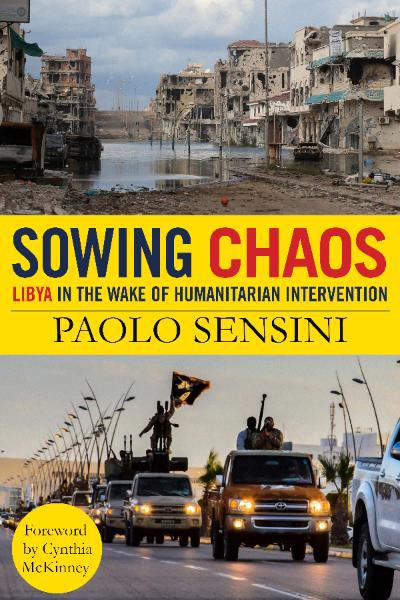 As with the history of many countries off the radar of western consciousness, Libyan history is a tragic tale of what happens when a country dares assert its right to independence – it is destroyed by violent attack, financial subterfuge, or both.
Although an Italian and Italy has a long history of exploiting Libya, a close neighbor, Sensini stands with the victims of colonial and imperial savagery. Not an armchair historian, he traveled to Libya during the 2011 war to see for himself what was true. Despite his moral stand against western aggression, his historical accuracy is unerring and his sourcing impeccable. For 234 pages of text, he provides 481 endnotes, including such fine sources as Peter Dale Scott, Patrick Cockburn, Michel Chossudovsky, Pepe Escobar, and Robert Parry, to name but a few better known names.
His account begins with Italy’s 1911 war against Libya that “Francesco Saverio Nitti charmingly described …. as the taking of a ‘sandbox’.” The war was accompanied by a popular song, “Tripoli, bel suol d’amore” (Tripoli, beauteous land of love). Even in those days war and love were synonymous in the eyes of aggressors.
This war went on until 1932 when the Sanusis’s resistance was finally crushed by Mussolini. First Italy conquered the Ottoman Turks, who controlled western Libya (Tripolitania); then the Sanusis, a Sunni Islamic mystical militant brotherhood, who controlled eastern Libya (Cyrenaica). This Italian war of imperial aggression lasted 19 years, and, as Sensini writes, “was hardly noticed in Italy.”
I cannot help but think of the U.S. wars against Afghanistan and Iraq that are in their 15th and 13th years respectively, and counting; they are not making a ripple on the placid indifference of the American people.
Sensini presents this history clearly and succinctly. Most of the book is devoted to the period following the 1968 overthrow of King Idris by the Free Unionist Officers, led by the 27 year old captain Mu’ammar Gaddafi. This bloodless coup d’état by military officers, who had all risen from the poorer classes, was called “Operation Jerusalem” to honor the Palestinian liberation movement. The new government, The Revolutionary Command Council (RCC), had “three key themes …. ‘freedom, socialism, and unity,’ to which we can add the struggle against western influences within the Arab world, and, in particular, the struggle against Israel (whose very existence was, according to Gaddafi, a confirmation of colonialization and subjugation).”
Sensini explains the Libyan government under Gaddafi, including his world theory that was encapsulated in his “Green Book” and the birth of what was called “Jamahiriyya” (State of the Masses). Gaddafi called Libya the “Socialist People’s Libyan Arab Jamahiriyya.”
Under Gaddafi there was dialogue between Christians and Muslims, including the establishment of diplomatic relations with the Holy See, and visits from Eastern Orthodox and Anglican religious leaders. Fundamentalist Islamic groups criticized Gaddafi as a heretic for these moves. Gaddafi described Islamists as “reactionaries in the name of Islam.” His animus toward Israel remained, however, due to the Palestinian issue. He promoted women’s rights, and in 1996 Libya “was the first country to issue an international arrest warrant with Osama bin Laden’s name on it.”
He had a lot of enemies: Israel, Islamists, al Qaeda, the western imperial countries, etc. But he had friends as well, especially among the developing countries.
A large portion of the book concerns the U.S./NATO 2011 attack on Libya and its aftermath. This attack was justified and sanctioned by UN Resolutions 1970 (2/26/11) and 1973 (3/17/11). These resolutions were prepared by the work of the International Commission on Intervention and State Sovereignty (ICISS) that in 2000-2001 produced a justification for powerful nations to intervene in the internal affairs of any nation they chose. Termed the “Responsibility to Protect” (R2P), it justified the illegal and immoral “humanitarian” attack on Libya in 2011. The ICISS, based in NYC, was founded by, among others, the Carnegie Corporation, the Simons, Rockefeller, William and Flora Hewitt, and John D. and Catherine MacArthur foundations, elite moneyed institutions devoted to American interventions throughout the world.
When the US/NATO attacked Libya, they did so despite the illegality of the intervention (an Orwellian term) under the UN Resolutions that prohibit arming of ‘rebels’ who do not represent the legal government of a country. On March 30, 2011 the Washington Post, a staunch supporter of US aggression, reported an anonymous government source as saying that “President Obama has issued a secret finding that would authorize the CIA to carry out a clandestine effort to provide arms and other support to Libyan opposition groups.” None of the mainstream media, including the Washington Post, noted the hypocrisy of reporting illegal activities as if they were legal. The law had become irrelevant.
The Obama administration had become the opposite of the Kennedy administration. Whereas JFK, together with Dag Hammarskjold the assassinated U.N. Secretary General, had used the UN to defend the growing third world independence movements throughout the world, Obama has chosen to use the UN to justify his wars of aggression against them. Libya is a prime example.
Sensini shows in great detail which groups were armed, where they operated, and who they represented. The US/NATO forces armed and supported all sorts of Islamist terrorists, including the Libyan Islamic Fighting Group (LIFG), led by Abu al-Laith al Libby, a close Afghan associate of Osama bin Laden, and al Qaeda’s third in command.
“These fanatical criminals (acclaimed as liberators by the mainstream media worldwide) were to form Libya’s emerging ruling class. These were people tasked to ensure a democratic future for Libya. However, the ‘rebel’ council of Benghazi did what it does best – ensuring chaos for the country as a whole, under a phantom government and a system of local fiefdoms (each with a warlord or tribal chief). This appears to be the desired outcome all along, and not just in Libya.”
Sensini is especially strong in his critical analysis of the behavior of the corporate mass media worldwide in propagandizing public opinion for war. Outright lies – “aligning its actions with Goebbels’ famous principle of perception management” and the Big Lie (thanks to Edward Bernays, the American father of Public Relations) – were told by Al Jazeera, Al Arabiya, and repeated by the western media, about Gaddafi allegedly slaughtering and raping thousands of Libyans. Sensini argues persuasively that Libya was a game-changer in this regard.
Here, the mass media played the part of a military vanguard. The cart, as it were, had been put before the horse. Rather than obediently repackaging and relaying the news that had been spoon fed to them by military commanders and Secretaries of State, the media were called upon actually to provide legitimation for armed actors. The media’s function was military. The material aggression on the ground and in the sky was paralleled and anticipated by virtual and symbolic aggression. Worldwide, we have witnessed the affirmation of a Soviet approach to information, enhanced to the nth degree. It effectively produces a ‘deafening silence’ – an information deficit. The trade unions, the parties of the left and the ‘love-thy-neighbor’ pacifists did not rise to this challenge and demonstrate against the rape of Libya.
The US/NATO attack on Libya, involving tens of thousands of bombing raids and cruise missile, killed thousands of innocent civilians. This was, as usual, explained away as unfortunate “collateral damage,” when it was admitted at all. The media did their part to downplay it. Sensini rightly claims that the U.S./NATO and the UN are basically uninterested in the question of the human toll. “The most widely cited press report on the effects of the NATO sorties and missile attacks on the civilian population is most surely that of The New York Times. In ‘Strikes on Libya by NATO, an Unspoken Civilian Toll’, conveniently published after NATO’s direct intervention had ceased. The article is truly a fine example of ‘embeddedness’:”
While the overwhelming preponderance of strikes seemed to hit their targets without killing noncombatants, many factors contributed to a run of fatal mistakes. These included a technically faulty bomb, poor or dated intelligence and the near absence of experience military personnel on the ground who could direct air strikes. The alliances apparent presumption that residences thought to harbor pro Gaddafi forces were not occupied by civilians repeatedly proved mistaken, the evidence suggests, posing a reminder to advocates of air power that no war is cost or error free.
The use of words like “seemed” and “apparent,” together with the oft used technical excuse and the ex post facto reminder are classic stratagems of the New York Times’ misuse of the English language for propaganda purposes.
Justifying the killing, President Obama “explained the entire campaign away with a lie. Gaddafi, he said, was planning a massacre of his own people.”
Hillary Clinton, who was then Secretary of State, was aware from the start, as an FOIA document reveals, that the rebel militias the U.S. was arming and backing were summarily executing anyone they captured: “The State Department and Obama were fully aware that the U.S.-backed ‘rebel’ forces had no such regard for the lives of the innocent.”
Clinton also knew that France’s involvement was because of the threat Gaddafi’s single African currency plan posed to French financial interests in Francophone Africa. Her joyous ejaculation about Gaddafi’s brutal death – “We came, we saw, he died” – sick in human terms, was no doubt also an expression of relief that the interests of western elites, her backers, had been served.
It is true that Gaddafi did represent a threat to western financial interests. As Sensini writes, “Gaddafi had successfully achieved Libya’s economic independence, and was on the point of concluding agreements with the African Union that might have contributed decisively to the economic independence of the entire continent of Africa.”
Thus, following the NATO attack, Obama confiscated $30 billion from Libya’s Central Bank. Sensini references Ellen Brown, the astute founder of the Public Banking Institute in the U.S., who explains how a state owned Central Bank, as in Libya, contributes to the public’s well-being. Brown in turn refers to the comment of Erica Encina, posted on Market Oracle, which explains how Libya’s 100% state owned Central Bank allowed it to sustain its own economic destiny. Encina concludes, “Hence, taking down the Central Bank of Libya (CBL) may not appear in the speeches of Obama, Cameron and Sarkozy [and Clinton] but this is certainly at the top of the globalist agenda for absorbing Libya into its hive of compliant nations.”
In five pages Sensini tells more truth about the infamous events in Benghazi that resulted in the deaths of US Ambassador Christopher Stevens and three American colleagues than the MSM has done in five years. After the overthrow of Gaddafi, in 2012 Stevens was sharing the American “Consulate” quarters with the CIA. Benghazi was the center of Sanusi jihadi fundamentalism, those who the US/NATO had armed to attack Gaddafi’s government. These terrorists were allied with the US. “Stevens’s task in Benghazi,” writes Sensini, “now was to oversee shipments of Gaddafi’s arms to Turkish ports. The arms were then transferred to jihadi forces engaged in terrorist actions against the government of Syria under Bashar al-Assad.” Contrary to the Western media, Sensini says that Stevens and the others were killed, not by the jihadi extremists supported by the US, but by Gaddafi loyalists who had tried to kill Stevens previously. These loyalists disappeared from the Libyan and international press afterwards. “The reports now focused on al-Qaida, Islamists, terrorists and protesters. No one was to mention either Gaddafi … or his ghosts.”
The stage for a long-term Western intervention against terrorists, who were armed by the US/NATO, was now set. The insoluble disorder of a vicious circle game meant to perpetuate chaos was set in motion. Sensini’s disgust manifests itself when he says, “Given its record of lavish distribution of arms to all and sundry in Syria, the USA’s warning that, in Libya, arms might reach ‘armed groups outside the government’s control’ is beneath contempt.”
Sowing Chaos: Libya in the Wake of Humanitarian Intervention is a superb book. If you wish to understand the ongoing Libyan tragedy, and learn where responsibility lies, read it. If the tale it tells doesn’t disgust you, I’d be surprised.
In closing, I would be remiss if I didn’t mention that former Congresswoman Cynthia McKinney, a stalwart and courageous truth teller, has written a fine forward where she puts Libya and Sensini’s analysis into a larger global perspective. As usual, she pulls no punches.
Copyright © Edward Curtin, Global Research, 2016
Italy ‘No Longer Sovereign State, It is on NATO’s, US’ Tight Military Leash’
Sputnik – 14.09.2016
Italy has been packed full of NATO and US military bases across the country, which serve as testing grounds for the US and the alliance; Sputnik Italy talked to Fulvio Grimaldi, Italian journalist, war correspondent and documentarian on the everyday damage these military facilities cause to the country.
“We fell victim to the self-restrictions contrary to our own interests. Europe is tormenting itself,” Grimaldi told Sputnik while commenting on the issue.
“It is in the interests of the US that Italy has imposed sanctions on Russia which have harmed Moscow less than Italian farmers and the country’s industry, which have subsequently found themselves in grave economic conditions,” he noted.
The journalist further acknowledged that his home country has been forcefully militarized. There are around 90 US bases in the country, let alone a lot more NATO bases on its territory, which are at the US disposal.
“We are a country overflowing with military bases, and this is a serious burden for our economy to the detriment of construction, maintenance of medical facilities, schools and land improvement,” the journalist said. These military facilities also put Italy at risk of becoming a potential target for those countries who will decide one day to stand up to NATO aggression.
The correspondent cites as an example the American Mobile User Objective System (MUOS), a modern satellite communications system located in Sicily, the largest Mediterranean island, which is capable of reaching out to Africa and the Middle East.
“It is a huge social and industrial burden for the island,” he said.
Another example is the US military facility on another large Italian island in the Mediterranean Sea, Sardinia, which serves as a testing range for the newly released weaponry which pollutes the environment and threatens the health of local residents.
The economic damage is also substantial. NATO military operations around the globe cost the Italian defense ministry 55 million euro ($61.7mln) per day. If you take into account the expenses of other related ministries, the daily cost rises to 80 million ($89.7mln).
“This is the contribution of the country which has no interest in the military operation in any country of the world, because it is facing no threats,” Grimaldi said.
The US military and political control over the Italian territory comes as the aftermath of the Second World War which deprived Italy of its sovereignty. “I see no reasons for optimism in such a situation.
What I actually see is the acknowledgment of similar subordination in other countries of the EU, and this aggressive strategy of NATO is leading us towards an epic failure,” the journalist said.
However he added that he is certain that one day the authorities will finally come to their senses and change their stance towards the alliance.
Demonize and Distract: Sanitizing Syria for the Masses
By Jason Hirthler | CounterPunch | September 9, 2016
Summoning the Humanitarian Pretext
The arch pragmatist Machiavelli once wrote that, “If you watch the ways of men, you will see that those who obtain great wealth and power do so either by force or fraud, and having got them they conceal under some honest name the foulness of their deeds.” You couldn’t pen a better description of the relationship between the imperial corporate state and its supplicant media. Once the coffers of vulnerable nations are ransacked by American wars of aggression, it is the media that sweeps the crimes of state beneath a carpet of piety. The truth may come out in due time, although it is always ex post facto. Thanks to the the coordination between the corporate sector, the state, and the media, the American doctrinal system is largely a self-contained narrative. It comes complete with a smooth internal logic. Corporations set priorities, the state produces a storyline that rationalizes the pursuit of those priorities, and the media distributes and reifies the storyline until it is gospel. This is no surprise, since the corporations own the politicians and the presses. Yet one way to examine the functioning of this kind of systemic propaganda is by looking at some of the keywords on which the stories hinge.
The foul deeds Machiavelli mentioned now principally occur in the Middle East, where vast resources lie and where power may be usefully projected deep into Eurasia. The Syrian proxy war between forces east and west is a nice example of how the dissimulations initiated in Washington are disseminated through the MSM. For instance, The New York Times, and its deputies in the vast clearinghouses of state propaganda, would have us believe that the White House is supporting freedom-loving rebels in Syria who are politically moderate and fighting for their lives in a civil war against a despotic regime led by an evil optometrist, Bashar al-Assad.
But we know that the entire Syrian fiasco was engineered by the CIA with cash, guns, and training, and unceasing support from the Gulf Cooperation Council (GCC) at our behest. It is a long-standing neoconservative plan to break the so-called Shia Crescent that runs from Lebanon through Syria to Iran. These are, of course, the independent-minded states that have thus far refused to accept either Israeli colonization of Palestinian land or permit Western-backed energy projects to take shape on their territory. Hence the need to dismember them into tiny, feckless statelets that pose no challenge to either Tel Aviv or Washington.
But this is hidden behind the fog of war and a domestic haze of media nuance. This entire conflict could reasonably be said to hinge on a single phrase: “moderate rebels.” The words “moderate” and “rebel” make all the difference in the telling of this fable. The truth is that we have hijacked Arab Spring discontent and festooned it with brigades of terrorist mercenaries procured from around the Middle East and Asia, all with the singular mandate to take down the Assad government. Tens of thousands of jihadists have been injected by NATO into a multi-confessional state governed by an elected leader who won a larger percentage of the electorate than our liberal messiah Barack Obama.
But this more truthful interpretation of events is unacceptable. To concede that the White House is now backing al-Qaeda terrorists in an effort to capsize a Middle Eastern democracy would implode the religion of American exceptionalism on which elite power depends. Thus the media cannot point out that the Pentagon’s recent admission of having troops in Syria violates the Nuremberg Principles on wars of aggression as well as the United Nations Charter. Omissions of this kind are what prevent average Americans from a) knowing what we’re really doing; and b) resisting it.
Demonize and Distract
But it isn’t enough to simply cloak our own crimes in the holy cloth of exceptionalism. We must defame our enemies. We must plant false flags in their soil now so that we can bury bombs in them later. It happens the same way every time. ‘Shocking’ discoveries are made about one of our most reviled enemies, usually provided by a defector with a farcical alias (think “Curveball”). Instantaneous mainstream reports issue a coordinated condemnation of the country in question. Each media outlet chooses a particular keyword to drive home the horror. Popular terms include “crimes against humanity”, “war crimes”, the words “industrial scale” in front of any noun or verb, the word “mass” in front of any noun or verb, “brutal crackdown”, “regime”, and so on. Grisly images are plastered across the front pages of the MSM. Often the images are fakes or are from unrelated incidents.
Once the reader has been stupefied, at least one columnist or politician will draw a deep breath, and then ‘draw comparisons’ to either Hitler and Auschwitz or Slobodan Milosevic and mass graves. (Recently Milosevic was declared innocent of all genocidal charges by the International Criminal Tribunal on Yugoslavia, albeit years after he died in prison after being denied medical treatment by his civilized captors. This process of posthumous exoneration is now practiced on an “industrial scale” by Obama’s drone assassination when various innocents are discovered to have been innocent after they’ve been “terminated”.)
Not only is the supposedly noble Syrian uprising a fraud, but so is our equally principled goal of wiping ISIS from the face of the earth, if the facts on the ground are of any import. Washington has gone after ISIS in a strangely half-hearted way. Why hasn’t it provided air cover for Syrian Arab Army when its helicopters were rendered useless by terrorist TOW missiles? Missiles sold by the United States to Saudi Arabia, likely for the express purpose of funneling them to al Nusrah and other rogue bandits in Syria. Why did the U.S. not immediately attack ISIS-controlled oil wells and oil trading routes–ISIS’ chief source of funding–as Russia did on its entry into the conflict? Why did the Obama administration produce a record-setting arms deal with the Saudis, the leading proselytizer of Wahhabism in the world? Why do we refuse to work with Moscow or the SAA or Iran? Why do we not share grids and intelligence and join their joint operations room in Baghdad?
Isn’t it obvious? We have different goals. We want Assad out and a daft, pliant puppet in charge, presiding over a vast arsenal of domestic police, ready to crush resistance on contact. Of course, any such resisters would be legitimate freedom fighters, as are the Palestinians. But the media takes care to call Palestinians “terrorists” and called citizens resisting the Iraqi occupation “insurgents”. Words matter. They shade the story and bring neutral readers over to the side of empire. They blame the victim for the violence that victimized them.
The dissimulation becomes even clearer when you realize that ISIS emerged from an American interrogation camp in Iraq, in a way that suggests CentCom was more than happy to release radicalized Islamists into the wild. To what purpose? The failed state in Libya and the collapsing scenery of the Syrian state provide plenty of fodder for speculation.
The Wages of Propaganda
Thanks to years of conditioning by the media, the population will do little to resist the escalation to come. Eventually the Syrian “regime” to be eventually overthrown by relentless American-backed violence. Hillary Clinton will win the election and gain control of the Oval Office. As Glen Ford wrote at Black Agenda Report, Clinton will “… ride into the White House on a warhorse”. She is the thinking man’s neocon, unlike President Bush, who represented the anti-intellectual strain of the American character, and Barack Obama, whose reluctance to pour troops into Arab prairie fires was widely predictably condemned as a sign of weakness.
Hillary is neither stupid nor soft. She will doubtless find a useful pretext by which to declare a no-fly zone in Syria, which would inhibit the efficacy of Russia’s campaign against various terrorist clans. (A House resolution is already afoot to lay the groundwork.) She will move more troops into the polder of northern Syria, violating all kinds of charters and conventions and declarations with an icy mixture of contempt and indifference. (See the UN Charter, Geneva Conventions, and the Universal Declaration of Human Rights for the bootless scraps of paper she will trample.) Perhaps most importantly, she will green light the transport of more arms, ammunition, and psychopaths into Syria to make a push for Damascus in the hopes of repeating the Libyan calamity.
Should that project succeed, Hillary will quite possibly ‘discover’ that Iran has been violating its bogus nuclear agreement with the P5 +1. Anonymous administration sources will be “troubled” by the development. This isn’t idle speculation. For lack of a better title, the long-term strategy for the “new world order,” as George H.W. Bush put it, is contingent on splitting the Shia Crescent, removing Iran as a regional antagonist, then moving farther into Eurasia to control Sino-Russian development. And we know how a confrontation with Tehran would play out. With rabid spittle cresting his white beard, Wolf Blitzer will escort numberless brigadier generals through The Situation Room to reassure Americans that the bearded mullahs in Qom are indeed a fearsome clan. Hillary will threaten, and perhaps use, tactical nuclear weapons (B-61s) on Iranian nuclear sites, backed by either a UN Security Council resolution of dubious authority or a coalition of the bullied, bought, and willing. As the mushroom cloud envelops the region in radioactive waste, Israel will be seen fastidiously colonizing more West Bank land, Benjamin Netanyahu rubbing his hands in frenzied anticipation, a dogeared copy of the Yinon plan stuffed in his jacket pocket. Saudi Arabia’s Deputy and Crown Princes will celebrate the fall of their hated rivals. Laconic onlookers in Washington and Europe will shrug and say nothing. CIA plants in D.C. will fastidiously distance Hillary’s bombs from Hiroshima’s, and Tel Aviv will move against Hezbollah in a final confrontation, since the Shia Crescent will by then be nothing more than a few shards of Mesopotamian culture atop a flaming midden.
With the Middle East finally brought “to heel,” as Hillary once proposed doing to young black boys, the ground will have been cleared for the pulse-racing showdown with Russia itself, the greatest thorn in Washington’s side. With Assad out of the way and Tehran chastened, the Kremlinologists and conspiracy theorists can be set loose to harrow the public into a state of high anxiety about the “expansionist” state to the East. NATO will inch closer to Russian borders and shout that Russia is moving closer to NATO. Destabilization will proceed apace. It will be called “democracy promotion” and will be paid for by fronts called “endowments”. Sanctions will tighten the economic screws. Verbal salvos will hit targets on either side of the water. New proxy wars will be touched off. Only a giant peace movement or stray asteroid could prevent something like this from happening. Perhaps the BRICS will halt the spread of empire with a collective stance, but Washington is agile if not artful at executing its core strategy to destabilize, divide, and rule its rivals. Until then, if you want to know what contempt looks like, look at this picture of Barack Obama and Vladimir Putin meeting at the G20 in China last week. The tenor of tomorrow is written all over their faces.
Jason Hirthler is a veteran of the communications industry and author of The Sins of Empire: Unmasking American Imperialism. He lives in New York City and can be reached at jasonhirthler@gmail.com.
Obama Flinches at Renouncing Nuke First Strike
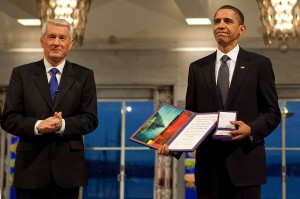
President Barack Obama uncomfortably accepting the Nobel Peace Prize, Dec. 10, 2009. (White House photo)
By Jonathan Marshall | Consortium News | September 8, 2016
Time is running short for President Obama to make good on his 2009 promise “to seek the peace and security of a world without nuclear weapons,” for which he won the Nobel Peace Prize. Yet as both the Wall Street Journal and New York Times recently reported, Obama’s advisers may have just nixed the single most important reform advocated by arms control advocates: a formal pledge that the United States will never again be the first country to use nuclear weapons in a conflict.
Ever since President Truman ordered two atomic bombs dropped on Japan in 1945, the United States has reserved the right to initiate nuclear war against an overwhelming conventional, chemical or biological attack on us or our allies. But peace advocates — and more than a few senior military officers — have long warned that resorting to nuclear weapons would ignite a global holocaust, killing hundreds of millions of people.
In a talk to the annual meeting of the Arms Control Association on June 6, Deputy National Security Advisor Benjamin Rhodes promised that President Obama would continue to review ways to achieve his grand vision of a nuclear-free world during his last months in office. Obama was reportedly considering a “series of executive actions” to that end, including a landmark shift to a “no first use” policy.
Two-thirds of adult Americans surveyed support such a policy. So do 10 U.S. senators who wrote President Obama in July, proposing a no-first-use declaration to “reduce the risk of accidental nuclear conflict” and seeking cut-backs in his trillion dollar plan for nuclear modernization over the next 30 years.
But Secretary of Defense Ashton Carter, Secretary of Energy Ernest Moniz (who oversees the nuclear stockpile), and Secretary of State John Kerry all warned during a National Security Council meeting in July that declaring a policy of “no first use” would alarm America’s allies, undercut U.S. credibility, and send a message of weakness to the Kremlin at a time of tense relations with Russia.
Yet until they took charge of giant bureaucracies whose funding depends on keeping the threat of nuclear war alive, both Carter and Moniz were on record supporting “a new strategy for reducing nuclear threats” and achieving security “at significantly lower levels of nuclear forces and with less reliance on nuclear weapons in our national security strategy.”
In a 2007 manifesto, Carter, Moniz, and other centrist Democratic foreign policy experts rejected the old claim that nuclear weapons are still needed to deter non-nuclear attacks.
“Nuclear weapons are much less credible in deterring conventional, biological, or chemical weapon attacks,” they wrote. “A more effective way of deterring and defending against such non-nuclear attacks – and giving the President a wider range of credible response options – would be to rely on a robust array of conventional strike capabilities and strong declaratory policies.”
They also gave strong implicit support to a no-first-use doctrine, stating that “nuclear weapons must be seen as a last resort, when no other options can ensure the security of the U.S. and its allies.”
Risk of Overreaction
Why does a no-first-use policy matter? In a New York Times column last month, Gen. James Cartwright, former vice chairman of the Joint Chiefs of Staff and head of the United States Strategic Command, emphasized the folly of introducing nuclear weapons into any conflict.
“Using nuclear weapons first against Russia and China would endanger our and our allies’ very survival by encouraging full-scale retaliation,” he and a colleague wrote. “Such use against North Korea would be likely to result in the blanketing of Japan and possibly South Korea with deadly radioactive fallout.”
A policy of no first use, backed up by a reconfiguration of U.S. nuclear forces to reduce their offensive capabilities, would lower the chance of a rival nuclear power rushing to launch early in a crisis and unleashing World War III. Today some nuclear powers like Russia have their forces on hair-trigger alert for fear of being wiped out by a U.S. surprise attack; as a result, the world is just one false alarm away from all-out nuclear war.
As two senior officials at the Arms Control Association observed recently in the Bulletin of the Atomic Scientists, “Among other advantages, a clear US no-first-use policy would reduce the risk of Russian or Chinese nuclear miscalculation during a crisis by alleviating concerns about a devastating US nuclear first-strike.
“Such risks could grow in the future as Washington develops cyber offensive capabilities that can confuse nuclear command and control systems, as well as new strike capabilities and strategic ballistic missile interceptors that Russia and China believe may degrade their nuclear retaliatory potential.”
They also discounted the claim that U.S. allies such as Japan or Korea would rebel against such a change of policy: “They are highly likely to accept such a decision, since no first use will in no way weaken US military preparedness to confront non-nuclear threats to their security. . . Many US allies, including NATO members Germany and the Netherlands, support the adoption of no-first-use policies by all nuclear-armed states.”
Warnings by nuclear hawks that a common-sense doctrine of no-first-use would undercut U.S. “credibility” or project “weakness” are simply business-as-usual attempts by national security bureaucrats to inflate threats and keep the war machine in high gear. If they succeed in blocking reform, America and the rest of the world will remain at real risk of annihilation through accidental nuclear escalation.
The question now is whether President Obama will listen to the fear-mongers in his cabinet, or remember what he said in May at the Hiroshima Peace Memorial: “Among those nations like my own that hold nuclear stockpiles, we must have the courage to escape the logic of fear and pursue a world without them.”
Jonathan Marshall is author or co-author of five books on international affairs, including The Lebanese Connection: Corruption, Civil War and the International Drug Traffic (Stanford University Press, 2012). Some of his previous articles for Consortiumnews were “Risky Blowback from Russian Sanctions”; “Neocons Want Regime Change in Iran”; “Saudi Cash Wins France’s Favor”; “The Saudis’ Hurt Feelings”; “Saudi Arabia’s Nuclear Bluster”; “The US Hand in the Syrian Mess”; and “Hidden Origins of Syria’s Civil War.”
Top General Warns That NATO Wants to Turn Post-Soviet Space ‘Into Another Syria’
Sputnik – 08.09.2016
A top Russian general has voiced his frustration over NATO’s lack of cooperation with a Russian-led alliance involving countries from the former Soviet space, saying that the Western alliance doesn’t seem to want countries in the former USSR to ally with one another, allowing NATO pick them off one by one at their leisure.
Speaking at a press conference in Moscow on Wednesday, Col. Gen. Nikolai Bordyuzha, secretary general of the Collective Security Treaty Organization, a military alliance involving six post-Soviet states, including Russia, Belarus, Armenia, Kazakhstan, Kyrgyzstan and Tajikistan, had some harsh words for Russia’s NATO partners.
The North Atlantic Alliance, he said, has been consistently opposed to any military integration between Russia and its partners in the CSTO, and the reason is that NATO wants to deprive these countries of their collective security guarantees.
“Why do you think NATO does not cooperate with the CSTO?” the general asked. “It’s simple – they have no need to support processes of [defense] integration. This way, things will be like in Syria, and nobody will be able to let out a peep. The country is being pounded, and there’s no one to help them, since it didn’t have any allies. And this is the situation they want to create for us as well,” Bordyuzha said, referring to the members of the CSTO.
Furthermore, the officer warned that the Western media has been engaged in what he called campaign of information warfare against the CSTO. “They will tell lies all day, every day. Everything that is being said about the CSTO is presented in a way that’s the opposite to how things are in reality,” Bordyuzha noted. “This is done, for example, in order to ensure that Tajikistan was not together with Russia,” he added.
Ultimately, Bordyuzha suggested that the Western political, media and military effort’s “most important task is to splinter our unity, to separate our nations into our own ‘national apartments’, and to dictate their terms to everyone individually.”
In this scenario, the officer emphasized that while the CSTO has absolutely no plans to fight a war of aggression against NATO, neither does it fear an attack by the Western alliance. “That’s why the CSTO exists,” Bordyuzha quipped.
The Collective Security Treaty Organization, formed in 1992, shortly after the collapse of the Soviet Union, integrates the defense capabilities of six former Soviet republics, including Russia, Belarus, Armenia, Kazakhstan, Kyrgyzstan and Tajikistan. Afghanistan and Serbia became observers to the organization in 2013. Former members include Azerbaijan, Georgia and Uzbekistan.
Signatories to the alliance are not able to join other military alliances, and aggression against one member is considered aggression against all.
The CSTO holds yearly command exercises and drills to improve coordination between its states militaries, the most recent being Cooperation-2016, which took place last month in Russia’s Pskov region.
Featured Video

New positive ivermectin evidence
or go to
Aletho News Archives – Video-Images
From the Archives
Fanatical Followers of the Covid Regime: A Jim Jones-Style Cult?
By Professor Roger Watson and Dr. Niall McCrae | The Daily Sceptic | November 15, 2021
As scholars at leading British universities over recent decades, we witnessed the replacement of critical thinking and debate by narrative: facts are discrimination and scientific method is imperialism; truth, instead, is derived from ‘progressive’ values. This educational trend may be a major contributory factor to the ease in which society has been inculcated to the Covid ‘new normal’ of masking, testing, and repeated doses of vaccines for a disease of similar risk to severe influenza.
One doesn’t need much critical reasoning to observe the flawed logic of some vaccination enthusiasts, such as people who respond to experiencing any side effects, however debilitating, by saying “at least I know it’s working”, or, after contracting the disease despite their promised inoculation (over 90% effective, according to initial drug company claims), “I’d have been worse off without the jab.” … continue
Blog Roll
 Aletho News
- EU Council Advances Chat Control 2.0 Scanning Proposal
- Ex-Greek MEP files complaint against Israeli spyware firm over alleged Pegasus surveillance
- Troubling ideas throughout the Torah, Talmud, Mishneh Torah and Tanya
- ‘Grave, alarming’: Iran mission on Trump’s UNGA ‘annihilation’ threats
- Najaf airport to reopen to Iranian flights within 24 hours: Ambassador
- From ‘How Will This End For Iran’ to ‘When America Walks Away’: A tale of two Economist covers
- Tehran blasts ‘baseless’ speculation linking Iran to alleged bomb plot at UK air base
- The Rise And… Rise Of ‘Color Revolutions’
- The Coming GOP Bloodbath?
- Arctic Scare Stories Melt Away
- If Americans Knew
- Netanyahu Asked UAE Leader to Deny Report on Oct. 7 Warning in Secret Visit, Sources Say
- CNN Chief Int’l Correspondent Clarissa Ward on Journalists in Gaza
- Democratic Party Consultants Surround Troy Jackson with Pro-Israel Donors
- Christian Leader Responds To Netanyahu’s Claims Regarding Palestinian Christians
- In Gaza, ‘Whoever Survives the Bombing Won’t Survive the Rubble’
- Israel kills more Palestinians, amid push to resettle Gaza – Daily Update
- Israel forces Gazans to live in constant peril – Daily Update
- Deconstructing Netanyahu’s pants-on-fire UN rant – Daily Update
- Trump betrayed voters with his campaign lies and prioritized a foreign country once he took office
- Netanyahu calls Israel’s war in Gaza ‘opposite of genocide’ in UN speech to near-empty hall
- No Tricks Zone
- New Study: Earth And Venus Surface Warmth Largely Explained By Convection And Lapse Rate, Not CO2 Or Radiation
- 2025 Nature Paper Claiming Worsening Global Drought Gets RETRACTED …Heavily Flawed
- New Study: ‘Global Drought Shows No Detectable Recent Acceleration Under Climate Warming’
- Economic Masterminds: German Socialists Suggest Taxing Productivity Gains Stemming From Using AI
- The South China Sea Has Not Been Cooperating With The Climate Change Narrative
- Energy Crisis: Germany Enters Heating Season With Historically Low Gas Reserve Fill Levels
- New Study: The Antarctic Ice Sheet Gained Mass From 2020-2024 Due To Staggering Snow And Ice Accumulation
- Study: Ocean Heating Rates From Thousands Of Years Ago ‘Dwarf’ Modern Ocean Heating Rates
- Climate Extremists Target, Attack Large-Scale Power Grid Infrastructure In Germany!
- New Study: Antarctic Ice Melt Has Contributed Less Than 1 Centimeter To Sea Level Rise In The Last 30 Years

