Window of Opportunity for Peace is Closing
John Mearsheimer, Alexander Mercouris & Glenn Diesen
Glenn Diesen | October 22, 2025
I had the great pleasure of discussing this with John Mearsheimer and Alexander Mercouris on The Duran, how the window of opportunity for a peaceful settlement is closing fast. Zelensky cannot accept the high demands from Russia. The Europeans will oppose any real diplomacy out of fear that peace would be accompanied by European divisions and the departure of the US. Meanwhile, Russia is growing increasingly pessimistic about any possible peace. As the Ukrainian frontlines collapse and Moscow has no trust in NATO, it will likely take all strategic territory that would make Ukraine a threatening frontline state. The successful efforts to sabotage the Budapest meeting may leave us with two options: a strategic defeat for NATO with the collapse in Ukraine, or escalating to a direct NATO-Russia War.
NATO States Say New Weapons Systems Must Be Tested in Ukraine
By Kyle Anzalone | The Libertarian Institute | October 21, 2025
 The military leaders of Nordic members of the North Atlantic Treaty Organization (NATO) said they are only interested in purchasing weapons that have undergone battlefield testing in Ukraine.
Speaking at the Association of the United States Army (AUSA) annual meeting last week, “For new [supply] chains and new technologies, I’m never going to buy anything that hasn’t worked in Ukraine,” Maj. Gen. Peter Harling Boysen, chief of the Royal Danish Army, explained.
During the panel discussion on Northern Europe, Lt. Gen. Pasi Välimäki, Commander of the Finnish Army, said demonstrations are nice, but weapons that are tested in Ukraine are proven to work.
Since the Russian invasion in 2022, Western and Ukrainian leaders have touted the war as an opportunity for NATO weapon systems to be utilized in battle to test their effectiveness in combat against Russian forces.
In September, Alexus Grynkewich, a US Air Force general who serves as NATO’s Supreme Allied Commander Europe, urged more weapons makers to test their military equipment in Ukraine.
Latvian Secretary of the National Security Council Aivars Puriņš said that throughout the war in Ukraine, Western states have discovered that weapons platforms are not functional in actual conflict.
“We have had too many stories, I think, over these years in Ukraine [where] the best technology solutions were deployed, and suddenly they didn’t work as they were kind of supposed to be and that’s the logic we should not be repeating,” he told Breaking Defense.
NATO has viewed the war in Ukraine as an opportunity to weaken Russia. Using Kiev as a proxy has come at a huge cost to Ukrainians. Moscow offered to end the war within a few months and allow Kiev to keep all of Ukraine except the Crimean Peninsula, which Russia annexed in 2014.
However, President Zelensky’s Western backers urged him to reject the Russian proposal and offered to flood Kiev with billions in aid and arms.
Ukraine has lost at least hundreds of thousands of troops, millions of people have been displaced, and Russia is now demanding Kiev cede at least 20% of its territory.
Rick Sanchez: War Propaganda & Suffocating Censorship Weaken the West
Glenn Diesen | October 19, 2025
Award-winning journalist Rick Sanchez has worked for CNN, MSNBC, Fox News and RT, which gives him a unique perspective on the Western and Russian media. Sanchez outlines how the war propaganda and rise of censorship across the West prevent us from pursuing rational policies.
Sweden calls on citizens for ‘war mode’
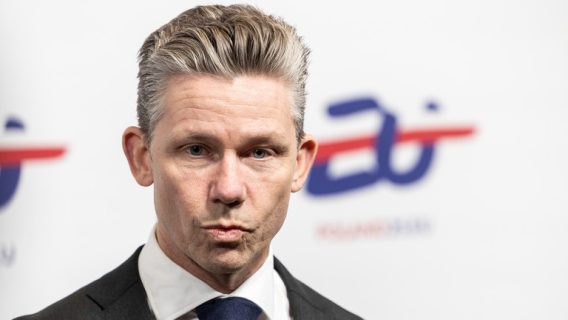
Swedish Defense Minister Pal Jonson, Warsaw, Poland, April 3, 2025. © Foto Olimpik / NurPhoto via Getty Images
RT | October 20, 2025
People living in European NATO member states must brace themselves for a possible war with Russia, Swedish Defense Minister Pal Jonson told RedaktionsNetzwerk Deutschland (RND) in an interview published on Sunday.
Jonson’s remarks come as the EU accelerates a broad militarization drive. Brussels has cast Russia as an imminent threat, a narrative Moscow has dismissed as a political distraction from Europe’s domestic crises.
“To preserve peace, we must prepare ourselves both mentally and militarily for the possibility of war,” the official said. “A change in mentality is necessary: We must switch to war mode to resolutely deter, defend, and preserve the peace.”
The push for greater defense spending aligns with calls from US President Donald Trump, who has demanded that European members buy more American weapons – including for Ukrainian use. Jonson justified such purchases, saying that Europe “simply doesn’t have or cannot yet produce” the necessary systems. “Ukraine needs these assets fast,” he said. “If Europe lacks them, it’s logical to procure them from the US.”
The European Commission last week unveiled a roadmap outlining its plans to expand joint arms procurement to at least 40% by 2027. The document emphasized the need to “invest more, invest together, and invest European,” citing global strategic shifts to other regions among “traditional allies.”
Moscow views the Ukraine conflict as a NATO proxy war aimed at undermining Russia’s security following decades of expansion. Sweden is the bloc’s newest member, while Ukraine was promised accession sometime in the future.
Turkey prepares its historic turn: from NATO sentinel to Eurasian protagonist
By Lucas Leiroz | Strategic Culture Foundation | October 19, 2025
For decades, Turkey was considered a pillar of NATO’s eastern flank — a key piece on the chessboard of containing Russia. Since joining the alliance in 1952, the country has played a dual role: on one hand, a strategic partner of the West; on the other, a regional power with ambitions of its own. This balance was always unstable — and now, it is beginning to undergo substantial change.
What was once whispered behind closed doors is now being openly voiced by central figures in Turkish politics. In September 2025, an unexpected statement from the leader of the Nationalist Movement Party (MHP), Devlet Bahçeli, sent shockwaves through Ankara and beyond: he openly proposed the formation of a strategic alliance between Turkey, Russia, and China, directly opposing what he called the “US-Israel evil coalition.”
Though shocking to some Western observers, this proposal did not emerge in a vacuum. According to analyst Farhad Ibragimov, Bahçeli’s remarks mark “the deepest ideological shift in Turkish nationalism since the Cold War.” A nationalism traditionally aligned with the West now appears skeptical — if not openly antagonistic — to the Washington-led structure.
It is important to note that Bahçeli is not alone in this shift. The idea is echoed with enthusiasm by other sectors of Turkish political life, such as Doğu Perinçek, leader of the Patriotic Party. For him, this reorientation is neither a tactical maneuver nor a veiled threat to NATO — it is, rather, a “civilizational project.” In his words, it is a historic decision: either Turkey remains a satellite of the Atlantic powers, or it fully integrates into the Eurasian civilization, alongside Russia, China, and Iran.
In this context, the suggested alliance should not be seen merely as a military or diplomatic pact, but as an attempt to redefine Turkey’s role in the 21st century. The proposal carries an implicit — and at times explicit — critique of the decadent, domineering, and unsustainable liberal world order.
President Recep Tayyip Erdoğan’s position has been more ambiguous. He stated he was “not fully familiar” with Bahçeli’s idea, but added: “Whatever is good, let it happen.” This phrase summarizes Erdoğan’s strategy in recent years: keeping the country in a bargaining position, flirting with Moscow and Beijing while still participating in Western institutions. However, there are signs that even this balancing act may be giving way to more definitive choices.
The growing instability in the Middle East, the erosion of European institutions, and constant pressure from the U.S. have pushed Turkey toward a new posture. As Perinçek aptly put it, “this is not a choice, but a necessity.” Remaining within the Atlantic system, in his view, offers no guarantees of sovereignty, economic development, or territorial security.
Although short-term technical obstacles remain, Turkey’s path toward Eurasian integration is not only viable — it is necessary. The country’s economic dependence on the West, inherited from decades of participation in the liberal-globalist architecture, is not a fixed destiny — but a chain that must be broken. Remaining in NATO, far from providing security, leaves Ankara a passive target of American strategy. In contrast, a strategic alliance with Moscow, Beijing, and Tehran — while demanding structural adjustments — offers something the Atlantic has never guaranteed: full sovereignty, mutual respect, and active participation in building a new international order based on multipolarity.
More than a geopolitical alignment, the proposals of Bahçeli and Perinçek carry a profound civilizational dimension. By drawing closer to Russia, China, and Iran, Turkey is not merely seeking strategic partners but also reconnecting with the historical and cultural space of Turkic populations within those countries — from the Arctic-Siberian frontiers in Sakha to the Uyghur Autonomous Region of Xinjiang and Iranian Azerbaijan. This reconnection creates fertile ground for a broader alliance that could also involve the Central Asian republics — Kazakhstan, Uzbekistan, Turkmenistan, Kyrgyzstan — and Mongolia itself. This is, therefore, not just a political axis, but an identity-based one, capable of forming a cohesive civilizational bloc with shared roots and converging interests in the face of the moral and structural decline of the liberal West.
The trend is clear: a significant part of Turkey’s political and military elite no longer believes the country’s future lies in Brussels or Washington. Instead, they look to the heart of Eurasia — where emerging powers are gradually drawing the contours of a new multipolar world.
At this moment, Turkey seems to be standing in front of a mirror: it can continue acting as a peripheral extension of Western will, or it can take a more independent course. The statements from Bahçeli and Perinçek may be just the beginning of a turn that, if consolidated, will shift the geopolitical balance of the region for decades to come.
Five years until war with Russia? The EU is already at war
Strategic Culture Foundation | October 17, 2025
The 27-nation European Union this week unveiled a five-year plan “to get ready for war” with Russia.
The so-called “Roadmap on European Defense Readiness 2030” sounds like a war manifesto and a self-fulfilling prophecy, putting the EU on a disastrous collision course with Russia.
It is incredible that such an ominous direction is being blatantly dictated by an unaccountable elite in Brussels. Eighty-five years ago, the Third Reich had a plan to rule over Europe by dominating the Soviet Union. The EU elite are carrying on the plan.
As for the “defense readiness” (that is, “war readiness”) roadmap, the future is already here, not in five years. The EU is presently on a disastrous collision course with Russia.
Like the United States, the European Union has been at war with Russia through its proxy regime in Ukraine since February 2022, and before that, going back to the 2014 coup in Kiev.
Over the past four years, the EU has supplied nearly €180 billion of taxpayer money to weaponize a NeoNazi regime in Kiev. As we noted in last week’s editorial, that vast allocation (and waste) of resources is far greater than the EU’s own member nations have received for developing their economies and societies. When has the European public had a chance to vote on that? Decisions are being made by an elite cabal.
Unlike the Trump administration, the European Union under the influence of arch-Russophobes like European Commission President Ursula von der Leyen and foreign affairs chief Kaja Kallas, has shown absolutely no will for finding a diplomatic resolution to the conflict in Ukraine. With honorable exceptions, most of the European governments are pushing the war hysteria. So, too, are the European media, as are the American mainstream media. Russia is the evil aggressor, no diplomacy, no dialogue with Moscow, no surrender, and so on. It’s war-on-autopilot.
The European bloc, at least at the official level, is completely dominated by NATO and intelligence agencies’ propaganda portraying Russia as the enemy. The CIA and Britain’s MI6 are no doubt pulling the strings and Europe is dancing like a pathetic puppet.
President Donald Trump held a two-hour phone call with Russian counterpart Vladimir Putin on Thursday during which the two leaders agreed to meet in Budapest in the next two weeks. The meeting is a follow-up to their summit in Anchorage on August 15, to try to end the hostilities in Ukraine.
The EU leadership is implacably opposed to any such diplomacy. They were disconcerted by the meeting in Alaska because Trump treated Putin with respectful diplomacy. The latest news about a summit in Budapest is also peeving EU leaders. They are clamoring for Trump to deliver Tomahawk cruise missiles to Ukraine, which they will pay for. This is aimed at ensuring that diplomacy gets blown up.
Since the Western-backed coup in Kiev in 2014, the European Union has undergone a retrograde transformation to become a militarized bloc defined by obsessive hostility towards Russia. The EU is increasingly a clone of the NATO military alliance. Historically, the European Union stood for peace through neighborly trade and commerce. It was intended to have evolved from the ashes of the Second World War, ensuring that war would never happen again on the continent. In 2012, the bloc was awarded the Nobel Peace Prize. Not that that award means much, but it serves to illustrate the absurdity.
Over recent months, the EU has become fixated on a feverish war mentality. The economies of the 27 nations are increasingly marshaled by military production and spending. The whole purpose of the bloc is being defined as an existential confrontation with Russia. It seems significant that Von der Leyen and German Chancellor Friedrich Merz have Nazi skeletons in their family wardrobes. The Baltic states, too, which have emerged as belligerent influences on EU policy, have nefarious links to the Nazi past.
The war mentality reached fever pitch in Von der Leyen’s State of the Union address on September 10. She opened by declaring that “Europe is in a fight” with Russia. She said it was a fight for “freedom and independence,” and she united the cause of the EU with Ukraine against Russia.
“Europe must fight… because Ukraine’s freedom is Europe’s freedom,” she claimed.
Von der Leyen, the former German military minister, and the European Union’s most senior official, who is unelected, was declaring that the bloc was at war. Now, not in five years.
In recent months with intensifying emphasis, the EU’s intelligence agencies (CIA, MI6 clones) have been warning of war with Russia as imminent, and there has been a suspicious surge in drone incursions in Poland, Estonia, Romania and Denmark, which have been blamed on Russia without any evidence.
All the while, European leaders and NATO chief Mark Rutte (a former Dutch prime minister, and an abject clone if ever there was one) have been calling for massive increases in military spending to “counter the Russia threat”. In March, Von der Leyen floated the figure at €800 billion for the bloc to spend on “defense”.
In 2014, the combined EU military spend was less than €200 billion. It now stands at €340 billion. That is an increase by 70 percent over a decade.
The roadmap unveiled this week sure enough delivers on Von der Leyen’s earlier astronomical figure. It is planning a total EU spend on military of €800 billion – more than double the current level and four times the level the EU spent 10 years ago.
This is insane and unsustainable. If it doesn’t escalate into an all-out war in Europe, the least damaging effect of such wanton militarism will destroy European nations from economic and political collapse.
It is clear that major decisions have been made behind closed doors to take the EU in a direction towards increased militarism where the civilian economies are transformed into war economies. That’s great news for military corporations and politicians who are sponsored (bribed) by lobbyists. European citizens are the losers and they are not being consulted about their fate. Their societies are being drained of vital resources, which are being sucked up by militarism and corporate investors.
To pull off this grand theft and deception, the EU relies on unelected bureaucrats like Von der Leyen, Kallas and Rutte to whip up Russophobia and “war fears”. The mainstream media plays its part by peddling intelligence propaganda to manufacture public acquiescence.
However, there is pushback to the craziness. The rise of populist (that is, more representative and democratic) parties is demonstrating contempt for the undemocratic EU ruling class. The protests in France throwing the government into chaos are motivated by disgust at the economic cutbacks for public services and workers’ rights while Paris throws billions of euros propping up the proxy war in Ukraine.
To their credit, governments in Hungary and Slovakia are speaking out against the warmongering of the EU towards Russia. Viktor Orbán and Robert Fico have criticized the militarization of Europe and are consistently calling for diplomacy with Moscow.
It is significant that Trump chose to meet Putin in the Hungarian capital for their next meeting, chaired by Orbán who described the event as “great news for people who want peace”.
The European-NATO leadership is displeased by the Budapest venue because it suggests following a diplomatic option instead of a policy of war-on-autopilot.
The Russophobic Euro elites are trying to railroad the continent to war. They can see no other way of doing international relations. They have committed the EU to war and dictatorial war spending that is criminal. They, therefore, cannot allow peace and diplomacy to succeed because that would be an admission of their criminal warmongering.
But their way is leading to the abyss.
NATO keeps massive forward military presence on Russia’s doorstep – defense minister
RT | October 15, 2025
NATO is keeping a large-scale military presence near Russia’s borders, Russian Defense Minister Andrey Belousov has said, pointing to what he called the bloc’s increased training and reconnaissance activities.
Belousov made his remarks at a joint session of the Russian and Belarusian defense ministries on Wednesday. Cooperation between Moscow and Minsk remains a key factor in maintaining regional stability in light of the “openly hostile actions” of the West, he stated.
“The Alliance maintains a massive forward military presence on its eastern flank,” Belousov said. “The total strength of NATO troops involved in the exercises held on its eastern flank amounted to roughly 60,000.”
This year alone, the US-led military bloc held almost a dozen drills in Scandinavia, Central and Eastern Europe as well as the Baltics and the Black Sea, which involved thousands of soldiers each.
Just one series of exercises, dubbed Defender 25, which was held throughout May and June, involved a total of 25,000 troops. The forces were deployed along the entire eastern border of the bloc, from Norway in the north to Bulgaria and Greece in the south, as part of the three-phase drill.
Other major NATO exercises included the 10,000-strong ‘Joint Viking 2025’ held in Norway in March, as well as the 16,000-strong ‘Hedgehog’ held in Estonia in May. The developments came amid increasingly belligerent statements from the European NATO members, which have repeatedly presented Russia as a threat since the escalation of the Ukraine conflict in February 2022.
Moscow has repeatedly stated that it has no intention to attack any NATO nations, calling such accusations unfounded.
It nonetheless warned that the bloc’s active involvement in the Ukraine conflict through weapons supplies and other assistance to Kiev risks a direct confrontation between Russia and NATO.
Last month, Politico reported that EU officials were increasingly worried about tensions with Moscow potentially spilling into a major conflict akin to World War I. Russia, in turn, expressed its concerns over the fact that World War III was seriously being discussed in the West as a potential scenario.
NATO must buy more US arms for Ukraine – Pentagon chief
RT | October 15, 2025
European NATO members should purchase more American-made weapons to sustain Ukraine’s war effort against Russia, US War Secretary Pete Hegseth said on Wednesday ahead of a meeting of the bloc’s defense ministers.
Moscow has repeatedly stated that Western arms shipments cannot change the balance of power on the battlefield, arguing that Ukraine’s chronic manpower shortage, fueled by mass draft avoidance and desertion, undermines any material advantage.
Speaking alongside NATO Secretary General Mark Rutte, Hegseth praised the Prioritized Ukraine Requirements List (PURL) initiative and said the European members must spend more funds through it.
“Our expectation today is that more countries donate even more, that they purchase even more to provide for Ukraine,” Hegseth said. Rutte noted there was “firepower coming out of our defense industry” to bolster Ukrainian forces.
US President Donald Trump recently claimed that with European funding for American weapons, Ukraine could still achieve its territorial goals – a reversal of his earlier assessment that the county had “no cards” to play. Trump is expected to soon announce whether the US will approve deliveries of long-range Tomahawk cruise missiles to Kiev, a move Moscow has warned would mark a serious escalation but would not significantly alter the frontline situation.
The Russian government has accused European backers of Kiev of prolonging the conflict at the expense of Ukrainian lives, arguing that the former are unwilling to admit the failure of their strategy.
Meanwhile, European NATO members continue to bear the economic fallout of their sanctions policy against Russia. Having rejected affordable Russian energy, many EU economies have faced surging production costs and widespread industrial bankruptcies, while the US has benefited from increased investment inflows and higher sales of liquefied natural gas to Europe.
Talk of Sending Tomahawk Missiles to Ukraine is Calculated Psy-Op to Pressure Russia
By Ekaterina Blinova – Sputnik – 14.10.2025
The US won’t allow strikes on Russian refineries, says Alexander Mikhailov, head of the Bureau of Military-Political Analysis.
Psy-op in the Making
“I don’t see any military prospects for using Tomahawks against Russia, except for attempts at informational blackmail and political pressure,” Mikhailov tells Sputnik.
No Tomahawks have been sent or launched, yet Western media frenzy suggests a pressure tactic.
It’s all connected:
- Washington raises the stakes by hinting at sending Tomahawks to Russia
- Western media, aligned with Washington, hype the story — discussing targets, launches, and control
- The impression is the missiles are already on their way
A Tomahawk launcher might even be rolled out at a test range somewhere simply for PR videos, Mikhailov suggests. But it would be similar to the Taurus missiles Germany promised: hyped by the media – yet still absent from Ukraine.
Washington Isn’t Suicidal
The Kremlin has repeatedly said Ukraine cannot launch Tomahawks on its own.
“Every Tomahawk fired at Russia from a US-made system by American crews would mark the start of a war between the US and Russia,” Mikhailov says.
- The idea of US-made Tomahawks striking energy infrastructure inside Russia is a fantasy
- Such an act would cross a red line that would trigger a response the US is 100% not ready for
- Russia’s updated nuclear doctrine explicitly states that a massive cruise missile attack (like a volley of Tomahawks) can be met with a NUCLEAR response
- Are the Americans ready to “collectively die” for this? The expert is clear: “I am absolutely sure, no.”
What Does the West Want?
The real target would be the “shadow fleet” moving Russian oil, according to the pundit. To that end, NATO holds provocative Baltic drills and tries to seize Russian ships.
The Nord Stream sabotage exemplifies economic attacks to choke Russia’s energy exports abroad.
The EU isn’t at war with Russia – it’s at war with the minds of its own citizens
European leaders are trying to gaslight their populations into believing that it’s Moscow that wants a fight, not them
By Tarik Cyril Amar | RT | October 14, 2025
Among other things, this particular moment in history will be remembered – whether in whole books, mere chapters, or (if we are lucky) forgotten footnotes – as the Great European Drone Scare. For weeks now, the populations of NATO-EU Europe have been subjected to a barrage of vague but scary reports about drone sightings. The drones have appeared – seemingly – over various places and installations, prominently including airports in Denmark and Germany.
They are of unknown origin and unknown purpose. And, quite often, it is actually also unknown whether they are even real. Indeed, there is no proof of Russia being responsible for any of these incidents, as even Western media admit. We are once again asked to simply trust our politicians and “experts.”
That is, the same ones who took months to stop pretending that Russia – absurdly – blew up its own Nord Stream pipelines in 2022. As late as spring 2023, Germany’s Carlo Masala, for instance, who also believes “Girkin” and “Strelkov” are two different individuals (just like “Santa” and “Claus”), was still spreading groundless speculation – really, a conspiracy theory – about a “false flag attack” on Nord Stream, that is: Russia, Russia, Russia.
And – oh, coincidence! – also recently, Moscow, we are told, has had nothing better to do than oblige Western information warriors with three further sort-of incidents: a purported electronic-warfare attack on the plane of EU despot and de facto US proconsul Ursula von der Leyen over the Bulgarian city of Plovdiv, an alleged incursion into Estonian airspace, and low fly-overs over the German frigate Hamburg during a recent NATO exercise.
In reality, those three stories share only one thing with the great drone saga: They don’t hold up to scrutiny. The case of the alleged Plovdiv GPS attack is so shoddy and cratered so badly so quickly that it’s been consigned to oblivion. The incursion into Estonian airspace did not happen either. Due to an agreement that Estonia itself signed in 1994, it cannot claim a 12-mile but only a 3-mile zone in the relevant area. Estonia’s case is hysterical to begin with; the 1994 agreement deprives it of even the flimsiest pretext of legality. Regarding the so-called buzzing of the Hamburg, finally, even Western military officials admit that it was not “imminently dangerous.” Instead, they complain, it was “unfriendly and provocative.” Frankly: Boohoo. What do you expect holding exercises on Russia’s doorstep while fighting an indirect war against it in Ukraine? A friendly chat among sailors over a stiff grog?
And yet everyone in NATO-EU establishment politics and its mainstream media has been singing the same old tired song, once again, sotto voce: Russia is coming, Russia is already here, Russia is everywhere. The new head of Germany’s spy agency – the Bundesnachrichtendienst – seems to believe that his job is not to do secret things quietly but to join the chorus of the panic-mongers: He also has sleepless visions of the Russians attacking just any day now. Maybe from right under his bed or out of his cupboard, one must suppose.
It is almost as if they were all reading from the same hymn sheet, that is, memo. And, of course, the new wave of self-induced hyper-ventilation has been milked for all it’s worth – a lot, as in billions of Euros – for yet more money to be spent on armaments, including but not limited to a “drone wall,” while ordinary people are subjected to ever more brutal austerity. Even more disturbingly, there is a clear drive to concentrate ever more powers with those same political establishments that can’t stop ruling by frightening and confusing their own citizens.
That the drone stories are already crumbling makes no difference: A dramatic French attempt – special forces and all – to pin nefarious drone activity on a tanker, for instance, has failed miserably. In Germany, a recent sighting has actually been cleared up quickly. The culprit? A hapless German drone amateur who must be living under a rock.
And perish the thought that Ukraine itself might have anything to do with those mystery drones! Its regime has plenty of motive, and, by now, even the West has been compelled to acknowledge that it is perfectly capable of massive sabotage operations and lies to manipulate its European backers. Because that is now even the official story of the Nord Stream terror attack. But: thinking logically – verboten!
Instead, let’s pretend that we know what we don’t know (Russia, Russia, Russia!) and start overreacting, again, based on our ignorance and panic at best, on a malevolent, deliberate strategy of cognitive warfare against our own countries at worst. In Germany, for instance, both Chancellor Friedrich Merz and Defense Minister Boris Pistorius have made the bizarre claim that while the country is not (yet?) at war, it is also no longer at peace. And the-Russians-are-coming head of the BND? He feels the current peace is “icy” at best and – drum roll – “could turn into heated confrontation at any moment.”
What is that even supposed to mean? Is there a backhanded admission, finally, that Germany has made a deliberate and awfully self-harming choice to fight Russia through Ukraine? If so, thank you, Hauptmann Obvious: during last year’s Ukrainian Kamikaze offensive, German tanks got shredded once again in the vicinity of Kursk – at the 1943 site of the largest tank battle in history. (And guess who lost?) We have noticed that much. How about you, our supposed leaders, stop playing with fire?
Or are these fear-mongering statements meant to prepare the ground for a concrete power grab? That is what Roderich Kiesewetter, an ultra-Russophobe and war fantasist from Merz’s own center-right CDU party has already suggested explicitly: he wants the German parliament to declare the so-called “Spannungsfall,” literally “situation of tension.” In the mainstream media, for instance the important newspaper Welt, the usual information warriors are already amplifying Kiesewetter’s message. And – yet another striking coincidence – a recent military exercise called “Red Storm Bravo,” in Hamburg, one of Germany’s biggest cities, was dedicated to cosplaying the “Spannungsfall” – with maximum publicity.
The consequences of initiating a “Spannungsfall” – a kind of official pre-war – are complex and severe: Open-ended, compulsory, and universal military service is only one of them; the army can be used domestically; citizens can be drafted for work; civil rights are painfully restricted; those critical of government policy, NATO, or the “Spannungsfall” itself can be cajoled even worse than usual.
Last but not least, the “Spannungsfall” allows the government to postpone or otherwise influence elections. In Germany, it would be an ideal vehicle for the traditional parties to at least stall the consequences of their own failure, unpopularity and decline, on one side, and the rise of challengers on the so-called “populist” new right and left, on the other.
Carl Schmitt, Germany’s 20th-century version of Niccolo Machiavelli – brilliantly smart, ruthlessly realistic, and morally badly questionable – defined ultimate political power as the ability to declare a state of exception. In essence, Schmitt’s logic was simple: we live together by having rules; hence, the power that trumps all others is to decide when those rules do not apply.
Schmitt explained extremes. In reality, governments don’t raze all rules in one fell swoop. Why should they? To unshackle themselves and become even less accountable than usual they proceed stealthily and gradually. No need to trumpet a state of exception in its pure, all-or-nothing form. Why needlessly scare the subjects and, perhaps, provoke resistance?
Instead, what usually happens is the invocation of an emergency – either simply made-up or greatly exaggerated – to justify chipping away at citizens’ rights, first a little then a lot, while boosting the unchecked powers of the rulers and their bureaucrats. Call it the salami-slicing tactics of Western liberalism.
Dialing up the state of exception in handy instalments – that is also the most plausible explanation of the recent great drone scare in NATO-EU Europe. Yet another phase in the years-long Putin-is-gonna-get-you cognitive warfare campaign that Western establishments and mainstream media have been waging on their own fellow citizens, the great drone scare serves the general purpose to promote even more panic over an allegedly impending Russian attack on NATO states.
The techniques for escalating the war scare are dishonest and repetitive, but highly developed. As a high-ranking NATO general has told us, their aim is not simply to manipulate “what people think.” That, in NATO-speak, would be mere propaganda and just so old-hat. Rather, the state-of-the-art approach is to “exploit vulnerabilities of the human mind” to influence “the way” people think. Targeting “human capital” – yes, that’s us, all of us – “from the individual to states, to multinational organizations, across everyday life.”
Of course, the official pretense is that all of the above is what the enemy – read: Russia (and China) – does or, at worst, what NATO will do to that enemy. But is in the nature of the cognitive warfare shtick that it easily allows for turning the psychological disruption guns on the West’s own populations. Because – so the pretext – those populations are already under cognitive attack by the enemy. So what can you do, except fight back on the battlefield you claim is under attack: their minds? We have seen and experienced the results of this nifty little sleight of hand for years already.
But there also is something special. In the words of Jonas Togel, one of the few Western experts daring to notice Western information warfare, “it is worse than it has ever been.” Indeed, but there is no guarantee that things won’t get even worse again. The real question is how much longer our cognitive warriors-in-chief will have a free hand to drive us all mad with fear.
Tarik Cyril Amar is a historian from Germany working at Koç University, Istanbul, on Russia, Ukraine, and Eastern Europe, the history of World War II, the cultural Cold War, and the politics of memory.
Ukraine’s Patriot defenses ‘down to 6%’ effectiveness – retired general
RT | October 12, 2025
Kiev’s US-made Patriot air defense systems are proving increasingly ineffective at repelling Russian missile strikes, former Deputy Chief of General Staff of the Ukrainian Armed Forces Igor Romanenko has claimed.
The first of the missile systems arrived in Ukraine in April 2023 and they have been supplied by a number of NATO countries, including the United States, Germany, and the Netherlands.
Kiev does not “have that many Patriot batteries,” and the effectiveness of those at its disposal has “fallen from 42% to 6%” recently, the retired lieutenant general told Ukraine’s Espreso TV on Friday.
Romanenko attributed the development to software upgrades the Russian military has made to its Iskander missiles, which have reportedly increased their speed and maneuverability as they approach their targets.
Last week, the Financial Times, citing anonymous Ukrainian and Western officials, similarly reported that Russian missiles are now capable of following a normal arc before veering into a steep terminal dive or performing maneuvers that “confuse and avoid” Patriot interceptors. According to the paper, Moscow has likely upgraded the Iskander-M mobile system and the air-launched Kinzhal.
According to the FT, a former Ukrainian official described the improved maneuverability of the Russian missiles as a “game changer.” The outlet cited data released by the Ukrainian Air Force indicating that the interception rate of Russian ballistic missiles had improved over the summer, reaching 37% in August, but then falling to just 6% in September.
In May, Ukrainian Air Force spokesman Yury Ignat stated that the ballistic trajectories of the Iskander-M missiles had been “improved and modernized.”
The Kremlin has consistently maintained that no amount of Western military aid to Ukraine can change the course of the conflict, and only serves to unnecessarily prolong the bloodshed.
On Friday, the Russian military reported launching a “massive strike” against Ukraine’s military-industrial complex and the energy facilities supporting its operations. The Russian Defense Ministry said the attack was in response to Ukrainian “terrorist attacks” on civilian facilities.
The strikes caused a large-scale blackout in Kiev, according to local media and officials. Power outages were also reported in several other regions across Ukraine. Vladimir Zelensky claimed that rainy weather and fog had prevented the Ukrainian air defenses from performing optimally.
Featured Video

Racist Seinfeld Dances for Joy as Bibi Unveils His New Map
or go to
Aletho News Archives – Video-Images
TV Drama Review
Japanese drama projects Japan’s wartime atrocities onto Chinese characters

Global Times | October 25, 2026
By portraying Chinese characters as perpetrators of ruthless violence while casting Japanese Self-Defense Forces (SDF) intelligence operatives as defenders, the season 2 of the Japanese drama Vivant has recently drawn criticism from Chinese netizens, who argue that its depiction turns historical reality on its head while ignoring Japan’s wartime atrocities.
The TBS drama series – a spy suspense story in which an alleged unofficial intelligence unit of the SDF operates across the globe — has attracted a passionate fanbase. Its currently airing season 2 opened with a household rating of 18.8 percent, the highest for a TV drama this year, according toa commentary article by Japanese media Toyo Keizai.
What draws attention is the portrayal of the enemies in the series, the article noted. Scenes in which the Chinese organization subjects kidnapped members of the SDF unit to brutal torture are repeated with unrelenting intensity.
It is rare for Japanese TV dramas to explicitly portray a real-life country as the enemy, the article noted.
Japanese Prime Minister Sanae Takaichi also made a reference to the drama, saying that she has been recording Vivant and hopes to binge-watch it over the year-end and New Year holidays, according to Japanese media outlets.
China’s CCTV News report on Sunday revealed that the drama features scenes in which Chinese personnel cut off the fingers of and stab Japanese intelligence operatives in the abdomen. Such acts bear striking similarities to the torture inflicted on Chinese nationals by invading Japanese troops during the World War II.
The drama distorts the truth by attributing these atrocities to modern Chinese characters. Beneath the surface, it subtly glorifies Japan’s cross-border overseas operations, blurs the functional boundaries of the SDF and implicitly promotes an expansionist narrative, per CCTV News. … continue
Blog Roll
 Aletho News
- Iran FM Araghchi: “Hormuz Will No Longer Be the Same”
- EU facing trillion-euro debt hole while seeking more cash for Kiev
- How US, Europe, Persian Gulf states exhausted missile stockpiles, splurged billions to defend Israel
- Up in arms… Koreans reject U.S. empire’s plan to make South Korea the next Ukraine
- Iran, Turkey, Pakistan, Saudi Arabia could advance region-led security framework in Tehran: FM spox
- Netizens condemn Japanese drama for projecting Japan’s wartime atrocities onto Chinese characters
- Racist Seinfeld Dances for Joy as Bibi Unveils His New Map
- A West Bank War for Netanyahu’s Election Campaign, Could It Backfire?
- Yemen denounces European Parliament’s ‘hypocritical’ push to blacklist Ansarullah
- Qalibaf: UAE’s UN bid aims to ‘clear the runway’ for ‘Greater Israel’, whitewash genocide
- If Americans Knew
- An error has occurred; the feed is probably down. Try again later.
- No Tricks Zone
- Sudden Stratospheric Warming, Powerful El Niño Combination May Lead To Extreme Europe Cold, Energy Crisis!
- Two New Studies Find Thwaites Glacier Melt Cannot Be Driven By Human Activity Or A Warming Ocean
- E-Cars Reduce CO2 Emissions By Only 41% Compared To Internal Combustion Engine Vehicles
- Predictions Made By Renowned Climate Professor Over Past Decades Have Been Proven To Be Poor
- New Study Suggests Large Regions Of The Pacific Ocean Have Been Cooling For The Last 80 Years
- Germany’s Green Energy Debacle: High Energy Costs Force Kahla Porzellan to Close After 182 Years!
- New Study: 50 Years Of The Most Aggressive ‘Net Zero’ Policies Can Only Affect The Global Climate By 0.03°C
- US September “Heat” Was No Record…Many Records Set Decades Ago
- Latest European Green Energy Debacle; Portugal’s Largest Flagship Solar Park Insolvent!
- Green Energy Debacle: German Expert Professor Fritz Vahrenholt Warns Of Severe Economic And Social Consequences

