Justifying a “Humanitarian War” against Syria? The Sinister Role of the NGOs
By Julien Teil | La Guerre Hunanitaire | November 16, 2011
The National Endowment for Democracy, or NED, is an organization that presents itself as an NGO officially dedicated to “the growth and strengthening of democratic institutions around the world”. But in reality it gets 95% of its budget from the United States Congress. It was officially created by the Reagan administration in 1982.

The nature of the NED has led many contemporary intellectuals and researchers to describe it as an agency enabling the secret services of the US to overthrow governments that the US State Department dislikes.
This description was supported by the testimony of Oliviet Guilmain, a researcher at the CECE (Centre for the Comparative Study of Elections), during an information session at the French Senate concerning financing of the electoral process. It is known that the NED finances opposition parties in numerous countries and provides special aid to exiles and opponents of regimes targeted by the US State Department.
In the case of Syria, NED’s main organization is the Damascus Center for Human Rights Studies. It is also a partner of the International Human Rights Federation (FIDH) which received $140,000 following a meeting in December 2009 between Carl Gershman and self-styled French human rights organizations. NED’s French contact was François Zimeray, who was former Foreign Minister Bernard Kouchner’s Ambassador for Human Rights. Those present during that meeting included the Catholic Committee against Hunger and for Development (CCFD), the African section of AEDH (Act Together for Human Rights), Reporters Without Borders, SOS Racisme and the FIDH.
The International Federation of Human Rights is thus an official partner of the NED, as is also shown by its support for the allegations made by the ex-secretary general of the Libyan Human Rights League – also attached to the FIDH – against the government of Moammer Kadhafi. Those allegations, also supported by the NGO “U.N Watch”, were what set off the diplomatic procedures against the Libyan Arab Jamahiriya.

In the case of Syria, Dr. Radwan Ziadeh is the director of the Damascus Center for Human Rights Studies. His highly impressive biography makes clear his engagement is in favor of US foreign policy in the Middle East. In particular, he is a member of the Middle East Studies Association (MESA) and director of the Syrian Center for Political and Strategic Studies in Washington. He was present alongside Aly Abuzakuuk – one of the NED representatives in Libya – for the Round Table of the Democracy Awards, which is an event that honors so-called “human rights activists” by the NED.
Moreover, there are strong similarities between the process that created the Humanitarian War in Libya and what is being elaborated in regard to Syria. For example, UN Watch, an organization that coordinates the operations of the NED and the FIDH in Geneva, has already launched several petitions against the Syrian regime and Bachar Al-Assad. These petitions against Syria make the same allegations of massacres as those put forth by the ex-secretary of the Libyan Human Rights League, Sliman Bouchuiguir, at the UN Human Rights Council against Libya.
It is therefore an urgent matter to denounce these procedures. It is all the more important since recent history shows us that these allegations were not verified in the case of Libya. Nor was there any proof based on any solid evidence about the allegations made against Tripoli, contrary to the claims of the International Criminal Court.
Julien Teil is a videographer and investigative documentary film maker from France.
Copyright © Julien Teil, La Guerre Hunanitaire
Subversion Against Cuba Continues Uninterrupted Amidst Normalization
By Matt Peppe | Just the Facts | September 13, 2015
U.S. and Cuban delegations met in Havana Friday to “focus on setting priorities for the next steps in the normalization process,” according to the Miami Herald. They set up a “steering committee in the rapprochement process” expected to hold regular meetings. The process was laid out last month after the American flag was raised at the newly-opened U.S. embassy in Havana. Secretary of State John Kerry noted on the occasion that “the road of mutual isolation that the United States and Cuba have been travelling is not the right one, and that the time has come for us to move in a more promising direction.” The Obama administration has since announced loosening of restrictions that would permit American citizens to travel to Cuba on both commercial flights and cruise ships.
Superficially, it would seem that U.S. policy has moved away from a half-century of economic warfare, terrorism, subversion, and interference in the internal affairs of the nation American politicians have long considered a “natural appendage” of the United States, which would fall into the U.S. orbit like an apple from a tree, as John Quincy Adams once said.
If U.S. policy makers had indeed abandoned this attitude and actually moved in a more promising direction, it would mean they finally decided to engage their counterpart as Cuban Minister of Foreign Affairs Bruno Rodríguez stated his government was willing to with the United States itself: “through a dialogue based on mutual respect and sovereign equality, to a civilized coexistence, even despite the differences that exist between both governments, which makes it possible to solve bilateral problems and promote cooperation and development of mutually beneficial relations, just as both peoples desire and deserve.”
But despite extending formal diplomatic courtesies and speaking in a more conciliatory tone, the Obama administration has demonstrated behind the scenes that it does not intend to demonstrate mutual respect or recognize sovereign equality.
As the delegations met on Friday, Obama quietly renewed Cuba’s status as an “enemy” under the Trading With the Enemy Act (TWEA) of 1917. Under this Act, utilized against Cuba by every President since John F. Kennedy in 1962, the government issues the Cuban Assets Control Regulations to set the terms of the embargo (more accurately described by Cuba and the United Nations as a blockade).
By extending this enemy designation, the Obama administration is reserving the right to dictate the terms of the embargo, rather than allowing Congress to do so under the 1996 Helms-Burton Act. While Obama has shown himself more willing than Congress to relax some punitive and illegal aspects of the embargo than the current Congress, by continuing to define Cuba as an enemy he is both sending an hostile signal to Cuba and employing a transparent legal fiction.
An “enemy” in the TWEA is specified as a government with which the U.S. is at war, as declared by Congress. Congress has never declared war on Cuba. They have not declared war on any country since Japan in 1941.
While it may be true that renewing the TWEA against Cuba may be more beneficial to Cuba by granting the executive branch greater flexibility, the fraudulent nature of the continued imposition of legal sanctions against Cuba should be emphasized. Though Obama has said U.S. policy against Cuba “has been rooted in the best of intentions,” it has in reality been rooted in vindictiveness and shrouded in legal distortions that continue to this day.
At the same time, the flood of U.S. taxpayer dollars earmarked with the express purpose of regime change in Havana continues unabated. The fiscal year 2016 budget contains $30 million for this purpose.
One use of these funds is for a US propaganda agency to hire mercenaries to denigrate Cuban civil and political personalities. As Tracey Eaton notes in his blog Along the Malecón : “The U.S. government wants to hire entertainers who would produce ‘uniquely funny, ironic, satirical and entertaining’ comedy shows targeting Cuban officials, politicians and others on the island. The Office of Cuba Broadcasting, which runs Radio & TV Martí, is looking for a team that would produce 10 30-minute comedy sketch shows.”
The infamous Radio Martí has been broadcasting John Birch Society type propaganda from Miami into Cuba since the 1980s. The U.S. has continued to fund the station, despite its being declared illegal by the Cuban government. One wonders how the U.S. government itself would react if the Russian or Chinese government financed a program lambasting Obama, Kerry, and other Americans for political gain while disguising it as organically developed entertainment? It is not likely they would view a strategic attack created and financed abroad, rather than being a homegrown political expression of dissent, as protected free speech.
USAID, after being exposed for its subversive Cuban Twitter program “ZunZuneo“, which sought to sow discontent and stir unrest among the Cuban population, and its effort to co-opt Cuban hip hop artists, announced last week that it is seeking three program managers to be awarded six-figure salaries.
Eaton writes that the job description calls for “experience in the areas of democracy promotion, human rights, civil society development” and that candidates must obtain a “secret” security clearance. It is not hard to imagine that these highly compensated program managers would likely be implementing similar covert programs to destabilize Cuban society and attempt to turn its citizens away from the Revolution.
The National Endowment for Democracy (NED) – an arm of US foreign policy that overtly carries out programs that previously were undertaken covertly by the CIA – is also hiring a Program Officer to work on NED’s “Cuba grants program” and “developing the Endowment’s strategy for Cuba.” Unlike the USAID positions, which are indicated to be in Washington, this position would require “regular field visits.”
Cuban blogger and former State Security Agent Percy Francisco Alvarado Godoy writes that the position is for “someone in charge of mounting all types of subversion against the Cuban government on behalf of the NED… completely illegal, meddlesome, and violative of our sovereignty and, therefore, will not admit any of his activity in our territory.”
It is clear that the U.S. continues to act towards Cuba with utter disregard for mutual respect and sovereign equality despite the formalities uncritically accepted by mainstream media as true normalization. By looking beyond the face value of the words of American officials, one can’t help but recognize that relations are anything but normal. Until the U.S. government recognizes that normal cannot include sanctioning, illegally occupying, and spending tens of millions of dollars on subversion and interference in another country’s internal affairs, “normalization” remains nothing more than a vacuous abstraction.
Why Russia Shut Down NED Fronts
By Robert Parry | Consortium News | July 30, 2015
The Washington Post’s descent into the depths of neoconservative propaganda – willfully misleading its readers on matters of grave importance – apparently knows no bounds as was demonstrated with two deceptive articles regarding Russian President Vladimir Putin and why his government is cracking down on “foreign agents.”
If you read the Post’s editorial on Wednesday and a companion op-ed by National Endowment for Democracy President Carl Gershman, you would have been led to believe that Putin is delusional, paranoid and “power mad” in his concern that outside money funneled into non-governmental organizations represents a threat to Russian sovereignty.
The Post and Gershman were especially outraged that the Russians have enacted laws requiring NGOs financed from abroad and seeking to influence Russian policies to register as “foreign agents” – and that one of the first funding operations to fall prey to these tightened rules was Gershman’s NED.
The Post’s editors wrote that Putin’s “latest move, announced Tuesday, is to declare the NED an ‘undesirable’ organization under the terms of a law that Mr. Putin signed in May. The law bans groups from abroad who are deemed a ‘threat to the foundations of the constitutional system of the Russian Federation, its defense capabilities and its national security.’
“The charge against the NED is patently ridiculous. The NED’s grantees in Russia last year ran the gamut of civil society. They advocated transparency in public affairs, fought corruption and promoted human rights, freedom of information and freedom of association, among other things. All these activities make for a healthy democracy but are seen as threatening from the Kremlin’s ramparts. …
“The new law on ‘undesirables’ comes in addition to one signed in 2012 that gave authorities the power to declare organizations ‘foreign agents’ if they engaged in any kind of politics and receive money from abroad. The designation, from the Stalin era, implies espionage.”
But there are several salient facts that the Post’s editors surely know but don’t want you to know. The first is that NED is a U.S. government-funded organization created in 1983 to do what the Central Intelligence Agency previously had done in financing organizations inside target countries to advance U.S. policy interests and, if needed, help in “regime change.”
The secret hand behind NED’s creation was CIA Director William J. Casey who worked with senior CIA covert operation specialist Walter Raymond Jr. to establish NED in 1983. Casey – from the CIA – and Raymond – from his assignment inside President Ronald Reagan’s National Security Council – focused on creating a funding mechanism to support groups inside foreign countries that would engage in propaganda and political action that the CIA had historically organized and paid for covertly. To partially replace that CIA role, the idea emerged for a congressionally funded entity that would serve as a conduit for this money.
But Casey recognized the need to hide the strings being pulled by the CIA. “Obviously we here [at CIA] should not get out front in the development of such an organization, nor should we appear to be a sponsor or advocate,” Casey said in one undated letter to then-White House counselor Edwin Meese III – as Casey urged creation of a “National Endowment.”
NED Is Born
The National Endowment for Democracy took shape in late 1983 as Congress decided to also set aside pots of money — within NED — for the Republican and Democratic parties and for organized labor, creating enough bipartisan largesse that passage was assured. But some in Congress thought it was important to wall the NED off from any association with the CIA, so a provision was included to bar the participation of any current or former CIA official, according to one congressional aide who helped write the legislation.
This aide told me that one night late in the 1983 session, as the bill was about to go to the House floor, the CIA’s congressional liaison came pounding at the door to the office of Rep. Dante Fascell, a senior Democrat on the House Foreign Affairs Committee and a chief sponsor of the bill. The frantic CIA official conveyed a single message from CIA Director Casey: the language barring the participation of CIA personnel must be struck from the bill, the aide recalled, noting that Fascell consented, not fully recognizing the significance of the demand.
The aide said Fascell also consented to the Reagan administration’s choice of Carl Gershman to head the National Endowment for Democracy, again not recognizing how this decision would affect the future of the new entity and American foreign policy. Gershman, who had followed the classic neoconservative path from youthful socialism to fierce anticommunism, became NED’s first (and, to this day, only) president.
Though NED is technically independent of U.S. foreign policy, Gershman in the early years coordinated decisions on grants with Raymond at the NSC. For instance, on Jan. 2, 1985, Raymond wrote to two NSC Asian experts that “Carl Gershman has called concerning a possible grant to the Chinese Alliance for Democracy (CAD). I am concerned about the political dimension to this request. We should not find ourselves in a position where we have to respond to pressure, but this request poses a real problem to Carl.”
Currently, Gershman’s NED dispenses more than $100 million a year in U.S. government funds to various NGOs, media outlets and activists around the world. The NED also has found itself in the middle of political destabilization campaigns against governments that have gotten on the wrong side of U.S. foreign policy. For instance, prior to the February 2014 coup in Ukraine, overthrowing elected President Viktor Yanukovych and installing an anti-Russian regime in Kiev, NED was funding scores of projects.
A second point left out of the Post’s editorial was the fact that Gershman took a personal hand in the Ukraine crisis and recognized it as an interim step toward regime change in Moscow. On Sept. 26, 2013, Gershman published an op-ed in the Washington Post that called Ukraine “the biggest prize” and explained how pulling it into the Western camp could contribute to the ultimate defeat of Russian President Putin.
“Ukraine’s choice to join Europe will accelerate the demise of the ideology of Russian imperialism that Putin represents,” Gershman wrote. “Russians, too, face a choice, and Putin may find himself on the losing end not just in the near abroad but within Russia itself.” In other words, NED is a U.S. government-financed entity that has set its sights on ousting Russia’s current government.
A third point that the Post ignored is that the Russian law requiring outside-funded political organizations to register as “foreign agents” was modeled on a U.S. law, the Foreign Agent Registration Act. In other words, the U.S. government also requires individuals and entities working for foreign interests and seeking to influence U.S. policies to disclose those relationships with the U.S. Justice Department or face prison.
If the Post’s editors had included any or all of these three relevant factors, you would have come away with a more balanced understanding of why Russia is acting as it is. You might still object but at least you would be aware of the full story. By concealing all three points, the Post’s editors were tricking you and other readers into accepting a propagandistic viewpoint – that the Russian actions were crazy and that Putin was, according to the Post’s headline, “power mad.”
Gershman’s Op-Ed
But you might think that Gershman would at least acknowledge some of these points in his Post op-ed, surely admitting that NED is financed by the U.S. government. But Gershman didn’t. He simply portrayed Russia’s actions as despicable and desperate.
“Russia’s newest anti-NGO law, under which the National Endowment for Democracy on Tuesday was declared an “undesirable organization” prohibited from operating in Russia, is the latest evidence that the regime of President Vladimir Putin faces a worsening crisis of political legitimacy,” Gershman wrote, adding:
“This is the context in which Russia has passed the law prohibiting Russian democrats from getting any international assistance to promote freedom of expression, the rule of law and a democratic political system. Significantly, democrats have not backed down. They have not been deterred by the criminal penalties contained in the ‘foreign agents’ law and other repressive laws. They know that these laws contradict international law, which allows for such aid, and that the laws are meant to block a better future for Russia.”
The reference to how a “foreign agents” registration law conflicts with international law might have been a good place for Gershman to explain why what is good for the goose in the United States isn’t good for the gander in Russia. But hypocrisy is a hard thing to rationalize and would have undermined the propagandistic impact of the op-ed.
So would an acknowledgement of where NED’s money comes from. How many governments would allow a hostile foreign power to sponsor politicians and civic organizations whose mission is to undermine and overthrow the existing government and put in someone who would be compliant to that foreign power?
Not surprisingly, Gershman couldn’t find the space to include any balance in his op-ed – and the Post’s editors didn’t insist on any.
~
Investigative reporter Robert Parry broke many of the Iran-Contra stories for The Associated Press and Newsweek in the 1980s. You can buy his latest book, America’s Stolen Narrative, either in print here or as an e-book (from Amazon and barnesandnoble.com).
Russian Duma dares to limit Imperial power
OffGuardian | July 29, 2015
In a brazen move, designed to ensure that Russia is ruled by Russians, the Duma has passed laws limiting the powers of Non-Governmental Organisations (NGOs) to operate inside Russia. The first target being the National Endowment for Democracy. This is a terrible blow for freedom around the world, according to The Guardian, because the NED is simply an oasis of decency in Putin’s Empire of Evil:
The National Endowment for Democracy, a Washington-based nonprofit funded largely by the US Congress, has become the first group to be banned in Russia under a law against “undesirable” international nongovernmental organisations.
According to its website, the National Endowment for Democracy (NED) is “dedicated to the growth and strengthening of democratic institutions around the world” and has funded local non-governmental organisations in more than 90 countries. But in a statement on Tuesday, the prosecutor general’s office said it “poses a threat to the constitutional order of the Russian Federation and the defensive capability and security of the government”. [our emphasis]
Really? Really Guardian ? In order to inform us about what the NED is you just went to their own website and did copy/paste? Even the HuffPo, which is no one’s idea of hard-hitting investigative journalism can do better than that. Here’s an article it published by Mark Taliano about the NED:
Democracy is usually the first victim of the National Endowment for Democracy (NED), a U.S. agency that promotes the U.S Empire’s foreign policy beneath the false guise of “promoting democracy”.
Considered a “soft” tool of Empire, NED and its subsidiaries work to transform societal fissures in target countries into gaping holes, through which covert agendas can metastize before exploding into illegal regime changes.
Funding flows from the congressional budget of USAID, to NED and its subsidiaries, and finally to factions within target countries whose political economies do not align with globalized economic models of monopoly capitalism.
Beneath NED’s democratic veneer is a Board of Directors replete with members who also represent Fortune 500 companies. Additionally, board members include signatories to the pro-war, pro-corporatocracy think tank Project For A New American Century: Francis Fukuyama, Zalmay Khalizad, Will Marshall, and Vin Weber.

You’ll notice they don’t say whose freedom.
Which makes the Russian Duma’s decision to boot these guys out a tad more understandable, no?
Since the Graun apparently doesn’t do its own research any more, maybe it could at least copy/paste the Huff’s article in place of the contents from NED’s own About page? Or will that conflict with their GCHQ brief?
China’s NGO Law: Countering Western Soft Power and Subversion
By Eric Draitser – New Eastern Outlook – 25.07.2015
China has recently taken an important step in more tightly regulating foreign non-governmental organizations (NGOs) inside the country. Despite condemnation from so called human rights groups in the West, China’s move should be understood as a critical decision to assert sovereignty over its own political space. Naturally, the shrill cries of “repression” and “hostility toward civil society” from western NGOs have done little to shake the resolve of Beijing as the government has recognized the critical importance of cutting off all avenues for political and social destabilization.
The predictable argument, once again being made against China’s Overseas NGO Management Law, is that it is a restriction on freedom of association and expression, and a means of stifling the burgeoning civil society sector in China. The NGO advocates portray this proposed legislation as another example of the violation of human rights in China, and further evidence of Beijing’s lack of commitment to them. They posit that China is moving to further entrench an authoritarian government by closing off the democratic space which has emerged in recent years.
However, amid all the hand-wringing about human rights and democracy, what is conveniently left out of the narrative is the simple fact that foreign NGOs, and domestic ones funded by foreign money, are, to a large extent, agents of foreign interests, and are quite used as soft power weapons for destabilization. And this is no mere conspiracy theory as the documented record of the role of NGOs in recent political unrest in China is voluminous. It would not be a stretch to say that Beijing has finally recognized, just as Russia has before it, that in order to maintain political stability and true sovereignty, it must be able to control the civil society space otherwise manipulated by the US and its allies.
‘Soft Power’ and the Destabilization of China
Joseph Nye famously defined ‘soft power’ as the ability of a country to persuade others and/or manipulate events without force or coercion in order to achieve politically desirable outcomes. And one of the main tools of modern soft power is civil society and the NGOs that dominate it. With financial backing from some of the most powerful individuals and institutions in the world, these NGOs use the cover of “democracy promotion” and human rights to further the agenda of their patrons. And China has been particularly victimized by precisely this sort of strategy.
Human Rights Watch, and the NGO complex at large, has condemned China’s Overseas NGO Management Law because they quite rightly believe that it will severely hamper their efforts to act independently of Beijing. However, contrary to the irreproachable expression of innocence that such organizations masquerade behind, the reality is that they act as a de facto arm of western intelligence agencies and governments, and they have played a central role in the destabilization of China in recent years.
Undoubtedly the most highly publicized example of just such political meddling took place in 2014 with the much hyped “Occupy Central” movement in Hong Kong, also known as the Umbrella Movement. The Western media fed uninformed news consumers story after story about a “pro-democracy” movement seeking to give voice to, as White House spokesman Josh Earnest cynically articulated, “…the aspirations of the Hong Kong people.” But such vacuous rhetoric was only part of the story.
What the corporate media in the West failed to mention were the deeply rooted connections between the Occupy Central movement and key organs of US soft power. The oft touted leader of Occupy Central was a pro-Western academic named Benny Tai, a law professor at the University of Hong Kong. Though he presented himself as the leader of a grassroots mass movement, Mr. Tai has for years been partnered with the National Democratic Institute (NDI), a nominal NGO which is actually directly funded by the US State Department via the National Endowment for Democracy (NED). In fact, the NDI has been one of the leading advocates (and financial backers presumably) of the Center for Comparative and Public Law at the University of Hong Kong, a program with which Benny Tai has been intimately connected, including as a board member since 2006. So, far from being merely an emerging leader, Tai was a carefully selected point person for a US-sponsored color revolution-style movement.
Two other high profile figures involved with Occupy Central were Audrey Eu, founder of the Civic Party in Hong Kong, and Martin Lee, founding chairman of the Democrat Party of Hong Kong. Both Eu and Lee have long-standing ties to the US government through the NED and NDI, with Eu having been a frequent contributor to NDI sponsored panels and programs, and Lee having the glorious distinction of having both been a recipient of awards from NED and NDI, as well as meeting with US Vice President Joe Biden in 2014 along with anti-Beijing advocate Anson Chan.
It does not take exceptional powers of deduction to see that, to varying degrees, Tai, Eu, Lee, and Chan each act as the public face of a US Government-sponsored initiative to destabilize the political situation in Hong Kong, one of China’s most economically and politically important regions. Through the intermediary of the NGO, Washington is able to promote an anti-Beijing line under the auspices of “democracy promotion,” just as it has done everywhere from Ukraine to Venezuela. Luckily for China, the movement was not supported by either the bulk of the working class in Hong Kong and China, or even by many of the middle class who saw it as little more than an inconvenience at best. However, it required swift government action to contain the public relations and media fiasco that could have resulted from the movement, a fact of which Beijing, no doubt, took note.
As a spokesperson for the National People’s Congress explained in April, the NGO law is necessary for “safeguarding national security and maintaining social stability.” Indeed, in late 2014, in the wake of the Occupy Central protests, Chinese President Xi Jinping traveled to Macau and spoke of the need to ensure that Macau walked on the “right path.” In a thinly veiled reference to Hong Kong, Xi praised Macau for continuing to follow the “one country, two systems” policy under which the special administrative regions of Macau and Hong Kong have greater autonomy but are still subject to Chinese law. Essentially, Xi made it quite clear that, despite the foreign NGO-manufactured movement in Hong Kong, Beijing remained firmly in control. And this is precisely the issue: control.
NGOs, Soft Power, and Terror in Xinjiang
The NGO ‘soft power’ weapon is not relegated solely to Hong Kong however. In fact, the western Chinese province of Xinjiang, one of the most volatile regions in the country, has seen active destabilization and subversion by soft power elements consistently over recent years. Home to the majority Muslim Uighur ethnic group, Xinjiang has been repeatedly attacked both with terrorism and vile propaganda that has sought to paint to China as the oppressor and enemy of Uighurs, and Muslims generally.
Xinjiang has been victim to a number of deadly terrorist attacks in recent years, including the heinous drive-by bombings that killed dozens and injured over 100 people in May 2014, the mass stabbings and bombings of November 2014, and the deadly attack by Uighur terrorists on a traffic checkpoint just last month which left 18 people dead. Were such attacks, which claimed the lives of scores of innocent Chinese citizens, to have been carried out against, say, Americans, the western media would be all but declaring holy jihad against the entire world. However, since they’ve happened in China, these are merely isolated incidents that are due to the “marginalization” and “oppression” of the Uighur people by the big bad Chinese authorities.
Such a sickeningly biased narrative is in no small part due to the NGO penetration of the Uighur community and a vast public relations network funded directly by the US Government. The same National Endowment for Democracy (NED) which has disbursed funds to the NDI and other organizations involved in the Hong Kong destabilization of “Occupy Central,” has been a primary funder of the Uighur NGO complex.
The following organizations have each received significant financial support from the NED through the years: World Uighur Congress, Uighur American Association, International Uighur Human rights and Democracy Foundation, and the International Uighur PEN Club, among others. These NGOs are quite often the sources cited by western media for comments on anything related to Xinjiang and are almost always quick to demonize Beijing for all problems in the region, including terrorism.
Perhaps the best example of just such propaganda and dishonesty came in the last few weeks as western media was flooded with stories making the spurious allegation that China had banned the observance of Ramadan in Xinjiang. Indeed, there were literally hundreds of articles condemning China for this “restriction of religious freedom,” portraying the Chinese government as repressive and a violator of human rights. Interestingly, the primary source for the claim was none other than the NED-funded World Uighur Congress.
Moreover, in mid July, on the day of Eid al-Fitr (the final day of Ramadan), the Wall Street Journal ran a story covering the media push-back from China which has sought in recent weeks to publicize the fact that Xinjiang, and all of China, has celebrated openly for Ramadan. And, as one should come to expect, the anti-China source cited is, as usual, a representative of the World Uighur Congress. It seems that this organization, far from being merely a human rights advocate, is in fact a mouthpiece for US propaganda against China. And when the propaganda is challenged and discredited by China, well that just invites new and more blistering propaganda.
The Geopolitical Footprints
All of this demonization has taken on a clear geopolitical and strategic significance as Turkey has stepped into the fray condemning China for its alleged “persecution” of Uighur Muslims, whom Ankara sees as Turks from its neo-Ottoman revanchist perspective. The Turkish Foreign ministry said in a statement that “Our people have been saddened over the news that Uighur Turks have been banned from fasting or carrying out other religious duties in the Xinjiang region… Our deep concern over these reports have been conveyed to China’s ambassador in Ankara.”
China responded to what it deemed to be inappropriate comments from Turkey’s Foreign Ministry, especially in light of Turkey’s absurd characterization of the Uighurs (who are Chinese citizens) as “Turks.” China’s Foreign Ministry Spokeswoman Hua Chunying stated, “China has already demanded that Turkey clarify these reports and we have expressed concern about the statement from the Turkish foreign ministry… You should know that all the people of Xinjiang enjoy the freedom of religious belief accorded to them by the Chinese constitution.”
While the Chinese government, as it almost always does, used decidedly muted language to express its displeasure, the implications of the statement were not lost on keen political observers with some understanding of the China-Turkey relationship. Although the two countries have many aligned interests, as evidenced by Turkey’s repeatedly expressed desire to join the Shanghai Cooperation Organization (SCO), the little known fact is that Turkey is one of the major facilitators of terrorism in China.
Though it received almost no fanfare from international media, in January 2015 Chinese authorities arrested at least ten Turkish suspects alleged to have organized and facilitated the illegal border crossings of a number of Uighur extremists. It has further been revealed that these extremists were planning to travel to Syria, Afghanistan, and Pakistan to train and fight with fellow jihadis.
The story is still further evidence of a well-funded, well-organized international terror network operated and/or facilitated by Turkish intelligence. According to the Turkish Foreign Ministry, the ten Turkish citizens were arrested in Shanghai on November 17, 2014 for facilitating illegal immigration. While the formal charges against them range from forging documents to actually aiding illegal migration, it is the larger question of international terrorism that lurks beneath the surface. Because of course, as the evidence seems to indicate, these Uighur immigrants were not merely traveling to see loved ones in another country. On the contrary, they were likely part of a previously documented trend of Uighur extremists traveling to the Middle East to train and fight with the Islamic State or other terror groups.
It is these same extremist networks that carried out the aforementioned deadly bombing in Urumqi, capital of Xinjiang. In fact, precisely this trend was exposed two months earlier in September 2014 when Reuters reported that Beijing formally accused militant Uighurs from Xinjiang of having traveled to Islamic State-controlled territory to receive training. Further corroborating these accusations, the Jakarta Post of Indonesia reported that four Chinese Uighur jihadists had been arrested in Indonesia after having travelled from Xinjiang through Malaysia. Other, similar reports have also surfaced in recent months, painting a picture of a concerted campaign to help Uighur extremists travel throughout Asia, communicating and collaborating with transnational terror groups such as the Islamic State.
So, Uighur terrorists with forged documents provided by sources inside Turkey are implicated as being part of the same terror networks that carried out a series of deadly attacks on Chinese citizens and police. No wonder China is not exactly bending over backwards to dry Erdogan’s and the Turkish government’s crocodile tears. And yet, despite the terror war, the US-funded Uighur NGOs continue to portray China as responsible for the terrorism.
The destabilization of China takes many forms. From a manufactured protest movement in Hong Kong sponsored by NGOs connected to the US government, to a fabricated propaganda war peddled by other NGOs sponsored by the US government, to a terror war fomented by a NATO member, China is a nation under assault by soft and hard power. That Beijing is finally taking steps to curb the pernicious influence of such NGOs, and the forces they represent, is not only a positive step, it’s an absolutely necessary one. The national security and national sovereignty of the People’s Republic of China requires nothing less.
Cold War II to McCarthyism II
By Robert Parry | Consortium News | June 8, 2015
Perhaps it’s no surprise that the U.S. government’s plunge into Cold War II would bring back the one-sided propaganda themes that dominated Cold War I, but it’s still unsettling to see how quickly the major U.S. news media has returned to the old ways, especially the New York Times, which has emerged as Official Washington’s propaganda vehicle of choice.
What has been most striking in the behavior of the Times and most other U.S. mainstream media outlets is their utter lack of self-awareness, for instance, accusing Russia of engaging in propaganda and alliance-building that are a pale shadow of what the U.S. government routinely does. Yet, the Times and the rest of the MSM act as if these actions are unique to Moscow.
A case in point is Monday’s front-page story in the Times entitled “Russia Wields Aid and Ideology Against West to Fight Sanctions,” which warns: “Moscow has brought to bear different kinds of weapons, according to American and European officials: money, ideology and disinformation.”
The article by Peter Baker and Steven Erlanger portrays the U.S. government as largely defenseless in the face of this unprincipled Russian onslaught: “Even as the Obama administration and its European allies try to counter Russia’s military intervention across its border, they have found themselves struggling at home against what they see as a concerted drive by Moscow to leverage its economic power, finance European political parties and movements, and spread alternative accounts of the conflict.”
Like many of the Times’ recent articles, this one relies on one-sided accusations from U.S. and European officials and is short on both hard evidence of actual Russian payments – and a response from the Russian government to the charges. At the end of the long story, the writers do include one comment from Brookings Institution scholar, Fiona Hill, a former U.S. national intelligence officer on Russia, noting the shortage of proof.
“The question is how much hard evidence does anyone have?” she asked. But that’s about all a Times’ reader will get if he or she is looking for some balanced reporting.
Missing the Obvious
Still, the more remarkable aspect of the article is how it ignores the much more substantial evidence of the U.S. government and its allies themselves financing propaganda operations and supporting “non-governmental organizations” that promote the favored U.S. policies in countries around the world.
Plus, there’s the failure to recognize that many of Official Washington’s own accounts of global problems have been riddled with propaganda and outright disinformation.
For instance, much of the State Department’s account of the Aug. 21, 2013 sarin attack in Syria turned out to be false or misleading. United Nations inspectors discovered only one rocket carrying sarin – not the barrage that U.S. officials had originally alleged – and the rocket had a much shorter range than the U.S. government (and the New York Times ) claimed. [See Consortiumnews.com’s “NYT Backs Off Its Syria-Sarin Analysis.”]
Then, after the Feb. 22, 2014 U.S.-backed coup in Ukraine, the U.S. government and the Times became veritable founts of propaganda and disinformation. Beyond refusing to acknowledge the key role played by neo-Nazi and other right-wing militias in the coup and subsequent violence, the State Department disseminated information to the Times that later was acknowledged to be false.
In April 2014, the Times published a lead story based on photographs of purported Russian soldiers in Ukraine but had to retract it two days later because it turned out that the State Department had misrepresented where a key photo was taken, destroying the premise of the article. [See Consortiumnews.com’s “NYT Retracts Ukraine Photo Scoop.”]
And sometimes the propaganda came directly from senior U.S. government officials. For instance, on April 29, 2014, Richard Stengel, under secretary of state for public diplomacy, issued a “Dipnote” that leveled accusations that the Russian network RT was painting “a dangerous and false picture of Ukraine’s legitimate government,” i.e., the post-coup regime that took power after elected President Viktor Yanukovych was driven from office. In this context, Stengel denounced RT as “a distortion machine, not a news organization.”
Though he offered no specific dates and times for the offending RT programs, Stengel did complain about “the unquestioning repetition of the ludicrous assertion … that the United States has invested $5 billion in regime change in Ukraine. These are not facts, and they are not opinions. They are false claims, and when propaganda poses as news it creates real dangers and gives a green light to violence.”
However, RT’s “ludicrous assertion” about the U.S. investing $5 billion was a clear reference to a public speech by Assistant Secretary of State for European Affairs Victoria Nuland to U.S. and Ukrainian business leaders on Dec. 13, 2013, in which she told them that “we have invested more than $5 billion” in what was needed for Ukraine to achieve its “European aspirations.” [See Consortiumnews.com’s “Who’s the Propagandist: US or RT?”]
One could go on and on about the U.S. government making false or misleading claims about these and other international crises. But it should be clear that Official Washington doesn’t have clean hands when it comes to propaganda mud-slinging, though you wouldn’t know that from the Times’ article on Monday.
Funding Cut-outs
And, beyond the U.S. government’s direct dissemination of disinformation, the U.S. government also has spread around hundreds of millions of dollars to finance “journalism” organizations, political activists and “non-governmental organizations” that promote U.S. policy goals inside targeted countries. Before the Feb. 22, 2014 coup in Ukraine, there were scores of such operations in the country financed by the National Endowment for Democracy. NED’s budget from Congress exceeds $100 million a year.
But NED, which has been run by neocon Carl Gershman since its founding in 1983, is only part of the picture. You have many other propaganda fronts operating under the umbrella of the U.S. State Department and its U.S. Agency for International Development. Last May 1, USAID issued a fact sheet summarizing its work financing friendly journalists around the world, including “journalism education, media business development, capacity building for supportive institutions, and strengthening legal-regulatory environments for free media.”
USAID estimated its budget for “media strengthening programs in over 30 countries” at $40 million annually, including aiding “independent media organizations and bloggers in over a dozen countries,” In Ukraine before the coup, USAID offered training in “mobile phone and website security.”
USAID, working with billionaire George Soros’s Open Society, also funds the Organized Crime and Corruption Reporting Project, which engages in “investigative journalism” that usually goes after governments that have fallen into disfavor with the United States and then are singled out for accusations of corruption. The USAID-funded OCCRP also collaborates with Bellingcat, an online investigative website founded by blogger Eliot Higgins.
Higgins has spread misinformation on the Internet, including discredited claims implicating the Syrian government in the sarin attack in 2013 and directing an Australian TV news crew to what appeared to be the wrong location for a video of a BUK anti-aircraft battery as it supposedly made its getaway to Russia after the shoot-down of Malaysia Airlines Flight 17 in 2014.
Despite his dubious record of accuracy, Higgins has gained mainstream acclaim, in part, because his “findings” always match up with the propaganda theme that the U.S. government and its Western allies are peddling. Though most genuinely independent bloggers are ignored by the mainstream media, Higgins has found his work touted.
In other words, whatever Russia is doing to promote its side of the story in Europe and elsewhere is more than matched by the U.S. government through its direct and indirect agents of influence. Indeed, during the original Cold War, the CIA and the old U.S. Information Agency refined the art of “information warfare,” including pioneering some of its current features like having ostensibly “independent” entities and cut-outs present the propaganda to a cynical public that rejects much of what it hears from government but may trust “citizen journalists” and “bloggers.”
To top off this modern propaganda structure, we now have the paper-of-record New York Times coming along to suggest that anyone who isn’t disseminating U.S. propaganda must be in Moscow’s pocket. The implication is that now that we have Cold War II, we can expect to have McCarthyism II as well.
~
Investigative reporter Robert Parry broke many of the Iran-Contra stories for The Associated Press and Newsweek in the 1980s. You can buy his latest book, America’s Stolen Narrative, either in print here or as an e-book (from Amazon and barnesandnoble.com).
‘Human Rights’ and Soft Power in Russia
By Eric Draitser | New Eastern Outlook | June 1, 2015
The news that Lyudmila Alekseyeva, head of the Russian Non-Governmental Organization (NGO) the Moscow-Helsinki Group, will be returning to the Presidential Council for Human Rights, has been heralded by many in the liberal establishment in Russia as a victory for their cause. Indeed, as an adversary of President Putin on numerous occasions, Alekseyeva has been held as a symbol of the pro-Western, pro-US orientation of Russian liberals who see in Russia not a power seeking independence and sovereignty from the global hegemon in Washington, but rather a repressive and reactionary country bent on aggression and imperial revanchism.
While this view is not one shared by the vast majority of Russians – Putin’s approval rating continues to hover somewhere in the mid 80s – it is most certainly in line with the political and foreign policy establishment of the US, and the West generally. And this is precisely the reason that Alekseyeva and her fellow liberal colleagues are so close to key figures in Washington whose overriding goal is the return of Western hegemony in Russia, and throughout the Eurasian space broadly. For them, the return of Alekseyeva is the return of a champion of Western interests into the halls of power in Moscow.
Washington and Moscow: Competing Agendas, Divergent Interests
Perhaps one should not overstate the significance of Alekseyeva as an individual. This Russian ‘babushka’ approaching 90 years old is certainly still relevant, though clearly not as active as she once was. Nevertheless, one cannot help but admire her spirit and desire to engage in political issues at the highest levels. However, taking the pragmatic perspective, Alekseyeva is likely more a figurehead, a symbol for the pro-Western liberal class, rather than truly a militant leader of it. Instead, she represents the matriarchal public face of a cohesive, well-constructed, though relatively marginal, liberal intelligentsia in Russia that is both anti-Putin, and pro-Western.
There could be no better illustration of this point than Alekseyeva’s recent meeting with US Assistant Secretary of State Victoria Nuland while Ms. Nuland was in Moscow for talks with her Russian counterparts. Alekseyeva noted that much of the meeting was focused on anti-US perception and public relations in Russia, as well as the reining in of foreign-sponsored NGOs, explaining that, “[US officials] are also very concerned about the anti-American propaganda. I said we are very concerned about the law on foreign agents, which sharply reduced the effectiveness of the human rights community.”
There are two distinctly different, yet intimately linked issues being addressed here. On the one hand is the fact that Russia has taken a decidedly more aggressive stance to US-NATO machinations throughout its traditional sphere of influence, which has led to demonization of Russia in the West, and the entirely predictable backlash against that in Russia. According to the Levada Center, nearly 60 percent of Russians believe that Russia has reasons to fear the US, with nearly 50 percent saying that the US represents an obstacle to Russia’s development. While US officials and corporate media mouthpieces like to chalk this up to “Russian propaganda,” the reality is that these public opinion numbers reflect Washington and NATO’s actions, not their image, especially since the US-backed coup in Ukraine; Victoria Nuland herself having played the pivotal role in instigating the coup and setting the stage for the current conflict.
So while Nuland meets with Alekseyeva and talks of the anti-US perception, most Russians correctly see Nuland and her clique as anti-Russian. In this way, Alekseyeva, fairly or unfairly, represents a decidedly anti-Russian position in the eyes of her countrymen, cozying up to Russia’s enemies while acting as a bulwark against Putin and the government.
And then of course there is the question of the foreign agents law. The law, enacted in 2012, is designed to make transparent the financial backing of NGOs and other organizations operating in Russia with the financial assistance of foreign states. While critics accuse Moscow of using the law for political persecution, the undeniable fact is that Washington has for years used such organizations as part of its soft power apparatus to be able to project power and exert influence without ever having to be directly involved in the internal affairs of the targeted country.
From the perspective of Alekseyeva, the law is unjust and unfairly targets her organization, the Moscow-Helsinki Group, and many others. Alekseyeva noted that, “We are very concerned about the law on foreign agents, which sharply reduced the effectiveness of the human rights community… [and] the fact the authorities in some localities are trying more than enough on some human rights organizations and declare as foreign agents those who have not received any foreign money or engaged in politics.”
While any abuse of the law should rightly be investigated, there is a critical point that Alekseyeva conveniently leaves out of the narrative: the Moscow-Helsinki Group (MHG) and myriad other so-called “human rights” organizations are directly supported by the US State Department through its National Endowment for Democracy, among other sources. As the NED’s own website noted, the NED provided significant financial grants “To support [MHG’s] networking and public outreach programs. Endowment funds will be used primarily to pay for MHG staff salaries and rental of a building in downtown Moscow. Part of the office space rented will be made available at a reduced rate to NGOs that are closely affiliated with MHG, including other Endowment grantees.” The salient point here is that the salary of MHG staff, the rent for their office space, and other critical operating expenses are directly funded by the US Government. For this reason, one cannot doubt that the term “foreign agent” directly and unequivocally applies to Alekseyeva’s organization.
But of course, the Moscow-Helsinki Group is not alone as more than fifty organizations have now registered as foreign agents, each of which having received significant amounts from the US or other foreign sources. So, an objective analysis would indicate that while there may be abuses of the law, as there are of all laws everywhere, by and large it has been applied across the board to all organizations in receipt of foreign financial backing.
It is clear that the US agenda, under the cover of “democracy promotion” and “NGO strengthening” is to weaken the political establishment in Russia through various soft power means, with Alekseyeva as the symbolic matriarch of the human rights complex in Russia. But what of Putin’s government? Why should they acquiesce to the demands of Russian liberals and allow Alekseyeva onto the Presidential Council for Human Rights?
The Russian Strategy
Moscow is clearly playing politics and the public perception game. The government is very conscious of the fact that part of the Western propaganda campaign is to demonize Putin and his government as “authoritarian” and “violators of human rights.” So by allowing the figurehead of the movement onto the most influential human rights-oriented body, Moscow intends to alleviate some of that pressure, and take away one of the principal pieces of ammunition for the anti-Russia propagandists.
But there is yet another, and far more significant and politically savvy reason for doing this: accountability. Putin is confident in his position and popularity with Russians so he is not at all concerned about what Alekseyeva or her colleagues might say or do on the Council. On the other hand, Putin can now hold Russian liberals accountable for turning a blind eye to the systematic violations of human rights by the Kiev regime, particularly in Donbass.
One of the primary issues taken up by the Presidential Council for Civil Society and Human Rights in 2014 was the situation in Ukraine. In October 2014, President Putin, addressing the Council stated:
[The developments in Ukraine] have revealed a large-scale crisis in terms of international law, the basic norms of the Universal Declaration of Human Rights and the Convention on Prevention and Punishment of the Crime of Genocide. We see numerous violations of Articles 3, 4, 5, 7 and 11 of the 1948 UN Universal Declaration of Human Rights and of Article 3 of the Convention on Prevention and Punishment of the Crime of Genocide of December 9, 1948. We are witnessing the application of double standards in the assessment of crimes against the civilian population of southeastern Ukraine, violations of the fundamental human rights to life and personal integrity. People are subjected to torture, to cruel and humiliating punishment, discrimination and illegal rulings. Unfortunately, many international human rights organisations close their eyes to what is going on there, hypocritically turning away.
With these and other statements, Putin placed the issue of Ukraine and human rights abuses squarely in the lap of the council and any NGOs and ostensible “human rights” representatives on it. With broader NGO representation, it only makes it all the more apparent. It will now be up to Alekseyeva and Co. to either pursue the issues, or discredit themselves as hypocrites only interested in subjects deemed politically damaging to Moscow, and thus advantageous to Washington. This is a critical point because for years Russians have argued that these Western-funded NGOs only exist to demonize Russia and to serve the Western agenda; the issue of Ukraine could hammer that point home beyond dispute.
And so, the return of Alekseyeva, far from being a victory for the NGO/human rights complex in Russia, might finally force them to take the issue of human rights and justice seriously, rather than using it as a convenient political club to bash Russians over the head with. Perhaps Russian speakers in Donetsk and Lugansk might actually get some of the humanitarian attention they so rightfully deserve from the liberals who, despite their rhetoric, have shown nothing but contempt for the bleeding of Donbass, seeing it as not a humanitarian catastrophe, but a political opportunity. Needless to say, with Putin and the Russian government in control, the millions invested in these organizations by Washington have turned out to be a bad investment.
Sovereignty, Sedition and Russia’s Undesirable NGOs
By F. William Engdahl – New Eastern Outlook – 31.05.2015
On May 23, 2015 Russian President Vlaldimir Putin signed into law a new bill from the Duma that now gives prosecutors power to declare foreign and international organizations “undesirable” in Russia and shut them down. Predictably US State Department spokesperson, Marie Harf, said the United States is “deeply troubled” by the new law, calling it “a further example of the Russian government’s growing crackdown on independent voices and intentional steps to isolate the Russian people from the world.”
Under the new law Russian authorities can ban foreign NGOs and prosecute their employees, who risk up to six years in prison or being barred from the country. The EU joined the US State Department in calling the law a “”worrying step in a series of restrictions on civil society, independent media and political opposition.” The George Soros-funded NGO, Human Rights Watch, condemned the law as did Amnesty International.
As with many things in today’s world of political doublespeak, the background to the new law is worth understanding. Far from a giant goose-step in the direction of turning Russia into a fascist state, the new law could help protect the sovereignty of the nation at a time it is in a de facto state of war with, above all, the United States and with various NATO spokesmen who try to curry favor with Washington, such as Jens Stoltenberg, its new Russophobic civilian head.
Russia has been targeted by political NGO’s operating on instructions from the US State Department and US intelligence since the collapse of the Soviet Union in the beginning of the 1990’s. The NGOs have financed and trained hand-picked opposition figures such as Alexei Navalny, member of a group called Russian Opposition Coordination Council. Navalny received money from the Washington NGO National Endowment for Democracy (NED), an acknowledged front for CIA political dirty tricks in their “weaponization of human rights and democracy” project.
Prior to the new NGO law, Russia had a far softer law—actually based on an existing US law, the Foreign Agents Registration Act (FARA)—that requires foreign-financed Russian NGOs to merely register as agents of a foreign country. Called the Russian Foreign Agent Law, it went into effect in November 2012, after US NGOs had been caught organizing numerous anti-Putin protests. That law requires non-profit organizations that receive foreign donations and serve as the instrument of a foreign power to register as foreign agents. The law was used to audit some 55 foreign-tied Russian NGOs, but to date has had little effect on the operations of those NGOs such as Human Rights Watch or Amnesty International.
The NED
The case of NED is illustrative. The NED is a huge global operation that, as its creator, Allen Weinstein, who drafted the legislation establishing NED, said in an interview in 1991, “A lot of what we do today was done covertly 25 years ago by the CIA.” In fact NED was initially the brainchild of Ronald Reagan’s CIA director, Bill Casey, as part of a major “privatization” of the CIA. NED’s budget comes from the US Congress and other State Department-friendly NGOs like George Soros’ Open Society Foundations.
The NED has sub-units: National Republican Institute, which is headed by Senator John McCain, the man who played a key role in the 2014 USA coup d’etat in Ukraine. The National Democratic Institute, tied to USA Democratic Party and chaired now by Clinton Secretary of State and Serbian bombing advocate, Madeline Albright. The NED Board of Directors includes the kernel of the Bush-Cheney neo-conservative warhawks like Elliott Abrams; Francis Fukuyama; Zalmay Khalilzad, former Iraq and Afghan US ambassador, and architect of Afghan war; Robert Zoellick, Bush family insider and ex-World Bank President.
In other words, this “democracy-promoting” US NGO is part of a nefarious Washington global agenda, using weaponized so-called Human Rights and Democracy NGOs to get rid of regimes who refuse to click their heels to commands of Wall Street or Washington. NED has been at the heart of every Color Revolution of Washington since their success toppling Slobodan Milosevic in Serbia in 2000. Their coups installed pro-NATO presidents in Ukraine and Georgia in 2003-4, attempted to destabilize Iran in 2009, ran the Arab Spring operations to redraw the political map of the Middle East after 2011, and more recently HongKong’s “Umbrella Revolution” last year to embarrass China. The list goes on.
NED in Russia today
Inside Russia, despite the foreign agents law, the well-financed NED continues to operate. Since 2012 NED doesn’t disclose names of organizations in Russia they finance, something they did previously. They only name the sector and rarely activities that they financing. Moreover, there is no Annual report for 2014, a critical year after the CIA coup in Ukraine when Washington escalated dirty tricks against Moscow and de facto declared a state of war against the Russian Federation by imposing financial sanctions designed to cripple Russia’s economy. In every US Color Revolution to date, the USA institutions, Wall Street banks and hedge funds always try to create economic chaos and use that to stir political unrest, as in Brazil today against BRICS leader President Dilma Rousseff.
What the NED is spending millions of American taxpayer dollars for in Russia is highly revealing. In their online abridged report for 2014 NED reveals that among numerous projects in Russia they spent $530,067 under a category, Transparency in Russia: “To raise awareness of corruption.” Are they working with Russian prosecutors or police? How do they find the corruption they raise awareness of? That naturally also has a side benefit of giving Washington intimate details of corruption, real or imagined, that can be later used by its trained activist NGOs such as Navalny groups. An American NGO financed by US Congress, tied to the CIA and Victoria Nuland’s State Department decides which Russian companies are “corrupt”? Please…
Another category where the Washington-financed NED spends considerable sums in Russia today is labeled Democratic Ideas and Values: $400,000 for something called “Meeting Point of Human Rights and History–To raise awareness of the use and misuse of historical memory, and to stimulate public discussion of pressing social and political issues.” That sounds an awful lot like recent attempts by the US State Department to deny the significant, in fact decisive, role of the Soviet Union in defeating the Third Reich. We should ask who decides what are “pressing social and political issues,” the NED? CIA? Victoria Nuland’s neo-cons in the State Department?
Shoe on other foot
Let’s imagine the shoe on the other foot. Vladimir Putin and the Russian FSB foreign intelligence service decide to set up something they call a “National Enterprise to Foster American Democracy” (NEFAD). This Russian NEFAD finances to the tune of millions of dollars the training of American black activist youth in techniques of swarming, twitter riots, anti-police brutality demos, how to make Molotov cocktails, use of social media to put the police in a bad light. Their aim is to put spotlight on human rights abuses of US Government, FBI, police, government, institutions of public order. They seize on an obscure ambiguous incident in Baltimore Maryland or Chicago or New York and send Youtube videos around the world, twitter messages about the alleged police brutality. It doesn’t matter if the police acted right or wrong. Thousands respond, and march against the police, riots break out, people are killed.
Dear readers, do you imagine that the US Government would permit a Russian NGO to intervene in the sovereign internal affairs of the United States of America? Do you think the FBI would hesitate one second to arrest all NEFAD persons and shut down their operations? This is just what the US Congress-financed, CIA-backed, National Endowment for Democracy is doing in Russia. They have no business at all being anywhere in Russia, a sovereign nation, nor for that matter in any foreign country. They exist to stir trouble. The Russian government should politely show them the door, as truly undesirable.
In October, 2001, days after the shock of the attacks on the World Trade towers and Pentagon, the Bush Administration passed a bill that essentially tears up the Bill of Rights of the American Constitution, one of the finest constitutions in history. The USA Patriot Act as it was cynically named by its sponsors, permits the US Government among other things to conduct “surveillance of suspected terrorists, those suspected of engaging in computer fraud or abuse (sic!), and agents of a foreign power who are engaged in clandestine activities.” Another provision of this Patriot Act allows the FBI to make an order “requiring the production of any tangible things (including books, records, papers, documents, and other items) for an investigation to protect against international terrorism or clandestine intelligence activities.”
There was barely a peep of outrage over this de facto USA police state law, a law which is now up for renewal in Congress. The fact that the NED stopped showing who they give money to in Russia proves they have something to hide. NED is the heart of the “Weaponization of Human Rights” operations by CIA and US State Department to do regime change in the world, so they can get rid of “uncooperative” regimes. As I stated in a recent Russian interview on the NED, shortly before this new law was enacted, I am astonished that Russia has not made such a law long ago when it was clear those US NGOs were up to no good. The NED is indeed an “undesirable” NGO, as are Human Rights Watch, Freedom House, Open Society Foundations and the entire gaggle of US-government-fostered human rights NGOs.
From Reagan to Obama: Forced Disappearances in Honduras
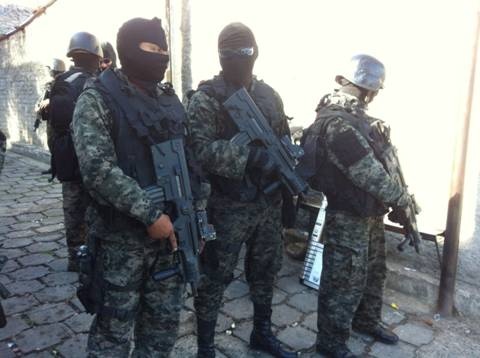
Honduran military police on patrol in Tegucigalpa, Honduras. (Photo: Karen Spring)
teleSUR | May 25, 2015
The 1980s saw widespread political violence and countless forced disappearances in many countries in Latin America, and Honduras was no exception.
Hundreds of political opponents of the 1980s U.S.-backed regime were kidnapped, tortured, and assassinated by the CIA-trained secret army unit Battalion 316, while at the same time Honduras served as a military base and training ground for U.S. counterinsurgency strategy in the region, especially in neighboring El Salvador and Nicaragua.
With the Reagan Administration turning a blind eye to the brutality of Battalion 316, intentionally downplaying or denying its violence in order to continue backing Honduras financially and using the country as a key U.S. military outpost, the details of this death squad’s operations did not become clear until years later. A historic expose published in the Baltimore Sun in 1995, which included interviews with ex-Battalion 316 torturers and details from declassified U.S. government documents, revealed the full extent of the secret unit’s atrocities and its close links to Washington.
However, torture and disappearances aren’t just a tragic reality of the past in Honduras. Human rights defenders have drawn disturbing parallels between Battalion 316 and the present day situation in Honduras, saying the current level of human rights abuses and political repression is just as bad, if not worse than the era of forced disappearances in the 1980s.
In the wake of the 2009 U.S.-backed coup ousting democratically elected President Manuel Zelaya, forced disappearance, torture, and targeted assassinations re-emerged as state terror tactics to intimidate and repress a broad-based resistance. Conspicuous and even conscious links to 1980s tactics since the 2009 coup, as well as ongoing U.S. complicity, show a continuity of state sponsored terror, with new elements for the post-coup context.
Cold War Anti-Communism, Battalion 316, and Spreading Terror with U.S. Support
As U.S. President Ronald Reagan took office in January 1980, the Sandinista revolutionary government was in power in Nicaragua and revolutionary forces were struggling for political control in El Salvador. Honduras was undergoing its so-called transition to democracy with a return to civilian rule. The U.S., already supporting the Guatemalan military’s bloody counterinsurgency efforts for over a decade, played a key role in backing the counter-revolutionary factions of the political struggles gripping the region in civil war, namely Salvadoran government forces and the Nicaraguan Contras.
While Honduras did not have a mass revolutionary guerrilla movement like its neighboring Central American countries, political opposition was criminalized to contain the threat of an armed, popular uprising. Much of this violent work was carried out through forced disappearances by the death squad Battalion 316, the special unit of the Honduran military responsible for political torture and assassinations, with the collaboration of other military branches, special forces, and police.
According to the Honduran human rights organization COFADEH, formed in the 1980s by family members of the disappeared, Battalion 316 was responsible over 180 forced disappearances between 1980 and 1988, and many more were kidnapped and tortured.
Forced disappearance refers to the practice of secretly abducting and murdering victims, making them disappear from society without a trace. Bodies of the disappeared are often carefully hidden, or rendered unrecognizable, to instil fear without the identity of the victim or the perpetrator becoming known..
Battalion 316’s terror was simultaneously covert and public, carried out by disguised agents at times in broad daylight, intended to instill fear and make an example of their victims. Suspected political dissidents were kidnapped, detained in secret jails, and tortured. Sometimes remains of victims were found in ditches. According to the Baltimore Sun expose, torture techniques included electric shock, suffocation, freezing temperatures, and psychological torture as part of interrogation, which sometimes involved CIA agents. Berta Oliva, director of the Committee of Relatives of the Disappeared in Honduras (COFADEH), has said that at least one prisoner was skinned alive in a clandestine Battalion 316 jail.
While the numbers of people disappeared in Honduras was considerably less than in many other Latin American countries during the same period, the hundreds killed and disappeared created a broader fear and terror campaign that had the intended outcome of disempowering the Honduran left.
According to Adrienne Pine, Professor of Anthropology at American University, it’s hard to overstate Battalion 316’s impact.
“The highly publicized disappearance, torture and murder of just under 200 activists, students, journalists and professors in the early 1980s created an atmosphere of terror, effectively crushing any possibility for civic or democratic engagement in Honduras,” she told teleSUR. “As such, it laid the groundwork for the implementation of U.S.-led neoliberal economic policies, of which the Honduran military itself was a primary beneficiary.”
Battalion 316, led in its most brutal years from 1982-1984 by School of the Americas and Argentine-trained head of the Honduran armed forces General Gustavo Alvarez Martinez, was a right-wing project designed to aid the Cold War fight against the alleged threat of communism in the region. Many Battalion agents were graduates of the U.S. School of the Americas (renamed in 2001 to the Western Hemisphere Institute for Security Cooperation) military training center for U.S. allies in Latin America, specializing in Cold War counterinsurgency training. The Battalion itself was trained and financed by the CIA. Meanwhile, Honduras received tens of millions of dollars in U.S. funding throughout the decade, reaching its height of US$77.4 million in 1984.
The secret military unit also received training in Chile under dictator General Augusto Pinochet, as well as from Argentine counterinsurgency forces, at the time deep in their own dirty war against leftist dissidents that claimed some 30,000 victims in Argentina by early the 1980s.
U.S. Ambassador under the Reagan Administration, John Negroponte, is documented to have met frequently with Battalion 316 leader Alvarez Martinez. However, the violence and human rights abuses perpetrated by Alvarez Martinez’s forces are conspicuously absent from the hundreds of cables of records of their correspondence. In 1983, the U.S. awarded Alvarez Martinez the Legion of Merit for “encouraging the success of democratic processes in Honduras,” exposing the true face of U.S. hypocrisy.
U.S. denial of the violent situation in Honduras enabled the ongoing use of the country as a strategic U.S. military base from which to execute counterinsurgency strategy in the region, while the supposed threat of an armed insurgency in Honduras justified the existence of Battalion 316 and its terror.
State Terror Returns: Post-Coup Fear Tactics and Forced Disappearances
After the 2009 military coup against democratically elected President Manuel Zelaya, the ousted president said in an exclusive interview with Democracy Now! that Battalion 316 was “already operating” in Honduras under a different name and using “torture to create fear.”
“There was a tremendous resurgence (after the coup) of death squad activity and assassinations of human rights defenders, trade unionists, campesinos, activists of the resistance of all sorts including journalists, lawyers,” Dana Frank, professor of History at the University of California Santa Cruz, told teleSUR. “It was very rare in the 20 years before the coup for these kinds of assassinations to happen … but it shot up dramatically after the coup.”
The post-coup links to Battalion 316 terror were palpable, both in the vast increase in human rights abuses, including torture, assassinations, and forced disappearances, as well as the direct connections of Battalion 316 personnel offering their expertise to the coup regime.
Former head of the Battalion 316, School of the Americas graduate Billy Joya, became a prominent coup regime spokesperson, advisor, and aide to de facto president Roberto Micheletti. According to COFADEH, many other retired Battalion 316 agents also became government advisors.
Pine, author of “Working Hard, Drinking Hard: On Violence and Survival in Honduras,” said that the numbers of state-sponsored disappearances, tortures, and extrajudicial killings since the coup have far exceeded those of the 1980s.
With striking similarity to the fear campaign of the 1980s, COFADEH documented in 2010, along with dozens of other death threats and assassinations, that a former Battalion 316 agent publicly threatened resistance activist Candelario Reyes with forced disappearance and death, saying that killing such a “communist dog” would make the “best example” for other resistance activists.
“You can see the continuity with some of these individuals including the references to the 80s that are conscious references,” said Frank. “It’s terror, it’s deliberately spreading terror.”
Harkening back to 1980s terror was a deliberate strategy to instil fear in perceived political threats. In 2012, COFADEH human rights defender Dina Meza received a series of threats of death and sexual violence by text message signed with the initials CAM, standing for Comando Alvarez Martinez, early 1980s head of Battalion 316 responsible for grave human rights abuses. According to Amnesty International, CAM was used as a pseudonym in numerous death threats against journalists and activists in the wake of the coup.
According to Frank, an expert on human rights and U.S. foreign policy in Honduras, the clearest and most alarming examples of post-coup strategies that follow the model of Battalion 316 are the TIGRES special units of the police force and FUSINA inter-agency task forces that bring together military, police, military police, prosecutors, and other government officials under military control.
FUSINA was initially headed by School of the Americas graduate Colonel German Alfaro, former commander of Battalion 15, the military unit in the Aguan Valley region implicated in dozens of post-coup murders of campesino activists. Trained by the FBI, DEA, and U.S. Marines, FUSINA is not only troubling for its conglomeration of agency functions under a military mandate, but also for its U.S.-enhanced intelligence capacities.
COFADEH denounced TIGRES as a “crude resurrection” of Battalion 316’s political disappearances, murder, and “criminal behaviour.”
These new constellations of state and military power, designed and deployed to create fear and contain political dissent, have again had a deep social and political impact in Honduras.
“A combination of the ‘soft power’ of USAID and NED-funded (so-called pro-democracy) programs on the one hand, and death squads within the police, the military, and now the military police have succeeded in destroying the post-coup resistance movement,” explained Pine. “This is what makes possible the neoliberal plunder of the country currently underway.”
A Different Pretext for Familiar Terror Tactics
But while there are clear continuities between the 1980s and post-coup strategies, there are also important differences.
Despite the fact that the armed left was a very small faction in Honduras, particularly in comparison to the revolutionary uprising in neighboring countries, Battalion 316’s violence was committed in the name of counterinsurgency. As Frank explains, the broad based nature of the post-coup popular resistance means that the victims of extrajudicial killings and forced disappearances have been from a more diverse cross-section of society than the 1980s campaign against suspected revolutionary leftists.
Now, with the pretext of an alleged communist armed struggle no longer relevant, post-coup repression, including use of these historical counterinsurgency tactics, and U.S.-backing of a violent regime is framed in different terms.
“The pretext now is drug trafficking,” said Frank. “The drug war has been the frame within which the United States government has legitimated support for repression by state security forces in Honduras and increased funding for them.”
And while the U.S. goal of maintaining a regional base of power amidst the threat of emerging or consolidating leftist alternatives remains much the same, the political context in the region has significantly changed.
“The larger context is the many democratically elected center and center-left governments all over Latin America that the United States is threatened by because they aren’t going to pay obeisance to United States power,” said Frank. “The United States wanted to lock down its power in Honduras so that it can maintain what has long been the most captive nation in Latin America.”
In the process, the U.S. also promotes the interests of transnational corporations that are making a killing from state-sponsored death squads that suppress resistance and pave the way for capitalist exploitation of land, labor, and indigenous and campesino resources.
“With the consolidation of neoliberal corporate capital, Honduran and U.S. politicians are more beholden to their sponsors than they were three decades ago,” explained Pine. “Hondurans today suffer not just from the terror of death squads but from the ravages of three decades of the implementation of neoliberal policy made possible by death squads, which makes them that much more vulnerable.”
COFADEH: Seeking Justice, Truth, and Respect for Human Rights
Bertha Oliva, director of COFADEH, lost her husband Tomas Nativi to forced disappearance by Battalion 316. Nativi was taken from their home by masked agents in 1981 and has never been seen again.
Over the year after Nativi’s disappearance, Oliva came to realize that she was not alone, and others had similar experiences of family members being disappeared. In 1982, 12 of these families came together to form COFADEH with the clear objective of bringing back alive family members who had been disappeared. In the majority of cases throughout the 1980s while Battalion 316 was operating, COFADEH did not succeed in their goal.
After the 1980s, COFADEH broadened its scope as an organization not only committed to seeking justice for the families of the disappeared and truth for Honduran society, but also representing and defending victims of human rights abuses, documenting cases, and providing training to raise awareness about human rights.
The creation of COFADEH was, in its own words, a “concrete action” in the face of the inactivity of the state to ensure “the right of victims to live and to have due process, among other rights that have been violated.”
COFADEH has continued to play a key role in documenting and denouncing human rights abuses and demanding justice, particularly once again in the years since the coup.
US Backtracks, Says Venezuela is Not a Threat, as Opposition Leaders Flock to Panama Summit
By Lucas Koerner | Venezuelanalysis | April 8, 2015
Caracas – On the eve of the much-anticipated Summit of the Americas, Senior White House Advisor Benjamin J.Rhodes downplayed his government’s designation of Venezuela as a threat to U.S. national security on Tuesday.
On March 9, President Obama issued an Executive Order branding Venezuela an “unusual and extraordinary threat” and imposing new sanctions, a move which has been roundly condemned by a multitude of nations and multilateral blocs, including UNASUR, the Non-Aligned Movement, CELAC, and the G77+China.
In response to the global outcry, the White House has appeared to soften its tone, with Rhodes dismissing the aggressive language of the Executive Order as “completely pro forma”.
“The United States does not believe that Venezuela poses some threat to our national security,” Rhodes stated in a press conference. The Presidential advisor did not, however, indicate that the U.S. administration had any intention of rescinding the executive decree.
The White House statement comes just days prior to the Summit of the Americas in Panama, which may mark a new chapter in U.S.-Latin American relations as the former continues to rebuild diplomatic ties with Cuba.
However, this supposed watershed moment has been vastly overshadowed by the Obama administration’s aggressive measures against Venezuela which have united the region behind Caracas and are likely to be a key point of contention at the summit.
Venezuelan President Nicolas Maduro has launched a petition campaign to gather 10 million signatures demanding the repeal of Obama’s Executive Order, of which 9 million have been collected so far. The Venezuelan head of state intends to personally deliver the signatures to the U.S. president during the summit this weekend.
Opposition Leaders Seek to Discredit Venezuela
While the U.S. attempts to downplay its aggressive posture against Venezuela, Venezuelan opposition leaders head to Panama where they plan to denounce the Bolivarian nation before the gathering of regional leaders.
The Panama summit will feature various parallel fora that will give “civil society” leaders the opportunity to present on the political and social situation in their respective countries.
Lilian Tintori, the wife of jailed far right opposition leader Leopoldo Lopez, will be given four minutes to present on Venezuela, which she claims is “on the verge of a humanitarian catastrophe“. Lopez, awaits trial for his role in leading last year’s violent opposition protests known as “the Exit” which sought the ouster of President Nicolas Maduro, taking the lives of at least 43 people.
Also attending is Rocio San Miguel of Citizen Control, who is a journalist specializing in military affairs closely linked to the U.S. embassy and various programs of USAID. She has actively worked to discredit President Nicolas Maduro’s relationship with the Venezuelan military as well as coordinates the provision of U.S. funds to anti-government groups.
Representing the Civil Consortium for Development and Justice, attendee Carlos Ponce Silen is the director of the Latin American and Caribbean Network for Democracy (RELIAL), which funnels the millions it receives in National Endowment for Democracy (NED) funding to Venezuelan opposition groups.
According to U.S. embassy cables published by Wikileaks, Ponce Silen organized a meeting between the U.S. Agency for International Development’s (USAID) acting country representative and right wing student leaders in 2008.
Participating on behalf of the Venezuelan Institute of Social and Political Studies (INVESP) is Carlos Correa, director of the NGO Public Space, which has been revealed by a Freedom of Information Act request to be one of the principal fronts for over $4 million in NED funds channelled to Venezuelan opposition journalists between 2008 and 2010.
The Venezuelan opposition has received hundreds of millions in U.S. funding over the past decade, including $14 million between 2013 and 2014 alone, provided via USAID and the NED.
How the US Funds Dissent against Latin American Governments
teleSUR | March 12, 2015
“A lot of what we do today was done covertly 25 years ago by the CIA.”
NED founding father, Allen Weinstein
The U.S. government and military have a long history of interfering in the affairs of numerous countries in Latin American and the Caribbean.
By the end of the 19th century, there had been at least 10 U.S. military interventions across the hemisphere including Argentina (1890), Chile (1891), Haiti (1891), Panama (1895), Cuba (1898), Puerto Rico (1898) and Nicaragua (1894, 1896, 1898 and 1899).
From this time onward, successive U.S. administrations applied different strategies and tactics for involvement in the region as a means to secure and protect its geopolitical and economic interests. However, only recently has there been wider acknowledgement about the role that U.S. funding to nongovernmental organizations, or NGOs, particularly from the National Endowment for Democracy (NED) and the United States Agency for International Development (USAID), plays in furthering U.S. foreign policy. For example, in 2012 governments of the Bolivarian Alliance for the Peoples of Our America (ALBA) collectively signed a resolution to expel USAID from each of the signing countries. Those countries included Bolivia, Cuba, Ecuador, Dominica, Nicaragua, and Venezuela.
The National Endowment for Democracy (NED)
Created by the administration of former U.S. President Ronald Reagan in 1983, the NED operates as a foundation that provides grants for “democracy promotion.” The foundation is structured as an umbrella with an almost corporatist flavor, housing four other organizations reflecting U.S. sectoral and party interest: the U.S. labor affiliated American Center for International Labor Solidarity (ACILS) and Chamber of Commerce linked Center for International Private Enterprise (CIPE), along with the National Democratic Institute for International Affairs (NDI) and the International Republican Institute (IRI), both of which reflect Democrat and Republican affiliations, respectively.
In many ways the NED resembles previous CIA efforts in the 1950s, 60s and 70s to provide mostly public money for secret operations aimed to bolster pro-U.S. governments and movements abroad. In South America for example, between 1975 and 1978 the U.S. helped with the creation and implementation of Operation Condor. The U.S. provided right-wing dictatorships in Argentina, Bolivia, Brazil, Chile, Paraguay, Uruguay, Colombia, Peru, Venezuela and Ecuador with technical and military support for the goal of hunting down and killing political opponents. Some estimate that Operation Condor killed between 60,000 and 80,000 people.
In 1986, then president of the NED Carl Gershman explained to the New York Times, “We should not have to do this kind of work covertly … It would be terrible for democratic groups around the world to be seen as subsidized by the C.I.A. We saw that in the 60s, and that’s why it has been discontinued. We have not had the capability of doing this, and that’s why the endowment was created.”
U.S. citizens unknowingly fund the NED with public money. The U.S. government allocates part the budget of the United States Agency for International Development (USAID) under the U.S. State Department to the NED – which is most of the NED’s funding source. Although it receives practically all of its funding from the U.S. government, the NED is itself an NGO headed by a Board of Directors. The current board includes:
- Political economist, author and free market universalist Francis Fukuyama,
- Elliott Abrams, former deputy assistant and deputy national security adviser on Middle East policy in the administration of President George W. Bush,
- Moises Naim, Venezuelan Minister of Trade and Industry during the turbulent early 1990s and former Executive Director of the World Bank, and
- Former Deputy Secretary of State under George W. Bush (2005 – 2006) and Vice Chairmanship at Goldman Sachs Group, Robert B. Zoellick.
The scope of activity of the NED is truly impressive. According to the NED website, it supports more than 1,000 NGO projects in more than 90 countries.
At its inception in the early 1980s, its funding allocation was set at US$18 million and reached its peak in the late 1990s and early 2000s. Allocations for 2014 and 2015 have been approved for US$103.5 million, while over US$7 million was directed primarily to opposition organizations in Ecuador, Bolivia, Venezuela and Cuba in 2013.
Within the U.S. State Department Justification of Request documents which outline the reasons for funding requests, it is clear that funding priorities in Latin America and the Caribbean reflect the NED’s modern strategy of overtly carrying out old covert objectives.
Michel Chossudovsky, a professor emeritus of economics at the University of Ottawa in Canada, sees this funding as an element in “manufacturing dissent” against governments that the U.S. government dislikes. However, these funders do not work alone. “The NED (and USAID) are entities linked with the U.S. state department, but they operate in tandem with a whole of other organizations,” said Chossudovsky.
In May 2010 the Foundation for International Relations and Foreign Dialogue released their report Assessing Democracy Assistance in Venezuela which revealed that in addition to NED and USAID funding, a broad range of private and European based foundations funded opposition-aligned NGOs in the country with between US$40-50 million annually.
According to Dan Beeton, International Communications Director at the Center for Economic and Policy Research (CEPR) in Washington, D.C., NED funds in Latin American have been directed at “a lot of what are kind of the old guard political entities that are now kind of discredited,” such as the Trade Union Confederation of Venezuela (CTV), which was instrumental in the 2002 coup in Venezuela, as well as older political parties that are now marginal forces in their country’s political landscapes in spite of their considerable outside funding.
The United States Agency for International Development
Created in 1961 as a foreign assistance program under President John F. Kennedy, USAID commands a much larger budget and broader scope than NED. While U.S. diplomats continue to stress that USAID funding does not have a political basis, USAID documents nonetheless acknowledge its role in “furthering America’s interests” while carrying out “U.S. foreign policy by promoting broad-scale human progress at the same time it expands stable, free societies, creates markets and trade partners for the United States.” But critics are skeptical of USAID’s missionary work, noting how their strategy has changed over time.
“(USAID’s) mandate is to provide development aid and historically it has provided development aid, tied into debt negotiations and so on. Subsequently with the evolution of the development aid program it has redirected its endeavours on funding NGOs,” said Chossudovsky.
While the range of activities undertaken by NGOs can be broad and some of these programs may not have political intentions, Beeton nonetheless argues that this funding “ultimately can and often does serve a political end when the U.S. wants these grantees to help it fulfill its goals in these countries.”
The extent of U.S. political ambitions recently came into the international spotlight with the revelation that USAID had secretly spent US$1.6 million to fund a social messaging network in Cuba called ZunZuneo, with the stated purpose of “renegotiat(ing) the balance of power between the state and society.” The project was headed up by Joe McSpedon of the USAID’s Office of Transition Initiatives (OTI).
Other USAID officials accused of active political meddling in the affairs of sovereign countries include regional head Mark Feierstein. According to Venezuelan investigative journalist Eva Golinger, in 2013 Feierstein met Venezuelan opposition figures including right-wing politicians Maria Corina Machado, Julio Borges and Ramon Guillermo Avelado as well as political strategist Juan Jose Rendon to devise a plan to undermine the Venezuelan government.
At the State Department budgetary hearing, Feierstein also confirmed “a long-standing program in place to support those who are advocating and fighting on behalf of democracy and human rights in Venezuela … and we are prepared to continue those under any scenario.”
State Department cables revealed by WikiLeaks also brought to light previous activities by USAID/OTI in Venezuela, including the development of a five point, anti-government strategy for U.S. embassy activities, as well as the confirmation that grantees had been active in promoting street demonstrations in 2009.
Machado, a former anti-Chavista National Assembly member, was among the signatories of the Carmona decree following the Venezuelan coup in 2002, which abolished the legislative and judiciary powers, as well as the constitution. She was also among the most prominent promoters of last year’s opposition violence that claimed the lives of 43 people.
In Bolivia, local rural workers’ groups and the government expelled the U.S.-based Chemonics International Inc. after their US$2.7 million USAID-funded “Strengthening Democracy” program was accused of financing destabilization attempts against the government. Chemonics operates in approximately 150 countries, offering various technical services and “consulting.”
The Bolivian government publicly outlined what they argued was proof of USAID-funded programs to mobilize the indigenous population against the government, in particular an indigenous march protesting the construction of a highway. USAID funded programs were active in these areas, and had funded some of the leading organizations such as the Eastern Bolivia Indigenous Peoples and Communities Confederation (CIDOB).
“USAID refused to reveal who it was funding and the Bolivian government had strong reasons to believe that it had ties and coordination with opposition groups in the country which at the time was involved in violence and destructive activities aimed at toppling the Morales government,” said Beeton. “Now we know through WikiLeaks that that’s what really was going on.”
President Evo Morales also revealed transcripts of phone calls between the anti-highway march organizers and U.S. embassy officials. The U.S. embassy confirmed the calls, but explained that they were merely trying to familiarize themselves with the country’s political and social situation.
Officials also denounced the lack of accountability to the Bolivian government or to the recipient constituencies of USAID funds.
The head of the Eastern Bolivia Indigenous Peoples and Communities Confederation (CIDOB), Lazaro Taco, confirmed that they had received “external support for our workshops,” but would not identify the source.
These and other USAID activities led Bolivian President Evo Morales to claim that the agency was conspiring against his government. The government expelled USAID from the country in May 2013, while USAID denied any wrongdoing.
In June of 2012, an Ecuadorian daily revealed that 4 NGOs based in Ecuador were recipients of over US$1.8 million for a project called Active Citizens, whose political bend was critical of the Correa government.
Shortly afterwards, the Technical Secretariat for International Cooperation (Seteci) of Ecuador announced it would also investigate the “Costas y Bosques” (Coasts and Forests) conservation project, which received US$13.3 million in funding from USAID. The project, based in the provinces of Esmeraldas, Guayas and Manabí, was also being undertaken by the Chemonics International Inc, the same organization expelled from Bolivia.
Mireya Cardenas, National Secretary of Peoples, Social Movements and Citizen Participation, said that “there is every reason to consider USAID a factor of disturbance that threatens the sovereignty and political stability (of Ecuador)”. While the U.S. Ambassador in Ecuador Adam Namm tried to reassert that USAID did not fund political parties, he did confirm that certain opposition groups such as Fundamedios was funded “indirectly.”
In November 2013 the Ecuadorean government sent a letter to the U.S. embassy in the country’s capital Quito, ordering that “USAID must not execute any new activity” in Ecuador. USAID canceled its aid shortly after.
For Beeton, “lack of transparency is probably the biggest problem (with USAID) in that it really prevents the governments in the host countries from finding something objectionable, or even coordinating better”. This was in large part the principle concern from the Ecuadorian Seteci, who questioned the extent of expenditures on certain project and the lack of coordination.
In the wake of the devastating 2010 earthquake, CEPR conducted an extensive evaluation of USAID funding to Haiti, including the history of funding, and found transparency and coordination with local government to be a significant problem, especially when the local government experienced tensions with U.S. foreign policy.
“The U.S. government has been perfectly happy to not coordinate with governments, and that has a lot to do with politics… it was under [former Haitian President] Aristide really saw a lot of assistance bypass the Haitian government and go to NGO, including violent opposition groups and so called democratic opposition groups much like what you are seeing recently in Venezuela and Bolivia,” said Beeton.
For 2013, the combined NED and USAID allocations for Cuba, Venezuela, Ecuador and Bolivia alone totaled over US$60 million, with the bulk of these funds destined to Cuba and Ecuador. For the government and progressive social movements of these countries, there is a growing concern that these funds could be used to undertake what Chossudovsky qualified as a “consistent process of destabilizing government as part of non-conventional warfare, meaning you don’t send in the troops but you destabilize the government through so called colored revolutions or infiltrations.”
Featured Video
Yemen joins the war – Red Sea could be blocked next – Saudi regime at risk
or go to
Aletho News Archives – Video-Images
From the Archives
A superpower and “the world’s sickest warrior state”
By Paul J. Balles | March 8, 2010
Living through five or six major wars has hardened me to what I thought were the extremes of inhuman cruelty and brutality.
Two things made those extremes almost bearable: the brutality always revealed – at least according to the media coverage – the viciousness of the enemy. It was therefore quite understandable when our “brave men and women” pulverized the enemy.
Films of Japanese torturing captive Americans somehow justified holding Japanese Americans in internment camps during World War II; and only a small percentage of Americans found the bombing of Hiroshima and Nagasaki unreasonably vengeful at best, at worst, depraved.
The media giants in America portrayed the North Koreans as barbaric beasts with their captives, quite unlike their southern counterpoints – our allies during the Korean War. No one ever felt the need to explain how the South Koreans were a civilized breed while the North Koreans were absolute savages, at least according to the official line.
In Vietnam, our warriors justifiably (or so the media made us believe) dropped napalm on the North Vietnamese who had the gall to hide in villages and tunnels to ravage our invaders. At least it was accepted practice until some rogue photojournalist filmed a young girl screaming down a Vietnamese road in flames. … continue
Blog Roll
 Aletho News
- America Racing to Strategic Defeat in Iran: Lt Col Daniel Davis
- FTC Warns Visa, Mastercard, PayPal, Stripe Over Political Debanking
- Russian tanker approaches Cuba despite US oil blockade
- Marandi: Yemen joins the war – Red Sea could be blocked next – Saudi regime at risk
- Pro-Palestinian French member of European Parliament denied entry to Canada
- Pakistan to Host US-Iran Talks
- How Indonesia’s tilt toward the US left it stranded in the Strait of Hormuz
- US has no choice but to retreat from Iranian borders: Top commander
- Iran Retaliation Strikes Chemical Plant Near Dimona
- AWACS’ Destruction is a Major Loss for US Military – Ex-DoW Analyst
- If Americans Knew
- Israeli police block Catholic cardinal from entering Church of the Holy Sepulchre on Palm Sunday
- Israel is assassinating journalists again, more than any other nation, anywhere, ever – Not a ceasefire Day 170
- Over 300 US service members wounded, majority have brain injuries – Not a ceasefire Day 169
- Researchers at Human Rights Watch Resign Over Blocked Report on Palestinian Refugee Return
- Jewish Groups Are Backing a War Americans Don’t Want
- Eric Fingerhut Thinks He’s the President of the Jews
- Top Jewish Philanthropists, Rabbis Urge Israeli President to Take Action Against ‘Jewish Extremists’
- Don’t Be Fooled. Zionist Leaders Have Always Wanted to Control Southern Lebanon
- Israel’s widespread use of torture is a core element of its genocide against the Palestinian people
- In Israel’s War on Iran, Many Middle East US Bases Rendered “All But Uninhabitable”
- No Tricks Zone
- New Study Finds Warming Saves Lives…Cold Temperatures 12 Times More Deadly Than Excess Heat
- German Science Blog Accuses PIK Climate Institute Of Hallucinating Climate Tipping Points
- Devastating Assessment Of Comirnaty Vaccine By Former Senior Pfizer Europe Toxicologist
- New Study: CO2 Is ‘Effectively Negligible’ As An Explanatory Climate Change Factor Since 2000
- Former Pfizer Toxicologist Dr. Helmut Sterz Tells Bundestag Hearing Pfizer Vaccine Should Have Never Been Approved
- Energy Expert: Germany’s Nuclear Phaseout Was A “500 Billion Euro Mistake”
- New Research: South Australia’s Mid-Holocene Sea Surface Temperatures Were 4°C Warmer Than Today
- Storing Green Energy To Last Germany 10 Days Would Require A 60-Million Tonne Battery
- New Studies: UK Sea Levels Were 4 Meters Higher Than Today During The Mid-Holocene
- Destructive Green New Deal: German Energy And Metal Group Warns Of Drastic Crisis
 Aletho News