Deep-state forces from abroad instigated violence in Nepal – former foreign minister
RT | January 13, 2026
External deep-state forces were instrumental in instigating the September 2025 violence in Nepal that led to the ouster of the government, its former foreign minister has told RT India.
K.P. Sharma Oli resigned as Nepal’s prime minister after violent clashes – known as the Gen Z protests – killed 77 and injured more than 2,000. Pradeep Kumar Gyawali, a former foreign minister, has now backed Oli’s assertion that Gen Z protests that led to the ouster of the government were backed by external forces.
“Those elements who were actively engaged with the deep state, who used the cross-border misinformation and disinformation to instigate the violence, they were active,” he told RT India in an exclusive interview.
The remarks came after Oli told RT India about external influences in the uprising last year.
Gyawali said Kathmandu’s growing engagement with India and China and its aspiration of being a bridge for the economic development of Nepal between the two neighboring countries “was not a very good message to some powers.”
He added, “[They] wanted to use Nepal’s geostrategic location for their policy in their favor. So maybe our engagement with our neighboring countries may have some grievances to the big powers as well.”
The Grayzone has cited leaked documents to reveal that the US government’s National Endowment for Democracy (NED) had spent hundreds of thousands of dollars tutoring Nepalese young people to stage the protests.
The Gen Z protests happened as the US sought to neutralize Chinese and Indian influence over Kathmandu, Grayzone investigations revealed.
The NED is officially a US State Department-funded nonprofit that provides grants to support ‘democratic initiatives’ worldwide.
The International Republican Institute (IRI), a NED division, has been accused of funding clandestine activities in Bangladesh and Sri Lanka, apart from funneling tens of millions of dollars to Ukrainian political entities and anti-Russian interests.
US-backed regime-change agency funded Nepal coup – media
RT | December 12, 2025
A US-backed regime-change agency funded and guided the September coup in Nepal, an independent US news outlet reports.
K.P. Sharma Oli resigned as prime minister in September amid violent clashes – known as the Gen Z protests – across the Himalayan nation. The clashes killed 77 and injured more than 2,000.
US-based news outlet The Grayzone cited leaked documents revealing that the US government’s National Endowment for Democracy (NED) spent hundreds of thousands of dollars tutoring Nepalese young people to stage the protests.
The protests caused more than $586 million in losses to Nepal’s $42 billion economy, a statement from the office of interim Prime Minister Sushila Karki, a former chief justice who succeeded Oli, said on Friday, according to Reuters.
The documents cited by The Grayzone reveal a clandestine campaign organized by an NED division, the International Republican Institute (IRI).
The IRI sought to cultivate a Nepalese network of young political activists explicitly designed to “become an important force to support US interests,” it said.
The documents say the IRI’s program “connects vibrant youth… and political leaders” and “provides comprehensive trainings on how to launch advocacy campaigns and protests,” The Grayzone reported.
The IRI has been accused of funding clandestine activities in Bangladesh as well.
Founded in 1983, the NED is officially a US State Department-funded nonprofit that provides grants to support ‘democratic initiatives’ worldwide. It has faced allegations of covertly influencing political outcomes, with critics arguing that it has taken over covert functions previously handled by the CIA, particularly those aimed at overthrowing foreign governments.
The organization has long faced criticism for its role in supporting political movements that undermine sovereign governments.
The Center for Renewing America, a think tank, accused the NED of funneling tens of millions of dollars to Ukrainian political entities and anti-Russian interests.
Kyrgyzstan’s Forgotten Colour Revolution
By Kit Klarenberg | Global Delinquents | November 6, 2025
October 5th marked the 25th anniversary of the world’s first “colour revolution”, in Yugoslavia. A lavishly-funded, multi-pronged CIA, NED and USAID campaign exploited civil society actors, in particular youth groups, to dislodge President Slobodan Milosevic from power. Such was the effort’s success, US officials and media openly boasted about Washington’s central role. A slick ‘documentary’ on the unrest, Bringing Down A Dictator, was even produced. Milosevic’s fall also provided a blueprint for countless future ‘soft coups’, which continue to this day.
So it was, one by one in the early 2000s, insufficiently pro-Western governments throughout the former Soviet sphere were toppled using strategies and tactics identical to those deployed against Belgrade. A common ruse was for the US to fund, via local NGOs, a “parallel vote tabulation” to project an election’s outcome in advance, and publicise the data before results were officially announced. As in Yugoslavia, PVT figures differing from formal tallies were the spark that ignited Georgia’s 2003 ‘Rose Revolution’, and Ukraine’s 2004 ‘Orange Revolution’.
Over subsequent years, much has been written by academics, historians and independent journalists about those colour revolutions. Conversely, Kyrgyzstan’s 2005 ‘Tulip Revolution’ has gone almost entirely unremarked upon, and is largely forgotten now. Yet, its destructive consequences reverberate today. Hitherto the freest and most stable state in Central Asia, post-colour revolution Bishkek careened from crisis to crisis, with multiple governments collapsing along the way. It’s only in recent years – following another Anglo-American coup in 2020 – the country has regained its economic, political, and social balance.
Pre-2005, Kyrgyzstan was not an obvious colour revolution candidate. Upon its 1991 independence from the Soviet Union, the country quickly established itself not only as the most democratic and open in the region, but a dependable US ally. President Askar Akayev, a former scientist with zero political background, was organically popular, and moreover made clear his economic policies were informed by arch-capitalist Adam Smith, not Karl Marx. In other words, Bishkek was primed to do business with the West.
Akayev moreover allowed a relatively free media to develop, and welcomed widespread foreign civil society penetration. Thousands of European and US-funded non-governmental organisations duly opened up shop locally. At one stage, the President quipped, “if the Netherlands is a land of tulips, then Kyrgyzstan is a land of NGOs.” His comments proved bitterly ironic, given the title of the colour revolution that eventually unseated him. In another deeply sour twist, it was precisely Akayev’s welcoming of Western financial and societal infiltration that was his undoing.
A self-laudatory USAID factsheet on the President’s removal notes, from 1994 onwards $68 million was funnelled into Kyrgyzstan. This vast windfall was used to train NGOs “to lobby government,” finance “private newspapers” critical of Akayev, establish an “American University” locally, and much more besides. The Tulip Revolution stands today as a stark warning to governments the world over of the dangers of permitting such entities to operate on their soil with impunity – and how often, even pro-Western leaders can fall victim to their mephitic influence.
‘Defeat Dictators’
Despite much goodwill built up since 1991, in October 2003 Akayev angered Washington by inviting Moscow to open an airbase not far from Bishkek, and just a few dozen kilometres from the Empire’s vast Manas military installation, one of a cluster constructed by the US across Central Asia post-9/11 to facilitate the War On Terror. Such insubordination was sufficient to mark the President for removal, and preparations for a colour revolution according to a by-then well-honed formula began almost immediately.
Akayev was not unwise to this risk, warning in December 2004 of an “orange danger” of the kind that had just engulfed Ukraine threatening Kyrgyzstan, in advance of the country’s elections in February the next year. As it was, the results were far too clean to allege rigging or other shenanigans, as with prior colour revolutions. A detailed investigation by the European Network of Election Monitoring Organizations in fact praised a “positive… lack of reports of vote-buying, voter intimidation, and harassment of journalists.”
Washington’s vast local standing army of civil society insurrectionists began causing havoc anyway. Some operated under the banner of KelKel, a group directly inspired by US-sponsored revolutionary youth factions in Yugoslavia, Georgia and Ukraine, and trained by their alumni. Moreover, as the Wall Street Journal revealed just before the elections, an ostensibly “independent” local printing company in receipt of Freedom House, NED, Soros and USAID cash was responsible for publishing a panoply of opposition pamphlets.
Days earlier, the firm’s electricity was cut off by local authorities. Kyrgyzstan’s US embassy “stepped in with emergency generators” to maintain its anti-government propaganda deluge. This included a prominent newspaper that published “front-page photos of a palatial mansion purportedly owned by the President and of a boy in a decrepit alleyway,” highlighting state embezzlement versus citizen poverty. Another was a handbook produced by CIA-connected Gene Sharp, From Dictatorship to Democracy, dubbed “the bible” of Ukraine’s US-sponsored youth activists at the forefront of the Orange Revolution.
This “manual on how to defeat dictators, including tips on hunger strikes and civil disobedience,” includes guidance “on nonviolent resistance – such as ‘display of flags and symbolic colors’.” However, the protests that instantly erupted after the elections were highly belligerent from inception, with bomb attacks, police pelted with bricks and beaten with sticks, and government buildings torched and forcibly occupied. The New York Times contemporaneously acknowledged broadcasts by US-funded local TV stations inspired violence in certain areas of Kyrgyzstan.
Upheaval raged for weeks, prompting a personal intervention from UN Secretary General Kofi Annan, who expressed significant alarm over “the use of violence and intimidation to resolve electoral and political disputes.” He welcomed Akayev’s invitation to instigate dialogue with protesters. They demanded he resign instantly – despite the President having already pledged before the election to do so in October that year. In March, Akayev acquiesced and stood down, replaced by Kurmanbek Bakiyev.
‘Terribly Disappointing’
Bakiyev’s seizure of power was initially framed by Western journalists, politicians and pundits as a sparkling victory for people power, and the dawning of a new era of democracy and freedom in Kyrgyzstan. Yet, five years later, he fled the country, following mass protests over his savage, corrupt rule. The tipping point for Bakiyev’s ouster was the April 7th 2010 mass shooting of demonstrators by security forces, which killed up to 100 people and wounded at least 450 more.
As Forbes recorded at the time, the level of graft under his Presidency was “mind-boggling”. Bakiyev appointed close relatives to key positions, allowing his family to profit handsomely from legally questionable privatisation of state industries, and supply of fuel to Washington’s Manas base. Bakiyev’s son Maxim, who oversaw the latter, was described by US diplomats in leaked cables as “smart and corrupt.” By some estimates, companies he ran reaped $1.8 billion from these deals, close to Kyrgyzstan’s total GDP in 2003.
Meanwhile, Bakiyev’s brother Zhanysh ran Bishkek’s security apparatus with an iron fist. Harsh restrictions on political freedoms were enacted, while arbitrary detentions, bogus convictions, torture, and killings of opposition activists, journalists, and politicians became commonplace. For example, in March 2009 Bakivey’s former chief of staff Medet Sadyrkulov died in an alleged road traffic accident. It was later revealed he was brutally slain upon Zhanysh’s order. That December, dissident reporter Gennady Pavlyuk was murdered, thrown out of a sixth-floor apartment with his arms and legs bound.
Bishkek’s Tulip Revolution wasn’t unique in producing such horrors. A March 2013 essay in elite imperial journal Foreign Policy acknowledged the results of every US-orchestrated government overthrow in the first years of the new millennium were “terribly disappointing”, and “far-reaching change never really materialized” resultantly. This is quite an understatement. Most target countries slid into autocracy, chaos and poverty as a result of Washington’s meddling. It has typically taken years for the damage to be corrected, if at all.
Still, despite this disgraceful legacy, the US appetite for fomenting colour revolutions – and the willingness of groomed citizens, particularly youth, the world over to serve as Washington’s regime change footsoldiers – remains undimmed. In September, Nepal’s elected government was overthrown by disaffected ‘Gen Z’ activists, with the full support of the country’s powerful military. The palace coup bore all the hallmarks of a colour revolution. Who and what will replace the felled administration still remains far from clear.
As a September 15th New York Times editorial noted, “Nepalis from all walks were ready to reject the system they had fought for decades to achieve,” but lack “any clear sense of what comes next.” There is an extraordinary political vacuum in Kathmandu presently, which elements within the country are seeking to exploit for malign ends. As before, Nepal’s “revolution” is likely to produce a government far worse than that which preceded it.
Nepal’s color revolution: US funding under scrutiny amid country’s political upheaval
By Kit Klarenberg | Press TV | September 17, 2025
In recent weeks, Nepal has been engulfed in chaos. Public and private buildings have been set ablaze, and dozens of civilians have been killed in incidents that many believe bear the imprint of Western involvement.
On September 9, Prime Minister K. P. Sharma Oli resigned. The Western media has universally framed the upheaval as spontaneous revolutionary fervour on the part of Kathmandu’s “Gen Z”, motivated by anger over official corruption, unemployment, state efforts to censor social media, and more.
However, there are unambiguous indications that the insurrectionary disarray has been long in the making and assisted by spectral, foreign forces.
The so-called “Gen Z” protests comprise a cluster of local youth activist groups, and are widely dubbed “leaderless”, although Hami Nepal has clearly emerged at the movement’s forefront.
English language Nepali Times has reported that the hitherto unknown NGO “played a central role in guiding the demonstrations, using its Instagram and Discord platforms to circulate protest information and share guidelines.”
The group was established to assist victims of earthquakes – a common occurrence in the country – and provide food, medical and other aid to disadvantaged Nepalese communities.
Subsequently, Hami Nepal oversaw the election of Kathmandu’s interim premier Sushila Karki on September 12, via the highly unorthodox and completely unprecedented expedient of an online vote via Discord.
The NGO’s chat group reportedly boasts 145,000 members, although it’s unclear how many people ultimately voted for Karki. The Western media, and local journalist Prayana Rana, a fervent supporter of the unrest who considers the palace coup to be wholly legitimate and organic, has acknowledged choosing a leader in this manner to be deeply problematic:
“It is much more egalitarian than a physical forum that many might not have access to. Since it is virtual and anonymous, people can also say what they want to without fear of retaliation. But there are also challenges, in that anyone could easily manipulate users by infiltration, and using multiple accounts to sway opinions and votes.”
Still, Karki has firmly pledged to only serve six months in the post until elections are held. She herself has an impressive revolutionary history, having participated in the 1990 People’s Movement that successfully overthrew Nepal’s absolute monarchy, for which she was jailed.
In June 1973, her husband hijacked a plane, stealing vast sums of money to fund armed resistance against the country’s brutal regime, which similarly landed him in prison. Karki’s commitment to seriously tackling corruption as Nepal’s Chief Justice led to her politically-motivated impeachment in June 2017, after just one year.
It is entirely uncertain who or what will replace Karki, and by which mechanism they will attain office. Nonetheless, that Hami Nepal, a previously obscure NGO with no history of political activism, has played such an outsized role in ousting the government of a country of 30 million people and installing its new ruler within mere days, should give us pause.
While the organization’s activities appear benevolent, its rollcall of “brands that support us” contains some puzzling entries, if not outright concerning.
Anonymous profiles
It is unclear what forms of “support” Hami Nepal has received from its sponsors, or when it was provided, but they run quite the gamut. For one, the list includes luxury Western hotels in Kathmandu, clothing and shoe brands, local conglomerate Shanker – the country’s biggest private investor – messaging app Viber, and Coca Cola, notorious for its complicity in countless human rights abuses in the Global South. Elsewhere, the Gurkha Welfare Trust appears.
The Gurkhas have for centuries served as an elite, unique force within the British Army, often tasked with sensitive missions. The Trust, which provides financial aid to Gurkha veterans, their widows and families, is financed by the British Foreign Office and Ministry of Defence.
Meanwhile, Students for a Free Tibet is also listed. The NGO receives funding from the National Endowment for Democracy, an avowed CIA front. In a striking coincidence, NED is deeply concerned about the precise issue that triggered Nepal’s recent protests.
In August 2023, Nepal’s government signed off on a National Cyber Security Policy, imitating China’s “Great Firewall”, which limits foreign internet traffic into the country, while allowing for the proliferation of homegrown ecommerce platforms, social networks, and other online resources. The move was harshly condemned by Digital Rights Nepal, which is bankrolled by George Soros’ Open Society Foundations – a repeat sponsor of government overthrows. Digital Rights Nepal claimed the Policy would lead to mass censorship and threaten citizens’ privacy.
Fast forward to February, and NED published a report warning “countries worldwide,” including Cambodia, Nepal and Pakistan, were looking to China’s internet sovereignty as a “potential model” to emulate.
Rather than acknowledge the threat to Washington’s waning global web dominance posed by such ambitions, the Endowment asserted the real risk was Beijing’s “prestige” being enhanced internationally, thus helping “make the world safe” for the Chinese Communist Party. That month, Nepalese lawmakers began voting on a bill supporting the National Cyber Security Policy.
The legislation required foreign social media networks and messaging apps to formally register with Kathmandu’s Ministry of Communication and Information Technology.
This was intended to not only make these platforms more legally accountable but also ensure the government could collect taxes on revenues they generated locally.
The Committee to Protect Journalists (CPJ) issued a statement imploring parliamentarians to reject the bill, on the basis that it posed a grave threat to press freedom, due to potential content restriction and banning of “creation or use of anonymous profiles.”
The CPJ is bankrolled by Open Society Foundations, a welter of leading Western news outlets, US corporate and financial giants, and Google and Meta, both of which would be adversely affected by the legislation.
The law nonetheless passed, imposing a deadline of September 3rd for registration. While TikTok and Viber complied, US platforms – including Facebook, Instagram, LinkedIn, WhatsApp, and YouTube – refused, prompting Kathmandu to ban usage of 26 foreign-owned sites. This was the spark that ultimately toppled Nepal’s government.
Secure environment
On September 4, the Federation of Nepali Journalists published a statement signed by 22 civil society organizations, expressing “strong objection” to the mass shutdown.
FNJ is funded by NED and the Open Society Foundations. Most of its co-signatories receive money from the same sources, and other Western foundations, governments, and social media platforms. For Hami Nepal, the ban was a “tipping point”, scheduling a mass rally for four days later.
The NGO extensively prepared participants in advance, even establishing a “protest support helpline”.
The September 8 protests quickly turned violent. “Gen Z” leaders distanced themselves from the destruction, claiming their peaceful action had been “hijacked” by “opportunists”.
Yet, Hami Nepal’s Discord server had bristled with belligerent messages in the preceding days. Some users openly advocated killing politicians and their children. Others posted requests for weapons, including machine guns, and openly announced their intention to “burn everything”.
So it was Nepal’s parliament that got set ablaze and the Prime Minister’s official residence torched, prompting ministers to flee in helicopters.
The next night, in the wake of K. P. Sharma Oli’s resignation, Nepalese military chiefs met with protesters to discuss the shape of the country’s future government.
As The New York Times reported on September 11, chief “Gen Z” agitators told army officials they wanted Sushila Karki as interim leader – days before this was apparently confirmed by a competitive Discord vote. Kathmandu’s powerful, popular military has pledged to “create a secure environment until the election is held,” effectively signing off on the violent coup.
It may be significant that one of Hami Nepal’s donors isn’t publicised on its website – arms dealer Deepak Bhatta. He has an extensive history of procuring weapons for Nepal’s military and security forces, and allegations of corruption have swirled around many of these deals.
For example, in July 2022, he was accused of sourcing small arms for local police from an Italian company at four times the actual unit price. Bhatta’s long-running relationship with the army could well have facilitated its friendly contact with protest leaders.
Yugoslavia’s CIA, NED and USAID-orchestrated “Bulldozer Revolution” in 2000 was the world’s first “color revolution”. Over subsequent decades, the US has ousted governments the world over using strategies and tactics identical to those that successfully dislodged Slobodan Milosevic from office.
In almost all cases, youth groups have been key “regime change” foot soldiers. In Belgrade, after almost a decade of lethally destructive sanctions, capped off with a criminal 78-day-long NATO bombing campaign, many residents of the country had legitimate grievances and wished to see Milosevic fall.
Nonetheless, the aftermath was a blunt-force lesson in the importance of being careful about what one wishes for. Milosevic’s downfall is dubbed the Bulldozer Revolution due to iconic scenes during the much-publicised unrest of a wheel loader helping anti-government agitators occupy state buildings, and shield activists from police gunfire. Its driver quickly turned against the “Revolution”.
Subsequent Western-imposed privatization decimated Yugoslavia’s economy, causing his successful independent business to fail, and him to go bankrupt. He subsisted until his dying day on meager state welfare payments.
Herein lies the rub. There’s little doubt that many Nepalese citizens were justifiably disillusioned with their government and sought change. Yet, colour revolutions invariably exploit grassroots public discontent to install governments considerably worse than those that preceded them.
In this context, the military, including disgraced local businessman Durga Prasai, who supports the restoration of Kathmandu’s monarchy, in transition talks with “Gen Z” activists, is rendered deeply suspect. That he has been falsely promoted by the BBC as the protesters’ leader is all the more ominous.
Even enthusiastic local supporters of Nepal’s “revolution” acknowledge it is uncertain whether Sushila Karki will be able to convene elections in six months.
In any event, all established political parties were in the firing line of demonstrators, leaving the question of who will contest any future vote likewise an open one.
There is quite a political vacuum in Kathmandu presently, and history shows us NED, Open Society Foundations, and intelligence-connected Western foundations are ever-poised to seize such “windows of opportunity”. Watch this space.
And what is particularly revealing is a fact, as reported in sections of Indian media, that a plan was in the works for years to bring about a “regime change” in Nepal, engineered by the US.
Internal USAID communications reviewed by The Sunday Guardian, together with program outputs released by US democracy organizations, show that since 2020, the US has committed over $900 million in assistance to Nepal. A significant portion of this funding has been directed toward programs administered through the Washington-based consortium CEPPS, which comprises the National Democratic Institute (NDI), the International Republican Institute (IRI), and the International Foundation for Electoral Systems (IFES).
As the report states, $900 million represents one of the largest per-capita US democracy investments in the region, and the goal was to have a government that serves the US interests.
Report: $900 million US funding in Nepal signals regime change plot
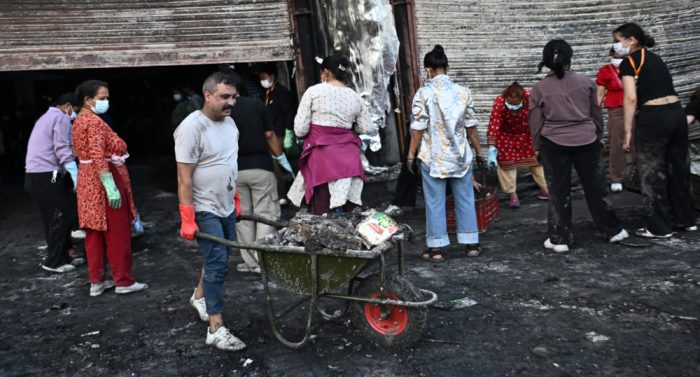
Local residents clean up the rubble of a burnt supermarket after it was set ablaze during protests in Kathmandu, September 13, 2025. (Photo by AFP)
Press TV – September 14, 2025
A new report warns that Washington’s more than $900 million commitment to Nepal since 2020 points to a deliberate US effort to reshape the Himalayan nation’s political order, as mass protests sweep the country.
The demonstrations, which killed at least 30 people, destroyed government and commercial properties, and led to Prime Minister Khadga Prasad Sharma Oli’s resignation, are widely viewed as a response to corruption, unemployment, and social media restrictions.
However, documents released by whistleblowers point to years of US-funded programs aimed at reshaping Nepal’s political landscape.
Internal documents obtained by the Sunday Guardian reveal that since 2020, more than $900 million in assistance has been directed to Nepal.
USAID alone committed $402.7 million through a Development Objective Agreement (DOAG) signed in May 2022, with $158 million disbursed by February 2025.
The Millennium Challenge Corporation, under a $500 million compact ratified in February 2022, had released only $43.1 million by early 2025, but projects continue under an extended timeline.
Key initiatives include Project 4150, “Democratic Processes,” funded at $8 million, and Project 4177, the “Democracy Resource Center Nepal,” fully funded at $500,000.
Civil society and media programs received $37 million, while adolescent health initiatives were allocated $35 million.
Critics warn that these programs, officially framed as civic, media, and health projects, also serve to influence political narratives and mobilize youth participation in governance.
The programs, run by US-based CEPPS consortium partners, the National Democratic Institute (NDI), International Republican Institute (IRI), and International Foundation for Electoral Systems (IFES), focus on youth engagement, party democracy, governance, and election mechanics.
NDI, for example, trained activists in leadership and advocacy, while IRI conducted a 2024 national survey showing that 62% of Nepalis wanted new political parties, reflecting the grievances driving recent protests.
Observers note parallels with US-funded interventions in Bangladesh and Cambodia, where youth and civil society programs coincided with political unrest.
In Nepal, the combination of extensive funding, targeted programs, and youth engagement suggests that the country’s recent upheaval may have been influenced by US intervention.
Nepal’s rebuff of SPP is major failure in US attempts to expand influence in South Asia
By Paul Antonopoulos | June 28, 2022
The Nepalese government has refused to cooperate with the United States in security matters via the State Partnership Program (SPP). Kathmandu made the decision to not promote the SPP ahead of a visit to Washington by Prime Minister Sher Bahadur Deuba in mid-July, where he will be accompanied by senior military officials, including Nepal’s army chief of staff, General Prabhu Ram Sharma. Nepal effectively does not want to ruin the delicate balance it has between China and India, the two giants that the country is sandwiched between, by adding the US into the geopolitical equation.
The Kathmandu Post noted that Deuba’s administration has come under intense pressure due to disagreements with Washington over Nepal’s participation in the SPP. At the same time, not only the Nepal Communist Party, the country’s main opposition party, but also the Nepali Congress Party, led by the prime minister himself, has voiced opposition to this type of cooperation with the US.
It is recalled that commander of the US Army in the Pacific, General Charles Flynn, made a four-day visit to Nepal in early June. The arrival of an American general put the opposition on high alert, fearing the development of military ties between Nepal and the US.
At the time, Giriraj Mani Pokhrel, a former education minister and member of the country’s parliament representing the Nepal Community Party, asked the government to inform parliament of the objectives and agenda of its military contacts with the US. Shortly afterwards, Interior Minister Bal Krishna Khand said that the government had no intention of signing an SPP agreement during the prime minister’s upcoming visit to Washington.
Officially, the partnership program regulates the exchange with the US National Guard and their responses to natural disasters, such as earthquakes, floods and wildfires. Critics in Nepal, however, believe that the US could interfere in internal affairs under the guise of the SPP, arguing that participating in the program is tantamount to Nepal signing off on the US’ Indo-Pacific Strategy.
By the ruling government and the opposition being in unison on this matter, Washington has failed in its attempt to expand its strategic presence in South Asia. Kathmandu’s decision was largely due to foreign policy factors, with the Nepalese government not wanting to damage relations with China or India.
It must be noted that both Beijing and New Delhi yield significant influence on Nepalese politics and economics. However, only China was open in welcoming Nepal’s decision and its non-aligned foreign policy. Chinese Foreign Ministry spokesman Wang Wenbin “commended” Kathmandu’s decision on June 23 and assured that China will always support Nepal in defending its sovereignty, independence and territorial integrity.
From the Chinese perspective, Nepal avoided a trap that the US could have set in the hope of dragging the landlocked country into a confrontation with one of its two neighbours. Effectively, the Nepalese government prevented any attempts at being pushed into confrontation with China by blocking the possibility of Nepalese territory being used.
And although it may appear that New Delhi would have welcomed closer cooperation between Nepal and the US considering China’s claims over parts of Indian territory and their participation in QUAD, the Indian Army’s exclusive and unique relationship with their Nepali counterpart would have been weakened by the SPP.
According to sources quoted by Indian media, New Delhi was not in favor of Nepal’s participation in the SPP, believing that it would unsettle the traditional relationship between the Indian and Nepali militaries.
The US Embassy in Nepal denies that the SPP has ulterior motives, writing on its website that: “The State Partnership Program is not and has not ever been a security or military alliance. The United States is not seeking a military alliance with Nepal.”
However, the SPP is administered by the National Guard Bureau, which means it is guided by Washington’s foreign policy goals. As the National Guard admits on its own website: “Through SPP, the National Guard conducts military-to-military engagements in support of defense security goals but also leverages whole-of-society relationships and capabilities to facilitate broader interagency and corollary engagements spanning military, government, economic and social spheres.”
This essentially makes the SPP another American trojan horse to penetrate the political, economic and social orders of countries to advance foreign policy goals under the guise of humanitarian engagement. With Nepal’s two main political parties unified in opposing participation in the SPP, and with both Beijing and New Delhi supporting Kathmandu’s decision, it represents a major failure in the US’ attempts to extend its influence in South Asia and the borders of Tibet.
Paul Antonopoulos is an independent geopolitical analyst.
US pushes military pact with Nepal, puts Himalayan peace at stake for geopolitical ambition
By Hu Yuwei | Global Times | June 20, 2022
After pushing Nepal to approve the Millennium Challenge Corporation (MCC) economic pact, the US may have also urged the Himalayan country to join its military alliance, the State Partnership Program (SPP), widely believed to be another component of the US’ Indo-Pacific Strategy.
Observers from both Nepal and China warned against the program’s heavy military focus on the containment of China in the region.
Nepalese media reported that the US renewed a push last week on Nepal to participate in the SPP during the visit of Commanding General of the US Army Pacific, Charles Flynn, to Nepal. Flynn called for the signing of the SPP when he met with Nepalese Prime Minister Sher Bahadur Deuba and Chief of Staff of the Nepal Army General Prabhu Ram Sharma.
The disclosed six-page draft US proposal triggered a debate and faced backlash in Nepal for the possible US military presence in Nepal, which, many warned, contradicts Nepal’s non-aligned foreign policy.
The SPP, once approved, would draw Nepal one step closer to the US’ military alliance, despite Washington’s denial and calling it a development assistance, said experts.
Under huge pressure from the public and lawmakers, during his meeting with coalition partners on Wednesday, Deuba said that he will not sign any agreement with any country, including the SPP, that could bring harm to Nepal, the Kathmandu Post reported.
The American embassy called the SPP draft circulating online “fake.”
Inspite of this, many suspect the disclosure of the SPP in Nepal could be intended as a tactic to test the waters, as the ambition and intention of the US to strengthen its military presence in Nepal have long been clear under the core purpose of the US’ Indo-Pacific Strategy to contain China.
Concluding his four-day trip to Nepal, Flynn said on Twitter that “we cherish our decades-long defense partnership and look forward to opportunities for collaboration.”
Observers told the Global Times that the US has increased its penetration and interference in Nepalese politics in recent years, and the approval of the US-pushed MCC program in Nepal in February is an example.
If the MCC has supported US control and influence in Nepal economically, the SPP could be used to strengthen the US’ military ties in the Asian country, Qian Feng, director of the Research Department of the National Strategy Institute at Tsinghua University, said.
“The US has always valued the geographical importance of Nepal which borders Southwest China’s Xizang Autonomous Region. Since the Trump administration, the US has been trying to include Nepal in its Indo-Pacific Strategy to achieve its multiple political and security goals toward China,” Zhang Yongpan, a research fellow of the Institute of Chinese Borderland Studies under the Chinese Academy of Social Sciences, suggested. “In recent years, the political situation in Nepal has been turbulent, and the divided parties are vulnerable to pressures of external forces. The US takes the opportunity to increase influence and infiltrations in Nepal via multiple ways, trying to make it a tool to promote the US’ Indo-Pacific Strategy,” Zhang told the Global Times.
But such US tactics to contain China are bound to be futile, and Nepal will not easily become the frontline of the US’ attempts to suppress China, experts concluded.
Dangerous move with risky clauses
Widespread debate and criticism surged in the public opinion against both the US and Nepalese governments, after the draft of a proposed agreement by the US Department of Defense on the State Partnership Program between the US National Guard and the Nepal Army was disclosed on June 13.
The six-page draft agreement has 10 clauses, in which the US promises to provide Nepal $500 million for five years in addition to non-lethal equipment to the Nepal Army, the Kathmandu Post reported, citing officials privy to the draft.
The leaked document says it is for strengthening the “partnership, in the areas of defense and security,” between the US and Nepal. One of the clauses in the leaked document mentions that the “US National Guard and US contractors, related vehicles and light aircrafts operated by or for the United States, may use such agreed facilities and areas for training, transit, support and related activities, refueling, temporary maintenance of vehicles and aircrafts, accommodation of personnel, their dependents, communications, staging, deploying of forces and material.”
The proposed agreed areas of cooperation also include joint training exercises “in high-altitude terrains in Nepal,” with experts alerting the risk to the security and stability of China’s Xizang, in the Qinghai-Xizang Plateau that borders Nepal, as well as potential infiltration of American forces into the border area.
This clause will make the security situation in western China more complicated with higher risks, considering that Nepal has long been at the forefront of preventing Tibetan separatist forces from destroying stability in Xizang, said Qian.
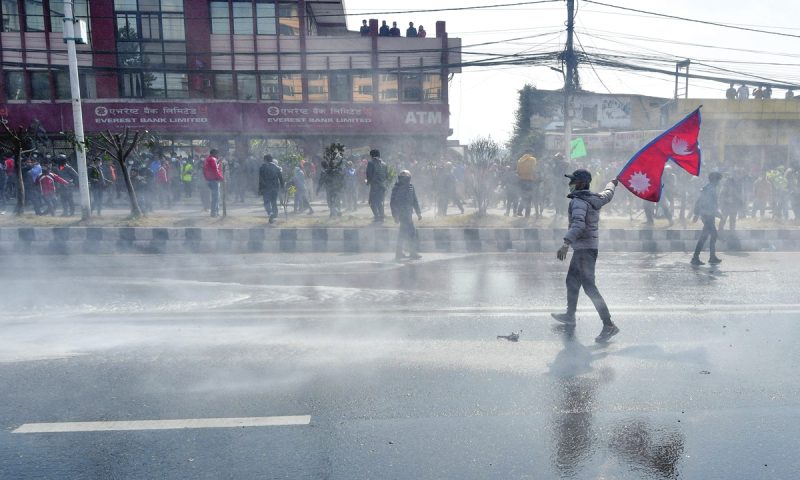
Demonstrators protest against the proposed grant agreement from America under the Millennium Challenge Corporation (MCC), in Kathmandu on February 24, 2022. Photo: VCG
Unanimous disapproval in Nepal
Public anger pumped up across social media over the last week with criticism against the Nepalese government and questions over the US’ intention in pushing the program. Netizens flocked to social media to urge the government to stop turning Nepal into a battlefield of geopolitical rivalry. Others shared their fear that the Deuba government is tilting toward the US and may submit to their pressure to advance in the SPP while ignoring the risks of harming the friendship with China.
Deuba is scheduled to visit the US in mid-July. Meanwhile, the Chief of the Army Staff, General Prabhu Ram Sharma, will be visiting the Pentagon before the Prime Minister’s trip, from June 27 to July 1, upon the invitation of the Pentagon, local media reported.
“This time, unlike the MCC, there is almost unanimous public opinion in Nepal that the SPP should not be approved by Nepal,” Ritu Raj Subedi, deputy executive editor of the Nepalese newspaper The Rising Nepal, told the Global Times.
“It can harm China-Nepal friendship and mutual understanding if the SPP gets approved. It can lead the nation toward long internal conflict and unrest. This type of activities will enhance distrust toward leaders because it is not transparent and was kept secret until the issue came to surface. Conflict mongers will try to reap benefits out of the situation. Internal conflicts can invite the involvement of foreigners and permanent corruption. There are so many byproducts of such issues,” Yogeshwar Romkhami, a former senior superintendent of the Nepal Police Service, told the Global Times.
Local people are not in the favor of MCC or SPP. Those who have even a little knowledge about it are worried. The West has penetrated every political party and the public believe these conspirators are pulling the country into internal conflict or uncertainties, said Romkhami.
Washington’s promotion of the SPP in Nepal comes at a time when the US’ Indo-Pacific Strategy is accelerating. The Biden administration’s essential competition with China through working with neighboring countries has never changed, Qian suggested.
US Under Secretary of State Uzra Zeya concluded her three-day trip to Nepal on May 22, the highest-level visit by a US official since 2012. Additionally, US Assistant Secretary of State Donald Lu visited Kathmandu in November last year. Before that, Vice President of MCC Compact Operations Fatema Sumar was in Kathmandu in September, local media reported.
The US is ramping up efforts in allying with Asian countries to suppress China both economically and militarily, Zhang said.
US foreign security tool
The US first came up with the concept of the SPP in 1993 as a humanitarian and disaster response training program.
Now the program has been established for over 25 years and includes more than 80 partnerships with over 90 countries. According to the SPP fact sheet of the National Guard, the program “supports the security cooperation objectives of the United States and the Geographic Combatant Commands (GCC) by developing enduring relationships with partner countries and carrying out activities to build partner capacity, improve interoperability, and enhance US access and influence while increasing the readiness of US and partner forces to meet emerging challenges. The SPP helps the United States react effectively to anticipated or unanticipated global scenarios as they emerge.”
Notably, Ukraine has been partnered with the California National Guard under the SPP since 1993. Over the past 29 years, the California National Guard conducted regular military-to-military exchanges with Ukrainian forces contributing to Ukraine’s continued defense modernization.
Since its inception, the SPP has been managed by the chief of the US Defense Department’s National Guard Bureau, a four-star general and also a member of the Joint Chiefs of Staff of the Department of Defense, equal to the heads of the army, navy and air force. This highlights the SPP’s military importance, according to Qian.
Although the SPP purportedly emphasizes disaster relief and anti-terrorism efforts, and intentionally downplays the military intentions of the US, its military essence has been clear in its implementation. It has served as an important foreign security cooperation tool for the US to achieve its foreign policy goals, said Qian.
Due to the unstable leadership in Nepal and possible reshuffled political landscape in the national elections at the end of the year, the operations and outcomes of the programs like SPP are still in doubt.
Chinese Foreign Minister visits India to discuss Ukraine
Samizdat | March 25, 2022
Chinese Foreign Minister Wang Yi arrived in New Delhi on Thursday night for a diplomatic visit, where he is expected to meet his Indian counterpart Subrahmanyam Jaishankar, the Indian foreign ministry announced. This is the first visit of a high-ranking Chinese official to India since border clashes in Ladakh in 2020.
Wang Yi previously held talks with India’s National Security Adviser Ajit Doval, according to Reuters. Both China and India kept the visit secret until the Beijing diplomat touched down in New Delhi late on Thursday.
The talks, set for Friday, are likely to be focused on border tensions between India-China, as well as Russia’s military offensive in Ukraine. Both countries have, so far, abstained from condemning and sanctioning Russia for its actions, maintaining trade relations with the country despite pressure from the West.
While the two nations have called on Russia to cease hostilities and look for a diplomatic solution, India continues to buy Russian oil and is currently discussing means to switch to a rupee-rouble trade mechanism, allowing the two sides to avoid trading in the euro or the dollar. China has repeatedly denounced unilateral sanctions on Moscow, protesting against Russia’s exclusion from the G20.
The relations between China and India began to deteriorate after a clash in the Ladakh region on their Himalayan border in June 2020, where at least 20 Indian and four Chinese soldiers were killed.
“Few would have anticipated … the turn that India’s relations with China have taken in the last two years,” Indian Foreign Minister said on Thursday, stressing the importance of coordination on defense and foreign policies matters between the two countries. It is likely that India will push for complete disengagement of troops from the region during the Friday talks.
The Chinese foreign minister visited Pakistan and Afghanistan earlier this week, and is set to continue his tour across South Asia by traveling to Nepal. In Pakistan, Wang Yi said that “China shares the same hope” as its Islamic colleagues regarding the status of Indian Kashmir province, who advocate for the province’s “inalienable right to self-determination”. The remark drew anger from some Indian officials ahead of his visit, as the Muslim majority region, controlled by both India and Pakistan, is considered a disputed territory, where India has been fighting armed rebels for decades.
Red star over Nepal
By M K Bhadrakumar | Indian Punchline | October 8, 2017
The Communist Party of Nepal-UML led by KP Oli, Communist Party of Nepal (Maoist Centre) led by Prachanda and the breakaway Naya Shakti Nepal led by Baburam Bhattarai have announced on October 3 the formation of a grand leftist alliance for the forthcoming provincial and federal elections in Nepal on November 26 and December 7 under the new constitution. The polarization of Nepal’s fragmented political spectrum on ideological lines makes the forthcoming elections a watershed event.
In reaction to the unexpected development, the Nepali Congress is reportedly planning to assemble a motley coalition of right-wing forces with some smaller parties to counter the grand leftist alliance. Interestingly, the constituents of the right-wing alliance may include the Rastriya Janata Party Nepal, which was formed in April with the merger of six “pro-India” Madhesi parties on the advice of their mentors in India. Even more interesting is the prospect of the Hindu right-wing, cultural conservative and royalist Rastriya Prajatantra Party Democratic – a veritable clone of India’s Bharatiya Janata Party – joining the Nepali Congress-led alliance.
It doesn’t require much ingenuity to figure out that the leitmotif of the polarization into two grand alliances lies in their respective disposition toward India. The announcement of the formation of the leftist alliance on October 3 seems to have taken not only the Nepali Congress but Delhi also by surprise. The Nepali Congress is scrambling to come up with a credible contestation – conceivably, with some encouragement from Delhi.
The polarization in Nepali politics is a good thing to happen since it presents a clear-cut choice to the electorate. The blurring of the ideological divide through the period of democratization in Nepal had been a major factor breeding the politics of expediency resulting in instability in the past. The big question is whether political stability as such guarantees good governance and can deliver on growth and development. India’s current experience speaks otherwise.
To be sure, the Leftist alliance is ideologically motivated and can be trusted to be far more cohesive and capable of offering a stable government. It will be campaigning on the plank of social justice, egalitarianism and Nepali nationalism. The alliance hopes to secure a two-thirds majority in the new Parliament which will strengthen their hands to steer future amendments to the Constitution smoothly, unlike in the past. During the general election, 165 members of the National Parliament will be elected by simple vote, while another 110 will be appointed through a system of proportional representation.
Based on the performance of the two main communist parties in the elections for the constituent assembly in 2013 and this year’s local polls, the leftist alliance has a distinct chance of winning a majority in the forthcoming elections. (The communists also have a strong party machinery all over the country.) If so, Nepal will be coming under communist rule – an unprecedented political feat not only for Nepal’s fledgling democracy but for the South Asian region as a whole. Importantly, based on the leftist alliance’s performance in the November elections, they intend to form a united Nepal Communist Party. It will be a big rebuff to the Indian establishment, which succeeded so far in splintering the Left in Nepal by fuelling internecine feuds and personality clashes.
These are early days but a communist government in Nepal will profoundly impact the geopolitics of South Asia. It is useful to factor in that Nepal took a neutral stance on the India-China standoff in Doklam. India’s capacity to influence Nepal’s foreign policies under a communist government will be even more limited. Equally, it remains to be seen how Nepal’s ‘defection’ from the Indian orbit might have a domino effect on Bhutan.
A ‘tilt’ toward China may well ensue under a communist government in Nepal. The country may embrace China’s Belt and Road Initiative unequivocally. Chinese investments can phenomenally transform Nepal. And comparisons will be inevitably drawn with the neighboring impoverished regions of Bihar and UP, which are run by India’s ruling party.
The forthcoming elections in Nepal assume great importance for India’s neighbourhood policies under the Modi government. The right-wing Hindu nationalist forces mentoring the Modi government will have a hard time in accepting the prospect of a communist government ruling the abode of the god Shiva. Will they attempt to interfere in the elections? Any overt Indian interference risks a furious backlash, given the pervasive anti-India sentiments in the country.
On the other hand, while the BJP is unable to tolerate a communist government even in the tiny southern state of Kerala, ironically, the Modi government may have to drink from the chalice of poison by doing business with a sovereign communist government in next-door Nepal. Read, here, an interview by Baburam Bhattarai, the well-known Marxist ideologue of Nepal, on the dramatic political developments in the country.
UK’s MI6 aided torture of Nepal rebels: Report
Press TV – August 31, 2014
British secret service MI6 has been accused of aiding Nepal’s authorities in the torture of Maoist rebels during the South Asian country’s civil war.
The accusations were made by author Thomas Bell in his new book Kathmandu citing sources in the Nepalese security establishment on Britain’s involvement in the country’s decade long civil war.
Bell said British authorities funded a four-year intelligence operation in Nepal in 2002 that financed safe houses and provided training in surveillance and counter-insurgency tactics to Nepal’s army and spy agency, the National Investigation Department (NID).
The British agency “also sent a small number of British officers to Nepal, around four or five — some tied to the embassy, others operating separately,” said Bell.
According to Bell, the British officers trained Nepalese authorities on how to place bugs, penetrate rebel networks and groom informers.
The sources said “British aid greatly strengthened” NID’s performance, which led to dozens of arrests, of which a number “were tortured and disappeared.”
One of the sources, a Nepalese general with close knowledge of the operation, argued that there was no doubt that British authorities realized that some of those detained would be tortured and killed.
Furthermore, Bell said that a senior Western official told him that the operation was cleared by Britain’s Foreign Office.
Bell said the findings revealed that “while calling for an end to abuses… the British were secretly giving very significant help in arresting targets whom they knew were very likely to be tortured.”
Tejshree Thapa, senior researcher at the Asia division of Human Rights Watch, commented on the book’s findings saying, “Nepal’s army was known by 2002 to be an abusive force, responsible for… summary executions, torture, custodial detentions,” adding, “To support such an army is tantamount to entrenching and encouraging abuse and impunity.”
Nepal’s civil war between the government and Maoists lasted between 1996 and 2006 and left more than 16,000 people killed.
Featured Video

America Racing to Strategic Defeat in Iran
or go to
Aletho News Archives – Video-Images
From the Archives
Should Europeans ‘Thank’ the Americans for Destroying Nord Stream?
By Robert Bridge | Strategic Culture Foundation | September 29, 2022
With an investigation continuing into the destruction of the Nord Stream gas pipeline that provided energy supplies to Europe from Russia, there appears to be just one prime suspect, and that should surprise nobody.
Following the sabotage of the Nord Stream 1 and 2 gas pipelines, former Polish Foreign Minister Radoslaw Sikorski already seemed to know the identity of the perpetrator when he tweeted out: “Thank you, USA.”
At first glance, it seemed that Sikorski was speaking sarcastically, berating Washington for carrying out an attack that will have severe repercussions for the people of Europe. After all, how could anyone see any good coming from the termination of Europe’s primary source of gas reserves with winter just around the corner? It was Sikorski’s homeland of Poland, after all, that urged its citizens to collect firewood in the face of dwindling gas reserves.
In fact, the Polish diplomat was speaking one-hundred percent literally… continue
Blog Roll
 Aletho News
- Growing insecurity, soaring prices fuel protests in north as regime bans evacuation: Sources
- Iran denies responsibility for ‘depraved’ attack on Kuwait desalination plant
- Bring The Troops Back. End This War Now!
- Can we please stop calling Israel the ‘only democracy in the Middle East’ now?
- US should start removing its troops for Germany, proposes AfD co-leader Chrupalla
- Iran Red Crescent: 600 educational centers attacked in US-Israeli ‘war crimes’
- Russian Oil Tanker Arrives in Cuba Amid U.S. Blockade
- America Racing to Strategic Defeat in Iran: Lt Col Daniel Davis
- FTC Warns Visa, Mastercard, PayPal, Stripe Over Political Debanking
- Russian tanker approaches Cuba despite US oil blockade
- If Americans Knew
- Israeli police block Catholic cardinal from entering Church of the Holy Sepulchre on Palm Sunday
- Israel is assassinating journalists again, more than any other nation, anywhere, ever – Not a ceasefire Day 170
- Over 300 US service members wounded, majority have brain injuries – Not a ceasefire Day 169
- Researchers at Human Rights Watch Resign Over Blocked Report on Palestinian Refugee Return
- Jewish Groups Are Backing a War Americans Don’t Want
- Eric Fingerhut Thinks He’s the President of the Jews
- Top Jewish Philanthropists, Rabbis Urge Israeli President to Take Action Against ‘Jewish Extremists’
- Don’t Be Fooled. Zionist Leaders Have Always Wanted to Control Southern Lebanon
- Israel’s widespread use of torture is a core element of its genocide against the Palestinian people
- In Israel’s War on Iran, Many Middle East US Bases Rendered “All But Uninhabitable”
- No Tricks Zone
- New Study Finds Warming Saves Lives…Cold Temperatures 12 Times More Deadly Than Excess Heat
- German Science Blog Accuses PIK Climate Institute Of Hallucinating Climate Tipping Points
- Devastating Assessment Of Comirnaty Vaccine By Former Senior Pfizer Europe Toxicologist
- New Study: CO2 Is ‘Effectively Negligible’ As An Explanatory Climate Change Factor Since 2000
- Former Pfizer Toxicologist Dr. Helmut Sterz Tells Bundestag Hearing Pfizer Vaccine Should Have Never Been Approved
- Energy Expert: Germany’s Nuclear Phaseout Was A “500 Billion Euro Mistake”
- New Research: South Australia’s Mid-Holocene Sea Surface Temperatures Were 4°C Warmer Than Today
- Storing Green Energy To Last Germany 10 Days Would Require A 60-Million Tonne Battery
- New Studies: UK Sea Levels Were 4 Meters Higher Than Today During The Mid-Holocene
- Destructive Green New Deal: German Energy And Metal Group Warns Of Drastic Crisis
 Aletho News