‘The Silence after the Screams’: How Western Media Helped Justify the Rape of Palestinians
Western media amplified Israel’s unverified claims of Hamas “mass rape” while downplaying documented Israeli sexual crimes against Palestinians
By Romana Rubeo | The Palestine Chronicle | November 5, 2025
On Monday, November 3, a group of Israeli soldiers stood outside the Supreme Court in West Jerusalem wearing black masks. They weren’t there to apologize; they were there to defend themselves.
The soldiers, accused of torturing and raping a Palestinian detainee at the notorious Sde Teiman prison, demanded “gratitude” for their actions.
“Instead of appreciation, we received accusations,” one said defiantly. Israeli media covered the scene while Western outlets mostly ignored it.
The same soldiers are part of a criminal case that Israeli prosecutors reluctantly opened in 2024 after video evidence surfaced showing Palestinian detainees stripped, beaten, and sexually assaulted at Sde Teiman.
One Palestinian man was hospitalized with seven broken ribs and a rectal tear, injuries consistent with violent sexual abuse.
The Times of Israel reported the indictment of five reservists for “severe abuse,” while other sources cited evidence of sodomy inside the facility.
Yet, in Western coverage, the word rape almost never appeared. Headlines spoke of “abuse” or “mistreatment,” as though sexual torture were a matter of workplace misconduct.
Contrast this silence with the wall-to-wall coverage of October 7, when Israel accused Hamas fighters of “mass rape.” Those claims, still unproven, became the moral foundation of Israel’s campaign of annihilation in Gaza.
In his latest interview with American journalist Candace Owens, political scientist Norman Finkelstein called the Israeli allegations “genocidal atrocity propaganda.”
After examining more than 5,000 photographs and fifty hours of footage from that day, Finkelstein said he found “not a single shred of evidence of even one rape.” Yet those unverified stories, repeated endlessly by Western outlets, were enough to cast an entire population as subhuman and to legitimize the killing of more than 68,000 Palestinians.
In December 2023, the New York Times published a sprawling investigation titled “Screams Without Words: How Hamas Weaponized Sexual Violence on Oct. 7.”
The article claimed Hamas fighters had systematically raped Israeli women during the attack. Its pages were filled with graphic descriptions and lurid imagery. The story relied on anonymous witnesses, unverified videos, and second-hand testimony, yet it was presented as conclusive evidence of mass rape.
Within days, it shaped international discourse. Then US President Joe Biden, European leaders, and prominent feminists invoked the Times’ story to condemn Hamas and morally justify Israel’s “retaliation”.
But when journalists and scholars began checking the evidence, the story fell apart. Forensic experts found no physical proof of rape. Several of the supposed witnesses cited by the Times contradicted one another or were later discredited.
In April 2024, more than 50 journalism professors sent a public letter demanding an independent review of the article’s sourcing and editorial process. The Washington Post reported internal dissent within the Times newsroom itself, where reporters said the piece had been “rushed” to meet political expectations.
Meanwhile, the Sde Teiman scandal, an Israeli atrocity supported by video evidence, medical reports, and judicial proceedings, has never received a fraction of the attention that the Times story did. This imbalance is not merely linguistic. It is structural, reflecting the hierarchy of human worth built into Western coverage of the war.
This is how “atrocity propaganda” works. It does not require lies to function, only selective truth. By repeating unverified claims of Hamas rape while downplaying verified Israeli sexual crimes, Western media transformed journalism into a weapon of war.
Romana Rubeo is an Italian writer and the managing editor of The Palestine Chronicle. Her articles appeared in many online newspapers and academic journals. She holds a Master’s Degree in Foreign Languages and Literature and specializes in audio-visual and journalism translation.
NYPD Commissioner Jessica Tisch is Turning New York City into a Surveillance Colony
By Matt Wolfson | The Libertarian Institute | October 29, 2025
In a recent report for the Libertarian Institute, I investigated Zionists’ role in creating the crisis point at which New York City now finds itself: caught between a colonial elite which has commandeered government and a progressive-socialist backlash to that elite which proposes to expand government. In this report, I will trace how, in response to the progressive-socialist threat to their power, Zionists and their allies are expanding government in new and frightening directions. The leading player in this operation, like in all good intelligence ops, is not a colorful or charismatic character. But she has all of the subtler qualities—connections, management prowess, presentational understatement—that the city’s minders look for in those who hold actual power.
Jessica Tisch, the New York Police Department Commissioner since 2024 who will definitely stay on if either Zohran Mamdani or Andrew Cuomo wins the mayoralty according to public statements made by both men, is the third generation of the billionaire Zionist family that has had prominent roles in shaping the city since the 1980s. Her grandfather, Laurence Tisch, bought CBS in the 1980s not long before his brother Robert bought the New York Giants, establishing the family, which had started in hotels and movie theaters, as the owner of two of the city’s landmark organizations. In the 1990s, Laurence Tisch was a member of The Study Group, the informal philanthropic Zionist gathering co-founded by Leslie Wexner and Charles Bronfman, which led directly and indirectly to the foundation of Taglit Birthright, the Foundation for Defense of Democracies, and various other projects for Zionist continuity. Laurence’s son and Jessica’s father, James Tisch, is the chairman of the Board of Leows Corporation, the family’s flagship business. James’ wife and Jessica’s mother, Merryl, was the chancellor of the New York State Board of Regents, responsible for supervising all educational activities in the state; and is the chair of the State University of New York Board of Trustees, responsible for supervising the state university system.
Within this context of a family involved in media, finance, philanthropy, and part-time politics, Jessica Tisch, who is now 44, charted her own specific path: from security to administration to the cusp of politics with the backing of money. She started in the NYPD in the decade of the September 11 attacks; continued in the department in the 2010s; moved in the first half of the 2020s to the Sanitation Department, arguably New York’s most important after police and fire. She has returned in the mid-2020s to the NYPD as its commissioner, while also widely being considered a potential future mayor. Like Mamdani, Tisch is a product, this time a direct one, of the decades of Zionist influence that preceded her rise. Like Mamdani, rewinding Tisch’s career shows how she is the capstone to a project of military policing that began in the 1990s and 2000s but that has sharpened under pressure into a full-blown project of social control.
That project began when crime rose in New York in the 1980s and 1990s in response to displacement and homelessness facilitated by WASPs, Zionists, and their allies co-opting city government to the benefit of finance and real estate. In response, Eric Breindel, the neoconservative Zionist editor of the New York Post who had extensive connections to Wall Street, arranged for the Post to back the then-longshot Rudolph W. Guiliani as a tough-on-crime candidate, delivering him Staten Island and so the city.
At the same time, Michael Steinhardt, the Zionist financier who was integral in the reinvention of Wall Street in the 1980s, became the major donor for the Democratic Leadership Council (DLC), which in turn was the major backer of President Bill Clinton, who shepherded to passage in Congress as his main legislative priority the Violent Crime Control and Law Enforcement Act. This act provided newly elected Mayor Giuliani and his police commissioner William Bratton federal funds for law enforcement, with certain conditions attached that increased local spending on policing as well as the size of the NYPD. The NYPD’s budget increased from $1.7 billion to $3.1 billion between 1993 and 2000, also leading to increased city spending, since, under the terms of the Clinton crime legislation, to receive federal funds the city had to spend funds of its own.
During this period, “crime”—defined as everything from murder to unlicensed street vending—fell in response to across-the-board enforcement. After 2001, Raymond Kelly, Mayor Michael Bloomberg’s police commissioner, pushed this practice to its limit with the aggressive practice of “stop and frisk” in minority neighborhoods: a daily distillation of the broader disenfranchisement the black and Latino communities of New York had been experiencing since the 1970s.
Kelly also made sure that the NYPD would benefit from post-9/11 funding of counter-terrorism measures, measures which hinged heavily on techniques for surveillance. And it was by channeling this new priority for social control that Jessica Tisch made her career beginning in 2000s. Fresh out of Harvard, she took “an analyst position available in what was then the counterterrorism bureau” of the NYPD. According to a recent profile in The New York Times:
“Kelly…did not normally meet with applicants for such entry-level jobs, but he ended up interviewing her. ‘Probably because she was a Tisch,’ he said, adding that he had been impressed with her three Harvard degrees.”
“Probably because she was a Tisch” seems like a fair assessment of why the supervisor of 55,000 employees took the time to meet a twenty-something about an entry-level position. But Kelly and Tisch also shared the promising ground of a professional focus: Kelly was committed to surveillance-as-policing, and Tisch’s main interest was data and surveillance. At the NYPD, she began “developing the Domain Awareness System, one of the world’s largest networks of security cameras, including handling contracts to build and expand it.” According to a description of this work in a recent profile of Tisch in New York Magazine, she was Domain’s driving force and Domain her career-maker:
“… Tisch, 27, was tasked with figuring out what to do with more than $100 million in unspent grant money from the federal Department of Homeland Security, which had just built a surveillance network to prevent another terror attack downtown. What if, she asked, the Domain Awareness System went citywide? And what if, instead of trying to stop a suicide bomber, the system tried to spot all kinds of crooks? What if it included the NYPD’s trove of arrest reports and criminal histories? When Tisch sent the privacy guidelines for the system to the lawyers at the New York Civil Liberties Union, they retched…The bosses had the opposite reaction: ‘No, you’ve made it. Congratulations,’ the former colleague recalls them saying.”
Based on an initial grant of $350 million from the Department of Homeland Security and developed with Microsoft technology, the System consists today of “a surveillance network of more than 18,000 interconnected cameras—including those in the private sector—as well as law-enforcement databases.” The system, in one description, “assimilates data from several surveillance tools—license plate readers, closed-circuit television streams, facial recognition software and phone call histories—and uses it to identify people.” As these descriptions suggest, private corporations and nonprofits, for example Rockefeller University in Midtown East Manhattan, can buy in: providing their own cameras then linking them to the surveillance system run out of the NYPD. “And,” according to one report, “when Microsoft turns around and sells the technology to other cities, New York gets a cut.”
Tisch was not only one of the developers, if not the developer, of the system; she also so impressed Kelly with her tenacity dealing with the various technology sub-vendors put in play by the project that he moved her up through the ranks. (She also may have impressed Kelly with her access to funds; the nonprofit the New York Police Foundation, which her uncle chaired and where two of her family members still sit on the board, provided some of the early contributions for testing her surveillance system.) Within a decade, “she became the city’s first information technology commissioner… and within months she was in the midst of the coronavirus pandemic, struggling to create a contact tracing system and then a vaccine distribution system.” Throughout this time, Tisch was working with at least one like-minded colleague from a similar background. This was fellow Harvard graduate Rebecca Ulam Weiner, the granddaughter of the Zionist nuclear scientist Stanislav Ulam of the Manhattan Project, whose view of her grandfather’s work is instructive:
“As someone whose job it is to keep secrets, I often wonder whether such an experiment [as the Manhattan Project] would be possible today, scientifically or socially.”
Fast forward to November 2024, and an embattled Mayor Eric Adams, whose allies in the black community have increasingly moved away from him even as powerful Zionists have edged closer, appointed Tisch Commissioner. He did this despite vocal concerns from civil liberties advocates that, in the words of one, “It’s really alarming to see a commissioner who built her career on the infrastructure of mass surveillance.” Weiner is Tisch’s deputy commissioner of intelligence and counterterrorism, and has let it be known that her department “relies on a mind-boggling suite of assets that Americans might otherwise assume are controlled by the CIA, FBI, DHS, Secret Service, or other agencies.” These include:
“… a legion of intelligence analysts, counterassault and dignitary-protection teams, a flotilla of boats…surveillance aircraft, the nation’s biggest bomb squad, a counter-drone unit, a remote contingent of NYPD detectives… and a network of multilingual undercover operatives…”
Among this “remote contingent” is NYPD Detective Charlie Benaim, “[whose] office could be any squad room in Brooklyn, but for years [has been] an Israeli police station near Tel Aviv,” where “Benaim’s been feeding an endless stream of information, in real time, to his bosses back at One Police Plaza.” According to Weiner, Benaim’s function is “asking the New York question, when something is happening, what would it look like it if it were to happen in New York City, and more importantly than that, how do you prevent it?” A new model for Benaim in answering these questions, apparently, is the Hamas uprising of October 7. This suggests either that the NYPD expects a coordinated attack from foreign operators; or that New York’s security leaders see the city as potentially under siege by its own displaced and ghettoized underclass and plan to respond accordingly.
Telling in this regard is the fact that Tisch’s top priority as commissioner is “doubling down on data-driven policing and surveillance,” an aim which has “sparked fierce criticism from watchdog groups that New Yorkers are living in a surveillance state.” According to New York Magazine, Tisch’s proposed reforms fall along four lines. First, she wants to expand actual surveillance capacities by expanding the city’s camera network “to include more privately owned cameras.” Second, she wants to extend the contract of one of Domain’s less reliable components, “the ShotSpotter gunshot-detection system” which “may result in confirmed shootings only less than 15 percent of the time, according to the comptroller’s office,” a fact which Tisch dismisses, “arguing that something is better than nothing.” Third, she wants to use data collected “to surge police resources down to a single block,” allowing for the department to deploy overwhelming force to tackle individual incidents in small areas. (This means essentially treating city policing as counterinsurgency warfare, and it’s not too different than the LAPD tactics that led to the abuse of Rodney King and the fallout that followed.) Finally, “perhaps the biggest change is that she wants to use those same systems and processes to fight ‘chaos,’ not just crime,” meaning that minor noise disturbances or unusual behavior could qualify for police enforcement via surveillance and surges. (Again, this is a retread of the 1990s: “Giuliani-style crackdowns, only with better gear.”)
More instructively still, she feels this way despite at least one recent controversy suggesting that her policies have adverse effects on the very communities historically at the blunt end of militarized policing. According to The New York Times, in an August report, the NYPD used Domain Awareness System’s facial recognition software to identify and arrest for indecent exposure in April a 230 pound 6-foot-2 black man, Trevis Williams. The arrest was made even though a witness said that the offender was about 160 pounds and 5-foot-6 and even though “location data from [Williams’s] phone put him about 12 miles away at the time.” According to the Times, the fact that “a facial recognition program plucked his image from an array of mug shots and the woman identified him as the flasher was enough to land Williams in jail.” This is despite the fact that “other police departments… require investigators to gather more facts before putting a suspect identified by facial recognition into a photo lineup,” and despite advocacy from groups like the American Civil Liberties Union to “ban… the use of facial recognition by the police because of the risk of misidentification.”
“In the blink of an eye, your whole life could change,” Williams told the Times about his experience, adding that he still gets panic attacks since his April arrest and subsequent imprisonment. The Times investigation did not report asking for a comment from the NYPD or its Commissioner. Nor did it report that, as early as 2019, 11,000 cases per year were being investigated by the NYPD with the help of facial recognition software.
Despite collateral damage from her policies, positive media profiles of “Commish Tisch” and her subordinates have been plentiful since her accession. In an April 2025 report in The News section of The New York Times, the paper had the following to say about her: She has “an unlikely and remarkable career”; is “the daughter and granddaughter of two strong women, neither of whom came from money”; “learned hard work by example”; is “talkative and purposeful, but circumspect”; is a “no-nonsense technocrat” and “incredibly competent”; commands “a huge amount of respect”; is “very businesslike,” “[takes] no guff,” and should run for mayor. New York Magazine, the city’s go-to venue for fashion and culture commentary, had run an equally complimentary profile in March of 2025 that included the same political prediction.
And, the month before New York Magazine’s profile of Tisch, Vanity Fair ran a profile of Tisch’s deputy Weiner titled “NYPD Confidential.” Headed by a black-and-white photo of Weiner flanked by members of her squad that seemed ripped from a promotional poster of Captain America, the article’s text gave its subject an equally marquee treatment, describing her as “laser focused,” “unfazed,” “poised, cultivated, pin-sharp, convivial, boundlessly curious, charmingly profane,” and “a lightning-quick study” who had “a wicked sense of humor.” All three of these profiles also emphasized, as The New York Times’ editorial board regularly emphasizes, a recent rise in crime in the city without honing in on its obvious causes: financialization, gentrification, and displacement.
The Times is owned by the Sulzberger Family, whose members are ambivalent about Zionism but who have deep connections to Zionists. (Their executive editor, Joseph Kahn, is the son of a committed Zionist corporatist and runs in the billionaire Zionist milieu; their editorial page is dominated by Jewish Zionists of all political persuasions; and the former head of the Sulzberger family wealth office now heads Bill Ackman’s.) Vanity Fair is still owned by the Newhouse Family, which, as I reported in my recent investigation on the rise of Zionist power in New York, was vital to that project thanks to its ownership of Conde Nast. New York Magazine is dependent for its scoops on access to the city’s financial and philanthropic elite, many of them Zionists—its recent profile subjects include not just Jessica Tisch but Barry Diller and Diane Von Furstenberg and Bill Ackman. The message from these media venues seems clear: the Zionist financial powers of New York are squarely behind Jessica Tisch, and want their readers to know it.
It is not, in this context, a coincidence that the Times ran an article soon after Zohran Mamdani’s victory in the Democratic mayoral primary citing anonymous sources to report that Mamdani was being urged to keep Tisch on if he wins the mayoralty as a “steady pair of hands.” It is also not a coincidence that this story came during a period when Dan Loeb and Bill Ackman, younger Zionist financial-philanthropic operators, were attacking Mamdani as soft-on-crime almost daily and shifting their funding focus to Mamdani’s Independent mayoral competitor, Mayor Eric Adams, to the point of personally vetting Adams’s campaign manager before the position was filled. What this suggested at the time was a pincer movement, in which attacks by Loeb and Ackman pressured Mamdani into keeping Tisch on as a sign of faith in the establishment and détente with Zionism.
And, in late October, with Mamdani still attacked by connected Zionist players for purportedly making Jews feel unsafe despite the fact that he has attracted significant Jewish support, this is exactly what occurred. On October 22, Mamdani announced, four days after Andrew Cuomo had announced the same, that he would ask Tisch to stay on should he win the election. The reported terms on which this “ask” was made are not encouraging when it comes to Mamdani’s leverage over Tisch if he is elected mayor. Details in The New York Times painted a scenario in which Mamdani had publicly (and factually erroneously) made Tisch the poster child for safety in the city without extracting any concessions from her camp in return. According to the Times,
“… Mr. Mamdani confirmed his decision during the final televised debate before the Nov. 4 election. ‘Commissioner Tisch took on a broken status quo, started to deliver accountability, rooting out corruption and reducing crime across the five boroughs,’ Mr. Mamdani said at the debate. “I’ve said time and again that my litmus test for that position will be excellence’… Ms. Tisch’s allies have signaled for months that she would want to stay in the job regardless of the election’s outcome. [Mamdani] campaign officials declined to detail any conversations between the candidate and the commissioner, but said they were confident she would accept. Delaney Kempner, a spokeswoman for Ms. Tisch, referred a reporter back to an earlier statement from the commissioner stressing that ‘it is not appropriate for the police commissioner to be directly involved or to seem to be involved in electoral politics.’”
Tisch’s strategic mix of aggressive behind-the-scenes lobbying and Olympian public detachment sends a message: as New York Magazine put it less than twenty-four hours after Mamdani made the announcement, she is “the Heiress Who Could Make or Break the Socialist Mayor.” Not long after this article ran, Hakeem Jeffries, the New York Democratic leader of the U.S. House of Representatives, ended five months of ostentatious non-endorsement of Mamdani with a statement endorsing Mamdani—specifically praising his willingness to keep on Tisch. Already, then, thanks to a series of private maneuvers and public feints, Tisch has been placed in the driver’s seat: the establishment’s cooperation with Mamdani is clearly conditioned on Mamdani’s continued acceptance of her.
One difficulty of critiquing moves like these is that the conflation of “Jewish power” and New York is an old trope, in part because New York has been since the early twentieth century a Jewish city. So it should be emphasized, as I have emphasized in my previous report on this topic, that New York’s problem is not a problem of Jewish power. It is a problem of government-tied financialization at the hands of a small number of WASPs and then a small number of Zionists, and it has come at the expense of the people who live in the city, among them many Jews. Now, with a direct threat to Zionists’ influence in the person of Zohran Mamdani, the operation is out front. Zionist financiers have sent one of their own to occupy the most powerful security position in the city, and they are intent on keeping her there. If they fail to install their ally Andrew Cuomo in the mayoralty, which will give Tisch carte blanche, the prospect of them working to sabotage a Mamdani mayoralty in the lead-up to a Tisch For Mayor campaign in 2029 is a very real one.
They will likely do this much like they managed the securance of Jessica Tisch’s job: with media attacks meant to maximize pressure on Mamdani; followed by private assurances to Mamdani that the attacks will stop if concessions follow. These public-private feints, in turn, will push Mamdani into concessions which will make him lose face with his base, isolating him between an unfriendly establishment and a disillusioned electorate. (This trend is already occurring, albeit at the edges, after Mamdani’s public commitment to keeping Tisch, whom many Mamdani voters see as a threat to civil liberties.) Tisch’s allies will manage these plays with the help of The New York Times and other organs of influence (the Conde Nast publications, New York Magazine, the New York Post) which by their own admission are pining for technocratic government predicated on what they call “effective management.”
But there is another equally bad outcome that could accrue should Mamdani win the mayoralty and Tisch stay on as police commissioner. This is the fusion of the most dangerous potential aspect of socialism, total government direction of the economy, with the most dangerous potential aspect of Zionism: total techno-military colonial control. It doesn’t take a great deal of imagination to see how, under a de facto power-sharing agreement between Mamdani and Tisch (Mamdani in charge of domestic welfare, Tisch in charge of security) the worst impulses of both systems will merge to create a city government which is totalistically involved in every aspect of its citizens’ lives, Singapore transfused with Sweden. This outcome for a city which for a century has been read as a triumph of American individualism would be, to understate the case, a seismic shift.
How Zionist Influence in New York Gave Rise to Zohran Mamdani
By Matt Wolfson | The Libertarian Institute | October 14, 2025
Coverage of Zohran Mamdani’s run for New York City mayor is focused on the outsized politics at play in the race: democratic socialism, Islam, state-owned grocers, former Governor Andrew Cuomo, until recently incumbent Mayor Eric Adams, and President Donald Trump. But this risks missing the real story in New York, which is the decades-long creation and maintenance of a financialized, factionalized city of free market distortions and middle class displacement at the hands of powerful Zionists and their allies that led to backlash and Mamdani’s rise. Rewinding Mamdani’s catapault to politcal stardom reveals that New York’s current situation—its transition from a city hospitable to the working and middle classes and genuine free exchange of goods and services to a feudal one of government-backed financiers and service workers—is in many ways the work of a little more than a dozen Zionist financiers who twisted government to their ends.
Zionism in New York was part of a shift in the city begun by establishment-connected WASPs away from government by wards and organizers and toward rule by government-connected finance. The originator was Nelson Rockefeller, John D. Rockefeller’s grandson and the governor of New York from 1959 to 1973, who floated New York City’s bills by arranging for banks like Chase Manhattan (run by his brother David) to buy bonds. These new bonds covered the old bills even though the bonds were not backed by actual assets of the city’s but by anticipated returns; e.g. “tax anticipation bonds,” “bond anticipation notes,” and “moral obligation bonds.” This meant the city borrowed from the bankers, paid a portion of the interest, and borrowed again, while having no long-term way to pay back the full amount of ever-increasing debt.
The fix to this problem created by financiers came from financiers: a consortium set up in 1975 by Nelson Rockefeller, now vice president, to “solve” the city’s $6 billion debt. The consortium operated through various vehicles with names like the Municipal Assistance Corporation and the Emergency Financial Control Board and it achieved this “fixing” in a predictably self-interested way. It cut out of influence the city’s old political power brokers—Jewish, Irish, Italian, Puerto Rican, and black politicians with connections to their communities. It then executed a bait-and-switch. It cut city funds from supporting welfare and unions in the name of small government while actually redirecting those funds to support financial development via investing in a real estate boom driven by a handful of connected players that attracted new “talent” to the city.
The main beneficiaries were rising Wall Street power brokers, the most notable ones Zionist, for whom the 1980s was a kind of heyday. The roster included Laurence and Robert Tisch, Maurice “Hank” Greenberg, Michael Steinhardt, the Bronfmans, Michael Milken, Stephen Schwarzman, and high-end retailers like Victoria Secret’s Leslie Wexner and Leonard and Ronald Lauder, the sons of Estee Lauder and heirs to her fortune. One difficulty of critiquing a cohort like this is that the conflation of “Jewish power” and New York is an old trope, in part because New York has been, since the early twentieth century, a Jewish city. So it should be emphasized that this cohort was small and highly specific. It was distinct from older generations of New York Jews—not just Jewish ward players like Abraham Beame, New York’s last mayor under its old power dispensation, but Jewish financiers like Felix Rohatyn, who played a major role in stabilizing the city’s debt in the 1970s.
Players like Beame and Rohatyn had planted their stakes firmly in America and nowhere else. Having experienced the rise of the Nazi Party in an economically cratered Germany as a childhood reality, they were committed to creating the conditions for what they hoped would be lasting social peace. Zionists, by contrast, had their eye on the military-corporate apparatus and its ties to Israel, and they were not especially concerned with the effects of their actions on the ground. They also rejected what would become the mores of the majority of Jews and especially Jews of a later generation: intermarriage, mixing, diverse assimilation. Their style was self-consciously distinctive and gloves off, and beginning in the 1980s they executed an aggressive reinvention not just of the financial markets but of New York.
Part of this reinvention was done, much as the Rockefellers’ rise to influence in New York had been done, through philanthropy, but at a much greater scale. Among these Zionist players’ direct bequests were the Steinhardt Conservatory at the Bronx Botanic Gardens, the NYU Steinhardt School of Culture, Education, and Human Development, the NYU Tisch School of the Arts, NYU Langone’s Tisch Hospital, the Tisch Galleries at the Metropolitan Museum, the Tisch Children’s Zoo in Central Park, the Leonard Lauder Galleries at the Metropolitan Museum and the Museum of Modern Art, Ronald S. Lauder’s Neue Museum, and the NYU Bronfman Center.
Another part of this reinvention was done through real estate, which, like Wall Street, was increasingly dominated by Zionists. Perhaps most notable among them was Lawrence D. Ackman of Ackman-Ziff, the firm which redeveloped West 34th Street, West 42nd Street, and Madison Avenue on the Upper East Side in the 1970s and 1980s and turned portions of 9th Avenue into the high-end Chelsea market in the 1990s.
So far, government had been indirectly incentivizing development; then, in the 2000s, government got directly involved. Philanthropy and real estate became direct tools of government with the mayoralty from 2002 to 2014 of Michael Bloomberg, the billionaire financial services provider and the man most connected to this class by Zionism and finance. Bloomberg’s projects pushed in one direction: using government policy and finance capital to redevelop the city to create a tourist and tech mecca. His opening gambit was re-zoning 40% of the city. He then filled those rezoned spaces with public-private projects—parks, high-rises, high-end department stores—displacing middle and working class New Yorkers and driving up rents for everyone else.
This was not a free market experiment, where the best contractor gets the development job or the philanthropic bequest. This was explicitly a project of wealthy and connected Zionists with ties to the mayor. As Leonard Lauder told it to The New York Times some years later, “When Mike Bloomberg was the mayor, he was the ultimate power broker. He would call me up on the phone and say, ‘I need this and this and this, OK?’” Hollywood Zionists who came East were mobilized too, notably the media executive Barry Diller and his wife, the designer Diane von Furstenburg, and the music producer David Geffen. So was a new generation of real estate Zionists like Steven M. Ross of Related Companies, the developer of Columbus Circle, and Gary Barnett of Extell Development Company, the son of a rabbi and former diamond trader with significant holdings in Israel. So, finally, was a new generation of Zionist financiers like the hedge fund operators Daniel Loeb and Bill Ackman, Lawrence Ackman’s son.
Development proceeded from there. Bill Ackman’s first wife Karen Herskovitz and Laurence Tisch’s niece Laurie Tisch were major backers of the public park The High Line and the High Line’s anchor building, the relocated Whitney Museum of American Art. This was Bloomberg’s pioneer re-development project: a park built on former railway lines that cut through the Lower West Side to Midtown West, from 4th to 34th Street. Barry Diller and Diane von Furstenberg provided the funds for Little Island off West 13th Street west of the High Line, which “replace[d] the dilapidated Pier 54, envisioning an extraordinary new pier combining public Park and performance space.” Stephen M. Ross, facilitated by Bloomberg and later backed by an infusion from the Saudi Public Investment Fund, developed Bloomberg’s culminating project: the mega-mall Hudson Yards on West 34th Street at the top of the High Line. Stephen Schwarzman donated $100 million to the New York Public Library. David Geffen donated $100 million to refurbish the New York Philharmonic, with the help of Leonard Lauder and Bloomberg confidante (and Zionist) Barbara Walters.
Then there was real estate. A bevy of “supertall” skyscrapers which cast shadows over the surrounding buildings and streets were developed by Gary Barnett’s Extell, among the most prolific developers in Manhattan. (The occupants of Extell’s and other supertall developments were mostly financial workers and Saudi princes, who complained when the buildings leaked from the inside and swayed in the wind.) Smaller versions of Extell’s developments appeared in Brooklyn neighborhoods, built with cheap materials and generally agreed by locals to be eyesores meant for purchase by out-of-towners. Imitators of these projects abounded, thanks to Bloomberg’s largesse via not just re-zoning but also his provision of incentives to developers and his personnel intercession to make some projects happen. During his mayoralty, seven of the twenty tallest buildings in the city were built, along with smaller towers in areas ranging from downtown Manhattan and Brooklyn to Harlem.
In all of these spaces, the natural circulation of neighborhoods, which depends on small businesses and schools and places of worship, was replaced by “excursion destinations” constructed with enormous capital investment from powerful financiers with access to government. These high rises, parks, and cultural centers and the luxury apartments surrounding them also functioned as surveillance spaces, with manicured lawns for “relaxation” flanked by buildings which were easy to watch and patrol. And they functioned as class filters, siphoning from Manhattan the middle income earners priced out by rising rents and replacing them with finance workers or wealthy foreign nationals looking for second apartment homes. These new arrivals, in turn, relied for their needs on a growing number of service workers working low-wage shifts in restaurants or at Doordash—many of them undocumented.
This finance-and-philanthropy-based surveillance-and-extraction model is quite similar to the fundamentals of the “Raze-and-Rebuild” program being pushed by prominent Zionists for Gaza: a space meant to be serviced by undocumenteds and inhabited by financiers and tourists once the “locals” are “relocated.” It is also quite similar to the cities of authoritarian regimes in West Asia and the Gulf States that rose in the 2010s. And there is past precedent for it in the developments of Paris and Berlin at the hands of authoritarian regimes of the nineteenth century—developments which immiserated the working and middle class of these cities and seeded the ground for the cycle of revolt and reaction that created fascism.
But these explicitly feudal parallels have gone almost completely unremarked on in New York, probably because Zionist financiers have also assumed positions at the helms of the city’s education system and media nexus.
At the hands of Laurence Tisch’s daughter-in-law Merryl Tisch, as Chair of the Board of Regents (in charge of education in New York state) she and her allies Andrew Cuomo and Michael Bloomberg put a focus on standardized testing in the name of “merit.” This functioned to place “high achieving” outer borough students into private or “special” schools in Manhattan rather than giving outer borough schools the resources to help these students represent their communities. At the hands of the longtime presidents of New York University and Columbia, the city’s two most powerful universities have expanded their footprints off the real estate boom and muted critiques of the crony corporatism behind it. Successive Zionist executives and op-ed editors of The New York Times and Conde Nast, which is owned since the 1980s by the Zionist Newhouse Family and publishes Vogue and Vanity Fair and The New Yorker, media coverage of New York has celebrated expansion, “modernization,” modernizers, and the celebrities and fashion innovations these shifts bring to the city. So has CBS News, owned by first the Tisches in the 1980s and 1990s and then the Redstones, another Zionist family, from the 1990s to the 2020s. Despite the quiet admonitions of older players like Felix Rohaytn against the dangers of this insularity, the fantasy of empire management has turned New York into something closer to nineteenth century Europe than anything Americans might recognize.
This project only continues faster today. Zionists like New York Times columnists Thomas Friedman and Ezra Klein are backing the “Abundance Agenda,” a spate of policies to fast-track building permits in urban areas across the nation to combat housing scarcity, which will accrue to the benefit of governmentally connected developers and financiers able to manage large-scale projects. Academics from MIT, the site of lavish donations from New York Zionist financiers like Jeffrey Epstein and Stephen Schwarzman, have been calling for New York to become a “leisure city” catering to tourists and younger workers in the finance industry.
Of course, just as there is backlash to colonization abroad, there is backlash to it at home. In the 1980s and 1990s, the backlash came in the form of crime, boycotts, and riots, and protests from leftwing activists and the leadership of black and Hispanic communities whose influence had waned after the 1970s. In the 2010s, these marginalized figures received a new infusion of outside energy from political progressives who had built up their power in universities and the arts using state grants, in effect commandeering parts of the institutions Zionists had funded to enhance their own control. These players brought media sophistication and an ideological agenda to the on-the-ground communal left which had been rudderless. Meantime, the on-the-ground left brought to the table a close connection to the communities at the stick end of Zionists’ policies. The realization of the success of this synthesis was the mayoralty of the progressive Bill De Blasio, who within three months of beginning his first term was publicly criticized by allies of Zionist philanthropists for failing to give them the attention they felt they were due.
Then, in the 2020s, came De Blasio’s successor, Zohran Mamdani, a more effective progressive (as De Blasio freely admits) on every level. Where De Blasio talked about a “tale of two cities” and universal Pre-K, Mamdani talked, over and over and in original ways, about affordability, and took direct aim at the enemies of affordability in New York, finance, and Zionism. Historically, as I have reported elsewhere, socialism and its ideological cousin redistributionism have occurred in America after long periods when finance twisted around the state and distorted its functions. At a certain point in these processes, Americans respond to a program pushing for government money to flow not toward financial firms or weapons contractors but directly to them. Indeed, Mamdani’s victory speech when he won the primary, which emphasized returning the city to serve the interests of the working people who make New York run, was an emblem of exactly what New Yorkers appear to be looking for.
Bill Ackman, Dan Loeb, and other members of the club of Zionist financial elites have sounded the alarm of creeping socialism since Mamdani’s victory, but they have not blamed themselves for creating the distortive conditions that led to it. In fact, they’ve done the opposite. They’ve turned to a characteristically Zionist—which is to say colonialist—solution to rising discontent. This is a solution which they’ve slowly been developing since the 1990s and which had its antecedents or parallels in nineteenth century Europe and the twenty-first century Middle East: techno-military law enforcement to control “restive populations.” As I will show in a coming report, if Andrew Cuomo wins on November 4, the militarist play being run by Zionists will continue without any meaningful check, since Cuomo is both a close Zionist ally and not known for his concern for civil liberties. If Mamdani wins, there may be checks on this militarism, but these checks will not be absolute. Instead, some measure of militarized law enforcement will coexist with socialist government expansion. Together, these could lead New York on a path toward government control across sectors: security, economy, politics, society.
Quit Promoting Mad Schemes, New York Times, Blocking the Sun is a Dangerous Climate Gamble
By Anthony Watts | ClimateRealism | September 25, 2025
In The New York Times’ (NYT) op-ed, “Turns Out Air Pollution Was Good for Something,” Zeke Hausfather and David Keith argue that because sulfur particles from past industrial pollution once cooled the planet by reflecting sunlight, policymakers should now consider a deliberate version of that process. They suggest aircraft could inject sulfur into the upper atmosphere to mimic the cooling once provided by dirty smokestacks, pointing to volcanic eruptions such as Mount Pinatubo in 1991 as evidence the method would work. This idea is wrong-headed madness. Experience demonstrates geo-engineering ideas such as this have dangerous and unpredictable consequences.
The authors write that “geoengineering the climate in this way is not a new idea,” and claim that “a more modest approach” of maintaining present temperatures with controlled sulfur injections buys the world time for carbon dioxide reductions to continue.
But geoengineering by blocking the sun is a dangerous fool’s errand. First, the potential unintended consequences are enormous and unpredictable. Sulfur dioxide particles injected into the upper atmosphere would scatter sunlight differently depending on latitude. At middle to low latitudes, sunlight passes through less atmosphere, so scattering effects are modest. But at higher latitudes, sunlight travels through more atmosphere, amplifying scattering—just as sunsets turn red because of the increased distance light travels through more air and particles at low sun angles. Injecting reflective particles globally would therefore not create uniform cooling. It would over-cool the polar and sub-polar regions, while perhaps under-cooling equatorial areas. The result would be an uneven, artificial climate system with consequences no climate model can reliably predict.
These regional impacts would not just be academic. Farmers in Canada or Scandinavia might see shortened growing seasons. Populations in northern Russia could face colder winters. Developing nations in Africa or Asia could sue over disrupted rainfall patterns or crop failures. Geoengineering would open a legal and geopolitical Pandora’s box of claims, counterclaims, and lawsuits, as countries argue that someone else’s climate tinkering damaged their own livelihoods. Even Hausfather and Keith concede in their NYT op-ed that large-scale deployment “could exacerbate climate change in some locations, perhaps by shifting rainfall patterns.”
Aside from these uncertain consequences, one consequence of this scheme is certain, increased sulfur pollution, most likely resulting in acid rain which changes the pH of waters and damages buildings, statues, and other structures.
History warns us as well. The eruption of Mount Tambora in 1815 produced the “year without a summer” in 1816, dropping temperatures, as seen in the figure below, devastating agriculture across Europe and North America. Crops failed, famines spread, and tens of thousands perished.
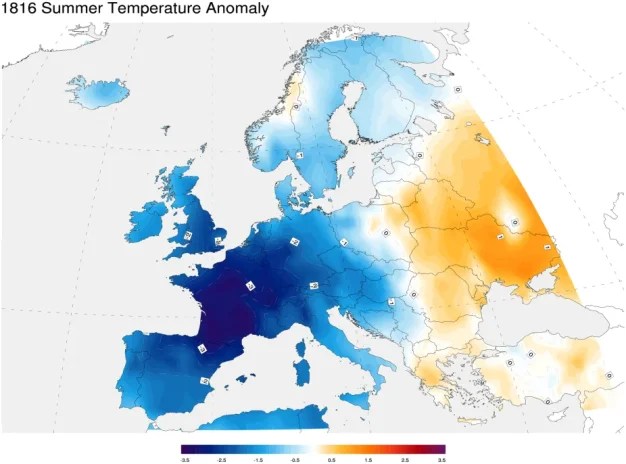
More recently, Mount Pinatubo’s eruption in 1991 cooled the globe by about half a degree Celsius (0.9 degree Fahrenheit) for at least 20 months, disrupting rainfall patterns in the process. The eruption also depleted the ozone layer.
Scientists have also raised red flags about such schemes mimicking the Pinatubo eruption. A 2018 study in Nature Ecology & Evolution warned that solar geoengineering could “abruptly terminate” and trigger rapid global warming if deployment stopped. Researchers published a paper in 2022 in the journal Science of the Anthropocene, have cautioned that stratospheric aerosol injection could delay, but not prevent, ocean acidification, and could undermine incentives for emissions reductions. Back in 2014, LiveScience argued that “Geoengineering Ineffective Against Climate Change, Could Make Worse.”
These papers together strongly suggest that geoengineering via sun-blocking/aerosol injection is not a benign or risk-free option and that its consequences are highly uncertain, with many potential negative side-effects that are difficult or impossible to predict. Deliberately blocking the sun is not a climate solution—it is climate roulette.
Even advocates of the idea admit it is nothing more than a Band-Aid. As Hausfather and Keith acknowledge, “sunlight reflection is no panacea” and “treats the symptoms of climate change but not the underlying disease.” They also admit the risk of political dependency: once started, stopping a geoengineering program could trigger rapid warming rebound, a scenario far more destabilizing than gradual warming itself.
Steve Milloy, writing in the Daily Caller, explained why this notion is absurd. In “Trump’s EPA Is Right To Be Skeptical Of ‘Sun-Blocking’,” he highlighted that sulfur dioxide particles are air pollution—pollution that once drove acid rain and deadly smog events. Milloy sulfur notes that particles eventually fall back to Earth, meaning a program of perpetual injections would be required. “It sounds like a great business model on paper,” he wrote, “but people can’t just launch potentially dangerous air pollutants into the sky without some sort of guidelines and monitoring.”
The unintended consequences are not only physical but political. If wealthy nations take it upon themselves to inject particles into the stratosphere, what happens if poorer nations see droughts or floods as a result? International lawsuits and even conflicts could follow. The specter of “climate weaponization” looms large—as Milloy noted, the ability to control sunlight could be seen as a tool of geopolitical leverage.
The NYT itself might have cooled to the idea. Shortly after the op-ed was first published, the title was changed from “A Responsible way to Cool the Planet” to “Turns Out Air Pollution Was Good for Something.” Perhaps other scientists raised similar concerns as have been highlighted here and the NYT decided to walk back the “responsible” part.
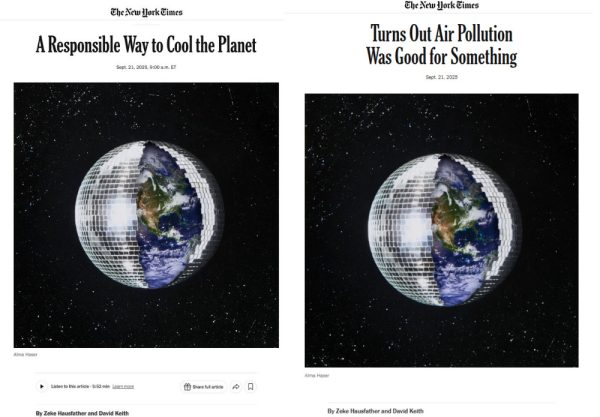
The bottom line is this: blocking the sun to cool the planet is an inherently dangerous idea. Sunlight is the basis of life on Earth. Corrupting its distribution and intensity will not stabilize climate but destabilize societies. History, common sense, and scientific warnings all converge on the same conclusion: geoengineering by aerosol injection is not a solution but an invitation to chaos.
The New York Times’s op-ed promoting intentional sulfur pollution is a reversal of decades of clean air progress, representing climate recklessness, not climate realism.
Western media’s pre-existing condition? Gaza atrocity denialism
By Rebecca Ruth Gold | The New Arab | September 10, 2025
In August 2025, for the first time in its 20 year history, the UN-backed Integrated Food Security Phase Classification (IPC) classified Gaza as having reached phase 5, the most acute phase in its system. This classification meant that Gaza was deep into a famine, and many of the starving have already suffered irreversible damage.
The IPC locates Gaza City as being fully within phase 5. The same level of food scarcity is expected to reach Deir al Balah and Khan Younis by late September.
Never before has the IPC made a full phase 5 famine classification outside Africa. It had certainly never reached this classification for a location that was just a few kilometres from world class restaurants. As UN Under-Secretary General Tom Fetcher put it in a memorable speech, the Gaza famine is taking place “within a few hundred meters of food, within a fertile land.”
The Gaza famine has been engineered in a manner that is without precedent in world history. People have described Israel’s siege as medieval, but the famine is backed by the full force of modern technology. Rather than looking to early history for analogies, what is happening in Gaza is best understood as a grotesquely futuristic iteration of modern biopolitics.
“Pre-existing conditions”
Within days of report’s release, Israel immediately called for its retraction. There is nothing unusual about a state that has created a famine pulling all the levers at its disposal to deny it. What makes Israel different from the average perpetrator is the eagerness of US and European media outlets to spread the perpetrator’s denialist narrative.
Already in July, the groundwork had been laid in mainstream outlets like the New York Times, which ran a “correction” to the caption it provided on an image of Mohammed Zakaria al-Mutawaq, a child dying of starvation in Gaza. When the cover image of his emaciated body was used for the story on Gazans dying of starvation, Israel’s Coordinator of Government Activities in the Territories (COGAT), which controls the entry of food and medicine into Gaza, informed the Times that al-Mutawaq was born with cerebral palsy.
Israeli media, including I24 and The Jerusalem Post set to work spreading this misinformation and suggesting that vulnerable individuals dying of starvation could not be treated as evidence of a famine.
Soon after, the Times stated that al-Mutawaq had “pre-existing health problems.” But what they failed to disclose is that this “correction” was made in response to Israeli pressure and that all famines target the vulnerable first. While cerebral palsy is a lifelong condition, it is not typically fatal for young children absent conditions of siege and famine. Had the victims of starvation not been Palestinian, common sense would have prevailed. No one would have found it necessary to make the obvious point that death by starvation combined with co-morbidities is still death by starvation.
Other media outlets soon followed, adjusting their captions to reflect, even in the abstract and untethered from specific cases, the possibility that children dying of starvation were suffering from “preexisting conditions.”
The Associated Press captioned the images on a photo essay by Palestinian photojournalist Jehad Alshrafi documenting how starvation is attacking children’s bodies with the following disclaimer: “In Gaza, malnutrition is often worsened by preexisting conditions and compounded by illnesses linked to inadequate health care and poor sanitation, largely the result of the ongoing war.”
Perhaps the Associated Press thought that they were mitigating the harm done by such captions by acknowledging that these so-called “preexisting conditions” that Israel and its defenders are using to deny evidence of famine are in fact “the result of the ongoing war.” But they should not be excused so easily for their complicity in famine denial.
The “pre-existing conditions” discourse has a dark history in the US, where it was introduced during the 1940s to deny healthcare to ailing patients. Even more ominously in Gaza, the “pre-existing conditions” that the media uses to whitewash famine are themselves the direct result of two decades of siege.
Legitimising Israel’s narratives
The right-wing US media company Free Press further disseminated the Israeli narrative when it published a story claiming that the “symbols of Gazan starvation […] suffer from other health problems.” Once again, ableism was used to deny the Gaza famine.
If the sick were made sicker by Israel’s engineered famine, it was implied that it was their own fault, and Israel could not be blamed for Gaza’s starvation. Yet the “preexisting conditions” cited by the Free Press journalists—rickets and cystic fibrosis—are not typically fatal for young children.
The fact that children in Gaza afflicted with these diseases are at a much higher risk of imminent death only confirms the severity of the famine, as well as its wider impact on conditions of life and mortality rates. Yet some media outlets downplayed the famine by focusing on the medical challenges faced by children who are dying of starvation.
On the very day the IPC released its famine report, CNN redacted its own story on starvation in Gaza by “updating” its captions to “reflect new information regarding the condition of some of the subjects.”
Israeli Prime Minister Netanyahu—himself a war criminal whom the International Criminal Court has indicted with “crimes of starvation,” marking the first time it had ever charged any leader with that crime—endorsed the Free Press story. He did not acknowledge all that his own government had done to undermine accurate reporting and to block data collection on starvation in Gaza.
The Gaza famine is an atrocity, a war crime, and evidence for genocide not just because it leads to deaths from starvation. No less fundamentally, it contributes to the breakdown of a social order. Famine tears communities apart. Mothers are forced to watch their children starve, and children watch their parents risk their lives—sometimes getting shot and killed—while searching for food to keep them alive.
Having normalised famine denialism through a eugenicist discourse in July, Israel was well-prepared to escalate its information warfare when the IPC issued its landmark report in August.
Israel attacked the report on two fronts. First, by falsely claiming that the data was biased. Second, by smearing the report authors due to their alleged political biases. As for the data-related dispute, the official X account for the state of Israel falsely insisted that the IPC had “forged” a famine by lowering the threshold to 15% malnutrition among the general population, as measured by upper-arm circumference. Yet the 15% malnutrition standard, measured according to upper arm circumference, was also relied on for previous IPC reports for other locations that reached a phase 5 famine assessment, including Sudan in 2024 and South Sudan in 2020.
As Jeremy Konyndyk, President of Refugees International concludes, Israel’s misrepresentation “is not a good-faith misread. It is a campaign of concerted disinfo[rmation].” The IPC quickly refuted Israel’s false claims.
Denialism
Food security experts criticise the IPC for being too conservative in its metrics. The general consensus is that the IPC places the bar for phase 5 famine classification too high. By the time famine is assessed by the IPC, mortality rates will have sharply escalated (as happened in Gaza during the second half of July 2025), and for many of those who are starving it will be too late to save them.
Unlike most European countries, the US did not issue any official response to the IPC famine report. On 27 August, during an emergency meeting of the UN Security Council which had been convened to address the famine in Gaza, US Ambassador Dorothy Shea to the UN rejected the report by alleging that one of the authors was biased against Israel. Shea’s critique was based on guilt-by-association and did not engage with the substance of the report’s claims.
The US’s denialist stance was explicitly rejected by all other 14 of the 15 Security Council members, who issued a statement affirming that they “trust the IPC’s work and methodology.” However, this consensus will be meaningless unless further measures are taken in defiance of the US.
Indeed, denialism is a core feature of Israel’s information war and is one reason why the genocide persists. In October 2023, less than three weeks into the Gaza genocide, U.S. President Joe Biden stated that he doubted the veracity of the casualty reports provided by the Palestinian Ministry of Health in Gaza. In a classic case of denying Palestinians the right to narrate their own extermination, he said “I have no confidence in the number that the Palestinians are using.”
These same reports that Biden cast doubt on had been deemed reliable by the United Nations, human rights groups, and mainstream—even the Israeli—media, not to mention Biden’s own State Department.
It was the first time a US President cast doubt on the validity of the figures provided by the Palestinian Ministry of Health.
Subsequent reporting and scholarship has shown that the Ministry of Health’s numbers are likely to be a drastic undercount; importantly, they don’t include indirect deaths from Palestinians who died due to lack of food, water, medicine, and medical care. Yet, mainstream US media started to refer to Gaza’s Ministry of Health as “Hamas-run” in order to undermine the source.
Around the same time, Israel launched a campaign questioning the casualty figures provided by the Palestinian Ministry of Health in Gaza. The Associated Press, The New York Times, The Washington Post, and CNN uncritically absorbed Israel’s messaging and began attaching “Hamas-run” to every reference to casualty figures from the Palestinian Ministry of Health in Gaza.
For no other nation does the media find it necessary to preface every reference to a civilian agency with the name of the political faction governing that country. Civilian agencies ought to be respected for the work they do, wherever they happen to be located.
Ending impunity, sanctions now
The crime of famine often converges in practice with the crime of genocide. For this reason, both kind of denialist narratives often flourish together. Just as complicity in genocide is a crime under international law, so should complicity in famine bring criminal sanctions.
In the first days of September 2025, as the famine and mass murder of civilians in Gaza continued to spiral out of control, Belgium announced that it would formally sanction Israel. The following day, Scotland announced similar measures. The majority of European states have maintained full complicity in this genocide, but the impunity that has been granted to Israel for decades is finally beginning to fray.
Famine expert Alex de Waal has compared famine to torture at the societal level. Systematic forced starvation creates a system in which “the biological imperative of survival turns against every impulse that makes us humans—compassion, solidarity, and love.”
The people of Gaza have pooled all their resources to resist this stage of social breakdown. That they have been able to withstand the pressures of famine for so long attests to the strong social and familial bonds that pre-existed the genocide.
However, no community can survive intact when their starvation becomes so acute that their bodies begin to consume themselves. Mass death by starvation awaits the people of Gaza unless we take action to stop the blockade and force Israel to open its borders and let aid flood Gaza.
Rebecca Ruth Gould is a Distinguished Professor of Comparative Poetics and Global Politics, at the School of Oriental and African Studies (SOAS), University of London.
Science-for-hire companies violate scientific norms, degrade public discourse, and facilitate the mass poisoning of society
By Toby Rogers | August 27, 2025
Last week, the New York Times published a bizarre “Guest Essay” on autism by Jessica Steier, a Pharma mercenary who has at least ten financial conflicts of interest and no background in autism research. I submitted a reply to the article to correct her disinformation and the NY Times refused to publish it.
Here are the facts for anyone who wants to read them:
Jessica Steier runs a science-for-hire company, “Unbiased Science.” She uses a number of pass-through organizations to launder contributions from large pharmaceutical and chemical companies. However, one can still figure out a lot of her funders (see article on “Unbiased Science Podcast” in SourceWatch). Steier advises an infant formula company and is an affiliate for a company that makes monosodium glutamate (MSG). Her podcast has taken money from 3M, Procter & Gamble, Pfizer, Johnson & Johnson, Novartis, Moderna, and CSL Seqirus (a flu vaccine manufacturer).
Steier is cartoonishly evil. From SourceWatch:
Steier’s Unbiased Science Podcast:
• Described the herbicide glyphosate as “safe for use”
• Declared polytetrafluoroethylene (PTFE) in Teflon to be “non-toxic to humans”
• Called the Environmental Working Group Dirty Dozen list of produce with the most and least pesticide residues “a fear-based marketing ploy”
• Claimed GMOs are “safe,” “nutritious,” and “beneficial to consumers, producers, and the environment” and
• Called hydrogenated oil “a safe dietary fat.”
The Unbiased Science Podcast recorded two episodes on organic food and farming in December 2022 and January 2023 in which they argued that organic pesticides are more harmful than synthetic pesticides used in chemical farming…
Andrea C. Love [Steier’s co-host] defended the artificial sweetener aspartame as “safe,” said in an interview that she has “at least one diet soda a day,” and the Podcast posted on Instagram that “aspartame does not pose a health risk to humans, cancer or otherwise, especially at levels we would consume.”
Love and Steier were critical of the International Agency for Research on Cancer’s ranking of the chemicals considered possibly carcinogenic to humans in 2023.
SourceWatch provides even more evidence of Steier’s toxic sophistry here.
For those who are new to these topics, mountains of evidence from The Defender, Beyond Pesticides, and Moms Across America, among others, show why all of Steier’s claims listed above are junk science.
Nearly everything Steier writes in her “Guest Essay” on autism is demonstrably false. For example, Steier:
- Thinks mercury and aluminum in vaccines are fine even though they are known neurotoxicants (see Grandjean and Landrigan, 2014, Supplementary appendix).
- Omits the fact that Mark, Anne, and David Geier sued the Maryland Board of Physicians and won (and then a higher court retroactively granted “absolute immunity” to this private board even though the Maryland legislature never gave it that right).
- Has apparently not read any of the 55 autism prevalence studies in the U.S. since 1970, so she is oblivious to the fact that autism rates have increased 32,158% over that time period.
- Seems unaware that a Danish study she cited favorably recently issued a correction after they discovered, post-publication, 136% more neurodevelopmental events, including autism and ADHD, that changed their research findings.
- Has never read, or just plain ignores, the six vaccinated vs. unvaccinated studies that show that vaccines significantly increase autism risk (see summaries in Rogers, 2025).
Science-for-hire companies will say or do anything for money. Steier’s company, “Unbiased Science,” is relatively new. However, it uses the same playbook developed by other notorious science-for-hire firms, including Gradient, Exponent, and Ramboll. They are often referred to as “rented white coats” (see discussion in Rogers, 2019). Anyone citing Steier as a “public health expert” has no idea what they are talking about.
The NY Times devoted considerable resources, including two graphic designers and prominent placement online and in the Sunday print edition, in the attempt to make this trashy hit piece look presentable to its readers. The NY Times’ failure to disclose Steier’s extensive conflicts of interest and its refusal to publish critical comments in connection with this “Guest Essay” make me wonder if this was a paid advertorial at the behest of a pharmaceutical company.
The autism epidemic is a matter of enormous national importance. Yet everything that the NY Times publishes on autism is an attempt to cover up the causes and protect the powerful industries that are culpable. Unfortunately, in the midst of this crisis, the NY Times has abandoned its role as “the newspaper of record” and is now a criminal syndicate that is endangering the health of all Americans.
Toby Rogers has a Ph.D. in political economy from the University of Sydney in Australia and a Master of Public Policy degree from the University of California, Berkeley. His research focus is on regulatory capture and corruption in the pharmaceutical industry. Dr. Rogers does grassroots political organizing with medical freedom groups across the country working to stop the epidemic of chronic illness in children. He writes about the political economy of public health on Substack.
The real Russiagate scandal blows away Watergate for crimes and treason by U.S. establishment
Strategic Culture Foundation | August 1, 2025
So the hoax is finally officially acknowledged. “Russiagate” – the mainstream narrative, that is – is now described by American intelligence chiefs as a fabrication that was concocted to overturn the results of the 2016 U.S. presidential elections.
Tulsi Gabbard, the current Director of National Intelligence (DNI), and CIA director John Ratcliffe have both accused former President Barack Obama of engaging in a “treasonous conspiracy” to subvert the constitutional process. It’s not just Obama who is implicated in this high crime. Other former senior officials in his 2013-17 administration, including former DNI James Clapper, CIA director John Brennan, and head of the FBI James Comey, are also implicated. If justice is permitted, the political repercussions are truly earth-shattering.
The potential impact is not confined solely to the violation of U.S. laws and the democratic process – bad enough as that is. The Russiagate scandal that began in 2016 has had a lasting, damaging effect on U.S. and European relations with Russia. The frightfully dangerous NATO proxy war incited in Ukraine, which threatens to escalate into a full-scale world war, was fueled in large part by the hostility generated from the false claims of Russian interference in the U.S. elections.
The allegations that Russian President Vladimir Putin oversaw a subversion campaign against the 2016 U.S. election and colluded with Donald Trump to get him elected were always specious. The scandal was based on shoddy intel claims to purportedly explain how Trump defeated his Democrat rival, Hillary Clinton. Subsequently, the scandal was hyped into a seemingly credible narrative by U.S. intelligence chiefs at the direction of then-President Barack Obama as a way to delegitimize Trump’s incoming first-term presidency.
Years before the recent intelligence disclosures, many independent journalists, including Aaron Maté, and former intelligence analysts like Ray MacGovern and William Binney, had cogently disproven the official Russiagate claims. Not only were these claims false, they were knowingly false. That is, lies and deliberate distortions. Russia did not hack emails belonging to the Democratic National Committee to discredit Clinton. Clinton’s corruption was exposed by a DNC internal leak to Julian Assange’s Wikileaks whistleblower site. That was partly why Assange was persecuted with years-long incarceration.
A large enough number of voters simply despised Clinton and her warmongering psychopathy, as well as her sell-out of working-class Americans for Wall Street largesse.
Furthermore, Moscow consistently denied any involvement in trying to influence the 2016 U.S. election or attempts to favor Trump. Putin has said more than once that Russia has no preference about who becomes U.S. president, implying that they’re all the same and controlled by deeper state forces. Laughably, too, while Washington accused Moscow of election interference, the actual record shows that the United States has habitually interfered in scores of foreign elections over many decades, including those of Russia. No other nation comes close to the U.S. – the self-declared “leader of the free world” – in sabotaging foreign elections.
In any case, it is instructive to compare the Russiagate farce with the Watergate scandal. Watergate involved spying by the White House of President Richard Nixon against a Democrat rival in the 1972 election. The political crisis that ensued led to Nixon’s resignation in disgrace in 1974. The U.S. nation was shocked by the dirty tricks. Several senior White House officials were later convicted and served time in jail for crimes related to the affair. Nixon was later pardoned by his successor, Gerald Ford, and avoided prosecution. Nevertheless, Watergate indelibly disgraced U.S. politics and, at the time, was described as “the worst political scandal of the 20th century.”
Subsequent cases of corruption and malfeasance are often dubbed with the suffix “gate” in a nod to Watergate as a momentous political downfall. Hence, “Russiagate.”
There are hugely important differences, however. While Watergate was a scandal based on factual crimes and wrongdoing, Russiagate was always a contrived propaganda deception. The real scandal behind Russiagate was not Trump’s alleged misdeeds or those of Russia, but the criminal conspiracy by Obama and his administration to sabotage the 2016 election and subsequently to overthrow the Trump presidency and the democratic will of the American people. Tulsi Gabbard, the nation’s most senior intelligence chief, has said that this amounts to “treason,” and she has called for the prosecution of Obama and other former senior aides.
Arguably, the real Russiagate scandal is far more criminal and devastating in its political implications than Watergate. The latter involved illegal spying and dirty tricks. Whereas, Russiagate involved a president and his intelligence chiefs trying to subvert the entire democratic process. Not only that, but the U.S. mainstream media are also now exposed for perpetrating a propaganda heist on the American public. All of the major U.S. media outlets amplified the politicised intelligence orchestrated by the Obama administration, claiming that Russia interfered in the election and that Trump was a “Kremlin stooge.” The hoax became an obsession in the U.S. media for years and piled up severe damage in international relations, a nefarious legacy that we are living with today.
The New York Times and Washington Post, reputedly two of the finest exponents of American journalism, jointly won the Pulitzer Prize in 2018 for their reporting on Russiagate, the official version, that is, which lent credibility to the hoax. In light of what we know now, these newspapers should be hanging their heads in shame for running a Goebbels-like Big Lie campaign to not only deceive the U.S. public but to subvert the democratic process and poison international relations. Their reputations are shredded, as well as those of other major media outlets, including ABC, CBS, CNN, and NBC.
Ironically, The Washington Post won the Pulitzer Prize in 1973 for its reporting on the Watergate scandal. The story was made into a best-selling book, All The President’s Men, and a hit Hollywood movie starring Robert Redford and Dustin Hoffman, playing the roles of intrepid reporters Bob Woodward and Carl Bernstein. Woodward and Bernstein and The Washington Post were acclaimed as the finest in U.S. journalism for exposing Watergate and bringing a crooked president to book.
How shameful and absurd that an even greater assault on American democracy and international relations in the form of Russiagate is ignored and buried by “America’s finest”. That the scandal is ignored and buried should be of no surprise because to properly reveal it would shatter the foundations of the U.S. political establishment and the sinister role of the deep state and its mainstream media propaganda system.
US media owe Putin an apology – Fox News host
RT | July 29, 2025
The US media need to make “serious” amends to many people, including Russian President Vladimir Putin, for their active role in spreading the Russiagate hoax following the 2016 presidential election, according to popular Fox News host Greg Gutfeld.
The political commentator, comedian, and author was responding to recent revelations made by Director of National Intelligence Tulsi Gabbard, who released a trove of documents she described as “overwhelming evidence” of a coordinated effort by senior Obama-era officials – allegedly led by Barack Obama himself – to politicize intelligence and falsely accuse Donald Trump of colluding with Russia to win the election.
“We cannot let this go. They need to make serious amends because we are still living with the aftermath,” Gutfeld said on his latest show, aired last weekend. “People lost jobs, careers, friends. There need to be consequences.”
“They owe a lot of people an apology. Hell, they even include Putin.”
According to Gutfeld, major American news media outlets “played the starring role in amplifying the subversive plot against the president of the United States.” He dismissed recent claims by the press accusing the Trump administration of trying to “rewrite history,” calling them an “attempt to shift culpability away from themselves and hide the lie they perpetuated for almost a decade.”
Earlier this month, a similar assessment was made by former CIA Director John Ratcliffe. In an interview with the New York Post, he cited an internal review suggesting that American public opinion had been manipulated through repeated media leaks and anonymous sources quoted by The Washington Post, The New York Times, and other major outlets.
Allegations of “Russian collusion” persisted in mainstream media coverage even after Special Counsel Robert Mueller’s investigation found no evidence to support the claims. Moscow has repeatedly denied interfering in the US election.
Gabbard described the Trump-Russia probe, widely referred to as Russiagate, as “a years-long coup” against Trump. The US president himself, who has consistently dismissed accusations of ties to Russia as fabricated, praised Gabbard for “exposing” the alleged plot and urged her to “keep it coming.”
Legacy media has a meltdown after RFK Jr fires the CDC’s vaccine panel
By Maryanne Demasi, PhD | June 10, 2025
Yesterday, Robert F. Kennedy Jr. fired every single member of the CDC’s Advisory Committee on Immunization Practices (ACIP)—the influential group of experts that decides which vaccines are added to the childhood schedule.
Today, he set fire to the media’s hysterical reaction.
Within 24 hours, legacy outlets and public health institutions lost their collective minds. Former CDC directors, industry-funded doctors, and conflicted public health groups lined up to denounce Kennedy’s move as reckless, anti-scientific, even deadly.
“This is a dangerous and unprecedented action that makes our families less safe,” said former CDC director Dr Tom Frieden.
“Unilaterally removing the entire panel of experts is reckless,” said paediatrician Dr Tina Tan to The New York Times.
The American Academy of Pediatrics (AAP) said it was “deeply troubled and alarmed.” It claimed the move would “stoke distrust in lifesaving vaccines”—this from the same organisation that has spent decades pushing the childhood vaccine schedule while taking money from the very companies that profit from it.
Others framed it as a political purge, a blow to science, or a “coup” that would bring back measles and polio.
But within hours, Kennedy hit back—and this time, he wasn’t the outsider being easily dismissed. He was the Secretary of Health and Human Services. And he came armed with evidence, receipts, and a brutal takedown of the media’s favourite falsehoods.
In a searing post on X, Kennedy explained the decision.
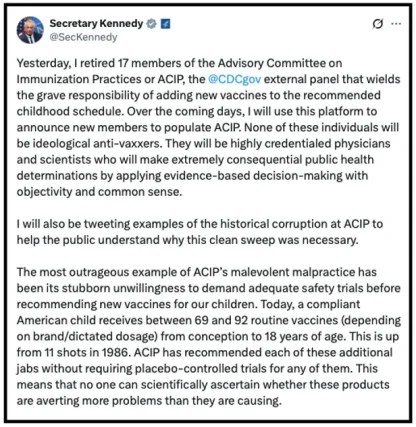
He said the clean sweep was necessary because ACIP had demonstrated its “stubborn unwillingness to demand adequate safety trials before recommending new vaccines for our children.”
And despite the media’s insistence otherwise, Kennedy argued that no routine injected childhood vaccine on the CDC’s schedule had ever been approved based on a placebo-controlled trial using an inert substance.
CNN had tried to prove him wrong last week—claiming it had found “257 placebo-controlled studies” of vaccines on the schedule.
Kennedy dismantled it in forensic detail.
“CNN is wrong,” he wrote. “No routine injected vaccine on CDC’s schedule was licensed for children based on a placebo-controlled trial. That is not conjecture. It is a fact based on FDA’s clinical trial data.”
Then came the body blows.
He pointed out that most of the 257 studies used active substances like aluminium, antibiotics, or other vaccines—not inert placebos.
He linked directly to FDA definitions of “placebo” and to official clinical trial records. Of the few studies that may have used saline controls, none were relied on by the FDA to license a single routine vaccine for American children.
Some studied products that were never approved in the US. Some occurred after licensure. Others involved discontinued vaccines. “CNN’s list ironically proves the lack of adequate safety trials,” Kennedy wrote in a stinging rebuke.
The post was devastating.
It was a clinical takedown of an industry riddled with deception—and it landed—because this time, Kennedy wasn’t being filtered through a hostile press.
He was speaking directly to the public, as a government official, with all the links to back it up. And the media couldn’t handle it.
Predictably, the media rolled out the same tired “experts” to recycle the same tired script—Paul Offit quotes, panic about “undermining trust,” warnings that children would die.
But Kennedy turned the whole thing inside out.
“We’ve gone from three routine injections by age one in 1986 to 25 in 2025,” he wrote. “And not one of them was licensed using a placebo-controlled trial.”
He said it plainly for the cameras: “That is just malpractice. So the people who are in charge of that are now gone.”
For years, the press had written Kennedy off as an anti-vaxxer and moved on. Now, they’ve thrown everything at him—and he threw it right back. Only now, he has the authority, data, and reach.
Kennedy told his followers he’d be announcing replacements in the coming days—no “ideological anti-vaxxers” just “highly credentialed physicians and scientists” committed to evidence, objectivity, and common sense.
Legacy media may still control the headlines, but they can no longer suppress the debate.
And perhaps that’s what really has them rattled.
They’re not defending science. They’re defending a regime of experts who signed off on decades of vaccine approvals without ever insisting on rigorous, inert-placebo safety trials.
When Kennedy calls them out, their only defence is to scream “danger!”—and hope no one checks the fine print.
Yesterday, he fired the gatekeepers. Today, he exposed the game.
New York Times On Climate Change: Two Candidates For Quote Of The Day
By Francis Menton | Manhattan Contrarian | May 21, 2025
Over at the New York Times today, print edition, there is a big front page article documenting how their side is losing the latest battle in the climate wars. The headline is “U.S. Embraces Climate Denial In Science Cuts.” (online headline somewhat different). Also in the Times today (online version) is a feature called “Quote of the Day.” Today’s “quote of the day,” as selected by the Times, is taken from the “climate denial” article just previously linked. Here it is:
“It’s as if we’re in the Dark Ages.”
This quote is attributed to one Rachel Cleetus, identified as senior policy director with the climate and energy program at the Union of Concerned Scientists.
But then, if you take some time to read the article, you come to what I would propose as another excellent candidate for quote of the day. It’s from Brooke Rollins, recently confirmed as the new Secretary of Agriculture in the Trump administration. Here it is:
“We’re not doing that climate change, you know, crud, anymore.”
The focus of the article is what the Times calls “getting rid of data.” In Times spin, the purpose is to “halt the national discussion about how to deal with global warming.” But what kind of “data” are we talking about here? The article is short on specifics as to which exact data series are being cut back or eliminated, let alone whether those series are accurate or useful. But there is enough to give you a general idea:
In recent weeks, more than 500 people have left the National Oceanic and Atmospheric Administration, the government’s premier agency for climate and weather science. . . . NOAA also stopped monthly briefing calls on climate change, and the president’s proposed budget would eliminate funding for the agency’s weather and climate research. The administration has purged the phrases “climate crisis” and “climate science” from government websites.
Ah, NOAA (National Oceanic and Atmospheric Administration). They’re the people who, via their branch called NCEI, put out the so-called “surface temperature” series that have been systematically altered to create a falsely-enhanced warming trend to support regular claims of “warmest day/month/year ever.” This is the subject of my now 33-part series “The Greatest Scientific Fraud Of All Time.”
Let me remind you of the basics of the temperature-alteration scam: (1) the surface temperature records as presented by NOAA/NCEI are not raw instrumental data, but rather have been altered, (2) NOAA admits that it alters the records, (3) NOAA gives seemingly-plausible reasons for altering the records (e.g., to account to station moves and instrument changes), (4) however, the alterations as implemented are not associated with any specific issues like station moves and instrument changes, and (5) the alterations systematically enhance the reported warming trend and are used to support the “climate crisis” narrative. For more detail, go to Part XXXIII of the “Greatest Scientific Fraud” series. Here are just a couple of backup points in case you are skeptical:
-
As to whether NOAA alters the raw data, from ABC News, February 25, 2025, “Yes, NOAA adjusts its historical weather data: Here’s why.” Excerpt: “When digging into conspiracies claiming that the federal agency “manipulates” its historical weather data, ABC News chief meteorologist and chief climate correspondent Ginger Zee was able to confirm that it was true — but that the routine, public adjustments to records happen for good reason. . . . NCEI [a branch of NOAA] adjusts weather data to account for factors like instrument changes, station relocation and urbanization, and it does so through peer-reviewed studies that are published through its federal website.”
-
As to whether the data alterations implemented by NOAA/NCEI can be tied to any specific legitimate bases like station moves or instrumentation changes, I cite a 2022 article by O’Neill, et al. (17 co-authors) from the journal Atmosphere, title “Evaluation of the Homogenization Adjustments Applied to European Temperature Records in the Global Historical Climatology Network Dataset.” I couldn’t get a pithy quote from the article, but here is my summary: “[The authors attempt] to reverse-engineer the adjustments to figure out what NCEI is doing, and particularly whether NCEI is validly identifying station discontinuities, such as moves or instrumentation changes, that might give rise to valid adjustments. The bottom line is that the adjusters make no attempt to tie adjustments to any specific event that would give rise to legitimate homogenization, and that many of the alterations appear ridiculous and completely beyond justification. . . .” There is much, much more detail if you follow the links.
It is not clear from the Times article whether the 500 recent departures from NOAA include the people who have been carrying out this temperature alteration scam. If those people aren’t gone yet, with any luck they will be soon; and maybe we’ll even get some details of how they have been practicing their dark arts.
Meanwhile, back in the world of climate reality, the Real Clear Foundation on Monday (May 19) held something they called the “Energy Future Forum.” Conference co-chairs David DesRosiers and Mark Mills gave opening key-notes. Kevin Killough of Just the News published a summary of the conference on May 20. From DesRosiers’ remarks:
“I think we’ve gone from scarcity to abundance — from the green gospel of scarcity and its Trinitarian ESG god — to the promised land of abundance guided by the values of affordability and reliability,” David DesRosiers, conference co-chair and founder of the RealClear Foundation, said.
And from Mills:
While many tech companies, such as Microsoft, embraced net-zero goals, Mills explained that the energy demands of data centers forced companies to contend with the reality that although fashionable in some circles, intermittent wind and solar power are not adequate. “Eventually, reality rears its ugly head, and we recalibrate around what reality permits,” Mills said.
Bottom line: the Times can scream all it wants, but the world is moving on. From my point of view, it can’t happen too fast.
Trump’s phone diplomacy with Putin shatters the Euro-Atlantic Cold War mental bloc
Strategic Culture Foundation | May 23, 2025
As the old saying goes, “it’s good to talk.” Good, that is, for most reasonable people who understand that dialogue is a process that opens positive possibilities, especially when the dialogue is conducted respectfully and sincerely.
This week, US President Donald Trump held his third phone conversation with Russian leader Vladimir Putin since he was inaugurated in the White House in January. The latest one on Monday was even more substantive than the previous calls, lasting about two hours, and, according to both sides, it was conducted in a friendly and productive manner.
Of course, the main topic of conversation was finding a peaceful end to the more than three-year war in Ukraine. Trump deserves credit for at least trying to bring peace to the table, instead of more and more weapons, as his predecessor, the mentally decrepit Joe Biden, did, and assorted European leaders would like to continue doing.
There was also discussion between Trump and Putin, using first names in their verbal exchanges, about repairing US-Russia relations for trade and strategic cooperation.
That portends a transformation in Washington’s erstwhile agenda of hostility towards Russia.
Tellingly, however, the talking was deemed “not good” by others, as could be gleaned from the vexed reactions to Trump’s call with Putin from European leaders and American advocates of the Euro-Atlantic alliance.
European politicians were reportedly “stunned” and “shocked” by Trump’s diplomatic outreach to Putin.
Following his conversation with the Russian president, Trump briefed five European leaders jointly. They included Germany’s Merz, France’s Macron, Italy’s Meloni, Finland’s Stubb, and the European Commission’s chief Von der Leyen. Ukraine’s Vladimir Zelensky was also part of the conference call. The non-entity British prime minister was not included. Sometimes, talking with toxic people is not good!
The Europeans tried to put a positive spin on the briefing from Trump, with Von der Leyen describing it as “good”. But that was the Europeans trying to save face from what is a stunning blow to the Euro-Atlantic alliance.
In a press conference at the White House on Monday, after his calls with Putin and the Europeans, Trump made it clear from his statements that the vaunted alliance is shattered. He is no longer listening to them, and his agenda towards Russia is transformational, if it is permitted to develop.
Trump rejected the European demands for an immediate 30-day ceasefire in Ukraine and more economic sanctions on Russia. He said that imposing more sanctions did not help resolve the conflict. Trump also indicated that he concurred with Russia’s logical position that negotiations must be focused on establishing a lasting peace, one that deals with addressing the root causes of conflict.
The European and Ukrainian demands for a 30-day truce as a precondition are not workable or logical. Indeed, such insistence impedes negotiations. From a cynical point of view, that is why the European backers of the Kiev regime are making such a song and dance about sanctions and the 30-day truce, because those demands are aimed at preventing diplomacy succeeding with Russia.
Britain’s Financial Times headlined its report on the Trump-Putin call: “Why Europe fears the worst after Trump’s ‘excellent’ chat with Putin”.
The BBC inadvertently shed light with its headline: “Trump’s call with Putin exposes shifting ground on Ukraine peace talks”. The BBC-speak about “shifting ground on peace talks” is an Orwellian translation. What the BBC should have said in plain language was that Trump is shafting the European warmongers.
Meanwhile, across the Atlantic, the supporters of the NATO proxy war against Russia tried their best to undermine Trump’s diplomacy.
The New York Times – the CIA’s main choice for gaslighting the American population – called the phone call a “diplomatic win for Russia” and snidely said, “Trump backs off ceasefire call”. The latter implied that Trump is against peace when, in fact, he is the only Western adult in the room calling for peace.
The Washington Post also did its best to smear Trump, reporting: “After call, Trump gives Russia more time for Ukraine war”. An op-ed piece also mockingly claimed: “Trump wasted two hours with Vladimir Putin”.
CNN, another outlet that has loyally and absurdly pushed the NATO proxy war as a noble endeavor, accused Trump for “siding with his friend in the Kremlin” and claimed that “peace in Ukraine looks further away after Trump’s call with Putin”, adding that “Putin got exactly what he wanted… stringing Trump along.”
The riot of negative and vitriolic reactions on both sides of the Atlantic shows that the US-European alliance under Trump has shattered. That alliance embodied by the NATO military bloc has been the linchpin of the “Collective West” for eight decades. It has now cracked wide open.
Unlike his predecessors in the White House, Donald Trump does not want to pursue a destructive and futile policy of inflicting a strategic defeat on Russia. That policy is what engendered the war in Ukraine, from the CIA-backed coup in Kiev in 2014, to the provocative weaponization of Ukrainian NeoNazis, until Russia’s intervention in February 2022 to defend its rights.
Trump appears to genuinely want to end the proxy war and to normalize relations with Russia for the sake of world peace, and, why not, good business.
For the Euro-Atlanticists, with their incurable, imperialist, and Russophobic mindsets, such a policy is anathema.
However, the good news is that the gaping cracks in the so-called Collective West now provide a path to peace.
Trump and Putin can end the war in Ukraine and negotiate an important peace deal that addresses Russia’s historic security grievances that stem from the decades of NATO aggression, which past American presidents and their European surrogates have facilitated.
For Trump to do that, he needs to listen carefully to the Russian leadership and reciprocate. If a new detente can be achieved, then the world will be a better, more secure, and peaceful place.
The other thing that Trump needs to do is to dismiss European lackeys with their warmongering servility to the status quo ante. They are has-beens and have nothing constructive to offer.
Trump’s phone call with Putin this week has had a major impact, and one that has significant potential for peace. The cracks in the Cold War mental bloc, so to speak, are a way forward.
Featured Video
Dan Dicks with James Corbett on Solutions Watch
or go to
Aletho News Archives – Video-Images
From the Archives
MMR (Measles, Mumps and Rubella) – Vaccine Risk Statement
MMR Vaccine (Measles, Mumps, and Rubella) Is It Safer Than Measles, Mumps and Rubella?
Physicians for Informed Consent | December 2024
… It has not been proven that the MMR vaccine is safer than measles, mumps, and rubella. The vaccine package insert raises questions about safety testing for cancer, genetic mutations, and impaired fertility. Although VAERS tracks some adverse events, it is too inaccurate to measure against the risk of measles, mumps, and rubella. Clinical trials do not have the ability to detect less common adverse reactions, and epidemiological studies are limited by the effects of chance and possible confounders. Safety studies of the MMR vaccine are particularly lacking in statistical power. A review of more than 60 MMR vaccine studies conducted for the Cochrane Library states, “The design and reporting of safety outcomes in MMR vaccine studies, both pre- and post-marketing, are largely inadequate.”19 Because permanent sequelae (aftereffects) from measles, mumps, and rubella are so rare (especially in children with normal levels of vitamin A and infected after birth),6,15-17 the level of accuracy of the research studies available is insufficient to rule out the possibility that the MMR vaccine causes greater death or permanent disability than measles, mumps, and rubella. – Read full article
Blog Roll
 Aletho News
- Yes, the Iran war has destroyed Trump’s presidency
- The fallacy of US delusions about Iran’s economic collapse
- Hezbollah denies Syria cell link, warns of Israeli plan to sow discord
- The legacy of US sanctions, war, and occupation in Iraq
- Iraqi resistance group rejects disarmament, vows to maintain support for Lebanon
- Sheikh al-Asadi warns of Iraqi government compliance with US demands
- How to MAKE THE CONSPIRATORS PAY for their crimes! Dan Dicks with James Corbett on Solutions Watch
- There’s a drought in academia: A drought in honest research on the subject of drought and other weather extremes
- Department of War Awards $20.7 Billion Contract to Raytheon for Air-to-Air Missiles
- ‘Distance yourselves from Israel’: IRGC urges US population to question govt policies
- If Americans Knew
- As settlers ravage West Bank, Israeli forces kill 10 in Gaza – Daily Update
- New Report: “Scholasticide and Genocide in Gaza: Assessment, Testimonies and Legal Analysis”
- Ex-Biden officials are desperate for a Gaza scapegoat
- Israeli “settlers” Invade Al-Aqsa; Pour Boiling Water on 75-Year-Old
- Israel Has Kidnapped Another American Teenager
- US arms sales to Israel worth $21.6 billion in 20 months
- Three Palestinians Killed in Israeli Attacks on Gaza
- Revealed: German “Anti-Semitism Expert” Driving Crackdown on Palestine Solidarity is Former Israeli Spy
- Egypt’s Warning to Israel Before Oct 7
- Israel’s siege signals another cruel winter for 1.8 million Gazans – Daily Update
- No Tricks Zone
- Two More Paleo Reconstructions Affirm Meters-Higher Sea Levels Across Ireland, Brazil 7000-6000 Years Ago
- New Study: Earth And Venus Surface Warmth Largely Explained By Convection And Lapse Rate, Not CO2 Or Radiation
- 2025 Nature Paper Claiming Worsening Global Drought Gets RETRACTED …Heavily Flawed
- New Study: ‘Global Drought Shows No Detectable Recent Acceleration Under Climate Warming’
- Economic Masterminds: German Socialists Suggest Taxing Productivity Gains Stemming From Using AI
- The South China Sea Has Not Been Cooperating With The Climate Change Narrative
- Energy Crisis: Germany Enters Heating Season With Historically Low Gas Reserve Fill Levels
- New Study: The Antarctic Ice Sheet Gained Mass From 2020-2024 Due To Staggering Snow And Ice Accumulation
- Study: Ocean Heating Rates From Thousands Of Years Ago ‘Dwarf’ Modern Ocean Heating Rates
- Climate Extremists Target, Attack Large-Scale Power Grid Infrastructure In Germany!

