A National Narrative for Media on Climate Change
By Kip Hansen | Watts Up With That? | June 22, 2019
Those of you who closely watch the media — newspapers, broadcast & streaming news, national magazines, national public radio — may have noticed that all the news about climate change is beginning to sound the same — regardless of outlet (there are a few sensible exceptions). This is no accident. In fact, it is an organized movement among American journalists.
I have written here before about the Editorial Narratives at the New York Times. Here’s the working definition I proposed for Editorial Narrative:
“Editorial Narrative: A mandated set of guidelines for the overriding storyline for any news item concerning a specified topic, including required statements, conclusions and intentional slanting towards a particular preferred viewpoint. A statement from the Editors of “How this topic is to be presented.”
In that essay, I quoted Michael Cieply when, in November 2016, he told the world about the NY Times’ Editorial Narratives:
“It was a shock on arriving at the New York Times in 2004, as the paper’s movie editor, to realize that its editorial dynamic was essentially the reverse [of that at the LA Times]. By and large, talented reporters scrambled to match stories with what internally was often called “the narrative.” We were occasionally asked to map a narrative for our various beats a year in advance, square the plan with editors, then generate stories that fit the pre-designated line.
Reality usually had a way of intervening. But I knew one senior reporter who would play solitaire on his computer in the mornings, waiting for his editors to come through with marching orders. Once, in the Los Angeles bureau, I listened to a visiting National staff reporter tell a contact, more or less: “My editor needs someone to say such-and-such, could you say that?”
The bigger shock came on being told, at least twice, by Times editors who were describing the paper’s daily Page One meeting: “We set the agenda for the country in that room.”
I don’t know how many readers took this bit of news seriously or how many readers realized the implications of the exposé. Personally, I was not surprised, as I had long suspected it. But the implications of this are quite disturbing. It means, in layman’s terms, that the news that you read has been pre-determined by the Editors and has little to do with actual events (real news) that happen in the real world. Those of you who have recently read Orwell’s 1984 will recognize some of the features of the Ministry of Truth (writ small at the NY Times’ “Page One meeting”). At the NY Times, the profession of journalism has been turned to the task of pushing the narratives of editors down the throats of the people. Newspeak is rampant.
While I found Cieply’s revelations unsettling, I find the following story truly frightening in its ability to threaten the very underpinnings of democracy.
The story starts earlier in the year with a conference planned and held at the behest of Columbia Journalism Review and The Nation (“along with partners such as The Guardian”). You can watch the conference online (YouTube). The outcome of that conference is a growing cabal of journalists and their editors: (in their own words):
“How does the media cover—or not cover—the biggest story of our time? Last fall, UN climate scientists announced that the world has 12 years to transform energy, agriculture, and other key industries if civilization is to avoid a catastrophe. We believe the news business must also transform.”
“The Columbia Journalism Review and The Nation assembled some of the world’s top journalists, scientists, and climate experts to devise a new playbook for journalism that’s compatible with the 1.5-degree future that scientists say must be achieved. We also held a town hall meeting on the coverage of climate change and the launch of an unprecedented, coordinated effort to change the media conversation.”
source: https://www.cjr.org/watchdog/climate-crisis-media.php/
Journalists around the world are being contacted by email by CJR with a message that includes this appeal:
“Our ask of you is simple: commit to a week of focused climate coverage this September. We are organizing news outlets across the US and abroad—online and print, TV and audio, large and small—to run seven days of climate stories from September 16 through the climate summit UN Secretary General Antonio Guterres hosts in New York September 23. The stories you run are up to you, though we can offer ideas and background information and connect outlets looking for content with content providers looking for outlets.
We’d be happy to schedule a phone call to discuss this further.
Sincerely,
What is their playbook? What’s the narrative they expect journalists to stick to?
It starts with this: “Transforming the media’s coverage of the climate crisis” and morphs into a “FAQ” titled “The media are complacent while the world burns” with these ideas and suggestions like these:
1. Climate is a crisis.
2. The Green New Deal is “a plan to mobilize the United States to stave off climate disaster and, in the process, create millions of green jobs.” and the GND has massive public support. [ NB: see Postscript at the end of this column. ]
3. Climate is the “biggest story of our time”.
4. Journalists should push the “… warning that humanity has a mere 12 years to radically slash greenhouse-gas emissions or face a calamitous future in which hundreds of millions of people worldwide would go hungry or homeless or worse.” and that “our civilization today faces the prospect of extinction”.
If this all sounds like a Climate Pragmatists Worst Nightmare, then you are starting to understand correctly. The CJR/Nation/Guardian cabal is working on a “handbook” to help news organizations “get the story right”. In other words, they are writing the Climate Journalism Narrative – a point for point list of what every climate story should say and how it should say it (and, remember folks, ”every story is a climate story”). They call on journalists to “Learn the science” suggesting that instead of actually reading anything containing the science of the climate, such as the real science sections of the IPCC AR5 report, they recommend that journalists read “Four recent books—McKibben’s Falter, Naomi Klein’s On Fire, David Wallace-Wells’s The Uninhabitable Earth, and Jeff Goodell’s The Water Will Come—are good places to start.” — all of which are extreme climate alarmist propaganda.
Covering Climate Now movement is organizing:
“A focused week of coverage
We’ll work to organize as much of the news media as possible—large and small, national and local—to commit to one week of focused coverage of climate change this September. The Secretary-General of the United Nations, António Guterres, is convening a summit in New York on September 23, where nations are urged to show how they will limit global temperature rise to 1.5 degrees Celsius. We propose a week of concentrated climate coverage in the lead-up to the UN summit, beginning September 16.” [source]
Don’t be fooled, they are not planning any real journalistic attempts to explain the complexity of the wicked problem called Earth’s Climate and the current controversies surrounding the issues involved. They are planning an intensive propaganda campaign across as many media outlets as they can convince (or shame) into signing on to participate.
I have laid out my position on the Climate Question here at WUWT ( here and here ). I encourage climate realists, especially those with a broader reach into mainstream media, to begin now to plan for their own counter-campaign to help neutralize the propaganda blitz envisioned by CJR/The Nation/The Guardian cabal for September 2019. We too are journalists, even if in just a small way. I for one will be following the Covering Climate Now propaganda campaign and will update the readership here with details from their promised propaganda ”handbook”.
The science is very plain on such issues as US wildfires, hurricanes (US and worldwide), US flooding, so-called heat waves and weather extremes. Opinion columns and essays in national newspapers and magazines (both print and online) and video commentary for broadcast and streamed news stations, laying out the simple truth, with graphs, numbers, and images, can and will help cut the ground from under the alarmist propaganda effort.
If we, the readers and contributors here, don’t make the effort to counteract this planned act of ideological sabotage of the American mind, who will?
# # # # #
POSTSCRIPT: One of the propaganda points that will be pushed by the Climate Journalists Cabal is: “Not only do most Americans care about climate change, but an overwhelming majority support a Green New Deal—81 percent of registered voters said so as of last December, according to Yale climate pollsters. Trump and Fox don’t like the Green New Deal? Fine. But journalists should report that the rest of America does.”
This is an example of how warped the journalism being promoted by the Covering Climate Now group is. It is true that a poll by “Yale climate pollsters” (in reality the activist department Yale Program on Climate Change Communication) found, in December 2018: “The survey results show overwhelming support for the Green New Deal, with 81% of registered voters saying they either “strongly support” (40%) or “somewhat support” (41%) this plan.” There’s the 81%.
What a great quotable quote!
The reality is a bit different. The pollsters asked this question:
“Some members of Congress are proposing a “Green New Deal” for the U.S. They say that a Green New Deal will produce jobs and strengthen America’s economy by accelerating the transition from fossil fuels to clean, renewable energy. The Deal would generate 100% of the nation’s electricity from clean, renewable sources within the next 10 years; upgrade the nation’s energy grid, buildings, and transportation infrastructure; increase energy efficiency; invest in green technology research and development; and provide training for jobs in the new green economy. How much do you support or oppose this idea?”
And got this result:
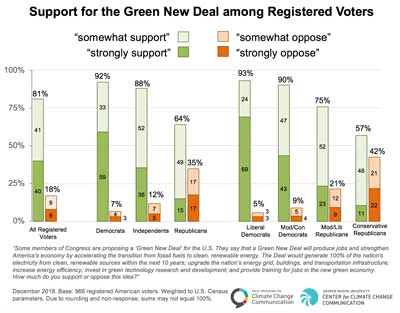 Now that looks pretty definitive, doesn’t it? But here’s the real deal…. the poll is taken in the first weeks of December 2018. The Green New Deal (in its current form) was announced the week following the November 2018 mid-term elections. So, less than 3 weeks after it is announced, put up on the web, taken down again, put up again (you remember the story), the climate advocacy group at Yale does a poll, preceded by a glowing recommendation of the GND, and then asks “How much to you support or oppose this idea?”
So, our Climate Journalist Cabal is not misrepresenting the poll… they are just misrepresenting the whole concept of public support for the GND.
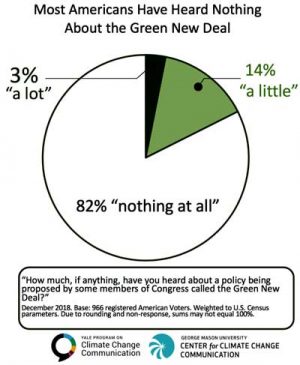 The same poll also asked:
“How much, if anything, have you heard about a policy being proposed by some members of Congress called the Green New Deal?”
The resounding answer?
“Nothing at all”
The same poll, the same cohort (same people polled), a greater percentage than those purportedly “supporting” it had heard “nothing at all” about the GND.
For those that interpret polls, this means, bluntly, that the “supporters” were responding solely to the pollsters “introduction” about the GND — they really didn’t know anything at all about it.
What does the public really think about the seriousness of climate issues? The Pew poll of January 2019:
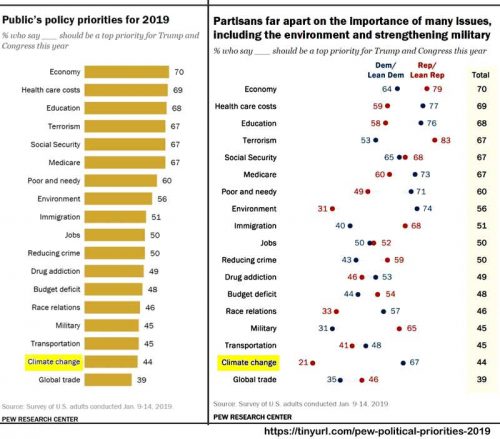
The Climate Journalist Cabal has already stated that it plans to use this near-total misrepresentation as part of its propaganda campaign. What they will do with other topics is not hard to imagine.
Iran ‘Violates’ Nuclear Deal, After US ‘Withdraws’

By Joshua Cho | Fair | June 21, 2019
Quick question: Does the US ever break, breach or violate its international agreements?
Apparently not, according to US coverage of Iran’s recent announcement that it intended to go beyond the limits of the 2015 Iran nuclear deal in enriching uranium for its civilian nuclear program (frequently mischaracterized as a nuclear weapons program in media coverage). Reading corporate media’s inversion of reality, it’s hard to escape the impression that while Iran betrays its international agreements, the US just leaves them behind.
An Associated Press report carried by USA Today (6/17/19) was headlined: “Iran Says It Will Break Uranium Stockpile Limit in 10 Days,” and reported that Iran’s announcement indicated its “determination to break from the landmark 2015 accord,” while noting that “tensions have spiked between Iran and the United States,” partly because the US “unilaterally withdrew” from the landmark agreement. Note that the US rejection of its obligations under the deal is referred to in neutral terms—Washington “withdrew”—while Iran’s response to US nonobservance gets negatively characterized as a “break”—a pattern that persists throughout the coverage.
There was no indication in the AP piece that Iran offered conditions under which it would continue to comply with the Iran Deal (formally known as the Joint Comprehensive Plan of Action), which gives the false impression that Iran’s decision to end compliance with the JCPOA is settled and unconditional.
The Wall Street Journal (6/17/19) offered the same kind of misleading headline: “Iran to Breach Limits of Nuclear Pact, as US to Send More Troops to the Middle East.” Again, Iran’s potential departure from the pact whose terms the US has vitiated is portrayed as a “breach,” while the US’s actual violation of the deal is labeled a “pullout” in the accompanying piece.
The Journal, unlike the AP, did note that Iran offered conditions under which it would continue to comply with the JCPOA’s terms:
The spokesman for Iran’s atomic energy agency, Behrouz Kamalvandi, said that by June 27—10 days from Monday—the country would surpass its enriched-uranium limits. He said Iran would further increase its production in early July, but could reverse both steps if Europe provided relief from [US] sanctions.
CNN (6/17/19) went with “Iran says it will break the uranium stockpile limit agreed under nuclear deal in 10 days,” as their headline. Only people who read past the headline, which most people don’t, would’ve known that that’s not really what Iran is saying:
Iran has reiterated that it could reverse the new measures should the remaining European signatories in the nuclear deal (France, Germany and the United Kingdom) step in and make more of an effort to circumvent US sanctions.
To its credit, CNN added “withdraw” in addition to the usual “violate,” “break” and “breach” in its list of words to describe Iran’s potential departure compared with just “withdrew” to describe the US’s actions.
The New York Post (6/17/19) chose “Iran Will Violate Nuclear Deal, Boost Uranium Stockpile” as the headline to mislead readers, and kept with the pattern of describing the US’s JCPOA breach as “pulling out of the deal.” However, unlike other reports, it didn’t feature any sources skeptical of Iran’s responsibility for the recent Gulf of Oman attacks on Japanese and Norwegian commercial oil tankers, despite crew members aboard the Japanese Kokuka Courageous contradicting US allegations of an Iranian mine attack by claiming to have been hit by a “flying object,” and European officials calling for further investigation and urging “maximum restraint.”
The New York Times’ headline (6/17/19): “Trump Adds Troops After Iran Says It Will Breach Nuclear Deal,” not only continued the above trends by not giving any hint that Iran might not depart from the pact, and characterizing the US’s JCPOA violations as a mere “withdrawal,” it also reported on US sanctions on Iran without mentioning that the sanctions themselves are violations of international law (Guardian, 10/3/18).
The Times uncritically cited Secretary of State Mike Pompeo’s statements that the US is “considering a full range of options”—including military strikes—without mentioning that these would be violations of international law because they go against UN Security Council Resolution 1887, which requires peaceful resolutions to disputes regarding nuclear issues, in accordance with the UN Charter and the Non-Proliferation Treaty, which both the US and Iran are parties to.
In fact, virtually all coverage fails to address the JCPOA in light of the NPT, because none of it challenges the legitimacy of the US’s prerogative to impose limits on Iran’s civilian nuclear program to begin with. Article IV of the NPT supports the “inalienable right of all the Parties to the Treaty to develop research, production and use of nuclear energy for peaceful purposes,” in accordance with Articles I and II forbidding the transfer and receiving of nuclear weapons from nuclear-weapon states.
FAIR (10/17/17) has observed that corporate media frequently attribute malicious intentions to Official US Enemies without going through the bother of presenting evidence. Iran is often accused of sneakily plotting to develop nuclear weapons, the way US ally Israel actually did when it built the only nuclear weapons arsenal in the Middle East (Guardian, 1/15/14).
This is ironic, because Iran has actually been a consistent leader in the nuclear disarmament movement. Foreign Minister Javad Zarif, when Iran was the chair of the Non-Aligned Movement, critiqued the JCPOA because it didn’t go far enough to ensure peace in the Middle East by not establishing a Nuclear Weapons–Free Zone there. Iran was also one of the first countries to propose making the Middle East a NWFZ, bringing up the proposal to the UN General Assembly in 1974 (CounterPunch, 12/13/13).
Journalist Gareth Porter (Foreign Policy, 10/16/14), reporting on Iran’s little-understood theocratic system, noted that Supreme Leader Ayatollah Khomeini’s fatwa against building any kind of WMDs in the 1990s is a formal ruling on Islamic jurisprudence, holding a legal status above mere legislation. He also pointed to Khomeini’s refusal to develop WMDs when up to 20,000 Iranians were killed by chemical weapons by then–US ally Saddam Hussein in the 1980s (Reuters, 9/16/13)—with an additional 100,000 survivors developing chronic diseases. Current US sanctions aiming to bring Iran’s “oil exports to zero” are exacerbating those chronic diseases, in addition to further strangling Iran’s economy, by restricting access to necessary medicine (Guardian, 9/2/13).
Of course, none of this can be mentioned, because it contradicts the corporate media narrative of Iran being an enemy that must be confronted, with US aggression against Iran being portrayed as defensive countermeasures (FAIR, 5/19/19, 6/6/19). For US media, Iran is the only JCPOA party with commitments that can be “breached,” “violated” or “broken,” with the US free to leave them whenever it wants to, without harming its reputation as a trustworthy party to international agreements.
US Cyberwar on Russia? New York Times Does Psyops
Strategic Culture Foundation | June 21, 2019
A front-page article in the New York Times this week certainly generated a lot of reaction. In rather sensational terms, the paper claimed that the Pentagon’s cyber command was stepping up hacking intrusions into Russia’s power infrastructure.
So penetrated were the purported “digital” weapons, it was conjectured that Russia could suffer “black outs” at any moment and see its military instantly paralyzed.
Presidents Trump and Putin were obliged to react to the NYT’s article. Trump rubbished it as fake news, while Putin responded with a certain tone of alarm about possible consequences of a cyberwar breaking out.
Many commentators, including critical ones who normally show skepticism towards the NYT, were inclined to accept the article as an accurate account of US cyber aggression against Russia.
However, it is worth asking the basic question: are the claims reliable?
There are several reasons to be suspicious about the veracity of the NYT’s report, and what the real purpose of publishing it is.
For a start, America’s so-called “newspaper of record” has demonstrated itself to be more often than not an obedient purveyor of misinformation for the US military-intelligence apparatus.
Just two examples are cited here of dutiful functioning from many instances over the decades.
In July 1945, when the Pentagon detonated the first-ever atomic bomb in the desert of New Mexico, it was the NYT that put out dutiful reports claiming that the massive test explosion was not a new, far more destructive weapon. It also claimed that the local population had nothing to fear from health effects, despite thousands of Americans later dying from radiation fallout.
A second notorious example is how the “paper of record” was a chief conduit for propaganda about “weapons of mass destruction” (WMD) which was used to launch the genocidal war on Iraq in 2003. Those claims were later shown to be entirely false. The NYT thus engaged in telling barefaced lies to the public in order to launch a criminal war of aggression.
One of the main NYT’s writers who peddled the WMD propaganda for the destruction of Iraq was David Sanger whose byline appeared on the latest article claiming that the Pentagon was escalating cyberwar on Russia. Arguably, this so-called journalist should be in a prison for complicity in war crimes, not sitting behind a desk receiving a big fat salary.
A closer reading of the article indicates that many of the sensational claims are vague and unsubstantiated. The article is long-winded and jargonistic, raising more questions than answers, which usually means the content is more fabulation than factual. As usual, the sources are anonymous and often referred to as “former officials”.
There were also contradictions in the reporting, the most glaring of which is that the NYT claims the Trump White House signed off on the alleged new aggressive activities, yet President Trump panned the story as fake. Trump’s evident disgust seemed genuine. He called the article “treasonous” and suggested it was a desperate attempt by the “failing” NYT to scoop up readers.
So, let’s think about this. A loyal conduit of Deep State misinformation is purporting to be revealing secret cyberwar activities against Russia. If it were doing that, the Pentagon would not be happy. If the NYT is quoting anonymous secret agencies, the suspicioun is that those sources wanted the NYT to publish this article. Why would that be? To alert Russia of implanted malware in its infrastructure only for Russian computer experts to track down the offending bugs and eliminate them? That doesn’t make sense. Why would the Pentagon out itself for the benefit of Russia?
What’s likely going on here is that the NYT is serving – as it usually does – as a conduit for “psychological operations”. The real intention seems to be to unnerve Moscow about an impending cyber strike on the Russian nation.
Another intended effect from the article is to further poison bilateral relations between the US and Russia. Presidents Trump and Putin are expected to hold a meeting next week during the G20 summit in Japan. It seems that the higher authors of the NYT’ report and their stenographers like David Sanger have the intention to pre-empt the forthcoming conversation between the American and Russian leaders.
A further sinister twist is that the NYT claims President Trump has not been informed about the alleged cyberwar against Russia. It suggests that is because Trump is not trusted by intelligence agencies for fear he might leak details to Putin. This is another tawdry attempt by the paper to revive its failed previous claims of undermining the American president as a “Kremlin stooge”.
Moreover, the NYT quotes National Security Adviser John Bolton as appearing to confirm the Pentagon’s alleged cyber aggression against Russia. That is a further slight on the American president. Who is actually running the US government? Trump, Bolton or Deep State operatives?
Finally, it should be noted that the NYT claims are premised on past dubious allegations that Russia interfered in US elections and that it has also been hacking into America’s power grid. By taking its latest story at face value, one is obliged to accept its previous stories of Russian malfeasance as accurate, which they are not.
Russia, of course like all nations, must ensure its infrastructure and defenses are inviolable from foreign hacking of computer systems. There is no doubt US agencies have and are probing Russian systems for potential vulnerabilities. But such a scenario is significantly different from one where a digital sword is supposedly hanging over Russia’s head threatening to deliver a lethal blow at any time.
Frankly, the NYT has become a consummate parody of a newspaper. Its Pulitzer Prizes for “journalistic excellence” are more baubles for good conduct in the service of state propaganda; propaganda that has often led to criminal wars and the deaths of millions of people. It purports to “reveal” secret Pentagon activities, yet elsewhere honorable journalists like Julian Assange are being persecuted for doing just that.
The “paper of record” styles itself as a truth-teller. Its advertising slogan is “the truth is worth it”.
Indeed, the truth is worth it, especially when lies and fabrications could have such horrific consequences for international relations and human lives.
Munk School of Global Affairs feeds anti-Iran propaganda

By Yves Engler · June 12, 2019
Sometimes, when you pay attention, it is easy to see how foreign policy propaganda works. Take the case of Iran.
Recently the US has choked off Iranian oil exports, listed its military a terrorist organization and dispatched an aircraft carrier and B-52 bombers to its environs to stop Iran’s “aggression”. Going along with Donald Trump’s warlike actions and rhetoric, Justin Trudeau’s government has broken a promise to restart diplomatic relations, failed to withdraw Iran from Canada’s list of state sponsors of terrorism and recently accused Tehran of destabilizing the region.
This is the context in which the Munk School of Global Affairs’ Citizen Lab released a recent report criticizing Iran. According to Citizen Lab, an Iran-aligned group dubbed Endless Mayfly impersonated major media sites, used fake Twitter accounts to spread false articles and targeted journalists with fake stories. Its report noted, “initial reporting on some of the inauthentic articles speculated that Endless Mayfly may have links to Russia; however, based on the evidence gathered from our investigation we conclude with moderate confidence that Endless Mayfly is Iran-aligned and has been operational since at least early 2016.”
The University of Toronto based lab’s accusations were picked up by dozens of media outlets around the world. A New York Times headline read: “Report Shows How a Pro-Iran Group Spread Fake News Online” while the Globe and Mail noted “New Citizen Lab report suggests Iran spreads fake news.”
But, the report’s concluding section titled “Narratives fit Iranian interests, propaganda” isn’t convincing. One reason it claims Iran was responsible for the initiative is that “framing Saudi Arabia as a creator and supporter of global Islamist terrorism is also a very common theme in Endless Mayfly content and is consistent with recent rhetoric from Iran’s top-ranking officials.” But, Iranian officials certainly aren’t the only ones who claim Saudi Arabia contributes significantly to Islamic terror.
While the media mostly covered Citizen Lab’s claims uncritically, its positions on Iran should be viewed with significant skepticism. This ‘lab’ has produced a stream of reports critical of Iran and, in fact, is part of a government funded effort to destabilize that country. In March Citizen Lab Director Ron Deibert co-authored “Censors Get Smart: Evidence from Psiphon in Iran.” Previously, Citizen Lab published “Group 5: Syria and the Iran Connection”, which described a malware operation targeting Syrian opposition figures that purportedly came from Iran. The Lab published After the Green Movement: Internet Controls in Iran, 2009-2012 and in 2015 they detailed hacking of Iranian dissidents. While Citizen Lab carefully avoided naming a culprit, their press release hyped the matter and a number of media reports implied Iranian authorities were responsible.
Deibert is a regular at anti-Iranian events. He spoke at a Toronto International Film Festival screening of a movie about the 2009 Green Revolution in Iran and a 2012 Walrus article described a “network of local Farsi speakers linked to Deibert and Psiphon.”
With early financial support from the Ford Foundation, Donner Canadian Foundation and Open Society Institute, Citizen Lab developed software to bypass government censors. It worked with Voice of America, Radio Free Europe and Radio Farda in Iran to disseminate its Psiphon technology to Iranian dissidents. A 2018 Vice story titled “This App Is Helping Iranians Beat Tehran’s Internet Censorship” described Psiphon’s growth in Iran. It noted, “the lab, and the school, has spent years devising various ways to improve civic engagement in Iran, especially online, with some financial support from the Canadian government.”
The Munk School of Global Affairs joined the Stephen Harper Conservatives’ low-level war against Iran. After severing diplomatic ties and designating Iran a state sponsor of terrorism in 2012, Foreign Affairs ploughed $250,000 into the Munk School’s Global Dialogue on the Future of Iran. The aim of the initiative was to foment opposition to the regime and help connect dissidents inside and outside Iran. Employing cutting-edge Internet strategies, the Iran Dialogue was launched at a two-day conference kicked off by foreign minister John Baird. Some Iranian Canadians criticized the 2013 Global Dialogue on Iran. In a letter to Munk School head Janice Stein, who was awarded an honorary doctorate from Hebrew University “in tribute to her unwavering devotion to Israel”, the president of the Iranian Canadian Community Council Niaz Salimi wrote: “Conspicuously absent from the event were experts, academics, political activists, students, bloggers, journalists and members of the Iranian diaspora (including those of the Iranian-Canadian community) whose views on Iran do not fully concur with the positions of the Harper government.”
The Munk School has been a hub of anti-Iranian activity. A senior research fellow until recently, Mark Dubowitz was dubbed “The Man Who Fights Iran” by Ynet, Israel’s largest English language news site. Alongside his position at the Munk School, Dubowitz was executive director of the extremist pro-Israel Foundation for Defense of Democracies where he led its campaign against the Obama administration’s Iran nuclear deal. In 2011 Dubowitz said, “the best way [to end Iran’s nuclear program] is to work toward changing the regime.”
Expanding the Global Dialogue on the Future of Iran, Foreign Affairs gave the Munk School $9 million in 2015 to establish the Digital Public Square project. The federal support “will enable the Munk School to create our new Digital Public Square, a square designed for citizens who cannot come together physically to exchange ideas about the future of their country,” Munk School head Janice Stein said. The countries cited were Iran, Syria, Iraq and Russia. There was no mention of employing digital technologies to undermine online censorship in equally, or more, repressive allies such as Rwanda, Jordan, Honduras or Saudi Arabia.
This is one-way Canadian propaganda works: Establish who your enemies are — generally defined by big corporations, rich people and whoever is in power in Washington — attempt to destabilize their “regimes”, then accuse their governments of interfering in your affairs.
Citizen Lab’s recent report criticizing Iran is part of a government funded effort to demonize that country, which could be a step towards a military assault.
MSM Mourns Death Of CIA-Backed Syrian Al-Qaeda/ISIS Ally

By Caitlin Johnstone | June 8, 2019
On Wednesday the alternative media outlet Southfront published an article titled “New Video Throws Light On Jaysh Al-Izza High-Tolerance To Al-Qaeda Ideology” about newly discovered footage showing the leader of a “rebel” faction in Syria cozying up with a militant who was wearing a badge of the official flag of ISIS.
“The video shows Jaysh al-Izza General Commander Major Jamil al-Saleh congratulating a group of his fighters on the occasion of Eid al-Fitr in a underground bunker,” Southfront reports. “One of the fighters greeted by Saleh was wearing a batch of the Islamic Black Standard with the Seal of Muhammad. This is a well-known symbol of al-Qaeda and the official flag of ISIS.”
Today, mass media outlets are mourning the death of a well-known Jaysh al-Izza fighter named Abdel-Basset al-Sarout with grief-stricken beatifications not seen since the death of war criminal John McCain. An Associated Press report which has been published by major news outlets like The New York Times, The Guardian, PBS and Bloomberg commemorates Sarout as a “Syrian soccer goalkeeper” who “won international titles representing his country”, as “the singer of the revolution”, and as “an icon among Syria’s opposition”.
Remember Major Jamil al-Saleh from two paragraphs ago? AP features his glowing eulogy in its write-up on Sarout’s death:
“He was both a popular figure, guiding the rebellion, and a military commander,” said Maj. Jamil al-Saleh, leader of Jaish al-Izza rebel group, in which Sarout was a commander. “His martyrdom will give us a push to continue down the path he chose and to which he offered his soul and blood as sacrifice.”
Other mainstream outlets like BBC, The Daily Beast and Al Jazeera have contributed their own fawning hagiographies of the late Jaysh al-Izza commander.
“Formed in 2013, Jaysh al-Izza was one of the first Free Syrian Army (FSA) groups in northern Syria to benefit from U.S. support through the CIA’s ‘Timber Sycamore’ train and equip program, which had been approved by then U.S. President Barack Obama,” Southfront reports in the aforementioned article. “The group received loads of weapons from the U.S. including Grad rockets, as well as Fagot and TOW anti-tank guided missiles (ATGMs).”
“Jaysh al-Izza received this support under the pretension of being a ‘moderate group’ led by a known Syrian Arab Army (SAA) defector, al-Saleh,” Southfront adds. “However, the group’s acts were not in line with these claims. Since its formation, Jaysh al-Izza has been deeply linked to al-Qaeda’s branch in Syria, the al-Nusra Front. The group became one of the main allies of al-Nusra when its changed its name to Hay’at Tahrir al-Sham (HTS) in 2017.”
“Western thought leaders are lionizing Abdel Baset al-Sarout who was killed fighting the Syrian army,” tweeted journalist Dan Cohen of the mass media response to Sarout’s death. “They conveniently omit that he fought in a militia allied with al-Qaeda and pledged allegiance to ISIS.”
Cohen linked to an excerpt from his mini-documentary The Syria Deception featuring footage of Sarout holding an ISIS flag, leading chants calling for the extermination of the Alawite minority in Syria, and announcing his allegiance to ISIS.
Other publicly available video footage includes a speech by Sarout urging cooperation between his own faction, ISIS and Jabhat al-Nusra (Al-Qaeda’s Syrian franchise), saying “we know that these two groups are not politicized and have the same goals as us, and are working for God.”
“God willing we will work with them shoulder-to-shoulder when we leave here,” Sarout has been translated as saying in the speech. “And we are not Christians or Shiaa to be scared of suicide belts and car bombs. We consider these things as strengths of ours, and God willing they will be just that. This message is to the Islamic State and our brothers in Jabhat al-Nusra, that when we come out of here we will all be one hand to fight Christians and not to have internal fights among ourselves. We want to take back all the lands that have been filthied by the regime, that were entered and taken over by Shiaas and apostates.”
This bloodthirsty terrorist warmongering was taken by the aforementioned AP hagiography and twisted into the single sentence, “He repeatedly denounced rebel infighting and called on Syrians to unite against government forces.”
The Atlantic’s Hassan Hassan framed Sarout’s unconscionable agendas as mere “flaws” which actually add to his inspiring and heroic story, tweeting, “Some individuals celebrated as heroes make you doubt all stories of heroes in history books. Others, like Abdulbasit Sarout, not inspire of but despite his flaws, make those stories highly plausible. He’s a true legend & his story is well documented. May his soul rest in peace.”
Yeah, come on, everybody’s got flaws. Some people suck at parallel parking, some people team up with ISIS and Al-Qaeda on genocidal extermination campaigns. We’ve all got our quirky little foibles.
We can expect more and more of these mass media distortions as Syria and its allies draw closer to recapturing Syrian land from the extremist forces which nearly succeeded in toppling Damascus just a few short years ago.
As these distortions pour in, keep this in mind: all of the violence that is still happening in Syria is the fault of the US and its allies, who helped extremist jihadist factions like Jaysh al-Izza overrun the nation to advance the preexisting goal of effecting regime change. The blame for all the death, suffering and chaos which ensues from a sovereign nation fighting to reclaim its land from these bloodthirsty factions rests solely on the government bodies which inflicted their dominance over the region in the first place.
You will see continuing melodramatic garment-rending from the US State Department and its mass media stenographers about “war crimes” and “human rights violations” as though the responsibility for this violence rests somewhere other than on the US-centralized power alliance, but they will be lying. What these warmongering propagandists are doing is exactly the same as paying a bunch of violent thugs to break into a home and murder its owner, then standing by and sounding the alarm about the way the homeowner chooses to fight off their assailants.
After it was discovered that the US and its allies armed actual, literal terrorist factions in Syria with the goal of effecting regime change, the only sane response would have been for the public to loudly and aggressively demand that all governments involved to take immediate action to completely rectify all damage done by this unforgivable war crime at any cost, and for there to be war crimes tribunals for every decision maker who was a part of it. Instead, because of propaganda circulated by the same mass media narrative management firms who are sanctifying the memory of Abdel-Basset al-Sarout today, the public remains asleep to the depravity of its rulers. This dynamic must change if we are to survive and thrive as a species.
Glacier National Park Quietly Removes Its ‘Gone by 2020’ Signs
Glaciers Appear to be Growing, not Melting in Recent Years
By Roger I. Roots, J.D., Ph.D.,
Founder, Lysander Spooner University
May 30, 2019. St. Mary, Montana. Officials at Glacier National Park (GNP) have begun quietly removing and altering signs and government literature which told visitors that the Park’s glaciers were all expected to disappear by either 2020 or 2030.
In recent years the National Park Service prominently featured brochures, signs and films which boldly proclaimed that all glaciers at GNP were melting away rapidly. But now officials at GNP seem to be scrambling to hide or replace their previous hysterical claims while avoiding any notice to the public that the claims were inaccurate. Teams from Lysander Spooner University visiting the Park each September have noted that GNP’s most famous glaciers such as the Grinnell Glacier and the Jackson Glacier appear to have been growing—not shrinking—since about 2010. (The Jackson Glacier—easily seen from the Going-To-The-Sun Highway—may have grown as much as 25% or more over the past decade.)
The centerpiece of the visitor center at St. Mary near the east boundary is a large three-dimensional diorama showing lights going out as the glaciers disappear. Visitors press a button to see the diorama lit up like a Christmas tree in 1850, then showing fewer and fewer lights until the diorama goes completely dark. As recently as September 2018 the diorama displayed a sign saying GNP’s glaciers were expected to disappear completely by 2020.
Video of the diorama two years ago.
But at some point during this past winter (as the visitor center was closed to the public), workers replaced the diorama’s ‘gone by 2020’ engraving with a new sign indicating the glaciers will disappear in “future generations.”
Almost everywhere, the Park’s specific claims of impending glacier disappearance have been replaced with more nuanced messaging indicating that everyone agrees that the glaciers are melting. Some signs indicate that glacial melt is “accelerating.”
A common trick used by the National Park Service at GNP is to display old black-and-white photos of glaciers from bygone years (say, “1922”) next to photos of the same glaciers taken in more recent years showing the glaciers much diminished (say, “2006”). Anyone familiar with glaciers in the northern Rockies knows that glaciers tend to grow for nine months each winter and melt for three months each summer. Thus, such photo displays without precise calendar dates may be highly deceptive.
Last year the Park Service quietly removed its two large steel trash cans at the Many Glacier Hotel which depicted “before and after” engravings of the Grinnell Glacier in 1910 and 2009. The steel carvings indicated that the Glacier had shrunk significantly between the two dates. But a viral video published on Wattsupwiththat.com showed that the Grinnell Glacier appears to be slightly larger than in 2009.
The ‘gone by 2020’ claims were repeated in the New York Times, National Geographic, and other international news sources. But no mainstream news outlet has done any meaningful reporting regarding the apparent stabilization and recovery of the glaciers in GNP over the past decade. Even local Montana news sources such as The Missoulian, Billings Gazette and Bozeman Daily Chronicle have remained utterly silent regarding this story.
(Note that since September 2015 the author has offered to bet anyone $5,000 that GNP’s glaciers will still exist in 2030, in contradiction to the reported scientific consensus. To this day no one has taken me up on my offer. –R.R.)
The New York Times Tries to Get Itself Out of the Duckgate Hole Using a Spade
By Rob Slane | The Blog Mire | June 5, 2019
A number of people, including myself, wrote to the New York Times journalist, Julian Barnes, to point out that the piece he and his colleague, Adam Goldman, published on 16th April 2019 about the CIA Director, Gina Haspel, contained a part which unwittingly showed that she had misled President Trump into expelling 60 Russian diplomats in March 2018. Here were the paragraphs of interest:
“During the discussion, Ms. Haspel, then deputy C.I.A. director, turned toward Mr. Trump. She outlined possible responses in a quiet but firm voice, then leaned forward and told the president that the “strong option” was to expel 60 diplomats.
To persuade Mr. Trump, according to people briefed on the conversation, officials including Ms. Haspel also tried to show him that Mr. Skripal and his daughter were not the only victims of Russia’s attack.
Ms. Haspel showed pictures the British government had supplied her of young children hospitalized after being sickened by the Novichok nerve agent that poisoned the Skripals. She then showed a photograph of ducks that British officials said were inadvertently killed by the sloppy work of the Russian operatives.
Ms. Haspel was not the first to use emotional images to appeal to the president, but pairing it with her hard-nosed realism proved effective: Mr. Trump fixated on the pictures of the sickened children and the dead ducks. At the end of the briefing, he embraced the strong option.
The outcome was an example, officials said, of how Ms. Haspel is one of the few people who can get Mr. Trump to shift position based on new information.”
I pointed out to the authors in an (unanswered) email that this was an extraordinary claim, because no children became sick due to poisoning by a toxic chemical, and nor did any ducks die. And so unless they were prepared to correct or retract their piece, there could only be two possibilities:
- Ms Haspel unwittingly showed false images to no less a person than the President of the United States, supplied to her by the British Government who knew them to be false, which persuaded him to embrace the “strong option”.
- Ms Haspel knowingly showed false images to no less a person than the President of the United States, which persuaded him to embrace the “strong option”.
It seems that the two journalists have not ignored mine and the many other emails they received about this issue, and they have today corrected their story. The paragraphs of interest now read as follows:
“During the discussion, Ms. Haspel, then deputy C.I.A. director, turned toward Mr. Trump. She outlined possible responses in a quiet but firm voice, then leaned forward and told the president that the “strong option” was to expel 60 diplomats.
To persuade Mr. Trump, according to people briefed on the conversation, officials including Ms. Haspel tried to demonstrate the dangers of using a nerve agent like Novichok in a populated area. Ms. Haspel showed pictures from other nerve agent attacks that showed their effects on people.
The British government had told Trump administration officials about early intelligence reports that said children were sickened and ducks were inadvertently killed by the sloppy work of the Russian operatives.
The information was based on early reporting, and Trump administration officials had requested more details about the children and ducks, a person familiar with the intelligence said, though Ms. Haspel did not present that information to the president. After this article was published, local health officials in Britain said that no children were harmed.
Ms. Haspel was not the first to use emotional appeals to the president. She and Mr. Pompeo showed Mr. Trump images of children sickened by chemical weapons attacks in Syria, in an earlier presentation. But Ms. Haspel’s strategy in the March briefing was to pair emotional appeals with her hard-nosed realism and it proved effective. At the end of the briefing, Mr. Trump embraced the strong option. [my emphasis]”
Below is Mr Barnes’s explanation on Twitter for the error and the correction:
“I made a significant error in my April 16 profile of Gina Haspel. It took a while to figure out where I went wrong. Initially, I reported that in March 2018, Gina Haspel, then the future CIA director, briefed President Trump about the Skirpal nerve agent attack, showing pictures of sickened children and dead ducks. That was wrong. There are—so far as we know—no pictures of dead ducks or sickened kids. Haspel did show pictures to Trump, but they were about the effects of nerve agents in general, they were not specific to the attack in the UK.
British officials did brief the Trump administration about early reports of dead ducks & sick children. Officials sought more info, believing such intel would be persuasive to Trump, who was skeptical of the proposed expulsion of 60 Russians in response to the attack. But Haspel did not brief the president on that intelligence.
Local UK health officials deny that any animals or children were sickened, as British officials pointed out soon after our story published. (In response to good reporting by @haynesdeborah, @guardian and others.) (link: https://www.theguardian.com/uk-news/2019/apr/18/no-children-ducks-harmed-novichok-attack-wiltshire-health-officials)
The intelligence about the ducks and children were based on an early intelligence report, according to people familiar with the matter. The intelligence was presented to the US in an effort to share all that was known, not to deceive the Trump administration. This correction was delayed because conducting the research to figure out what I got wrong, how I got it wrong and what was the correct information took time.
I regret the error and offer my apology. I strive to get information right the first time. That is what subscribers pay for. But when I get something wrong, I fix it.”
Here is my response on Twitter to Mr Barnes:
Dear Julian,
Thanks for taking the time to correct your report. However, it unfortunately raises just as many questions as the initial report.
Firstly, you say British officials briefed the Trump administration about early reports of dead ducks & sick children.
Really? Which early reports were these? There were none. The parents of the children who had tests to see if they had been contaminated were only contacted 2 weeks after the incident, and none of them was found to be ill. This is the first report on it, and it confirms the children were given the all clear. And there were never any dead ducks in Salisbury nor any reports of them.
Secondly, you say that “Officials sought more info, believing such intel would be persuasive to Trump, who was skeptical of the proposed expulsion of 60 Russians in response to the attack.” But the fact is that any further (truthful) info could not have persuaded Mr Trump, for the simple reason that no other people were harmed in Salisbury than the three people who were initially harmed. How, then, was he persuaded?
Thirdly, you presumably give the answer to the second point, when you say “Haspel did show pictures to Trump, but they were about the effects of nerve agents in general, they were not specific to the attack in the UK.” So in other words, Ms Haspel couldn’t show any pictures from Salisbury to persuade the sceptical Mr Trump, because there weren’t any to show. So she showed him pictures from other nerve agent attacks, which were presumably sufficiently bad to turn him from his scepticism, to expelling 60 diplomats. Even though nothing like that happened in Salisbury.
Thank you for clarifying that Ms Haspel did indeed wilfully mislead the President.”
Despite NYT’s correction, the question it poses is this: Which is worse:
- The deputy director of the CIA showing a sceptical President some fake pictures of dead ducks and sick children to persuade him to take the strongest action?
- Or the deputy director of the CIA, knowing full well that there weren’t any pictures of the effects of nerve agent on the population of Salisbury because only three people were ever affected, showing some pictures of actual nerve agent victims who were never anywhere near Salisbury to persuade him to take the strongest action?
The answer is they’re both as bad. In both scenarios, an utterly false picture of what happened in Salisbury was given to the sceptical President to twist his arm into taking action he didn’t want to take.
As they say, when in a hole, better stop digging.
How Did Russiagate Begin?
Why Barr’s investigation is important and should be encouraged.
By Stephen F. Cohen | The Nation | May 30, 2019
It cannot be emphasized too often: Russiagate—allegations that the American president has been compromised by the Kremlin and which may even have helped to put him in the White House—is the worst and (considering the lack of actual evidence) most fraudulent political scandal in American history. We have yet to calculate the damage Russsiagate has inflicted on America’s democratic institutions, including the presidency and the electoral process, and on domestic and foreign perceptions of American democracy, or on US-Russian relations at a critical moment when both sides, having “modernized” their nuclear weapons, are embarking on a new, more dangerous, and largely unreported arms race.
Rational (if politically innocent) observers may have thought that when the Mueller Report found no “collusion” or other conspiracy between Trump and Vladimir Putin’s Kremlin, only possible “obstruction” by Trump—nothing Mueller said in his May 29 press statement altered that conclusion—Russiagate would fade away. If so, they were badly mistaken. Evidently infuriated that Mueller did not liberate the White House from Trump, Russiagate promoters—liberal Democrats and progressives foremost among them—have only redoubled their unverified collusion allegations, even in once-respectable media outlets. Whether out of political ambition or impassioned faith, the damage wrought by these Russiagaters continues to mount, with no end in sight.
One way to end Russiagate might be to discover how it actually began. Considering what we have learned, or been told, since the allegations became public nearly three years ago, in mid-2016, there seem to be at least three hypothetical possibilities:
1. One is the orthodox Russiagate explanation: Early on, sharp-eyed top officials of President Obama’s intelligence agencies, particularly the CIA and FBI, detected truly suspicious “contacts” between Trump’s presidential campaign and Russians “linked to the Kremlin” (whatever that may mean, considering that the presidential administration employs hundreds of people), and this discovery legitimately led to the full-scale “counter-intelligence investigation” initiated in July 2016. Indeed, Mueller documented various foreigners who contacted, or who sought to contact, the Trump campaign. The problem here is that Mueller does not tell us, and we do not know, if the number of them was unusual.
Many foreigners seek “contacts” with US presidential campaigns and have done so for decades. In this case, we do not know, for the sake of comparison, how many such foreigners had or sought contacts with the rival Clinton campaign, directly or through the Clinton Foundation, in 2016. (Certainly, there were quite a few contacts with anti-Trump Ukrainians, for example.) If the number was roughly comparable, why didn’t US intelligence initiate a counter-intelligence investigation of the Clinton campaign?
If readers think the answer is because the foreigners around the Trump campaign included Russians, consider this: In 1988, when Senator Gary Hart was the leading candidate for the Democratic presidential nomination, he went to Russia—still Communist Soviet Russia—to make contacts in preparation for his anticipated presidency, including meeting with Soviet leader Mikhail Gorbachev. US media coverage of Hart’s visit was generally favorable. (I accompanied Senator Hart and do not recall much, if any, adverse US media reaction.)
2. The second explanation—currently, and oddly, favored by non-comprehending pro-Trump commentators at Fox News and elsewhere—is that “Putin’s Kremlin” pumped anti-Trump “disinformation” into the American media, primarily through what became known as the Steele Dossier. As I pointed out nearly a year and a half ago, this makes no sense factually or logically. Nothing in the Dossier suggests that any of its contents necessarily came from high-level Kremlin sources, as Steele claimed. Moreover, if Kremlin leader Putin so favored Trump, as A Russiagate premise insists, is it really plausible that underlings in the Kremlin would have risked Putin’s ire by furnishing Steele with anti-Trump “information”? On the other hand, there is plenty of evidence that “researchers” in the US (some, like Christopher Steele, paid by the Clinton campaign) were supplying him with the fruits of their research.
3. The third possible explanation—one I have termed “Intelgate,” and that I explore in my recent book War With Russia?: From Putin & Ukraine to Trump & Russiagate—is that US intelligence agencies undertook an operation to damage, if not destroy, first the candidacy and then the presidency of Donald Trump. More evidence of “Intelgate” has since appeared. For example, the intelligence community has said it began its investigation in April 2016 due to a few innocuous remarks by a young, lowly Trump foreign policy adviser, George Papadopoulos. The relatively obscure Papadopoulos suddenly found himself befriended by apparently influential people he had not previously known, among them Stefan Halper, Joseph Mifsud, Alexander Downer, and a woman calling herself Azra Turk. What we now know—and what Papadopoulos did not know at the time—is that all of them had ties to US and/or UK and Western European intelligence agencies.
US Attorney General William Barr now proposes to investigate the origins of Russiagate. He has appointed yet another special prosecutor, John Durham, to do so, but the power to decide the range and focus of the investigation will remain with Barr. The important news is Barr’s expressed intention to investigate the role of other US intelligence agencies, not just the FBI, which obviously means the CIA when it was headed by John Brennan and Brennan’s partner at the time, James Clapper, then Director of National intelligence. As I argued in The Nation, Brennan, not Obama’s hapless FBI Director James Comey, was the godfather of Russiagate, a thesis for which more evidence has since appeared. We should hope that Barr intends to exclude nothing, including the two foundational texts of the deceitful Russiagate narrative: the Steele Dossier and, directly related, the contrived but equally ramifying Intelligence Community Assessment of January 2017. (Not coincidentally, they were made public at virtually the same time, inflating Russiagate into an obsessive national scandal.)
Thus far, Barr has been cautious in his public statements. He has acknowledged there was “spying,” or surveillance, on the Trump campaign, which can be legal, but he surely knows that in the case of Papadopoulos (and possibly of General Michael Flynn) what happened was more akin to entrapment, which is never legal. Barr no doubt also recalls, and will likely keep in mind, the astonishing warning Senator Charles Schumer issued to President-elect Trump in January 2017: “Let me tell you, you take on the intelligence community, they have six ways from Sunday at getting back at you.” (Indeed, Barr might ask Schumer what he meant and why he felt the need to be the menacing messenger of intel agencies, wittingly or not.)
But Barr’s thorniest problem may be understanding the woeful role of mainstream media in Russiagate. As Lee Smith, who contributed important investigative reporting, has written: “The press is part of the operation, the indispensable part. None of it would have been possible … had the media not linked arms with spies, cops, and lawyers to relay a story first spun by Clinton operatives.” How does Barr explore this “indispensable” complicity of the media in originating and perpetuating the Russiagate fraud without impermissibly infringing on the freedom of the press?
Ideally, mainstream media—print and broadcast—would now themselves report on how and why they permitted intelligence officials, through leaks and anonymous sources, and as “opinion” commentators, to use their pages and programming to promote Russiagate for so long, and why they so excluded well-informed, nonpartisan alternative opinions. Instead, they have almost unanimously reported and broadcast negatively, even antagonistically, about Barr’s investigation, and indeed about Barr personally. (The Washington Post even found a way to print this: “William Barr looks like a toad …”) Such is the seeming panic of the Russiagate media over Barr’s investigation, which promises to declassify related documents, that The New York Times again trotted out its easily debunked fiction that public disclosures will endanger a purported US informant, a Kremlin mole, at Putin’s side.
Finally, but most crucially, what was the real reason US intelligence agencies launched a discrediting operation against Trump? Was it because, as seems likely, they intensely disliked his campaign talk of “cooperation with Russia,” which seemed to mean the prospect of a new US-Russian détente? Even fervent political and media opponents of Trump should want to know who is making foreign policy in Washington. The next intel target might be their preferred candidate or president, or a foreign policy they favor.
Nor, it seems clear, did the CIA stop. In March 2018, the current director, Gina Haspel, flatly lied to President Trump about an incident in the UK in order to persuade him to escalate measures against Moscow, which he then reluctantly did. Several non-mainstream media outlets have reported the true story. Typically, The New York Times, on April 17 of this year, reported it without correcting Haspel’s falsehood.
We are left, then, with this paradox, formulated in a tweet on May 24 by the British journalist John O’Sullivan: “Spygate is the first American scandal in which the government wants the facts published transparently but the media want to cover them up.”
This commentary is based on Stephen F. Cohen’s most recent weekly discussion with the host of The John Batchelor Show. Now in their sixth year, previous installments are at TheNation.com.
NYT Parrots US Propaganda on Hezbollah in Venezuela
Lucas Koerner and Ricardo Vaz | FAIR | May 24, 2019
Judith Miller and Michael Gordon published their now infamous New York Times article on September 8, 2002, falsely claiming on the basis of unnamed “American officials” that Iraq had acquired “aluminum tubes” with the aim of producing “an atomic bomb.”
Disgraced by her regurgitation of bogus claims, Miller left the Times in 2005, but her spirit is “alive and well” at the “paper of record.” Nicholas Casey follows faithfully in Miller’s footsteps, authoring dubious, anonymously sourced stories that coincidentally happen to further US regime-change objectives.
In a recent piece headlined “Secret Venezuela Files Warn About Maduro Confidant” (5/2/19), the Times’ Andes bureau chief claimed, on the basis of a leaked Venezuelan intelligence “dossier” that only his paper has seen, that Venezuela’s Industry minister and former Vice President Tareck El Aissami has active links to Hezbollah and drug trafficking. Casey wrote:
The dossier, provided to the New York Times by a former top Venezuelan intelligence official and confirmed independently by a second one, recounts testimony from informants accusing Mr. El Aissami and his father of recruiting Hezbollah members to help expand spying and drug trafficking networks in the region.
Unsurprisingly, the article has been endorsed by Florida Republican Sen. Marco Rubio, widely considered the point man for Trump’s Latin America policy, and whose zeal for regime change in Caracas appears unperturbed by elementary facts or international law. In a May 16 tweet, Rubio openly celebrated the fact that Venezuelan President Maduro “can’t access funds to rebuild electric grid,” thereby dispensing with any pretence that US sanctions are not directly aimed at the Venezuelan population.
The claims of an alleged relationship between Caracas and Hezbollah are, however, entirely unoriginal, having been repeated by corporate journalists and national security pundits without evidence for years.

Attempts to tie Venezuela to Hezbollah are not new (The Hill, 1/13/17)
“Hezbollah has a long and sordid history in Venezuela,” wrote Foreign Policy (2/2/19) earlier this year. Newsweek claimed in a 2017 article (12/8/17) that the Lebanese political party “was involved in cocaine shipments from Latin America to West Africa, as well as through Venezuela and Mexico to the United States,” while The Hill (1/13/17) labeled El Aissami a “fan of Iran and Hezbollah,” rehashing US allegations going back to 2008.
Likewise, corporate media claims about Hezbollah presence in Latin America have not been exclusive to Venezuela, with similar baseless rumors circulating about the Lebanese political party operating in the so-called Tri-Border Area of Paraguay (Extra!, 9–10/07).
Such stories just happen to buttress similar unsupported claims by US Secretary of State Mike Pompeo that Hezbollah has “active cells” in Venezuela. Pompeo and other senior administration officials have repeatedly warned that a military option to remove the Maduro government is “on the table,” while self-proclaimed “interim president” Juan Guaidó has requested “cooperation” from the Pentagon’s US Southern Command.
Casey himself has a long-established track record in dodgy Venezuela reporting, ranging from ludicrous stories about Cuban doctors (FAIR.org, 3/26/19) to false claims that private media like Globovision and El Universal “toe a government line.” (See FAIR.org, 5/20/19.)
Suspect sources
According to Casey’s “dossier,” Tareck El Aissami conspired with his father, Carlos Zaidan El Aissami,
in a plan to train Hezbollah members in Venezuela, “with the aim of expanding intelligence networks throughout Latin America and at the same time working in drug trafficking.”
We should begin by recognizing that Casey provides no proof of the authenticity of the alleged documents, and there is no reason why readers should take the assurances of unnamed “former top Venezuelan intelligence official[s]” at face value, especially those currently outside Venezuela collaborating with Washington. Similar sources were used to craft the fraudulent case for war in Iraq.
For instance, former Venezuelan intelligence czar Hugo “El Pollo” Carvajal, who broke with the Maduro government in 2017, is facing extradition to the US from Spain on cocaine-smuggling charges. In February, the ex-general gave an interview to Casey and the Times (2/21/19) in which he accused El Aissami of similar drug trafficking and Hezbollah links. Nowhere in the article did Casey think it relevant to mention that Carvajal plans to cooperate with US authorities, and thus has reasonable motive to fabricate information that improves the conditions of his plea bargain.
Taking refuge in anonymity, which the Times’ own handbook describes as a “last resort,” Casey leaves open the question of whether his source is Carvajal or another ex-official collaborating with the US who authored the dossier after leaving Venezuela, since no date is provided. From “Curveball” to North Korean defectors, corporate media have been consistently guilty of not examining sources’ motives so long as their “information” bolsters US foreign policy interests, even at the cost of tens or hundreds of thousands of lives.
Urea-gate?
Beyond the issue of sourcing, the alleged “dossier” has a troubling number of logical and factual inconsistencies. A case in point is the alleged testimony from an unnamed National Guard officer about a 2004 raid near the border with Brazil, which reportedly found more than 150 tons of urea in a warehouse. Casey disingenuously refers to urea as a “precursor substance used to make cocaine,” when in fact over 90 percent of industrially produced urea is used for fertilizer. Casey does concede later on that urea has non-cocaine purposes, but cannot conceive of the possibility of the substance being stored in a given location only to be used elsewhere.
The narrative function of the urea bust, which for some reason was not reported until a mysterious dossier was handed to the New York Times 15 years later, is to provide a link to Walid Makled, allegedly the owner of the urea warehouses, and a drug trafficking kingpin of sorts. Even assuming that the urea was meant for cocaine production, and not for more mundane agricultural purposes, a key fact is that Makled is currently serving a jail sentence in Venezuela for drug trafficking. This inconvenient reality, noted but not explained by the Times, on its face seriously undermines the idea that the current Industry minister, supposedly a close associate of Makled, is a powerful figure running a drug ring at the heart of the Venezuelan state.
That aside, it’s worth reviewing the “links” that Casey presents between Makled and El Aissami:
- According to the “dossier,” El Aissami’s brother, Feraz, went into business with Makled.
- The government gave “contracts” to a company “tied to Mr. Makled.” (Casey doesn’t think it relevant to explain the nature of these “ties” or “contracts”)
- The US government offered a similarly vague level detail regarding El Aissami’s alleged “ties” to drug-running when it sanctioned the then-vice president in 2017, and even Casey admits that Washington “never revealed the evidence.”
- “Two people familiar with [El Aissami’s] family” identified Haisam Alaisami as being El Aissami’s cousin, with Alaisami supposedly telling prosecutors he was a legal representative of Makled’s company. Beyond the anonymous genealogy, no concrete evidence is presented linking El Aissami to Alaisami, and hence to drugs.
In the absence of any externally verifiable evidence, what Casey presents as bombshell revelations of solid links to drug trafficking come out looking like 15-year-old gossip from unnamed sources.
Hezbollah hysteria
While Casey’s story provides very questionable allegations on links to drug trafficking and to Hezbollah, the connection between both is even more dubious.
The dossier concludes with informant testimony on the family’s ties to Hezbollah…. One of the sources of the information was the drug lord, Mr. Makled, who described Mr. El Aissami’s involvement in the scheme, according to the intelligence memo.
After establishing highly questionable ties between Tareck El Aissami and Walid Makled, largely based on their shared Syrian ancestry, Casey’s “dossier” then claims it is none other than Makled who “reveals” El Aissami’s supposed Hezbollah plot.
According to the alleged “documents,” El Aissami and his father were “involved in a plan to train Hezbollah members in Venezuela, ‘with the aim of expanding intelligence networks throughout Latin America and at the same time working in drug trafficking.’”
The unspoken assumption is that Hezbollah, which is a resistance movement and political party that forms part of the the elected Lebanese government, would be interested in conducting such illicit activities halfway around the world. Here Casey displays a geopolitical illiteracy on par with top Trump administration officials since, according to Middle East expert As’ad AbuKhalil, “there is no agenda or reason for Hezbollah to have an international presence.”
“For what purpose? Doesn’t the party have enough on its plate in Lebanon itself?” he asked, while acknowledging that the party does have sympathizers and supporters worldwide.
On the assertion that Hezbollah is engaged in drug trafficking, the University of California at Stanislaus professor is equally skeptical. “There has been no credible story in Arabic or in Western languages about Hezbollah’s involvement in drugs,” he stressed:
Hezbollah publicly and organizationally took a stance against drugs and issues fatwas against drugs not only among members but even in Shiite areas of Lebanon. Hezbollah has even allowed Lebanese government agencies to penetrate deep into its strongholds [this year] to search for drug traffickers.
Casey and his editors cleverly shield themselves from any reputational damage over the ludicrous nature of these allegations with a rather significant proviso buried in the 14th paragraph of the article:
Whether Hezbollah ever set up its intelligence network or drug routes in Venezuela is not addressed in the dossier. But it does assert that Hezbollah militants established themselves in the country with Mr. El Aissami’s help.
In other words, what was originally presented as anonymously sourced claims about Hezbollah spying and drug trafficking in Venezuela turn out to be little more than speculation about intent to carry out such activities.
In giving credence to these allegations, the Times repeats the propaganda of top Trump administration officials and the Israeli government about the “global terrorist ambitions” of Iran/Hezbollah, which is in league with Venezuela’s socialist “narco-dictatorship.”
Having played a key propaganda role in recent US regime change operations in Iraq, Syria, Libya and elsewhere, corporate media outlets like the New York Times are all too eager to beat the drums of war once again. With Washington actively threatening military force in both Iran and Venezuela, Nicholas Casey lends a hand in manufacturing public consent for not one but two illegal wars.
‘Ratf***er and spy’: British academic sues FBI informant & MSM for calling her Russian ‘honeypot’
RT | May 25, 2019
A Russian-born British historian is suing FBI informant Stefan Halper and several news outlets for defaming her as a “honeypot” working for the Kremlin to seduce Trump aide Michael Flynn. She says the scandal ruined her life.
Former Cambridge University academic Svetlana Lokhova has demanded $25 million from Halper, along with the Washington Post, New York Times, MSNBC, and Wall Street Journal, charging their “combined character assassination” over the past three years “injured her business as an academic and author, and propelled her to the epicenter of a massive fraudulent hoax about ‘Russian collusion.'”
Calling Halper a “ratf***er and a spy, who embroiled an innocent woman in a conspiracy to undo the 2016 Presidential election,” Lokhova says he colluded with the FBI, political operatives at the university where they both worked, and mainstream media journalists to paint her as a traitor and a “honeypot” who seduced Michael Flynn at a dinner in 2014 when he was US Director of National Intelligence. The FBI informant claimed Lokhova was “not a real academic” and that her “research was provided by Russian intelligence on the orders of Vladimir Putin” – and the media ran with the story for three years, hounding her out of her job and home and any hope of a normal life.
(“Ratf***er,” the suit helpfully explains in a footnote, “is a colorful and foul simile [sic] for ‘pulling a dirty trick’ coined by a Nixon campaign strategist.”)
The suit alleges Halper fed the fake story of Lokhova seducing Flynn to the named media organizations, which despite knowing he was a spy failed to fact-check Halper’s claims. Instead, she says, they crafted the story “out of whole cloth,” knowing the “sensational and scandalous accusations of ‘Russian collusion'” would catch fire – and, hopefully, burn the Trump campaign to the ground, “creat[ing] another Watergate.”
While stating repeatedly that she is not, was not, and has never been a spy, Lokhova claims it is Halper who has extensive Russian intelligence connections – from whom he could have learned that she was not a spy. The former MI6 agent who invited her to the dinner with Flynn never would have done so if she’d been a spy, she says, and at no point did she so much as sit next to Flynn (she includes a photograph to illustrate this last point in which Flynn is flanked by two men). Indeed, she says, everything in the stories published about her is completely false, from the email from Flynn signed with a pet name inviting her to Moscow to work as his translator to the seduction of the former general on orders from Putin.
Lokhova learned from colleagues that Halper and another academic were spreading rumors about her, and those rumors soon found their way into print, where the story became more salacious with each retelling. Her attempts to correct the record were rebuffed, repeatedly. Journalists began showing up at her door.
After not only losing her job but two book contracts and seven years of work toward her PhD, Lokhova says she was forced to leave the country “in order to avoid public scrutiny, invasion of her privacy, and constant public ridicule,” destroying her health and leaving her suicidal. For “insult, pain, embarrassment, humiliation, mental suffering, injury to her reputation, loss of income and business, special damages, costs, and other out-of-pocket expenses,” she wants $25 million from those responsible.
The Mueller report and revelations that Halper may have used a “honeypot” gambit to try to entrap Trump aide George Papadopoulos vindicate her, Lokhova says, noting that while the special counsel interviewed Flynn 19 times, she was not interviewed once.
What Could Be More “Fun” than Covering the Pentagon and All Its “Toys”? Asks the New York Times
By Mark Crispin Miller | MintPress News | May 22, 2019
Every day, on page A2, the New York Times runs an excruciating feature called “Inside the Times,” wherein one of its reporters tells us (as the feature ought to be entitled) “What It’s Like to Be Me at the New York Times.” Such narcissistic burbling is so empty, and so much less enlightening than the news we should be getting from that skimpy propaganda rag, that this feature cannot possibly have been concocted in response to readership demand (unless those readers are the Times’ reporters’ mothers). What it’s really meant to do is take up space, along with all the other fluff used to fill out those first two pages of the Times : e.g., “Of Interest” (“noteworthy facts from today’s paper”), “The Conversation” (“four of the most read, shared and discussed posts from across the NYT” ), and “The Mini Crossword,” among other trifles.
But this is not to say that we learn nothing from the me-me-me blathering in that feature. Check out what the feature told us last month in “From Refugee to Pentagon Correspondent, Helene Cooper on Covering ‘the Best Beat in Washington,’” an interview with Times employee Cooper.
First, there’s this bit of background:
“I arrived in the United States from Liberia as a refugee at the age of 14. There had been a military coup in Liberia, and members of my family were attacked and shot. I hadn’t seen it coming, too consumed by my adolescent life to pay attention to what was going on around me.
Once we got to the United States, I became obsessed with the news. I devoured the local newspaper and read back copies of The New York Times. I watched ABC’s “World News Tonight” every day, wanting any glimmer of information on what was happening in Liberia and elsewhere around the world. This was in part because I never wanted to be surprised by something again, and in part because I felt isolated in Knoxville, Tenn., where we lived. I used the news as an escape.
Then I read “All the President’s Men” and was hooked. It was for A.P. American History in 11th grade. That was when I decided I wanted to be a reporter.”
Thus we learn that Helene Cooper is a woman of color (lest we miss that point, there’s a drawing of her face above the title) and, as well, an immigrant to these United States (so take that, Donald Trump!) and, to boot, an immigrant of color who was forced to spend her teen years feeling “isolated” out among the nativist deplorables in Tennessee, where she “used the news as an escape,” hungrily absorbing what she could from “back copies of The New York Times” and “ABC’s ‘World News Tonight,’” until she “read ‘All the President’s Men’ and was hooked,” deciding she would go to work as “a reporter.”

Helene Cooper waxes poetic about the Pentagon’s latest ‘toys’
Checking out all the toys
Now read how this reporter feels about her daily beat:
“What do you enjoy most about being a Pentagon correspondent? What is most challenging about it?
The cool hardware! I love checking out all the toys the American military has. I’ve flown for hours in the co-pilot seat of a B-1 bomber, including during midair refuels. I’ve done the catapult takeoff and abrupt landing on an aircraft carrier in the Persian Gulf. I’ve been in Apache, Black Hawk and Chinook helicopters over Baghdad, Kabul and the DMZ, on the border of North and South Korea. I’ve been on an American naval destroyer in the South China Sea while it was being shadowed by the Chinese. That part of the job is just pure fun.
But covering the military also allows me to keep my hand in national security policy, about which I love writing. I think the Pentagon is the best beat in Washington.
The challenging part is the language. The military lives and dies by acronyms. Sometimes sources sound as if they don’t even want to speak English. I’m always stopping people mid-sentence to make them explain what they’re saying.”
Where to begin? As to the orgasmic thrill that this “reporter” gets from riding in those homicidal “toys,” one wonders how that would go down if Helene were H. Lane Cooper, a fat white guy with a buzz-cut, born in Knoxville as opposed to having fled there from Liberia. The fact is that such naked gushing over all that lethal hardware is perfectly okay from someone with her racial/gender/national profile, even as that hardware is now being inescapably deployed in 36 code-named military operations all over her home continent, and wherever else “our troops” are on the job (for a different take on the “pure fun” of riding high in an Apache helicopter, see “Collateral Murder”).
And now for some real challenges
And while it can’t be easy mastering all those acronyms, if that’s what Helene Cooper finds “most challenging” about her beat, she needs to check out what’s been written on the Pentagon, and/or its works, by journalists who haven’t had the time, desire or opportunity to go joy-riding in a B-1 bomber.
For example, Helene Cooper would find it “most challenging” to press her sources on the $21 trillion that the Pentagon could not account for when finally audited late last year. If Cooper were to look into that mind-boggling disappearance, and the Pentagon’s decades of stonewalling as to where their money (that is, our money) goes, it could be the “most challenging” investigation of her whole career, since the Times and all the rest of “our free press” have carefully refrained from such investigation, even as the Pentagon has, year after year, asked for still more funding by Congress (which gladly hands it over), as Dave Lindorff — who broke the news of that failed audit in The Nation — noted in an interview with FAIR:
“…[W]hat we’re learning is that one of the main reasons for these plugs in the budget is to allow the Pentagon to come into Congress and say, “Look, we spent all the money you gave us last year, and we need more.” When, in fact, they probably are not spending all the money they get each year, and then the money that doesn’t get spent, which by law is supposed to be returned to the Treasury, gets — they have a term for it — it gets “nippered” away from the category it was in, and moved to five-year money in other parts of the budget, where it gets hidden away, and becomes a slush fund that the Pentagon can use for black projects and other things that it wants to use it for without any observation.”
Or, now that the Pentagon has warned of China’s plans to “build a string of military bases” around the world (as The Guardian has dutifully reported), adding some unspecified number to the one that China operates today (in Djibouti), Cooper also might accept the “challenge” of pressing her sources to help determine just how many military bases the U.S. runs worldwide, since, as Nick Turse noted in Asia Times in 2011, “no American knows [that number]. Not the president. Not the Pentagon. Not the experts. No one.” [emphasis added]
In fact, there are more than a thousand U.S. military bases dotting the globe. To be specific, the most accurate count is 1,077. Unless it’s 1,088. Or, if you count differently, 1,169. Or even 1,180. Actually, the number might even be higher. Nobody knows for sure.
If even the Pentagon does not know (or claims not to know) how many military bases the U.S. runs worldwide, it is because some number of “our” bases — drone bases, for example — are maintained by the CIA (see below). Couldn’t Cooper team up with some other challenge-seeking Times reporter(s) to find out that number? They could, but only if they’d want to (and if their editors would let them).
As noted parenthetically above, the Pentagon is now running 36 code-named operations in Africa. “The code-named operations cover a variety of different military missions, ranging from psychological operations to counterterrorism,” Nick Turse and Sean D. Naylor reported on Yahoo News on May 1. The countries where U.S. special operations forces saw combat — according to Army Brig. Gen. Don Bolduc, who served at U.S. Africa Command (AFRICOM) from 2013 to 2105 — are Burkina Faso, Cameroon, Central African Republic, Chad, Congo, Kenya, Libya, Mali, Mauritania, Niger, Somalia, South Sudan and Tunisia. “[Bolduc] added that U.S. troops have been killed or wounded in action in at least six of them: Kenya, Libya, Niger, Somalia, South Sudan and Tunisia.”
How is this not big news? Although Turse and Naylor mention no such operation in Liberia, Cooper might find it “challenging” to ask her sources at the Pentagon to shed more light on those three dozen U.S. wars on her home continent.
It also would be very “challenging” for Cooper to investigate the scandal, noted very quietly by a few outlets since 2010, of the roughly 1,700 Pentagon employees — and an unknown number of defense contractors, some with high-level security clearances — seeking out and downloading child pornography on government computers.
The discovery of this apparent criminal network inside the Department of Defense arose from Operation Flicker, “a wider investigation conducted by Immigration and Customs Enforcement,” according to Voice of America. Since this scandal is unknown to most Americans, Cooper could perform a crucial public service by doing an in-depth report on it for the New York Times, if her editor would let her. In keeping with the Times’ obsessive #MeToo coverage — and its peculiar lack of interest in the scourge of pedophilia outside the Catholic Church — Cooper has reported on Sen. Martha McSally’s (R-AZ) claim that she was raped by her superior officer in the Air Force.
The Pentagon’s school system educates 47,000 students in this country on military bases in seven states, and 24,000 students on foreign bases in 11 countries. Sexual abuse among children there is common, if not epidemic, and the military tends to let it slide, according to an AP exposé published in March of 2018:
“A decade after the Pentagon began confronting rape in the ranks, the U.S. military frequently fails to protect or provide justice to the children of service members when they are sexually assaulted by other children on base, an Associated Press investigation has found.”
In between her jaunts on Black Hawks and Chinooks, Cooper might find it “most challenging” to follow up on that AP report, which seems to have run almost nowhere in the corporate press. (PBS NewsHour, to its credit, did a piece about it.) That the story made no splash makes it quite likely that the Pentagon has not done much, if anything, to make those children safe, so there’s probably a lot for Cooper to investigate.
Diversity as propaganda’s passport
Thus Helene Cooper’s record on “the best beat in Washington” — like that of Eric Schmitt, her predecessor in that role — makes quite clear (as if it hadn’t been quite clear for decades) that the New York Times is wholly at the service of the U.S. war machine, no less so than Stars and Stripes; although that newspaper is explicitly a propaganda outlet for the Pentagon, while the Times pretends to serve the interests of the public, or at least its (Trump-bumped) readership of urban liberals.
Back before it shrank into a full-blown propaganda rag, the Times was highly critical of the Pentagon’s grotesquely bloated budgets. In pieces like “C-5A Jet Repairs to Cost $1.5 Billion,” “Pentagon Discloses $2-Million Increase in Price of an F-14” (both 1975), and “How Pentagon Spending Is Wrecking the Economy” (1986), the Times offered tough reporting on the military industrial complex which is unthinkable today.
This is the same Times that just six weeks ago featured an opinion piece on “Why America Needs a Stronger Defense Industry” and that has Helene Cooper never questioning the U.S. military budget, or its ruinous effects on all the rest of us, but instead selling those obscenely costly “toys,” by pitching the “pure fun” of riding in them, blithely unaware of their atrocious impact down below.
That there has been no protest of that psychopathic rhapsody — no comment anywhere throughout the U.S. press throughout the weeks since that interview appeared — could mean one of two things. The more hopeful possibility is that nobody reads “Inside the Times” (or anything else on those two pages of the paper), and so nobody protested Cooper’s paean to the Pentagon’s “cool hardware” because nobody read it.
If, however, people did read Cooper’s interview, it may be her identity that’s keeping everybody mute. Just as Obama’s color (and Hillary Clinton’s gender) had liberals sitting quiet in the face of an unprecedented surge of U.S. wars, which would have been a harder sell from white-male-Cheney-Rumsfeld-Bush (even with the background hue supplied by Colin Powell and Condoleezza Rice), so Helene Cooper’s categorical identity — her status as a (female) refugee (of color) — has clearly let her get away with what some may call whoring for the U.S. war machine as eagerly as if she’d posed, all smiles, in full-page ads for Rockwell, Boeing, Sikorsky, Northrop Grumman or Raytheon.
Cooper’s propaganda function would explain the Times’ avid emphasis on her identity, rather than her expertise in military policy or practices. That campaign began on Jan. 31, 2017 with “A Washington Correspondent’s Own Refugee Experience,” Cooper’s harrowing account of what her family went through in post-coup Liberia, “where enlisted soldiers took over the government and launched an orgy of retribution against the old guard:
“My father was shot. My cousin was executed on the beach by firing squad. My mother was gang-raped by soldiers in the basement of our house after she volunteered to submit to them on the condition that they leave my sisters and me, ages 8 to 16, alone.”
Cooper then recounts her family’s flight from that anarchic nightmare to the United States: “The plane was a DC-10 … it was like we were already in America, with carpets and air conditioning and air freshener.” And then proclaims her stand against Trump’s xenohphic immigration policy:
“This country took me and my family in when we were at one of the lowest points of our lives and returned to me a feeling I had lost: that of being safe. I was so proud when I eventually took the oath of citizenship and posed for photos, waving anAmerican flag, in front of the courthouse where I was sworn in.”
The piece ends with good news about the gradual recovery of Liberia — that “it elected a female president — the first African country to do so” — and a reprise of the exhilarating moment when that DC-10 took off from Monrovia.
“I hadn’t seen my mom cry in the whole month after the coup. Not even the night she was raped. But when the plane’s engines revved and it accelerated down the runway [as] we left for the United States, her chest heaved with big racking sobs.”
So poignant is this story of deliverance (and diversity) that it could seem a little churlish to deplore the author’s hearty appetite for military rides — or to point out that the “military coup” that rocked Liberia in 1980 causing so much misery for Cooper’s family and forcing them to flee to the United States, had been covertly run by the United States.
During the presidency of William Tolbert (who was murdered in the coup), “both the CIA and the Pentagon were … prospecting for leadership change in Liberia,” according to the final report of that nation’s Truth and Reconciliation Commission, founded in 2005 (the report has since disappeared online). That Cooper now reports so gently on the Pentagon responsible for her own family’s agony seems rather strange, to say the least.
The social justice war dance
But what all of this may tell us about Helene Cooper, and her beautiful career, matters far less than what it says about the U.S. war machine’s grand strategy — so far, a winning strategy — of using the clichés of “social justice” to sell war and coups — all over and forever.
This strategy explains Barack Obama’s rise from nowhere to front for an unprecedented seven wars at once (and maybe more), along with an unprecedented war on whistleblowers and total blackout on state operations — a record that is sure to be maintained, if not surpassed, by whichever female, black, Hispanic and/or gay exemplar of “diversity” may be anointed, and “elected,” to deliver us from Trump (right now Pete Buttigieg appears to be that person).
And that ostensible deliverance will have millions of us dancing in the streets, as other millions of us weep, and gnash their teeth — and still the U.S. war machine will just keep rolling along, killing further millions (mostly brown), and driving us still deeper into inequality and poverty.
And so it will go on and on, until the United States of America collapses, or the planet burns, unless we all wake up — and work as one to put a stop to it at last.
Featured Video
“Historic Russia”: The Land Putin Will Not Give Back
or go to
Aletho News Archives – Video-Images
From the Archive
How Ukraine Tortured and Slaughtered Donbass
By Kit Klarenberg | Al Mayadeen | July 11, 2024
Almost immediately after the proxy war erupted, ISIS-tier footage of the torture and murder of Russians in Ukrainian custody emerged.
On July 6th, the New York Times published an astonishing investigation: In Ukraine, Killings of Surrendering Russians Divide an American-Led Unit. The article documents in grim detail how Chosen Company, an international volunteer battalion for Kiev, routinely executes Russian prisoners of war. It is the very first mainstream admission that this practice – a brazen breach of the Geneva Conventions, and a grave war crime – is widespread among Ukraine’s fighters, both foreign and homegrown. … continue
Blog Roll
 Aletho News
- Burnham tackles Britain’s poverty with aggression in Yemen
- Peace in Ukraine: the easy way – or the hard way
- Trump & the Rrrrussians
- US taxpayer money laundered back through Ukraine – Musk
- Before COVID, an NIH lab chief proposed making a SARS-like bat virus more infectious
- Gates, Bourla on Trial in Netherlands Accused of ‘Great Reset’ Scheme at Vaccine Injury Hearing
- BRITAIN’S WARNING: PREPARE FOR WAR
- “Historic Russia”: The Land Putin Will Not Give Back
- How the Cambridge Analytica scandal still haunts Mark Zuckerberg
- The Ongoing Cancellation Campaign Against a Dissenting Academic in Norway
- If Americans Knew
- DAILY UPDATE: Latest essential news on Palestine, Israel, & region
- Damning report shows the media must confront its failures on Gaza
- BBC senior broadcaster speaks out on Gaza coverage
- Netanyahu vows vast West Bank invasion in response to 20-minute skirmish that left 2 Israeli soldiers and 2 Palestinian fighters dead
- Tied up and tortured: Israel using US-made electroshock weapons on Palestinian detainees
- The outsourced risk: how newsrooms rely on Gaza’s freelancers without protecting them
- Gaza bakeries forced to shut as Israel blocks flour shipments
- Gaza’s breast cancer patients face a deadly wait for treatment amid Israel’s genocide
- DAILY UPDATE: Latest essential news on Palestine, Israel, & region
- The Israel Lobby’s Changing Fortunes
- No Tricks Zone
- Two New Studies Find Thwaites Glacier Melt Cannot Be Driven By Human Activity Or A Warming Ocean
- E-Cars Reduce CO2 Emissions By Only 41% Compared To Internal Combustion Engine Vehicles
- Predictions Made By Renowned Climate Professor Over Past Decades Have Been Proven To Be Poor
- New Study Suggests Large Regions Of The Pacific Ocean Have Been Cooling For The Last 80 Years
- Germany’s Green Energy Debacle: High Energy Costs Force Kahla Porzellan to Close After 182 Years!
- New Study: 50 Years Of The Most Aggressive ‘Net Zero’ Policies Can Only Affect The Global Climate By 0.03°C
- US September “Heat” Was No Record…Many Records Set Decades Ago
- Latest European Green Energy Debacle; Portugal’s Largest Flagship Solar Park Insolvent!
- Green Energy Debacle: German Expert Professor Fritz Vahrenholt Warns Of Severe Economic And Social Consequences
- Two More Paleo Reconstructions Affirm Meters-Higher Sea Levels Across Ireland, Brazil 7000-6000 Years Ago

