US establishment in hysterics that Trump-Putin summit might succeed
RT | July 6, 2018
There are many reasons the bipartisan US establishment hates Trump. His heresies from neoliberal orthodoxies on immigration and trade are prominent. But top among them is his oft-stated intention to improve relations with Russia.
That’s fighting words for the Deep State and its mainstream media arm, for which demonizing Russia and its president Vladimir Putin is an obsession.
The fact that Donald Trump made his intention to get along with Moscow a priority during his 2016 campaign, both against his Republican primary rivals and Hillary Clinton (who has compared Putin to Hitler) was cause for alarm. This is because far more than even the frightening prospect that the 70-year state of war on the Korean Peninsula might end, US reconciliation with Russia would yank the rug out from under the phony justifications for spending hundreds of billions of dollars annually to counter a “threat” that ceased to exist over a quarter century ago. Absent hostility to Russia that money has no reason to keep sustaining the power, privilege, and prosperity of a horde of moochers and profiteers, both at home and abroad.
That’s why when it was reported soon after his January 2017 inauguration that Trump was seeking to open dialogue with the Kremlin and set an early summit with Putin there was a hysterical counteraction. As described just over a year ago by conservative columnist and former presidential candidate Patrick Buchanan:
Trump planned a swift lifting of sanctions on Russia after inauguration and a summit meeting with Vladimir Putin to prevent a second Cold War. The State Department was tasked with working out the details. Instead, says Daniel Fried, the coordinator for sanctions policy, he received ‘panicky’ calls of ‘Please, my God, can you stop this?’. Operatives at State, disloyal to the president and hostile to the Russia policy on which he had been elected, collaborated with elements in Congress to sabotage any detente. They succeeded.
“It would have been a win-win for Moscow,” said Tom Malinowski of State, who boasted last week of his role in blocking a rapprochement with Russia. State employees sabotaged one of the principal policies for which Americans had voted, and they substituted their own.
Back then, constitutional government and the rule of law took a back seat to bureaucratic obstructionism, atop months of a phony “Russian collusion” story that even anti-Russian Republican Congressmen are now calling to “finish the hell up.” But now, in the aftermath of the successful Singapore summit and with the collusion narrative looking ever more threadbare, Trump is back on track. The summit with Putin will finally take place on July 16 in Helsinki, Finland, the site of earlier meetings between American and Russian leaders.
Today the assaults on Trump are no less frenzied than a year ago, but they seem to pack less of a punch with the critics’ glum awareness that, aside from some extraordinary provocation, little can be done to stop the summit from taking place. The Beltway Swamp’s flagship bulletin board Washington Post accused Trump of “kowtowing” to Putin by merely agreeing to meet with him. Trump’s one-on-one with the “autocrat” Putin will be a “meeting of kindred spirits,” warned the conceited New York Times. Putin has “devoured” Trump grumbled über-Russophobe Ralph Peters on CNN. Trump wants to “Finlandize” the US moaned Max Boot. Officials in the United Kingdom, a key culprit in ginning up “Russiagate” in the first place, are particularly scared that – horror! – there could be a “peace deal” between Trump and Putin.
Major worries are voiced by useless freeloader countries we call “allies,” whose governments fret that the US will become “less reliable” – to their rulers’ interests of course, not to those of the American people. This specifically means the members of NATO, whose summit Trump will attend prior to Helsinki. As former US ambassador to Moscow and to NATO Alexander Vershbow suggests, “allies are wondering whether they will be in for nothing more than a tongue lashing by President Trump over insufficient defense spending, further inflaming transatlantic divisions over trade, the Iran deal, and other issues.”
Indeed, Trump’s hammering on the NATO deadbeats’ treating the US as a “piggy bank” that will no longer be at their disposal exposes the biggest fraud at the heart of the long-obsolete alliance: there is no threat of Russian military “aggression” and they all know it. If these countries really thought they were in danger of invasion from Russia (and not from Third World migrants, regarding which NATO is totally worthless) they wouldn’t need Trump to nag them about spending, they’d commit more money because they knew they had to. The proof is in noting which NATO member, after the US, consistently spends the largest GDP share on its military: Greece. Is that because the penniless Greeks are terrified of Russia? No, they’re afraid of a genuine threat from their fellow NATO “ally,” Turkey.
In the absence of an actual military menace from the east, NATO advocates are scrambling to come up with ever more imaginative justifications. As described by one member of Latvia’s parliament on the website of the Atlantic Council, a leading Washington establishment think tank, the real Russian threat comes from “hybrid warfare, with an increased focus on asymmetric and nontraditional military capabilities, has made it considerably more difficult for NATO to counter destabilization efforts, information operations, cyber-attacks, disinformation, propaganda, and psychological operations.” Yeah sure, maybe Trump will fall for that! Anything to save the Atlantic Council’s $30 million budget provided by a Who’s Who of US government agencies, NATO and Gulf Arab governments, and military contractor firms.
However, it should not be thought that the US and NATO establishment’s hostility to Russia is entirely venal. There is also a strong ideological component. Whereas during the first Cold War much of the western establishment, especially on the Left, felt an affinity for the materialist goals of communism (if not its methods), Russia’s reemergence under Putin as a conservative country in which national traditions and the Orthodox Church are respected has led to a bitter sense of betrayal. That makes Putin, as articulated by Hillary Clinton, leader of the worldwide “authoritarian, white-supremacist, and xenophobic movement” who is “emboldening right-wing nationalists, separatists, racists, and even neo-Nazis.” No Soviet leader, not even Joseph Stalin, was ever portrayed in such diabolical fashion in US media and government circles the way Putin is.
It is no coincidence that Trump himself is vilified in the same dire Hitlerian terms once reserved for foreign targets of regime change like Slobodan Milosevic, Saddam Hussein, and Muammar Gaddafi. Together with the rising elements of anti-establishmentism in Europe, most recently in the installation of a patriotic Lega/Five-Star government in Rome, the post-modern, neo-liberal elite on both sides of the Atlantic feels its dominance slipping away.
For some Democratic partisans and Never-Trump neo-conservative Republicans, horror at improved US-Russia relations competes with the loathing of Trump personally. But for other Americans, both supporters of the President and people who find him objectionable, the summit should not be seen as a litmus test about their attitudes toward the current occupant of the White House. Rather, the issue is what the summit can mean for Americans’ safety and security – and perhaps our very survival.
Claims of Russian collusion and attitudes toward Trump have obscured the fact that Russia is the only country on the planet with a nuclear establishment on a par with ours. Even during the worst periods of the first Cold War with the USSR, US administrations of both parties kept in mind that a minimum of mutual respect and open communication was not just prudent, it was literally a matter of life and death – for the American people and for the world.
During the past few years as we have entered what has been called a second Cold War, this time with post-communist Russia, the seriousness with which the US used to regard the old Soviet Union has been lacking. The bipartisan foreign policy consensus became a closed, incestuous loop in which Republicans and Democrats vied for who could be most strident in their anti-Russian attitudes: let’s poke the bear and see if he growls!
NATO expansion right in Russia’s face became an end in itself, continuing with induction of Montenegro in 2017, plans to welcome Macedonia (or “North Macedonia” or whatever other silly name is concocted to appease Hellenic pride) – even Ukraine, Georgia, and Bosnia-Herzegovina remain formally on track for joining.
Color revolutions and disastrous wars of regime change toppled Moscow-friendly governments, justified as supposed “democracy promotion.” Risk of confrontation between US and Russian military personnel – studiously avoided during Cold War 1 – takes place with reckless glee in Russia’s Black and Baltic Seas littorals, in Ukraine, and especially in Syria, where earlier this year American forces reportedly slaughtered many Russian contractors – to the delight of some of those now warning darkly against the Trump-Putin meeting. Perhaps most dangerously, the painfully constructed complex of arms control agreements has atrophied as both sides build up stocks of new hypersonic, cyber, and space weapons.
It is perhaps beyond the power of either Trump or Putin to reverse this dangerous trend with one stroke, but maybe they can at least make a start in arresting it. The usual suspects warn of failure, but their real worry is that the summit might be a success. Let’s hope their worst nightmare comes true and peace breaks out.
Jim Jatras is a Washington, DC-based attorney, political analyst, and media & government affairs specialist.
Read more:
Mexican President-Elect’s Campaign Already Target of Russia Fearmongering
21st Century Wire | July 3, 2018
Mexico’s newly elected president, Andrés Manuel López Obrador (“AMLO”), just won a sweeping victory by all accounts, but that hasn’t stopped the Russia fearmongering express from rolling on in the mainstream press.

Andrés Manuel López Obrador speaks to his campaign volunteers and supporters after his election victory. (lopezobrador.org.mx)
It’s truly something diabolical to witness – everything from the prospects of peace to just about anything happening on the planet – Russia could be to blame.
You’ll never guess who is behind AMLO’s victory in Mexico. See if you can find a whiff of evidence for this claim (not that it’s needed to just say it anyway): https://t.co/Dz4Eev2rqv
— Glenn Greenwald (@ggreenwald) July 2, 2018
As it turns out, back in January, Rueters ran a story quoting H.R. McMaster, then U.S. National Security Adviser. McMaster said he’d already seen the “initial signs” of Russia ‘meddling’ in Mexico’s upcoming election. The story added that AMLO is also “the Kremlin’s favorite” because his campaign was covered on RT and Sputnik broadcasts.
This sounds a lot like north of the border Russiagate. In the case of Mexico, we’re again supposed to take an official’s word for it. No hard evidence needed.

H.R. McMaster, sacked from the White House in April, now works to combat ‘Russia and China threats’ at Stanford University’s Hoover Institution think tank.
The McMaster speculation, as we’ll call it, has been used for months to traffic in more Russia fearmongering news stories leading up to Mexico’s 2018 election.
This is all it takes to give a little canard its wings.
The Guardian soon jumped in with “Mexico’s leftwing frontrunner laughs off Russia jibes and says: I’m no Moscow stooge.” AMLO the candidate responded to the ridiculous allegations of ‘Russian support’ by jokingly referring to himself as “Andrés Manuelovich” and said he was expecting a submarine to arrive from Moscow bringing him gold.
A clever and humorous response, no doubt, but really just more fodder for Russiagate…
The Atlantic (“Are Mexico’s Elections Russia’s Next Target?”) and The New York Times (“Bots and Trolls Elbow Into Mexico’s Crowded Electoral Field”) joined in with their own version of this fake news story.
True to form, The Washington Post couldn’t resist with “The prospect of Russian meddling in Mexico’s election is no joke.”
As Mexico’s election results poured in on Monday, signaling a landslide victory for AMLO, Russophobia ensued on Twitter:
Lots of coverage today of Amlo (Andres Manual Lopez Obrador) victory in Mexico — populist platform, explicitly anti-Trump. Worth remembering that he likely received media/info ops support from Russia + Russian $$ coming through several means. /1https://t.co/wwDxd3md4r
— Molly McKew (@MollyMcKew) July 2, 2018
But the “Gran Premio” (Grand Prize) for this fake news story on Russia meddling in Mexico’s election goes to The Daily Express :

As you can see in the screen grab above from Monday’s edition of their website, the UK tabloid newspaper ran with the headline:
“Mexico Election 2018: Russia INTERFERENCE in López Obrador President campaign feared by US”
And in the subhead and top image, there’s the recycled McMaster claim along with reference to none other than Russia’s President Vladimir Putin.
This is the paint-by-numbers kit for how the mainstream press pushes Russia fearmongering inside their fake news echo chamber. With more elections to come this year, expect to see it again.
It’s official. Russiagate goes to Mexico. Where will it go next?
The New York Times Squares off with the Truth, Again
By Michael Howard | American Herald Tribune | July 1, 2018
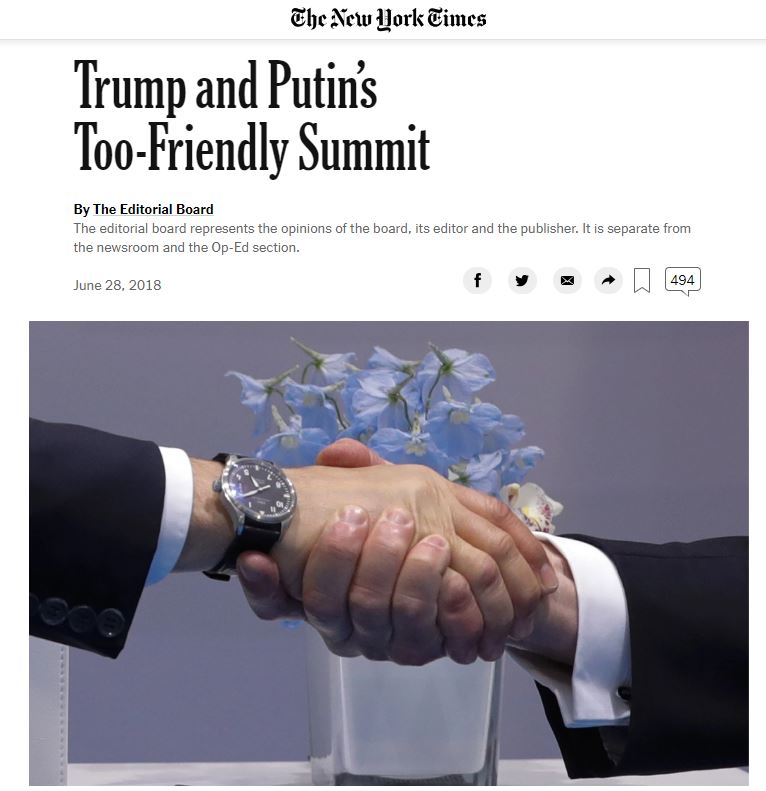
Whenever I’m having a rough day and need a pick-me-up, I turn to The New York Times’ editorial page. It’s always a gas to see how far the empire’s leading propaganda outfit is prepared to go in its mission to pull the wool over we the people’s gullible little eyes. The good editors have come through for me again with their latest entry, “Trump and Putin’s Too-Friendly Summit.” (Original title: “Trump and Putin: Best Frenemies for Life”). No doubt the original headline was deemed rather too impish for such a serious newspaper—it might, for instance, have alerted readers to the fact that the editorial’s content is not to be taken very seriously—and so was understandably jettisoned.
“One would think,” the editors write, “that the president of the United States would let Mr. Putin know that he faces a united front of Mr. Trump and his fellow NATO leaders, with whom he would have met days before the [Putin] summit in Helsinki.” Alas, during said meeting Trump reportedly remarked that “NATO is as bad as NAFTA”—the “free trade” agreement that has succeeded in decimating most of the manufacturing jobs spared by the automation wrecking ball. In other words, Trump does not necessarily think it’s a good idea to encircle Russia with a hostile military alliance whose existence, according to geopolitical expert Richard Sakwa, is “justified by the need to manage the security threats provoked by its enlargement.” (If you haven’t read Professor Sakwa’s comprehensive study of the Ukrainian crisis, Frontline Ukraine, put it at the top of your summer reading list.)
One notes the Turgidsonian delight with which the Times reminds us that, should push come to shove, we’ve got those Russki bastards outgunned. Of course, gullibles like you and I are to pay no mind to the fact that such a confrontation (a military one, for the Times brought up NATO) would almost certainly involve a nuclear exchange, rendering the disparity in manpower that so excites the Times totally meaningless. No, what’s important is that NATO has twenty-nine member states and counting, while the Warsaw Pact was dissolved twenty-seven years ago: ergo, unless he wants the old mailed fist, Putin had better ask “how high?” when we tell him to jump. One would be hard-pressed to come up with a more delusional assessment of where things stand.
In case any of its readers have been living under rocks (not so bad an idea in this day and age), the Times made sure to stress just how sinister “the Russian autocrat” is. To that end they touch upon, with signature glibness, “Mr. Putin’s seizure of Crimea and attack on Ukraine.” Later, the “attack on Ukraine” is upgraded to “the Ukraine invasion”—a charge dealt with most eloquently here. Omitted as a matter of course is Crimea’s complicated history, the issue of the Sevastopol naval bases, as well as numerous uncontroversial polls showing that the overwhelming majority of Crimeans (of whom an overwhelming majority are ethnic Russians) support “Mr. Putin’s seizure.”
According to Forbes, a February 2015 survey by German polling firm GfK asked of the Crimean population: “Do you endorse Russia’s annexation of Crimea?” Eighty-two percent responded: “yes, definitely.” On the other hand, a whopping two percent responded: “no.” Seems plain enough. But hold the phone, says the New Cold Warrior, we can’t rule out the possibility that GfK is actually an arm of Putin’s Federal Security Service. Can you prove it isn’t? Didn’t think so.
Failing that, I think I recall reading something somewhere about an international principle called … what was it again? … “self-determination.” That’s it. Something to do with the bloody dismemberment of a certain former country in the Balkans in the nineties, spearheaded by our very own Uncle Sam. It’ll come back to me.
Deployed next by our great pandering Paper of Record are the increasingly monotonous claims that Moscow “interfered in the 2016 election to put [Trump] in office and is continuing to undermine American democracy.” If only we had a democracy to undermine, then this never-ending soap opera might have a little more going for it. Having, wisely, I think, adopted a wake-me-up-when-it’s-over attitude to “Russia-gate,” I’m simply not up to speed on the latest pseudo-bombshell reports that, on account of their utter want of journalistic merit, wind up being heavily redacted or retracted altogether. The whole scene has become too farcical for my taste. That said, I encourage still-interested parties to read the various counter narratives that fail to penetrate the mass media’s filters. This, for example.
But the board’s main concern in all this is that, according to them, Trump is “intent on eroding institutions that undergird democracy and peace.” To clarify, they’re referring to NATO again, or what they call “allied security.” It’s an obsession with these people. So let’s look at it a moment. I’ll give you a few well-known (but poorly understood) examples of NATO’s philanthropic work over the decades, since the Times forgot to include them in its editorial: namely, the illegal bombing of Yugoslavia, the illegal invasion and occupation of Afghanistan, and the illegal “humanitarian” intervention in Libya. After I’m finished writing this, I must write the Times to notify them that they printed a typo: they obviously meant to write “undermine,” not “undergird.”
It boils down to this: NATO is good because it’s us. Trump is bad because he’s ambivalent about NATO. If Trump succeeds in “eroding” NATO, the beneficiary is Putin, “whose goal is to fracture the West and assert Russian influence in places where Americans and Europeans have played big roles, like the Middle East …” Given the outcomes of those “big roles” (9/11, the destruction of whole countries, ISIS, a flourishing slave trade, a migrant crisis of biblical proportions, mass famine, the tragedy of Gaza, the death of the two-state solution, the list goes on), it’s hard to imagine Putin, or anyone else, for that matter, doing any worse. So here’s a modest proposal: Washington sells its empire to Moscow and gets out of the world domination business for good. God knows we need the money. Unfortunately, Putin is no more interested in ruling over a global empire than we are in relinquishing one. (Fun fact: on defense, the US outspends Russia by about $540 billion.)
As Sakwa explains, “Putin’s challenge is not to the system of international politics but only to what he considers its skewed and selective operation in favor of the Atlantic system.”
“The Russian autocrat” has been, for a long time, crystal clear on this point. Far from harboring Washington-style fantasies of imperial glory, his is a vision of a multipolar world order in which the leading powers engage in serious diplomacy and coordinate their efforts to address the major economic, security and environmental issues confronting us all. Then there’s Trump: “But our destiny, beyond the Earth, is not only a matter of national identity, but a matter of national security. It is not enough to merely have an American presence in space. We must have American dominance in space.” (Emphasis mine.) Between insane rhetoric like that and NATO’s incessant (and equally insane) provocations along Russia’s western front, I think it’s fair to say Putin has shown an admirable degree of composure.
In their final flurry, the Times editors make some big-sounding statements about the need to prevent another nuclear arms race, duly omitting that the US is on track to spend more than $1 trillion over the next three decades modernizing and diversifying its nuclear arsenal (and no, we can’t pin this one on Trump). Then, flailing now, punching wide, they managed to project responsibility for the breakdown of the flawed Intermediate-Range Nuclear Forces Treaty squarely onto Russia, duly omitting that the US, by continuing to install provocative missile defense systems across Eastern Europe, is in constant violation of the treaty. Inconvenient truths, I regret to say, are still truths; and lies by omission are still lies.
But let us not stray from the bottom line: Russia is the threat. Russia is the threat. Russia is the threat. If you say it enough times you might start to believe it—and then, and only then, can you count yourself among the good upright citizens of this great indispensable nation.
The Two Superpowers: Who Really Controls the Two Countries?
By Paul Craig Roberts | Institute For Political Economy | June 30, 2018
Among the ruling interests in the US, one interest even more powerful than the Israel Lobby—the Deep State of the military/security complex— there is enormous fear that an uncontrollable President Trump at the upcoming Putin/Trump summit will make an agreement that will bring to an end the demonizing of Russia that serves to protect the enormous budget and power of the military-security complex.
You can see the Deep State’s fear in the editorials that the Deep State handed to the Washington Post (June 29) and New York Times (June 29), two of the Deep State’s megaphones, but no longer believed by the vast majority of the American people. The two editorials share the same points and phrases. They repeat the disproved lies about Russia as if blatant, obvious lies are hard facts.
Both accuse President Trump of “kowtowing to the Kremlin.” Kowtowing, of course, is not a Donald Trump characteristic. But once again fact doesn’t get in the way of the propaganda spewed by the WaPo and NYT, two megaphones of Deep State lies.
The Deep State editorial handed to the WaPo reads: “THE REASONS for the tension between the United States and Russia are well-established. Russia seized Crimea from Ukraine, instigated a war in eastern Ukraine, intervened to save the dictatorship of Syrian President Bashar al-Assad, interfered in the U.S. presidential election campaign to harm Hillary Clinton and help Donald Trump, poisoned a former intelligence officer on British soil and continues to meddle in the elections of other democracies.”
The WaPo’s opening paragraph is a collection of all the blatant lies assembled by the Deep State for its Propaganda Ministry. There have been many books written about the CIA’s infiltration of the US media. There is no doubt about it. I remember my orientation as Staff Associate, House Defense Appropriation Subcommittee, when I was informed that the Washington Post is a CIA asset. This was in 1975. Today the Post is owned by a person with government contracts that many believe sustain his front business.
And don’t forget Udo Ulfkotte, an editor of the Frankfurter Allgemeine Zeitung, who wrote in his best seller, Bought Journalism, that there was not a significant journalist in Europe who was not on the CIA’s payroll. The English language edition of Ulfkotte’s book has been suppressed and prevented from publication.
The New York Times, which last told the truth in the 1970s when it published the leaked Pentagon Papers and had the fortitude to stand up for its First Amendment rights, repeats the lies about Putin’s “seizure of Crimea and attack on Ukraine” along with all the totally unsubstantiated BS about Russia interfering in the US president election and electing Trump, who now kowtows to Putin in order to serve Russia instead of the US. The editorial handed to the NYT insinuates that Trump is a threat to the national security of America and its allies (vassals). The problem, the NYT declares, is that Trump is not listening to his advisors.
Shades of President John F. Kennedy, who did not listen to the CIA and Joint Chiefs of Staff about invading Cuba, nuking the Soviet Union, and using the false flag attack on America of the Joint Chiefs’ Northwoods Project (look it up online). Is the New York Times setting up Trump for assassination on the grounds that he is lovey-dovey with Russia and sacrificing US national interests?
I would bet on it.
While the Washington Post and New York Times are telling us that if Trump meets with Putin, Trump will sell out US national security, The Saker says that Putin finds himself in a similar box, only it doesn’t come from the national security interest, but from the Russian Fifth Column, the Atlanticist Integrationists whose front man is the Russian Prime Minister Medvedev, who represents the rich Russian elite whose wealth is based on assets stolen during the Yeltsin years enabled by Washington. These elites, The Saker concludes, impose constraints on Putin that put Russian sovereignty at risk. Economically, it is more important to these elites for financial reasons to be part of Washington’s empire than to be a sovereign country.
I find The Saker’s explanation the best I have read of the constraints on Putin that limit his ability to represent Russian national interests.
I have often wondered why Putin didn’t have the security force round up these Russian traitors and execute them. The answer is that Putin believes in the rule of law, and he knows that Russia’s US financed and supported Fifth Column cannot be eliminated without bloodshed that is inconsistent with the rule of law. For Putin, the rule of law is as important as Russia. So, Russia hangs in the balance. It is my view that the Russian Fifth Column couldn’t care less about the rule of law. They only care about money.
As challenged as Putin might be, Chris Hedges, one of the surviving great American journalists, who is not always right but when he is he is incisive, explains the situation faced by the American people. It is beyond correction. American civil liberties and prosperity appear to be lost.
In my opinion, Hedges’ leftwing leanings caused him to focus on Reagan’s rhetoric rather that on Reagan’s achievements—the two greatest of our time—the end of stagflation, which benefited the American people, and the end of the Cold War, which removed the threat of nuclear war. I think Hedges also does not appreciate Trump’s sincerity about normalizing relations with Russia, relations destroyed by the Clinton, George W. Bush, and Obama regimes, and Trump’s sincerity about bringing offshored jobs home to American workers. Trump’s agenda puts him up against the two most powerful interest groups in the United States. A president willing to take on these powerful groups should be appreciated and supported, as Hedges acknowledges the dispossessed majority do. If I might point out to Chris, whom I admire, it is not like Chris Hedges to align against the choice of the people. How can democracy work if people don’t rule?
Hedges writes, correctly, “The problem is not Trump. It is a political system, dominated by corporate power and the mandarins of the two major political parties, in which we [the American people] don’t count.”
Hedges is absolutely correct.
It is impossible not to admire a journalist like Hedges who can describe our plight with such succinctness:
“We now live in a nation where doctors destroy health, lawyers destroy justice, universities destroy knowlege, the press destroys information, religion destroys morals, and banks destroy the economy.”
Read The Saker’s explanation of Russian politics. Possibly Putin will collapse under pressure from the powerful Fifth Column in his government. Read Chris Hedges analysis of American collapse. There is much truth in it. What happens if the Russian people rise up against the Russian Fifth Column and if the oppressed American people rise up against the extractions of the military/security complex? What happens if neither population rises up?
Who sets off the first nuclear weapon?
Our time on earth is not just limited by our threescore and ten years, but also humanity’s time on earth, and that of every other species, is limited by the use of nuclear weapons.
It is long past the time when governments, and if not them, humanity, should ask why nuclear weapons exist when they cannot be used without destroying life on earth.
Why isn’t this the question of our time, instead of, for example, transgender toilet facilities, and the large variety of fake issues on which the presstitute media focuses?
The articles by The Saker and Chris Hedges, two astute people, report that neither superpower is capable of making good decisions, decisions that are determined by democracy instead of by oligarchs, against whom neither elected government can stand.
If this is the case, humanity is finished.
Here are the Washington Post and New York Times editorials:
Washington Post
June 29, 2018
Editorial
Trump is kowtowing to the Kremlin again. Why?
Ahead of a summit with Putin, Trump is siding with the Russian leader, with dangerous results.THE REASONS for the tension between the United States and Russia are well-established. Russia seized Crimea from Ukraine, instigated a war in eastern Ukraine, intervened to save the dictatorship of Syrian President Bashar al-Assad, interfered in the U.S. presidential election campaign to harm Hillary Clinton and help Donald Trump, poisoned a former intelligence officer on British soil and continues to meddle in the elections of other democracies. Yet on Wednesday in the Kremlin, President Vladimir Putin brushed it all aside and delivered the Russian “maskirovka,” or camouflage, answer that it is all America’s fault.
Meeting with John Bolton, the president’s national security adviser, Mr. Putin declared that the tensions are “in large part the result of an intense domestic political battle inside the U.S.” Then Mr. Putin’s aide Yuri Ushakov insisted that Russia “most certainly did not interfere in the 2016 election” in the United States. On Thursday morning, Mr. Trump echoed them both on Twitter: “Russia continues to say they had nothing to do with Meddling in our Election!”
Why is Mr. Trump kowtowing again? The U.S. intelligence community has concluded that Russia did attempt to tilt the election using multiple campaigns, including cyberintrusions and insidious social media fakery. Would it be so difficult to challenge Mr. Putin about this offensive behavior? A full accounting has yet to be made of the impact on the election, but Mr. Bolton did not mince words last year when he described Russian interference as “a true act of war” and said, “We negotiate with Russia at our peril.” And now?
Summits can be productive, even – maybe especially – when nations are at odds. In theory, a meeting between Mr. Trump and Mr. Putin, now scheduled for next month in Helsinki, could be useful. But a meeting aimed at pleasing Mr. Putin is naive and foolhardy. A meeting aimed at pleasing Mr. Putin at the expense of traditional, democratic U.S. allies would be dangerous and damaging.
Just as Mr. Bolton was flattering Mr. Putin, Russia was engaging in subterfuge on the ground in Syria. The United States, Russia and Jordan last year negotiated cease-fire agreements in southwestern Syria, along the border with Jordan and the Golan Heights. In recent days, the United States has warned Russia and its Syrian allies not to launch an offensive in the area, where the rebel forces hold parts of the city of Daraa and areas along the border. The State Department vowed there would be “serious repercussions” and demanded that Russia restrain its client Syrian forces. Secretary of State Mike Pompeo called the Russian foreign minister, Sergei Lavrov, saying an offensive would be unacceptable. All to no avail; Syria is bombing the area.
This is what happens when Mr. Trump signals, repeatedly, that he is unwilling or unable to stand up to Russian misbehavior. We are on dangerous ground. Either Mr. Trump has lost touch with essential U.S. interests or there is some other explanation for his kowtowing that is yet unknown.
New York Times
June 29, 2018
Editorial
Trump and Putin’s Too-Friendly Summit
It’s good to meet with adversaries. But when Mr. Trump sits down with Mr. Putin, it will be a meeting of kindred spirits. That’s a problem.It’s good for American presidents to meet with adversaries, to clarify differences and resolve disputes. But when President Trump sits down with President Vladimir Putin of Russia in Finland next month, it will be a meeting of kindred spirits, and that’s a problem.
One would think that at a tête-à-tête with the Russian autocrat, the president of the United States would take on some of the major concerns of America and its closest allies. Say, for instance, Mr. Putin’s seizure of Crimea and attack on Ukraine, which led to punishing international sanctions. But at the Group of 7 meeting in Quebec this month, Mr. Trump reportedly told his fellow heads of state that Crimea is Russian because everyone there speaks that language. And, of course, Trump aides talked to Russian officials about lifting some sanctions even before he took office.
One would hope that the president of the United States would let Mr. Putin know that he faces a united front of Mr. Trump and his fellow NATO leaders, with whom he would have met days before the summit in Helsinki. But Axios reported that during the meeting in Quebec, Mr. Trump said, “NATO is as bad as NAFTA,” the North American Free Trade Agreement, which is one of Mr. Trump’s favorite boogeymen.
Certainly the president would mention that even the people he appointed to run America’s intelligence services believe unequivocally that Mr. Putin interfered in the 2016 election to put him in office and is continuing to undermine American democracy. Right? But on Thursday morning, Mr. Trump tweeted, “Russia continues to say they had nothing to do with Meddling in our Election!”
More likely, Mr. Trump will congratulate Mr. Putin, once again, for winning another term in a sham election, as he did in March, even though his aides explicitly warned him not to. And he has already proposed readmitting Russia to the Group of 7, from which it was ousted after the Ukraine invasion.
Summits once tended to be carefully scripted, and presidents were attended by senior advisers and American interpreters. At dinner during a Group of 20 meeting last July, Mr. Trump walked over to Mr. Putin and had a casual conversation with no other American representative present. He later said they discussed adoptions – the same issue that he falsely claimed was the subject of a meeting at Trump Tower in 2016 between his representatives and Russian operatives who said they had dirt on Hillary Clinton.
It’s clear that Mr. Trump isn’t a conventional president, but instead one intent on eroding institutions that undergird democracy and peace. Mr. Trump “doesn’t believe that the U.S. should be part of any alliance at all” and believes that “permanent destabilization creates American advantage,” according to unnamed administration officials quoted by Jeffrey Goldberg in The Atlantic.
Such thinking goes further than most Americans have been led to believe were Mr. Trump’s views on issues central to allied security. He has often given grudging lip service to supporting NATO, even while complaining frequently about allies’ military spending and unfair trade policies.
The tensions Mr. Trump has sharpened with our allies should please Mr. Putin, whose goal is to fracture the West and assert Russian influence in places where the Americans and Europeans have played big roles, like the Middle East, the Balkans and the Baltic States.
Yet despite growing anxieties among European allies, Mr. Trump is relying on his advisers less than ever because, “He now thinks he’s mastered this,” one senior member of Congress said in an interview. That’s a chilling thought given his inability, so far, to show serious progress on any major security issue. Despite Mr. Trump’s talk of quick denuclearization after his headline-grabbing meeting with the North Korean leader, Kim Jong-un, experts say satellite imagery shows the North is actually improving its nuclear capability.
While the White House hasn’t disclosed an agenda for the Putin meeting, there’s a lot the two leaders should be discussing, starting with Russian cyberintrusions. Mr. Trump, though, has implied that Mr. Putin could help the United States guard against election hacking. And although Congress last year mandated sweeping sanctions against Russia to deter such behavior, Mr. Trump has failed to implement many of them.
In a similar vein, should Mr. Trump agree to unilaterally lift sanctions imposed after Moscow invaded Ukraine and started a war, it would further upset alliance members, which joined the United States in imposing sanctions at some cost to themselves. Moreover, what would deter Mr. Putin from pursuing future land grabs?
Mr. Trump could compound that by canceling military exercises, as he did with South Korea after the meeting with Mr. Kim, and by withdrawing American troops that are intended to keep Russia from aggressive action in the Baltics.
Another fraught topic is Syria. Mr. Trump has signaled his desire to withdraw American troops from Syria, a move that would leave the country more firmly in the hands of President Bashar al-Assad and his two allies, Russia and Iran. Russia, in particular, is calling the shots on the battlefield and in drafting a political settlement that could end the fighting, presumably after opposition forces are routed.
What progress could be made at this summit, then? Mr. Trump and Mr. Putin may find it easier to cooperate in preventing a new nuclear arms race by extending New Start, a treaty limiting strategic nuclear weapons that expires in 2021.
Another priority: bringing Russia back into compliance with the I.N.F. treaty, which eliminated all U.S. and Soviet ground-launched ballistic and cruise missiles with ranges between 500 and 5,500 kilometers, until Russia tested and deployed a prohibited cruise missile.
Mr. Trump’s top national security advisers are more cleareyed about the Russian threat than he is. So are the Republicans who control the Senate. They have more responsibility than ever to try to persuade Mr. Trump that the country’s security is at stake when he meets Mr. Putin, and that he should prepare carefully for the encounter.
New York Times exposes its own hypocrisy with juvenile cartoon of Trump & Putin as gay lovers

© The New York Times
By Danielle Ryan | RT |
A recent cartoon produced by the New York Times depicts Donald Trump and Vladimir Putin as gay lovers. It was clearly intended to be hilariously funny while also making a salient political point. In reality, it does neither.
The cartoon is part two of a three-part series called ‘Trump Bites’ from critically-acclaimed animator Bill Plympton. Let me explain the contents of the minute-long video to save you from having to watch it yourself.
It begins with a cartoon Trump standing in front of a mirror altering his bow tie while a portrait of a topless Putin hangs on the wall behind him. Audio of the real Trump confirming that he does have “a relationship” with Putin begins to play and the doorbell of Trump’s cartoon house rings.
The visitor is none other than a muscly, topless (again) Putin. Trump’s cartoon heart begins to beat out of his chest and he hands it over to the macho Russian as a gift. Audio of the real Trump claiming Putin has done a “brilliant and amazing” job plays over the scene.
Now Donald and Vlad are sitting in a car together. The Russian is in the driving seat. Witty political metaphor? Check! Cartoon Trump leans over and places his tiny hand on top of Putin’s excessively large hand. Overdone dig at the size of Trump’s hands? Check!
Suddenly, the car morphs into a unicorn (stay with me) and the star-crossed lovers are riding on its back through a pink sky filled with butterflies, hearts and rainbows. Putin turns around to kiss Trump and we get a close-up of tongues swirling.
Back in his bedroom after his date with the Russian, cartoon Trump is seen with a gun in hand shooting at his TV screen — an obvious reference to his distaste for “fake news” and the like. Roll credits.
Describing the cartoon on its website, the Times explains that it “plays out in a teenager’s bedroom, where the fantasies of this forbidden romance come to life.” But, in case it wasn’t already clear, the end result isn’t funny. It doesn’t do a particularly good job of making any political point, either — unless you’re counting the reinforcement of a tired, boring and unproven narrative of “collusion” and “bromance” between Trump and his Russian counterpart.
What it does do, very well in fact, is highlight the hypocrisy of the New York Times. Despite its socially liberal credentials, the paper of record has seen fit to use gay stereotypes to malign political figures it does not like. The very fact that the men are portrayed as gay is what is supposed to make the cartoon so funny.
Unsurprisingly, gay people on Twitter were quick to point out that mocking people — even fake versions of real people — for being gay isn’t actually very funny at all. Journalist Glenn Greenwald (who happens to be gay himself) called out the Times for “using one disgusting gay stereotype after the next” in an attempt to make a political point. “Homophobia for progressive messaging is still bigotry,” he wrote on Twitter. He’s right. Another gay Twitter user hit out at the Times for its “vulgar” and “homophobic” negative stereotyping, while others blasted the paper for the tone-deaf decision to publish the “gay-bashing” cartoon during Pride Month, of all times.
The Times’ decision to produce the ‘lol they’re gay’ cartoon seems particularly odd, given how oh-so-concerned they pretend to be with the plight of gay people in Russia. Then again, much of the Western concern over gay rights in Russia is and always has been insincere; a political tool that Western nations use to hammer Russia with while ignoring the far, far worse treatment that gay people are subjected to in countries like Saudi Arabia — a religious dictatorship which is hailed by US political leaders for its progressiveness if it makes even the mildest step towards modernity.
Recall the stunt pulled by the Paddy Power bookmakers during the World Cup. The company proudly announced that it would donate €10,000 to gay rights charities every time Russia scored a goal. The irony of announcing this charitable endeavor during a match against a country (Saudi Arabia) where being gay (MAY BE PUNISHED) by death was apparently entirely lost on them.
Anyway, back to the Times. Even if we forgive the newspaper for its foray into homophobic stereotyping to malign public figures, there’s still the fact that the cartoon is boring and stale and one would struggle to justify classing it as political satire.
There is nothing particularly cutting edge about it. It’s a simple rehash of a tired narrative — just with some homophobia thrown in for laughs. The cartoon series bills itself as satire — but satire is supposed to be original, biting, thought-provoking, clever. This fails on every count.
Danielle Ryan is an Irish freelance journalist. Having lived and worked in the US, Germany and Russia, she is currently based in Budapest, Hungary. Her work has been featured by Salon, The Nation, Rethinking Russia, Russia Direct, teleSUR, The BRICS Post and others. Follow her on Twitter @DanielleRyanJ, check out her Facebook page, or visit her website: danielle-ryan.com
Korean Voices Missing From Major Papers’ Opinions on Singapore Summit

The Washington Post‘s Jennifer Rubin (6/17/18) epitomized the zero-sum takes of US pundits.
By Adam Johnson | FAIR | June 21, 2018
In major-paper opinion coverage of the Singapore summit, the people with the most to lose and gain from the summit, the people whose nation was actually being discussed—Koreans—were almost uniformly ignored.
Three major US papers—the New York Times, Washington Post and Wall Street Journal—had only one Korean-authored op-ed out of 41 opinion pieces on the subject of the Korean peace talks.
The Post had 23 total opinion pieces, the Times had 16 and the Journal four. The only op-ed by a Korean was a pro-summit piece on June 12 by Moon Chung-in, an aide to South Korean President Moon Jae-in. Of the 41 editorials or op-eds only four (9 percent), were broadly positive about the Trump/Kim summit, 29 (70 percent) were negative and eight (21 percent) were mixed or ambiguous. The full list, current as of June 19, is here.
As FAIR noted in May (5/7/18), there’s a huge chasm between how recent peace efforts are being received in ostensible US ally South Korea and how they’re being covered in US media. As we noted at the time, polling shows 88 percent of South Koreans in favor of these efforts, while the person spearheading them, President Moon, holds an 86 percent approval rating. But the bulk of US coverage ranged from snide dismissal to outright opposition (FAIR.org, 6/14/18).
Similarly, a poll taken after the Singapore summit found that 66 percent of South Koreans were pleased with the results, and only 11 percent opposed them. This contrasts sharply with the reaction in US newspapers, which has been overwhelmingly negative in tone, and dominated by NatSec-centered horse race takes over who “won.”
The New York Times published one pro-summit piece, by Victor Cha (6/12/18), and it was a very qualified and conflicted. The Washington Post was mostly negative and skeptical, with three exceptions: predictable partisan cheerleading from reliable Trump apologist Marc Thiessen (6/15/17); a measured “wait and see” take from Michael O’Hanlon, a fellow at the Brookings Institution (6/13/18); and the aforementioned piece by President Moon’s aide. The Wall Street Journal’s commentary was uniformly negative.
The US media’s reaction to the summit is almost a mirror image of that of the South Korean public: 70 percent of major US papers’ opinion columns disapproved of the summit, whereas 66 percent of South Koreans approved. Eleven percent of South Koreans disapproved, whereas only 9 percent of professional opinion-havers at the Times, Post and Journal thought the summit was a good thing.
This raises an important question: Why? What do US pundits know that those with something actually at stake—Koreans—don’t know?

Trump showed “reckless disregard for the security concerns of America’s allies,” argued Kori Schake of the International Institute for Strategic Studies–funded by Boeing, Northrop Grumman and Lockheed Martin (New York Times, 6/15/18)
One factor is that our media system turns to professional “experts” at a small handful of establishment think tanks, and these are often funded by monied interests with a vested interest in particular kinds of policy (Extra!, 7/13). On international questions, this often means the arms industry, who are major funders of think tanks like the Center for Strategic and International Studies (CSIS) and the International Institute for Strategic Studies (IISS). These think tanks produced predictably hawkish putdowns of the summit, such as CSIS’s Sue Mi Terry, who told MSNBC’s Nicolle Wallace, in a rare moment of candor:
A peace treaty is not OK. That should come at the end of the process, because a peace treaty, while it sounds great and could be historic, also undermines the justification of our troops staying South Korea.
The “justification” for troops also happens to be the justification for the weapons systems they come with, namely those of CSIS’s major donors Northrop Grumman, Lockheed Martin and Boeing (FAIR.org, 5/8/17).
Another part of the problem is partisanship. US pundits overwhelmingly view the Kim/Trump summit as a Trump-led or US-directed event, rather than an essential but limited part of a broader peace effort being undertaken by the Koreas themselves. … Full article
Western Media Whitewash Yemen Genocide

By Finian CUNNINGHAM | Strategic Culture Foundation | 18.06.2018
With the United Nations warning that millions of civilians could die from violence or starvation from the ongoing military siege of the Yemeni port city of Hodeida, there is no other way to describe what is happening except as “genocide”.
The more than three-year war on Yemen waged by a Western-backed Saudi coalition has been arguably genocidal from the outset, with up to eight million people facing imminent starvation due to the years-long blockade on the Arabian country, as well as from indiscriminate air strikes.
But the latest offensive on the Red Sea city of Hodeida threatens to turn the world’s already worst humanitarian disaster into a mass extermination.
Hodeida is the entry point for 90 per cent of all food and medical aid into Yemen. If the city’s port stops functioning from the military offensive – as UN aid agencies are warning – then an entire country population of more than 20 million will, as a result, be on the brink of death.
The Saudi coalition which includes Emirati forces and foreign mercenaries as well as remnants from the previous regime (which the Western media mendaciously refer to as “government forces”) is fully backed by the US, Britain and France. This coalition says that by taking Hodeida it will hasten the defeat of Houthi rebels. But to use the cutting off of food and other vital aid to civilian populations as a weapon is a blatant war crime. It is absolutely inexcusable.
This past week an emergency session at the UN Security Council made the lily-livered call for the port city to remain open. But it stopped short of demanding an end to the offensive being led by Saudi and Emirati forces against Hodeida, which is the second biggest stronghold for Houthi rebels after the capital Sanaa. The port city’s population of 600,000 is at risk from the heavy fighting underway, including air strikes and naval bombardment, even before food, water and medicines supply is halted.
Since the Security Council meeting was a closed-door session, media reports did not indicate which members of the council voted down the Swedish call for an immediate end to hostilities. However, given that three permanent members of the council, the US, Britain and France, are militarily supporting the Saudi-led offensive on Hodeida, one can assume that these states blocked the call for a cessation.
As the horror of Hodeida unfolds, Western media are reporting with a strained effort to whitewash the criminal role of the American, British and French governments in supporting the offensive. Western media confine their focus narrowly on the humanitarian plight of Hodeida’s inhabitants and the wider Yemeni population. But the media are careful to omit the relevant context, which is that the offensive on Hodeida would not be possible without the crucial military support of Western governments. If the Western public were properly informed, the uproar would be an embarrassing problem for Western governments and their servile news media.
What is notable in the Western media reportage is the ubiquitous descriptor when referring to the Houthi rebels. Invariably, they are described as “Iran-backed”. That label is used to implicitly “justify” the Saudi and Emirati siege of Hodeida “because” the operation is said to be part of a “proxy war against Iran”. The BBC, France 24, CNN, Deutsche Welle, New York Times and Washington Post are among media outlets habitually practicing this misinformation on Yemen.
Both Iran and the Houthis have said that there is no military linkage. Granted, Iran politically and diplomatically supports the Houthis, and the Yemeni population generally, suffering from the war. The Houthis share a common Shia Muslim faith as Iran, but that is a far cry from military involvement. There is no evidence of Iran being militarily involved in Yemen. The claim of a linkage relies heavily on assertion by the Saudis and Emiratis which is peddled uncritically by Western media. Even the US government has shied away from making forthright accusations against Iran supporting the Houthis militarily. Washington’s diffidence is a tacit admission that the allegations are threadbare. Besides, how could a country which is subjected to an illegal Saudi blockade of its land, sea and air routes conceivably receive weapons supplied from Iran?
By contrast, while the Western media repeatedly refer to the Houthis as “Iran-backed”, what the same media repeatedly omit is the descriptor of “American-backed” or “British and French-backed” when referring to the Saudi and Emirati forces that have been pounding Yemen for over three years. Unlike the breathless claims of Iranian linkage to the Houthis, the Western military connection is verified by massive weapons exports, and indeed coy admissions by Western governments, when they are put to it, that they are supplying fuel and logistics to aid and abet the Saudi and Emirati war effort in Yemen.
Last week, the New York Times affected to lament the infernal conditions in Yemen as a “complex war”, as if the conflict is an unfathomable, unstoppable mystery. Why doesn’t the New York Times publish bold editorials bluntly calling for an end to US government complicity in Yemen? Or perhaps that is too “complex” for the Times’ editorial board?
The Washington Post also wrung its hands last week, saying: “The world’s most dire humanitarian crisis may get even worse. Emirati-led [and Saudi] offensive underway against port city of Hodeida, which is controlled by Iran-backed [sic] Houthi rebels.”
In its report, the Post did not mention the fact that air strikes by Saudi and Emirati forces are carried out with American F-15 fighter jets, British Typhoons and French Dassault warplanes. Incongruously, the Post cites US officials claiming that their forces are not “directly involved” in the offensive on the port city. How is that credible when air strikes are being conducted day after day? The Washington Post doesn’t bother to ask further.
In a BBC report last week also lamented the “humanitarian crisis” in Hodeida, there was the usual evidence-free casual labelling of Houthi rebels as “Iran-backed”. But, incredibly, in the entire article (at least in early editions) there was not a single mention of the verifiable fact that the Saudi and Emirati military are supplied with billions-of-dollars-worth of British, American and French weapons.
In the final paragraph of its early edition of the report, the BBC editorializes: “In March 2015, Saudi Arabia and eight other mainly Sunni Muslim Arab states launched a military campaign to restore [exiled president] Hadi’s government after becoming alarmed by the rise of the Houthi group which they see as an Iranian Shia Muslim proxy.”
Note the BBC’s lame and unconvincing implication of Iran. This is a stupendous distortion of the Yemeni conflict by the British state-owned broadcaster which, astoundingly, or perhaps that should be audaciously, completely airbrushes out any mention of how Western governments have fueled the genocidal war on Yemen.
At the end of 2014, the American and Saudi puppet self-styled “president” Mansour Hadi was kicked out by a Yemeni popular revolt led by the Houthis, but not exclusive to these rebels. The Yemeni uprising involved Shia and Sunni. To portray Iran as sponsoring a Shia proxy is a vile distortion which the Saudis and their Western backers have used in order to justify attacking Yemen for the objective of re-installing their puppet, who has been living in exile in the Saudi capital Riyadh. In short, covering up a criminal war of aggression with lies.
In reality, the Yemen war is about Western powers and their Arab despot client regimes trying to reverse a successful popular revolt that aspired to bring a considerably more democratic government to the Arab region’s poorest country, overcoming the decades it languished as a Western, Saudi client kleptocracy.
For over three years, Saudi and Emirati forces, supported with Western warplanes, bombs, missiles, attack helicopters, naval power, and air refueling, as well as targeting logistics, have waged a non-stop bombing campaign on Yemeni civilians. Nothing has been off-limits. Hospitals, schools, markets, mosques, funerals, wedding halls, family homes, farms, water-treatment plants and power utilities, all have been mercilessly obliterated. Even graveyards have been bombed.
Even during the Muslim holy month of Ramadan, the Saudi-led coalition – the supposed custodian of the two holy mosques of Mecca and Medina – has continued to massacre innocents from the air.
Elsewhere in the region, Western politicians and media have mounted hysterical protests against the Syrian government and its Russian ally when they have liberated cities from Western-backed terrorists, accusing Syria and Russia of “war crimes” and “inhuman sieges”. None of these hyperbolic Western media campaigns concerning Syria has ever been substantiated. Recall Aleppo? East Ghouta? The Syrian people have gladly returned to rebuild their lives now in peace under Syrian government protection after the Western terror proxies were routed. Western media claims about Syria have transpired to be outrageous lies, which have been hastily buried by the media as if they were never told in the first place.
Yet in Yemen there is an ongoing, veritable genocidal war fully supported by Western governments. The latest barbarity is the siege of Hodeida with the callous, murderous objective of finally starving a whole population into submitting to the Western, Saudi, Emirati writ for dominating the country. This is Nuremberg-standard capital crimes.
With no exaggeration, Western news media are a Goebbels-like propaganda ministry – par excellence – whose duty is to whitewash genocide conducted by their governments. The barefaced lies and sly omissions being told about Yemen is one more reason among many reasons why the Western media have forfeited any vestige of credibility. They are serving as they usually do – Vietnam, Iraq, Libya, Syria among others – as accomplices in an epic war crime against Yemen.
Photo: Geopolitics Alert
Pundits Worry Threat of Nuclear War Is Being Reduced
By Gregory Shupak | FAIR | June 14, 2018
Media outlets don’t want America to negotiate with North Korea; they want the US to hold North Korea for ransom.

MSNBC‘s Rachel Maddow (6/12/18) appears dismayed by the manifestation of a US president meeting with an Official Enemy.
On MSNBC’s Rachel Maddow Show, the host was aghast (6/12/18) that the US says it will halt the annual war games it conducts with South Korea on North Korea’s doorstep, because doing so is “an absolute jackpot for the North Korean dictator,” “one of the things he wants most on earth,” and now Washington “has just given them that for free, for nothing.”
Maddow implied that Trump has taken this step out of fealty to Russia, and complained that pausing war games that threaten North Korea benefits Russia and China. She twice called the Kim/Trump summit a “wedding,” twice said that the two leaders “love” each other, and referred to Kim as Trump’s “best friend.” In other words, de-escalation is for wimps, and what’s needed is toughness, even if it risks nuclear war.
Not once did Maddow demonstrate the slightest concern with avoiding war. The message of her segment is that the US should subject all 25 million people in North Korea to the threat of nuclear annihilation until its leaders do what the US says, a threat that necessarily extends to the rest of East Asia, since it would be decimated in any nuclear exchange, to say nothing of the likely devastating effects on the rest of the world.

The Washington Post (6/12/18) warned against trusting “a cruel and unpredictable ruler whose motives and aims are far from clear”.
The editorial board of the Washington Post (6/12/18) says that diplomacy “is certainly preferable to the slide toward war that appeared to be underway last year,” but opposes taking steps to prevent another Korean War—a nuclear one, this time. The editorialists complain that the joint statement issued by the leaders of the US and North Korea makes no mention of “US terms for disarmament”: What the editorial, tellingly titled “No More Concessions,” is saying is that the predetermined outcome of diplomacy should be complete North Korea acquiescence to US demands—which, of course, isn’t diplomacy at all.
Similarly, the New York Times’ editorial board (6/12/18) writes that “after months of venomous barbs and apocalyptic threats of war, the meeting between President Trump and the North Korean leader, Kim Jong-un, was unquestionably a relief.” Trump, they wrote, “seems seized with the need to resolve it peacefully. That is to the good.” Yet the editorial lists measures that Times believes the Democratic People’s Republic of Korea (DPRK, North Korea’s official name) needs to take, without saying that America should do anything, and expresses anxiety over the break in war games.
In the same vein, Nicholas Kristof of the New York Times (6/12/18) says that “it certainly is better for the two leaders to be exchanging compliments rather than missiles,” but describes the US suspending military exercises with South Korea as a “concession” for which America is getting “astonishingly little” in return. He purports to be against the exchanging of missiles, but thinks it’s a mistake to take steps to minimize the threat of exchanging missiles.

While acknowledging Trump being “snookered” is “far better than war,” NYT’ Nicholas Kristof (6/12/18) fears “the cancellation of military exercises will raise questions among our allies.”
“Astonishingly,” Kristof writes, Trump
even adopted North Korean positions as his own, saying that the United States military exercises in the region are “provocative.” That’s a standard North Korean propaganda line.
The columnist failed to explain how military exercises on North Korea’s doorstep, involving 50,000 South Korean troops and 17,500 of their American counterparts, are anything other than “provocative,” but evidently Kristof would have no problem with joint DPRK/Mexico maneuvers near the US southern border pretending to launch an attack featuring 67,500 soldiers, along with simulated nuclear bomber attacks (FAIR.org, 4/3/13).
The Times’ editorial is as bemused as Kristof, writing that Trump “even endorsed the North Korean view of such joint exercises as ‘provocative.’”
Kristof criticized the joint statement because it says
nothing about North Korea freezing plutonium and uranium programs, nothing about destroying intercontinental ballistic missiles, nothing about allowing inspectors to return to nuclear sites, nothing about North Korea making a full declaration of its nuclear program, nothing about a timetable, nothing about verification, not even any clear pledge to permanently halt testing of nuclear weapons or long-range missiles.
At no point did Kristof call on the US to take any remotely comparable steps.

The Washington Post‘s Anne Applebaum (6/12/18) does not seem to see Trump and Kim ceasing to threaten each other’s countries with nuclear destruction as a “gain” for those countries.
For Anne Applebaum of the Washington Post (6/12/18), provisionally scaling back American hostility to North Korea should be understood as a humiliation. She wrote that
had any previous American president, Republican or Democrat, emerged from an event like this, in which so much was given away with so little to show for it, he would have been embarrassed.
Her article was headlined, “Trump and Kim Got What They Wanted. The Rest of the World, Not So Much.” It’s likely, however, that “the rest of the world” does not want nuclear war, and might want steps that could help avert that danger—such as, say, an end to nuclear-armed America antagonizing another nuclear power by having “tens of thousands of US and [South Korean] troops, aircraft and naval vessels engaged in mock clashes” with that power.
Shining City on a Hill
Under-girding the view that the United States should only negotiate with North Korea when “negotiation” means “forcing the DPRK under nuclear duress to do whatever America says” are entrenched notions of intrinsic US superiority.
Probably the most blatant example of this is the view that the United States is “legitimizing” DPRK by meeting with its leaders. MSNBC’s Maddow seems to find it blasphemous that the summit “billed” North Korea “as a nation equal in stature to the United States.” According to the Times, Kim got a “win” by receiving the “legitimacy of being treated as an equal as a nuclear power on the world stage, country flags standing side by side.” The Post was incensed that Kim was “able to parade on the global stage as a legitimate statesman,” while Applebaum said that “the flags and the handshake will reinforce Kim’s legitimacy and make him harder to depose.”
States, and the parties that govern them, are not granted legitimacy by the United States. Legally, that legitimacy comes from United Nations recognition or its absence; as a practical matter, states and their leaders establish legitimacy through what the Italian political theorist Antonio Gramsci described as a combination of coercion and consent. Believing that the US has the power to confer or deny legitimacy on other countries or their leaders is part of the same imperial hubris that makes pundits panic about tentative moves in the direction of curtailing American belligerence toward North Korea, and thus the threat of nuclear war.

We would find it absurd if pundits complained that Kim failed to extract a promise from Trump to halt the thousand or so extrajudicial executions that take place in the US every year.
A comparable dynamic is at work in the commentariat concern-trolling about North Korean human rights. Maddow was perplexed that the US would meet with North Korea without the North Korean leadership making any promises about “their behavior toward their own people.” The Times’ editors considered it “startling” that the joint Kim/Trump statement contains no reference to human rights in DPRK.
In this conception, America is the shining city on a hill that must free the people of the DPRK, though these analysts don’t ask who will liberate US citizens living under a regime with the highest incarceration rate in the world, rampant judicial and extrajudicial execution, widespread racism, obscene wealth inequality and an undemocratic political system. Calling for a US government crusade for change inside North Korea while overlooking all of these features of US society is another dimension of the imperial arrogance that insists it’s legitimate to subject the entire population of other nations to crushing sanctions and violent threats until their governments give Washington everything it wants.
Nor do any of these commentators address the possibility that the US ruling class might need to change its global conduct: The hanging of Saddam Hussein and the sodomizing to death of Moammar Gadhafi, neither of whom possessed nuclear weapons with which to deter America from invading and destroying the countries they governed, could be a reason why the leaders of North Korea want nuclear weapons.
For the punditry, the goal of US/North Korea talks isn’t lasting peace on the Korean peninsula, it’s total North Korean submission to US commands. Corporate media appear to be more worried about the United States being successfully defied than it is about nuclear war.
NYT Carries IDF Attack on Murdered Medic–Reveals It’s a Smear in 20th Paragraph

By Adam Johnson | FAIR | June 11, 2018
A reporter at the most influential paper in English-language media appears to not know the difference between a government “tightly editing” and selectively editing video.
New York Times reporter Herbert Buchsbaum (6/7/18) wrote up a propaganda video posted by the Israeli Defense Force, showing Rouzan al-Najjar–a 21-year-old medic the Israeli Defense Force shot and killed earlier this month—apparently throwing a tear-gas canister, along with a brief clip of her purportedly saying, “I am here on the front line and I act as a human shield.”
The video seems to suggest that throwing a device spewing caustic gas away from people into an empty field is a sort of violence. (“This medic was incited by Hamas,” the video reads as she grabs the canister.) But the primary problem with the IDF video is that it deceptively edits her comments to distort what she said—a fact not noted by the Buchsbaum until paragraph 20, when he threw in this crucial piece of information:
In the longer video, the comment that the military translated as “I act as a human shield” was part of a sentence in which Ms. Najjar said, “I’m acting as a human rescue shield to protect the injured inside the armistice line.”
“Acting as a human shield to protect the injured inside the armistice line” has a radically different meaning than the commonly understood canard about Palestinians using “human shields” to protect “terrorists.” This hugely consequential fact should have led the story; instead, it’s casually tossed out in the third-to-last paragraph. The story here is that the IDF—as it has been doing for decades—casually lies and distorts facts to suit its narrative. Like all militaries, the Israeli military is not presenting a “dueling narrative” in good faith, as a New York Times tweet suggested; it’s manipulating video, hoping credulous journalists help them muddy the waters, as Buchsbaum did.
Indeed, the bizarre IDF press release write-up serves no other purpose than to reframe the gunning down of the unarmed medic from a clear crime committed by Israel to a Fog of War “dueling narratives between Israel and Hamas” tale of “both sidesism.” Buchsbaum vaguely alludes to—but strangely omits—the deceptive editing in the opening with his risible turn of phrase in paragraph two:
The tightly edited video shows a woman identified as the medic, Rouzan al-Najjar, throwing what appears to be a tear-gas canister.
“Tightly edited”? What does this mean, exactly? “Tight” editing is generally considered a compliment in the film and TV world, and says nothing about deliberate omissions for the purposes of misleading the viewer. When videographer Tate B. James confronted Buchsbaum about this fact, Buchsbaum appeared to think he had covered his bases:
hey herbert, any reason why you waited until the 20th paragraph to let folks know the video was selectively edited?
— Tate James (@tatebjames) June 8, 2018
a music video is “tightly edited”, herbert. that video is *deceptively* edited. there’s a difference
— Tate James (@tatebjames) June 8, 2018
Either Buchsbaum doesn’t know he’s being misleading, and is thus severely unqualified to be writing for a major paper, or he knows he’s spinning in Israel’s favor, but was hoping no one would really notice. Either way, the New York Times is once again (FAIR.org, 7/14/17, 5/17/18, 5/15/18) using its pages to confuse readers to the benefit of the Israeli military.
You can send a message to the New York Times at letters@nytimes.com (Twitter:@NYTOpinion). Please remember that respectful communication is the most effective.
Featured Video
Chinese jet fuel and the myth of energy independence
or go to
Aletho News Archives – Video-Images
Book Review
Former Insiders Criticize Iran Policy as U.S. Hegemony
By GARETH PORTER | CounterPunch | February 27, 2013
“Going to Tehran” arguably represents the most important work on the subject of U.S.-Iran relations to be published thus far.
Flynt Leverett and Hillary Mann Leverett tackle not only U.S. policy toward Iran but the broader context of Middle East policy with a systematic analytical perspective informed by personal experience, as well as very extensive documentation.
More importantly, however, their exposé required a degree of courage that may be unparalleled in the writing of former U.S. national security officials about issues on which they worked. They have chosen not just to criticise U.S. policy toward Iran but to analyse that policy as a problem of U.S. hegemony. … continue
Blog Roll
 Aletho News
- What is fueling unrest across the EU?
- Why no power can undermine Iran’s eternal dominance over the Strait of Hormuz
- Is The War Against Iran Over?
- Iran war will leave long-term ‘scar’ on Wall Street, investors warn
- How Iran decimated US power projection in West Asia: Military lessons of 40-day war
- Iran’s report details US-Israeli war crimes in targeting schools, hospitals, livelihoods
- NATO’s Slow Fracture: How Trump’s Iran War Exposed the Instrument of Hegemony
- Chinese jet fuel and the myth of energy independence
- Ukraine Sea Drone Fired From Libya Hit Russian Tanker in Mediterranean
- IRGC: Iranian forces launched no attacks during ceasefire hours
- If Americans Knew
- Military aid to Israel emerges as the latest political litmus test for Democrats
- The only Palestinian children’s rights organization closes following years-long Israeli campaign against it
- ‘I Can’t Forget the Smell’: Lebanese Reel After Israel Kills Over 300 in Single Day
- DNC Shoots Down Resolutions Calling Out AIPAC and Limiting Arms to Israel
- TCN: Is Israel Blackmailing President Trump?
- Israel killed at least 303 Lebanese yesterday – who were they? Daily Update
- Amnesty: Urgent – Protect Lebanese civilians from brutal escalation in Israeli attacks
- Is The War Against Iran Over?
- Inside the Israeli army’s propaganda wing
- Hundreds of Gaza Amputees Stranded in Legal Limbo
- No Tricks Zone
- An Inconvenient Tree: Uncovered In Alps… Europe Much Warmer Than Today 6000 Years Ago
- New Study Reports A 60% Slowdown In Greenland’s Ice Loss Rate In The Last Decade
- Low Intensity Tornado Wrecks Major Solar Farm, Creating A Potential Toxic Dump
- New Study Finds Warming Saves Lives…Cold Temperatures 12 Times More Deadly Than Excess Heat
- German Science Blog Accuses PIK Climate Institute Of Hallucinating Climate Tipping Points
- Devastating Assessment Of Comirnaty Vaccine By Former Senior Pfizer Europe Toxicologist
- New Study: CO2 Is ‘Effectively Negligible’ As An Explanatory Climate Change Factor Since 2000
- Former Pfizer Toxicologist Dr. Helmut Sterz Tells Bundestag Hearing Pfizer Vaccine Should Have Never Been Approved
- Energy Expert: Germany’s Nuclear Phaseout Was A “500 Billion Euro Mistake”
- New Research: South Australia’s Mid-Holocene Sea Surface Temperatures Were 4°C Warmer Than Today
 Aletho News