Bringing Down a President
By Philip M. GIRALDI | Strategic Culture Foundation | 13.09.2018
If anyone doubted that the top level of the intelligence agencies in Washington have dedicated themselves to ousting President Donald Trump, the past two weeks should have demonstrated precisely how such a plan of action is being executed. First came the leaked accounts of chaos in the Trump Administration derived from the Bob Woodward book Fear: Trump in the White House.
Then a New York Times op-ed entitled “I am part of the resistance inside the Trump administration” written by one Anonymous who claimed to be a senior official in the White House, exploded on the scene, describing how top officials were deliberately sabotaging Trump’s policies to protect the country.
Finally, another another op-ed “Why so many former intelligence officers are speaking out” by former CIA Acting Director John McLaughlin appeared, providing a rationale for intelligence officers to speak up against the White House.
There has been considerable chatter in the media regarding the Woodward book and the Anonymous op-ed, but relatively little concerning McLaughlin, who arguably has made the most serious case for pushback against Donald Trump from within the intelligence community. To sum up the op-ed, McLaughlin wrote that many former intelligence officers are beginning to speak out against the foreign policy of the Trump Administration because America’s institutions are being seriously damaged by an “extraordinarily unprecedented context” of threats emerging from both inside and outside the country due to a “president’s dangerous behavior.”
McLaughlin claims that “failure to warn is the ultimate sin in the intelligence world” and that is precisely why he and his colleagues now speak out. In particular, and perhaps inevitably, he cites the “refus[al] to combat a well-documented covert foreign attack on U.S. elections — in the process weakening efforts by others to do so and encouraging Russia to keep it up.”
McLaughlin also addresses the issue of the credibility of the intelligence community after Trump, i.e. will the public and many policymakers henceforth believe that the national security team is in fact politically biased, tainting the judgments that it makes when delivering its intelligence product. He argues somewhat evasively and not altogether clearly that “… we have to hope most people will understand why we reject silence: It’s because this is a threat that we cannot combat silently, as we have been able to do with foreign threats — overseas and out of the public’s eye.”
McLaughlin is praising himself and friends as constituting some kind of loyal opposition consisting of the good guys driven to protect “American values” and “American institutions” from Trump and his “deplorables.” His argument is carefully framed but ultimately self-serving. Witness his own career as Deputy Director of CIA under George Tenet, who famously sat in the United Nations sagaciously nodding to validate the argument that Saddam Hussein threatened the world with weapons of mass destruction and terrorist support. It was all a lie, leading to America’s greatest foreign policy disaster and McLaughlin was complicit. Did he ever apologize for what he did? No. He was also around when the CIA was “renditioning” people by snatching them off the streets and sending them to foreign lands to be tortured. Did he ever consider how that damaged America’s rule of law? And then there were the torture prisons. Again, silence from the suddenly-found-Jesus John McLaughlin.
And since that time, where was McLaughlin’s conscience when Barack Obama was sitting down with his intelligence advisor John Brennan and making up lists of American citizens to be killed by drone? Or planning the destruction of Libya? Apparently, the only threats that matter are those presumably generated by Donald Trump, who is particularly reviled because he has spoken of bettering relations with Russia. And when McLaughlin inevitably cites the threat from Moscow, he ignores the fact that the United States has been arming Ukraine while at the same time conducting military exercises right on Russia’s border. It has also been sanctioning Russians and Persona Non Grata’ing its diplomats regularly to punish it under Trump, making the bilateral relationship the worst it has been since the end of the Cold War. So where is the coddling of Moscow?

And McLaughlin is also wrong about the timing and substance of the intelligence officers’ speaking out. John Brennan, Michael Morell, Michael Hayden, James Woolsey and James Clapper all have been actively trying to discredit Trump since before he was nominated. Several of them have claimed absurdly that the president is a Russian spy, also suggested in some comments made by McLaughlin himself in July, including that Trump is an “intelligence recruiter’s dream.” So, it all would appear to be less a response to policies than it is a personal vendetta by a number of politicized senior officers who were lined up behind Hillary Clinton with hopes of being personally rewarded after her election.
Finally, though McLaughlin is claiming to support former intelligence officers who bravely speak out when the United States is threatened, he completely ignores a whole lot of them who have been doing just that for many years. They are sometimes labeled whistleblowers or dissidents, but McLaughlin probably considers them to be the lowest of the low. The whistleblowers and their allies have been calling for an end to the warfare surveillance state, which McLaughlin helped create and which he is still sustaining through his fearmongering, Russophobia being the wedge issue that drives both him and his “patriotic” friends. Introspection is apparently not McLaughlin’s strong suit, but he perhaps should pause and think for a second whether he and they are doing the American people any favors by their setting the stage for yet another war in their zeal to bring down Donald Trump.
Butina prosecutors wrote their own James Bond novel with sex allegations – and the media loved it

Jailed Russian “spy” Maria Butina / Facebook
RT | September 10, 2018
US prosecutors who wrongly accused Russian ‘foreign agent’ and gun activist Maria Butina of trading sex for influence peddled their own cheap James Bond fan fiction. No matter how incorrect, the media lapped it up.
Butina’s request to be released until the time of her trial was declined by US District Judge Tanya Chutkan on Monday. Chutkan ruled that the Russian activist is to remain in jail until she’s tried on the charges of acting as an unregistered agent for a foreign government. Butina has pleaded not guilty.
The judge has also slapped both the prosecution and the defense with a media gag order, after berating the defense attorney for giving interviews on his client’s innocence and slamming the prosecution for opening the case with a “salacious” and “notorious” claim that proved to be completely false. Days after Butina was arrested in July, Assistant US Attorney Erik M. Kenerson claimed she was offering an individual “sex in exchange for a position within a special interest organization.”
In a filing on Friday, prosecutors in the US attorney’s office in Washington, including Kenerson, backtracked on the July allegation, and stressed that it “was based both on a series of text messages between the defendant and another individual.” They admitted that the “government’s understanding of this particular text conversation was mistaken.”
Accusing Butina of trading sex for work was never about building a solid case against her, however. Instead, it was about portraying her as a Russian femme fatale; a pawn of Putin seducing her way through American political circles to sow division and discord in American politics.
“I think it was done to get headlines,” human rights lawyer Dan Kovalik told RT. “I think it was done to injure her reputation… All along, the US officials and even the press have tried to present her as some kind of spy, when in fact there is not even an allegation in that regard.”
Using the term “spy” to describe Butina, even to the untrained eye, is a bit of a reach. Before falling victim to Washington’s anti-Russian crusade, Butina moved to the US on a student visa in 2016. She graduated from American University in Washington DC with a master’s degree in international relations earlier this year. Butina is also the founder of Right to Bear Arms, a pro-gun organization that lobbies to change Russia’s strict gun laws. Right to Bear Arms has developed ties with the National RIfle Association (NRA) in the US. In her time in America, Butina met and socialized with several conservative political figures.
The sex allegations, Kovalik argues, were tacked on to bolster the US government’s already weak case against Butina. The 28-year-old gun activist was arrested for failing to register as a foreign lobbyist under the Foreign Agents Registration Act (FARA), an offense that doesn’t immediately scream “spy.”
“Clearly, this is a political case,” Kovalik said. “It is unclear to me what this young woman has done wrong, except maybe not registered under the FARA act. I believe no one has been arrested ever for violating that act which is rarely invoked.”
The smear worked, and the salacious headlines did the rounds in US media. “A simple Google search using the phrase ‘Maria Butina and sex’ yields over 300,000 hits,” her defense lawyer Robert Driscoll said in an interview, after the government backtracked on the allegation.
With their imaginations left to run riot, American journalists pumped out cold-war style spy fiction with impunity. “Sex and schmoozing are common Russian spy tactics. Publicity makes Maria Butina different,” read a headline from USA Today on August 29.
The USA Today writer scratches his head as to why Butina operated so publicly; giving interviews and speeches, publishing articles explaining her political views, and even posing for photos in magazines. After speaking to four anonymous ‘intelligence officials,’ he can only conclude that Butina’s transparency is “evidence the Russians have grown bolder in their spy efforts.”
Throughout much of the mainstream media, journalists parroted the prosecutors’ claims. Butina’s activism, the New York Times wrote in July “appears to be another arm of the Russian government’s attempts to influence or gain information about the American political process.” Butina, Time Magazine wrote at the same time, “lived a double life by using sex and a love of guns to infiltrate American political organizations… in order to advance Moscow’s agenda.”
What ‘Moscow’s agenda’ is here is unclear. Butina’s however, is clear as day. “She was meeting with people to talk about gun rights that she wants loosen in her own country back home in Russia,” Kovalik told RT. After all, if you want to talk gun rights in the USA, who better to talk to than the NRA, the world’s best-known gun rights organization, with more than six million members and a yearly revenue of almost $500 million.
Why then did she find herself the unwilling star of a third-rate spy novel, serialized and dramatized in US newspapers?
“I think this was a political gambit to deal with bigger geopolitical issues to try to ruin the outcome of the summit between Trump and Putin,” Kovalik said. “She is being used as a political pawn by the US.”
As long as the case against Butina is ongoing, the US government has human proof that the specter of ‘Russian meddling’ in US politics is alive and well.Unfortunately for Butina, that means she sits in jail until her case is eventually resolved. The Russian Embassy in Washington DC has accused American authorities of subjecting her to ‘borderline torture’ conditions, including unnecessary strip searches after every visit, sleep deprivation, and denying the 28-year-old medical treatment for a swelling on her leg.
“There are attempts to break her will,” the embassy said.
According to Kovalik, Butina’s outlook is grim. “I am going to bet that this case will drag on and this poor woman will rot in jail, apparently subjected to all sorts of indignities, including a body cavity search she is after every meeting,” the veteran human rights lawyer said. “And ultimately the charges will be dropped for the lack of evidence. But in the meantime her reputation and life will be destroyed. That is how I see this case going, to be perfectly frank.”
While the sex allegations against Butina have been dropped, prosecutors have still clung to the claims that she is, in fact, a spy. They say that her having received multiple visits from Russian officials while in jail is somehow proof of her importance to the Russian government, as is the fact that Russian Foreign Minister Sergey Lavrov complained about her detention to his US counterpart Mike Pompeo.
However, a visit from a Russian bureaucrat doesn’t sell newspapers like a juicy, sex-filled headline does. Therefore, this information was relegated to the final paragraphs of the retraction articles on Friday – an ignominious end to a damp squib of a modern spy thriller.
See also:
The New York Times Anonymous Op-Ed – A Neocon Generated Document?
By Philip Giraldi | American Herald Tribune | September 8, 2018
It seems that the entire world now knows that an Anonymous senior official on the White House staff has described an administration in chaos, headed by an “amoral” ignoramus, which only avoids disaster because a patriotic cabal within the West Wing that “puts country first” and constitutes a “resistance” has blocked or circumvented the president when he tries to do something unwise or dangerous. Or so the story goes.
My first admittedly quick reading of the op-ed “I am Part of the Resistance Inside the Trump Administration” that appeared in The New York Times a week ago left me with the impression that it was a hoax, possibly concocted via the connivance of a lower level official in the national security apparatus who sold a dodgy package to the Times. The newspaper then cast aside all journalistic ethics to run with it in light of the near-simultaneous timing of the forthcoming Bob Woodward book Fear: Trump In the White House, which has a narrative that meshes nicely with the op-ed. The fact that the Times admits that it only had contact with the source, which may have been by phone, after dealing through intermediaries, suggests that they were hungry for the story and might not have carefully established the bona fides of the person claiming to be the author. And one has to wonder if the Times might have actively enabled a possible imposture to succeed or even engaged in some fabrication to delegitimize Donald Trump.
So it might just have been the latest symptom of Trump Derangement Syndrome, but then I read the piece through again and observed that the argument being made was logically consistent, i.e. that Donald Trump’s instincts and morals are so bad that he would end up destroying the American Republic but for the brave White House staffers who are taking steps to “box-in” the president on policies that those same staffers view as undesirable. Also, stylistically and syntactically, I noted how the writing and some on the contents reflect the worldview and linear thinking of someone who has been working in some aspect of national security. Indeed, it read like the sort of document that might have been produced by an intelligence agency.
Assuming that it actually was written by an individual in the Administration, one might profitably consider that many mid-level and even higher White House staffers are increasingly being drawn from the neocon ranks that infested the George W. Bush Administration. They hate their boss Trump and they also hate Russia, which features prominently (and somewhat oddly) in the op-ed.
In short, I now believe that the op-ed is serious, with intent to undermine the Trump Administration, written by someone or several someones in or close to the White House. The argument that the author should have gone public and resigned can be countered by two observations: first, the staffer might actually believe that he and his brethren staying in place and blocking Trump is for the good of the country. And second, if an increasingly paranoid Trump becomes consumed by searching through his staff for Anonymous “traitors,” he will become even more error and gaffe-prone, strengthening the case, if it should come to it, for impeachment.
The author’s possible neocon credentials surface in several places, starting with the reference to the “more robust military” before proceeding on to Russia. The op-ed describes how the good work of the dissidents in the White House, which he or she describes as “the Resistance,” have succeeded in “[calling out] countries like Russia… for meddling and [have them] punished accordingly” in spite of the president’s desire for détente. It then goes on to elaborate on Russia and Trump, describing how “… the president was reluctant to expel so many of Mr. Putin’s spies as punishment for the poisoning of a former Russian spy in Britain. He complained for weeks about senior staff members letting him get boxed into further confrontation with Russia, and he expressed frustration that the United States continued to impose sanctions on the country for its malign behavior. But the national security team knew better – such actions had to be taken to hold Moscow accountable.”
The op-ed is also notable for its praise of recently deceased neocon icon Senator John McCain, urging all Americans to “follow his example.” It notes “Mr. Trump may fear such honorable men, but we should revere them.” One might point out that the combination of citation of McCain with expressions like “robust” military, “punishing Russia,” “malign behavior” and holding Moscow “accountable” are straight out of the neoconservative playbook. They are also assertions that can be challenged. McCain was a flat-out warmonger. The “meddling” in any serious fashion in America’s 2016 election has yet to be demonstrated and the Skripal spy case in Britain is also based on questionable evidence, while “malign behavior” depends on which side of the fence one is standing on. To heighten tension with nuclear-armed and capable Russia is not necessarily in America’s interest. And Anonymous also forgets that Trump’s margin of victory in 2016 came from voters who found his calls for mending relations with Moscow appealing.
In passing, one other bizarre feature of the op-ed is the description of Trump as “amoral.” Compared to Bill and Hillary Clinton, George W. Bush and Barack Obama that is quite an astonishing observation unless one considers rape, starting wars as a foreign policy option and assassinating American citizens to be just part of the job. And also the author might wonder about his or her own morality as he or she is betraying both his or her boss and plausibly the oath taken to uphold the Constitution.
But who wrote the op-ed and with what intention pales besides what the Times document appears to reveal. A cabal of senior officials who were not elected by the American people might be acting together and have possibly seen fit to circumvent the elected president by refusing to carry out his instructions as well as by actively and deliberately narrowing his options over policy issues to reflect what they think is best.
One might reasonably have problems with much of what Donald Trump does and how he does it, but our Constitution derives from the belief that the president and congressmen ought to be elected by popular vote and subject to the will of the people. Like it or not, the people spoke in November 2016. Nameless and faceless officials, many of whom are appointed purely on the basis of political connections, do not represent voters any more than they necessarily have any correct understanding about what is going on in the world. Their track record would suggest that they are wrong far more than they are right.
The Washington consensus has proven to be disastrous both for the American people and for many others worldwide. Anonymous represents the Establishment or Deep State or neoconservatism, call it what you will, striking back to bring down Trump. He or she is party to boxing in a president who, in his best moments, appears to be eager to bring change. Make no mistake, it all amounts to subversion of the intent of the Constitution of the United States and no one should regard “the Resistance,” if it truly exists, as patriotic or heroic.
The New York Times as Iago
Undermining Peace Efforts by Sowing Suspicion
By Diana Johnstone • Unz Review • September 7, 2018
The New York Times continues to outdo itself in the production of fake news. There is no more reliable source of fake news than the intelligence services, which regularly provide their pet outlets (NYT and WaPo ) with sensational stories that are as unverifiable as their sources are anonymous. A prize example was the August 24 report that US intelligence agencies don’t know anything about Russia’s plans to mess up our November elections because “informants close to … Putin and in the Kremlin” aren’t saying anything. Not knowing anything about something for which there is no evidence is a rare scoop.
A story like that is not designed to “inform the public” since there is no information in it. It has other purposes: to keep the “Russia is undermining our democracy” story on front pages, with the extra twist in this case of trying to make Putin distrustful of his entourage. The Russian president is supposed to wonder, who are those informants in my entourage?
But that was nothing compared to the whopper produced by the “newpaper of record” on September 5. (By the way, the “record” is stuck in the same groove: Trump bad, Putin bad – bad bad bad.) This was the sensational oped headlined “I am Part of the Resistance Inside the Trump Administration”, signed by nobody.
The letter by Mister or Ms Anonymous is very well written. By someone like, say, Thomas Friedman. That is, someone on the NYT staff. It is very cleverly composed to achieve quite obvious calculated aims. It is a masterpiece of treacherous deception.
The fictional author presents itself as a right-wing conservative shocked by Trump’s “amorality” – a category that outside the Washington swamp might include betraying the trust of one’s superior.
This anonymous enemy of amorality claims to approve of all the most extreme right-wing measures of the Trump administration as “bright spots”: deregulation, tax reform, a more robust military, “and more” – cleverly omitting mention of Trump’s immigration policy which could unduly shock the New York Times’ liberal readers. The late Senator John McCain, the model of bipartisan bellicosity, is cited as the example to follow.
The “resistance” proclaimed is solely against the facets of Trump’s foreign policy which White House insiders are said to be working diligently to undermine: peaceful relations with Russian and North Korea. Trump’s desire to avoid war is transformed into “a preference for autocrats and dictators”. (Trump gets no credit for his warlike rhetoric against Iran and close relations with Netanyahu, even though they must please Anonymous.)
The purpose of this is stunningly obvious. The New York Times has already done yeoman service in rounding up liberal Democrats and left-leaning independents in the anti-Trump lynch mob. But now the ploy is to rally conservative Republicans to the same cause of overthrowing the elected President. The letter amounts to an endorsement of future President Pence. Just get rid of Trump and you’ll have a nice, neat, ultra-right-wing Republican as President.
The Democrats may not like Pence, but they are so demented by hatred of Trump that they are visibly ready to accept the Devil himself to get rid of the sinister clown who dared defeat Hillary Clinton. Down with democracy; the votes of deplorables shouldn’t count.
That is treacherous enough, but even more despicable is the insidious design to destabilize the presidency by sowing distrust. Speaking of Trump, Mr and/or Ms Anonymous declare: “The dilemma – which he does not fully grasp – is that many of the senior officials in his own administration are working diligently from within to frustrate parts of his agenda and his worst inclinations” (meaning peace with Russia).
This is the Iago ploy. Shakespeare’s villain destroyed Othello by causing him to distrust those closest to him, his wife and closest associates. Like Trump in Washington, Othello, the “Moor” of Venice, was an outsider, that much easier to deceive and betray.
The New York Times is playing Iago, whispering that Putin in the Kremlin is surrounded by secret “informants”, and that Trump in the White House is surrounded by people systematically undermining his presidency. Putin is not likely to be impressed, but the trick might work with Trump, who is truly the target of open and covert enemies and whose position is much more insecure. There is certainly some undermining going on.
Was the New York Times oped written by the paper’s own writers or by the CIA? It hardly matters since they are so closely entwined.
No trick is too low for those who consider Trump an intolerable intruder on THEIR power territory. The New York Times “news” that Trump is surrounded by traitors is taken up by other media who indirectly confirm the story by speculating on “who is it?” The Boston Globe (among others) eagerly rushed in, asking:
“So who’s the author of the op-ed? It’s a question that has many people poking through the text, looking for clues. Meanwhile, the denials have come thick and fast. Here’s a brief look at some of the highest-level officials in the administration who might have a motive to write the letter.”
Isn’t it obvious that all this is designed to make Trump distrust everyone around him? Isn’t that a way to drive him toward that “crazy” where they say he already is, and which is fallback grounds for impeachment when the Mueller investigation fails to come up with anything more serious than the fact that Russian intelligent agents are intelligent agents?
The White House insider (or insiders, or whatever) use terms like “erratic behavior” and “instability” to contribute to the “Trump is insane” narrative. Insanity is the alternative pretext to the Mueller wild goose chase for divesting Trump of the powers of the presidency. If Trump responds by accusing the traitors of being traitors, that will be final proof of his mental instability. The oped claims to provide evidence that Trump is being betrayed, but if he says so, that will be taken as a sign of mental derangement. To save our exemplary democracy from itself, the elected president must be thrown out.
The military-industrial-congressional-deep state-media complex is holding its breath to breathe that great sigh of relief. The intruder is gone. Hurrah! Now we can go right on teaching the public to hate and fear the Russian enemy, so that arms contracts continue to blossom and NATO builds up its aggressive forces around Russia in hopes that this may frighten the Russians into dumping Putin in favor of a new Boris Yeltsin, ready to let the United States pursue the Clintonian plan of breaking up the Russian Federation into pieces, like the former Yugoslavia, in order to take them over one by one, with all their great natural resources.
And when this fails, as it has been failing, and will continue to fail, the United States has all those brand new first strike nuclear weapons being stationed in European NATO countries, aimed at the Kremlin. And the Russian military are not just sitting there with their own nuclear weapons, waiting to be wiped out. When nobody, not even the President of the United States, has the right to meet and talk with Russian leaders, there is only one remaining form of exchange. When dialogue is impossible, all that is left is force and violence. That is what is being promoted by the most influential media in the United States.
‘Deceptive’: NYT Botches Story on Suspended Korean War Games
Sputnik – 01.09.2018
The New York Times’ Thursday article “Pause in Military Drills, Ordered by Trump, Leaves South Koreans Uneasy” is giving its readers “deceptive” information, historian and investigative journalist Gareth Porter told Sputnik.
The Times’ article piggybacks on US President Donald Trump’s announcement this week on suspended joint military drills between Washington and Seoul, suggesting that an overwhelming amount of South Koreans are now upset with President Moon Jae In for supporting 45 on the matter.
Porter told Radio Sputnik’s Loud & Clear on Friday that the publication’s article shows that it “has a bug up somewhere about this issue,” since polls in South Korea actually show that upwards of 80 percent of the people support Moon’s decision to mend the country’s relations with North Korea.
“The Times is being very deceptive in this, creating the sense or allusion that South Koreans are upset with Moon about this when, in fact, it’s a small percent of the population,” Porter told hosts Brian Becker and John Kiriakou. “[It’s] trying to sabotage the Trump support for a North-South accord and, even more importantly, support for an agreement of some sort with North Korea.”
The statement released by the White House on Wednesday notes that Trump no longer believes that costly war games are necessary in the current climate, a stance POTUS has repeatedly taken in the past.
“The president believes that his relationship with [North Korean leader] Kim Jong Un is a very good and warm one, and there is no reason at this time to be spending large amounts of money on joint US-South Korea war games,” the press release announced, adding that Trump, if he wishes to do so, can easily reboot the exercises.
According to Porter, the Korean War, which halted in an armistice in 1953 but has still not been concluded with a formal peace treaty, “doesn’t have an end because of the vested interests that are tied up in the status quo.”
“It becomes clear with every passing month that there are tremendous interests involving the US national security state as well as the political and media elite, all of whom want to keep things precisely the way they are because they all have interests that are bound up in keeping this present situation of US military hegemony in northeast Asia,” the historian stressed.
Porter, the author of “Manufactured Crisis: The Untold Story of the Iran Nuclear Scare,” went on to tell Becker that had any other “nominal centrist Republican or centrist Democrat been elected, we certainly wouldn’t be looking at making peace with North Korea.”
“I’m afraid it’s true,” he said, noting that it was shocking to admit.
‘Vital’ US moles in the Kremlin go missing!
By Stephen F. Cohen | The Nation | August 30, 2018
According to New York Times intel leakers, “informants close to” Putin have “gone silent.” What can it all mean?
For nearly two years, mostly vacuous (though malignant) Russiagate allegations have drowned out truly significant news directly affecting America’s place in the world. In recent days, for example, French President Emmanuel Macron declared “Europe can no longer rely on the United States to provide its security,” calling for instead a broader kind of security “and particularly doing it in cooperation with Russia.” About the same time, German Chancellor Angela Merkel and Russian President Vladimir Putin met to expand and solidify an essential energy partnership by agreeing to complete the Nord Stream 2 pipeline from Russia, despite US attempts to abort it. Earlier, on August 22, the Afghan Taliban announced it would attend its first ever major peace conference – in Moscow, without US participation.
Thus does the world turn, and not to the wishes of Washington. Such news would, one might think, elicit extensive reporting and analysis in the American mainstream media. But amid all this, on August 25, the ever-eager New York Times published yet another front-page Russiagate story – one that, if true, would be sensational, though hardly anyone seemed to notice. According to the Times’ regular Intel leakers, US intelligence agencies, presumably the CIA, has had multiple “informants close to… Putin and in the Kremlin who provided crucial details” about Russiagate for two years. Now, however, “the vital Kremlin informants have largely gone silent.” The Times laces the story with misdeeds questionably attributed to Putin and equally untrustworthy commentators, as well as a mistranslated Putin statement that incorrectly has him saying all “traitors” should be killed. Standard US media fare these days when fact-checkers seem not to be required for Russia coverage. But the sensation of the article is that the US had moles in Putin’s office.
Skeptical or credulous readers will react to the Times story as they might. Actually, an initial, lesser version of it first appeared in the Washington Post, an equally hospitable intel platform, on December 15, 2017. I found it implausible for much the same reasons I had previously found Christopher Steele’s “Dossier,” also purportedly based on “Kremlin sources,” implausible. But the Times’ new, expanded version of the mole story raises more and larger questions.
If US intelligence really had such a priceless asset in Putin’s office – the Post report implied only one, the Times writes of more than one – imagine what they could reveal about Enemy No. 1 Putin’s intentions abroad and at home, perhaps daily – why would any American intel official disclose this information to any media at the risk of being charged with a treasonous capital offense? And now more than once? Or, since “the Kremlin” closely monitors US media, at the risk of having the no less treasonous Russian informants identified and severely punished? Presumably this is why the Times’ leakers insist that the “silent” moles are still alive, though how they know we are not told. All of this is even more implausible. Certainly, the Times article asks no critical questions.
But why leak the mole story again, and now? Stripped of extraneous financial improprieties, failures to register as foreign lobbyists, tacky lifestyles, and sex having nothing to do with Russia, the gravamen of the Russiagate narrative remains what it has always been: Putin ordered Russian operatives to “meddle” in the US 2016 presidential election in order to put Donald Trump in the White House, and Putin is now plotting to “attack” the November congressional elections in order to get a Congress he wants. The more Robert Mueller and his supporting media investigates, the less evidence actually turns up, and when it seemingly does, it has to be considerably massaged or misrepresented.
Nor are “meddling” and “interfering” in the other’s domestic policy new in Russian-American relations. Tsar Alexander II intervened militarily on the side of the Union in the American Civil War. President Woodrow Wilson sent troops to fight the Reds in the Russian Civil War. The Communist International, founded in Moscow in 1919, and its successor organizations financed American activists, electoral candidates, ideological schools, and pro-Soviet bookstores for decades in the United States. With the support of the Clinton administration, American electoral advisers encamped in Moscow to help rig Russian President Boris Yeltsin’s re-election in 1996. And that’s the bigger “meddling” apart from the decades-long “propaganda and disinformation” churned out by both sides, often via forbidden short-wave radio. Unless some conclusive evidence appears, Russian social media and other meddling in the 2016 presidential election was little more than old habits in modern-day forms. (Not incidentally, the Times story suggests that US Intel had been hacking the Kremlin, or trying to, for many years. This too should not shock us.)
The real novelty of Russiagate is the allegation that a Kremlin leader, Putin, personally gave orders to affect the outcome of an American presidential election. In this regard, Russiagaters have produced even less evidence, only suppositions without facts or much logic. With the Russiagate narrative being frayed by time and fruitless investigations, the “mole in the Kremlin” may have seemed a ploy needed to keep the conspiracy theory moving forward, presumably toward Trump’s removal from office by whatever means. And hence the temptation to play the mole card again, now, as yet more investigations generate smoke but no smoking gun.
The pretext of the Times story is that Putin is preparing an attack on the upcoming November elections, but the once-“vital,” now-silent moles are not providing the “crucial details.” Even if the story is entirely bogus, consider the damage it is doing. Russiagate allegations have already de-legitimized a presidential election, and a presidency, in the minds of many Americans. The Times’ updated, expanded version may do the same to congressional elections and the next Congress. If so, there is an “attack on American democracy” – not by Putin or Trump but by whoever godfathered and repeatedly inflated Russiagate.
As I have argued previously, such evidence that exists points to John Brennan and James Clapper, President Obama’s head of the CIA and director of national intelligence respectively, even though attention has been focused on the FBI. Indeed, the Times story reminds us of how central “intelligence” actors have been in this saga. Arguably, Russiagate has brought us to the worst American political crisis since the Civil War and the most dangerous relations with Russia in history. Until Brennan, Clapper, and their closest collaborators are required to testify under oath about the real origins of Russiagate, these crises will grow.
Stephen F. Cohen, professor emeritus of Russian studies and politics at NYU and Princeton, and John Batchelor continue their (usually) weekly discussions of the new US-Russian Cold War. (Previous installments, now in their fifth year, are at TheNation.com.)
READ MORE:
Russiagate’s ‘core narrative’ has always lacked actual evidence – Stephen Cohen
US Intel, Media Spread Fake Reports on Alleged Russian Election Meddling
Sputnik – 29.08.2018
WASHINGTON – US intelligence officials and the American mainstream media have been propagating false Russia meddling claims to undermine pro-Trump congressional candidates ahead of the midterm elections, analysts told Sputnik.
In particular, The New York Times reported on Friday, citing unnamed intelligence officials, that US sources in the Kremlin who had warned about Russian intervention in the US 2016 presidential election “had gone silent” and now the CIA is in the dark about Moscow’s plans vis-a-vis the upcoming congressional midterm elections.
In November, US voters go to the polls to elect lawmakers who will represent their respective states at the federal level. The midterm elections will determine whether Republicans maintain control of Congress and will be seen by many as a referendum on the sitting president’s performance.
US intelligence leaders, including Director of National Intelligence Dan Coats, without any evidence have been warning that Russia will likely interfere in the midterm elections. Coats and others have also claimed that Russia is waging an influence campaign via social media.
Former US Defense Department adviser Karen Kwiatkowski told Sputnik that she had doubts about the reliability of the New York Times report and intelligence community claims.
“Reading between the lines of this article, it seems as if politicized members of the US intelligence establishment — including people like Dan Coats — are hedging their bets,” she said.
Coats and his colleagues were getting on record their ‘concern’ about Russia interference in these upcoming elections in the event of an unexpected wave of support for President Donald Trump, Kwiatkowski explained.
The New York Times report, claiming that the United States had human sources inside the Kremlin appeared to be based on false assumptions and to be part of a wider strategy to try and convince US public opinion about a non-existent Russian plot to influence the elections, Kwiatkowski cautioned.
“In terms of this article, I suspect it is wrong in its assumptions, and is part of a larger domestic propaganda effort,” Kwiatkowski said.
Kwiatkowski pointed out the remarkable lack of evidence to support US allegations of Russia’s meddling in the 2018 midterm elections.
“The American intelligence apparatus is ‘concerned’ that the Russians are trying to pick and choose candidates in midterm elections — 435 Congressional elections and 33 plus Senate elections — but they don’t have any information about this activity that they ‘know’ is happening,” the former Pentagon aide said. “This isn’t how intelligence is done. It is however how agendas are pushed, and propaganda rejuvenated.”
Former CIA Director John Brennan, who was referred to in the New York Times article, lacked any credibility based on his documented record, Kwiatkowski noted.
“Brennan is an unreliable source, extremely biased, a known liar and he’s currently angrier than usual. With his clearance suspended, he may be receiving less information from his friends in the government, and maybe that’s what he is complaining about,” Kwiatkowski said.
Former Canadian diplomat Patrick Armstrong, who once served as a political official at Ottawa’s embassy in Moscow, told Sputnik that The New York Times report was written to try and sustain flagging interest and support the diminishing credibility of the fiction that Russia intervened in the 2016 US elections.
“The writers are trying to keep the conspiracy going in the hope that the Democrats will control the House and shut down all examination of what really happened,” Armstrong said.
Fake News
However, the fantasy that Russian involvement had cost the Democratic candidate Hillary Clinton the 2016 election was supported by no evidence whatsoever, Armstrong emphasized.
“This is nonsense on stilts and only can be twisted into a question if you believe — as New York Times consumers do as a matter of faith — that Russia ‘interfered’ in the first place,” Armstrong said.
No evidence has been produced other than the “fantasies” in the unsubstantiated dossier produced by former UK spy Christopher Steele.
The only plausible content in the New York Times story was the assertion that Moscow had expelled many of Washington’s intelligence assets in Russia, Armstrong observed.
Kwiatkowski pointed out that the real manipulation of US elections was done by countries that had a historically shared culture with the United States.
The UK’s MI6 and Israel’s Mossad, Kwiatkowski said, are far more active in US elections, at many levels, than the Russians could ever hope to be.
“It’s nice for The New York Times to be able not to talk about these risks — in part because Trump is not the candidate these two countries would prefer,” Kwiatkowski concluded.
In January 2017, a US intelligence community report that contained zero evidence claimed that Moscow tried to meddle in the US election process. Moscow has repeatedly denied interfering in US elections as such actions would run counter to the principles and practices of Russian foreign policy.
Be Careful What You Ask For: Wasting Time with Manafort, Cohen, and Russiagate
By Jim Kavanagh | The Polemicist | August 23, 2018
So, Paul Manafort, described by the New York Times as “a longtime lobbyist and political consultant who worked for multiple Republican candidates and presidents,” was convicted of bank fraud, tax fraud and failure to report a foreign bank account. And Michael Cohen, Donald Trump’s former personal lawyer, pled guilty to tax evasion, bank fraud (making false statements to obtain loans), and breaking campaign finance laws by paying off two women who claimed to have had sexual affairs with Trump. Because Cohen says those payoffs were made at Trump’s direction, that is the one charge that directly implicates Trump.
On the basis of the these results, the NYT editorial board insists: “Only a complete fantasist … could continue to claim that this investigation of foreign subversion of an American election, which has already yielded dozens of other indictments and several guilty pleas, is a ‘hoax’ or ‘scam’ or ‘rigged witch hunt.’” Democrats concur, saying the results “put the lie to Mr. Trump’s argument that Mr. Mueller was engaged in a political investigation.”
But these crimes are tax fraud, money laundering, and credit app padding that have nothing to do with Donald Trump, and campaign-finance violations related to what a critic of Trump aptly describes as “a classic B-team type of bumbling screw-up of covering up mistresses.” I question the level of word play, if not fantasizing, necessary to claim that these crimes validate “this investigation of foreign subversion.” None of them has anything to do with that. The perils of this, that, these, and those.
Do these results disprove that the Mueller probe is “a political investigation”? I think they imply quite the opposite, and quite obviously so.
Why? Because these convictions would not have occurred if Hillary Clinton had been elected president. There would be no convictions because there would have been no investigation.
If Hillary had been elected, all the crimes of Manafort and Cohen—certainly those that took place over many years before the election, but even, I think, those having to do with campaign contributions and mistress cover-ups—would never have been investigated, because all would have been considered right with the political world.
The Manafort and Cohen crimes would have been ignored as the standard tactics of the elite financial grifting—as well as of parasitism on, and payoffs by, political campaigns—that they are. Indeed, there would have been no emergency, save-our-democracy-from-Russian-collaboration, Special Counsel investigation, from which these irrelevant charges were spun off, at all.
The kinds of antics Manafort and Cohen have been prosecuted for went unnoticed when Donald Trump was a donor to the Democratic and Republican parties, and if he had stayed in his Tower doling out campaign contributions, they still would be. It’s only because he foolishly won the Presidency against the wishes of the dominant sectors of the ruling class that those antics became the target of prosecutorial investigation. Lesson to Donald: Be careful what you wish for.
If Trump weren’t such an idiot, he probably would have realized that this is what happens when you run for president without prior authorization from the ruling classes, and win. #ManafortTrial #MichaelCohen #Trump pic.twitter.com/tyrpuLHRNT
— Consent Factory (@consent_factory) August 21, 2018
What the NYT calls “a culture of graft as well as corruption” that “suffused” the Trump campaign is part and parcel of a culture of politico-capitalist corruption that suffuses American electoral politics in general. Manafort, who has indeed been “a longtime lobbyist and political consultant,” is only one in a long, bipartisan line that “enrich [themselves] by working for some of the world’s most notorious thugs and autocrats.”
Have you heard of the Podestas? The Clinton Foundation? Besides, the economic purpose of American electoral politics is to funnel millions to consultants and the media. Campaign finance law violations? We’ll see how the lawsuit over $84 million worth of funds allegedly transferred illegally from state party contributions to the Clinton campaign works out. Does the media report, does anybody know or care, about it? Will anybody ever go to prison over it?
The Republicans and Democrats would just as soon leave this entire culture of graft and corruption undisturbed by the prosecutorial apparatus of the state. That kind of thing can get out of hand. Only because the election of Donald Trump was a mistake from the establishment point of view has that apparatus been sicced on him. The frantic search, anywhere and everywhere, for some legal charges that can stick to Trump is driven by a burning desire to get something on Donald Trump that will fatally wound him politically, and serve as “objective” grounds for impeachment or resignation.
So, it’s my contention that, without the political opposition to Donald Trump as president, none of this legal prosecution would be taking place. The convictions of Manafort and Cohen don’t put a lie to the idea that the Mueller investigation is political; they are an effect of the fact that it is.
At any rate, there can be no doubt that the Manafort and Cohen convictions have upped the political ante for everybody. Democratic Senator Richard Blumenthal (second wealthiest Senator; net worth ~ $80 million) has now invoked the dreaded word, from which it’s hard to retreat: “We’re in a Watergate moment.”
Yup, the anti-Trump establishment, led by the Democrats, has now succeeded, via a legal ground game, in moving the ball into the political red zone where impeachment talk is unavoidable. But going forward from here, the plays and paths available are very dangerous to the establishment and the Democrats themselves, and the whole game is getting to the point where it can—indeed, almost inevitably will—seriously disrupt the system they want to protect.
First of all, the Democrats will now face increasing demands for impeachment from the impassioned members of their base whom they have riled up to see Trump as the epitome of the Putin-Nazi evil that threatens “our democracy.” If the Democrats insist these convictions are not just matters of financial hijinx, irrelevant to Mueller’s “Russia collusion” investigation, and irrelevant in fact to anything of political substance; if they assert that the payoffs to Stormy and Karen (the only acts directly involving Trump) disqualify Trump for the presidency, then they will have no excuse but to call for Trump’s impeachment, and act to make it happen. Their base will demand that Democratic candidates run on that promise, and if the Democrats re-take the House, that they begin impeachment proceedings immediately.
So, if, after all the “only a complete fantasist” talk, the Democrats don’t act to impeach Trump, they will further alienate their base, and drive more liberals and progressives to withhold their votes, if not abandon the party altogether. And evil Putin-Nazi Trump will be strengthened.
If they try to impeach and fail (which is likely), well, then, as happened to the Republicans with Clinton, they will just look stupid, and will be punished for having wasted the nation’s political time and energy foolishly. And Trump will be strengthened.
If they were to impeach, convict, and remove Trump (even by forcing a resignation), a large swath of the population would conclude, correctly, that a ginned-up litigation had been used to overturn the result of the 2016 election, that the Democrats had gotten away with what the Republicans couldn’t in 1998-9. That swath of the population would likely withdraw completely from electoral politics, leaving all their problems and resentments intact—hidden for a while, but sure to erupt in some other ways. It would deeply undermine any notion that the political system holds the confidence of the people, and intensify division, disruption, and the sense of incipient civil war in the country more than any number of Russian Facebook posts.
Furthermore, if the Democrats were successful in removing Trump, their own base would be confronted with the terrible beauty of the Pence presidency to which they had given birth. After such a fight, Pence, who is a much more serious, organized, and ideologically-coherent religious proto-fascist than Trump, will benefit from the inevitable propensity of Democrats to calm things down and protect the stability of the system. Progressive Democrats will find, again, that the two-party system has produced no good result. In other words, the result of a successful impeachment effort might very well be more disaffection from “our democracy” by Democrats.
In short, through a process of litigation and prosecution, the Democrats are getting what they asked for: The field of political discourse and action will now increasingly center on the possibility of removing or impeaching the president. Given their construction of the Manafort-Cohen verdicts, they must move forward on that, or they will be perceived as weak and back-pedaling, and Trump will be strengthened. But if they do move forward, that will initiate a political battle that will tear the country apart and end up either with their defeat or the victory of Mike Pence.
Of course, the Democratic leadership knows all this. Which is why they have always said they do not want to push for impeachment or removal, and probably will not. They also know—and they know that Trump’s supporters know—that a campaign-law violation has no more political substance than Bill Clinton’s perjury. They know that they are not likely to win that fight in the Senate. They know the can of worms they are opening with charges that could be levied against most rich politicians. And, most importantly, they know the fight they will have to wage will be intensely divisive and will deeply undermine confidence in the political system, however it ends up.
The Democrats much prefer to have Trump in office to kick around politically. The most likely scenario is that they will make a cloakroom agreement with Republicans not to go too far, while they continue to whip up Trump-Putin “Russiagate” fever among their constituency. They will continue to stoke anticipation of a smoking “collusion” gun from Mueller, which will probably never come. The Democrats are not really after impeaching Trump; they are after stringing along their progressive voters.
In the meantime, the delightful Trump-effect—his constant embarrassment of American political self-righteousness and discomfiting of both political parties—will continue apace.
By the way, for those who think that Manafort’s conviction portends a smoking gun, based on his work for “pro-Kremlin Viktor Yanukovych,” as the NYT and other liberals persistently call him, I would suggest looking at this Twitter thread by Aaron Maté. It’s a brilliant shredding of Rachel Maddow’s (and, to a lesser extent, Chris Hayes’s) version of the deceptive implication—presented as an indisputable fact—that Manafort’s work for Yanukovych is proof that he (and by extension, Trump) was working for Putin. As Maté shows, that is actually indisputably false. Manafort was working hard to turn Yanukovych away from Russia to the EU and the West, and the evidence of that is abundant and easily available. It was given in the trial, though you’d never know that from reading the NYT or listening to MSNBC. As a former Ukraine Foreign Ministry spokesman said: “If it weren’t for Paul, Ukraine would have gone under Russia much earlier. He was the one dragging Yanukovich to the West.” And the Democrats know this.
And if you think Cohen is harboring secret knowledge of Trump-Russia collusion that he’s going to turn over to Mueller, take look at Maté’s thread on that.
We are now entering a new period of intense political maneuvering that’s the latest turning point in the bizarre and flimsy “Russiagate” narrative. I’ve been asked to comment on that a number of times over the past two years, and each time I or one of my fellow commentators would say, “Why are we still talking about this?” It was originally conjured up as a Clinton campaign attack on Trump, but, to my and many others’ surprise and chagrin, it somehow morphed into the central theme of political opposition to Trump’s presidency.
Donald Trump is a horrid political specimen. I witnessed his flourishing into apex narcissism and corruption over decades in New York City, as chronicled by the dogged reporter, Wayne Barrett, and I would be surprised if there weren’t financial crimes in his closet that any competent prosecutor could ferret out. Anyone who knows his history knows that this is the kind of dirt the Mueller investigation was most likely to find on Donald Trump; anyone who’s honest knows that this is the kind of dirt it was meant to find. Russiagate was a pretext to dig around everywhere in his closet. Trump was clueless about the trap he was setting for himself, and has been relentlessly foolish in dealing with it. It is a witch hunt, and he’s riding around on his broom, skywriting self-incriminating tweets.
There are a thousand reasons to criticize Donald Trump—his racism, his stupidity, his infantile narcissism, his full embrace of Zionist colonialism with its demand to attack Iran, his enactment of Republican social and economic policies that are destroying working-class lives, etc. That he is a Kremlin agent is not one of them. His election was a symptom of deep pathologies of American political culture that we must address, including the failure of the “liberal” party and of the two-party system itself. That Donald Trump is a Russian agent is not one of them. There are a number of very good justifications for seeking his impeachment, starting with the clear constitutional crime of launching a military attack on another country without congressional authorization. That he is a Kremlin agent is not one of them.
Unfortunately, the Democratic Party and its allied media do not want to center the fight on these substantive political issues. Instead, they are centering on this barrage of Russiagate litigation—none of which yet proves, or even charges, Russian “collusion”—which they are using as a substitute for politics. And, in place of opposition, they’re substituting uncritical loyalty to the heroes of the military-intelligence complex and “our democracy” that only a complete fantasist could stomach. I mean, when you get to the point that you’re suspecting John Bolton’s “ties to Russia”….
Now, with the Manafort and Cohen convictions, the Russiagate discourse is moving to a new stage, and it’s unlikely that we will ever stop talking about it, as long as Trump is president. Nothing good can come of it.
Our country is in, and on the verge of, multiple crises that threaten to destroy it. That Donald Trump is a Russian agent is not one of them. Political time is precious.
What a waste.
The Real “Fake News” From Government Media
By Scott Lazarowitz | ActivistPost | July 31, 2018
Facebook has announced its campaign against “fake news.” But, according to some workers’ own admission, conservatives are being censored.
And Google also wants to censor “fake news.” But Google also was shown to treat conservative websites, but not liberal ones, as “fake news.”
The same thing seems to be going on with Twitter. And again, conservatives are complaining.
But who is to decide what is “fake news”? Who will be Facebook and Google’s sources for real news?
In 2013 the U.S. Senate considered a new a shield law to protect journalists. In the lawmakers’ attempts to narrow the definition of a journalist, some Senators including Sen. Dianne Feinstein only wanted to include reporters with “professional qualifications.”
“Professional” publications such as the New York Times, the “Paper of Record,” would apparently be protected.
So one can conclude that the New York Times can be a source of “real” news for Facebook or Google, despite all the Times‘ errors, screw-ups, and corrections, right?
According to one NYT former reporter, the Times has been a “propaganda megaphone” for war. Also a partner with the CIA to promote Obama’s reelection bid.
Or CNN, “The Most Trusted Name in News” which wins its own “fake news” awards with its errors, screw-ups and corrections.
During the 2016 U.S. Presidential campaign, there were collusions between then-CNN contributor and DNC operative Donna Brazile, who was outed by WikiLeaks in her giving candidate Hillary Clinton questions in advance for a CNN Town Hall.
Other emails that were leaked to WikiLeaks informed us that reporters obediently followed instructions from the Hillary Clinton campaign on how to cover the campaign. These include reporters from the New York Times such as Maggie Haberman who said the campaign would “tee up stories for us,” and Mark Leibovich, who would email Clinton flunky Jennifer Palmieri for editing recommendations.
And Politico reporter Glenn Thrush asked Clinton campaign chairman John Podesta for approval of stories on Clinton. Thrush was then hired by the New York Times. After Thrush was then suspended from NYT over allegations of sexual misconduct, the Times ended the suspension, stating that while Thrush had “acted offensively,” he would be trained to behave himself. Hmm.
But all this from the 2016 campaign reminded me of the “JournoLists,” the group of news journalists who participated in a private forum online from 2007-2010. The forum was to enable news reporters to discuss news reporting and political issues in private and with candor, but also, it was revealed, to discuss ways to suppress negative news on then-2008 presidential candidate Barack Obama.
For instance, according to the Daily Caller, some members of the group discussed their criticism of a 2008 debate in which Obama was questioned on his association with the controversial Rev. Jeremiah Wright. The Nation‘s Richard Kim wrote that George Stephanopoulos was “being a disgusting little rat snake.” The Guardian‘s Michael Tomasky wrote that “we all have to do what we can to kill ABC and this idiocy.”
Spencer Ackerman, then with the Washington Independent and now of the Daily Beast, wrote, “If the right forces us all to either defend Wright or tear him down, no matter what we choose, we lose the game they’ve put upon us. Instead, take one of them — Fred Barnes, Karl Rove, who cares — and call them racists.”
The Nation‘s Chris Hayes wrote, “Our country disappears people. It tortures people. It has the blood of as many as one million Iraqi civilians — men, women, children, the infirmed — on its hands. You’ll forgive me if I just can’t quite dredge up the requisite amount of outrage over Barack Obama’s pastor.”
(But has Hayes criticized Obama’s assassination program, or Obama’s bombings or the blood on Obama’s hands? Just askin’)
In an open letter, according to the Daily Caller, several of the JournoList members called the ABC debate a “revolting descent into tabloid journalism,” because of the moderators’ legitimate questions on Rev. Jeremiah Wright.
So, in today’s Bizarro World, objectively questioning a candidate on a controversial issue is now “tabloid journalism,” but making things up like “Trump-Russia collusions” and repeating the propaganda over and over – that’s not “tabloid journalism.”
The JournoLists also included reporters from Time, the Baltimore Sun, the New Republic, Politico, and Huffington Post.
Now, are those the sources of “real news” that Facebook, Google and Twitter want to rely upon to combat “fake news”?
And who exactly were the “JournoLists” promoting? Obama?
Regarding Obama’s own crackdown on actual journalism, Fox News reporter James Rosen was accused by the feds of being a “co-conspirator” with State Department leaker Stephen Jin-Woo Kim in violating the Espionage Act. Rosen’s correspondences with Kim were seized by Obama’s FBI, along with Rosen’s personal email and phone records. The FBI also used records to track Rosen’s visits to the State Department.
Apparently, then-attorney general Eric Holder went “judge-shopping” to find a judge who would approve subpoenaing Rosen’s private records, after two judges rejected the request.
Commenting on James Rosen and the FBI’s abuse of powers, Judge Andrew Napolitano observed that “this is the first time that the federal government has moved to this level of taking ordinary, reasonable, traditional, lawful reporter skills and claiming they constitute criminal behavior.”
And there was the Obama administration’s going after then-CBS News investigative reporter Sharyl Attkisson, possibly for her reporting on Benghazi and Fast and Furious. Attkisson finally resigned from CBS news out of frustration with the company’s alleged pro-Obama bias and with CBS’s apparently not airing her subsequent reports.
In 2013 CBS News confirmed that Attkisson’s computers had been “accessed by an unauthorized, external, unknown party on multiple occasions.” In 2015 Attkisson sued the Obama administration, claiming to have evidence which proves the computer intrusions were connected to the Obama DOJ.
In Attkisson’s latest lawsuit update, after her computer was returned to her following the DOJ Inspector General’s investigation, her forensics team now believes her computer’s hard drive was replaced by a different one.
Now back to “fake news.”
After Donald Trump locked up the Republican Presidential nomination in May, 2016, there were significant events in the next two months. Fusion GPS and former British spy Christopher Steele colluded to get opposition research on behalf of Hillary Clinton, the FBI applied for a FISA warrant to spy on Trump campaign associates, and Donald Trump, Jr., Paul Manafort and Jared Kushner had a possibly set-up meeting with a Russian lawyer at Trump Tower.
Also within that same period, the DNC claimed that its computers were hacked but the DNC wouldn’t let FBI investigate. The Washington Post published an article claiming, with no evidence presented, that “Russian government hackers” took DNC opposition research on Trump.
It was very shortly after the November, 2016 Presidential election that the Washington Post published an article on a “Russian propaganda effort to spread ‘fake news’ during the election.” To escalate the media’s censorship campaign perhaps?
The campaign against “fake news” coincided with Obama minions at FBI, DOJ and CIA apparently panicking over a possible Trump presidency and their allegedly abusing their powers to attempt to take down Trump.
So the news media seem to be on a crusade to fabricate “Trump-Russia collusions” and repeat it over and over, and to vilify, ignore and squash actual investigative research and reporting on what exactly the FBI and DOJ bureaucrats have been doing. Call such real investigative reporting “fake news,” “conspiracy theory,” and so forth.
In the end, Facebook, Twitter and Google might want to reconsider relying on the mainstream news media led by the New York Times, the Washington Post and CNN, and instead include citizen journalists and non-government-sycophant media to provide news and information.
UCLA law professor Eugene Volokh has noted that the Founders generally viewed the freedom of the Press to apply to every citizen to print, publish or express accounts of events. We really need to highlight that kind of old-fashioned, honest journalism.
Western Collapse… Scapegoating Trump & Putin
By Finian CUNNINGHAM | Strategic Culture Foundation | 29.07.2018
Former US President Barack Obama was in South Africa last week for the centennial anniversary marking the birth of the late Nelson Mandela. Obama delivered a speech warning about encroaching authoritarianism among nations and the “rise of strongman politics”.
Coming on the heels of the summit in Helsinki between Donald Trump and Russian President Vladimir Putin, media reports assumed that Obama was taking a swipe at these two leaders for supposed growing authoritarianism.
Obama’s casting of the “strongman” as a foreboding enemy to democracy is a variant of the supposed threat of “populism” that Western political establishments also seem concerned about.
Trump, Putin, Turkey’s Erdogan, Italy’s Salvini, Victor Orban in Hungary and Sebastian Kurz in Austria, among many others, are all lumped together as “strongman politics”, “populists” or “authoritarians”.
Here we are not trying to defend the above-mentioned political leaders or to make out that they are all virtuous democrats.
The point rather is to debunk the false narrative that there is some kind of dichotomy in modern politics between those who, on one hand, are supposedly virtuous, liberal, democratic, multilateralists, and on the other hand, the supposedly sinister “strongman”, “authoritarian”, or “populist”.
In Obama’s pompous depiction of world political trends, people like him are supposedly the epitome of a civilized, democratic legacy that is now under threat from Neo-fascists who are darkly rising to destroy an otherwise happy world order. That world order, it is presumed, was up to now guided by the magnificence of American political leadership. In short, the “Pax Americana” that prevailed for nearly seven decades following the Second World War.
Following the Helsinki summit, the Western media went full-tilt in hysterics and hyperbole. Trump was assailed for “embracing a dictator” while repudiating Western democratic allies.
In a Washington Post article, the headline screamed: “Is Trump at war with the West?” It was accompanied by a photograph of Trump and Putin, bearing the caption: “The New Front”.
Meanwhile, a New York Times piece editorialized: “His [Trump’s] embrace of Putin is a victory dance on the Euro-American tomb.”
Another NY Times op-ed writer declared: “Trump and Putin vs. America”.
The Western establishment political and media commentary promulgates the notion that the US-led Western order is breaking down because of “populist”, “strongman” Trump. In this alleged assault on the pillars of democracy and rule of law, Trump is being aided and abetted by supposedly nasty, like-minded authoritarians like Russian leader Vladimir Putin, or other nationalistic European politicians.
The premise of this establishment narrative is that all was seemingly salubrious and convivial in the US-led order until the arrival of various renegade-type politicians, like Trump and Putin.
That premise is an absolute conceit and deception. If we look at Obama’s presidency alone, one can see how the supposed guardians of democracy and international order were the very ones who have actually done the most to decimate that order.
Obama, you will recall, was the US president who notched up seven simultaneous overseas wars conducted by American military, arguably without a shred of international legal mandate. Under international law, Obama and other senior officials in his administration should face prosecution for war crimes. He also greatly expanded the executive use of assassination with aerial drones, reckoned to have killed thousands of innocent civilians in several countries, including Afghanistan, Iraq, Yemen and Somalia, merely on the suspicion of being terrorists.
It was Obama who ramped up the covert war policy of his predecessor GW Bush in Syria, arming and directing terrorist proxies in a failed bid to overthrow the elected government of President Assad. That US-backed covert war in Syria, along with Obama’s overt regime-change war in Libya, largely contributed to the refugee crisis that has destabilized the politics of the European Union.
So here we have the supremely bitter irony. Obama now lectures audiences with his pseudo-gravitas about the specter of strongman politics and xenophobic populism, when in fact it was politicians like Obama who created much of the refugee problems that have given rise to anti-immigrant politics in Europe.
It really is a conceited delusion among US and European establishment politicians, pundits and media that somehow a once virtuous, law-abiding US-led Western order is being eroded by rabble rousers like Trump, Salvini, Orban and so on, all being orchestrated by a “strongman dictator” in the Kremlin.
For the record, Putin, the supposed “strongman” in the Kremlin, warned more than a decade ago in a seminal Munich speech that the international order was being eroded by rampant American unilateralism and disregard for law in its pursuit of illegal wars for US hegemony. That was at the height of US wars in Afghanistan and Iraq, which killed more than one million civilians and forced millions more into infernal destitution.
In truth, the Pax Americana that is presumed to have prevailed over the past 70 years was never about order, peace or justice in the world. The notion that the US guided the world with its “moral authority” and maintained stability throughout is one of the most fatuous delusions of modern history.
From the atomic holocaust in Japan and during subsequent decades, the US has waged wars non-stop in almost every year, whether from covert operations in Latin America and Africa, to full-on genocidal wars in Indochina. The past quarter-century has seen an acceleration and expansion of these US wars, sometimes with the assistance of its military axis in NATO, largely because Washington viewed that its license to kill for mass murder was unchecked after the collapse of the Soviet Union.
This is the real dynamic underlying why the Western order is now seen to be collapsing. The US and its minions among European allies have destroyed any foundations of international order from their unabated wars and campaigns of mass murder. Their corporate-capitalist plunder has eviscerated the planet.
The chaos from these wars, including economic impacts of gargantuan costs to Western populations, has created social conditions which engender politics of protest, anti-establishment, anti-austerity, anti-war, anti-immigration, and so on.
If the supposed order is shaking for the establishment political class and its flunkies like Barack Obama it is because of their own criminal depredations – depredations which have been going on for decades under the guise of Pax Americana.
The writers at Monthly Review had it so presciently right years ago, when they analyzed the actual Western order as “Pox Americana” – a diseased affliction.
This is the historical context which accounts for why US and European establishments are decrying “strongmen” and “populists”. They are essentially scapegoating others for the historic failure of institutionalized Western criminality led primarily by “democratic” regimes in Washington.
Russian President Vladimir Putin stands out as the one international leader who put a brake on the US-led criminal assault on global peace. Putin’s stand first emerged with his landmark speech in Munich in 2007, and then came into clear expression when he helped put an end to the US-led covert criminal war on Syria.
That is why Putin is so vilified and demonized by the Western establishment. The poachers have been stopped from raiding the globe, and in their exasperation, they have whipped up all sorts of disparaging epithets like “strongman” and “authoritarian”.
No one has practiced more fascist-style criminality and brutality towards law and peace than the polite-sounding pseudo-democrats who have been in office for the past 70 years in the US and Europe.
The Western political establishment and its elite-driven capitalism is rotten to the core. Always has been. Its own erosion and oozing corruption is the source of the putrid smell that it now wishes to waft away by scapegoating others.
Aftermath of Helsinki summit: American ‘democracy’ in action
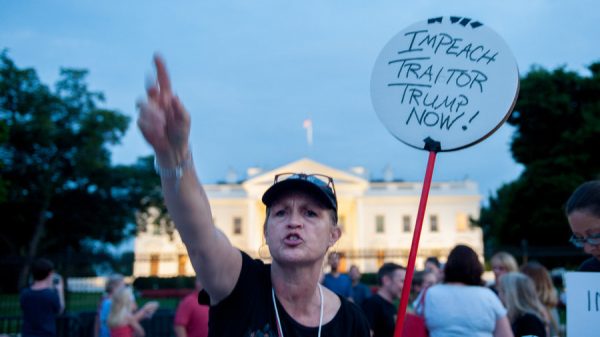
© Erin Scott / Global Look Press
By Finian Cunningham | RT | July 19, 2018
After his landmark summit with Russian leader Vladimir Putin in Helsinki, US President Donald Trump was apparently forced into an embarrassing u-turn over allegations of Russian interference in American elections.
On returning to the White House from his summit in Finland, Trump read out a statement, saying that he “accepted” US intelligence claims that Russia had meddled in the 2016 presidential election.
He offered the explanation that he had “mis-spoken” during his press conference with Putin in Helsinki the day before, when he appeared then to accept the Russian president’s “powerful denial” that his country had not interfered in the race for the White House.
What to make of it? Was Trump correcting a glitch in his speech, or is there something more sinister at play?
In any case, political and media critics in the US don’t believe the president’s “attempt at backtracking,” as the Washington Post put it.
Senior Democrats insisted Trump “could not squirm his way out” of the torrent of accusations that he had “capitulated to Putin” and dishonored US intelligence services by appearing to accept Moscow’s assurances it had not interfered in the elections.
The context of words spoken at the press conference in Helsinki does indeed suggest that Trump was countenancing Putin’s denial of Russian meddling. The US president went on to say that the various probes into the matter were a “disaster” for America’s international image and for bilateral relations with Russia. This is consistent with Trump’s long-held view that the Mueller inquiry is a “witch-hunt” based on “fake news”.
So, Trump’s belated about-turn on what he meant to say in Helsinki regarding alleged Russian interference does not seem to be a convincing, genuine correction on his part. It suggests rather that the president is being forced into making a retraction.
What could be viewed as more disturbing is the way the American president has been browbeaten and cowed to make an embarrassing denial of something he actually believes. In other words, Trump has been humiliated or intimidated into toeing a line.
The US media reaction following the summit with Putin was immediate and shockingly coordinated, like a full-on assault.
“Trump faces tidal wave of criticism over handling of summit with Putin,” reported US government-funded Radio Free Europe.
The president was assailed with a torrent of abuse, decrying him as a “disgrace” and “traitor” for having engaged in a cordial manner with the Russian leader. The uniform scorn poured on Trump by the political and media establishment was something to behold.
Rabid pundits in supposedly prestigious newspapers such as the New York Times were declaring that it’s “Trump and Putin vs. America,” claiming that “the president’s refusal to condemn Russian attacks was a betrayal of every single American citizen.”
The media backlash of vituperation against the president was nothing short of extraordinary. It was a concerted campaign of sedition against his authority which, at times, openly called for a palace coup to oust him.
Under the headline, “This sad, embarrassing wreck of a man,” one oped in the Washington Post posed the question: “Which Republicans will stand behind a president who puts Russia first?”
Ironically, Trump’s instincts about the whole Russiagate affair are correct. It is a load of unsubstantiated farrago promoted by Democrats and large sections of supportive news media who have never got over the ignominy of Hillary Clinton losing out to “deplorable Trump.” Clinton was also backed by high-ranking officials in the state intelligence apparatus, as well as the foreign policy establishment.
This constituency of the political class in Washington shared Clinton’s avowed hostility towards Putin. It is to their unforgivable chagrin that Donald Trump was elected. Moreover, Trump was elected partly on the promise of restoring normal relations between the US and Russia. His policy was given a democratic mandate upon his election to the White House.
After nearly two years of relentless Russophobia from the US political and media establishment, the case for alleged Russian interference in American politics remains embarrassingly vacuous. Not even the latest so-called indictments produced by special counsel Robert Mueller have any credibility to anyone who looks earnestly at the charges. What’s more, ordinary American citizens seem to agree that the whole Russiagate affair is a frivolity indulged in by the political and media elites confined to Washington’s Beltway Bubble.
In a poll out this week following the Helsinki summit, a small majority of Americans (55 percent) seem to think that Trump is “mishandling” relations with Russia. It is perhaps not surprising, given the wall-to-wall media pillorying of the president as a “traitor.” Nevertheless, the same poll found that only a minority of Americans view Russia as “an enemy” (38 percent) or an “imminent threat” (27 per cent).
These figures are cold comfort for the US political establishment, which has assiduously pushed the narrative of Russian malevolence.
What the astounding media backlash against Trump shows is not so much the fecklessness of his character. No, the really perplexing issue is how American democracy is warped and fashioned to meet the demands of powerful unelected forces. The imperative is brazen and brutal.
Trump may want to normalize relations with Russia. The people may have voted for this policy. But the powers-that-be are making sure that this policy is not implemented. They want hostility towards Russia to prevail, as it would have explicitly if Hillary Clinton had been elected.
In short, what we are seeing this week is “American democracy” in action. Meaning there is no actual democracy exercised by the power of the people. It is power exercised by elite interests.
In that way, Russian reaction to the Helsinki summit should be restrained.
Indeed, it was welcome to see Trump and Putin engage in cordial, mutual dialogue. Trump deserves credit for holding the summit and for his civilized manner towards the Russian leader, instead of adopting the vulgar offensiveness for which so much of the US establishment is baying.
The problem is that Trump has evidently very limited political authority to implement the obvious goodwill he desires between Washington and Moscow. He has limited authority to actually adopt one of the key policies for which he was elected by the people.
Trump’s cringe-making u-turn was not a correction over his misuse of “double negative speech.” It was a positively damning sign that the president and the citizens who voted for him have actually negligible power when it comes to overturning a fundamental objective of the unelected plutocrats of the deep state.
For Russia, and indeed the wider world, that is deeply troubling. Because the American powers-that-be are evidently hell-bent on pursuing a hostile agenda towards Russia. Their Russophobia is not just some passing phase. It’s a symptom of an incorrigible malaise and desire within the US establishment for conflict.
Finian Cunningham (born 1963) has written extensively on international affairs, with articles published in several languages. Originally from Belfast, Northern Ireland, he is a Master’s graduate in Agricultural Chemistry and worked as a scientific editor for the Royal Society of Chemistry, Cambridge, England, before pursuing a career in newspaper journalism. For over 20 years he worked as an editor and writer in major news media organizations, including The Mirror, Irish Times and Independent. Now a freelance journalist based in East Africa, his columns appear on RT, Sputnik, Strategic Culture Foundation and Press TV.
Featured Video
BRITAIN’S WARNING: PREPARE FOR WAR
or go to
Aletho News Archives – Video-Images
From the Archive
How Ukraine Tortured and Slaughtered Donbass
By Kit Klarenberg | Al Mayadeen | July 11, 2024
Almost immediately after the proxy war erupted, ISIS-tier footage of the torture and murder of Russians in Ukrainian custody emerged.
On July 6th, the New York Times published an astonishing investigation: In Ukraine, Killings of Surrendering Russians Divide an American-Led Unit. The article documents in grim detail how Chosen Company, an international volunteer battalion for Kiev, routinely executes Russian prisoners of war. It is the very first mainstream admission that this practice – a brazen breach of the Geneva Conventions, and a grave war crime – is widespread among Ukraine’s fighters, both foreign and homegrown. … continue
Blog Roll
 Aletho News
- Record Oil, Empty Tanks: The UAE’s Miracle Recovery
- Burnham tackles Britain’s poverty with aggression in Yemen
- Peace in Ukraine: the easy way – or the hard way
- Trump & the Rrrrussians
- US taxpayer money laundered back through Ukraine – Musk
- Before COVID, an NIH lab chief proposed making a SARS-like bat virus more infectious
- Gates, Bourla on Trial in Netherlands Accused of ‘Great Reset’ Scheme at Vaccine Injury Hearing
- BRITAIN’S WARNING: PREPARE FOR WAR
- “Historic Russia”: The Land Putin Will Not Give Back
- How the Cambridge Analytica scandal still haunts Mark Zuckerberg
- If Americans Knew
- An error has occurred; the feed is probably down. Try again later.
- No Tricks Zone
- Two New Studies Find Thwaites Glacier Melt Cannot Be Driven By Human Activity Or A Warming Ocean
- E-Cars Reduce CO2 Emissions By Only 41% Compared To Internal Combustion Engine Vehicles
- Predictions Made By Renowned Climate Professor Over Past Decades Have Been Proven To Be Poor
- New Study Suggests Large Regions Of The Pacific Ocean Have Been Cooling For The Last 80 Years
- Germany’s Green Energy Debacle: High Energy Costs Force Kahla Porzellan to Close After 182 Years!
- New Study: 50 Years Of The Most Aggressive ‘Net Zero’ Policies Can Only Affect The Global Climate By 0.03°C
- US September “Heat” Was No Record…Many Records Set Decades Ago
- Latest European Green Energy Debacle; Portugal’s Largest Flagship Solar Park Insolvent!
- Green Energy Debacle: German Expert Professor Fritz Vahrenholt Warns Of Severe Economic And Social Consequences
- Two More Paleo Reconstructions Affirm Meters-Higher Sea Levels Across Ireland, Brazil 7000-6000 Years Ago

