News Media Gave Blanket Coverage To Flawed Climate Paper
Global Warming Policy Forum – 07/11/18
 A week ago, we were told that climate change was worse than we thought. But the underlying science contains a major error.
Independent climate scientist Nicholas Lewis has uncovered a major error in a recent scientific paper that was given blanket coverage in the English-speaking media. The paper, written by a team led by Princeton oceanographer Laure Resplandy, claimed that the oceans have been warming faster than previously thought. It was announced, in news outlets including the BBC, the New York Times, the Washington Post and Scientific American that this meant that the Earth may warm even faster than currently estimated.
However Lewis, who has authored several peer-reviewed papers on the question of climate sensitivity and has worked with some of the world’s leading climate scientists, has found that the warming trend in the Resplandy paper differs from that calculated from the underlying data included with the paper.
“If you calculate the trend correctly, the warming rate is not worse than we thought – it’s very much in line with previous estimates,” says Lewis.
In fact, says Lewis, some of the other claims made in the paper and reported by the media, are wrong too.
“Their claims about the effect of faster ocean warming on estimates of climate sensitivity (and hence future global warming) and carbon budgets are just incorrect anyway, but that’s a moot point now we know that about their calculation error”.
And now that the errors have been uncovered, Lewis points out that it is important that the record is corrected.
“The original findings of the Resplandy paper were given blanket coverage by the media, who rarely question hyped-up findings of this kind. Let’s hope some of them are willing to correct the record”.
Pipe Bombs: Frantic Denunciations of the False Flag Concept
By Prof. Graeme McQueen | Global Research | November 1, 2018
Onto the 24-hour reality show that is U.S. politics, 15 package bombs recently made their entrance.
The devices were sent to vocal opponents of Mr. Trump, most of them prominent members of the Democratic Party. The incident became public on October 25, less than two weeks before the November 6 elections that mark the middle of Trump’s first term.
Now, it is an interesting question as to whether the designated perpetrator, Cesar Sayoc, is a lone wolf terrorist or a patsy acting on behalf of larger forces. I am encouraged to see researchers exploring the second possibility. But my focus in this article is different.
The suggestion that the package bomb incidents might be false flag attacks—attacks by opponents of Trump deceptively imputing the attacks to his supporters to discredit them before the elections—was rapidly put forth. Among the fastest off the mark were right-wing pundits, so it was easy enough for various “liberals” (whatever this term means today in the U.S.) to characterize the false flag suggestion as a variety of right-wing conspiracy theory, and as both intellectually ridiculous and morally disgusting. The evident aim has been to stigmatize the concept and drive it from responsible political discourse.
Among the most prominent of the denunciations appeared in CNN and The New York Times.
The article by CNN Editor-at-large Chris Cillizza’s was entitled, “Debunking the despicable ‘false flag’ theory on the mail bombs.” He quoted Rush Limbaugh’s claim that a “Democratic operative” could be responsible for the attacks in order to make it look as if “the Republicans are a bunch of insane lunatics.” Cillizza noted that although we may be tempted to dismiss such “conspiracy crap” without comment, we must not. To refuse to comment on it is “to let it fester.” We must publicly challenge it. His article, it seems, was meant to be a model of such debunking.
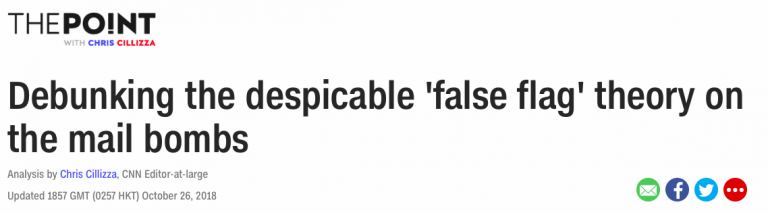
Screengrab from CNN
It was not a good model.
Cillizza concentrated on what he believed to be the logistical impossibilities in Limbaugh’s scenario. He named two steps in the scenario:
1. “Someone or someones who wanted to help Democrats—and the media, I guess, somehow?—would send a series of pipe bombs to prominent Democrats across the country.”
2. “Then Democrats or the media or, again, someone, would have to have coordinated with the state and local police—not to mention federal authorities—so that law enforcement said that these were functional bombs (even though, again, according to this theory, they weren’t).”
He feels that simply to have named these steps is to have shown how ridiculous the hypothesis is.
Really?
There is nothing impossible about Step 1. Surely Cillizza is not saying that the faction of the U.S. intelligence community hostile to Trump—nicely represented by James Clapper and John Brennan, two recipients of the package bombs—is incapable of fashioning a few clumsy devices and sending them through the mail? The material in the 2001 anthrax envelopes was much more sophisticated and difficult to acquire than the non-functional “pipe bombs,” yet the U.S. intelligence community remains a prime suspect in these attacks.
As for the purpose in sending out such bombs, one of the first questions we ask when confronted by a violent event of this sort is, Cui bono? Who benefits? I cannot see how Trump and his supporters benefit, whereas the benefit to mainstream Democrats—of the Clinton variety, no threat to the established order—is obvious. They get to claim the status of nonviolent, sane victim.
What about Cillizza’s Step 2? I confess I am defeated by his prose. I do not know what he is trying to say. But let me speculate that he is claiming this conspiracy theory involves too many people (various levels of police, for example) and that it involves an impossibly complex deception—policing agencies portraying inoperative devices as operative.
Once again we might fruitfully examine the anthrax attacks. There was an impressive amount of coordination involved in these attacks. As far as policing was concerned, this was mainly achieved by the FBI chasing away other levels of police while keeping strict control over its own personnel when they wandered too near the truth.
But the coordination in the anthrax case went far beyond policing. Media were deeply implicated. The media faithfully set out the story they were handed by authorities: the attacks appeared to have been carried out by al-Qaeda, with a strong possibility of Iraqi involvement. This story was successfully propagated, for example, through a wide variety of newspapers, from The New York Times and Washington Post to the Guardian. By the end of 2001—less than four months after the attacks began—Homeland Security, the FBI and the White House had been forced to admit that neither al-Qaeda, nor Iraq, nor domestic Muslims, appeared to have had anything to do with these attacks. Instead, they came from the heart of the US Military-Industrial-Intelligence community. As to who, precisely, in this community carried out the attacks, there remains disagreement; but even a sketchy familiarity with the anthrax attacks knocks out Cillizza’s Step 2 objections.
A useful rule of thumb is that if a thing has happened it is possible. We know a violent, coordinated and complex false flag attack is possible in the U.S. because it happened.
But if this was the best CNN could do, what about The New York Times? Kevin Roose produced a piece somewhat longer, although not much more thoughtful, than the CNN editor’s.
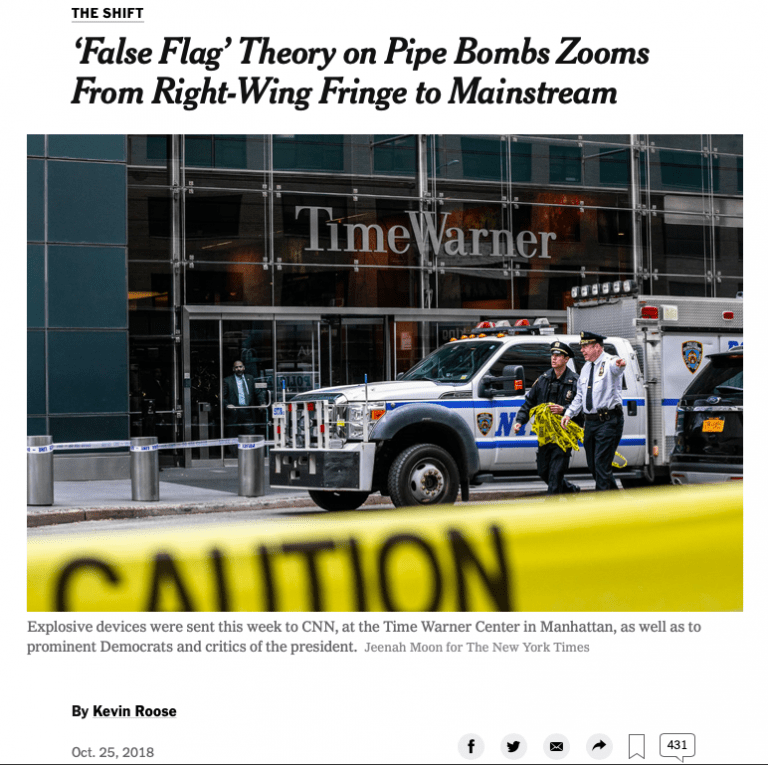
Screengrab from The New York Times
Roose let us have it with the old chestnut, “conspiratorial thinking has always been with us”, and then proceeded to dance lightly from the grassy knoll to the moon landing to 9/11 without troubling us with sources, evidence or other bothersome material.
If you are like me you will find yourself, in an increasingly bad mood, asking: has this young fellow carefully researched all of these incidents? Has he, in fact, carefully researched a single one of them?
Like the CNN editor, Roose spends his time countering claims that the package bombs sent to prominent enemies of Mr. Trump might have been sent by people wanting to discredit Trump and his allies. He places these “conspiracy theorists” on the political right and associates them with Trump’s presidency. More than this, he uses, and explains, the term “false flag” and tries hard to discredit it. “False flag philosophy—the idea that powerful groups stage threats and tragic events to advance their agendas—is now a bizarrely common element of national news stories.”
This statement is a sign of progress in the opening of the American mind. We should celebrate the good news that the concept of false flag is common in political discourse, common enough that The New York Times feels a need to discredit it. This achievement came through much labour by many people over many years.
That Roose finds the concept “bizarre” is, of course, to be regretted, but this merely testifies to his naivety and his poor knowledge of false flag attacks, of which there have been plenty in human history (see Sources).
As a matter of fact, the particular type of false flag attack being discussed in the present case, where Group A attacks itself and blames Group B, is centuries old. In China it used to be called the Stratagem of Wounded Flesh (see Sources).
The notion that the false flag concept and the conspiracy concept are the exclusive property of the political right is absurd. They are ideas available to, and used by, all those who genuinely care about what is going on around them and wish to have an adequate intellectual toolbox. I am not on the political right and I am not a supporter of Rush Limbaugh, Ann Coulter and the like, but I do not for that reason choose to shut down my brain.
Although we may not want to admit it, repetition is half the battle in public fights and debates. Let us use the term “false flag” repeatedly and ensure that it remains where it apparently is at the moment: in the center of U.S. political discourse.
***
Graeme MacQueen is the former director of the Centre for Peace Studies at McMaster University. He is a member of the 9/11 Consensus Panel, former co-editor of the Journal of 9/11 Studies, and an organizer of the 2011 Toronto Hearings, the results of which have been published in book form as The 9/11 Toronto Report. He is a Research Associate of the Centre for Research on Globalization (CRG)
Sources
1. The CNN article is as follows:
Chris Cillizza, “Debunking the despicable ‘false flag’ theory on the mail bombs”, CNN, Octo. 25, 2018
https://www.cnn.com/2018/10/25/politics/false-flag-theory-mail-bombs-cnn-democrats/index.html
2. The NYT article is:
Kevin Roose, “‘False Flag’ Theory on Pipe Bombs Zooms From Right-Wing Fringe to Mainstream,” The New York Times, Oct. 25, 2018.
3. Most comments on the anthrax attacks in this essay are based on my book, The 2001 Anthrax Deception: The Case for a Domestic Conspiracy. Clarity Press, 2014.
https://www.claritypress.com/MacQueen.html
But see also FBI whistleblower Richard Lambert’s lawsuit, paragraphs 50 ff.:
4. For examples of false flags, see the collection by Washington’s blog:
https://www.globalresearch.ca/53-admitted-false-flag-attacks/5432931
5. The Wounded Flesh Stratagem can be found at least as early as the 14th century CE in the novel, Romance of the Three Kingdoms (San Guo Yan Yi). It can also be found as one among many stratagems in the later compilation, Thirty-six Stratagems. The Wikipedia article on the latter text offers an interpretative translation of ku rou ji: “inflict injury on oneself to win the enemy’s trust”. If the pipe bomb case is an instance of ku rou ji, the enemy of the perpetrators would be the U.S. population itself.
https://en.wikipedia.org/wiki/Thirty-Six_Stratagems
Copyright © Prof. Graeme McQueen, Global Research, 2018
Read more: The 9/11 Anniversary: Conspiracy Theory or Critical Thinking?
Who’s really ‘undermining’ US democracy?
‘We have met the enemy and he is us’
The Nation | November 2, 2018
Allegations that Russia is still “attacking” US elections, now again in November, could delegitimize our democratic institutions.
Summarizing one of the themes in his new book, ‘War with Russia? From Putin and Ukraine To Trump and Russiagate,’ Stephen F. Cohen argues that Russiagate allegations of Kremlin attempts to “undermine American democracy” may themselves erode confidence in those institutions.
Ever since Russiagate allegations began to appear more than two years ago, their core narrative has revolved around purported Kremlin attempts to “interfere” in the 2016 US presidential election on behalf of then-candidate Donald Trump. In recent months, a number of leading American media outlets have taken that argument even further, suggesting that Putin’s Kremlin actually put Trump in the White House and now is similarly trying to affect the November 6 midterm elections, particularly House contests, on behalf of Trump and the Republican Party. According to a page-one New York Times “report,” for example, Putin’s agents “are engaging in an elaborate campaign of ‘information warfare’ to interfere with the American midterm elections.”
Despite well-documented articles by Gareth Porter and Aaron Mate effectively dismantling these allegations about 2016 and 2018, the mainstream media continues to promote them. The occasionally acknowledged lack of “public evidence” is sometimes cited as itself evidence of a deep Russian conspiracy, of the Kremlin’s “arsenal of disruption capabilities… to sow havoc on election day.” (See the examples cited by Alan MacLeod.)
Lost in these reckless allegations is the long-term damage they may themselves do to American democracy. Consider the following possibilities:
Even though still unproven, charges that the Kremlin put Trump in the White House have cast a large shadow of illegitimacy over his presidency and thus over the institution of the presidency itself. This is unlikely to end entirely with Trump. If the Kremlin had the power to affect the outcome of one presidential election, why not another one, whether won by a Republican or a Democrat? The 2016 presidential election was the first time such an allegation became widespread in American political history, but it may not be the last.
Now the same shadow looms over the November 6 elections and thus over the next Congress. If so, in barely two years, the legitimacy of two fundamental institutions of American representative democracy will have been challenged, also for the first time in history.
And if US elections are really so vulnerable to Russian “meddling,” what does this say about faith in American elections more generally? How many losing candidates on November 6 will resist blaming the Kremlin? Two years after the last presidential election, Hillary Clinton and her adamant supporters still have not been able to do so.
We know from critical reporting and from recent opinion surveys that the origins and continuing fixation on the Russiagate scandal since 2016 have been primarily a product of US political-intelligence-media elites. It did not spring from the American people – from voters themselves. Thus a Gallup poll recently showed that 58 percent of those surveyed wanted improved relations with Russia. And other surveys have shown that Russiagate is scarcely an issue at all for likely voters on November 6. Nonetheless, it remains a front-page issue for US elites.
Indeed, Russiagate has revealed the low esteem that many US political-media elites have for American voters – for their ability to make discerning, rational electoral decisions, which is the bedrock assumption of representative democracy. It is worth noting that this disdain for rank-and-file citizens echoes a longstanding attitude of the Russian political intelligentsia, as recently expressed in the argument by a prominent Moscow policy intellectual that Russian authoritarianism springs not from the nation’s elites but from the “genetic code” of its people.
US elites seem to have a similar skepticism about – or contempt for – American voters’ capacity to make discerning electoral choices. Presumably this is a factor behind the current proliferation of programs – official, corporate, and private – to introduce elements of censorship in the nation’s “media space” in order to filter out “Kremlin propaganda.” Here, it also seems, elites will decide what constitutes such “propaganda.”
The Washington Post recently gave such an example: “portraying Russian and Syrian government forces favorably as they battled ‘terrorists’ in what US officials for years have portrayed as a legitimate uprising against the authoritarian government of President Bashar al-Assad.” That is, thinking that the forces of Putin and Assad were fighting terrorists, even if closer to the truth, is “Kremlin propaganda” because it is at variance with “what US officials for years have” been saying. This was the guiding principle of Soviet censorship as well.
If the American electoral process, presidency, legislature, and voter cannot be fully trusted, what is left of American democracy? Admittedly, this is still only a trend, a foreboding, but one with no end in sight. If it portends the “undermining of American democracy,” our elites will blame the Kremlin. But they best recall the discovery of Walt Kelly’s legendary cartoon figure Pogo: “We have met the enemy and he is us.”
Stephen F. Cohen is a professor emeritus of Russian studies and politics at New York University and Princeton University and a contributing editor of The Nation.
‘Horrendous’: New York Times Attacks Inter-Korean Peace Process
Sputnik – 31.10.2018
On Monday, the New York Times reported that South Korean President Moon Jae-in is succeeding where all of his predecessors have failed — in engaging North Korea and convincing the country to give up its nuclear weapons program.
However, the article isn’t complimentary, quoting a South Korean newspaper that claimed Moon is Kim Jong Un’s most effective spokesperson.
The New York Times article also quotes an American think tank analyst stating that Moon is a “bad moon on the rise,” quoting an old Creedence Clearwater Revival song.
Simone Chun, a fellow at the Korea Policy Institute and a member of the Korean Peace Network, joined Radio Sputnik’s Loud & Clear Tuesday to discuss how the US corporate media continues to attack the historic progress towards peace on the Korean Peninsula.
“What this article is suggesting is that Kim Jong Un is either manipulating Moon Jae-in or Moon Jae-in is the unwitting fool falling for deception,” Becker said.
“In the article, they even describe Moon Jae-in as ‘the agent of North Korea.’ It’s a very carefully crafted editorial position designed to sabotage Moon Jae-in’s effort to bring about peace on the Korean peninsula,” Becker added.
In September, North and South Korea signed a joint agreement, proclaiming an end to the state of war. The two nations agreed to cease large-scale artillery exercises and military flights near the demarcation line and make efforts to denuclearize the peninsula.
However, according to the New York Times article, “[A]s Mr. Moon has pushed to deepen ties with Pyongyang, the backlash from his critics has been swift. A major South Korean newspaper this month called him the ‘chief spokesman for Kim Jong-un,’ and an American commentator, quoting Creedence Clearwater Revival, recently referred to him as a ‘bad Moon on the rise.'”
“If Mr. Kim wanted to change his image from nuclear madman to mature negotiator, it’s unlikely he could have found a better agent than Mr. Moon,” the article stated.
The South Korean newspaper being referenced is chosun.com, “one of the most right-wing newspapers in South Korea–and, according to a recent poll, the least trusted media,” Chun told Radio Sputnik. The Creedence Clearwater quotation comes from Gordon Chang, a “notorious right wing” columnist, she added.
“It is a shame [that the] New York Times is giving a platform for the very ultra right-wing and minority voices who are afraid of [the] Korean peace process and who are trying to sabotage the current peace talks,” Chun told Sputnik.
“Based on these two sources [cited by the New York Times ], there isn’t much credibility on this particular article. The image they create is that president Moon is somehow a spokesperson for Chairman Kim. Nine out of 10 Koreans in recent polls support the peace process. I would argue that it’s the Korean people [themselves] who are behind the peace process. The big picture, you see here, is a growing, orchestrated chorus of America’s right wing think tanks, such as the Heritage Foundation and CSIS, in conjunction with the minority voices in South Korea, who are now in the process of sabotaging and trying to discredit Moon. I think it is very important to, as your media [Sputnik] is doing, respond to this horrendous claims,” Chun added.
“If this peace plan between the two Koreans has the support of 90 percent of the Korean people and is going so well for Donald Trump, a Republican president, why would the New York Times place an article like that?” Kirikou asked.
“This is a propaganda piece that found its way into the New York Times,” he added.
“The author of the [New York Times ] article is actually Korean,” Chun responded, also adding that the author has taken a conservative viewpoint when it comes to foreign policy over recent years.
“The New York Times, when it comes to foreign policy, has often taken a conservative position” as well, Chun added.
Last week, Seoul, Pyongyang and the UN Command (UNC) on Monday agreed to withdraw firearms and military posts from the village of Panmunjom, known as the Joint Security Area, in the Demilitarized Zone, in what Chun called a “historic attempt” that reveals that the “two Koreas are very determined [to make peace.]”
“The two Koreas and the UNC agreed to take measures of withdrawing firearms and military posts from the JSA by October 25, and for the following two days, the three parties will conduct a joint verification,” the South Korean Ministry’s of National Defense news release said, according to the Yonhap news agency.
In June, Kim also reached an agreement with US President Donald Trump, stipulating that North Korea would make efforts to promote complete denuclearization of the peninsula in exchange for freezing US-South Korean military drills and a potential removal of US sanctions.
American Pravda: The ADL in American Society

13-year-old Mary Phagan, the girl raped and murdered by Leo Frank, the founding hero of the ADL
By Ron Unz • Unz Review • October 15, 2018
In our modern era, there are surely few organizations that so terrify powerful Americans as the Anti-Defamation League (ADL) of B’nai B’rith, a central organ of the organized Jewish community.
Mel Gibson had long been one of the most popular stars in Hollywood and his 2004 film The Passion of the Christ became among the most profitable in world history, yet the ADL and its allies destroyed his career, and he eventually donated millions of dollars to Jewish groups in desperate hopes of regaining some of his public standing. When the ADL criticized a cartoon that had appeared in one of his newspapers, media titan Rupert Murdoch provided his personal apology to that organization, and the editors of The Economist quickly retracted a different cartoon once it came under ADL fire. Billionaire Tom Perkins, a famed Silicon Valley venture capitalist, was forced to issue a heartfelt apology after coming under ADL criticism for his choice of words in a Wall Street Journal column. These were all proud, powerful individuals, and they must have deeply resented being forced to seek such abject public forgiveness, but they did so nonetheless. The total list of ADL supplicants over the years is a very long one.
Given the fearsome reputation of the ADL and its notorious hair-trigger activists, there was a widespread belief that my small webzine would be completely annihilated when I first launched my recent series of controversial articles in early June by praising the works of historian David Irving, long demonized by the ADL. Yet absolutely nothing happened.
During the next three months my subsequent articles directly challenged nearly every hot-button issue normally so fiercely defended by the ADL and its lackies, so much so that a friendly journalist soon described me as the “Kamikaze from California.” Yet despite my 90,000 words of text and the 13,000 comments I had attracted, the continuing silence of the ADL was absolutely deafening. Meanwhile, my articles were read more than half a million times, with the following being a list of the most provocative pieces:
- The Remarkable Historiography of David Irving
June 4, 2018 • 1,700 Words • 570 Comments - American Pravda: The JFK Assassination, Part II – Who Did It?
June 25, 2018 • 8,000 Words • 985 Comments - American Pravda: Oddities of the Jewish Religion
July 16, 2018 • 7,800 Words • 1,637 Comments - American Pravda: The Bolshevik Revolution and Its Aftermath
July 23, 2018 • 6,900 Words • 913 Comments - American Pravda: The Nature of Anti-Semitism
July 30, 2018 • 5,500 Words • 666 Comments - American Pravda: Jews and Nazis
August 6, 2018 • 6,800 Words • 554 Comments - American Pravda: Holocaust Denial
August 27, 2018 • 17,600 Words • 2,323 Comments - American Pravda: 9/11 Conspiracy Theories
September 10, 2018 • 11,000 Words • 2,355 Comments
When divine wrath fails to smite the heretic and terrifying enforcers of official dogma seem to have suddenly lost their taste for battle, others gradually begin to take notice and may grow emboldened. Eventually leading pro-Russian and Libertarian websites such as Russia Insider and LewRockwell began republishing some of my most controversial American Pravda articles, thus bringing my factual claims to the attention of broader audiences. After the conclusion of the my series, I began directly ridiculing my strangely timorous ADL opponents, publishing a short column entitled “Has the ADL Gone Into Hiding?” which led the redoubtable Paul Craig Roberts to describe me as “the bravest man I know.”
Apparently the combination of all these factors at long last grew too worrisome for the ADL, and stirring from their secret hiding place, its activists have now finally released a short and rather milquetoast response to my material, one which hardly much impresses me. A few days ago, they Tweeted out their column, together with a photo of their new nemesis.
California businessman Ron Unz has long been funding anti-Israel activists. Now, he’s embracing hardcore #antiSemitism, denying the Holocaust & claiming Jews run the media & worship Satan. Learn more from our experts: https://t.co/KnngID3YCh
— ADL (@ADL_National) October 8, 2018
The ADL may boast an annual budget of $60 million and have many hundreds of full-time employees, but its research skills seem sorely lacking. I discovered that they opened their rebuke by denouncing me as a notorious “anti-immigrant activist.” This seems an extremely odd claim given that I have published perhaps a quarter-million words on that contentious topic over the last twenty-five years, nearly all of it online and fully searchable, and my views have never been characterized in that fashion. To cite just one example, my article “California and the End of White America” appeared as a 1999 cover-story in Commentary, the flagship publication of The American Jewish Committee, and surely anyone reading it would be greatly puzzled by the ADL’s description. Indeed, just a few years earlier, I had been a top featured speaker at the October 1994 pro-immigrant protest in downtown Los Angeles, a 70,000 strong political rally that was the largest such gathering in American history to that date.

Over the years, my political activities have been the subject of many thousands of articles in the mainstream media, including a half-dozen front-page stories in the New York Times, and these would provide a similar picture, as did the New Republic cover story chronicling my California successes. Moreover, my views on immigrants haven’t changed all that much over the years as demonstrated by my more recent articles such as “The Myth of Hispanic Crime,” “Immigration, Republicans, and the End of White America” and “A Grand Bargain on Immigration?” Perhaps the intrepid ADL investigators should acquaint themselves with a powerful new technological tool called “Google.”

I was equally unimpressed that they so hotly denounced me for substantially relying upon the writings of Israel Shahak, whom they characterized as viciously “anti-Semitic.” As I had repeatedly emphasized, my own total lack of Aramaic and Hebrew necessarily forces me to rely upon the research of others, and the late Prof. Shahak, an award-winning Israeli academic, certainly seems a fine source to use. After all, famed linguist Noam Chomsky had lauded Shahak’s works for their “outstanding scholarship,” and numerous of our other most prominent public intellectuals such as Christopher Hitchens, Edward Said, and Gore Vidal had been similarly lavish in their praise. Furthermore, one of Shahak’s co-authors was Norton Mezvinsky, a prominent American academic specializing in Middle Eastern history, himself hardly an obscure figure given that both his brother and sister-in-law served in Congress and his nephew later married Chelsea Clinton. And as far as I’m aware almost none of Shahak’s explicit claims about the Talmud or traditional Judaism have ever been directly challenged, while the online availability of his first book allows those so interested to conveniently read it and decide for themselves.

The ADL similarly denounced me for taking seriously the theories of Ariel Toeff, another Israeli academic. But Prof. Toeff, son of the Chief Rabbi of Rome, certainly ranks as one of the world’s leading scholarly authorities on Medieval Jewry, and working together with his graduate students and other colleagues, he had devoted many years of effort to the research study in question, drawing upon extensive primary and secondary sources produced in eight different languages. I found his 500 page book quite persuasive, as did Israeli journalist Israel Shamir, and I have seen no credible rebuttals.
Now the work of all these prominent academics and intellectuals may not necessarily be correct, and perhaps I am mistaken in accepting their factual claims. But I would need to see something far more weighty than a casual dismissal in a few paragraphs contained within an anonymous ADL column, whose author for all I know might have been some ignorant young intern.
Those glaring flaws aside, most of the ADL’s remaining catalogue of my numerous heretical positions seemed reasonably accurate, though obviously presented in a somewhat hostile and derogatory fashion and sorely lacking any links to my original pieces. But even this desultory listing of my mortal transgressions was woefully incomplete, with the ADL strangely failing to include mention of some of my most controversial claims.

For example, the authors excluded all reference to my discussion of the thoroughly documented Nazi-Zionist economic partnership of the 1930s, which played such a crucial role in laying the basis for the State of Israel. And the ADL similarly avoided mentioning the nearly 20,000 words I had allocated to discussing the very considerable evidence that the Israeli Mossad had played a central role in both the JFK Assassination and the 9/11 Attacks. Surely this must be one of the few times that the ADL has deliberately avoided leveling the charge of “conspiracy theorist” against an opponent whom they might have so easily slurred in that fashion. Perhaps they felt the evidence I provided was too strong for them to effectively challenge.
The worrisome incompetence of ADL researchers becomes particularly alarming when we consider that over the last couple of years that organization has been elevated into a content gatekeeping role at America’s largest Internet companies, helping to determine what may or may not be said on the most important Social Media platforms such as Facebook, YouTube, and Twitter.

Brittan Heller, director of technology and society for the Anti-Defamation League, photographed in Palo Alto, Calif., on August 27, 2018. (Nhat V. Meyer/Bay Area News Group)
My local paper is the San Jose Mercury News and a couple of weeks ago it published a major profile interview with Brittan Heller, the ADL Director tasked with policing “hate speech” across the America-dominated portions of the Internet. She seemed like a perfectly pleasant young woman in her mid-thirties, a Stanford English major and a graduate of Yale Law, now living in Silicon Valley with her husband and her two cats, Luna and Stella. She emphasizes her own experience as a victim of cyber-harassment from a fellow college student whose romantic overtures she rejected and the later expertise she had gained as a Nazi-hunter for the U.S. government. But does that resume really provide her with the god-like knowledge suitable for overriding our traditional First Amendment rights and determining which views and which individuals should be allowed access to some two billion readers worldwide?
There is also a far more serious aspect to the situation. The choice of the ADL as the primary ideological overseer of America’s Internet may seem natural and appropriate to politically-ignorant Americans, a category that unfortunately includes the technology executives leading the companies involved. But this reflects the remarkable cowardice and dishonesty of the American media from which all these individuals derive their knowledge of our world. The true recent history of the ADL is a remarkably sordid and disreputable tale.
In January 1993, the San Francisco Police Department reported that it had recently raided the Northern California headquarters of the ADL based upon information provided by the FBI. The SFPD discovered that the organization had been keeping intelligence files on more than 600 civic organizations and 10,000 individuals, overwhelmingly of a liberal orientation, with the SFPD inspector estimating that 75% of the material had been illegally obtained, much of it by secret payments to police officials. This was merely the tip of the iceberg in what clearly amounted to the largest domestic spying operation by any private organization in American history, and according to some sources, ADL agents across the country had targeted over 1,000 political, religious, labor, and civil rights organizations, with the New York headquarters of the ADL maintaining active dossiers on more than a million Americans.
Not long afterward, an ACLU official who had previously held a high-ranking position with the ADL revealed in an interview that his organization had been the actual source of the highly controversial 1960s surveillance on Martin Luther King, Jr., which it had then provided to FBI Director J. Edgar Hoover. For many years Hoover had been furiously denounced in the national media headlines for his use of tapes and other secret information on King’s activities, but when a local San Francisco newspaper revealed that an ADL spying operation had actually been the source of all that sordid material, the bombshell revelation was totally ignored in the national media and only reported by fringe organizations, so that today almost no Americans are aware of that fact.
I am not aware of any other private organization in American history that has been involved in even a sliver of such illegal domestic espionage activity, which appears to have been directed against almost all groups and prominent individuals—Left, Right, and Center—suspected of being insufficiently aligned with Jewish and Israeli interests. Some of the illegal material found in ADL possession even raised dark suspicions that it had played a role in domestic terrorist attacks and political assassinations directed against foreign leaders. I am no legal expert, but given the massive scale of such illegal ADL activities, I wonder whether a plausible case might have been made to prosecute the entire organization under RICO statutes and sentence all of its leaders to long prison terms.
Instead, the resulting government charges were quickly settled with merely a trivial fine and a legal slap on the wrist, demonstrating the near-total impunity provided by massive Jewish political power in modern American society.
In effect, the ADL seems to have long operated as our country’s privatized secret political police, monitoring and enforcing its ideological doctrines on behalf of Jewish groups much as the Stasi did for the Communist rulers of East Germany. Given such a long history of criminal activity, allowing the ADL to extend its oversight to our largest Social Media platforms amounts to appointing the Mafia to supervise the FBI and the NSA, or taking a very large step towards implementing George Orwell’s Ministry of Truth on behalf of Jewish interests.
In his 1981 memoirs, the far right Classics scholar Revilo P. Oliver characterized the ADL as “the formidable organization of Jewish cowboys who ride herd on their American cattle” and this seems a reasonably apt description to me.
Although I had long recognized the power and influence of the ADL, a leading Jewish-activist organization whose leaders were so regularly quoted in my newspapers, until rather recently I had only the vaguest notions of its origins. I’m sure I’d heard the story mentioned at some points, but the account had never stuck in my mind.
Then perhaps a year or two ago, I happened to come across some discussion of the ADL’s 2013 centenary celebration, in which the leadership reaffirmed the principles of its 1913 founding. The initial impetus had been the vain national effort to save the life of Leo Frank, a young Jew unjustly accused of murder and eventually lynched. Not long before, Frank’s name and story would have been equally vague in my mind, with the man half-remembered from my introductory history textbooks as a notorious early KKK victim in the fiercely anti-Semitic Deep South of the early twentieth century. However, not long before seeing that piece on the ADL I’d read Albert Lindemann’s highly-regarded study The Jew Accused, and his short chapter on the notorious Frank case had completely exploded all my preconceptions.
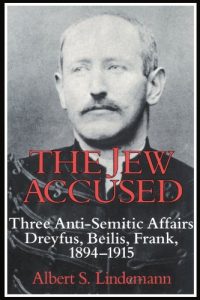
First, Lindemann demonstrated that there was no evidence of any anti-Semitism behind Frank’s arrest and conviction, with Jews constituting a highly-valued element of the affluent Atlanta society of the day, and no references to Frank’s Jewish background, negative or otherwise, appearing in the media prior to the trial. Indeed, five of the Grand Jurors who voted to indict Frank for murder were themselves Jewish, and none of them ever voiced regret over their decision. In general, support for Frank seems to have been strongest among Jews from New York and other distant parts of the country and weakest among the Atlanta Jews with best knowledge of the local situation.
Furthermore, although Lindemann followed the secondary sources he relied upon in declaring that Frank was clearly innocent of the charges of rape and murder, the facts he recounted led me to the opposite conclusion, seeming to suggest strong evidence of Frank’s guilt. When I much more recently read Lindemann’s longer and more comprehensive historical study of anti-Semitism, Esau’s Tears, I noticed that his abbreviated treatment of the Frank case no longer made any claim of innocence, perhaps indicating that the author himself might have also had second thoughts about the weight of the evidence.
Based on this material, I voiced that opinion in my recent article on historical anti-Semitism, but my conclusions were necessarily quite tentative since they relied upon Lindermann’s summary of the information provided in the secondary sources he had used, and I had the impression that virtually all those who had closely investigated the Frank case had concluded that Frank was innocent. But after my piece appeared, someone pointed me to a 2016 book from an unexpected source arguing for Frank’s guilt. Now that I have ordered and read that volume, my understanding of the Frank case and its historical significance has been entirely transformed.
Mainstream publishers may often reject books that too sharply conflict with reigning dogma and sales of such works are unlikely to justify the extensive research required to produce the manuscript. Furthermore, both authors and publishers may face widespread vilification from a hostile media for taking such positions. For these reasons, those who publish such controversial material will often be acting from deep ideological motives rather than merely seeking professional advancement or monetary gain. As an example, it took a zealous Trotskyite leftist such as Lenni Brunner to brave the risk of widespread vilification and invest the time and effort to produce his remarkable study of the crucial Nazi-Zionist partnership of the 1930s. And for similar reasons, we should not be totally surprised that the leading book arguing for the guilt of Leo Frank appeared as a volume in the series on the pernicious aspects of Jewish-Black historical relations produced by Louis Farrakhan’s Nation of Islam (NOI), nor that the text lacked any identified author.
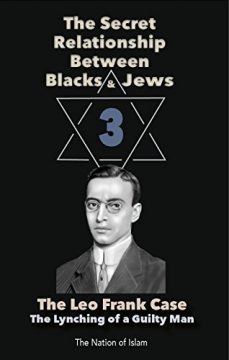
Anonymous works published by heavily-demonized religious-political movements naturally engender considerable caution, but once I began reading the 500 pages of The Leo Frank Case: The Lynching of a Guilty Man I was greatly impressed by the quality of the historical analysis. I think I have only very rarely encountered a research monograph on a controversial historical event that provided such an enormous wealth of carefully-argued analysis backed by such copious evidence. The authors seemed to display complete command of the major secondary literature of the last one hundred years while drawing very heavily upon the primary sources, including court records, personal correspondence, and contemporaneous publications, with the overwhelming majority of the 1200 footnotes referencing newspaper and magazine articles of that era. The case made for Frank’s guilt seemed absolutely overwhelming.
The basic outline of events is not disputed. In 1913 Georgia, a 13-year-old pencil company worker named Mary Phagan was last seen alive visiting the office of factory manager Leo Frank on a Saturday morning to collect her weekly paycheck, while her raped and murdered body was found in the basement early the next morning and Frank eventually arrested for the crime. As the wealthy young president of the Atlanta chapter of B’nai B’rith, Frank ranked as one of the most prominent Jewish men in the South, and great resources were deployed in his legal defense, but after the longest and most expensive trial in state history, he was quickly convicted and sentenced to death.
The facts of the case against Frank eventually became a remarkable tangle of complex and often conflicting evidence and eyewitness testimony, with sworn statements regularly being retracted and then counter-retracted. But the crucial point that the NOI authors emphasize for properly deciphering this confusing situation is the enormous scale of the financial resources that were deployed on Frank’s behalf, both prior to the trial and afterward, with virtually all of the funds coming from Jewish sources. Currency conversions are hardly precise, but relative to the American family incomes of the time, the total expenditures by Frank supporters may have been as high as $25 million in present-day dollars, quite possibly more than any other homicide defense in American history before or after, and an almost unimaginable sum for the impoverished Deep South of that period. Years later, a leading donor privately admitted that much of this money was spent on perjury and similar falsifications, something which is very readily apparent to anyone who closely studies the case. When we consider this vast ocean of pro-Frank funding and the sordid means for which it was often deployed, the details of the case become far less mysterious. There exists a mountain of demonstrably fabricated evidence and false testimony in favor of Frank, and no sign of anything similar on the other side.
The police initially suspected the black night watchman who found the girl’s body, and he was quickly arrested and harshly interrogated. Soon afterward, a bloody shirt was found at his home, and Frank made several statements that seemed to implicate his employee in the crime. At one point, this black suspect may have come close to being summarily lynched by a mob, which would have closed the case. But he stuck to his story of innocence with remarkable composure, in sharp contrast to Frank’s extremely nervous and suspicious behavior, and the police soon shifted their scrutiny toward the latter, culminating in his arrest. All researchers now recognize that the night watchman was entirely innocent, and the material against him planted.
The evidence against Frank steadily mounted. He was the last man known to have seen the young victim and he repeatedly changed important aspects of his story. Numerous former female employees reported his long history of sexually aggressive behavior toward them, especially directed towards the murdered girl herself. At the time of the murder, Frank claimed to have been working alone in his office, but a witness who went there reported he had been nowhere to be found. A vast amount of circumstantial evidence implicated Frank.
A black Frank family servant soon came forward with sworn testimony that Frank had confessed the murder to his wife on the morning after the killing, and this claim seemed supported by the latter’s strange refusal to visit her husband in jail for the first two weeks after the day of his arrest.
Two separate firms of experienced private detectives were hired by Frank’s lavishly-funded partisans, and the agents of both eventually came to the reluctant conclusion that Frank was guilty as charged.
As the investigation moved forward, a major break occurred as a certain Jim Conley, Frank’s black janitor, came forward and confessed to having been Frank’s accomplice in concealing the crime. At the trial he testified that Frank had regularly enlisted him as a lookout during his numerous sexual liaisons with his female employees, and after murdering Phagan, had then offered him a huge sum of money to help remove and hide the body in the basement so that the crime could be pinned upon someone else. But with the legal noose tightening around Frank, Conley had begun to fear that he might be made the new scapegoat, and went to the authorities in order to save his own neck. Despite Conley’s damning accusations, Frank repeatedly refused to confront him in the presence of the police, which was widely seen as further proof of Frank’s guilt.
By the time of the trial itself, all sides were agreed that the murderer was either Frank, the wealthy Jewish businessman, or Conley, the semi-literate black janitor with a first-grade education and a long history of public drunkenness and petty crime. Frank’s lawyers exploited this comparison to the fullest, emphasizing Frank’s Jewish background as evidence for his innocence and indulging in the crudest sort of racial invective against his black accuser, whom they claimed was obviously the true rapist and murderer due to his bestial nature.
Those attorneys were the best that money could buy and the lead counsel was known as the one of the most skilled courtroom interrogators in the South. But although he subjected Conley to a grueling sixteen hours of intense cross-examination over three days, the latter never wavered in the major details of his extremely vivid story, which deeply impressed the local media and the jury. Meanwhile, Frank refused to take the stand at his own trial, thereby avoiding any public cross-examination of his often changing account.
Two notes written in crude black English had been discovered alongside Phagan’s body, and everyone soon agreed that these were written by the murderer in hopes of misdirecting suspicion. So they were either written by a semi-literate black such as Conley or by an educated white attempting to imitate that style, and to my mind, the spelling and choice of words strongly suggests the latter, thereby implicating Frank.
Taking a broader overview, the theory advanced by Frank’s legion of posthumous advocates seems to defy rationality. These journalists and scholars uniformly argue that Conley, a semi-literate black menial, had brutally raped and murdered a young white girl, and the legal authorities soon became aware of this fact, but conspired to set him free by supporting a complex and risky scheme to instead frame an innocent white businessman. Can we really believe that the police officials and prosecutors of a city in the Old South would have violated their oath of office in order to knowingly protect a black rapist and killer from legal punishment and thereby turn him loose upon their city streets, presumably to prey on future young white girls? This implausible reconstruction is particularly bizarre in that nearly all its advocates across the decades have been the staunchest of Jewish liberals, who endlessly condemned the horrific racism of the Southern authorities of that era, but then unaccountably chose to make a special exception in this one particular case.
In many respects, the more important part of the Frank case began after his conviction and death sentence when many of America’s wealthiest and most influential Jewish leaders began mobilizing to save him from the hangman. They soon established the ADL as a new vehicle for that purpose and succeeded in making the Frank murder case one of the most famous in American history to that date.
Although his role was largely concealed at the time, the most important new backer whom Frank attracted was Albert Lasker of Chicago, the unchallenged monarch of American consumer advertising, which constituted the life’s blood of all of our mainstream newspapers and magazines. Not only did he ultimately provide the lion’s share of the funds for Frank’s defense, but he focused his energies upon shaping the media coverage surrounding the case. Given his dominant business influence in that sector, we should not be surprised that a huge wave of unremitting pro-Frank propaganda soon began appearing across the country in both local and national publications, extending to most of America’s most popular and highly-regarded media outlets, with scarcely a single word told on the other side of the story. This even included all of Atlanta’s own leading newspapers, which suddenly reversed their previous positions and became convinced of Frank’s innocence.
Lasker also enlisted other powerful Jewish figures in the Frank cause, including New York Times owner Adolph Ochs, American Jewish Committee president Louis Marshall, and leading Wall Street financier Jacob Schiff. The Times, in particular, began devoting enormous coverage to this previously-obscure Georgia murder case, and many of its articles were widely republished elsewhere. The NOI authors highlight this extraordinary national media attention: “The Black janitor whose testimony became central to Leo Frank’s conviction became the most quoted Black person in American history up to that time. More of his words appeared in print in the New York Times than those of W.E.B. Du Bois, Marcus Garvey, and Booker T. Washington—combined.”
Back a century ago just as today, our media creates our reality, and with Frank’s innocence being proclaimed nationwide in near-unanimous fashion, a long list of prominent public figures were soon persuaded to demand a new trial for the convicted murderer, including Thomas Edison, Henry Ford, and Jane Addams.
Ironically enough, Lasker himself plunged himself into this crusade despite apparently having very mixed personal feelings about man whose cause he was championing. His later biography reveals that upon his first personal meeting with Frank, he perceived him as “a pervert” and a “disgusting” individual, so much so that he even hoped that after he managed to free Frank, the latter would quickly perish in some accident. Furthermore, in his private correspondence he freely admitted that a large fraction of the massive funding that he and numerous other wealthy Jews from across the country were providing had been spent on perjured testimony and there are also strong hints that he explored bribing various judges. Given these facts, Lasker and Frank’s other major backers were clearly guilty of serious felonies, and could have received lengthy prison terms for their illegal conduct.
With the New York Times and the rest of the liberal Northern media now providing such massive coverage of the case, Frank’s defense team was forced to abandon the racially-inflammatory rhetoric aimed at his black accuser which had previously been the centerpiece of their trial strategy. Instead, they began concocting a tale of rampant local anti-Semitism, previously unnoticed by all observers, and adopted it as a major grounds for their appeal of the verdict.
The unprincipled legal methods pursued by Frank’s backers is illustrated by a single example. Georgia law normally required that a defendant be present in court to hear the reading of the verdict, but given the popular emotions in the case, the judge suggested that this provision be waived, and the prosecution assented only if the defense lawyers promised not to use this small irregularity as grounds for appeal. But after Frank was convicted, AJC President Marshall and his other backers orchestrated numerous unsuccessful state and federal appeals on exactly this minor technicality, merely hiring other lawyers to file the motion.
For almost two years, the nearly limitless funds deployed by Frank’s supporters covered the costs of thirteen separate appeals on the state and federal levels, including to the U.S. Supreme Court, while the national media was used to endlessly vilify Georgia’s system of justice in the harshest possible terms. Naturally, this soon generated a local reaction, and during this period outraged Georgians began denouncing the wealthy Jews who were spending such enormous sums to subvert their local criminal justice system.
One of the very few journalists willing to oppose Frank’s position was Georgia publisher Tom Watson, a populist firebrand, and in one of his editorials he reasonably declared “We cannot have… one law for the Jew, and another for the Gentile” while he also lamented that “It is a bad state of affairs when the idea gets abroad that the law is too weak to punish a man who has plenty of money.” A former Georgia governor indignantly inquired “Are we to understand that anybody except a Jew can be punished for a crime.” The clear facts indicate that there was indeed a massive miscarriage of justice in Frank’s case, but virtually all of it occurred in Frank’s favor.
All appeals were ultimately rejected and Frank’s execution date for the rape and murder of the young girl finally drew near. But just days before he was scheduled to leave office, Georgia’s outgoing governor commuted Frank’s sentence, provoking an enormous storm of popular protest, especially since he was the legal partner of Frank’s chief defense lawyer, an obvious conflict of interest. Given the enormous funds that Frank’s national supporters had been deploying on his behalf and the widespread past admissions of bribery in the case, there are obviously dark suspicions about what had prompted such a remarkably unpopular decision, which soon forced the former governor to exile himself from the state. A few weeks later, a group of Georgia citizens stormed Frank’s prison farm, abducting and hanging him, with Frank becoming the first and only Jew lynched in American history.
Naturally, Frank’s killing was roundly denounced in the national media that had long promoted his cause. But even in those quarters, there may have been a significant difference between public and private sentiments. No newspaper in country had more strongly championed Frank’s innocence than the New York Times of Adolph Ochs. Yet according to the personal diary of one of the Times editors, Ochs privately despised Frank, and perhaps even greeted his lynching with a sense of relief. No effort was ever made by any of Frank’s wealthy supporters to bring any of the lynching party to justice.
Although I have now come to regard the NOI volume as the most persuasive and definitive text on the Frank case, I naturally considered conflicting works before coming to this conclusion.
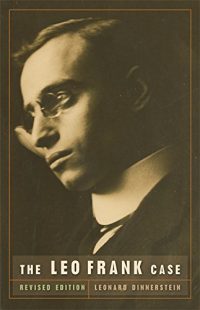
For nearly a half-century, the leading scholarly account of the incident had probably been Leonard Dinnerstein’s book The Leo Frank Case, first published in 1966, and Dinnerstein, a University of Arizona professor specializing in Jewish history, entirely supported Frank’s innocence. But although the work won a national award, carries glowing blurbs from several prestigious publications, and has surely graced the reading lists of endless college courses, I was not at all impressed. Among other things, the book appears to be the original source of some of the most lurid examples of alleged anti-Semitic public outbursts that apparently have no basis in reality and seem to have been simply fabricated by the author given his lack of any citations; the NOI authors note these stories have been quietly abandoned by all recent researchers. Even leaving aside such likely falsifications, which were widely cited by later writers and heavily contaminated the historical record, I found the short Dinnerstein work rather paltry and even pitiful when compared to that of its NOI counterpart.
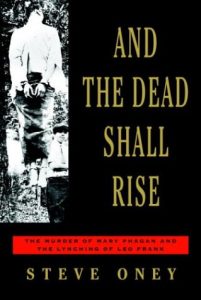
A far longer and more substantial recent work was Steve Oney’s 2003 And the Dead Shall Rise, which runs nearly 750 pages and won the National Jewish Book Award, the Southern Book Critics Circle Prize, and the American Bar Association’s Silver Gavel, probably establishing itself as today’s canonical text on the historical incident. Oney had been a longtime Atlanta journalist and I was favorably impressed by his narrative skill, along with the numerous fascinating vignettes he provided to illustrate the Southern history of that general era. He also seemed a cautious researcher, drawing heavily upon the primary sources and avoiding much of the falsified history of the last century, while not entirely suppressing the massive evidence of bribery and perjury employed by the Frank forces.
But although Oney does mention much of this information, he strangely fails to connect the dots. For example, although he occasionally mentions some of the funds spent on Frank’s behalf, he never attempts to convert them into present-day equivalents, leaving a naive reader to assume that such trivial amounts could not possibly have been used to pervert the course of justice. Furthermore, his entire book is written in chronological narrative form, with no footnotes provided in the text, and a large portion of the content being entirely extraneous to any attempt to determine Frank’s guilt or innocence, contrasting very sharply with the more scholarly style of the NOI authors.
To my mind, a central element of the Frank case was the massive financial temptations being offered by Frank’s Jewish backers, and the huge number of Atlanta citizens, both high and low, who apparently shifted their positions on Frank’s guilt in eager hopes of capturing some of that largess. But although this obvious theme was heavily emphasized in the NOI book, Oney seems to mostly avoid this obvious factor, perhaps even for personal reasons. Print publications have suffered massive cutbacks in recent years and I noticed on the book flap that although Oney is described as a longtime Atlanta journalist, he had subsequently relocated to Los Angeles. Once I checked, I immediately discovered that Oney’s book had became the basis for an independent film entitled The People v. Leo Frank, and I wonder whether his hopes of capturing a sliver of Hollywood’s vast lucre may not have encouraged him to so strongly suggest Frank’s innocence. Would an account of Leo Frank as rapist and murderer ever be likely to reach the silver screen? The quiet influence of financial considerations today is no different today than they were a century ago, and this factor must be taken into account when evaluating historical events.
The NOI authors devote nearly all of their lengthy book to a careful analysis of the Frank case provided in suitably dispassionate form, but a sense of their justifiable outrage does occasionally poke through. In the years prior to Frank’s killing, many thousands of black men throughout the South had been lynched, often based on a slender thread of suspicion, with few of these incidents receiving more than a few sentences of coverage in a local newspaper, and large numbers of whites had also perished in similar circumstances. Meanwhile, Frank had received benefit of the longest trial in modern Southern history, backed by the finest trial lawyers that money could buy, and based on overwhelming evidence had been sentenced to death for the rape and murder of a young girl. But when Frank’s legal verdict was carried out by extra-judicial means, he immediately became the most famous lynching victim in American history, perhaps even attracting more media attention than all those thousands of other cases combined. Jewish money and Jewish media established him as a Jewish martyr who thereby effectively usurped the victimhood of the enormous number of innocent blacks who were killed both before and after him, none of whom were ever even recognized as individuals.
As Prof. Shahak has effectively demonstrated, traditional Talmudic Judaism regarded all non-Jews as being sub-human, with their lives possessing no value. Given that Frank’s backers were all followers of Reform Judaism, it seems quite unlikely that they followed this doctrine or were even aware of its existence. But religious traditions of a thousand years standing can easily become embedded within a culture, and such unrecognized cultural sentiments may have easily shaped their reaction to Frank’s legal predicament.
Influential historical accounts of the Frank case and its aftermath have contained lurid tales of the rampant public anti-Semitism visited upon Atlanta’s Jewish community in the wake of the trial, even claiming that a substantial portion of the population was forced to flee as a consequence. However, a careful examination of the primary source evidence, including the contemporaneous newspaper coverage, provides absolutely no evidence of this, and it appears to be entirely fictional.
The NOI authors note that prior to Frank’s trial American history had been virtually devoid of any evidence of significant anti-Semitism, with the previous most notable incident being the case of an extremely wealthy Jewish financier who was refused service at a fancy resort hotel. But by totally distorting the Frank case and focusing such massive national media coverage on the case, Jewish leaders around the country succeeded in fabricating a powerful ideological narrative despite its lack of reality, perhaps intending it to serve as a bonding experience to foster Jewish community cohesion.
As a further example of the widely promoted but apparently fraudulent history, the Jewish writers who have overwhelmingly dominated accounts of the Frank case have frequently claimed that it sparked the revival of the Ku Klux Klan soon afterward, with the group of citizens responsible for Frank’s 1915 lynching supposedly serving as the inspiration for William Simmons’ reestablishment of that organization a couple of years later. But there seems no evidence for this. Indeed, Simmons strongly emphasized the philo-Semitic nature of his new organization, which attracted considerable Jewish membership.
The primary factor behind the rebirth of the KKK was almost certainly D.W. Griffith’s overwhelmingly popular landmark 1917 film Birth of a Nation, which glorified the Klan of the Reconstruction Era. Given that the American film industry was so overwhelmingly Jewish at the time and the film’s financial backers and leading Southern distributors came from that same background, it could be plausibly argued that the Jewish contribution to the creation of the 1920s Klan was a very crucial one, while the revenue from the film’s distribution throughout the South actually financed Sam Goldwyn’s creation of MGM, Hollywood’s leading studio.
In their introduction, the NOI authors make the fascinating point that the larger historical meaning of the Frank case in American racial history has been entirely lost. Prior to that trial, it was unprecedented for Southern courts to allow black testimony against a white man, let alone against a wealthy man being tried on serious charges; but the horrific nature of the crime and Conley’s role as the sole witness required a break from that longstanding tradition. Thus, the authors argue not unreasonably, that the Frank case may have been as important to the history of black progress in America as such landmark legal verdicts as Plessy vs. Ferguson or Brown vs. Board. But since almost the entire historical narrative has been produced by fervent Jewish advocates, these facts have been completely obscured and the case entirely misrepresented as an example of anti-Semitic persecution and public murder.
Let us now summarize what seems to be the solidly established factual history of the Frank case, quite different than the traditional narrative. There is not the slightest evidence that Frank’s Jewish background was a factor behind his arrest and conviction, nor the death sentence he received. The case set a remarkable precedent in Southern courtroom history with the testimony of a black man playing a central role in a white man’s conviction. From the earliest stages of the murder investigation, Frank and his allies continually attempted to implicate a series of different innocent blacks by planting false evidence and using bribes to solicit perjured testimony, while the exceptionally harsh racial rhetoric that Frank and his attorneys directed towards those blacks was presumably intended to provoke their public lynching. Yet despite all these attempts by the Frank forces to play upon the notorious racial sentiments of the white Southerners of that era, the latter saw through these schemes and Frank was the one sentenced to hang for his rape and murder of that young girl.
Now suppose that all the facts of this famous case were exactly unchanged except that Frank had been a white Gentile. Surely the trial would be ranked as one of the greatest racial turning points in American history, perhaps even overshadowing Brown v. Board because of the extent of popular sentiment, and it would have been given a central place in all our modern textbooks. Meanwhile, Frank, his lawyers, and his heavy financial backers would probably be cast as among the vilest racial villains in all of American history for their repeated attempts to foment the lynching of various innocent blacks so that a wealthy white rapist and murderer could walk free. But because Frank was Jewish rather than Christian, this remarkable history has been completely inverted for over one hundred years by our Jewish-dominated media and historiography.
These are the important consequences that derive from control of the narrative and the flow of information, which allows murderers to be transmuted into martyrs and villains into heroes. The ADL was founded just over a century ago with the central goal of preventing a Jewish rapist and killer from being held legally accountable for his crimes, and over the decades, it eventually metastasized into a secret political police force not entirely dissimilar to the widely despised East German Stasi, but with its central goal seeming to be the maintenance of overwhelming Jewish control in a society that is 98% non-Jewish.
We should ask ourselves whether it is appropriate for an organization with such origins and such recent history to be granted enormous influence over the distribution of information across our Internet.
Trump Administration Follows Corporate Media Playbook for War With Iran
By John C. O’Day | FAIR | October 4, 2018
Three years ago, as Americans debated the Joint Comprehensive Plan of Action (JCPOA) agreement with the Islamic Republic of Iran—popularly known as “the Iran deal”—I highlighted a troubling media trend on FAIR.org (8/20/15): “For nearly all commentators, regardless of their position, war is the only alternative to that position.”
In the months since US President Donald Trump tore up the JCPOA agreement, his administration has been trying to make good on corporate media’s collective prediction. Last week, John Bolton (BBC, 9/26/18), Trump’s national security advisor and chief warmonger, told Iran’s leaders and the world that there would be “hell to pay” if they dare to “cross us.”
That Bolton’s bellicose statements do not send shockwaves of pure horror across a debt-strapped and war-weary United States is thanks in large part to incessant priming for war, facilitated by corporate media across the entire political spectrum, with a particular focus on Iran.
Back in 2015, while current “resistance” stalwarts like the Washington Post (4/2/15) and Politico (8/11/15) warned us that war with Iran was the most likely alternative to the JCPOA, conservative standard-bearers such as Fox News (7/14/15) and the Washington Times (8/10/15) foretold that war with Iran was the agreement’s most likely outcome. Three years hence, this dynamic has not changed.
To experience the full menu of US media’s single-mindedness about Iran, one need only buy a subscription to the New York Times. After Trump withdrew from the JCPOA, the Times’ editorial board (5/8/18) wrote that his move would “lay conditions for a possible wider war in the Middle East.” Susan Rice (New York Times, 5/8/18), President Barack Obama’s national security advisor, agreed: “We could face the choice of going to war or acquiescing to a nuclear-armed Iran,” she warned. Cartoonist Patrick Chappatte (New York Times, 5/10/18) was characteristically more direct, penning an image of Trump alongside Bolton, holding a fictitious new agreement featuring the singular, ultimate word: “WAR.”
On the other hand, calling Trump’s turn against JCPOA a “courageous decision,” Times columnist Bret Stephens (5/8/18) explained that the move was meant to force the Iranian government to make a choice: Either accede to US demands or “pursue their nuclear ambitions at the cost of economic ruin and possible war.” (Hardly courageous, when we all know there is no chance that Trump or Stephens would enlist should war materialize.)
Trump’s latest antics at the United Nations have spurred a wave of similar reaction across corporate media. Describing his threat to “totally destroy North Korea” at the UN General Assembly last year as “pointed and sharp,” Fox News anchor Eric Shawn (9/23/18) asked Bill Richardson, an Obama ally and President Bill Clinton’s ambassador to the UN, whether Trump would take the same approach toward Iran. “That aggressive policy we have with Iran is going to continue,” Richardson reassured the audience, “and I don’t think Iran is helping themselves.” In other words, if the United States starts a war with Iran, it’s totally Iran’s fault.
Politico (9/23/18), meanwhile, reported that Trump “is risking a potential war with Iran unless he engages the Islamist-led country using diplomacy.” In other words, if the United States starts a war with Iran, it’s totally Trump’s fault. Rice (New York Times, 9/26/18) reiterated her view that Trump’s rhetoric “presages the prospect of war in the Persian Gulf.” Whoever would be the responsible party is up for debate, but that war is in our future is apparently all but certain.
Politico’s article cited a statement signed by such esteemed US experts on war-making as Madeleine Albright, who presided over Clinton’s inhuman sanctions against Iraq in the ’90s, and Ryan Crocker, former ambassador for presidents George W. Bush and Obama to some of America’s favorite killing fields: Iraq, Afghanistan, Pakistan and Syria. James Clapper, Obama’s National Intelligence Director, who also signed the letter, played an important role in trumping up WMD evidence against Saddam Hussein before the United States invaded Iraq in 2003. When it comes to US aggression, they’re the experts.
Vanity Fair (9/26/18) interviewed John Glaser of the Cato Institute, who called Trump’s strategy “pathetic,” and also warned that it forebodes war. In an effort to “one-up Obama,” Glaser explained, Trump’s plan is “to apply extreme economic pressure and explicit threats of war in order to get Iran to capitulate.” Sound familiar? As Glaser implies, this was exactly Obama’s strategy, only then it wasn’t seen as “pathetic,” but rather reasonable, and the sole means for preventing the war that every US pundit and politician saw around the corner (The Hill, 8/9/15).
When everyone decides that war is the only other possibility, it starts to look like an inevitability. But even when they aren’t overtly stoking war fever against Iran, corporate media prime the militaristic pump in more subtle yet equally disturbing ways.

Netanyahu speaks for the Iranian people on CNN (9/29/18)
First among these is the near-complete erasure of Iranian voices from US airwaves (FAIR.org, 7/24/15). Rather than ask Iranians directly, national outlets like CNN (9/29/18) prefer to invite the prime minister of Israel, serial Iran alarmist and regional pariah Benjamin Netanyahu, to speak for them. During a jovial discussion this weekend over whether regime change and/or economic collapse is Iran’s most likely fate, Netanyahu explained to the audience that, either way, “The ones who will be happiest if that happens are the people of Iran.” No people of Iran were on hand to confirm or deny this assessment.
Bloomberg (9/30/18) similarly wanted to know, “What’s not to like about Trump’s Iran oil sanctions?” Julian Lee gleefully reported that “they are crippling exports from the Islamic Republic, at minimal cost to the US.” One might think the toll sanctions take on innocent Iranians would be something not to like, but Bloomberg merely worried that, notwithstanding the windfall for US refineries, “oil at $100 a barrel would be bad news for drivers everywhere—including those in the US.” [$500,000,000 increase in gas costs, daily, just for Americans]
Another prized tactic is to whitewash Saudi Arabia, Iran’s chief geopolitical rival, whose genocidal destruction of Yemen is made possible by the United States, about which corporate media remain overwhelmingly silent (FAIR.org, 7/23/18). Iran’s involvement in Yemen, which both Trump and the New York Times (9/12/18) describe as “malign behavior,” is a principal justification for US support of Saudi Arabia, including the US-supplied bombs that recently ended the brief lives of over 40 Yemeni schoolchildren. Lockheed Martin’s stock is up 34 percent from Trump’s inauguration day.
Corporate media go beyond a simple coverup of Saudi crimes to evangelize their leadership as the liberal antidote to Iran’s “theocracy.” Who can forget Thomas Friedman’s revolting puff piece for the Saudi crown prince Mohammad bin Salman? Extensively quoting Salman (New York Times, 11/23/17), who refers to Iranian Ayatollah Ali Khamenei as “the new Hitler of the Middle East,” Friedman nevertheless remains pessimistic about whether “MBS and his team” can see their stand against Iran through, as “dysfunction and rivalries within the Sunni Arab world generally have prevented forming a unified front.” Oh well, every team needs cheerleaders, and Friedman isn’t just a fair-weather fan.
While Friedman (New York Times, 5/15/18) believes that Trump has drawn “some needed attention to Iran’s bad behavior,” for him pivotal questions remain unanswered, such as “who is going to take over in Tehran if the current Islamic regime collapses?” One immediate fix he proposed was to censure Iran’s metaphorical “occupation” of Syria, Iraq and Lebanon. Isn’t this ironic coming from an unapologetic propagandist for Washington’s decades-long, non-metaphorical occupation of the two countries to the east and west of Iran? (FAIR.org, 12/9/15)
In a surprising break from corporate media convention, USA Today (9/26/18) published a column on US/Iran relations written by an actual Iranian. Reflecting on the CIA-orchestrated coup against Iran’s elected government in 1953, Azadeh Shahshahani, who was born four days after the 1979 revolution there, wrote:
I often wonder what would have happened if that coup had not worked, if [Prime Minister] Mosaddeq had been allowed to govern, if democracy had been allowed to flourish.
“It is time for the US government to stop intervening in Iran and let the Iranian people determine their own destiny,” she beseeched readers.
Shahshahani’s call is supported by some who have rejected corporate media’s war propaganda and have gone to extreme lengths to have their perspectives heard. Anti-war activist and Code Pink founder Medea Benjamin was recently forcibly removed after she upstaged Brian Hook, leader of Trump’s Iran Action Group, on live TV, calling his press conference “the most ridiculous thing I have ever seen” (Real News, 9/21/18). Benjamin implored the audience: “Let’s talk about Saudi Arabia. Is that who our allies are?”
“How dare you bring up the issue of Yemen,” admonished Benjamin as she was dragged from the room. “It’s the Saudi bombing that is killing most people in Yemen. So let’s get real. No more war! Peace with Iran!” Code Pink is currently petitioning the New York Times and Washington Post to stop propagandizing war.
Sadly, no matter whom you ask in corporate media, be they spokespeople for “Trump’s America” or “the resistance,” peace remains an elusive choice in the US political imagination. And while the public was focused last week on Supreme Court nominee Brett Kavanaugh’s perjurious testimony, the Senate finalized a $674 billion “defense” budget. Every single Democrat in the chamber voted in favor of the bill, explicitly naming Iran as persona non grata in the United States’ world-leading arms supply network, which has seen a 25 percent increase in exports since Obama took office in 2009.
The US government’s imperial ambitions are perhaps its only truly bipartisan project—what the New York Times euphemistically refers to as “globalism.” Nowhere was this on fuller display than at the funeral for Republican Sen. John McCain (FAIR.org, 9/11/18), where politicians of all stripes were tripping over themselves to produce the best accolades for a man who infamously sang “bomb bomb bomb, bomb bomb Iran” to the tune of a Beach Boys song.
McCain’s bloodlust was nothing new. Nearly a hundred years ago, after the West’s imperial competition culminated in the most destructive war the world had ever seen, the brilliant American sociologist and anti-colonial author WEB Du Bois wrote, “This is not Europe gone mad; this is not aberration nor insanity; this is Europe.”
Iranian leaders have repeatedly said they do not want war with the US (AP, 9/27/18), but US corporate media, despite frequently characterizing Trump as a “mad king” (FAIR.org, 6/13/18), continue to play an instrumental role in rationalizing a future war with Iran. Should such an intentional catastrophe come to pass, we can hardly say that this would be America gone mad; war is not aberration, it is always presented as the next sane choice. This is America.
The New York Times as Judge and Jury
By Joe Lauria • Consortium News • September 21, 2018
We’ve seen it before: a newspaper and individual reporters get a story horribly wrong but instead of correcting it they double down to protect their reputations and credibility—which is all journalists have to go on—and the public suffers.
Sometimes this maneuver can contribute to a massive loss of life. The most egregious example was the reporting in the lead-up to the invasion of Iraq. Like nearly all Establishment media, The New York Times got the story of Iraq’s weapons of mass destruction—the major casus belli for the invasion—dead wrong. But the Times, like the others, continued publishing stories without challenging their sources in authority, mostly unnamed, who were pushing for war.
The result was a disastrous intervention that led to hundreds of thousands of civilian deaths and continued instability in Iraq, including the formation of the Islamic State.
In a massive Times‘ article published on Thursday, entitled, “‘A Plot to Subvert an Election: Unravelling the Russia Story So Far,” it seems that reporters Scott Shane and Mark Mazzetti have succumbed to the same thinking that doubled down on Iraq.
They claim to have a “mountain of evidence” but what they offer would be invisible on the Great Plains.
With the mid-terms looming and Special Counsel Robert Mueller unable to so far come up with any proof of collusion between Russia and the Trump campaign to steal the 2016 election—the central Russia-gate charge—the Times does it for him, regurgitating a Russia-gate Round-Up of every unsubstantiated allegation that has been made—deceptively presented as though it’s all been proven.
This is a reaffirmation of the faith, a recitation of what the Russia-gate faithful want to believe is true. But mere repetition will not make it so.
The Times’ unsteady conviction is summed up in this paragraph, which the paper itself then undermines only a few paragraphs later:
“What we now know with certainty: The Russians carried out a landmark intervention that will be examined for decades to come. Acting on the personal animus of Mr. Putin, public and private instruments of Russian power moved with daring and skill to harness the currents of American politics. Well-connected Russians worked aggressively to recruit or influence people inside the Trump campaign.”
But this schizoid approach leads to the admission that “no public evidence has emerged showing that [Trump’s] campaign conspired with Russia.”
The Times also adds: “There is a plausible case that Mr. Putin succeeded in delivering the presidency to his admirer, Mr. Trump, though it cannot be proved or disproved.”
This is an extraordinary statement. If it cannot be “proved or disproved” what is the point of this entire exercise: of the Mueller probe, the House and Senate investigations and even of this very New York Times article?
Probing to prove this constructed story without proof is the very point of this piece.
A Banner Day
The 10,000-word article opens with a story of a pro-Russian banner that was hung from the Manhattan Bridge on Putin’s birthday, and an anti-Obama banner hung a month later from the Memorial Bridge in Washington just after the 2016 election.
On public property these are constitutionally-protected acts of free speech. But for the Times, “The Kremlin, it appeared, had reached onto United States soil in New York and Washington. The banners may well have been intended as visual victory laps for the most effective foreign interference in an American election in history.”
Why? Because the Times tells us that the “earliest promoters” of images of the banners were from social media accounts linked to a St. Petersburg-based click-bait farm, a company called the Internet Research Agency. The company is not legally connected to the Kremlin and any political coordination is pure speculation. IRA has been explained convincingly as a commercial and not political operation. Its aim is get and sell “eyeballs.”
For instance the company conducted pro and anti-Trump rallies and social media messages, as well as pro and anti-Clinton. But the Times, in classic omission mode, only reports on “the anti-Clinton, pro-Trump messages shared with millions of voters by Russia.” Sharing with “millions” of people on social media does not mean that millions of people have actually seen those messages. And if they had there is little way to determine whether it affected how they voted, especially as the messages attacked and praised both candidates.
The Times reporters take much at face value, which they then themselves undermine. Most prominently, they willfully mistake a an indictment for a conviction, as if they do not know the difference.
This is in the category of Journalism 101. An indictment need not include evidence and under U.S. law an indictment is not evidence. Juries are instructed that an indictment is merely an accusation. That the Times commits this cardinal sin of journalism to purposely confuse allegations with a conviction is not only inexcusable but strikes a fatal blow to credibility of the entire article.
It actually reports that “Today there is no doubt who hacked the D.N.C. and the Clinton campaign. A detailed indictment of 12 officers of Russia’s military intelligence agency, filed in July by Mr. Mueller, documents their every move, including their break-in techniques, their tricks to hide inside the Democrats’ networks and even their Google searches.”
Who needs courts when suspects can be tried and convicted in the press?
What the Times is not taking into account is that Mueller knows his indictment will never be tested in court because the GRU agents will never be arrested, there is no extradition treaty between the U.S. and Russia and even if it were miraculously to see the inside of a courtroom Mueller can invoke states secrets privilege to show the “evidence” to a judge with clearance in his chambers who can then emerge to pronounce “Guilty!” without a jury having seen that evidence.
This is what makes Mueller’s indictment more a political than a legal document, giving him wide leeway to put whatever he wants into it. He knew it would never be tested and that once it was released, a supine press would do the rest to cement it in the public consciousness as a conviction, just as this Times piece tries to do.
Errors of Commission and Omission
There are a series of erroneous assertions and omissions in the Times piece:
–Not mentioning that the FBI was never given access to the DNC server but instead gullibly believing the assertion of the anti-Russian private company CrowdStrike, paid for by the DNC, that the name of the first Soviet intelligence chief found in metadata proves Russia was behind the hack. Only someone wanting to be caught would leave such a clue.
–Incredibly believing that Trump would have launched a covert intelligence operation on live national television by asking Russia to get 30,000 missing emails.
–Ignoring the possible role of the MI6, the CIA and the FBI setting up Trump campaign members George Papadopoulos and Carter Page as “colluders” with Russia.
–Repeating misleading statements about the infamous Trump Tower meeting, in which Trump’s son did not seek dirt on Clinton but was offered it by a music promoter, not the Russian government. None was apparently produced. It’s never been established that a campaign receiving opposition research from foreigners is illegal (though the Times has decided that it is) and only the Clinton campaign was known to have obtained any.
–Making no mention at all of the now discredited opposition research dossier paid for by the Clinton campaign and the DNC from foreign sources and used by the FBI to get a warrant to spy on Carter Page and potentially other campaign members.
–Dismissing the importance of politicized text messages between FBI agents Peter Strzok and Lisa Page because the pair were “skewered regularly on Mr. (Sean) Hannity’s show as the ‘Trump-hating F.B.I. lovebirds.’”
–Putting down to “hyped news stories” the legitimate fear of a new McCarthyism against anyone who questions the “official” story being peddled here by the Times.
–Seeking to get inside Putin’s head to portray him as a petulant child seeking personal revenge against Hillary Clinton, a tale long peddled by Clinton and accepted without reservation by the Times.
–Pretending to get into Julian Assange’s head as well, saying he “shared Mr. Putin’s hatred of Mrs. Clinton and had a soft spot for Russia.” And that Assange “also obscured the Russian role by fueling a right-wing conspiracy theory he knew to be false.”
–Ignoring findings backed by the Veteran’s Intelligence Professionals for Sanity that the DNC emails were leaked and not hacked.
–Erroneously linking the timing of WikiLeaks’ Podesta emails to deflect attention from the “Access Hollywood” tape, as debunked in Consortium News by Italian journalist Stefania Maurizi, who worked with WikiLeaks on those emails.
Distorts Geo-Politics
The piece swallows whole the Establishment’s geo-strategic Russia narrative, as all corporate media do. It buys without hesitation the story that the U.S. seeks to spread democracy around the world, and not pursue its economic and geo-strategic interests as do all imperial powers.
The Times reports that, “The United States had backed democratic, anti-Russian forces in the so-called color revolutions on Russia’s borders, in Georgia in 2003 and Ukraine in 2004.” The Times has also spread the erroneous story of a democratic revolution in Ukraine in 2014, omitting crucial evidence of a U.S.-backed coup.
The Times disapprovingly dismisses Trump having said on the campaign trail that “Russia was not an existential threat, but a potential ally in beating back terrorist groups,” when an objective view of the world would come to this very conclusion.
The story also dismisses American voters’ real concerns that led to Trump’s election. For the Times, economic grievances and rejection of perpetual war played no role in the election of Trump. Instead it was Russian influence that led Americans to vote for him, an absurd proposition defied by a Gallup poll in July that showed Americans’ greatest concerns being economic. Their concerns about Russia were statistically insignificant at less than one percent.
Dismissing Americans’ real concerns exposes the class interests of Times staffers and editors who are evidently above Americans’ economic and social suffering.
Establishment reporters insulate themselves from criticism by retreating into the exclusive Establishment club they think they inhabit. It is from there that they vicariously draw their strength from powerful people they cover, which they should instead be scrutinizing. Validated by being close to power, Establishment reporters don’t take seriously anyone outside of the club, such as a website like Consortium News.
But on rare occasions they are forced to take note of what outsiders are saying. Because of the role The New York Times played in the catastrophe of Iraq its editors took the highly unusual move of apologizing to its readers. Will we one day read a similar apology about the paper’s coverage of Russia-gate?
Joe Lauria is editor-in-chief of Consortium News and a former correspondent for The Wall Street Journal, Boston Globe, Sunday Times of London and numerous other newspapers. He can be reached at joelauria@consortiumnews.com and followed on Twitter @unjoe .
Alabama debunks the Times’ story about our warming world
Fabius Maximus website | September 19, 2018
Summary: The NY Times gives a story with bold numbers, confidently stated. Too bad their fact-checkers did not notice that their numbers are grossly misleading. Propaganda pretending to be science. This does not help, even if well-intended. The State Climatologist of Alabama tells the real story.
The Alabama Climate Report, August 2018.
By John R. Christy, Alabama State Climatologist.
Also Professor of Atmospheric Science and Director of the Earth System Science Center
at the U of AL in Huntsville. Links added.
Meteorological summer (June, July and August) is over. It is time to check how the summer temperatures compare with other years. For a research project a few years ago we developed a statewide summer temperature index for four 100-mile diameter regions centered on the major cities of the state – Mobile, Montgomery, Birmingham and Huntsville – going back to 1883. This summer will go down in that database and in NOAA’s official records as being slightly cooler than average.
Somewhat related to this, a reader sent me a link to a New York Times interactive website that claims to provide the number of days above 90°F each year for cities across the country: “How Much Hotter Is Your Hometown Than When You Were Born?” The results are produced for the Times by Climate Impact Lab (some might call it an environmental pressure group).
Since I build numerous datasets of this type, I took a look. The website asks you for the town and year in which you were born, then provides a time series purportedly showing the number of 90°F days per year since your birth and how that has increased.
Though a native of California, I have lived in Huntsville more years than any other place, so I put in my birth year and Huntsville as my hometown. Immediately I became suspicious when their dataset started only recently in 1960 (and a few years after my birth). …
For Huntsville and Montgomery, here are their results. Quite scary. It appears that the number of 90°F days has risen to their highest levels ever. It says that in 1960 Huntsville had 45 days above 90°F, but by 2017 it was 57 days and rising.
Huntsville, Alabama.

Montgomery, Alabama.

Then, to make matters even scarier, they use climate model projections to 2090 to tell me that in 2040, when I’m 80, there will be 73 such hot days in Huntsville (as shown below). Yikes!
Huntsville’s future per RCP4.5!

Editor’s note – From the NYT website.
“For each year, the count of days at or above 90 degrees reflects a 21-year rolling average. Temperature observations for your hometown are averaged over an area of approximately 625 km² (240 square miles), and may not match single weather-station records.
“The time series is based on historical data for 1960-2000. The 2001-2020 period relies on a combination of historical data and future projections. After 2020, the data uses a mixed climate model that captures a broad range of extreme temperature responses. The “likely” future range reflects outcomes with 66 percent probability of occurrence in the RCP 4.5 scenario.”
The rest of the story
Before you sell your house and move to Canada, let’s take a look at the real story. Having built many climate datasets of Alabama, some starting as early as 1850, I knew the Times story was designed to create alarm and promote the claim that humans who use carbon-based energy (gasoline, natural gas, coal) to help them live better lives are making our summers ever more miserable. Be aware reader, this webtool is not designed to provide accurate information.
First of all, climate data for Alabama began in the 19th century, not 1960. In 2016 Dr. Richard McNider (Alabama’s former State Climatologist) and I published a carefully constructed time series of summer temperatures for the state starting from 1883. This used numerous station records, including some that the federal government had not archived into its databases (which are the most common source for outfits like the Climate Impacts Lab.)
“Time Series Construction of Summer Surface Temperatures for Alabama, 1883–2014, and Comparisons with Tropospheric Temperature and Climate Model Simulations” in the Journal of Applied Meteorology and Climatology, March 2016.
I’ve updated that work to include summer temperatures through 2018. The result is below. Not only are summer daytime temperatures not rising, they have actually fallen over the last 136 years. After looking at the graph, why do you suppose the Climate Impacts Lab decided to start their charts in 1960?
We went a step further in that paper and demonstrated that climate models failed completely to replicate the downward temperature trend in Alabama over the past 120 years: 76 different models with a 100% failure rate. Would you trust these same models to tell you about the future as the Times does? Why did they not check the models for validity?
Now, what about the number of “hot” (or in Alabama we would say “typical”) 90°F days? For Alabama and the nation, I’ve calculated the average value per station each year since 1895. The results below speak for themselves (there is no increase of days hotter than 90°F) and expose the misinformation provided through the Times.


Providing accurate information on Alabama’s climate is what we do in our office. In fact, using real data, I can’t even come close to reproducing the images that the Climate Impacts Lab did which show 2010’s as having the most 90°F days in Alabama. I’m guessing they are using some theoretical output rather than sticking with observations. …I’ll check and follow-up as I can, but something is fishy.
This is a great state in which people can enjoy life and in which businesses can operate. Our climate resources are one of the reasons we are doing so well in recruitment. Occasionally though the time comes when I must address claims made by those whose intention is not to inform but to promote false alarm. This usually happens when an environmental pressure group generates a press release whose dramatic statements are published by a willing media (without any fact-checking). This is one of those times, and I’m sure it will not be the last.
Dr. John R. Christy is the Distinguished Professor of Atmospheric Science and Director of the Earth System Science Center at the University of Alabama in Huntsville. Since November 2000 he has been Alabama’s State Climatologist. See his bio at the U of AL website (from which this bio was taken).
In 1989 Dr. Roy W. Spencer (then a NASA scientist, now a Principle Research Scientist at UAH) and Christy developed a global temperature data set from microwave data observed from satellites beginning in 1979. For this achievement, the Spencer-Christy team was awarded NASA’s Medal for Exceptional Scientific Achievement in 1991. In 1996, they received a Special Award by the American Meteorological Society “for developing a global, precise record of earth’s temperature from operational polar-orbiting satellites, fundamentally advancing our ability to monitor climate.” In January 2002 Christy was inducted as a Fellow of the American Meteorological Society.
Dr. Christy has served as a Contributor (1992, 1994, 1996 and 2007) and Lead Author (2001) for the U.N. reports by the IPCC in which the satellite temperatures were included as a high-quality data set for studying global climate change. He has served on five National Research Council panels or committees, has performed research funded by NASA, NOAA, DOE, DOT and the State of Alabama, and has testified 18 times for congressional committees.
His papers have been published in many journals, including Science, Nature, Journal of Climate, and The Journal of Geophysical Research. See the list here (with links).
New York Times’ fraudulent “election plot” dossier escalates anti-Russia hysteria
By Bill Van Auken | WSWS | September 21, 2018
The New York Times published a fraudulent and provocative “special report” Thursday titled “The plot to subvert an election.”
Replete with sinister looking graphics portraying Russian President Vladimir Putin as a villainous cyberage cyclops, the report purports to untangle “the threads of the most effective foreign campaign in history to disrupt and influence an American election.”
The report could serve as a textbook example of CIA-directed misinformation posing as “in-depth” journalism. There is no news, few substantiated facts and no significant analysis presented in the 10,000-word report, which sprawls over 11 ad-free pages of a separate section produced by the Times.
The article begins with an ominous-sounding recounting of two incidents in which banners were hung from bridges in New York City and Washington in October and November of 2016, one bearing the likeness of Putin over a Russian flag with the word “peacemaker,” and the other that of Obama and the slogan “Goodbye Murderer.”
It acknowledges that “police never identified who had hung the banners,” but nonetheless goes on to assert that: “The Kremlin, it appeared, had reached onto United States soil in New York and Washington. The banners may well have been intended as visual victory laps for the most effective foreign interference in an American election in history.”
Why does it “appear” to be the Kremlin? What is the evidence to support this claim? Among the 8.5 million inhabitants of New York City and another 700,000 in Washington, D.C., aren’t there enough people who might despise Obama as much as, if not a good deal more than, Vladimir Putin?
This absurd passage with its “appeared” and “may well have” combined with the speculation about the Kremlin extending its evil grip onto “United States soil” sets the tone for the entire piece, which consists of the regurgitation of unsubstantiated allegations made by the US intelligence agencies, Democratic and Republican capitalist politicians and the Times itself.
The authors, Scott Shane and Mark Mazzetti, complain about a lack of “public comprehension” of the “Trump-Russia” story. Indeed, despite the two-year campaign of anti-Russian hysteria whipped up in Washington and among the affluent sections of the upper-middle class that constitute the target audience of the Times, polls have indicated that the charges of Russian “meddling” in the 2016 presidential election have evoked little popular response among the broad masses of the American population.
The “special report” attempts to remedy this problem by ginning up the meddling allegations, claiming that the Kremlin staged a “stealth cyberage Pearl Harbor” against the United States and succeeded in “hijacking” both “American companies like Facebook and Twitter” and “American citizens’ feelings about immigration and race.”
The reporting is all couched in “maybes” and “appears,” with the claim made that “there is a plausible case that Mr. Putin succeeded in delivering the presidency to his admirer, Mr. Trump, though it cannot be proved or disproved.” In other words, the Times’ reporters cannot substantiate their claims.
Mazzetti and Shane strain to portray the actions of Putin, assuming for the sake of argument that he was the mastermind behind the Facebook postings, as something uniquely horrible in the annals of international relations.
But as is well known, the US spends tens of billions of dollars every year to influence foreign elections, subvert governments viewed as obstacles to US interests and buy politicians, intellectuals and other agents of influence. It has backed coups and waged direct wars to effect regime change. Many of these coups have been supported by the New York Times. Many of its reporters collaborate with US intelligence agencies and dish up the propaganda required to advance the international interests of the United States.
There is not a country in the world whose political system has not been targeted by the United States. This includes Russia and the former Soviet republics, where it has carried out continuous regime-change operations, while extending the NATO military alliance across vast swaths of territory and spheres of influence vacated by the Soviet Union, deploying US-led armed forces right to Russia’s borders, in contravention of agreements reached between Washington and Moscow at the time of the Stalinist bureaucracy’s dissolution of the USSR.
This is passed over lightly by the Times special report, which presents the alleged Russian “meddling” as all a product of Putin’s personal grudges against President Barack Obama and Democratic presidential candidate Hillary Clinton.
In the context of US global operations, what the Times article alleges, even if it were all true, amounts to less than a hill of beans.
It claims that Russian “trolls, hackers and agents” assigned to influence the 2016 US election “totaled barely 100.” Their task, it states, was “to steer millions of American voters” and “sabotage an election.”
To that end, the article states, Russians allegedly spent $100,000 on Facebook ads, “a trivial sum compared with the tens of millions spent on Facebook by both the Trump and Clinton campaigns.” Far less than trivial compared to the nearly $7 billion spent on all US federal elections in 2016.
The ads, the Times claims, were directed at “sowing division” in the American body politic, as if the US was not already a country torn by the deepest social inequality of any of the so-called advanced capitalist countries, with a population seething with anger over declining living standards for the masses of the working population, while a financial and corporate oligarchy has registered the biggest income gains in history.
The article refers to a handful of demonstrations allegedly promoted by Russian Facebook ads that attracted a few dozen people as evidence that Moscow’s “trolls” could act as “puppet masters for unsuspecting Americans.” One only need compare this to Washington’s spending of what former State Department official Victoria Nuland acknowledged was $5 billion to promote an armed fascist-led coup that toppled a pro-Russian government in Ukraine in 2014.
The most sinister side of the Times report is its indictment of WikiLeaks and its founder and editor Julian Assange for the leaking of emails of the Democratic National Committee (DNC) and Clinton campaign chairman John Podesta. The emails laid bare the DNC’s rigging of the primaries in favor of Clinton against Bernie Sanders and made public the texts of slavish and well-paid speeches given by Clinton to Wall Street audiences, guaranteeing she would defend their interests and making clear her readiness to escalate the war in Syria and bomb Iran.
The Times report complains that Clinton’s self-damning words were “taken out of context” and “subjected to the most damaging interpretation.”
The report paints Assange as either a witting or unwitting agent of the Kremlin at a moment in which the WikiLeaks founder is facing imminent threat of losing his refuge in the Ecuadorian embassy in London followed by arrest and extradition to the US to stand trial for treason and espionage.
Also resurrected in the report is the neo-McCarthyite vilification of Jill Stein, the Green Party’s presidential candidate in 2016. “The Russian operation also boosted” her candidacy, the Times claims, in order “to draw votes from Mrs. Clinton.”
The political thrust of the “special report” is clear. It is aimed at criminalizing domestic dissent, delegitimizing and suppressing any opposition to the political monopoly exercised by the capitalist two-party system and outlawing the use of the internet to report any news or express any opinions that have not first been vetted by “authoritative sources” like the CIA-embedded stenographers of the Times .
Mazzetti and Shane are Times national security correspondents. In an accompanying piece posted on the newspaper’s website, they claim that their “special report” was modelled upon two special issues of the Times magazine section published in July 1973 and the following January detailing the background and development of the Watergate scandal that ultimately brought down the Nixon presidency.
While they may be attempting to signal that their reporting could bring down Trump, the comparison is as ludicrous as it is self-serving. The pieces produced by the Times 45 years ago provided cogent political analysis that served to at least partially expose the crimes and conspiracies of the US government. They came just three years after the newspaper had defied the Nixon administration in publishing the Pentagon Papers—leaked to the paper by Daniel Ellsberg—exposing the lies and crimes associated with the US war in Vietnam.
Mazzetti and Shane have produced a poorly written propaganda potboiler, parroting the unsubstantiated allegations of US intelligence agencies and making the case for the criminal prosecution of Julian Assange for exposing similar crimes.
Mazzetti is notorious for his secretly passing to the CIA in 2011—prior to publication—a piece written by Times columnist Maureen Dowd, along with a note reading, “this didn’t come from me … and please delete after you read.”
Shane was the author of a 2012 article titled “The moral case for drones,” which attempted to justify the assassination program being run out of the White House that claimed the lives of thousands in Pakistan, Afghanistan, Yemen and elsewhere.
The authors are, to put it bluntly, a pair of broken-down hacks, embedded with the US military and intelligence apparatus and held in contempt by serious journalists.
Their “special report” expresses the thoroughgoing repudiation of any democratic principles by the Times and the rest of the major media, which have adopted the role of guarantors of state secrecy and apologists for war and political repression.
U.S. Perversity on Peace in Korea
By Jacob G. Hornberger | FFF | September 19, 2018
Just when you think that the U.S. national-security state’s policy toward Korea can’t get more perverse, it does. The latest perversion? Opposing a peace agreement between North Korea and South Korea! Imagine that. And why would U.S. officials oppose such an agreement? Because it would inevitably lead to calls for U.S. troops in Korea to be sent packing home to the United States. After all, when a peace agreement is entered into, what would be the justification for keeping U.S. troops in that faraway land?
Don’t believe me? Well, take if from the New York Times, one of the most mainstream papers in the country:
President Moon Jae-in of South Korea arrived in Pyongyang Tuesday for his third summit with Kim Jong-un, North Korea’s leader, to work toward a common goal: fashioning a political statement this year declaring the end of the Korean War. Such a declaration, although not a legally binding treaty, could carry far-reaching repercussions, helping North Korea escalate its campaign for the withdrawal of American troops from the South, analysts said. For that and other reasons, the United States has strong reservations about such a breakthrough.
Why the strong reservations? Wouldn’t you think that U.S. officials would be ecstatic about the prospect of peace in Korea? Wouldn’t you expect that to be the response of any rational person?
Not for a regime that has come to view Korea as a constant flashpoint to keep people on edge and afraid, thereby assuring ever-increasing budgets for the Pentagon, the CIA, the NSA, and their army of contractors and sub-contractors. And not for a regime that has come to view Korea as a place that permanently bases tens of thousands of U.S. troops. And not for a regime that continues to target the North Korean regime for regime change.
A peace agreement between the two Koreas would threaten all of those things. Suddenly, the national-security state would lose one its principal flashpoints for crisis and fear, one that it has relied on since at least 1950. It would also mean having to bring all those troops home and trying to figure out what to do with them. And it would mean giving up its dream of regime change, at least through military force.
That’s why U.S. officials are so concerned about the ongoing improvement in relations between North and South Korea and the possibility that the two countries could enter into a peace agreement.
South Korean president Moon Jae-in and North Korea’s leader Kim Jong-un continue their efforts to improve relations between their two countries. They are currently holding their third summit, with Kim visiting Pyongyang, North Korea’s capital, for the first time ever. Kim was met by huge throngs of people, organized of course by the North Korean regime, cheering for Kim, waving flowers, and chanting “reunification of the fatherland.”
Left out of these negotiations are U.S. officials. But so what? Korea belongs to the Koreans, not to the Pentagon or the CIA. It’s their civil war, a civil war that the Pentagon and the CIA butted into more than 60 years ago, and without the constitutionally required congressional declaration of war. Koreans don’t need the permission of U.S. officials to resolve their war and their differences.
What is concerning U.S. officials is that the two leaders might reach an agreement that doesn’t involve “denuclearization” by North Korea. But the only reason that North Korea has nuclear weapons is to deter the Pentagon and the CIA from attacking and invading North Korea for the purpose of regime change. With no regime-change attack by the United States, North Korea’s nukes become irrelevant.
But there’s the rub: The Pentagon and the CIA refuse to give up their goal of regime change in North Korea. They don’t want U.S. troops to come home. They want to keep them in South Korea forever (just like they want to keep their wars in the Middle East and Afghanistan, their war on terrorism, and their war on drugs going on forever). In that way, there is always the chance that North Korea can be provoked into committing some provocative act that could serve as an excuse for bombing and destroying North Korea’s communist, anti-U.S. regime and replacing it with a pro-U.S. puppet regime.
Meanwhile, trying their best to ratchet up tensions and forcing North Korea to “denuclearize,” U.S. officials are doing everything they can to fortify their brutal systems of economic sanctions on the North Korea people, even lashing out against everyone they suspect is violating the sanctions, like Russia. They have to keep those North Korea citizens starving to death so that their public officials finally “denuclearize.”
In another perversity, South Koreans are being warned against violating U.S. sanctions by entering into mutually beneficial economic transactions with the North, such as working together to operate a passenger rail line between the two countries.
The best thing South Koreans could ever do for themselves and the American people would be to boot all U.S. troops out of their country, whether South and North arrive at a peace agreement or not. Korea remains no business of the Pentagon and the CIA. But at least the American people are getting to see the real truth about the U.S. national-security state and its perverse and destructive policies.
Why Is Assad An Insane Suicidal Monster? – #PropagandaWatch
corbettreport | September 17, 2018
As we know from the political puppets and their mouthpieces in the controlled corporate media, Syrian President Basher al-Assad is a bloodthirsty monster responsible for the wanton slaughter of (fill in the number) of his own citizens, and he particularly enjoys dropping chemical weapons on women and children despite knowing that this is the one thing that will bring him universal condemnation and ensure a full-scale assault on his country. . . But why? Why is he such a monster? That is the question, and the New York Times offers its own helpful explainer with predictably comic results. Don’t miss this edition of #PropagandaWatch from The Corbett Report.
SHOW NOTES: https://www.corbettreport.com/?p=28173
The New York Times Editorial Opposing Military Intervention in Venezuela May Do More Harm Than Good
By Steve Ellner – Venezuelanalysis – September 13, 2018
There is a growing body of pro-establishment statements opposing the possibility of U.S. military intervention in Venezuela. The latest expression of this position is a New York Times editorial titled “Stay Out of Venezuela, Mr. Trump” published on September 11. At first glance the editorial is a welcomed statement that counters the careless war-mongering declarations coming from the ilk of Marco Rubio and a number of high-ranking Trump administration officials as well as Trump himself.
Certainly, one must applaud the NY Times’ decision to come out in opposition to military intervention, and its recognition that similar intervention and support for regime change in Latin America historically (the editorial even makes reference to the Brazilian coup of 1964) as well as elsewhere in the world has had disastrous consequences.
The line of reasoning of the New York Times’s editorial overlaps that of other articles that have come out recently in the establishment media such as one titled “U.S. Military Intervention in Venezuela would be a Major Mistake” by Robert Moore published the following day in The Hill as well as the position of the Washington Office on Latin America (WOLA). The anti-war stand crosses party lines as Moore has served Republican senators including Tea Party Republican Jim DeMint.
One hint regarding the limitations of this new position is the subtitle of the NY Times’ editorial: “President Maduro has to Go, but an American Backed Coup is not the Answer.” The way the article frames the issue is what makes it worrisome. The New York Times does not question the right of the U.S. as a nation (as opposed to the UN) to promote regime change. All it says is that a more intelligent approach to getting rid of Maduro is what is called for. As an alternative to military intervention, Trump’s pro-establishment critics call for increased sanctions.
WOLA, for instance, criticizes the Trump administration for increasing the number of Chavistas who are being sanctioned, rather than concentrating on a smaller number of leading Chavistas and increasing the penalties against them. In fact, the issue of sanctions against individuals serves as a cover for the financial embargo which has inflicted considerable harm on Venezuela, as even Reuters recognizes.
A valid question is why the New York Times has waited until now to adamantly oppose military intervention. After all, the then Secretary of State Rex Tillerson raised the possibility of a military solution as far back as February of this year when he kicked off his six-day Latin American tour in Austin where he stated “In the history of Venezuela and South American countries, it is often times that the military is the agent of change when things are so bad and the leadership can no longer serve the people.” The statement was a trial balloon. Trump pushed the idea in subsequent months but the response from right-wing and conservative governments was negative. Countries which form part of the Lima Group rejected the military option and distanced themselves from Washington by supporting Mexico in its differences with the U.S. on tariffs and NAFTA.
The New York Times saw the handwriting on the wall and realized that military intervention would not count on the support of Latin American governments, in spite of their hostility to the Maduro government. The intervention that Trump proposed would be truly unilateral (unlike current military intervention in the Middle East) as Latin American governments would be unwilling to pay the inevitably high political price for supporting a U.S. invasion in the region.
Given these circumstances, coupled with Trump’s lack of political capital, a military invasion is unlikely. Talk of it may be designed to encourage dissension and unrest within the Venezuelan military. The strategy is that by threatening military action, members of the Venezuelan armed forces may put up resistance to Maduro out of the prospect of having to risk their lives in a confrontation against the world’s greatest military superpower.
In any case, if the central argument of the New York Times and other members of the “liberal” establishment is that Trump should focus on economic sanctions rather than a military solution, then they are undoubtedly doing more harm than good.
Featured Video
“Historic Russia”: The Land Putin Will Not Give Back
or go to
Aletho News Archives – Video-Images
From the Archive
How Ukraine Tortured and Slaughtered Donbass
By Kit Klarenberg | Al Mayadeen | July 11, 2024
Almost immediately after the proxy war erupted, ISIS-tier footage of the torture and murder of Russians in Ukrainian custody emerged.
On July 6th, the New York Times published an astonishing investigation: In Ukraine, Killings of Surrendering Russians Divide an American-Led Unit. The article documents in grim detail how Chosen Company, an international volunteer battalion for Kiev, routinely executes Russian prisoners of war. It is the very first mainstream admission that this practice – a brazen breach of the Geneva Conventions, and a grave war crime – is widespread among Ukraine’s fighters, both foreign and homegrown. … continue
Blog Roll
 Aletho News
- Record Oil, Empty Tanks: The UAE’s Miracle Recovery
- Burnham tackles Britain’s poverty with aggression in Yemen
- Peace in Ukraine: the easy way – or the hard way
- Trump & the Rrrrussians
- US taxpayer money laundered back through Ukraine – Musk
- Before COVID, an NIH lab chief proposed making a SARS-like bat virus more infectious
- Gates, Bourla on Trial in Netherlands Accused of ‘Great Reset’ Scheme at Vaccine Injury Hearing
- BRITAIN’S WARNING: PREPARE FOR WAR
- “Historic Russia”: The Land Putin Will Not Give Back
- How the Cambridge Analytica scandal still haunts Mark Zuckerberg
- If Americans Knew
- An error has occurred; the feed is probably down. Try again later.
- No Tricks Zone
- Two New Studies Find Thwaites Glacier Melt Cannot Be Driven By Human Activity Or A Warming Ocean
- E-Cars Reduce CO2 Emissions By Only 41% Compared To Internal Combustion Engine Vehicles
- Predictions Made By Renowned Climate Professor Over Past Decades Have Been Proven To Be Poor
- New Study Suggests Large Regions Of The Pacific Ocean Have Been Cooling For The Last 80 Years
- Germany’s Green Energy Debacle: High Energy Costs Force Kahla Porzellan to Close After 182 Years!
- New Study: 50 Years Of The Most Aggressive ‘Net Zero’ Policies Can Only Affect The Global Climate By 0.03°C
- US September “Heat” Was No Record…Many Records Set Decades Ago
- Latest European Green Energy Debacle; Portugal’s Largest Flagship Solar Park Insolvent!
- Green Energy Debacle: German Expert Professor Fritz Vahrenholt Warns Of Severe Economic And Social Consequences
- Two More Paleo Reconstructions Affirm Meters-Higher Sea Levels Across Ireland, Brazil 7000-6000 Years Ago

