Conspiracy Humor and Irony in the Trump-Russia Brouhaha
By Jacob G. Hornberger | FFF | July 18, 2018
New York Times : Mr. Trump raised a series of largely irrelevant conspiracy theories — none of which were directly related to the evidence of Russian hacking activity.
Washington Post : And with that, yet another President Trump conspiracy theory is thoroughly repudiated by the Russia investigation.
Chicago Tribune : On Monday, Trump also resurrected several debunked conspiracy theories about his opponent Hillary Clinton and the Democratic Party.
Time: President Donald Trump gave a not-so subtle nod to an online conspiracy theory about the 2016 hacking of the Democratic National Committee.
NBC: President Donald Trump on Monday promoted two conspiracy theories and raised questions about his former Democratic rival Hillary Clinton’s email server.
CNN: Trump has made a lot of the conservative conspiracy theory that there’s an entrenched “deep state” out to get him even though he leads the government.
*****
Special Counsel Robert Mueller’s Indictment Against 12 Russians (which many in the mainstream media have accepted as gospel)
COUNT ONE: Conspiracy to Commit an Offense Against the United States).
COUNT TEN: Conspiracy to Launder Money.
COUNT ELEVEN: Conspiracy to Commit an Offense Against the United States).
Horror in Helsinki: Trumputin Strikes Again
By Michael Howard | American Herald Tribune | July 18, 2018
Something very extraordinary has just taken place—something unprecedented in American history. A sitting president, one Donald J. Trump, has committed treason against the United States. Don’t take my word for it. This is being documented by our nation’s most important political thinkers. New York Times headline from regular columnist Charles Blow: “Trump, Treasonous Traitor.” Quote from a column by regular New York Times columnist Thomas Friedman: “There is overwhelming evidence that our president … is deliberately or through gross negligence or because of his own twisted personality engaged in treasonous behavior.” Tweet from former CIA Director John Brennan: “[Trump’s meeting with Putin] was nothing short of treasonous.”
And for those whose tastes are a bit more lowbrow (not that the brows of the NYT and the CIA are especially high), here’s a front page headline from the venerable New York Daily News : “Open Treason: Trump Backs Enemy Putin Over U.S. Intel.” Not only treason, then, but open treason. The worst kind.
I know it’s trendy nowadays to play fast and loose with the Constitution, but—call me pedantic—it might be instructive to consult the much-cited document on this particular subject. Article III Section 3 states the following: “Treason against the United States, shall consist only in levying War against them, or in adhering to their Enemies, giving them Aid and Comfort.” Note the use of the word “only”—the Founders had very specific ideas in mind about what constituted treason, namely waging war against the U.S. and/or aiding and abetting its enemies. “Enemy” meaning a state with which we are at war, and the U.S. is, despite routinely bombing seven countries (probably the number is higher now; it’s hard to keep track), not officially at war with anyone, least of all Russia. Therefore, charges of treason in the context of Trump’s Helsinki gambit are rather untenable, and more than a little hysterical. But don’t tell that to Charles Blow’s Twitter followers.
There’s no point singling out one of the hundred manic articles about the Trump-Putin summit to pick apart: they’re all exactly the same. In a nutshell: Trump refuses to acknowledge the U.S. intelligence community’s conclusion that Russia “attacked” our country by hacking into the DNC’s emails; Trump refuses to say anything negative about Vladimir Putin; Trump is helping Moscow to splinter NATO; Trump refuses to condemn Russian aggression; Trump is a Kremlin puppet doing Moscow’s bidding; and so on and so forth.
Needless to say these are all specious arguments. Asked recently about America’s collective panic over Russia’s alleged interference in our presidential election, Noam Chomsky responded: “That has most of the world cracking up in laughter.” It doesn’t take a scholar to understand why. The United States is the world champion when it comes to meddling in the domestic affairs of foreign countries. But we don’t just meddle: we engineer military coups and install mass-murdering dictators or, when that’s not feasible, simply overthrow undesirable governments using unilateral military force. Examples abound. In 1953 the CIA, in tandem with MI6, orchestrated a coup against Iran’s first democratically elected Prime Minister, Mohammad Mossadegh, who had intolerable plans to nationalize his country’s oil industry. The coup was a success, restoring the despotic shah to his erstwhile throne where he remained until 1979, when he was chased into exile by the Islamic Revolution. The following year, Guatemala’s leftist president Jacobo Arbenz was deposed by another CIA-authored coup, Operation PBSUCCESS, paving the way for a series of ultraviolent dictatorships.
A mere three months into his presidency, and acting in accordance with the imperialist Monroe Doctrine, Jack Kennedy went after Fidel Castro’s revolutionary government in Cuba using CIA-sponsored militants. The Bay of Pigs failed miserably, but Uncle Sam was not to be deterred: “Operation Mongoose” was soon set in motion, and countless attempts on Castro’s life were made, all unsuccessful.
Sensing that CIA black ops might not be sufficient to neuter the movement for independence in Vietnam—and, more importantly, to discourage other countries in the region from adopting similar dangerous ideas—the U.S. government opted for full-scale military invasion, killing over three million people and decimating most of the country.
Skipping ahead a couple decades, the CIA armed, trained and financed the Contras, a terrorist gang in Nicaragua whose duty it was to take down the leftist Sandinista government. This particular affair is notable for the fact that, in 1986, the U.S. government was found by the International Court of Justice to be, inter alia, “in breach of its obligation under customary international law not to intervene in the affairs of another State” and “in breach of its obligation under customary international law not to use force against another State.” It was thus ordered by the court to pay an “interim award” of $370.2 million to the Republic of Nicaragua, with the total sum of reparations to be determined at a later date. The U.S. simply ignored the court’s ruling and continued supporting the terrorists.
Nicaragua to this day isn’t free from U.S. harassment. The country’s current political crisis, characterized by violent neoliberal opposition to President Daniel Ortega’s popular leftist government (Ortega won the 2016 election with over seventy-two percent of the vote), is supported by U.S. policy, with the National Endowment for Democracy—funded by the U.S. Congress—channeling millions of dollars to Ortega’s political opposition over the last five years. The reason for this is simple. As Kevin Zeese and Nils McCune wrote in Counterpunch:
Nicaragua has set [an example] for a successful social and economic model outside the US sphere of domination. Generating over 75% of its energy from renewable sources, Nicaragua was the only country with the moral authority to oppose the Paris Climate Agreement as being too weak…. The FMLN government of El Salvador, while less politically dominant than the Sandinista Front, has taken the example of good governance from Nicaragua, recently prohibiting mining and the privatization of water.
If the oligarchs in Nicaragua manage to pull off a coup, you can bet your bottom dollar Trump and co. will offer their full-throated support, as Obama and co. did following the 2009 military coup in Honduras, now one of the most dangerous and repressive countries in the world, and a leading source of those pesky migrants flooding the southern U.S. border.
Simply put, Washington is incapable of minding its own business. Cambodia, Laos, El Salvador, the Dominican Republic, Ecuador, Chile, Bolivia, Venezuela, Indonesia, Libya, Iraq, Afghanistan, Syria, Iran … they all know it all too well. If you step out of line, you get whacked. Iraq, Libya and Syria have been taught the ultimate lesson—they’ve all been pulverized. Iran may yet receive the sledgehammer treatment as well, given that various non-military means of destabilization and subversion have failed to bear fruit, and especially given that the hawkish theocrats governing Israel, along with their mouthpieces in Washington, would like nothing more than to see the mullahs blown to bits.
So yes, it’s easy to see why, in Chomsky’s words, “Russia-gate”—even if we grant that its core allegations are factual—“has most of the world cracking up in laughter.”
Nearly as laughable is the claim, made over and over again, that Trump is a “Russian asset.” Anyone leveling this charge is either a fool or a demagogue. Those amenable to it should put on their thinking caps for a moment. Would a Russian asset impose a series of damaging sanctions on Russian companies and individuals, including those accused of human rights abuses, as Trump has done? Would a Russian asset expel dozens of Russian diplomats from the U.S. in retaliation for a nerve agent attack on a former double agent in Britain that may or may not have been ordered by Moscow, as Trump did? Would a Russian asset twice order the (illegal) use of military force against the Syrian government, Russia’s ally, risking direct military confrontation with Russia, in retaliation for dubious chemical weapons attacks, as Trump did? Would a Russian asset void the Iranian nuclear accord of which Russia is strongly in favor, as Trump did? Would a Russian asset approve the sale of missiles to Ukraine’s stridently anti-Russian government, knowing those weapons will likely be used against pro-Russian counterrevolutionary fighters in the east, as Trump did? Would a Russian asset demand that NATO member states, most if not all of them adversarial toward Russia, increase their defense spending, as Trump did?
Ah, yes, but Trump has never said anything mean about Putin! True enough, but then has he ever criticized el-Sisi, whose security forces massacred over eight-hundred political protestors in the streets of Cairo in 2013? How about Mohammed bin Salman, whose air force daily bombs hospitals, weddings, funerals, mosques and schools in Yemen? Rodrigo Duterte, whose drug war includes widespread summary executions? George W. Bush, Dick Cheney, et al, who invaded two countries and instituted torture centers around the world? Trump has never had an unkind word for any of the forgoing thugs. Most strikingly, he’s offered only fulsome praise for “Bibi” Netanyahu, whose crimes are too numerous to record here. If Trump’s an “asset,” he’s plainly Israel’s.
All in all, the media delirium over Trump’s humdrum meeting with Putin pushes us ever further into the political Twilight Zone. Soon a fanatical opposition to all things Russian will serve as a litmus test for Democratic presidential candidates. Just as the GOP uses gays and guns to energize an otherwise disaffected base, so the Democrats will use this new and more dangerous form of McCarthyism. All this is by design: they understand they can’t rely on their actual policies, created for and by our corporate masters, to secure votes. Hence the diversionary tactics, all of which are beginning to merge into a rabid Russophobia—one that, if allowed to inform policy-making at the highest levels of government, may well get us all vaporized. In the words of Allen Ginsberg: America this is quite serious.
The Helsinki Summit: Trying to Turn the Page on the New Cold War
By Max Forte | Zero Anthropology | July 17, 2018
Finally, on Monday, July 16, 2018, the Helsinki Summit bringing together Russian President Vladimir Putin and US President Donald Trump took place, despite shrill demands that it be stopped, canceled, or turned into a platform for more aggression. “President Trump should cancel his meeting with Vladimir Putin until Russia takes demonstrable and transparent steps to prove that they won’t interfere in future elections. Glad-handing with Vladimir Putin on the heels of these indictments would be an insult to our democracy,” Senate Minority Leader Chuck Schumer said. Yet there could never be any “proof” of someone not doing something in the future, and to implement the conditions for this specific case would require turning off all the electricity in Russia and seizing all computers everywhere on its territory. It is thus plainly an absurd, irrational, and unrealistic statement that is meant to satisfy partisan emotional needs. As a recipe for international relations, it would be a disaster of a policy. In a desperate effort to maintain the interests vested in the new Cold War, Democrats tried to elbow their way into the summit, to no avail. In the US today, “resistance” means continuing, even escalating, the fabricated Cold War against Russia—resistance has become the catchy buzzword for what Eisenhower called the military-industrial complex, updated to include billionaire tycoons funding “social movements” operating as part of “civil society”.
Thus days before the event, President Trump pointed critically at the shrill media and Democrats for firing up the new Cold War:
“Heading to Helsinki, Finland – looking forward to meeting with President Putin tomorrow. Unfortunately, no matter how well I do at the Summit, if I was given the great city of Moscow as retribution for all of the sins and evils committed by Russia… … over the years, I would return to criticism that it wasn’t good enough – that I should have gotten Saint Petersburg in addition! Much of our news media is indeed the enemy of the people and all the Dems… … know how to do is resist and obstruct! This is why there is such hatred and dissension in our country – but at some point, it will heal!” (Twitter 1, Twitter 2, Twitter 3).
What united all of the US media, from Fox News to CNN and right across to MSNBC, was the dominance of the America-the-innocent-victim narrative. Joining them was an established band of encrusted “neocons” such as Senator John McCain who asserted, in the usual evidence-free fashion of the kind that brought the US to Iraq, that Putin was guilty of “ongoing aggression towards the United States”. The “no blame” narrative (that permanently shields Americans from the consequences of their actions) was joined by the insistence that the secret police and espionage agencies should just be believed, without doubt, and that such agencies should have primacy over democratically elected representatives. Funny that this is what should issue from the same mouths that claim to warn us against “fascism”.
However, in an amazing press conference featuring Putin and Trump at the close of the summit, virtually everything the Democrats, their neocon associates, the media, and the military-intelligence establishment did not want to hear, is what they were instead forced to hear. Allegations of “collusion” between Trump and Russia faced thorough embarrassment as utter idiocy. Putin tossed back allegations of Russian interference in US elections, and essentially laughed at the bogus “assessment” that has been treated as if it were sacrosanct truth in the US media, such that Trump was expected to perform an auto da fé in front of the new Cold War media’s Grand Inquisition. There was no hint of Russia withdrawing from Syria (there at the Syrian government’s request)—though Trump reiterated the near total defeat of ISIS that had been achieved, which also eliminates the US’ rationale for its illegal intervention in Syria. Russia refused to accept that Crimea did not legally, peacefully, and democratically choose to join Russia, to which it belonged for the majority of its history. On these and other issues, it was as if a stake had been driven through the heart of the new Cold War. Of course, it was also just a beginning, and not an end. In an interview with Fox News’ Chris Wallace, Putin said that the Helsinki Summit was simply “a good start” to ending a revived Cold War that significantly endangered the world. Trump also said that US-Russia relations had reached a disastrously low point, without precedent, and that had ended with the Helsinki Summit. This was an important diplomatic breakthrough, and a legitimate success. Then how was it turned into a moment of infamy in the US? Just how deep is the addiction to empire?
Misunderstanding the Previews
Any student of international relations will know that such summits leave as little room as possible to spontaneity and chance. Instead, they are preceded by officials meeting and corresponding behind the scenes, in planning the event weeks and months in advance. They collaborate in drafting an agenda, and preparing the process of formulating and articulating what could become points of agreement, to be ironed out when the leaders meet in person. That was true of the Helsinki Summit as it was true of the Singapore Summit, as it has been true of all other major summits in the last three centuries of international diplomacy. The notion that Donald Trump would somehow be “winging” this and that the meeting could produce a “surprise” is something entertained by either those who do not know better, or those who pretend to be ignorant. The fact of months of preparation was confirmed by Vladimir Putin himself, at the opening of his interview with Chris Wallace of Fox News on the evening of the summit, July 16. Unfortunately the media completely missed the significance of these statements.
As such, what Trump did in the lead up to the summit was to begin to widen the path for his point of departure. Speaking of trade relationships with “allies,” days before the Helsinki Summit Trump stated: “Sometimes our friends, when it comes to trade, are treating us worse than the enemies”. A day before the Helsinki Summit, Trump told a journalist that, “I think we have a lot of foes. I think the European Union is a foe, what they do to us in trade. Now, you wouldn’t think of the European Union, but they’re a foe”.
Trump’s European counterparts seemed to understand what was coming too: some officials confessed that, as the NATO gathering approached, they were “scared shitless” by Trump. Leon Panetta claimed that the Europeans were “scared to death” that Trump would seriously act on his “America First” strategy. Being “absolutely worried” seemed justified, as NATO members had no good arguments for maintaining NATO and for perpetuating what some astute analyses saw as an obsolete and abusive relationship. On his way to the NATO gathering in Belgium, President Trump said this about the alliance and how it benefited allies: “Frankly it helps them a lot more than it helps us”. The divisions dominating NATO, since Trump took office, were now apparent to anyone willing to pay some attention.
Predictably, The Economist voiced the outcry of liberal imperialist elites for the waning NATO alliance, astonishingly touting it as an anchor for democracy—this, despite all evidence to the contrary, particularly NATO’s disastrous intervention in Libya, and the corrupt and rigged elections which it supervised in Afghanistan. The argument one could not credibly make, is the one about NATO as a support system for democracy. Moreover, the manner in which NATO is upheld, against the wishes of citizens in its member states, who are tired of NATO’s incessant war agenda, and the way NATO leaders try to delegitimize democratically-elected leaders, blasts more holes into the democracy illusion advanced by NATO’s elitist apologists. Indeed, democracy is in decline even among NATO members themselves, albeit according to some questionable analyses. Either way, democracy is the last argument one should ever make in defense of NATO, and is easily one of the worst arguments. As for the notion that the military is the supreme guardian and supervisor of democracy, that is better left with the likes of General Augusto Pinochet and other legitimate “fascists”.
The really significant moment, misinterpreted and misunderstood in every article I have read, concerned Trump’s comments on Germany. Trump expressed acute condemnation of Germany, going as far as calling it a “captive” of Russia, in language evocative of Russiagate conspiracy theories. For those who would use Russiagate conspiracy theories against Trump, provoking a new Cold War, Trump seized on their contrived fears and turned them against the fear-mongers. Some argued, with considerable merit, that NATO itself has helped to cause a new Cold War. Trump’s harangue against Germany’s agreement to be connected via a gas pipeline to Russia, pointed to the German government’s hypocrisy—in demanding the US remain committed to the defense of Germany, presumably against Russia, while doing business with Russia. Implausibly, the German response was that the two matters were separate. Seizing on this contradiction, and using it for his own purposes, Trump himself said this: “I am meeting with President Putin next week and getting along—let me tell you, getting along with Russia and getting along with China and getting along with other countries is a good thing. It’s not a bad thing. It’s a good thing”. Indeed, Trump later altered his message, saying the pipeline deal would not be so bad, if NATO states improved their relations with Russia—which seems to have been his larger point, one that both undermined the new Cold War and NATO’s very own reason for being. As for why Trump is doing all of this, right now, so far the lone genius in the story who has correctly discerned the forces producing the pattern, is the eccentric and entertaining Max Keiser.
How Trump used the new Cold War and its Russiagate conspiracy theory rhetoric against its own purveyors, calling out their hypocrisy and then attaching a price to it, seems to have been missed in most analyses. It was a particularly deft move, similar to his holding neoliberals hostage to their own free trade rhetoric (while they practiced less-than-free trade). In this as in other instances, Trump proved to be more clever than many of his professional critics.
What cannot be said, with any justification, is that “nobody saw this coming”. Trump’s messaging has been consistent in recent weeks and months, taking aim at the European Union, at NATO, at Canada (now a “national security threat”), and even at the UK over Brexit as in his “explosive” interview with The Sun. Finally, Trump also denounced the “foolishness” that prevailed in the US around Russia (as displayed in the reactions in the next section):
“Our relationship with Russia has NEVER been worse thanks to many years of U.S. foolishness and stupidity and now, the Rigged Witch Hunt!”—Donald J. Trump: @realDonaldTrump
Taken together, all of these positions are united by their divergence from the status quo ante, the neoliberals’ dream of a New World Order, of a “transatlanticism” that married Europe and the US in an imperial alliance that sought to command, and thus exploit, the rest of the planet. In the US, it repaired the apparent belief among neoliberals of the right and left that the political system is one where the FBI/CIA rule at the top, and the President is second.
The Alarmists: Addicted to Imperialism
The US’ foreign policy establishment, and specifically the military-industrial-complex, had been alarmed at least since 2016 that Trump, in seeking to improve relations with Russia, would yank the rug out from underneath their lucrative anti-Russia scare-mongering. True to form, just three days before Trump would meet with Putin and in an obvious attempt to “pressure” Trump, Deputy Attorney General Rod Rosenstein issued an indictment alleging 12 Russian operatives had attempted to interfere with the US election of 2016. Not facing a realistic prospect that these 12 individuals would ever appear in a US court, the alleged evidence against them would never be tested—the easiest indictment to make, as Glenn Greenwald put it. Under the rules of due process, it also means such operatives were innocent, simply because they had yet to be proven guilty. One can also wonder, if one wants to pretend being naïve, whether the US would ever fork over its intelligence agents if they were indicted by a foreign state.
Of course an onslaught of alarmist, anti-Russia and anti-Trump hyperbole vented from the US media once more, as if oblivious not only to popular distrust of the same media, but the incredible fatigue over everything constantly being likened to Pearl Harbor. Absurdly irrational contradictions continued—the Russians apparently stole DNC emails, and then spread “fake news”…except both of those statements cannot be true at the same time. Either the news was fake, or the emails were real and thus dissemination of their contents was real. Clearly Rosenstein, with the aid of the FBI’s Bob Mueller, was intent on destabilizing Trump’s government and specifically its authority to conduct foreign policy, employing a transparently cheap political stunt that casts Mueller in the worst possible light. (The move backfired somewhat: almost immediately it was announced that Rosenstein would face impeachment, while Trump pointed out that the alleged Russian interference occurred under Obama, which did nothing to stop it.) The indictment also came just one day after a scandalous performance by the FBI’s Peter Strzok in front of cameras in an open Congressional hearing, revealing the level of corruption, bigotry and bias permeating the highest levels of the FBI. Strzok successfully caricatured himself as the classic fascist secret policeman. Meanwhile, Rosenstein’s opportunistic and futile indictment not only failed to present any new information, it left out a great deal about how Republicans were also allegedly targeted.
If the Democrats and the media only suggested opposition to Donald Trump’s summit with Kim Jong-un a month before, they both came out openly against any meeting with Vladimir Putin. In the two days leading up to the event, there were shrill demands that the meeting be canceled outright. As such, the Democrats and their media were sealing their fate as the party of imperialism, the party of the Cold War, and the party of the past. Their denunciations of diplomacy served as a reminder of why they deserved to lose the 2016 elections.
Witness the reactions that came from Democrats:
“Every single day, I find myself asking: what do the Russians have on @realDonaldTrump personally, financially, & politically? The answer to that question is that only thing that explains his behavior & his refusal to stand up to Putin.”—Nancy Pelosi: @NancyPelosi
“In the entire history of our country, Americans have never seen a president of the United States support an American adversary the way @realDonaldTrump has supported President Putin.”—Senator Chuck Schumer: @SenSchumer
“Donald Trump’s press conference performance in Helsinki rises to & exceeds the threshold of ‘high crimes & misdemeanors.’ It was nothing short of treasonous. Not only were Trump’s comments imbecilic, he is wholly in the pocket of Putin. Republican Patriots: Where are you???”—John Brennan, CIA Director under Obama: @JohnBrennan
“For the President to side with Putin over his own intelligence officials and blame the United States for Russia’s attack on our democracy is a complete disgrace.”—Senator Mark Warner, in just one message among a torrent of similar denunciations: @MarkWarner
“Once again, @realDonaldTrump takes to the international stage to embarrass America, undermine our institutions, weaken our alliances, & embrace a dictator. Russia interfered in our elections & attacked our democracy. Putin must be held accountable – not rewarded. Disgraceful.”—Elizabeth Warren: @SenWarren
“Today is a good day for Putin and the oligarchs in Russia. It is a bad day for people in the United States and all over the world who believe in democracy and who are trying to understand what world our idiot president lives in.”—Bernie Sanders: @SenSanders
Also, here are some reactions from liberal imperialist Republicans:
“Today’s press conference in #Helsinki was one of the most disgraceful performances by an American president in memory.”—Senator John McCain: @SenJohnMcCain
“I never thought I would see the day when our American President would stand on the stage with the Russian President and place blame on the United States for Russian aggression. This is shameful.”—Senator Jeff Flake: @JeffFlake
“Missed opportunity by President Trump to firmly hold Russia accountable for 2016 meddling and deliver a strong warning regarding future elections. This answer by President Trump will be seen by Russia as a sign of weakness and create far more problems than it solves.”—Senator Lindsey Graham: @LindseyGrahamSC
“President Trump must clarify his statements in Helsinki on our intelligence system and Putin. It is the most serious mistake of his presidency and must be corrected—-immediately.”—Former House Speaker Newt Gingrich: @newtgingrich
The Reactionary Resistance and its Struggle with Reality
Most of the Republicans quoted above are “never Trump” has beens, on their way out of electoral politics because they became so unpopular with constituents, or are no longer involved in elections. The never Trumpers are boiling at their collective failure, having been driven from the Republican Party and thus no longer in a position to dictate its agenda. Like other exiles the US has hosted, they are determined to carry out regime change from another shore.
As for the Democrats, and specifically Bernie Sanders, we have known for years that Sanders is the perfect example of a “progressive” who is an imperialist half-head. Bernie Sanders, whose greatest political acts of courage these days involve pushing for a higher wage for Walmart workers, was already on the record as a supporter of NATO and taking an aggressive stance toward Russia. Had the imperial left seen its dream of a Sanders presidency come true, we already know that it would have just been more of the same. On NATO Sanders himself stated in the Democratic debate in Wisconsin on February 11, 2016:
“Russia’s aggressive actions in the Crimea and Ukraine have brought about a situation where President Obama and NATO—correctly, I believe—are saying we’re going to beef up our troop level in that part of the world to tell Putin that his aggressiveness is not going to go unmatched. We have to work with NATO to protect Eastern Europe against any kind of Russian aggression”.
But what did these people seriously expect of Donald Trump? Did they imagine that President Trump would essentially invalidate his own electoral victory, stripping it of all legitimacy, by affirming that the “Russian collusion” stories were what they are patently not, i.e., serious, credible, evidence-based, truthful representations of reality? Apparently the “logic” at work among his critics is that if Trump fails to agree that his election was the result of a Russian conspiracy, then that means he is the agent of a Russian conspiracy.
Otherwise Trump’s “failures” at Helsinki appear to have been that, (a) he was critical of American spies and secret police, and, (b) that he was diplomatic toward Putin. By criticizing American agencies, Trump diminished the American claim to perpetual victimhood. The US is in the grips of a generalized fever, ruled by a panic that privileges “victims” and which constructs victims everywhere one looks. Trump thus challenged the prevailing fiction that America was without any blame—and here Trump was making a major break with his own narratives. His critics denounced the “moral equivalency” implicit in his remarks at the Helsinki press conference, which is a familiar complaint of American exceptionalists who have long been trained in the arts of hypocrisy and decontextualized self-representation.
Speaking of hypocrisy, Trump’s Democratic critics persisted in their failure to explain what their “reset” with Russia would have looked like, if the little that Trump did so offended them. What exactly did Obama mean in 2012 by his otherwise clever retort to the hawkish Mitt Romney, “the 1980s called and they want their foreign policy back”? Worse yet is the glaring contradiction between opposing an economic Cold War with China, played out on the field of trade, while proposing to escalate a Cold War with Russia. What sort of globalism is that? “Globalization has transformed American universities into a front line for espionage,” argues Daniel Golden, author of the recently published book, Spy Schools. However, The New York Times, having energetically fanned the flames of anti-Russian hysteria and xenophobic paranoia, it now accuses the Trump administration of doing just that, only with reference to China and Chinese researchers on US campuses who may soon face tighter restrictions in gaining access. What media elites obfuscate, of course, is that deglobalization is increasingly a fact. Whether the favourite target is Russia (for Democrats) or China (for Trump’s Republicans), either way the logic, means, and outcomes are the same: diminished international cooperation at the heart of the globalist ethos.
On the other hand, whether they admit it or not, the Democrats (and the EU) are fully on Russia’s side in defending the Iran nuclear agreement, which Russia upholds and which Trump abrogated. How do the Democrats explain this rather strange overlap in interests? Are they secretly colluding with the Kremlin to support Tehran? Would not the Uranium One deal exposed by the New York Times be further evidence of such collusion? When one lowers the threshold for rational thought, the way critics of Trump have done, then any old crazy talk should suddenly sound plausible.
Trump’s critics also expected him to shame and berate Putin, escalating tensions to the breaking point, in what would have been an unprecedented scene of personal aggression on the diplomatic stage. Yet recall how utterly charming and amiable Vice President Richard M. Nixon, an arch anti-communist, was when he publicly met with Soviet Premier Nikita Khrushchev during the famous “kitchen debate”. Trump was hectored for merely shaking hands with Kim Jong-un, taken as a sure sign that he “loves dictators”. The question then becomes: with a domestic opposition so ostensibly debased and pathological, who wouldn’t love foreign dictators instead?
Demonizing Russia: Inventing Fictions to Boost Faith in a Defunct World Order
In an interview with Larry King, Russia’s Foreign Minister, Sergei Lavrov, outlined the issues of importance to Russia—these ranged from a strong critique of the West’s humanitarian imperialism, to its double-standards on the popular referendum in Crimea that saw its Russian majority choose to join Russia (there was no “invasion”), to the continued threat of NATO expansion. Lavrov specifically cited NATO as an “atavism of Cold War times” and criticized the “inertia of Cold War thinking” that dominates the West. As for the much touted “rules based international order,” Lavrov correctly pointed out that it was built on Western double-standards that allowed the US to flout international law with impunity and live by a separate set of norms. Separately, the Kremlin spokesperson, Dmitri Peskov, pointed out that it was not Russia that was responsible for initiating the deterioration in relations, and that the US seemed to particularly resent that Russia would not simply bend to its will like a dependent puppet state. In advance of the summit, Peskov made some very reasonable and basic observations on the need for peaceful cooperation, while each state should safeguard the interests of its own citizens. There was nothing here indicative of the fabled Russian “aggression” that seems to preoccupy the shrill, imperialist “resistance” in the US.
But then rational, critical, independent-minded thought is not allowed. We are instead plunged into a free fall to new depths of distortion, exaggeration, and outright invention.
Thus in the US media and political circles (the two being virtually indistinguishable), it has become a matter of fact that “Russia invaded Crimea”. Do they mean like the US invaded Iraq? Fine. Then it should be a very simple matter for the reader to find us photographs and videos of Russian columns pouring into Crimea, seizing buildings, and engaged in gunfire. Also, remind us of the body count resulting from Russia’s “invasion”. The actual reality is that Russia neither invaded nor annexed Crimea, not if words are to have any meaning at all. Acceptance of the notion that Russia invaded Crimea indicates that one is already prepared to accept any sort of fabrication as if it were fact. Nothing has apparently been learned from the great WMDs myth of 2003, except how to repeat it and amplify it. This involves a deeply perverse commitment, and there is no point railing against “alternative facts” when all you do is recite alternatives to facts.
And what exactly is “the solution” to Crimea? Is it about forcing the majority of Crimeans to subjugate themselves to rule by a government that has resolutely persecuted Russian communities within its borders? What sort of idea of justice is this exactly? Let us not forget how that government came into being in Ukraine, which was through a Western-backed coup and violence in the streets, and which has also witnessed the rise to power of actual neo-Nazis.
Then there is the assertion and easy acceptance of the fabrication that Russia aided “the Syrian regime” in its “chemical weapons” attacks on civilians. What chemical attacks? Has the reader noticed the almost total silence in the media about the facts actually found on the ground? After the US, France, and the UK used a “chemical attack” as a justification for attacking Syria, Western media largely ignored the facts that were revealed by the Organization for the Prohibition of Chemical Weapons, tasked by the UN to conduct an investigation. In a July report, the OPCW stated that it had found “no organophosphorous nerve agents or their degradation products were detected in the environmental samples or in the plasma samples taken from alleged casualties”. That it called the casualties “alleged,” meant it also found none. No nerve agents, no casualties. Again, let me ask: what chemical attacks? Like the Iraq WMD myth, once again Western governments and media perpetrated egregious lies against their own citizens, to justify acts of unlawful military aggression. How many more times do we need to repeat this before you finally learn the lesson? This is a very serious question, because what is being challenged here is your human capacity to learn, and to remember what you learned.
We are also told that Russians subverted US elections. If it had been true, how would you have been able to spot their subversion among all the other subversion? Here I am referring to the persistent subversion of American politics by giant corporations and oligarchic financiers, and of the pervasive influence of the military-industrial complex, to the point that US elections risked degenerating into mere demonstration elections staged by the corporate imperial state, not to mention an impressive array of foreign donors (recall the Clinton Foundation). Logically, the only way one can “subvert” something that is already corrupted, is by fixing it.
Repeatedly we have been instructed that all of the US’ intelligence agencies concluded that there was significant Russian interference in the US elections of 2016. First, it would be useful to consult the resources on Russiagate compiled on Fabius Maximus. Second, it is important to remember that: “The intelligence community as a whole has not been tasked to make a judgment and some key members of that community did not participate in the report that is routinely cited as ‘proof’ of ‘Russian interference’,” as explained in careful detail by Jack Matlock, a veteran of government service with experience on national security matters at the highest levels. Next, remember that US media such as the New York Times have been forced to withdraw statements that all of the US intelligence agencies reached these so-called conclusions about Russian interference, not to mention all of the other “fake news” actually produced by CNN, The Washington Post and others on Russiagate. Third, recall that veterans of US intelligence agencies openly challenged claims that Russians hacked the emails of the DNC. Even this short list should, in the mind of any reasonable adult, provoke at least some misgivings.
Finally, in what became an all too obvious and predictable pattern, shortly before Donald Trump was to finally meet with Vladimir Putin—worrying the globalists and interventionist establishment—another chemical hoax emerged, this time involving a random couple being poisoned not far from the site of the Skirpal attack in the UK. The only thing that was apparent about this attack, according even to The Guardian which usually lusts after anti-Russia conspiracy theories, is that “someone is out to embarrass Vladmir Putin”:
“all we can see are the devious tools of the new international politics. We see the rush to judgment at the bidding of the news agenda. We see murders and terrorist incidents hijacked for political gain or military advantage. Ministers plunge into Cobra bunkers. Social media and false news are weaponised. So too are sporting events”.
That Vladimir Putin should publicly assert, as he did on July 16, that the Russian state has no compromising information about Donald Trump, should have put an end to that story. Why? Simply because if in the future the Russian government should purport to have any such information, it will have been contradicted and thus invalidated by Putin’s prior statement. There is no point in having compromising information, if you challenge its very existence at the outset. Case closed.
Yet, we are instructed that Russia is “untrustworthy”. What makes it so unworthy of trust? The real problem about Russia is twofold. One is that Russia has been cynically exploited by Americans which have used Russia as a cheap political football in their domestic conflicts. The second problem is that Russia is the kind of state that does not immediately bend its knee to Western demands. What Americans describe as “trustworthy” is exactly what describes a puppet, an instrument that bends to the American will. It is thus not terribly flattering to have an American call you a “trusted partner”.
What especially irks Americans in the foreign policy establishment is that Vladimir Putin is an obviously brilliant statesman, and that Russian diplomats have bested their Western counterparts for decades, both in their expertise and professionalism, and in their deep appreciation of international law, sovereignty, and self-determination. These are all qualities to be detested.
In the interview with Wallace, Putin provided a short list of Russian complaints, that rarely get aired by the US media: NATO’s relentless expansion eastward, even after the Cold War had ended, and in violation of promises to Russia in return for its agreement to allow the reunification of Germany. Added to this is the US’ unilateral withdrawal from the ABM Treaty. Then added to that was the US and European intervention in Yugoslavia, participating in its illegal breakup, and then backing a coup in Ukraine. While freaking out about some emails and Facebook ads, compare it to that list and see which side weighs more.
That Putin should end his interview with Wallace by pointing how US sanctions on Russia have backfired, producing only opportunity for the US’ competitors, is not a simple demonstration of his concern for Americans. It is a reminder to the viewer of just how stupid we have become.
A Bad Day? For Whom?
Probably the single most important achievement for Donald Trump arising from the Helsinki Summit, is that he forced fellow Americans to begin to debate what was previously treated as unquestionable, to debate that faith which has been masked as “facts” and which are used to create a sacred aura around the upholders of empire. Trump’s supporters will be divided between those who supported Trump while they thought they could use him, and his genuine supporters who elected him because of the principles he advanced in the 2016 campaign.
We can look forward to some interesting and embarrassing contradictions. Fox News has a privileged relationship with Donald Trump, but also an ambiguous and contradictory one that contains a lot of latent conflict (hopefully an intelligent study by a calm media analysis scholar will eventually bring this out better). Emblematic of this privilege, Fox News monopolized all of the key interviews arising from the summit: Chris Wallace was granted an exclusive interview with Vladimir Putin; at the same time that was happening, Sean Hannity was interviewing Donald Trump; thirdly, this was to to be followed up by Tucker Carlson’s interview with Trump, to be aired on July 17. Sean Hannity, who until now has been an unquestioning supporter of President Trump, never expressing even the mildest of reservations, is also a close friend of Newt Gingrich who appears frequently on Hannity’s show. Gingrich condemned Trump’s statements in Helsinki. Hannity was apparently unaware of this when he scorched all of Trump’s Republican critics. Hannity’s “Opening Monologue” for July 16, just hours after the summit ended, seemed to show someone who was unable or unwilling to digest what had just happened. Hannity was full of contradictions; he continued, like a broken record, to repeat content that is now many months old; and he praised Trump, but in the way that a neoconservative would, touting Trump’s “toughness” on Russia and belligerence toward Iran, North Korea, etc. Meanwhile, people commenting under Fox News’ reports on the summit are for the most part firmly in support of Trump’s stance at the summit, condemning the neocon elites ousted from the Republican Party. Fox, for its part, has largely tilted against Trump—they risk bringing the relationship with Trump back to what it was in late 2015, when Trump’s arch enemy in the media was not CNN, but Fox News. How some have forgotten already. Trump went as far as boycotting and then upstaging a Fox News Republican primary debate. Since Fox decided to repair relations with Trump, it has tried to use him as an instrument: knowing they have his ear, their commentary has consistently pushed the old neoliberal imperialist orthodoxy, trying to preserve the interests of the status quo ante, while reducing Trump’s ascendancy from a structural shift to a mere partisan switch. All of Fox’s contributors, virtually without a single exception, all presumed to advise Trump from a distance, to treat the meeting with Putin as something like a boxing match and to make sure to bloody Putin’s face. Fox failed. It is actually worth relishing how solidly and totally they have been ignored.
Trump is definitely not a politician, or he would not show this much courage. Seemingly aware of this himself, Trump’s opening comments at the joint press conference with Putin at the summit indicated as much, saying: “I would rather take a political risk in pursuit of peace, than to risk peace in pursuit of politics”. By politics he clearly meant partisan status and security.
What was especially significant about the Helsinki Summit was not so much anything either Vladimir Putin or Donald Trump said, as much as the hyperbole of knee-jerk reactions—excessive even by American standards—involving a growing, collective, high-pitched scream coming especially from displaced liberal imperialist elites who have still not come to grips with their loss of the US presidency. Witnessing the reactions to the press conference that closed the summit afforded a special, rich, and just pleasure to those of us who just a few years ago saw today’s screamers pompously preside over the razing of Iraq, the military colonization of Afghanistan, the destruction of Libya, and the dismantling of Syria, all while cheerfully preaching the virtues of a neoliberal world “order” that saw the biggest wealth transfer ever recorded in human history. What they did not steal abroad they robbed at home. It was about time that they had (another) bad day.
And it was indeed a very bad day—a bad day for the conspiracy theories pushed by the Democrats, their neoconservative bed partners, and the corporate media who are the instruments of power. It was also a bad day for the interests vested in the way things were before, who had poured hundreds of millions of dollars into the failed campaign of their would-be stewardess, Hillary Clinton. And, it was an especially bad day for orthodox, imperialist reactionaries who in the US gesture as progressives and garb themselves as “the resistance”. These are the same forces that would claim monopoly ownership over “respectability,” “reason,” and “decency,” assuming in turn that the rest of us suffer from a collective amnesia as deep as our generous credulity. If one could rewind and replay a day, then July 16, 2018, was the day worth recording.
To better understand what happened at Helsinki, it is useful to follow the trail of tears to its sources. What took a big blow were the interests of self-styled “transatlanticists,” the elites of a transnational capitalist class that has ardently preached the virtuous necessity of neoliberal empire. This is the class, with all its “responsibility to protect,” its “humanitarian intervention,” and its projects of regime change. We are speaking here of the stalwarts of failure, the abiding defenders of the New World Order which has collapsed in front of their eyes. Keeping this in mind, one sees the pattern that joins the seemingly disparate dots that have dared, in the face of their popular repudiation at the polls, to condemn Trump for moving toward what he promised.
How the imperial national security state will let this stand, is to be seen.
Neocons Panic As Trump-Putin Meeting Could Mark Close Of Syrian Proxy War
By Tyler Durden | Zero Hedge | July 13, 2018
When multiple op-ed pieces appear in the pages of the New York Times, Washington Post, and the CFR-owned Foreign Affairs authored by neocons simultaneously pleading with Trump Don’t Get Out of Syria(!) all within the same week, this is typically an indicator that the president is about to do something good.
Trump is set to meet with Putin one-on-one this coming Monday in Helsinki after a contentious NATO summit and a sufficiently awkward visit with Theresa May, and mainstream pundits’ heads are exploding.
The Post’s Josh Rogin warns, Trump and Putin may be about to make a terrible deal on Syria, and Susan Rice suddenly emerges from obscurity and irrelevance to say in the Times that Trump Must Not Capitulate to Putin while urging the administration not to “prematurely withdraw United States forces [from Syria], thus ceding total victory to Russia, Mr. Assad and Iran.” From North Korea to Afghanistan to Syria to Ukraine, Rice advises the typical regime change script of “harsh additional sanctions” anywhere the dictates of Washington are not strictly adhered to.
Similarly, Eli Lake links together the main regime change wars begun under Obama while lamenting their potential winding down as a result of Putin and Trump meeting as indicative of living in “some alternate universe.” “The price of Russian cooperation in Syria cannot be U.S. capitulation on Crimea,” Lake writes, and further calls such a possibility “the most dangerous possible outcome.”
The Kagan-led neocon think tank ISW, meanwhile, is outraged(!) the administration appears to lack “the will to use” America’s military might to counter Assad, Iran, and Russia, saying “the United States should invest now in building leverage for future decisive action.”
And then there’s Senator Lindsey Graham’s meltdown on Twitter this week in reaction to both the Syrian Army victoriously raising the national flag over Daraa and Israeli Prime Minister Benjamin Netanyahu telling President Vladimir Putin during a summit that Israel has no problem with Assad staying, so long as Israel can preserve “freedom of action” if attacked.
In a significant change of posture toward Damascus, Netanyahu told reporters in Moscow, “We haven’t had a problem with the Assad regime, for 40 years not a single bullet was fired on the Golan Heights.”
This was enough to send Graham’s head spinning: “Radical Sunni groups will say – correctly – that Assad is a proxy of Iran and the Ayatollah. It means the Syrian war never ends and ISIS comes back,” he said in a strange twist of logic that gives credence to the arguments of terror groups.
Israel’s Haaretz newspaper featured Sen. Graham’s reaction:
‘Without Assad’s blessing, the flags of Hezbollah and the Iranian Revolutionary Guard would not be on Israel’s front door,’ Graham tweets in response to Netanyahu claiming Israel has no problem with Assad.
As Trump readies for Putin summit, saying “He’s not my enemy,” interventionistas are raging:
Senator @LindseyGrahamSC continues his Twitter storm against the Netanyahu-Putin meeting https://t.co/MAjs8VA30Y
— Barak Ravid (@BarakRavid) July 12, 2018
#Putin is not our friend nor merely a competitor. Putin is our enemy—not b/c we wish it so, but b/c he has chosen to be. He chose to invade Ukraine & annex Crimea. He chose to help Assad slaughter Syrians. He chose to attack our election & undermine democracies around the world.
— John McCain (@SenJohnMcCain) July 12, 2018
In the past months there’s been widespread reporting on a “secret” deal brokered between Russia, Israel, and Syria, which reportedly involves the Syrian Army agreeing to keep Iranian forces away from the ongoing successful campaign along the Israeli and Jordanian borders, especially the contested Golan Heights.
Netanyahu now says, fresh off his Moscow visit, that Putin agreed to restrain Iran in Syria, but that ultimately Assad will take back all of Syria.
The New York Times reports this hugely significant acknowledgement and surprising change of tune from the Israeli PM:
Israel, he said, did not object to President Bashar al-Assad’s regaining control over all of Syria, a vital Russian objective, and Russia had pushed Iranian and allied Shiite forces “tens of kilometers” away from the Israeli border.
The NYT continues:
But a commitment to keep Iranian forces tens of kilometers from Israel was a far cry from ejecting them completely from Syria, which Mr. Netanyahu has been lobbying Mr. Putin to do. And even that commitment was not confirmed by Russian officials.
… So a willingness to accept Mr. Assad’s resumption of control over all of Syria is no small concession, said Amos Yadlin, a former chief of Israeli military intelligence who now heads the Institute for National Security Studies in Tel Aviv.
“Nobody can these days destabilize the Assad regime,” he said. “The only one who can do it is Israel. And the Russians know that very well. So to get a commitment from Israel not to destabilize Syria is something that Russia will value very much.”
The neocon pundits’ last hope for military intervention in Syria has remained Netanyahu, and to see him fold must feel like a swift unexpected punch in the stomach, but more crucially the Syrian diplomatic cards have fallen in place just days before Monday’s Trump-Putin meeting.
President Assad has long vowed to liberate “every inch” of sovereign Syrian territory, something which but two years ago appeared impossible, yet which now looks increasingly inevitable. Should the Trump-Putin summit result in a green light that ensures Moscow and Damascus remain in the driver’s seat and set the terms for Syria’s stabilization, we could be witnessing the final diplomatic chapter in this dark seven-year long proxy war.
However, Trump continues to be urged from various corners of the beltway foreign policy establishment to salvage and preserve what he can of the open-ended US troop presence in eastern Syria: the US must “preserve its interests in the conflict, namely… constraining Iranian influence in the country” as one Foreign Policy essay argues.
For months now, Trump has talked of US military withdrawal from the country — which the Pentagon in public statements has put at over some 2,000 troops — a proposal which hawks within his administration have pushed back against every time.
And then there’s the clearly observable pattern that seems to repeat whenever the administration announces it is poised to pull out of Syria. Indeed it seems to occur every time the Syrian Army is on a trajectory of overwhelming victory: an ill-timed and strategically nonsensical mass chemical attack on civilians supposedly ordered by Assad — inevitably giving the West an open door for military intervention, new rounds of crippling sanctions, and yet more international media condemnation heaped on Damascus.
Precisely this scenario occurred just days after President Trump declared in the last week of March of this year that he wanted a complete US military pullout from Syria. What then immediately followed was the April 7 “chemical attack” provocation in Douma — just the thing that brought Trump’s planned pullout to a grinding halt, instead resulting tomahawk missiles unleashed on Damascus.
Should Trump and Putin ultimately come to a lasting settlement on the Syria issue which results in US troop withdrawal from Syria, will the international proxy war come to a close?
Or will we witness yet another last minute “mass casualty event” or other other provocation that pulls the US, Israel, and Russia into yet deeper direct military confrontation?
Evidence Will Probably Never Be Produced in Indictments of ‘Russian Agents’
By Joe Lauria | Consortium News | July 14, 2018
Charges against 12 Russian intelligence agents for allegedly hacking emails from the Democratic Party during the 2016 presidential election were announced by the U.S. Justice Department on Friday at the very moment President Donald Trump was meeting Queen Elizabeth II at Windsor Castle and just days before a summit between Trump and Russian President Vladimir Putin in Helsinki.
A central claim of Russia-gate has been that the Russian government with help from the Trump campaign stole emails from the Democratic Party and the Hillary Clinton campaign and then gave those emails to WikiLeaks for publication to damage Clinton’s quest for the White House.
Until Friday however, the investigation into the allegations had produced no formal indictment of Russian government interference in the election. Like previous U.S. government accusations against Russia for alleged election meddling, the indictment makes assertions without providing evidence. Under U.S. law, indictments are not considered evidence. And it is highly unlikely that the government will ever have to produce any evidence in court.
Friday’s indictments do not include any charges against Trump campaign members for allegedly colluding with the Russian government to carry out the hacks. That has been at the core of allegations swirling in U.S. media for two years. If the alleged co-conspirators “known” to the DOJ were on the Trump team, the indictments do not say. There is only a hint that “unknown” persons might be.
In announcing the indictments at a press conference Friday, Deputy Attorney General Rod Rosenstein said: “The conspirators corresponded with several Americans during the course of the conspiracy through the internet. There’s no allegation in this indictment that the Americans knew they were corresponding with Russian intelligence officers.”
The indictment alleges that Russian agents, posing as Guccifer 2.0, communicated on Aug. 15, 2016 with “a person who was in regular contact with senior members” of the Trump campaign, mostly like advisor Roger Stone, who has spoken about communicating with Guccifer 2.0. The indictment says Guccifer offered to “help u anyhow,” apparently indicating that Stone did want Guccifer 2.0’s help.
Clinging to ‘Collusion’
The lack of evidence that the Trump campaign was colluding with Russia has never stopped Democrats and their media outlets from believing unnamed U.S. intelligence sources for two years about such collusion. “Collusion” is the title of a best-selling book about the supposed Trump-Russia conspiracy to steal the election, but such a charge is not to be found.
The indictment excluding collusion also undermines the so-called Steele dossier, a work of opposition research paid for by the DNC and Clinton campaign masquerading as an intelligence document because it was compiled by a former MI6 agent. The memos falsely claimed, it turns out, that Trump’s people started colluding with Russia years before he became a candidate.
But even after Friday’s indictments failed to charge anyone from Trump’s team, the Democratic media continued to insist there was collusion. A New York Times story, headlined, “Trump Invited the Russians to Hack Clinton. Were They Listening?,” said Russia may have absurdly responded to Trump’s call at 10:30 a.m. on July 27, 2016 to hack Clinton’s private email server because it was “on or about” that day that Russia allegedly first made an attempt to hack Clinton’s personal emails, according to the indictment, which makes no connection between the two events.
If Russia is indeed guilty of remotely hacking the emails it would have had no evident need of assistance from anyone on the Trump team, let alone a public call from Trump on national TV to commence the operation.
Instead of Trump operatives, the indictments name 12 Russians, allegedly agents from the GRU, the Russian military intelligence agency. The agents “knowingly and intentionally conspired with each other, and with persons known and unknown to the Grand Jury (collectively the ‘Conspirators’), to gain unauthorized access (to ‘hack’) into the computers of U.S. persons and entities involved in the 2016 U.S. presidential election, steal documents from those computers, and stage releases of the stolen documents to interfere with the 2016 U.S. presidential election,” the 29-page indictment says.
“Starting in at least March 2016, the Conspirators used a variety of means to hack the email accounts of volunteers and employees of the U.S. presidential campaign of Hillary Clinton (the ‘Clinton Campaign’), including the email account of the Clinton Campaign’s chairman,” the indictment says.
Obvious Timing
The timing of the announcement was clearly intended to embarrass Trump as he was meeting the Queen and to undermine his upcoming meeting with Putin on July 16. The indictments may also have been meant to embarrass Russia two days before the World Cup final to be held in Moscow.
Pressure was immediately brought on Trump to cancel the summit in light of the indictments, which may have been the main aim in the timing of their announcement. “Glad-handing with Vladimir Putin on the heels of these indictments would be an insult to our democracy,” Senator Chuck Schumer (D-NY) said in a statement less than an hour after the indictments were announced. “President Trump should cancel his meeting with Vladimir Putin until Russia takes demonstrable and transparent steps to prove that they won’t interfere in future elections,” Schumer said.
With no apparent irony, The New York Times reported, “The timing of the indictment … added a jolt of tension to the already freighted atmosphere surrounding Mr. Trump’s meeting with Mr. Putin. It is all but certain to feed into the conspiratorial views held by the president and some of his allies that Mr. Mueller’s prosecutors are determined to undermine Mr. Trump’s designs for a rapprochement with Russia.”
Russia Denies
The Russian government on Friday strongly denied the charges. In a statement, the Foreign Ministry called the indictments “a shameful farce” that was not backed up by any evidence. “Obviously, the goal of this ‘mud-slinging’ is to spoil the atmosphere before the Russian-American summit,” the statement said.
The Ministry added that the 12 named Russians were not agents of the GRU.
“When you dig into this indictment … there are huge problems, starting with how in the world did they identify 12 Russian intelligence officers with the GRU,” said former CIA analyst Larry Johnson in an interview with Consortium News. Johnson pointed out that the U.S. Defense Intelligence Agency was not allowed to take part in the January 2017 Intelligence Community Assessment on alleged interference by the GRU. Only hand-picked analysts from the FBI, the NSA and the CIA were involved.
“The experts in the intelligence community on the GRU … is the Defense Intelligence Agency and they were not allowed to clear on that document,” Johnson said.
“When you look at the level of detail about what [the indictment is] claiming, there is no other public source of information on this ,and it was not obtained through U.S. law enforcement submitting warrants and getting affidavits to conduct research in Russia, so it’s clearly intelligence information from the NSA, most likely,” Johnson said.
CrowdStrike’s Role
The indictment makes clear the evidence of an alleged hack of the DNC and DCCC computers did not come from the FBI, which was never given access to the computers by the DNC, but instead from the private firm CrowdStrike, which was hired by the DNC. It is referred to as Company 1 in the indictment.
“Despite the Conspirators’ efforts to hide their activity, beginning in or around May 2016, both the DCCC and DNC became aware that they had been hacked and hired a security company (“Company 1”) to identify the extent of the intrusions,” the indictment says.
The indictment doesn’t mention it, but within a day, CrowdStrike claimed to find Russian “fingerprints” in the metadata of a DNC opposition research document, which had been revealed by DCLeaks, showing Cyrillic letters and the name of the first Soviet intelligence chief. That supposedly implicated Russia in the hack.
CrowdStrike claimed the alleged Russian intelligence operation was extremely sophisticated and skilled in concealing its external penetration of the server. But CrowdStrike’s conclusion about Russian “fingerprints” resulted from clues that would have been left behind by extremely sloppy or amateur hackers–or inserted intentionally to implicate the Russians.
One of CrowdStrike’s founders has ties to the anti-Russian Atlantic Council raising questions of political bias. And the software it used to determine Russia’s alleged involvement in the DNC hack, was later proved to be faulty in a high-profile case in Ukraine, reported by the Voice of America.
The indictment then is based at least partially on evidence produced by an interested private company, rather than the FBI.
Evidence Likely Never to be Seen
Other apparent sources for information in the indictment are intelligence agencies, which normally create hurdles in a criminal prosecution.
“In this indictment there is detail after detail whose only source could be intelligence, yet you don’t use intelligence in documents like this because if these defendants decide to challenge this in court, it opens the U.S. to having to expose sources and methods,” Johnson said.
If the U.S. invoked the states secret privilege so that classified evidence could not be revealed in court a conviction before a civilian jury would be jeopardized.
Such a trial is extremely unlikely however. That makes the indictment essentially a political and not a legal document because it is almost inconceivable that the U.S. government will have to present any evidence in court to back up its charges. This is simply because of the extreme unlikelihood that arrests of Russians living in Russia will ever be made.
In this way it is similar to the indictment earlier this year of the Internet Research Agency of St. Petersburg, Russia, a private click bait company that was alleged to have interfered in the 2016 election by buying social media ads and staging political rallies for both Clinton and Trump. It seemed that no evidence would ever have to back up the indictment because there would never be arrests in the case.
But Special Counsel Robert Mueller was stunned when lawyers for the internet company showed up in Washington demanding discovery in the case. That caused Mueller to scramble and demand a delay in the first hearing, which was rejected by a federal judge. Mueller is now battling to keep so-called sensitive material out of court.
In both the IRA case and Friday’s indictments, the extremely remote possibility of convictions were not what Mueller was apparently after, but rather the public perception of Russia’s guilt resulting from fevered media coverage of what are after all only accusations, presented as though it is established fact. Once that impression is settled into the public consciousness, Mueller’s mission would appear to be accomplished.
For instance, the Times routinely dispenses with the adjective “alleged” and reports the matter as though it is already established fact. It called Friday’s indictments, which are only unproven charges, as “the most detailed accusation by the American government to date of the [not alleged] Russian government’s interference in the 2016 election, and it includes a litany of [not alleged] brazen Russian subterfuge operations meant to foment chaos in the months before Election Day.”
GRU Named as WikiLeak’s Source
The indictment claims that GRU agents, posing as Guccifer 2.0, (who says he is a Romanian hacker) stole the Democratic documents and later emailed them to WikiLeaks, named as “Organization 1.” No charges were brought against WikiLeaks on Friday.
“After failed attempts to transfer the stolen documents starting in late June 2016, on or about July 14, 2016, the Conspirators, posing as Guccifer 2.0, sent Organization 1 an email with an attachment titled ‘wk dnc linkl.txt.gpg,’” the indictment says. “The Conspirators explained to Organization 1 that the encrypted file contained instructions on how to access an online archive of stolen DNC documents. On or about July 18, 2016, Organization 1 confirmed it had ‘the 1Gb or so archive’ and would make a release of the stolen documents ‘this week.’”
WikiLeaks founder and editor Julian Assange, who is in exile in the Ecuador embassy in London, has long denied that he got the emails from any government. Instead Assange has suggested that his source was a disgruntled Democratic Party worker, Seth Rich, whose murder on the streets of Washington in July 2016 has never been solved.
On Friday, WikiLeaks did not repeat the denial that a government was its source. Instead it tweeted: “Interesting timing choice by DoJ today (right before Trump-Putin meet), announcing indictments against 12 alleged Russian intelligence officers for allegedly releasing info through DCLeaks and Guccifer 2.0.”
Assange has had all communication with the outside world shut off by the Ecuadorian government two months ago.
Since the indictments were announced, WikiLeaks has not addressed the charge that GRU agents, posing as Guccifer 2.0, were its source. WikiLeaks’ policy is to refuse to disclose any information about its sources. WikiLeaks’ denial that the Russian government gave them the emails could be based on its belief that Guccifer 2.0 was who he said he was, and not what the U.S. indictments allege.
Those indictments claim that the Russian military intelligence agents adopted the personas of both Guccifer 2.0 and DCLeaks to publish the Democratic Party documents online, before the Russian agents, posing as Guccifer 2.0, allegedly supplied WikiLeaks.
The emails, which the indictment does not say are untrue, damaged the Clinton campaign. They revealed, for instance, that the campaign and the Democratic Party worked to deny the nomination to Clinton’s Democratic Party primary challenger Bernie Sanders.
The indictments also say that the Russian agents purchased the use of a computer server in Arizona, using bitcoin to hide their financial transactions. The Arizona server was used to receive the hacked emails from the servers of the Democratic Party and the chairman of Clinton’s campaign, the indictment alleges. If true it would mean the transfer of the emails within the United States, rather than overseas, presumably to Russia.
Some members of the Veterans’ Intelligence Professionals for Sanity argue that metadata evidence points to a local download from the Democratic computers, in other words a leak, rather than a hack. They write the NSA would have evidence of a hack and, unlike this indictment, could make the evidence public: “Given NSA’s extensive trace capability, we conclude that DNC and HRC servers alleged to have been hacked were, in fact, not hacked. The evidence that should be there is absent; otherwise, it would surely be brought forward, since this could be done without any danger to sources and methods.”
That argument was either ignored or dismissed by Mueller’s team.
The Geopolitical Context
It is not only allies of Trump, as the Times thinks, who believe the timing of the indictments, indeed the entire Russia-gate scandal, is intended to prevent Trump from pursuing detente with nuclear-armed Russia. Trump said of the indictments that, “I think that really hurts our country and it really hurts our relationship with Russia. I think that we would have a chance to have a very good relationship with Russia and a very good chance — a very good relationship with President Putin.”
There certainly appear to be powerful forces in the U.S. that want to stop that.
After the collapse of the Soviet Union in 1991, Wall Street rushed in behind Boris Yeltsin and Russian oligarchs to asset strip virtually the entire country, impoverishing the population. Amid widespread accounts of this grotesque corruption, Washington intervened in Russian politics to help get Yeltsin re-elected in 1996. The political rise of Vladimir Putin after Yeltsin resigned on New Year’s Eve 1999 reversed this course, restoring Russian sovereignty over its economy and politics.
That inflamed American hawks whose desire is to install another Yeltsin-like figure and resume U.S. exploitation of Russia’s vast natural and financial resources. To advance that cause, U.S. presidents have supported the eastward expansion of NATO and have deployed 30,000 troops on Russia’s border.
In 2014, the Obama administration helped orchestrate a coup that toppled the elected government of Ukraine and installed a fiercely anti-Russian regime. The U.S. also undertook the risky policy of aiding jihadists to overthrow a secular Russian ally in Syria. The consequences have brought the world closer to nuclear annihilation than at any time since the Cuban missile crisis in 1962.
In this context, the Democratic Party-led Russia-gate appears to have been used not only to explain away Clinton’s defeat but to stop Trump — possibly via impeachment or by inflicting severe political damage — because he talks about cooperation with Russia.
Joe Lauria is editor-in-chief of Consortium News and a former correspondent for The Wall Street Journal, Boston Globe, Sunday Times of London and numerous other newspapers. He can be reached at joelauria@consortiumnews.com and followed on Twitter @unjoe .
The View of Russia in the West
By Paul Craig Roberts | OffGuardian | July 12, 2018
The upcoming Trump/Putin summit is hampered by the crazed portrait of Russia painted by presstitutes. Jonathan Chait, Amy Knight, Max Bergmann, Yaroslav Trofimov, Roger Cohen, and the rest of the conscious or de facto CIA assets that comprise the Western presstitute media have turned Putin into a superhuman who controls election outcomes throughout the West, murders people without rhyme or reason, and has President Trump under his thumb doing Putin’s bidding. Who could imagine a more extreme conspiracy theory?
Jonathan Chait in New York magazine writes that “the dark crevices of the Russia scandal run deep,” so deep that “it would be dangerous not to consider the possibility that the summit is less a negotiation between two heads of state than a meeting between a Russian-intelligence asset and his handler.”
So here is Chait, who brands truth-tellers “conspiracy theorists” coming up with the greatest conspiracy theory of our time that President Trump has been a Kremlim asset since 1987. Chait provides a ”crazy quilt of connections” to illustrate his absurd conspiracy theory that “it’s not necessary to believe that Putin always knew he might install Trump in the Oval Office to find the following situation highly plausible: Sometime in 2015, the Russian president recognized that he had, in one of his unknown number of intelligence files, an inroad into American presidential politics.”
Chait believes that Russia is also behind the UK’s exit from the European Union. “Driving Britain out of the European Union advanced the decades-long Russian goal of splitting Western nations apart, and Russia found willing allies on the British far right.”
Chait gets even more conspiratorial. He admits that Paul Manafort’s indictments for alleged white collar crimes are not related to Trump’s election, having occurred years previously in Ukraine. Nevertheless, Chait is certain that Manafort is shielding Trump even though according to Chait Manafort is facing many years in prison. Why would Manafort shield Trump? Chait’s answer:
One way to make sense of his behavior is the possibility that Manafort is keeping his mouth shut because he’s afraid of being killed. That speculation might sound hyperbolic, but there is plenty of evidence to support it. In February, a video appeared on YouTube showing Manafort’s patron Deripaska on his yacht with a Belarusian escort named Anastasia Vashukevich.”
Chait’s article is long and heavily weighted with innuendo. Chait, or whoever wrote the article, possibly the person who wrote the Steele Dossier, collects every disparaging fact and fantasy about Trump and assembles them in a way to paint a portrait of a person who must also, without much doubt, be a Russian agent. If the public can be convinced of this, the military/security complex can assassinate Trump and blame Putin for getting rid of an asset who was exposed by the Russiagate investigation, no longer useful, and perhaps prepared to spill the beans.
Another conspiracy theorist, Amy Knight, writes that “The real question is where does the Russian criminal state end and the criminal underworld begin, and how do they work together in what amounts to a new murder incorporated?”
Yaroslav Trofimov tells us in the Wall Street Journal (July 7) that “Putin maps out his own empire” to replace the lost Soviet one.
In the Washington Post Max Bergmann tells us that Trump is going to sell out NATO in Helsinki. This line leads to the supposition that Putin is using Trump to unleash the Russian military on Europe. Many conspiracy theorists have come together on the view that first the Baltic States will be invaded and then Putin will move on to Germany and the rest of Europe. The New York Times’ Roger Cohen even pulls Marine Le Pen into the plot which widens to include ethnically cleansing the West of the refugees from Washington’s wars.
This is the level of absurdity that the American media delivers to the public’s understanding of foreign affairs.
Dr. Paul Craig Roberts was Assistant Secretary of the Treasury for Economic Policy and associate editor of the Wall Street Journal. He was columnist for Business Week, Scripps Howard News Service, and Creators Syndicate. He has had many university appointments. His internet columns have attracted a worldwide following. Roberts’ latest books are The Failure of Laissez Faire Capitalism and Economic Dissolution of the West, How America Was Lost, and The Neoconservative Threat to World Order.
NY Times Pours Linguistic Gasoline on North Korea-US Negotiations
By K.J. Noh | Dissident Voice | July 10, 2018
On the heels of the historic June 12 Trump-Kim Singapore Summit that de-escalated tensions between North Korea and the US, Secretary of State Mike Pompeo made his third visit to NK to move the negotiations for denuclearization and security on the peninsula forward. He met with his North Korean counterpart, Vice Chair of the Party Central Committee, Kim Young Chol, on July 6 and 7, for intensive negotiations. At the end of the meeting, on leaving Pyongyang, Secretary Pompeo declared that the summit had been conducted in good faith and that he had “made progress on almost all central matters”. Without divulging details, he stated there was more work to be done, which would be continued by working groups on both sides and that a follow up meeting had been scheduled.
The North Korean Foreign Ministry released a more sobering assessment, stating that despite high expectations after the summit they found “regrettable” the US failure to approach the negotiations in a balanced and constructive manner, and critiquing the “opposing winds” that recapitulate the “tired old process” (CVID, disclosure, verification first) that could lead to failure, and that have ignored or misinterpreted their unilateral gestures of good will, forbearance, and their desire for phased, mutual, step-wise measures based on the creation of “objective conditions for trust”.
Clearly, after the euphoria of the Singapore summit, this is a drilling down onto the details on process, timing, specifics, and reciprocity necessary for the successful implementation of the Singapore Summit’s four enumerated commitments: normalization, peace, denuclearization, and repatriation of remains. Clearly there is much to bridge in terms of procedure, protocol, sequencing, as well as a need to overcome mutual distrust and historical antagonism.
The North Korean statement is a quiet but firm dressing down of the Bolton Approach that seems to have been upfront in the recent negotiation, that seeks to rapidly frontload the process with North Korean concessions on disarmament, after which US concessions and security guarantees could be provided. The North points to this “tired old approach” as lacking simultaneity, mutuality, and trust-building measures, and points out it has clearly failed in the past. They peg it—in polite diplomatic language—as the definitionally insane practice of doing the same thing over and over again while expecting different outcomes. They take great pains to point out that Trump’s approach was the promise of a bold, new approach to denuclearization, mutually agreed-upon at the summit, and they hint that “working level groups”, and “oppositional winds” might be working in a way that contravenes what they understand to have been proposed and agreed to by Trump. There is, in the statement, a question to Washington as to whether its charges are faithfully implementing its own stated desires and will, as well as an inquiry as to whether there is congruence and internal alignment (or change of tactics) within the administration. It is also a not-so-subtle hint that if the Bolton faction is ascendant, then the bets are likely to be called off.
It’s important to note here that the North Korean Foreign Ministry statement, while clearly critical and inquiring, is very measured, relative to past statements from the leadership, and there is little overblown rhetoric there. If anything, the language is careful and circuitous, and the recrimination is largely self-directed: they may have been “naïve to the point of foolishness in their hopes and expectations”, and they express their worries of “great disappointment and tragedy”. They critique the “erroneous thinking” that assumes that “our forbearance” will accommodate the “demands based on such a strong-arming mindset” and consider “unhelpful” the “hurriedness that has seized” the US that elides the need for confidence-building measures to overcome “deep-rooted mistrust”. Nevertheless, they mention that they still “faithfully maintain their trust” in Trump and make clear their intentions to continue to denuclearize. They finish with an almost wistful tone: they warn of deep disappointment to the international society and global peace and security, and that there is no guarantee that a tragic outcome will not follow from this one-sided approach.
Trust the New York Times to misrepresent the above statement, the better to pour linguistic gasoline over the still unextinguished of pyres of recent North Korea-US brinksmanship. There’s nothing like headlining a linguistic firebomb to torch any fragile, combustible agreements or relations that might be in the process of negotiation or exploration: “North Korea Criticizes ‘Gangster-Like’ U.S. Attitude After Talks With Mike Pompeo.”
By attributing “Gangster-like” invective to North Korea, the Times refreshes the “irrational, out-of-control, over- the- top, can’t-be-negotiated-with” framing that has prevented, sabotaged and derailed negotiation in the past. It also puts the Trump administration further on the back foot, reprising the illogical trope that the US had demeaned its global standing just by meeting with North Korea, and is now further demeaned by tolerating being insulted by it. Although early media outlets were circumspect in their characterization of the disagreement, focusing appropriately on the disappointment and regret by North Korea in the divergence in the talks from agreed upon approaches in Singapore, after the NY Times published this incendiary headline, the “gangster” trope was then picked up by the BBC, CNN, Bloomberg, even DemocracyNow! and is now the standard media sound bite about the meeting. The administration is now in the awkward position of defending against the NY Times epithet rather than discussing its work for peace and denuclearization.
The phrase the NY Times is referring to in the statement is “강도적인 비핵화요구” . In literal translation, this would be “robber-like”, but in this context would be more accurately translated as “strong arming, or high pressure demands for denuclearization.”1 The North has no problem using strong language in its statements, but this statement hardly conforms to that type. As noted above, it’s a pointed critique of the “cancerous” Bolton approach—tempered with self-criticism and an appeal to faithfully implement the new approaches and attitudes of the Singapore summit. It’s hardly the incendiary firebomb the NY Times would like it to be.
Further reading of the statement clarifies this:
But, if the US, sized by a sense of impatience, tries to enforce on us, the old ways asserted by previous administrations, this will not give us any help in solving the problem.
If the objective conditions conducive to denuclearization in accordance with our wills are not established, then it’s possible that the currents of positive development in developing bilateral relations in the beginning could become confused [turbulent].
Should opposing winds start to blow, this could bring great disappointment to international society that desires peace and security, as well as to the US and NK; and if that happens, then both sides would start to explore other options; there is no guarantee that this would not lead to tragic consequences.
[However] We still faithfully maintain our trust in President Trump.
The US should reflect seriously whether, in opposition to the will of its [own] leaders, permitting these opposing forces (“winds”) meets the aspirations and expectations of the people of the world, and whether it meets the interests of its own county.
This not a minor exegetical divergence. The upfront voicing of a legitimate disagreement with an approach—at the beginning of a long, complex, negotiation fraught with mistrust—and an appeal to return to the agreed-upon spirit and intent of the summit are a far cry from reductively headlining and encapsulating the disagreement to a deal-breaking, incendiary cri-de-coeur of violent criminality and thuggishness. On the contrary, the North Korean position is clear and reasoned:
Dispelling deep-rooted mistrust, and building trust between the DPRK and the U.S.; seeking to resolve the problem in completely new way—by boldly breaking away from past methods and being unconstrained by conventional methods that have only resulted in failure; prioritizing trust-building while solving one-by-one problems that can be solved through a step-by-step process, [based on the] principle of simultaneous [reciprocal] actions: this is the fastest shortcut to denuclearization.
Perhaps the storied NY Times has no one on their large staff capable of rendering a nuanced, contextual interpretation of North Korean statements—even for the most delicate of delicate negotiations. Perhaps this is part of their baked-in, irredeemable, click-baiting journalistic incompetence. But taken in context with a past record of journalistic gangsterism—namely criminally irresponsible lies and misrepresentation agitating for violent wars of aggression—it’s understandable it might jump to see gangsters and gangsterism everywhere.
*****Full Translation of NK Statement (Author’s Translation)7/7/2018 Ministry of Foreign Affairs
조선민주주의인민공화국 외무성 대변인담화
Pyongyang, July 7 (KCNA) – Statement of the Ministry of the Foreign Affairs of the Democratic People’s Republic of Korea
력사적인 첫 조미수뇌상봉과 회담이 진행된 이후 국제사회의 기대와 관심은 조미수뇌회담 공동성명의 리행을 위한 조미고위급회담에 쏠리였다.
After the first historic summit meeting was held between the DPRK and the U.S., international society has focused its expectation and attention on the high-level DPRK-U.S. talks for the implementation of the Joint Statement of the DPRK-U.S. summit.
우리는 미국측이 조미수뇌상봉과 회담의 정신에 맞게 신뢰조성에 도움이 되는 건설적인 방안을 가지고 오리라고 기대하면서 그에 상응한 그 무엇인가를 해줄 생각도 하고있었다.
We expected that the U.S. side would bring [to the talks] constructive proposals that would help trust-building in accordance with the spirit of the DPRK-U.S. summit meeting.
We, on our part, were also thinking of offering things to match this.
그러나 6일과 7일에 진행된 첫 조미고위급회담에서 나타난 미국측의 태도와 립장은 실로 유감스럽기 그지없는것이였다.
However, the the attitude and position that appeared in the US Side during the first high level talks held on July 6th and 7th was truly regretful.
우리측은 조미수뇌상봉과 회담의 정신과 합의사항을 성실하게 리행할 변함없는 의지로부터 이번 회담에서 공동성명의 모든 조항들의 균형적인 리행을 위한 건설적인 방도들을 제기하였다
Our side, during the talks, put forward constructive proposals in order to seek a balanced implementation of the Joint Statement, out of our firm willingness faithfully implement of the spirit and the agreed-upon provisions of the DPRK-U.S. summit meeting and talks.
조미관계개선을 위한 다방면적인 교류를 실현할데 대한 문제와 조선반도에서의 평화체제구축을 위하여 우선 조선정전협정체결 65돐을 계기로 종전선언을 발표할데 대한 문제,비핵화조치의 일환으로 ICBM의 생산중단을 물리적으로 확증하기 위하여 대출력발동기시험장을 페기하는 문제,미군유골발굴을 위한 실무협상을 조속히 시작할데 대한 문제 등 광범위한 행동조치들을 각기 동시적으로 취하는 문제를 토의할것을 제기하였다.
These included proposing wide-ranging, simultaneous, mutual, proactive steps, such as realizing multilateral exchanges for improved relations between the DPRK and the U.S; making a public declaration to the end of war on the occasion of the 65th anniversary of the signing of the Korean Armistice Agreement, in order to build a peace regime on the Korean Peninsula; as a single element of the denuclearization process, dismantling [our] high thrust jet engine test grounds as concrete proof of the suspension of ICBM production; and making the earliest start on working-level talks for repatriating POW/MIA remains.
회담에 앞서 조선민주주의인민공화국 국무위원회 위원장 김정은동지께서 트럼프대통령에게 보내시는 친서를 위임에 따라 우리측 수석대표인 김영철 당중앙위원회 부위원장이 미국측 수석대표인 폼페오국무장관에게 정중히 전달하였다.
Prior to the talks, Kim Yong Chol, vice-chairman of the Central Committee of the Workers’ Party of Korea, our chief delegate from our side to the talks, was tasked to convey, with due respect, to U.S. Secretary of State Pompeo, a personal letter from the Chairman of the State Affairs Commission of the DPRK, Kim Jong Un to President Trump.
국무위원회 위원장동지께서는 싱가포르수뇌상봉과 회담을 통하여 트럼프대통령과 맺은 훌륭한 친분관계와 대통령에 대한 신뢰의 감정이 이번 고위급회담을 비롯한 앞으로의 대화과정을 통하여 더욱 공고화되리라는 기대와 확신을 표명하시였다.
Chairman Kim Jong Un expressed his hope and conviction that the excellent personal relations and his feelings of trust forged with President Trump at the Singapore summit would be further consolidated through the process of this and other future dialogues.
그러나 미국측은 싱가포르수뇌상봉과 회담의 정신에 배치되게 CVID요,신고요,검증이요 하면서 일방적이고 강도적인 비핵화요구만을 들고나왔다.
But, contrary to the spirit of the [agreed upon provisions of] the Singapore summit, the U.S. side came out only with unilateral and strong-arm demands for denuclearization, that is, calling only for CVID, declaration and verification.
정세악화와 전쟁을 방지하기 위한 기본문제인 조선반도평화체제구축문제에 대하여서는 일절 언급하지 않고 이미 합의된 종전선언문제까지 이러저러한 조건과 구실을 대면서 멀리 뒤로 미루어놓으려는 립장을 취하였다.
The U.S. side never mentioned the issue of establishing a peace regime on the Korean peninsula which is essential for preventing the deterioration of the situation and preventing war. It took the position that it could delay the agreed-upon statement to end the war with sundry conditions and excuses.
종전선언을 하루빨리 발표할데 대한 문제로 말하면 조선반도에서 긴장을 완화하고 공고한 평화보장체제를 구축하기 위한 첫 공정인 동시에 조미사이의 신뢰조성을 위한 선차적인 요소이며 근 70년간 지속되여온 조선반도의 전쟁상태를 종결짓는 력사적과제로서 북남사이의 판문점선언에도 명시된 문제이고 조미수뇌회담에서도 트럼프대통령이 더 열의를 보이였던 문제이다.
The issue of announcing the declaration of the end of war at the earliest possible date, is the [key] priority process [necessary] to defuse tension and establish a lasting peace regime on the Korean peninsula. It is the priority factor in building trust between the DPRK and the U.S. This issue was also stipulated in Panmunjom Declaration as the historical task to terminate the nearly 70-year-old condition of war on the Korean peninsula. President Trump, too, was more enthusiastic about this issue at the DPRK-U.S. summit talks.
미국측이 회담에서 끝까지 고집한 문제들은 과거 이전 행정부들이 고집하다가 대화과정을 다 말아먹고 불신과 전쟁위험만을 증폭시킨 암적존재이다.
The issues the U.S. side insisted on till the very end at the talks are a cancerous [i.e. destructive] entity [position], which previous administrations also had stubbornly insisted on, that sabotaged the dialogue process, and increased distrust and the danger of war.
미국측은 이번 회담에서 합동군사연습을 한두개 일시적으로 취소한것을 큰 양보처럼 광고했지만 총 한자루 페기하지 않고 모든 병력을 종전의 자기 위치에 그대로 두고있는 상태에서 연습이라는 한개 동작만을 일시적으로 중지한것은 언제이건 임의의 순간에 다시 재개될수 있는 극히 가역적인 조치로서 우리가 취한 핵시험장의 불가역적인 폭파페기조치에 비하면 대비조차 할수 없는 문제이다.
The U.S. side, during the talks, made a great publicity about suspension of one or two joint military exercises as a tremendous concession. But the temporary suspension of single exercise-type action is a highly reversible step which can be resumed immediately at any moment as all of its military force remains in its previously positioning, with not a single rifle removed. This is incomparable with the irreversible steps taken by us to explode and dismantle our nuclear testing site.
회담결과는 극히 우려스러운것이라고 하지 않을수 없다.
We cannot but be extremely worried about the outcomes of the talks.
미국측이 조미수뇌상봉과 회담의 정신에 부합되게 건설적인 방안을 가지고 오리라고 생각했던 우리의 기대와 희망은 어리석다고 말할 정도로 순진한것이였다.
One could say we were naïve to the point of foolishness in our expectation and hope that the US would come forth with a constructive proposals in accordance with the spirit of the US-NK summit meeting.
낡은 방식으로는 절대로 새것을 창조할수 없으며 백전백패한 케케묵은 낡은 방식을 답습하면 또 실패밖에 차례질것이 없다.
Tired, old methods can never create new outcomes. Only failure comes from following proven-to-fail, worn out methods.
조미관계력사상 처음으로 되는 싱가포르수뇌회담에서 짧은 시간에 귀중한 합의가 이룩된것도 바로 트럼프대통령자신이 조미관계와 조선반도비핵화문제를 새로운 방식으로 풀어나가자고 하였기때문이다.
Because President Trump himself proposed that US-NK relations and denuclearization of the peninsula be resolved in a new fashion, for the first time in US-NK relations, a valuable agreement was reached in a very short time.
쌍방이 수뇌급에서 합의한 새로운 방식을 실무적인 전문가급에서 줴버리고 낡은 방식에로 되돌아간다면 두 나라 인민의 리익과 세계의 평화와 안전을 위한 새로운 미래를 열어나가려는 수뇌분들의 결단과 의지에 의하여 마련되였던 세기적인 싱가포르수뇌상봉은 무의미해지게 될것이다.
The historic Singapore summit—achieved by the determination and the will of its top leaders to open a new future for the peace and benefit of the whole world—will become pointless, if working-level groups renege on the mutually agreed new approach agreed at the summit, and return to the old methods.
이번 첫 조미고위급회담을 통하여 조미사이의 신뢰는 더 공고화되기는커녕 오히려 확고부동했던 우리의 비핵화의지가 흔들릴수 있는 위험한 국면에 직면하게 되였다.
These first DPRK-U.S. high-level talks, rather than consolidating trust, have brought us face-to-face with a dangerous situation where our unshakable will for denuclearization might waiver.
우리는 지난 몇달동안 할수 있는 선의의 조치들을 먼저 취하면서 최대의 인내심을 가지고 미국을 주시하여왔다.
In the past few months, we exercised maximum forbearance and observed the U.S. while initiating as many goodwill measures as we could.
그러나 미국은 우리의 선의와 인내심을 잘못 리해한것 같다.
But, it seems that the U.S. misunderstood our goodwill and forbearance.
미국은 저들의 강도적심리가 반영된 요구조건들까지도 우리가 인내심으로부터 받아들이리라고 여길 정도로 근본적으로 잘못된 생각을 하고있다.
The U.S. is fundamentally mistaken in its reasoning if it goes so far as to conclude that its demands—reflecting its strong-arm mindset—would be accepted by us out of our forbearance.
조미사이의 뿌리깊은 불신을 해소하고 신뢰를 조성하며 이를 위해 실패만을 기록한 과거의 방식에서 대담하게 벗어나 기성에 구애되지 않는 전혀 새로운 방식으로 풀어나가는것,신뢰조성을 앞세우면서 단계적으로 동시행동원칙에서 풀수 있는 문제부터 하나씩 풀어나가는것이 조선반도비핵화실현의 가장 빠른 지름길이다.
Dispelling deep-rooted mistrust, and building trust between the DPRK and the U.S. seeking to resolve the problem in completely new way—by boldly breaking away from past methods and being unconstrained by conventional methods that have only resulted in failure; prioritizing trust-building while solving one-by-one problems that can be solved through a step-by-step process, [based on the] principle of simultaneous [reciprocal] actions: this is the fastest fastest shortcut to denuclearization.
그러나 미국측이 조바심에 사로잡혀 이전 행정부들이 들고나왔던 낡은 방식을 우리에게 강요하려 한다면 문제해결에 아무런 도움도 주지 못할것이다.
But, if the US, sized by a sense of urgency [impatience], tries to enforce on us, the old ways asserted by previous administrations, this will not give us any help in solving the problem.
우리의 의지와는 별개로 비핵화실현에 부합되는 객관적환경이 조성되지 못한다면 오히려 좋게 시작된 쌍무관계발전의 기류가 혼탕될수 있다.
If the objective conditions conducive to denuclearization in accordance with our wills are not established, then it’s possible that the currents of positive development in developing bilateral relations in the beginning could become confused [turbulent].
역풍이 불기 시작하면 조미량국에는 물론 세계평화와 안전을 바라는 국제사회에도 커다란 실망을 안겨줄수 있으며 그렇게 되면 서로가 필경 다른 선택을 모색하게 되고 그것이 비극적인 결과에로 이어지지 않으리라는 담보는 어디에도 없다.
Should opposing winds start to blow, this could bring great disappointment to an international society that desires peace and security, as well as to the US and NK; and if that happens, then both sides would start to explore other options; there is no guarantee that this would not lead to tragic consequences.
우리는 트럼프대통령에 대한 신뢰심을 아직 그대로 간직하고있다.
We still faithfully maintain our trust in President Trump.
미국은 수뇌분들의 의지와는 달리 역풍을 허용하는것이 과연 세계인민들의 지향과 기대에 부합되고 자국의 리익에도 부합되는것인가를 심중히 따져보아야 할것이다.
The U.S. should reflect seriously whether, in opposition to the will of its [own] leaders, permitting these opposing forces (“winds”) meets the aspirations and expectations of the people of the world, and whether it meets the interests of its own country.
주체107(2018)년 7월 7일
평 양(끝)
Juche Year 107 (2018), July 7th
PyongYang (end)
- KCNA seems to have used this word, but its translations often contain context-free and connotation-blind malapropisms, that should be taken with a grain of salt; for example, it states, “captivated in a fidget” when it means “seized by impatience.”
K.J. Noh is a long time activist, writer, and teacher. He is a member of Veterans for Peace and works on global justice issues. He can be reached at: k.j.noh48@gmail.com.
US establishment in hysterics that Trump-Putin summit might succeed
RT | July 6, 2018
There are many reasons the bipartisan US establishment hates Trump. His heresies from neoliberal orthodoxies on immigration and trade are prominent. But top among them is his oft-stated intention to improve relations with Russia.
That’s fighting words for the Deep State and its mainstream media arm, for which demonizing Russia and its president Vladimir Putin is an obsession.
The fact that Donald Trump made his intention to get along with Moscow a priority during his 2016 campaign, both against his Republican primary rivals and Hillary Clinton (who has compared Putin to Hitler) was cause for alarm. This is because far more than even the frightening prospect that the 70-year state of war on the Korean Peninsula might end, US reconciliation with Russia would yank the rug out from under the phony justifications for spending hundreds of billions of dollars annually to counter a “threat” that ceased to exist over a quarter century ago. Absent hostility to Russia that money has no reason to keep sustaining the power, privilege, and prosperity of a horde of moochers and profiteers, both at home and abroad.
That’s why when it was reported soon after his January 2017 inauguration that Trump was seeking to open dialogue with the Kremlin and set an early summit with Putin there was a hysterical counteraction. As described just over a year ago by conservative columnist and former presidential candidate Patrick Buchanan:
Trump planned a swift lifting of sanctions on Russia after inauguration and a summit meeting with Vladimir Putin to prevent a second Cold War. The State Department was tasked with working out the details. Instead, says Daniel Fried, the coordinator for sanctions policy, he received ‘panicky’ calls of ‘Please, my God, can you stop this?’. Operatives at State, disloyal to the president and hostile to the Russia policy on which he had been elected, collaborated with elements in Congress to sabotage any detente. They succeeded.
“It would have been a win-win for Moscow,” said Tom Malinowski of State, who boasted last week of his role in blocking a rapprochement with Russia. State employees sabotaged one of the principal policies for which Americans had voted, and they substituted their own.
Back then, constitutional government and the rule of law took a back seat to bureaucratic obstructionism, atop months of a phony “Russian collusion” story that even anti-Russian Republican Congressmen are now calling to “finish the hell up.” But now, in the aftermath of the successful Singapore summit and with the collusion narrative looking ever more threadbare, Trump is back on track. The summit with Putin will finally take place on July 16 in Helsinki, Finland, the site of earlier meetings between American and Russian leaders.
Today the assaults on Trump are no less frenzied than a year ago, but they seem to pack less of a punch with the critics’ glum awareness that, aside from some extraordinary provocation, little can be done to stop the summit from taking place. The Beltway Swamp’s flagship bulletin board Washington Post accused Trump of “kowtowing” to Putin by merely agreeing to meet with him. Trump’s one-on-one with the “autocrat” Putin will be a “meeting of kindred spirits,” warned the conceited New York Times. Putin has “devoured” Trump grumbled über-Russophobe Ralph Peters on CNN. Trump wants to “Finlandize” the US moaned Max Boot. Officials in the United Kingdom, a key culprit in ginning up “Russiagate” in the first place, are particularly scared that – horror! – there could be a “peace deal” between Trump and Putin.
Major worries are voiced by useless freeloader countries we call “allies,” whose governments fret that the US will become “less reliable” – to their rulers’ interests of course, not to those of the American people. This specifically means the members of NATO, whose summit Trump will attend prior to Helsinki. As former US ambassador to Moscow and to NATO Alexander Vershbow suggests, “allies are wondering whether they will be in for nothing more than a tongue lashing by President Trump over insufficient defense spending, further inflaming transatlantic divisions over trade, the Iran deal, and other issues.”
Indeed, Trump’s hammering on the NATO deadbeats’ treating the US as a “piggy bank” that will no longer be at their disposal exposes the biggest fraud at the heart of the long-obsolete alliance: there is no threat of Russian military “aggression” and they all know it. If these countries really thought they were in danger of invasion from Russia (and not from Third World migrants, regarding which NATO is totally worthless) they wouldn’t need Trump to nag them about spending, they’d commit more money because they knew they had to. The proof is in noting which NATO member, after the US, consistently spends the largest GDP share on its military: Greece. Is that because the penniless Greeks are terrified of Russia? No, they’re afraid of a genuine threat from their fellow NATO “ally,” Turkey.
In the absence of an actual military menace from the east, NATO advocates are scrambling to come up with ever more imaginative justifications. As described by one member of Latvia’s parliament on the website of the Atlantic Council, a leading Washington establishment think tank, the real Russian threat comes from “hybrid warfare, with an increased focus on asymmetric and nontraditional military capabilities, has made it considerably more difficult for NATO to counter destabilization efforts, information operations, cyber-attacks, disinformation, propaganda, and psychological operations.” Yeah sure, maybe Trump will fall for that! Anything to save the Atlantic Council’s $30 million budget provided by a Who’s Who of US government agencies, NATO and Gulf Arab governments, and military contractor firms.
However, it should not be thought that the US and NATO establishment’s hostility to Russia is entirely venal. There is also a strong ideological component. Whereas during the first Cold War much of the western establishment, especially on the Left, felt an affinity for the materialist goals of communism (if not its methods), Russia’s reemergence under Putin as a conservative country in which national traditions and the Orthodox Church are respected has led to a bitter sense of betrayal. That makes Putin, as articulated by Hillary Clinton, leader of the worldwide “authoritarian, white-supremacist, and xenophobic movement” who is “emboldening right-wing nationalists, separatists, racists, and even neo-Nazis.” No Soviet leader, not even Joseph Stalin, was ever portrayed in such diabolical fashion in US media and government circles the way Putin is.
It is no coincidence that Trump himself is vilified in the same dire Hitlerian terms once reserved for foreign targets of regime change like Slobodan Milosevic, Saddam Hussein, and Muammar Gaddafi. Together with the rising elements of anti-establishmentism in Europe, most recently in the installation of a patriotic Lega/Five-Star government in Rome, the post-modern, neo-liberal elite on both sides of the Atlantic feels its dominance slipping away.
For some Democratic partisans and Never-Trump neo-conservative Republicans, horror at improved US-Russia relations competes with the loathing of Trump personally. But for other Americans, both supporters of the President and people who find him objectionable, the summit should not be seen as a litmus test about their attitudes toward the current occupant of the White House. Rather, the issue is what the summit can mean for Americans’ safety and security – and perhaps our very survival.
Claims of Russian collusion and attitudes toward Trump have obscured the fact that Russia is the only country on the planet with a nuclear establishment on a par with ours. Even during the worst periods of the first Cold War with the USSR, US administrations of both parties kept in mind that a minimum of mutual respect and open communication was not just prudent, it was literally a matter of life and death – for the American people and for the world.
During the past few years as we have entered what has been called a second Cold War, this time with post-communist Russia, the seriousness with which the US used to regard the old Soviet Union has been lacking. The bipartisan foreign policy consensus became a closed, incestuous loop in which Republicans and Democrats vied for who could be most strident in their anti-Russian attitudes: let’s poke the bear and see if he growls!
NATO expansion right in Russia’s face became an end in itself, continuing with induction of Montenegro in 2017, plans to welcome Macedonia (or “North Macedonia” or whatever other silly name is concocted to appease Hellenic pride) – even Ukraine, Georgia, and Bosnia-Herzegovina remain formally on track for joining.
Color revolutions and disastrous wars of regime change toppled Moscow-friendly governments, justified as supposed “democracy promotion.” Risk of confrontation between US and Russian military personnel – studiously avoided during Cold War 1 – takes place with reckless glee in Russia’s Black and Baltic Seas littorals, in Ukraine, and especially in Syria, where earlier this year American forces reportedly slaughtered many Russian contractors – to the delight of some of those now warning darkly against the Trump-Putin meeting. Perhaps most dangerously, the painfully constructed complex of arms control agreements has atrophied as both sides build up stocks of new hypersonic, cyber, and space weapons.
It is perhaps beyond the power of either Trump or Putin to reverse this dangerous trend with one stroke, but maybe they can at least make a start in arresting it. The usual suspects warn of failure, but their real worry is that the summit might be a success. Let’s hope their worst nightmare comes true and peace breaks out.
Jim Jatras is a Washington, DC-based attorney, political analyst, and media & government affairs specialist.
Read more:
Mexican President-Elect’s Campaign Already Target of Russia Fearmongering
21st Century Wire | July 3, 2018
Mexico’s newly elected president, Andrés Manuel López Obrador (“AMLO”), just won a sweeping victory by all accounts, but that hasn’t stopped the Russia fearmongering express from rolling on in the mainstream press.

Andrés Manuel López Obrador speaks to his campaign volunteers and supporters after his election victory. (lopezobrador.org.mx)
It’s truly something diabolical to witness – everything from the prospects of peace to just about anything happening on the planet – Russia could be to blame.
You’ll never guess who is behind AMLO’s victory in Mexico. See if you can find a whiff of evidence for this claim (not that it’s needed to just say it anyway): https://t.co/Dz4Eev2rqv
— Glenn Greenwald (@ggreenwald) July 2, 2018
As it turns out, back in January, Rueters ran a story quoting H.R. McMaster, then U.S. National Security Adviser. McMaster said he’d already seen the “initial signs” of Russia ‘meddling’ in Mexico’s upcoming election. The story added that AMLO is also “the Kremlin’s favorite” because his campaign was covered on RT and Sputnik broadcasts.
This sounds a lot like north of the border Russiagate. In the case of Mexico, we’re again supposed to take an official’s word for it. No hard evidence needed.

H.R. McMaster, sacked from the White House in April, now works to combat ‘Russia and China threats’ at Stanford University’s Hoover Institution think tank.
The McMaster speculation, as we’ll call it, has been used for months to traffic in more Russia fearmongering news stories leading up to Mexico’s 2018 election.
This is all it takes to give a little canard its wings.
The Guardian soon jumped in with “Mexico’s leftwing frontrunner laughs off Russia jibes and says: I’m no Moscow stooge.” AMLO the candidate responded to the ridiculous allegations of ‘Russian support’ by jokingly referring to himself as “Andrés Manuelovich” and said he was expecting a submarine to arrive from Moscow bringing him gold.
A clever and humorous response, no doubt, but really just more fodder for Russiagate…
The Atlantic (“Are Mexico’s Elections Russia’s Next Target?”) and The New York Times (“Bots and Trolls Elbow Into Mexico’s Crowded Electoral Field”) joined in with their own version of this fake news story.
True to form, The Washington Post couldn’t resist with “The prospect of Russian meddling in Mexico’s election is no joke.”
As Mexico’s election results poured in on Monday, signaling a landslide victory for AMLO, Russophobia ensued on Twitter:
Lots of coverage today of Amlo (Andres Manual Lopez Obrador) victory in Mexico — populist platform, explicitly anti-Trump. Worth remembering that he likely received media/info ops support from Russia + Russian $$ coming through several means. /1https://t.co/wwDxd3md4r
— Molly McKew (@MollyMcKew) July 2, 2018
But the “Gran Premio” (Grand Prize) for this fake news story on Russia meddling in Mexico’s election goes to The Daily Express :

As you can see in the screen grab above from Monday’s edition of their website, the UK tabloid newspaper ran with the headline:
“Mexico Election 2018: Russia INTERFERENCE in López Obrador President campaign feared by US”
And in the subhead and top image, there’s the recycled McMaster claim along with reference to none other than Russia’s President Vladimir Putin.
This is the paint-by-numbers kit for how the mainstream press pushes Russia fearmongering inside their fake news echo chamber. With more elections to come this year, expect to see it again.
It’s official. Russiagate goes to Mexico. Where will it go next?
The New York Times Squares off with the Truth, Again
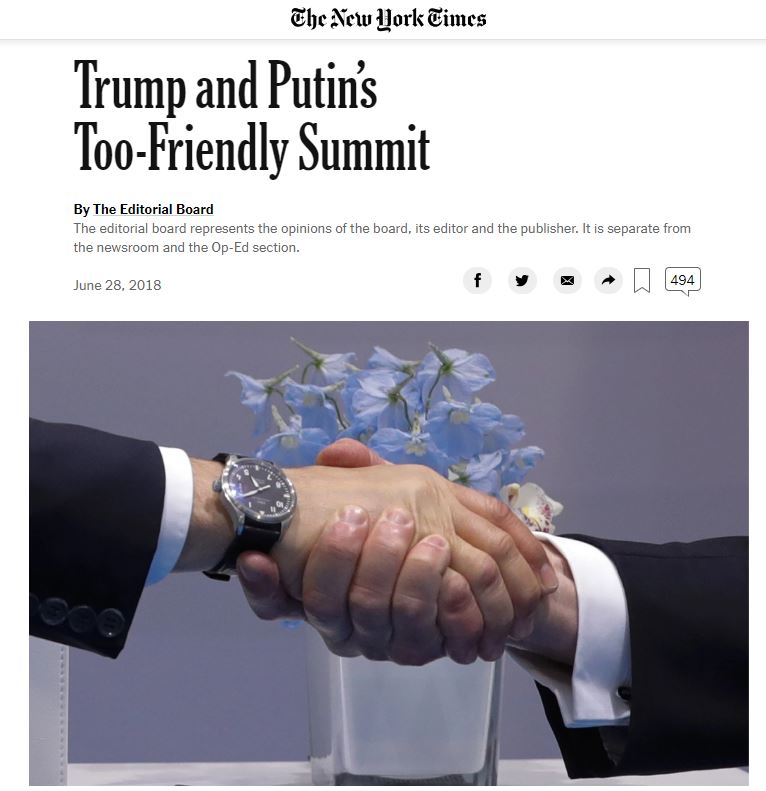
By Michael Howard | American Herald Tribune | July 1, 2018
Whenever I’m having a rough day and need a pick-me-up, I turn to The New York Times’ editorial page. It’s always a gas to see how far the empire’s leading propaganda outfit is prepared to go in its mission to pull the wool over we the people’s gullible little eyes. The good editors have come through for me again with their latest entry, “Trump and Putin’s Too-Friendly Summit.” (Original title: “Trump and Putin: Best Frenemies for Life”). No doubt the original headline was deemed rather too impish for such a serious newspaper—it might, for instance, have alerted readers to the fact that the editorial’s content is not to be taken very seriously—and so was understandably jettisoned.
“One would think,” the editors write, “that the president of the United States would let Mr. Putin know that he faces a united front of Mr. Trump and his fellow NATO leaders, with whom he would have met days before the [Putin] summit in Helsinki.” Alas, during said meeting Trump reportedly remarked that “NATO is as bad as NAFTA”—the “free trade” agreement that has succeeded in decimating most of the manufacturing jobs spared by the automation wrecking ball. In other words, Trump does not necessarily think it’s a good idea to encircle Russia with a hostile military alliance whose existence, according to geopolitical expert Richard Sakwa, is “justified by the need to manage the security threats provoked by its enlargement.” (If you haven’t read Professor Sakwa’s comprehensive study of the Ukrainian crisis, Frontline Ukraine, put it at the top of your summer reading list.)
One notes the Turgidsonian delight with which the Times reminds us that, should push come to shove, we’ve got those Russki bastards outgunned. Of course, gullibles like you and I are to pay no mind to the fact that such a confrontation (a military one, for the Times brought up NATO) would almost certainly involve a nuclear exchange, rendering the disparity in manpower that so excites the Times totally meaningless. No, what’s important is that NATO has twenty-nine member states and counting, while the Warsaw Pact was dissolved twenty-seven years ago: ergo, unless he wants the old mailed fist, Putin had better ask “how high?” when we tell him to jump. One would be hard-pressed to come up with a more delusional assessment of where things stand.
In case any of its readers have been living under rocks (not so bad an idea in this day and age), the Times made sure to stress just how sinister “the Russian autocrat” is. To that end they touch upon, with signature glibness, “Mr. Putin’s seizure of Crimea and attack on Ukraine.” Later, the “attack on Ukraine” is upgraded to “the Ukraine invasion”—a charge dealt with most eloquently here. Omitted as a matter of course is Crimea’s complicated history, the issue of the Sevastopol naval bases, as well as numerous uncontroversial polls showing that the overwhelming majority of Crimeans (of whom an overwhelming majority are ethnic Russians) support “Mr. Putin’s seizure.”
According to Forbes, a February 2015 survey by German polling firm GfK asked of the Crimean population: “Do you endorse Russia’s annexation of Crimea?” Eighty-two percent responded: “yes, definitely.” On the other hand, a whopping two percent responded: “no.” Seems plain enough. But hold the phone, says the New Cold Warrior, we can’t rule out the possibility that GfK is actually an arm of Putin’s Federal Security Service. Can you prove it isn’t? Didn’t think so.
Failing that, I think I recall reading something somewhere about an international principle called … what was it again? … “self-determination.” That’s it. Something to do with the bloody dismemberment of a certain former country in the Balkans in the nineties, spearheaded by our very own Uncle Sam. It’ll come back to me.
Deployed next by our great pandering Paper of Record are the increasingly monotonous claims that Moscow “interfered in the 2016 election to put [Trump] in office and is continuing to undermine American democracy.” If only we had a democracy to undermine, then this never-ending soap opera might have a little more going for it. Having, wisely, I think, adopted a wake-me-up-when-it’s-over attitude to “Russia-gate,” I’m simply not up to speed on the latest pseudo-bombshell reports that, on account of their utter want of journalistic merit, wind up being heavily redacted or retracted altogether. The whole scene has become too farcical for my taste. That said, I encourage still-interested parties to read the various counter narratives that fail to penetrate the mass media’s filters. This, for example.
But the board’s main concern in all this is that, according to them, Trump is “intent on eroding institutions that undergird democracy and peace.” To clarify, they’re referring to NATO again, or what they call “allied security.” It’s an obsession with these people. So let’s look at it a moment. I’ll give you a few well-known (but poorly understood) examples of NATO’s philanthropic work over the decades, since the Times forgot to include them in its editorial: namely, the illegal bombing of Yugoslavia, the illegal invasion and occupation of Afghanistan, and the illegal “humanitarian” intervention in Libya. After I’m finished writing this, I must write the Times to notify them that they printed a typo: they obviously meant to write “undermine,” not “undergird.”
It boils down to this: NATO is good because it’s us. Trump is bad because he’s ambivalent about NATO. If Trump succeeds in “eroding” NATO, the beneficiary is Putin, “whose goal is to fracture the West and assert Russian influence in places where Americans and Europeans have played big roles, like the Middle East …” Given the outcomes of those “big roles” (9/11, the destruction of whole countries, ISIS, a flourishing slave trade, a migrant crisis of biblical proportions, mass famine, the tragedy of Gaza, the death of the two-state solution, the list goes on), it’s hard to imagine Putin, or anyone else, for that matter, doing any worse. So here’s a modest proposal: Washington sells its empire to Moscow and gets out of the world domination business for good. God knows we need the money. Unfortunately, Putin is no more interested in ruling over a global empire than we are in relinquishing one. (Fun fact: on defense, the US outspends Russia by about $540 billion.)
As Sakwa explains, “Putin’s challenge is not to the system of international politics but only to what he considers its skewed and selective operation in favor of the Atlantic system.”
“The Russian autocrat” has been, for a long time, crystal clear on this point. Far from harboring Washington-style fantasies of imperial glory, his is a vision of a multipolar world order in which the leading powers engage in serious diplomacy and coordinate their efforts to address the major economic, security and environmental issues confronting us all. Then there’s Trump: “But our destiny, beyond the Earth, is not only a matter of national identity, but a matter of national security. It is not enough to merely have an American presence in space. We must have American dominance in space.” (Emphasis mine.) Between insane rhetoric like that and NATO’s incessant (and equally insane) provocations along Russia’s western front, I think it’s fair to say Putin has shown an admirable degree of composure.
In their final flurry, the Times editors make some big-sounding statements about the need to prevent another nuclear arms race, duly omitting that the US is on track to spend more than $1 trillion over the next three decades modernizing and diversifying its nuclear arsenal (and no, we can’t pin this one on Trump). Then, flailing now, punching wide, they managed to project responsibility for the breakdown of the flawed Intermediate-Range Nuclear Forces Treaty squarely onto Russia, duly omitting that the US, by continuing to install provocative missile defense systems across Eastern Europe, is in constant violation of the treaty. Inconvenient truths, I regret to say, are still truths; and lies by omission are still lies.
But let us not stray from the bottom line: Russia is the threat. Russia is the threat. Russia is the threat. If you say it enough times you might start to believe it—and then, and only then, can you count yourself among the good upright citizens of this great indispensable nation.
The Two Superpowers: Who Really Controls the Two Countries?
By Paul Craig Roberts | Institute For Political Economy | June 30, 2018
Among the ruling interests in the US, one interest even more powerful than the Israel Lobby—the Deep State of the military/security complex— there is enormous fear that an uncontrollable President Trump at the upcoming Putin/Trump summit will make an agreement that will bring to an end the demonizing of Russia that serves to protect the enormous budget and power of the military-security complex.
You can see the Deep State’s fear in the editorials that the Deep State handed to the Washington Post (June 29) and New York Times (June 29), two of the Deep State’s megaphones, but no longer believed by the vast majority of the American people. The two editorials share the same points and phrases. They repeat the disproved lies about Russia as if blatant, obvious lies are hard facts.
Both accuse President Trump of “kowtowing to the Kremlin.” Kowtowing, of course, is not a Donald Trump characteristic. But once again fact doesn’t get in the way of the propaganda spewed by the WaPo and NYT, two megaphones of Deep State lies.
The Deep State editorial handed to the WaPo reads: “THE REASONS for the tension between the United States and Russia are well-established. Russia seized Crimea from Ukraine, instigated a war in eastern Ukraine, intervened to save the dictatorship of Syrian President Bashar al-Assad, interfered in the U.S. presidential election campaign to harm Hillary Clinton and help Donald Trump, poisoned a former intelligence officer on British soil and continues to meddle in the elections of other democracies.”
The WaPo’s opening paragraph is a collection of all the blatant lies assembled by the Deep State for its Propaganda Ministry. There have been many books written about the CIA’s infiltration of the US media. There is no doubt about it. I remember my orientation as Staff Associate, House Defense Appropriation Subcommittee, when I was informed that the Washington Post is a CIA asset. This was in 1975. Today the Post is owned by a person with government contracts that many believe sustain his front business.
And don’t forget Udo Ulfkotte, an editor of the Frankfurter Allgemeine Zeitung, who wrote in his best seller, Bought Journalism, that there was not a significant journalist in Europe who was not on the CIA’s payroll. The English language edition of Ulfkotte’s book has been suppressed and prevented from publication.
The New York Times, which last told the truth in the 1970s when it published the leaked Pentagon Papers and had the fortitude to stand up for its First Amendment rights, repeats the lies about Putin’s “seizure of Crimea and attack on Ukraine” along with all the totally unsubstantiated BS about Russia interfering in the US president election and electing Trump, who now kowtows to Putin in order to serve Russia instead of the US. The editorial handed to the NYT insinuates that Trump is a threat to the national security of America and its allies (vassals). The problem, the NYT declares, is that Trump is not listening to his advisors.
Shades of President John F. Kennedy, who did not listen to the CIA and Joint Chiefs of Staff about invading Cuba, nuking the Soviet Union, and using the false flag attack on America of the Joint Chiefs’ Northwoods Project (look it up online). Is the New York Times setting up Trump for assassination on the grounds that he is lovey-dovey with Russia and sacrificing US national interests?
I would bet on it.
While the Washington Post and New York Times are telling us that if Trump meets with Putin, Trump will sell out US national security, The Saker says that Putin finds himself in a similar box, only it doesn’t come from the national security interest, but from the Russian Fifth Column, the Atlanticist Integrationists whose front man is the Russian Prime Minister Medvedev, who represents the rich Russian elite whose wealth is based on assets stolen during the Yeltsin years enabled by Washington. These elites, The Saker concludes, impose constraints on Putin that put Russian sovereignty at risk. Economically, it is more important to these elites for financial reasons to be part of Washington’s empire than to be a sovereign country.
I find The Saker’s explanation the best I have read of the constraints on Putin that limit his ability to represent Russian national interests.
I have often wondered why Putin didn’t have the security force round up these Russian traitors and execute them. The answer is that Putin believes in the rule of law, and he knows that Russia’s US financed and supported Fifth Column cannot be eliminated without bloodshed that is inconsistent with the rule of law. For Putin, the rule of law is as important as Russia. So, Russia hangs in the balance. It is my view that the Russian Fifth Column couldn’t care less about the rule of law. They only care about money.
As challenged as Putin might be, Chris Hedges, one of the surviving great American journalists, who is not always right but when he is he is incisive, explains the situation faced by the American people. It is beyond correction. American civil liberties and prosperity appear to be lost.
In my opinion, Hedges’ leftwing leanings caused him to focus on Reagan’s rhetoric rather that on Reagan’s achievements—the two greatest of our time—the end of stagflation, which benefited the American people, and the end of the Cold War, which removed the threat of nuclear war. I think Hedges also does not appreciate Trump’s sincerity about normalizing relations with Russia, relations destroyed by the Clinton, George W. Bush, and Obama regimes, and Trump’s sincerity about bringing offshored jobs home to American workers. Trump’s agenda puts him up against the two most powerful interest groups in the United States. A president willing to take on these powerful groups should be appreciated and supported, as Hedges acknowledges the dispossessed majority do. If I might point out to Chris, whom I admire, it is not like Chris Hedges to align against the choice of the people. How can democracy work if people don’t rule?
Hedges writes, correctly, “The problem is not Trump. It is a political system, dominated by corporate power and the mandarins of the two major political parties, in which we [the American people] don’t count.”
Hedges is absolutely correct.
It is impossible not to admire a journalist like Hedges who can describe our plight with such succinctness:
“We now live in a nation where doctors destroy health, lawyers destroy justice, universities destroy knowlege, the press destroys information, religion destroys morals, and banks destroy the economy.”
Read The Saker’s explanation of Russian politics. Possibly Putin will collapse under pressure from the powerful Fifth Column in his government. Read Chris Hedges analysis of American collapse. There is much truth in it. What happens if the Russian people rise up against the Russian Fifth Column and if the oppressed American people rise up against the extractions of the military/security complex? What happens if neither population rises up?
Who sets off the first nuclear weapon?
Our time on earth is not just limited by our threescore and ten years, but also humanity’s time on earth, and that of every other species, is limited by the use of nuclear weapons.
It is long past the time when governments, and if not them, humanity, should ask why nuclear weapons exist when they cannot be used without destroying life on earth.
Why isn’t this the question of our time, instead of, for example, transgender toilet facilities, and the large variety of fake issues on which the presstitute media focuses?
The articles by The Saker and Chris Hedges, two astute people, report that neither superpower is capable of making good decisions, decisions that are determined by democracy instead of by oligarchs, against whom neither elected government can stand.
If this is the case, humanity is finished.
Here are the Washington Post and New York Times editorials:
Washington Post
June 29, 2018
Editorial
Trump is kowtowing to the Kremlin again. Why?
Ahead of a summit with Putin, Trump is siding with the Russian leader, with dangerous results.THE REASONS for the tension between the United States and Russia are well-established. Russia seized Crimea from Ukraine, instigated a war in eastern Ukraine, intervened to save the dictatorship of Syrian President Bashar al-Assad, interfered in the U.S. presidential election campaign to harm Hillary Clinton and help Donald Trump, poisoned a former intelligence officer on British soil and continues to meddle in the elections of other democracies. Yet on Wednesday in the Kremlin, President Vladimir Putin brushed it all aside and delivered the Russian “maskirovka,” or camouflage, answer that it is all America’s fault.
Meeting with John Bolton, the president’s national security adviser, Mr. Putin declared that the tensions are “in large part the result of an intense domestic political battle inside the U.S.” Then Mr. Putin’s aide Yuri Ushakov insisted that Russia “most certainly did not interfere in the 2016 election” in the United States. On Thursday morning, Mr. Trump echoed them both on Twitter: “Russia continues to say they had nothing to do with Meddling in our Election!”
Why is Mr. Trump kowtowing again? The U.S. intelligence community has concluded that Russia did attempt to tilt the election using multiple campaigns, including cyberintrusions and insidious social media fakery. Would it be so difficult to challenge Mr. Putin about this offensive behavior? A full accounting has yet to be made of the impact on the election, but Mr. Bolton did not mince words last year when he described Russian interference as “a true act of war” and said, “We negotiate with Russia at our peril.” And now?
Summits can be productive, even – maybe especially – when nations are at odds. In theory, a meeting between Mr. Trump and Mr. Putin, now scheduled for next month in Helsinki, could be useful. But a meeting aimed at pleasing Mr. Putin is naive and foolhardy. A meeting aimed at pleasing Mr. Putin at the expense of traditional, democratic U.S. allies would be dangerous and damaging.
Just as Mr. Bolton was flattering Mr. Putin, Russia was engaging in subterfuge on the ground in Syria. The United States, Russia and Jordan last year negotiated cease-fire agreements in southwestern Syria, along the border with Jordan and the Golan Heights. In recent days, the United States has warned Russia and its Syrian allies not to launch an offensive in the area, where the rebel forces hold parts of the city of Daraa and areas along the border. The State Department vowed there would be “serious repercussions” and demanded that Russia restrain its client Syrian forces. Secretary of State Mike Pompeo called the Russian foreign minister, Sergei Lavrov, saying an offensive would be unacceptable. All to no avail; Syria is bombing the area.
This is what happens when Mr. Trump signals, repeatedly, that he is unwilling or unable to stand up to Russian misbehavior. We are on dangerous ground. Either Mr. Trump has lost touch with essential U.S. interests or there is some other explanation for his kowtowing that is yet unknown.
New York Times
June 29, 2018
Editorial
Trump and Putin’s Too-Friendly Summit
It’s good to meet with adversaries. But when Mr. Trump sits down with Mr. Putin, it will be a meeting of kindred spirits. That’s a problem.It’s good for American presidents to meet with adversaries, to clarify differences and resolve disputes. But when President Trump sits down with President Vladimir Putin of Russia in Finland next month, it will be a meeting of kindred spirits, and that’s a problem.
One would think that at a tête-à-tête with the Russian autocrat, the president of the United States would take on some of the major concerns of America and its closest allies. Say, for instance, Mr. Putin’s seizure of Crimea and attack on Ukraine, which led to punishing international sanctions. But at the Group of 7 meeting in Quebec this month, Mr. Trump reportedly told his fellow heads of state that Crimea is Russian because everyone there speaks that language. And, of course, Trump aides talked to Russian officials about lifting some sanctions even before he took office.
One would hope that the president of the United States would let Mr. Putin know that he faces a united front of Mr. Trump and his fellow NATO leaders, with whom he would have met days before the summit in Helsinki. But Axios reported that during the meeting in Quebec, Mr. Trump said, “NATO is as bad as NAFTA,” the North American Free Trade Agreement, which is one of Mr. Trump’s favorite boogeymen.
Certainly the president would mention that even the people he appointed to run America’s intelligence services believe unequivocally that Mr. Putin interfered in the 2016 election to put him in office and is continuing to undermine American democracy. Right? But on Thursday morning, Mr. Trump tweeted, “Russia continues to say they had nothing to do with Meddling in our Election!”
More likely, Mr. Trump will congratulate Mr. Putin, once again, for winning another term in a sham election, as he did in March, even though his aides explicitly warned him not to. And he has already proposed readmitting Russia to the Group of 7, from which it was ousted after the Ukraine invasion.
Summits once tended to be carefully scripted, and presidents were attended by senior advisers and American interpreters. At dinner during a Group of 20 meeting last July, Mr. Trump walked over to Mr. Putin and had a casual conversation with no other American representative present. He later said they discussed adoptions – the same issue that he falsely claimed was the subject of a meeting at Trump Tower in 2016 between his representatives and Russian operatives who said they had dirt on Hillary Clinton.
It’s clear that Mr. Trump isn’t a conventional president, but instead one intent on eroding institutions that undergird democracy and peace. Mr. Trump “doesn’t believe that the U.S. should be part of any alliance at all” and believes that “permanent destabilization creates American advantage,” according to unnamed administration officials quoted by Jeffrey Goldberg in The Atlantic.
Such thinking goes further than most Americans have been led to believe were Mr. Trump’s views on issues central to allied security. He has often given grudging lip service to supporting NATO, even while complaining frequently about allies’ military spending and unfair trade policies.
The tensions Mr. Trump has sharpened with our allies should please Mr. Putin, whose goal is to fracture the West and assert Russian influence in places where the Americans and Europeans have played big roles, like the Middle East, the Balkans and the Baltic States.
Yet despite growing anxieties among European allies, Mr. Trump is relying on his advisers less than ever because, “He now thinks he’s mastered this,” one senior member of Congress said in an interview. That’s a chilling thought given his inability, so far, to show serious progress on any major security issue. Despite Mr. Trump’s talk of quick denuclearization after his headline-grabbing meeting with the North Korean leader, Kim Jong-un, experts say satellite imagery shows the North is actually improving its nuclear capability.
While the White House hasn’t disclosed an agenda for the Putin meeting, there’s a lot the two leaders should be discussing, starting with Russian cyberintrusions. Mr. Trump, though, has implied that Mr. Putin could help the United States guard against election hacking. And although Congress last year mandated sweeping sanctions against Russia to deter such behavior, Mr. Trump has failed to implement many of them.
In a similar vein, should Mr. Trump agree to unilaterally lift sanctions imposed after Moscow invaded Ukraine and started a war, it would further upset alliance members, which joined the United States in imposing sanctions at some cost to themselves. Moreover, what would deter Mr. Putin from pursuing future land grabs?
Mr. Trump could compound that by canceling military exercises, as he did with South Korea after the meeting with Mr. Kim, and by withdrawing American troops that are intended to keep Russia from aggressive action in the Baltics.
Another fraught topic is Syria. Mr. Trump has signaled his desire to withdraw American troops from Syria, a move that would leave the country more firmly in the hands of President Bashar al-Assad and his two allies, Russia and Iran. Russia, in particular, is calling the shots on the battlefield and in drafting a political settlement that could end the fighting, presumably after opposition forces are routed.
What progress could be made at this summit, then? Mr. Trump and Mr. Putin may find it easier to cooperate in preventing a new nuclear arms race by extending New Start, a treaty limiting strategic nuclear weapons that expires in 2021.
Another priority: bringing Russia back into compliance with the I.N.F. treaty, which eliminated all U.S. and Soviet ground-launched ballistic and cruise missiles with ranges between 500 and 5,500 kilometers, until Russia tested and deployed a prohibited cruise missile.
Mr. Trump’s top national security advisers are more cleareyed about the Russian threat than he is. So are the Republicans who control the Senate. They have more responsibility than ever to try to persuade Mr. Trump that the country’s security is at stake when he meets Mr. Putin, and that he should prepare carefully for the encounter.
Featured Video
BRITAIN’S WARNING: PREPARE FOR WAR
or go to
Aletho News Archives – Video-Images
From the Archive
How Ukraine Tortured and Slaughtered Donbass
By Kit Klarenberg | Al Mayadeen | July 11, 2024
Almost immediately after the proxy war erupted, ISIS-tier footage of the torture and murder of Russians in Ukrainian custody emerged.
On July 6th, the New York Times published an astonishing investigation: In Ukraine, Killings of Surrendering Russians Divide an American-Led Unit. The article documents in grim detail how Chosen Company, an international volunteer battalion for Kiev, routinely executes Russian prisoners of war. It is the very first mainstream admission that this practice – a brazen breach of the Geneva Conventions, and a grave war crime – is widespread among Ukraine’s fighters, both foreign and homegrown. … continue
Blog Roll
 Aletho News
- Israel Demolishes Home Of Lebanese Journalist Whose Viral Film Exposed Pager Attack
- Record Oil, Empty Tanks: The UAE’s Miracle Recovery
- Burnham tackles Britain’s poverty with aggression in Yemen
- Peace in Ukraine: the easy way – or the hard way
- Trump & the Rrrrussians
- US taxpayer money laundered back through Ukraine – Musk
- Before COVID, an NIH lab chief proposed making a SARS-like bat virus more infectious
- Gates, Bourla on Trial in Netherlands Accused of ‘Great Reset’ Scheme at Vaccine Injury Hearing
- BRITAIN’S WARNING: PREPARE FOR WAR
- “Historic Russia”: The Land Putin Will Not Give Back
- If Americans Knew
- An error has occurred; the feed is probably down. Try again later.
- No Tricks Zone
- Two New Studies Find Thwaites Glacier Melt Cannot Be Driven By Human Activity Or A Warming Ocean
- E-Cars Reduce CO2 Emissions By Only 41% Compared To Internal Combustion Engine Vehicles
- Predictions Made By Renowned Climate Professor Over Past Decades Have Been Proven To Be Poor
- New Study Suggests Large Regions Of The Pacific Ocean Have Been Cooling For The Last 80 Years
- Germany’s Green Energy Debacle: High Energy Costs Force Kahla Porzellan to Close After 182 Years!
- New Study: 50 Years Of The Most Aggressive ‘Net Zero’ Policies Can Only Affect The Global Climate By 0.03°C
- US September “Heat” Was No Record…Many Records Set Decades Ago
- Latest European Green Energy Debacle; Portugal’s Largest Flagship Solar Park Insolvent!
- Green Energy Debacle: German Expert Professor Fritz Vahrenholt Warns Of Severe Economic And Social Consequences
- Two More Paleo Reconstructions Affirm Meters-Higher Sea Levels Across Ireland, Brazil 7000-6000 Years Ago

