Why Saudi Purge Signals War Footing
By Finian CUNNINGHAM | Strategic Culture Foundation | 10.11.2017
Mass arrests of senior royals, amid fear of assassinations, indicate that what is going on in Saudi Arabia is a far-reaching purge. The facade of a “corruption probe” – promoted in part by Western news media and US President Donald Trump – is a barely credible cover.
The cover is not just for a ruthless power grab within the desert kingdom by Saudi rulers, but a realignment that also puts the entire Middle East region on notice for more conflict and possibly even an all-out war with Iran. A war that the Israeli state and the Trump administration are enthusiastically egging on.
This move towards war with Iran could explain why the Saudi royals made a landmark trip to Moscow last month. Was it an attempt to buy off Russia with oil and weapons deals in order to free the Saudi hand with regard to Iran?
In typical fragmented fashion, Western media have tended to report the mass arrest last weekend of royal princes, ministers and business leaders, carried out under the orders of King Salman and his heir Crown Prince Mohammed bin Salman, as a crackdown on corruption and business sleaze.
Omitted in media coverage is the significant wider context of the Saudi rulers moving at the same time to exert political control over regional politicians, as well as making sensational claims that Iran and Lebanon have “declared war” on Saudi Arabia by allegedly supporting a missile strike from Yemen.
The apparent forced resignation of Lebanese premier Saad Hariri last weekend after having been summoned to Saudi capital Riyadh provided convenient substance to Saudi claims that Iran and its Lebanese ally Hezbollah were destabilizing Lebanon and indeed plotting to assassinate Hariri.
However, Hariri was just one of several regional political figures whom the Saudis were reportedly putting pressure on. Reports emerged that the ex-Yemeni president Mansour Hadi has been held under house arrest in his exile home in Riyadh. There were reports too of Syrian opposition figures being detained in Riyadh. And the Palestinian leader Mahmoud Abbas was ordered to the Saudi capital. This suggests the Saudis are orchestrating a regional chorus line.
Furthermore, there were credible Israeli media reports that the government of Benjamin Netanyahu in Tel Aviv is coordinating with Saudi Arabia to support the latter’s accusations against Iran and Hezbollah of committing acts of war from Yemen by supplying missiles to the Houthi rebels.
Washington has also weighed in to support the Saudi claims that Iran is arming the Houthis in violation of a UN Security Council resolution. Referring to the missile strike on Riyadh international airport last Sunday President Trump said that “Iran took a shot at Saudi Arabia”. Then the US ambassador to the UN Nikki Haley later in the week called for sanctions against Tehran, citing Saudi “evidence”. Iran has dismissed the claims as baseless, pointing to the Saudi air, sea and land blockade on Yemen as preventing any such weapons supply.
The power behind the Saudi throne, Mohammed bin Salman (MbS), the 32-year-old son of aging King Salman (82), has emerged as an ambitious autocrat who also harbors an intense hostility towards Iran. In several media interviews, the Crown Prince has disclosed an obsession with crushing Iran. This goes way beyond the usual sectarian Wahhabi antipathy of Saudi leaders towards Shia Iran.
Crown Prince MbS is playing a smart game to a degree. He has made a big media play on “reforming” Saudi Arabia from its fundamentalist social conservatism to become a seemingly more cosmopolitan society. The Crown Prince has pushed reforms giving Saudi women the right to drive cars, travel without male guardians, and enter sports stadiums. Hardly radical advances in gender equality. Nevertheless, MbS has ably projected himself with Western media assistance as something of a progressive reformer.
Those changes are but the veneer for ruthless ambitions and a hyper power-grab within the despotic House of Saud. The supposed “corruption probe” is another layer of varnish to conceal much more sinister developments.
Britain’s Guardian newspaper this week waxed lyrical over the mass round-up of senior Saudi royals and ministers describing it as a “revolution” carried out by the would-be reformer Crown Prince, placing the development in the context of minor liberalization of women’s rights.
Meanwhile, the New York Times offered an apologia for the “Saudi Corruption Crackdown” by saying: “Graft is so pervasive that any measures short of revolutionary change may appear to be selective prosecution.”
Such reporting serves as a distraction from the real power play at work and the grave regional implications.
For a start, the number of detained princes, as well as current and former government ministers, are in the dozens. The profiles of those arrested suggest a pattern that has more to do with eliminating potential rivals than with alleged corruption.
Potentially most sinister is that on the day of the mass arrests, a contender for inheriting the Saudi throne was killed in a helicopter crash. Prince Mansour bin Muqrin (42) was among eight officials who died when their chopper went down in southern Asir Province near the border with Yemen. Saudi media have not given any details about the cause of the crash. One might have expected the Saudis to lay the blame on Houthi rebels and, by extension, Iran. But no. The House of Saud and its media outlets have said little about the death of this senior royal. Significantly, too, the Houthi rebels and their media have said little about the incident. If there was a chance of the rebels being involved, one might expect them to prompt a propaganda coup claiming a spectacular blow against the Saudis whom they have been fighting a war against since March 2015.
The chopper victim Prince Mansour was the son of 72-year-old Prince Muqrin, who is one of the last surviving sons of the Saudi kingdom’s founder Ibn Saud. (He is a half-brother to the sitting King Salman.)
Prince Muqrin was also former head of Saudi state intelligence (2005-2012) before he was made Crown Prince in January 2015 upon the death of his brother, the late King Abdullah. In the arcane world of Saudi power inheritance, the throne has always passed between Ibn Saud’s sons, or from brother to brother. When Abdullah died in January 2015, the next in line was their brother Salman (the present king). After Salman, according to traditional succession rules, the next heir to the throne should have been Muqrin, who indeed was made Crown Prince in January 2015. However, three months later, King Salman demoted Muqrin as heir apparent. He was sidelined to make way for the emergence of Mohammed bin Salman, the son of the king, as Crown Prince. That marked an unprecedented rupture in Saudi royal tradition, and no doubt has left a seething resentment among the clans comprising the House of Saud.
Prince Muqrin and his lineage of six sons therefore can be seen as a dangerous rival to the ambitions of Crown Prince Mohammed bin Salman. As his own father King Salman’s health declines, the next-in-line appears to be clearing the royal court of potential competition for the throne.
It is not yet known what actually happened to the helicopter ferrying Prince Mansour last weekend. But it seems more than a coincidence that the crash occurred on the same day as the arrest and round-up of several other senior royals. Two of those arrested were Prince Mataib bin Abdullah and Prince Turki bin Abdullah. They are the sons of the late King Abdullah, and like Prince Mansour, they are cousins of Crown Prince MbS, and therefore could potentially mount a challenge to his succession to the throne.
The arrests also targeted the heads of national security, the National Guard and Navy, as well as Western-connected Saudi media magnates Prince Al-Waleed bin Talal and Waleed Al-Ibrahim, who are major shareholders in 20th Century Fox, News Corporation, Apple, Twitter, and TV satellite companies. Those arrests suggest that Crown Prince Mohammed bin Salman is trying to close down any backlash from within the Saudi security establishment, as well as shut off potentially negative media coverage.
Donald Trump immediately hailed the events in Saudi Arabia as a welcome clean-up against corruption. He said people had been “milking the country for years”.
There is little doubt that Saudi elites are generally up to their eyes in graft. The House of Saud and the country’s fabulously wealth oil industry are a byword for endemic corruption, bribery and racketeering. (Recall the British Al-Yamamah $60 billion arms and bribery scandal during the 1980s under the Thatcher government for example.)
So, for Trump and sections of the Western media to indulge the notion of a reforming Crown Prince overhauling endemic national sleaze is impossibly naive.
It also completely misses the point of how the Saudi rulers are gearing up for a regional war with Iran and via Lebanon by consolidating all power behind Crown Prince MbS and his anti-Iran obsession.
Trump and his business mogul son-in-law Jared Kushner have from an early stage gravitated to Crown Prince MbS for massive US arms sales and Saudi investment in the American economy. Only days before the Saudi purge, Kushner was on a low-key visit to Riyadh to meet with Saudi rulers. Trump also appealed last week to the Saudis to choose US stock markets for the much-anticipated share sell-off for Aramco, the Saudi national oil company, which is expected to fetch $2 trillion.
Crown Prince Mohammed bin Salman, the architect behind the Saudi slaughter in Yemen, is positioning himself with total power in order to pursue his obsession of confronting Iran. That’s like pushing an open door when it comes to forming an anti-Iran front with Israel’s Benjamin Netanyahu and the Trump administration. And for Trump there is also the added incentive of lavishing Wall Street by pandering to the Saudi despots.
Guardians of the Magnitsky Myth
By Robert Parry | Consortium News | October 28, 2017
As Russia-gate becomes the go-to excuse to marginalize and suppress independent and dissident media in the United States, a warning of what the future holds is the blacklisting of a documentary that debunks the so-called Magnitsky case.

Hedge-fund executive William Browder
The emerging outlines of the broader suppression are now apparent in moves by major technology companies – under intense political pressure – to unleash algorithms that will hunt down what major media outlets and mainstream “fact-checkers” (with their own checkered histories of getting facts wrong) deem to be “false” and then stigmatize that information with pop-up “warnings” or simply make finding it difficult for readers using major search engines.
For those who believe in a meaningful democracy, those tactics may be troubling enough, but the Magnitsky case, an opening shot in the New Cold War with Russia, has demonstrated how aggressively the Western powers-that-be behave toward even well-reported investigative projects that unearth inconvenient truth.
Throughout the U.S. and Europe, there has been determined effort to prevent the American and European publics from seeing this detailed documentary that dissects the fraudulent claims at the heart of the Magnitsky story.
The documentary – “The Magnitsky Act: Behind the Scenes” – was produced by filmmaker Andrei Nekrasov, who is known as a fierce critic of Russian President Vladimir Putin but who in this instance found the West’s widely accepted, anti-Russian Magnitsky storyline to be a lie.
However, instead of welcoming Nekrasov’s discoveries as an important part of the debate over the West’s policies toward Russia, the European Parliament pulled the plug on a premiere in Brussels and – except for a one-time showing at the Newseum in Washington – very few Americans have been allowed to see the documentary.
Instead, we’re fed a steady diet of the frothy myth whipped up by hedge-fund investor William Browder and sold to the U.S. and European governments as the basis for sanctioning Russian officials. For years now, Browder has been given a free hand to spin his dog-ate-my-homework explanation about how some of his firms got involved a $230 million tax fraud in Russia.
Browder insists that some “corrupt” Russian police officers stole his companies’ corporate seals and masterminded a convoluted conspiracy. But why anyone would trust a hedge-fund operator who got rich exploiting Russia’s loose business standards is hard to comprehend.
The answer is that Browder has used his money and political influence to scare off and silence anyone who dares point to the glaring contradictions and logical gaps in his elaborate confection.
So, the hedge-fund guy who renounced his U.S. citizenship in favor of a British passport gets the royal treatment whenever he runs to Congress. His narrative just fits so neatly into the demonization of Russia and the frenzy over stopping “Russian propaganda and disinformation” by whatever means necessary.
This summer, Browder testified before the Senate Judiciary Committee and argued that people involved in arranging the one-time showing of Nekrasov’s documentary should be prosecuted for violating the Foreign Agent Registration Act (FARA), which carries a five-year prison term.
Meanwhile, the U.S. mainstream media helps reinforce Browder’s dubious tale by smearing anyone who dares question it as a “Moscow stooge” or a “useful idiot.”
Magnitsky and Russia-gate
The Magnitsky controversy now has merged with the Russia-gate affair because Russian lawyer Natalia Veselnitskaya, who traveled to America to challenge Browder’s account, arranged a meeting with Donald Trump Jr. and other Trump campaign advisers in June 2016 to present this other side of the story.
Though nothing apparently came from that meeting, The New York Times, which always treats Browder’s account as flat fact, led its Saturday editions with a breathless story entitled, “A Kremlin Link to a Memo Taken to Trump Tower,” citing similarities between Veselnitskaya’s memo on the Magnitsky case and an account prepared by “one of Russia’s most powerful officials, the prosecutor general Yuri Y. Chaika.” Cue the spooky music as the Times challenges Veselnitskaya’s honesty.
Yet, the Times article bows to Browder as the ultimate truth-teller, including repetition of his assertion that Sergei Magnitsky was a whistleblowing “tax lawyer,” rather than one of Browder’s accountants implicated in the tax fraud.
While Magnitsky’s profession may seem like a small detail, it gets to the heart of the mainstream media’s acceptance of Browder’s depiction of Magnitsky – as a crusading lawyer who died of medical neglect in a Russian prison – despite overwhelming evidence that Magnitsky was really a clever accountant caught up in the scheme.
The “lawyer” falsehood – so eagerly swallowed by the Times and other mainstream outlets – also bears on Browder’s overall credibility: If he is lying about Magnitsky’s profession, why should anyone believe his other self-serving claims?
As investigative reporter Lucy Komisar noted in a recent article on the case, Browder offered a different description when he testified under oath in a New York court deposition in a related criminal case.
In that adversarial setting, when Browder was asked if Magnitsky had a law degree, Browder said, “I’m not aware that he did.” When asked if Magnitsky had gone to law school, Browder answered: “No.”
Yet, the Times and the rest of the mainstream media accept that Magnitsky was a “lawyer,” all the better to mislead the American public regarding his alleged role as a whistleblower.
The rest of Browder’s story stretches credulity even more as he offers a convoluted explanation of how he wasn’t responsible for bogus claims made by his companies to fraudulently sneak away with $230 million in refunded taxes.
Rather than show any skepticism toward this smarmy hedge-fund operator and his claims of victimhood, the U.S. Congress and mainstream media just take him at his word because, of course, his story fits the ever-present “Russia bad” narrative.
Plus, these influential people have repeated the falsehoods so often and suppressed contrary evidence with such arrogance that they apparently feel that they get to define reality, which – in many ways – is what they want to do in the future by exploiting the Russia-gate hysteria to restore their undisputed role as the “gatekeepers” on “approved” information.
Which is why Americans and Europeans should demand the right to see the Nekrasov documentary and make their own judgments, possibly with Browder given a chance after the show to rebut the overwhelming evidence of his deceptions.
Instead, Browder has used his wealth and connections to make sure that almost no one gets to see the deconstruction of his fable. And The New York Times is okay with that.
[For details on the Nekrasov documentary, see Consortiumnews.com’s “A Blacklisted Film and the New Cold War.”]
Investigative reporter Robert Parry broke many of the Iran-Contra stories for The Associated Press and Newsweek in the 1980s.
JFK Files: Cover-Up Continues of President’s Assassination
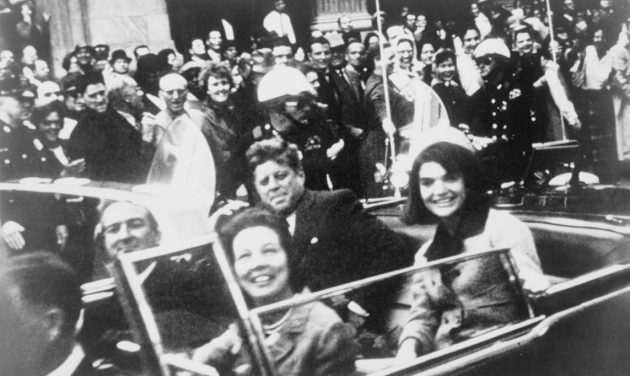
By Finian CUNNINGHAM | Strategic Culture Foundation | 28.10.2017
The murder of President John F Kennedy 54 years ago has been described as the “crime of the century”. If US and Western news media cannot discuss this seminal event openly and honestly, let alone investigate it, then what does that say about their credibility?
Such systematic media denial of reality inflicts irreparable damage to their credibility. How can they be taken seriously on any other matter, whether it is claims of “Russian meddling” or about the war in Syria, or the claims justifying Washington’s aggression towards Iran and North Korea?
The astounding media denial over JFK’s assassination is a symptom of the tacit totalitarianism that passes for “Western democracy”.
The release this week of secret government papers on the killing of President Kennedy was billed as a day of revelation and reckoning. Closer to the truth is that the shocking murder of Kennedy continues to be covered-up by the US deep state.
The premise of “revelation and reckoning” is absurdly false and naive. The notion that US authorities would “finally come clean” on what happened that day in Dallas is not only flawed. It also creates the illusion that the controversy has finally been settled, thereby supposedly confirming the official version that Kennedy was assassinated by a lone malcontent, Lee Harvey Oswald.
CNN reported the release of official documents this week thus: “More than 50 years after President John F Kennedy was killed, Americans on Thursday may finally get the US government’s full accounting… to quell conspiracy theories that have long swirled around the assassination.”
The New York Times wrote: “The final trove of sealed government records to be released” will lay to rest the “grand-daddy of all conspiracy theories”.
The evidence and truth about Kennedy’s slaying in Dealey Plaza, Dallas, on November 22, 1963, is already out there in the testimony of dozens of eye witnesses who observed the assassination or who were present in the aftermath. The assumption that the release of secret archives could shed any light is misplaced. But the media depiction of a “final trove” of documents conveniently shores up the official account that any other explanation of what really happened is that of a “conspiracy crank”.
CNN and the New York Times, as with the rest of the mainstream media in the US, claim that the release of declassified papers this week confirms the official narrative that JFK was shot dead by Lee Harvey Oswald firing a sniper rifle from the sixth floor of the Texas Book Store Depository at the president’s motorcade. That was the original conclusion from the government-led Warren Commission, which published its report on the assassination in 1964. For over 50 years, the US media have unswervingly maintained that version of events, despite abundant evidence to the contrary.
What the media have studiously ignored for all these years is the evidence and testimony from dozens of witnesses who were either excluded from the Warren Commission hearings, or their testimonies were distorted by FBI investigators. Many of them mysteriously killed.
One of the best compendiums on the Kennedy assassination is ‘JFK and the Unspeakable’ by James Douglass (2008). Other essential titles for details on the murder – details which mainstream media largely ignore – include ‘Crossfire’ by Jim Marrs, and ‘Brothers’ by David Talbot.
Among the many crucial witnesses recorded over the years, here below are a select few. Their testimonies show that the murder of Kennedy was a much darker “crime of the century” than the mainstream media would ever explore.
Shot from the front, not from the back
Doctor Charles Crenshaw led the medical staff at Dallas Parkland Hospital where the fatally wounded JFK was rushed to minutes after being shot. Crenshaw and nearly 20 other medical staff tended to the president’s wounds trying to resuscitate him. All of these medics testified that Kennedy’s fatal head wound was from a gun shot to the front of the skull which resulted in a massive exit hole at the back of his head. That one detail alone contradicts the official claim that Oswald allegedly shot JFK from the rear, as the Warren Commission contends.
The fatal shot must have come from the front, which the famous amateur video footage recorded by bystander Abraham Zapruder near the Grassy Knoll also purports to show. (Notably, a Congressional panel, the House Select Committee on Assassinations, concluded in 1979 after a reexamination of evidence that there was more than one shooter in Dealey Plaza. But this finding has never been thoroughly explored by the media. Why not?)
Critically important, Dr Crenshaw and his medical colleagues were immediately pressured by the FBI and other authorities to suppress their initial observations. They were tacitly intimidated to change their accounts to say the opposite: that the president’s head wound was caused by a shot from the rear. Crenshaw was not invited to testify before the Warren Commission during its year-long hearings. He says for years after, he and Parkland staff were subtly intimidated to keep quiet about their witness to Kennedy’s final moments. However, three decades later, in 1992, Dr Crenshaw published ‘JFK and the Conspiracy of Silence’. Ironically, it became a best-seller on the New York Times book list, in spite a huge media campaign to discredit Crenshaw’s medical expertise.
Lieutenant Commander William Bruce Pitzer was in charge of the Audio-Visual Department at Bethesda Naval Hospital in Washington DC where Kennedy’s remains were flown hours after the shooting. That was where the official autopsy was carried out, bizarrely, under the watchful eye of senior military personnel. Pitzer was tasked with filming the remains of the president. As he later confided to a colleague, who corroborated the film’s images, JFK’s head had a massive exit wound at the back of the skull, just as the Dallas doctors had initially maintained. Two years later, Pitzer was mysteriously found dead in his studio. He had been shot in the head, a revolver nearby. His death was officially said to be suicide, which his widow disputed. The film of the president’s remains, which Pitzer had been carefully storing, was removed from his studio by an unknown person.
The contention that Kennedy was shot from the front is not a theory. The direction of fire was witnessed by several people who were near the Grassy Knoll, the stockade-fence area which JFK’s limousine was approaching as it drove away from the Texas Book Store Depository, further up on Elm Street. If Oswald was the shooter from the depository, as the official narrative goes, then how could Kennedy have been shot fatally from the front?
Secret Service men at Grassy Knoll
Ed Hoffman, a young deaf and mute man, was watching the approaching motorcade from the flyover overlooking the knoll. Hoffman says he saw a puff of smoke emitting from where a gunman was standing against the stockade fence just as the president’s car was approaching. The shooter then quickly moved to rail lines behind the knoll where he threw his rifle to another man dressed in work overalls. The second man disassembled the rifle in a twist, shoved it into a holdall bag and proceeded to walk along the rail track away from the knoll. The shooter then swiftly walked back to the stockade fence. Several police officers on duty that day, who immediately ran towards the knoll on hearing the gunfire, reported that they were confronted by men purporting to be secret service agents. Ed Hoffman’s testimony was ignored by FBI investigators when he voluntarily came forward. But his account was verified by a railroad operator named Lee Bowers who also observed the shooting from the Grassy Knoll from the vantage point of a control tower he happened to be working in. Bowers testified his observation to respected JFK researcher and author Mark Lane. Four months later, in 1966, Bowers was killed in a single-car accident. This fate of untimely death has met several other people who spoke out about circumstances of the shooting which did not fit with the Warren Commission narrative.
Another witness on the Grassy Knoll was a young off-duty soldier, Gordon Arnold. Years later after mustering the courage, he testified that he felt the discharge of two shots fired from close behind while he was taking photos of the passing motorcade. Gordon said he ducked for cover, and before he knew it, two men lit on him, one holding a rifle and dressed in a police uniform, who demanded he empty his camera of its film. Arnold kept silent about his story for years out of fear for his life.
Jack Ruby was not a random killer of Oswald
Many serious independent investigators have disputed the Warren Commission report as being riddled with anomalies, apart from its exclusion of key witnesses. One of the glaring flaws in the Warren findings is that Lee Harvey Oswald purportedly acted alone, and that he had no connection to Jack Ruby, the Mob-connected nightclub owner who shot dead Oswald while in custody in the Dallas police station – two days after Kennedy was killed.
Rose Cheramie worked in Ruby’s Dallas club. Before her death in a bizarre road accident in 1965, Cheramie claimed that Ruby and Oswald knew each other for years. She said Oswald would often call round to the club where he would sit at Ruby’s table.
Julia Ann Mercer was stuck in traffic in Dealey Plaza on the morning of the assassination, at 11am, an hour and a half before the president’s motorcade arrived. She noticed a man getting out of a station wagon parked below the Grassy Knoll and that this man was carrying what appeared to be a concealed rifle as he proceeded to walk up to the stockade-fence area. Out of curiosity, Mercer then rolled her car alongside the parked vehicle and took a look at the driver squarely in the face. It was Jack Ruby. She didn’t know Ruby at that time. Only days later when his infamous shooting of Oswald at the police station made international headlines did Mercer recognize Ruby’s face. Her testimony was distorted by FBI investigators. It was only when Mercer later talked to various independent researchers that her crucial identification of Ruby at the scene came to light, albeit not in a mass media light.
Other witnesses further substantiate the real conspiracy that lies behind JFK’s assassination. The word “conspiracy” is not used here in the pejorative sense to demean. It conveys the literal meaning of an organized plot.
What was that plot? As James Douglass and others have cogently pieced together, after his election in 1960 JFK was increasingly viewed by the US deep state as a “rogue president”. He was firmly opposed to the unfurling arms race against the Soviet Union and wanted to pursue earnest, radical nuclear disarmament with Russian leader Nikita Khrushchev. The Cuban missile crisis of 1962 had jolted JFK on the dangers of a nuclear world war. Kennedy also wanted to normalize relations with Cuba’s Fidel Castro following the disastrous CIA-led Bay of Pigs invasion in 1961 for which the president vowed he would “smash the agency into a thousand pieces”. He fired the CIA director Allen Dulles over the fiasco. Ironically, Dulles would later be appointed to the seven-member Warren Commission, supposedly tasked with uncovering the truth behind Kennedy’s assassination.
Moreover, JFK had concluded that the looming Vietnam War would be a disaster. In the summer of 1963 he was preparing orders for US military withdrawal. That move was a formidable threat to the anticipated huge profits for the military industrial complex if the war escalated, which it did after Kennedy’s death.
At the height of the Cold War, Kennedy was therefore seen as little more than a traitor by the military-security apparatus and as an obstacle to the vested economic interests of the Pentagon’s military-industrial complex. In short, he had to be got rid of by “executive action”.
The CIA had the motive to terminate Kennedy. It also had the means. CIA contract-killers were often drawn from the ranks of criminal underworld, the Mafia and far-right Cuban exiles living in Miami. This arrangement affords “plausible deniability”.
Jack Ruby, who had long been a Mafia, CIA gun-runner and fixer, was recruited into the months-long planning of the plot to ambush the president.
Oswald the CIA agent who became a scapegoat
So, what was Oswald’s connection? The 23-year-old ex-US marine had been recruited in the late 1950s by the CIA when he was posted to a U2 spy plane base in Japan. He became fluent in Russian and then “defected” to the Soviet Union. It seems that the KGB did not take Oswald seriously as a reliable would-be agent. He then returned to the US in 1962, apparently of his own volition. Significantly, for an American citizen who had renounced his country and defected to the Soviet Union, Oswald and his Russian wife were not subjected to any recriminations on their return to the US. Indeed, it seems they were given generous patronage to find accommodation, jobs, and connections.
Oswald, who became immersed in both pro- and anti-Castro Cuban political activities in the US, became embroiled in the plot to assassinate Kennedy. How much Oswald knew of CIA involvement or the agency’s true objectives is not clear. But evidence suggests that he was also working as an informer for the FBI to alert them of the plot to kill the president. Oswald was out of his depth. He probably didn’t realize how little a pawn he was in a much bigger nefarious plot.
His close involvement with the bit-player plotters explains how he was an associate of Jack Ruby. What Oswald’s true intentions were are not clear. Tragically, he may have had a misplaced belief that his role as an informant for the FBI was trying to save the president.
In the end, tragically, Oswald was made the scapegoat for the assassination. The claim that he fired a rifle from the Texas School Book Depository with three shots in a matter of seconds and hit the president twice – as the Warren Commission contends – defies credibility. Also, according to the Warren report, one of those bullets supposedly exited Kennedy’s neck and then struck Governor John Connally who was riding in front of the Limousine. Dr Crenshaw and the other doctors at Parkland Hospital initially said that the wound on Kennedy’s neck (in addition to the fatal head injury) was an entry wound – another pointer that shots were actually fired from the front, not from the back as the Warren Commission maintains. That’s not to say shots were not fired from the depository. Witnesses say they heard gunfire and saw a gunman in the upper window. But that speaks more to the elaborate CIA plot to frame Oswald, who happened to recently become employed at the depository weeks before Kennedy’s visit to Dallas.
Less than an hour after the president was shot, Oswald hurriedly entered a movie theater. Witness Jack Davis said he noticed Oswald acting strangely, sitting beside individuals, then restlessly getting up and sitting down again beside another moviegoer – this in an almost empty theater! “It was obvious he was looking for someone,” recalled Davis. It is reasonable to speculate Oswald was seeking out a FBI contact whom he was instructed to connect with in a faux-arrangement. Oswald never did meet his “contact”. He was being left out to hang and dry by the plotters.
Another movie-theater customer, George Applin, told how when police officers arrested Oswald, Applin kindly advised another seated man to move to the back of the cinema hall, away from the trouble. The man nonchalantly looked at Applin, ignored his advice, kept sitting in his seat, and then proceeded to intently observe the arrest of Oswald. Days later, Applin recognized the face of Jack Ruby as being that of the man in the cinema hall. Evidently, Ruby had expected the police officers to shoot Oswald on the spot at his arrest, especially because their colleague Officer JD Tippit had just been shot dead minutes before – supposedly by Oswald fleeing from the assassination of the president. As it turned out, the arresting officers did not kill Oswald in the movie-theater, and it would fall to Ruby to follow-up two days later at the Dallas police station.
There are many other such key witnesses to the events surrounding the assassination of JFK, recorded in the reference books cited above, among other sources. All these witnesses were ignored by the mainstream media, or excluded and distorted by the Warren Commission, or were intimidated from speaking out publicly.
State-level organization of assassination
One further crucial story is that of Air Force Sergeant Robert Vinson. On the Friday of the assassination, through sheer happenstance, he caught an unscheduled ride onboard an unmarked C-54 military cargo plane, making his way back from Washington DC to his home near Colorado Springs. During the flight in which he was the only passenger, the pilots announced the president’s death. The plane then banked to another unspoken destination. When it landed on a rough strip, Sgt. Vinson recognized the city’s skyline as Dallas. It was mid-afternoon. During the brief stop, the plane’s engines did not shut off. Two men boarded. The aircraft then took off, landing eventually at the air base at Roswell, New Mexico. It was only when Vinson finally got home on Sunday, watching the breaking news on the TV with his wife, that he recognized the face of the man accused of being the president’s assassin, Lee Harvey Oswald. It was the same facial appearance as one of the two men who boarded at Dallas.
Vinson’s experience confirms what many other witnesses have contended. That in the plot to kill JFK and frame Oswald, there was an Oswald double, an imposter whose task was to incriminate the scapegoat. The double was used to lay down a trail of evidence purporting to frame Oswald as a Cuban or Soviet malcontent. This would explain the strange encounters at the Cuban and Soviet embassies in Mexico City only weeks before the Dallas assassination. During those encounters, the Oswald imposter dramatically proclaimed his communist allegiance. Significantly, the Soviet records show that the person claiming to be Oswald spoke very bad Russian, whereas it is known that the real Oswald was fluent in the language.
For years, Sgt. Vinson was subtly intimidated by the CIA to keep quiet about his accidental flight onboard the unmarked cargo plane. However, Vinson did come forward years later to tell researchers of his insights into the plot to kill Kennedy. He also testified that the plane he rode on was not entirely unmarked. On the tail section, the aircraft bore the insignia of the CIA.
But perhaps the absolute key witness in all this was Lee Harvey Oswald himself. His last words shouted out in defiance at the Dallas police station were: “I’m just a patsy!”
Conveniently, Oswald was silenced by the Mob, CIA-connected Jack Ruby before he could tell his side of the story in a court of law. Oswald no doubt could have lifted a very disturbing lid on who really was orchestrating the president’s assassination.
Regime change American-style
The story of JFK’s assassination is one of state-sponsored murder carried out by the deep state power structure in the US. It was a coup d’état against a president elected by the people, whom the deep state viewed as an enemy to their objectives for war and foreign intrigues.
It was a shocking, brutal blow against democracy, a “regime change”, delivered not in some distant country, but right at home in the United States.
Such was the elaborate conspiracy to murder the president, involving contract-killers and secret services, as well as the complicity of police forces, the FBI, the military, judiciary and the corporate media, that the plotters behind JFK’s killing had to be positioned at the highest level of US government – the deep state.
Nearly 54 years after Kennedy’s murder by America’s state apparatus, the cover-up continues in the form of a futile release of “secret papers”. And, suitably, the mainstream media declare that this “disclosure” is the final settling of the matter, which puts an end to “conspiracy theories”. The media’s complicity may simply be due to an inability or reluctance to question the official narrative. This is what we mean by “tacit totalitarianism” – a willingness to believe in indoctrinated thinking, such as the false Warren Commission conclusion.
No wonder the US public – which polls have consistently shown do not believe the official Warren Commission narrative, and who indeed believe instead that JFK was actually killed in a nefarious plot – no wonder the public have increasing distrust and contempt for the corporate media for being dishonest and unreliable.
For the past year, the same media have been trying to slander Russia for interfering in US democracy. The same media have also tried to conceal American state-sponsored terrorism in Syria to overthrow the government there, just like it did when it overthrew the government in Libya in 2011 and killed the country’s leader Muammar Gaddafi. And many other illegal regime-change operations carried out by the US and its Western allies, presented as noble endeavors to “defend democracy”, “fight terrorism” or “protect human rights”.
In an era when such commercially-driven mass media pontificate about “fake news” perpetrated by others it is all the more galling that the accusation comes from the very same media who specialize in mass fake news and mass fake narratives.
The US state murder of JFK in 1963 and the decades-long cover-up is perhaps the greatest condemnation of the fraud that is US mass media. The day that the president was assassinated was also the day that American pretensions of democracy took a deadly hit.
Russia-gate Breeds ‘Establishment McCarthyism’
By Robert Parry | Consortium News | October 26, 2017
In the past, America has witnessed “McCarthyism” from the Right and even complaints from the Right about “McCarthyism of the Left.” But what we are witnessing now amid the Russia-gate frenzy is what might be called “Establishment McCarthyism,” traditional media/political powers demonizing and silencing dissent that questions mainstream narratives.

Sen. Joe McCarthy with lawyer Roy Cohn (right)
This extraordinary assault on civil liberties is cloaked in fright-filled stories about “Russian propaganda” and wildly exaggerated tales of the Kremlin’s “hordes of Twitter bots,” but its underlying goal is to enforce Washington’s “groupthinks” by creating a permanent system that shuts down or marginalizes dissident opinions and labels contrary information – no matter how reasonable and well-researched – as “disputed” or “rated false” by mainstream “fact-checking” organizations like PolitiFact.
It doesn’t seem to matter that the paragons of this new structure – such as The New York Times, The Washington Post, CNN and, indeed, PolitiFact – have a checkered record of getting facts straight.
For instance, PolitiFact still rates as “true” Hillary Clinton’s false claim that “all 17 U.S. intelligence agencies” agreed that Russia was behind the release of Democratic emails last year. Even the Times and The Associated Press belatedly ran corrections after President Obama’s intelligence chiefs admitted that the assessment came from what Director of National Intelligence James Clapper called “hand-picked” analysts from only three agencies: CIA, FBI and NSA.
And, the larger truth was that these “hand-picked” analysts were sequestered away from other analysts even from their own agencies and produced “stove-piped intelligence,” i.e., analysis that escapes the back-and-forth that should occur inside the intelligence community.
Even then, what these analysts published last Jan. 6 was an “assessment,” which they specifically warned was “not intended to imply that we have proof that shows something to be a fact.” In other words, they didn’t have any conclusive proof of Russian “hacking.”
Yet, the Times and other leading newspapers routinely treat these findings as flat fact or the unassailable “consensus” of the “intelligence community.” Contrary information, including WikiLeaks’ denials of a Russian role in supplying the emails, and contrary judgments from former senior U.S. intelligence officials are ignored.
The Jan. 6 report also tacked on a seven-page addendum smearing the Russian television network, RT, for such offenses as sponsoring a 2012 debate among U.S. third-party presidential candidates who had been excluded from the Republican-Democratic debates. RT also was slammed for reporting on the Occupy Wall Street protests and the environmental dangers from “fracking.”
How the idea of giving Americans access to divergent political opinions and information about valid issues such as income inequality and environmental dangers constitutes threats to American “democracy” is hard to comprehend.
However, rather than address the Jan. 6 report’s admitted uncertainties about Russian “hacking” and the troubling implications of its attacks on RT, the Times and other U.S. mainstream publications treat the report as some kind of holy scripture that can’t be questioned or challenged.
Silencing RT
For instance, on Tuesday, the Times published a front-page story entitled “YouTube Gave Russians Outlet Portal Into U.S.” that essentially cried out for the purging of RT from YouTube. The article began by holding YouTube’s vice president Robert Kynci up to ridicule and opprobrium for his praising “RT for bonding with viewers by providing ‘authentic’ content instead of ‘agendas or propaganda.’”
The article by Daisuke Wakabayashi and Nicholas Confessore swallowed whole the Jan. 6 report’s conclusion that RT is “the Kremlin’s ‘principal international propaganda outlet’ and a key player in Russia’s information warfare operations around the world.” In other words, the Times portrayed Kynci as essentially a “useful idiot.”
Yet, the article doesn’t actually dissect any RT article that could be labeled false or propagandistic. It simply alludes generally to news items that contained information critical of Hillary Clinton as if any negative reporting on the Democratic presidential contender – no matter how accurate or how similar to stories appearing in the U.S. press – was somehow proof of “information warfare.”
As Daniel Lazare wrote at Consortiumnews.com on Wednesday, “The web version [of the Times article] links to an RT interview with WikiLeaks founder Julian Assange that ran shortly before the 2016 election. The topic is a September 2014 email obtained by Wikileaks in which Clinton acknowledges that ‘the governments of Qatar and Saudi Arabia … are providing clandestine financial and logistic support to ISIL and other radical Sunni groups in the region.’”
In other words, the Times cited a documented and newsworthy RT story as its evidence that RT was a propaganda shop threatening American democracy and deserving ostracism if not removal from YouTube.
A Dangerous Pattern
Not to say that I share every news judgment of RT – or for that matter The New York Times – but there is a grave issue of press freedom when the Times essentially calls for the shutting down of access to a news organization that may highlight or report on stories that the Times and other mainstream outlets downplay or ignore.
And this was not a stand-alone story. Previously, the Times has run favorable articles about plans to deploy aggressive algorithms to hunt down and then remove or marginalize information that the Times and other mainstream outlets deem false.
Nor is it just the Times. Last Thanksgiving, The Washington Post ran a fawning front-page article about an anonymous group PropOrNot that had created a blacklist of 200 Internet sites, including Consortiumnews.com and other independent news sources, that were deemed guilty of dispensing “Russian propaganda,” which basically amounted to our showing any skepticism toward the State Department’s narratives on the crises in Syria or Ukraine.
So, if any media outlet dares to question the U.S. government’s version of events – once that storyline has been embraced by the big media – the dissidents risk being awarded the media equivalent of a yellow star and having their readership dramatically reduced by getting downgraded on search engines and punished on social media.
Meanwhile, Congress has authorized $160 million to combat alleged Russian “propaganda and disinformation,” a gilded invitation for “scholars” and “experts” to gear up “studies” that will continue to prove what is supposed to be proved – “Russia bad” – with credulous mainstream reporters eagerly gobbling up the latest “evidence” of Russian perfidy.
There is also a more coercive element to what’s going on. RT is facing demands from the Justice Department that it register as a “foreign agent” or face prosecution. Clearly, the point is to chill the journalism done by RT’s American reporters, hosts and staff who now fear being stigmatized as something akin to traitors.
You might wonder: where are the defenders of press freedom and civil liberties? Doesn’t anyone in the mainstream media or national politics recognize the danger to a democracy coming from enforced groupthinks? Is American democracy so fragile that letting Americans hear “another side of the story” must be prevented?
A Dangerous ‘Cure’
I agree that there is a limited problem with jerks who knowingly make up fake stories or who disseminate crazy conspiracy theories – and no one finds such behavior more offensive than I do. But does no one recall the lies about Iraq’s WMD and other U.S. government falsehoods and deceptions over the years?
Often, it is the few dissenters who alert the American people to the truth, even as the Times, Post, CNN and other big outlets are serving as the real propaganda agents, accepting what the “important people” say and showing little or no professional skepticism.
And, given the risk of thermo-nuclear war with Russia, why aren’t liberals and progressives demanding at least a critical examination of what’s coming from the U.S. intelligence agencies and the mainstream press?
The answer seems to be that many liberals and progressives are so blinded by their fury over Donald Trump’s election that they don’t care what lines are crossed to destroy or neutralize him. Plus, for some liberal entities, there’s lots of money to be made.
For instance, the American Civil Liberties Union has made its “resistance” to the Trump administration an important part of its fundraising. So, the ACLU is doing nothing to defend the rights of news organizations and journalists under attack.
When I asked ACLU about the Justice Department’s move against RT and other encroachments on press freedom, I was told by ACLU spokesman Thomas Dresslar: “Thanks for reaching out to us. Unfortunately, I’ve been informed that we do not have anyone able to speak to you about this.”
Meanwhile, the Times and other traditional “defenders of a free press” are now part of the attack machine against a free press. While much of this attitude comes from the big media’s high-profile leadership of the anti-Trump Resistance and anger at any resistors to the Resistance, mainstream news outlets have chafed for years over the Internet undermining their privileged role as the gatekeepers of what Americans get to see and hear.
For a long time, the big media has wanted an excuse to rein in the Internet and break the small news outlets that have challenged the power – and the profitability – of the Times, Post, CNN, etc. Russia-gate and Trump have become the cover for that restoration of mainstream authority.
So, as we have moved into this dangerous New Cold War, we are living in what could be called “Establishment McCarthyism,” a hysterical but methodical strategy for silencing dissent and making sure that future mainstream groupthinks don’t get challenged.
Investigative reporter Robert Parry broke many of the Iran-Contra stories for The Associated Press and Newsweek in the 1980s.
NYT Laments ‘Forever Wars’ Its Editorials Helped Create
By Adam Johnson | FAIR | October 23, 2017

In considering why “the public is quiet” about the United States’ unending wars, the New York Times (10/23/17) fails to examine the failure of leading media outlets to actually oppose these wars.
Corporate media have a long history of lamenting wars they themselves helped sell the American public, but it’s rare so many wars and so much hypocrisy are distilled into one editorial. On Monday, the New York Times (10/22/17) lamented the expansion of America’s “forever wars” overseas, without once noting that every war mentioned is one the editorial board has itself endorsed, while failing to oppose any of the “engagements” touched on in the editorial.
The Times began by noting the sheer scope of US military reach:
The United States has been at war continuously since the attacks of 9/11 and now has just over 240,000 active-duty and reserve troops in at least 172 countries and territories…. American forces are actively engaged not only in the conflicts in Afghanistan, Iraq, Syria and Yemen that have dominated the news, but also in Niger and Somalia, both recently the scene of deadly attacks, as well as Jordan, Thailand and elsewhere. An additional 37,813 troops serve on presumably secret assignment in places listed simply as “unknown.” The Pentagon provided no further explanation.

The New York Times (10/8/01) endorsed the invasion of Afghanistan…
The editorial stops short of actually opposing anything specific, instead insisting, “It’s time to take stock of how broadly American forces are already committed to far-flung regions and to begin thinking hard about how much of that investment is necessary.” They are vaguely concerned; here we have this massive global empire, fighting an ever-changing nebulous enemy of “terrorism,” with no end in sight. What can be done? It’s unclear—but let’s “take stock.”
Left unmentioned in the editorial: from Afghanistan (both the 2001 invasion and Obama’s 2009 surge) to Iraq (the 2003 invasion and Obama re-entering the country in August 2014 to fight ISIS) to Syria (both CIA-backed regime change and bombing ISIS) to Korea to our drone wars in Pakistan, Yemen and Somalia, the New York Times has endorsed and often cheered every of these “forever wars.” And the “engagements” the Times didn’t expressly support (Thailand, Jordan, etc.), because they’re so routine as to not merit mention, there’s no record of them opposing. Indeed, as FAIR (3/27/17) has noted previously, the New York Times editorial board has not opposed a single US war since its equivocal and lukewarm opposition to Reagan’s invasion of Grenada 34 years ago (10/30/83).
When confronted with this fact on Twitter, New York Times foreign and defense policy editorial writer Carol Giacomo responded, “In last decade, NYT editorial board has raised many questions about US military engagements.” Raised many questions? Well, then, never mind; let’s leave the Times’ role in the creation of said global empire unexamined.

…and the invasion of Iraq (New York Times, 2/20/03).
The Times spends a great deal of time trying to market itself as not being the rubber stamp pro-war outlet it manifestly is. To do this, it employs two main genres of nominal anti-war posturing. The first—previously commented on by FAIR (3/27/17)—is to call for congressional approval of a war, without actually opposing it or arguing against its underlying moral or political validity. It’s a process complaint that permits the New York Times to look Very Concerned without the messy work of actually opposing anyone in power. The argument is never “this war is wrong or unjust”; it’s “this war may be great, but we have a legal problem of not getting congressional buy-in—the absence of which is not problematic enough to make us actually oppose the war.”
The second is the morally half-assed “no boots on the ground” argument, like the one the Times employed in support of bombing ISIS in Iraq in 2014 (8/8/14) and the Syrian government in 2013 (8/27/13). They insisted, for example, that Obama “best follow through” on his threat to bomb the Syrian government, while still opposing “deep American involvement,” whatever that meant. This genre supports bombing people—typically brown and poor—from afar, but draws the line at using US troops to augment the long-distance killing.
The “no boots on the ground” pseudo-opposition is an admission that the only lives that matter are American, and that the PR pitfalls of body bags returning home on national TV are the only moral limit to the US invading and occupying other countries. Cruise missiles, drones, special forces raids, and covert funding and arming of dodgy rebel groups are A-OK, so long as there are no “boots on the ground”—a cliche, as FAIR has noted (5/19/15), that itself has an increasingly boutique definition.
Both of these genres permit the New York Times to look like Conflicted Liberals, distressed about war without ever opposing it in any meaningful sense. Both modes typically involve appeals to gather more willing nations, other vague appeals to “international support” or running through legal motions, but, ultimately, after all the tortured language and qualifications, the Times always—always—ends up back at supporting the bombing. The Times acts not as an outside voice holding power to account, but as US empire’s internal compliance officer—there to warn of excesses and problems around the margins, but always with the best interest of their NatSec client at heart.

…along with bombing ISIS (NYT, 10/2/14), and every other major new front in the “War on Terror.”
No such heavy-hearted qualifications, needless to say, exist for US enemies. Russia is “engaging in aggressive and dangerous behavior in the air and on the high seas,” the Times (5/19/16) insisted in an editorial condemning the “duplicity of President Vladimir Putin.” Iran’s “destabilizing role in the Mideast” is simply taken for granted (4/24/17); its actions routinely “deserve condemnation” (4/7/17).
Meanwhile, the US is presented as a good-faith arbiter of human rights and peacekeeping, with no broader military or cynical aims. “At least in recent decades,” the Times editorial board (2/7/17) childishly put it earlier this year, “American presidents who took military action have been driven by the desire to promote freedom and democracy.” Funny how that worked out.
No, The US Didn’t ‘Stand By’ Indonesian Genocide—It Actively Participated
Jim Naureckas | FAIR | October 18, 2017

New York Times headline, 10/18/17.
There’s a story in the New York Times today (1/18/17) headlined:
US Stood By as Indonesia Killed a Half-Million People, Papers Show
“Standing by,” however, is not what the United States did during the Indonesian genocide of 1965–66; rather, it actively supported the massacres, which were applauded at the time by the New York Times.
Indonesia in 1965 was run by President Sukarno, an anti-colonial nationalist who had irritated Washington with friendly ties to the Indonesian Communist Party, known as the PKI. When an abortive coup attempt was dubiously blamed on the PKI, this was seen by both the Indonesian military and the US as an opportunity.
“Events of the past few days have put PKI and pro-Communist elements very much on defensive and they may embolden army at long last to act effectively against Communists,” the US embassy in Jakarta told the State Department in a now-declassified telegram (10/5/65). While advising the US to “avoid overt involvement as power struggle unfolds,” US Ambassador Marshall Green urged the government to
covertly, however, indicate clearly to key people in army such as Nasution and Suharto our desire to be of assistance where we can, while at same time conveying to them our assumption that we should avoid appearance of involvement or interference in any way.
Notably, the embassy identified propaganda as a key role for the US to play:
Spread the story of PKI‘s guilt, treachery and brutality (this priority effort is perhaps most needed immediate assistance we can give army if we can find way to do it without identifying it as solely or largely US effort).
The Indonesian military used the coup attempt to justify an ongoing series of massacres, targeting not only PKI members but also the ethnic Chinese community that was their primary base. As the scope of the bloodbath became clear, the US cheered on the killing, with Ambassador Green (10/20/65) writing that the Indonesian army had been “working hard at destroying PKI and I, for one, have increasing respect for its determination and organization in carrying out this crucial assignment.”

A WaPo headline (12/2/15) frames US involvement as more active.
The Washington Post (12/2/15), marking the 50th anniversary of the genocide, ran a piece by historian Kai Thaler that summarized the active role the US played in supporting the mass killing:
[Secretary of State Dean] Rusk affirmed US support for the “elimination of the PKI.” US officials also provided detailed lists of thousands of PKI members for the military and anti-communist civilians, with American officials reportedly checking off who had been killed or arrested.
Amid reports of massacres throughout the country, in late October, Rusk and U.S. national security officials made plans to unconditionally provide weapons and communications equipment to the Indonesian military, while new US aid was organized in December for the civilian anti-communist coalition and the military. By February 1966, Green stated approvingly that “the Communists…have been decimated by wholesale massacre.”
Compare that to the New York Times‘ account, by Southeast Asia bureau chief Hannah Beech, which puts the US in an altogether more passive light:
It was an anti-Communist blood bath of at least half a million Indonesians. And American officials watched it happen without raising any public objections, at times even applauding the forces behind the killing, according to newly declassified State Department files that show diplomats meticulously documenting the purge in 1965–66….
When a group of hard-line generals blamed Communist Party operatives for a failed coup attempt in 1965, with China accused as a mastermind, Washington did little to challenge that narrative.
The United States government largely stayed silent as the death toll mounted at the hands of the Indonesian Army, paramilitaries and religious mobs.
It was not that “Washington did little to challenge that narrative” being used to justify hundreds of thousands of murders; rather, spreading that narrative was seen by the US ambassador as “perhaps most needed immediate assistance we can give army.”
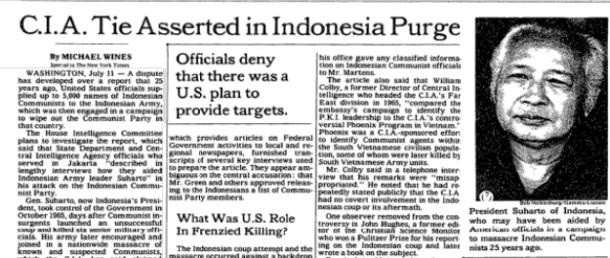
The New York Times (7/12/90) went out of its way to cast doubt on evidence of US participation in the mass murders.
This is not the first time that the New York Times has downplayed US culpability in the Indonesian bloodbath. When Kathy Kadane of States News Service (Washington Post, 5/21/90) broke the story that the US embassy had provided lists of PKI members to the Indonesian military at the height of the murders, the Times‘ Michael Wines (7/12/90) wrote an unusual attempt to discredit the story:
A dispute has developed over a report that 25 years ago, United States officials supplied up to 5,000 names of Indonesian Communists to the Indonesian Army…. The dispute has focused on whether the decision to turn over the names was that of an individual American Embassy officer, or was coordinated with the Central Intelligence Agency and approved by senior embassy officers.

The NYT’ most cheerleading coverage
came from future editor Max Frankel (e.g., 10/11/65).
As FAIR noted at the time (Extra!, 7–8/90), the Times‘ reluctance to admit that the US had actively participated in the Indonesian genocide may have been related to its enthusiasm for the genocide as it was happening:
While some of its coverage did invoke the horror of the massive killing (as early as 1/16/66), in general the Times’ commentary and analysis viewed the destruction of the Communist party quite favorably. “A Gleam of Light in Asia” was the headline of a James Reston column (6/19/66). “Almost everyone is pleased by the changes now being wrought,” C.L. Sulzberger commented (4/8/66). The Times itself editorialized (4/5/66) that the Indonesian military was “rightly playing its part with utmost caution.”
But perhaps the most enthusiastic of all the Times’ writers was Max Frankel, then Washington correspondent, now executive editor. “US Is Heartened by Red Setback in Indonesia Coup,” one Frankel dispatch was tagged (10/11/65). “The Johnson administration believes that a dramatic new opportunity has developed both for anti-Communist Indonesians and for United States policies” in Indonesia, Frankel wrote. “Officials… believe the army will cripple and perhaps destroy the Communists as a significant political force.”
After the scale of the massacre began to be apparent, Frankel was even more enthusiastic. Under the headline “Elated US Officials Looking to New Aid to Jakarta’s Economy” (3/13/66), Frankel reported that
the Johnson administration found it difficult today to hide its delight with the news from Indonesia…. After a long period of patient diplomacy designed to help the army triumph over the Communists, and months of prudent silence… officials were elated to find their expectations being realized.
Frankel went on to describe the leader of the massacre, Gen. Suharto, as “an efficient and effective military commander.”
To acknowledge that the US has looked upon mass murder as a positive project worth supporting is risky when the Times itself saw that same mass murder as worthy of support.
It’s not that the Times‘ piece today is wholly uncritical; it even admits, in a backhanded fashion, that the US did more than “stand by” during the massacres:
In 2015, Senator Tom Udall of New Mexico reintroduced a resolution in the Senate calling for Indonesia to face up to its traumatic history. He also held the United States to account for its “military and financial support” there, which included providing lists of possible leftist sympathizers to the Indonesian government and, as one cable released Tuesday showed, pushing to bury foreign news coverage of the killings.
But this information, appearing two-thirds of the way through the article, does not overcome the message in the headline and much of the text that the US sinned by omission, not commission. Framing Washington as a passive onlooker rather than active participant not only lessens the government’s (and the New York Times‘) culpability; it also tells readers that if the US is to be faulted, it’s to be blamed for not doing enough. That’s a handy attitude to cultivate for the next time you want to sell a “humanitarian” war.
You can send a message to the New York Times at letters@nytimes.com
Weinstein scandal shows America is ethically bankrupt, indecent collection of moral cowards
By Michael McCaffrey | RT | October 12, 2017
Harvey Weinstein’s sexual harassment scandal isn’t only an indictment of his twisted soul, but of America’s as well.
The story of Weinstein, the uber-powerful film producer, co-founder of Miramax Films and major donor to Democratic politicians, who got fired from his job as co-Chairman of The Weinstein Company after the New York Times ran an article exposing his serial sexual harassment of female employees, is such a perfect storm of corruption, depravity and hypocrisy that it exquisitely encapsulates the moral decay of America.
The New York Times piece revealed that Weinstein has settled at least eight different sexual harassment lawsuits over the years. The article was just the tip of a really grotesque iceberg, for in its wake a plethora of other claims has surfaced.
In a New Yorker article, written, ironically enough, by Ronan Farrow, son of alleged pedophile Woody Allen, even more claims emerged of Weinstein’s predatory behavior. One of the many lowlights from that article includes Italian actress/filmmaker Asia Argento and two other women claiming that Weinstein raped them.
The most famous women among the sea of those claiming harassment at the hands of the movie mogul are Gwyneth Paltrow, Angelina Jolie, Ashley Judd, Rose McGowan and Rosanna Arquette.
The odiousness of this Weinstein scandal is overwhelming, and nearly every public person is going through the Kabuki theater of denouncing Harvey and his lecherousness, but this strikes me as disingenuous at best. All the movie stars, media members, and politicians strongly reprimanding Weinstein now, displayed nothing but egregious cowardice during Harvey Weinstein’s grotesque reign of wanton terror.
Many Hollywood heavyweights like Meryl Streep, George Clooney, Ben Affleck and Jennifer Lawrence, are feigning ignorance of Weinstein’s disgusting depravity, but the revelation of Weinstein’s repulsive misdeeds cannot possibly come as a surprise. Harvey, the rotund and repugnant Hollywood kingmaker, is notorious in the film industry for his petulant and imperious approach, which includes physically abusing underlings and being a lascivious beast to women. Tales of Weinstein’s bad behavior are so legion that even a complete nobody like me has heard them ad infinitum.
So how did Harvey get away with being such a gigantic creep for so long? The main reason is that he possessed the rarest talent that all of Hollywood covets, the ability to garner Oscar votes for his films. Weinstein produced films have been nominated for Best Picture 26 times in the last 28 years and have been nominated overall for over 300 Academy Awards. In other words, Harvey could make people rich and famous beyond their wildest dreams, which is why so many in Hollywood checked their humanity and ethics at the door and looked the other way when he was being such a troglodyte. To quote Upton Sinclair, “It is difficult to get a man to understand something when his salary depends on his not understanding it.”
Blind ambition isn’t the only reason Hollywood looked the other way regarding Weinstein, political expediency played a part as well. Weinstein has been a long time supporter of Democratic candidates, Barack Obama and Hillary Clinton in particular, and has donated a lot of money to their campaigns.
A perfect example of someone making a devil’s bargain with Weinstein for political reasons is Lena Dunham. Dunham, a vociferous and vocal Clinton supporter and devout feminist, admitted she knew of Weinstein’s predatory reputation in regards to women, but still shook his hand and performed at a fundraiser he held for Clinton’s campaign. Dunham said she betrayed her feminist values because “she so desperately wanted to support Clinton.”
Hollywood liberals were quick to denounce Evangelical Christians for supporting Trump despite his moral turpitude and misogyny, calling them hypocrites. I agree that Evangelicals are hypocrites for supporting Trump, but so are Hollywood liberals for enabling Weinstein. Both sides need to get off their high horse and read Matthew 7:5, “You hypocrite! First, remove the beam out of your own eye, and then you can see clearly to remove the speck out of your brother’s eye.”
Speaking of enabling, the Weinstein scandal brought to my mind a line from a U2 song, “if you need someone to blame, throw a rock in the air, you’ll hit someone guilty.” When I throw my rock, it often lands on the media, and so it is with this case.
Ronan Farrow published his Weinstein story in the New Yorker magazine, but only because his employer NBC news refused to go with the story. NBC is in business with Weinstein on various film and television projects, and no doubt did not want to ruffle the feathers of such a powerful and litigious man like Harvey Weinstein, so they passed on it, which means this story says just as much about them as it does about Weinstein.
Even the New York Times, which broke the Weinstein story, came out smelling less like a rose and more like a manure pile after it became known the newspaper spiked a similar story regarding Weinstein in 2004 after being pressured by the producer and his lawyers to do so.
The New York Times dropping the ball on an important story in the early 2000’s should come as no surprise to anyone who followed the lead up to the Iraq War or Bush surveillance, but what was shocking was who helped to scuttle the 2004 Weinstein article. Matt Damon, yes, Matt Damon, Mr. Good Will Hunting, and thought-to-be good guy called the Times reporter to defend and vouch for Weinstein to stop the story. So did everyone’s favorite Gladiator Russell Crowe. I wonder how Damon and Crowe sleep at night knowing they were complicit in thirteen more years of Weinstein’s abusing women?
It is uncomfortable to acknowledge, but another group of people who could have stopped Harvey Weinstein but did not were the more famous of his victims, like Gwyneth Paltrow, Angelina Jolie, Mira Sorvino and Ashley Judd. These women did not ask to be placed in this terrible position, but they could have stopped him cold if they came forward years ago. The reason I cite them and not the other victims is because they were uniquely positioned to be able to defend themselves and to take on Harvey Weinstein, where the other victims were not. What I mean by that is that Paltrow, Jolie, Sorvino, and Judd all come from entertainment families that are well-known and liked in the industry. They were not powerless because they have strong allies and deep connections in the business. These women, sans Judd, also won Oscars, giving them, even more, credibility and visibility to make their claims. I do not “blame” these women for being harassed or assaulted by Weinstein, I only wish they overcame their ambition and saved others from that awful fate.
The cavalcade of condemnation for Weinstein will continue unabated for the days and weeks to come, and deservedly so, but to see him only as a target of derision diminishes his impact as a cautionary tale. Weinstein is simply a symptom of the wider disease which I call “reality show America,” which sees human beings as disposable and transactional objects whose value is measured in terms of their usefulness for entertainment or pleasure.
The true power of the Weinstein story is not about his personal failings, but that it is symbolic of the fact that “reality-show America”, which thrives across the political and cultural spectrum, is a collection of self-serving, amoral, hypocrites who are quick to attack the failings of their enemy but slow to embrace self-reflection.
Will the denizens of “reality-show America” in Hollywood, Washington and the news media ask themselves how they have contributed to the culture that bred a man like Harvey Weinstein? I sincerely doubt it since deflection, emotional myopia and historical amnesia are as American as apple pie.
This scandal is an opportunity, not only to see Weinstein for who he really is but also to see America for what we have become…an ethically bankrupt and indecent collection of moral cowards allergic to self-reflection and truth.
This “reality-show America”, currently starring the Trumps and Kardashians (with special guest appearance by the Clintons!) and produced by Harvey Weinstein, reveals that America has devolved to the point of shameless obscenity, and regardless of how self-righteous we as liberals, conservatives, Democrats or Republicans may feel, we no longer possess any moral authority because, just like Harvey Weinstein, Hollywood, Washington and Wall Street, we are incapable of being honest with ourselves.
It is difficult to admit, but if we mustered the courage to see ourselves as we truly are, we would recognize that Harvey Weinstein is America, and America is Harvey Weinstein. Both are bloated, entitled, corrupt, bombastic, blindly ambitious bullies, full of fear and loathing, that use their outsized power to exploit the defenseless to indulge their darker impulses and insatiable desires. The sooner we recognize that, the faster we can try to change it.
Michael McCaffrey is a freelance writer, film critic and cultural commentator. He currently resides in Los Angeles where he runs his acting coaching and media consulting business. mpmacting.com/blog/
https://www.rt.com/shows/crosstalk/406317-weinstein-scandal-hollywood-hypocrisy/video/
Featured Video
BRITAIN’S WARNING: PREPARE FOR WAR
or go to
Aletho News Archives – Video-Images
From the Archive
How Ukraine Tortured and Slaughtered Donbass
By Kit Klarenberg | Al Mayadeen | July 11, 2024
Almost immediately after the proxy war erupted, ISIS-tier footage of the torture and murder of Russians in Ukrainian custody emerged.
On July 6th, the New York Times published an astonishing investigation: In Ukraine, Killings of Surrendering Russians Divide an American-Led Unit. The article documents in grim detail how Chosen Company, an international volunteer battalion for Kiev, routinely executes Russian prisoners of war. It is the very first mainstream admission that this practice – a brazen breach of the Geneva Conventions, and a grave war crime – is widespread among Ukraine’s fighters, both foreign and homegrown. … continue
Blog Roll
 Aletho News
- Israel Demolishes Home Of Lebanese Journalist Whose Viral Film Exposed Pager Attack
- Record Oil, Empty Tanks: The UAE’s Miracle Recovery
- Burnham tackles Britain’s poverty with aggression in Yemen
- Peace in Ukraine: the easy way – or the hard way
- Trump & the Rrrrussians
- US taxpayer money laundered back through Ukraine – Musk
- Before COVID, an NIH lab chief proposed making a SARS-like bat virus more infectious
- Gates, Bourla on Trial in Netherlands Accused of ‘Great Reset’ Scheme at Vaccine Injury Hearing
- BRITAIN’S WARNING: PREPARE FOR WAR
- “Historic Russia”: The Land Putin Will Not Give Back
- If Americans Knew
- An error has occurred; the feed is probably down. Try again later.
- No Tricks Zone
- Two New Studies Find Thwaites Glacier Melt Cannot Be Driven By Human Activity Or A Warming Ocean
- E-Cars Reduce CO2 Emissions By Only 41% Compared To Internal Combustion Engine Vehicles
- Predictions Made By Renowned Climate Professor Over Past Decades Have Been Proven To Be Poor
- New Study Suggests Large Regions Of The Pacific Ocean Have Been Cooling For The Last 80 Years
- Germany’s Green Energy Debacle: High Energy Costs Force Kahla Porzellan to Close After 182 Years!
- New Study: 50 Years Of The Most Aggressive ‘Net Zero’ Policies Can Only Affect The Global Climate By 0.03°C
- US September “Heat” Was No Record…Many Records Set Decades Ago
- Latest European Green Energy Debacle; Portugal’s Largest Flagship Solar Park Insolvent!
- Green Energy Debacle: German Expert Professor Fritz Vahrenholt Warns Of Severe Economic And Social Consequences
- Two More Paleo Reconstructions Affirm Meters-Higher Sea Levels Across Ireland, Brazil 7000-6000 Years Ago

