Are Neocons an Existential Threat?
By Robert Parry | Consortium News | September 15, 2015
The neoconservatives arguably have damaged American national interests more than any group in modern history. They have done more harm than the marginal Communists pursued by Sen. Joe McCarthy in the 1950s, more than the Yippies of the 1960s, more than Richard Nixon’s Watergate burglars in the 1970s or the Iran-Contra conspirators in the 1980s.
The neocons have plunged the U.S. government into extraordinarily ill-considered wars wasting trillions of dollars, killing hundreds of thousands if not millions of people, and destabilizing large swaths of the planet including the Middle East, much of Africa and now Europe. Those costs include a swelling hatred against America and a deformed U.S. foreign policy elite that is no longer capable of formulating coherent strategies.
Yet, the neocons have remained immune from the consequences of their catastrophes. They still dominate Washington’s major think tanks as well as the op-ed pages of virtually all the leading newspapers, including The Washington Post, Wall Street Journal and New York Times. They hold down key positions in the State Department, and their “liberal interventionist” pals have the ear of President Barack Obama.
Clearly, the neocons are skilled operatives, knowing how to arrange a steady stream of funding for themselves, from military contractors donating to think tanks, from U.S. taxpayers footing the bill for organizations like the National Endowment for Democracy, and from ideological billionaires set on aligning U.S. foreign policy with hard-line Israeli desires.
The neocons are adept at writing op-ed articles that twist any set of facts into support for their ideological cause; they supply just the right quote that fits into the news cycle’s latest narrative; and they host policy conferences that attract powerful politicians and fawning media coverage.
But are the neocons a force that can coexist with the American Republic? Have they become an existential threat not only to the constitutional structure crafted in 1787 but to continued life on the planet? Are they locked on a course of action that could lead to a nuclear holocaust?
Clearly, the neocons’ commitment to Israeli interests violates a key principle established by the nation’s early presidents who all warned against “foreign entangling alliances” as a fundamental threat to a citizens’ republic that would transform America into a warrior state that would inevitably sap the nation’s liberties.
That loss of liberty has surely happened. Not only is there now bipartisan support for a surveillance state that can spy on the personal lives of American citizens, but the U.S. government has wedded itself to the concept of “strategic communications,” a catch-phrase that merges psychological operations, propaganda and P.R. into a seamless approach toward managing public perceptions at home and abroad.
When information is systematically pushed through a filter designed to ensure consent, the core democratic concept of an informed electorate has been turned on its head: The people no longer oversee the government; the government manipulates the people.
Neocon Tactics
All this has been part of the neocon approach dating back to the 1980s when key operatives, such as Robert Kagan and Elliott Abrams, were part of inter-agency task forces designed to whip the American people into line behind the government’s aggressive war policies. Guided by seasoned CIA propagandists, such as Walter Raymond Jr., the neocons learned their lessons well.
But the neocons are no longer just threatening the existence of the Republic; they are now endangering the continuation of life itself. They have decided to launch a new Cold War against Russia that will push the world toward the brink of thermo-nuclear war.
Of course, the neocons will frame their doomsday strategy as all Vladimir Putin’s fault. They will insist that they are just standing up to “Russian aggression” and that anyone who doesn’t join them is a “stooge of Moscow” or “weak.” They will dictate the shape of the debate just as they have in countless other situations, such as guiding Americans to war in Iraq over non-existent WMD stockpiles.
The neocon pundits will write seemingly authoritative op-eds about devious Kremlin strategies which will glue black hats on the Russians and white hats on whomever is on the other side, whether the neo-Nazis in Ukraine or the Islamic State/Al Qaeda terrorists in Syria. Americans will be whipped up into a frenzy that will demand a direct clash with the “Russ-kies” or “regime change” in Moscow.
There will be little or no concern about the risks. With the neocons, there never is. The assumption is that if “Amur-ika” is tough, the other side will back down. Then, with U.S.-led economic sanctions from the outside and U.S.-funded NGOs stirring up trouble from the inside, “regime change” becomes the cure-all.
Everyone who’s important in Official Washington – everyone on the talk shows and op-ed pages – knows that these disruptive situations always play out just the way they’re diagramed inside the top think tanks. A hand-picked “democratic reformer” who’s traveled the think-tank circuit and gotten the seal of approval – the likes of Iraq’s Ahmed Chalabi – will easily be installed and then the target country will do whatever the neocons dictate. After all, that approach worked so well in Iraq. The neocons always know best.
Raising the Stakes
Yet, with Russia, the stakes are even higher than with Iraq. Yes, it’s easy to find fault with Vladimir Putin. I myself have a personal rule that men over 40 should keep their shirts on when out in public (unless maybe they’re actors in a Bond film or going for a swim at the beach).
But Putin at least is a rational player in global affairs. Indeed, he has tried to cooperate with President Obama on a variety of key issues, including convincing Syria to surrender its chemical weapons and getting Iran to make concessions in the nuclear deal – two contributions to world peace that infuriated the neocons who favored bomb-bomb-bombing both Syria and Iran.
At a dinner party in Europe this summer, I was asked by a well-informed British woman what should be done with Putin. My answer was that Putin doesn’t frighten me; it’s the guy who comes after Putin who frightens me – because despite the neocons’ confidence that their “regime change” plans for Moscow will install a malleable moderate, the more likely result would be a much harder-line Russian nationalist than Putin.
The idea of the nuclear codes being handed to someone determined to defend the honor of Mother Russia is what scares me. Then, the clumsily aggressive neocons in Washington would have their reckless counterpart in Moscow, with neither side having the wisdom of a John F. Kennedy or a Nikita Khrushchev as displayed during the Cuban Missile Crisis in 1962.
Would American neocons or a Russian super-nationalist have the wisdom and courage to back down, to compromise, to make the concessions necessary to avoid plunging over the edge? Or would they assume that the other guy would blink first and that they would “win” the showdown?
I recall what William R. Polk, one of Kennedy’s mid-level aides during the Cuban Missile Crisis, wrote recently about what happens to the human mind under such stress.
“Since human beings make the decisions, we must be aware of decision makers’ vulnerabilities,” Polk wrote. “During the Cuban Missile Crisis, I was one of about 25 civilians fully engaged in the events. I was not at the center but in the second or third ‘echelon.’ So I did not feel the full strain, but by the Thursday of the Crisis, I was thoroughly exhausted. My judgment must have been impaired even though I was not aware of it.
“I do remember, however, a terrible episode – fortunately lasting only a few minutes – at which I thought to myself, ‘let’s just get it over with.’ When later I met with my Soviet counterparts, I got the impression, although they denied it, that my feelings were not unique. How the strain impacted on the inner group I can only guess.”
If someone as stable and serious as Bill Polk had such thoughts – “let’s just get it over with” – what might happen when American neocons or hyped-up Russian nationalists are inserted into the decision process? That is an existential question that I don’t want to even contemplate.
Endless Putin-Bashing
And, if you doubt that the neocons will engage in over-the-top Cold War-style Putin bashing, you should read the op-ed by The Washington Post’s neocon deputy editorial page editor Jackson Diehl on Monday, entitled “Putin shifts fronts: With a move into Syria, he continues his in-your-face maneuvers.”
Diehl delves into Putin’s psyche – a process that is so much easier than doing real reporting – and concludes that Putin’s decision to join the fight in Syria against the Islamic State and Al Qaeda is just another attempt to stick his finger in the eye of the righteous but clueless United States.
Diehl, of course, starts off with the neocon-approved narrative of the Ukraine crisis, ignoring the key role of neocon Assistant Secretary of State Victoria Nuland (Robert Kagan’s wife) in midwifing the Feb. 22, 2014 coup that overthrew democratically elected President Viktor Yanukovych and installed an intensely anti-Russian regime on Russia’s border. Nuland even handpicked the new Prime Minister Arseniy Yatsenyuk, telling U.S. Ambassador Geoffrey Pyatt in a phone call several weeks before the coup that “Yats is the guy.”
The coup-makers then dispatched neo-Nazi militias (and Islamist militants) to wage a bloody “anti-terrorism operation” against ethnic Russian Ukrainians who resisted the “regime change.” [See Consortiumnews.com’s “Ukraine Merges Nazis and Islamists.”]
But all that complexity is neatly boiled down by American neocons and the mainstream U.S. media as “Russian aggression.” Regarding the Syrian civil war, some neocons have even joined with senior Israeli officials in claiming that a victory by Al Qaeda is preferable to the continuation of Assad’s secular regime. [See Consortiumnews.com’s “Syria’s Nightmarish Narrative.”]
Yet, however the story goes, the biggest bad guy is Putin, always with sinister motives and evil intent. So, in explaining the situation in Ukraine and Syria, Diehl writes:
“Throughout the summer, Russia’s forces in eastern Ukraine kept up a daily drumbeat of attacks on the Ukrainian army, inflicting significant casualties while avoiding a response by Western governments. On Sept. 1, following a new cease-fire, the guns suddenly fell silent. Optimists speculated that Vladimir Putin was backing down.
“Then came the reports from Syria: Russian warplanes were overflying the rebel-held province of Idlib. Barracks were under construction at a new base. Ships were unloading new armored vehicles. Putin, it turns out, wasn’t retreating, but shifting fronts — and executing another of the in-your-face maneuvers that have repeatedly caught the Obama administration flat-footed.”
The rest of the op-ed is similarly didactic and one-sided: Putin is the villain and Obama is the rube. In Diehl’s world, only he and other neocons have what it takes to take on Putin and put Russia down.
Any alternative explanation for Russia’s action in Syria is brushed aside, such as Putin deciding that a victory by either Al Qaeda’s Nusra Front – as favored by Israel – or the even more bloodthirsty Islamic State is unacceptable and thus Assad’s regime must be stabilized to avert a major geopolitical catastrophe.
Typically, the neocons breeze past the frightening logic of what the collapse of Assad’s military would mean for the Middle East, Europe and the world. After all, once Israeli leaders decided to throw in their lot with Al Qaeda in Syria, the die was cast as far as the neocons were concerned.
But the notion that the neocons can micromanage the outcome in Syria, with “moderate” Al Qaeda taking Damascus rather than the more “radical” Islamic State, reflects the arrogant know-nothing-ism of these U.S. opinion leaders. More likely, Al Qaeda’s Nusra Front would coordinate with their former allies in the Islamic State and share in the Sunni revenge against Syria’s Christian, Alawite, Shiite and other minorities.
So, while the Islamic State would busy itself chopping off heads of “heretics,” Al Qaeda could use its new headquarters in Damascus to plot the next round of terror attacks against the West. And, as destabilizing as the current refugee flow into Europe has been, it would multiply astronomically as the survivors of the Islamic State/Al Qaeda bloodletting flee Syria.
With Europe in chaos and the neocons still insisting that the real enemy is Russia, the possible consequences would be frightening to contemplate. Yet, this is the course that the neocons have set for the world – and nearly all the Republican candidates for president have signed on for the journey along with Democratic frontrunner Hillary Clinton.
In 2014, arch-neocon Robert Kagan, whom Secretary of State Clinton selected as one of her advisers while also promoting his wife, Victoria Nuland, told The New York Times that he could embrace a Clinton presidency: “If she pursues a policy which we think she will pursue … it’s something that might have been called neocon, but clearly her supporters are not going to call it that; they are going to call it something else.” [For more, see Consortiumnews.com’s “Is Hillary Clinton a Neocon-Lite?” and “Obama’s True Foreign Policy ‘Weakness.’“]
So far, virtually no one in the 2016 presidential race or in the mainstream U.S. news media is seriously addressing the reality of the neocons’ “regime change” chaos spreading across the Middle East and the prospect of a destabilized Europe. What limited discussion there is on the campaign trail mostly echoes Jackson Diehl’s Putin-bashing.
No one dares confront the existential question of whether the United States and the world can continue to tolerate and accommodate the neoconservatives.
~
Investigative reporter Robert Parry broke many of the Iran-Contra stories for The Associated Press and Newsweek in the 1980s. You can buy his latest book, America’s Stolen Narrative, either in print here or as an e-book (from Amazon and barnesandnoble.com).
Al Aqsa Under Attack: The NY Times Blames Its Youthful Defenders
By Barbara Erickson | TimesWarp | September 14, 2015
Tensions are running high at Jerusalem’s Al Aqsa Mosque, and The New York Times can tell us where to place the blame: It’s not the fault of extremists who plan to destroy the landmark, according to the Times, nor is it recent Israeli moves to restrict Muslim access to the site; it is the fault of hot-headed Palestinian youth.
In a story today and in a similar article last July Isabel Kershner points directly to these young people as the source of trouble in clashes with police. This is how the police have framed the issue, and Kershner gives prominence to their claims.
The Times story contrasts with reports from international media and Palestinian sources. From these accounts we learn that the youths were volunteer guards helping defend the holy site against Israeli incursions and that police stormed the mosque while Muslims were inside, beating and injuring worshippers and damaging prayer rugs and other articles. We also learn that these actions prompted even Arab nations on good terms with Israel to speak out in protest.
Kershner quotes Palestinian Liberation Organization secretary Saeb Erekat and a Hamas spokesman who condemn the Israel invasion of the mosque, but she fails to tell readers that both Jordan and Egypt, two nations friendly to Israel, also protested, along with the Arab League and the United Nations representative for peace talks.
The Al Aqsa Mosque has stood at its site in Jerusalem for a thousand years and is revered by Muslims everywhere, but Jews also consider the area as holy ground, where the Second Temple once stood. Extremists openly call for the destruction of both Al Aqsa and the even more ancient Dome of the Rock, which dominates the Jerusalem skyline. They plan to raze the edifices and replace them with a Third Temple.
The Times story fails to acknowledge these real threats that cause anguish among the followers of Islam. It has also neglected to report on Israel’s numerous efforts to restrict Muslim prayer at the mosque and the increasing presence of Jewish worshippers, who are protected by troops when they visit the compound.
Muslims know that another holy site, the Ibrahimi Mosque in Hebron, has been divided between a Muslim and a Jewish section, and that Israeli officials often choose to ban Muslims from entering altogether. This month, worshippers have been excluded from the Hebron mosque for six entire days.
Kershner reports that Muslims charge Israel with plans to divide the Al Aqsa compound, but she says that this is “an assertion vehemently denied by Israel.” Missing from her article is the history of Hebron and the restrictions Israeli authorities frequently impose on Muslim worshippers in both sites.
In recent weeks, for instance, Israel has prevented women from entering the Al Aqsa area, retained the identify cards of worshippers, allowed Jewish extremists to enter the mosque compound for “tours,” restricted the entry of students attending schools in the Al Aqsa compound and confiscated land in an Islamic cemetery next to the mosque.
After the latest incursion, the director of the mosque compound, Sheikh Omar al-Kiswani, said that Israel occupation authorities “have imposed their sovereignty over [the mosque compound] by power of force.” Israel controls who enters and exists, he said, and officials use force against anyone who challenges them.
This is a cry of alarm from a site revered by millions of Muslims throughout the world, but it found no mention in the Times. Instead, we receive the Israeli spin on this tragic saga as the newspaper glosses over the expansionist aims of a Zionist state.
US War Theories Target Dissenters
By Todd E. Pierce | Consortium News | September 12, 2015
When the U.S. Department of Defense published a new Law of War Manual (LOW) this past summer, editorialists at the New York Times sat up and took notice. Their concern was that the manual stated that journalists could be deemed “unprivileged belligerents.” The editorial explained that as a legal term “that applies to fighters that are afforded fewer protections than the declared combatants in a war.” In fact, it is far more insidious than that innocuous description.
Here is the manual’s definition: “‘Unlawful combatants’ or ‘unprivileged belligerents’ are persons who, by engaging in hostilities, have incurred one or more of the corresponding liabilities of combatant status (e.g., being made the object of attack and subject to detention), but who are not entitled to any of the distinct privileges of combatant status (e.g., combatant immunity and POW status).”
The key phrase here is “being made the object of attack.” For slow-witted New York Times editorialists, that means journalists can be killed as can any enemy soldier in wartime. “Subject to detention” means a journalist deemed an unprivileged belligerent will be put into military detention if captured. As with any enemy belligerent, however, if “capture is not feasible,” they would be killed if possible, by drone perhaps if in a foreign country.
Currently, most U.S. captives deemed “unprivileged belligerents” are imprisoned in Guantanamo although some may be held in Afghanistan. It must be noted that the United States deems as an “unprivileged belligerent” anyone they target for capture or choose to kill.
That the New York Times’ concern only arose with publication of the new LOW manual suggests they may have been in a deep sleep since 9/11 as the Department of Defense (DOD) has openly worked to impose limitations on information sharing and news gathering since that event gave them a pretext. It is now a well-established pattern of the U.S. government to suppress rights guaranteed by the First Amendment whenever they can get by with it, as was seen with the New York Times own James Risen.
But the New York Times colluded with the CIA in censoring Risen’s reporting. Furthermore, they seemed to have ignored the U.S. government’s momentous argument of the unlimited power of the President to target journalists and activists for “expressive activities,” as the Department of Justice stated in the case of Hedges v. Obama, as described below.
It has frequently been noted there’s been an ongoing “war” against journalists since 9/11. The new DOD Law of War manual makes that official and potentially takes it to the highest level of conflict. While expressing concern, the Times’ editorialist does not seem to realize or care how ominous it is that the DOD now openly declares that journalists may be deemed “unprivileged belligerents,” unlawful combatants, as the DOD manual provides, instead of hiding the fact in coded language as done since 2001. Inherent to those classifications is that they represent the “enemy” and can be killed by U.S. officials.
That will come as no surprise to those acquainted with the foreign journalists who have been targeted and killed by drones in places such as Pakistan. Nor will it surprise Sami al-Hajj, the Al Jazeera journalist who was held in Guantanamo for years. But now it is clear that the same fate could be in store for U.S. journalists.
That coded language is embedded in the claim by Military Commissions prosecutors and the Justice Department that there is a “U.S. domestic common law of war.” What they claim is entirely based upon martial law orders of the Civil War and the military’s orders to remove Japanese-Americans from the their homes on the West Coast in World War II. All the cases they rely on for a “domestic law of war” today were judicially condemned during or almost immediately after the wars in which they were a part of.
U.S. Domestic Common Law of War
U.S. Military Commissions Chief Prosecutor Brig. General Mark Martins and his staff invented what they call the “U.S. domestic common law of war” in filings to the D.C. Circuit Court of Appeals. That invention consists only of the martial law precedents of the U.S. Civil War and the removal of the Japanese-Americans from the West Coast at the direction of General DeWitt. Both were later seen as examples of military despotism.
The American people have been inured by a deliberate effort of the U.S. military to accept invocation of the law of war as a talisman to permit any act by officials which would have been known as illegal before 9/11. But as the manual states: “Although the law of war is generally viewed as ‘prohibitive law,’ in some respects, especially in the context of domestic law, the law of war may be viewed as permissive or even as a source of authority. For example, the principle of military necessity in the customary law of war may be viewed as justifying or permitting certain acts.” (Emphasis added.)
“Military necessity” was the law of war basis for removal of the Japanese-Americans. Military necessity though indisputably a part of the law of war is a totalitarian precept when applied to a civilian population.
The LOW manual explains the object of war by quoting George H. Aldrich, Deputy Legal Adviser to the U.S. Department of State during the Vietnam War. He wrote of “a general acceptance of the view that modern war is aimed not merely at the enemy’s military forces but at the enemy’s willingness and ability to pursue its war aims. . . . In Viet-Nam political, rather than military, objectives were even more dominant. Both sides had as their goal not the destruction of the other’s military forces but the destruction of the will to continue the struggle.”
The “destruction of the will” of the adversary is always the object of war, according to Clausewitz and adopted by the U.S. military. But this has a totalitarian element to it; the adversary’s reciprocal object is to destroy our will. Consequently, “our” will must be protected by suppressing any dissent which could harm morale and the population’s willingness to “continue the struggle.”
That was the foundational belief underlying martial law during the Civil War. The Constitution was an obstacle again to suppressing dissent to a degree after the Civil War, but with the invention of a U.S. domestic common law of war and legalistic word play, this obstacle has once again been removed as the Justice Department argued in Hedges v. Obama.
The claim of being at war with internal and external enemies is always made by totalitarian states to justify their suppression of speech and a free press through repression. For a brief period in U.S. history, the Civil War, the U.S. military adopted military repression through martial law to suppress any dissent to its war practices.
Martial law was declared throughout the Union States, the North, on Aug. 8, 1862, by Secretary of War Edwin M. Stanton, at the request of President Abraham Lincoln. Orders were published to “arrest and imprison” any persons “discouraging volunteer enlistments” or “giving aid and comfort to the enemy” or for “any other disloyal practice.” A military commission would try the prisoners, and a second order “suspended” the writ of habeas corpus in their cases.
Martial law was more formally declared on Sept. 24, 1862, by President Lincoln himself in addition to suspending the writ of habeas corpus. Lieber’s Code was then prepared as the order giving effect to martial law. Contrary to how it is presented by the U.S. Army and credulous human rights commentators, Lieber’s Code was primarily a harsh martial law order with Prussian militarist law of war concepts introduced to the U.S. to criminalize any expressions of dissent as “war treason.”
Thus, Col. William Winthrop explained that among the greater number of individuals who were brought to trial before the military commissions during the Civil War, the offenses included “hostile or disloyal acts, or publications or declarations calculated to excite opposition to the federal government or sympathy with the enemy, etc.”
Whiting’s Guidance
Solicitor of the Department of War during the Civil War, William Whiting, gave legal guidance to the Union Commanders for enforcement of martial law. The “guidebook” was his own War Powers of the President. This book could have been used by any militaristic and totalitarian regime, which in fact it was as it was derived from authoritarian principles of martial law from Prussia. Those authoritarian principles remained in force under Prussia’s successor state, Germany, during two world wars, and were the legal basis of the infamous People’s Court which tried “war treason” cases; cases of “disloyal” expressive acts in most cases without more.
The guidance of Whiting was: “No person in loyal States can rightfully be captured or detained unless he has engaged, or there is reasonable cause to believe he intends to engage, in acts of hostility to the United States — that is to say, in acts which may tend to impede or embarrass the United States in such military proceedings as the commander-in-chief may see fit to institute.” This is the same argument that the U.S. government made in Hedges v. Obama.
What constituted an act of hostility? Whiting defines that to include a sentiment of hostility to the government “to undermine confidence in its capacity or its integrity, to diminish, demoralize . . . its armies, to break down confidence in those who are entrusted with its military operations in the field.”
An example of how martial law was to be carried out was in an order to a subordinate commander by the Army Department of the Pacific Commander in response to complaints from the Citizens of Solano County, California, of disloyal “utterances” they were hearing from fellow citizens.
The order read: “The department commander desires you to let the people understand generally that the order of the President suspending the writ of habeas corpus and directing the arrest of all persons guilty of disloyal practices will be rigidly enforced. . . . Practices injurious to the government or offensive to the loyal sentiment of the people will under no circumstances be permitted.”
Immediately after the Civil War, when it was freshest in their minds, the Supreme Court had this to say about martial law in Ex Parte Milligan: “What is ordinarily called martial law is no law at all. Wellington, in one of his despatches from Portugal, in 1810, in his speech on the Ceylon affair, so describes it. Let us call the thing by its right name; it is not martial law, but martial rule. And when we speak of it, let us speak of it as abolishing all law, and substituting the will of the military commander, and we shall give a true idea of the thing, and be able to reason about it with a clear sense of what we are doing.”
Martial law is a sub-part of the Law of War and since it is for application to a domestic population as with the Northern States during the Civil War by the Union Army, it is “moderated” ordinarily from the even harsher provisions of the Law of War which are now invoked in the Law of War manual. Yet precepts of both are being introduced domestically with Section 1021 of the 2012 National Defense Authorization Act and domestically and globally by the “U.S. domestic common law of war” precedents trumpeted by Chief Military Commissions Prosecutor, Brig. Gen. Mark Martins.
It must be noted that this is not to compare the Union unfavorably with the Confederacy. The Confederacy had the highest form of martial law: slavery. But the Defense Department only uses one legal precedent from the Confederacy today, which is “outlawry.”
Lieber’s Code addressed “outlawry” in Art. 148, which provided, in pertinent part: “The law of war does not allow proclaiming either an individual belonging to the hostile army, or a citizen, or a subject of the hostile government, an outlaw, who may be slain without trial by any captor, . . . on the contrary, it abhors such outrage.”
This was adopted in the Hague Regulations and as interpreted in earlier Army Law of Land Warfare manuals, prohibited assassinations as well as any declarations that an individual or group is outside the protection of the law of war, which is what designation as an unprivileged belligerent does. The prohibition of assassination has also been put aside with the routine practice of assassination with drones today by the U.S. military.
The Confederacy committed the offense of outlawry when its leaders declared all captured African-Americans fighting for the Union were outside the protection of the law of war (which did preexist Lieber’s Code) and would be placed into the indefinite detention of slavery. After 9/11, the U.S. government did the same with the invention of the unlawful combatant/unprivileged belligerent category and indefinite detention at Guantanamo Bay and any other location U.S. officials chose to place “unprivileged belligerents.”
Treason of the Professors and the Media
Ironically, shortly after the New York Times expressed its concern for journalists in early August, the Guardian reported in an article written by William C. Bradford, a recently hired assistant professor in the law department at the U.S. Military Academy at West Point. The article, entitled “Trahison des Professeurs: The Critical Law of Armed Conflict Academy as an Islamist Fifth Column,” was published in the National Security Law Journal of George Mason University Law School.
Bradford argued that the U.S. should be more aggressive in attacking Muslims to include attacks which are war crimes under the law of war. But it was his advocacy that the U.S. military attack other “lawful targets” in its war on terrorism, which include “law school facilities, scholars’ home offices and media outlets where they give interviews” that caught the most attention. These civilian areas were all places where a “causal connection between the content disseminated and Islamist crimes incited” exist, according to Bradford.
Furthermore, Bradford wrote, “Shocking and extreme as this option might seem, [dissenting] scholars, and the law schools that employ them, are – at least in theory – targetable so long as attacks are proportional, distinguish noncombatants from combatants, employ nonprohibited weapons, and contribute to the defeat of Islamism.” In other words, dissenting scholars are unprivileged belligerents and subject to attack, just as journalists are according to the Law of War manual.
Not to defend him but Bradford was articulating the underlying logic of the new Law of War manual’s position that dissenting journalists can be targeted as unprivileged belligerents. This, as stated above, is consistent with oppressive extra-constitutional martial law practices which Chief Prosecutor Mark Martins boasts of as “U.S. domestic common law of war.”
One has to ask: where are the supposed watchdogs of the press when military officers can so easily slide historical falsehoods past them in destroying freedom of the press? Further, Bradford argued that law professors who criticized the failure of the U.S. to abide by the Geneva Conventions and the Law of War represented a “treasonous” fifth column that could be attacked as enemy combatants.
If there is treason being committed in the United States, it must be seen in the acts of those reconstituting the extra-constitutional martial law cases of the Civil War period. That is, Brig. Gen. Mark Martins and associated government attorneys who, in effect, are engaged in an indirect coup d’etat of the U.S. Constitutional order. In fact, Bradford was alleged to have written in favor of a direct military coup d’etat as well.
As it turned out, Bradford had other ethical issues than just his incitement to commit war crimes and target law professors. A combination of factors led to his resigning his position at the Military Academy and this individual crisis would seem to have passed.
The home page of the National Security Law Journal in which his essay had been published carried a repudiation of it by the incoming editorial board. They summarized his article as follows: “Mr. Bradford’s contention that some scholars in legal academia could be considered as constituting a fifth column in the war against terror; his interpretation is that those scholars could be targeted as unlawful combatants.”
But substitute “journalists” for “scholars” and you have the position on journalists of the DOD’s new Law of War manual.
An insightful article in The Atlantic asks “how a scholar pushing these ideas seems not to have raised red flags any earlier.” That’s an excellent question. The article was entitled “The Unusual Opinions of William C. Bradford.” But here’s the point; these opinions are not unusual among some members of the military and right-wing law professors such as Adrian Vermeule of Harvard and Eric Posner of the University of Chicago.
Posner and Vermeule have carved out a niche in American legal discourse in advocating that the U.S. needs to turn to the legal “wisdom” of the German Nazi lawyer, Carl Schmitt. In Terror in the Balance, they suggest that the U.S. may need to adopt censorship for, among other reasons, “antigovernment speech may demoralize soldiers and civilians.” For precedent, they point out that “Martial law during the Civil War permitted the military to try and punish people who criticized the Lincoln administration’s conduct of the war.”
The Attack on ‘Lawfare’
Other prominent advocates of authoritarian legal practices present themselves as protecting against disloyal attorney who practice “lawfare,” which is defined as a form of “asymmetric warfare” that misuses domestic or international law to damage an opponent through legal actions in a courtroom. For instance, Ben Wittes of lawfareblog.com would seem to espouse this type of animosity toward public-interest lawyers who use the courts to defend First Amendment liberties.
A fallacious argument, made by Wittes in a paper which calls for “balancing” liberty and security, is his idiosyncratic belief that “in American constitutional law, for example, free speech does not exist as a general right of the public to communicate as much or as widely as it desires but as an individual right not to have government restrict one’s speech.”
This is contrary to the understanding of the Supreme Court which held in First Nat. Bank of Boston v. Bellotti, that: “[T]he First Amendment goes beyond protection of the press and the self-expression of individuals to prohibit government from limiting the stock of information from which members of the public may draw.” In other words, the First Amendment guarantees the public’s “right to know.”
Why does this matter? The Constitution’s Framers understood that an informed population was crucial for a Republic. As James Madison put it: “A popular Government, without popular information, or the means of acquiring it, is but a Prologue to a Farce or a Tragedy; or, perhaps both. Knowledge will forever govern ignorance: And a people who mean to be their own Governors, must arm themselves with the power which knowledge gives.”
This understanding of the criticality of the free flow of information for wise democratic decision-making is particularly important for national security where ignorance comes with the highest cost. This understanding formed Clausewitz’s belief in a broad-based civilian decision-making process in matters of national security strategic policy, and not one driven by military leaders with their one-dimensional thinking process.
The Vietnam War is Exhibit A as proof of this. If it had been left to the Generals to decide, the war would have continued “perpetually” even though wiser heads realized from the beginning that it was unwinnable by U.S. terms of maintaining an unpopular government in South Vietnam. The antiwar movement, whatever the motives of some, proved to be more strategically astute than General William Westmoreland who would have continued the war until the U.S. bankrupted itself in the manner that the Soviet Union would years later in Afghanistan. It was the American antiwar movement which gave effect to Clausewitz’s strategy that when a war’s costs exceed its “benefits,” a way must be found to end it.
Curiously, Wittes accurately notes in Law and the Long War that to claim “the President has all the powers of a normal war yet few of its restraints, that the whole world is his battlefield, and that this state of affairs goes on in perpetuity is really akin to claiming a kind of worldwide martial law.” In fact, that’s exactly what the Justice Department argued in Hedges v. Obama without the admission as to martial law.
Dissent as Treason
Since the Vietnam War, the belief that the media and other critics of government policies act as fifth columnists has become commonplace in military-oriented journals and with the American authoritarian-oriented political class, expressed in articles such as William Bradford’s attack on “treasonous professors.”
To the question “how a scholar pushing these ideas” did not raise a red flag, that might best be asked of the National Security Law Journal’s previous editorial board. It is worth noting however that the editors who chose to publish Bradford’s article are not neophytes in national security issues or strangers to the military or government.
As described on the NSLJ website, the Editor-in-Chief from 2014-2015 has broad experience in homeland and national security programs from work at both the Department of Justice and the Department of Homeland Security and currently serves (at the time of publication of Bradford’s article) as the Deputy Director for the Office of Preparedness Integration and Coordination at FEMA. A U.S. government official in other words.
The “Articles Selection Editor” is described as “a family physician with thirty years of experience in the foreign affairs and intelligence communities.” Websites online suggest his experience may have been acquired as a CIA employee. The executive editor appears to be a serving Marine Corps officer who attended law school as a military-funded student.
Significantly; Bradford was articulating precepts of the “U.S. common law of war” promoted by Chief Prosecutor Mark Martins because nothing Bradford advocated was inconsistent with William Whiting’s guidance to Union Generals. Except Whiting went even further and advised that judges in the Union states who “impeded” the military in any way by challenging their detentions were even greater “public enemies” than Confederate soldiers were.
This “U.S. common law of war” is a prosecution fabrication created by legal expediency in the absence of legitimate legal precedent for what the United States was doing with prisoners captured globally after 9/11. This legal invention came about when military commission prosecutors failed to prove that the offense of Material Support for Terrorism was an international law of war crime. So prosecutors dreamed up a “domestic common law of war.” This in fact is simply following the pattern of totalitarian states of the Twentieth Century.
Government-Media-Academic-Complex
The logic of Bradford’s argument is the same as that of the Defense Department in declaring that journalists may be deemed “unprivileged belligerents.” As quoted above, George H. Aldrich had observed that in Vietnam, both sides had as their goal “the destruction of the will to continue the struggle.”
Bradford argued that Islamists must overcome Americans’ support for the current war to prevail, and “it is the ‘informational dimension’ which is their main combat effort because it is U.S. political will which must be destroyed for them to win.” But he says Islamists lack skill “to navigate the information battlespace, employ PSYOPs, and beguile Americans into hostile judgments regarding the legitimacy of their cause.”
Therefore, according to Bradford, Islamists have identified “force multipliers with cultural knowledge of, social proximity to, and institutional capacity to attrit American political will. These critical nodes form an interconnected ‘government-media-academic complex’ (‘GMAC’) of public officials, media, and academics who mould mass opinion on legal and security issues . . . .”
Consequently, Bradford argues, within this triumvirate, “it is the wielders of combat power within these nodes — journalists, officials, and law professors — who possess the ideological power to defend or destroy American political will.”
While Bradford reserves special vituperation for his one-time fellow law professors, he states the “most transparent example of this power to shape popular opinion as to the legitimacy of U.S. participation in wars is the media.”
As proof, Bradford explained how this “disloyalty” of the media worked during the Vietnam War. He wrote: “During the Vietnam War, despite an unbroken series of U.S. battlefield victories, the media first surrendered itself over to a foreign enemy for use as a psychological weapon against Americans, not only expressing criticism of U.S. purpose and conduct but adopting an ‘antagonistic attitude toward everything America was and represented’ and ‘spinning’ U.S. military success to convince Americans that they were losing, and should quit, the war. Journalistic alchemists converted victory into defeat simply by pronouncing it.”
Space does not permit showing in how many ways this “stab in the back” myth is false. But this belief in the disloyalty of the media in Bradford’s view remains today. He wrote: “Defeatism, instinctive antipathy to war, and empathy for American adversaries persist within media.”
Targeting Journalists
The right-wing militarist Jewish Institute for National Security Affairs (JINSA), with mostly retired U.S. military officers serving as advisers, has advocated targeting journalists with military attacks. Writing in The Journal of International Security Affairs in 2009, retired U.S. Army Lt. Col. Ralph Peters wrote:
“Today, the United States and its allies will never face a lone enemy on the battlefield. There will always be a hostile third party in the fight, but one which we not only refrain from attacking but are hesitant to annoy: the media . . . . Future wars may require censorship, news blackouts and, ultimately, military attacks on the partisan media.” (Emphasis in original.)
The rationale for that deranged thinking was first propounded by Admiral Ulysses S. Grant Sharp and other authoritarian-minded officers after the Vietnam War. Sharp explained, our “will” was eroded because “we were subjected to a skillfully waged subversive propaganda campaign, aided and abetted by the media’s bombardment of sensationalism, rumors and half-truths about the Vietnam affair — a campaign that destroyed our national unity.” William C. Bradford apparently adopted and internalized this belief, as have many other military officers.
That “stab in the back” myth was propagated by a number of U.S. military officers as well as President Richard Nixon (as explained here). It was more comfortable to believe that than that the military architects of the war did not understand what they were doing. So they shifted blame onto members of the media who were astute enough to recognize and report on the military’s failure and war crimes, such as My Lai.
But those “critical” journalists, along with critics at home, were only recognizing what smarter Generals such as General Frederick Weyand recognized from the beginning. That is, the war was unwinnable by the U.S. because it was maintaining in power its despotic corrupt ally, the South Vietnamese government, against its own people. Whether or not what came later was worse for the Vietnamese people was unforeseeable by the majority of the people. What was in front of their eyes was the military oppression of American and South Vietnamese forces and secret police.
Information Warfare Today
In 1999, the Rand Corporation published a collection of articles in Strategic Appraisal: The Changing Role of Information in Warfare. The volume was edited by Zalmay Khalilzad, the alleged author of the Defense Department’s 1992 Defense Planning Guidance, which was drafted when Dick Cheney was Defense Secretary and Paul Wolfowitz was Under Secretary of Defense – and promulgated a theory of permanent U.S. global dominance.
One chapter of Rand’s Strategic Appraisal was written by Jeremy Shapiro, now a special adviser at the U.S. State Department, according to Wikipedia. Shapiro wrote that the inability to control information flows was widely cited as playing an essential role in the downfall of the communist regimes of Eastern Europe and the Soviet Union.
He stated that perception management was “the vogue term for psychological operations or propaganda directed at the public.” As he expressed it, many observers worried that potential foes could use techniques of perception management with asymmetric strategies with their effect on public opinion to “destroy the will of the United States to wage war.”
Consequently, “Warfare in this new political environment consists largely of the battle to shape the political context of the war and the meaning of victory.”
Another chapter on Ethics and Information Warfare by John Arquilla makes clear that information warfare must be understood as “a true form of war.” The range of information warfare operations, according to Arquilla, extends “from the battlefield to the enemy home front.” Information warfare is designed “to strike directly at the will and logistical support of an opponent.”
This notion of information warfare, that it can be pursued without a need to defeat an adversary’s armed forces, is an area of particular interest, according to Arquilla. What he means is that it necessitates counter measures when it is seen as directed at the U.S. as now provided for in the new LOW Manual.
Important to note, according to Arquilla, is that there is an inherent blurriness with defining “combatants” and “acts of war.” Equating information warfare to guerrilla warfare in which civilians often engage in the fighting, Arquilla states “in information warfare, almost anyone can engage in the fighting.”
Consequently, the ability to engage in this form of conflict is now in the hands of small groups and individuals, offering up “the prospect of potentially quite large numbers of information warfare-capable combatants emerging, often pursuing their own, as opposed to some state’s policies,” Arquilla wrote.
Therefore, a “concern” for information warfare at the time of the Rand study in 1999 was the problem of maintaining “noncombatant immunity.” That’s because the “civilian-oriented target set is huge and likely to be more vulnerable than the related set of military infrastructures . . . . Since a significant aspect of information warfare is aimed at civilian and civilian-oriented targets, despite its negligible lethality, it nonetheless violates the principle of noncombatant immunity, given that civilian economic or other assets are deliberately targeted.”
What Arquillo is saying is that civilians who are alleged to engage in information warfare, such as professors and journalists, lose their “noncombatant immunity” and can be attacked. The “blurriness” of defining “combatants” and “acts of war” was removed after 9/11 with the invention of the “unlawful combatant” designation, later renamed “unprivileged belligerent” to mimic language in the Geneva Conventions.
Then it was just a matter of adding the similarly invented “U.S. domestic common law of war” with its martial law precedents and a framework has been built for seeing critical journalists and law professors as “unprivileged belligerents,” as Bradford indiscreetly wrote.
Arquilla claims that information warfare operations extend to the “home front” and are designed “to strike directly at the will and logistical support of an opponent.” That is to equate what is deemed information warfare to sabotage of the population’s psychological will to fight a war, and dissidents to saboteurs.
Perpetual War
But this is a perpetual war driven by U.S. operations, according to a chapter written by Stephen T. Hosmer on psychological effects of information warfare. Here, it is stated that “the expanding options for reaching audiences in countries and groups that could become future U.S. adversaries make it important that the United States begin its psychological conditioning in peacetime.” Thus, it is necessary “to begin to soften the fighting will of the potential adversary’s armed forces in the event conflict does occur.”
As information warfare is held to be “true war,” this means that the U.S. is perpetually committing acts of war against those deemed “potential” adversaries. Little wonder that Vladimir Putin sees Russia as under assault by the United States and attempts to counter U.S. information warfare.
This same logic is applied to counter-insurgency. The 2014 COIN Manual, FM 3-24, defines “Information Operations” as information-related capabilities “to influence, disrupt, corrupt, or usurp the decision-making of adversaries and potential adversaries while protecting our own.”
Those we “protect ourselves from” can logically be seen as the internal enemy, as William Bradford saw it, such as critical law professors and journalists, just as Augusto Pinochet did in Chile with dissidents.
With the totalitarian logic of information-warfare theorists, internalized now throughout much of the U.S. government counter-terrorism community, it should be apparent to all but the most obtuse why the DOD deems a journalist who writes critically of U.S. government war policy an “unprivileged belligerent,” an enemy, as in the Law of War manual. William C. Bradford obviously absorbed this doctrine but was indiscreet enough to articulate it fully.
It Has Happened Here!
That’s the only conclusion one can draw from reading the transcript of the Hedges v. Obama lawsuit. In that lawsuit, plaintiffs, including journalists and political activists, challenged the authority provided under Sec. 1021 of the 2012 National Defense Authorization for removal out from under the protection of the Constitution of those deemed unprivileged belligerents. That is, civilians suspected of lending any “support” to anyone whom the U.S. government might deem as having something to do with terrorism.
“Support” can be as William Whiting described it in 1862 and as what is seen as “information warfare” by the U.S. military today: a sentiment of hostility to the government “to undermine confidence in its capacity or its integrity, to diminish, demoralize . . . its armies, to break down confidence in those who are intrusted with its military operations in the field.”
Reminiscent of the Sinclair Lewis novel It Can’t Happen Here where those accused of crimes against the government are tried by military judges as in the U.S. Military Commissions, a Justice Department attorney arguing on behalf of the United States epitomized the legal reasoning that one would see in a totalitarian state in arguing why the draconian “Law of War” is a substitute for the Constitution.
The Court asked Assistant U.S. Attorney Benjamin Torrance if he would agree, “as a principled matter, that the President can’t, in the name of the national security of the United States, just decide to detain whomever he believes it is important to detain or necessary to detain to prevent a terrorist act within the United States?”
Rather than giving a straight affirmative answer to a fundamental principle of the U.S. Constitution, Torrance dissembled, only agreeing that that description would seem “quite broad,” especially if citizens. But he added disingenuously that it was the practice of the government “not to keep people apprehended in the U.S.”
Which is true, it is known that people detained by the U.S. military and CIA have been placed everywhere but in the U.S. so that Constitutional rights could not attach. Under Section 1021, that “inconvenience” to the government would not be necessary.
When asked by the Court if he, the Justice Department attorney, would agree that a different administration could change its mind with respect to whether or not Sec. 1021 would be applied in any way to American citizens, he dissembled again, answering: “Is that possible? Yes, but it is speculative and conjecture and that cannot be the basis for an injury in fact.”
So U.S. citizens or anyone else are left to understand that they have no rights remaining under the Constitution. If a supposed “right” is contingent upon who is President, it is not a right and the U.S. is no longer under the rule of law.
In discussing whether activist and journalist Birgitta Jónsdóttir, a citizen of Iceland, could be subject to U.S. military detention or trial by military commission, Assistant U.S. Attorney Torrance would only disingenuously answer that “her activities as she alleges them, do not implicate this.” Disingenuous because he knew based upon the answer he previously gave that the law of war is arbitrary and its interpretation contingent upon a military commander, whoever that may be, at present or in the future.
What could happen to Ms. Jónsdóttir would be completely out of her control should the U.S. government decide to deem her an “unprivileged belligerent,” regardless of whether her expressive activities changed positively or negatively, or remained the same. Her risk of detention per the Justice Department is entirely at the sufferance of whatever administration may be in place at any given moment.
Any doubt that the Authorization for the Use of Military Force, along with Section 1021 of the National Defense Authorization Act of 2012, is believed by the U.S. Executive Branch to give it the untrammeled power that Article 48 of the Weimar Germany constitution gave to the German President in 1933 was settled by the arguments made by the Justice Department attorney in Hedges v. Obama.
Setting First Amendment Aside
One does not need to speculate that the U.S. government no longer sees First Amendment activities as protected. Government arguments, which were made in the Hedges v. Obama lawsuit, revealed that the Justice Department, speaking for the Executive Branch, considers protection of the Bill of Rights subordinate to the claim of “war powers” by the Executive. One can only be willfully blind to fail to see this.
By the Justice Department’s court arguments and filings, the protections afforded by the U.S. Bill of Rights are no more secure today than they were to Japanese-Americans when Western District military commander General DeWitt decided to remove them from their homes on the West Coast and intern them in what were initially called, “concentration camps.”
The American Bar Association Journal reported in 2014 that Justice Antonin Scalia told students in Hawaii that “the Supreme Court’s Korematsu decision upholding the internment of Japanese Americans was wrong, but it could happen again in war time.” But contrary to Scalia stating that Korematsu had been repudiated, Korematsu has never been overruled.
The court could get a chance to do so, the ABA article stated, in the Hedges v. Obama case “involving the military detention without trial of people accused of aiding terrorism.” But that opportunity has passed.
A U.S. District Court issued a permanent injunction blocking the law’s indefinite detention powers but that ruling was overturned by the Second Circuit Court of Appeals. A petition to the U.S. Supreme Court asked the justices to overturn Sec. 1021, the federal law authorizing such detentions and stated the justices should consider overruling Korematsu. But the Supreme Court declined to hear the case in 2014, leaving the Appeals Court’s ruling intact.
The Supreme Court’s decision to not overturn Korematsu allows General DeWitt’s World War II decision to intern Japanese-Americans in concentration camps to stand as a shining example of what Brig. General Marks Martins proudly holds up to the world as the “U.S. domestic common law of war.”
Todd E. Pierce retired as a Major in the U.S. Army Judge Advocate General (JAG) Corps in November 2012. His most recent assignment was defense counsel in the Office of Chief Defense Counsel, Office of Military Commissions. In the course of that assignment, he researched and reviewed the complete records of military commissions held during the Civil War and stored at the National Archives in Washington, D.C.
As Third Victim Dies, Arsonists Get a Pass in Israel (and in The NY Times)
By Barbara Erickson | TimesWarp | September 8, 2015
Riham Dawabsheh, the third victim of an arson attack on her West Bank home, was laid to rest this week in a funeral attended by thousands. The New York Times has duly reported this, but the article is little more than a “color” piece, a detour around the full story of Israeli racism and impunity surrounding this event.
Riham, 27, died Monday, on her birthday, more than a month after the July 31 firebombing of her home in the village of Duma. Her toddler son, Ali, was burned to death in the attack, and her husband, Saad, 32, died a week later. A second son, Ahmad, 4, remains alive in a hospital with burns over 60 percent of his body.
The Times barely mentioned Riham’s death in a brief 135-word story yesterday (placed in the bottom corner of page 6 of the print edition); today it gives us a five-column photo with an article by Diaa Hadid that describes the women at her funeral and very little else.
It is a piece devoid of context, and it includes no official responses to the news of the latest death, with one exception—the statement by Israeli Prime Minister Benjamin Netanyahu, decrying the attack and insisting that security services were “doing their utmost” to find the perpetrators.
Other media outlets in the United States and Israel report the anguished concern of United Nations and Palestinian officials over the lack of progress in the case. Nicholay Mladenov, UN special coordinator for the Middle East peace process, said that he “reiterated and strengthened” his earlier call for justice, and that he was “concerned by the lack of progress in identifying and prosecuting the perpetrators of this outrage.”
Saeb Erekat, secretary-general of the Palestinian Liberation Organization, released a statement saying, “Over a month has passed and the Israeli government has not yet brought the terrorists to justice. In fact, more hate speech and incitement have been coming out from members of the Israeli government, more settler attacks have been carried out, and more Palestinians have been killed, injured or detained.”
The Times story mentions none of this and says only that Israel arrested several extremists who belonged to a “network that had encouraged acts of arson” and that it is “unclear” if any of them were connected to the Duma attack because Israel had imposed a gag order on the investigation.
Missing from this all-too-brief summary are some significant facts: The Israeli authorities arrested several suspects soon after the arson attack but released them, and although villagers reported that four men ran from the house after setting it on fire and entered a nearby settlement, no one from the settlement is in custody.
Other media have noted that Israel has failed to arrest and prosecute those responsible for similar attacks in the past. The Israeli magazine 972 ran a piece titled “No one is put on trial when a Palestinian family is burned alive,” comparing the Duma attack to a taxi firebombing three years ago.
The taxi bombing left six Palestinian family members hospitalized, but all survived. The investigation, however, did not. As 972 writers John Brown and Noah Rotem state, “Despite incontrovertible evidence showing settlers were behind the attack, the case was closed after a two-week investigation.”
None of the Times stories on the Duma bombing have found this news fit to print, and the newspaper has failed to mention other developments that shed light on the tragedy. They include:
- Under Israeli law, the Dawabsheh family is not eligible for compensation, while settlers who suffer similar attacks automatically receive reparations.
- The family struggled to cover medical expenses for the three who were being treated for burns.
- Settlers tried to burn another Duma house not long after the July 31 arson attack.
The newspaper has had several opportunities to include this kind of information in its pages, but it has preferred to emphasize officials’ efforts to control the damage to Israel’s reputation as news of the deadly arson emerged in the media. Thus we have found several stories about the arrests of Jewish extremists and many reports of Israeli outrage over this act of terrorism.
Today’s story was one more opportunity to inform readers of the full context in this disturbing story, but the Times has given us a diversionary slice of local life, omitting any reactions beyond that from the prime minister’s office and obscuring the facts surrounding the investigation.
Even in the most egregious examples of violence against Palestinians, the Times chooses to act as a protector of Israel, placing this goal above its mandate as the newspaper of record.
Missing From Reports of Yemeni Carnage: Washington’s Responsibility
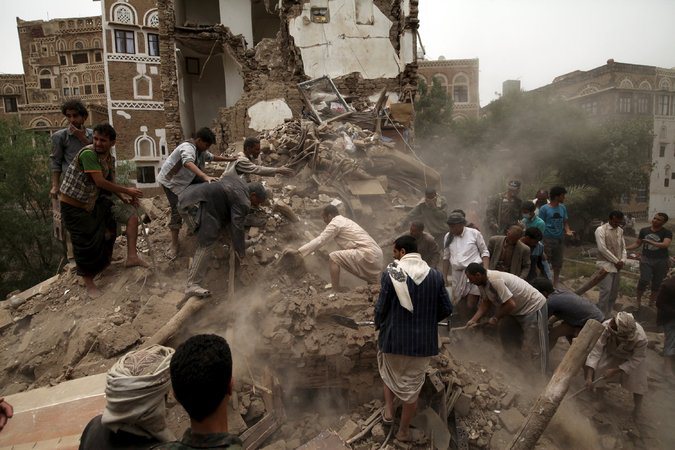
This photo of the aftermath of an airstrike in Sana, Yemen, accompanied a New York Times story (6/24/15) that provided a detailed account of the human toll of the air war—but made no mention of the US’s responsibility. (photo: Mohamed Al-Sayaghi/Reuters)
By Jim Naureckas | FAIR | August 31, 2015
The New York Times (8/30/15) reported on the deaths of civilians in a military assault in Yemen. Wrote reporter Saeed Al-Batati:
Airstrikes by a Saudi-led military coalition killed at least 13 civilians working early Sunday at a water plant in northern Yemen, the plant’s owner said.
The bombings appeared to be the latest in a series of airstrikes by Saudi Arabia or its Arab coalition partners that have hit civilian facilities with no apparent military target nearby.
The Washington Post (8/30/15) briefly covered the story too, using a Reuters wire report that gave a higher death toll:
An airstrike by warplanes from a Saudi-led coalition, which said it targeted a bomb-making factory, killed 36 civilians working Sunday at a bottling plant in the northern Yemeni province of Hajjah, residents said.
Noting that another airstrike had killed four people in Sanaa, Yemen’s capital, the piece continued:
The attacks were the latest in an air campaign launched in March by a Saudi-led alliance in support of Yemen’s exiled government, which is fighting Houthi forces allied with Iran.
Both of these reports left out the information that made this news particularly relevant to the papers’ mostly American readership: The US government is actively backing the air war in Yemen that killed those civilians, as the Times and Post have both reported. The Times (3/26/15) wrote at the start of the Saudi assault:
A spokeswoman for the National Security Council said Wednesday night that the United States was providing intelligence and logistical support for the campaign in Yemen, and that President Obama had authorized a ”joint planning cell” with Saudi Arabia to coordinate American support for the military offensive.

The Washington Post provided a photo of the kind of jets the US had sold to Saudi Arabia—but when such jets were used to kill civilians, they were out of the picture. (photo: Fayez Nureldine/AFP)
And the Post, in a piece headlined “How US Weapons Will Play a Huge Role in Saudi Arabia’s War in Yemen” (3/26/15), noted that the weaponry involved largely comes from the US:
US officials said they will offer intelligence and logistical support to the Saudis, but that’s really only a piece of it: The Saudi military is equipped with billions of dollars in advanced American-made weapons.
But that “huge role” often disappears when the the leading papers are discussing the carnage that results from the air attacks that the US is supporting and supplying. Thus when the Times‘ Rick Gladstone (8/22/15) reported that “Saudi-led airstrikes on a residential district in Yemen’s southwestern city of Taiz had killed more than 65 civilians, including 17 people from one family,” according to Doctors Without Borders, and that the death toll in the war included “hundreds of civilians killed in airstrikes,” Washington’s role in facilitating those deaths went unmentioned.
International Outcry Over Demolitions of Palestinian Homes: Silence in The NY Times
By Barbara Erickson | TimesWarp | August 31, 2015
The United Nations has called for a freeze on Israeli demolitions of Palestinian homes, dozens of aid agencies and the European Union have joined in the protest, and even the U.S. State Department has voiced its dismay. Yet, even as the outcry has become an international issue and reached the highest ranks of our own government, we find a resounding silence at The New York Times.
Times readers are unlikely to know that 31 international organizations recently called on Israel to stop the “wanton destruction of Palestinian property,” including “basic humanitarian necessities,” such as solar panels, animal pens, latrines and tents supplied by the European Union. The groups asked world leaders to take “urgent action,” to hold Israel accountable for “grave breaches” of international law, and to demand reparations for the destruction of their charitable gifts.
The statement came shortly after the United Nations and representatives of the European Union in separate actions called on Israel to freeze demolitions in the West Bank.
The State Department joined both groups with statements made during a press briefing Aug. 19. When spokesman John Kirby was asked about the issue, he had a prepared declaration ready to hand.
The department was “deeply concerned” and “very troubled,” he said, calling the demolitions and evictions “harmful and provocative and indicative of a damaging trend.” He referred to the “destruction of dozens of structures and the displacement of over 150 people in the West Bank and East Jerusalem this month alone.”
His words got the attention of Israeli media, which published his comments at length, but they failed to arouse the interest of the Times.
In fact, Israel’s cruel (and illegal) policy of demolishing Palestinian property has been a constant story in alternative and Palestinian media outlets over the years, and the spate of international protests appearing this past month is not the first. Last February, for instance, some 400 rabbis from around the world urged Israel to halt demolitions in the West Bank.
Israeli forces have destroyed houses, tents, animal shelters, shops and farming structures throughout the West Bank at a steady clip, leaving 486 Palestinians displaced in 2015 as of Aug. 24. The destruction has hit the poorest and most vulnerable populations hardest, as Israel attempts to clear the land for Jewish settlers.
In the midst of this, the Times has seen fit to report on only one official demolition action this summer: the destruction of illegal Jewish settler homes in the West Bank. (This event was accompanied by Prime Minister Benjamin Netanyahu’s announcement of plans for 500 news settlement homes to replace them.)
When the demolitions have made their way into the pages of the Times, the reports have failed to reveal the full extent of the problem. This year, for instance, the paper took notice of the threatened destruction of the West Bank village Susiya, when international media attention made it impossible to ignore, but dozens of other actual demolitions found no mention in the newspaper.
Again, when bureau chief Jodi Rudoren wrote about East Jerusalem demolitions last year, she underreported the extent of the damage by omitting over 46,000 structures that have been destroyed over the years and mentioning only the 675 that took place for “punitive reasons” during the second intifada.
Although demolitions are a constant threat to thousands of Palestinians in the West Bank, the Times prefers to ignore this reality. Palestinian media, however, issue reports almost daily, and monitoring groups such as the United Nations and the Israeli organization B’Tselem struggle to keep tallies.
These groups also note that demolitions fly in the face of international rules. As the UN release states, they contravene “Israel’s obligations as an occupying power under humanitarian law and human rights law.”
Behind the numbers cited by the United Nations and other groups are thousands of individual stories: herders struggling to shelter their flocks as Israeli forces tear up sheds and corrals, children robbed of playgrounds and schools, communities forced to pay for water deliveries after bulldozers crush their pipelines, families pulling prized possessions out of the rubble of their homes.
These stories find little notice in the Times, even as aid organizations and governments from the European Union to the U.S. State Department have spoken out with alarm and dismay. On many levels, Israeli demolitions are eminently newsworthy, but this is not enough for the Times, which prefers to shield Israel above all.
As Gaza Lies in Ruins, The NY Times Blames the Victims
By Barbara Erickson | TimesWarp | August 24, 2015
Israel’s attacks on Gaza ended a year ago, but the strip remains an expanse of rubble and devastation. Who’s to blame for this outrage? The New York Times has an answer: everyone but Israel.
Jodi Rudoren comes up with this response in a story that aims to whitewash Israel’s brutal treatment of Gaza by blaming the Palestinian victims along with the international community for the lack of rebuilding. It is all summed up in the story’s subhead, “Political Infighting and Lack of Funds Stymie a Reconstruction Mechanism.”
Her article takes pains to present the process as a collaborative project between the Palestinian Authority, Israel and the United Nations, and she is hazy about Israel’s role, describing it as nothing more than “involvement in approving projects and participants.”
Rudoren furthers her efforts in a single paragraph that absolves Israel completely: “[The Palestinian minister of housing], other Palestinian leaders and United Nations representatives all said that Israel had done its part in reasonable time and allowed cement into Gaza. Empty coffers, they said, are the primary problem.”
Times readers, however, never learn the direct quotes or the names of the “leaders” and “representatives” that would help substantiate this claim, nor does Rudoren explain what “Israel’s part” actually refers to here.
In fact, Israel controls everything that goes into Gaza, from people to foodstuffs to building material, and the agreed-on process for rebuilding the strip—the “reconstruction mechanism” referred to in the subhead—is built solely on Israeli demands. (Israel also blocks Gaza traffic by sea and has the full cooperation of the Egyptian government on that border as well.)
Although the United Nations and the Palestinian Authority have roles in the process, Israel determines who gets building materials, what they get and in what amounts. As Harvard-based Gaza expert Sara Roy notes, the two major documents outlining the reconstruction process “read like security plans, carefully laying out Israeli concerns and the ways in which the United Nations will accommodate them.”
Roy adds, “Israel will have to approve all projects and their locations and will be able to veto any part of the process on security grounds.” Moreover, she writes, “No mechanism for accountability or transparency will apply to Israel.”
Without doubt, Palestinian bureaucracy, donor fears of yet another attack on Gaza and other factors come into play in reconstruction efforts, but Rudoren ignores the major element, which is the Israeli blockade.
Her story, in fact, never refers to the eight-year blockade of Gaza and makes only vague mention of Israeli “control” of the enclave. Readers are left without any relevant context.
Rudoren’s article also omits other details that would place Israel’s role in a different light: the fact that by July of this year it had allowed the passage less than 1 percent of the construction materials needed to adequately house Gaza residents or that as of May, a total of 20 schools (kindergarten to college level) completely destroyed by Israel had yet to be repaired.
Readers never learn, for instance, that aid agencies in Gaza were forced to rely on temporary building materials as the Israeli-mandated process kept concrete, cement and steel supplies to a trickle. They also never learn the sequel to this chapter: that Israel stepped in to squelch the effort just as it was gaining momentum.
The project was run by Catholic Relief Services, which began using lumber to build temporary homes for the displaced residents this year, and media reports in February and March stated that 70 had been built and 40 families had moved into the new houses. CRS had plans to construct more than 100 additional wooden homes, but in April the program came to an end when Israel suddenly banned all lumber for housing.
Here we can see how Israel actually operates in the opaque rebuilding process mentioned in Rudoren’s piece. Times readers, however, never learn of this sad narrative nor of many others that would reveal how Israeli actions are destroying the economy and depressing the living conditions in Gaza.
And yet, the Times story would have us believe that Israel has “done its part” in the reconstruction of Gaza, ignoring the obvious: that Israel alone has complete control of its borders with the strip, and if Israel so willed, Gaza residents would have moved out of the rubble long ago.
New York Times is Crimea Tourism News for Dummies
By Phil Butler – New Eastern Outlook – 24.08.2015
A post by the New York Times this week, is a woeful reminder what poor losers Americans can be. Have a read here, and discover how low publisher Arthur Sulzberger’s newspaper has sunk. The latest formed and fashioned feature against Mr. Putin, it is a crummy bit of journalistic license entitled, “Russia’s Pitch to Vacationers: Crimea Is for Patriots.” […]
On August 19th a writer named Neil MacFarquhar skillfully crafted a story about tourism in Crimea. It is a story timed to coincide with the visit of Vladimir Putin, and Dmitry Medvedev to that peninsula on business, and for pleasure. Putin, with a multiplicity of missions there including efforts on behalf of the Russian Geographic Society, draws negative reportage from the NYTs daily. This time MacFarquhar ventures farther astray than most other NYTs writers though, as the author paints a grim, grimy, and gray touristic destination out of this resort area. Here’s a section of his dispatch on Russia tourism to Americans. Speaking of the coastal town of Saky, the writer explains:
“The dreary shoreline with its view of rusted dredging equipment was perhaps less appealing than previous holiday destinations in Turkey and Europe, she said, but patriotism drove her choice this summer.”
So there you have the framing of a horrid picture, one capitalized by a carefully chosen image of two elderly ladies sitting by what appears to be the seashore. Oh but wait, this story is intensely misleading, a lie, for all intents and purposes. If you research the images MacFarquhar uses, or maybe call friends in Crimea like I have, geography and reality will slap you awake from this gifted storyteller’s fairy tale. Right here it’s necessary to profile MacFarquhar for you, as the Moscow based has a habit of being where the action is, or where the New York Times wants it to be. A former United Nations bureau chief, MacFarquhar’s stories intriguingly coincide with upheaval and/or diatribe, against individuals portrayed as “enemies” of America.
An expert on the Middle East, wherever US military forces go around the 40th parallel North, Neil MacFarquhar offers up editorial support. When the US helped unseat Libya’s Col. Muammar el-Qaddafi, the New York Times reporter who spent part of his childhood in Libya was the “go to” man to tell America about the dictator’s violent death, and to help justify it. Over a year before the west alleged Syria’s leader Assad used chemical weapons at Ghouta against his own people, MacFarquhar was reporting for the NYTs on alleged Syrian threats to use such weapons. And if you follow that story from 2012, you’ll find a familiar face of Western hegemony cited too. MacFarquhar and one Victoria Nuland (of Ukraine infamy) do tend to occupy the same pages of the grand old New York Times fairly frequently. The fact is, anytime one of America’s “enemies” is in the crosshairs, MacFarquhar is there, start to finish, telling of the evil deeds, and then of the justifiable demise of tyrants. He helped paint the terror portrait of Iraq’s Saddam Hussein, and then wrote the man’s epitaph too. MacFarquhar profiled Osama Bin Laden on September 26th, 2001 right after the 9/11 attacks, and then profiled his possible successors for us.
I’m hesitant to go on here, for fear a good leader in Russia may be doomed just on account of being in the reports of this specter of the New York Times. Instead, maybe it’s better to announce the impending doom of Crimea tourism. Alas there is hope though, for my contacts on the ground there tell me business is booming! Let’s just hope the US State Department has not come up with some touristic alert to ruin Summer by the sea for Russians. If you’ll excuse the sarcasm briefly, MacFarquhar’s uncanny tendency of being surrounded with death and chaos is spooky indeed. Just how such a gifted writer came to discussing beach blanket bingo on the Black Sea, it baffles me actually. Instead, let’s move on to a bullshit finale to a story propped up by incorrect imagery, geography, and statistics.
The two images MacFarquhar uses to show us a pitiful Crimea touristic drought are all wrong. The two old ladies alone by the seaside, they are not actually on the sea. The ladies you see sitting, looking out across the water, they’re sitting the Sevastopol harbor, not exactly beach bunny Mecca, if you know what I mean. Rather than show New York Times readers the real beach of Saky, where his story is supposedly situated, it’s more appropriate somehow to show lonely old ladies marooned on one of the most industrialized harbors on the Black Sea. The misdirect is brilliant, if you want to paint Crimea as deserted of tourists, that is.
Skillfully, the veteran wordsmith draws the reader in. Illuminating “rusted” dredging equipment along the salt lake at Saky, MacFarquhar takes strategic advantage of a readership that has never laid eyes on the Black Sea, let alone mineral salt baths in Crimea. Being an expert on the Middle East, MacFarguhar has no doubt seen dredges on the Dead Sea, or along other ancient shorelines where therapy is sought? Maybe he’s unaware of the high concentrations of salt along these Crimean lakes’ shores, and of the effects of high saline concentrations on ferrous metals? No matter, the author’s second photo from clear across the peninsula, it shows an overweight sun bather choosing from empty beach chairs, his spot along a beach in Livadia, Crimea. Abandoned beach chairs in Livadia? “This cannot be right,” I thought.
 Unfortunately for the New York Times, many of the resorts in Crimea have live webcams. Maybe MacFarquhar is unaware of Russians’ affinity for real-time, but facts are facts. The stream you will find at the therapeutic spa Poltava Crimea in Saky, it reveals normal tourist activity on the beach there. The screenshot provided is from 11:34 and 54 seconds, on the main beach at the resort town. Comparing this photo, with the resort’s promotional photos of their beach, anyone can determine for themselves the health spa is running true to form. Furthermore, my friend and colleague, Graham Phillips is in Yalta at this very moment, broadcasting live the buzzing resort MacFarguhar tells his American audience is dead as a door nail. I called Graham to help me illuminate the seeming darkness surrounding this Summer in Yalta and Crimea. For those who do not know, Graham is fairly famous for his reportage refuting incorrect Western news on the Ukraine conflict. Our chat today proved no less interesting for me, and for readers of the New York Times too. As it happens, Graham just filmed a video at the end of this link shot this week in Yalta. Not only does the footage refute the aforementioned Times story, but it also shows Graham meeting up with at least one tourist from Kiev. If we relied on the NYT and other mainstream media for our understanding of this region, then we’d surely believe Ukrainians are ALL dead set on killing Russians, rather than vacationing with them. But don’t take my word for any of this, follow the links and do your own 5 minute “truth” research. For more Crimea spa experience, this other Saky therapy resort called Sanatorium “Yurmino” posts almost daily photos of guests living it up in the mud baths via their VK profile.
In conclusion, the reader here should formulate his or her own opinion of what ANY truth about Crimea, Ukraine, or Russia is, from ALL the sources of information available. While American news and other media is dominated by entities like The New York Times, there are always good alternatives. Mr. MacFarquhar, and noteworthy journalists like him, they’ve been relied upon too much in my estimation. As anyone knows, ideas and methods in any profession are influenced heavily by resource and the prevalent mind set. That said, any skilled reporter can paint whatever picture is desired. Manipulating imagery, inserting well crafted words and inflection, and a Miami Beach bikini contest can become a cellulite extravaganza not worth attending. This is where we are in the world of so-called “news” – caught in between fact and a fabricated agenda. And believe you me, the New York Times’ is the tippy top pinnacle, of a fashioned corporate agenda against Mother Russia and her people.
Thomas Friedman’s Bizarre Moral Universe: Defending Israel in The NY Times
By Barbara Erickson | Times Warp | August 14, 2015
Thomas Friedman in The New York Times argues for approval of the Iran nuclear deal, and on the way to this conclusion he hauls readers through a morass of false narratives and murky ethics, all of them invoked on behalf of Israel.
The column, however, does more than reveal the contortions of Israeli propaganda. It also points up a defect in the Times op-ed pages: The section allows writers to assert almost any claim without having to supply evidence to the readers, and although the newspaper says that it fact-checks even its editors, plenty of misinformation appears in the op-ed pages.
Thus we have Friedman’s latest, “If I Were an Israeli Looking at the Iran Deal,” which lays out a series of bald statements about Iran, Mideast history and the Israeli military that point to one overriding premise: Israel is a lonely moral force in the midst of lunatic regimes.
Friedman asserts, among other things, that Iran “regularly cheated” in order to expand its nuclear capability and aided Lebanon in “an unprovoked war” against Israel in 2006. Israel, however, “tries to avoid hitting civilian targets,” follows “Western mores” and pursues “war without mercy” only “when it has to.”
We are told, in other words, that Iran is an existential threat to Israel, bent on its destruction. Oddly, just as Friedman’s column was appearing in the Times, the newspaper also published a rebuttal to his claim in a story titled “Reporting From Iran Jewish Paper Sees No Plot to Destroy Israel.”
Here we learn that many Iranians support a two-state solution in Palestine-Israel and that Jewish Iranians are “basically well-protected second-class citizens—a broadly prosperous, largely middle-class community whose members have no hesitation about walking down the streets of Tehran wearing yarmulkes.”
If readers took the time to check out some of Friedman’s specific claims, they would find that the “unprovoked war” of 2006 was something else again. Israel was actually planning to attack Lebanon and seized on one incident (among many skirmishes on both sides) to unleash its arsenal on the country.
They would discover that Iran has not “regularly cheated its way” in its nuclear program. Instead, as investigative journalist Gareth Porter notes, “The evidence adduced to prove that Iran secretly worked on nuclear weapons represents an even more serious falsification of intelligence than we saw in the run-up to the war in Iraq.”
As for Friedman’s claim that the “Israeli army tries to avoid hitting civilian targets,” many readers already know that rights groups have cast grave doubts on this particular bit of propaganda. Most recently, we have heard from Breaking the Silence and Amnesty International, as both groups have exposed the criminal policies and actions that left so many civilians dead last summer in Gaza.
This sloppy approach to the facts is appalling, but even worse in this particular piece is the moral quagmire he creates in justifying Israel’s war crimes. Israel is forced to kill civilians, he says, because it faces enemies that stop at nothing. Therefore, Israel will “play by local rules” because “for all its Western mores it will not be out-crazied.”
Friedman would have it both ways: Israel is a moral society and Israel is the toughest, meanest guy on the block. If Hezbollah or Hamas fire rockets, he writes, Israel “will not be deterred by the threat of civilian Arab casualties.” The threat that concerns him here is the damage to Israel’s reputation, not the deaths of innocent Arabs.
He finds Iran’s alleged nuclear cheating particularly egregious because the country had signed the Nuclear Nonproliferation Treaty. This observation, however, does not prevent him from threatening Iran with Israel’s nukes: “[Israel] not only possesses 100 to 200 nuclear weapons,” he writes, “it can deliver them to Iran by plane, submarine and long-range rocket.”
Israel, on the other hand, has never signed the NPT and has never allowed inspectors into its nuclear plant, but this is no matter to Friedman. Iran, which has signed the treaty and allows inspections of its facilities, finds this state of affairs used against it in his bizarre moral universe.
Friedman presents Iran as one of the “crazies” that force Israel to break from its “Western mores,” but he can maintain this stance only by ignoring a little-discussed fact: Iran has forbidden the production and use of weapons of mass destruction, including chemical warfare and nuclear arms.
Even when Iraq attacked Iranians with poison gas during the eight-year war, Iran refused to retaliate in kind. Two supreme leaders have pronounced a fatwa against such weapons, including nuclear arms, Ayatollah Ruhollah Khomeini and Ayatollah Ali Khameini. Iran’s nuclear program, they declared, can only be pursued for peaceful purposes, and under the Iranian system, their word is the law of the land.
No wonder we hear not a word of this from Friedman (or the Times): Iran’s fatwa contrasts starkly with the Israeli stance on its own nuclear program.
In Friedman’s piece, facts that would expose his fraudulent narratives are excluded, in spite of the newspaper’s claim to fact-check even opinion pieces and editorials. Readers are denied even the minimal links that appear in most news stories.
Friedman’s columns appear twice a week in the Times. He has won awards for reporting and commentary, and he is a member of the Pulitzer Prize board. Such is the state of mainstream American journalism today.
At it Again: Law Enforcement Officials’ Anti-Encryption New York Times Op-Ed
By Jamie Williams | EFF | August 12, 2015
Yesterday, Manhattan District Attorney Cyrus Vance, Jr. and law enforcement officials from Paris, London, and Madrid published an anti-encryption op-ed in the New York Times—an op-ed that amounts to nothing more than a blatant attempt to use fear mongering to further their anti-privacy, anti-security, and anti-constitutional agenda. They want a backdoor. We want security, privacy, and respect for the Fourth Amendment’s guarantee that we be “secure” in our papers. After all, the Founding Fathers were big users of encryption.
The government’s use of horror stories to convince us that we should unlock our doors and give it free reign to pry inside our lives is nothing new. FBI Director James Comey is notorious for his examples of how cell-phone encryption will lead law enforcement to a “very dark place.” Yesterday’s op-ed adopts Comey’s signature tactic, focusing on the fatal shooting of a man in Illinois in June of this year and suggesting—without any evidence—that but for encryption built into both of the victim’s two phones (both found at the crime scene), police would have been able to track down the shooter. Never mind that of the two devices mentioned in the article, one of them (the Samsung Galaxy S6) isn’t actually encrypted by default.
The op-ed goes on to cite numerous other “examples,” again divorced from any actual facts, of cases in which encryption supposedly “block[ed] justice”—including 74 occasions over a nine-month period in which the Manhattan district attorney’s office encountered locked iPhones. Vance has touted this statistic before. But a spokesperson for his office told Wired last month that the office handles approximately 100,000 cases in the course of a year, meaning that officials encountered encryption in less than 0.1% of cases. And Vance has never been able to explain how even one of these 74 encrypted iPhones stood in the way of a successful prosecution.
The op-ed faults Apple and Google for attempting to offer their customers strong, user-friendly encryption. An iPhone with iOS8 automatically encrypts text messages, photos, contacts, call history, and other sensitive data though the use of a passcode. But contrary to the suggestion of the op-ed’s authors, Google has already backed off its promise to offer its users encryption by default, and Google would have been able to unlock the specific model of Samsung phone at issue.
But what’s more important than the op-ed’s shortage of facts is how out of touch it is with not only the fundamental importance of encryption and how encryption works, but also the U.S. Constitution.
The op-ed calls for an “appropriate balance between the marginal benefits of full-disk encryption and the need for local law enforcement to solve and prosecute crimes.” This single sentence demonstrates the numerous ways in which the authors are untethered from reality.
First, the benefits of encryption are in no way “marginal”—unless you view ensuring the privacy and security of innocent individuals across the globe as trivial goals. The authors here reveal their failure to appreciate the need for encryption to protect against not only security breaches, but also criminals (the folks they are supposed to be protecting us from) and of course pervasive and unconstitutional government surveillance.
Second, when the authors say they want an “appropriate balance,” what they are really asking for is a backdoor—or golden key—to allow government officials to decrypt any encrypted messages. As The Intercept explained in an article outlining the many things wrong with the op-ed, Vance and his counterparts in Paris, London, and Madrid are “demand[ing]—in the name of the ‘safety of our communities’—a magical, mathematically impossible scenario in which communications are safeguarded from everyone except law enforcement.”
We’ve said it before and we’ll say it again: It is technologically impossible to give the government an encryption backdoor without weakening everyone’s security. Computer scientists and cybersecurity experts agree, and have been telling the government as much for nearly two decades. And earlier this year, one Congressman with a technical background called encryption backdoors “technologically stupid.” Everyone who understands how encryption works agrees.
Third, law enforcement isn’t currently and won’t in the future “go dark” as a result of encryption. The government voiced the same concerns over encryption stifling criminal investigations during the Crypto Wars of the 1990s—i.e., Crypto Wars, Part I—which saw efforts by the government to prevent the development and distribution of strong consumer encryption technologies. (Protecting your ability to use strong encryption was one of EFF’s very first victories.) Such concerns have proven to be unfounded in the past. Just a few weeks ago, former NSA director Mike McConnell, former Homeland Security director Michael Chertoff, and former deputy defense secretary William Lynn—in a Washington Post op-ed in support of ubiquitous encryption—remarked that despite losing Part I of the Crypto Wars,
[T]he sky did not fall, and we did not go dark and deaf. Law enforcement and intelligence officials simply had to face a new future. As witnesses to that new future, we can attest that our security agencies were able to protect national security interests to an even greater extent in the ’90s and into the new century.
The same is true today. And as the former national security officials recognize, “the greater public good is a secure communications infrastructure protected by ubiquitous encryption at the device, server and enterprise level without building in means for government monitoring.”
At its core, yesterday’s op-ed demonstrates a fundamentally different vision for the future than the one we have here at EFF. Our vision is for a world where the privacy of communications are protected and where we can use the best tools possible to protect it. The vision of Vance, Comey, and others in the anti-encryption camp is for a world where no one is secure and where everyone is vulnerable. Their vision is not consistent with reality. And we hope the public is not swayed by their fear tactics.
As Palestinians Die, NY Times Shields Israel
By Barbara Erickson | TimesWarp | August 9, 2015
One week has passed since a Palestinian toddler died in an arson fire, one day since the boy’s father also perished from burns, and The New York Times has provided us with some half dozen stories on the tragedy. Only one of these was deemed fit to make the front page, however, and this fact is instructive: The favored story was not the original crime or the deaths of two villagers but a report on Israeli angst.
This maneuver was just one more piece of evidence that the Times has tried to provide an Israeli spin to this story. The paper has also adopted the government line that the concern here is extremism, not official policies and actions, and it has failed to provide the full context of settler violence in occupied Palestine.
When the story broke, the Times placed the news that 18-month-old Ali Dawabsheh was burned to death on page 4 of the Aug. 1 of the print edition. The brief article about his father’s demise appears on page 9 today. Other stories—concerning protests, accusations and additional responses to the news—were also on inside pages.
It was only when Jerusalem bureau chief Jodi Rudoren filed an article on Israeli “soul searching” that the editors saw fit to give the story a prominent spot in its Friday edition.
The print article, “Two Killings Make Israelis Look Inward,” received a favored site on page 1 above the fold. This, the editors are saying, is the real news here—not the shocking death of a helpless child, the lingering and painful death of his father or even the legacy of settler attacks—but the feelings of ordinary Israelis.
The arson attack has received this much attention in the Times only because it was impossible to ignore: It made headlines worldwide and forced Israeli officials to condemn the act and vow to take action. But the Times stories have failed to report the full extent of violence against Palestinians and official complicity in these actions.
Readers of the newspaper are unlikely to know that Israeli settlers have often resorted to arson and that their actions have never, until now, caused much concern among government officials. B’Tselem, an Israeli rights group, reports that “in recent years Israeli civilians set fire to dozens of homes, mosques, businesses, agricultural land and vehicles in the West Bank. The vast majority of these cases were never solved, and in many of them the Israeli police did not even bother taking elementary investigative actions.”
B’Tselem also notes that West Bank Palestinians are tried in military courts, with minimal rights and protection, while settlers living in the same area appear in civilian courts. Most shocking of all: The conviction rate for Palestinians in military courts is 99.74 percent.
The Times has acknowledged the charges of unequal treatment in an Isabel Kershner story titled “Israeli Justice in West Bank Is Seen as Often Uneven,” but the headline leaves the impression that we are dealing with opinions here, not facts, and the story fails to provide the data that would reveal just how uneven the system is.
In fact, B’Tselem reports that over an 11-year period only 11 percent of settler violence cases resulted in an indictment, nearly a quarter of the cases were never investigated and in the few cases where settlers were tried and convicted, they usually received “extremely light sentences.” The numbers are even more glaring when we note that Palestinians, knowing the outcomes and facing obstacles, often fail to file complaints.
These percentages, however, are less scandalous than the statistics concerning security forces. The Israeli monitoring group Yesh Din reports that 94 percent of the investigations into complaints about Israeli soldiers suspected of violence against Palestinians and their property are closed without action.
Yet the Times, following the lead of the Israeli government, has focused on “extremists” as the problem, ignoring the officially sanctioned destruction wrought by the military: In defiance of international law, the army helps the state confiscate land and destroy property to make room for illegal Jewish settlements.
In recent weeks and months, the Israeli army has been responsible for widespread destruction of Palestinian property in the West Bank. Here are a few examples:
- On July 22 the army invaded the village of Beit Ula and destroyed a Roman-era water well and 450 olive trees.
- On July 2 the army uprooted an acre of agricultural land west of Hebron and issued demolition orders for a home and a water well.
- On June 15 the Israeli army uprooted dozens of olive tree saplings over five acres in Husan, a village west of Bethlehem.
- On May 4 the army evacuated the residents of Wadi al Maleh in the Jordan Valley for “training exercises” and set fire to grazing land using live ammunition. Residents were denied access to the land to put out the fires.
- During the month of June in the Jordan Valley the army forced hundreds of Palestinians from their homes for “military maneuvers” and used live ammunition that set fire to acres of grazing land.
- As of Aug. 3 the army was responsible for demolishing 302 Palestinian structures in 2015, displacing 304 people in the West Bank and East Jerusalem.
Times readers almost never read of these actions taken by the military with the official blessing of the government, and they rarely learn of most settler attacks. (Nor do they learn that settlers are allowed to carry weapons while Palestinians are denied even the most basic arms for defense.)
Now the Times, in the face of an international scandal, has done what it can to minimize the damage to Israel, muting the charges of unequal justice, placing Israeli “soul searching” on prominent display, joining the Israeli effort to blame extremists and ignoring the officially sanctioned crimes against Palestinians.
Israeli angst is fit to print in the Times, but Israeli crimes against Palestinians are something else again. If they are deemed worthy of notice, they may come to light in the back pages, under evasive headlines—all part of an effort to protect Israel at the expense of our right to be informed.
Featured Video
Seyed M. Marandi: Negotiations Collapsed – Return to War
or go to
Aletho News Archives – Video-Images
From the Archives
Wartime internment camps in Australia
National Archives of Australia
World War I
During World War I, for security reasons the Australian Government pursued a comprehensive internment policy against enemy aliens living in Australia.
Initially only those born in countries at war with Australia were classed as enemy aliens, but later this was expanded to include people of enemy nations who were naturalised British subjects, Australian-born descendants of migrants born in enemy nations and others who were thought to pose a threat to Australia’s security.
Australia interned almost 7,000 people during World War I, of whom about 4,500 were enemy aliens and British nationals of German ancestry already resident in Australia.
Records of World War I internment camps
World War II
During World War II, Australian authorities established internment camps for three reasons – to prevent residents from assisting Australia’s enemies, to appease public opinion and to house overseas internees sent to Australia for the duration of the war.
Unlike World War I, the initial aim of internment during the later conflict was to identify and intern those who posed a particular threat to the safety or defence of the country. As the war progressed, however, this policy changed and Japanese residents were interned en masse. In the later years of the war, Germans and Italians were also interned on the basis of nationality, particularly those living in the north of Australia. In all, just over 20 per cent of all Italians resident in Australia were interned. … continue
Blog Roll
 Aletho News
- Seyed M. Marandi: Negotiations Collapsed – Return to War
- Tomorrow’s naval blockade showdown
- ‘Israel’ attacks civilians to hide its embarrassing military failures & out of pure sadism
- Any Foreign Military Vessel Approaching Hormuz Under Any Pretext ‘Will Be Dealt With Severely’: IRGC
- Diplomats slam US negotiators’ performance in Iran talks
- Trump Refuses Exit Ramp, War with Iran will Continue
- Trump Says US Naval Blockade in Strait of Hormuz Will Begin Shortly
- US, Iran end 21-hour talks without agreement
- US IRAN TALKS: Who Are the Crazy Ones Here? /Lt Col Daniel Davis
- Talks with the US end without a deal over excessive US demands: Iran
- If Americans Knew
- US-Iran ceasefire negotiations make zero progress – Daily Update
- Pro-Israel ‘Thinktanks’ and Individuals who Influence U.S. Foreign Policy
- Mearsheimer reveals how Israel dictates US policies on Iran, Gaza – video
- After killing 350+, Israel still has a “score to settle” with Lebanon before ceasefire – Daily Update
- Military aid to Israel emerges as the latest political litmus test for Democrats
- The only Palestinian children’s rights organization closes following years-long Israeli campaign against it
- ‘I Can’t Forget the Smell’: Lebanese Reel After Israel Kills Over 300 in Single Day
- DNC Shoots Down Resolutions Calling Out AIPAC and Limiting Arms to Israel
- TCN: Is Israel Blackmailing President Trump?
- Israel killed at least 303 Lebanese yesterday – who were they? Daily Update
- No Tricks Zone
- German Expert: Heat Dome Led To Record Temps In Western USA…Warmer In 1934, 1936
- New Study: No Linear Warming Or Glacier Retreat Along Northern Antarctic Peninsula Since 1980s
- An Inconvenient Tree: Uncovered In Alps… Europe Much Warmer Than Today 6000 Years Ago
- New Study Reports A 60% Slowdown In Greenland’s Ice Loss Rate In The Last Decade
- Low Intensity Tornado Wrecks Major Solar Farm, Creating A Potential Toxic Dump
- New Study Finds Warming Saves Lives…Cold Temperatures 12 Times More Deadly Than Excess Heat
- German Science Blog Accuses PIK Climate Institute Of Hallucinating Climate Tipping Points
- Devastating Assessment Of Comirnaty Vaccine By Former Senior Pfizer Europe Toxicologist
- New Study: CO2 Is ‘Effectively Negligible’ As An Explanatory Climate Change Factor Since 2000
- Former Pfizer Toxicologist Dr. Helmut Sterz Tells Bundestag Hearing Pfizer Vaccine Should Have Never Been Approved
 Aletho News