The New York Times recently published a news brief, reporting that Israel is going to re-investigate an incident in which an American citizen, Tristan Anderson, was permanently maimed.
Anderson suffered extensive brain damage (part of his frontal lobe was destroyed) and paralysis, and was blinded in one eye, after Israeli soldiers shot him with a tear gas canister intended as a “barricade penetrator” from inappropriately close range. According to eyewitnesses, Anderson was shot as he was taking photographs in a Palestinian village after an unarmed protest against the illegal and extensive confiscation of village land.
Israeli forces have a history of shooting unarmed protesters with these canisters, which one expert likens to “a small missile.”
Yet the New York Times report, “Israel Reopens Inquiry Into Activist’s Injury” (July 11, 2013, P. 9) reveals few of these details.
The Times article states that Anderson was injured when he was hit in the head by a tear gas canister and is partly paralyzed and blind in one eye, but does not mention his extensive brain damage and that his paralysis is over half his body. It doesn’t reveal that the type of canister used is extraordinarily destructive or that it was fired at such close range.
The report also omits the fact that this incident is part of a pattern, even though Israeli forces have killed at least two Palestinians with these canisters, and shot out the eye of an American student with another. According to a report by an Israeli organization, Israeli forces “frequently fire tear-gas canisters directly at demonstrators.”
The Times report states that the protest was “against the extension of Israel’s separation barrier in the West Bank” without citing the villagers’ actual complaint — the confiscation of their land and, thus, livelihood by Israel. It similarly fails to mention that over previous decades Israel confiscated over 80 percent of the village land and now intends to take between a quarter and a third of what remains to build the “barrier.”
Finally, the Times report repeats, without attribution, the Israeli security forces’ claim that the shooting occurred “during a clash,” implying that it happened accidentally during a violent engagement, ignoring eyewitness testimony that the protest had dissipated and most people had gone home.
The byline on the Times report is Myra Noveck. Noveck has bylined a number of stories for both the New York Times and its European affiliate the International Herald Tribune, where ZoomInfo lists her as a contributor.
Noveck is frequently cited in New York Times news reports as a contributor to stories, and a prominent Israeli newspaper calls her the Times’ “deputy bureau chief” for the Times’ Jerusalem bureau, its bureau for covering Israel-Palestine.
From information she has posted online, it appears that Noveck is an American who moved to Israel after college. According to Torah in Motion, which promotes Jewish dialogue and speakers, two of her children were serving in the Israeli military as of 2012. It is unclear whether her children are currently still on active duty or whether they are now serving as Israeli reserve soldiers.
In either case, it appears that while Noveck has been writing and contributing to news reports about Israel and about the Israeli military, her children have been serving in it.
Such a situation appears to constitute a clear conflict of interest – even according to the Times’ own ethics standards – and should normally cause a journalist to be assigned to a different area of reporting.
When it came to light in 2010 that then chief of the Times’ Jerusalem bureau, Ethan Bronner, had a son in the Israeli military, even the Times’ own ombudsman concluded that Bronner should be reassigned.
In response to requests for information and interviews with Noveck and Times Executive Editor Jill Abramson, a Times spokesperson issued a written statement claiming that Noveck is “not a reporter,” but merely a “long-time news assistant in The Times’s bureau in Jerusalem.”
The statement went on to say: “She works under the direction of our bureau chief primarily doing translation and research. She is an Israeli citizen. If she has children and they are also Israeli citizens, presumably they would be required to serve in the military*. This situation would not constitute a ‘breach with impartiality.’”
I wrote back pointing out (1) that Times’ conflict of interest requirements include family members and (2) that Noveck’s byline appeared on a news report. The spokesperson then admitted that Noveck “on rare occasions received a byline” but still maintained that “she is not a reporter.”
However, the Times’ published ethics standards generally extend ethical requirements ”to all newsroom and editorial page employees, journalists and support staff alike.”
Reporters Frequently Have Ties to Israeli Military
This incident is part of a pattern of ethics violations concerning reporting on Israel.
Isabel Kershner, a senior Times reporter in the region, is an Israeli citizen whose husband, according to Fairness and Accuracy in Reporting (Fair) works for an Israeli organization, the Institute for National Security Studies (INSS), which has close ties to the Israeli military and is “tasked with shaping a positive image of Israel in the media.”
A FAIR study of articles that Kershner had written or contributed to since 2009 found they had overwhelmingly relied on the INSS for analysis about events in the region.
A multitude of journalists at the Times and elsewhere have had close personal and family ties to the Israeli military – almost none of them ever disclosed, including the previous Times bureau chief Ethan Bronner, as noted above.
Jonathan Cook, a British journalist based in Israel, quotes a Jerusalem bureau chief who stated: “… Bronner’s situation is ‘the rule, not the exception. I can think of a dozen foreign bureau chiefs, responsible for covering both Israel and the Palestinians, who have served in the Israeli army, and another dozen who like Bronner have kids in the Israeli army.”
Cook writes that the bureau chief explained: “It is common to hear Western reporters boasting to one another about their Zionist credentials, their service in the Israeli army or the loyal service of their children.”
For more information on journalists’ pro-Israel conflict of interest violations see ”US Media and Israeli Military: All in the Family,” “Jodi Rudoren, Another Member of the Family: Meet the New York Times’ New Israel-Palestine News Chief,” “Ethan Bronner’s Conflict With Impartiality,” and ”AP’s Matti Friedman: Israeli citizen and former Israeli soldier.”
It would appear from this pervasive pattern that many of the owners, editors, and journalists who determine U.S. reporting on Israel-Palestine believe that normal ethics requirements don’t apply in regard to Israel.
This situation holds serious consequences for the American public. American taxpayers give Israel over $8 million per day (more than to any other country) and, as a result, most of the world views Americans as responsible for Israeli actions, exposing us to escalating risks.
Osama Bin Laden and others have often cited U.S. support for Israeli crimes as a primary cause of hostility against us.
It is thus essential that Americans be accurately and fully informed. This is unlikely to happen while those reporting for American news media (whether “reporters” or “assistants”) have such close ties to Israel and its powerful military forces.
Witnesses Describe Soldiers Shooting Protesters with High-Speed Canisters
Anderson was shot in 2009 after a protest in the Palestinian village of Ni’lin in the West Bank. Since 2007 Ni’lin villagers and others have been demonstrating against the illegal Israeli confiscation of up to a third of the village’s land (following previous confiscations in which the majority of the village’s original land was taken by Israel).
Gabby Silverman, a witness to the shooting of Tristan Anderson, describes the incident: “Tristan had wandered off with his camera. I was looking at him. And out of nowhere, they opened fire on us. The first shot they fired, they got Tristan.”
Anderson is now in a wheelchair with permanent brain damage. He is hemiplegic (paralyzed on the left, formerly dominant, side of his body). He is blind in his right eye and part of his head and frontal lobe were destroyed.
The kind of canister Israeli forces shot at Anderson is particularly dangerous, according to their manufacturer itself. The shells have a range of several hundred meters, yet Israeli soldiers fired at Anderson from approximately 60 meters away.
The canisters’ manufacturer, Combined Systems, Inc. (CSI), classifies them as “barricade penetrators” and advises that they should not be fired at people. A spokesperson for an Israeli human rights organization says, “It’s like firing a small missile.” Because of an internal propulsion mechanism, they hurtle through the air at 122 meters per second.
CSI is reportedly the primary supplier of tear gas to Israel. A watchdog group reports that the company flew the Israeli flag at its Jamestown, Pennsylvania, headquarters until, in advance of a planned Martin Luther King Day demonstration, CSI took it down and replaced it with the Pennsylvania state flag.
According to an in-depth report on CSI by Pennsylvania professor Dr. Werner Lange, the company was founded by two Israelis, Jacob Kravel and Michael Brunn.
A month after Anderson was shot, a Palestinian nonviolence leader was killed by this same type of tear gas canister when an Israeli soldier shot it into the victim’s chest (the fifth Palestinian killed in Ni’lin by the Israeli military in a year and a half).
The next year Israeli forces fired a similar canister at a young American art student, Emily Henochowicz, destroying one eye. An eyewitness reported that an Israeli soldier intentionally aimed the canister at Henoschowitz while she was participating in a nonviolent demonstration.
In 2012 another Palestinian was killed when an Israeli soldier shot him in the face with what appears to have also been a long-range CSI canister.
The occupying Israeli forces have consistently suppressed the Ni’lin villagers’ unarmed protests against the stealing of their land. As of 2012, Israel had arrested more than 350 villagers, killed 5 – including a 10-year-old child – injured “multiple” protesters with live ammunition, and broken the bones of 15 people with tear gas projectiles, according to the villagers’ website, created to document the situation.
There are similar reports from other Palestinian villages, where several other protesters have died from tear gas fired by Israeli forces.
It is unfortunate that almost none of this was even hinted at in Myra Noveck’s New York Times report.
*While military service is required for both males and females in Israel, only about 50 percent actually serve; many Israelis have refused to serve in the Israeli military for reasons of conscience.
Alison Weir is executive director of If Americans Knew and president of the Council for the National Interest. She can be reached through contact@ifamericansknew.org.
For more information on Anderson, videos of the incident, and the latest updates go to http://www.justice4tristan.org/.
Ni’lin is also sometimes referred to as Nilin or Na’alin.
July 26, 2013
Posted by aletho |
Deception, Ethnic Cleansing, Racism, Zionism, Mainstream Media, Warmongering, Subjugation - Torture | Ethan Bronner, New York Times, Palestine, Tristan Anderson, Zionism |
Leave a comment
Recently the Latin American “dirty wars” of the 1960s through 1980s have resurfaced in mainstream media discussion. One reason is the trials in Argentina, Chile, Guatemala, Haiti, Peru, and Uruguay against some of the late twentieth century’s most vicious criminals, who are collectively responsible for the murders of hundreds of thousands of political dissidents and their suspected sympathizers. Some of the highest-profile defendants are Guatemalan dictator General Efraín Ríos Montt (1982-83), Haitian dictator Jean-Claude Duvalier (1971-86), and various officials from Argentina’s military dictatorship (1976-83). Dozens of former Argentine military officials have been convicted since 2008, while prosecutions against Ríos Montt and other Guatemalan officials and Haiti’s Duvalier have been attempted since 2011.
Despite dedicating substantial coverage to these events, U.S. news outlets have usually ignored the role of the U.S. government in supporting these murderous right-wing regimes through military aid and diplomatic support. This pattern also applies to press coverage of current U.S.-backed “dirty wars,” in Honduras and elsewhere.
The documentary record leaves no doubt about U.S. support for state terror in Latin America’s dirty wars.1 Although historians debate whether U.S. support was decisive in particular cases, all serious scholars agree that Washington played at least an important enabling role. Argentina, Guatemala, and Haiti are good examples.
Argentina’s military regime murdered, tortured, and raped tens of thousands of people, mainly leftists, who criticized government policy. During the height of the repression, the U.S. government gave the junta over $35 million in military aid and sold it another $43 million in military supplies. It was well aware of the state terror it was supporting. Three months after the 1976 coup, U.S. Secretary of State Henry Kissinger privately told Argentine Foreign Minister César Guzzetti that, “we have followed events in Argentina closely” and “wish the new government well. We wish it will succeed . . . If there are things that have to be done, you should do them quickly.”2
In Guatemala, around 200,000 people were slaughtered by the U.S.-backed military regimes that followed the 1954 CIA-sponsored coup against elected President Jacobo Arbenz. The height of state violence was the genocidal “scorched earth” campaign of the early 1980s, carried out—largely with U.S. weapons—by General Ríos Montt and his predecessor Romeo Lucas García. The campaign specifically targeted indigenous Mayans, who were deemed likely to sympathize with the country’s leftist guerrillas. In December 1982, despite his administration’s private recognition of the military’s “large-scale killing of Indian men, women, and children,” Reagan visited Guatemala and publicly declared that Ríos Montt was getting “a bum rap” and was “totally dedicated to democracy.” The next day the Guatemalan army launched its worst single massacre of the decade, killing nearly 200 men, women, and children in the village of Las Dos Erres. U.S. military aid continued thereafter, though often secretly.3 Ríos Montt himself later noted the importance of U.S. military and diplomatic support, telling a journalist that, “he should be tried only if Americans,” including Ronald Reagan, “were tried too.” (On May 10 Ríos Montt was convicted of genocide and crimes against humanity, but the conviction was annulled by the country’s Constitutional Court after intense lobbying by business and military elites. In April, former army officer and current Guatemalan President Otto Pérez Molina had tried to shut the trial down for fear that witnesses would implicate him in civilian massacres; one had already done so.)4
Turning to the Caribbean, Haiti’s Jean-Claude Duvalier is no less notorious for his brutality. He and his father, François, murdered and tortured tens of thousands of Haitians. Yet for three decades the Duvalier dynasty enjoyed strong U.S. support, including military training and the sale of millions of dollars in weapons and military aircraft. The dictatorship was “a dependable, good friend of the U.S.” according to a U.S. Embassy official in 1973.5 U.S. support was only withdrawn when a popular uprising was on the verge of ousting Jean-Claude in 1986.
Argentina, Guatemala, and Haiti are just three examples of U.S. support for repression. Political scientist Lars Schoultz has quantified the relationship between U.S. aid and repression by Latin American governments for the years 1975-77, finding a clear pattern: “The correlations between the absolute level of U.S. assistance to Latin America and human rights violations by recipient governments” were “uniformly positive, indicating that aid has tended to flow disproportionately to Latin American governments which torture their citizens.”6 The logic is not a mystery: Washington has always preferred U.S.-friendly oligarchs and murderers when faced with the threats of substantive democracy, economic redistribution, and independent nationalism.
Yet the documentary record and scholarly consensus are not reflected in U.S. press coverage. As the table below shows, even the nation’s leading liberal media almost never acknowledge U.S. support for the dictatorships in Argentina, Guatemala, and Haiti. Only 13 times over the past five years did any allusion to that support appear in coverage by The New York Times, Washington Post, and National Public Radio (NPR), despite 222 total news and opinion pieces that mentioned former dictatorship officials in those countries. In other words, these media outlets only acknowledged U.S. support 6% of the time.
Recently the U.S. press has strongly condemned the Argentine, Guatemalan, and Haitian dictatorships, decrying, for instance, Duvalier’s “squalid legacy of disappearance, torture and murder” and interviewing Argentine torture victims and children stolen from their parents at birth by the military.8 The problem is that the perpetrators appear simply as brutal criminals in far-off lands, with no connection whatsoever to the United States. … Full article
July 23, 2013
Posted by aletho |
Deception, Ethnic Cleansing, Racism, Zionism, Mainstream Media, Warmongering, Subjugation - Torture, Timeless or most popular, War Crimes | and National Public Radio, Argentina, Efraín Ríos Montt, Guatemala, Haiti, Jean-Claude Duvalier, Latin America, New York Times, NPR, Rios Montt, Washington Post |
Leave a comment
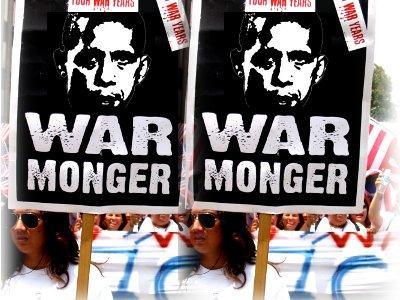
New York Times reporter Peter Baker has a piece today (7/16/13) about Barack Obama and Dwight Eisenhower that presents a somewhat confusing picture of both.
The article is about how Obama wields power–or, in the eyes of some critics, fails to take advantage of the “bully pulpit.”
The real point of the piece is to draw a parallel to Dwight Eisenhower’s “hidden hand” approach. According to an author of an Eisenhower book, Baker writes, “Mr. Obama was like the former president in avoiding major international conflict, relying more on covert action and letting Congress take the lead in legislation.”
Baker explains:
Just as Eisenhower, the 34th president, pulled troops out of Korea and avoided other military adventures, Mr. Obama has pulled out of Iraq, is leaving Afghanistan, has limited intervention in Libya largely to airstrikes and has resisted being drawn directly into the civil war in Syria.
Let’s try a rewrite–especially on the Obama years.
Obama withdrew troops from Iraq on the schedule inherited from Bush. His administration wanted to keep some troops there, but the Iraqi government would not allow it.
To say that Obama “is leaving Afghanistan” ignores the fact that he massively escalated the Afghan War, sending tens of thousands of additional troops to the country–essentially tripling the size of the U.S. military in the first 2 years of his term.
To say that Obama “limited intervention in Libya largely to airstrikes” is an odd way to describe what was a rather extensive bombing campaign in violation of the War Powers Act.
Baker does note that the White House has decided to formally begin arming the Syrian rebels–it is somewhat unclear how and/or when that will happen–and the CIA has reportedly been coordinating arms shipments into the country.
And, of course, one has to factor in ongoing drone wars in countries like Yemen, Afghanistan and Pakistan.
It is possible that these do not count as “military adventures,” but I think you’d have hard time explaining that to anyone in those countries.
As for Eisenhower, when the Times refers vaguely to “covert operations” during his term, one might want to spell out that the CIA was instrumental in the overthrow of governments in Iran, Guatemala and Congo, and that the CIA was deeply involved in supporting anti-government rebels in Indonesia fighting the Sukarno government–including dropping supplies to the rebels. His hands may have been “hidden,” but there’s no reason to not let the record speak for itself 50 years later.
July 17, 2013
Posted by aletho |
Militarism, Progressive Hypocrite, Timeless or most popular | Afghanistan, Dwight D Eisenhower, Dwight Eisenhower, New York Times, Obama |
Leave a comment
Writing in his original preface to Animal Farm, George Orwell wrote about how “inconvenient facts [can be] kept dark, without the need for any official ban”:
Anyone who has lived long in a foreign country will know of instances of sensational items of news – things which on their own merits would get the big headlines – being kept right out of the British press, not because the Government intervened but because of a general tacit agreement that ‘it wouldn’t do’ to mention that particular fact […] At any given moment there is an orthodoxy, a body of ideas which it is assumed that all right-thinking people will accept without question. It is not exactly forbidden to say this, that or the other, but it is ‘not done’ to say it, just as in mid-Victorian times it was ‘not done’ to mention trousers in the presence of a lady. Anyone who challenges the prevailing orthodoxy finds himself silenced with surprising effectiveness. A genuinely unfashionable opinion is almost never given a fair hearing, either in the popular press or in the highbrow periodicals.
One way in which readers, listeners, or viewers can gauge the validity of news stories is by how quickly they drop off the media’s radar. If a story is sensationalist hype it will likely disappear as fast as it appeared. Another way is if the story gets reported at all.
Earlier this year was the scare story of an impending North Korea attack on the United States. The mainstream media, especially in the U.S. and the West, went ballistic (pun intended) on supposed North Korean threats. Hundreds, possibly thousands, of articles claimed over and over that North Korea threatened to attack South Korea and the United States. That was the popular narrative repeated ad infinitum. But it’s not entirely true. What North Korea “threatened” was retaliation, not an attack. Kim Jong-Un said his country would respond to South Korean and American aggression.
But, let’s rewind to the New Year. According to the Washington Post: “In New Year’s speech, N. Korea’s Kim says he wants peace with South”:
SEOUL — In a domestically televised New Year’s Day speech, North Korean supreme leader Kim Jong Eun said he wants to “remove confrontation” on this divided peninsula and called on “anti-reunification forces” in South Korea to end their hostility toward the North.
The lengthy address, which laid out North Korea’s goals for the year, marked Kim’s first formal remarks since the election two weeks ago of Park Geun-hye as South Korea’s next president.
The North Korean leader asked for a detente — but with prerequisites that the conservative Park is likely to be reluctant to accept. Both sides, Kim said, must implement joint agreements signed years ago by the North and liberal, pro-engagement presidents in Seoul. Those agreements call for, among other things, economic cooperation, high-level government dialogue and the creation of a special “cooperation” zone in the Yellow Sea, where the North and South spar over a maritime border.
The peace overture was replied with the annual South-Korean-U.S. military exercise, but this time with an interesting twist: the exercise included a scenario of a pre-emptive attack on North Korea. Worse, the U.S. pulled out its B-52’s, that are capable of firing nuclear weapons, and flaunted them recklessly.
In chronological order: North Korea requests peace and steps to move in that direction, to which South Korea and the United States respond with a mock scenario of a pre-emptive strike, including the possible use of nuclear weapons, to which North Korea says it will retaliate against any such attack, and, finally, the American media largely ignores this context, that Kim was vowing retaliation, and whips up hysteria of North Korea coming out of the blue with threats of nuking America.
But then the story simply went away.
We have seen this also with the recent case of Syria and the regime’s alleged use of chemical weapons.
A month ago the White House came out with the claim that the Syrian government used chemical weapons “on a small scale against the opposition multiple times in the last year.”
And though FAIR’s Peter Hart quickly pointed out that skepticism was “warranted,” the mainstream media saturated news outlets with the story.
But, like the North Korean “threat,” the story simply went away.
Until yesterday.
The story is back on the radar as Russia provided the UN, and Western countries with their report on the Sarin attack in Aleppo, Syria. Unlike the US, the Russians have (and provided) evidence that it was the rebels who carried out the chemical attack.
According to Rick Gladstone of The New York Times, in his article “Russia Says Study Suggests Syria Rebels Used Sarin,” and which appears on page A7 of the July 10, 2013 edition, Moscow’s “scientific analysis of a suspected chemical weapons attack in Syria on March 19 showed it probably had been carried out by insurgents using Sarin nerve gas of ‘cottage industry’ quality delivered by a crudely made missile.” Gladstone then informs us that Russia’s findings “contradicted conclusions presented by Western nations, including the United States, that the Syrian government had been responsible.”
The most troubling aspect of Gladstone’s article was this passage: “The American conclusion was based in part on indirectly procured soil samples and interviews with survivors, as well as the Syrian insurgency’s lack of technical ability and materials to carry out a chemical weapons attack.”
The problem? Those last sixteen words—“the Syrian insurgency’s lack of technical ability and materials to carry out a chemical weapons attack”—are presented, not as a claim, but as a fact. As we at the NYTimes eXaminer pointed out last month, The New York Times has ignored two important news items that undermine this assertion: (1) the hacking of Britam, a British defense company, revealed a plan by Washington for the use of chemical weapons in Syria, and then blame it on the government; and (2) the arrest of Syrian rebels in Turkey, who happened to be in possession of Sarin nerve gas.
All of this occurred before the White House came out with their claim that the Syrian government was behind the Sarin attacks, and was readily available in the press, though not reported by The New York Times. To this day the “paper of record” has yet to mention either of these two incidences, even as they claim that the Syrian rebels have a “lack of technical ability and materials to carry out a chemical weapons attack.”
Readers should be concerned with why sensationalist stories of a threatening North Korea, and chemical weapon-using Syria, can appear long enough to outrage the public, but stories of false flags, and rebels getting caught with the very chemical weapons we claim they don’t have, go unreported.
July 12, 2013
Posted by aletho |
False Flag Terrorism, Mainstream Media, Warmongering, Progressive Hypocrite | New York Times, North Korea, South Korea, Syria, United States |
Leave a comment
One consumes U.S. corporate media at the risk of one’s sanity. Schizophrenia, for example, appears to be the permanent mental state at the New York Times, which cannot figure out which global reality is operative on any given day. Last week, the Times almost simultaneously painted a picture of two different and contradictory worlds – or, at least, two very different Obama administrations. On Friday, June 5, in the wake of the military coup against Egyptian President Mohamed Morsi, the Times depicted the Obama administration as totally unruffled by the turmoil in Cairo – as if the U.S. had little stake in the outcome. The Times headline proclaimed: “Egypt Crisis Finds Washington Largely Ambivalent and Aloof.” The newspaper of record gave the impression that Egypt was no longer a “strategic player” in the region and, therefore, the political complexion of its government was nothing for Washington to worry its last nerve about.
By Saturday, July 6, the article had been replaced by reporting on what the Obama administration had really been up to as the coup unfolded. It described President Morsi’s “last hours” in office, awaiting his fate at the hands of an Egyptian military that has been a United States asset for the last 40 years. An Arab foreign minister telephoned to ask if Morsi would accept the appointment of a new prime minister and cabinet, which would make Morsi a mere figurehead. The Arab foreign minister made it clear that he was acting as an emissary of Washington.
Morsi rejected the offer. His top foreign policy advisor stepped out of the room to call the U.S. ambassador to Egypt, Anne Patterson, and tell her so. But, when he came back, he said he’d been on the phone with Susan Rice, Obama’s national security advisor, in Washington, who advised him that the coup was about to begin.
So, of course, the U.S. was deeply involved in the events that were swirling in Cairo – it would have been bizarre beyond belief if the superpower had, indeed, been “ambivalent” or “aloof” about the fate of the Arab world’s most populous country. What is amazing, is the ability of an organization as large as the New York Times to accommodate two opposite realities within its own pages, and pass off both as the truth, without shame or even visible embarrassment.
The New York Times and its corporate colleagues are not in the business of providing reliable information, but of rationalizing and sanitizing the behavior of those in power. If there are contradictions in the narrative, they can always be papered over with more lies in the next edition.
However, the lies told by the Times and its ilk cannot alter the reality of U.S. decline; they can only make Americans oblivious to the facts. The United States will get the kind of civilian front men it wants in Egypt: international corporate citizens like economist el-Hazem Beblawy, as interim prime minister, and Mohamed ElBaradei, the darling of the global rich, as a vice president. But the U.S. is also now dependent on Muslim fundamentalists as the foot soldiers of imperialism in Syria and North Africa, even as it double-crossed its Muslim Brotherhood friend, former president Morsi. And the Arab royals of the Persian Gulf have their own plans for the region. The superpower isn’t as super as it used to be – but you won’t find out why in the New York Times.
Glen Ford can be contacted at Glen.Ford@BlackAgendaReport.com.
July 10, 2013
Posted by aletho |
Mainstream Media, Warmongering | Egypt, Mohamed ElBaradei, Mohamed Morsi, Morsi, New York Times, Susan Rice, United States |
Leave a comment
By Stephen Roblin · NYTX · July 4, 2013
Evidently, in the worldview of the New York Times, the United States can play a “vital role in improving” a country despite subjecting it to mass famine death, while at the same time be a victim of the country’s internal troubles. This remarkable interpretation of recent events is implied from the few statements made about Somalia this past week.
As Carol Giacomo, a member of the NYT’s editorial board, informs us, the Obama administration “has played critical roles in stabilizing Somalia.” Elsewhere, NYT reporters cite the view of J. Stephen Morrison, an analyst at the Center for Strategic and International Studies, that the administration has played a “vital role in improving Somalia, a country whose troubles have bedeviled several American presidents.” When Somalia is the topic of discussion, the views expressed here are often put forth and taken for granted.
Before subjecting these views to Obama’s actual record, let us briefly entertain a hypothetical in order to achieve some helpful perspective. Imagine that Syria was on the brink of famine. And in its effort to prop up the Assad regime and prevent aid from “benefitting” the rebels, the Iranian government prevented international humanitarian relief agencies from providing life-saving assistance to civilians in rebel-controlled territory. By doing so in this hypothetical, Tehran played a major role in causing the death of an estimated 250,000 people. Needless to say, the American press would not overlook this policy in investigating whether Iran has played a “vital role in improving” Syria.
Of course, no historical analogy is perfect. But the one drawn here is sufficiently close to illustrate how remarkable the statements cited above are in light of the Obama administration’s record on the 2011 Somali famine, which may have killed over 250,000 people, according to a recent mortality study.
Obama’s contribution to humanitarianism has been to lead an assault on the very notion of humanitarian relief. The victims of the Somali famine are part of this legacy. By instituting and enforcing “counterterrorism” restrictions on aid operations, his administration effectively criminalized humanitarian relief in regions where anyone labelled a “terrorist” resides. In Somalia, this meant criminalizing relief in Al Shabaab-controlled territory, which was nearly all of southern Somalia. Due to these restrictions and Al Shabaab’s ban on numerous Western aid agencies, the region was largely “depopulated” of humanitarian relief operations. When an “epic” drought hit the Horn of Africa in late 2010 and 2011, the conditions were ripe for famine. (For a detailed assessment of the famine’s various causes and contributive factors, see the special issue on the Somalia famine in Global Food Security.) Despite the fact that the catastrophe was predicted close to a year in advance, the U.S. refused to de-criminalize humanitarian relief in the region, even after the UN officially declared famine in July 2011.
Obama did offer nice words as the horror that he helped create unfolded. “[T]ogether, we must insist on unrestricted humanitarian access,” he declared, “so that we can save the lives of thousands of men and women and children.” Ever the moral leader, he called on us to “show that the life of a child in Somalia is as precious as any other.” His record is understood well enough to unveil the deep cynicism and contempt present in these words. (See: Ken Menkhaus, “No access: Critical bottlenecks in the 2011 Somali famine,” Global Food Security, December 2012; Roblin, “New Study Claims Over 250,000 Died From 2011 Somali Famine, U.S.-Al Shabaab Savagery To Blame,” ZNet, May 11, 2013; Roblin, “The ‘Unscandal’ of Mass Famine Deaths in Somalia,” NYT eXaminer, Jun 26, 2013; and “Horn of Africa Crisis: Somalia’s Famine,” Al Jazeera, November 29, 2011.)
It’s true that to some degree conditions in Somalia have improved, particularly on the political front. However, it’s arguable that progress in this area has occurred largely in spite of the policies pursued by the U.S. and other Western “donors,” rather than because of them. Putting aside this issue, we should recall that since 2006 Somalia has struggled to climb out of the hell that Washington and its regional client, Ethiopia, created. Indeed, Somalia has been “bedeviled” by Washington far more than the other way around–there’s simply no comparison. Here’s a quick list of some of the more notable policies pursued by Somalia’s patron saint: the closure of Somalia’s largest remittance company, Al Barakaat, in November 2001; hiring warlords to wage a dirty war on the streets of Mogadishu (2004-2006); authoring Ethiopian aggression and backing its brutal two year-long occupation (2006-2009); criminal airstrikes and drone strikes (see link); criminalizing humanitarian relief (2009 to present); and supporting Kenya’s criminal invasion that began in October 2011. (For more on this record, see my articles: “War and famine, the only option?,” part I and part II, ZNet, September 2011; “Kenya’s Criminal Assault on Famine-Stricken Somalia,” Truthout, December 18, 2011; “Somalia’s ‘Climate of Impunity’ Enjoyed By More Than Just Pirates,” NYT eXaminer, August 1, 2012; and “The Maury Levy Method of Journalism,” NYT eXaminer, October 28, 2012.)
To conclude, when readers of the “paper of record” come across historical themes that concern Somalia, they should assume the opposite is true and then investigate for themselves. Last week confirmed the reliability of this heuristic device, which very well may have wider application.
July 4, 2013
Posted by aletho |
Deception, Mainstream Media, Warmongering, Progressive Hypocrite, Timeless or most popular, War Crimes | Africa, Center for Strategic and International Studies, Horn of Africa, Kenya, New York Times, Somalia, United States |
Leave a comment
In a recent New York Times article article David Carr questioned whether someone could be both a journalist and an activist, a question that was prompted by the role of Glenn Greenwald, a writer for The Guardian and a political activist, in reporting on Edward Snowden’s National Security Agency leaks.
As Carr put it, “The question of who is a journalist and who is an activist and whether they can be one and the same continues to roar along, most recently in the instance of Glenn Greenwald’s reporting for The Guardian on the secrets revealed by Edward J. Snowden.” Carr also framed the question as “a fight between objectivity and subjectivity.”
Carr initially seemed to concede that one and the same person could be both an activist and a journalist, even though the activists are “driven by an agenda.” In fact, the title of his article conveyed exactly that point: “Journalism, Even When It’s Tilted.” And, as Carr noted, this is an important concession since journalists are afforded special legal protections in the case of reporting leaks. Mr. Greenwald needs this protection because there are some government officials who would like to see him prosecuted.
However, towards the end of his article Carr began to raise caveats. Activism, he concluded, does not prevent someone from being a journalist; it rather tends to make them bad journalists: “But I think activism – which is admittedly accompanied by the kind of determination that can prompt discovery – can also impair vision.” And he added: “…the tendentiousness of ideology creates its own narrative.” In other words, activism can on rare occasions be helpful in unearthing the truth, but usually it is a barrier.
But perhaps Mr. Carr has failed to grasp the larger picture, possibly due to his own unspoken commitments. Everyone falls into one of two categories. There are those who basically have resigned themselves to established society, perhaps because of ideological compatibility, a strong strain of pragmatism, or a conviction that attempts to change society are entirely futile. Then there are others who are critical and are prepared to embark on a campaign to try to change what they find objectionable. Neither of these groups has a monopoly on objectivity; both positions rest on a set of fundamental values that can be rationally supported. And both involve a kind of activism: one aims at changing society while the other aims at refraining from changing it.
Yet there is a superficial difference between the two: those who want to change society do stand out. Unlike Mr. Carr, they do not seamlessly blend in with the surrounding social institutions and the values embodied in them. Accordingly, they might seem as if they have an agenda that uniquely distinguishes them, but that is only from the perspective of people like Mr. Carr, whose agenda ties him to the status quo but who has not sufficiently reflected on his own social commitments and therefore is unable to acknowledge them. No one, in other words, is exempt from having an “agenda.”
This point was graphically illustrated when “Meet the Press” host David Gregory pointedly asked Greenwald why he should not be charged with a crime for divulging Edward Snowden’s leaks. Here Gregory stood smugly on the side of those who wield power and was quick to demonstrate this point by his tendentious question, perhaps with the thought in mind of winning a promotion, which is a rampant form of another kind of activism.
To his credit, Carr elicited Greenwald’s response to the counterposing of activism and journalism, and this was Greenwald’s response: “It is not a matter of being an activist or a journalist; it’s a false dichotomy. It is a matter of being honest or dishonest. All activists are not journalists, but all real journalists are activists. Journalism has a value, a purpose – to serve as a check on power.” And Greenwald added: “I have seen all sorts of so-called objective journalists who have all kinds of assumptions in every sentence they write. Rather than serve as an adversary of government, they want to bolster the credibility of those in power. That is a classic case of a certain kind of activism.”
Greenwald’s rejection of the purported dichotomy between activism and journalism is, of course, entirely correct. Everyone is an activist of one kind or another. The distinction should rather be drawn between those who are conscious activists and those who, like Mr. Carr and Mr. Gregory, are unconscious activists. Those who fail to reflect on their own commitments are sometimes the most vicious.
Ann Robertson and Bill Leumer may be reached at sanfrancisco@workerscompass.org
July 4, 2013
Posted by aletho |
Deception, Mainstream Media, Warmongering | David Carr, David Gregory, Glenn Greenwald, Journalism, National Security Agency, New York Times |
Leave a comment
What should you do if you uncover wrongdoing and the people responsible are the same ones who are supposed to investigate it? The way our politicians and elite media figures talk, you would think there’s something honorable about tipping them off (or shutting your mouth). In the political arena, the bold person of conscience – the rebel, the maverick, the damn-the-costs truth-teller – is the bad guy, not the action hero; the company man is played by Bruce Willis.
When Edward Snowden gave up a lucrative career in an island paradise to blow the whistle about the US government’s staggeringly broad spying operations – revealing what thousands of others with access to the same information wouldn’t – he was going up against a system that values loyalty to those who sign your paychecks over loyalty to principle or the public. A columnist for The New York Times, which is very much a part of that system, denounced him in terms one would think would be reserved for our leaders, declaring that Snowden had “betrayed the Constitution” and “the privacy of us all” by leaking evidence of the Obama administration doing just that.
Snowden need not be the world’s greatest human being for us to recognize the courage it took to do what he did. When compliance with a system makes one an accomplice to wrongdoing, there’s no virtue in being compliant. There’s no virtue in abiding by the “honor codes of all those who enabled [one] to rise,” as the Times columnist put it, when that code doesn’t respect the rights of everyone else. We recognize that when we go to the movies. Maybe we should stop condemning it in real life?
Instead of getting caught up in media attempts to pathologize a whistle-blower, we should also probably look more closely at what the whistle was blown on, because what Snowden revealed should be concerning, even if you don’t have relatives in Yemen.
This Matters
According to leaked classified documents, the US National Security Agency (NSA) is collecting data on nearly every call made by nearly every American, from the time it was placed, who was called and from where it originated. The NSA also has relationships with nearly every major Internet company, from Facebook to Google, granting the agency streamlined access to your user history. Everything you email or post to your wall could end up on an NSA server somewhere. That’s a lot of data, which is why the agency is building a 1.5 million square feet server farm in Utah to hold it, at a cost of $1.2 billion.
The Obama administration claims the information it belatedly admits it collects is only later accessed with a court order. But then, those court orders are classified, granted by judges in a secret court in front of which only the government can appear. Meanwhile, the White House has refused to release its legal rationale for the spying program, which senators from the president’s own party suggest is both illegal and unnecessary. It has, however, publicly credited the program with breaking up terrorist plots, though those claims – like its earlier denials that the spying program existed – have proven false.
But while it’s intrusive, sure, if you have nothing to hide, you have nothing to fear, right? Well, no. Even if you don’t have grandparents in Yemen, you should be concerned about any agency – that is, a collection of fallible human beings – that claims the right and has the power to know pretty much everything you’ve ever done on your iPhone. Go ahead and assume the best motives on the part of those in power, just don’t forget that even the most honorable people have ex-lovers too. Even saints can be seduced by power.
Most spooks aren’t saints, either. They’re like us: fallen. And what would you do if you were invisible? For some NSA employees, listening to your phone calls is the equivalent of sneaking into the locker room, several of them telling ABC News that the agency routinely eavesdrops on the phone calls of Americans abroad as they call friends and family back home.
“Hey, check this out,” the agents would tell each other, according to one whistle-blower. “There’s good phone sex or there’s some pillow talk, pull up this call, it’s really funny, go check it out.” Not exactly the model of professionalism one would hope for in someone who has god-like eavesdropping powers.
“These were just really everyday, average, ordinary Americans who happened to be in the Middle East, in our area of intercept and happened to be making these phone calls on satellite phones,” said another military whistleblower. Journalists and aid workers had their communications intercepted on a regular basis.
That was a decade ago.
It’s Gotten Worse
These days, the NSA is now known to be intercepting a much broader range of communication. Revelations to The Guardian show it claims the ability to tap into not just email communication, but live Skype calls. Basically everything you do on the Internet could potentially be viewed by a US government agent. There’s no need for black helicopters when you voluntarily divulge your life secrets with the help of a black box made by Sony. Or a white one by Apple.
You should be especially concerned if you have opinions about things going on in our world. When a group of Pennsylvanians began working to stop a natural gas fracking project in their community, they found themselves listed on a state Department of Homeland Security bulletin. “We want to continue providing this support to the Marcellus Shale Formation natural gas stakeholders while not feeding those groups fomenting dissent against those same companies,” the Secretary of Homeland Security, a Democrat, stated in an email.
If you oppose corporate America’s destruction of your community, you could end up being lumped in with actual terrorist threats. And once the word “terrorism” is invoked, all bets are off, potentially leading to a government agent, working on behalf of their corporate stakeholders, going through every ill-considered email you ever sent.
Sometimes, simply stating one’s political beliefs is enough to grab the state’s attention. In Seattle, the NSA’s partners in surveillance at the FBI tracked a group of young anarchists to a May Day demonstration, not because they were wanted for any crimes, but because they called themselves anarchists.
“Although many anarchists are law-abiding,” an FBI agent explained, “there is a history in the Pacific Northwest of some anarchists participating in property destruction and other criminal activity in support of their political philosophy.” And so we track them. And with the surveillance capabilities we have today, it’s not hard to make even the most innocent acts seem sinister, particularly when one has unpopular political beliefs or presents a challenge to corporate or state power.
It Could Be You
Combined with expansive terrorism laws, that could be a nightmare for those who fall in the arbitrary crosshairs of a government prosecutor looking to make a name for themselves. In 2010, the Supreme Court ruled that humanitarian groups can be convicted of “material support” for terrorism even if that support consists solely of helping seek conflict resolution. As former president Jimmy Carter said at the time, “the vague language of the law leaves us wondering if we will be prosecuted for our work to promote peace and freedom.”
Others don’t have to wonder. Since 2010, antiwar activists across the country have been subpoened and forced to testify before grand juries into a “material support” for terrorism investigation that has succeeded in scaring those who do humanitarian work in Palestine and Colombia, but as of yet yielded no convictions. Perhaps our broad spying and terrorism laws are working, just not in the way our leaders tell us. And, as these activists can attest: you don’t need to be convicted of anything to be constantly spied on.
As another NSA whistle-blower, William Binney, recently told journalist Amy Goodman, “if you’re doing something that irritates or is against what the government wants to be expressed to the American public, then you can become a target.” It’s as easy as that. And whenever you call a friend, keep in mind that you’re calling every friend your friend has ever called. Are you absolutely sure you have nothing to hide?
In Washington, most politicians seem annoyed that you now know this. They wish you didn’t. As Senator Al Franken explained, “Anything that the American people know, the bad guys know so there’s a line here, right?”
That’s how those in Washington often view those they claim to represent in our representative democracy: lumped in with the bad guys. Indeed, aiding us in our knowledge of what the government is doing in our name, as Bradley Manning and now Edward Snowden have done, is often likened with aiding the enemy.
“I don’t look at this as being a whistle-blower,” Senator Dianne Feinstein said of the NSA leaks. “I think it’s an act of treason.”
Feinstein voted for a war in Iraq that she and her husband personally profited from, so she knows a thing or two dozen about treachery. But she’s off base here. The American public is not the enemy, nor should informing them about the things being done to them with their own money be construed as the act of a traitor. Edward Snowden may not be the world’s greatest human being; who reading this has met him? What we do know is that his act did a lot of good by exposing a lot of wrong and took a lot more courage than it takes to criticize him on Capitol Hill. Since they don’t see that very often there, no wonder they mistake it as treason.
June 14, 2013
Posted by aletho |
Civil Liberties, Corruption, Full Spectrum Dominance, Progressive Hypocrite | iPhone, National Security Agency, New York Times, NSA, Snowden, United States |
Leave a comment
Last month when UN investigator Carla Del Ponte came out publicly to say, “There are strong, concrete suspicions but not yet incontrovertible proof of the use of sarin gas, from the way the victims were treated,” and, “This was use on the part of the opposition, the rebels, not by the government authorities,” it was quickly met with suspicion and denial, from the UN and the White House.
Jay Carney, the White House press secretary, said as much to reporters.
“We are highly skeptical of the suggestion that the opposition could have or did use chemical weapons,” Mr. Carney said. “We find it highly likely that any chemical weapon use that has taken place in Syria was done by the Assad regime. And that remains our position.” (NYT, 05/07/2013)
In the previous month both the US and Israel came out with the claim that the Syrian government had used chemical weapons.
On Tuesday the UN issued a report on the war-torn country, and The New York Times reported that, “There are reasonable grounds to believe limited quantities of toxic chemicals were used.”
However, the “paper of record” conveniently failed to note that the report immediately goes on to say that “It has not been possible, on the evidence available, to determine the precise chemical agents used, their delivery systems or the perpetrator.”
But there are two very important developments to this story which have been met with total silence.
The first is the hacking of Britam, a British defense company. Four months ago it was reported by Yahoo! that:
The Obama administration gave green signal to a chemical weapons attack plan in Syria that could be blamed on President Bashar al Assad’s regime and in turn, spur international military action in the devastated country, leaked documents have shown.
One of the leaked documents was an email. The email:
Phil
We’ve got a new offer. It’s about Syria again. Qataris propose an attractive deal and swear that the idea is approved by Washington.
We’ll have to deliver a CW to Homs, a Soviet origin g-shell from Libya similar to those that Assad should have.
They want us to deploy our Ukrainian personnel that should speak Russian and make a video record.
Frankly, I don’t think it’s a good idea but the sums proposed are enormous. Your opinion?
Kind regards
David
One of the parties who continues to feed the UN information about the use of chemical weapons in Syria is the United Kingdom. The NYT reported on Wednesday, Britain “repeated an earlier assessment that ‘a growing body of limited but persuasive information’ pointed to the use of the same toxin.”
After the email was leaked, claims of chemical weapons usage were made and then President Obama was hounded to act swiftly. Syria’s President Assad allegedly crossed Washington’s “red line.”
The June 4th UN panel report claims that, “It is possible that anti-Government armed groups may access and use chemical weapons. This includes nerve agents, though there is no compelling evidence that these groups possess such weapons or their requisite delivery systems.”
The Turkish news agency, Zaman, reported on May 28, 2013—that is, a week before the UN report was published—that Syrian rebels were arrested in Turkey and had Sarin gas in their possession.
While Russia Today covered the development, as well as Voice of Russia and Iran’s PressTV, no Western source published the development.
In all the coverage provided on Syria and chemical weapons—in the last year the NYT has provided more than 1,100 news items—we should suppose that a hacked email showing Washington supports a plan to use chemical weapons in Syria and blame it on the regime, and that rebels have been caught with Sarin nerve gas in Turkey, simply is not “all the news fit to print.”
June 8, 2013
Posted by aletho |
Deception, False Flag Terrorism, Mainstream Media, Warmongering, Progressive Hypocrite, War Crimes | New York Times, Obama, Sarin, Syria |
Leave a comment
Karl Eikenberry and David Kennedy’s “Americans and Their Military: Drifting Apart” (May 26) called for reinstatement of a draft, a favorite stance of the Times’ Op Ed page.
Eikenberry, a retired lieutenant general, and Kennedy, a retired Stanford history professor, prefer a draft lottery which, they argue, would result in less willingness to go to war.
The truth is, we had a draft before Korea and Vietnam yet we still went to war and killed millions of people, including some 100,000 American GIs.
They also called for a draft “weighted to select the best-educated and most highly skilled.”
But no draft or draft lottery can ever be fair.
It’s good to recall that virtually no congressional son was drafted during Vietnam and in any future draft very few of the sons and possibly daughters of the very rich will ever be drafted, as I and millions of others were.
Anyone with political or money connections will always be able to avoid active military service.
The same situation would surely prevail if compulsory national service for all our kids is instituted, a system of government control found only among authoritarian nations.
Perhaps someday the Times’ Op Ed editors will instead commission a column defying our resident hawks and war profiteers and instead advocate allowing young people to live in peace in a country which avoids its endless and fruitless wars.
Murray Polner is the author of “No Victory Parades: The Return of the Vietnam Veteran”; editor of “When Can I Come Home: Amnesty, Exiles, Anti-War Prisoners and 0thers”; and co-author/editor with Thomas Woods Jr. of “We Who Dared To Say No To War.”
May 30, 2013
Posted by aletho |
Mainstream Media, Warmongering, Militarism, Timeless or most popular | David Kennedy, Karl Eikenberry, New York Times, United States, Vietnam War |
Leave a comment
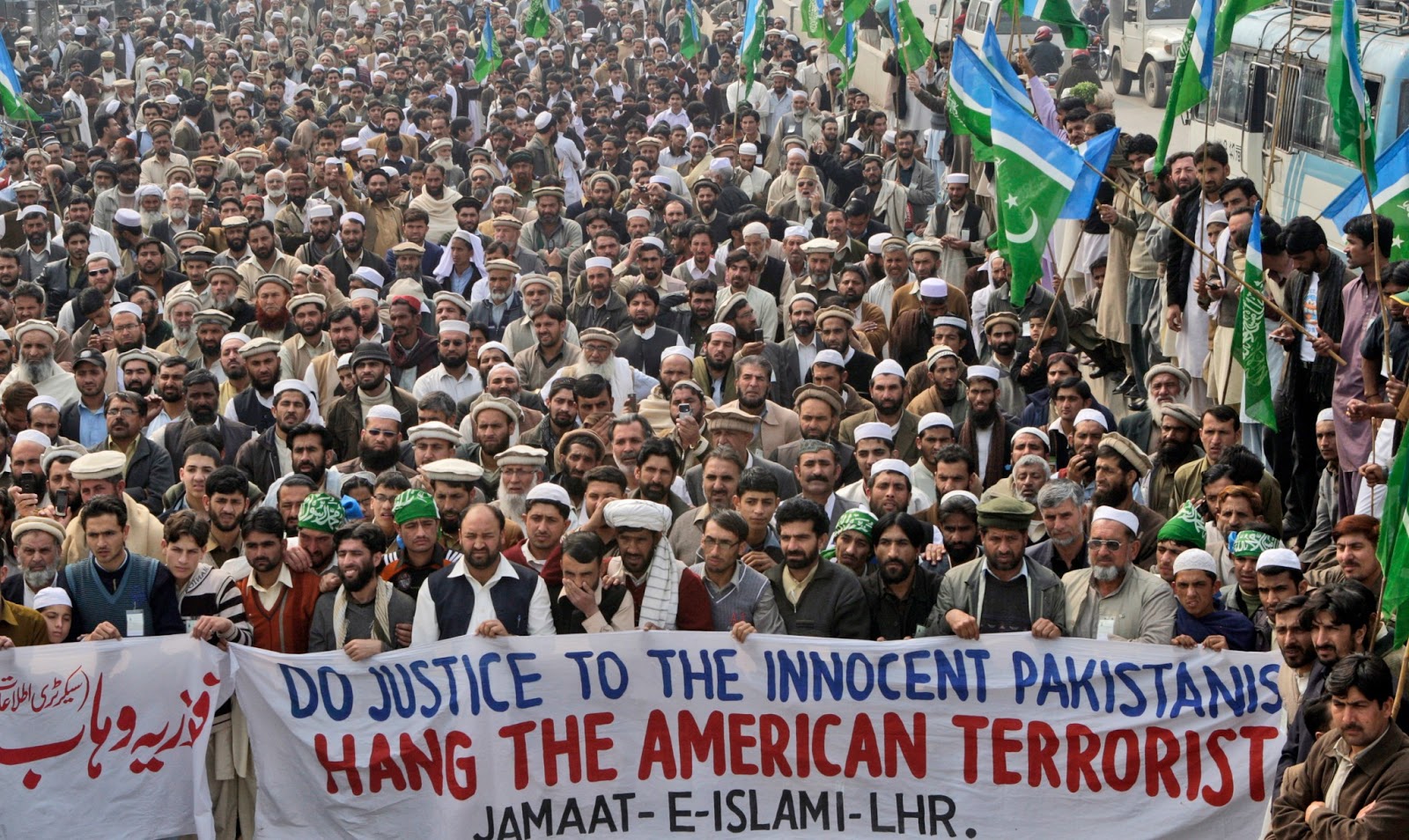
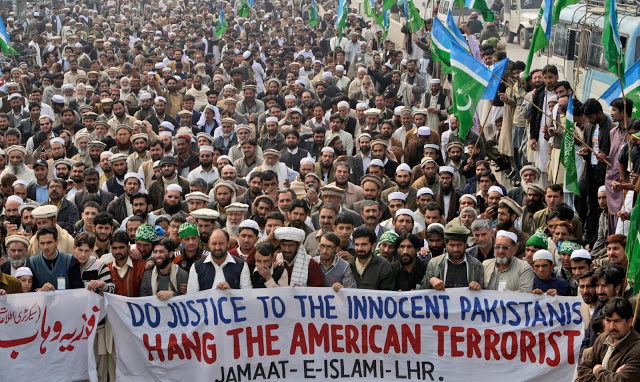 The A1 story in Sunday’s New York Times, written by Declan Walsh, is titled “U.S. Shift Poses Risk to Pakistan.” The story argues that, with the United States gradually dwindling down its political and military engagement with Pakistan, the latter faces a highly uncertain future. Walsh tells us that the disengagement will “diminish” the “prestige” and “political importance” Pakistan held as a “crucial player in global counterterrorism efforts” and could very well “upset its internal stability.”
It’s a piece that is revealing because one voice is noticeably left out of the analysis: that of the Pakistani people. Arguably the most salient fact about the U.S.-Pakistan dynamic is that Pakistanis – you know, the actual human beings who live in that country – despise the U.S. government and think the interaction between the two countries does more harm than good. Gallup conducted polling on these matters in Pakistan last year. An amazing 92% of Pakistanis expressed disapproval of U.S. leadership (i.e. Obama), while 4% approved. In a separate poll, 55% of Pakistanis reported that interaction with the West constitutes “more of a threat”; just 39% thought it was “more of a benefit.”
In a surprising development, Pakistanis don’t seem to support flagrant intrusions on their sovereignty, drone strikes that kill their fellow citizens, and a corrupt, secretive military government that regularly colludes with the U.S. (as of October, just 23% of Pakistanis expressed “confidence” in their government, which Gallup reports is widely viewed as being “too cozy” with the U.S.).
The Times article does not pay much attention to the thoughts and opinions of the Pakistani people, though. They’re background players and largely irrelevant. Walsh instead quotes a single Pakistani academic to support the article’s thesis; at other times in the piece he relies on unnamed “analysts” and “experts.” The only other individual he does quote on this narrow question of whether or not American disengagement “poses a risk” for Pakistan, a former Pakistani foreign minister, explicitly rejects the notion, saying that “less American involvement is good, not bad.”
The article concludes by stressing that, in fact, this alleged “shift” in the U.S.’s posture toward Pakistan is largely illusory, with “few” doubting that America “will remain deeply involved in Pakistan.” A former Obama administration official confidently predicts that the “mutual dependency” between the two countries “will not go away.” This basically undermines the entire point of the story.
Declan Walsh is a good reporter and he has spent a lot of time in Pakistan. But his virtual ignoring of the Pakistanis’ clearly expressed thoughts on these matters is instructive (the extent of the Pakistanis’ role in the article is a single sentence pointing out that drone strikes “stoked anger”). Consider the reverse scenario. Let’s say Pakistan had been propping up a corrupt military government here in the United States for years with aid and support. Pakistan was violating U.S. sovereignty at will, assassinating residents it considers a threat to Pakistani security, dumping their corpses in the ocean. Pakistan flew robots over American skies, from which missiles were regularly launched, killing American men, women, and children. Now imagine how we would feel if the most esteemed newspaper in the world published an article about all of this on its front page that completely ignored the will of the American public and disregarded our opinions.
Perhaps, when discussing geopolitics, we should consider the views of the populations themselves, and not just governments and elites. It’s a radical notion, but it just might make sense.
May 27, 2013
Posted by aletho |
Mainstream Media, Warmongering, Progressive Hypocrite, Subjugation - Torture, Timeless or most popular, War Crimes | Declan Walsh, New York Times, Pakistan, United States |
Leave a comment
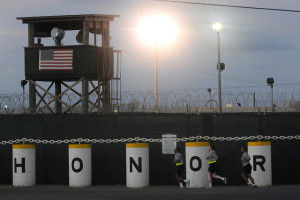
Guantanamo (Joshua Nistas/US Army)
President Barack Obama’s address yesterday on U.S. terror strategies got a lot of attention for supposedly charting a new course in America’s longest war. But some of the facts were mangled along the way.
On CBS Evening News (5/23/13), reporter Major Garrett stated that
Obama urged Congress to close the military prison in Guantanamo Bay, Cuba. To that end, he will seek permission to send 86 of the 166 jailed terror suspects already cleared for release to other countries.
Those 86 prisoners have not been, and will not be, charged with any crime whatsoever; they are not “terror suspects.” Garrett’s statement was all the more awkward considering that it came right before CBS played a clip of Obama saying this:
Imagine a future, 10 years from now, or 20 years from now–when the United States of America is still holding people who have been charged with no crime on a piece of land that is not a part of our country.
To refer to “people who have been charged with no crime” as “terror suspects” is simply Orwellian. Garrett went on to say:
An intelligence report in January, Scott, found that fewer than 5 percent of those detainees released since 2009 have rejoined the fight.
That is indeed the language used in the government’s accounting of former Guantanamo detainees–and the definition of “re-enagaging” has been narrowed considerably since the Bush years. Reporters have taken some of this Pentagon propaganda on this issue at face value in the past, which should be all the more reason to continue to be skeptical. If someone has been imprisoned without charge or trial for a number of years, can one plausibly claim that they have “returned” to committing crimes that they were never charged with in the first place?
It’s not just CBS. In the New York Times (5/24/13), Peter Baker writes:
Mr. Obama said he was lifting a moratorium he imposed on sending detainees to Yemen, where a new president has inspired more faith in the White House that he would not allow recidivism.
Again, these are prisoners cleared for release because they cannot be charged with any crimes. It is bizarre to seriously discuss the threat that they might go back to committing crimes there’s no apparent evidence that they’ve ever taken part in.
May 26, 2013
Posted by aletho |
Deception, Mainstream Media, Warmongering, Progressive Hypocrite | CBS, Guantanamo Bay detention camp, New York Times, Obama, United States |
Leave a comment

 Aletho News
