ANALYSIS: HOW THE UK AND US MEDIA DEHUMANISE PALESTINIANS
BY CLAIRE LAUTERBACH AND NAMIR SHABIBI | DECLASSIFIED UK | NOVEMBER 22, 2023
Nazis. Beneath animals.
This is a small sample of what Palestinians have been called by commentators speaking to Western media outlets in the last month of the Palestinian-Israeli conflict – examples of the bestiary of zoological terms natural to a coloniser’s view of the colonised.
Political philosopher Frantz Fanon wrote during France’s colonial war in Algeria of “hordes of vital statistics”, “hysterical masses”, “faces bereft of all humanity”, and “children who seem to belong to nobody”.
These are all terms that could describe how western media covers the suffering of Palestinians — “a tide of humanity… a teeming mass of Gazans”, as the BBC put it (15 October). This is all sharply in focus since Hamas’ October offensive, and Israel’s genocidal razing of the Gaza strip.
We analysed the front page coverage of Israel’s war in Gaza by five major US and UK news media — the Washington Post, the New York Times, the Guardian, the Times, and the BBC (the news landing page at 7am daily) between 7-26 October.
Over these three weeks following Hamas’ offensive, the mechanics of the Western press’ dehumanisation of Palestinians in death and life are revealed as clinical and routine.
Israelis are murdered, Palestinians die
The dehumanisation process begins (or ends) with questioning who counts in death, and how the killer and the victim are portrayed.
In the UK-US mainstream media, Israelis die actively. They are either killed or murdered by Hamas, or “after a surprise Palestinian attack”. “The Palestinians” stands in for “Hamas” for sloppy or ideological editors, for example in the Guardian on 8 October.
Palestinian civilians, by contrast, die passively – and yet it is they who have done most of the dying since 7 October; over ten times the number of Israelis killed.
Gazans aren’t killed by Israeli forces or Israeli government policies. They “dehydrate to death as clean water runs out” (Guardian, 18 October) while Israeli airstrikes “continue to pound the Palestinian territory”.
On 9 October, the BBC ran with “700 people have been killed on the Israeli side with more than 400 also dead in Gaza”, presumably succumbing to shock or an act of God.
On 8 November, the Times of London noted: “Israelis marked a month since Hamas killed 1,400 people and kidnapped 240, starting a war in which 10,300 Palestinians are said to have died”, which is of course qualified.
Palestinian deaths are natural, undifferentiated. This is only possible because the media treat Israel’s blockade of Gaza as wholly logical, proportionate and even restrained.
Violations of international law
Collective punishment, which is essentially what Israel is doing by striking civilian “targets” and totally blockading the “open prison” (in former prime minister David Cameron’s words), is also illegal. This is the view of EU foreign policy chief Josep Borrell, UN human rights chief Volker Türk and Human Rights Watch, among others.
When UN chief António Guterres noted Israel’s decades-long occupation of Palestine and called for an end to the siege, Israel’s UN representative demanded he resign. At least one of Guterres’ colleagues, the head of the New York office of the UN high commissioner for human rights, Craig Mokhiber, resigned of his own accord, protesting Israel’s “genocide unfolding before our eyes” in Palestine.
However, in none of the three weeks’ of front-page headlines and lead paragraphs for the five UK-US media analysed for this article are Israel’s serial violations of international law mentioned.
The exclusion of this important context on Israel’s crimes is important. As journalists we’re trained to account for the fact that most people don’t read beyond the headlines or first paragraphs.
Off the front page, some media published separate analysis pieces, such as the New York Times’ “Israel, Gaza and the laws of war” (12 October). This unsurprisingly goes nowhere near calling Israel’s crimes what they are: crimes.
Despite discussing at length how civilians cannot be targeted or disproportionately harmed for military purposes, the closest the New York Times gets to criticising the action of the Israel Defence Forces (IDF) is quoting the opinion of an expert on siege law.
This was that Israel’s siege is “an unusually clear-cut example of starvation of civilians as a method of warfare, which is considered a violation of international humanitarian law, a crime against humanity and a war crime” (emphasis added).
A swift qualifier follows: “Jurisdiction over some war crimes would depend on whether the conflict is considered inter-state.” So some crimes are not a crime as long as Palestine or Palestinians don’t exist, as Israeli prime minister Golda Meir asserted over 50 years ago, repeated by current Israeli politicians.
By contrast, Hamas’ actions are, to the same cited expert, “not close calls”.
Preventable deaths
Moving on from, or ignoring completely, both the illegality of Israel’s total siege of Gaza, the UK-US media portray the starvation and preventable deaths resulting directly from it in almost entirely passive, naturalistic language.
For example, the Washington Post’s print version front page: “Civilian harm in Gaza looms over Biden’s visit; Rising human toll from attacks could threaten Israel’s global backing” (harm arising of course from Israel’s battering).
On 13 October, from the New York Times : “300,000 homeless in battered Gaza as food runs low” (because Israel is blocking food from entering Gaza). It continues: “Hospitals overwhelmed and fuel scarce” (because Israel is blocking medical supplies and fuel from reaching Gaza) “as Israel strikes back at Hamas.”
That’s fine then – the reader should feel at ease since Israel’s crushing of hospitals is merely an act of “self-defence”.
The Israeli military is not much a fan of Gazan hospitals – it regularly bombs them. It ordered 23 hospitals in northern Gaza to evacuate on 13 October, and seems to have been picking them off, with patients inside, ever since.
When Israel might have gone too far, as it did in almost certainly bombing Al-Ahli Arab Hospital on 17 October, most outlets covered the strike by repeating both Israel’s and Hamas’ “he said-she said” accusations against the other.
Nevertheless, the New York Times gave the IDF’s denial more weight with “Hamas fails to make case that Israel struck hospital” (23 October, emphasis added), which is a catchier headline than “We don’t know, and don’t want to work it out ourselves”.
Meanwhile, the Times ran with “Strike kills up to 500 in Gaza”, swiftly adding that “Israel denies responsibility and blames jihadis”, with no comment from a Palestinian voice.
Mirroring the discrepancy between how Palestinians have died (passively, often with no mention of Israeli actions) and Israelis have died (actively, directly attributed to Hamas or “Palestinian” actions) is how the media describes child victims of both sides.
Discussing a prisoner exchange, a Washington Post columnist described Israel’s “children hostages” while referring to Palestinian children as “young people”. Under Military Order 1591, the Israeli government can hold minors as young as 12 without trial and potentially indefinitely in “administrative detention”, UNICEF reports.
When Gazan civilian deaths from siege and strikes against civilian infrastructure are shown as authorless natural disasters rather than as war crimes, any access Gazans get to essential goods becomes “aid” or “relief”, and every tiny amount allowed to reach them is an act of Israeli mercy.
For example, the New York Times (19 October): “Deal lays groundwork for aid to reach desperate Gazans”. Or the Washington Post (12 October): “Closed borders, falling bombs choke Gaza; thousands injured as supplies wane”, adding “humanitarian crisis in Gaza worsens” (due to Israeli siege, let’s not forget).
Also in the Washington Post is the incredible headline (16 October) “As Palestinian death toll rises, aid stuck in Egypt”, as if it couldn’t physically fit through the door, which ignores the fact that Israel prevented aid from entering Israel via Rafah, demanding proof it would not be diverted to Hamas.
The numbers
Having reduced Palestinians to numbers, the work then becomes to cast doubt on these numbers.
When Israel’s flattening of Gaza began raising international alarm, Biden said he didn’t trust that “Palestinians” (or the Hamas government, since to him the distinction is irrelevant) “are telling the truth about how many people are killed.”
His statement was the latest in a time-honoured tradition of US administrations disputing the number of deaths wreaked by their allies abroad, from Suharto’s Indonesia, to Salvadoran death squads in the 1980s and Saudi Arabia today, as historian Bradely Simpson notes.
No one seriously disputes the Gazan Ministry of Health’s numbers as too high. If anything, they are likely a serious undercount given how many bodies are trapped under rubble.
Nevertheless, the attribution of figures to the “Gaza Ministry of Health” is now almost always prefaced by “Hamas-government” or followed by “controlled by Hamas”. This would seem an odd waste of words, considering that everyone from the UN to the US State Department cites Gazan health ministry casualty data, and Gaza’s government is run by Hamas.
Dead Palestinians are simply irrelevant for some media. The first mention of Palestinian deaths in Times headlines occurred 11 days after Hamas’ assault: “Strike kills up to 500 in Gaza”. It had by then run several front page pieces about specific, named Israeli victims, including an in-depth profile (with portrait) of a kibbutz family horrifically killed by the Hamas-led offensive [or not].
Unsurprisingly, on 12 October, the Telegraph published the number of Israelis killed in factors of “9/11s” in a striking infographic which didn’t even bother to include an estimate of Palestinian deaths.
Double standards
Once a people are truly dehumanised, it becomes logical – necessary, even – to apply a wholly different standard of (in)decency to them.
UK-US media report Palestinian deaths passively, as if through apparent acts of God, often couching the deaths in language suggesting that they were mostly Hamas or Hamas-adjacent, or at least that they inconveniently stood in missiles’ way.
For still-breathing Palestinians, it is not enough to have somehow escaped being killed by the almost 6,000 bombs Israel launched in its first six days punishing the densely populated territory. This is more than the US, not usually known for its restraint, deployed in any single year of its war in Afghanistan.
A living Palestinian must justify his or her continued aliveness by disavowing Hamas. A viral example of this can be seen in BBC Newsnight’s interview of the head of the Palestinian mission to the UK, Husam Zomlot.
Presenter Kirsty Wark barely flinched upon hearing Zomlot describe in detail how members of his family had been killed by Israeli strikes in the previous days before repeatedly demanding Zomlot condemn Hamas’ actions.
To reverse this, in other words, to ask every Israeli who had lost a family member in this conflict to first begin by condemning Israel’s murders and collective punishment of civilian Gazans would be rightly seen as outrageous. Unsurprisingly, we have not seen any examples of such in the Western press.
The UK-US press also tells us that to support Palestinians is to support Hamas, in case anyone doubted the conflation.
The BBC declared London’s peaceful pro-Palestine protesters as providing “backing for Hamas.” It later retracted its “poorly phrased” comments.
Sky News did no better in using images of peaceful protesters bearing Palestinian flags to accompany its discussion of efforts by the London Metropolitan Police to “tackle extremism”.
These “slips” pale in comparison with the virulently offensive terms guests on BBC programmes have called Palestinians, completely unchallenged by their hosts.
For example, BBC Arabic hosted former Israeli intelligence veteran-turned academic, Mordechai Kedar who refused to recognise popular Israeli racism towards Palestinians, claiming that bestial comparisons of Palestinians are “denigrating to animals.”
Tellingly, the BBC Arabic host neither ejected Kedar from the interview, nor did she admonish him and demand an apology. Instead, the host pivoted away from Kedar’s genocidal language with the comment “that’s your opinion”.
Platforming Israeli justifications
UK-US media have also taken to running pieces platforming Israeli justifications for the IDF’s actions when the staggering number of dead Gazan civilians was becoming harder to write around.
“How Israelis justify scale of airstrikes” ran the New York version front page of the New York Times on 26 October. It was later rewritten as “Israel’s strikes on Gaza are some of the most intense this century”.
It is unthinkable that a Western newspaper would carry a piece platforming in the same benign-to-neutral terms Palestinian rage, or worse, justifications for Hamas’ crimes.
Another trend is to normalise Israel’s actions by focusing not on its costs in Gazan lives, but its intentions which, of course, are shown as benign. (Note: intentions don’t matter in the laws of war.)
Three days into Israel’s illegal total blockade of Gaza, the BBC asked: “Could an Israeli ground invasion of Gaza meet its aims?” (14 October). Charitably characterising Netanyahu as “risk-averse” (for Israelis, not Palestinians), the New York Times ran with “All-out war is untried ground”, comforting readers that “limited strikes in past were safe politically”.
Dissenting voices: harder to hear
Journalists at the BBC and Agence France Presse (AFP) who have been critical of their agencies’ bias against Palestinian lives and minimisation of Israeli war crimes told Declassified that there is no space to discuss editorial concerns.
Palestinian commentators have seen their segments edited out of mainstream news programmes. Palestinian Americans report their events are being cancelled while they’re called Hamas supporters.
Meanwhile, a senior editor at US publication Newsweek called for Gaza to be flattened to resemble a parking lot, apparently without censure.
Elsewhere in the media ecosystem, an official of the UK’s communications regulator OFCOM, Fadzai Madzingira, was suspended for a social media post criticising UK support for “ethnic cleansing and genocide of Palestinians” and “this vile colonial alliance”.
None of these points – that Israel may be committing genocide, that it continues to ethnically cleanse Palestinian land or that Israel was founded as a colonial project which still uses settler outposts to consolidate territorial control – is outside of reasonable analysis of historical facts.
It’s looking an awful lot like the beginning (or end, depending on your starting point) of a genocide.
The IDF has instructed all Palestinians to flee south of the Wadi Gaza area “for their safety” from Israeli strikes. Some were struck as they were evacuating, and Palestinians are still being shelled by the IDF in southern refuge areas.
Soldiers plant Israeli flags on Gazan beaches, while Israel’s intelligence agency floats the idea of permanently expelling Gazans to Egyptian Sinai as a preferred solution. Netanyahu invokes a Bible passage where God orders the Israelites “to put to death men and women, children and infants” of a rival kingdom.
Still, the New York Times uncritically presents Netanyahu as “seeking [a] permanent end to threat but not a reoccupation” (13 October).
That last bastion of dissent, gallows humour, is also at grave risk. Michael Eisen, editor of science journal eLife, was sacked for posting on Twitter an article from humour site the Onion, with the headline “Dying Gazans criticized for not using last words to condemn Hamas”.
The Guardian’s cartoonist Steve Bell’s contract was not renewed after his sketch of Netanyahu preparing to operate on his own stomach with an outline of Gaza was deemed too reminiscent of the “pound of flesh” anti-semitic trope.
Meanwhile, the Washington Post published a cartoon of a Hamas official with Gazan children and women strapped to him saying “How dare Israel attack civilians”. It’s since been deleted following racism complaints.
Yet the cartoonist is still drawing for mainstream media. Last week he published another cartoon in the Las Vegas Review showing a (fat, black) woman with a Black Lives Matter t-shirt holding up a sign saying “Terrorist Lives Matter: Blame Israel, Support Hamas”.
How dare Israel attack civilians indeed.
Claire Lauterbach is an independent investigative journalist and producer. She is the former Head of Investigations at Privacy International where she investigated the use and abuse of surveillance and military technologies, and a former Senior Investigator at Global Witness. Claire previously investigated war crimes in Goma, DR Congo for Human Rights Watch.
Namir Shabibi is an independent investigative journalist, visiting lecturer in Geopolitics at the University of Westminster, and PhD candidate researching covert paramilitary action in the ‘War on Terror’. He is a former International Committee of the Red Cross delegate investigating breaches of the Geneva Conventions in Darfur and Guantanamo Bay.
Will mainstream media heads roll over Trump ‘Russiagate’ fraud?
By Paul Robinson | RT | November 19, 2021
If you want to know how reliable journalists and TV talking heads are, look at their record when it comes to the biggest stories of the past decade: Iraq’s purported ‘weapons of mass destruction’ or the invasion of Afghanistan.
If they told you at the time that Iraq was knee-deep in lethal chemicals and victory over Islamist militias across the border would surely come in another six months’ time, then you have grounds for considering them to be less than reliable. If, on the other hand, they told you that all that WMD stuff was built on shaky ground and the war in Afghanistan would probably end badly, then you’ve got grounds for trusting them.
Once you start doing this, you reach a sad conclusion. The people who got it wrong have risen onwards and upwards to greater things, never having to repent for their errors, while those who got it right have been shoved to the margins. There is, in short, an astonishing lack of accountability for journalistic failure.
Still, errors need explaining, so it’s interesting to see how people go about it. Roughly speaking, there are three methods: first, deny any error; second, say you never actually believed it; and third, say you were the victim of deception. So, with the invasion of Iraq, you have a few who still maintain it was a good idea; a bunch who claim that they were secret doubters all along; and then some more who argue that the real problem was that Saddam Hussein deliberately misled everybody into thinking he had WMD, so it was quite reasonable to believe it.
Move on a few years and we can see much the same process at work in the aftermath of Russiagate – the breathless scandal that obsessed the American media for the best part of four years, with allegations that Donald Trump had colluded with the Russian state to win the 2016 election. Much like Iraq’s secretive chemical weapons program, proof of collusion has proved embarrassingly elusive. Moreover, as has become very clear, one of the key documents driving the story, the so-called Steele dossier, has turned out to be utterly worthless.
The latest nail in the coffin of the collusion narrative came with the arrest this month of the man who compiled the dossier on behalf of former British spy Christopher Steele, one Igor Danchenko. The reaction of the punditocracy has echoed that which followed the failure to find Iraqi WMD: denial by some; claims by others that they never believed the story; and, last, allegations that the whole affair was a deliberate act of deception by the Russian state.
Prime place among the first group, the deniers, goes to Max Boot. Writing in the Washington Post on Thursday, Boot showed not the slightest bit of repentance for boosting the Steele Dossier, any more than he has previously shown for backing the wars in Iraq and Afghanistan. “Even if the Steele dossier is discredited, there’s plenty of evidence of Trump’s collusion with Russia,” he says.
Paul Pillar, writing in the National Interest this week, likewise claims the dossier was unimportant. Pillar doubles down on what he knows to be the truth, that “Trump and his circle encouraged, welcomed, facilitated, and exploited a foreign power’s interference in a US election.” Incredibly, Pillar concludes that what is needed is, “a well-funded investigation to look into this further,” as if the only reason that proof of collusion is lacking is that we haven’t looked hard enough.
Given just how hard a huge number of people have looked, this is patently silly. But at least the deniers display the virtue of consistency. Perhaps more irritating are those who are now coming forward to claim that, although they didn’t say so until now, they never believed in collusion. They were, you might say, secret, silent sceptics.
Thus, Max Seddon of the Financial Times turned to Twitter to declare that the lesson of the affair was to “listen to reporters on the ground.” “I don’t know a single Moscow corr[espondent] who bought the dossier,” he says, adding that the immense fuss about Russiagate was the fault of “editors” who wasted journalists’ time on the matter rather than on “substantive coverage of Russia.”
I’m willing to believe Seddon when he implies that he never swallowed the nonsense in the Steele dossier as well as the rest of the collusion narrative. But I have to ask him, “Why didn’t you say so at the time?” Lots of people did. One assumes he’d blame his editors, and I get it – when you work for a media outlet, you’re constrained by what your editors want. But that hardly lets journalists off the hook. All it does is explain why the people who did publicly scoff at the dossier were to be found outside the mainstream media, while the likes of The Guardian’s Luke Harding were earning big bucks writing books on collusion and telling everybody what a great guy Christopher Steele was. But it doesn’t explain why all those journalists who say that they disbelieved the collusion story never called out Harding and co. Clearly something is amiss.
And then, we have the third group: those who claim innocence on the grounds of deception. The logic here is that the dossier was indeed garbage, but very clever garbage dreamt up by Russian intelligence to deceive us all. By spreading stories of Trump-Russia collusion, the Russians aimed to sow chaos and set Americans at each other’s throats.
It is, of course, ridiculous, but that hasn’t stopped many supposedly serious commentators from suggesting it as a means of excusing their own gullibility. For instance, Newsweek’s deputy opinion editor Batya Ungar-Sargon went on air to discuss the “irony of American journalists falling for Russian disinformation en masse because it confirmed what they *really* wanted to believe.”
For, you see, all those stories saying the Russians were spreading disinformation were themselves Russian disinformation. Damn, but those Ruskies are clever!
The reality is this – the Steele dossier was obvious rubbish from the start, but the mass of the journalistic community either swallowed it wholesale or, alternatively, chose to stay silent about its doubts while allowing the believers to dominate the headlines. Belated claims that “I never believed,” or absurd allegations that the whole thing was a Russian plot, are just excuses designed to deflect blame. If we are to avoid such failures in the future, we need an honest reckoning. Judging by what’s come out from Western journalists this week, it doesn’t seem we are likely to get it.
Paul Robinson is a professor at the University of Ottawa. He writes about Russian and Soviet history, military history and military ethics, and is author of the Irrussianality blog.
Inside Journalist Tareq Haddad’s Spectacular Departure from Newsweek

A photo of Tareq Haddad is shown from his Twitter profile: @Tareq_Haddad
By Alan Macleod | MintPress News | December 20, 2019
It’s Manufacturing Consent meets Operation Mockingbird; in a long exposé essay that doubles as a goodbye to the profession, Newsweek journalist Tareq Haddad explained why he was very publicly quitting his job at the New York-based magazine. “Journalism is quickly dying. America is regressing because it lacks the truth,” he wrote.
The trigger for his decision was management suppressing his story on the bombshell news that the Organization for the Prohibition of Chemical Weapons (OPCW) hid a mountain of evidence suggesting the 2018 Douma Attack was staged, thus paving the way for more military intervention in Syria. But below the surface, it was about far more than that; Haddad’s essay described how journalists are worked to the bone and how media drives the public towards war, coordinating smears against politicians who stand against it. But most spectacularly of all, he alleges that there is a network of hundreds of government assets working as high-level editors in newsrooms across America, even naming the one at Newsweek.
Haddad knew the consequences of speaking out:
In the end, that decision was rather simple, all be it I understand the cost to me will be undesirable. I will be unemployed, struggle to finance myself and will likely not find another position in the industry I care about so passionately. If I am a little lucky, I will be smeared as a conspiracy theorist, maybe an Assad apologist or even a Russian asset—the latest farcical slur of the day,” he wrote.
MintPress News reached out to him for comment. He responded that he was certain that there were more capable and well-meaning reporters like him that could come forward. “Hopefully, those journalists will have the courage to push the issue with their editors or face the embarrassment the industry will experience when the truth of the matter is revealed to all,” he stated.
Newsweek was not alone in failing to report on the OPCW revelations. Virtually the entirety of the mainstream press (with the exception of Tucker Carlson) ignored or downplayed the findings that cast the Syrian Civil War in a considerably different light. In contrast, MintPress News, with a tiny budget compared to corporate media, has covered the story closely. Unsurprisingly, they have shown little interest in Haddad’s exposé of their corruption either.
“In any functioning democracy the Tareq Haddad affair should occupy mainstream media for weeks” Oliver Boyd-Barrett, Professor Emeritus of Bowling Green State University (Department of Journalism and Communications) told MintPress News. However, he noted, “We have neither a fully functioning democracy nor the uncontaminated information ecosystem that would enable such a thing.” Newsweek, for the record, claimed that the matter was much more mundane: “The writer pitched a conspiracy theory rather than an idea for objective reporting. Editors rejected the pitch,” it said in a statement.
The “conspiracy theory” referenced is that multiple whistleblowers have come forward to publicly accuse the OPCW of suppressing their evidence in order to reach a predetermined conclusion about the Douma attacks– one that supported military intervention. On the new evidence, former head of the OPCW Dr. Jose Bustani said it “confirmed doubts and suspicions I already had” about the incoherent report, claiming that “the picture is clearer now, although very disturbing.”
Truth, Haddad wrote, is “the most fundamental pillar of this modern society we so often take for granted,” claiming that, despite going into the profession after reading radical critiques of the media like Herman and Chomsky’s Manufacturing Consent, and knowing others (like Chris Hedges) had been fired for opposing war, “I believed that honest journalism could be done. Nothing I read, however, came close to the dishonesty and deception I experienced while at Newsweek.”
He spoke of constantly self-censoring and modifying his language as to not rock the boat and how staff were totally overworked. Haddad himself wrote an average of four articles per day on complicated topics he admitted he often had no experience with whatsoever. This is a phenomenon called “churnalism” by academics, where reporters are turned into cogs in giant news machines, churning out vapid and shallow writing or copying corporate press releases for the profit of the outlet. This is one reason why trust in media has been falling since the 1970s, and particularly in the last few years.
He also discusses how the media manufactured public consent for military intervention in Syria. One example of this was his boss’s refusal to publish another of his stories questioning the legitimacy of Bana Alabed, the youthful face of the pro-intervention movement. Meanwhile, those who stand up against war are smeared as assets of foreign powers. He condemns what he describes as coordinated attacks launching “preposterous accusations” against antiwar voices such as Hawaii Congresswoman Tulsi Gabbard.
Academics found the case remarkable, but not particularly unusual. When asked for comment by MintPress News, Tabe Bergman, Lecturer in Journalism at Xi’an Jiaotong-Liverpool University, Suzhou, China replied,
“Sadly, the resignation of Tareq Haddad is merely the latest in a long series of dedicated journalists quitting their job at mainstream news organizations that try to squeeze every penny out of the ‘news product’ while placating the powers that be.”
Operation Mockingbird 2.0
Perhaps the most truly alarming claim Haddad makes in his tell-all treatise is that there is a network of hundreds of deep state assets placed into newsrooms across the country, working to control what the public sees and hears, planting stories and quashing others. As he says:
“The U.S. government, in an ugly alliance with those that profit the most from war, has its tentacles in every part of the media — imposters, with ties to the U.S. State Department, sit in newsrooms all over the world. Editors, with no apparent connections to the member’s club, have done nothing to resist. Together, they filter out what can or cannot be reported. Inconvenient stories are completely blocked.”
Dr. Boyd-Barrett compared his revelations to Operation Mockingbird, a widespread CIA infiltration of hundreds of agenda-setting news outlets throughout the United States during the 20th century, placing agents in key positions or persuading existing reporters to work with them. “The use of journalists has been among the most productive means of intelligence‑gathering employed by the CIA,” wrote the legendary investigative journalist Carl Bernstein, who broke the story for Rolling Stone in 1977. As such, Boyd-Barrett told us there is “nothing essentially new” with Haddad’s exposé:
“Discerning critics have long assumed the wholesale penetration of our media ecosystem and universities by intelligence agencies and other special interests and every so often something emerges accidentally to confirm their worst fears.”
While initially fearing he might never work in the profession again, Haddad said that he is still weighing his options and is considering crowdfunding as a model to finance new investigations as an independent journalist.
“There are numerous stories that haven’t had the attention they deserve in the mainstream press and they are well worth investigating further. Also, it’s worth noting that because of my initial piece, several journalists have reached out to me with information I wasn’t previously aware of so there are several threads to be investigated more,” he revealed.
Haddad’s exposé of the corruption and collusion at the heart of modern journalism is something long-discussed by academics such as Bergman and Boyd-Barrett, but rarely does such a clear example present itself. His account undermines the credibility of the entire for-profit corporate model of news that prevails across the world, precisely the reason why you are unlikely to hear about it on CNN or in the New York Times.
Alan MacLeod is a MintPress Staff Writer as well as an academic and writer for Fairness and Accuracy in Reporting. His book, Bad News From Venezuela: Twenty Years of Fake News and Misreporting was published in April.
Lies, Newsweek and Control of the Media Narrative: First-Hand Account
A mafia runs editors. Freedom of the press is dead. Journalists and ordinary people must stand up.
By Tareq Haddad | December 14, 2019
Introduction
Until several days ago, I was a journalist at Newsweek. I decided to hand my resignation in because, in essence, I was given a simple choice. On one hand, I could continue to be employed by the company, stay in their chic London offices and earn a steady salary—only if I adhered to what could or could not be reported and suppressed vital facts. Alternatively, I could leave the company and tell the truth.
In the end, that decision was rather simple, all be it I understand the cost to me will be undesirable. I will be unemployed, struggle to finance myself and will likely not find another position in the industry I care about so passionately. If I am a little lucky, I will be smeared as a conspiracy theorist, maybe an Assad apologist or even a Russian asset—the latest farcical slur of the day.
Although I am a British citizen, the irony is that I’m half Arab and half Russian. (Bellingcat : I’m happy to answer any requests.)
It is a terribly sad state of affairs when perfectly loyal people who want nothing but the best for their countries are labelled with such preposterous accusations. Take Iraq war veteran and Hawaii congresswoman Tulsi Gabbard for example, who was the target of such mud slinging for opposing U.S. involvement in Syria and for simply standing up to the Democratic Party’s most corrupt politician, Hillary Clinton. These smears are immature for a democracy—but I, in fact, welcome such attacks.
When the facts presented are utterly ignored and the messengers themselves are crucified in this way, it signals to right-minded people who the true perpetrators of lies are and where the truth in fact lies.
That truth is what matters most to me. It is what first drove me to journalism while I was working in Jersey’s offshore finance industry after completing my degree from Binghamton University’s School of Management in upstate New York. I was so outraged when I grew to realize that this small idyllic island I love and had grown up on since the age of nine, a British Crown dependency fifteen miles off the coast of France, was in fact a hub for global tax evasion. This realization came to me while the British people were being told that austerity had to continue—public funding for schools, hospitals, policing and all matter of things were to be slashed—all while the government “recovered” after bailing out the banks following the 2008 crash. That austerity lie was one I could no longer stomach as soon as I came to understand that my fairly uninspiring administrative role was in fact a part of this global network of firms to help multinational companies, businessmen, politicians and members of various royal families in avoiding paying trillions in tax—all under a perfectly legal infrastructure that the government was fully aware of, but kept quiet about.
In my naivety, as I left that industry and began my journalism training, I wrote a piece that detailed some of this corruption in hopes of changing the public awareness around these issues and in hopes that they no longer continued—albeit I did so in a manner of writing and sophistication I would be embarrassed of presently—but to my disappointment at the time, the piece was hardly noticed and the system remains little changed to now. Nonetheless, since that moment, I have not once regretted speaking truthfully, most especially for my own mental well being: I would not have been able to regard myself with a grain of self-respect had I continued to engage in something I knew was a lie. It is the very same force that compels me to write now.
There is also another, deeper force that compels me to write. In my years since that moment when I decided to become a journalist and a writer, although I suspect I have known it intrinsically long before, I have come to learn that truth is also the most fundamental pillar of this modern society we so often take for granted—a realization that did not come to us easily and one that we should be extremely careful to neglect. That is why when journalistic institutions fail to remember this central pillar, we should all be outraged because our mutual destruction follows. It may sound like hyperbole, but I assure you it’s not. When our record of where we come from is flawed, or our truth to put it more simply, the new lies stack on top of the old until our connection to reality becomes so disjointed that our understanding of the world ultimately implodes. The failure of current journalism, among other factors, is undoubtedly linked to the current regression of the Western world. In consequence, we have become the biggest perpetrators of the crimes our democracies were created to prevent.
Of course, for those who pay attention, this failure of mainstream journalism I speak of is nothing new. It has been ongoing for decades and was all too obvious following the Iraq war fiasco. The U.S. and U.K. governments, headed by people who cared for little other than their own personal gain, told the people of their respective countries a slew of fabrications and the media establishment, other than a handful of exceptions, simply went along for the ride.
This was something that consumed my interest when I was training to be a journalist. How could hundreds of reputable, well-meaning journalists get it so wrong? I read numerous books on the issue—from Noam Chomsky’s Manufacturing Consent and Philip Knightley’s The First Casualty to work by Chris Hedges, the Pulitzer-prize-winning former foreign correspondent for the New York Times who was booted out for opposing that war (who I disagree with on some things, for the record)—but still, I believed that honest journalism could be done. Nothing I read however, came close to the dishonesty and deception I experienced while at Newsweek. Previously, I believed that not enough journalists questioned the government narrative sufficiently. I believed they failed to examine the facts with close enough attention and had not connected the dots as a handful of others had done.
No. The problem is far worse than that.
Syria
In the aftermath of the Iraq war and during my time studying this failure of the media since, I was of course extremely aware of the high likelihood that the U.S. government narrative on Syria was a deception. For starters, there were the statements made by the retired four-star general, General Wesley Clark, to Democracy Now!’s Amy Goodman in 2007, four years prior to the beginning of the Syria conflict. The following is worth watching to in full.
Nonetheless, once I joined IBTimes UK in 2016, after training with the Press Association and working at the Hull Daily Mail (both of whom I am eternally indebted to for giving me an excellent foundation for starting my career) I solidly understood that journalism was not the profession of making unverifiable claims. I, or any journalist for that matter, could not out-right say that the nature of the Syrian conflict was based on a lie, no matter how strongly we suspected it. To do so, we would need unshakeable evidence that pointed to this.
Through the years, good journalists did document evidence. Roula Khalaf, who will soon take over from Lionel Barber as the editor of the Financial Times, wrote one such piece alongside Abigail Fielding-Smith in 2013. It documented how Qatar provided arms and funded the opposition of Bashar al-Assad’s legitimate government to the tune of somewhere between $1 and $3 billion from the outset of the conflict, rubbishing claims that it was a “people’s revolution” that turned violent. Footage captured by Syrian photographer Issa Touma—made into a short film titled 9 Days From My Window in Aleppo—similarly showed how Qatar-funded jihadists from the Al-Tawhid Brigade were present in the streets of Syria’s capital from the very outset of the war.
“Fighters re-enter my street,” Touma says as he films covertly out of his window. “They look different. They are heavily armed men with beards. I had only heard about them before. This is Liwa al-Tawhid. National television calls them terrorists. The international press calls them freedom fighters. I don’t care what they call it—I refuse to chose a side. But it’s a lie that the revolution started peacefully everywhere. At least in my street, Al Said Ali Street, it started with guns. It didn’t start peacefully at all.”
Veterans of the trade Seymour Hersh and Robert Fisk also poked holes in the U.S. government narrative, but their treatment by other journalists has been one of the most shameful episodes in the history of the press.
Hersh—who exposed the My Lai Massacre during the Vietnam War, the clandestine bombing of Cambodia, the torture at Abu Ghraib prison, in addition to telling the world the real story of how Osama Bin Laden died—was shunned from the industry for reporting a simple fact: Bashar al-Assad’s government is not the only actor with access to chemical weapons in Syria. After a sarin attack in the Damascus suburb of Ghouta in 2013, he was further smeared for reporting that Barack Obama withheld important military intelligence: samples examined in Britain’s Porton Down did not match the chemical signatures of sarin held in the Syrian government’s arsenals.
Fisk, writing days before the Syrian conflict escalated, in a piece that asked Americans to consider what they were really doing in the Middle East as the ten-year anniversary of 9/11 approached, also raised important questions, but he too was largely ignored.
I also did my best to document evidence that poked holes in the narrative as best I could. In 2016, I wrote how Egyptian authorities arrested five people for allegedly filming staged propaganda that purported to be from Syria. Though I’m not aware of any evidence to suggest that the two are connected and I make no such claims, these arrests came to light after The Bureau of Investigative Journalism and The Sunday Times revealed that a British PR firm, Bell Pottinger, was working with the CIA, the Pentagon and the National Security Council and received $540 million to create false propaganda in Iraq a month prior.
The following year, after the alleged chemical weapons attack in Khan Sheikhoun, I documented the intriguing story of Shajul Islam, the British doctor who purported to have treated the alleged victims and appeared on several television networks including NBC to sell the case for retaliation. He gushed with heroism, but it was not reported he was previously charged with terror offences in the U.K. and was in fact considered a “committed jihadist” by MI6. He was imprisoned in 2013 in connection with the kidnapping of two Western photo-journalists in northern Syria and was struck off Britain’s General Medical Council in 2016. Why he was released without sentencing and was allowed to travel back to Syria remains a mystery to me.

I also refused to recycle the same sloppy language used, inadvertently or not, by a number of other publications. Al Qaeda and their affiliates had always been referred to as terrorists as far as I was aware—why the sudden change to “rebels” or “moderate rebels” for the purposes of Syria? Thankfully, the news editor I worked with most frequently at the time, Fiona Keating, trusted my reporting and had no problems with me using the more appropriate terms “anti-Assad fighters” or “insurgents”—though one could arguably say even that was not accurate enough.
When buses carrying civilian refugees hoping to escape the fighting in Idlib province were attacked with car bombs in April of 2017, killing over 100, most of them women and children, I was disappointed with the Guardian and the BBC for continuing with their use of this infantile word, but this was not the language I felt to be appropriate in my report.

At roughly the same time, in light of the Khan Sheikhoun attack, confronted with an ever-growing list of irregularities and obvious falsifications—such as increasing evidence that the White Helmets were not what they purported of being, or the ridiculousness that the Western world’s de facto authority on Syria had become 7-year-old Bana al-Abed—I wrote an opinion piece that came short of calling the narrative around the Syrian conflict a lie, but simply pleaded that independent investigations of the alleged chemical weapons attack were allowed to take place before we rushed head first into war. I still believed honesty would prevail.
That piece was ultimately declined by IBTimes—though I covertly published it in CounterPunch later—but the rejection email I received from the editor-in-chief at the time makes for interesting reading.

I was sad to hear that asking for an independent investigation into a chemical weapons attack was an “incendiary theory,” but I was forced to move on.
By that summer, I was let go alongside a number of other journalists from the publication after the Buzzfeed-style model of click-bait-aggregation journalism was heavily punished by a new Google algorithm and had largely failed: page views plummeted and editors couldn’t seem to understand it was because we weren’t doing any real journalism. Having felt frustrated with the industry, I decided not to pursue another position in reporting and decided to move to mainland Europe in hopes of pursuing my other passion—literature—with aspirations of being able to write more freely.
Fast forward to 2019, I decided to return to journalism as I was feeling the pressure to have “a grown-up job” and could not count on my ability to be a novelist as a means of long-term career stability. So when I joined Newsweek in September, I was extremely thankful for the opportunity and had no intention of being controversial—the number of jobs in the industry appeared to be shrinking and, besides, the Syrian conflict appeared to be dying down. As soon as I arrived, Newsweek editor-in-chief Nancy Cooper emphasized original reporting and I was even even more pleased. I wanted to come in, get my head down and start building my reputation as a journalist again.
Then on October 6, President Donald Trump and the military machine behind him threw my quiet hopes of staying well clear of Syria into disarray. He announced the decision to withdraw U.S. troops from the country and green-lit the Turkish invasion that followed in a matter of days. Given my understanding of the situation, I was asked by Newsweek editors to report on this.

Within days of the Turkish invasion into Syria beginning, Turkey was accused of using the incendiary chemical white phosphorus in an attack on Ras al-Ayn and, again, having pitched the story, I was asked to report on the allegations. This spurred a follow-up investigation on why the use of the substance—a self-igniting chemical that burns at upwards of 4,800 degrees Fahrenheit, causing devastating damage to its victims—was rarely considered a war crime under the relevant weapons conventions and I was commended by Nancy for doing excellent journalism.
It was while investigating this story that I started to come across growing evidence that the U.N.-backed body for investigating chemical weapons use, the Organisation for the Prohibition of Chemical Weapons (OPCW), issued a doctored report about an alleged chemical attack in Douma in April of 2018, much to the anger of OPCW investigators who visited the scene. Once Peter Hitchens of the Mail on Sunday published his story containing a leaked letter that was circulated internally from one of the disgruntled OPCW scientists, I believed there was more than enough evidence to publish the story in Newsweek. That case was made even stronger when the letter was confirmed by Reuters and had been corroborated by former OPCW director-general Dr. Jose Bustani.
Although I am no stranger to having story ideas rejected, or having to censor my language to not rock the ship, this was a truth that had to be told. I was not prepared to back down on this.
Let me be clear: there is evidence that a United Nations body—whose jurisdiction was established after the world agreed to never repeat the horrors of World War I and World War II, such as German forces firing more than 150 tons of chlorine gas at French colonial troops in Ypres—is being weaponized to sell the case for war.
After OPCW experts found trace levels of chlorine when they visited Douma—i.e. no different than the levels of chlorine normally present in the atmosphere—or raised concerns that the canisters may have been tampered with or placed, both of which were reflected in their original reports, they made protestations because this information was withheld from the final report that was released to the world’s media. Instead, the final wording said chlorine was “likely” used and the war machine continued.
This is not a “conspiracy theory” as Newsweek sadly said in a statement to Fox News—interestingly the only mainstream publication to cover my resignation. Real OPCW scientists have met with real journalists and explained the timeline of events. They provided internal documents that proved these allegations—documents that were then confirmed by Reuters. This is all I wanted to report.
Meanwhile, OPCW scientists were prevented from investigating Turkey’s alleged use of white phosphorus. This flagrant politicization of a neutral body is opening the world up to repeating the same horrors we experienced in those two devastating wars.
This is unacceptable and I resigned when I was forbidden from reporting on this. … Continue reading
George H.W. Bush, the CIA and a Case of State-Sponsored Terrorism
By Robert Parry | Consortium News | September 23, 2000
In early fall of 1976, after a Chilean government assassin had killed a Chilean dissident and an American woman with a car bomb in Washington, D.C., George H.W. Bush’s CIA leaked a false report clearing Chile’s military dictatorship and pointing the FBI in the wrong direction.
The bogus CIA assessment, spread through Newsweek magazine and other U.S. media outlets, was planted despite CIA’s now admitted awareness at the time that Chile was participating in Operation Condor, a cross-border campaign targeting political dissidents, and the CIA’s own suspicions that the Chilean junta was behind the terrorist bombing in Washington.
In a 21-page report to Congress on Sept. 18, 2000, the CIA officially acknowledged for the first time that the mastermind of the terrorist attack, Chilean intelligence chief Manuel Contreras, was a paid asset of the CIA.
The CIA report was issued almost 24 years to the day after the murders of former Chilean diplomat Orlando Letelier and American co-worker Ronni Moffitt, who died on Sept. 21, 1976, when a remote-controlled bomb ripped apart Letelier’s car as they drove down Massachusetts Avenue, a stately section of Washington known as Embassy Row.
In the report, the CIA also acknowledged publicly for the first time that it consulted Contreras in October 1976 about the Letelier assassination. The report added that the CIA was aware of the alleged Chilean government role in the murders and included that suspicion in an internal cable the same month.
“CIA’s first intelligence report containing this allegation was dated 6 October 1976,” a little more than two weeks after the bombing, the CIA disclosed.
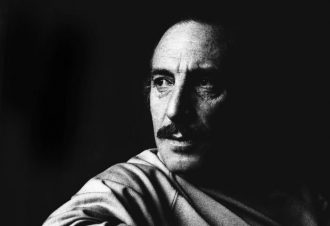
Chilean diplomat Orlando Letelier (Wikipedia)
Nevertheless, the CIA – then under CIA Director George H.W. Bush – leaked for public consumption an assessment clearing the Chilean government’s feared intelligence service, DINA, which was then run by Contreras.
Relying on the word of Bush’s CIA, Newsweek reported that “the Chilean secret police were not involved” in the Letelier assassination. “The [Central Intelligence] agency reached its decision because the bomb was too crude to be the work of experts and because the murder, coming while Chile’s rulers were wooing U.S. support, could only damage the Santiago regime.” [Newsweek, Oct. 11, 1976]
Bush, who later became the 41st president of the United States (and is the father of the 43rd president), has never explained his role in putting out the false cover story that diverted attention away from the real terrorists. Nor has Bush explained what he knew about the Chilean intelligence operation in the weeks before Letelier and Moffitt were killed.
Dodging Disclosure
As a Newsweek correspondent in 1988, a dozen years after the Letelier bombing, when the elder Bush was running for president, I prepared a detailed story about Bush’s handling of the Letelier case.
The draft story included the first account from U.S. intelligence sources that Contreras was a CIA asset in the mid-1970s. I also learned that the CIA had consulted Contreras about the Letelier assassination, information that the CIA then would not confirm.
The sources told me that the CIA sent its Santiago station chief, Wiley Gilstrap, to talk with Contreras after the bombing. Gilstrap then cabled back to CIA headquarters in Langley, Virginia, Contreras’s assurances that the Chilean government was not involved. Contreras told Gilstrap that the most likely killers were communists who wanted to make a martyr out of Letelier.
My story draft also described how Bush’s CIA had been forewarned in 1976 about DINA’s secret plans to send agents, including the assassin Michael Townley, into the United States on false passports.
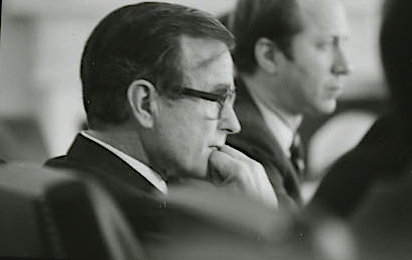
Then-Vice President George H.W. Bush at the White House on Feb. 12, 1981. (Reagan Library)
Upon learning of this strange mission, the U.S. ambassador to Paraguay, George Landau, cabled Bush about Chile’s claim that Townley and another agent were traveling to CIA headquarters for a meeting with Bush’s deputy, Vernon Walters. Landau also forwarded copies of the false passports to the CIA.
Walters cabled back that he was unaware of any scheduled appointment with these Chilean agents. Landau immediately canceled the visas, but Townley simply altered his plans and continued on his way to the United States. After arriving, he enlisted some right-wing Cuban-Americans in the Letelier plot and went to Washington to plant the bomb under Letelier’s car.
The CIA has never explained what action it took, if any, after receiving Landau’s warning. A natural follow-up would have been to contact DINA and ask what was afoot or whether a message about the trip had been misdirected. The CIA report in 2000 made no mention of these aspects of the case.
After the assassination, Bush promised the CIA’s full cooperation in tracking down the Letelier-Moffitt killers. But instead the CIA took contrary actions, such as planting the false exoneration and withholding evidence that would have implicated the Chilean junta.
“Nothing the agency gave us helped us to break this case,” said federal prosecutor Eugene Propper in a 1988 interview for the story I was drafting for Newsweek. The CIA never volunteered Ambassador Landau’s cable about the suspicious DINA mission nor copies of the fake passports that included a photo of Townley, the chief assassin. Nor did Bush’s CIA divulge its knowledge of the existence of Operation Condor.
FBI agents in Washington and Latin America broke the case two years later. They discovered Operation Condor on their own and tracked the assassination back to Townley and his accomplices in the United States.
In 1988, as then-Vice President Bush was citing his CIA work as an important part of his government experience, I submitted questions to him asking about his actions in the days before and after the Letelier bombing. Bush’s chief of staff, Craig Fuller, wrote back, saying Bush “will have no comment on the specific issues raised in your letter.”
As it turned out, the Bush campaign had little to fear from my discoveries. When I submitted my story draft – with its exclusive account of Contreras’s role as a CIA asset – Newsweek’s editors refused to run the story. Washington bureau chief Evan Thomas told me that Editor Maynard Parker even had accused me of being “out to get Bush.”
The CIA’s Admission
Twenty-four years after the Letelier assassination and 12 years after Newsweek killed the first account of the Contreras-CIA relationship, the CIA admitted that it had paid Contreras as an intelligence asset and consulted with him about the Letelier assassination.
Still, in the sketchy report in 2000, the spy agency sought to portray itself as more victim than accomplice. According to the report, the CIA was internally critical of Contreras’s human rights abuses and skeptical about his credibility. The CIA said its skepticism predates the spy agency’s contact with him about the Letelier-Moffitt murders.
“The relationship, while correct, was not cordial and smooth, particularly as evidence of Contreras’ role in human rights abuses emerged,” the CIA reported. “In December 1974, the CIA concluded that Contreras was not going to improve his human rights performance. …
“By April 1975, intelligence reporting showed that Contreras was the principal obstacle to a reasonable human rights policy within the Junta, but an interagency committee [within the Ford administration] directed the CIA to continue its relationship with Contreras.”
The CIA report added that “a one-time payment was given to Contreras” in 1975, a time frame when the CIA was first hearing about Operation Condor, a cross-border program run by South America’s military dictatorships to hunt down dissidents living in other countries.
“CIA sought from Contreras information regarding evidence that emerged in 1975 of a formal Southern Cone cooperative intelligence effort – ‘Operation Condor’ – building on informal cooperation in tracking and, in at least a few cases, killing political opponents. By October 1976, there was sufficient information that the CIA decided to approach Contreras on the matter. Contreras confirmed Condor’s existence as an intelligence-sharing network but denied that it had a role in extra-judicial killings.”
Also, in October 1976, the CIA said it “worked out” how it would assist the FBI in its investigation of the Letelier assassination, which had occurred the previous month. The spy agency’s report offered no details of what it did, however. The report added only that Contreras was already a murder suspect by fall 1976.
“At that time, Contreras’ possible role in the Letelier assassination became an issue,” the CIA’s report said. “By the end of 1976, contacts with Contreras were very infrequent.”
Even though the CIA came to recognize the likelihood that DINA was behind the Letelier assassination, there never was any indication that Bush’s CIA sought to correct the false impression created by its leaks to the news media asserting DINA’s innocence.
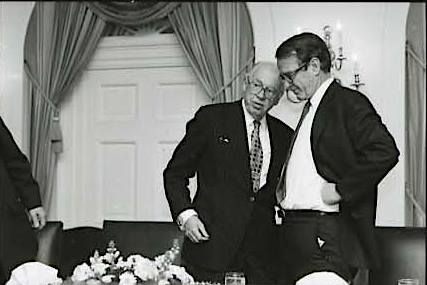
Then-Vice President George H.W. Bush with CIA Director William Casey, Feb. 11, 1981. (Reagan Library)
After Bush left the CIA with Jimmy Carter’s inauguration in 1977, the spy agency distanced itself from Contreras, the new report said. “During 1977, CIA met with Contreras about half a dozen times; three of those contacts were to request information on the Letelier assassination,” the CIA report said.
“On 3 November 1977, Contreras was transferred to a function unrelated to intelligence so the CIA severed all contact with him,” the report added. “After a short struggle to retain power, Contreras resigned from the Army in 1978. In the interim, CIA gathered specific, detailed intelligence reporting concerning Contreras’ involvement in ordering the Letelier assassination.”
Remaining Mysteries
Though the CIA report in 2000 contained the first official admission of a relationship with Contreras, it shed no light on the actions of Bush and his deputy, Walters, in the days before and after the Letelier assassination. It also offered no explanation why Bush’s CIA planted false information in the American press clearing Chile’s military dictatorship.
While providing the 21-page summary on its relationship with Chile’s military dictatorship, the CIA refused to release documents from a quarter century earlier on the grounds that the disclosures might jeopardize the CIA’s “sources and methods.” The refusal came in the face of President Bill Clinton’s specific order to release as much information as possible.
Perhaps the CIA was playing for time. With CIA headquarters officially named the George Bush Center for Intelligence and with veterans of the Reagan-Bush years still dominating the CIA’s hierarchy, the spy agency might have hoped that the election of Texas Gov. George W. Bush would free it from demands to open up records to the American people.
For his part, former President George H.W. Bush declared his intent to take a more active role in campaigning for his son’s election. In Florida on Sept. 22, 2000, Bush said he was “absolutely convinced” that if his son is elected president, “we will restore the respect, honor and decency that the White House deserves.”
The late investigative reporter Robert Parry, the founding editor of Consortium News, broke many of the Iran-Contra stories for The Associated Press and Newsweek in the 1980s. His last book, America’s Stolen Narrative, can be obtained in print here or as an e-book (from Amazon and barnesandnoble.com).
Newsweek Claims Russia Orchestrated Boston Marathon Bombing
Sputnik | September 6, 2017
Online publication Newsweek upped the ante in explosive rhetoric Sunday by suggesting the Tsarnaev brothers, responsible for the 2013 Boston Marathon terror attack, were operating on behalf of Moscow – even though Russian security agencies tipped off the FBI and CIA that Tamerlan Tsarnaev and his mother presented imminent security risks.
Since evidence is apparently optional for arguments published by Newsweek, this time, an author featured in the publication seems to have looked out onto the world, found it bloody and complicated, and decided to pin any old recent disaster on Russia.
The United Kingdom’s Brexit vote, the Syrian refugee crisis in Europe and the rise of right-leaning politicians can all be traced back to one single, remarkably effective cause: Moscow. “Russia must accept a share of responsibility” in all of these events, Andrei Kovalev wrote in a September 3 op-ed for Newsweek.
As for the Boston bombing, he asks, “Did the emigrants, the brothers Tsarnaev, of Chechen nationality, responsible for the Boston attack, act on their own initiative? It seems most unlikely.”
Kovalev worked as a diplomat in the Soviet Union under Mikhail Gorbachev as well as for Russian presidents Boris Yeltsin and Vladimir Putin. “Sometimes I am reproached for attributing to the Kremlin too much influence in the world,” he confessed in the article.
In reality, Russian security services sent warnings to multiple US agencies explaining that Chechen-American Tamerlan Tsarnaev had “changed drastically since 2010” and that he and his mother were adherents to “radical Islam” long before the Boston attack occurred. “The Russians were concerned that mother and son were very religious and strong believers, and they could be militants if they returned to Russia,” a US official told the New York Times in 2013.
“You have Russian intelligence services contacting two agencies without our federal government responsible for our national security, the FBI and CIA … they tell us, ‘We believe you have a radical Islamist in your midst,'” South Carolina Senator Lindsey Graham explained at the time.
Newsweek’s readers quickly pointed out that the claim that Russia had orchestrated the Boston Marathon terror attack originated with Louise Mensch, a former UK member of Parliament who shot to fame as a darling of the Russia-bashing wing of the Trump resistance, but, given her penchant for calling literally any critic a Russian spy, has somewhat fallen from favor. Mensch was recently embarrassed by the Guardian for broadcasting information around the internet that was made up by a hoaxer but supported her “Russians are behind it all” agenda. As Radio Sputnik’s Fault Lines host Garland Nixon joked, “pretty much everybody that dies, the death was related to Vladimir Putin,” in Mensch’s world.
When faced with accusations of spreading deleterious and false information, Mensch doubled down and said the Guardian was being operated by Russian security agency spies, too. The former MP alleged that one of her collaborators, Claude Taylor, had been duped, but that her reporting remained free of falsehoods.
Mensch has nevertheless been published by the New York Times, the Guardian and the Sun in addition to making TV appearances on MSNBC and Bill Maher’s “Real Time” show. A running list of her baseless conspiracies includes Facebook CEO Mark Zuckerberg acting as a mole and Putin ordering the assassination of Breitbart News founder Andrew Breitbart to pave the way for Steve Bannon to take the reins of the organization.
Newsweek, too, has gotten quite good at getting things wrong. It previously deleted two slanderous articles attacking a former Sputnik News editor following a defamation lawsuit settlement levied by now-attorney and former Sputnik weekend editor William Moran. During the scandal, in which the young lawyer represented himself in legal proceedings alleging slander against himself and Sputnik as a whole, Newsweek Editor-in-Chief Jim Impoco was fired. The February ouster was first reported by Politico.
Newsweek was forced to settle with Moran in July. “I brought this case before I was admitted to the bar and was up against the talented attorneys at mega law firm Pepper Hamilton,” Moran said in a statement that month after a settlement was reached between the publication and recent Georgetown Law graduate for an undisclosed sum.
Shortly after, Editor-in-Chief Matt McAllester was forced to take a leave of absence for “personal reasons” in the beginning of August following an age and sex discrimination suit filed against Time Inc. by its former European editor, Catherine Mayer, in which McAllester is featured as the main offender. By August 25, McAllester had been dismissed from his position, the New York Post reported, citing internal company memos.
See Also:
Newsweek Seems to Fire Disgraced Writer Eichenwald After Humiliating Settlement
Newsweek Takes Down Fabricated Sputnik-Trump Collusion Stories After Humiliating Settlement
Newsweek Shamefully Silent as Twitter Demands Retraction From Implicated Writer
In Clinton Cuckooland: 1000s-Strong Army of Russian Babushkas is Hacking America
Sputnik – 05.11.2016
If you thought there was nothing left for the Clinton propaganda machine to blame Russia for during this election season, hold on tight!
Newsweek’s infamous Kurt Eichenwald just released another bombshell: the US is being hacked by a massive army of elderly Russian emigrants who, underneath those headscarves, are actually top-notch cyberspies!
Newsweek has finally cracked the case!
Moscow is hacking America on behalf of Donald Trump — it’s an accusation that’s become a familiar refrain for Hillary Clinton’s campaign. But who, exactly, are the soldiers behind Putin’s nefarious plan? Senior writer Kurt Eichenwald, who made headlines last month for pushing an equally absurd conspiracy theory about Sputnik’s own role in the intrigue, has the scoop: Western intelligence and law enforcement say tens of thousands of people have been working with Russia on its hacking and disinformation campaign for many years. They include propagandists and cyberoperatives stationed in Moscow, St. Petersburg and Novosibirsk, located in the southwestern part of Siberia. Operations have also been conducted in the United States, primarily out of New York City, Washington, D.C., and Miami. Those involved include a large number of Russian émigrés, as well as Americans and other foreign nationals. Intelligence operations in Europe and the U.S. have determined that the money these émigrés receive for their work is disguised as payments from a Russian pension system.
Evidence? Nah, who needs it.
You read that right: thousands of Russian retirees that moved to the States to live with their kids are hardly who they pretend to be. Those babushkas and dedushkas are really soldiers (or maybe even officers!) in the army of cyberspies hacking America from within for Donald Trump, according to Newsweek.
Why Trump? Because he’s Putin’s puppet, of course! Eichenwald goes on to reiterate his earlier theory, which, according to his own admission, was fed to him by US intelligence. He claims that the Republican nominee rehashed Russian “propaganda” at a rally speech — transmitted to the candidate by none other than yours truly, Sputnik News. What Eichenwald misses entirely is the irony of admitting that he was handed the story by his own government — the very definition of propaganda.
“You need to ask yourself — how does someone like me who is deeply wired into the intelligence community know so fast that you had posted this? It’s not like I was sitting around reading Sputnik. Others are though, and they are not reading it 24-hours a day in real time for the purpose of keeping abreast of the news,” Eichenwald told former Sputnik News writer and editor Bill Moran in an email. Newsweek magazine is displayed on a shelf at a news stand at South Station in Boston, Wednesday, May 5, 2010. The Washington Post Co. is putting Newsweek up for sale in hopes that another owner can figure out how to stem losses at the 77-year-old weekly magazine.
Not to mention that Eichenwald tried to bribe Moran with a job as a political reporter for The New Republic in exchange for his silence, when his lies and attempts at a cover-up were revealed — he also left that out of the new report.
Newsweek’s darling also failed to mention that, since his original story was published, it has been widely debunked across the board as an absolute lie.
The New York Times recently dismissed the myth of a Trump-Putin connection, reporting that the FBI has failed to find any links between the two despite a thorough investigation. The Washington Post also dismissed Eichenwald’s conspiracy theory, openly calling him out. And the Intercept’s Glenn Greenwald wrote a piece tearing apart Eichenwald’s false report.
None of these facts have stopped Newsweek’s bizarre crusade to spread this misinformation to smear both Trump and Russia, however. And Newsweek is not alone in its campaign: MSNBC’s Rachel Maddow on Thursday night previewed Eichenwald’s story as an important piece of evidence against Trump, and the next morning Eichenwald himself appeared on CNN to present his latest conspiracy theory. Naturally, none of the Clinton-campaigning correspondents challenged his statements.
To sum up, Eichenwald published an entirely fabricated conspiracy theory, which has been widely debunked. He attempted to bribe a journalist for his silence. He is now continuing his crusade, with new revelations about an army of geriatric ne’er-do-wells, all the while becoming more and more of a laughing stock.
Bravo, Newsweek. Now we know why you went out of print.
Corporate Media Backing Clinton Exploits Orlando Shooting for Passive Holocaust Denial
By Robert Barsocchini | Empire Slayer | June 16, 2016
Within hours of the mass shooting in Orlando, the corporate media backing neoconservative favorite Hillary Clinton began, almost unanimously, to exploit the opportunity to passively promote holocaust and genocide denial.
Outlets including the NY Times, CBS News, NBC News, CNN, Newsweek, USA Today, and so on, all referred to the Orlando massacre unequivocally as the worst shooting and/or worst act of gun violence in US history. (CBS News, at the time it was accessed for this piece, was running a large “I’m With Her” ad for Hillary Clinton at the top of its page.) A useful comparison to the corporate assessment might be to imagine if a German civilian gassed a group of people to death and the German press reported it as the worst gassing in German history. After the Paris shooting, the Western press likewise reported that as the worst shooting in recent Parisian history, despite that the Parisian police not long ago massacred some 300 peaceful marchers protesting the French dictatorship in Algeria and dumped their bodies in the river that runs through the city (more info in previous piece).
Native News Online quickly pointed out that the corporate media was almost completely whitewashing “mass killings of American Indians in its reporting” on Orlando. It gave two well-known (as far as these go) examples of worse gun-violence and mass-shootings: some 300 Native men, women, and children, were massacred at Wounded Knee, and 70 to 180 were massacred at Sand Creek.
One commenter on the Native News piece shared that she “wrote to every single news outlet yesterday from the New York Times, the Guardian, the Huffington Post, and Salon to CNN, NBC, and the BBC. I have yet to receive a reply from any of them with the exception of the Oregonian, who changed its language immediately. They also informed me that the Associated Press has just begun to change its language. I’m hoping the Guardian and BBC begin to do the same too.”
Another commenter on the Native News piece gave a short list of some acts of gun-violence, mass-shootings, or mass killings perpetrated in US history, by US forces:
1864 – 300 Yana in California
1863 – 280 Shoshone in Idaho
1861 – 240 Wilakis in California
1860 – 250 Wiyot in California
1859 – 150 Yuki in California
1853 – 450 Tolowa in California
1852 – 150 Wintu in California
1851 – 300 Wintu in California
1850 – 100 Pomo in California
1840 – 140 Comanches in Colorado
1833 – 150 Kiowa in Oklahoma
1813 – 200 Creek in Alabama
1813 – 200 Creek in Alabama
1782 – 100 Lanape in Pennsylvania
1730 – 500 Fox in Illinois
1713 – 1000 Tuscarora in North Carolina
1712 – 1000 Fox in Michigan
1712 – 300 Tuscarora in North Carolina
1704 – 1000 Apalachee killed & 2000 sold into slavery in North Carolina
1676 – 100 Algonquian and Nipmuc in Massachusetts.
1676 – 100 Occaneechi in Virginia
1675 – 340 Narragansett in Rhode Island
1644 – 500 Lanape in New York
1640 – 129 Massapeag in New York
1637 – 700 Pequot in Connecticut
1623 – 200 Powhatan & Pamunkey in Virginia with “poison wine”
Professor David E. Stannard describes one such massacre, wherein US forces weakened a Delaware group of Native men, women, children, and elders through starvation, convinced them it would be in their best interest to disarm, then tied them up and exterminated them and mutilated their dead bodies. Stannard notes that such massacres by US forces “were so numerous and routine that recording them eventually becomes numbing”. (American Holocaust, pp. 125/6)
A couple of corporate news outlets used somewhat more precise language to describe the Orlando massacre, editorializing (while again presenting it as fact) that it was the ‘worst shooting in modern US history’.
However, this still leaves unstated the writer’s opinion of what constitutes ‘modern’. The wounded knee massacre took place in 1898, and the Black Wall Street massacre, for example, in which 55-400 people were murdered and a wealthy black community in Oklahoma ethnically cleansed, took place in 1921. (More examples.)
And, of course, the US has massacred millions of people, many of them with rifles and other types of guns, but also in far worse ways, outside the territory it officially claims, and continues to do so. Obama recently massacred almost a hundred people at one time with what could be viewed as an AR-15 on steroids. Is any of this part of ‘modern US history’? Why or why not? The qualifications are unstated and thus subjective. The vague language from the neoliberal, government-linked corporate outlets may lead readers to believe that all of US history is included in their ‘factual’ statements, and that the US has never massacred more than fifty people anywhere.
In some cases, this impression will have been intentional on the part of the oligarch mouthpiece outlets, which have an interest in fostering a benevolent image of the US to help elites further capture global markets . In others, it will have been a result of conveniently self-aggrandizing ignorance on behalf of the writers and editors – an ignorance that makes an important contribution to their job security.
As some of them partially or belatedly demonstrated, all of the corporate outlets could have easily avoided any holocaust/genocide-denial by calling the shooting the worst by a single civilian on US territory in at least the last thirty years, or any number of other obvious, simple, direct phrasings, which are supposed to be integral to journalism, anyway.
But as John Ralston Saul points out, the neoliberal/neoconservative ideology relies on the ‘whitewashing of memory’. That doesn’t always work, though, especially on survivors of US and Western genocides, which is why, as Ralston Saul further notes, the West and its proxies are behind most of the global murders of writers, who may try to expose facts and evidence that interfere with the West’s historical whitewashing.
Since the Orlando massacre, both Clinton and Trump have called for further escalation of Western aggression in the Middle East.
Robert Barsocchini is an internationally published author who focuses on force dynamics, national and global, and also writes professionally for the film industry. Updates on Twitter.
Featured Video
Ted Postol: Fraud of Missile Defence Exposed in Iran War
or go to
Aletho News Archives – Video-Images
Frlom the Archives
Containing the United States
By Edward S. Herman | Z Magazine | September 2016
“Containing the United States” is, of course, a ridiculous and self-contradictory idea in the U.S. and Western ideological and propaganda system. We all know that the United States had to “contain” the Soviet Union from 1945 to 1991, and since then has had the task of containing Russia and China. Only they threaten, bully, aggress and worry countries like Poland and Vietnam. Obama has had to reassure them both of our steadfast stand against Russian and Chinese military attacks. NATO has, of course, expanded greatly over the past several decades, despite the deaths of the Soviet Union and Warsaw Pact, but only to contain the renewed Russian — and Iranian, Libyan, Syrian and other — military threats; and we have “pivoted” to Asia, supported Japanese rearmament, bolstered our own forces in that area and jousted with the Chinese in their coastal waters solely to contain China. Earlier we had been obliged to contain North Vietnam, or was it the Soviet Union in Vietnam? Or China? Or “communism”? Or maybe all of them? Or none of them, but just needing an excuse to enlarge power?
The parallel propaganda has taken many forms. One is accepting as a premise that the United States only acts defensively and has no internal forces and interests that drive it to enlarge its sphere of control. I noted in an earlier article how Paul Krugman claims that internal Russian problems may well be the explanation of Russian “aggression,” but how at the same time it never occurs to him that the huge U.S. transnational corporate interests and “defense” establishment, and the pro-Israel lobby’s activities, might possibly make for an expansionist dynamic here.2 This reflects the standard establishment perspective that we are good and only react to evil. This was the view sustaining and justifying the invasion and occupation of Iraq from 2003. That attack was taken here as not evil but a response to evil, even if involving lies and mistakes, hence not describable as “aggression.” … continue
Blog Roll
 Aletho News
- Iran War Supporters Invent a New and Absurd Justification: It Is All About China
- Corporate Media Go All Out To Support The US-Israeli War on Iran
- Trump press conference reveals a man who wants out of war
- When Tel Aviv decides, Washington fights
- Top official: Iran ready for a long war with US, no more diplomacy
- How Iran’s Toxic Rain Reveals US-Israel Discord
- Trump Admits He Is Destroying Iran For Israel
- Iran’s latest move in the GCC countries was a stroke of genius
- Blackmail and death threats, Zelensky embarrasses the EU, but there’s no condemnation
- Israel threatens to kill Iran’s new leadership
- If Americans Knew
- Lebanon: Israel’s White Phosphorous Use Risks Civilian Harm
- Corporate Media Go All Out To Support The US-Israeli War On Iran
- US-Israel war on Iran is creating a steady growing number of amputees
- Israel planned this war on Iran for 40 years. Everything else is a smoke screen
- The wrong question about the war in Iran
- ‘Your Tax Dollars Being Used to Raise Your Gas Prices’: US-Israel Bomb Major Iranian Oil Depots
- ‘Bogus Evidence’: Former Nuclear Watchdog Head Debunks US Justification for Iran War
- EXPLAINER – Dimona: What to know about Israel’s nuclear site
- Fires and toxic air in Iran (thanks, Israel) – Not a ceasefire Day 150
- At Israel’s hands, Iran is burning, Lebanon and Gaza are crumbling – Not a ceasefire Day 149
- No Tricks Zone
- Wake-up Call: Survey Shows Majority Of Germans Now Favor Postponing Climate Targets!
- Televised! Leading German Political Candidate Tells Schoolchildren CO2 Makes Sun Hotter!
- New Study: A Century Warming Of 1.1°C Is ‘Commonplace’ And ‘Not Unusual’ During This Interglacial
- New Study: ‘Internal Noise’ And Volcanic Forcing Can Trigger 10-15°C Warming Within Decades
- Glaciers Worldwide Are Suddendly Surging, Experts Blame Warming!
- Surprising Discovery: Sahara Is Greening…Billions Of Trees Where Once Thought To Be Barren
- New Research Reaffirms Clouds, Aerosols, And Surface Solar Radiation Are ‘Driving The Climate System’
- Germany: Electric Car Catches Fire At Charging Station, Sets Off Local “Inferno”, Widespread Damage
- New Study: Canada’s New Brunswick Was 1°C Warmer Than Today During The Medieval Warm Period
- Coal Power Back In Trend As Globe Tries To Keep Pace With Growing Demand For Power
 Aletho News
