NED Pursues Regime Change by Playing the Long Game
By Edward Hunt | Lobe Log | July 3, 2018
During a recent congressional hearing, the heads of three influential non-profit organizations that operate in numerous countries around the world revealed the subtle ways in which the United States meddles in the internal affairs of other countries by playing what the officials called “the long game.”
The three officials—Carl Gershman, Daniel Twining, and Kenneth Wollack—told Congress about their long-term efforts to empower the opponents of U.S. enemies and boasted about their ability to change foreign governments. They said that they had recently helped their political allies gain political power in Malaysia, acknowledged that they have helped train thousands of activists in Nicaragua, and speculated about the potential to create new governments in China, Russia, and North Korea.
All three men strongly defended their activities, insisting that they are critically important to the advancement of democracy in the world.
“We’re not asking people to do anything that they don’t want to do,” Gershman said. “We’re supporting their own aspirations and giving them some of the tools to realize those aspirations.”
Gershman is the president of the National Endowment for Democracy (NED), a U.S. taxpayer-funded nonprofit created by the U.S. government in 1983. As the president of NED, Gershman oversees the issuance of grants to its political-party-associated organizations, including the International Republican Institute (IRI), which is headed by Twining, and the National Democratic Institute (NDI), which is headed by Wollack.
Facing skepticism about their work from the Trump administration, which views the organizations as unnecessary expenses and wants to cut their funding, Gershman and his colleagues provided Congress with a broad overview of how their work affects the world. They defended their ongoing operations, trying to persuade Congress that they should continue to receive funding.
Ultimately, the three officials revealed how they are helping the U.S. government interfere in numerous countries around the world.
The NED Approach
The general strategy of NED is to empower like-minded activists to build new political movements in their home countries. NED helps these activists become influential political actors, often with the goal of creating new possibilities for political change.
Officials typically describe their approach as one of “democracy promotion.” They argue that they are helping democratic forces introduce democratic politics into countries ruled by authoritarian leaders.
“These leaders, their strategic Achilles heel is fear of their own publics,” Twining explained. “And I think we should think about the old Reagan message of exploiting that a little bit.”
The strategy requires a long-term commitment in the countries where the NED is active. Twining calls it “playing the long game.” Gershman calls it “long-term work.”
The officials discussed numerous examples. Twining said that IRI has been working with opposition forces in Malaysia since 2002. He credited IRI with helping opposition forces prevail in the country’s recent parliamentary elections, calling the victory “an example of playing the long game.”
U.S.-backed opposition forces are “now in-charge of this very strategic country right there on the frontlines of the South China Sea, right there on the frontlines of the Islamic world’s intersection with rest of Asia,” Twining said. “And that’s good for America.”
The NED has also been active in Nicaragua, where opposition forces are organizing major protests against the Nicaraguan government. The protesters are trying to bring down the government of Nicaraguan President Daniel Ortega, a popular leftist leader who has been in power since 2007.
“We have been working on youth leadership programs and have worked with more than 8,000 youth on a very extensive coursework and academies to develop U.S. engagement,” Wollack said.
Although Wollack denied that the organizations are training their grantees for the purpose of overthrowing Ortega, Gershman indicated that regime change is the ultimate goal. “Time for him to go,” Gershman said, referring to Ortega.
The three officials also cited many additional opportunities to influence governments around the world. They are especially excited about opportunities in Armenia, where a major social movement recently ousted a government backed by Russia.
Twining speculated about the possibility of achieving regime change in Russia, calling Putin a “very brittle” leader who is “frankly quite insecure.”
Gershman saw potential for a similar outcome in North Korea. “This is an eroding totalitarian system, so we shouldn’t give up hope on the possibilities for internal change,” he said.
Gershman believes that the primary focus should be on China, however. He called China “the most serious threat our country faces today.”
Although Gershman said that the U.S. government will initially respond to challenges from China with a mix of military, economic, and geostrategic power, he insisted that the long-term solution could be found in the “unhappy people” who oppose the Chinese government.
“We have to not give up on the possibility for democratic change in China and keep finding ways to support them,” he said.
The Controversy in Washington
The open talk of U.S. meddling in other countries around the world was so commonplace that the U.S. mass media spent no time covering the hearing, even though the speakers did encounter some pushback. Not all members of Congress are on board with the programs.
Congressman Dana Rohrabacher (R-CA) made the strongest critique, insisting that U.S. meddling destabilizes countries while creating more problems for the United States in the long run. Rohrabacher blamed recent U.S. meddling for destabilizing Ukraine. He argued that the U.S. involvement in national protests that led to the downfall of the government of Viktor Yanukovych in February 2014 prompted the subsequent Russian invasion of the country and the war that continues there today.
“I don’t believe the Russians would have invaded Ukraine had we not arrogantly involved ourselves to overthrow that democratically elected government in Ukraine,” Rohrabacher said.
Rohrabacher also insisted that the U.S. should support dictators. He singled out Egypt, saying that the country should continue to be ruled by General Abdel Fattah el-Sisi, the military dictator who gained power by overthrowing the country’s first democratically elected government in 2013.
“I know I am making everybody mad at me, but I had to say it,” Rohrabacher commented.
Faced with Rohrabacher’s criticisms, the remaining participants in the hearing made some effort to counter his arguments but otherwise said very little, preferring instead to blandly praise NED for performing admirable work by promoting democracy around the world.
The general feeling in Congress is that the U.S. government should continue to fund the work of the NED and its affiliated institutes. Most members of Congress view the organizations as important assets in the U.S. government’s toolkit, believing they play an important role in U.S. global strategy.
Congressman Gerry Connolly (D-VA) unabashedly praised NED, IRI, and NDI, calling their work “exciting.” He told the three officials that “nothing does America prouder than the work frankly you’re doing.”
Nicaragua, unraveling a plot
The US’ NED distributed $4.2 million in Nicaragua, between 2014 and 2017, to train “new leaders” to overthrow the Sandinista government
By Francisco Arias Fernández | Granma | June 29, 2018
 AS early as 2016, talk of war against Nicaragua could again be heard in Miami, at a time when the streets of this nation were a regional example of security, peace, and prosperity, where a hardworking, tranquil people proudly enjoyed the social and economic advances achieved by the Sandinista government, that had established a national consensus, in the wake of one of the worst interventions carried out by the United States in Central America.
With no justification whatsoever – when the news from Nicaragua around the world was about a proposed inter-oceanic canal that would boost the economy and impact global navigation – Congress members who make a living off the U.S. war against Cuba and Venezuela were mounting efforts to reverse the prosperity and calm that reigned in the land of Augusto César Sandino.
Congress members, first in the House of Representatives and later the Senate, introduced a bill to create obstacles to the awarding of international loans to Nicaragua, hamper foreign investment, and put a brake on socio-economic development in the country. This imperialist punishment, cooked up by the worst of the anti-Cuban mafia in 2015, set in motion the fabrication of a pretext regarding the alleged lack of democracy, justified as a way to “guarantee electoral transparency and fight corruption.” The result of this initial maneuver was the Nicaraguan Investment Conditionality Act of 2017 (NICA Act).
Ileana Ros, Albio Sires, Marco Rubio, and Ted Cruz, and others, among the most reactionary legislators in Congress from South Florida, Texas, and New Jersey, are again attempting to reinvent the Contras and get rid of the Sandinista government, which has repeatedly shown at the polls that it enjoys the people’s majority support.
The tentacles of this subversive plot go beyond the capital, since these forces are well connected to the United States’ coup-manufacturing machinery, and laid the foundation for a media campaign in coordination with agencies specialized in carrying out dirty wars and soft coups, working with U.S. intelligence and the CIA, in particular.
In this specific case, international press media have documented the participation of the U.S. Agency for International Development (USAID); the National Endowment for Democracy (NED); and the National Democratic Institute (NDI), as well their sub-contractors, which have been working meticulously, since Daniel Ortega was first elected, to re-invent a “new leadership,” selectively infiltrating key sectors of the economy, targeting youth, students, medium and small businesspeople, environmental and feminist groups, among others, to undermine the foundation of support for the Sandinista government.
It is revealing that on April 16, this year, following the same line espoused by anti-Cuban Congress members, USAID Administrator Mark Green announced that the U.S. government would continue supporting the participation of a “free … genuine” civil society in Nicaragua, after stating that the United States is concerned about the closing of democratic spaces in Nicaragua, “systematic” violations of human rights, and government corruption.
In March, Representatives Ileana Ros-Lehtinen and Albio Sires sent a letter to Green, in which they call on the U.S. government to reverse its decision to provide “zero aid” to Nicaragua through USAID for the fiscal year 2018-2019, while at the same time calling on the agency to avoid supporting “members of the private sector linked to corruption, money laundering, or the Daniel Ortega regime.”
At the end of 2008, the media reported that USAID had provided at least a million dollars in Nicaragua that year to NGOs, radio broadcasters, and political groups like the Communications Research Center (CINCO), to intervene in municipal elections.
This financing, as was denounced at the time, contributed surreptitiously as “small donations,” that were not to exceed 25,000 dollars, was part of a large scale U.S. plan to overthrow the government of Daniel Ortega, carried out since then by internal agents from the Nicaraguan right.
The strategy mounted to discredit the Sandinista government in the media was conducted via two financing routes; one directed by USAID and the Casals & Associates firm, and another managed by the so-called Common Fund in Europe, which provided funds to organize campaigns and mobilizations to destabilize the government.
By 2008, media in Nicaragua had identified at least 14 subversive projects run by USAID across the country, under the cover of a wide range of titles and objectives, made possible by this funding.
Another key element of the U.S. machinery linked to the CIA is the National Democratic Institute, an instrument dedicated to promoting “change” that focuses on “empowering” so called “agents of change” in countries with governments not to Washington’s liking.
A Swedish journalist reported, this past June 4, that three students from Nicaragua were conducting a tour of Europe to raise support for a plot against the Sandinista government, stating that at least one of the youth represented an organization created and financed by the United States.
Jessica Cisneros, he reported, was active around the issue of the involvement and participation of youth in political processes, and was a member of the Movimiento Cívico de Juventudes (Civic Youth Movement).
Another of these “agents of change” promoting hate for the Sandinista government and support for a coup, was Yerling Aguilera, from the Polytechnic University in Managua (UPOLI) and specializing in research on revolution and the feminist movement, who, according to the reporter, has been an employee and consultant for the Institute of Strategic Studies and Public Policy (IEEPP) in Nicaragua, that works to “strengthen the abilities of political, state, and social actors for a better informed public via creative, innovative services,” which has received 224,162 dollars from the National Endowment for Democracy (NED) between 2014 and 2017.
The NED has distributed some 4.2 million dollars in Nicaragua, over this three-year period.
The USAID, NDI, and NED have been busy in the country, with thousands of activists trained to “change society.” Hundreds of NGOs, universities, and political parties have received funds and materials as part of the subversive plan that was not conceived to advance through traditional political organizations, but rather those invented to give the impression that they emerged “spontaneously” from dissatisfaction, hiding the true interest of the North at work.
Although efforts were intensified after Ortega’s 2006 electoral victory, since 2015, with the approval of the NICA Act, U.S. agencies increased and broadened financial support and resources for their “agents of change” in Nicaragua, above all through leadership courses and money for young people in universities, NGOs, and political parties.
In their political, diplomatic, and media advice to the coup-plotters, Washington has insisted on demonizing Daniel Ortega and his government, an effort carried out not only by the White House, and its agencies, allies, satellites, and mercenaries, but also the corporate media monopolies and fabricators of lies, which magnify internal problems and accuse authorities for all types of human rights violations, totally omitting the crimes and destruction committed by individuals who have been “empowered” by the USAID, NDI, NED, and CIA, who have caused the failure of talks and calls for peace. As is the case in Venezuela, Donald Trump and his advisors, architects of a thousand invasions, do not believe in dialogue or pacts, opting for war on all fronts.
Nicaragua has become the epicenter of U.S. warmongering efforts, hand in hand with Anti-Cuban legislators and profiteers, and other veteran hawks. Washington is attempting to re-invent its strategy at the cost of human lives and destruction in the streets of Nicaragua.
USAID’S THINLY DISGUISED SUBVERSION PROJECTS IN NICARAGUA:
– Citizen participation in electoral processes
– Developing a culture of transparency among Nicaraguan youth
– Communications training for students to produce stories that promote self-efficacy
– Multimedia for democratic governability
– Strengthening civil rights of women and youth in Masaya
– Citizen action legal framework for journalists
– Active participation for Nicaraguans exercising their right to vote
NDI TENTACLES
– Since 2010 the NDI has been associated with Nicaraguan universities and civic organizations conducting a youth leadership program which has helped prepare more than 2,000 “youth leaders,” and worked to increase the political influence of women, LGBT persons, and electoral processes
– The Movimiento Cívico de Juventudes (MCJ) is an organization financed, created, and part of the NDI.
– Several members of the group graduated from the NDI program earning a Certificate in Leadership and Political Management (CLPM).
Francisco Arias Fernández, internet@granma.cu
Nicaragua: Legitimacy And Human Rights
By Stephen Seftan | Tortilla con Sal | July 4, 2018
The murder of Miguel Ramos on July 3 focuses many aspects of the current crisis in Nicaragua to do with conflicting claims of legitimacy involving fundamental issues of civil and political rights and social and economic rights. In 1978 and 1979, as a teenager in the Carlos Fonseca Northern Front guerrilla column, Miguel fought for Nicaragua’s sovereign independence. On July 3 he died for that same cause, gunned down by supporters of the U.S.-backed right-wing coup in progress against the Sandinista government of President Daniel Ortega. Miguel was one of a group of civilians helping the authorities clear an opposition roadblock at La Trinidad on the Panamerican Highway about 20km south of Esteli.
On July 3, Carlos Ascencio, El Salvador’s ambassador, published an appeal on behalf of all the Central American ambassadors in Nicaragua to clear similar roadblocks in Jinotepe. His letter provides independent corroboration of the violent intimidation and extortion practised by opposition gangs who have operated these roadblocks for two months, strangling Nicaragua’s economy and abusing people’s basic rights.
Ascencio denounces the effective detention of 400 truck drivers and their vehicles near the town of Jinotepe for over a month. The drivers, from all over Central America, have been threatened and their vehicles damaged. The political opposition activists operating the roadblocks refuse to liberate the trucks and their drivers because “they are our protective shield and negotiating card to support our demands in the dialogue.”
A Focus For Murder
That is just one of the innumerable gross human rights abuses by the right-wing opposition forces promoting the attempted coup in Nicaragua. For two months the road blocks, operated by opposition paramilitaries and paid thugs, have been a focus for murder, torture, kidnapping, intimidation, extortion and criminal delinquency. Supporters of the coup turn that reality upside-down, blaming the resulting violence on the government. In their upside-down world, ordinary citizens organizing to defend their rights against armed and violent opposition gangs metamorphose into ‘Sandinista paramilitaries.’
In the case of Miguel Gomez, the opposition have already portrayed the incident in which he died as a government paramilitary attack on peaceful protesters. They will add Miguel’s death to the tally of their own casualties, even though he died at their hands. Abundant documentation and audio-visual evidence exists now disproving categorically the constant falsehoods propagated by U.S.-funded opposition human rights organizations and local Nicaraguan opposition media. The original list of 55 deaths, proclaimed with such theater on the first day of the National Dialogue, has been completely debunked. There was never any ‘student massacre.’
Sadistic Violence
Other material exposes media and NGO manipulation of opposition marches, or the deaths of women during the crisis. Numerous videos demonstrate the sadistic violence of opposition activists. Various writers like Alex Anfruns have explained the systematic pattern of media distortion and manipulation of opposition attacks and abuses reported by opposition media and NGOs as government human rights violations. No Western corporate media and only a handful of alternative media publish this material or any version challenging the demonstrable false witness of Amnesty International and the Inter-American Commission for Human Rights (IACHR).
Just as in the case of Venezuela, those organizations have failed to investigate impartially any of the incidents they report, merely recycling the version already prepared for them by U.S.-funded local NGOs and media and ignoring or rejecting documentation from the Nicaraguan authorities out of hand. IACHR Director Paulo Abrao effectively disqualified himself as an independent arbitrator during a visit to Nicaragua last May, when he was recorded publicly declaring his support for the opposition. The investigative process accompanied by a group of IACHR experts had not even begun when, on June 22, the IACHR presented their final report to the OAS Permanent Commission.
Blatant Political Bias
Perhaps as the political price of avoiding – at least for the moment – the kind of all-out economic and diplomatic assault applied to Cuba and Venezuela, the Nicaraguan government has accepted these gross methodological irregularities and the blatant political bias of the OAS and its IACHR subsidiary. For its part, the Comission for Truth, Justice and Peace appointed by the National Assembly has actively sought an exchange of information with the opposition human rights organizations. As Commission member Cairo Amador has explained, “It’s a matter of everyone providing their data and their versions so, in the end, everyone contributes to getting at the truth.”
But as Esteli Mayor Francisco Valenzuela has pointed out, the effects of the attempted coup are much broader than the civil rights violations: “The damages can definitely be classified in order of importance. First, the suffering and the victims that we all lament. Secondly, everything to do with the economy and with people’s freedoms, the roadblocks that impede freedom of movement and have affected employment. The inability to move goods and products for export has caused enormous financial losses. Tourism has suffered nationally and locally, especially small businesses. Most businesses in Nicaragua are small- or medium-sized and have been very badly affected. A lot of businesses have closed.” Economy Minister Ivan Acosta has stated: “Growth projections for the economy were 4.5 percent to 5 percent, but now we think the economy is not growing. 200,000 jobs have been lost, which affects social security, trade, domestic demand and real productive activity.”
Extensive Losses
Nicaragua’s municipal authorities report losses to vehicles, machinery and equipment of over US$10 million and to buildings and infrastructure of over US$112 million. The country’s technical training institute reports losses of US$80 million. The Ministry of Education reports over 60 schools attacked and damaged. A preliminary MINSA report in June reported 55 ambulances destroyed or damaged, as well as other damage to hospitals and health centers, all resulting from opposition attacks. The Infrastructure and Transport Ministry also reports extensive losses, for example damage valued at US$1.5 million from just one incident, when opposition activists attacked a plant in Sebaco and destroyed equipment.
None of that extraordinary level of violence and destruction figures anywhere in the reports by Amnesty International or the IACHR, nor the abuse of the basic rights of the government workers and local population involved. Similarly, neither those organizations nor the Western media have reported the role of criminals contracted to operate the opposition roadblocks and carry out attacks. On June 30, Nicaraguan police arrested Salvadoran mara leader Oscar Rivas Carrillo, who confirmed he and other criminals were being paid to operate roadblocks, carry out murders, burn public buildings and attack economic targets. Rivas and other criminals worked jointly with opposition activists supported by right-wing business interests, U.S.-funded NGOs, right-wing political parties and the Catholic Church.
Clearly, Amnesty International and the IACHR have deliberately covered up that reality and misled international opinion, faithlessly exploiting their image as defenders of human rights, just as they do on Venezuela and Cuba. Even so, despite the extreme violence and the egregious dishonesty of its apologists, the U.S.-backed right-wing opposition coup to oust President Daniel Ortega has failed. People in Nicaragua overwhelmingly support efforts to return to normality and a political solution to the crisis. The Nicaraguan authorities will tolerate the IACHR’s theatrics for another few months before the OAS circus eventually moves on. Defeated opposition leaders hoped to impose their coup, failed because they lacked popular support, and now have to accept what the Sandinista government is prepared to agree as the sovereign power in Nicaragua. Miguel Gomez did not die in vain.
Nicaragua: terrorism as an art of demonstrating
By Alex Anfruns | Investig’Action | July 1, 2018
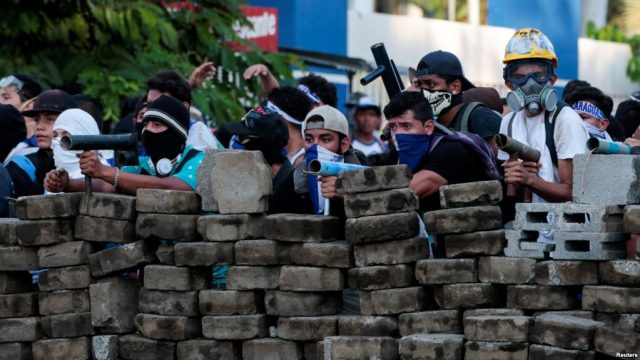
For two months, Nicaragua has been through a major political crisis, fueled by clashes between law enforcement and an insurgency. Humanitarian organizations report a terrifying record of nearly 200 deaths. This violence, compromising the attempts of political negotiations, makes it necessary to understand who has an interest in paralyzing this Central American country. What are the motivations of protesters and opposition forces? Is the Nicaraguan government the symbol of absolute tyranny?
It was a pension reform project that started the fire. To avoid privatizing social security as recommended by the IMF, the government wanted to increase contributions for both workers and employers. Faced with a public outcry, the government backtracked and withdrew its reform plan. But the protests continued without anyone being able to understand what their objective was. In order to stop the cycle of violence, government spokesmen called on the protesters to participate in peace commissions. They insisted on their willingness to listen to the various demands and to promote the expression of political opposition. To no avail. Calls for dialogue from the government have been shunned. They were even perceived as a sign of weakness, galvanizing the young protesters of the M-19 movement.
With no program, this movement simply calls for overthrowing the “dictatorship” accused of being at the origin of the “repression”. Moreover, the international media aligned themselves without reserve with these demonstrators, regarded as the quintessence of the civil society, in spite of their nihilism and extremism. But the attitude of the M-19 raises questions. By refusing any political solution and promoting violence, the movement offers an ideal motive for the proponents of “regime change” and “constructive chaos” already applied in countries like Libya, Iraq or Ukraine
On 14 June, the M-19 operation consisting of deploying “tranques” (barricades) in certain areas of the capital Managua, as well as in nearby cities such as Masaya or Granada, was supported by a “national strike” of 24 hours. This strike was convened by COSEP, the main employers’ organization. Yes, in Nicaragua, it is the bosses who call to strike! The world upside down? The fact remains that neither the majority of workers, nor the small and medium-sized enterprises followed suit. But it allowed an evaluation of the balance of power as well as maintaining the pressure until the next phase. On June 16, the day when the peace dialogue between the opposition and the government was to be revived, a new episode of extreme violence made the front pages of the international media.
The macabre fire of the Velasquez house
First, the facts. On June 16, a group of hooded people set fire to a building in Managua using Molotov cocktails, causing seven deaths, including a two-year-old child and a five-month-old baby. A mattress store occupied the ground floor of the building while the owner and his family lived on the first floor. Neighbors said they saw hoodlums throw their cocktails at the building, and said some shooters would have prevented the family from escaping. Accident as a possible cause was therefore immediately rejected.
But private media like Televisa or BBC immediately seized on the case to blame the authorities for the crime. According to their information, paramilitaries on government payroll wanted to use the roof of the building to post snipers; the paramilitaries, having been denied access by the homeowner, would have locked him up in his residence with his family before setting it on fire. This is the same thesis defended by the Nicaraguan Center for Human Rights (CENIDH), which pointed out “their complicity with the national police”. For other governments, this argument would appear simplistic, implausible and irrational. Who would have defended the idea that the British government was behind the fire at the Grenfell tower for example? But in the case of Nicaragua, the complicity or even the responsibility of the government is put forth as a matter of fact.
To give credit to the story, the BBC used the testimony of the only survivor in the family: “Hooded people came with police officers and locked up nine people in a room on the second floor and burned us alive.” According to the same testimony, the offenders carried “mortars, weapons, and Molotov bombs”. We can only respect the bereavement of the survivor. But it cannot be dismissed that under shock, and calling for divine justice, she felt the need to find an immediate culprit. This is why it cannot be excluded that her testimony has been influenced in some way so as to channel her anger and to politically exploit it. In an effort to get closer to the truth, it is necessary to look for additional information and to cross-check it with other testimonies and documents.
The problem is that observers are facing a real war of images. Filmed from the balcony of the burned house, an amateur video was immediately relayed on social media. It aims at reinforcing the thesis of police forces and para-police organizations participation. Filmed by the eldest son of the family, Alfredo Pavon, one of the victims of the fire, this video is certainly interesting. But we see only a convoy of five police vans stopping near the house after a motorcycle chase, after which the police fires some warning shots and arrests a young biker. It’s hard to turn this into evidence. This document is nevertheless used to sow doubt, or even to point at the authorities as being responsible for the crime. Widely shared by the media in the aftermath of the crime, the video continues to be broadcast in a loop and feed hate comments…
However, these images have in fact been taken out of context: the recording was made on April 21, that is, at the very beginning of this crisis. What it reveals above all is that this precise area had been the scene of clashes between the two camps since the beginning of the crisis. This corresponds to information sent by Nicaraguan citizens, which indicates that the Carlos Marx district is controlled by the opposition. Indeed, it is hard to believe, as the opposition says, that police forces have surrounded the same neighborhood for two months, without being able to quell the protest movement until June 16, when they finally decided to use the roof of the Velasquez family to post snipers. And that’s not all. According to the same version, short of obtaining the family’s approval, the authorities acted brutally by setting the house on fire, without anticipating that it would cause a resurgence of tensions instead of calming them down.
Not really intimidated by the crime in the Velasquez house, four members of the M-19 were present on the scene the same day, to record a video where they accuse the government of “state terrorism” and call to support their movement. They take the opportunity to send a message to the negotiation table: “We are not going to remove the barricades, they are in our hands and those of the people, and we will not take them off. I want you to know: if the people do not unite, it will end up in new massacres like this one”. But have their accusations, carried by certain media and Internet users on social media, been the subject of a real inquiry gathering enough facts?
Retaliation against the right to work?
TeleSur journalist, Madelein Garcia, reports a completely different version: the people responsible for the fire are “delinquents recruited by the opposition”, “hooded men who attacked with mortars and Molotov cocktails the family home, after reading in a media that snipers of the police were hiding there.” Garcia explains that according to a friend of the family, “the hooded men asked for mattresses, the owner refused and that’s when they burned the house for revenge.”
Moreover, a disturbing screen shot of the April 19 movement was relayed via social media, including several photos of the owner of the premises, the father Velasquez Pavon, accompanied by explicit threats against him. The document dates from 2 days before the fire, that is to say at the time of the strike organized by COSEP. The commentary indicates that he did not respect the strike directive, preferring to continue working. In the eyes of his attackers, that would have been enough to make him automatically suspicious of sympathy with the government. The M-19 would have then relayed the identity and address of one of the future victims, threatening to “disappear” these “infiltrated” Sandinistas who “refuse to strike by pretending to support the people”.
Since the release of this document, it appears that the text and photos have been removed from the account, the group administrators explaining that it could be a forgery. An explanation that did not convince everyone: some remember seeing these photos before the day of the fire, and point out that the area was under the control of the opposition, including through the “tranques” (barricades).
Who to believe? We only have amateur videos published by Velasquez Pavon on his Facebook account in recent months. He proudly presents his mattress making workshop and says he works tirelessly. Would the small business owner Velasquez Pavon have been the target of opposition or paramilitary forces? Two days after the employers’ strike, would there have been any reprisals against the right to work of the Nicaraguan people? The dead do not speak; it is difficult to answer these questions. But respect for the victims requires a real independent investigation, which is incompatible with political and media manipulation.
Who wants to eliminate the Sandinistas?
Without the same outrage from the media, other killings and attacks have clearly targeted citizens and buildings associated with Sandinismo.
On the same day that the Velasquez house was burned, a funeral home located a few meters from the house was also ransacked and set on fire.
Still near the scene of the incident, two men were spotted in the street dismantling the barricades of the opposition. They were shot dead on the spot. The killers sprinkled gasoline on one of the corpses and set it on fire. Before leaving, they put objects on the burned body to create a macabre scene. It was Francisco Aráuz Pineda, from a historical family of the Sandinista Revolution.
Here is a non-exhaustive timeline sequence of violent actions that took place in just three weeks:
- On May 28, the public prosecutor’s office in Masaya was subjected to arson, while the police reported an attack on their offices.
- On May 29 protesters set fire to the offices of Tu Nueva Radio Ya, considered a pro-government media.
- On May 31, the offices of Caruna, a financial services cooperative, were set on fire.
- On June 9 it was Radio Nicaragua’s turn, destroyed by the flames. That same day, a young Sandinista activist died in a motorcycle accident while trying to dodge a trap in a barricade in San José de Jinotepe, Carazo.
- On June 12, a gang kidnapped and brutally tortured 3 workers at San José College in Jinotepe. In the context of the clashes, 2 historic Sandinista militants were murdered. Also that day, the mayor’s house was ransacked and burned.
- On June 13, another group held captive and brutally tortured Leonel Morales, a leader of the National Union of Students of Nicaragua (UNEN). The emergency doctors at Bautista Hospital treated serious wounds caused by a bullet lodged in the young man’s abdomen, which would indicate a clear intention to kill. The authors of this attack had come from the vicinity of the Polytechnic University of Managua.
- On June 15, the day after the employers strike, Sandinista lawyer and activist Marlon Medina Tobal was shot dead while walking beside a barricade in the city of Leon. On the same day, demonstrators armed with mortars were spotted in Jinotepe town.
- On June 18, criminals threw a burning tire inside the house of Rosa Argentina Solís, a 60-year-old communal leader … for “totally supporting the government of the constitutional president Daniel Ortega and reminded that he had won the elections by a majority of votes.” The same day, the house of the mother of Sandinista MP José Ramón Sarria Morales was the subject of arson. Then nine members of his family were held captive and tortured.
- On June 18, Sandinista activist Yosep Joel Mendoza Sequeira, a resident of Simón Bolivar Matagalpa neighborhood, was held captive and savagely tortured. The same day, a video was relayed via social media, where a young woman accused of sympathy with the government is humiliated and tortured during an interrogation.
- On June 21, after being held by men manning barricades in Zaragoza, Stiaba, a young Sandinista youth activist named Sander Bonilla was savagely tortured under the impassive gaze of a priest.
- On June 22, an anti-Sandinist group fired at the house of the teacher Mayra Garmendia in Jinotega and burned the building where her family was, who managed to escape.
The similarities with the crimes perpetrated in Venezuela by the anti-Chavista opposition a year ago suggest that this wave of violence is primarily motivated by a deep ideological hatred that goes beyond the framework of ordinary crime.
When the dead are brought back to life
To these brutal attacks that speak for themselves, we can add the confusion maintained by the protesters themselves with the complicity of the private media.
- Thus, on April 23, at the very beginning of the protests, motorcyclists carrying Molotov cocktails shot at point blank range Roberto Carlos Garcia Paladino, a 40-year-old man who died on the spot. His mother, Janeth Garcia, denounced the opposition for using his image by making him a student victim of repression. “They are carrying the flag with his image, as if it were a flag of struggle, but he was not a student, you can verify it without problems.”
- On May 4 a video with the testimony of José Daniel García is broadcast. He denounces the use of his own photo in a demonstration, looking as if he was killed in the clashes. Alerted by his mother, García demands that his photo be removed. According to him, this “manipulation is intended to deceive the people”. Similar cases where the dead are resurrected have been identified:
- On May 13, a Frente Sandinista activist, Heriberto Rodríguez, was shot dead in the head near a cinema in Masaya. The private media say he was murdered during a protest, portraying him as a martyr of the anti-government struggle, while Sandinismo’s Voice media claims he was killed by gangs of criminals allied with the right.
- On May 16, a group of demonstrators near the Metrocentro Mall in Managua threw down a metal art installation called “The Tree of Life”. After demolishing it, they stomped on it. The filmmaker of Guatemalan origin Eduardo Spiegler, who was there at the time of the incident, was crushed by the weight of the metal construction and died on the spot. His picture will be used to make it look as if he was a student victim of the repression, which some will denounce as manipulation.
- On May 30, the 18-year-old Mario Alberto Medina’s family, who died in September 2017, condemns the “unscrupulous actions of people who are using the young man’s photographs to add them to the list of dead”.
Other people also discovered the presence of their name or photo in a list of dead claimed by the protesters: Christomar Baltodano, Karla Sotelo, Marlon Joshua Martinez, Marlon Jose Davila, William Daniel Gonzalez … Much like in Venezuela in 2014, the public was intoxicated by a massive campaign of fake news via social media.
Observers on the “good side” of the barricade
If we want to broaden the perspective, short of exposing the long history, it is necessary to return to the chronology of the facts. On June 15, the Catholic Church’s peace dialogue had just resumed after the talks had been interrupted since May 23. The new agenda between the government and the opposition renewed the authorization granted to a list of international organizations to participate in observation missions in the country, in order to identify all murders and acts of violence as well as their leaders, with an integral plan of care for victims in order to achieve effective justice. They included observers from the Inter-American Commission on Human Rights (IACHR), as well as the EU.
An organization dependent of the Organization of American States (aligned with Washington), the IACHR had already carried out a mission between May 17 and May 21. Then it continued to issue reports, the last of which coincided with the day of the strike. Its record attributed to the government of Daniel Ortega the central responsibility in this crisis, while recognizing the presence of armed groups with “homemade mortars filled with gunpowder” in the ranks of the demonstrators. The wording is not very eloquent: the reader of the release is unlikely to imagine the scenes of horror that these groups were responsible for.
On June 14, the Nicaraguan Foreign Ministry replied in a letter that the work of the IACHR had still not taken into account “evidence of atrocious crimes, cruel and degrading treatment, kidnapping and other acts of violence committed against the population and especially against public officials and persons known to be Sandinistas “. Given the biased stance it is accused of, the authorization to visit the premises that the Ortega government granted to the IACHR on June 26, must be considered as a concession in the framework of peace negotiations between the two parties. Especially since institutions like Amnesty International have clearly shown that they are on the other side of the barricade, turning a deaf ear to the testimonies that are not aligned with the dominant narrative.
Caution is therefore required. If we assume the hypothesis of a political motive behind the frightening crime of the Velasquez house, the arrival of the investigators of the IACHR could have constituted a special motivation, in order to attract the international public opinion’s attention. Be that as it may, it did not take long to happen.
First, on June 18 the Civic Alliance, the political opposition movement engaged in dialogue with the government, announced its withdrawal from the negotiation table and demanded the presence of external observers. The reactions were immediate, notably that of the representative of the OAS Luis Almagro and the IACHR… and finally the unavoidable press release of the spokesperson of the US Department of State Heather Nauert, condemning the ‘current violence sponsored by the government, including the attack on June 16 against the residence and trade of a family…”. Nauert recommended that the government should carry on according to the points on the peace agenda, including the planned visit of observers of the IACHR. Her conclusion is quite significant: the United States “takes note of the general appeal of Nicaraguans for new presidential elections” and “considers that the elections would be a constructive way forward”!
This statement contains a thinly veiled threat: it is an interference with the sovereignty of Nicaragua. It relies on a new balance of power, starting from the mid-June sequence – the strike and the peace agreement, undermined by the new violence of the weekend, which has had as a result the opposition leaving the negotiation table. Nauert therefore puts pressure on the Ortega government, which is now confronted on the one hand with increased street violence and lack of dialogue with the political opposition, and on the other hand with the arrival of the observation missions – who have probably already decided in advance the conclusion of their report.
Is “regime change” a thing of the past?
Unless one is uncontrollably naive, everyone will have noticed that the United States continues to regard Latin America as its backyard. For we cannot dismiss the role played in Nicaragua by a certain international activism, which is centered on the United States Congress, where the Nica Act was approved last November. Under the initiative of Ileana Ros-Lehtinen, an anti-Castro Cuban-American elected member of the Republican party, this law aims to stifle the Nicaraguan economy, blocking international loans. The reason? “Human rights violations, the regression of democracy in Nicaragua, and the dismantling of the free elections system in this country”.
When the United States presents itself as the defender of human rights and the champion of democracy in the world, it should be remembered that in recent years bodies dedicated to “promoting democracy”, such as USAID or the NED, showered opposition movements with dollars (support that the protesters do not hide). Simultaneously, Senator Marco Rubio proposed to use the Magnitsky Act as a weapon of financial sanctions against the Vice-President of the mixed enterprise Albanisa. What was Rubio’s aim? “Not only to support the desire for new elections as soon as possible to change the government, but also change the constitution, because a new government on the basis of corruption and dictatorship is more or less the same thing.” Helping to overthrow the government elected by the Nicaraguan people is not enough, so you have to write directly a new constitution in its place, to prevent these Latinos from returning to bad habits!
All these mechanisms of destabilization correspond to the different phases of a real hybrid war. In the view of the neoconservative strategists, “constructive chaos” is far better than the loss of the areas of direct influence of yesteryear. If Nicaragua is again in the line of sight of US imperialism, the real reasons are mostly economic.
Nicaragua, theater of a long US strategic war
As early as 1825, the Federal Republic of Central America, a political entity stemming from the wars of independence, had commissioned a study on the creation of a canal on the Lake Nicaragua Canal route. It was a strategic project for the economic development and survival of the young republic. But following the creation of the Independent State of Nicaragua in 1838, the Central American Federation broke out, dividing it into six different political entities (Guatemala, Belize, El Salvador, Honduras, Nicaragua and Costa Rica). What about the economic integration project in the region? It fell into oblivion.

For the United States, the break-up of Central America was therefore very advantageous from a strategic point of view. In 1846, the Colombian government with the United States signed the Mallarino-Bidlak Treaty, by which Colombia was to ensure free circulation in this region, where the United States planned to create an inter-oceanic canal. Following the vision of US Marine Corps Captain Alfred Thayer, the goal was to better control maritime trade. The new agreement offered US troops the pretext to intervene militarily 14 times, relying on the legal foundations of the treaty. Thus the United States played a decisive role in the separation of Colombia and the Department of Panama on November 3, 1903.
As a reminder, as early as 1823, the United States had issued a warning to the European powers who would be tempted to regain control over the young emerging republics. It was the famous Monroe Doctrine: “America for Americans”. Translation: The United States were keeping a “right of interference” on its southern neighbors. Well, in 1850 the United States signed a similar treaty with England, which since 1661 had established a protectorate over the coastal region of Mosquitia, allying itself with the indigenous Mosquito people against the Spaniards. The agreement between the two powers provided for the shared control of the coast and the circulation of goods in the future canal. But in 1860, Nicaragua signed another agreement with England, by which it formally renounced the protectorate. In its place, the Kingdom of Mosquitia was created, with a constitution based on English laws. In 1904, Mosquitia was finally incorporated in Nicaragua.
On December 6, 1904, facing the US Congress, President Theodore Roosevelt proclaimed the “Big Stick” doctrine, also known as the “Roosevelt Corollary.” This foreign policy was practiced in the period between 1898 and 1934 where, in order to protect its commercial interests, the United States occupied several Latin American countries, in what would become known as the “banana wars”. William Howard Taft, who had been appointed Secretary of War in the Roosevelt administration, did not hesitate to use force in several countries. Significantly, the same Taft was responsible for overseeing the construction of the Panama Canal, which was finally inaugurated in 1914.
It must be remembered that the initial project for the construction of the Panama Canal was first granted by Colombia to France thanks to the signing of the Salgar-Wyse agreement. The works, led by Ferdinand de Lesseps, the engineer responsible for the Suez Canal in Egypt, began in 1878 and lasted ten years, but was abandoned in 1888. The abandonment of the project by the French led to the United States resuming the idea of the canal and commissioned a study of the American Congress at the Walker Commission. Finally, the choice was on Nicaragua and a construction treaty was signed. But this country opposed the granting of a route planned by the United States, and envisaged the possibility of granting it to Germany. In retaliation, in August 1912, the United States sent troops to Nicaragua. They would only return home after 21 years of occupation, turning the country into a sort of protectorate. The invasion served the purpose of preventing another country from building a canal in the area. In 1916, the newly elected Adolfo Diaz government, with the kind support of the US Marines, signed with the United States the Bryan-Chamorro Treaty, through which that country obtained the concession for the canal for a period of 99 years and the authorization to install a naval base.
The success of the Panama Canal and the long invasion of Nicaragua by the United States threw the other canal project into the dustbin of history. But not forever. Daniel Ortega, the historical leader of the Sandinista Revolution who was president of Nicaragua in the 1980s and re-elected in 2006, brought back the project. In 2013, the National Assembly approved a law granting the concession of the new Transoceanic Canal to the private Chinese company HKND. If it saw the light of day, it would be three times the size of the Panama Canal. In other words, there would be a serious competition issue.
Translated from French by Tamarvlad
Nicaragua : Defeating the Soft Coup
By Tortilla Con Sal | teleSUR | June 12, 2018
Nicaragua has been a good example of how Western corporate and alternative news media are able to create a custom-made bizarro-world to suit the propaganda requirements of their countries’ elites. The current media onslaught against Nicaragua uses the whole toolbox of propaganda tricks portraying aggressors as victims, reporting non-existent massacres of peacefully protesting students, denying systematic destruction by opposition paramilitaries of public property and private businesses, even omitting attacks on hospitals and ambulances. The big fundamental fiction has been that a majority of people in Nicaragua reject the Sandinista government led by President Daniel Ortega. The converse of the lie is that most people support the so-called Civic Alliance composed of right-wing business leaders, right-wing political parties, reactionary Catholic bishops, US-funded NGOs and university students allied to those interests.
But events in real life contradict the minority opposition storyline. On April 22nd, the supposed dictatorship proposed a national dialogue mediated by the Catholic church. It took the opposition almost three weeks to agree. They did so on condition the government withdraw the police from the streets. In fact, police had already been ordered not to intervene against the violent opposition paramilitaries. The government agreed, but when the dialogue began the bishops refused to condemn opposition violence while still falsely accusing the government of violent repression. The opposition never tried to negotiate in good faith, simply demanding the government resign and refusing to dismantle roadblocks which the government, supposedly a dictatorship, allowed to operate so as to avoid more violent conflict.
The government strategy has been to accept extraordinary levels of opposition violence and intimidation so as to allow the opposition to discredit themselves with public opinion. The opposition violence and roadblocks have disrupted economic life, affecting thousands of small and micro businesses, throwing tens of thousands into unemployment and causing hardship for many thousands of people with serious health problems. The opposition paramilitary violence has destroyed numerous public buildings and government offices in various cities, decimated the tourist industry, cost the lives of around 150 people and left over 1100 injured. Some of the worst violence has been in the tourist cities of Granada and Masaya where hundreds of businesses have been practically destroyed. In that context, the Catholic bishops categorically betrayed their mediation role last week by presenting President Ortega with an undisclosed ultimatum very obviously in sympathy with the political opposition and demanding a response in two days.
Following that ultimatum delivered on June 7th, the opposition paramilitaries staged a wave of attacks against government offices in León, Masaya and Jinotega, also attacking police stations elsewhere to steal firearms, kidnapping and torturing police officers. In an attack on Monday, June 11th, a gang of paramilitaries killed two more police officers, wounding two in Mulukukú in the country’s northern Mining Triangle. At the same time, they intensified their roadblocks almost completely stopping traffic along the highway between Managua and the north of the country. That same day, police acted to clear some of the roadblocks in what many people view as the beginning of President Ortega’s response to the bishops’ ultimatum. The government decision to act against the roadblocks strangling the economy is clearly supported by a majority of people in the country. But it remains to be seen how the opposition will react.
One feature in particular of the crisis covered up by alternative and corporate media has been the role in the opposition violence of organized crime and delinquents. From the very start of the crisis on April 18th criminals and youth gangs have operated alongside right-wing extremists to foment civil disturbances and lethal violence. One notorious group involved in attacks portrayed as political protest and also responsible for various murders, including one of a US citizen, was broken up by police on May 31st. The group operated out of the private Polytechnic University occupied by opposition students and associated protestors, including this group of criminals The police have accused right-wing political activist Felix Maradiaga of involvement with that criminal group. Maradiaga, one of the leaders of the opposition protests against the government is currently in the United States where he went to lobby against the Nicaraguan government in the Organization of American States General Assembly on June 4th and 5th.
During that OAS General Assembly, Nicaragua’s diplomats defeated opposition efforts to secure any condemnation of President Ortega’s government. Secretary-General Luis Almagro had previously denounced deceitful and misleading statements from Nicaragua’s opposition, insisting on a constitutional resolution of the country’s crisis. That lead Felix Maradiaga to accuse Almagro of being President Ortega’s accomplice, to which Almagro retorted that he is indeed an accomplice, but an accomplice of democracy against anti-democratic moves in violation of constitutional norms. Subsequently, the United Nations Secretary-General expressed his satisfaction that the Nicaraguan government is working closely with the OAS to reach a negotiated settlement to Nicaragua’s political crisis, a position supported by the European Union and, at least nominally, even by the US State Department.
These setbacks at the international level for Nicaragua’s political opposition have been followed by the collapse of the Catholic bishops’ credibility as mediators for the dialogue and the emergence of clear majority support nationally for an end to the violence and the economic damage and distress it has caused. In this new context, Nicaragua’s Sandinista government seems to be moving cautiously to clear the roadblocks while at the same time developing local initiatives for peace and dialogue aimed at isolating the violent opposition paramilitary groups. As that process advances, Nicaragua’s political opposition are likely to act with increasing desperation to try and mitigate the likely consequences of their attempted coup. While the next couple of weeks may well see the beginnings of a political settlement of the crisis, achieving that outcome is likely to come at the price of yet more death and destruction from Nicaragua’s opposition extremists.
Rebellion or Counter-Revolution: Made In US In Nicaragua?
By Achim Rödner – teleSUR – May 30, 2018
Many wonder if the United States is involved in the student protests of the past month in Nicaragua which attempted to destabilize the country. Western media writes nothing about the issue, while at the same time similar scenarios have played out in Venezuela, Brazil, Cuba, Honduras, Bolivia and other countries in which the left has made progress. At this moment, three Nicaraguan students are touring Europe and Sweden in search of support for their campaign. At least one of the students represents an organization funded and created by the United States.
The student protests in Nicaragua are described in the Western media as legitimate protests by young Nicaraguans who have spontaneously united to fight the supposed dictatorship. Surely there are many young people who have joined the fight with these ideas. Surely many people here in Sweden have joined and support that struggle. But there is much that indicates that these are not just spontaneous protests. There are many indications that organizations led by the United States waited for the right moment to create chaos, and exacerbate the contradictions to destabilize the democratically elected government of Nicaragua.
Changing Society
One of the three students on tour in Sweden right now is Jessica Cisneros, active in issues of integration and youth participation in political processes. She is a member of the Movimiento Civico de Juventudes (MCJ). That organization is financed, created by and an integral part of the National Democratic Institute. The NDI is an organization that works to change society in other countries. The president of the NDI is Madeleine Albright, former U.S. secretary of state. The general secretary of the MCJ, Davis Jose Nicaragua Lopez, founder of the organization, is also the coordinator of the NDI in Nicaragua and active in a series of similar organizations in Nicaragua and El Salvador.
Excerpt from the NDI website: “The Civic Youth Movement (MCJ) has been part of an NDI project that began in 2015 with the aim of expanding youth leadership and political commitment by providing hands-on training in organizational techniques. Several of the group members are graduates of the Leadership and Political Conduct Certification (CLPM) program that the NDI has supported in conjunction with Nicaraguan universities and civil society organizations.”
Yerling Aguilera is from the Polytechnic University (UPOLI) of Managua and has specialized in research on the revolution and the feminist movement. She has also been an employee and consultant for IEEPP in Nicaragua, which works to strengthen the capacity of political, state and social actors for a better informed public through creative and innovative services. IEEPP has received support from the National Endowment for Democracy (NED) of US$224,162 between 2014 and 2017.
Madelaine Caracas participates in the national dialogue currently taking place in Nicaragua. She is also active in the feminist and environmental movement.
From 2015 on, the United States expanded its support to Nicaragua, especially through support for leadership courses and money for young people in universities, schools, NGOs and political parties. Organizations that work with feminist movements and women, human rights and the environment have been prioritized.
This from the NDI website: “To ensure that the next generation of leaders will be equipped to govern in a democratic and transparent manner, since 2010 the NDI has partnered with Nicaraguan universities and civic organizations to lead a youth leadership program that has helped prepare more than 2,000 youth leaders, current and future, throughout the country. The NDI has also contributed to Nicaragua’s efforts to increase women’s political participation and initiatives to reduce discrimination against LGBT people, as well as shared best practices for monitoring electoral processes.” Is foreign interference in democracy and elections good for Nicaragua, but unacceptable for the United States and Sweden?
Foreign Interference
It is also interesting to compare what happens in Nicaragua with what happens in other countries. The NDI also works in Venezuela, also with subversive tasks. The activity of the United States and the NDI in Latin America should be compared with the debate on the interference of powers in the electoral systems of the United States, Sweden or Europe. For example, would those countries accept that Russia form and support organizations that train political leaders in Sweden or the United States?
This is how the NDI describes its activities in Venezuela on its website: “The NDI began working in Venezuela in the mid-1990s in response to requests to exchange international experiences on comparative approaches to democratic governance. After closing its offices in Venezuela in 2011, the NDI has continued – based on requests – offering material resources to democratic processes, including international approaches on electoral transparency, monitoring of political processes and civic and political organization, and the Institute promotes dialogue among Venezuelans and their civic and political peers and politicians at an international level on topics of mutual interest. ”
Organizations from the United States work towards the development of democracy and foreign interference in Nicaragua. According to its website, the Instituto Democratico Nacional (NDI) has 2,000 young leaders in Nicaragua. The National Endowment for Democracy (NED) is another organization that, according to its own version of events, since the 1990s has been dedicated to doing the work that the CIA used to do in secret. It promotes the destabilization of other countries. The NED works with a number of other organizations, media, websites and NGOs in Nicaragua. Officially, its support for Nicaragua amounted to US$4.2 million between 2014 and 2017.
USAID officially works with medical and disaster relief, but the NDI and the NED support a number of organizations that work with issues concerning women, children, the environment and human rights. On their website, they write that they want to “Promote democracy by training young and emerging leaders and giving them technical help so that they strengthen civil participation and improve local leadership.” They do not say whose democracy they want to strengthen: whether it is the vision of democracy in the United States and the CIA, or the people of Nicaragua.
Previously, USAID worked in Bolivia but it was expelled in 2013 for carrying out destabilizing activities. In the same raid, a Danish organization was also expelled. That does not mean the organization necessarily engaged in illegal activities, but that it did work with an organization that received money from the United States. USAID also works in Venezuela, and also says there is work to strengthen “civil society.” Its budget in Venezuela in 2015 was US$4.25 million. Its partners in Venezuela are, among others, Freedom House and the NDI.
Creating Change
Who will create change in Nicaragua? And will it be violently or through elections? USAID, NDI and NED have extensive activities in Nicaragua, with thousands of activists trained to “change society,” and hundreds of NGOs, universities and political parties that receive money and material for these organizations. The United States participates in this process and its interests are to destabilize the democratically elected Sandinista government.
Believing that the United States is not involved in the riots in Nicaragua is naive. The situation in Nicaragua is serious and a dialogue for peace is necessary. Those responsible for the violence, the criminal fires, the riots, the destruction and the looting must answer for them, both on the side of the demonstrators, as well as on the critical elements, the political groups of young people and the responsible politicians. If, as the student leaders say, Daniel Ortega has ordered the police to shoot to kill, go ahead and have the president tried. And if there has been foreign interference in the internal affairs of Nicaragua, those responsible for it have responded, both from activists in Nicaragua and from politicians in the United States. Many things can change for the better in Nicaragua, but it must be the work of the Nicaraguans themselves and not the money and agenda of the United States determining the changes.
An Urgent Call for Solidarity with Nicaragua
Asociación de Trabajadores del Campo (Rural Workers Association) | May 17, 2018
Friends in Solidarity,
We have lived a month full of tragedy in our country. The peace we achieved as a people, so fragile and at the cost of so many lives, is in immanent danger of disappearing irreparably. There are now two sizeable camps of the population with dangerously contrary positions. On one side, there is a combination of private university students, media outlets with rightwing owners representing the oligarchy, Catholic Church bishops close to Opus Dei, the private sector and, of course, the US Embassy, working together to create a situation of chaos in the country in order to remove president Daniel Ortega. This group of actors accuses the National Police of having killed dozens of protestors in the riots that reached all Nicaraguan cities, ostensibly against a reform—since revoked—to the system of social security. As we have described, the reality is more complex, and the violence was generalized and explosive, involving protestors with homemade firearms that often misfired, as well as counter-protestors, paid pickets, unknown gunmen and street gangs. The National Police was really a minor actor in the violence, using tear gas and rubber bullets to clear crowds in a few points of Managua, but not involved in the vast majority of the 50 or more deaths that have been reported since April. The InterAmerican Commission of Human Rights has been invited by the government and currently is investigating the events of April.
A national dialogue began on Wednesday, May 16th, with the participation of anti-government students, civil society organizations, and the Presidency, and mediation by the Episcopal Conference of the Catholic Church led by Archbishop Leonaldo Brenes. However, the coup-like violence has only grown and currently, rightwing armed groups have all of the main highways in the country closed. On the other side of the conflict, the militancy of the Sandinista Front continues to withstand phenomenal provocations, including:
- The destruction of its Sandinista homes (party headquarters) in dozens of cities
- The destruction or defacement of hundreds of historic monuments, murals, and memorials of Sandinistas
- The arson of dozens of public buildings
- The interruption of work and the food shortages that have resulted from the road closures and violence
- The deaths of passersby and journalists by paid pickets and violent protestors
- Relentless false accusations and lies circulated by corporate media.
It must be added that Facebook has been the primary means for transforming Nicaraguan society that one month ago was at peace into a toxic, hate-filled nightmare. Currently, hundreds of thousands of fake Facebook profiles amplify the hatred and pressure Nicaraguan Facebook users to begin to share and post hate messages. Many, if not most, of these fake Facebook profiles have been created in countries other than Nicaragua, and in particular, Miami is the city where many of the Facebook and WhatsApp accounts behind the violence are managed.
Historically, the ATC has been a participant in the Sandinista struggle. In truth, we have not felt consulted or represented by the current FSLN government. The current coup attempt makes use of these historical contradictions and is trying to co-opt the symbols, slogans, poems and songs of Nicaragua’s Sandinista Revolution, since of course the rightwing has none of its own. However we may feel about Daniel Ortega, the ATC would never contribute to making chaos and sowing violence in order to force the collapse of the democratically elected government in order to install a more docile, Washington-friendly neoliberal government. There are clearly real frustrations in sectors of the population, especially youth, and if these sectors are unable to find popular organizing processes, they will end up being the cannon fodder for a war, which would be the worst possible situation for the Nicaraguan people.
In this context, the ATC has called for “all national actors to reorganize themselves based on their aspirations.” With this intention, the ATC proposes to confront the national crisis with a series of dialogues among young people, without party distinction or any ideological basis, in favor of peace and understanding. We propose extraordinary youth assemblies in the cities of San Marcos, Jinotepe, Rivas, Granada, Masaya, Estelí, Matagalpa, Jinotega, Juigalpa, Santo Tomás and Tipitapa, as spaces for young people to discuss the national situation and find points of unity. It is important to mention that we do not have a previously defined “line” to impose upon these debates—they will be spaces for listening, forming ideas and thinking with our hearts.
We call upon your solidarity and generous support for the creation of an emergency fund for peace in Nicaragua that makes possible this round of extraordinary youth assemblies. The national coordinators of the Rural Youth Movement, Sixto Zelaya and Marlen Sanchez, will have the responsibility of organizing the assemblies and administering the fund with absolute transparency.
It is urgent to organize the Nicaraguan family and win peace!
International Secretariat of the ATC
The Guardian Distorts Nicaragua’s Indio Maiz Fire
teleSUR | April 14, 2018
Under the headline ‘Nicaragua fires: aid from Costa Rica rejected as blaze destroys rainforest,’ the U.K.’s Guardian newspaper has published another politically skewed report smearing Nicaragua’s Sandinista government. This time, the pretext is a devastating forest fire affecting the peripheral buffer zone of the Indio Maiz Biological Reserve. Falsely alleging that Nicaragua has rejected the offer of help from Costa Rica, the Guardian report uses the standard NATO propaganda attack recipe, blending false reports from hostile opposition media and anti-government NGOs.
The article argues that Nicaragua’s government has been negligent in protecting the Indio Maiz Biological Reserve; has not sought international help, and has deliberately facilitated invasion of the reserve by impoverished rural families seeking land.
Reality completely contradicts the report’s main assertions. The Guardian refers to a statement by the Costa Rican government saying that a unit of Costa Rican firefighters was turned away, but the Guardian report offers neither a link to the alleged statement nor any quote from it.
Here’s the Costa Rican fire service spokesman on the matter: “We are fully ready to cooperate in any other incident. From what we can see, this incident has already been controlled by the army. We were at the border and had to return. We see no problem. In the moment (we offered to help) Nicaragua they didn’t have the personnel to fight the fire; thankfully, over the last few hours, it now has the personnel to deal with this emergency and they are engaged in controlling and extinguishing the fire.”
In fact, the decision not to use the help offered by Costa Rica was taken jointly by the chiefs of the Nicaraguan and Costa Rican fire services during a meeting in Managua on April 8, when they agreed that “the realistic possibilities of controlling the fire by the firefighting services of Nicaragua and Costa Rica were limited due to the characteristics of the fire and that the effective means to control and extinguish the fire is from the air.” In any case, access to the area of the fire was impractical overland, with access being possible almost exclusively by air or sea along the region’s Caribbean coast.
Nicaragua’s Vice-President Rosario Murillo said on April 9, in relation to coordination with the director of operations of the Costa Rican Fire Fighting Service: “We have been in meetings with him all weekend, looking precisely at what is being done, the difficulty of reaching the place… There, where the fire has broken out, it’s impossible to reach with trucks or pick-ups. What’s really needed, urgently, are airplanes equipped with all the technical means to fight forest fires.”
Murillo also explained on April 10 that the Sandinista government led by President Daniel Ortega had “coordinated with Honduras, El Salvador, Panama, Mexico, the Russian Federation, the air forces of each one of these countries, requesting air resources to fight the fires.” Currently, helicopters from Mexico, Honduras and El Salvador are helping control and extinguish the fire, contradicting the impression given by the Guardian’s report that the government had not sought international help.
The Nicaraguan government has also coordinated support from U.S. authorities, with a specialist team sent from USAID’s Office of Disaster Assistance and the U.S. Forestry Service. The team leader arrived in Nicaragua on April 10. The Guardian’s April 11 report includes none of this information, which contradicts the impression that report gives by citing environmentalists calling on the government to seek international support, as if it had not already done so a week before the Guardian’s report was published.
The report quotes criticism from well-known Nicaraguan environmentalist Jaime Incer Barquero. Now in his 80s, Incer Barquero has made distinguished contributions to environmental conservation in Nicaragua. However, his pronouncements on the fire in the Indio Maiz Biological Reserve demonstrate ignorance of the measures taken by the Nicaraguan government to control the fire. The Guardian report also quotes a representative of the Fundacion Rio NGO, who noted ‘relations between the countries have not been the best’ due to a long-running border dispute. But as Costa Rica’s cooperation with Nicaragua makes clear, diplomatic relations take a back seat in the context of a major regional ecological threat like the Indio Maiz forest fire.
The Fundacion Rio NGO has solicited funds supposedly to support community authorities and firefighters in the Indio Maiz area, a function well beyond the organization’s statutory objectives. It has now been warned by the Nicaraguan government not to solicit funds for purposes it was not established to carry out: functions which are the government’s responsibility and which the government is fulfilling. The self-serving propaganda of this kind of environmentalist NGO is no doubt the basis for the Guardian’s allegation that “the fires are believed to have been started by illegal homesteaders, who were attempting to clear land for planting crops.”
In fact, the fires began in a marshland area completely unsuitable for agricultural activity, either arable farming or pasture for cattle. One of Nicaragua’s leading environmental scientists, Efrain Acuña, has dismissed the accusation that the area was set on fire so as to facilitate arable or cattle farming: “The soils in this zone do not lend themselves to those activities, among other reasons because the acidity is high, the fertility percentages for grazing are very low and so the nutritional value for cattle is insufficient.”
The Guardian quotes Gabriel Jaime of Fundacion Rio as saying that the government has encouraged rural workers and their families to encroach on land belonging mainly to the Indigenous Rama people, but gives no context to that allegation. Jaime’s solution is “removing people and telling them ‘You can’t live in a protected area.”’ Jaime also criticizes the government’s provision of health and education services in the area, as if these did not benefit the local Indigenous population. This is another example of a neocolonial NGO patronizing local Indigenous people who own their land and have a strong say in how it is used.
The same false neocolonial argument has been used to misrepresent the potential displacement of Indigenous people should Nicaragua’s interoceanic canal go ahead. The canal company HKND and the Nicaraguan authorities consulted with local Indigenous people who agreed terms for the canal’s construction across their land, but that fact has been systematically omitted or misrepresented by environmentalists in the same way as the complex issue of migration by rural workers families to areas of the Caribbean coast has been.
Western NGOs and the local organizations they fund around the world undermine the role and functions of sovereign national governments. That is why Western corporations finance them. It is also why foreign news coverage by Western corporate media systematically distorts and misrepresents the reality of events around the world. The Guardian report on the Indio Maiz forest fire categorically demonstrates that fact one more time.
Nicaragua’s Sandinista Achievements Baffle World Bank, IMF
teleSUR | August 31, 2017
No one can take at face value any report, governmental or quasi non-governmental, coming out of the imperialist bureaucracy in Washington. Ideological bias and institutional self-justification prevent these reports from giving a true account of virtually anything.
The latest World Bank report on Nicaragua is no exception.
The implicit but unstated truth in this report is that President Daniel Ortega and the Sandinista National Liberation Front have achieved an unprecedented economic turnaround in just seven years, starting in 2010.
Reading the report, it is impossible to ignore the tension between latent ideological and political imperatives and the obligation to report the facts. Put another way, mild conflict clearly prevails between the World Bank’s Washington head office and its reality based local officials. From Washington, the tendency is both to minimize Ortega’s achievement and also to cover up the World Bank’s own lamentable history in Nicaragua. On the other hand, in Nicaragua, local World Bank staff dutifully report the facts as they see them.
A total of 71 people contributed to the report. Supposing those 71 people each worked for a month to prepare the research and say their average salary was about US$80,000, then pro rata a month’s work by that team cost over US$500,000, a very conservative guess. Even so, in summary, that money bought policy recommendations for Nicaragua’s development amounting to little more than better infrastructure; better basic services; more private business investment; more efficient government; better targeted social policies. That’s it, for US$500,000 or more.
In general, the report recognizes Nicaragua’s achievements in reducing poverty and inequality, raising productivity, diversifying economic activity and promoting security and stability. The report’s 130 or so pages include, among the economic and sociological analysis, many self-confessed guesses to fill in “knowledge gaps” and much gerrymandered history to cover up what Harold Pinter in his 2005 Nobel prize winning address justly called “the tragedy of Nicaragua.”
Pinter himself might have remarked the report is almost witty in its audacious, glib omissions. It acknowledges the catastrophic destructive effects of the 1980s war in Nicaragua, but carefully omits the U.S. government’s deliberate role in that destruction, now repeated against Syria and Venezuela.
The report talks about a “democratic transition” starting in 1990. In fact, the Sandinistas organized the first free and fair democratic elections ever in Nicaragua in 1984, but the U.S. government ordered the main Nicaraguan opposition to boycott them. Despite the war, Ortega and the Sandinistas won with 67 percent of the vote, very similar to the most recent presidential elections in 2016.
The heavy ideological bias also explains the World Bank’s curious dating of when Nicaragua’s economic turnaround began, placing it firmly in the neoliberal era prior to 2007. But at just that time, the World Bank was cutting back the public sector as much as they could, pushing, for example, to privatize Nicaragua’s public water utility and its education system.
Back then, Nicaragua’s neglected electrical system collapsed through 2005 and 2006, incapable of generating even 400 megawatts a day, plunging swathes of Nicaragua back into 19th-century darkness for 10 to 12 hours at a time, day after day. That was the World Bank and IMF’s gift to Nicaragua after 17 years of so-called “democratic transition.” That period included Hurricane Mitch, devastating Nicaragua to the tune of 20 percent of its GDP, only for the corrupt neoliberal government at the time to misuse hundreds of millions of dollars in disaster relief. The only structurally significant economic achievement of the neoliberal era in Nicaragua was substantial foreign debt relief.
When Ortega took office in January 2007, he faced four years of domestic crisis with an opposition controlled legislature persistently sabotaging his government’s programs. From 2007 to 2008, Nicaragua and the whole region struggled in vain to contain a balance of payment deficits against oil prices reaching US$147 a barrel in 2008.
That disaster was compounded by the collapse of the Western financial system in late 2008 to 2009, a year when Nicaragua’s economy suffered a 3 percent contraction. Only in 2010, did the Nicaraguan government finally enjoy domestic and international conditions stable enough to be able to consolidate and improve its social programs, improve infrastructure investment, democratize and diversify the economy, extend basic services, and attract foreign investment, among other things.
If that sounds suddenly familiar, it should. It is exactly the development recipe offered up by this latest World Bank report, essentially an embellished review of policies the Nicaraguan government has already been implementing for a decade. Put positively, the government’s National Human Development Plan and other relevant documents suggest that the World Bank’s engagement with the Nicaraguan government has been one of mutual learning. So much so, that the current country program is likely to continue and may even expand.
The political opposition in Nicaragua has seized on parts of the report to try and discredit the Sandinista government’s outstanding achievements. In fact, for 17 years under neoliberal governments implementing World Bank and IMF policies, areas criticized like, for example, access to drinking water and adequate sanitation, or education, suffered chronic lack of investment, compounded by egregious waste and corruption. Now, the World Bank hypocritically criticizes Nicaragua’s government for intractable policy difficulties the IMF and the World Bank themselves originally provoked.
Similarly, when the World Bank report criticizes the targeting of social programs, they omit the unquestionable success of the government’s Zero Usury micro credit program and the Zero Hunger rural family support program, both prioritizing women. These programs have lifted tens of thousands of families out of poverty and, along with unprecedented support for Nicaragua’s cooperative sector, radically democratized Nicaragua’s economy, especially for previously excluded rural families and women. That supremely important national process is entirely absent from the World Bank report.
In its discussions of almost all these issues, the report makes more or less detailed contributions, mostly already identified by the government itself. In every case, the underlying cause of problems or lack of progress, for example, on land titling or social security, has been the legacy of neoliberal governments between 1990 and 2007, that reinstated elite privilege, rolled back the revolutionary gains of the 1980s and failed to guarantee necessary investment.
The World Bank and the IMF were enthusiastic ideological partners in that endeavor. They would have continued their ideological offensive had not Ortega and his government dug in their heels in 2007 and 2008, backed by investment support for social and productive programs from Venezuela as part of the Bolivarian Alliance of the Americas.
Since then, the World Bank, as this report suggests, seems, at least for the moment, to have learned two key lessons from the Sandinistas. In a world dominated by corporate elite globalization, their report implicitly recognizes the importance, firstly, of a mixed economy under a strong central government and, secondly, the crucial role of broad dialogue and consensus, across all sectors of society, to promote and sustain national stability. Essentially, the World Bank has acknowledged the undeniable success of the Sandinista Revolution’s socialist inspired, solidarity based policies, decisively prioritizing the needs of people over corporate profit and demonstrating the systemic inability of capitalism to meet those needs.
Amnesty International – weaponizing hypocrisy for the US and NATO
Tortilla con Sal | Telesur | August 12, 2017
Over the last year, in Latin America, Amnesty International have taken their collusion in support of NATO government foreign policy down to new depths of falsehood and bad faith attacking Venezuela and, most recently, Nicaragua. The multi-million dollar Western NGO claims, “We are independent of any government, political ideology, economic interest or religion”. That claim is extremely dishonest. Many of Amnesty International’s board and most of the senior staff in its Secretariat, which produces the organization’s reports, are individuals with a deeply ideologically committed background in corporate dominated NGO’s like Purpose, Open Society Institute, Human Rights Watch, and many others.
Mexico has over 36000 people disappeared and abuses by the security forces are constant. Colombia has over 4 million internally displaced people with over 53 community activists murdered just in 2017. Amnesty International generally puts that horrific reality in context by including criticism of forces challenging those countries’ authorities. By contrast, its reporting on Venezuela and Nicaragua, like those of other similar Western NGOs, reproduces the false claims of those countries’ minority political opposition forces, all supported one way or another by NATO country governments.
In Venezuela and Nicaragua, Western human rights organizations exaggerate alleged government violations while minimizing abuses and provocations by the opposition. This screenshot of Amnesty International’s three main news items on Venezuela from August 9th gives a fair idea of the organization’s heavily politicized, bad faith coverage of recent events.
This is identical false coverage to that of Western mainstream corporate media and most Western alternative media outlets too. Amnesty International’s coverage minimizes opposition murders of ordinary Venezuelans, setting many people on fire, violent attacks on hospitals, universities and even preschools and innumerable acts of intimidation of the general population. That headline “Venezuela: Lethal violence, a state policy to strangle dissent” is a pernicious lie. President Nicolas Maduro explicitly banned the use of lethal force against opposition demonstrations from the start of the latest phase of the opposition’s long drawn out attempted coup back in early April this year.
Likewise, against Nicaragua, Amnesty’s latest report, kicking off their global campaign to stop Nicaragua’s proposed Interoceanic Canal, also begins with a demonstrable lie : “Nicaragua has pushed ahead with the approval and design of a mega-project that puts the human rights of hundreds of thousands of people at risk, without consultation and in a process shrouded in silence” That claim is completely false. Even prior to September 2015, the international consultants’ impact study found that the government and the HKND company in charge of building the Canal had organized consultations with, among others, over 5400 people from rural communities in addition to 475 people from indigenous communities along the route of the Canal and its subsidiary projects. There has been very extensive media discussion and coverage of the project ever since it was announced.
That extremely prestigious ERM consultants’ Environmental and Social Impact study, which together with associated studies cost well over US$100 million, is publicly available in Spanish and in English. Two years ago, it anticipated all the criticisms made by Amnesty International and was accepted by the Nicaraguan government, leading to a long period of analysis and revision that is still under way. Amnesty International excludes that information. Recently, government spokesperson Telemaco Talavera, said the continuing process involves a total of 26 further studies. Until the studies are complete, the government is clearly right to avoid commenting on the proposed Canal, because the new studies may radically change the overall project.
Amnesty International states, “According to independent studies of civil society organizations, along the announced route of the canal, approximately 24,100 households (some 119,200 people) in the area will be directly impacted.” But, the ERM study notes, “HKND conducted a census of the population living in the Project Affected Areas. The census determined that approximately 30,000 people (or 7,210 families) would need to be physically or economically displaced.” But Amnesty International’s report omits that contradictory detail, demonstrating how irrationally committed they are to the false propaganda of Nicaragua’s political opposition.
Amnesty International claim their research team interviewed “at least 190 people” concerned about the effects of the Canal. By contrast, the Nicaraguan government and the HKND company have discussed the project with around six thousand people in the areas along the route of the Canal. In that regard, even the local church hierarchy has criticized the way the Nicaraguan opposition have manipulated rural families on the issue of the Canal. But that fact too, Amnesty International omits. Their whole report is tailor made to supplement the political opposition’s campaign for US intervention via the notorious NICA Act.
The Nicaraguan government has made an express commitment to a fair and just resolution of the issue of expropriations. Its 2015 report on the Canal in the context of its National Development Plan, states : “The Nicaraguan government and HKND will guarantee that persons and families on the route of the Canal’s construction will have living conditions superior to those they currently have (without the Canal). To that end, the Government of Reconciliation and National Unity, via the Project’s Commission, will guarantee not just a fair and transparent indemnification of their properties, via negotiations and direct agreements with each family affected, but furthermore will promote actions to improve their economic conditions, health care, education, housing and employment.
But the Amnesty International report systematically excludes that and any other sources giving the government’s point of view, claiming it was unable to access primary sources either from the government itself or from among the Canal’s numerous advocates. However, secondary sources abound that categorically contradict Amnesty’s advocacy against the Canal. Their report specifically and extensively attacks the Law 840, facilitating the construction of the Canal and its sub-projects, but cynically omits a fundamental, crucial detail, while also failing completely to give relevant social and economic context.
The crucial detail is that Law 840’s Article 18 specifically states the Canal project “cannot require any Government Entity to take any action that violates the political Constitution of the Republic of Nicaragua or the terms of any international treaty of which the State of the Republic of Nicaragua is a party.” Amnesty International completely omit that absolutely crucial part of the Law 840 from their report because it makes redundant their advocacy of opposition claims attacking the equity and legality of the Canal’s legal framework. The same is true of the relevant political, social and economic context.
Nicaragua’s political culture is based on dialog, consensus and respect for international law. All the main business organizations and labor unions in Nicaragua and all the main international financial and humanitarian institutions acknowledge that. President Daniel Ortega and Vice President Rosario Murillo enjoy levels of approval of over 70%. There is good reason for that massive majority approval. Among many other factors, the precedents of how the Nicaraguan authorities have resolved relocating populations affected by large projects, for example the Tumarín hydroelectric project, completely contradict the scaremongering of the Nicaraguan opposition propaganda, so glibly recycled by Amnesty International.
Nicaragua’s current Sandinista government has been the most successful ever in reducing poverty and defending the right of all Nicaraguans to a dignified life. To do so, among many other initiatives, it has mobilized record levels of foreign direct investment. In that context, Law 840 explicitly protects the huge potential investments in the proposed Canal, while at the same time implicitly guaranteeing constitutional protections. Similarly, ever since the announcement of the Canal, President Ortega has repeatedly, publicly reassured people in Nicaragua that any families who may eventually be relocated should the Canal go ahead will get every necessary help and assistance from the government.
Just as it has done in the case of Venezuela, on Nicaragua, Amnesty International misrepresents the facts, cynically promoting the positions of the country’s right wing political opposition. In Latin America, under cover of phony concern for peoples’ basic rights, in practice Amnesty International, like almost all the big multi-millionaire Western NGOs, gives spurious humanitarian cover to the political agenda of the US and allied country corporate elites and their governments. The destructive, catastrophic effects of Amnesty International’s recent role in the crises affecting Syria, Ukraine and now Venezuela, are living proof of that.
Featured Video

Meet The Ellisons: Zionists, Technocrats, Moguls
or go to
Aletho News Archives – Video-Images
Frlom the Archives
With apparently fabricated nuclear documents, Netanyahu pushed the US towards war with Iran
By Gareth Porter | The Grayzone | April 29, 2020
President Donald Trump scrapped the nuclear deal with Iran and continued to risk war with Iran based on Israeli Prime Minister Benjamin Netanyahu’s claim to have proven definitively that Iran was determined to manufacture nuclear weapons. Netanyahu not only spun Trump but much of the corporate media as well, duping them with the public unveiling of what he claimed was the entire secret Iranian “nuclear archive.”
In early April 2018, Netanyahu briefed Trump privately on the supposed Iranian nuclear archive and secured his promise to leave the Joint Comprehensive Plan of Action (JCPOA). That April 30, Netanyahu took the briefing to the public in a characteristically dramatic live performance in which he claimed Israel’s Mossad intelligence services had stolen Iran’s entire nuclear archive from Tehran. “You may well know that Iran’s leaders repeatedly deny ever pursuing nuclear weapons…” Netanyahu declared. “Well, tonight, I’m here to tell you one thing: Iran lied. Big time.”
However, an investigation of the supposed Iranian nuclear documents by The Grayzone reveals them to be the product of an Israeli disinformation operation that helped trigger the most serious threat of war since the conflict with Iran began nearly four decades ago. This investigation found multiple indications that the story of Mossad’s heist of 50,000 pages of secret nuclear files from Tehran was very likely an elaborate fiction and that the documents were fabricated by the Mossad itself. … continue
Blog Roll
 Aletho News
- Meet The Ellisons: Zionists, Technocrats, Moguls
- US failures in Iran reveal Russia is key to South Korea’s strategic security
- ‘All ports in Persian Gulf will be legitimate targets if Iranian ports are attacked’
- 40 Years of Endless War, Data Point by Data Point
- Department of War Using Palantir AI to Pick Targets in Iran
- American bases do not protect – they attack the peoples of the Persian Gulf
- ‘We’ve Obliterated Their Missiles’
- Syrian president vows ‘absolute support’ to disarm Hezbollah
- Ukraine attacking Russian gas pipeline to stop deliveries to Europe – Defense Ministry
- ‘Heinous crime’: Iran denounces Israeli assassination of 4 Iranian diplomats in Lebanon
- If Americans Knew
- Israeli strategic plans to “remake the Middle East” from the 1950s and since
- Honoring Gaza’s women who refused to let the world look away
- 97% of victims of war on Iran are Iranian, 98% of victims in war on Gaza are Gazans – Not a ceasefire Day 152
- Early Iran strikes cost $5.6 billion in munitions, Pentagon estimates
- Israel Decided the War, But Trump’s America Fights and Pays the Bill
- Conscientious Objector Group: Phone ‘Ringing Off Hook’ As Huge Mobilization Underway
- U.S. support for Israel continues to plummet, despite media’s best efforts
- Threats and missiles fly, death tolls soar in Iran, Lebanon, Gaza – Not a ceasefire Day 151
- Lebanon: Israel’s White Phosphorous Use Risks Civilian Harm
- Corporate Media Go All Out To Support The US-Israeli War On Iran
- No Tricks Zone
- Destructive Green New Deal: German Energy And Metal Group Warns Of Drastic Crisis
- New Study Documents A 20-Year Pause In Arctic Sea Ice Decline – Driven By Internal Variability
- Wake-up Call: Survey Shows Majority Of Germans Now Favor Postponing Climate Targets!
- Televised! Leading German Political Candidate Tells Schoolchildren CO2 Makes Sun Hotter!
- New Study: A Century Warming Of 1.1°C Is ‘Commonplace’ And ‘Not Unusual’ During This Interglacial
- New Study: ‘Internal Noise’ And Volcanic Forcing Can Trigger 10-15°C Warming Within Decades
- Glaciers Worldwide Are Suddendly Surging, Experts Blame Warming!
- Surprising Discovery: Sahara Is Greening…Billions Of Trees Where Once Thought To Be Barren
- New Research Reaffirms Clouds, Aerosols, And Surface Solar Radiation Are ‘Driving The Climate System’
- Germany: Electric Car Catches Fire At Charging Station, Sets Off Local “Inferno”, Widespread Damage
 Aletho News