Newspeak at the Media Freedom Conference
Joint UK-Canada Event Littered With Insidious Undertones
By Kit Knightly | OffGuardian | July 16, 2019
OffGuardian already covered the Global Media Freedom Conference, our article Hypocrisy Taints UK’s Media Freedom Conference, was meant to be all there was to say. A quick note on the obvious hypocrisy of this event. But, in the writing, I started to see more than that. This event is actually… creepy.
Let’s just look back at one of the four “main themes” of this conference:
building trust in media and countering disinformation
“Countering disinformation”? Well,that’s just another word for censorship.
This is proven by their refusal to allow Sputnik or RT accreditation. They claim RT “spreads disinformation” and they “countered” that by barring them from attending.
“Building trust”? In the post-Blair world of PR newspeak, “building trust” is just another way of saying “making people believe us” (the word usage is actually interesting, building trust not earning trust).
The whole conference is shot through with this language that just feels… off.
Here is CNN’s Christiane Amanpour:
Our job is to be truthful, not neutral… we need to take a stand for the truth, and never to create a false moral or factual equivalence.”
Being “truthful not neutral” is one of Amanpour’s personal sayings, she obviously thinks it’s clever.
Of course, what it is is NewSpeak for “bias”.
Refusing to cover evidence of The White Helmets staging rescues, Israel arming ISIS or other inconvenient facts will be defended using this phrase – they will literally claim to only publish “the truth”, to get around impartiality… and then set about making up whatever “truth” is convenient.
Oh, and if you don’t know what “creating a false moral equivalence is”, here I’ll demonstrate:
MSM: Putin is bad for shutting down critical media.
OffG: But you’re supporting RT being banned and Wikileaks being shut down.
BBC: No. That’s not the same.
OffG: It seems the same.
BBC: It’s not. You’re creating a false moral equivalence.
Understand now? You “create a false moral equivalence” by pointing out mainstream media’s double standards.
Other ways you could mistakenly create a “false moral equivalence”:
- Bringing up Gaza when the media talk about racism.
- Mentioning Saudi Arabia when the media preach about gay rights.
- Referencing the US coup in Venezuela when the media work themselves into a froth over Russia’s “interference in our democracy”
- Talking about the invasion of Iraq. Ever.
- OR Pointing out that the BBC is state funded, just like RT.
These are all no-longer flagrant examples of the media’s double standards, and if you say they are, you’re “creating a false moral equivalence”… and the media won’t have to allow you (or anyone who agrees with you) air time or column inches to disagree.
Because they don’t have a duty to be neutral or show both sides, they only have a duty to tell “the truth”… as soon as the government has told them what that is.
Prepare to see both those phrases – or variations there of – littering editorials in the Guardian and the Huffington Post in the coming months. Along with people bemoaning how “fake news outlets abuse the notion of impartiality” by “being even handed between liars the truth tellers”. (I’ve been doing this site so long now, I have a Guardian-English dictionary in my head).
Equally dodgy-sounding buzz-phrases litter topics on the agenda.
“Eastern Europe and Central Asia: building an integrated support system for journalists facing hostile environments”, this means pumping money into NGOs to fund media that will criticize our “enemies” in areas of strategic importance. It means flooding money into the anti-government press in Hungary, or Iran or (of course), Russia. That is ALL it means.
I said in my earlier article I don’t know what “media sustainability” even means, but I feel I can take a guess. It means “save the government mouthpieces”.
The Guardian is struggling for money, all print media are, TV news is getting lower viewing figures all the time. “Building media sustainability” is code for “pumping public money into traditional media that props up the government” or maybe “getting people to like our propaganda”.
But the worst offender on the list is, without a doubt…
“Navigating Disinformation”
“Navigating Disinformation” was a 1 hour panel from the second day of the conference. You can watch it embedded above if you really feel the need. I already did, so you don’t have to.
The panel was chaired by Chrystia Freeland, the Canadian Foreign Minister. The members included the Latvian Foreign Minister, a representative of the US NGO Committee to Protect Journalists, and the Ukrainian Deputy Minister of Information
Have you guessed what “disinformation” they’re going to be talking about?
I’ll give you a clue: It begins with R.
Freeland, chairing the panel, kicks it off by claiming that “disinformation isn’t for any particular aim”.
This is a very common thing for establishment voices to repeat these days, which makes it all the more galling she seems to be pretending its is her original thought.
The reason they have to claim that “disinformation” doesn’t have a “specific aim” is very simple: They don’t know what they’re going to call “disinformation” yet.
They can’t afford to take a firm position, they need to keep their options open. They need to give themselves the ability to describe any single piece of information or political opinion as “disinformation.” Left or right. Foreign or domestic. “Disinformation” is a weaponised term that is only as potent as it is vague.
So, we’re one minute in, and all “navigating disinformation” has done is hand the State an excuse to ignore, or even criminalise, practically anything it wants to. Good start.
Interestingly, no one has actually said the word “Russia” at this point. They have talked about “malign actors” and “threats to democracy”, but not specifically Russia. It is SO ingrained in these people that “propaganda”= “Russian propaganda” that they don’t need to say it.
The idea that NATO as an entity, or the individual members thereof, could also use “disinformation” has not just been dismissed… it was literally never even contemplated.
Next Freeland turns to Edgars Rinkēvičs, her Latvian colleague, and jokes about always meeting at NATO functions. The Latvians know “more than most” about disinformation, she says.
Rinkēvičs says disinformation is nothing new, but that the methods of spreading it are changing… then immediately calls for regulation of social media.
Nobody disagrees.
Then he talks about the “illegal annexation of Crimea”, and claims the West should outlaw “paid propaganda” like RT and Sputnik.
Nobody disagrees.
Then he says that Latvia “protected” their elections from “interference” by “close cooperation between government agencies and social media companies”.
Everyone nods along.
If you don’t find this terrifying, you’re not paying attention. They don’t say it, they probably don’t even realise they mean it, but when they talk about “close cooperation with social media networks”, they mean government censorship of social media. When they say “protecting” their elections… they’re talking about rigging them.
It only gets worse.
The next step in the Latvian master plan is to bolster “traditional media”. The problems with traditional media, he says, are that journalists aren’t paid enough, and don’t keep up to date with all the “new tricks”.
His solution is to “promote financing” for traditional media, and to open more schools like the “Baltic Centre of Media Excellence”, which is apparently a totally real thing. It’s a training centre which teaches young journalists about “media literacy” and “critical thinking”.
You can read their depressingly predictable list of “donors” here.
I truly wish I was joking.
Next up is Courtney Radsch from CPJ – a US-backed NGO, who notionally “protect journalists”, but more accurately spread pro-US propaganda. (Their token effort to “defend” RT and Sputnik when they were barred from the conference was contemptible). She talks for a long time… without saying much at all. Her revolutionary idea is that disinformation could be countered if everyone told the truth. Inspiring.
Beata Balogova, Journalist and Editor from Slovakia, gets the ship back on course – immediately suggesting politicians should not endorse “propaganda” platforms. She shares an anecdote about “a prominent Slovakian politician” who gave exclusive interviews to a site that is “dubiously financed, we assume from Russia”.
They assume from Russia. Everyone nods. It’s like they don’t even hear themselves.
Then she moves on to Hungary.
Apparently, Orban has “created a propaganda machine” and produced “antisemitic George Soros posters”. No evidence is produced to back-up either of these claims. She thinks advertisers should be pressured into not giving money to “fake news sites”. She calls for “international pressure”, but never explains exactly what that means.
The stand-out maniac on this panel is Emine Dzhaparova, the Ukrainian First Deputy Minister of Information Policy. (She works for the Ministry of Information – nicknamed the Ministry of Truth, which was formed in 2014 to “counter lies about Ukraine”. Even The Guardian thought that sounded dodgy.)
She talks very fast and, without any sense of irony, spills out a story that shoots straight through “disinformation” and becomes “incoherent rambling”. She claims that Russian citizens are so brainwashed you’ll never be able to talk to them, and that Russian “cognitive influence” is “toxic… like radiation.”
Is this paranoid, quasi-xenophobic nonsense countered? No. Her fellow panelists nod and chuckle.
On top of that, she just lies. She lies over and over and over again.
She claims Russia is locking up Crimean Tartars “just for being muslims”, nobody questions her.
She says the war in Ukraine has killed 13,000 people, but doesn’t mention that her side is responsible for over 80% of civilian deaths.
She says only 30% of Crimeans voted in the referendum, and that they were “forced”. A fact not supported by any polls done by either side in the last four years, and any referenda held on the peninsula any time in the last last 30 year. It’s simply a lie.
Nobody asks her about the journalists killed in Ukraine since their glorious Maidan Revolution.
Nobody questions the fact that she works for something called the “Ministry of Information”.
Nobody does anything but nod and smile as the “countering disinformation” panel becomes just a platform for spreading total lies.
When everyone on the panel has had their ten minutes on the soapbox, Freeland asks for recommendations for countering this “threat” – here’s the list:
- Work to distinguish “free speech” from “propaganda”, when you find propaganda there must be a “strong reaction”.
- Pressure advertisers to abandon platforms who spread misinformation.
- Regulate social media.
- Educate journalists at special schools.
- Start up a “Ministry of Information” and have state run media that isn’t controlled, like in Ukraine.
This is the Global Conference on Media Freedom… and all these six people want to talk about is how to control what can be said, and who can say it.
They single only four countries out for criticism: Hungary, Nicaragua, Venezuela and Russia…. and Russia takes up easily 90% of that.
They mention only two media outlets by name: RT and Sputnik.
This wasn’t a panel on disinformation, it was a public attack forum – a month’s worth of 2 minutes of hate.
These aren’t just shills on this stage, they are solid gold idiots, brainwashed to the point of total delusion. They are the dangerous glassy eyes of a Deep State that never questions itself, never examines itself, and will do anything it wants, to anyone it wants… whilst happily patting itself on the back for its superior morality.
They don’t know, they don’t care. They’re true believers. Terrifyingly dead inside. Talking about state censorship and re-education camps under a big sign that says “Freedom”.
And that’s just one talk. Just one panel in a 2 day itinerary filled to the brim with similarly soul-dead servants of authority.
Truly, perfectly Orwellian.
Nicaragua Honors Police Killed During US-backed Protests

teleSUR | June 15, 2019
The National Police of Nicaragua’s Sandinista government held a ceremony Wednesday to honor the 22 police officers killed by right-wing protesters during the failed coup d’etat against President Daniel Ortega one year ago. Activists also paid tribute to two Sandinista supporters who were murdered during the same period.
The ceremony was held in the nation’s capital of Managua by senior National Police members and attended by the friends and families of the police officers who were killed during the violent coup attempt by armed right-wing groups backed by the United States.
Also Wednesday, the city of Jinotepe paid tribute to Marcos Gutierrez and Guillermo Mendez, two Sandinista activists, at the one year anniversary of their murder at the hands of the anti-government protesters.
In Managua, Police Commissioner General Aldo Saenz Ulloa said at the ceremony: “Thanks to the sacrifice of our 22 fallen brothers and sisters in defense of the well-being of Nicaragua’s families, we have peace, stability and security that we will carry forward to rebuild well-being (in Nicaragua) for all”.
Jinotepe Mayor Mariano Madrigal spoke at the city’s gathering, saying “Nicaragua will never forget the spirit of hate that was inculcated in the population when terrorist and coup elements kidnapped, tortured and assassinated citizens here.”
Violence broke out in Nicaragua during May and June of 2018 when the right-wing opposition launched a bid to overthrow the leftist Sandinista administration lead by Ortega. The opposition in Nicaragua have been recipients of funds and training from the U.S. government.
Right-wing elements also burned the leftist Radio Ya! Community radio station during the protests, and kidnapped and tortured elderly Sandinista supporter Bismarck Martinez, whose remains were recently found after a year long search.
The Amnesty Law was approved this week by the Nicaraguan National Assembly that grants a one-off amnesty for those involved in clashes on the condition that perpetrators do not re-offend. The government hopes this law will bring peace and reconciliation to the nation.
Nicaragua Approves Amnesty Law To Bring Peace
teleSUR | June 9, 2019
In an effort lead by the FSLN, to bring peace and reconciliation, Nicaragua’s National Assembly has approved a law that will provide amnesty for those involved with right-wing violence during the distabilization process last year.
The new law will grant a one off amnesty to those who committed crimes during the right-wing protests last year, it will apply equally to those with or without active cases against them. However, article 3 of the constitution states that the amnesty is conditional and will be withdrawn if the perpetrators re-offend.
The law was proposed by 70 lawmakers of the ruling Sandinista party, the FSLN, who hold a majority in the Assembly, Edwin Castro, a FSLN lawmaker said; “this is a sovereign act that seeks peace, reconciliation, that seeks forgiveness with justice, with reparation, and with no repetition.”
Castro continued; “it hurts us to have to grant amnesty to confessed assassins of policemen, to torturers of the San Jose school in Jinotepe, who murdered Bismarck Martinez, but we are aware that we have to put our country first.”
The right-wing opposition in Nicaragua, who have allegedly received funds and training from the U.S. government’s NED, have been responsible for a number of criminal offenses in their bid to overthrow the elected government led by Daniel Ortega. Most recently, the remains were found of an elderly Sandinista supporter, Bismarck Martinez, who was kidnapped and tortured to death in Jinotepe by opposition activists. Another high profile offense was in 2018 when demonstrators set fire to the leftist “Radio Ya” station whilst journalists were still inside.
However, the government hopes that they can bring peace to the country by granting amnesty on the condition of not re-offending. This is part of wider efforts to bring the country together, other initiatives have included the establishment of peace talks between government and the opposition, which the government has remained committed to despite the failure of the opposition coalition, Alianza Civica, to condemn US economic sanctions, which was an early request from the FSLN.
The United States Is at It Again: Compiling an Enemies List
By Philip M. GIRALDI | Strategic Culture Foundation | 24.01.2019
Many American still long for the good old days when men were still manly and President George W. Bush was able to announce that there was a “new sheriff in town” pledged to wipe terrorism from the face of the earth. “You’re either with us or against us,” he growled and he backed up his warning of lethal retribution with an enemies list that he called the “axis of evil.”
The axis of evil identified in those days in the 2002 State of the Union Address consisted of Iraq, Iran and North Korea. Iraq, which had not yet been invaded and conquered by the American war machine, was number one on the list, with Saddam allegedly brandishing weapons of mass destruction deliverable by the feared transatlantic gliders that could easily strike the United States. Bush explained that “Iraq continues to flaunt its hostility toward America and to support terror. The Iraqi regime has plotted to develop anthrax and nerve gas and nuclear weapons for over a decade. This is a regime that has already used poison gas to murder thousands of its own citizens, leaving the bodies of mothers huddled over their dead children. This is a regime that agreed to international inspections, then kicked out the inspectors. This is a regime that has something to hide from the civilized world.”
North Korea meanwhile was described as “A regime arming with missiles and weapons of mass destruction, while starving its citizens” while Iran “aggressively pursues these weapons and exports terror, while an unelected few repress the Iranian people’s hope for freedom.”
The phrase “axis of evil” proved so enticing that Undersecretary of State John Bolton used it two months later in a speech entitled “Beyond the Axis of Evil.” He included three more countries – Cuba, Libya and Syria because they were “state sponsors of terrorism that are pursuing or who have the potential to pursue weapons of mass destruction (WMD) or have the capability to do so in violation of their treaty obligations.” The nice thing about an Axis of Evil List is that you can make up the criteria as you go along so you can always add more evildoers.
Iraq was removed from the playing field in March 2003 while Libya had to wait for President Barack Obama and Secretary of State Hillary Clinton to be dealt with, but North Korea, Cuba, Syria and Iran are still around. Nevertheless, the idea of an enemies list continues to intrigue policy makers since it would be impossible to maintain the crippling burden of the military industrial complex without a simple expression that would convey to the public that there were bad actors out there waiting to pounce but for the magnificent efforts being made by Boeing, Lockheed, Northrop Grumman, General Dynamics and Raytheon to defend freedom.
The Administration of President Donald Trump, not to be outdone by its predecessors, has recently come up with two enemies lists. The first one was coined by the irrepressible John Bolton, who is now National Security Adviser. He has come up with the “troika of tyranny” to describe Cuba, Venezuela and Nicaragua, where he sees “… the dangers of poisonous ideologies without control, and the dangers of domination and suppression… I am here to convey a clear message from the President of the United States about our policy towards these three regimes. Under this administration, we will no longer appease the dictators and despots near our coasts in this hemisphere. The troika of tyranny in this hemisphere — Cuba, Venezuela and Nicaragua — has finally found its rival.”
Bolton also demonstrated that he has a light touch, adding “These tyrants fancy themselves strongmen and revolutionaries, icons and luminaries. In reality, they are clownish, pitiful figures more akin to Larry, Curly, and Moe. The three stooges of socialism are true believers, but they worship a false God.”
Secretary of State Mike Pompeo has apparently also been looking at Venezuela and not liking what he is seeing. On his recent road trip to the Middle East he told reporters that “It is time to begin the orderly transition to a new government [in Caracas].” He declared that “The Maduro regime is illegitimate and the United States will work diligently to restore a real democracy to that country. We are very hopeful we can be a force for good to allow the region to come together to deliver that.” “Force for good” is another key soundbite used by Pompeo. In his Cairo speech on January 10th, he described the United States as a “force for good” in the entire Middle East.
Bolton might have thought “troika of tyranny” was a hands down winner, but he was actually upstaged by the dour Vice President Mike Pence who declared to a gathering of US Ambassadors that “Beyond our global competitors, the United States faces a ‘wolf pack of rogue states.’ No shared ideology or objective unites our competitors and adversaries except this one: They seek to overturn the international order that the United States has upheld for more than half a century.” The states Pence identified were North Korea, Iran, Cuba, Venezuela and Nicaragua. Of the five, only North Korea can even plausibly be considered as a possible threat to the United States.
As wolves are actually very social animals the metaphor provided by Pence does not hold together very well. But Pence, Bolton and Pompeo are all talking about the same thing, which is the continued existence of some governments that are reluctant to fall in line with Washington’s demands. They have to be banished from polite discourse by declaring them “rogue” or “tyrannical” or “evil.” Other nations with far worse human rights records – to include Saudi Arabia, Pakistan, Israel and Egypt – are given a pass as long as they stay aligned with the US on policy.
So useful “lists” are all about what Washington wants the world to believe about itself and its adversaries. Put competitors on a list and condemn them to eternal denigration whenever their names come up. And, as Pence observes, it is all done to prevent the overturning of the “international order.” However, his is a curious conceit as it is the United States and some of its allies, through their repeated and illegal interventions in foreign countries, that have established something like international disorder. Who is really doing what to whom is pretty much dependent on which side of the fence one is standing on.
Every Single Member of US Congress Approved Crushing Sanctions on Nicaragua
By Ben Norton | Gray Zone | December 14, 2018
Every single member in both chambers of the US Congress approved legislation that will impose sanctions and financial restrictions on Nicaragua in an explicit effort to weaken its government.
Known as the NICA Act, the bill is now on its way to the desk of President Donald Trump, who will almost certainly sign it into law. Its passage was spearheaded by neoconservative lawmakers centered around the Miami lobby of right-wing Latin American exiles dedicated to eradicating any iteration of socialism in the Western hemisphere.
The United States has spent decades trying to topple Nicaragua’s government, now led by the left-wing Sandinista movement. In April, US-backed opposition figures launched an unsuccessful and exceedingly violent coup attempt in the Central American country — one of the last bastions of leftist politics in an increasingly right-leaning Latin America.
The newly approved Nicaraguan Investment and Conditionality Act (NICA) will give the US president the authority to impose targeted sanctions on Nicaraguan government officials, former officials, or people purportedly “acting on behalf of” Managua.
The bill also seeks to prevent international financial institutions from providing “any loan or financial or technical assistance” to Nicaragua’s government.
The NICA Act enjoyed bipartisan support, but the campaign behind it was largely led by neoconservative Florida Representative Ileana Ros-Lehtinen, with help from Senators Marco Rubio and Ted Cruz. Ros-Lehtinen and Cruz met for a Facebook live this December 13 to celebrate the bill’s passage.
In June, these three right-wing Cuban-American lawmakers gathered with young leaders of the Nicaraguan opposition in Washington, DC.
The NICA Act encourages the US government to increase assistance to anti-government “civil society in Nicaragua, including independent media, human rights, and anti-corruption organizations” and to “support the protection of human rights and anti-corruption advocates in Nicaragua.”
The legislation also suggests that political negotiations should be “mediated by the Catholic Church in Nicaragua,” which has for decades supported violent right-wing forces in the region.
This October, leaked audio revealed the Catholic Church’s auxiliary bishop of Managua, Silvio Baez, conspiring with the opposition to oust Nicaragua’s elected president, Daniel Ortega.
“The unity that we need at this moment must include everyone opposed to the government, even if they are suspected of being opportunists, abortionists, homosexuals, [drug] traffickers…,” Baez declared, according to a translation of the leaked audio.
Baez urged the opposition to put up more of the tranque roadblocks that had plunged the country into violence and strangled its economy, describing them as “an extraordinary invention.”
In November, USAID Director Mark Green announced an infusion of $4 million to civil society and media groups opposed to the Sandinista front.
My colleagues in Congress + I are proud of passing the #NICAAct. It will pressure #Ortega to do what he’s refused to do: hold early elections that meet democratic standards + protect the human rights of #Nicaraguans. Thanks @SpeakerRyan for being a partner on this worthy effort. pic.twitter.com/U1kG4Mf1Ub
— Ileana Ros-Lehtinen (@RosLehtinen) December 13, 2018
Neoconservative gloating
In September, the NICA Act was combined with a remarkably similar bill from Democratic New Jersey Senator Bob Menendez: the Nicaragua Human Rights and Anticorruption Act, which imposed additional sanctions on Nicaraguan government officials.
Menendez – a Cuban-American whose legal defense from corruption charges was bankrolled by the pro-Israel lobby – joined his neoconservative colleagues in referring to Nicaragua’s democratically elected president, Daniel Ortega, as a “dictator” who leads a “regime.”
Ortega — who voluntarily stepped down from power after losing an election to a US-backed right-wing oligarch in 1990 — won his third presidential term in 2011 with 62 percent of the vote, in what international observers recognized was a fair election. Even the staunchly anti-Sandinista New York Times admitted at the time that Ortega had widespread support.
Ros-Lehtinen declared that “the NICA Act that will help the Nicaraguan people break free of Ortega’s despotic rule.” She has previously insinuated that Nicaragua was a national security threat to the US, proclaiming, “We must also remain vigilant of efforts by Russia, Cuba, Venezuela, China and Iran that continue to help Ortega with military equipment, surveillance, and other technology support.”
For his part, Rubio boasted, “We are one step closer to expanding sanctions and other pressures against the oppressive Ortega regime.”
In lieu of a formal vote, the NICA Act was sent to the bipartisan House Committee on Foreign Affairs for amendments, and these changes were then agreed to by each chamber, without any objections.
On November 27, amendments for the combined legislation were approved with unanimous consent in the Senate. Then on December 11, the changes were unanimously approved in the House without objection.
Congratulations to mi amiga @RosLehtinen on an amazing three decades of leadership fighting for freedom. I am proud to have worked together on #NICAAct, which will send a message to the people of #Nicaragua that we stand with them in their fight for freedom & democracy. pic.twitter.com/7J1MzKH1BH
— Senator Ted Cruz (@SenTedCruz) December 13, 2018
US corporate media echoes Nicaragua’s US-backed opposition
The unanimous approval of the de facto economic embargo on Nicaragua received very little attention in the English-language media. The story was covered by only a small handful of local news outlets, although it received much more attention in right-wing Spanish-language media.
In an interview with Confidencial – an opposition outlet funded by the US government’s National Endowment for Democracy regime change arm – Nicaragua’s former foreign affairs minister Norman Caldera exclaimed that the “NICA Act is a devastating blow for the regime.”
The right-wing channel 100% Noticias, whose director, Miguel Mora, stands accused by family members of coup victims of inciting hatred and violence, echoed the celebratory language.
CNN Español reported favorably on the NICA Act (it even has a tag on its website devoted to the law), although its English-language counterpart demonstrated little interest. CNN Español referred to the democratically elected government in Managua as a “regime” and noted, “The opposition of Nicaragua celebrates this decision.”
The chaos unleashed by last summer’s coup attempt has badly bled Nicaragua’s economy, plunging growth from a steady five percent to almost zero and eliminating tens of thousands of jobs. With the NICA Act, the US and its local proxies are hoping that exacerbating the economic desperation even further will bend a largely non-compliant Nicaraguan population to their will.
The Return of the Nicaraguan Contras, and the Rise of the Pro-Contra Left
By Dan Kovalik | CounterPunch | December 7, 2018
According to our nation’s paper of record, the New York Times, the Nicaraguan Contras re-activated some time ago in order to take on their old foe, Daniel Ortega, who had been re-elected in 2007 after a long hiatus of 17 years. One may recall that it was the pressure of the Contras, and their brutal terrorist tactics, which were critical to unseating Ortega from office the first time back in 1990.
Just as a refresher, the Contras (short for “counterrevolutionaries”) were made up largely of the National Guardsmen of the US-backed dictator, Anastasio Somoza. After the successful 1979 revolution against Somoza – a revolution led by Ortega and the FSLN (or, Sandinistas) — the CIA organized the Guardsmen into the Contras and trained, armed and directed them for the purpose of undermining the fledgling Sandinista government. The Contras, with the direct encouragement of the CIA, carried out various terrorist acts which included the torture, rape and murder of civilians and the destruction of key civilian infrastructure. All told, around 30,000 Nicaraguans died in the 1980’s as a result of the US-backed Contra War.
The Contras, after effectively exhausting the Nicaraguan people and extorting them into voting Ortega out of office in 1990, largely disarmed. However, as the Times wrote back in March of 2016 in a laudatory piece about the Contras’ return, this changed sometime after Ortega’s re-election in 2007. The Times piece begins as follows:
He calls himself Tyson, wears tattered United States Army fatigues and carries a beat-up AK-47.
He is a rebel fighter in the mountains of Nicaragua, setting ambushes against President Daniel Ortega’s government and longing for the days when covert American funding paid for overt warfare.
Tyson and his men are contras — yes, like the ones from the 1980s who received stealth funding during the Reagan administration to topple Mr. Ortega’s leftist Sandinista government. . . .
The contras of today, often nicknamed “the rearmed,” are a shadow of what they once were. . . .
Still, skirmishes in rural areas around the country as recently as last week have left police officers, civilians and soldiers dead, a violent expression of the broader anger brewing against the government.
In this same article, the Times acknowledges that “Mr. Ortega enjoys strong support among the poor . . . .” And of course, this makes absolute sense given Ortega’s enlightened social policies. As the website Popular Resistance explains,
these policies have yielded the highest growth rate in Central America and annual minimum wage increases 5-7% above inflation, improving workers’ living conditions and lifting people out of poverty. The anti-poverty Borgen project reports poverty fell by 30 percent between 2005 and 2014.
The FSLN-led government has put into place an economic model based on public investment and strengthening the safety net for the poor. The government invests in infrastructure, transit, maintains water and electricity within the public sector and moved privatized services, e.g., health care and primary education, into the public sector. This has ensured a stable economic structure that favors the real economy over the speculative economy. The lion’s share of infrastructure in Nicaragua has been built in the last 11 years, something comparable to the New Deal-era in the US, including renewable electricity plants across the country.
Still, according to the Times, the Contras re-emerged in response to what they viewed as Ortega’s over-consolidation of power.
Meanwhile, the Times was not the only one writing about these rearmed Contras. Indeed, over the years, there have been a number of reports about these Contras. According to a 2013 article in Insight Crime, for example, “estimates of the numbers of rearmed contras have varied from dozens to hundreds, and even thousands . . . .” This article explained that eight people had recently been killed as a result of Contra activity in northern Nicaragua near the Honduran border.
For his part, Tim Rogers, a viciously anti-Sandinista journalist, has been writing for years about the phenomenon of the rearmed Contras. For example, in a 2014 piece, Rogers wrote:
A deadly midnight ambush targeting government supporters in northern Nicaragua has stirred the sleeping dogs of war and raised new fears of a pending military campaign against rearmed guerrillas hiding in the mountains.
Five people were killed and 19 injured early Sunday morning in what appears to be a coordinated series of attacks against Sandinista party members traveling by bus through the mountainous coffee-growing region of Matagalpa, one of the main battlegrounds of Nicaragua’s civil war in the 1980s.Video
The buses, filled with pro-government supporters returning from Managua after a day of celebrating the thirty-fifth anniversary of the Sandinista Revolution, were fired on indiscriminately from the darkened shoulder of the road by unidentified men armed with AK-47s.
This very sort of attack against Sandinista rank and file members was played out time and again over this past summer during the three-month-long crisis which received significant media attention. Indeed, when I was in Managua this past July for the anniversary of the Sandinista Revolution, I was told that, contrary to traditional practice, there would not be buses sent to Managua from other parts of the country for the celebration for fear of such attacks.
And yet, while the mainstream press covered the crisis in Nicaragua this past summer with rapt attention, and while Tim Rogers himself published a number of pieces in the mainstream press about it, there was not one whisper about the rearmed Contras, nor was there coverage of the regular assaults against Sandinista rank and file – attacks which included torture, rape and murder. Instead, we were told by the mainstream press, and by most of the “left-wing” press as well, only of peaceful protesters being attacked by an allegedly repressive Sandinista government. And, when people were killed by sniper attacks, we were told that it had to be government security forces because the opposition used only peaceful means, and, in any case, did not have the capacity to carry out such assaults.
Just as the devil was able to do about his own existence, the greatest feat accomplished in this instance was to convince the public that the rearmed Contras did not exist. Of course, this is not a difficult task given that most Americans’ historical memory is about 24 hours.
What is most deeply disappointing and frustrating, however, is that most of the American left, which presumably should know better, has also fallen for this devil’s trick, and has quickly leapt to join in the right-wing chorus calling for the removal of Ortega and the Sandinistas from office. This despite the fact that, as journalist Max Blumenthal explained, there is clear evidence that the US itself has been behind the violent push to unseat Ortega. As Blumenthal related, on May 1, 2018, a publication funded by the Cold War-era National Endowment for Democracy (NED) “bluntly asserted that organizations backed by the NED have spent years and millions of dollars ‘laying the groundwork for insurrection’” which took place over the summer. And, the US AID just announced that it will continue this work by sending another $4 million to support opposition civil society groups in Nicaragua.
What’s more, as far back as 2012, former Navy intelligence officer and NSA analyst Wayne Madsen was not only writing about the rearmed Contras but also about the US and Israeli support for them. While Madsen can sometimes be prone to conspiracy theories which do not always pan out, his claims back then about this particular subject seem spot on and indeed quite prescient.
Thus, in his 2012 book, The Manufacturing of a President, Madsen claims, based upon his numerous intelligence sources, that the CIA and Mossad have both been funding these rearmed Contras, and that they have been shipping these Contras arms over both the Honduran and Costa Rican borders. He claims also that the Honduran government which came to power through the 2009 coup – a coup which the Obama Administration actively aided and abetted to unseat a leftist government which, by the way, happened to be friendly to Ortega – has been key to helping both support the Contras as well as to provide a staging ground for the covert operations to bring down the Sandinista government. In other words, Honduras is playing the very same role it did in the 1980s, and the US-backed coup in 2009 – a mere 2 years after Ortega was elected – was crucial to this role.
And, just last week, in a further attempt to unseat Ortega, the US Senate finally passed the NICA Act which will cut Nicaragua off from all international financing – financing which the Ortega government has been using to effectively combat poverty in Nicaragua. The NICA Act has been in the works for some time, and Nicaraguan opposition forces, including the Sandinista Renovation Movement (MRS), have openly been lobbying for this. This, however, has not stopped most of the left in the US, who obviously have not been impressed with Ortega’s successful social programs and his real support for the poor, from cheerleading and romanticizing these very same opposition forces.
The result of the NICA Act sanctions will be massive suffering for the poor of Nicaragua who support Ortega the most. These sanctions will be particularly painful after the crisis this past summer in which the opposition managed to trash the economy along with substantial civilian infrastructure (just as the Contras had done in the 1980s). And, should Ortega be unseated as a result of all this, it will most certainly be the violent and most right-wing portion of the opposition which will take power, for it is they who have the resolve and the means to do so.
But, guided by the new religion of “humanitarian interventionism,” the pro-imperialist left of the US is indifferent to the consequences of their support, whether explicit or tacit, of Western imperial aggression. Just as many on the US left cheered on the NATO invasion of Libya – an invasion which inevitably left that country broken and with slaves being sold openly on the streets – they now applaud the counterrevolution taking place in Nicaragua. This shows once again that the US left has a very high tolerance for the suffering of Third World peoples so long as they feel that this suffering is endured for the sake of their own abstract notions of human rights.
 Daniel Kovalik teaches International Human Rights at the University of Pittsburgh School of Law. He is also author of the newly-released, The Plot to Control the World: How the US has Spent Billions to Change the Outcome of Elections Around the World.
US: Nicaragua is An ‘Enemy to Regional Stability’, ‘Extraordinary Threat to National Security’
teleSUR | November 28, 2018
U.S. President Donald Trump signed an executive order, on Tuesday, declaring that the Nicaraguan Government “constitutes an unusual and extraordinary threat to the national security and foreign policy of the United States.”
Trump’s Administration claims that sanctions, which the Nicaraguan Government has sternly rejected, were put in place due to alleged human rights violations.
“We categorically reject the historical continuity of the interference and the interventionist policy of the U.S. imperial power against Nicaragua,” the Nicaraguan government stated, adding that “we declare all accusations that ratify the imperialist perspectives and practices of the United States of America as inadmissible, disrespectful, false and illegitimate.”
Trump also authorized the Department of the Treasury to act against Nicaragua’s Vice President Rosario Murillo, and aide Nestor Moncada Lau.
An ‘executive order on blocking property of certain persons contributing to the situation in Nicaragua’ will effect the seizure of any property owned by Murillo and Moncada that falls under U.S. jurisdiction. The order will also effectively bar any U.S. individuals, banks and other entities from carrying out any transactions with either party.
Hours after President Trump signed off on the executive order, the U.S. Senate approved an additional instrument against the government of Nicaragua.
The ‘Nicaraguan Investment Conditionality Act’ (Nica Act) facilitates the United States dictating that the Latin American country implement specific U.S.-approved political reforms. The bill also seeks to sanction any government that extends assistance to the administration of President Daniel Ortega, who is open to meeting Trump.
“As Ortega expands his cooperation with Venezuela, Cuba, Russia and other [governments], Nicaragua is both a security threat to the U.S. and an enemy to regional stability,” Ileana Ros-Lehtinen, a U.S. representative, who presented the Nica Act, stated.
CNN Español uses photo of pro-government rally in report about protest against Nicaraguan president
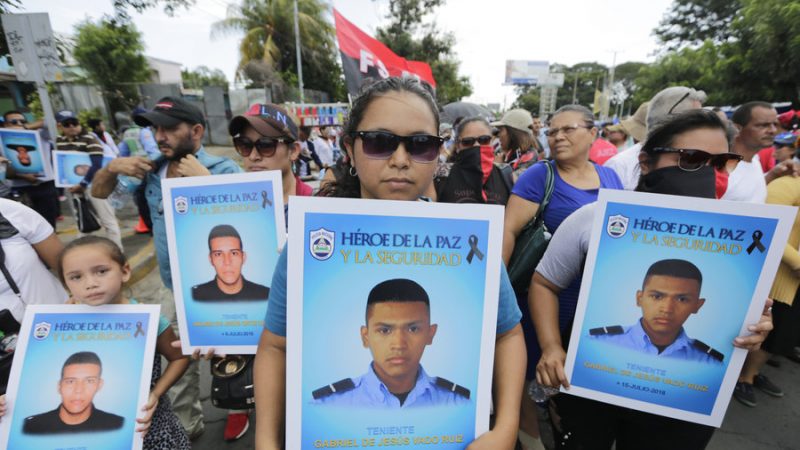
Supporters of Nicaraguan President Daniel Ortega “expressing their rejection of Daniel Ortega’s government,” according to CNN © Inti Ocon / AFP
RT | August 17, 2018
CNN’s Spanish-language site used an easily-identifiable photograph of a pro-government rally in a report detailing a protest against Nicaragua’s president, sparking accusations of propaganda peddling and sloppy journalism.
CNN Español tweeted out a video report on August 15 about Nicaraguans “returning to the streets to express their rejection of [President] Daniel Ortega’s government,” accompanied by a photograph of a large pro-government rally that took place several days prior.
The odd choice of photograph is particularly curious because it’s difficult to imagine how the marchers could be mistaken as anti-government. A red-and-black Sandinista flag is clearly visible in the background, and some demonstrators are even seen wearing red-and-black bandanas over their mouths. The Sandinista National Liberation Front – or FSLN – is the democratic socialist political party headed by Ortega.
“There is a flag of the FSLN in the picture. This is a PRO-government demonstration, absurd propaganda,” US journalist Ben Norton tweeted at the news site in Spanish.
Although the photograph appears to have been updated to more accurately reflect the story’s content, it’s still being used for an audio version of the video posted to the news channel’s Soundcloud account.
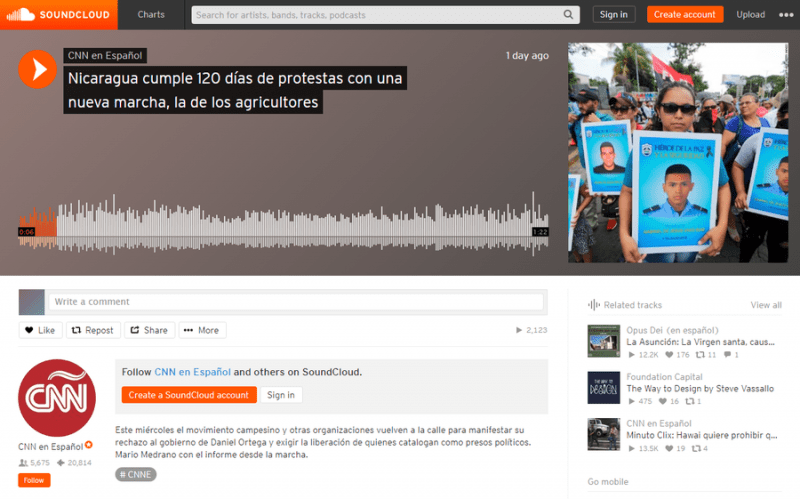
CNN Español’s audio report about an anti-government protest in Nicaragua continues to feature a photograph of a large pro-government rally
The erroneous tweet – which CNN has yet to delete – has been bombarded by hundreds of angry comments.
The CNN report comes amid months of civil unrest in Nicaragua, with more than 100 people having been killed in what has been characterized as a US-backed effort to overthrow the government.
“We have always wanted to have normal relations with the US but we see only aggression in return,” Ortega said in an exclusive interview with RT Spanish earlier this month.
Chomsky on Regime Change in Nicaragua
By Roger Harris | CounterPunch | August 3, 2018
With patented angst, Noam Chomsky opined on President Daniel Ortega’s Nicaragua to an agreeing Amy Goodman: “But there’s been a lot of corruption, a lot of repression. It’s autocratic, undoubtedly.”
Earlier in their DemocracyNow! interview, the main talking points were established via a video clip of a dissident former official from Ortega’s Sandinista Party: Ortega’s “entire government has been, in essence, neoliberal. Then it becomes authoritarian, repressive.”
Left out of this view is why the US has targeted Nicaragua for regime change. One would think that a neoliberal regime, especially if it were authoritarian and repressive, would be just the ticket to curry favor with Washington.
In Chomsky’s own words, Nicaragua poses a threat of a good example to the US empire:
Since Ortega’s return election victory in 2006, Nicaragua had achieved the following, according to NSCAG, despite being the second poorest country in the hemisphere:
+ Second highest economic growth rates and most stable economy in Central America.
+ Only country in the region producing 90% of the food it consumes.
+ Poverty and extreme poverty halved; country with the greatest reduction of extreme poverty.
+ Reaching the UN Millennium Development Goal of cutting malnutrition by half.
+ Free basic healthcare and education.
+ Illiteracy virtually eliminated, down from 36% in 2006.
+ Average economic growth of 5.2% for the past 5 years (IMF and the World Bank).
+ Safest country in Central America (UN Development Program) with one of the lowest crime rates in Latin America.
+ Highest level of gender equality in the Americas (World Economic Forum Global Gender Gap Report 2017).
+ Did not contribute to the migrant exodus to the US, unlike neighboring Honduras, El Salvador, and Guatemala.
+ Unlike its neighbors, kept out the drug cartels and pioneered community policing.
Nicaragua targeted by the US for regime change
Before April 18, Nicaragua was among the most peaceful and stable countries in the region. The otherwise inexplicable violence that has suddenly engulfed Nicaragua should be understood in the context of it being targeted by the US for regime change.
Nicaragua has provoked the ire of the US for the good things its done, not the bad.
Besides being a “threat” of a good example, Nicaragua is in the anti-imperialist ALBA alliance with Venezuela, Bolivia, Cuba, and others. The attack on Nicaragua is part of a larger strategy by the US to tear apart regional alliances of resistance to the Empire, though that is not the whole story.
Nicaragua regularly votes against the US in international forums such as challenging retrograde US policies on climate change. An inter-ocean canal through Nicaragua is being considered, which would contend with the Panama Canal. Russia and China invest in Nicaragua, competing with US capital.
The NICA Act, passed by the US House of Representatives and now before the Senate, would initiate economic warfare designed to attack living conditions in Nicaragua through economic sanctions, as well as intensify US intelligence intervention. The ultimate purpose is to depose the democratically-elected Ortega government.
Meanwhile, USAID announced an additional $1.5 million “to support freedom and democracy in Nicaragua” through non-governmental organizations (NGOs) to overthrow the democratically elected government and “make this truly a hemisphere of freedom.” That is, freedom for the US empire.
Holding Nicaragua to a higher standard than our own government
Although Chomsky echoes the talking points of the USAID administrator Mark Green about “Ortega’s brutal regime,” he can’t quite bring himself to accept responsibility for regime change. Chomsky despairs, “it’s hard to see a simple way out at this point. It’s a very unfortunate situation.”
Chomsky is concerned about corruption, repression, and autocracy in Nicaragua, urging the democratically elected president to step down and run for re-election. Need it be mentioned that Chomsky chastised leftists who did not “absolutely” support Hillary Clinton? It is from this moral ground that the professor looks down on Nicaragua.
These charges of corruption and such are addressed by long-time solidarity activist Chuck Kaufman:
+ The World Bank, IMF, and EU countries have certified Nicaragua for its effective use of international loans and grants; funds were spent for the purposes they were given, not siphoned off into corruption.
+ Kaufman asks, “why a police force that in 39 years had not repressed the Nicaraguan people would suddenly go berserk,” while videos clearly show the violence of the more militant opposition.
+ Ortega won in 2006 with a 38% plurality, in 2011 with 63%, and 72.5% in 2016. The Organization of American States officially accompanied and certified the vote. Kaufman notes, “Dictators don’t win fair elections by growing margins.”
Alternatives to Ortega would be worse
Those who call for Ortega’s removal need to accept responsibility for what comes after. Here the lesson of Libya is instructive, where the replacement of, in Chomsky’s words, the “brutal tyrant” and “cruel dictator” Qaddafi has resulted in a far worse situation for the Libyan people.
Any replacement of Ortega would be more, not less, neoliberal, oppressive, and authoritarian. When the Nicaraguan people, held hostage to the US-backed Contra war, first voted Ortega out of office in 1990, the incoming US-backed Violeta Chamorro government brought neoliberal structural adjustment and a moribund economy.
The dissident Sandinistas who splintered off from the official party after the party’s election defeat and formed the MRS (Sandinista Renovation Movement) are not a progressive alternative. They are now comfortably ensconced in US-funded NGOs, regularly making junkets to Washington to pay homage to the likes of Representative Iliana Ros-Lehtinen and Senator Marco Rubio to lobby in favor of the NICA Act. Nor do they represent a popular force, garnering less than 2% in national elections.
When the MRS left the Sandinista party, they took with them almost all those who were better educated, came from more privileged backgrounds, and who spoke English. These formerly left dissidents, now turned to the right in their hatred of Ortega, have many ties with North American activists, which explains some of the confusion today over Nicaragua.
The world, not just Ortega, has changed since the 1980s when the Soviet Union and its allies served as a counter-vailing force to US bullying. What was possible then is not the same in today’s more constrained international arena.
Class war turned upside down
Kevin Zeese of Popular Resistance aptly characterized the offensive against the democratically elected government of Nicaragua as “a class war turned upside down.” Nicaragua was the most progressive country in Central America with no close rival. Yet some North American left intellectuals are preoccupied with Nicaragua’s shortcomings while not clearly recognizing that it is being attacked by a domestic rightwing in league with the US government.
Noam Chomsky is a leading world left intellectual and should be acclaimed for his contributions. His incisive warning about the US nuclear policy is just one essential example. Nevertheless, he is also indicative of a tendency in the North American left to accept a bit too readily the talking points of imperialist propaganda, regarding the present-day Sandinistas.
There is a disconnect between Chomsky’s urging Nicaraguans to replace Ortega with new elections and his longtime and forceful advocacy against US imperialist depredations of countries like Nicaragua. Such elections in Nicaragua would not only be unconstitutional but would further destabilize a profoundly destabilized situation. Given the unpopularity and disunity of the opposition and the unity and organizational strength of the Sandinistas, Ortega would likely win.
Most important, the key role of Northern American solidarity activists is to end US interference in Nicaragua so that the Nicaraguans can solve their own problems.
The rightwing violence since April in Nicaragua should be understood as a coup attempt. A significant portion of the Nicaraguan people have rallied around their elected government as seen in the massive demonstrations commemorating the Sandinista revolution on July 19.
For now, the rightwing tranques (blockades) have been dismantled and citizens can again freely circulate without being shaken down and threatened. In the aftermath, though, Nicaragua has suffered unacceptable human deaths, massive public property damage, and a wounded economy with the debilitating NICA Act threatening to pass the US Senate.
Roger Harris is on the board of the Task Force on the Americas, a 32-year-old anti-imperialist human rights organization.
Violent Coup Fail in Nicaragua
By Kevin Zeese | CounterPunch | July 24, 2018
On Clearing The FOG radio and podcast, Margaret Flowers and I interviewed Stephen Sefton, who lives in Nicaragua and is a founder of Tortilla con Sal. He names the names behind the violence and describes what is happening in Nicaragua.
Lessons Learned From The Failed Violent Coup In Nicaragua And Next Steps
The violent coup in Nicaragua has failed. This does not mean the United States and oligarchs are giving up, but this phase of their effort to remove the government did not succeed. The coup exposed the alliances who are working with the United States to put in place a neoliberal government that is controlled by the United States and serves the interests of the wealthy. People celebrated the failure of the coup but realize work needs to be done to protect the gains of the Sandinista revolution.
People Celebrate Revolution, Call For Peace, Show Support for Government
The people of Nicaragua showed their support for the democratically-elected government of Daniel Ortega with a massive outpouring in Managua in a celebration of the 39th anniversary of the Sandinista Revolution. In addition to the mass protest in Managua, various cities had their own, in some cases very sizeable ones.
People have wanted peace to return to Nicaragua. They have also wanted the roadblocks removed, which have resulted in closed businesses, job loss and loss of mobility. Roadblocks have been removed, even in the opposition stronghold of Masaya. There were two opposition deaths and one police officer killed in the removal. There was also an earlier death of a policeman in Masaya, captured when he was off-duty, tortured and burnt to death. This brings the total of police killed since April up to at least 21 with hundreds injured. With the opening of the main road on the east side of Masaya, all Nicaragua’s main routes are open to traffic and buses etc are operating normally.
At the rally, President Ortega called on the people of Nicaragua to defend peace and reinstate the unity that existed in the nation before the violent opposition protests. He described how the violent coup attempted to destabilize the country and ended the peace that has existed through the eleven years of his time in office. He said, “Peace must be defended every day to avoid situations like these being repeated.”
He also criticized the Catholic Bishops for their role in the failed violent coup. Ortega described the Episcopal Conference of Nicaragua as “coup leaders” for collaborating with the opposition during the protests. Not only did the Catholic leadership side with the opposition during the national dialogue, but priests were involved in kidnapping and torture. Pope Francis has a lot of work to do to rein in the Catholic Church in Nicaragua. If their role in these violent protests and opposition to an economy for the people is not stopped, this will become a scandal for the Catholic Church.
Other Latin American leaders spoke out against involvement in the coup. Bolivian President Evo Morales condemned US “interference” in Nicaragua, denouncing the “criminal strategies” used against the government of Daniel Ortega. Morales accused the United States Agency for International Development (USAID), and the National Endowment for Democracy (NED) of “openly supporting violence” in Nicaragua. Also at the celebration were the foreign ministers of Cuba and Venezuela, Bruno Rodríguez Parrilla, and Jorge Arreza, all supporting Nicaragua over the violent coup of the United States and oligarchs.
The United States is Escalating Economic War and Support for Opposition
The United States is not giving up. Also on the anniversary of the revolution, the NICA Act, designed to escalate the economic war against Nicaragua, was introduced in the Senate. It has already been passed by the US House of Representatives. The Senate bill, called the Nicaragua Human Rights and Anti-corruption Act of 2018, imposes sanctions, calls for early elections and escalates US intelligence involvement in Nicaragua. It is a law that ensures continued US efforts to remove the democratically-elected government.
At the same time, USAID announced an additional $1.5 million for Nicaragua to build opposition to the government. This will fund the NGOs that participated in the protests, human rights groups that falsely reported the situation, media to produce the regime change narrative and other support for the opposition.
The coordination between Nicaraguan opposition and the United States was shown by Max Blumenthal’s attempted visit to an organization that funnels USAID and NED money to the opposition. He visited the Managua offices of the Institute of Strategic Studies and Public Policies (IEEPP in Spanish), but it was closed because its director, Felix Maradiaga, who was at the heart of the violent unrest, was in Washington, DC seeking more funding from USAID.
On July 18, the US-dominated OAS passed a resolution concerning “The Situation in Nicaragua.” An earlier effort to endorse a report of the Inter-American Commission on Human Rights (IACHR) was so biased that it failed. The report ignored the opposition’s widespread violence or inaccurately attributed it to the government. It also failed to recognize government actions in self-defense. The resolution approving the IACHR report was supported by only ten out of 34 countries.
The resolution, which was finally passed by the OAS, condemned violence on all sides and urged Nicaragua to pursue all options including the national dialogue to seek peace begun by Ortega. On the issue of elections, the resolution urged Nicaragua “to support an electoral calendar jointly agreed to in the context of the National Dialogue process.” Only this mainly symbolic resolution could pass muster in the OAS, despite US domination.
What Happened and What Was Learned
In our article “Correcting the Record: What Is Really Happening In Nicaragua,” Nils McCune and I describe what was behind the violent coup attempt. We reported that there was a lot of misinformation on what was occurring in Nicaragua, indeed the false narrative of regime change was part of the tactics of the failed coup. Perhaps most importantly we described the alignment of forces behind the coup.
The coup was a class war turned upside down. The Ortega government includes none of the oligarchic families, a first in the history of Nicaragua. He has put in place a bottom-up economy that has lifted people out of poverty, provided access to health care and education, given micro-loans to entrepreneurs and small businesses and created an economy energized by public spending. Ortega expanded coverage of the social security system; as a result, a new formula was required to ensure fiscal stability.
Ortega made a counter-proposal to the IMF/business proposal, which would cut social security and raise the retirement age. He proposed no cuts to social security and increasing employer contributions by 3.5% to pension and health funds, while only slightly increasing worker contributions by 0.75% and shifting 5% of pensioners’ cash transfer into their healthcare fund. These reforms were the trigger as it was the business lobby who called for the protests.
The forces aligned with the violent coup included the oligarchs, big business interests, foreign investors (e.g. Colombian financiers), the US-funded NGO’s and the Catholic Church, a long-term ally of the wealthy. Also involved was the Movement for Renovation of Sandinismo (MRS), a tiny Sandinista offshoot party, of former Sandanistas who left the party when Ortega lost an election in 1990 who are aligned with the US State Department.
Regarding students, there were already student protests around university elections, and these were redirected by the violent coup effort and supported by a small minority of students from private universities, the April 19th Movement. Some of these students had been brought to the US by the Freedom House, which has long ties to the CIA and met with far-right interventionist members of the US Congress, including Rep. Ileana Ros-Lehtinen, Sen. Marco Rubio, and Sen. Ted Cruz.
These groups acted in opposition to the bulk of Nicaraguan society and showed their true colors. This includes:

No doubt more will come out about this in the future as the coup is researched and analyzed. As the facts become clear, the opposition will lose more political power and be even less likely to win elections. The blockades of roads with violence undermined the economy and had a negative impact on the poor and working class. If it becomes evident that this was a strategy of the opposition, they will lose power. NGO’s that are funded by the US and run by members of the MRS will be noted for their dishonest narrative and will be seen as an arm of the United States and not trusted by the people of Nicaragua. Media outside of Nicaragua will come to understand that human rights groups and NGOs are not reliable sources of information but need to be questioned. They need to be pushed to break their ties with the United States.
This does not mean all is well on the Sandinista side of the alliance of forces. The coup is an opportunity for self-reflection and self-criticism that is already happening, as seen in this list of 20 results from the coup, which begins with “A more consolidated and United FSLN.” In addition, the Action Group of the Solidarity with Nicaragua Campaign put forward seven propositions to unify around. The protest took advantage of challenges the Nicaraguan government faces in continuing to lift up the poor and economically insecure. It shows their need to build their capacity to quickly let the public know their side of the story. And, it shows the need for planning for a post-Ortega Sandinista government, as the president is in his third term.
The anniversary of the revolution was a good beginning at strengthening the unity of the Sandinista movement and celebration of the defeat of the coup, but there will be challenges ahead. Nicaragua is a poor country that needs foreign investment. If the United States escalates the economic war, which seems to be the intent, it will make it challenging to continue the social and economic programs that are lifting up the poor. Nicaragua had relied on investment from Venezuela, but it is also in the midst of an economic war, which along with the low oil prices has created economic challenges for them. Nicaragua has begun to build economic relationships with China, Russia, Iran and other countries; these will likely need to expand.
The misinformation was deep and widespread. Inside Nicaragua, there were stories of students being killed that never happened but that escalated the protests. The opposition claimed to be nonviolent when their strategy was to use violence to force regime change while the government quartered the National Police. False news and videos of attacks on neighborhoods and universities never stopped being manufactured. One example, students calling for help and claiming they were under attack, was later exposed in a video showing the students practicing the false social media narrative.
Peace and justice activists in the United States and western nations have learned they need to be much more careful believing reports on what is occurring in Nicaragua. The US-funding of NGOs involved in women’s issues, environmental protection and human rights in Nicaragua make them questionable sources of information for justice advocates. In addition, US-funded regime change efforts are getting more sophisticated at social media; and thus, care must be taken as social media is abused by regime change advocates. We must look to other sources that have shown the ability to report accurately e.g., Tortilla con Sal, Telesur, Redvolucion. Peace and justice advocates must be grounded in anti-imperialism and nonintervention by the United States.
In Nicaragua, is Operation “Contra bis” failing?
By Alex Anfrus | Journal of Our Americas, Investig’Action | July 21, 2018
Thrown under the spotlight since mid-April, the homeland of Sandino is still facing an intense political crisis. From now on, the crisis seems to be approaching its final resolution. On the one hand, the Nicaraguan people are mobilizing more and more alongside the authorities to help them dismantle barricades in insurgent spots. And on the other hand, in one week two big demonstrations for peace took place. Against the wishes of an opposition camp and spokespersons of the US administration, the message of Daniel Ortega during the march for peace of July 7 in Managua was crystal clear: “Here it is the people who set the rules in the Constitution of the Republic. They will not change overnight by the will of some coup leaders. If the putschists want to come to the government, let them seek the people’s vote in the next elections. With all the destruction they have provoked, we will see what support they will have.” But these facts are minimized by the private media and major news agencies, which continue to hide the evolution on the ground and blow on the embers of the dispute. Which side will tip the scales?
A dreadful propaganda scheme
In a recent article, I examined a number of contradictions in the treatment by international media of Nicaragua. Notably, one can recognize one of the principles of war propaganda which is to reverse the aggressor and the victim. The scheme works as follows: first, an opposition sector, one that refuses dialogue with the government, plans to control some parts of the capital and other cities by means of barricades. These areas are then considered “liberated from tyranny”, and thus represent the hearth of insurgency that must recur throughout the country, to defeat the operations of “repression” of police forces. This tactic of deploying barricades has been theorized as an effective means of preventing the authorities from gaining control over the national territory, because it is “impossible for the government to have enough personnel to control every inch of the country”. The first obvious thing to emphasize is that this is not a completely spontaneous crisis that emerges from a massive popular mobilization, but that there is indeed an insurrectional plan in place capable of standing up to the authorities for months. We are witnessing the first phase in the development of an unconventional war to overthrow a democratically elected government.
Then, a number of clashes take place in these areas “liberated” by the opposition. At this point, it is not trivial to note that the activists who defend these barricades are no longer peaceful protesters that the mainstream media has portrayed. Images of hooded youths handling homemade mortars and other explosive devices are impossible to conceal. In fact, they even contribute to the creation of a “romantic” dimension of popular resistance in the context of face-to-face contact with the professional police corps. This is where the second phase of the unconventional war comes in, namely the decisive role of media corporations that contribute to the production of a dominant and one-sided narrative of the crisis. It is easier to identify with a young demonstrator who is rebelling than a young police officer compelled to use force to enforce the law. Thus, when there have been deaths around the barricades, it becomes complicated for an outside observer to know the truth.
Who is not concerned with these victims?
A simple and quick tour of private media news will make anyone realize that the idealized dimension mentioned above serves only to delegitimize government action. No one is asking themselves this simple question: “Was the victim a pro-government Sandinista helping the police dismantle the barricades, or an opponent who defended them?” Many testimonies in favor of the first version have been systematically dismissed! Indeed, the role of the private media is fundamental in order to give maximum credibility to the opposition’s side of the story. Would the latter be manipulating the victims’ memory with the complicity of some private media in Nicaragua? This is quite a strong point for us: what about the many cases of victims whose membership in the pro-government camp has been proven?
In the framework of the peace talks, the Nicaraguan government first accepted that the IACHR (Note: Inter-American Commission on Human Rights, organ of the Organization of American States (OAS)) lead a human rights observation mission. But it went on to denounce that its report does not include the description of many cases of attacks against civilian victims, including public officials, as a result of the violence unleashed by the opposition. Are the dice loaded? Here are some recent examples that illustrate a much more nuanced situation than that described by some media:
– On June 19, the authorities launch an operation in Masaya to release the Deputy Director of the National Police Ramon Avellan and his agents, who were entrenched in the police station, surrounded by barricades since June 2. Every night, protesters fired mortar at the police station, accompanied by threats: “What do you think? That there were only “güevones” (rascals) in this fight? Here again, here is my little sister… ” Then, the mortar fire would start again near the police station… Under the pretext of playful action, a video shows how protesters positioned behind a barricade sing menacing songs against General Avellan, accompanied by shots. According to the Pro-Human Rights Nicaraguan Association ANPDH organization, as a result of the police rescue operation, six people – including three whose identity remains to be verified – were murdered in several surrounding neighborhoods.
– On June 30, in the context of an opposition march, a protester was shot dead. Recorded a few minutes before the tragedy by a journalist who was there, a video shows how opposition members surround a private security officer and ask him to handover his weapon, simulating a hostage situation in order to justify their action. Then, the images show a person who stands behind the agent, points a pistol at his temple and steals his rifle. Later, the protesters will attribute the death to government repression.
– On July 3, two people were kidnapped in Jinotepe by a group of armed hooded men: police major Erlin García Cortez and Enacal worker Erasmo Palacios. Three days later, Bismarck de Jesús Martínez Sánchez, a worker from the Managua City Hall, was also kidnapped. A week later, relatives had still not received any sign of life from them.
– On July 5, the lifeless body of National Police officer Yadira Ramos was found in Jinotepe. She had been kidnapped, raped and tortured. She had been forced to get off her vehicle and her husband had been killed on the spot.
– On July 6, FSLN member Roberto Castillo Cruz was killed by opposition hoodlums who held barricades in Jinotepe. His son, Christopher Castillo Rosales had been killed just a week before him. In a video published shortly before his own murder, Castillo Cruz denounced the murderers: “This criminal gang of the right has killed my son, I only ask for justice and that peace prevails so that our children do not lose their lives!”
– On July 8, during a nighttime clash in Matagalpa, a 55-year-old man named Aran Molina was killed while rescuing Lalo Soza, a Sandinista activist who was under attack. The following day, Frente Sandinista de Liberación Nacional (FSLN) paid tribute to him through a procession. The same day, two other people were killed: social worker Tirzo Ramón Mendoza, executed by hooded people after being kidnapped, and a third victim whose identity remains unknown.
– On 9 July, the authorities dismantled the barricades that prevented free movement in the towns of Diriamba and Jinotepe. Many residents then testified about the many violent actions of the opposition, including torture against the Sandinistas. At the same time, representatives of the Episcopal Conference arrived. Citizens of Jinotepe then entered the church, where they found opposition members disguised as members of the clergy. Residents accused church officials of protecting them and not saying anything or doing anything to stop the violence unleashed in the last two months. In Diriamba, the inhabitants also discovered an arsenal of mortars hidden in the church of San Sebastian.
– On July 12, a criminal gang attacked the Morrito Town Hall in Rio San Juan. A historical Sandinista fighter, Carlos Hernandez, was kidnapped there. Seriously wounded and unable to escape, a youth Sandinista activist, two police officers and their superiors are murdered. A Sandinista activist received a bullet in the abdomen. Later, schoolmaster Marvin Ugarte Campos would succumb to his injuries. The version of the opposition? It says the massacre was … a “self-attack by paramilitaries”!
It seems that some deaths and violent acts have no value, while others are erected as martyrs for a sacred cause. In the end, does everything depend on the prism through which we look at reality? Are we already placed in a camp in a conflict without knowing it or even suspecting it? In this case, would it be a waste of time to try to form one’s own opinion from fact analysis? The search for peace and truth prevents us from succumbing to such resignation.
In a remarkable 46-page work entitled “The monopoly of death – how to inflate figures to assign them to the government”, Enrique Hendrix identified the numerous inconsistencies in the various reports presented by the three main human rights organizations, the CENIDH (Nicaraguan Center for Human Rights), the IACHR and the ANPDH. Comparing the various reports from the beginning of the crisis to the date of the last reports presented (from April 18 to June 25), he concluded that the three organizations recorded a total of 293 deaths. In 26% of cases (77 citizens), information on the deaths is incomplete and remains to be verified. In 21% of cases (60 citizens), the dead are persons murdered by the opposition, either public officials or Sandinista militants who were murdered for helping the authorities dismantle the barricades. In 20% of the cases (59 citizens), the dead were protesters, opposition members or people who erected barricades. In 17% of cases (51 citizens), the dead do not have a direct relationship with the demonstrations. Finally in 16% of the cases (46 citizens), the dead were passers-by who did not take part in the clashes.
As can be seen in this study, the balance sheets of these organizations are sorely lacking in rigor and mix all sorts of victims (fights between gangs, road accidents, murders in the context of vehicle theft, conflict between land owners, police officers, a pregnant woman in an ambulance blocked by barricades …). Conclusion: if we take into account the exact circumstances of each death, it is obvious that we cannot attribute the responsibility to the government alone. In light of these elements, we have the right to challenge the international media about their lack of objectivity. Why such an alignment with a sector of the opposition who has declared itself fiercely hostile to any dialogue?
Who is not interested in dialogue?
This propaganda mechanism is completed by the “blackout” of other information that is not considered relevant. However, while the media focuses on the clashes, other sectors of the opposition continue to participate in the various sessions of the “dialogue tables for truth, peace and justice”, organized to listen to different points of view and seek to establish responsibility in the wave of violence ravaging the country. Moreover, the final conclusions of the various human rights observation missions in the country had not yet been made, they were to be discussed and include new elements. But what can we expect from the dialogue between the two parties, when a number of observers have already decided in advance that the government alone is responsible for the violence?
All over the world, the role of the police is to repress in case of “disturbance of public order”. But we struggle to understand why the authorities would order it to attack civilians wildly and arbitrarily at the same time as the peace dialogue is taking place. On the other hand, one could expect such an attitude from those who, refusing to participate in the dialogues, would seek to sabotage it, having an interest in the derailment of this process. In this case, it is not unlikely that hooded thugs have been posing as police forces on several occasions.
In any case, it is no less credible than the version of these same hooded thugs, who say that the government of Daniel Ortega would have given the green light to disguised civilians to destroy infrastructure and kill other civilians! Still, the government did not deny that at the beginning of the crisis some police officers sometimes acted using disproportionate violence, and it responded that justice will have to determine their responsibility in actions punishable by law. The National Assembly, for its part, has launched an initiative to create a “Commission for Truth, Justice and Peace” with the aim of reporting on the responsibilities of human rights violations within three months.
But in the fairy tale that the mainstream media is manufacturing from dawn to dusk, and on the internet 24 hours a day, it is not even conceivable that the government of Nicaragua is facing difficulties whose causes would be complex and numerous. The media hype and the positions of foreign political figures serve as irrefutable proof! As has been the case in Venezuela in recent years, taking the public hostage in this way is an insult to its intelligence. Of course, not everything is explained by the tentacles of the imperialist octopus. But for those who are interested in the history of inter-American relations for the last two centuries, it is not serious to forget about its weight and consider that this influence is a thing of the past.
How to export democracy in dollars
It seems that few observers are really shocked by the rapid progression of these events, which are shaped like a breadcrumb trail towards a single objective: condemning the Ortega government and demanding early elections. That’s where the hiccup is: Latin American countries where assassinations of trade unionists, peasants and social leaders have been a common thing for years, where the peace efforts of governments are considered, at best, as totally ineffective, and at worst as non-existent, such as Colombia, Honduras or Mexico, are not at all worried about the image of their “democracies”. There is something wrong, isn’t it? To shed some light on this mystery, a reminder of the history of the twentieth century is worth the detour.
The coups and destabilizations fomented from abroad, such as in the Dominican Republic or in Guatemala, show that in the second half of the 20th century the Latin-American context was still marked by the military interventionism of the Monroe Doctrine and the “manifest destiny” of the United States. It was nothing more than an imperialist policy of controlling the resources and raw materials of Latin America, now presented as an anticommunist “crusade” in the context of the Cold War. On the other hand, the dominance of the United States would not be limited to a demonstration of force based on the “regime change” and the sending of troops on the ground, but it would also take forms of cultural domination, in particular through the so-called “development aid” policies.
In his speech in January 1949, US President Harry Truman described non-industrialized countries as “underdeveloped” countries. Thus, in 1950, the American Congress passed an Act for International Development (AID). On September 4, 1961, a US Congress law replaced the AID by USAID, which was to implement a new, more comprehensive vision of “development assistance” directed anywhere in the planet. As can be seen in the coup against Jacobo Arbenz in Guatemala in 1954, the anti-communist struggle was only a pretext. The main concern of the US government was to prevent the development of national consciousness within the armies and police of “underdeveloped countries”. That is why, from 1950 to 1967, “the United States government spent more than $ 1,500 million on military aid to Latin American countries.” (1)
After the victory of the Cuban Revolution in 1959, John Kennedy announced the Alliance for Progress in 1961. It was a similar initiative to the Marshall Plan in Europe. Between 1961 and 1970, the Alliance for Progress provided $ 20 billion in economic assistance to Latin America. One of the objectives was the stabilization of the regimes that fought against communism and the influence of Cuba.
“John F. Kennedy and his advisers are developing an action plan for the region, the Alliance for Progress, consisting of a $ 20 billion investments for economic development and massive military assistance. The decade of the sixties is marked by the formation of a new generation of Latin American military and the transfer of capital and technology from the US military to Latin America. The Pentagon and the CIA draw their strategy to halt the advance of socialism: the US Army-run Panama School trains the cadres of the Latin American armed forces “. (2)
Under the fallacious concept of “development aid policies”, the “creation of strong armies and police” and “military aid to reactionary and pro-imperialist regimes” served to offer to the monopolies “the most favorable conditions of exploitation of underdeveloped countries “. (3) In other words, this “aid” represented above all a political weapon in favor of the economic interests of the countries of the Global North. These were represented in the OECD (Organization for Economic Co-operation and Development), founded in 1961 and also known as the “Rich Country Club”. It consisted of 27 countries, mostly those of North America, Western Europe and Japan.
Resistance emerges sooner or later
But the new reality resulting from decolonization in Asia and Africa also represented an awareness: the strength of the liberated countries now resided in their unity. This would enable them to exercise some orientation on the agenda of the United Nations General Assembly, and to defend the autonomous “right to development”. Thus, in the 1970s, the United Nations Conference on Trade and Development (UNCTAD) would play an important role in defending the interests of the Group 77. Created in 1964, UNCTAD was characterized by the Common Declaration of the 77 countries as a “historic turning point”.
The invasion and the military occupation of Nicaragua by the United States makes it possible to better appreciate the historical value of the Sandinista Popular Revolution and the resistance to the interferences which it showed in the 1980s. The scandal of the financing of Contras by the CIA through the drug trade in Central America was proof that these plans are not infallible. Despite the many interferences and destabilizations suffered throughout history, the peoples of the South have an advantage over the powerful: collective memory and intelligence.
After the dictatorships’ repression, the debt crisis and the rule of the IMF in the 1970s and 1980s, Latin America was to experience many social revolts in the 1990s, paving the way for the arrival of new progressive governments in Brazil, Ecuador, Venezuela or Bolivia. The next step was to launch the Bolivarian Alliance for the Peoples of Our America (ALBA), a regional cooperation body created in 2004 to defeat the proposed Free Trade Area of the Americas (ALCA in Spanish) by the United States.
What remains today of yesterday’s meddling?
Since the 1990s, at the end of the Cold War, US aid no longer had the pretext of restraining communism. It then took the form of “counter-terrorism” or “security and anti-drug policies”. Here are the main recipients of US aid in Latin America: $ 9.5 billion for Colombia; $ 2.9 billion for Mexico; and since 2016, aid to all countries in the Northern Triangle of Central America (El Salvador, Guatemala and Honduras) has exceeded that of the first two. (4) Which explains why we systematically condemn some countries and not others… regardless of reality and the degree of violence.
Yet the Cold War is not over in the minds of some. Thus, OAS Secretary General Luis Almagro believes it is necessary in 2018 to comply with White House requirements, and to harass night and day countries such as Nicaragua or Venezuela at the risk of being ridiculed. Indeed, when in a special session of the OAS the US spokesperson has just criticized the violence in Nicaragua and attributed it exclusively to the government, can we take his word for it? It would be better to remind him that his country does not have the slightest legitimacy to talk about Nicaragua, because it invaded and occupied it militarily for 21 years, then went on to support the clan of the dictator Somoza for another 43 years!
The “conservative restoration” of recent years, with the “soft coups” to overthrow Lugo in Paraguay, Zelaya in Honduras, Rousseff in Brazil; the failure of the peace process in Colombia, the judicial persecution against Jorge Glas, Lula Da Silva and now Rafael Correa, is the ideal context for the OAS, this obsolete organization, to try to put an end to the memory of the social achievements of recent years.
Since the US did not invent hot water, to reach their ends they must use the means at hand. Unsurprisingly, Freedom House, funded among others by USAID and the National Endowment for Democracy (NED), decided to create a special task force to fight the FSLN in Nicaragua in 1988. It is always opportune to hear NED Co-Founder Allen Weinstein: “A lot of what we do today was done covertly 25 years ago by the CIA. The biggest difference is that when such activities are done overtly, the flap potential is close to zero. Openness is its own protection.”. (5)
Today, the interference keeps going through the financing of opposition movements, framed by training programs for “young leaders” ready to defend tooth and nail the values of the sacrosanct “democracy” and to overthrow “dictatorships” from their countries of origin. From 2014 to 2017, the NED has dedicated up to $ 4.2 million to Nicaraguan organizations such as IEEPP (Institute for Strategic Studies and Public Policy), CPDHN (Human Rights Permanent Commission in Nicaragua), Invermedia, Hagamos Democracia and Fundacion Nicaraguense para el Desarrollo Economico y Social. When we remind this to young opponents and their sympathisers, they pretend not to understand…
While it may have been extremely effective in some countries like Ukraine in 2014, the pattern we have described must be confronted with the reality and political traditions of each country. In Nicaragua, the FSLN is the dominant political force that has won democratically in the last three elections. It is significant that opposition sectors that rely on the support of the US, the right wing, and local employers are forced to use references to Sandinismo in an attempt to gain credibility. However, this practice goes too far when it tries to compare the Sandinista government and the dictatorship of Somoza, thus demonizing Daniel Ortega.
The march for peace convened by the FSLN on July 13, in tribute to the 39th anniversary of the historic “tactical retreat” of Sandinism in Masaya, was a new show of strength of the Nicaraguan people and its willingness to defeat the violent strategy of the opposition. Will the peoples of the world live up to the solidarity that this moment demands?
Notes
1) Yves Fuchs; La coopération. Aide ou néo-colonialisme ? Editions Sociales. Paris, 1973, pp. 55 (Cooperation. Help or neo-colonialism?)
2) Claude Lacaille; En Mission dans la Tourmente des Dictatures. Haïti, Equateur, Chili : 1965-1986. Novalis, Montreal, 2014. p 23. (In Mission in the Torment of Dictators. Haiti, Ecuador, Chile: 1965-1986)
3) Gustavo Esteva, “Desarrollo” in SachsWolfgang (coord.) Diccionario del Desarrollo, Lima, PRATEC, 1996. p. 52.
4) https://www.wola.org/es/analisis/ayuda-militar-de-estados-unidos-en-latinoamerica/
5) Washington Post, 22 September 1991.
Featured Video

Liberty Cannot Exist Inside a Panopticon
or go to
Aletho News Archives – Video-Images
From the Archives
Left-leaning despisers of 9/11 Truth movement: Do you really believe in miracles?
David Ray Griffin | Global Research | 06 Jul 2010
An Open Letter to Terry Allen, Noam Chomsky, Alexander Cockburn, David Corn, Chris Hayes, George Monbiot, Matthew Rothschild, and Matt Taibbi.
[1]According to several left-leaning critics of the 9/11 Truth Movement, some of its central claims, especially about the destruction of the World Trade Center, show its members to be scientifically challenged. In the opinion of some of these critics, moreover, claims made by members of this movement are sometimes unscientific in the strongest possible sense, implying an acceptance of magic and miracles. … Full article
Blog Roll
 Aletho News
- EU sending ‘biased’ observers to interfere in Serbian election – president
- White House envoy declares kinetic action against Yemen ‘fruitless’
- Ukraine deployed thousands of microdrones in Iraqi Kurdistan: Tasnim
- Iran calls for emergency UNSC meeting over Trump’s ‘brazen’ bomb talk, Israeli threats
- Iranian sources reveal details of Russia-China Hormuz proposal
- Plan for more US-Israel integration puts our military tech at risk
- Another Round Against Iran Will Break What Is Left of the Gulf
- SVR Report on Ukraine’s Mexican Drug Gang Links Could Pressure Zelensky, Won’t Change US Policy
- British Government Employees Were Fact-Checking the News at the BBC. Nobody Told You.
- Albania on fire: who’s behind the riots?
- If Americans Knew
- Mysterious bot accounts reportedly spread fake ‘man on the street’ videos for Michigan Senate candidate
- Israeli Defense Minister Katz Says Over 60 Lebanon Villages Have Been Destroyed
- Why Is Israel Running TV Ads in Iowa Ahead of the Midterms?
- Hind Rajab’s Alleged Killer Is in the United States. HRF Demands His Arrest.
- US Officials Face Fresh Pressure After Another American ‘Brutalized’ by Israeli Settlers in West Bank
- Israel-Backed Palestinian Militias Terrorize Displaced Families in Gaza
- FBI subpoenas pro-Palestine activists over Israeli weapons plant disruption
- Fourth winter arrives in wartorn Gaza, too early – Daily Update
- More on how Bari Weiss is using CBS on behalf of Israel
- What the UK Is Doing to Pro-Palestine Novelist Sally Rooney Is an Act of Orwellian Villainy
- No Tricks Zone
- Predictions Made By Renowned Climate Proifessor Over Past Decades Have Been Proven To Be Poor
- New Study Suggests Large Regions Of The Pacific Ocean Have Been Cooling For The Last 80 Years
- Germany’s Green Energy Debacle: High Energy Costs Force Kahla Porzellan to Close After 182 Years!
- New Study: 50 Years Of The Most Aggressive ‘Net Zero’ Policies Can Only Affect The Global Climate By 0.03°C
- US September “Heat” Was No Record…Many Records Set Decades Ago
- Latest European Green Energy Debacle; Portugal’s Largest Flagship Solar Park Insolvent!
- Green Energy Debacle: German Expert Professor Fritz Vahrenholt Warns Of Severe Economic And Social Consequences
- Two More Paleo Reconstructions Affirm Meters-Higher Sea Levels Across Ireland, Brazil 7000-6000 Years Ago
- New Study: Earth And Venus Surface Warmth Largely Explained By Convection And Lapse Rate, Not CO2 Or Radiation
- 2025 Nature Paper Claiming Worsening Global Drought Gets RETRACTED …Heavily Flawed

