How biased are the US media, really? This is a frequently asked question. The answer is – they are biased very much and they know how to instill the vision of things in a quiet and unobtrusive way. Here is an example to prove the point.
«Defense Secretary Mattis Arrives at Only US Base in Africa» reads the Voice of America’s headline on April 23. «Only US Base in Africa»? It’s hard to believe one’s eyes but that’s what it says. This is a good example of what is called «inaccurate reporting», to put it mildly. Probably, some people will call it outright distortion because anyone who knows the first thing about military matters knows it has nothing to do with reality.
Suffice it to take a cursory look at the US military presence on the continent. Guess who is spending $100 million to build a new drone base in Niger? What about a “cooperative security location” in Ouagadougou, Burkina Faso, which provides surveillance and intelligence over the entire Sahel?
In recent years, the US Army has rolled out an extensive network of over 60 outposts and access points in at least 34 African countries – more than 60 percent of the nations on the continent. To compare, the US has only 50 diplomatic missions in Africa.
In his 2015 article for TomDispatch.com, Nick Turse, disclosed the existence of an «America’s empire» comprising dozens of US military installations in Africa, besides Camp Lemonnier in Djibouti. These numerous cooperative security locations (CSLs), forward operating locations (FOLs) and other outposts have been built by the US in Burkina Faso, Cameroon, the Central African Republic, Chad, Djibouti, Ethiopia, Gabon, Ghana, Kenya, Mali, Niger, Senegal, the Seychelles, Somalia, South Sudan, and Uganda. The US military also has had access to locations in Algeria, Botswana, Namibia, São Tomé and Príncipe, Sierra Leone, Tunisia, Zambia and other countries.
According to a rough guide of foreign bases in Africa, the US military uses Garoua airport in northern Cameroon as a drone base for operations in northeastern Nigeria. It houses Predator drones and some 300 US soldiers. Predator and Reaper drones are based in Ndjamena, the capital of Chad. In Kenia, the military uses Camp Simba in Manda Bay as a base for naval personnel and Green Berets. It also houses armed drones for operations in Somalia and Yemen. In Niger, the American armed forces use Agadez, capable of handling large transport aircraft and armed Reaper drones. The base covers the Sahel and the Lake Chad Basin. US special operations forces (SOF) use compounds in Kismayo and Baledogle in Somalia. A drone base is operated on the island of Victoria, the Seychelles. PC-12 surveillance aircraft operate from Entebbe airport, Uganda.
At least 1,700 special operations forces (SOF) are deployed across 33 African nations at any given time supported by planes and drones. In 2006, just 1% of commandos sent overseas were deployed in the US Africa Command area of operations. In 2016, 17.26% of all US SOF – Navy SEALs and Green Berets among them deployed abroad were sent to Africa. They utilize nearly 20 different programs and activities – from training exercises to security cooperation engagements – these included Burkina Faso, Burundi, Cameroon, Democratic Republic of Congo, Djibouti, Kenya, Mali, Mauritania, Niger, Nigeria, Tanzania, and Uganda, among others.
Drone warfare is a special case as the vehicles are carrying out combat missions in peacetime. The full scope of the US unmanned aerial vehicles (UAV) program has long been shrouded from view. Only sketchy details emerge off and on about individual drone strikes. The US African Unified Command (AFRICOM) is known to operate at least nine UAV bases in Africa located in Djibouti, the Seychelles, Uganda, Ethiopia, Kenya, South Sudan, Niger, Burkina Faso and Cameroon.
Housing 4,000 military and civilian personnel, Camp Lemonnier, Djibouti, is the hub of a network of American drone bases in Africa. It is used for aerial strikes at insurgents in Yemen, Nigeria and Somalia, as well as exercising control over the Bab-el-Mandeb strait – a strategic maritime waterway linking the Indian Ocean and the Mediterranean through the Gulf of Aden and Red Sea. In 2014, America signed a new 20-year lease on the base with the Djiboutian government, and committed over $1.4 billion to modernize and expand the facility in the years to come.
Unlike other installations, the Djibouti base is called a permanent facility. Not the only facility on the continent but the only «permanent» base. The US military uses the terms Main Operating Base (MOB), Forward Operating Site (FOS) and Cooperative Security Location (CSL). Camp Lemonnier is a MOB. The difference is the size of the presence and the scale of operations a facility is designed for. The terms used do not change the essence – the US uses a vast array of military installations in Africa and the presence keeps on growing. Temporary and permanent facilities are hard to distinguish – you sign an agreement and operate a facility as long as you need it. It’s just a play of words without any effect on substance. For instance, US forces are reported to be deployed in Europe on «rotational basis» or temporarily under the pretext of participation in exercises. Every army unit has an operational cycle, which inevitably includes various stages in training. From time to time, they leave home bases and rotate, moving from one location to another. All military career paths presuppose rotation. Using this or that term does not change the reality – US forces are constantly stationed near Russia’s borders on whatever «basis» it takes place.
It’s not only the increasing number military facilities in Africa and elsewhere. The Donald Trump administration is considering a military proposal that would designate various undeclared battlefields worldwide to be «temporary areas of active hostility». If approved, the measure would give military commanders the same latitude to launch strikes, raids and campaigns against enemy forces for up to six months that they possess in Iraq, Afghanistan and Syria. No top level permission will be required anymore. The authority could be pre-delegated to Defense Secretary James Mattis on extremely sensitive operations. It could be pushed down all the way down to the head of the Joint Special Operations Command for raids or drone strikes against pre-approved targets. If a high-value target is spotted, a force can move into action without wasting time.
How all these activities jibe with the pre-election promise «A Trump administration will never ever put the interest of a foreign country before the interest of our country. From now on, it’s going to be America first» is an open question. Looks like the whole «black continent» has become an area of vital interests for the United States. But reading the media headlines one gets the impression that it’s just «one base» on the huge continent. Not a big thing from point of view of expenditure and the extent of dangerous involvement in faraway conflicts that have no relation whatsoever to the national security, a reader may say. The lesson is – take what the media tell you with a grain of salt, never at face value. It would stand everyone in good stead.
April 25, 2017
Posted by aletho |
Deception, Militarism, Timeless or most popular | Africa, and Uganda, Burkina Faso, Burundi, Cameroon, Democratic Republic of Congo, Djibouti, Kenya, Mali, Mauritania, Niger, Nigeria, Tanzania, United States |
Leave a comment
The desert town of Agadez in Niger is currently best known as a stop on the people-smuggling route between West Africa and Europe, but it is about to take its place in the geopolitical stage as the American military has announced it will build a drone base on its outskirts. Reportedly costing U.S. taxpayers as much of $100 million, the base is just the latest American play for military supremacy in Africa — Niger is the only country in that volatile region of the continent prepared to risk allowing Washington a base for its MQ-9 Reapers, the even more lethal successor to the notorious Predator drone.
While the U.S. is strengthening its military capabilities in the region, it is also forging deeper ties with Niger’s repressive government. President Mahamadou Issoufou was re-elected in March with a laughably high 92% of the vote. Suspicions about the legitimacy of the landslide win are warranted, considering the run-up to the election was marred by the jailing of a pro-opposition pop singer, the barring of nearly a quarter of voters from the race, and the fact that the opposition coalition withdrew its candidate, Hama Amadou, from the contest. The opposition cited unfair treatment between the two candidates, not least because Amadou was put in jail on spurious charges of “baby trafficking” and forced to campaign from behind bars. Issoufou’s American partners, however, promptly issued a laughable press release congratulating Issoufou on his win and reaffirming the US’s commitment to its “partnership with Niger on security, development, and democratic governance.”
The people of Niger have less to be pleased about. While President Issoufou and his military enjoy the lucrative revenue that comes with inviting the American military to pursue the endless War on Terror on Nigerien soil, everyday Nigerians continue to suffer. As the United Nations Human Development Index makes clear, Niger is one of the poorest and least developed countries in the world. Issoufou, for his part, seems to forget who he is meant to be representing, especially as he continues to grant French energy company Areva tax breaks as it mines uranium in the north of the country. No matter that the local population is affected by radiation without benefiting from the extraction taking place in their midst.
Far from being the exception, Niger is simply the latest in a long line of countries happy to take greenbacks in exchange for allowing the U.S. to pursue its hegemonic designs for Africa. Across the continent in Djibouti, to take just one example, Ismail Omar Guelleh has turned his tiny country – barely bigger than the state of New Jersey – into a massive multi-nation military base, with U.S. and Chinese warships nestled alongside each other. It is, according to American ambassador Thomas Kelly, a modern day equivalent of Casablanca in the 1940s. Specifically, he cites “all the different nationalities elbowing each other” and “all the intrigue”.
Like Niger, Djibouti exploits the “island of stability” narrative to make itself indispensable to international partners. Sadly, the money earned from all the military bases in the country does not trickle down to the population. 42% of Djiboutians live in extreme poverty, and another 48% are unemployed. Meanwhile, the U.S. turns a blind eye to “electoral hold-ups” like Guelleh’s re-election earlier this year. Washington said little in 2010, when President Guelleh amended the constitution to permit himself to seek his third and now fourth term in office. In the U.S. foreign policy calculus, it seems allegiance to autocrats will always trump the democratic commitment to human rights and popular sovereignty from the moment fuzzy words like “terrorism” or “security” come into play.
Sadly, this pattern goes back decades in Africa. The Reagan administration helped Chad’s former dictator Hissène Habré – dubbed ‘Africa’s Pinochet’ – into power and helped keep him there with millions of dollars in military aid and training for his bloodthirsty secret police. Habré, of course, was put on trial in Senegal in 2015 for crimes against humanity, torture and war crimes, and his historic conviction this year marked one of the rare instances when an African dictator has truly faced justice for their actions. In 2011, Egypt’s Hosni Mubarak enjoyed $1.3 billion in aid from American partners and was seen as “an ideal partner for the United States, as long as Washington focused on stability in the present without much thought about long term implications.”
The “long term implications” are where Washington’s one-track mindset ends up burning American policymakers time and time again. Instead of helping to reinforce stability in any part of the world, be it West Africa, Central America, or the Middle East, US-backed dictators eventually fall. Their abuses, combined with the collateral damage wrought by U.S. actions (especially drone strikes), help stoke and perpetuate the grievances that allow the very terrorist groups Washington is targeting to thrive. As American aid and support goes to leaders that crush dissent and subvert the democratic order, as Issoufou is doing in Niger, the invariable result is widespread resentment against the U.S. and the West more generally.
Blaise Compaoré, the former president of Burkina Faso – a “key hub of the U.S. spying network” – is only one of the most recent to fall. Despite the fact that Compaoré’s early years in power were marked by a cozy relationship with Muammar Gaddafi and accusations that he sent mercenaries to fight United Nations peacekeepers in Sierra Leone, the U.S. security community embraced him as a partner. After a popular uprising in the streets of Ouagadougou blocked Compaoré’s attempt to extend his 27 years in power, the onetime army officer fled to Ivory Coast, leaving behind not only a tumultuous political legacy but also an impoverished country not altogether [free] from terrorist attacks like those conducted by al-Qaeda in January.
By getting into bed with African dictators, the U.S. simply sets up future problems for itself while ensuring life gets no better for the continent’s most vulnerable populations.
October 14, 2016
Posted by aletho |
Progressive Hypocrite | Africa, Djibouti, Niger, Obama, United States |
Leave a comment
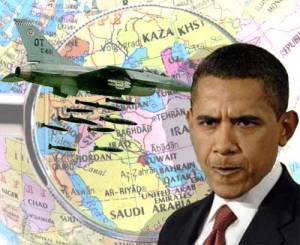 US military personnel are engaged in counterterrorism operations across 15 different countries, President Barack Obama said in a biannual statement to Congress released on Monday.
The letter outlined US military counterrorism operations across the globe in Afghanistan, Iraq, Syria, Turkey, Somalia, Yemen, Djibouti, Libya, Cuba, Niger, Cameroon, the Central African Republic, Egypt, Jordan, and Kosovo. All nations have US combat-equipped personnel deployed for a specific counterterrorism mission.
Obama indicated that that there is no timeline for the war on terrorism, and he will direct “additional measures to protect US citizens and interests” if necessary.
“It is not possible to know at this time the precise scope or the duration of the deployments of US Armed Forces necessary to counter terrorist threats to the United States,” Obama said.
Under the 2001 authorization for use of military force, the US president must update Congress every six months on the military operations against al-Qaeda, the Taliban and associated forces.
June 13, 2016
Posted by aletho |
Illegal Occupation, Militarism, Progressive Hypocrite | Afghanistan, Cameroon, Central African Republic, Cuba, Djibouti, Egypt, Iraq, Jordan, Libya, Niger, Obama, Somalia, Syria, Turkiye, United States, Yemen |
Leave a comment
The Pentagon has been secretly backing a U.S. Special Operations program to build elite units to fight “terrorism” in Libya, Niger, Mauritania and Mali, the New York Times revealed Monday.
The program was launched last year and is backed by millions of dollars in classified Pentagon funds. U.S. military trainers, including members of the Green Berets and Delta Force, are working with African “commandos” to “build homegrown African counterterrorism teams,” according to the Times.
According to the reporting, $70 million in Pentagon funds is going towards “training, intelligence-gathering equipment and other support” for commandos in Nigeria and Mauritania. And $16 million is going towards commandos in Libya. In Mauritnaia, $29 million has been allotted for “logistics and surveillance equipment in support of the specialized unit.” According to the Times, the program in Mali “has yet to get off the ground as a new civilian government recovers from a military coup last year.”
The U.S. military has for years been increasing its role across the continent of Africa, including the expansion of AFRICOM, drone attacks in Somalia, air strikes and arms shipments to Libya, and more.
May 28, 2014
Posted by aletho |
Militarism | Africa, AFRICOM, Libya, Mal, Mauritania, Niger, Nigeria |
Leave a comment
A chorus of outraged public opinion demands that the “international community” and the Nigerian military “Do something!” about the abduction by Boko Haram of 280 teenage girls. It is difficult to fault the average U.S. consumer of packaged “news” products for knowing next to nothing about what the Nigerian army has actually been “doing” to suppress the Muslim fundamentalist rebels since, as senior columnist Margaret Kimberley pointed out in these pages, last week, the three U.S. broadcast networks carried “not a single television news story about Boko Haram” in all of 2013. (Nor did the misinformation corporations provide a nanosecond of coverage of the bloodshed in the Central African Republic, where thousands died and a million were made homeless by communal fighting over the past year.) But, that doesn’t mean the Nigerian army hasn’t been bombing, strafing, and indiscriminately slaughtering thousands of, mainly, young men in the country’s mostly Muslim north.
The newly aware U.S. public may or may not be screaming for blood, but rivers of blood have already flowed in the region. Those Americans who read – which, presumably, includes First Lady Michelle Obama, who took her husband’s place on radio last weekend to pledge U.S. help in the hunt for the girls – would have learned in the New York Times of the army’s savage offensive near the Niger border, last May and June. In the town of Bosso, the Nigerian army killed hundreds of young men in traditional Muslim garb “Without Asking Who They Are,” according to the NYT headline. “They don’t ask any questions,” said a witness who later fled for his life, like thousands of others. “When they see young men in traditional robes, they shoot them on the spot,” said a student. “They catch many of the others and take them away, and we don’t hear from them again.”
The Times’ Adam Nossiter interviewed many refugees from the army’s “all-out land and air campaign to crush the Boko Haram insurgency.” He reported:
“All spoke of a climate of terror that had pushed them, in the thousands, to flee for miles through the harsh and baking semi-desert, sometimes on foot, to Niger. A few blamed Boko Haram — a shadowy, rarely glimpsed presence for most residents — for the violence. But the overwhelming majority blamed the military, saying they had fled their country because of it.”
In just one village, 200 people were killed by the military.
In March of this year, fighters who were assumed to be from Boko Haram attacked a barracks and jail in the northern city of Maiduguri. Hundreds of prisoners fled, but 200 youths were rounded up and made to lie on the ground. A witness told the Times: “The soldiers made some calls and a few minutes later they started shooting the people on the ground. I counted 198 people killed at that checkpoint.”
All told, according to Amnesty International, more than 600 people were extra-judicially murdered, “most of them unarmed, escaped detainees, around Maiduguri.” An additional 950 prisoners were killed in the first half of 2013 in detention facilities run by Nigeria’s military Joint Task Force, many at the same barracks in Maiduguri. Amnesty International quotes a senior officer in the Nigerian Army, speaking anonymously: “Hundreds have been killed in detention either by shooting them or by suffocation,” he said. “There are times when people are brought out on a daily basis and killed. About five people, on average, are killed nearly on a daily basis.”
Chibok, where the teenage girls were abducted, is 80 miles from Maiduguri, capital of Borno State.
In 2009, when the Boko Haram had not yet been transformed into a fully armed opposition, the military summarily executed their handcuffed leader and killed at least 1,000 accused members in the states of Borno, Yobe, Kano and Bauchi, many of them apparently simply youths from suspect neighborhoods. A gruesome video shows the military at work. “In the video, a number of unarmed men are seen being made to lie down in the road outside a building before they are shot,” Al Jazeera reports in text accompanying the video. “As one man is brought out to face death, one of the officers can be heard urging his colleague to ‘shoot him in the chest not the head – I want his hat.’”
These are only snapshots of the army’s response to Boko Haram – atrocities that are part of the context of Boko Haram’s ghastly behavior. The military has refused the group’s offer to exchange the kidnapped girls for imprisoned Boko Haram members. (We should not assume that everyone detained as Boko Haram is actually a member – only that all detainees face imminent and arbitrary execution.)
None of the above is meant to tell Boko Haram’s “side” in this grisly story (fundamentalist religious jihadists find no favor at BAR), but to emphasize the Nigerian military’s culpability in the group’s mad trajectory – the same military that many newly-minted “Save Our Girls” activists demand take more decisive action in Borno.
The bush to which the Boko Haram retreated with their captives was already a free-fire zone, where anything that moves is subject to obliteration by government aircraft. Nigerian air forces have now been joined by U.S. surveillance planes operating out of the new U.S. drone base in neighboring Niger, further entrenching AFRICOM/CIA in the continental landscape. Last week it was announced that, for the first time, AFRICOM troops will train a Nigerian ranger battalion in counterinsurgency warfare.
The Chibok abductions have served the same U.S. foreign policy purposes as Joseph Kony sightings in central Africa, which were conjured-up to justify the permanent stationing of U.S Special Forces in the Democratic Republic of Congo, Uganda, Rwanda, the Central African Republic and South Sudan, in 2011, on humanitarian interventionist grounds. (This past March, the U.S. sent 150 more Special Ops troops to the region, claiming to have again spotted Kony, who is said to be deathly ill, holed up with a small band of followers somewhere in the Central African Republic.) The United States (and France and Britain, plus the rest of NATO, if need be) must maintain a deepening and permanent presence in Africa to defend the continent from… Africans.
When the crowd yells that America “Do something!” somewhere in Africa, the U.S. military is likely to already be there.
Barack Obama certainly needs no encouragement to intervention; his presidency is roughly coterminous with AFRICOM’s founding and explosive expansion. Obama broadened the war against Somalia that was launched by George Bush in partnership with the genocidal Ethiopian regime, in 2006 (an invasion that led directly to what the United Nations called “the worst humanitarian crisis is Africa”). He built on Bill Clinton and George Bush’s legacies in the Congo, where U.S. client states Uganda and Rwanda caused the slaughter of 6 million people since 1996 – the greatest genocide of the post War World II era. He welcomed South Sudan as the world’s newest nation – the culmination of a decades-long project of the U.S., Britain and Israel to dismember Africa’s largest country, but which has now fallen into a bloody chaos, as does everything the U.S. touches, these days.
Most relevant to the plight of Chibok’s young women, Obama led “from behind” NATO’s regime change in Libya, removing the anti-jihadist bulwark Muamar Gaddafi (“We came, we saw, he died,” said Hillary Clinton) and destabilizing the whole Sahelian tier of the continent, all the way down to northern Nigeria. As BAR editor and columnist Ajamu Baraka writes in the current issue, “Boko Haram benefited from the destabilization of various countries across the Sahel following the Libya conflict.” The once-“shadowy” group now sported new weapons and vehicles and was clearly better trained and disciplined. In short, the Boko Haram, like other jihadists, had become more dangerous in a post-Gaddafi Africa – thus justifying a larger military presence for the same Americans and (mainly French) Europeans who had brought these convulsions to the region.
If Obama has his way, it will be a very long war – the better to grow AFRICOM – with some very unsavory allies (from both the Nigerian and American perspectives).
Whatever Obama does to deepen the U.S. presence in Nigeria and the rest of the continent, he can count on the Congressional Black Caucus, including its most “progressive” member, Barbara Lee (D-CA), the only member of the U.S. Congress to vote against the invasion of Afghanistan, in 2001. Lee, along with Reps. Marcia Fudge (D-Ohio), Sheila Jackson Lee (D-Texas) and fellow Californian Karen Bass, who is the ranking member on the House Subcommittee on African, gave cart blanch to Obama to “Do something!” in Nigeria. “And so our first command and demand is to use all resources to bring the terrorist thugs to justice,” they said.
A year and a half ago, when then UN Ambassador Susan Rice’s prospects for promotion to top U.S. diplomat were being torpedoed by the Benghazi controversy, a dozen Black congresspersons scurried to her defense. “We will not allow a brilliant public servant’s record to be mugged to cut off her consideration to be secretary of state,” said Washington, DC Delegate Eleanor Holmes Norton.
As persons who are presumed to read, Black Caucus members were certainly aware of the messy diplomatic scandal around Rice’s role in suppressing United Nation’s reports on U.S. allies’ Rwanda and Uganda’s genocidal acts against the Congolese people. Of all the high profile politicians from both the corporate parties, Rice – the rabid interventionist – is most intimately implicated in the Congo Holocaust, dating back to the policy’s formulation under Clinton. Apparently, that’s not the part of Rice’s record that counts to Delegate Norton and the rest of the Black Caucus. Genocide against Africans does not move them one bit.
So, why are we to believe that they are really so concerned about the girls of Chibok?
May 14, 2014
Posted by aletho |
Militarism, Progressive Hypocrite | Africa, AFRICOM, Barbara Lee, Boko Haram, Congo Holocaust, Congressional Black Caucus, Hillary Clinton, Niger, Nigeria, Obama, Sahel, Somalia, United States |
Leave a comment
Workers at a China National Nuclear Corporation (SinoU) uranium mine in northern Niger have gone on a 72-hour strike, trade union officials say.
On Tuesday, Boubacar Mamane, a spokesman for the Syntramines labor union, said 680 workers at SinoU have gone on strike to demand better wages and bonus payments, Reuters reported.
“Management refused to pay our allowances and production bonus despite having promised to do so last year. If nothing is done, we will launch an unlimited strike,” Mamane said.
SinoU officials and the Nigerien government, which owns 33 percent of the mine, were not available to comment on the action.
SinoU and its partners have a majority stake in the 700 ton-per-year SOMINA mine, whose production kicked off in 2011 and is expected to increase its output to 2,500 tons annually in 2015.
In 2007, SOMINA was established 160 kilometers southwest of Arlit and 150 kilometers northwest of Agadez, in the Agadez region of northern Niger.
Niger is the top supplier of uranium to the nuclear power industry of France.
March 21, 2013
Posted by aletho |
Economics, Nuclear Power, Solidarity and Activism | Areva, China National Nuclear Corporation, Niger, Press TV |
Leave a comment
The press wires are reporting on intensified fighting in Mali between the nation’s military and ethnic Tuareg rebels of the Azawad National Liberation Movement in the north of the nation.
As the only news agencies with global sweep and the funds and infrastructure to maintain bureaus and correspondents throughout the world are those based in leading member states of the North Atlantic Treaty Organization – the Associated Press, Reuters, Agence France-Presse, BBC News and Deutsche Presse-Agentur – the coverage of ongoing developments in Mali, like those in most every other country, reflects a Western bias and a Western agenda.
Typical headlines on the topic, then, include the following:
“Arms and men out of Libya fortify Mali rebellion” Reuters
President: Tuareg fighters from Libya stoke violence in Mali” CNN
“Colonel Gaddafi armed Tuaregs pound Mali” The Scotsman
“France denounces killings in Mali rebel offensive” Agence France-Presse
“Mali, France Condemn Alleged Tuareg Rebel Atrocities” Voice of America
To reach Mali from Libya is at least a 500-mile journey through Algeria and/or Niger. As the rebels of course don’t have an air force, don’t have military transport aircraft, the above headlines and the propaganda they synopsize imply that Tuareg fighters marched the entire distance from Libya to their homeland in convoys containing heavy weapons through at least one other nation without being detected or deterred by local authorities. And that, moreover, to launch an offensive three months following the murder of Libyan leader Muammar Gaddafi after his convoy was struck by French bombs and a U.S. Hellfire missile last October. But the implication that Algeria and Niger, especially the first, are complicit in the transit of Tuareg fighters and arms from Libya to Mali is ominous in terms of expanding Western accusations – and actions – in the region.
Armed rebellions are handled differently in Western-dominated world news reporting depending on how the rebels and the governments they oppose are viewed by leading NATO members.
In recent years the latter have provided military and logistical support to armed rebel formations – in most instances engaged in cross-border attacks and with separatist and irredentist agendas – in Kosovo, Macedonia, Liberia, Ivory Coast, Libya and now Syria, and on the intelligence and “diplomatic” fronts in Russia, China, Pakistan, Sudan, Iran, Indonesia, Congo, Myanmar, Laos and Bolivia.
However, major NATO powers have adopted the opposite tack when it comes to Turkey, Morocco (with its 37-year occupation of the Western Sahara), Colombia, the Philippines, the Central African Republic, Chad and other nations that are their military clients or territory controlled by them, where the U.S. and its Western allies supply weapons, advisers, special forces and so-called peacekeeping forces.
The drumbeat of alarmist news concerning Mali is a signal that the West intends to open another military front on the African continent following last year’s seven-month air, naval and special operations campaign against Libya and ongoing operations in Somalia and Central Africa with the recent deployment of American special forces to Uganda, Congo, the Central African Republic and South Sudan. In Ivory Coast, Mali’s neighbor to the south, last February the French military with compliant United Nations troops – “peacekeepers” – fired rockets into the presidential residence and forcibly abducted standing president Laurent Gbagbo.
U.S. Africa Command (AFRICOM) first became operational as the war fighting force it was intended to be from the beginning in running the first two weeks of the war against Libya last March with Operation Odyssey Dawn before turning the campaign over to NATO for seven more months of relentless bombing and missile strikes.
Mali may be the second military operation conducted by AFRICOM.
The landlocked country is the hub of the wheel of former French West Africa, bordered by every other member except Benin: Burkina Faso, Guinea (Conakry), Ivory Coast, Mauritania, Niger and Senegal. It also shares a border with Algeria, another former French possession, to its north.
Mali is Africa’s third largest producer of gold after South Africa and Ghana. It possesses sizable uranium deposits run by French concessions in the north of the country, the scene of the current fighting. Tuareg demands include granting some control over the uranium mines and the revenue they generate. Major explorations for oil and natural gas, also in the north, have been conducted in recent years as well.
The nation is also a key pivot for the U.S.’s Trans-Saharan Counter-Terrorism Partnership established in 2005 (initially as the Trans-Saharan Counter-Terrorism Initiative), which grew out of the Pan Sahel Initiative of 2003-2004.
In May of 2005 U.S. Special Operations Command Europe inaugurated the Trans-Saharan Counter-Terrorism Initiative by dispatching 1,000 special forces troops to Northwest Africa for Operation Flintlock to train the armed forces of Mali, Algeria, Chad, Mauritania, Niger, Senegal and Tunisia, the seven original African members of the Trans-Saharan Counter-Terrorism Initiative, which in its current format also includes Burkina Faso, Morocco and Nigeria. Libya will soon be brought into that format as it will the NATO Mediterranean Dialogue military partnership.
The American special forces led the first of what have now become annual Operation Flintlock counterinsurgency exercises with the above nations of the Sahel and Magreb. The following year NATO conducted the large-scale Steadfast Jaguar war games in the West African island nation of Cape Verde to launch the NATO Response Force, after which the African Standby Force has been modeled.
Flintlock 07 and 08 were held in Mali. Flintlock 10 was held in several African nations, including Mali.
On February 7 of this year the U.S. and Mali began the Atlas Accord 12 joint air delivery exercise in the African nation, but Flintlock 12, scheduled for later in the month, was postponed because of the fighting in the north. Sixteen nations were to have participated, including several of the U.S.’s major NATO allies.
Last year’s Flintlock included military units from the U.S., Canada, France, Germany, the Netherlands, Spain, Mali, Burkina Faso, Chad, Mauritania, Nigeria and Senegal.
When AFRICOM became an independent Unified Combatant Command on October 1, 2008, the first new overseas U.S. regional military command established in the post-Cold War era, AFRICOM and Special Operations Command Africa’s Joint Special Operations Task Force-Trans Sahara took control of the Flintlock exercises from U.S. European Command and U.S. Special Operations Command Europe.
In 2010 AFRICOM announced that Special Operations Command Africa “will gain control over Joint Special Operations Task Force-Trans Sahara (JSOTF-TS) and Special Operations Command and Control Element–Horn of Africa (SOCCE-HOA).”
Last year the AFRICOM website wrote:
“Conducted by Special Operations Command Africa, Flintlock is a joint multinational exercise to improve information sharing at the operational and tactical levels across the Saharan region while fostering increased collaboration and coordination. It’s focused on military interoperability and capacity-building for U.S., North American and European Partner Nations, and select units in Northern and Western Africa.”
Although the stated purposed of the Trans-Saharan Counter-Terrorism Partnership and its Flintlock multinational exercises is to train the military forces of nations in the Sahel and Magreb to combat Islamist extremist groups in the region, in fact the U.S. and its allies waged war against the government of Libya last year in support of similar elements, and the practical application of Pentagon military training and deployment in Northwest Africa has been to fight Tuareg militias rather than outfits like al-Qaeda in the Islamic Magreb or Nigeria’s Boko Haram.
The U.S. and its NATO allies have also conducted and supported other military exercises in the area for similar purposes. In 2008 the Economic Community of West African States (ECOWAS), the regional economic group from which the U.S.- and NATO-backed West African Standby Force was formed, held a military exercise named Jigui 2008 in Mali, which was “supported by the host governments as well as France, Denmark, Canada, Germany, the Netherlands, the United Kingdom, the United States of America and the European Union,” as the Ghana News Agency reported at the time.
AFRICOM also runs annual Africa Endeavor multinational communications interoperability exercises primarily in West Africa. Last year’s planning conference was held in the Malian capital of Bamako and, according to U.S. Army Africa, “brought together more than 180 participants from 41 African, European and North American nations, as well as observers from Economic Community of West African States (ECOWAS), Economic Community of Central African States (ECCAS), the Eastern African Standby Force and NATO to plan interoperability testing of communications and information systems of participating nations.” The main exercise was also held in Mali.
The U.S. military has been ensconced in the nation since at least 2005 and Voice of America revealed in that year that the Pentagon had “established a temporary operations center on a Malian air force base near Bamako. The facility is to provide logistical support and emergency services for U.S. troops training with local forces in five countries in the region.”
The following year U.S. European Command and NATO Supreme Allied Command Europe chief Marine General James Jones, subsequently the Obama administration’s first national security advisor, “made the disclosure [that] the Pentagon was seeking to acquire access to… bases in Senegal, Ghana, Mali and Kenya and other African countries,” according to a story published on Ghana Web.
In 2007 a soldier with the 1st Battalion, 10th Special Forces Group based in Stuttgart, Germany, where AFRICOM headquarters are based, died in Kidal, Mali, where fighting is currently occurring. His death was attributed to a “non-combat related incident.” The next year a soldier with the Canadian Forces Military Training Assistance Programme also lost his life in Mali.
Last year the Canadian Special Operations Regiment deployed troops to the northern Mali conflict zone for what was described “an ongoing mission.” Canadian Special Operations Regiment forces also participated in the Flintlock 11 exercise in Senegal.
In September of 2007 an American C-130 Hercules military transport plane was hit by rifle fire while dropping supplies to Malian troops under siege by Tuareg forces.
According to Stars and Stripes:
“The plane and its crew, which belong to the 67th Special Operations Squadron, were in Mali as part of a previously scheduled exercise called Flintlock 2007…Malian troops had become surrounded at their base in the Tin-Zaouatene region near the Algerian border by armed fighters and couldn’t get supplies…[T]he Mali government asked the U.S. forces to perform the airdrops…”
In 2009 the U.S. announced it was providing the government of Mali with over $5 million in new vehicles and other equipment.
Later in the year the website of U.S. Air Forces in Europe reported:
“The first C-130J Super Hercules mission in support of U.S. Air Forces Africa, or 17th Air Force, opened up doors to a future partnership of support between the 86th Airlift Wing and upcoming missions into Africa.
“The mission’s aircraft commander, Maj. Robert May of the 37th Airlift Squadron, and his crew were tasked to fly into Mali Dec. 19 to bring home 17 troops who were assisting with training Malian forces.”
The U.S. has been involved in the war in Mali for almost twelve years. Recent atrocity stories in the Western press will fuel demands for a “Responsibility to Protect” intervention after the fashion of those in Ivory Coast and Libya a year ago and will provide the pretext for American and NATO military involvement in the country.
AFRICOM may be planning its next war.
February 19, 2012
Posted by aletho |
Militarism, Progressive Hypocrite, Timeless or most popular | Africa, Algeria, Central African Republic, Libya, Mali, NATO, Niger, West Africa |
Leave a comment

 Aletho News
