Where are the Iran talks heading after Moscow?
By Peter Jenkins* | Lobelog | June 24th, 2012
To anyone trying to guess where this year’s re-engagement of Iran by the Obama administration is likely to lead, two things look clearer in the aftermath of the 18-19 June talks in Moscow.
First, the administration appears to have thought better of the idea of tolerating uranium enrichment, even at low levels, in Iran. The distinction President Obama drew earlier in the year between opposing the development of nuclear weapons (his position) and opposing the development of a nuclear weapons capability (the Israeli position), and the signal implied when the President authorised a resumption of talks with Iran even though Iran had failed to commit to suspending its enrichment activities–hitherto a pre-condition for such talks–have turned out to be misleading.
In Moscow, the US and its EU allies once more placed emphasis on the suspension of enrichment (a so-called “international obligation” which Iran must implement fully to secure a deal) and they declined to give Iran the assurance it wants that these talks will eventually result in the West tolerating enrichment.
Without that assurance Iran is unwilling to embark on the process of concession-making that is diplomatically termed “confidence-building”. Iran believes that it has a treaty right to master the nuclear fuel cycle provided it submits all nuclear material in its possession to International Atomic Energy Association (IAEA) inspection. It also considers the UN Security Council resolutions that the West has sponsored to override that treaty right to be illegal. (The resolutions are certainly not a proportionate response to Iran’s IAEA safeguards non-compliance.)
Second, neither the US nor its EU allies seem inclined to purchase Iranian confidence-building by granting Iran the other thing (apart from “recognition” of its Non-Proliferation Treaty (NPT) rights) that it craves: some measure of relief from the sanctions introduced by the US and EU (without UN authorisation) in the course of the past winter. Instead the West has sought to obtain concessions by offering what look like baubles for Iran’s negotiators.
On the face of it, therefore, re-engagement has been a failure. It has not sparked the give-and-take, the reciprocity that characterises almost all successful negotiations. It may have contributed to a pre-electorally useful drop in gas prices, but that drop is more likely due to a weakening global economic outlook. It has failed to deliver the Iranian capitulation that would complicate life for proponents of another war in the Gulf or regime change in Iran.
There is, however, an important difference between the 2009 version of engagement and the 2012 version. This time around neither side, it seems, is in a hurry to declare the process dead.
That this should be the case for the US and its allies is hardly surprising. In an electoral year the administration has every interest in heeding the American public’s preference for what Winston Churchill called “jaw-jaw” over “war-war”. And if diplomacy can contribute to lowering the cost of gas and make it harder for Israel to justify an aerial strike on Iranian nuclear facilities, so much the better.
What’s less obvious is what motivates Iran to help spin out talks that are going nowhere.
Iran does have an interest, of course, in making it harder for Israel to justify a strike. But Iran has never taken such Israeli threats very seriously and the opposition to a strike voiced by Israeli intelligence and military professionals earlier this year will have reinforced that inclination.
Iran has no interest in lower oil prices. But perhaps it reasons that bringing the Istanbul process to an end would not have much of an effect on prices, given the worsening economic outlook and the expansion of oil production under way in Gulf States allied to the US.
Perhaps, then, the answer is that Iran’s leaders are hoping that President Obama will be re-elected and that he will award them for their cooperation in keeping the show on the road until November by softening, early in his second term, the US position on enrichment and sanctions.
If so, will they be disappointed? At any time tolerating enrichment and removing or relieving sanctions will be politically costly for whoever occupies the White House, so widespread is Congress’ animosity towards Iran. The line of least resistance for an Obama II administration would be to back the judgement of those who claim that Iran will eventually capitulate under the weight of sanctions.
But it is not impossible that the President and his closest advisers have realised that a negotiated solution tends to be more durable than a solution imposed on a prostrate foe. That, after all, is a lesson that can be drawn from 19th and 20th century European history and from the 1783 Treaty of Paris between the US and Great Britain. Machiavelli once wrote: ”I believe that forced agreements will be kept neither by a prince nor by a republic”.
*Peter Jenkins was Britain’s permanent representative to the IAEA, 2001–06
How the Obama Administration Is Stalling Its Way to War with Iran
Deep-Sixing the China Option
By Flynt Leverett and Hillary Mann Leverett | TomDispatch | June 19, 2012
Since talks with Iran over its nuclear development started up again in April, U.S. officials have repeatedly warned that Tehran will not be allowed to “play for time” in the negotiations. In fact, it is the Obama administration that is playing for time.
Some suggest that President Obama is trying to use diplomacy to manage the nuclear issue and forestall an Israeli strike against Iranian nuclear targets through the U.S. presidential election. In reality, his administration is “buying time” for a more pernicious agenda: time for covert action to sabotage Tehran’s nuclear program; time for sanctions to set the stage for regime change in Iran; and time for the United States, its European and Sunni Arab partners, and Turkey to weaken the Islamic Republic by overthrowing the Assad government in Syria.
Vice President Biden’s national security adviser, Antony J. Blinken, hinted at this in February, explaining that the administration’s Iran policy is aimed at “buying time and continuing to move this problem into the future, and if you can do that — strange things can happen in the interim.” Former Pentagon official Michèle Flournoy — now out of government and advising Obama’s reelection campaign — told an Israeli audience this month that, in the administration’s view, it is also important to go through the diplomatic motions before attacking Iran so as not to “undermine the legitimacy of the action.”
New York Times’ journalist David Sanger recently reported that, “from his first months in office, President Obama secretly ordered increasingly sophisticated attacks on the computer systems that run Iran’s main nuclear enrichment facilities, significantly expanding America’s first sustained use of cyberweapons” — even though he knew this “could enable other countries, terrorists, or hackers to justify” cyberattacks against the United States. Israel — which U.S. intelligence officials say is sponsoring assassinations of Iranian scientists and other terrorist attacks in Iran — has been intimately involved in the program.
Classified State Department cables published by WikiLeaks show that, from the beginning of the Obama presidency, he and his team saw diplomacy primarily as a tool to build international support for tougher sanctions, including severe restrictions on Iranian oil exports. And what is the aim of such sanctions? Earlier this year, administration officials told the Washington Post that their purpose was to turn the Iranian people against their government. If this persuades Tehran to accept U.S. demands to curtail its nuclear activities, fine; if the anger were to result in the Islamic Republic’s overthrow, many in the administration would welcome that.
Since shortly after unrest broke out in Syria, the Obama team has been calling for President Bashar al-Assad’s ouster, expressing outrage over what they routinely describe as the deaths of thousands of innocent people at the hands of Syrian security forces. But, for morethana year, they have been focused on another aspect of the Syrian situation, calculating that Assad’s fall or removal would be a sharp blow to Tehran’s regional position — and might even spark the Islamic Republic’s demise. That’s the real impetus behind Washington’s decision to provide “non-lethal” support to Syrian rebels attacking government forces, while refusing to back proposals for mediating the country’s internal conflicts which might save lives, but do not stipulate Assad’s departure upfront.
Meeting with Iranian oppositionists last month, State Department officials aptly summarized Obama’s Iran policy priorities this way: the “nuclear program, its impact on the security of Israel, and avenues for regime change.” With such goals, how could his team do anything but play for time in the nuclear talks? Two former State Department officials who worked on Iran in the early months of Obama’s presidency are onrecord confirming that the administration “never believed that diplomacy could succeed” — and was “never serious” about it either.
How Not to Talk to Iran
Simply demanding that Iran halt its nuclear activities and ratcheting up pressure when it does not comply will not, however, achieve anything for America’s position in the Middle East. Western powers have been trying to talk Iran out of its civil nuclear program for nearly 10 years. At no point has Tehran been willing to surrender its sovereign right to indigenous fuel cycle capabilities, including uranium enrichment.
Sanctions and military threats have only reinforced its determination. Despite all the pressure exerted by Washington and Tel Aviv, the number of centrifuges operating in Iran has risen over the past five years from less than 1,000 to more than 9,000. Yet Tehran has repeatedly offered, in return for recognition of its right to enrich, to accept more intrusive monitoring of — and, perhaps, negotiated limits on — its nuclear activities.
Greater transparency for recognition of rights: this is the only possible basis for a deal between Washington and Tehran. It is precisely the approach that Iran has advanced in the current series of talks. Rejecting it only guarantees diplomatic failure — and the further erosion of America’s standing, regionally and globally.
George W. Bush’s administration refused to accept safeguarded enrichment in Iran. Indeed, it refused to talk at all until Tehran stopped its enrichment program altogether. This only encouraged Iran’s nuclear development, while pollsshow that, by defying American diktats, Tehran has actually won support among regional publics for its nuclear stance.
Some highly partisan analysts claim that, in contrast to Bush, Obama was indeed ready from early in his presidency to accept the principle and reality of safeguarded enrichment in Iran. And when his administration failed at every turn to act in a manner consistent with a willingness to accept safeguarded enrichment, the same analysts attributed this to congressional and Israeli pressure.
In truth, Obama and his team have never seriously considered enrichment acceptable. Instead, the president himself decided, early in his tenure, to launch unprecedented cyberattacks against Iran’s main, internationally monitored enrichment facility. His team has resisted a more realistic approach not because a deal incorporating safeguarded enrichment would be bad for American security (it wouldn’t), but because accepting it would compel a more thoroughgoing reappraisal of the U.S. posture toward the Islamic Republic and, more broadly, of America’s faltering strategy of dominating the Middle East.
The China Option
Acknowledging Iran’s right to enrich would require acknowledging the Islamic Republic as a legitimate entity with legitimate national interests, a rising regional power not likely to subordinate its foreign policy to Washington (as, for example, U.S. administrations regularly expected of Egypt under Anwar Sadat and Hosni Mubarak). It would mean coming to terms with the Islamic Republic in much the same way that the United States came to terms with the People’s Republic of China — another rising, independent power — in the early 1970s.
America’s Iran policy remains stuck in a delusion similar to the one that warped its China policy for two decades after China’s revolutionaries took power in 1949 — that Washington could somehow isolate, strangle, and ultimately bring down a political order created through mass mobilization and dedicated to restoring national independence after a long period of Western domination. It didn’t work in the Chinese case and it’s not likely to in Iran either.
In one of the most consequential initiatives in American diplomatic history, President Nixon and Henry Kissinger finally accepted this reality and aligned Washington’s China policy with reality. Unfortunately, Washington’s Iran policy has not had its Nixonian moment yet, and so successive U.S. administrations — including Obama’s — persist in folly.
The fact is: Obama could have had a nuclear deal in May 2010, when Brazil and Turkey brokered an agreement for Iran to send most of its low-enriched uranium abroad in return for new fuel for a research reactor in Tehran. The accord met all the conditions spelled out in letters from Obama to then-Brazilian President Lula and Turkish Prime Minister Erdogan — but Obama rejected it, because it recognized Iran’s right to enrich. (That this was the main reason was affirmed by Dennis Ross, the architect of Obama’s Iran policy, earlier this year.) The Obama team has declined to reconsider its position since 2010 and, as a result, it is on its way to another diplomatic failure.
As Middle Eastern governments become somewhat more representative of their peoples’ concerns and preferences, they are also — as in Egypt and Iraq — becoming less inclined toward strategic deference to the United States. This challenges Washington to do something at which it is badly out of practice: pursue genuine diplomacy with important regional states, based on real give and take and mutual accommodation of core interests. Above all, reversing America’s decline requires rapprochement with the Islamic Republic (just as reviving its position in the early 1970s required rapprochement with the People’s Republic of China).
Instead, three and a half years after George W. Bush left office, his successor continues to insist that Iran surrender to Washington’s diktats or face attack. By doing so, Obama is locking America into a path that is increasingly likely to result in yet another U.S.-initiated war in the Middle East during the first years of the next presidential term. And the damage that war against Iran will inflict on America’s strategic position could make the Iraq debacle look trivial by comparison.
~
Flynt Leverett is professor of international affairs at Penn State. Hillary Mann Leverett is senior professorial lecturer at American University. Together, they write the Race for Iran blog. Their new book, Going to Tehran: Why the United States Needs to Come to Terms With the Islamic Republic of Iran (Metropolitan Books), will be published in January 2013.
Copyright 2012 Flynt Leverett and Hillary Mann Leverett
Top Ten Things That Have and Haven’t Changed In the Era of Obama
By Bruce A. Dixon | BAR | June 20, 2012
Black America’s median household wealth, compared to that of whites, has sharply declined under Barack Obama. That’s a change. Just not a good one.
This is a consequence of the foreclosure epidemic which began in 2007 and 2008 and has always been concentrated in black and poor neighborhoods. But the Obama administration has allowed the foreclosure wave to continue without any letup during its first three and a half years, rejecting demands for foreclosure moratoriums or other measures which would make it easier for large numbers of families to remain in their homes. Where the ratio of white to black household wealth four years ago was around 11 to one, today it is greater than 20 to 1.
African Americans still make up 12 or 13% of the nation’s population, remain more than 40% of its locked down and locked up, No change there at all…
Latinos, who make up another 13%, are about 30% of the nation’s prisoners and rising, a slight change, but distinctly for the worse. So seven of every ten US prisoners are from the one quarter of the nation that is black or brown, and that percentage is rising.
The fifty-year war on drugs continues. No change for the better at all there.
Like every president since Nixon, Barack Obama has thwarted states that wanted to decriminalize small amounts of drugs, refuses to treat drug use as a medical problem rather than a police one. Like its predecessors, the Obama administration has expanded the frontiers of the drug war into places like Mexico and Colombia, where the US demand for illegal drugs has given birth to vast industries which may be among the largest and most lucrative, and certainly the most deadly, in those countries.
“Too big to fail” banksters and other financial criminals are still above the law. No change here either.
Not a single person responsible for crashing the economy in 2007 has seen the inside of a prison. It’s just not going to happen. Wall Street insiders give as much, and often more to Democrats than they do to Republicans. So the Obama administration has protected banks and lenders and their co-conspirators from prosecution, and shoveled more than ten trillion more at banksters, including those based outside the US, than the Bush-Cheney gang ever did.
It’s worth remembering that when Bush could not pass his own bailout bill six weeks before the 2008 election, he called Barack Obama into town to spend the week on the phone with Congressional Democrats getting them to switch their votes. So the only change here has been the party in charge.
Although governments will create trillions of new dollars to give to banksters and borrow it back from them at interest in the name of “fixing the economy”, it still won’t create millions of jobs for the unemployed. No change:
In the 1930s, the federal government addressed the Depression by creating hundreds of thousands of jobs out of thin air. They built roads and subways, parks, recreational facilities, dams and bridges. They did theater and historical research like tracking down and interviewing the last living survivors of slavery. It was called the WPA, or Works Progress Administration, under the administration of Democrat Franklin D. Roosevelt.
The White House could do the same today, creating millions of new jobs, repairing and rebuilding infrastructure, building high speed rail, refitting millions of homes for energy efficiency. But Barack Obama disdains the heritage of his own Democratic party. He sounds more like Hoover than FDR today when he says that it’s the exclusive role of the private sector to create jobs.
It’s still almost impossible to organize a union and fight for your own rights on the job anywhere in the US. No change:
There are laws against firing workers who try, but employers are unafraid to break those laws, while working people are very much afraid to lose their jobs. Candidate Obama did promise to put on his comfortable shoes and walk a picket line. Maybe he just lied. President Obama has frozen the wages and pensions of government workers, and endorsed the traditionally Republican idea that public employee and private pensions and health plans cause economic distress to employes and the economy.
The bipartisan corporate-funded drive to “reform” education by breaking teachers unions, turning teachers into Wal-Mart style temps, hi-stakes testing, dissolving public schools and replacing them by privately owned charter schools, exempt from public accountability continues apace. No change there at all.
Bush’s Secretary of Education called teachers unions “terrorist organizations.” Obama’s Secretary of Education declared that Katrina was the best thing that could have happened to public education in New Orleans.
If anything, the Obama administration’s Race To The Top program pushed the envelope further than Republicans would have been able to without sustained resistance. It required states to compete for available federal education funds based upon how many teachers they can fire, how many public schools they can close, how many so-called “merit pay” schemes and similar atrocities they can inflict. Just as only a vicious warmonger like Nixon could have made the first presidential trip to China, only a black Democrat could have successfully pushed the education policy envelope this far in the anti-democratic directions of charters and educational privatization. If anything, Obama’s heinous education policies provide an even further rightward step-off point for Republicans like Mitt Romney. It didn’t have to be that way.
US troops are in more than 140 countries worldwide, and the US, with under 5% of the world’s people, spends more on the military than the other 95% of humanity combined. Not much change there.
On the other hand, in the first weeks of his administration, President Obama received a Nobel Peace Prize. So the pan-European elite, which feared and despised George Bush, loves Obama. That’s a kind of change they call a distinction without a difference.
The Afghan war drags on, apparently indefinitely. A hundred thousand US-paid mercenaries remain in Iraq, and the war there too is far from over. On the other hand, Barack Obama has been able to use cruise missiles and drones to kill black and brown civilians including children in Yemen, Somalia and Pakistan, among other places. US military forces took part in the invasion and overthrow of the African nation of Libya, and the White House has openly rather than covertly sent unknown numbers of US special forces into nobody knows how many countries of Central Africa. A Bush administration doing this would have been greeted with nationwide street demonstrations. But a black Democrat gets a near automatic pass. Is this what the real “race card” looks like?
A US president still orders torture, murder, indefinite imprisonment without trial, and lets corporations that commit crimes abetting those of government employees completely off the hook. But there has been a change here.
When the Bush-Cheney gang did all this stuff, they did it as scofflaws. The Obama Administration has rammed through legislation in Congress and asked for court decisions to cloak most of the previously illegal torture, murder, kidnapping, warrantless spying and similar crimes with thin veneers of legality. This is the all-important difference between having an MBA as president as opposed to a professor of constitutional law.
Black politics, at one time heavily influenced by what Martin Luther King called opposition to the triple evils of racism, militarism, and economic injustice, has shrunken and shriveled under the influence of a new class of corporate funded black political leaders like Corey Booker and Barack Obama. Deep, real and significant change here.
Black politics ain’t about fighting for decent housing or jobs any more. It’s not about diverting resources from the war machine to uplifting the downtrodden. It’s not about funding education or working for the end of the prison state. It’s certainly not about defying unjust laws in the pursuit of just ends, as the Freedom Movement once routinely did.
People forget that King was murdered in Memphis in the middle of a sanitation workers strike in which the National Guard had been called out to patrol the city, and students had stayed home from high school for days to participate in illegal mass actions.
21st century black politics is about electing black politicians, no more and no less. That, and observing Black History Month.
This is far from an exhaustive list, of course.
We could have mentioned the fact that big oil, big agribusiness, big insurance, and big pharma all continue to get whatever they ask for. We might have pointed out that local and state fiscal crises are constantly being provoked, to which the solutions are always “public private partnerships” a standard euphemism for privatizations of public assets like roads, waterworks, generation facilities and public services like payroll, parking and fleet management. We could have pointed out that medical costs are still factors in a majority of personal bankruptcies, and the FCC has essentially abandoned any pretense of regulating the cable and broadcast industries, preferring to simply lease out or auction off the electromagnetic spectrum and leave it all to the “free market”.
Some things have changed over the last four years, and some haven’t. One thing that seems never to change, as long as our choices are restricted to the two corporate parties, is that while you can squint hard enough to make distinctions between Republicans and Democrats, there are few important differences.
Bruce A. Dixon is managing editor at Black Agenda Report. He lives and works in Marietta GA, and is a state committee member of the Georgia Green Party. Contact him at bruce.dixon(at)blackagendareport.com.
Obama Regime: Federal Agents Should Be Allowed To Hold Guns To The Heads Of Children
Ninth Circuit to DEA: Putting a Gun to an 11-Year-Old’s Head Is Not OK
By Mike Riggs | Reason | June 18, 2012
At 7 a.m. on January 20, 2007, DEA agents battered down the door to Thomas and Rosalie Avina’s mobile home in Seeley, California, in search of suspected drug trafficker Louis Alvarez. Thomas Avina met the agents in his living room and told them they were making a mistake. Shouting “Don’t you fucking move,” the agents forced Thomas Avina to the floor at gunpoint, and handcuffed him and his wife, who had been lying on a couch in the living room. As the officers made their way to the back of the house, where the Avina’s 11-year-old and 14-year-old daughters were sleeping, Rosalie Avina screamed, “Don’t hurt my babies. Don’t hurt my babies.”
The agents entered the 14-year-old girl’s room first, shouting “Get down on the fucking ground.” The girl, who was lying on her bed, rolled onto the floor, where the agents handcuffed her. Next they went to the 11-year-old’s room. The girl was sleeping. Agents woke her up by shouting “Get down on the fucking ground.” The girl’s eyes shot open, but she was, according to her own testimony, “frozen in fear.” So the agents dragged her onto the floor. While one agent handcuffed her, another held a gun to her head.
Moments later the two daughters were carried into the living room and placed next to their parents on the floor while DEA agents ransacked their home. After 30 minutes, the agents removed the children’s handcuffs. After two hours, the agents realized they had the wrong house—the product of a sloppy license plate transcription—and left.
In 2008, the Avinas—mom, dad, and both daughters—filed a federal suit against the DEA for excessive use of force, assault, and battery in the U.S. District Court for the Southern District of California. That court ruled in favor of the DEA, and the Avinas appealed. Last week, the family got justice.
While the Ninth Circuit Court of Appeals defended the agents’ rough treatment of Thomas and Rosalie, it also declared that yanking the Avina children of their beds and putting guns to their heads did, in fact, constitute the “intentional infliction of emotional distress.” (Read the Obama administration’s defense of the DEA agents.)
“A jury could find that the agents pointed their guns at the head of an eleven-year-old girl, ‘like they were going to shoot [her],’ while she lay on the floor in handcuffs, and that it was excessive for them to do so,” reads the Ninth Circuit’s decision, which was filed June 12. “Similarly, a jury could find that the agents’ decision to force the two girls to lie face down on the floor with their hands cuffed behind their backs was unreasonable.”
More from the decision:
Under our case law, an issue of material fact exists as to whether the actions of the agents were excessive in light of the ages of B.S.A. (age eleven) and B.F.A. (age fourteen) and the limited threat they posed. See Tekle, 511 F.3d 839 (holding that officers were not entitled to summary judgment on excessive force claim where officers pointed guns at an eleven-year-old boy’s head during the arrest of the boy’s father); Motley v. Parks, 432 F.3d 1072, 1089 (9th Cir. 2005) (en banc) (holding that officer’s act of pointing a gun at an infant during the search of a gang member’s house was objectively unreasonable); see also McDonald ex rel. McDonald v. Haskins, 966 F.2d 292, 294-95 (7th Cir. 1992) (holding that officer’s act of pointing his gun at a nine-year-old’s head during the search of home was excessive use of force). Accordingly, we reverse the district court’s grant of summary judgment in favor of the United States on B.F.A.’s and B.S.A.’s claims for assault and battery.
In a footnote, the court wrote:
Although there is evidence that the agents released the girls from their handcuffs once they realized how young they were, there is also evidence that the agents knew, prior to entering the girls’ bedrooms, that the girls were children. Rosalie testified that, as the agents were heading towards the girls’ rooms, she screamed at the agents several times, “Don’t hurt my babies.” Moreover, one of the agents testified at his deposition that, when he first saw one of the girls (presumably the older of the two girls), she appeared to be “12 [or] 13 years old.”
The ruling concludes:
Viewing the evidence in the light most favorable to the Avinas, a rational trier of fact could find that agents engaged in “extreme or outrageous” conduct when the agents: (1) pointed their guns at the head of eleven-year-old B.S.A. “like they were going to shoot [her]” while B.S.A. was lying on the floor in handcuffs; (2) forced eleven-year-old B.S.A. and fourteen-year-old B.F.A. to lie face down on the floor with their hands cuffed behind their backs; (3) left B.S.A. and B.F.A. in handcuffs for half an hour; and (4) yelled at eleven-year-old B.S.A. and fourteen-year-old B.F.A. to “[g]et down on the f[uck]ing ground.” See Tekle, 511 F.3d at 856 (holding that officers were not entitled to summary judgment on claim for intentional infliction of emotional distress where officers pointed guns at eleven-year old’s head during the arrest of the eleven-year-old’s father); see also id. at 859 (Fisher, J., concurring). Accordingly, we reverse the district court’s grant of summary judgment in favor of the United States on B.F.A.’s and B.S.A.’s claims for intentional infliction of emotional distress.
As a side note: While this raid was conducted under President George W. Bush, the deputy administrator of the DEA at that time was Michele Leonhart. She is now the administrator of the DEA, thanks to an appointment by President Barack Obama. Furthermore, the Obama Administration could have declined to defend the DEA in this case. Instead, Obama’s Justice Department has decided to make the case that federal agents should be allowed to hold guns to the heads of children.
Related articles
- DEA Embroiled In Prostitution Scandal (huffingtonpost.com)
- The DEA and the Massacre in the Moskitia (alethonews.wordpress.com)
- Here’s How the Obama Administration Defended DEA Agents Who Put a Gun to a Little Girl’s Head (reason.com)
Guantanamo’s Goon Squads Still Torturing Under Obama
By Sherwood Ross | Aletho News | June 17, 2012
Despite President Obama’s pledge to end torture, the brutalization of Muslim prisoners at Guantanamo prison continues under his regime.
Guantanamo is where a thug squad called the Immediate Reaction Force (IRF) tortures inmates while pointing their required video cameras at the floor to hide their beatings.
In illegal and cowardly assaults on tied-up inmates that violate the Geneva Conventions, five or more Pentagon IRF MP’s will spray Mace in a prisoner’s face and then gang-beat him. The MP’s are known to break bones, gouge eyes, squeeze testicles, inject disease, force the prisoner’s head into a toilet or bang it on a concrete floor, smear the prisoner with feces, douse him with noxious chemicals, urinate on him and even sodomize him. A prisoner may also be virtually buried alive in total darkness underground for as long as three weeks, during which he is denied adequate food and sleep. Prisoners have also been hog-tied in painful positions for hours on end. In short, Guantanamo’s prisoners have suffered tortures far worse than France’s notorious Devil’s Island.
The above facts about Guantanamo are according to distinguished investigative reporter Jeremy Scahill in an article published for “World View News Service.” He quotes Michael Ratner, president of the Center For Constitutional Rights (CCR) as saying: “They (the IRF) are the Black Shirts of Guantanamo. IRFs can’t be separated from torture. They are part of the brutalization of humans treated as less than human.” Adds Scott Horton, a leading expert on the U.S. military and constitutional law, “They (the IRF) were trained to brutally punish prisoners in a brief period of time, and ridiculous pretexts were taken to justify” the beatings. (One prisoner said he was beaten for feeding crumbs to some lizards.)
“I have seen detainees suffer serious injuries as a result of being IRF’ed,” said David Hicks, an Australian citizen held at Guantanamo. “I have seen detainees IRF’ed while they were praying or by refusing medication.”
In his book, “An Innocent Man in Guantanamo,” (Palgrave/macmillan), Murat Kurnaz, held there for five years even though it was clear to U.S. authorities he was innocent, writes, “Blows from the IRF team were the basic form of punishment at Camp X-Ray… beating us and then chaining our hands and feet, connecting those chains with a third one. You couldn’t move your arms, they were pressed to your body. Then they’d leave you sitting there like that and take away your blanket and the thin mattress. It could take days before they’d unshackle you… ” Perhaps the ultimate in sadism, Kurnaz recalls, “fathers had to watch as their sons were beaten, and vice versa.”
Kurnaz writes that when General Geoffrey Miller took over Guantanamo in 2003 the plight of the prisoners “dramatically worsened.” “The interrogations got more brutal, more frequent, and longer. The first order General Miller issued was to commence Operation Sandman, which meant we were moved to new cells every one or two hours. The general’s goal was to completely deprive us of sleep, and he achieved it.” Kurnaz said that if he dozed off an IRF guard would punch him in the face.
The CCR has called upon the Obama regime to immediately end the use of IRF teams at Guantanamo. One Guantanamo defense lawyer said that after Obama took office his clients reported “a ramping up in abuse.” Horton says, “detainees should be entitled to compensation for injuries they suffered,” reports Scahill.
“As Commander in Chief of United States Armed Forces under the terms of the United States Constitution, President Obama has an absolute obligation to terminate torture and war crimes committed by the IRFs on Gitmo,” says Francis Boyle, professor of international law at the University of Illinois, Champaign. “Failure to do so renders him liable for these international crimes under international criminal law, U.S. domestic criminal law, and U.S. Army Field Manual 27-10 on the Law of Land Warfare under the doctrine of Command Responsibility. The best way to do this would be to terminate the IRFs on Gitmo.” Boyle is author of “Tackling America’s Toughest Questions” (Clarity).
Scahill says that while Barack Obama, almost immediately upon taking office, issued an executive order saying he was going to close down Guantanamo within a year and that he was going to respect the Geneva Convention while his administration reviewed Guantanamo, the (IRF) force under Obama has continued to torture prisoners.
~
Sherwood Ross formerly worked as a reporter and columnist for major dailies and wire services. He currently heads a Miami, Florida-based public relations firm for worthy causes. Reach him at sherwoodross10@gmail.com.
Related articles
Unilateral sanctions on Iran to hurt Russia-US ties: Russian official
Xinhua – June 17, 2012
MOSCOW – Potential U.S.sanctions on Iran over its nuclear program will “deal a blow” to Russian-U.S. relations, a senior Russian official said Sunday, presuming a hard-line stance before the long-waited meeting of the heads of the two states.
Russian presidential aide Yury Ushakov told reporters that U.S. sanctions on Iran would “run against international law and affect third countries.”
Moscow could not accept if Russian firms and banks become potential victims of such unilateral actions from the U.S., Ushakov warned.
Russian President Vladimir Putin and U.S. President Barack Obama are to meet on the sidelines of the upcoming Group of 20 summit Monday in the Mexican city of Los Cabos.
The two leaders had agreed by phone in early May that they would meet for one and a half hours during the summit, Ushakov said, which would be the first since Putin returned to the top seat.
Putin’s absence from the Group of Eight summit last month in the United States and Obama’s no-show decision at an Asia-Pacific Economic Cooperation forum meeting in Russia’s Vladivostok in September augured a possible cool-down of the already soured Russia-U.S. relations amidst Putin’s tough words concerning the U.S.-led missile defense system in Europe.
A new round of talks between Iran and the six major world powers — Britain, China, France, Germany, Russia and the United States — is due on Monday in Moscow, a month after the last round of “six plus one” talks was held in the Iraqi capital Baghdad.
U.S. Escalates Military Penetration of Africa
By Glen Ford | Black Agenda Report | June 13, 2012
According to the Army Times newspaper, the United States will soon deploy a brigade of about 3,000 troops – “and likely more” – for duty “across the continent” of Africa. The “pilot program”has all the markings of a permanent, roving presence, joining the 1,200 U.S. soldiers stationed in Djibouti and the 100-plus Special Forces dispatched to Central Africa by President Obama, last October.
As always and everywhere, the U.S. is looking for bases to occupy – although the U.S. military command in Africa doesn’t call them bases. Rather, “as part of a ‘regionally’ aligned force concept,’ soldiers will live and work among Africans in safe communities approved by the U.S. government,” said AFRICOM’s Maj. Gen. David Hogg.
The First Black U.S. President, who in 2009 lectured Africans that “corruption” and “poor governance,” rather than neocolonialism, were the continent’s biggest problems, has made the U.S. military the primary interlocutor with African states. Functions that were once the purview of the U.S. State Department, such as distribution of economic aid and medical assistance, are now part of AFRICOM’s vast portfolio. In Africa, more than anyplace in the world, U.S. foreign policy wears a uniform – which should leave little doubt as to Washington’s objectives in the region: Africa is to be dominated by military means. Obama’s “good governance” smokescreen for U.S. neocolonialism is embedded in AFRICOM’s stated mission: “to deter and defeat transnational threats and to provide a security environment conducive to good governance and development.” Translation: to bring the so-called war on terror to every corner of the continent and ensure that U.S. corporate interests get favorable treatment from African governments.
AFRICOM’s array of alliances and agreements with African militaries already embraces virtually every nation on the continent except Eritrea and Zimbabwe. All but a handful of Black African states routinely take part in military maneuvers staged by Americans, utilizing U.S. command-and-control equipment and practices. The new, roving U.S. brigade will further institutionalize U.S. ties with the African officer class, part of AFRICOM’s mission to forge deep “soldier-to-soldier” relationships: general-to-general, colonel-to-colonel, and so forth down the line. The proposed network of “safe communities” to accommodate the highly mobile U.S. brigade is a euphemism for joint bases and the most intense U.S. fraternization with local African militaries. Regime change will never be farther away than a drink at the officers club.
According to the Army Times article, the composition of the new brigade, in terms of military skills, is not yet known. However, the brigade is conceived as part of the “new readiness model,” which “affords Army units more time to learn regional cultures and languages and train for specific threats and missions.” This sounds like special ops units – Rangers and Special Forces – which have been vastly expanded under President Obama (and are quite capable of carrying out regime-change operations on their own or in close coordination with their local counterparts).
In most cases, coups will be unnecessary. Regional African “trade” blocs like ECOWAS, the 16-member Economic Community of West African States, and IGAD, the six-nation Intergovernmental Authority on Development, in East Africa, have provided African cover for U.S. and French military/political designs in the Ivory Coast and Somalia, respectively. These blocs will doubtless become even more useful and compliant, as U.S. military commanders and their African counterparts get cozier in those “safe communities.”
Americans, no matter how bloody their hands, have always liked to think of themselves as “innocents abroad.” “As far as our mission goes, it’s uncharted territory,” said AFRICOM’s Gen. Hogg. Not really. The Americans are following a European chart in Africa that goes back centuries, and their own long experience in the serial rape of Latin America, where the close fraternization of U.S. and Latin American militaries in recent decades smothered the region in juntas, dirty wars, torture-based states, and outright genocide.
The U.S. and its African allies perpetrated of the worst genocide since World War Two: the death of six million in the eastern Democratic Republic of Congo. Uganda, which acts as a mercenary for the U.S. in Africa, is complicit in mega-death in Congo and Somalia. As Milton Allimadi, publisher of Black Star News, reported: “In 2005 The International Court of Justice (ICJ) found Uganda liable for the Congo crimes. The court awarded Congo $10 billion in reparations. Uganda’s army plundered Congo’s wealth and committed: mass rapes of both women and men; disemboweled pregnant women; burned people inside their homes alive; and, massacred innocents.”
Naturally, as a henchman of the United States, Uganda has not paid the $10 billion it owes Congo. Ugandan leader Yoweria Museveni, who became Ronald Reagan’s favorite African after seizing power in 1986 with a guerilla army packed with child soldiers, and who for decades waged genocidal war against the Acholi people of his country, now plays host to the Special Forces continent sent by President Obama, ostensibly to fight the child soldier-abusing Joseph Kony and his nearly nonexistent Lord’s Resistance Army.
Rwanda, the Pentagon’s other hit man on the continent, has been cited by a United Nations report as bearing responsibility for some of the millions slaughtered in Congo, as part of its ongoing rape and plunder of its neighbor.
Gen. Hogg says AFRICOM’s mission is to combat famine and disease. Yet, the AFRICOM-assisted Ethiopian invasion of Somalia in late 2006 led to “the worst humanitarian crisis in Africa – worse than Darfur,” according to United Nations observers. The 2007 humanitarian crisis and the escalating U.S.-directed war against Somalia made the 2010 famine all but inevitable.
Ugandan soldiers, nominally working for the African Union but in the pay of the Pentagon, kept watch over western interests in the starving country, as did the 1,200 soldiers stationed at the U.S. base in neighboring Djibouti – a permanent presence, along with the French garrison.
There’s nothing “uncharted” or mysterious about AFRICOM’s mission. The introduction of the 3,000-strong mobile brigade and a network of supporting bases prepares the way for the arrival of much larger U.S. and NATO forces – the recolonization of Africa. Gen. Hogg swears up and down there are no such plans. “For all the challenges that happen and sprout up across Africa, it really comes down to, it has to be an African solution,” he said.
That’s exactly the same thing they said in Iraq, Afghanistan, and Libya.
Glen Ford can be contacted at Glen.Ford@BlackAgendaReport.com.
Related articles
- Libya, Africa and Africom (alethonews.wordpress.com)
Predator Nation: Obama and Corporate Crime
By RUSSELL MOKHIBER | CounterPunch | June 12, 2012
When Charles Ferguson accepted the Academy Award in 2010 for his documentary film Inside Job, he told 30 million people viewing the award ceremony that “three years after a horrific financial crisis caused by massive fraud, not a single senior financial executive has been prosecuted and that’s wrong.”
Two years later, still no prosecution.
So, now Ferguson is out with a book – Predator Nation: Corporate Criminals, Political Corruption, and the Hijacking of America (Random House, 2012.)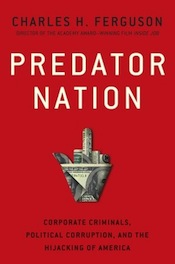
It reads like an indictment.
Check that.
It reads like a number of indictments.
And Ferguson is hoping that federal prosecutors will pick up the book and get some ideas.
And why exactly have there been no prosecutions of high level Wall Street investment bank executives?
Politics?
“Not exactly,” Ferguson says.
“It’s important to bear in mind the direct personal incentive structures of many of the people involved,” Ferguson told Corporate Crime Reporter last week. “The revolving door phenomenon now effects the Justice Department and federal prosecutors to a very substantial extent.”
“The previous federal prosecutor for the southern district of New York, Mary Jo White, now does white collar criminal defense and makes a great deal more money than she did as a federal prosecutor. I think that phenomenon is very well entrenched, very thoroughly entrenched.”
“Indeed Lanny Breuer, the Assistant Attorney General for the Criminal Division was head of the white collar criminal defense practice at Covington & Burling. They represent most of the major banks and investment banks in the United States.”
And his boss, Eric Holder, the Attorney General, came from the same firm.
“Exactly,” Ferguson said. “So, when you say politics, you sort of think of Republicans, Democrats, ideology, large scale political and policy debates. I don’t think that’s the only thing going on here. I think you have to consider incentives – individual, personal, financial and professional.”
When Rudy Giuliani was U.S. Attorney, he had no qualms about prosecuting Michael Milken. What has changed?
“One thing that has changed is that the amount of wealth and political power held by the financial sector has gone up by at least an order of magnitude,” Ferguson said.
“Another thing that’s changed is the amount of money that the financial sector spends on politics and acquiring political power and influence has also gone up by at least an order of magnitude.”
“And thirdly, the divergence, the difference between public sector salaries and incomes and private sector salaries and incomes has widened enormously.”
“So again, for those at the level of large scale political behavior and at the level of individual incentive, things have changed dramatically since the 1980s.”
As an undergrad, Ferguson studied mathematics at the University of California Berkeley and went on to study political science at MIT.
He then went on to organize an early software company – Vermeer Technologies – which was sold in 1996 to Microsoft for a reported $133 million.
He was an early fan of President Obama.
“I donated my legal maximum to his campaign in 2008,” Ferguson says.
But at a press conference in October 2011, Obama addressed the question of why no high level Wall Street executive has been prosecuted.
“So, you know, without commenting on particular prosecutions– obviously, that’s not my job, that’s the attorney general’s job – you know, I think part of people’s frustrations, part of my frustration, was a lot of practices that should not have been allowed weren’t necessarily against the law, but they had a huge destructive impact,” Obama said. […]
What was Ferguson’s reaction when he heard Obama say – the actions “weren’t necessarily against the law”?
“My reaction was very negative,” Ferguson said. “First of all the statement is thoroughly inaccurate and incorrect, but secondly it’s very difficult for me to believe that he doesn’t know that.”
“Given what we now know, it’s very difficult for me to believe that President Obama actually believes that there was no significant criminality in the housing bubble and the financial crisis.”
Russell Mokhiber edits the Corporate Crime Reporter.
Related articles
- Exposing Countrywide (alethonews.wordpress.com)
- Predator Nation: How Wall Street Crashed the Economy & Got Off Scott Free (ritholtz.com)
- Corporate criminals gone wild (salon.com)
Obama says Washington is ‘more attentive’ to Israelis than Palestinians
Press TV – June 6, 2012
US President Barack Obama has once again voiced unwavering support for Tel Aviv, reiterating that Washington is “decidedly more attentive” to Israel than it is to the Palestinians.
Obama made the remarks on Tuesday at a meeting between White House Chief of Staff Jack Lew and a visiting delegation of the US Orthodox Jewish community, Israeli daily Haaretz reported on Wednesday.
The US president also called on the audience not to cast doubts on his loyalty to his Israeli allies.
Referring to his amicable personal relationship with the hawkish Israeli Premier Benjamin Netanyahu, Obama highlighted that he understands that the Israeli official wishes “no restraints”.
When asked about what he had found out from events regarding Israel-Palestine talks to end the conflict between the two sides, Obama said “it’s really hard,” and pointed to numerous possibilities for misunderstanding.
The remarks come after the US House of Representatives announced its plans on May 7 to allocate nearly USD one billion for the 2013 fiscal year for Israel’s missile systems.
“This funding level is the highest ever appropriated in a single year” for Israeli missiles, Rep. Steve Rothman (D-NJ), a member of the committee, said in a statement.
Tel Aviv is the top recipient of military aid from the United States.
Related articles
- African Immigrants in Tel Aviv Attacked by Racist Israeli Mobs (alethonews.wordpress.com)
- Obama says when chips are down I have Israel’s back (alethonews.wordpress.com)
MSNBC: No Time for Obama’s Kill List?
By Peter Hart | FAIR | June 1, 2012
The New York Times‘ lengthy report (5/29/12) on Barack Obama’s drone “kill list” should provoke serious questions: Is such a program legal? How does it square with Obama’s criticism of the Bush administration’s “war on terror” policies? What does it tell us about how the administration identifies “militants” who are targeted for assassination?
But those questions have been raised only in fits and starts–and are basically absent from the liberal cable news channel MSNBC. In fact, a far more interesting discussion of these questions can be heard on Fox News Channel.
It’s not all good on Fox, naturally. Host Bill O’Reilly and guest Dennis Miller (5/29/12) joked about whether they were on the kill lists . Geraldo Rivera defended the program on Fox & Friends (6/1/12). Fox “liberal” Bob Beckel did the same on Fox‘s The Five (5/29/12):
To even suggest that somehow there is something wrong with a kill list, for you to suggest that shows you how rabidly anti-Obama you are.
Part of that discussion focused on what the reaction would be if we were reading about George W. Bush’s drone kill list–a contrast that was raised on other Fox shows, and a legitimate one.
It wasn’t just that angle that Fox covered, though. On Special Report (5/30/12), James Rosen looked at the White House’s “fuzzy math” at counting civilian deaths from drone strikes. A Special Report panel (5/29/12) used a soundbite from the ACLU to illustrate criticism from the left.
But what about the channel that would seem the natural place for some of that left-leaning analysis? MSNBC has been mostly quiet. A search of the Nexis news database turns up nothing on Obama’s kill list. The program Morning Joe had one discussion (5/29/12) where the panelists mostly supported the program, though host Joe Scarborough expressed some reservations.
What was more newsworthy? MSNBC‘s prime time shows seemed to have plenty of coverage of “birther” Donald Trump.
And it is worth noting one left-leaning TV host who did present a critical take on the Obama drone program was Current host Cenk Uygur (5/29/12). Some might remember that he briefly hosted a show on MSNBC but left amidst disputes over whether management wanted him to tone it down. Draw your own conclusions.
*Also: Kevin Gosztola has a good piece about drones and media coverage at FireDogLake (6/1/12). And it should be noted that ABC correspondent Jake Tapper (5/29/12) asked some strong questions to White House press secretary Jay Carney, particularly about civilian deaths and how the administration was defining “militants.” As best I can tell, Tapper’s exchange with Carney was not included in any ABC broadcasts, but can be viewed at the link above (starting around the 13:00 mark)
Featured Video
Prof. Ted Postol: Iran Already Achieved Nuclear Deterrence Against Israel
or go to
Aletho News Archives – Video-Images
From the Archives
How the occupied mentality syndrome works
Saudi Arabia on the American chessboard – Part 3
By B. J. Sabri | American Herald Tribune | June 27, 2016
Read part 2: “The occupied mentality Syndrome“
Previously I argued whether Saudi Arabia’s repeated involvements in U.S. interventions and wars stem from free national will or in response to a specific condition. For starters, in Saudi Arabia there is no national will. In Saudi Arabia, the national will is the will of the Al Saud clan. Still, when a major Arab state allies itself with a superpower that committed unspeakable crimes against humanity in almost every Arab country, then something is wrong. This fact alone should compel us to examine the U.S.-Saudi relation for one exceptional reason. As a result of the U.S.-Saudi wars, hundreds of thousands of people in Afghanistan, Iraq, Iran, Libya, Syria, Yemen, and Somalia have lost their lives. Millions became displaced in their own homelands. And millions more rendered refugees.
Attributing the Saudi policies to the bonds of “partnership” with the U.S. is frivolous. There are no bonds between these two thugs except those of business, military deals, secret plots, and wars. Proving this point, bonds such as these have no space for the American and Saudi peoples to share significant cultural or societal exchanges. If partnership is not the reason for the Saudi contribution to the U.S. strategy of empire and imperialism, then another reason must exist.
This leads to three possibilities. … continue
Blog Roll
 Aletho News
- NIAID/NIH and USDA Fund Bioengineered Chimeric Influenza Viruses Built Using Pandemic H1N1 Components: Journal ‘Science Advances’
- Hezbollah hits Israeli warship off Lebanon’s coast, sets it aflame
- Iran slams US strikes on B1 bridge, Mahshahr petrochemical plants as ‘blatant acts of state terrorism’
- In letter to UN chief, Araghchi warns of dire consequences of US-Israeli attacks on Iran’s nuclear facilities
- Why the CIA conspiracy to invade Iran with Kurdish militias failed
- Why Are Upbeat US Claims About Mission to Rescue Pilot ‘Highly Questionable’?
- Aircraft destroyed during US ‘rescue’ of downed F-15 pilot cost more than $100 million each
- Washington University removes professor who condemned US-Israeli war on Iran
- Russia Warns of Retaliation as UK Authorizes Seizure of Vessels
- Serbia thwarts plot to bomb Russia-Hungary gas pipeline – Vucic
- If Americans Knew
- In Iran, Israel-US take aim at “reason, research, and freedom of thought” – Daily Update
- US loses planes over Iran, Israel downgrades Lebanon war goals – Daily Update
- Israel Is Blocking Palestinians from Easter at Church Where Jesus Resurrected
- Plot to assassinate Palestinian activist follows harassment campaign promoted by Zionist groups and elected officials
- Prominent New York synagogue hosts presentation on why U.S. Jews should support the ethnic cleansing of Gaza
- Tapper vs. Piker: Is the CNN Anchor Auditioning for David Ellison?
- Shouldn’t Democrats Be Able to Condemn Genocide?
- Israel-US kill negotiators, destroy civilian structures, but Iran’s military capabilities still largely intact – Daily Update
- ‘War crime’: Global condemnation as Israeli ministers celebrate death penalty law targeting Palestinian prisoners
- 7 Ways Israel Is Turning Lebanon Into Gaza
- No Tricks Zone
- An Inconvenient Tree: Uncovered In Alps… Europe Much Warmer Than Today 6000 Years Ago
- New Study Reports A 60% Slowdown In Greenland’s Ice Loss Rate In The Last Decade
- Low Intensity Tornado Wrecks Major Solar Farm, Creating A Potential Toxic Dump
- New Study Finds Warming Saves Lives…Cold Temperatures 12 Times More Deadly Than Excess Heat
- German Science Blog Accuses PIK Climate Institute Of Hallucinating Climate Tipping Points
- Devastating Assessment Of Comirnaty Vaccine By Former Senior Pfizer Europe Toxicologist
- New Study: CO2 Is ‘Effectively Negligible’ As An Explanatory Climate Change Factor Since 2000
- Former Pfizer Toxicologist Dr. Helmut Sterz Tells Bundestag Hearing Pfizer Vaccine Should Have Never Been Approved
- Energy Expert: Germany’s Nuclear Phaseout Was A “500 Billion Euro Mistake”
- New Research: South Australia’s Mid-Holocene Sea Surface Temperatures Were 4°C Warmer Than Today
 Aletho News