The FBI Hand Behind Russia-gate
By Ray McGovern | Consortium News | January 11, 2018
Russia-gate is becoming FBI-gate, thanks to the official release of unguarded text messages between loose-lipped FBI counterintelligence official Peter Strzok and his garrulous girlfriend, FBI lawyer Lisa Page. (Ten illustrative texts from their exchange appear at the end of this article.)
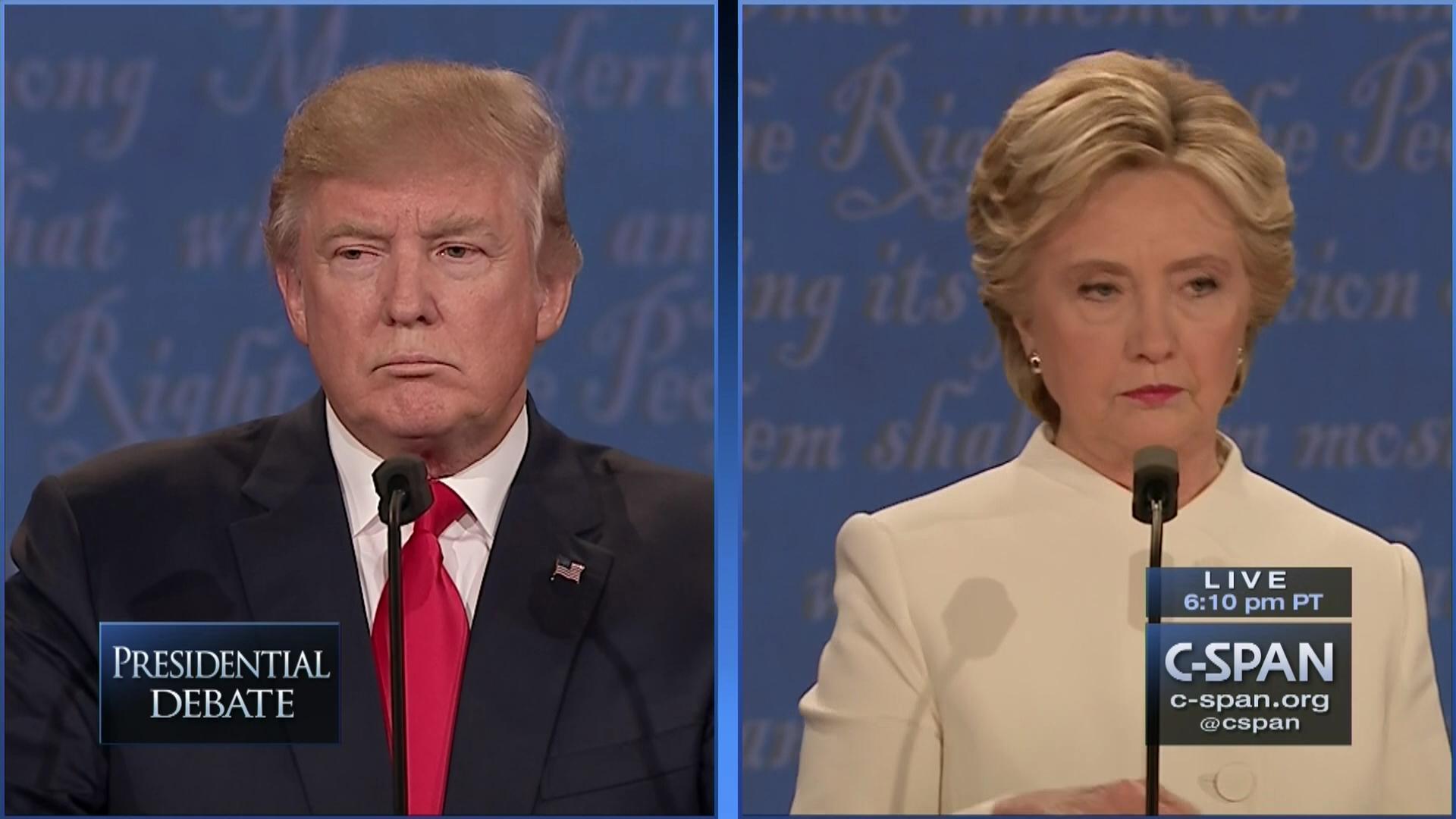
Donald Trump and Hillary Clinton in their third debate,
as Clinton called Trump Vladimir Putin’s “puppet.”
Despite his former job as chief of the FBI’s counterintelligence section, Strzok had the naive notion that texting on FBI phones could not be traced. Strzok must have slept through “Security 101.” Or perhaps he was busy texting during that class. Girlfriend Page cannot be happy at being misled by his assurance that using office phones would be a secure way to conduct their affair(s).
It would have been unfortunate enough for Strzok and Page to have their adolescent-sounding texts merely exposed, revealing the reckless abandon of star-crossed lovers hiding (they thought) secrets from cuckolded spouses, office colleagues, and the rest of us. However, for the never-Trump plotters in the FBI, the official release of just a fraction (375) of almost 10,000 messages does incalculably more damage than that.
We suddenly have documentary proof that key elements of the U.S. intelligence community were trying to short-circuit the U.S. democratic process. And that puts in a new and dark context the year-long promotion of Russia-gate. It now appears that it was not the Russians trying to rig the outcome of the U.S. election, but leading officials of the U.S. intelligence community, shadowy characters sometimes called the Deep State.
More of the Strzok-Page texting dialogue is expected to be released. And the Department of Justice Inspector General reportedly has additional damaging texts from others on the team that Special Counsel Robert Mueller selected to help him investigate Russia-gate.
Besides forcing the removal of Strzok and Page, the text exposures also sounded the death knell for the career of FBI Deputy Director Andrew McCabe, in whose office some of the plotting took place and who has already announced his plans to retire soon.
But the main casualty is the FBI’s 18-month campaign to sabotage candidate-and-now-President Donald Trump by using the Obama administration’s Russia-gate intelligence “assessment,” electronic surveillance of dubious legality, and a salacious dossier that could never pass the smell test, while at the same time using equally dubious techniques to immunize Hillary Clinton and her closest advisers from crimes that include lying to the FBI and endangering secrets.
Ironically, the Strzok-Page texts provide something that the Russia-gate investigation has been sorely lacking: first-hand evidence of both corrupt intent and action. After months of breathless searching for “evidence” of Russian-Trump collusion designed to put Trump in the White House, what now exists is actual evidence that senior officials of the Obama administration colluded to keep Trump out of the White House – proof of what old-time gumshoes used to call “means, motive and opportunity.”
Even more unfortunately for Russia-gate enthusiasts, the FBI lovers’ correspondence provides factual evidence exposing much of the made-up “Resistance” narrative – the contrived storyline that The New York Times and much of the rest of the U.S. mainstream media deemed fit to print with little skepticism and few if any caveats, a scenario about brilliantly devious Russians that not only lacks actual evidence – relying on unverified hearsay and rumor – but doesn’t make sense on its face.
The Russia-gate narrative always hinged on the preposterous notion that Russian President Vladimir Putin foresaw years ago what no American political analyst considered even possible, the political ascendancy of Donald Trump. According to the narrative, the fortune-telling Putin then risked creating even worse tensions with a nuclear-armed America that would – by all odds – have been led by a vengeful President Hillary Clinton.
Besides this wildly improbable storyline, there were flat denials from WikiLeaks, which distributed the supposedly “hacked” Democratic emails, that the information came from Russia – and there was the curious inability of the National Security Agency to use its immense powers to supply any technical evidence to support the Russia-hack scenario.
The Trump Shock
But the shock of Trump’s election and the decision of many never-Trumpers to cast their lot with the Resistance led to a situation in which any prudent skepticism or demand for evidence was swept aside.
So, on Jan. 6, 2017, President Obama’s Director of National Intelligence James Clapper released an evidence-free report that he said was compiled by “hand-picked” analysts from the CIA, FBI and NSA, offering an “assessment” that Russia and President Putin were behind the release of the Democratic emails in a plot to help Trump win the presidency.
Despite the extraordinary gravity of the charge, even New York Times correspondent Scott Shane noted that proof was lacking. He wrote at the time: “What is missing from the [the Jan. 6] public report is what many Americans most eagerly anticipated: hard evidence to back up the agencies’ claims that the Russian government engineered the election attack. … Instead, the message from the agencies essentially amounts to ‘trust us.’”
But the “assessment” served a useful purpose for the never-Trumpers: it applied an official imprimatur on the case for delegitimizing Trump’s election and even raised the long-shot hope that the Electoral College might reverse the outcome and possibly install a compromise candidate, such as former Secretary of State Colin Powell, in the White House. Though the Powell ploy fizzled, the hope of somehow removing Trump from office continued to bubble, fueled by the growing hysteria around Russia-gate.
Virtually all skepticism about the evidence-free “assessment” was banned. For months, the Times and other newspapers of record repeated the lie that all 17 U.S. intelligence agencies had concurred in the conclusion about the Russian “hack.” Even when that falsehood was belatedly acknowledged, the major news outlets just shifted the phrasing slightly to say that U.S. intelligence agencies had reached the Russian “hack” conclusion. Shane’s blunt initial recognition about the lack of proof disappeared from the mainstream media’s approved narrative of Russia-gate.
Doubts about the Russian “hack” or dissident suggestions that what we were witnessing was a “soft coup” were scoffed at by leading media commentators. Other warnings from veteran U.S. intelligence professionals about the weaknesses of the Russia-gate narrative and the danger of letting politicized intelligence overturn a constitutional election were also brushed aside in pursuit of the goal of removing Trump from the White House.
It didn’t even seem to matter when new Russia-gate disclosures conflicted with the original narrative that Putin had somehow set Trump up as a Manchurian candidate. All normal journalistic skepticism was jettisoned. It was as if the Russia-gate advocates started with the conclusion that Trump must go and then made the facts fit into that mold, but anyone who noted the violations of normal investigative procedures was dismissed as a “Trump enabler” or a “Moscow stooge.”
The Text Evidence
But then came the FBI text messages, providing documentary evivdence that key FBI officials involved in the Russia-gate investigation were indeed deeply biased and out to get Trump, adding hard proof to Trump’s longstanding lament that he was the subject of a “witch hunt.”
Justified or not, Trump’s feeling of vindication could hardly be more dangerous — particularly at a time when the most urgent need is to drain some testosterone from the self-styled Stable-Genius-in-Chief and his martinet generals.
On the home front, Trump, his wealthy friends, and like-thinkers in Congress may now feel they have an even wider carte blanche to visit untold misery on the poor, the widow, the stranger and other vulnerable humans. That was always an underlying danger of the Resistance’s strategy to seize on whatever weapons were available – no matter how reckless or unfair – to “get Trump.”
Beyond that, Russia-gate has become so central to the Washington establishment’s storyline that there appears to be no room for second-thoughts or turning back. The momentum is such that some Democrats and the media never-Trumpers can’t stop stoking the smoke of Russia-gate and holding out hope against hope that it will somehow justify Trump’s impeachment.
Yet, the sordid process of using legal/investigative means to settle political scores further compromises the principle of the “rule of law” and integrity of journalism in the eyes of many Americans. After a year of Russia-gate, the “rule of law” and “pursuit of truth” appear to have been reduced to high-falutin’ phrases for political score-setttling, a process besmirched by Republicans in earlier pursuits of Democrats and now appearing to be a bipartisan method for punishing political rivals regardless of the lack of evidence.
Strzok and Page
Peter Strzok (pronounced “struck”) has an interesting pedigree with multiple tasks regarding both Mrs. Clinton and Mr. Trump. As the FBI’s chief of counterespionage during the investigation into then-Secretary of State Hillary Clinton’s unauthorized use of a personal email server for classified information, Strzok reportedly changed the words “grossly negligent” (which could have triggered legal prosecution) to the far less serious “extremely careless” in FBI Director James Comey’s depiction of Clinton’s actions. This semantic shift cleared the way for Comey to conclude just 20 days before the Democratic National Convention began in July 2016, that “no reasonable prosecutor” would bring charges against Mrs. Clinton.
Then, as Deputy Assistant Director of the Counterintelligence Division, Strzok led the FBI’s investigation into alleged Russian interference in the U.S. election of 2016. It is a safe bet that he took a strong hand in hand-picking the FBI contingent of analysts that joined “hand-picked” counterparts from CIA and NSA in preparing the evidence-free, Jan. 6, 2017 assessment accusing Russian President Vladimir Putin of interfering in the election of 2016. (Although accepted in Establishment groupthink as revealed truth, that poor excuse for analysis reflected the apogee of intelligence politicization — rivaled only by the fraudulent intelligence on “weapons of mass destruction“ in Iraq 15 years ago.)
In June and July 2017 Strzok was the top FBI official working on Special Counsel Robert Mueller’s investigation into possible links between the Trump campaign and Russia, but was taken off that job when the Justice Department IG learned of the Strzok-Page text-message exchange and told Mueller.
There is no little irony in the fact that what did in the FBI sweathearts was their visceral disdain for Mr. Trump, their cheerleading-cum-kid-gloves treatment of Mrs. Clinton and her associates, their 1950-ish, James Clapperesque attitude toward Russians as “almost genetically driven” to evil, and their (Strzok/Page) elitist conviction that they know far better what is good for the country than regular American citizens, including those “deplorables” whom Clinton said made up half of Trump’s supporters.
But Strzok/Page had no idea that their hubris, elitism and scheming would be revealed in so tangible a way. Worst of all for them, the very thing that Strzok, in particular, worked so hard to achieve — the sabotaging of Trump and immunization of Mrs. Clinton and her closest advisers is now coming apart at the seams.
Congress: Oversee? or Overlook?
At this point, the $64 question is whether the various congressional oversight committees will remain ensconced in their customarily cozy role as “overlook” committees, or whether they will have the courage to attempt to carry out their Constitutional duty. The latter course would mean confronting a powerful Deep State and its large toolbox of well-practiced retaliatory techniques, including J. Edgar Hoover-style blackmail on steroids, enabled by electronic surveillance of just about everything and everyone. Yes, today’s technology permits blanket collection, and “Collect Everything” has become the motto.
Sen. Chuck Schumer, D-New York, with almost four decades of membership in the House and Senate, openly warned incoming President Trump in January 2017 against criticizing the U.S. intelligence community because U.S. intelligence officials have “six ways from Sunday to get back at you” if you are “dumb” enough to take them on.
Thanks to the almost 10,000 text messages between Strzok and Page, only a small fraction of which were given to Congress four weeks ago, there is now real evidentiary meat on the bones of the suspicions that there indeed was a “deep-state coup” to “correct” the outcome of the 2016 election. We now know that the supposedly apolitical FBI officials had huge political axes to grind. The Strzok-Page exchanges drip with disdain for Trump and those deemed his smelly deplorable supporters. In one text message, Strzok expressed visceral contempt for those working-class Trump voters, writing on Aug. 26, 2016, “Just went to a southern Virginia Walmart. I could SMELL the Trump support. … it’s scary real down here.”
The texts even show Strzok warning of the need for an “insurance policy” to thwart Trump on the off-chance that his poll numbers closed in on those of Mrs. Clinton.
An Aug. 6, 2016 text message, for example, shows Page giving her knight in shining armor strong affirmation: “Maybe you’re meant to stay where you are because you’re meant to protect the country from that menace [Trump].” That text to Strzok includes a link to a David Brooks column in The New York Times, in which Brooks concludes with the clarion call: “There comes a time when neutrality and laying low become dishonorable. If you’re not in revolt, you’re in cahoots. When this period and your name are mentioned, decades hence, your grandkids will look away in shame.”
Another text message shows that other senior government officials – alarmed at the possibility of a Trump presidency – joined the discussion. In an apparent reference to an August 2016 meeting with FBI Deputy Director Andrew McCabe, Strzok wrote to Page on Aug. 15, 2016, “I want to believe the path you threw out for consideration in Andy’s office — that there’s no way he [Trump] gets elected — but I’m afraid we can’t take that risk.” Strzok added, “It’s like an insurance policy in the unlikely event that you die before you’re 40.”
Insurance Policy?
Senate Judiciary Committee chair Chuck Grassley, R-Iowa, says he will ask Strzok to explain the “insurance policy” when he calls him to testify. What seems already clear is that the celebrated “Steele Dossier” was part of the “insurance,” as was the evidence-less legend that Russia hacked the DNC’s and Clinton campaign chairman John Podesta’s emails and gave them to WikiLeaks.
If congressional investigators have been paying attention, they already know what former weapons inspector Scott Ritter shared with Veteran intelligence Professionals for Sanity (VIPS) colleagues this week; namely, that Fusion GPS’s Glenn Simpson, who commissioned the Russia dossier using Democratic Party money, said he reached out to Steele after June 17, just three days before Steele’s first report was published, drawing on seven sources.
“There is a snowball’s chance in hell that this is raw intelligence gathered by Steele; rather he seems to have drawn on a single ‘trusted intermediary’ to gather unsubstantiated rumor already in existence.”
Another VIPS colleague, Phil Giraldi, writing out of his own experience in private sector consulting, added: “The fact that you do not control your sources frequently means that they will feed you what they think you want to hear. Since they are only doing it for money, the more lurid the details the better, as it increases the apparent value of the information. The private security firm in turn, which is also doing it for the money, will pass on the stories and even embroider them to keep the client happy and to encourage him to come back for more. When I read the Steele dossier it looked awfully familiar to me, like the scores of similar reports I had seen which combined bullshit with enough credible information to make the whole product look respectable.”
It is now widely known that the Democrats ponied up the “insurance premiums,” so to speak, for former British intelligence officer Christopher Steele’s “dossier” of lurid — but largely unproven — “intelligence” on Trump and the Russians. If, as many have concluded, the dossier was used to help justify a FISA warrant to snoop on the Trump campaign, those involved will be in deep kimchi, if congressional overseers do their job.
How, you might ask, could Strzok and associates undertake these extra-legal steps with such blithe disregard for the possible consequences should they be caught? The answer is easy; Mrs. Clinton was a shoo-in, remember? This was just extra insurance with no expectation of any “death benefit” ever coming into play — save for Trump’s electoral demise in November 2016. The attitude seemed to be that, if abuse of the FISA law should eventually be discovered — there would be little interest in a serious investigation by the editors of The New York Times and other anti-Trump publications and whatever troubles remained could be handled by President Hillary Clinton.
Sen. Lindsey Graham, R-South Carolina, who chairs the Judiciary Subcommittee of Judiciary on Crime and Terrorism, joined Sen. Grassley in signing the letter referring Christopher Steele to the Justice Department to investigate what appear to be false statements about the dossier. In signing, Graham noted the “many stop signs the Department of Justice ignored in its use of the dossier.” The signature of committee ranking member Sen. Dianne Feinstein, D-California, however, was missing — an early sign that a highly partisan battle royale is in the offing. On Tuesday, Feinstein unilaterally released a voluminous transcript of Glenn Simpson’s earlier testimony and, as though on cue, Establishment pundits portrayed Steele as a good source and Fusion GPS’s Glenn Simpson as a victim.
The Donnybrook is now underway; the outcome uncertain.
+++++++++++++
Sample text messages between Peter Strzok and Lisa Page, released to Congress and the media on December 13, 2016
++++++++++++++
03/04/2016
Strzok – God Hillary should win. 100,000,000-0.
Page – I know
++++++++++++
04/02/2016
Page – So look, you say we text on that phone when we talk about Hillary because it can’t be traced, you were just venting, bc you feel bad that you’re gone so much but that can’t be helped right now.
++++++++++
07/08/2016
Strzok – And meanwhile, we have Black Lives Matter protestors, right now, chanting “no justice no peace” around DoJ and the White House…
Page – That’s awful.
+++++++++
07/14/2016
Page – Have you read this? It’s really frightening. For Whites Sensing Decline, Donald Trump Unleashes Words of Resistance http://NYTI/ms/29WCu5!
Strzok – I have not. But I think it’s clear he’s capturing all the white, poor voters who the mainstream republicans abandoned in all but name in the quest for the almighty $$$
Page – Yeah, it’s not good.
Strzok – Poll Finds Emails Weighing on Hillary Clinton, Now Tied With Donald Trump http://nyti.ms/29RV5gf
Page – It is
+++++++++++++
07/26/2016
Strzok – And hey. Congrats on a woman nominated for President in a major party! About damn time! Many many more returns of the day!!
Page – That’s cute. Thanks
++++++++++
08/06/2016
Page – Jesus. You should read this. And Trump should go f himself. Moment in Convention Glare Shakes Up Khans American Life http://nyti.ms/2aHulE0
Strzok – God that’s a great article. Thanks for sharing. And F TRUMP.
++++++++
08/06/2016
Page – And maybe you’re meant to stay where you are because you’re meant to protect the country from that menace. To that end comma, read this:
Page – Trump Enablers Will Finally Have to Take A Stand http://nyti.ms/2aFakry
Strzok – Thanks. It’s absolutely true that we’re both very fortunate. And of course I’ll try and approach it that way. I just know it will be tough at times. I can protect our country at many levels, not sure if that helps
++++++++++++
08/09/2016
Page – He’s not ever going to become president, right? Right?!
Strzok – OMG did you hear what Trump just said?
+++++++++++
08/26/2016
Strzok – Just went to a southern Virginia Walmart. I could SMELL the Trump support…
Page – Yep. Out to lunch with (redacted) We both hate everyone and everything.
Page – Just riffing on the hot mess that is our country.
Strzok – Yeah…it’s scary real down here
+++++++++
10/20/2016
Strzok: I am riled up. Trump is a f***ing idiot, is unable to provide a coherent answer.
Strzok – I CAN’T PULL AWAY, WHAT THE F**K HAPPENED TO OUR COUNTRY (redacted)??!?!
Page– I don’t know. But we’ll get it back. We’re America. We rock.
Strzok– Donald just said “bad hombres”
Strzok– Trump just said what the FBI did is disgraceful.
END
Ray McGovern works with Tell the Word, a publishing arm of the ecumenical Church of the Saviour in inner-city Washington. He was an Army and CIA intelligence analyst for 30 years; prepared and briefed the President’s Daily Brief for Nixon, Ford, and Reagan; and is co-founder of Veteran Intelligence Professionals for Sanity (VIPS).
Did Obama Arm Islamic State Killers?
By Daniel Lazare | Consortium News | December 21, 2017
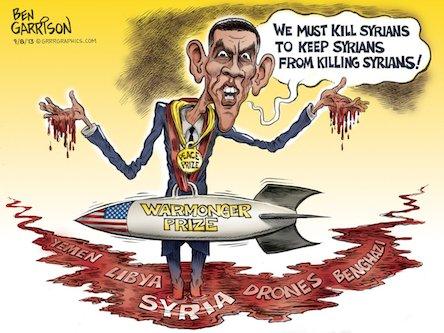
Did Barack Obama arm ISIS? The question strikes many people as absurd, if not offensive. How can anyone suggest something so awful about a nice guy like the former president? But a stunning report by an investigative group known as Conflict Armament Research (CAR) leaves us little choice but to conclude that he did.
CAR, based in London and funded by Switzerland and the European Union, spent three years tracing the origin of some 40,000 pieces of captured ISIS arms and ammunition. Its findings, made public last week, are that much of it originated in former Warsaw Pact nations in Eastern Europe, where it was purchased by United States and Saudi Arabia and then diverted, in violation of various rules and treaties, to Islamist rebels seeking to overthrow Syrian President Bashar al-Assad. The rebels, in turn, somehow caused or allowed the equipment to be passed on to Islamic State, which is also known by the acronyms ISIS or ISIL, or just the abbreviation IS.
This is damning stuff since it makes it clear that rather than fighting ISIS, the U.S. government was feeding it.
But CAR turns vague when it comes to the all-important question of precisely how the second leg of the transfer worked. Did the rebels turn the weapons over voluntarily, involuntarily, or did they somehow drop them when ISIS was in close proximity and forget to pick them up? All CAR will say is that “background information … indicates that IS [Islamic State] forces acquired the materiel through varied means, including battlefield capture and the amalgamation of disparate Syrian opposition groups.” It adds that it “cannot rule out direct supply to IS forces from the territories of Jordan and Turkey, especially given the presence of various opposition groups, with shifting allegiances, in cross-border supply locations.” But that’s it.
If so, this suggests an astonishing level of incompetence on the part of Washington. The Syrian rebel forces are an amazingly fractious lot as they merge, split, attack one another and then team up all over again. So how could the White House have imagined that it could keep weapons tossed into this mix from falling into the wrong hands? Considering how each new gun adds to the chaos, how could it possibly keep track? The answer is that it couldn’t, which is why ISIS wound up reaping the benefits.
But here’s the rub. The report implies a level of incompetence that is not just staggering, but too staggering. How could such a massive transfer occur without field operatives not having a clue as to what was going on? Was every last one of them deaf, dumb, and blind?
Not likely. What seems much more plausible is that once the CIA established “plausible deniability” for itself, all it cared about was that the arms made their way to the most effective fighting force, which in Syria happened to be Islamic State.
This is what had happened in Afghanistan three decades earlier when the lion’s share of anti-Soviet aid, some $600 million in all, went to a brutal warlord named Gulbuddin Hekmatyar. Hekmatyar was a raging bigot, a sectarian, and an anti-western xenophobe, qualities that presumably did not endear him to his CIA handlers. But as Steve Coll notes in Ghost Wars, his bestselling 2004 account of the CIA’s love affair with Islamic holy war, he “was the most efficient at killing Soviets” and that was the only thing that mattered. As one CIA officer put it, “analytically, the best fighters – the best-organized fighters – were the fundamentalists” that Hekmatyar led. Consequently, he ended up with the most money.
After all, if you’re funding a neo-medieval uprising, it makes sense to steer the money to the darkest reactionaries of them all. Something similar occurred in March 2015 when Syrian rebels launched an assault on government positions in the northern province of Idlib. The rebel coalition was under the control of Jabhat al-Nusra, as the local branch of Al Qaeda was known at the time, and what Al-Nusra needed most of all were high-tech TOW missiles with which to counter government tanks and trucks.
Arming Al Qaeda
So the Obama administration arranged for Nusra to get them. To be sure, it didn’t provide them directly. To ensure deniability, rather, it allowed Raytheon to sell some 15,000 TOWs to Saudi Arabia in late 2013 and then looked the other way when the Saudis transferred large numbers of them to pro-Nusra forces in Idlib. [See Consortiumnews.com’s “Climbing into bed with Al-Qaeda.”] Al-Nusra had the toughest fighters in the area, and the offensive was sure to send the Assad regime reeling. So even though its people were compatriots with those who destroyed the World Trade Center, Obama’s White House couldn’t say no.
“Nusra have always demonstrated superior planning and battle management,” Yezid Sayigh, a senior associate at the Carnegie Middle East Center in Beirut, said a few weeks later. If the rebel coalition was successful as a whole, it “was entirely due to their willingness to work with Nusra, who have been the backbone in all of this.”
Scruples, assuming they existed in the first place, fell by the wayside. A senior White House official told The Washington Post that the Obama administration was “not blind to the fact that it is to some extent inevitable” that U.S. weapons would wind up in terrorist hands, but what could you do? It was all part of the game of realpolitik. A senior Washington official crowed that “the trend lines for Assad are bad and getting worse” while The New York Times happily noted that “[t]he Syrian Army has suffered a string of defeats from re-energized insurgents.” So, for the master planners in Washington, it was worth it.
Then there is ISIS, which is even more beyond the pale as most Americans are concerned thanks to its extravagant displays of barbarism and cruelty – its killing of Yazidis and enslavement of Yazidi women and girls, its mass beheadings, its fiery execution of Jordanian fighter pilot Moaz al-Kasasbeh, and so on.
Yet U.S. government attitudes were more ambivalent than most Americans realized. Indeed, the U.S. government was strictly neutral as long as ISIS confined itself to attacking Assad. As a senior defense official told the Wall Street Journal in early 2015: “Certainly, ISIS has been able to expand in Syria, but that’s not our main objective. I wouldn’t call Syria a safe haven for ISIL, but it is a place where it’s easier for them to organize, plan, and seek shelter than it is in Iraq.”
In other words, Syria was a safe haven because, the Journal explained, the U.S. was reluctant to interfere in any way that might “tip the balance of power toward Syrian President Bashar al-Assad, who is fighting Islamic State and other rebels.” So the idea was to allow ISIS to have its fun as long as it didn’t bother anyone else. For the same reason, the U.S. refrained from bombing the group when, shortly after the Idlib offensive, its fighters closed in on the central Syrian city of Palmyra, 80 miles or so to the east. This was despite the fact that the fighters would have made perfect targets while “traversing miles of open desert roads.”
As The New York Times explained: “Any airstrikes against Islamic State militants in and around Palmyra would probably benefit the force of President Bashar al-Assad. So far, United States-led airstrikes in Syria have largely focussed on areas far outside government control, to avoid the perception of aiding a leader whose ouster President Obama has called for.” [See Consortiumnews.com’s “How US-Backed War on Syria Helped ISIS.”]
Looting Palmyra
The United States thus allowed ISIS to capture one of the most archeologically important cities in the world, killing dozens of government soldiers and decapitating 83-year-old Khalid al-Asaad, the city’s retired chief of antiquities. (After looting and destroying many of the ancient treasures, ISIS militants were later driven from Palmyra by a Russian-backed offensive by troops loyal to President Assad.)
Obama’s bottom line was: ISIS is very, very bad when it attacks the U.S.-backed regime in Iraq, but less so when it wreaks havoc just over the border in Syria. In September 2016, John Kerry clarified what the administration was up to in a tape-recorded conversation at the U.N. that was later made public. Referring to Russia’s decision to intervene in Syria against ISIS, also known by the Arabic acronym Daesh, the then-Secretary of State told a small knot of pro-rebel sympathizers:
“The reason Russia came in is because ISIL was getting stronger. Daesh was threatening the possibility of going to Damascus and so forth, and that’s why Russia came in, because they didn’t want a Daesh government and they supported Assad. And we know this was growing. We were watching. We saw that Daesh was growing in strength, and we thought Assad was threatened. We thought, however, we could probably manage, that Assad might then negotiate. Instead of negotiating, he got … Putin in to support him. So it’s truly complicated.” (Quote starts at 26:10.)
“We were watching.” Kerry said. So, by giving ISIS free rein, the administration hoped to use it as a lever with which to dislodge Assad. As in Afghanistan, the United States thought it could use jihad to advance its own imperial interests. Yet the little people – Syrian soldiers, three thousand office workers in lower Manhattan, Yazidis, the Islamic State’s beheading of Western hostages, etc. – made things “truly complicated.”
Putting this all together, a few things seem clear. One is that the Obama administration was happy to see its Saudi allies use U.S.-made weapons to arm Al Qaeda. Another is that it was not displeased to see ISIS battle Assad’s government as well. If so, how unhappy could it have been if its allies then passed along weapons to the Islamic State so it could battle Assad all the more? The administration was desperate to knock out Assad, and it needed someone to do the job before Vladimir Putin stepped in and bombed ISIS instead.
It was a modern version of Henry II’s lament, “Who will rid me of this meddlesome priest?” The imperative was to get rid of Assad; Obama and his team had no interest in the messy details.
None of which proves that Obama armed ISIS. But unless one believes that the CIA is so monumentally inept that it could screw up a two-car funeral, it’s the only explanation that makes sense. Obama is still a congenial fellow. But he’s a classic liberal who had no desire to interfere with the imperatives of empire and whose idea of realism was therefore to leave foreign policy in the hands of neocons or liberal interventionists like Secretaries of State Hillary Clinton and John Kerry.
If America were any kind of healthy democracy, Congress would not rest until it got to the bottom of what should be the scandal of the decade: Did the U.S. government wittingly or unwittingly arm the brutal killers of ISIS and Al Qaeda? However, since that storyline doesn’t fit with the prevailing mainstream narrative of Washington standing up for international human rights and opposing global terrorism, the troublesome question will likely neither be asked nor answered.
Daniel Lazare is the author of several books including The Frozen Republic: How the Constitution Is Paralyzing Democracy (Harcourt Brace).
Questioning the Russia-gate ‘Motive’

Donald Trump and Hillary Clinton in the third presidential debate in 2016, during which Clinton called Trump Vladimir Putin’s “puppet.”
By Gilbert Doctorow | Consortium News | December 18, 2107
The American public is now experiencing mass paranoia over Russia-gate, hysteria about Russia supposedly corrupting and manipulating the U.S. political system. This panic originated with Obama administration holdovers in the intelligence community who outlined the narrative while providing few if any facts — and it has been carried forward by Democrats, some Republicans hostile to President Trump, and by the U.S. mainstream media.
The Russia-gate frenzy has similarities to the madness that followed the 9/11 attacks when public passions were manipulated to serve the geopolitical agenda of President George W. Bush and Vice President Dick Cheney. In that case, civil liberties that had become accepted norms in the U.S. were suddenly cast aside – and the public was deceptively led into the invasion of Iraq.
In both cases – the Iraq War and Russia-gate – the U.S. intelligence community played central roles by – regarding Iraq – promoting false intelligence that Iraq was hiding WMD and had ties to Al Qaeda and – in the Russian case – assessing (without presenting evidence) that Russian President Vladimir Putin ordered the hacking of Democratic emails and their publication via WikiLeaks to hurt Hillary Clinton’s campaign and to help elect Donald Trump.
While the Iraq deception was driven by the neoconservatives in the Bush-Cheney administration, the Russia paranoia was started by the nominally left-of-center administration of Barack Obama in the closing months of his presidency. It has been fanned ever since by liberals and centrists in the Democratic Party and the never-Trump contingent in the Republican Party as well as the mainstream media – with the goal of either removing Trump from office or politically crippling him and his administration, i.e., to reverse the results of the 2016 election or, as some might say, reverse the “mistake” of the 2016 election.
Because promoters of the Russia-gate hysteria talk about the Kremlin’s “war” on the U.S. political process, the frenzy also carries extreme dangers, even greater than the death and destruction from the Iraq War. Russia is the only country on earth capable of turning the United States into ashes within a day. And even as U.S. journalists and politicians have casually – and sloppily – hyped the Russia-gate affair, the Russians have taken the growls of hostility from the United States very seriously.
Rumbles of War
If Russia is preparing for war, as the latest issue of Newsweek magazine tells us, we have no one but our political leaders and media pundits to blame. They have no concern for Russian national sensitivities and the “red lines” that the Russians have drawn. U.S. senators and congressmen listen only to what U.S. “experts” think the Russian interests should be if they are to fit into a U.S.-run world. That is why the Senate can vote 98-2 in favor of elevating President Obama’s executive sanctions against Russia into federal law as happened this past summer so President Trump can’t reverse them.
There have been a few U.S. journalists and academics who have examined the actual facts of the Russia-gate story and found them lacking in substance if not showing outright signs of fabrication, including Consortiumnews.com, Truthdig.com, and Antiwar.com. But they make up a very small minority.
Instead the major U.S. media has taken the Jan. 6 “Intelligence Community Assessment” accusing the Russians of meddling in the 2016 election as unassailable truth despite its stunning lack of evidence. According to President Obama’s Director of National Intelligence James Clapper, that “assessment” came from a “hand-picked” group of analysts from the CIA, FBI and National Security Agency, not the “all 17 intelligence agencies consensus” that the public was repeatedly told.
Perhaps the most significant challenge to the Russia-did-the-hacking “assessment” came from a study of the available forensic evidence by a group of former U.S. intelligence officers with relevant technical expertise from Veteran Intelligence Professionals for Sanity.
The VIPS’ analysis of the known download speed of one batch of Democratic emails concluded in July that the emails were likely extracted by a local download, not an external hack over the Internet, i.e., an inside job by someone with direct access to the computers. But the VIPS findings were largely ignored by the U.S. mainstream media, which has treated the original “assessment” by those “hand-picked” analysts as unchallengeable if not flat fact.
Besides the conventional wisdom that Russia did “hack” the emails and somehow slipped the emails to WikiLeaks, there is another core assumption of the Jan. 6 report – that Russian President Vladimir Putin ordered the hack of the Democratic emails and their publication through WikiLeaks because of his contempt for Hillary Clinton and his desire for Trump to win.
Indeed, the Jan. 6 “assessment” treats this supposed motive as the central evidence of Russian guilt, since actual physical or testimonial evidence is lacking. Yet what is also missing from the report is any recognition of other attitudes among the Russian political elite that would go against the report’s thesis, including whether Putin would have taken such a risk in the face of a widespread consensus that Clinton was the near-certain winner – and the strong possibility that any Russian operation would be exposed. An evenhanded intelligence “assessment” would have included these counter-arguments even if in the end they were cast aside. But the Jan. 6 report offered no such context or balance.
A View from Moscow
However, from my perspective – having participated in some of the leading Russian public affairs programs in 2016 – I heard Russian insiders close to President Putin expressing grave doubts about whether a Trump presidency would be good for Russia.
Political talk shows are a very popular component of Russian television programming on all channels, both state-run and commercial channels. They are mostly carried on prime time in the evening but also are showing up in mid-afternoon where they have displaced soap operas and cooking lessons as entertainment for housewives and pensioners.
The shows are broadcast live either to the Moscow time zone or to the Far East time zone. Given the fact that Russia extends over nine time zones, they are also video recorded and reshown locally at prime time. In the case of the highest quality and most watched programs produced by Vesti 24 for the Rossiya One channel, they also are posted in their entirety and in the original Russian on Youtube.
The panelists come from a rather small pool of Russian legislators, including chairmen of the relevant committees of the Duma (lower house) and Federation Council (upper house); leading journalists; think tank professors; and retired military brass. The politicians are drawn from among the most visible and colorful personalities in the Duma parties, but also extend to Liberal parties such as Yabloko, which failed to cross the five-percent threshold in legislative elections and thus received no seats in parliament.
(Since I live in Brussels, I was flown by the various channels who paid airfare and hotel accommodation in Moscow. That is to say, my expenses were covered but there was no honorarium. I make this explicit acknowledgement to rebut in advance any notion that I and other outside panelists were in any way “paid by the Kremlin” or restricted in our freedom of speech on air.)
During the period under review, I appeared on both state channels, Rossiya-1 and Pervy Kanal, as well as on the major commercial television channel, NTV. My debut on the No. 1 talk show in Russia, “Sunday Evening with Vladimir Soloviev,” on Sept. 11, 2016, was particularly useful because I had a chance to speak with the host, Vladimir Soloviev, for five minutes before the program.
I put to him the question that interested me the most: whom did he want to see win the U.S. presidential election. Without hesitation, Soloviev told me that he did not want to see Trump win because the celebrity businessman was volatile, unpredictable — and weak. Soloviev added that he and other politically knowledgeable Russians did not expect improved relations with the U.S. regardless of who won. He rejected the notion that Trump’s tossing the neocons out of government would be a great thing in and of itself.
The Devil You Know
Soloviev’s resistance to the idea that Trump could be a good thing was not just an example of Russians’ prioritizing stability, the principle “better the devil you know,” meaning Hillary Clinton. During a chat with a Russian ambassador, someone also close to power, I heard the firm belief that the United States is like a big steamship which has its own inertia and cannot be turned around, that presidents come and go but American foreign policy remains the same.
This view may be called cynical or realistic, depending on your taste, but it is reflective of the thinking that came out from many of the panelists in the talk shows.
To appreciate what weight the opinions of Vladimir Soloviev carry, you have to consider just who he is – that his talk show is the most professional from among numerous rival shows and attracts the most important politicians and expert guests. But even more to the point, he is as close to Putin as journalists can get and is familiar with the President’s thinking.
In April 2015, Soloviev conducted a two-hour interview with Putin that was aired on Rossiya 1 under the title “The President.” In early January 2016, the television documentary “World Order,” co-written and directed by Soloviev, set out in forceful terms Putin’s views on American and Western attempts to stamp out Russian sovereignty that first were spoken at the Munich Security Conference in February 2007 and have evolved and become ever more frank since.
Soloviev has a Ph.D. in economics from the Institute of World Economics and International Relations of the USSR Academy of Sciences. He was an active entrepreneur in the 1990s and spent some time back then in the U.S., where his activities included teaching economics at the University of Alabama. He is fluent in English and has been an unofficial emissary of the Kremlin to the U.S. at various times.
For all of these reasons, I believe it is safe to say that Vladimir Soloviev represents the thinking of Russian elites close to Putin, if not the views of Putin himself.
I encountered similar skepticism about Trump elsewhere as well. On Sept. 27, 2016, I took part in the “Sixty Minutes” talk show on Rossiya 1that presented a post-mortem of the first Trump-Clinton debate the day before.
Presenter Yevgeny Popov and his wife and co-presenter Olga Skabeyeva made a point that was largely missing in Western news coverage – that the Democrats and Republicans had largely switched positions on the use of military force, with Clinton taking the more hawkish position and Trump the more dovish stance.
Doubting Trump
Yet, Russian politicians and journalists on the panel were split down the middle on whether Trump or Clinton was their preferred next occupant of the Oval Office. The Trump skeptics noted that he was impulsive and could not be trusted to act with prudence if there was some crisis or accidental clash between U.S. and Russian forces in the field, for example.
They took the cynical view that the more dovish positions that Trump took earlier were purely tactical, to differentiate himself from his Republican competitors and then Clinton. Thus, these analysts felt that Trump could turn out to be no friend of Russia on the day after the elections.
One Trump doubter called Trump a “non-systemic” politician – or anti-establishment. But that is not a compliment in the Russian context. It has the odious connotation applied to Alexei Navalny and some members of the U.S.- and E.U.-backed Parnas political movement, suggesting seditious intent.
The Oct. 20 program “Evening with Vladimir Soloviev,” which I watched on television from abroad, was devoted to the third Clinton-Trump debate. My main takeaway from the show was that there was a bemused unanimity on the very diverse panel that the U.S. presidential campaign was awful, with both candidates having serious weaknesses of character and/or careers. Particular attention was devoted to the very one-sided position of the U.S. mass media and the centrist establishments of both parties favoring Hillary Clinton.
Though flamboyant in his language, nationalist politician Vladimir Zhirinovsky, leader of the LDPR Party, touched on a number of core concerns:
“The debates were weak. The two cannot greet one another on stage, cannot say goodbye to one another at the end. They barely can get out the texts that have been prepared for them by their respective staffs. Repeating on stage what one may have said in the locker room. Billions of people around the world conclude with one word: disgrace! This is the worst electoral campaign ever.
“And mostly what we see is the style of the campaign. However much people criticize the USSR – the old fogies who ran it, one and the same, supposedly the conscience of the world. Now we see the same thing in the USA: the exceptional country – the country that has bases everywhere, soldiers everywhere, is bombing everywhere in some city or other. …
“Hillary has some kind of dependency. A passion for power – and that is dangerous for the person who will have her finger on the nuclear button. If she wins, on November 9th the world will be at the brink of a big war.”
Zhirinovsky made no secret of his partiality for Trump, calling him “clean” and “a good man” whereas Clinton has “blood on her hands” for the deaths of hundreds of thousands due to her policies as Secretary of State. But then again, Zhirinovsky has made his political career over more than 30 years precisely by making outrageous statements that run up against what the Russian political establishment says aloud.
Zhirinovsky had been the loudest voice in Russian politics in favor of Turkey and its president Erdogan, a position which he came to regret when the Turks shot down a Russian jet at the Syrian border, causing a rupture in bilateral relations.
The final word on Russia’s electoral preferences during the Oct. 20 show was given by the moderator, Vladimir Soloviev: “There can be no illusions. Both Trump and Clinton have a very bad attitude toward Russia. What Trump said about us and Syria was no compliment at all. The main theme of American political life right now is McCarthyism and anti-Russian hysteria.”
This being Russia, one might assume that the deeply negative views of the ongoing presidential election reflected a general hostility toward the United States as a country. But nothing of the sort came out from the discussion. To be sure, there was the odd outburst from Zhirinovsky. But otherwise the panelists, including Zhirinovsky, displayed informed respect and even admiration for what the U.S. has achieved and represents as a country. But the panelists concluded that the U.S. has a political leadership at the national level that is unworthy and inappropriate to its position in the world.
Yet, back in the U.S., the ongoing hysteria over Russia-gate and the perceived threat that Russia poses to U.S. national interests, risks tilting the world into nuclear war.
Gilbert Doctorow is an independent political analyst based in Brussels. His latest book, Does the United States Have a Future?
The Scalp-Taking of Gen. Flynn
By Robert Parry | Consortium News | December 1, 2017
Russia-gate enthusiasts are thrilled over the guilty plea of President Trump’s former National Security Adviser Michael Flynn for lying to the FBI about pre-inauguration conversations with the Russian ambassador, but the case should alarm true civil libertarians.
What is arguably most disturbing about this case is that then-National Security Adviser Flynn was pushed into a perjury trap by Obama administration holdovers at the Justice Department who concocted an unorthodox legal rationale for subjecting Flynn to an FBI interrogation four days after he took office, testing Flynn’s recollection of the conversations while the FBI agents had transcripts of the calls intercepted by the National Security Agency.
In other words, the Justice Department wasn’t seeking information about what Flynn said to Russian Ambassador Sergey Kislyak – the intelligence agencies already had that information. Instead, Flynn was being quizzed on his precise recollection of the conversations and nailed for lying when his recollections deviated from the transcripts.
For Americans who worry about how the pervasive surveillance powers of the U.S. government could be put to use criminalizing otherwise constitutionally protected speech and political associations, Flynn’s prosecution represents a troubling precedent.
Though Flynn clearly can be faulted for his judgment, he was, in a sense, a marked man the moment he accepted the job of national security adviser. In summer 2016, Democrats seethed over Flynn’s participation in chants at the Republican National Convention to “lock her [Hillary Clinton] up!”
Then, just four days into the Trump presidency, an Obama holdover, then-acting Attorney General Sally Yates, primed the Flynn perjury trap by coming up with a novel legal theory that Flynn – although the national security adviser-designate at the time of his late December phone calls with Kislyak – was violating the 1799 Logan Act, which prohibits private citizens from interfering with U.S. foreign policy.
But that law – passed during President John Adams’s administration in the era of the Alien and Sedition Acts – was never intended to apply to incoming officials in the transition period between elected presidential administrations and – in the past 218 years – the law has resulted in no successful prosecution at all and thus its dubious constitutionality has never been adjudicated.
Stretching Logic
But Yates extrapolated from her unusual Logan Act theory to speculate that since Flynn’s publicly known explanation of the conversation with Kislyak deviated somewhat from the transcript of the intercepts, Flynn might be vulnerable to Russian blackmail.
Yet, that bizarre speculation would require that the Russians first would have detected the discrepancies; secondly, they would have naively assumed that the U.S. intelligence agencies had not intercepted the conversations, which would have negated any blackmail potential; and thirdly, the Russians would have to do something so ridiculously heavy-handed – trying to blackmail Flynn – that it would poison relations with the new Trump administration.
Yates’s legal theorizing was so elastic and speculative that it could be used to justify subjecting almost anyone to FBI interrogation with the knowledge that their imperfect memories would guarantee the grounds for prosecution based on NSA intercepts of their communications.
Basically, the Obama holdovers concocted a preposterous legal theory to do whatever they could to sabotage the Trump administration, which they held in fulsome disdain.
At the time of Flynn’s interrogation, the Justice Department was under the control of Yates and the FBI was still under President Obama’s FBI Director James Comey, another official hostile to the Trump administration who later was fired by Trump.
The Yates-FBI perjury trap also was sprung on Flynn in the first days of the Trump presidency amid reverberations of the massive anti-Trump protests that had arisen across the country in support of demands for a “#Resistance” to Trump’s rule.
Flynn also had infuriated Democrats when he joined in chants at the Republican National Convention of “lock her up” over Democratic presidential nominee Hillary Clinton’s use of a private email server and other alleged offenses. So, in targeting Flynn, there was a mix of personal payback and sabotage against the Trump administration.
The Legal Construct
The two-page complaint against Flynn, made public on Friday, references false statements to the FBI regarding two conversations with Kisylak, one on Dec. 22, 2016, and the other on Dec. 29, 2016.
The first item in the complaint alleges that Flynn did not disclose that he had asked the Russian ambassador to help delay or defeat a United Nations Security Council vote censuring Israel for building settlements on Palestinian territory.
The New York Times reported on Friday that Russia-gate investigators “learned through witnesses and documents that Israeli Prime Minister Benjamin Netanyahu asked the Trump transition team to lobby other countries to help Israel, according to two people briefed on the inquiry.
“Investigators have learned that Mr. Flynn and Mr. Trump’s son-in-law and senior adviser, Jared Kushner, took the lead in those efforts. Mr. Mueller’s team has emails that show Mr. Flynn saying he would work to kill the vote, the people briefed on the matter said,” according to the Times.
Breaking with past U.S. precedents, President Obama had decided not to veto the resolution criticizing Israel, choosing instead to abstain. However, the censure resolution carried with Russian support, meaning that whatever lobbying Flynn and Kushner undertook was unsuccessful.
But the inclusion of this Israeli element shows how far afield the criminal Russia-gate investigation, headed by former FBI Director Robert Mueller, has gone. Though the original point of the inquiry was whether the Trump team colluded with Russians to use “hacked” emails to defeat Hillary Clinton’s campaign, the criminal charge against Flynn has nothing to do with election “collusion” but rather President-elect Trump’s aides weighing in on foreign policy controversies during the transition. And, one of these initiatives was undertaken at the request of Israeli Prime Minister Netanyahu, not Russian President Vladimir Putin.
The second item, cited by Mueller’s prosecutors, referenced a Dec. 29 Flynn-Kislyak conversation, which received public attention at the time of Flynn’s Feb. 13 resignation after only 24 days on the job. That phone call touched on Russia’s response to President Obama’s decision to issue new sanctions against the Kremlin for the alleged election interference.
The complaint alleges that Flynn didn’t mention to the FBI that he had urged Kislyak “to refrain from escalating the situation” and that Kislyak had subsequently told him that “Russia had chosen to moderate its response to those sanctions as a result of his request.”
The Dec. 29 phone call occurred while Flynn was vacationing in the Dominican Republic and thus he would have been without the usual support staff for memorializing or transcribing official conversations. So, the FBI agents, with the NSA’s transcripts, would have had a clearer account of what was said than Flynn likely had from memory. The content of Flynn’s request to Kislyak also appears rather uncontroversial, asking the Russians not to overreact to a punitive policy from the outgoing Obama administration.
In other words, both of the Flynn-Kislyak conversations appear rather unsurprising, if not inconsequential. One was taken at the behest of Israel (which proved ineffective) and the other urged the Kremlin to show restraint in its response to a last-minute slap from President Obama (which simply delayed Russian retaliation by a few months).
Double Standards
While Flynn’s humiliation has brought some palpable joy to the anti-Trump “Resistance” – one more Trump aide being taken down amid renewed hope that this investigation will somehow lead to Trump’s resignation or impeachment – many of the same people would be howling about trampled civil liberties if a Republican bureaucracy were playing this game on a Democratic president and his staff.
Indeed, in the turnabout-is-fair-play department, there is some equivalence in what is happening over Russia-gate to what the Republicans did in the 1990s exploiting their control of the special-prosecutor apparatus in the first years of Bill Clinton’s presidency when interminable investigations into such side issues as his Whitewater real-estate deal and the firing of the White House travel office staff plagued the Clinton administration.
Similarly, Republicans seized on the deaths of four U.S. diplomatic personnel on Sept. 11, 2012, in Benghazi, Libya, to conduct a series of lengthy investigations to tarnish Secretary of State Hillary Clinton’s tenure and raise questions about her judgment. Democrats understandably called these attacks partisan warfare in legal or investigative garb.
What I have heard from many Hillary Clinton supporters in recent months is that they don’t care about the unfairness of the Russia-gate process or the dangerous precedents that such politicized prosecutions might set. They simply view Trump as such a danger that he must be destroyed at whatever the cost.
Yet, besides the collateral damage inflicted on mid-level government officials such as retired Lt. Gen. Flynn facing personal destruction at the hands of federal prosecutors with unlimited budgets, there is this deepening pattern of using criminal law to settle political differences, a process more common in authoritarian states.
As much as the Russia-gate enthusiasts talk about how they are upholding “the rule of law,” there is the troubling appearance that the law is simply being used to collect the scalps of political enemies.
Investigative reporter Robert Parry broke many of the Iran-Contra stories for The Associated Press and Newsweek in the 1980s.
The Democrats Used to Love Russian Oligarchs

By Glen Ford | Black Agenda Report | November 15, 2017
The massive leaking of the so-called “Paradise Papers” detailing the myriad ways corporations and individual billionaires hide their money in tax havens around the world, provided news organizations a chance to make the case for reining in global capital. Unlike the 2015 leak of the so-called “Panama Papers ,” which detailed the offshore tax evasions of a sleazier class of capitalists, the “Paradise” disclosures reveal how the world’s public sectors are starved for funding by billionaires and corporations from “the high end of town” — the Lords of Capital that make up the “international oligarchy” whose spreading influence is “the major issue of our time,” in the words of Sen. Bernie Sanders.
Nearly 100 news media groups agreed to join with the International Consortium of Investigative Journalists to expose how the oligarchs avoid their responsibility to share in the cost of civilization, while simultaneously dictating the terms of life for most of the planet’s people. The New York Times is part of this network, but instead of following the money wherever it leads, the paper chose, in the bulk of its own reporting, to make the Paradise Papers an extension of its Russiagate obsession.
To kick off the project, the Times highlighted Twitter and Facebook investments by Yuri Milner , an alleged recipient of “hundreds of millions of dollars in Kremlin funding” who has ties to Trump son-in-law Jared Kushner; and dealings by Wilbur Ross , Trump’s commerce secretary whose money is invested in a shipping company “with business ties to a Russian oligarch facing sanctions and [with] President Vladimir V. Putin’s son-in-law.”
The Wilbur Ross story has been at the center of the Times coverage of the Paradise Papers ever since, solidifying the public’s impression that the Russian oligarch connection to the U.S. is mainly a Republican affair — or, more specifically, the result of relatively recent machinations within Donald Trump’s circles. The truth is quite the opposite. It is the Democrats that have been in “collusion” with Russian oligarchs since the birth of that class out of the rubble of the Soviet collapse. And it was during the brief “reset” of U.S.-Russian relations, between 2009 and 2012 under President Obama and Secretary of State Hillary Clinton, that the most recent deals between American and Russian capitalists were consummated.
Donald Trump and his crowd arrived very late on the Russian scene, after relations between Moscow and Washington had been poisoned, and never got a chance to wheel and deal with ruling oligarchic circles — which is why the Trump team’s Russian interlocutors turned out to be so marginal, sleazy and ultimately useless. The party was over when Trump’s people arrived on the Moscow scene; they met with hustlers, self-dealers and wannabes.
Hillary Clinton and other Democrats, on the other hand, took advantage of the “reset” that she and Barack Obama had initiated. In 2015, the New York Times headlined “Cash Flowed to Clinton Foundation Amid Russian Uranium Deal ,” detailing how Clinton’s State Department and other U.S. and Canadian agencies had signed off on a 2012 deal that gave a Russian company control of one-fifth of all uranium production capacity in the United States. During that same period, the chairman of the Russian company kicked in $2.5 million to the Clinton Foundation, and former president Bill Clinton “received $500,000 for a Moscow speech from a Russian investment bank with links to the Kremlin that was promoting” the uranium company’s stock, according to the Times.
During the thaw in U.S.-Russian relations Tony Podesta, the lobbyist brother of former Clinton campaign chairman John Podesta, won the contract to represent the then president of Ukraine, Viktor F. Yanukovych, who would later flee to Russia after U.S.-backed Nazi’s ran him out of office. Podesta is now one of the rare Democratic targets of Robert Mueller’s Russiagate investigation. However, it was logical that a “pro-Russian” politician hire a Democratic lobbyist to represent his interests in Washington under a Democratic president. Indeed, Democratic-identified lobbyists got most of the Russian contracts during the “reset” period, and Democratic businesses had the inside track on whatever deals were available. Had the reset occurred under President George W. Bush, Republican lobbyists and firms would have had the advantage — as is well understood in Washington.
Is it any wonder that Trump turns an even redder shade of orange when he demands an investigation into Clinton’s “Uranium to Russia deal”? The Donald was totally outclassed by a Democratic apparatus with far more experience in navigating the Kremlin.
The Democrats were there at the birth of the Russian mafia-oligarchy, clucking and cooing like godmothers. Bill Clinton and platoons of Wall Street advisors guided the dissolution of the Russian state and redistribution of public assets among the new class of gangster-owners. They openly backed the drunken quisling Boris Yeltsin for president in 1996, and were assured by the nouveau gangster capitalist class of continued subservience to Washington. To this day, the U.S. government (and the New York Times ) treats fallen Russian oligarchs like political prisoners, and exiled mafia as allies, and has installed an oligarch-run regime in Ukraine. They hate Putin because he “tamed” the most unpatriotic elements of Russian oligarchy, and put his country on an independent international path.
The Democrats don’t hate oligarchs. How could they, when the United States is a world-strangling oligarchy, home to six of the planet’s eight wealthiest men, three of whom — Jeff Bezos, Bill Gates and Warren Buffett — own more wealth than the bottom half of the entire U.S. population: 160 million people. Russia’s oligarchs are bums compared to the Lords of Capital of the United States.
But Washington does deeply resent the loss of their special relationship with the Russian oligarchy. Putin’s success in domesticating his country’s mafia allowed Russia to reassert its national interests and, in the process, to resist Barack Obama’s (Democratic) global military offensive, centered in Syria, beginning in 2015, and to forge a working partnership with China, which has reclaimed its ancient status as the center of the world economy. These are the events that will shape our world for the rest of this century.
Glen Ford can be contacted at Glen.Ford@BlackAgendaReport.com
How America Spreads Global Chaos
By Nicolas J.S. Davies | Consortium News | October 30, 2017
As the recent PBS documentary on the American War in Vietnam acknowledged, few American officials ever believed that the United States could win the war, neither those advising Johnson as he committed hundreds of thousands of U.S. troops, nor those advising Nixon as he escalated a brutal aerial bombardment that had already killed millions of people.

U.S. F-105s bomb North Vietnam in 1966
(Photo credit: U.S. Air Force)
As conversations tape-recorded in the White House reveal, and as other writers have documented, the reasons for wading into the Big Muddy, as Pete Seeger satirized it, and then pushing on regardless, all came down to “credibility”: the domestic political credibility of the politicians involved and America’s international credibility as a military power.
Once the CIA went to work in Vietnam to undermine the 1954 Geneva Accords and the planned reunification of North and South through a free and fair election in 1956, the die was cast. The CIA’s support for the repressive Diem regime and its successors ensured an ever-escalating war, as the South rose in rebellion, supported by the North. No U.S. president could extricate the U.S. from Vietnam without exposing the limits of what U.S. military force could achieve, betraying widely held national myths and the powerful interests that sustained and profited from them.
The critical “lesson of Vietnam” was summed up by Richard Barnet in his 1972 book Roots of War. “At the very moment that the number one nation has perfected the science of killing,” Barnet wrote, “It has become an impractical means of political domination.”
Losing the war in Vietnam was a heavy blow to the CIA and the U.S. Military Industrial Complex, and it added insult to injury for every American who had lost comrades or loved ones in Vietnam, but it ushered in more than a decade of relative peace for America and the world. If the purpose of the U.S. military is to protect the U.S. from the danger of war, as our leaders so often claim, the “Vietnam syndrome,” or the reluctance to be drawn into new wars, kept the peace and undoubtedly saved countless lives.
Even the senior officer corps of the U.S. military saw it that way, since many of them had survived the horrors of Vietnam as junior officers. The CIA could still wreak havoc in Latin America and elsewhere, but the full destructive force of the U.S. military was not unleashed again until the invasion of Panama in 1989 and the First Gulf War in 1991.
Half a century after Vietnam, we have tragically come full circle. With the CIA’s politicized intelligence running wild in Washington and its covert operations spreading violence and chaos across every continent, President Trump faces the same pressures to maintain his own and his country’s credibility as Johnson and Nixon did. His predictable response has been to escalate ongoing wars in Syria, Iraq, Afghanistan, Yemen, Somalia and West Africa, and to threaten new ones against North Korea, Iran and Venezuela.
Trump is facing these questions, not just in one country, Vietnam, but in dozens of countries across the world, and the interests perpetuating and fueling this cycle of crisis and war have only become more entrenched over time, as President Eisenhower warned that they would, despite the end of the Cold War and, until now, the lack of any actual military threat to the United States.
Ironically but predictably, the U.S.’s aggressive and illegal war policy has finally provoked a real military threat to the U.S., albeit one that has emerged only in response to U.S. war plans. As I explained in a recent article, North Korea’s discovery in 2016 of a U.S. plan to assassinate its president, Kim Jong Un, and launch a Second Korean War has triggered a crash program to develop long-range ballistic missiles that could give North Korea a viable nuclear deterrent and prevent a U.S. attack. But the North Koreans will not feel safe from attack until their leaders and ours are sure that their missiles can deliver a nuclear strike against the U.S. mainland.
The CIA’s Pretexts for War
U.S. Air Force Colonel Fletcher Prouty was the chief of special operations for the Joint Chiefs of Staff from 1955 to 1964, managing the global military support system for the CIA in Vietnam and around the world. Fletcher Prouty’s book, The Secret Team: The CIA and its Allies in Control of the United States and the World, was suppressed when it was first published in 1973. Thousands of copies disappeared from bookstores and libraries, and a mysterious Army Colonel bought the entire shipment of 3,500 copies the publisher sent to Australia. But Prouty’s book was republished in 2011, and it is a timely account of the role of the CIA in U.S. policy.
Prouty surprisingly described the role of the CIA as a response by powerful people and interests to the abolition of the U.S. Department of War and the creation of the Department of Defense in 1947. Once the role of the U.S. military was redefined as one of defense, in line with the United Nations Charter’s prohibition against the threat or use of military force in 1945 and similar moves by other military powers, it would require some kind of crisis or threat to justify using military force in the future, both legally and politically. The main purpose of the CIA, as Prouty saw it, is to create such pretexts for war.
The CIA is a hybrid of an intelligence service that gathers and analyzes foreign intelligence and a clandestine service that conducts covert operations. Both functions are essential to creating pretexts for war, and that is what they have done for 70 years.
Prouty described how the CIA infiltrated the U.S. military, the State Department, the National Security Council and other government institutions, covertly placing its officers in critical positions to ensure that its plans are approved and that it has access to whatever forces, weapons, equipment, ammunition and other resources it needs to carry them out.
Many retired intelligence officers, such as Ray McGovern and the members of Veteran Intelligence Professionals for Sanity (VIPS), saw the merging of clandestine operations with intelligence analysis in one agency as corrupting the objective analysis they tried to provide to policymakers. They formed VIPS in 2003 in response to the fabrication of politicized intelligence that provided false pretexts for the U.S. to invade and destroy Iraq.
CIA in Syria and Africa
But Fletcher Prouty was even more disturbed by the way that the CIA uses clandestine operations to trigger coups, wars and chaos. The civil and proxy war in Syria is a perfect example of what Prouty meant. In late 2011, after destroying Libya and aiding in the torture-murder of Muammar Gaddafi, the CIA and its allies began flying fighters and weapons from Libya to Turkey and infiltrating them into Syria. Then, working with Saudi Arabia, Qatar, Turkey, Croatia and other allies, this operation poured thousands of tons of weapons across Syria’s borders to ignite and fuel a full-scale civil war.
Once these covert operations were under way, they ran wild until they had unleashed a savage Al Qaeda affiliate in Syria (Jabhat al-Nusra, now rebranded as Jabhat Fateh al-Sham), spawned the even more savage “Islamic State,” triggered the heaviest and probably the deadliest U.S. bombing campaign since Vietnam and drawn Russia, Iran, Turkey, Israel, Jordan, Hezbollah, Kurdish militias and almost every state or armed group in the Middle East into the chaos of Syria’s civil war.
Meanwhile, as Al Qaeda and Islamic State have expanded their operations across Africa, the U.N. has published a report titled Journey to Extremism in Africa: Drivers, Incentives and the Tipping Point for Recruitment, based on 500 interviews with African militants. This study has found that the kind of special operations and training missions the CIA and AFRICOM are conducting and supporting in Africa are in fact the critical “tipping point” that drives Africans to join militant groups like Al Qaeda, Al-Shabab and Boko Haram.
The report found that government action, such as the killing or detention of friends or family, was the “tipping point” that drove 71 percent of African militants interviewed to join armed groups, and that this was a more important factor than religious ideology.
The conclusions of Journey to Extremism in Africa confirm the findings of other similar studies. The Center for Civilians in Conflict interviewed 250 civilians who joined armed groups in Bosnia, Somalia, Gaza and Libya for its 2015 study, The People’s Perspectives: Civilian Involvement in Armed Conflicts. The study found that the most common motivation for civilians to join armed groups was simply to protect themselves or their families.
The role of U.S. “counterterrorism” operations in fueling armed resistance and terrorism, and the absence of any plan to reduce the asymmetric violence unleashed by the “global war on terror,” would be no surprise to Fletcher Prouty. As he explained, such clandestine operations always take on a life of their own that is unrelated, and often counter-productive, to any rational U.S. policy objective.
“The more intimate one becomes with this activity,” Prouty wrote, “The more one begins to realize that such operations are rarely, if ever, initiated from an intent to become involved in pursuit of some national objective in the first place.”
The U.S. justifies the deployment of 6,000 U.S. special forces and military trainers to 53 of the 54 countries in Africa as a response to terrorism. But the U.N.’s Journey to Extremism in Africa study makes it clear that the U.S. militarization of Africa is in fact the “tipping point” that is driving Africans across the continent to join armed resistance groups in the first place.
This is a textbook CIA operation on the same model as Vietnam in the late 1950s and early 60s. The CIA uses U.S. special forces and training missions to launch covert and proxy military operations that drive local populations into armed resistance groups, and then uses the presence of those armed resistance groups to justify ever-escalating U.S. military involvement. This is Vietnam redux on a continental scale.
Taking on China
What seems to really be driving the CIA’s militarization of U.S. policy in Africa is China’s growing influence on the continent. As Steve Bannon put it in an interview with the Economist in August, “Let’s go screw up One Belt One Road.”
China is already too big and powerful for the U.S. to apply what is known as the Ledeen doctrine named for neoconservative theorist and intelligence operative Michael Ledeen who suggested that every 10 years or so, the United States “pick up some small crappy little country and throw it against the wall, just to show we mean business.”
China is too powerful and armed with nuclear weapons. So, in this case, the CIA’s job would be to spread violence and chaos to disrupt Chinese trade and investment, and to make African governments increasingly dependent on U.S. military aid to fight the militant groups spawned and endlessly regenerated by U.S.-led “counterterrorism” operations.
Neither Ledeen nor Bannon pretend that such policies are designed to build more prosperous or viable societies in the Middle East or Africa, let alone to benefit their people. They both know very well what Richard Barnet already understood 45 years ago, that America’s unprecedented investment in weapons, war and CIA covert operations are only good for one thing: to kill people and destroy infrastructure, reducing cities to rubble, societies to chaos and the desperate survivors to poverty and displacement.
As long as the CIA and the U.S. military keep plunging the scapegoats for our failed policies into economic crisis, violence and chaos, the [elite elements of] United States and the United Kingdom can remain the safe havens of the world’s wealth, islands of privilege and excess amidst the storms they unleash on others.
But if that is the only “significant national objective” driving these policies, it is surely about time for the 99 percent of Americans who reap no benefit from these murderous schemes to stop the CIA and its allies before they completely wreck the already damaged and fragile world in which we all must live, Americans and foreigners alike.
Douglas Valentine has probably studied the CIA in more depth than any other American journalist, beginning with his book on The Phoenix Program in Vietnam. He has written a new book titled The CIA as Organized Crime: How Illegal Operations Corrupt America and the World, in which he brings Fletcher Prouty’s analysis right up to the present day, describing the CIA’s role in our current wars and the many ways it infiltrates, manipulates and controls U.S. policy.
The Three Scapegoats
In Trump’s speech to the U.N. General Assembly, he named North Korea, Iran and Venezuela as his prime targets for destabilization, economic warfare and, ultimately, the overthrow of their governments, whether by coup d’etat or the mass destruction of their civilian population and infrastructure. But Trump’s choice of scapegoats for America’s failures was obviously not based on a rational reassessment of foreign policy priorities by the new administration. It was only a tired rehashing of the CIA’s unfinished business with two-thirds of Bush’s “axis of evil” and Bush White House official Elliott Abrams’ failed 2002 coup in Caracas, now laced with explicit and illegal threats of aggression.
How Trump and the CIA plan to sacrifice their three scapegoats for America’s failures remains to be seen. This is not 2001, when the world stood silent at the U.S. bombardment and invasion of Afghanistan after September 11th. It is more like 2003, when the U.S. destruction of Iraq split the Atlantic alliance and alienated most of the world. It is certainly not 2011, after Obama’s global charm offensive had rebuilt U.S. alliances and provided cover for French President Sarkozy, British Prime Minister Cameron, Secretary of State Hillary Clinton and the Arab royals to destroy Libya, once ranked by the U.N. as the most developed country in Africa, now mired in intractable chaos.
In 2017, a U.S. attack on any one of Trump’s scapegoats would isolate the United States from many of its allies and undermine its standing in the world in far-reaching ways that might be more permanent and harder to repair than the invasion and destruction of Iraq.
In Venezuela, the CIA and the right-wing opposition are following the same strategy that President Nixon ordered the CIA to inflict on Chile, to “make the economy scream” in preparation for the 1973 coup. But the solid victory of Venezuela’s ruling Socialist Party in recent nationwide gubernatorial elections, despite a long and deep economic crisis, reveals little public support for the CIA’s puppets in Venezuela.
The CIA has successfully discredited the Venezuelan government through economic warfare, increasingly violent right-wing street protests and a global propaganda campaign. But the CIA has stupidly hitched its wagon to an extreme right-wing, upper-class opposition that has no credibility with most of the Venezuelan public, who still turn out for the Socialists at the polls. A CIA coup or U.S. military intervention would meet fierce public resistance and damage U.S. relations all over Latin America.
Boxing In North Korea
A U.S. aerial bombardment or “preemptive strike” on North Korea could quickly escalate into a war between the U.S. and China, which has reiterated its commitment to North Korea’s defense if North Korea is attacked. We do not know exactly what was in the U.S. war plan discovered by North Korea, so neither can we know how North Korea and China could respond if the U.S. pressed ahead with it.
Most analysts have long concluded that any U.S. attack on North Korea would be met with a North Korean artillery and missile barrage that would inflict unacceptable civilian casualties on Seoul, a metropolitan area of 26 million people, three times the population of New York City. Seoul is only 35 miles from the frontier with North Korea, placing it within range of a huge array of North Korean weapons. What was already a no-win calculus is now compounded by the possibility that North Korea could respond with nuclear weapons, turning any prospect of a U.S. attack into an even worse nightmare.
U.S. mismanagement of its relations with North Korea should be an object lesson for its relations with Iran, graphically demonstrating the advantages of diplomacy, talks and agreements over threats of war. Under the Agreed Framework signed in 1994, North Korea stopped work on two much larger nuclear reactors than the small experimental one operating at Yongbyong since 1986, which only produces 6 kg of plutonium per year, enough for one nuclear bomb.
The lesson of Bush’s Iraq invasion in 2003 after Saddam Hussein had complied with demands that he destroy Iraq’s stockpiles of chemical weapons and shut down a nascent nuclear program was not lost on North Korea. Not only did the invasion lay waste to large sections of Iraq with hundreds of thousands of dead but Hussein himself was hunted down and condemned to death by hanging.
Still, after North Korea tested its first nuclear weapon in 2006, even its small experimental reactor was shut down as a result of the “Six Party Talks” in 2007, all the fuel rods were removed and placed under supervision of the International Atomic Energy Agency, and the cooling tower of the reactor was demolished in 2008.
But then, as relations deteriorated, North Korea conducted a second nuclear weapon test and again began reprocessing spent fuel rods to recover plutonium for use in nuclear weapons.
North Korea has now conducted six nuclear weapons tests. The explosions in the first five tests increased gradually up to 15-25 kilotons, about the yield of the bombs the U.S. dropped on Hiroshima and Nagasaki, but estimates for the yield of the 2017 test range from 110 to 250 kilotons, comparable to a small hydrogen bomb.
The even greater danger in a new war in Korea is that the U.S. could unleash part of its arsenal of 4,000 more powerful weapons (100 to 1,200 kilotons), which could kill millions of people and devastate and poison the region, or even the world, for years to come.
The U.S. willingness to scrap the Agreed Framework in 2003, the breakdown of the Six Party Talks in 2009 and the U.S. refusal to acknowledge that its own military actions and threats create legitimate defense concerns for North Korea have driven the North Koreans into a corner from which they see a credible nuclear deterrent as their only chance to avoid mass destruction.
China has proposed a reasonable framework for diplomacy to address the concerns of both sides, but the U.S. insists on maintaining its propaganda narratives that all the fault lies with North Korea and that it has some kind of “military solution” to the crisis.
This may be the most dangerous idea we have heard from U.S. policymakers since the end of the Cold War, but it is the logical culmination of a systematic normalization of deviant and illegal U.S. war-making that has already cost millions of lives in Afghanistan, Iraq, Syria, Libya, Somalia, Yemen and Pakistan. As historian Gabriel Kolko wrote in Century of War in 1994, “options and decisions that are intrinsically dangerous and irrational become not merely plausible but the only form of reasoning about war and diplomacy that is possible in official circles.”
Demonizing Iran
The idea that Iran has ever had a nuclear weapons program is seriously contested by the IAEA, which has examined every allegation presented by the CIA and other Western “intelligence” agencies as well as Israel. Former IAEA Director General Mohamed ElBaradei revealed many details of this wild goose chase in his 2011 memoir, Age of Deception: Nuclear Diplomacy in Treacherous Times.
When the CIA and its partners reluctantly acknowledged the IAEA’s conclusions in a 2007 National Intelligence Estimate (NIE), ElBaradei issued a press release confirming that, “the agency has no concrete evidence of an ongoing nuclear weapons program or undeclared nuclear facilities in Iran.”
Since 2007, the IAEA has resolved all its outstanding concerns with Iran. It has verified that dual-use technologies that Iran imported before 2003 were in fact used for other purposes, and it has exposed the mysterious “laptop documents” that appeared to show Iranian plans for a nuclear weapon as forgeries. Gareth Porter thoroughly explored all these questions and allegations and the history of mistrust that fueled them in his 2014 book, Manufactured Crisis: the Untold Story of the Iran Nuclear Scares, which I highly recommend.
But, in the parallel Bizarro world of U.S. politics, hopelessly poisoned by the CIA’s endless disinformation campaigns, Hillary Clinton could repeatedly take false credit for disarming Iran during her presidential campaign, and neither Bernie Sanders, Donald Trump nor any corporate media interviewer dared to challenge her claims.
“When President Obama took office, Iran was racing toward a nuclear bomb,” Clinton fantasized in a prominent foreign policy speech on June 2, 2016, claiming that her brutal sanctions policy “brought Iran to the table.”
In fact, as Trita Parsi documented in his 2012 book, A Single Roll of the Dice: Obama’s Diplomacy With Iran, the Iranians were ready, not just to “come to the table,” but to sign a comprehensive agreement based on a U.S. proposal brokered by Turkey and Brazil in 2010. But, in a classic case of “tail wags dog,” the U.S. then rejected its own proposal because it would have undercut support for tighter sanctions in the U.N. Security Council. In other words, Clinton’s sanctions policy did not “bring Iran to the table”, but prevented the U.S. from coming to the table itself.
As a senior State Department official told Trita Parsi, the real problem with U.S. diplomacy with Iran when Clinton was at the State Department was that the U.S. would not take “Yes” for an answer. Trump’s ham-fisted decertification of Iran’s compliance with the JCPOA is right out of Clinton’s playbook, and it demonstrates that the CIA is still determined to use Iran as a scapegoat for America’s failures in the Middle East.
The spurious claim that Iran is the world’s greatest sponsor of terrorism is another CIA canard reinforced by endless repetition. It is true that Iran supports and supplies weapons to Hezbollah and Hamas, which are both listed as terrorist organizations by the U.S. government. But they are mainly defensive resistance groups that defend Lebanon and Gaza respectively against invasions and attacks by Israel.
Shifting attention away from Al Qaeda, Islamic State, the Libyan Islamic Fighting Group and other groups that actually commit terrorist crimes around the world might just seem like a case of the CIA “taking its eyes off the ball,” if it wasn’t so transparently timed to frame Iran with new accusations now that the manufactured crisis of the nuclear scare has run its course.
What the Future Holds
Barack Obama’s most consequential international achievement may have been the triumph of symbolism over substance behind which he expanded and escalated the so-called “war on terror,” with a vast expansion of covert operations and proxy wars that eventually triggered the heaviest U.S. aerial bombardments since Vietnam in Iraq and Syria.
Obama’s charm offensive invigorated old and new military alliances with the U.K., France and the Arab monarchies, and he quietly ran up the most expensive military budget of any president since World War Two.
But Obama’s expansion of the “war on terror” under cover of his deceptive global public relations campaign created many more problems than it solved, and Trump and his advisers are woefully ill-equipped to solve any of them. Trump’s expressed desire to place America first and to resist foreign entanglements is hopelessly at odds with his aggressive, bullying approach to every foreign policy problem.
If the U.S. could threaten and fight its way to a resolution of any of its international problems, it would have done so already. That is exactly what it has been trying to do since the 1990s, behind both the swagger and bluster of Bush and Trump and the deceptive charm of Clinton and Obama: a “good cop – bad cop” routine that should no longer fool anyone anywhere.
But as Lyndon Johnson found as he waded deeper and deeper into the Big Muddy in Vietnam, lying to the public about unwinnable wars does not make them any more winnable. It just gets more people killed and makes it harder and harder to ever tell the public the truth.
In unwinnable wars based on lies, the “credibility” problem only gets more complicated, as new lies require new scapegoats and convoluted narratives to explain away graveyards filled by old lies. Obama’s cynical global charm offensive bought the “war on terror” another eight years, but that only allowed the CIA to drag the U.S. into more trouble and spread its chaos to more places around the world.
Meanwhile, Russian President Putin is winning hearts and minds in capitals around the world by calling for a recommitment to the rule of international law, which prohibits the threat or use of military force except in self-defense. Every new U.S. threat or act of aggression will only make Putin’s case more persuasive, not least to important U.S. allies like South Korea, Germany and other members of the European Union, whose complicity in U.S. aggression has until now helped to give it a false veneer of political legitimacy.
Throughout history, serial aggression has nearly always provoked increasingly united opposition, as peace-loving countries and people have reluctantly summoned the courage to stand up to an aggressor. France under Napoleon and Hitler’s Germany also regarded themselves as exceptional, and in their own ways they were. But in the end, their belief in their exceptionalism led them on to defeat and destruction.
Americans had better hope that we are not so exceptional, and that the world will find a diplomatic rather than a military “solution” to its American problem. Our chances of survival would improve a great deal if American officials and politicians would finally start to act like something other than putty in the hands of the CIA.
Nicolas J. S. Davies is the author of Blood On Our Hands: the American Invasion and Destruction of Iraq. He also wrote the chapters on “Obama at War” in Grading the 44th President: a Report Card on Barack Obama’s First Term as a Progressive Leader.
CONFIRMED: US and Saudi coordinated barbaric terrorist attacks on Syria
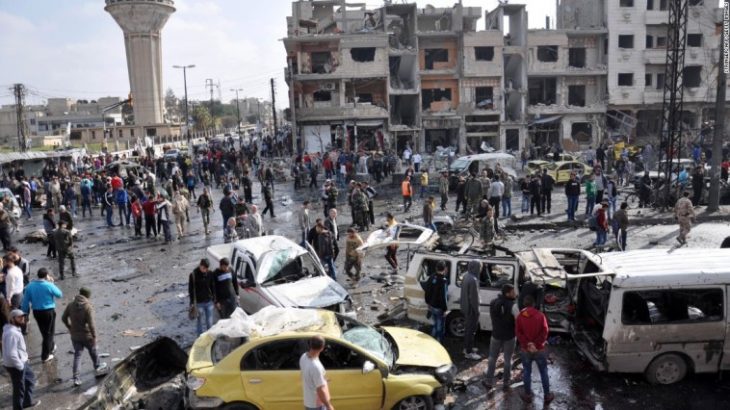
By Adam Garrie | The Duran | October 25, 2017
The intricate role played by Saudi Arabia and the United States in ushering in a proxy terrorist war on Syria, have been both explicitly and implicitly known, since virtually the beginning of the US instigated proxy conflict in Syria, which was inaugurated in 2011.
In many ways, 2013 represented the nadir of the Syrian conflict. It was a time when it looked as though the combined strength of terrorist groups including ISIS/Daesh, FSA and al-Qaeda might succeed in destroying the secular, tolerant, pluralist Syrian Arab Republic and realise their goal of creating a Takfiri state based on extremist religious supremacist ideology and racism.
With Syria on the verge of a full victory and with Russia confirming that ISIS now controls less than 5% of Syrian territory, 2013 seems like a very distant time in the context of the Syrian conflict.
But on the 18th of March, 2013, large scale coordinated rocket attacks on Damascus International Airport, the Syrian Presidential Palace and other vital security targets in the capital, were conducted by the Takfiri terrorist group FSA.
Today, the exiled American whistleblower who once worked for the notorious NSA, Edward Snowden has released the following short top secret document which plainly details how the US and a powerful member of the Saudi regime, helped to fund and organise the illegal attack on Syria.
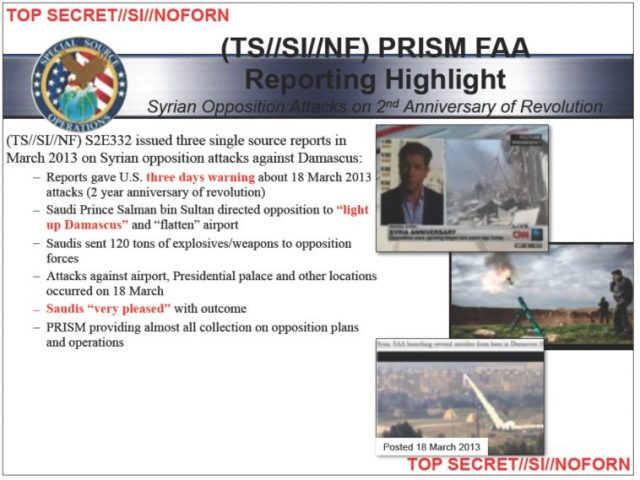
The text of the document reads as follows:
“TOP SECRET//S1//NOFORN
(TS//S1//NF) S2E332 issued three single source reports in
March 2013 on Syrian opposition attacks against Damascus:
– Reports gave U.S. three days warning about 18 March 2013
attacks (2 year anniversary of revolution)
– Saudi Prince Salman bin Sultan directed opposition to “light
up Damascus ” and “flatten” airport
– Saudis sent 120 tons of explosives/weapons to opposition
forces
– Attacks against airport, Presidential palace and other locations
occurred on 18 March
– Saudis “very pleased” with outcome
– PRISM providing almost all collection on opposition plans
and operationsTOP SECRET//S1//NOFORN”.
The collusion between Saudi and the US in a deadly terrorist attack constitutes nothing less than a war crime.
Because of the patently biased nature of the International Criminal Court, it is unlikely that anyone from the US or Saudi will be prosecuted for this war crime.
However, Snowden’s document does help to explain Syria’s unity in the face of a campaign of foreign state sponsored organised terrorism. Contrary to what many al-Qaeda apologists say, the Syrian conflict was a proxy war from day one. Of course, foreign powers used the promise of enhanced material status to woo a small number of disgruntled locals, but the main sources of terrorist fighters and virtually all of the funding and arms came from abroad.
While Syria faced onslaughts funded and directed by some of the wealthiest and most powerful states in the world including, the USA, Saudi Arabia, Qatar, Israel, Turkey, UK, France, Belgium, Germany, Netherlands and others, Syria managed to retain her sovereignty, even prior to Russia’s game-changing legal intervention in 2015.
The anti-Syrian alliance did its utmost to destroy one of the last truly revolutionary Arab Republics in the world. The fact that of all their efforts ultimately failed, is a testament both to the resolve of the Syrian Arab Republic and to the powerful anti-terrorist alliance that Damascus built throughout the conflict, one which has been capable of resisting imperialist obscurantist aggression from the west and its Middle East proxies and allies.
Featured Video
What is AZAPAC? Why is it important?
or go to
Aletho News Archives – Video-Images
From the Archives
Is America behind the massive surge in Kiev regime’s child trafficking?
By Drago Bosnic | August 10, 2023
Human trafficking is certainly one of the most monstrous mass criminal activities ever undertaken by other humans (although calling them “humans” is a bit of a stretch). And yet, there’s a special kind of this deeply repulsive crime that pushes it to diabolical proportions – child trafficking. Underage kids, particularly those who were abandoned, sold or have very poor/abusive family backgrounds, are by far the most vulnerable group. The depraved criminals who engage in such illicit activities specifically target unfortunate children and given there are millions of them all around the globe, particularly in war-torn areas, the “recruitment pool” is effectively endless. Unfortunately, the demand on the black market also seems to be constant and growing, making it a very lucrative and appealing prospect for criminals.
Children are usually forced into literal slavery that includes forced labor, sexual exploitation or prostitution, drug smuggling, forced begging, organ harvesting, etc. Many terrorist groups and narco-traffickers even use them as child soldiers, forcing them into dangerous firefights with rival groups or even official security forces such as the police and/or military. Although estimates vary significantly, as the exact data is incomplete at best, expectedly, the world’s most populous countries have the highest number of child trafficking victims. And yet, it seems the United States is the most profitable market for such criminal activities. Back in 2018, Tim Swarens of USA Today calculated that adults purchase children for sex at least 2.5 million times a year in the US alone. Worse yet, this is only based on available data. … continue
Blog Roll
Recent Comments
loongtip on When Threats Replace Evid… loongtip on Zelensky tried to kill the cha… eddieb on I might get killed for posting… Bill Francis on I might get killed for posting… loongtip on Beijing cancels Panama deals a… loongtip on Showdown loongtip on New York Bans Israel-Linked Te… loongtip on Trump tells India to stop purc… eddieb on The Old Testament and the Geno… papasha408 on Trump’s war posturing against… Coronistan on This is How We Should Have Res… Coronistan on NO MANDATES, NO PROFITS: MODER…


 Aletho News
- Iran Willing to Dilute Enriched Uranium If US Lifts All Sanctions
- Orbán calls Ukraine an ‘enemy’ of Hungary
- No Grounds for Talks About New Negotiations With US on New START – Russian Deputy Foreign Minister
- UK proposes North Sea drone fleet to target tankers – Sunday Times
- Epstein’s Ukrainian nexus: modeling agencies, trafficking, and elite connections
- South American countries’ pragmatic reassessment of ties with China amid US hegemonism, protectionism
- Epstein case reveals ‘satanism’ of Western elites – Lavrov
- What is AZAPAC? Why is it important?
- The Toxic Border: How Israel’s Chemical Spraying is Reshaping Life in South Lebanon
- Zelensky tried to kill the chance for Russia-Ukraine peace, again
- If Americans Knew
- Israel is killing far more civilians than fighters in Gaza – Not a ceasefire Day 122
- In Gaza, marriage is a form of resistance – Not a ceasefire Day 121
- Israel returns bodies with evidence of organ theft and severe mutilation – Not a ceasefire Day 120
- AIPAC Coordinates Donors in Illinois House Primaries
- Geneva Academy warns Gaza death toll could top 200,000
- Media ignore allegations that Israel raped German journalist
- Former Israeli PM: Settlers are Aiding and Abetting Jewish Rioters in the West Bank
- Tucker Carlson sheds light on Christian-Muslim harmony in Palestine, Jordan
- Revealed: Private jet owned by Trump friend used by ICE to deport Palestinians to West Bank
- Bypassing Oversight to Rush Billions in Arms to Israel
- No Tricks Zone
- Germany’s Natural Gas Storage Level Dwindles To Just 28%… Increasingly Critical
- New Study Rebuts The Assumption That Anthropogenic CO2 Molecules Have ‘Special’ Properties
- Climate Scientist Who Predicted End Of “Heavy Frost And Snow” Now Refuses Media Inquiries
- Polar Bear Numbers Rising And Health Improving In Areas With The Most Rapid Sea Ice Decline
- One Reason Only For Germany’s Heating Gas Crisis: Its Hardcore-Dumbass Energy Policy
- 130 Years Later: The CO2 Greenhouse Effect Is Still Only An Imaginary-World Thought Experiment
- New Study Affirms Rising CO2’s Greening Impact Across India – A Region With No Net Warming In 75 Years
- Germany’s Natural Gas Crisis Escalates … One Storage Site Near Empty …Government Silent
- Polar Colding…Antarctica Saw Its Coldest October In 44 Years!
- New Study: Sea Levels Rose 20 Times The Modern Rate During The Roman Warm Period
 Aletho News