Analysts alarmed over Pentagon’s 60,000-strong Syrian rebel force
‘US aid ends up with extremists’
RT | March 7, 2018
Analysts have warned that US-supported groups in Syria often defect to extremists with their weapons. That’s after it was revealed the Pentagon plans to spend around $300 million to train and equip a 60,000-strong army in Syria.
Commenting on the Pentagon’s plans to build, train and equip a massive ‘Vetted Syrian Opposition’ to fight Islamic State (IS, formerly ISIS) in Syria, a number of US-based experts told RT the move has nothing to do with combatting terrorism. Instead, US weapons and aid could easily land in the hands of Islamist extremists, as has often been seen in the past.
“In the past, some of the groups who were the recipient of US aid ended up either taking over or [being] defeated by some of the radical forces on the ground in Syria. Or some of them ended up joining the extremists and taking some of the weapons with them,” Edmund Ghareeb, a scholar at the American University in Washington, DC, told RT.
Another expert said an armed formation will help Washington tighten its grip over rebel-controlled parts of Syria, while stressing that the US’ “hostile military presence in Syria” has no legal basis. “They want to create… conditions in Syria where the country is still divided. The record of the US and the CIA’s operations in Syria is that the people they have supported all along have been extremists,” said Nicolas J.S. Davies, the author of ‘Blood On Our Hands: the American Invasion and Destruction of Iraq.’
He argued that the State Department and Pentagon “clearly want to push ahead with a plan to basically keep forces under their control in command of all Syrian territory east of the Euphrates river.”
While the US justifies its presence in Syria with claims it is fighting terrorists, the only area IS “has survived is the area that is under American and its allies’ control,” Daoud Khairallah, a professor of international law at Georgetown University, believes.“One would wonder whether they are getting assistance from Americans for their survivability, ” Khairallah told RT.
Pentagon pays monthly allowance to rebels, seeks to establish large force in Syria
Following the virtual defeat of IS terrorists in Syria, the US appears to be trying to restructure its military presence in the war-torn country. In February, a fiscal year 2019 budget document mulled creating a new army out of elements of the so-called Vetted Syrian Opposition (VSO). The forces are “projected to total approximately 60,000 to 65,000” by October 2018, according to a report titled ‘Justification for FY 2019 Overseas Contingency Operations (OCO)’.
The document explains that some 30,000 fighters will conduct “ongoing combat missions” against remaining pockets of IS in the Middle Euphrates River Valley (MERV), while another 35,000-strong contingent will form Internal Security Forces in liberated areas.
Creating the massive new military structure of rather questionable legality, roughly equivalent to the size of the Canadian armed forces, is an expensive endeavor. Besides seeking $250 million for border security requirements for areas outside of Iraq and Syria, the Pentagon is seeking some $300 million from US lawmakers to implement the creation of the new opposition bulwark machine that will be funded through the Syrian Train and Equip Program. Launched under the Obama administration in 2014, the program identified and trained selected Syrian opposition forces to fight IS.
The Pentagon plans to spend the bulk of the new funds on arming the forces. Nearly $50 million is allocated for buying AK-47s, PKM machine guns, as well as RPG-7 anti-tank rocket-propelled grenade launchers. Mortar launchers and sniper rifles are also on the menu next to hand grenades, different types of vehicles and tons of ammunition.
Washington plans to pay a monthly allowance to its force, in addition to providing the new force with uniforms, hygiene kits and medical equipment. “[The Department of Defense] will transition to a stabilization effort that will focus on support to local Internal Security Forces, who will receive stipends for their efforts to secure liberated territory and prevent the re-emergence of ISIS or its affiliates,” the document reads. “Currently, 10,000 established partner force personnel are being paid stipends. The individual stipend payments range from $200 to $400 per month.”
While Washington maintains that its goal is to defeat IS, Moscow has repeatedly questioned US intentions, especially as the American presence in Syria is viewed as a violation of sovereignty.
The Russian military last month asserted that the true US goal is to capture “economic assets” in Syria, warning that America’s presence constitutes a dangerous threat to the political process and territorial integrity of the country.
Iran trade is not vulnerable to US sanctions
By M K Bhadrakumar | Indian Punchline | February 28, 2018
The fear mongers among the Indian elite spread a canard that India needs to be watchful of American wrath if it expands economic ties with Iran. Of course, that is plain baloney. The Modi government has announced a decision to sequester India-Iran relations from US sanctions by allowing Indian companies and entities to use the national currency. This decision coincided with President Hassan Rouhani’s recent visit and becomes a landmark event in the chronicle of India-Iran relations.
Interestingly, European countries are also moving in the same direction as India. Their plan is to offer euro-denominated credits to Iranian buyers of their goods and services, which will keep the transactions beyond the reach of any US sanctions. France has already announced its intention to offer dedicated, euro-dominated export guarantees to Iranian buyers, which dispense with any US link, whether to the dollar or otherwise.
Like India, European countries also are staunch supporters of the Iran nuclear deal. Like India, they also are on the lookout for increasing their trade with Iran. The head of France’s state-owned Public Investment Bank (Bpifrance) Nicolas Dufurcq said last week with a touch of sarcasm, “This is a completely separate flow (of money). There is no dollar in this scheme… no one holding a US passport.” (One might say about the Indian elite, perhaps – “no one holding a Green Card.”)
Dufurcq was addressing French lawmakers in Paris. He disclosed that there is a pipeline of about 1.5 billion euros in potential contracts for French exporters in the Iranian market. France used to have close business ties with Iran and French manufacturing plants are still operating in Iran. Other European countries such as Germany, Belgium, Austria and Italy are also following the French example to insulate their economic relations with Iran from US sanctions. Italy and Iran agreed recently on a framework agreement that provides Italian credit up to 5 billion euros for its companies making investments in Iran. The credit agreement is between state-owned agencies in the two countries.
Unfortunately, Indian analysts largely go by the jaundiced opinions about Iran disseminated by the US media. The stunning reality is that in the last financial year the post-sanctions Iranian economy surged by 16%. Importantly, Iran is unique among the petrodollar states of the Persian Gulf in having a concerted strategy to grow its non-oil economy. And that is where lucrative business opportunities lie for Indian trade and industry.
Of course, the stabilization of oil prices above $50 per barrel also helps boost Iran’s income. Thus, the Modi government’s plans for a huge expansion of economic relations with Iran are based on a sound assessment. This is what Professor Juan Cole, the noted American expert on the Middle East wrote in his blog Informed Comment :
- US pressure on Iran is not insignificant and does slow its economic progress. But if you tallied up wins and losses, there does not seem much question that Iran is gradually winning. That progress by Tehran is because of the nuclear accord, which reassured most of the world. Tehran should stick with it.
To be sure, Iran intends to stick to the nuclear accord and keep its part of the bargain so long as the international community abides by the July 2015 agreement. Tehran places great store on the support from European countries. (Read a piece in LobLog by former British diplomat Peter Jenkins, A Nuclear Deal With Iran Remains The Least Bad Option)
Iranian foreign policy is making an historic shift in its integration with the international community. The Supreme Leader Ali Khamenei said on February 19 in a national address, “In foreign policy today, the top priorities for us include preferring East to West.” Of course, it is another side of the Iranian ideology of preserving the country’s strategic autonomy. Yet, importantly, Khamenei didn’t exclude the West.
Détente with the US was Iran’s expectation in negotiating the 2015 nuclear deal but the growing feeling is that this will not be possible so long as the Trump administration is in power. It was an historic mistake on the part of the Obama administration not to have taken the nuclear deal to its logical conclusion by removing the residual US sanctions that hamper banking ties and, secondly, by engaging Iran constructively on issues of regional security and stability. The bottom line is that Iran has a surprisingly flexible foreign policy – pragmatic to dealings with the West. It’s the Israeli lobby, stupid – in Washington and Delhi!
New US Sanctions Against Russia Are Coming, ‘Expect Them’ Soon – US Treasury Sec
Sputnik – February 14, 2018
The United States Secretary of the Treasury revealed that sanctions against the people mentioned in the so-called ‘Kremlin list’ would be soon introduced.
“We are actively working on those sanctions. And you should expect them in… [the] near future,” US Treasury Secretary Steven Mnuchin told the US Senate Finance Committee.
Previously responding to the “Kremlin report” release, Russian President Vladimir Putin described the sanctions as a deadlock solution, which is likely to lead to losses for those who introduced them.Putin expressed hope the West would soon “get bored with the sanctions policy” and Russia-US relations would normalize.
“The policy of artificially imposed restrictions in international business relations is a dead-end road that leads everyone, including the initiators of such a policy, to missed profits and direct losses,” Russian President stated.
In January, the US published the so-called “Kremlin report,” which listed names of 114 Russian politicians, including the Russian presidential administration and members of the government, as well as 96 businessmen.
Inclusion on the list implies that restrictive measures against named officials can be introduced in the future.
Commenting on the release of the report, Vladimir Putin called it an “unfriendly step” by the US administration, which harms Moscow-Washington relations.
In the wake of the publication, the Association of European Businesses (AEB) warned that the US Treasury’s “Kremlin Report” can affect the interests of European investors and European companies doing business in Russia.
The “Kremlin Report” was drafted in accordance with the law called Countering America’s Adversaries Through Sanction Act and signed by the US President Donald Trump in August 2017.
On July 28 the Russian Foreign Ministry suspended the use of all US Embassy warehouses and its compound in Moscow amid the new US anti-Russia sanctions bill and follows a series of restrictive measures which have been imposed by Washington since 2014. It is similar to Washington’s decision to expel 35 Russian diplomats and suspend the use of diplomatic assets by Moscow in late 2016.
The relationship between Russia and the US worsened amid the internal conflict in Ukraine and Crimea’s reunification with Russia. Although Moscow denied all the allegations of meddling in Ukrainian internal affairs, a number of Western countries imposed sanctions on Russia, with the Kremlin then introducing response measures and launching the policy to replace foreign imports with domestic products.
Steele wrote memo based on information fed through Clinton campaign — released documents

RT | February 5, 2018
People close to Hillary Clinton were feeding information to Christopher Steele who compiled the Trump dossier on Trump’s alleged connections with Russia, according to a criminal referral filed by Republican senators.
A newly-released document from the Senate Judiciary Committee says Steele wrote an additional memo, besides the controversial dossier, using information that came from the Clinton campaign.
The newly-released memorandum is an unclassified and heavily-redacted version of the criminal referral targeting Steele, filed on January 4 by Republican Senators Chuck Grassley and Lindsey Graham. It is addressed to Deputy Attorney General Rod Rosenstein and Director of the FBI Christopher Wray who Grassley and Graham are asking to investigate Steele.
The report reveals coordination between the extended Clinton circle and the Obama administration in an attempt to source damaging information about then-candidate Trump.
Steele was hired by private firm Fusion GPS in June 2016 to gather information on alleged links between Trump and Russia. His dossier, parts of which were leaked to the media before the elections, was the basis for the warrant to spy on Trump adviser, Carter Page, according to the memo released on Friday.
The report alleges that there was a circular flow of information between Clinton associates and Steele. A memorandum dated October 19, 2016 says that foreign sources provided the information to an unnamed associate of Hillary and Bill Clinton, who then gave the information to an unnamed official in the Obama State Department, who would then pass the information to Steele.
“It is troubling enough that the Clinton Campaign funded Mr. Steele’s work, but that these Clinton associates were contemporaneously feeding Mr. Steele allegations raises additional concerns about his credibility,” the report states.
“It appears that either Steele lied to the FBI and the British court, or that the classified documents reviewed by the Committee contain materially false statements,” the report states.
On January 4, Senators Grassley and Graham referred Steele to the FBI for further investigation after reviewing Justice Department documents that conflicted with Steele’s sworn court statements about the distribution of his research.
“Seeking transparency and cooperation should not be this challenging. The government should not be blotting out information that it admits isn’t secret, and it should not take dramatic steps by Congress and the White House to get answers that the American people are demanding. There are still many questions that can only be answered by complete transparency. That means declassifying as much of the underlying documents as possible,” Grassley said in the release accompanying the document.
Leaked to Buzzfeed in January 2017, Steele’s dossier contains unverified allegations that Russia holds information on Trump which it’s using to blackmail the US president. It further alleges sustained and close working contacts between Trump aides and Kremlin representatives, with Russia “feeding Trump and his team valuable intelligence on his opponents” for years prior to 2016. The allegations have not been proven.
As alleged in the ‘Nunes memo‘, this dossier “formed an essential part” of the FISA probable cause order obtained by the FBI from the Foreign Intelligence Surveillance Court (FISC) in 2016 to spy on Trump adviser Carter Page. The warrant was extended three times, also on the basis of the Steele dossier.
Nunes Memo Details Weaponization of FISA Court for Political Advantage
By Kenneth Whittle | Disobedient Media | February 4, 2018
On Friday, the much anticipated “Nunes Memo” was finally released to the general public. Disobedient Media previously reported on the push to prevent the memo from being released. While there is much contained in the four pages, the most glaring issue contained in the memo is the FBI’s willful concealment of pertinent details of which they were required by law to turn over to the FISA court when seeking the initial surveillance warrant on Carter Page, a former volunteer foreign policy adviser for the Trump campaign.
According to the memo, former director James Comey signed three FISA applications on behalf of the FBI. Additionally, Deputy Director Andrew McCabe, former Deputy Attorney General Sally Yates, former Deputy Attorney General Dana Boente, and acting Deputy Attorney General Rod Rosenstein, each signed one or more applications on behalf of the DOJ.
Under 50 U.S.C. § 1805(d)(1), a FISA order on an American citizen must be renewed by the Foreign Intelligence Surveillance Court (FISC) every 90 days. In order to protect the rights of Americans, each subsequent renewal requires a separate finding of probable cause. This means that the in order to be granted a renewal, the government is required to produce all material and relevant facts to the court, including any information which may be potentially favorable to the target of the FISA application.
On four separate occasions the Obama administration essentially claimed before the FISA court that Page had betrayed his country by working for a hostile foreign nation, and therefore it was necessary that the government violate his Fourth Amendment rights. However, in this case, the government purposely withheld relevant information from the government not once, but four separate times.
According to the memo, at no time during the initial application process for the warrant to surveil Page, or in any of the three renewals of that application, did the government disclose to the FISA Court the nature of their relationship with Christopher Steele, his relationship with the Democratic National Committee (DNC), or his relationship with the Clinton campaign. Instead, the memo simply, yet vaguely states that, “Steele was working for a named U.S. person.”
Instead, the government purposefully withheld information from the court that the “dossier” compiled by Steele was done so on behalf of the DNC and the Hillary Clinton campaign. It was further withheld from the court that the DNC had paid Steele over $160,000 for his work in compiling this “dossier”, and that the money was funneled to Steele through the law firm Perkins Coie, which represents both the Hillary Clinton campaign as well as the DNC in legal matters. According to the National Review, the Clinton campaign and the DNC paid at least $9.1 million to Perkins Coie from mid-2015 to late 2016.
The government further held from the court the fact that the FBI had authorized payments to Steele. According to the New York Post, in October 2016 the FBI contracted to pay Steele $50,000 to “help corroborate the dirt on Trump.”
In March of 2017, CNN also reported that the FBI had entered into an arrangement with Steele, whereby they agreed to cover all of his expenses.
While it is extremely disconcerting that the government willfully concealed the existence of their financial relationship with Steele, a foreign national, what is more troubling is the fact that the government used tax payer dollars to do so. In other words, every single American who did not vote for Hillary Clinton, whether they voted for Trump or a third party candidate or did not vote at all – were forced to finance the Clinton campaign-funded opposition research.
In other words, the public’s tax dollars were spent on creating fake “evidence” to tie Trump with Russia, a false narrative that put the planet at heightened risk for nuclear war, for the sake of the Clinton’s hurt feelings.
Why the media refuses to mention or cover this fact, this author does not know. But this is an extremely important fact that every American, whether left, right, up, down, should remember, as it is the perfect example of the corruption which exists within our tax payer-funded institutions, which we are told to have nothing but the utmost respect for.
According to the memo, in an effort to corroborate Steele’s dossier, the FBI extensively cited a September 23, 2016, Yahoo News article by Michael Isikoff, titled “U.S. intel officials probe ties between Trump adviser and Kremlin”, which focuses on Page’s July 2016 trip to Moscow. However, when presenting this article to the court the FBI falsely assessed that Steele did not provide this information directly to Isikoff. Meaning that the FBI was aware that the article they presented to the court was not corroborating evidence from a separate source, because the information in the article was provided to Isikoff by Steele himself. In fact, as the memo points out, Steele himself has stated in British court filings that in September 2016 he met with Yahoo News, as well as several other outlets including the New York Times, the Washington Post, and the New Yorker.
What’s more, in an article published on January 12, 2017, Isikoff reports on a story by the Wall Street Journal in which Christopher Steele is identified as the author of the infamous dossier, and even notes that Steele was an “FBI asset”. However, what is most striking about this article is the fact that despite receiving the underline information which served as the basis for his own article in September, Isikoff pretends have not known that Steele was the source of the dossier.
Even more interesting is the close relationship Isikoff had with the DNC during the 2016 Presidential election. According to an email from the DNC released by Wikileaks, Isikoff attended the “Open World Society’s forum” as the guest of DNC official Ali Chalupa. In the email, Chalupa states that she was invited to the forum to speak specifically about Paul Manafort, the former campaign manager for Donald Trump. Chalupa goes on to state that she has been working with Isikoff for the past few weeks and that at the event, she was able to get him “connected him to the Ukrainians.” She adds:
“I invited Michael Isikoff whom I’ve been working with for the past few weeks and connected him to the Ukrainians. More offline tomorrow since there is a big Trump component you and Lauren need to be aware of that will hit in next few weeks and something I’m working on you should be aware of.”
According to the memo, Steele’s relationship with the FBI as a source continued until late October 2016, when he was terminated for what the FBI defines as the most serious violations, “an unauthorized disclosure to the media of his relationship with the FBI”. This unauthorized disclosure occurred in an October 30, 2016, Mother Jones article by David Corn, the reporter who broke the infamous Mitt Romney “47 Percent” story.
Again, the FBI did not notify the court that Steele was leaking information to media outlets, or that he was terminated by the FBI after doing so for the second time.
Before and after his termination, Steele maintained contact with then-Associate Deputy Attorney General Bruce Ohr, whose wife, Nellie Ohr, was employed by Fusion GPS. Ohr would later tell the FBI in an interview in September 2016, that Steele had stated that he, “was desperate that Donald Trump not get elected and was passionate about him not being president.”
Lastly, the memo also reveals that the Steele dossier was so crucial to the investigation, that Deputy Director McCabe testified in December 2017 that no surveillance warrant would have been sought from the FISC without the Steele dossier information. This admission by the former Deputy Director is damning, as it proves that, if it were not for the Clinton campaign and DNC funded dossier created by a foreign national, there would have been no surveillance of Page, and ultimately there would have never been a special counsel appointed.
At the end of the day, every American, regardless of their position on the political spectrum, should be worried about the fact that the FBI and DOJ sought and were granted a warrant to spy on an opposing political campaign based on a document that the FBI itself had neither verified or corroborated. If the FISA court does in fact employ strict “safeguards” and procedures in order to ensure that the rights of American citizens are not being systematically violated, how is it that the FBI and DOJ were able to obtain a surveillance warrant based on unverified allegations? And why did Congress overwhelmingly vote to reauthorize Section 702?
Lying, Spying and Hiding
By Andrew Napolitano • Unz Review • February 1, 2018
I have argued for a few weeks now that House Intelligence Committee members have committed misconduct in office by concealing evidence of spying abuses by the National Security Agency and the FBI. They did this by sitting on a four-page memo that summarizes the abuse of raw intelligence data while Congress was debating a massive expansion of FISA.
FISA is the Foreign Intelligence Surveillance Act of 1978, which was written to enable the federal government to spy on foreign agents here and abroad. Using absurd and paranoid logic, the secret Foreign Intelligence Surveillance Court, which only hears the government’s lawyers, has morphed “foreign intelligence surveillance” into undifferentiated bulk surveillance of all Americans.
Undifferentiated bulk surveillance is the governmental acquisition of fiber-optic data stored and transmitted by nearly everyone in America. This includes all telephone conversations, text messages and emails, as well as all medical, legal and financial records.
Ignorant of the hot potato on which the House Intelligence Committee had been sitting, Congress recently passed and President Donald Trump signed a vast expansion of spying authorities — an expansion that authorizes legislatively the domestic spying that judges were authorizing on everyone in the U.S. without individual suspicion of wrongdoing or probable cause of crime; an expansion that passed in the Senate with no votes to spare; an expansion that evades and avoids the Fourth Amendment; an expansion that the president signed into law the day before we all learned of the House Intelligence Committee memo.
The FISA expansion would never have passed the Senate had the House Intelligence Committee memo and the data on which it is based come to light seven days sooner than it did. Why should 22 members of a House committee keep their 500-plus congressional colleagues in the dark about domestic spying abuses while those colleagues were debating the very subject matter of domestic spying and voting to expand the power of those who have abused it?
The answer to this lies in the nature of the intelligence community today and the influence it has on elected officials in the government. By the judicious, personalized and secret revelation of data, both good and bad — here is what we know about your enemies, and here is what we know about you — the NSA shows its might to the legislators who supposedly regulate it. In reality, the NSA regulates them.
This is but one facet of the deep state — the unseen parts of the government that are not authorized by the Constitution and that never change, no matter which party controls the legislative or executive branch. This time, they almost blew it. If just one conscientious senator had changed her or his vote on the FISA expansion — had that senator known of the NSA and FBI abuses of FISA concealed by the House Intelligence Committee — the expansion would have failed.
Nevertheless, the evidence on which the committee members sat is essentially a Republican-written summary of raw intelligence data. Earlier this week, the Democrats on the committee authored their version — based, they say, on the same raw intelligence data as was used in writing the Republican version. But the House Intelligence Committee, made up of 13 Republicans and nine Democrats, voted to release only the Republican-written memo.
Late last week, when it became apparent that the Republican memo would soon be released, the Department of Justice publicly contradicted President Trump by advising the leadership of the House Intelligence Committee in very strong terms that the memo should not be released to the public.
It soon became apparent that, notwithstanding the DOJ admonition, no one in the DOJ had actually seen the memo. So FBI Director Chris Wray made a secret, hurried trip to the House Intelligence Committee’s vault last Sunday afternoon to view the memo. When asked by the folks who showed it to him whether it contains secret or top-secret material, he couldn’t or wouldn’t say. But he apparently saw in the memo the name of the No. 2 person at the FBI, Deputy Director Andrew McCabe, as one of the abusers of spying authority. That triggered McCabe’s summary departure from the FBI the next day, after a career of 30 years.
The abuse summarized in the Republican memo apparently spans the last year of the Obama administration and the first year of the Trump administration. If it comes through as advertised, it will show the deep state using the government’s powers for petty or political or ideological reasons.
The use of raw intelligence data by the NSA or the FBI for political purposes or to manipulate those in government is as serious a threat to popular government — to personal liberty in a free society — as has ever occurred in America since Congress passed the Alien and Sedition Acts of 1798, which punished speech critical of the government.
What’s going on here?
The government works for us; we should not tolerate its treating us as children. When raw intelligence data is capable of differing interpretations and is relevant to a public dispute — about, for example, whether the NSA and the FBI are trustworthy, whether FISA should even exist, whether spying on everyone all the time keeps us safe and whether the Constitution even permits this — the raw data should be released to the American public.
Where is the personal courage on the House Intelligence Committee? Where is the patriotism? Where is the fidelity to the Constitution? The government exists by our consent. It derives its powers from us. We have a right to know what it has done in our names, who broke our trust, who knew about it, who looked the other way and why and by whom all this was intentionally hidden until after Congress voted to expand FISA.
Everyone in government takes an oath to preserve, protect and defend the Constitution. How many take it meaningfully and seriously?
Copyright 2018 Andrew P. Napolitano. Distributed by Creators.com.
US Democrats’ Accusations Against Russia Distract Public From Real Problem
Sputnik – 26.01.2018
US Democrats have asked Facebook and Twitter for evidence of Russia’s involvement in an online campaign to release a politically charged memo.
The move comes as Congressional Republicans have been calling for the public release of a four-page classified memo they claim reveals reported abuses of the Foreign Intelligence Surveillance Act (FISA) by the Obama administration, which approved surveillance against Trump’s team on behalf of the Clinton campaign.
Dr. Jeanne Zaino, American political analyst and professor of Political Science at Iona College told Radio Sputnik in an interview that by asking for an investigation into allegations that Russian bots are behind #releasethememo, US Democrats are drawing the public’s attention away from the real question. That question is whether the memo actually exposes severe surveillance abuses, Zaino said, noting that Republicans claim the explosive content of the memo could upend special counsel Robert Mueller’s ongoing investigation into allegations of Russian meddling in the 2016 US election and collusion with the Trump campaign.
“They are saying that this push to release the memo is being conducted by Russian bots. Whether that is the case or whether it is not the case… it is almost beside the point, because the real question — particularly in a democracy where we value transparency — should be what does the memo contain,” Zaino told Radio Sputnik.
She pointed out that while the FBI and the Justice Department have been blocking the memo’s release saying it would violate national security, whether that is actually the case should be decided in a court of law.
“They simply cannot keep information and materials top secret just because they think it might embarrass them or embarrass the administration, embarrass Congress or whoever this memo might embarrass,” the analyst said. “I really think that the Democrats are trying to have us look left when in fact we should be looking right and saying what in fact does the memo contain and is it really something that we need to protect for national security reasons.”
Zaino stressed that she doesn’t know whether the memo “shows abuse of the government surveillance program by the Obama administration”, as is being claimed, but if the question is raised, the memo should be released if it is not protecting national security.
“You cannot just classify [the memo] that way. We have an overclassification problem in this country where almost everything is classified as top secret,” Zaino said. “The Democrats are asking us to focus on the bots, that’s fascinating and interesting, but it doesn’t get to the heart of the question which is what does this memo show and did we see an abuse of the government surveillance programs under the Obama administration.”
As walls close in on FBI, the bureau lashes out at its antagonists
By Sharyl Attkisson | The Hill | January 25, 2018
What happens when federal agencies accused of possible wrongdoing — also control the alleged evidence against them? What happens when they’re the ones in charge of who inside their agencies — or connected to them — ultimately gets investigated and possibly charged?
Those questions are moving to the forefront as the facts play out in the investigations into our intelligence agencies’ surveillance activities.
There are two overarching issues.
First, there’s the alleged improper use of politically-funded opposition research to justify secret warrants to spy on U.S. citizens for political purposes.
Second, if corruption is ultimately identified at high levels in our intel agencies, it would necessitate a re-examination of every case and issue the officials touched over the past decade — or two — under administrations of both parties.
This is why I think the concerns transcend typical party politics.
It touches everybody. It’s potentially monumental.
This week, the FBI said it was unfair for the House Intelligence Committee not to provide its memo outlining alleged FBI abuses. The committee wrote the summary memo after reviewing classified government documents in the Trump-Russia probe.
The FBI’s complaint carries a note of irony considering that the agency has notoriously stonewalled Congress. Even when finally agreeing to provide requested documents, the Department of Justice uses the documents’ classified nature to severely restrict who can see them — even among members of Congress who possess the appropriate security clearance. Members who wish to view the documents must report to special locations during prescribed hours in the presence of Department of Justice minders who supervise them as they’re permitted to take handwritten notes only (you know, like the 1960s).
What most people don’t know is that the FBI and Department of Justice already know exactly what Congressional investigators have flagged in the documents they’ve reviewed, because three weeks ago the Senate Judiciary Committee sent its own summary memo to FBI Director Christopher Wray and Department of Justice Deputy Attorney General Rod Rosenstein. The committee also referred to the Department of Justice a recommendation for possible charges against the author of the political opposition research file, the so-called “Trump dossier”: Christopher Steele.
The head of the Senate Judiciary Committee, Republican Charles Grassley co-authored the memo with fellow Republican Sen. Lindsey Graham. Grassley says it’s important for the public to see the unclassified portions of the memo. But unlike the House, which can release the memo on its own (and is taking steps to do so), Senate rules require permission from the Department of Justice — the possibly offending agency — approve or declassify the memo. And that’s reached a snag.
According to Grassley, the FBI is blocking the release of the unclassified sections of the Senate memo by falsely claiming that they contain classified information.
“It sure looks like a bureaucratic game of hide the ball, rather than a genuine concern about national security,” said Grassley in a speech on the Senate floor yesterday.
Grassley also pointed out that agencies accused of possible improprieties are the ones controlling the information. It’s the FBI who may have misused the unverified “dossier” opposition research, allegedly presenting it to a secret court as if it were verified intelligence.
“[FBI] Director [James] Comey testified in 2017 that it was ‘salacious and unverified’,” said Grassley. “So, it was a collection of unverified opposition research funded by a political opponent in an election year. Would it be proper for the Obama administration — or any administration — to use something like that to authorize further investigation that intrudes on the privacy of people associated with its political opponents? That should bother civil libertarians of any political stripe.”
Democrats and many in the media are taking the side of the intelligence community, calling the Republican efforts partisan. House Democrats are said to be writing a counter-memo.
“We need to produce our own memo that lays out the actual facts and shows how the majority memo distorts the work of the FBI and the Department of Justice,” said Rep. Adam Schiff, the lead Democrat on the House Intelligence Committee.
Meantime, the Department of Justice has officially warned the House Intelligence Committee not to release its memo. It’s like the possible defendant in a criminal trial threatening prosecutors for having the audacity to reveal alleged evidence to the judge and jury.
This is the first time I can recall open government groups and many reporters joining in the argument to keep the information secret. They are strangely uncurious about alleged improprieties with implications of the worst kind: Stasi-like tactics used against Americans. “Don’t be irresponsible and reveal sources and methods,” they plead.
As for me? I don’t care what political stripes the alleged offenders wear or whose side they’re on. If their sources and methods are inappropriate, they should be fully exposed and stopped.
Sharyl Attkisson (@SharylAttkisson) is an Emmy-award winning investigative journalist, author of The New York Times bestsellers “The Smear” and “Stonewalled,” and host of Sinclair’s Sunday TV program “Full Measure.”
“Too Big To Believe” – Massive Scandal Is Brewing At The FBI
By Tyler Durden | Zero Hedge | January 24, 2018
As the Potemkin Village walls of The Left’s ‘Trump Collusion’ narrative crash and burn along with special counsel Mueller’s credibility, The New York Post’s Michael Goodwin sees far more wide-ranging problems ahead for America’s ‘intelligence’ agencies as the anti-Trump ‘secret society’ and lovers-texts-gate debacles threaten the core of the Deep State.
Goodwin writes that, during the financial crisis, the federal government bailed out banks it declared “too big to fail.” Fearing their bankruptcy might trigger economic Armageddon, the feds propped them up with taxpayer cash.
Something similar is happening now at the FBI, with the Washington wagons circling the agency to protect it from charges of corruption. This time, the appropriate tag line is “too big to believe.”
Yet each day brings credible reports suggesting there is a massive scandal involving the top ranks of America’s premier law enforcement agency. The reports, which feature talk among agents of a “secret society” and suddenly missing text messages, point to the existence both of a cabal dedicated to defeating Donald Trump in 2016 and of a plan to let Hillary Clinton skate free in the classified email probe.
If either one is true — and I believe both probably are — it would mean FBI leaders betrayed the nation by abusing their powers in a bid to pick the president.
More support for this view involves the FBI’s use of the Russian dossier on Trump that was paid for by the Clinton campaign and the Democratic National Committee. It is almost certain that the FBI used the dossier to get FISA court warrants to spy on Trump associates, meaning it used the opposition research of the party in power to convince a court to let it spy on the candidate of the other party — likely without telling the court of the dossier’s political link.
Even worse, there is growing reason to believe someone in President Barack Obama’s administration turned over classified information about Trump to the Clinton campaign.
As one former federal prosecutor put it, “It doesn’t get worse than that.” That prosecutor, Joseph diGenova, believes Trump was correct when he claimed Obama aides wiretapped his phones at Trump Tower.
These and other elements combine to make a toxic brew that smells to high heaven, but most Americans don’t know much about it. Mainstream media coverage has been sparse and dismissive and there’s a blackout from the same Democrats obsessed with Russia, Russia, Russia.
Partisan motives aside, it’s as if a scandal of this magnitude is more than America can bear — so let’s pretend there’s nothing to see and move along.
But, thankfully the disgraceful episode won’t be washed away, thanks to a handful of congressional Republicans, led by California Rep. Devin Nunes, chairman of the House’s Permanent Select Committee on Intelligence. After he accused the FBI of stonewalling in turning over records, the bureau relented, at least partially.
The result was clear evidence of bias against Trump by officials charged with investigating him and Clinton. Those same agents appear to have acted on that bias to tilt the election to Clinton.
In one text message, an agent suggests that Attorney General Loretta Lynch knew while the investigation was still going on that the FBI would not recommend charges against Clinton.
How could she know unless the fix was in?
All roads in the explosive developments lead to James Comey, whose Boy Scout image belied a sinister belief that he, like his infamous predecessor J. Edgar Hoover, was above the law.
It is why I named him J. Edgar Comey last year and wrote that he was “adept at using innuendo and leaks” to let everybody in Washington know they could be the next to be investigated.
It was in the office of Comey’s top deputy, Andrew McCabe, where agents discussed an “insurance policy” in the event that Trump won. Reports indicated that the Russia-collusion probe was that insurance policy.
The text was from Peter Strzok, the top investigator on the Trump case, and was sent to Lisa Page, an FBI lawyer and also his mistress.
“I want to believe the path you threw out for consideration in Andy’s office — that there’s no way he gets elected — but I’m afraid we can’t take that risk. It’s like an insurance policy in the unlikely event you die before you’re 40 . . . ” Strzok wrote.
It is frightening that Strzok, who called Trump “an idiot,” was the lead investigator on both the Clinton and Trump cases.
After these messages surfaced, special counsel Robert Mueller removed Strzok and Page from his probe, though both still work at the FBI.
Strzok, despite his talk of an “insurance policy” in 2016, wrote in May of 2017 that he was skeptical Mueller’s probe would find anything on Trump because “there’s no big there there.”
Talk about irony. While Dems and the left-wing media already found Trump guilty of collusion before Mueller was appointed, the real scandal might be the conduct of the probers themselves.
Suspicions are hardly allayed by the fact that the FBI says it can’t find five months of messages between Strzok and Page, who exchanged an estimated 50,000 messages overall. The missing period — Dec. 14, 2016 through May 17, 2017 — was a crucial time in Washington.
There were numerous leaks of classified material just before and after Trump’s inauguration on Jan. 20.
And the president fired Comey last May 9, provoking an intense lobbying effort for a special counsel, which led to Mueller’s appointment on May 19.
Jeff Sessions, the attorney general, has emerged from his hidey hole to notice that the FBI has run amok, and said Monday he would “leave no stone unturned” to find the five months of missing texts.
Fine, but the House is racing ahead of him. Nunes has prepared a four-page memo, based on classified material that purportedly lays out what the FBI and others did to corrupt the election.
A movement to release the memo is gaining steam, but Congress says it might take weeks. Why wait? Americans can handle the truth, no matter how big it is.
A National Defense Strategy of Sowing Global Chaos
By Nicolas J.S. Davies | Consortium News | January 23, 2018
Presenting the 2018 National Defense Strategy of the United States on Friday at the Johns Hopkins University, Secretary of Defense James Mattis painted a picture of a dangerous world in which U.S. power – and all of the supposed “good” that it does around the world – is on the decline.
“Our competitive edge has eroded in every domain of warfare – air, land, sea, space, and cyberspace,” he said. “And it is continually eroding.”
What he could have said instead is that the United States military is overextended in every domain, and that much of the chaos seen around the world is the direct result of past and current military adventurism. Further, he could have acknowledged, perhaps, that the erosion of U.S. influence has been the result of a series of self-inflicted blows to American credibility through foreign policy disasters such as 2003 invasion of Iraq.
There were also two important words hidden between the lines, but never mentioned by name, in the new U.S. National Defense Strategy: “empire” and “imperialism.”
It has long been taboo for U.S. officials and corporate media to speak of U.S. foreign policy as “imperialism,” or of the U.S.’s global military occupations and network of hundreds of military bases as an “empire.” These words are on a long-standing blacklist of “banned topics” that U.S. official statements and mainstream U.S. media reports must never mention.
The streams of Orwellian euphemisms with which U.S. officials and media instead discuss U.S. foreign policy do more to obscure the reality of the U.S. role in the world than to describe or explain it, “hiding imperial interests behind ever more elaborate fig leaves,” as British historian A.J.P. Taylor described European imperialists doing the same a century ago.
As topics like empire, imperialism, and even war and peace, are censored and excised from political debate, U.S. officials, subservient media and the rest of the U.S. political class conjure up an illusion of peace for domestic consumption by simply not mentioning our country’s 291,000 occupation troops in 183 other countries or the 39,000 bombs and missiles dropped on our neighbors in Iraq, Syria and Afghanistan since Trump took office.
The 100,000 bombs and missiles dropped on these and other countries by Obama and the 70,000 dropped on them by Bush II have likewise been swept down a kind of real time “memory hole,” leaving America’s collective conscience untroubled by what the public was never told in the first place.
But in reality, it’s been a long time since U.S. leaders of either party resisted the temptation to threaten anyone anywhere, or to follow through on their threats with “fire and fury” bombing campaigns, coups and invasions. This is how empires maintain a “credible threat” to undergird their power and discourage other countries from challenging them.
But far from establishing the “Pax Americana” promised by policymakers and military strategists in the 1990s, from Paul Wolfowitz and Dick Cheney to Madeleine Albright and Hillary Clinton, the results have been consistently catastrophic, producing what the new National Defense Strategy calls, “increased global disorder, characterized by decline in the long-standing, rules-based international order.”
Of course the drafters of this U.S. strategy document dare not admit that U.S. policy is almost single-handedly responsible for this global chaos, after successive U.S. administrations have worked to marginalize the institutions and rules of international law and to establish illegal U.S. threats and uses of force that international law defines as crimes of aggression as the ultimate arbiter of international affairs.
Nor do they dare acknowledge that the CIA’s politicized intelligence and covert operations, which generate a steady stream of political pretexts for U.S. military intervention, are designed to create and exacerbate international crises, not to solve them. For U.S. officials to admit such hard truths would shake the very foundations of U.S. imperialism.
Opposition to the Joint Comprehensive Plan of Action with Iran – the so-called nuclear deal – from Republicans and Democratic hawks alike seems to stem from the fear that it might validate the use of diplomacy over sanctions, coups and war, and set a dangerous precedent for resolving other crises – from Afghanistan and Korea to future crises in Africa and Latin America. Iran’s success at bringing the U.S. to the negotiating table, instead of falling victim to the endless violence and chaos of U.S.-backed regime change, may already be encouraging North Korea and other targets of U.S. aggression to try to pull off the same trick.
But how will the U.S. justify its global military occupation, illegal threats and uses of force, and trillion-dollar war budget once serious diplomacy is seen to be more effective at resolving international crises than the endless violence and chaos of U.S. sanctions, coups, wars and occupations?
From Bhurtpoor to Baghdad
Major Danny Sjursen, who has fought in Iraq and Afghanistan and taught history at West Point, is a rare voice of sanity from within the U.S. military. In a poignant article in Truthdig, Major Sjursen eloquently described the horrors he has witnessed and the sadness he expects to live with for the rest of his life. “The truth is,” he wrote, “I fought for next to nothing, for a country that, in recent conflicts, has made the world a deadlier, more chaotic place.”
Danny Sjursen’s life as a soldier of the U.S. Empire reminds me of another soldier of Empire, my great-great-great grandfather, Samuel Goddard. Samuel was born in Norfolk in England in 1793, and joined the 14th Regiment of Foot as a teenager. He was a Sergeant at the Battle of Waterloo in 1815. During 14 years in India, his battalion led the assault on the fortress of Bhurtpoor in 1826, which ended the last resistance of the Maratha dynasty to British rule. He spent 3 years in the Caribbean, 6 years in Canada, and retired as Commandant of Dublin Castle in 1853 after a lifetime of service to Empire.
Danny’s and Samuel’s lives have much in common. They would probably have a lot to talk about if they could ever meet. But there are critical differences. At Bhurtpoor, the two British regiments who led the attack were followed through the breech in the walls by 15 regiments of Indian “Native Infantry.” After Bhurtpoor, Britain ruled India (including Pakistan and Bangladesh) for 120 years, with only a thousand British officials in the Indian Civil Service and a few thousand British officers in command of up to 2.5 million Indian troops.
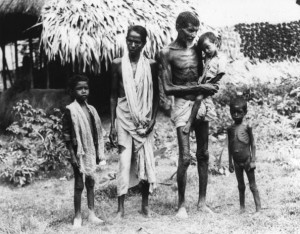 The British brutally put down the Indian Mutiny in 1857-8 with massacres in Delhi, Allahabad, Kanpur and Lucknow. Then, as up to 30 million Indians died in famines in 1876-9 and 1896-1902, the British government of India explicitly prohibited relief efforts or actions that might reduce exports from India to the U.K. or interfere with the operation of the “free market.”
As Mike Davis wrote in his 2001 book, Late Victorian Holocausts, “What seemed from a metropolitan perspective the nineteenth century’s final blaze of imperial glory was, from an Asian or African viewpoint, only the hideous light of a giant funeral pyre.”
And yet Britain kept control of India by commanding such loyalty and subservience from millions of Indians that, in every crisis, Indian troops obeyed orders from British officers to massacre their own people.
Danny Sjursen and U.S. troops in Afghanistan, Iraq and other post-Cold War U.S. war zones are having a very different experience. In Afghanistan, as the Taliban and its allies have taken control of more of the country than at any time since the U.S. invasion, the U.S.-backed Afghan National Army has 25,000 fewer troops under its command than it did five years ago, while ten years of training by U.S. special operations forces has produced only 21,000 trained Afghan Commandos, the elite troops who do 70-80% of the killing and dying for the corrupt U.S.-backed Afghan government.
But the U.S. has not completely failed to win the loyalty of its imperial subjects. The first U.S. soldier killed in action in Afghanistan in 2018 was Sergeant 1st Class Mihail Golin, originally from Latvia. Mihail arrived in the U.S. in November 2004, enlisted in the U.S. Army three months later and has now given his life for the U.S. Empire and for whatever his service to it meant to him. At least 127 other Eastern Europeans have died in occupied Afghanistan, along with 455 British troops, 158 Canadians and 396 soldiers from 17 other countries. But 2,402 – or 68%, over two-thirds – of the occupation troops who have died in Afghanistan since 2001, were Americans.
In Iraq, an American war that always had even less international support or legitimacy, 93% of the occupation troops who have died were Americans, 4,530 out of a total of 4,852 “coalition” deaths.
When Ben Griffin, who later founded the U.K. branch of Veterans for Peace, told his superiors in the U.K.’s elite SAS (Special Air Service) that he could no longer take part in murderous house raids in Baghdad with U.S. special operations forces, he was surprised to find that his entire chain of command understood and accepted his decision. The only officer who tried to change his mind was the chaplain.
The Future of Empire
The U.S. Joint Chiefs of Staff have explicitly told Congress that war with North Korea would require a ground invasion, and the same would likely be true of a U.S. war on Iran. South Korea wants to avoid war at all costs, but may be unavoidably drawn into a U.S.-led Second Korean War.
But besides South Korea, the level of support the U.S. could expect from its allies in a Second Korean War or other wars of aggression in the future would probably be more like Iraq than Afghanistan, with significant international opposition, even from traditional U.S. allies. U.S. troops would therefore make up nearly all of the invasion and occupation forces – and take nearly all of the casualties.
Compared to past empires, the cost in blood and treasure of policing the U.S. Empire and the blame for its catastrophic failures fall disproportionately – and rightly – on Americans. Even Donald Trump recognizes this problem, but his demands for allied countries to spend more on their militaries and buy more U.S. weapons will not change their people’s unwillingness to die in America’s wars.
This reality has created political pressure on U.S. leaders to wage war in ways that cost fewer American lives but inevitably kill many more people in countries being punished for resistance to U.S. imperialism, using air strikes and locally recruited death squads instead of U.S. “boots on the ground” wherever possible.
The U.S. conducts a sophisticated propaganda campaign to pretend that U.S. air-launched weapons are so accurate that they can be used safely without killing large numbers of civilians. Actual miss rates and blast radii are on the “banned topics” blacklist, along with realistic estimates of civilian deaths.
When former Iraqi foreign minister Hoshyar Zebari told Patrick Cockburn of the U.K.’s Independent newspaper that he had seen Iraqi Kurdish intelligence reports which estimated that the U.S.- and Iraqi-led destruction of Mosul had killed 40,000 civilians, the only remotely realistic estimate so far from an official source, no other mainstream Western media followed up on the story.
But America’s wars are killing millions of innocent people: people defending themselves, their families, their communities and countries against U.S. imperialism and aggression; and many more who were simply in the wrong place at the wrong time under the onslaught of over 210,000 American bombs and missiles dropped on at least 7 countries since 2001.
According to a growing body of research (for example, see the UN Development Program study, Journey to Extremism in Africa: Drivers, Incentives and the Tipping-Point for Recruitment), most people who join armed resistance or “terrorist” groups do so mainly to protect themselves and their families from the dangers of wars that others have inflicted on them. The UNDP survey found that the final “tipping point” that pushes over 70% of them to take the fateful step of joining an armed group is the killing or detention of a close friend or family member by foreign or local security forces.
So the reliance on airstrikes and locally recruited death squads, the very strategies that make U.S. imperialism palatable to the American public, are in fact the main “drivers” spreading armed resistance and terrorism to country after country, placing the U.S. Empire on a collision course with itself.
The U.S. effort to delegate war in the Middle East to Saudi Arabia is turning it into a target of global condemnation as it tries to mimic the U.S. model of warfare by bombing and starving millions of innocent people in Yemen while blaming the victims for their plight. The slaughter by poorly trained and undisciplined Saudi and Emirati pilots is even more indiscriminate than U.S. bombing campaigns, and the Saudis lack the full protection of the Western propaganda system to minimize international outrage at tens of thousands of civilian casualties and an ever-worsening humanitarian crisis.
The need to win the loyalty of imperial subjects by some combination of fear and respect is a basic requirement of Empire. But it appears to be unattainable in the 21st century, certainly by the kind of murderous policies the U.S. has embraced since the end of the Cold War. As Richard Barnet already observed 45 years ago, at the end of the American War in Vietnam, “At the very moment the number one nation has perfected the science of killing, it has become an impractical instrument of political domination.”
Obama’s sugar-coated charm offensive won U.S. imperialism a reprieve from global public opinion and provided political cover for allied leaders to actively rejoin U.S.-led alliances. But it was dishonest. Under cover of Obama’s iconic image, the U.S. spread the violence and chaos of its wars and regime changes and the armed resistance and terrorism they provoke farther and wider, affecting tens of millions more people from Syria and Libya to Nigeria and Ukraine.
Now Trump has taken the mask off and the world is once again confronting the unvarnished, brutal reality of U.S. imperialism and aggression.
China’s approach to the world based on trade and infrastructure development has been more successful than U.S. imperialism. The U.S. share of the global economy has declined from 40% to 22% since the 1960s, while China is expected to overtake the U.S. as the world’s largest economy in the next decade or two – by some measures, it already has.
While China has become the manufacturing and trading hub of the global economy, the U.S. economy has been financialized and hollowed out, hardly a solid basis for future growth. The neoliberal model of politics and economics that the U.S. adopted a generation ago has created even greater wealth for people who already owned disproportionate shares of everything, but it has left working people in the U.S. and across the U.S. Empire worse off than before.
Like the “next to nothing” that Danny Sjursen came to realize he was fighting for in Iraq and Afghanistan, the prospects for the U.S. economy seem ephemeral and highly vulnerable to the changing tides of economic history.
The Rise and Fall of the Great Powers
In his 1987 book, The Rise and Fall of the Great Powers: Economic Change and Military Conflict from 1500 to 2000, historian Paul Kennedy examined the relationship between economic and military power in the histories of the Western empires who colonized the world in the past 500 years. He described how rising powers enjoy significant competitive advantages over established ones, and how every once-dominant power sooner or later has to adjust to the tides of economic history and find a new place in a world it can no longer dominate.
Kennedy explained that military power is only a secondary form of power that wealthy nations develop to protect and support their expanding economic interests. An economically dominant power can quickly convert some of its resources into military power, as the U.S. did during the Second World War or as China is doing today. But once formerly dominant powers have lost ground to new, rising powers, using military power more aggressively has never been a successful way to restore their economic dominance. On the contrary, it has typically been a way to squander the critical years and scarce resources they could otherwise have used to manage a peaceful transition to a prosperous future.
As the U.K. found in the 1950s, using military force to try to hold on to its empire proved counter-productive, as Kennedy described, and peaceful transitions to independence proved to be a more profitable basis for future relations with its former colonies. The drawdown of its global military commitments was an essential part of its transition to a viable post-imperial future.
The transition from hegemony to coexistence has never been easy for any great power, and there is nothing exceptional about the temptation to use military force to try to preserve and prolong the old order. This has often led to catastrophic wars and it has always failed.
It is difficult for any political or military leader to preside over a diminution of his or her country’s power in the world. Military leaders are rewarded for military strategies that win wars and expand their country’s power, not for dismantling it. Mid-level staff officers who tell their superiors that their weapons and armies cannot solve their country’s problems do not win promotion to decision-making positions.
As Gabriel Kolko noted in Century of War in 1994, this marginalization of critical voices leads to an “inherent, even unavoidable institutional myopia,” under which, “options and decisions that are intrinsically dangerous and irrational become not merely plausible but the only form of reasoning about war and diplomacy that is possible in official circles.”
After two world wars and the independence of India, the Suez crisis of 1956 was the final nail in the coffin of the British Empire, and the Eisenhower administration burnished its own anti-colonial credentials by refusing to support the British-French-Israeli invasion of Egypt. British Prime Minister Anthony Eden was forced to resign, and he was replaced by Harold Macmillan, who had been a close aide to Eisenhower during the Second World War.
Macmillan dismantled the remains of the British Empire behind the backs of his Conservative Party’s supporters, winning reelection in 1959 on the slogan, “You’ve never had it so good,” while the U.S. supported a relatively peaceful transition that preserved Western international business interests and military power.
As the U.S. faces a similar transition from empire to a post-imperial future, its leaders have been seduced by the chimera of the post-Cold War “power dividend” to try to use military force to preserve and expand the U.S. Empire, even as the relative economic position of the U.S. declines.
In 1987, Paul Kennedy ended The Rise and Fall of the Great Powers with a prescient analysis of the U.S. position in the world. He concluded,
“In all of the discussions about the erosion of American leadership, it needs to be repeated again and again that the decline referred to is relative not absolute, and is therefore perfectly natural; and that the only serious threat to the real interests of the United States can come from a failure to adjust sensibly to the newer world order.”
But after Kennedy wrote that in 1987, instead of accepting the future of peace and disarmament that the whole world hoped for at the end of the Cold War, a generation of American leaders made a fateful bid for “superpower.” Their delusions were exactly the kind of failure to adjust to a changing world that Kennedy warned against.
The results have been catastrophic for millions of victims of U.S. wars, but they have also been corrosive and debilitating for American society, as the perverted priorities of militarism and Empire squander our country’s resources and leave working Americans poorer, sicker, less educated and more isolated from the rest of the world.
When I began writing Blood On Our Hands: the American Invasion and Destruction of Iraq in 2008, I hoped that the catastrophes in Afghanistan and Iraq might bring U.S. leaders to their senses, as the Suez crisis did to British leaders in 1956.
Instead, eight more years of carefully disguised savagery under Obama have squandered more precious time and good will and spread the violence and chaos of U.S. war-making even farther and wider. The new National Defense Strategy’s implicit threats against Russia and China reveal that 20 years of disastrous imperial wars have done nothing to disabuse U.S. leaders of their delusions of “superpower status” or to restore any kind of sanity to U.S. foreign policy.
Trump is not even pretending to respect diplomacy or international law, as he escalates Bush’s and Obama’s wars and threatens new ones of his own. But maybe Trump’s nakedly aggressive policies will force the world to finally confront the dangers of U.S. imperialism. A coming together of the international community to stop further U.S. aggression may be the only way to prevent an even greater catastrophe than the ones that have already befallen the people of Afghanistan, Iraq, Somalia, Honduras, Libya, Syria, Ukraine and Yemen.
Or will it actually take a new and even more catastrophic war in Korea, Iran or somewhere else to finally force the United States to “adjust sensibly to the new world order,” as Paul Kennedy put it in 1987? The world has already paid a terrible price for our leaders’ failure to take his sound advice a generation ago. But what will be the final cost if they keep ignoring it even now?
Nicolas J.S. Davies is the author of Blood On Our Hands: the American Invasion and Destruction of Iraq.
Featured Video

Houthis Keep Advancing as the Red Sea Crisis Deepens
or go to
Aletho News Archives – Video-Images
From the Archives
Clash of Civilization, Iran Part II
By Jamal Kanj – Intifada-Palestine.com – January 14, 2011
Israel’s survival kit is: perpetuate conflict, insecurity to rationalize collective hate and finally playing victim.
Devoid of conflict, Israel implodes internally; without hate, Zionism loses its justification; and playing eternal victim to continue blackmailing the West. Absence of this holy trinity, Israel ceases to exist. … continue
Blog Roll
 Aletho News
- Macgregor: We Haven’t Seen the Worst of the Iran War Yet
- ‘We are not like everyone else’ laws that bind other nations do not apply to Israel, says Likud lawmaker
- Report: Saudi Arabia seeks allies’ assistance as missiles deplete amid war on Yemen
- Fuel Crisis Deepens: Pakistan Warns Tanker Attack in Red Sea Would Be an ‘Act of War’
- ‘Bucha massacre’ a false flag orchestrated by UK – Moscow
- China Rejects Outside Pressure on Trade Ties After New US Russia Sanctions Bill
- Houthis Keep Advancing as the Red Sea Crisis Deepens
- Iran spent $1 million to wipe out $30 billion in data center plans, and take down Amazon in the ME
- Zionist billionaire pressure to silence Macklemore sparks exodus from Ed Sheeran tour
- House Votes to End Iran War for Third Time
- If Americans Knew
- Biden’s Genocide Accomplices Targeted by New Accountability Campaign
- AIPAC’s Network Has Already Spent $67.2 Million to Shape the Midterm Elections
- Jewish Supremacist Manufacturing a Civilizational Threat to License Bigotry
- US bans Palestinian president from speaking at the UN
- Israeli Forces Detain Journalist Alaa al-Rimawi amid Widespread West Bank Raids
- Even a pro-Israel Congress member has put a hold on 40,000 one-ton bombs to Israel
- As Gaza crumbles, Israel preps new ground invasion – Daily Update
- ‘We are not like everyone else’ laws that bind other nations do not apply to Israel, says Likud lawmaker
- Trump’s govt makes ‘treasonous’ claim of weapons shortages
- Palestinian-American Journalist Naqaa Hamed Imprisoned by Israeli Forces After Settlers Targeted Her
- No Tricks Zone
- New Study: ‘Global Drought Shows No Detectable Recent Acceleration Under Climate Warming’
- Economic Masterminds: German Socialists Suggest Taxing Productivity Gains Stemming From Using AI
- The South China Sea Has Not Been Cooperating With The Climate Change Narrative
- Energy Crisis: Germany Enters Heating Season With Historically Low Gas Reserve Fill Levels
- New Study: The Antarctic Ice Sheet Gained Mass From 2020-2024 Due To Staggering Snow And Ice Accumulation
- Study: Ocean Heating Rates From Thousands Of Years Ago ‘Dwarf’ Modern Ocean Heating Rates
- Climate Extremists Target, Attack Large-Scale Power Grid Infrastructure In Germany!
- New Study: Antarctic Ice Melt Has Contributed Less Than 1 Centimeter To Sea Level Rise In The Last 30 Years
- Fear Of Debate: Alarmist German Climate Scientist Calls On Mainstream Media To Discredit Skeptic Voices
- End-Of-August Arctic Sea Ice Extent Hasn’t Fallen In 20 Years, Official Data Show!
 Aletho News