Letting ‘Wall Street’ Walk
By Michael Brenner | Consortium News | June 3, 2016
Illicit financial behavior has been decriminalized in the United States – for all practical purposes. Despite the revelations of massive misconduct by banks and other financial services businesses, criminal investigations are rare, indictments exceptional and guilty judgments extraordinary.
Most potentially culpable actions are overlooked by authorities, slighted, reduced from criminal to civil status when pursued, individuals evade penalties much less punishment, and the appeals courts take extreme liberties in exonerating culprits when and if the odd conviction reaches them.
The last mentioned are establishing new frontiers in the formulation of ingeniously sophistic arguments to justify letting financial malefactors off the hook. As some wit suggests, all 32 or so judicial inventions should be assembled in a legal code called the Goldman Variations.
Our elected officials, our regulators, our politicos and the media have come to accept this as the natural order of things. Business Sections of newspapers, like The New York Times, read like the gazette for the world of organized crime in its heyday when the five Mafia families were on top of their game. (substitute Goldman Sachs, Chase Morgan, Bank of America, CITI, Wells Fargo). As for the Wall Street Journal and the legion of business magazines, they blend features of VARIETY and Osservatore Romano.
The reasons for this phenomenon are multiple: the rule of money in our politics; the neutering of regulatory bodies by the appointment of business friendly officers in symbiotic relationships with former or prospective employers; a wider culture in which the cult of wealth pervades all; and the timidity of a political class that defers to the power centers who enjoy rank, status and respect.
Obama’s appointment of Mary Jo White, from the white gloves law firm Debevoise & Plimpton which specialized in advising and representing Wall Street during the financial crisis (where she was head of litigation), to head the Security Exchange Commission is roughly analogous to appointing Dominick “Quiet Dom” Cirillo, consigliore of the Vito Genovese Mafia family, to run the FBI’s Organized Crime Task Force in Manhattan.
In White’s case, her earlier experience as United States Attorney for the Southern District of New York (the financial district) made her an exceptionally valuable acquisition when she switched sides in 2003 – 2013. Her record at the SEC since 2013 confirms her adherence to the Holder philosophy of leniency toward financial misdeeds – and confirms where her loyalties lie.
Appointments to senior positions dealing with financial matters have been primarily “parachutists.” Several of them are more egregious than the White case. So too was former Attorney-General Eric Holder. Within days of leaving the Justice Department, he was back at his former corporate law firm – albeit as a “counselor” for the one-year stipulated transition period.
During his years in private practice, Holder represented the Swiss private bank UBS. Because of this, he recused himself from participating in the Department of Justice investigation of UBS’s abetting of tax evasion by U.S. account-holders.
Such is the privileged status of our largest financial institutions that the Obama administration has amended, de facto, the Constitution to accommodate their claim to being above the law. Former Attorney General Holder is the author of the doctrine that posits the principle of “too-big-to-prosecute.”
Fearing Economic Damage
Holder’s publicly stated view is that he, the Justice Department and the Executive Branch generally have a right to exempt financial institutions from criminal prosecution when they believe that doing so would cause “unacceptable” damage to the national economy. It first took shape during Bill Clinton’s administration.
Holder presented the full-blown doctrine in a startling confession during testimony before the Senate Judiciary Committee on March 5, 2011. “I am concerned that the size of some of these institutions becomes so large that it does become difficult for us to prosecute them when we are hit with indications that if you do prosecute, if you do bring a criminal charge, it will have a negative impact on the national economy, perhaps even the world economy,” Holder said, according to The Hill newspaper.
Holder’s comments didn’t come as a total surprise. His underlings had already made similar confessions to The New York Times the previous year, after they declined to prosecute HSBC for flagrant, years-long violations of money-laundering laws, out of fear that doing so would hurt the global economy.
Lanny Breuer, formerly in charge of doling out the Justice Department’s wrist slaps to banks, told Frontline as much in the documentary “The Untouchables” which aired in January 2011.
Of course, President Obama and Attorney-General Holder had taken oaths to uphold the laws of the land. That pledge does not allow them personal discretion as to whom it applies. Yet, they have acted as if the Justice Department and the Executive Branch generally have a right to exempt financial institutions from criminal prosecution when they believe that doing so would cause “unacceptable” damage to the national economy.
Let us be clear; Holder is not referring to the interpretation and application of any legal standard. He is referring to a purely subjective standard that has nothing to do with the law. In a similar vein, it is reported that the Obama administration has instructed the Department of Justice and the FBI to make mortgage fraud its lowest priority and, indeed, to dismiss hundreds of cases without any investigation whatsoever. (Report of the Inspector General, Department of Justice March 11, 2014).
The administration also improperly has diverted funds appropriated for this specific purpose to other areas. This arbitrary exclusion from investigation of the largest category of financial crime has been made in the face of a well-publicized and solemn undertaking by both President Obama and Attorney General Holder to take bold and expeditious action in this area.
“Equal protection of the laws” is a principle enshrined in the Constitution. There is no allowance for the President or the Attorney General, who serves at the President’s pleasure, to establish special classes of persons who are exempt from the laws’ stipulations – either to make them immune or to deny them due process. Yet, that is what they explicitly have done.
In a commencement address at NYU in 2014, Holder stated bluntly: “Responsibility remains so diffuse, and top executives so insulated, that any misconduct could again be considered more a symptom of the institution’s culture than a result of the willful actions of any single individual.”
The Holder-Obama doctrine concentrates heavily on the disruptive effects on the nation’s (and the world’s) financial system were any of the too-big-to-fail banks brought low by a combination of criminal convictions and financial penalties that were greater than the profits made from systematically skirting the law – as currently done.
Addressing the Problem
That is a highly debatable proposition on purely technical grounds. Whatever the appraisal one makes, there are two straightforward solutions to the problem as stated.
First, one should break them up so that were they to “fail,” the systemic consequences would be manageable. Second, risk is increased rather than lowered by following a legal cum political strategy that has the effect of encouraging the managers of mega-financial institutions to play fast-and-loose in their financial maneuverings.
To return to the analogy of the five Mafia families, a law enforcement strategy that favored civil action over criminal prosecution, that entailed fines rather than prison time, and that kept those fines at a level where they could be calculated as a cost of doing a very lucrative business would result in a flourishing of criminal organizations – at great cost to society.
Moreover, were there a practice of Mafia bosses and police commissioners/district attorneys parachuting from one sphere to another, the collateral damage inflicted on all law enforcement would be enormous.
The Holder claim for corporate immunity is unsustainable by any reasonable legal standard and reading of the Constitution. Such reasonableness, though, no longer prevails. Witness the widespread passive acceptance of this novel revolutionary doctrine when it was pronounced – and its only slight rhetorical qualification since.
The radical idea that nominally criminal acts should be understood contextually and that judgment as well as punishment should be administered accordingly opens up a wide assortment of questions about the conduct of our judicial system.
There is no reason why it could not be applied generally to the entire range of criminal conduct and proceedings. Following the Holder-Obama logic, this should be done at every stage of jurisprudence: indictment, trial, judgment and punishment. A recent case in New York City illustrates what the implications might be.
In that instance, a woman was arrested at Kennedy airport for possession of 500 grams of cocaine. She was detained, indicted and convicted of a felony. All that followed the well-trod legal path. It was the sentencing that broke the mold.
Judge Frederick Block placed the woman on probation rather than throwing her into the slammer. His main argument, developed in a closely reasoned 46-page opinion, concentrated on the “collateral consequences” of her conviction. Those consequences were deemed adequate punishment to meet the requirements of the law, society and the felon’s long-term integration into the community. The addition of prison time would have made the punishment disproportionate to the crime. It would have exceeded – not fit – the crime.
What the judge pointed out is that so many legal disabilities attach to anyone convicted of a felony as to deny the person a reasonable chance of pursuing a normal life upon release. Those disabilities include disqualification for all kinds of access to government assistance programs which cover education, housing and employment. The net result would be a high likelihood of recidivism. From society’s perspective, that translates into a higher likelihood of costs associated with welfare, medical care, and possible re-institutionalization. In addition, there are the tangible and intangible costs for possible maintenance of any children she might bear.
The woman in question lives with her mother in New Haven where she was enrolled in college and was working part time as a nail technician. For her, the collateral consequences could be expected to be particularly high. The underlying logic, though, applies generally.
Setting Examples
What about the “systemic consequences?” Isn’t punishment for the commission of a crime supposed to act as a deterrent for others? Yes – in principle. That consideration, however, did not figure in the Holder-Obama doctrine as applied to financial misdeeds whose perpetrators are in a more visible position to set an example.
Indeed, one could argue that the sense of entitlement and expectation of having a right to act with impunity free of worry about accountability is far more pronounced among Wall Street executives than it is among inner city poor. Thereby, the positive value of criminal conviction followed by individual punishment would be commensurately greater in terms of a benefit to society.
The case cited above involves a felonious criminal act whose commission was proven in a court of law. American prisons, today, confine hundreds of thousands whose crimes are of a lesser order. Indeed, a significant percentage may not have committed any crime at all but rather are victims of police campaigns to cleanse the streets of those who allegedly have committed relatively minor misdemeanors.
Draconian enforcement of “zero tolerance” philosophies has led to widespread abuse of the police power in cities like New York. The absurd “three strikes and you’re out” strategy initiated in California and promoted nationwide by President Bill Clinton, has had even more dire results in spiking the incarceration rates, for longer terms – jailing mainly marijuana and other drug users who are a threat only to themselves rather than to society.
Much has been made of the dogmatic claim that a crackdown on misbehavior is the reason for the drastic drop in urban violent crime. This is an urban legend. In New York City, former Mayor Rudi Giuliani and his Police Commissioner Bill Bratton, have been lionized for this supposed achievement. Yet, the story is pure fiction.
The unprecedented sharp decline occurred under David Dinkins, his black predecessor who was widely criticized for being “soft on crime” and stinting in his support for the police. The truth is that violent crime was closely correlated with the crack epidemic and its recession – reinforced by other trends that registered nationwide.
For these categories of criminals and alleged criminals whose misdeeds fall in the category of misdemeanors, Judge Block’s concept of “collateral consequences” is even more compelling. The concept, in fact, should be broadened to pertain to arrest and prosecution as well as sentencing. The consequences to be taken into account properly should aggregate their weight for both the individual and society. Then, there are the intangible costs of mass criminalization and imprisonment.
Unsettling Markets
Yet, while rulings like Judge Block’s may be rare regarding “street crimes,” they have become routine regarding Wall Street crimes, which are not prosecuted in the name of the Holder doctrine concerned about the unsettling effects on investor confidence and markets from casting a dark cloud over “Wall Street.”
Again, this is dubious on technical grounds; and the logical responses obvious. Let us shift ground and think of the unsettling effects produced by legally stigmatizing a considerable slice of inner-city populations. Disruption of families, instilling widespread feelings of persecution, aggravation of relations with the police, more estranged race relations, etc. It may be difficult to place numbers on these costs, but the negative consequences for society are great.
The full extent of the decade-long police “zero tolerance” campaign, and its demoralizing impact on largely minority neighborhoods, is one of the great unreported stories of our times. Corruption was its hallmark: in its misleading justifications, in its methods that systematized entrapment and fabrication of charges (Examples: creating a public nuisance by drinking a beer from a can on the steps of your house; impeding pedestrian movement by stopping to chat while walking your dog at midnight; loitering in the hallway of your own apartment building).
Other elements of the corruption included its degeneration into a crass quota system, its abuse of the criminal justice system that jailed hundreds of thousands of innocents who couldn’t meet bail or hire a lawyer, forcing them to admit to misdemeanors that leave a permanent stain on their records in order to be released, and its exploitation by cynical politicians.
The one first-hand account that tells the tale is Matt Taibbi’s deeply disturbing DIVIDE (Spiegel & Grau 2014). It deals with New York City, but the same phenomenon is visible across urban America.
Collateral consequences can be a valuable concept – one that has multiple meanings. But it should be applied where it serves justice not iniquity.
Michael Brenner is a professor of international affairs at the University of Pittsburgh. mbren@pitt.edu
Cluster Bombs or Not, Washington Still Helps Saudis to ‘Wreck Yemen’
Sputnik – June 1, 2016
Washington has apparently decided to stop selling cluster munitions to Saudi Arabia as Riyadh’s is waging its devastating military campaign in Yemen with US-made weapons, however the long overdue measure will come too late, if it is implemented at all, Daniel Larison wrote for the American Conservative.
“There have been credible reports of the Saudi use of cluster bombs in civilian areas for more than a year, so the administration’s action is inexcusably tardy,” he observed.
The latest attack involving cluster munitions in Yemen took place less than five months ago. The Saudi military unleashed CBU-105 sensor fused weapons on a cement factory in the Amran governorate on February 15, Human Rights Watch reported. The Saudis have used cluster bombs in six assaults in total since launching an offensive on the poorest Arab country in the world in March 2015.
Saudi Arabia purchased as many as 1,300 CBU-105s from the US in August 2013. The weapons were supposed to be delivered by December 2015, but the shipments could take longer. It remains unclear whether Washington’s decision covers the existing agreement or is only meant to prevent future deals from taking place.
“The fact that it has taken the administration more than a year of indiscriminate coalition attacks on civilian areas to take even this first step shows how thoroughly the US has been enabling the Saudi-led war on Yemen,” Larison observed. “For the most part, the US is still enabling that war.”
Cluster bombs are air-dropped ground-launched explosive weapons that disperse over a large area and leave smaller bombs behind. If their remnants do not explode on impact, they turn into landmines. Cluster munitions have been banned by a treaty that more than 110 countries signed in 2008, but Saudi Arabia and the US are not among them.
If Washington’s decision to stop selling cluster munitions to the oil kingdom is an isolated step, it will change nothing.
“We shouldn’t let this small bit of good news make us forget that the US still provides weapons, fuel, and intelligence to assist the Saudis and their allies in wrecking Yemen, and Washington backs the coalition blockade that is starving Yemen to death,” the analyst noted.
Amnesty International warned earlier this month that the Saudi-led coalition has essentially turned civilian areas in Yemen into minefields.
Locals “cannot live in safety until contaminated areas in and around their homes and fields are identified and cleared of deadly cluster bomb submunitions and other unexploded ordnance,” Senior Crisis Advisor at Amnesty International Lama Fakih asserted.
US Accuses Russia of Militarizing Space While Doing the Same for Years
Sputnik | May 28, 2016
Washington is set to start deterring Russia in space. President Barack Obama in a letter notified Congress that in “accordance with section 1613 of the National Defense Authorization Act for Fiscal Year 2016” he had submitted a classified report on deterring “adversaries in space.”
The US brought up the idea of deterrence in space last year, citing Russia and China among the possible rivals. According to the Pentagon, Moscow and China are building up their presence in space while the US is lagging behind.
US Deputy Defense Secretary Frank Kendall urged to boost spending on space in a bid to catch up to Russia and China.
Recently, Barack Obama recalled the “Russian threat in space” in the light of fierce debates on the 2017 defense budget. According to draft bill, US defense spending for the next fiscal year estimates at $582 billion. Debates over the budget once again showed contradictions between the Republicans and the Democrats. The Republicans have insisted on boosting defense spending, including costly modernization programs, particularly in rocket technologies and nuclear arms.
Space technologies are the hottest topic of the debates. Recently, the House Armed Services Committee discussed the purchase of 18 Russian-made RD-180 rocket engines. They are required for the Atlas-5 space program, including delivering military satellites into orbit. The Russian engines are also part of the X-37B Orbital Test Vehicle (OTV).
American analysts suggest that the OTV reusable suborbital surveillance aircraft designed in cooperation with NASA will be used to practice destroying satellites, Space.com reported.
After Washington imposed sanctions against Russia a group of US congressmen called for the cancellation of the RD-180 deliveries. However, the Pentagon opposed, saying that the US would not be capable to develop its own analogue to until 2021. Probably, the classified report would include measures to cut reliance on the Russian-made engines.
It is also possible that the US would further develop its traditional space technologies.
“Military space technologies can be divided into two segments – offensive and information. The US is not developing offensive space weapons because such programs are too expensive. Washington is interested in information technologies, particularly space intelligence,” Ivan Moiseyev, head of the Institute of Space Politics, told the Russian online newspaper Vzglyad.
Currently, 40 percent of the satellites orbiting Earth are American satellites. In addition to financial benefits, the use of satellites is crucial for defense needs. The Outer Space Treaty bars states from placing weapons of mass destruction in orbit. But the treaty does not prohibit the use of conventional weapons in space.
As a result, the US wants to secure its satellites via military dominance in space.
In 2008, the Russian and Chinese governments proposed an international agreement to prevent the deployment of weapons in outer space but the US government under Presidents George W. Bush and Barack Obama consistently rejected launching negotiations to conclude such a treaty.
The US is likely to further block the initiative, the article read. It is possible that in the near future Washington would include information systems into the military segment.
“What the US is seriously developing is missile defense. And missile defense system can be used to hit satellites. China also has such a program. In turn, Russia is not developing such plans,” Moiseyev said.
For example, back in 2008, the malfunctioning USA-193 reconnaissance military satellite was intentionally destroyed by a SM-3 missile fired from the USS Lake Erie, at an altitude of 246 km.
According to the analyst, the fire was aimed at demonstrating the US capabilities in the field.
However, the US has accused Russia of using anti-satellite missiles. This refers to the launch of a Nudol missile from the Plesetsk Cosmodrome. The launch was allegedly detected by a US satellite. However, neither Moscow nor Washington officially confirmed the launch.
Probably, the missile may have been the A-235 Nudol missile defense system which is expected to replace A-135 Amur missile defenses deployed around Moscow. However, the A-235 is incapable of destroying satellites in orbit while the US ship-based SM-3 can do this.
Ticking Closer to Nuclear Midnight
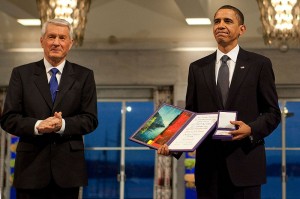
President Barack Obama uncomfortably accepting the Nobel Peace Prize from Committee Chairman Thorbjorn Jagland in Oslo, Norway, Dec. 10, 2009. (White House photo)
By Jonathan Marshall | Consortium News | May 27, 2016
Even if you’ve never won an office raffle, a sports pool or a lottery, consider yourself supremely lucky. Unlike the atomic bomb victims who were recognized by President Barack Obama’s visit to Hiroshima, you’ve never experienced the horrors of nuclear war.
That’s nothing any of us should take for granted, says former Defense Secretary William Perry. On at least three occasions, he noted recently, the U.S. military received false alarms of a Soviet nuclear attack. At least twice the Soviet military went on high alert from similar alarms. And anyone who lived through the Cuban Missile Crisis in 1962 survived “as much by good luck as by good management,” he added.
The consequences of an accidental nuclear war would be staggering. Thousands of U.S. and Russian warheads, some of them orders of magnitude larger than the one that wiped out Hiroshima, are primed for launch on warning. Besides wiping out tens or hundreds of millions of people in urban centers, they would put a large fraction of the world’s population at risk from starvation.
A 2013 report by Physicians for Social Responsibility concluded that even a limited regional nuclear exchange — say between India and Pakistan — could “cause significant climate disruption worldwide” and jeopardize food supplies to as many as two billion people.
Many authorities believe the threat of accidental war is even greater today than during most of the Cold War. Last year, the Science and Security Board of the Bulletin of Atomic Scientists moved its famous Doomsday Clock forward to three minutes to midnight, its “direst setting” since the nuke-rattling days of the early Reagan era.
The group cited continued bluster and brinkmanship between NATO and Russia, including the shooting down of a Russian warplane by Turkey, as indicators of today’s risky nuclear environment.
Getting Lucky
National security experts and reporters such as Eric Schlosser, author of Command and Control (2014), have compiled long lists of nuclear accidents and near-misses, some of which might have cost millions of lives but for a few quick-thinking heroes. Here’s a small sample:
–In 1958, a B-47 dropped a 30 kiloton Mark 6 atomic bomb into a family’s backyard in Mars Bluff, South Carolina. Its high-explosive trigger blasted the home and left a 35-foot crater. A few months later, another B-47 dropped a Mark 39 hydrogen bomb near Abilene, again setting off its high explosives but not a nuclear blast.
–In 1961, a B-52 exploded over North Carolina, dropping two Mark 39 hydrogen bombs. One of them nearly detonated after five of its six safety devices failed. The Air Force never did recover the uranium trigger.
–In October 1962, at the height of the Cuban Missile Crisis, a Soviet submarine thought it was under attack from U.S. warships, which were practicing dropping depth charges in the Sargasso Sea. The submarine commander ordered a launch of nuclear missiles, but was persuaded to stop by his second-in-command.
Other near misses during that mother of all nuclear crises in 1962 included a reckless U.S. spy plane over-flight of Siberia, the explosion of a Soviet satellite that U.S. authorities interpreted as the start of a Soviet missile attack, American test launches of two nuclear-capable ICBMs, and a screw-up at a Minuteman site that allowed a single operator to launch a fully armed missile.
–In 1966, a B-52 bomber collided with a refueling tanker over Palomares, Spain and broke apart, dropping its four hydrogen bombs. Two of them partially detonated, contaminating a wide region with radiation.
–Two years later, a B-52 crashed in Greenland, losing three hydrogen bombs and contaminating nearly a quarter million cubic feet of ice and snow.
–In 1979, a technician mistakenly confused NORAD’s computers with a war games simulation, triggering signals of a Soviet nuclear launch. The Strategic Air Command scrambled its bombers before learning of the false alarm.
–A year later, a defective computer chip prompted the Pentagon to waken President Jimmy Carter’s national security adviser with reports of a massive launch of Soviet missiles from submarines and land-based silos.
–In 1985, a glint of sunlight confused a Soviet early-warning satellite, which reported that the United States had launched five intercontinental ballistic missiles. Fortunately, the watch commander risked his career by not reporting the alarm, saving the day.
–In 1995, Russia’s early-warning system confused a small Norwegian weather rocket with an incoming U.S. Trident missile. The Russian military went on high alert, notifying President Boris Yeltsin and preparing a possible counter-attack before recognizing the mistake.
Tensions Reduce the Odds
As MIT nuclear expert Theodore Postol noted last year, “Had the false alert of 1995 occurred instead during a political crisis, Russian nuclear forces might have been launched. American early warning systems would have immediately detected the launch, and this might then have led to the immediate launch of US forces in response to the Russian launch.”
Recent years have brought us accounts of missing nuclear missiles, drug use by Minuteman missile crews, shocking security breaches, crew commanders falling asleep, computer failures, a silo fire that went undetected by smoke alarms, and much more.
And just this week we were reminded by the Government Accountability Office that the Pentagon’s “Strategic Automated Command and Control System” uses 8-inch floppy disks and 1970s-vintage computers.
The Pentagon insisted in 2014 that the system “is extremely safe and extremely secure” — after all, how many hackers know how to operate such ancient technology? — but Princeton University’s Bruce Blair, a former Air Force ICBM launch-control officer, said this week, “The floppy disks are associated with a nuclear-communications system that was unreliable even when the system was upgraded in the 1970s.”
No doubt the odds of any one of these accidents triggering a war or mass catastrophe were low. But odds increase with the number of incidents. If the probability of a disaster from one incident is only one in 100, the odds of ruin from 20 such incidents rise to nearly one in five. Those are not comforting numbers.
That’s why it’s critical that the United States and Russia get serious about promoting world security by eliminating first-use and “launch on warning” policies that heighten the risk of accidental wars. They must also sharply reduce the size of nuclear arsenals that are difficult to track, safeguard and maintain.
Instead, President Obama has embarked on a trillion dollar program of nuclear modernization and a dangerous policy of confrontation with Russia in Eastern Europe. (Russia is not blameless in these matters, of course.) Such policies are, in turn, prompting China’s military to pursue a nuclear expansion program of its own — including a dangerous shift to hair-trigger alerts and a launch-on-warning policy.
Former Defense Secretary Perry warns that all of this is putting the world “on the brink of a new nuclear arms race.” That’s not what we expected from the President who was awarded a Nobel Peace Prize in part for his call to reduce the threat of nuclear weapons. Let’s hope Obama’s visit to Hiroshima rekindles his commitment to helping create a safer world.
Jonathan Marshall is author or co-author of five books on international affairs, including The Lebanese Connection: Corruption, Civil War and the International Drug Traffic (Stanford University Press, 2012).
Why Obama Accused Russia of Showing No Interest in Nuke Reduction
Sputnik – May 23, 2016
US President Barack Obama tried to show Russia in a bad light when he said that Moscow is not doing enough to reduce its stockpile of nuclear weapons, but Russia has many reasons for not accepting Washington’s initiative, Svobodnaya Pressa asserted.
“The US president mentioned Russia, but preferred not to name other members of the official nuclear club, including China, the United Kingdom and France,” the media outlet noted, pointing out that several other nations are believed to have nuclear weapons, including India, Pakistan, Israel and North Korea.
Another major reason for Russia to keep its nukes intact involves Washington. The US has not ratified the 1996 Comprehensive Nuclear-Test-Ban Treaty (CTBT), which bans all nuclear weapons in all environments. Moscow ratified the deal in 2000, but CTBT will only enter force when all signatories ratify it.
In addition, Moscow, according to the Svobodnaya Pressa, has to consider the funds that the US allocates for defense purposes – nearly $600 billion a year. Washington’s “gargantuan” military budget, as analyst Finian Cunningham described it, exceeds those of other big spenders, including China, Russia, Saudi Arabia, France, the UK, Germany, Japan and India.
But this is not the whole picture – alliances and affiliations also matter.”Three of these countries [France, the UK and Germany] are NATO members, while Japan has been a longtime US ally. This means that the gap [in military spending] between the US and Russia is even wider,” the media outlet explained.
Last week, Obama told Japan’s public broadcaster NHK that “we can go further” in reducing the stockpiles of Russian and US nuclear weapons “but so far Russia has not shown its self interest in doing more.”
Russian lawmaker Vyacheslav Tetekin pointed out that the US foreign policy is “disingenuous.”
“Any disarmament initiatives launched by US hawks, who are pretending to be ‘doves of peace,’ serve merely as an instrument designed to weaken their opponents. The Pentagon is making every effort to deploy its missile defense system, upgrading its nuclear weapons. Meanwhile they are offering Moscow to stop,” he said.
Earlier this month, the US-made Aegis Ashore base became operational in Romania. The site is part of a larger initiative aimed at creating a missile shield to cover the US and Europe from Iranian ballistic missiles. Russian officials have called the system a threat to the country, as well as global security.In this context, Moscow has no other option than to keep its nukes. Defense analyst Mikhail Alexandrov noted that Russia’s “nuclear weapons guarantee the country’s national security.”
Read more: Kim Jong Un Vows to Avoid Using Nukes Unless Sovereignty Violated
Obama Won’t Apologize for US Genocide on Visit to Vietnam

teleSUR | May 22, 2016
U.S. President Barack Obama on Sunday headed for his first visit to Vietnam, a trip officially aimed at sealing the transformation of an old enemy into a new partner to help counter China’s growing assertiveness in the region and viewed by veteran communists in the Asian nation as an attempt by Washington to undermine their one-party rule.
However, there is no apology planned by Obama for the massive U.S. bombing of the Asian nation that killed over 3.6 million people, injured over 5 million, left close to 900,000 children orphans and turned 200,000 women into prostitutes, apart from spraying millions of hectares with highly toxic pesticides that affected over 4 million people. The U.S. intervention also left a million women widowed and 11 million people displaced.
But four decades after the Vietnam war that deeply divided opinion in America, Obama aims to boost defense and economic ties with the country’s communist rulers while also prodding them on human rights, aides say.
His visit has been preceded by a debate in Washington over whether Obama should use the three-day visit starting Monday to roll back an arms embargo on Hanoi, one of the last vestiges of wartime animosity.
That would make Beijing uncomfortable, because its government resents U.S. efforts to forge stronger military bonds with its neighbors amid rising tensions in the disputed South China Sea. But there was no immediate word of a final U.S. decision on the issue.
Vietnam’s government earlier this month said lifting the embargo would show mutual trust and that buying arms from its partners was “normal”.
Bilateral U.S.-Vietnam trade has swelled 10 times over since ties were normalized in 1995 to around US$45 billion now. Vietnam is Southeast Asia’s biggest exporter to the United States, with textiles and electronics the largest volumes.
Washington wants Vietnam to open up on the economic front and move closer militarily, including increased visits by U.S. warships and possibly access to the strategic harbor at Cam Ranh Bay, U.S. officials say.
While Vietnam wants warmer ties, some among the party’s old guard remain suspicious that the U.S. endgame is to undermine their one-party rule.
On May 27, Obama is also scheduled to visit Japan, where he is expected to visit Hiroshima. Again, he has no plans to apologize for the nuclear bombing there.
Featured Video
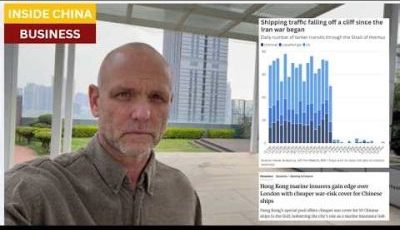
More Iran War fallout: Maritime insurance industry shifts from London to China
or go to
Aletho News Archives – Video-Images
From the Archives
The Biggest Threat to Peace in Middle East
By Dr. Elias Akleh* | Sabbah Report | May 24, 2010
A build up of heightened tension in the Middle East is escalating in the last few weeks. American and Israeli postures towards Lebanon, Syria, and Iran have become more threatening. Listening to speeches of political leaders one hears talks only about war not peace. Iranians and Israelis are continuously training hard for a possible showdown. Both sides are conducting extensive war games every month. This led Syrians to claim that Israel is preparing for a soon-to-come another war. The Jordanians also are warning that current stalemate of the peace process is an indication of a war breaking out this summer. The Russian President and his army chief hinted, a few months ago, that the US and Israel were planning for an attack on Iran.
Indeed Iran is, as it has been for last few years, the target of most of the threats and accusations of supporting terrorism. Escalating incitement against Iran the American Defense Department sent last month (April) to Congress a report on Iran’s military claiming Iran could develop intercontinental ballistic missiles capable of reaching the US by 2015.
Ignoring the fact that N. Korea, India, Pakistan, and Israel are proven to have nuclear weapons while Iran does not, the US Secretary of State Hillary Clinton chose in her speech, to the nuclear Non-Proliferation Treaty review conference at the UN, to focus on Iran’s alleged nuclear ambitions putting the whole world at risk as she put it. According to Clinton Iran’s acquisition of nuclear weapons, rather than Israel’s more than 200 nuclear bombs, is destabilizing the Middle East. She called on the world’s nations to rally around US efforts to hold Iran, not other nuclear countries, to account.
The accusation that Usama Bin Laden is living comfortably in Iran had received a boost after the broadcast of a documentary called “Feathered Cocaine”. This echoed the June 2003 claims of the Italian newspaper Corre de la Sierra that Bin Laden was in Iran according to some intelligence report, and according to Richard Miniter’s book “Shadow War”. … continue
Blog Roll
 Aletho News
- Japan Clings to US Vassalage Despite Energy Crunch Caused By Iran War
- US Seeks Control Over Global Energy Infrastructure – Kremlin
- US senators target Orban government for standing up to Zelensky
- The deep-rooted culture of corruption in Ukraine
- Iran mobilizing one million soldiers to ‘create hell’ for any US ground assault: Report
- The coming military and psychological unravelling?
- Iran has the last laugh
- More Iran War fallout: Maritime insurance industry shifts from London to China
- US-Israeli aggression on Iran triggers review of GCC countries’ investment pledges to Washington
- Russia slams UK plan to seize tankers suspected of carrying its oil
- If Americans Knew
- Reports: Iran mobilizing 1M fighters, Israel-US run low on ammo, Israeli army faces shortage – Not a ceasefire Day 168
- ‘No Innocent Children’: Far-right Israeli Lawmaker Defends Killing of Palestinian Family
- Mossad’s promises helped Netanyahu convince Trump that Iran could be toppled
- US Arms Control Official Refuses To Comment When Asked If Israel Has Nuclear Weapons
- Veterans warn US landing could be ‘more Gallipoli than Vietnam’
- Israel may be committing war crimes in Lebanon – Not a ceasefire Day 167
- In the West Bank, life is a constant battle – 3 articles
- Jacob Reses, one of the most powerful pro-Israel operatives in Trump’s Washington
- Israeli-US assaults kill or injure 87 children a day – Not a ceasefire Day 166
- ‘Forever live by the sword’: Understanding Israelis’ massive support for Iran war
- No Tricks Zone
- Devastating Assessment Of Comirnaty Vaccine By Former Senior Pfizer Europe Toxicologist
- New Study: CO2 Is ‘Effectively Negligible’ As An Explanatory Climate Change Factor Since 2000
- Former Pfizer Toxicologist Dr. Helmut Sterz Tells Bundestag Hearing Pfizer Vaccine Should Have Never Been Approved
- Energy Expert: Germany’s Nuclear Phaseout Was A “500 Billion Euro Mistake”
- New Research: South Australia’s Mid-Holocene Sea Surface Temperatures Were 4°C Warmer Than Today
- Storing Green Energy To Last Germany 10 Days Would Require A 60-Million Tonne Battery
- New Studies: UK Sea Levels Were 4 Meters Higher Than Today During The Mid-Holocene
- Destructive Green New Deal: German Energy And Metal Group Warns Of Drastic Crisis
- New Study Documents A 20-Year Pause In Arctic Sea Ice Decline – Driven By Internal Variability
- Wake-up Call: Survey Shows Majority Of Germans Now Favor Postponing Climate Targets!
 Aletho News