Judge orders US government to prepare Guantánamo force-feeding tapes for public release
Reprieve | July 10, 2015
A federal judge today ordered the Obama Administration to prepare secret videotapes of a Guantanamo detainee’s treatment for release to the public.
In a ruling this afternoon in Washington DC, Judge Gladys Kessler ordered the US Government to complete all national security-related redactions to the first eight tapes – which show Abu Wa’el Dhiab being forcibly removed from his cell and tube-fed — by August 31, and to complete other key redactions by September 30.
The tapes were first filed to court as classified evidence in a legal challenge to prison conditions at Guantanamo Bay, Dhiab v Obama. 16 press organizations, including Associated Press, the Washington Post and the New York Times, intervened seeking the videos’ release to the public on First Amendment grounds. Judge Kessler ordered them to be released; the Obama Administration then appealed in what Judge Kessler called “as frivolous an appeal as I’ve seen.’
Reprieve attorney for Abu Wa-el Dhiab Cori Crider said:
“This is a great win for the US press, and for the First Amendment. The Obama Administration has been kicking and screaming to avoid processing even one minute of this footage, and never wanted to have to give a specific reason for keeping it secret. That is because the real reason for trying to hide Mr Dhiab’s face is that what he suffered is a scandal and an embarrassment to the Administration that allowed it.
“The Government has been rightly chided by the judge and now will be made to give real reasons for every frame of this footage that they want to keep hidden from the public.
“Images of a suffering detainee are matters of public importance and should no more be suppressed than those of Abu Ghraib, Eric Garner or Rodney King. An Administration truly committed to transparency would release the tapes forthwith.
“That’s why the US press is intervening in this case, and the courts are standing firm to preserve our right to see what is being done in our name.”
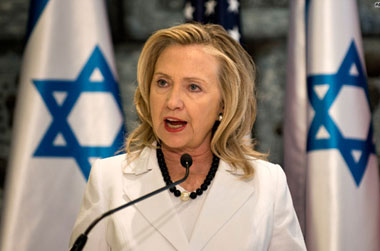
Hillary Clinton: Use Congress and Corporations to End Boycott Israel Movement
By Naji Dahi – ANTIMEDIA – July 9, 2015
According to a letter from Hillary Clinton to pro-Israel donor, Haim Saban, she wants to be the top pro-Israel candidate in the race for the Democratic presidential nomination. More specifically, Clinton pledges her opposition to the BDS (Boycott, Divest, Sanction) movement. According to McClatchy,
“I know you agree that we need to make countering BDS a priority… we can work together…to reverse this trend with information and advocacy, and fight back against further attempts to isolate and delegitimize Israel… from Congress and state legislatures to boardrooms and classrooms, we need to engage all people of good faith, regardless of their political persuasion or their views on policy specifics, in explaining why the BDS campaign is counterproductive to the pursuit of peace and harmful to Israelis and Palestinians alike.”
It is no secret that Hillary Clinton is the Wall Street-sponsored candidate in the Democratic primary race. Data from Open Secrets for the 1999-2016 election cycles shows that three of her top five contributors were Wall Street firms (Citigroup, Goldman Sachs, and J.P. Morgan Chase). It seems that Clinton now wants to become the undisputed pro-Israel candidate, as well.
In the United States presidential elections, all major party candidates are obliged to show their loyalty to the state of Israel. In return, wealthy pro-Israel donors fill their election campaign coffers with much needed cash. In 2008, for example, the top three candidates in both parties (Obama, Clinton, McCain) were also the top three recipients of donations from pro-Israel groups and individuals. In 2012, history repeated itself with Mitt Romney and Barack Obama, the top two recipients of campaign cash from pro-Israel individuals and groups. While it is too early to tell, it is highly likely that the top two candidates from the two major parties will also be the top two recipients of pro-Israel campaign contributions.
Haim Saban, a billionaire who made his fortune in the entertainment industry, is a long time Democrat and ally of Hillary Clinton. He will likely promote pro-Israel, anti-BDS discourse in the Democratic Party. Sheldon Adelson, also a billionaire, is a long-time Republican whose job is to enforce pro-Israel, anti-BDS discourse in the Republican Party. According to The Times of Israel,
“Adelson said his prime focus… was to reverse the inroads being made by what he called ‘the BDS (Boycott, Divestment and Sanctions) and company… the anti-Israel and anti-Semitic organizations [that] are making a lot of headway on the campuses in the United States.’ He said he would encourage Jewish groups to work to have boycott decisions taken by student campus groups reversed… Saban made clear that he intended to fight back against any business groups inclining to boycott Israel, and create a climate in which they were deterred from doing so.”
The success of the BDS movement is becoming an issue for Israel—so much so, that Saban and Adelson held a secret summit in Las Vegas last month to address the matter. The two billionaires invited 50 pro-Israel groups and pledged to fund their efforts to fight BDS on American college campuses with the hope of branding the movement anti-Semitic. According to Haaretz,
”…of millions of dollars were raised to combat campus campaigns to boycott, divest from and sanction Israel — or BDS, as the movement is known… both [Adelson and Saban] stressed their view that BDS — a form of nonviolent protest promoted by a diverse array of groups opposed to Israel’s policies toward the Palestinians — as simply a form of anti-Semitism.”
With Hillary Clinton officially on board and the two billionaires raising $20 million for the anti-BDS cause, American college campuses will be interesting centers of debate this fall.
Lessons from Libya’s Destruction
Tortilla Con Sal | July 9, 2015
Later this month the outcome is expected of the completely unjust and incompetent show trials held in Libya over the last year or so of around 200 former officials of the Libyan Jamahiriya. If that outcome is reported at all in North American and European media, its real meaning will be completely hidden in self-serving apologetics for NATO’s destruction of Libya in 2011.
The same psy-warfare framework that justified NATO’s campaign of terrorist aggression will falsely present the show trials’ outcome as rough justice dealt out to individuals who deserve no better.
That outcome should put on high alert anyone defending the countries of the Bolivarian Alliance of the Americas against very similar psychological warfare and terrorist subversion supported by NATO governments of the US and its allies. Not for nothing did Hugo Chávez and Daniel Ortega speak out in defense of Muammar al Gaddhafi and Libya against NATO’s terrorist war. They had already learned long ago the very same lessons to have emerged more recently from the utterly depressing human, moral and political catastrophe of Libya’s destruction.
In 2013, a study by a distinguished Harvard University academic acknowledged that the failure in Libya of the US government’s ostensible avowed policy in Libya and in North and West Africa was based on serial falsehoods. That fact-based, acerbic policy criticism from a source generally supportive of US government foreign policy should give much pause for thought. Along with support for Libya from outstanding revolutionary leaders like Ortega, Chavez and Nelson Mandela it amounts to a categorical indictment of received Western opinion about Libya which, across virtually the entire Western political spectrum, sided either openly or indirectly with NATO’s 2011 war.
No one genuinely concerned to defend progress towards an equitable, peaceful multi-polar world based on mutual respect between sovereign, autonomous nations and peoples should underestimate or forget the horror of what NATO did to Libya. Tens of thousands were killed and wounded in attacks by the bombers and helicopters of many NATO countries. Millions were displaced or forced into exile. Cities like Sirte and Bani Walid were devastated. Schools, universities, hospitals, factories producing food products and other essential civilian infrastructure were targeted and severely damaged or destroyed.
The destruction of Libya marked the categorical abandonment of whatever vestigial moral authority may still have remained to the European Union and its member governments.
It demonstrated in the most humiliating way the impotence and irrelevance of the African Union.
It put hard questions about the anti-imperialism of the Iranian and Syrian governments as well as highlighting the race supremacism of the governments of the Arab League and the already damaged integrity of the Palestinian authorities.
Almost all of them quickly recognized the overtly racist renegade Libyan CNT junta. For their part, the then governments of Russia and China weakly accepted NATO country assurances about the defensive nature of the air exclusion zone.
The only governments to emerge with any real credit from the destruction of Libya were the governments of the ALBA countries and a few African governments like Zimbabwe.
Countries like Cuba, Venezuela, Argentina, Nicaragua, Bolivia and Ecuador have all been victims of comprehensive disinformation campaigns of demonization and caricature, although perhaps not so extreme as the final campaign against Libya’s Jamahiriya and Muammar al Gaddhafi.
It is worth considering the basic component of that disinformation war against Libya. What is sometimes called 4th generation warfare is as old as warfare itself. Like Athens versus Sparta, or Rome versus Carthage the fundamental objective of NATO governments and their allies is to make their chosen target seem Other, creating a despised, outcast doppelganger anti-image of the West’s own phony self-image.
So Libya’s Jamahiriya was tagged as undemocratic by hypocritical Western governments, most of whom came to power with around just 20% to 25% of the vote of their electorates, thanks overwhelmingly to elite corporate funding. Libya’s democratic process was one that recognized its society’s contradictions and attempted continual self-renewal.
By contrast, the Western corporate oligarchies offer virtually meaningless periodic elections obfuscated by public relations and organized on a yes-or-yes basis to favor politicians groomed and bankrolled by their countries’ anti-democratic elites. Muammar al Ghaddafi was labeled a dictator even though his policy initiatives were not infrequently rejected within Libya’s system of popular congresses.
In 2009, during a policy conflict between Muammar al Gaddhafi and pro-Western so-called reformers, these could not get their way in Libya’s popular assemblies so they chose staging a violent putsch to achieve the regime change their Western government backers wanted. Venezuela’s experience has been almost identical, although, to date, the country has avoided the kind of coup d’état and subsequent NATO driven war that destroyed Libya Libya was portrayed as a systematic human rights violator.
But Libya’s response to the constant terrorist attacks and subversion it suffered from the very start of its Revolution in 1969 was no different to that of any Western government faced with a similar threat. The British government tortured and murdered alleged subversives all through the Irish war, colluding with sectarian paramilitary death squads. The same pattern of torture and extrajudicial murder also consistently marked the Spanish authorities’ campaign against Basque separatists. Guantanamo’s torture camp symbolizes the brutality and illegality of the US government’s response to terrorist threats.
Libya’s Jamahiriya probably conformed as closely to international human rights norms in relation to fighting terrorism as the three Western governments that led NATO’s war of destruction. Human rights protection in Libya was certainly superior to Western allies like Turkey, Egypt, Israel, Saudi Arabia, Qatar or the other quasi-feudal Gulf State tyrannies.
All the pretexts for the Western assault on Libya’s legitimate government were completely bogus. In any case, as Gerald Perreira points out, the fundamental objective achieved by the destruction of Libya was to shut down the decisive impetus towards African integration led by Muammar al Gaddhafi.
CNT leaders like Mustafa Abdul Jalil were Arab supremacists who fiercely resisted the Pan-African policies advocated by Muammar al Gaddhafi. Arab supremacism, phony neoliberal reformism and the treachery of repressive human rights abusers like Mahmoud Jibril made a lethal reactionary cocktail perfectly suited to ruthless NATO government manipulation. On cue, Western corporate and alternative media presented the corrupt political project of these viciously reactionary elements as a “revolution”, part of the absurdly hyped “Arab Spring”. As if NATO country governments, dedicated to the service of their countries’ corporate elites, have ever promoted genuine democracy or comprehensive human rights around the world.
From Ukraine and Greece, to Yemen and Syria, to Haiti and Honduras, what the Western powers and their allies want is access to natural resources, control of strategically important territories and decisive advantages for their trade and finance. Destroying Libya effectively removed a real threat to Western control and domination in Africa.
Currently, the NATO country elites’ political sales staff, for the moment President Obama, Prime Minister Cameron, President Hollande and Chancellor Merkel, are battering Greece into submission. But those leaders and their allies are using economic and psychological warfare to attack many other targets, not just Greece. They do so against Venezuela and other stubbornly independent countries around the world.
That is why the leaders of Argentina, Cuba, Ecuador, Nicaragua and Venezuela very publicly welcomed the No vote in the Greek referendum. Unlike Libya, in their different regions Syria and Venezuela are part of regional alliances backed at long last by firm leaders in Russia and China, strong enough to face down any likely economic or military threat from the United States and its allies.
But it would be a mistake to forget Libya. Defending the people of Libya represents an important self-defense measure against Western predators in their global psychological warfare assault on the free, anti-imperialist world.
As a leading force in that free world, ALBA country governments should urgently consider challenging the governments of North America and Europe to protect the thousands of political prisoners in Libya who have been tortured and denied due process.
The ALBA country governments and their allies have infinitely more moral and political authority than Western leaders to speak out in defense of fundamental human rights. They should make outspoken use of that authority now to expose the sadism and hypocrisy of Western governments in Libya, Syria, Yemen and elsewhere.
In Libya, they may perhaps yet help to save the lives of as many as 200 former officials of the Libyan Jamahiriya at risk from quasi-judicial murder by the West’s corrupt terrorist proxies in a country they have devastated with merciless cynicism.
UN Srebrenica Resolution Shows Double Standards Justifying Russian Stand
Sputnik – 09.07.2015
WASHINTON — Russia was justified by the evidence in its decision to veto a UN Security Council Resolution on Wednesday that sought to condemn Serbia for genocide over the Srebrenica massacre 20 years ago, US experts told Sputnik.
“After the bruising and pointless campaign to shame Turkey over an Armenian genocide this past year, here we are again in the political game of outrage and finger pointing,” historian and political analyst Dr. Gilbert Doctorow, a board member of the Committee on East-West Accord, told Sputnik on Wednesday.
Up to 8,000 Bosniak Muslims, mainly men and boys, in and around the town of Srebrenica were killed by units of the Army of Republika Srpska under the command of general Ratko Mladic.
Doctorow acknowledged that Srebrenica was an atrocity carried out during a time of war. But he pointed out that it was not an act of genocide nor was it a part of any planned and orchestrated campaign of total extermination.
“Yes, Srebrenica was a war crime, and let things stand there,” the Columbia professor said.
However, Doctorow added, “Calling it genocide cheapens the term by two orders of magnitude and serves only to raise tensions in the UN by those who want to discredit it to justify unilateralism.”
Michael Averko, a New York-based foreign policy analyst and regular contributor to Eurasia Review told Sputnik that Allied bombing campaigns against Germany and Japan killed vastly more civilians, including women and children, than the number of male prisoners killed at Srebrenica.
However, the US and British strategic bombing campaigns are never described as attempted genocides, he said.
“In these World War II examples, men, women and children were killed,” the analyst wrote. “The Srebrenica massacre in question involved Muslim males, with the Muslim nationalist [Alija] Izetbegovic regime recognizing ages 16-64 as worthy for armed service.”
Averko also pointed out that critics who focus on condemning the Serbs for Srebrenica are silent about the documented earlier killings of Serbs by Bosnian Muslims and Croats in the 1992-95 war.
“There was an earlier massacre of Serbs in the Srebrenica area, carried out by forces under the command of Nasir Oric,” he wrote.
Averko also accused the administration of President Barack Obama of double standards in its continued refusal to condemn Turkey for the World War I massacre of 1.5 million Christian Armenians as genocide.
“It is absurd for the US UN Ambassador Samantha Power to bash Russia for not recognizing Srebrenica as genocide,” he said. “The Armenian genocide more aptly fits the definition of genocide than Srebrenica. [Yet] the US government doesn’t formally recognize what happened to the Armenians as genocide.”
According to US military historian R.J. Rummel in his September 2003 online article “Was World War II American Urban Bombing Democide?” US and British bombing campaigns killed 410,000 Germans and 337,000 Japanese, including the 165,000 who died in the atomic bombing of Hiroshima and Nagasaki.
Obama’s Failure to Make the Strategic Case for an Iran Nuclear Deal: The Leveretts on CNN and CNBC
By Flynt Leverett and Hillary Mann Leverett | Going To Tehran | July 8, 2015
The Iran nuclear talks may be getting close to some sort of conclusion in Vienna, but American political and policy elites remain, to an appallingly large extent, clueless as to what is really at stake in the negotiations. (This was a significant theme yesterday in Hillary’s appearance on CNN, see here, and in Flynt’s appearance on CNBC, see here, to discuss the Vienna talks.) And, while the headline from a recent NBC News poll notes that Americans favor an Iran nuclear deal by a “2 to 1” margin, in fact, the polls shows that a plurality of Americans say they don’t know what to think about a possible Iran nuclear deal.
These observations underscore a point that we have been making for some time: President Obama has yet to make the case to his fellow Americans for why an Iran nuclear deal—and, beyond that, a potential realignment of U.S. relations with the Islamic Republic—is not just profoundly in American interests, but is strategically imperative for the United States.
–This failure will almost certainly make it more difficult for Obama (and his successor) to implement a deal.
–Furthermore, this failure will severely circumscribe the strategic benefits that the United States can accrue from a deal.
At the moment, many American elites convey particular distress over the Obama administration’s inability simply to dictate the terms of a prospective United Nations Security Council resolution that would endorse a final nuclear agreement and, to help implement such an agreement, remove international sanctions previously authorized by the Council against the Islamic Republic.
–In its approach to drafting a new Security Council resolution, the Obama administration has been demanding that previously authorized limits on exports of conventional weapons and missile-related technology remain in place. Iran, for its part, resists any text that would imply its “acceptance” of continuing international sanctions. Moreover, Russia and China are not going along.
–Likewise, Moscow and Beijing have rejected the Obama administration’s demand that UN sanctions be lifted only for six months at a time, subject to renewal—renewal which the United States, on its own, could veto, thus realizing U.S. ambitions to be able to “snap” sanctions back into place without being blocked by Russia and China.
That the Obama administration has been pushing these positions reveals much of what is so fundamentally wrong with the U.S. approach to diplomacy with Iran. As Flynt pointed out on CNBC, “This was an approach that not only were the Iranians going to object to it, but I don’t think the administration ever had a serious chance of getting consensus within the P5+1, among the permanent members of the Security Council…It was foolish, really, for the administration to take those positions on those issues.” Yet these are the positions the administration took, and now it must either find a way to walk back from them or (foolishly) embrace diplomatic impasse.
Of course, this reflects weakness on Obama’s part—but not the sort of weakness for which neoconservatives and others constantly lambaste him. As Hillary noted on CNN,
“We have tried [the interventionists’] version of strength—invading Iraq; invading Libya; occupying Afghanistan for more than a decade; arming, training, and funding various jihadis in Syria and all across the Middle East. And all it has brought us is damage to ourselves.
The real strength would be, just like Nixon and Kissinger went to China and accepted the People’s Republic of China, we need to go to Tehran, as we wrote in our book, and make our peace with Iran. It will help us. It will resurrect our position in the Middle East and around the world. And if we don’t, we will see ourselves continue to flail across the Middle East and around the world…
The Islamic Republic of Iran is here to stay, like the People’s Republic of China. What we need to recognize is that rising Iran, just like rising China, is a strong, independent power. And we need to work with them, not constantly try to bring them down and align with other countries like Saudi Arabia that get us into strategic disaster after strategic disaster.”
But that is precisely what Obama has been unwilling to do. Could the United States still “walk away” from the process? As Hillary said on CNN, “A decision by the United States to ‘walk away,’ to cut off talks with Iran would be just as strategically damaging, if not more so, to the United States than the decision to invade Iraq. It would have enormously devastating consequences for the United States in the Middle East, keep us on a trajectory to get into one never-ending, unwinnable war after another. And it would have repercussions for us globally, in economic terms and military terms.”
Stay tuned.
Putin to Obama: No one has the right to ask Assad to resign
MEMO | July 8, 2015
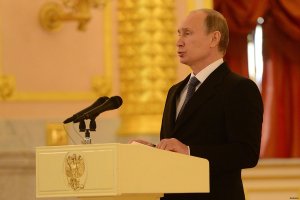 Vladimir Putin has insisted that Bashar al-Assad is the “legally-elected” president of Syria and no one is entitled to ask him to resign. The Russian president made his comment in response to statements by Barack Obama, who said that the only way to achieve stability in Syria is through the formation of a new government without Assad, Anadolu has reported.
According to Putin’s adviser Dmitry Peskov, this conversation took place during a phone call between the two leaders on 26 June. He stressed that the Russian position on Assad is known to everyone and the Russian president said nothing new to his US counterpart.
In a related context, Syria’s ambassador in Moscow, Riad Haddad, has revealed that Russia will host the third consultative meeting between Syrian parties involved in the conflict. He said that the date of the meeting will be linked to the schedule of the UN Secretary-General’s special envoy for Syria, Staffan de Mistura. No further details were reported.
Why does the Obama administration neglect American national interests?
Sputnik – 07.07.2015
Paradoxically, US President Barack Obama, a Nobel Peace Prize winner, has finally found himself lured into an open-ended war in the Middle East, tense confrontation with China, and a new Cold War with Russia.
Director of the Economic Growth Program at the New America Foundation Sherle R. Schwenninger pointed out that although Barack Obama vowed to end the “wars of occupation” in Iraq and Afghanistan and to reset Russo-American relations, he has finally found himself fighting on multiple fronts.
“Now, after being “pulled back in” by liberal interventionists and neoconservative hawks both inside and outside his administration, he finds himself pursuing a new open-ended war against the so-called Islamic State, prosecuting an expanded counterterrorism campaign from Central Asia to North Africa, overseeing a new Cold War with Russia, and pivoting toward what could become one with China in East Asia,” the scholar elaborated.
The expert noted that “many of the people,” which contributed to the shift in US foreign policy, “are the same ones who cheered us into the war in Iraq.”
Mr. Schwenninger underscored that while the US President’s critics are accusing Barack Obama of hesitancy, “the failure of Obama’s foreign policy” is that “it has embraced many of the very positions that Obama’s interventionist opponents have advocated.”
“In so doing, it has failed to protect America’s most important national interests,” the expert stressed.
According to Mr. Schwenninger, it was not in the US’ interest to topple Syrian President Bashar al-Assad or to change Ukraine’s nonaligned status, or to alienate Russia and China. It was also not in America’s interest to help to escalate the civil war in Ukraine “by unconditionally supporting Kiev’s various military offensives this past year, when such offensives would only further bankrupt Ukraine and cause even more unnecessary bloodshed.”
Blaming the White House for its Middle Eastern policy, US experts point to Washington’s role in the Yemeni crisis.
“Yemenis have good reason to hold the US responsible for the war that has devastated their country. The US is particularly responsible for the campaign’s attacks on civilian areas because it is actively aiding the Saudis in their operations. US officials are understandably embarrassed to talk about this,” US conservative publicist Daniel Larison noted.
However, it is just the tip of the iceberg. While pursuing its ambitious global goals, Washington has undermined its own strategic foreign policy goals.
While Washington was beefing up its military presence in Eastern Europe, citing Russia’s imaginary “threat,” Moscow and Beijing have jumped at the opportunity to reshape the Eurasian economy, bringing under their umbrella a vast number of Central/South Asian and former Soviet states.
Furthermore, when the United States was speculating about its “Asian pivot” and teasing the Chinese Dragon, Beijing kicked off its ambitious New Silk Road project, aimed at cementing Eurasia’s heartland and gradually expelling Washington from the region.
As a result the United States risks losing its dominant positions in both Eurasia and the Asia Pacific.
And that is not all. Preoccupied with its foreign policy, the Obama administration neglected the country’s most important domestic tasks: namely, to reduce inequality and rebuild the American middle class.
“We should be working with our international counterparts to strengthen the world economy and create jobs. In this way, we might be able to break our downward drift toward endless war in the Middle East and new Cold Wars in Europe and Asia,” Mr. Schwenninger noted.
In order to realign Washington’s foreign policy to support its domestic agenda, Obama would have better considered curtailing military commitments and promoting programs to expand investments and jobs inside the country.
Or as American conservative political commentator Patrick Joseph “Pat” Buchanan put it: “Our agenda in that decade was — stay out of wars that are not our business, economic patriotism, secure borders, and America first.”
America’s Endless Air Wars
By Nicolas J S Davies | Consortium News | July 6, 2015
U.S. Central Command’s latest figures on its aerial bombardment of Iraq and Syria reveal that this is the heaviest U.S. bombing campaign since President George W. Bush’s “Shock and Awe” campaign against Iraq in 2003. In the campaign’s first ten months from August 2014 to May 2015, the U.S. and its allies conducted 15,245 air strikes, or an average of 51 air strikes per day.
This is only the latest campaign in a 15-year global air war, largely ignored by U.S. media, in which the United States and its allies have conducted at least 118,000 air strikes against other countries since 2000. The 47,000 air strikes conducted in the 6 ½ years since President Barack Obama took office are only a small reduction from the 70,000 in eight years of the Bush administration, and the current campaign will easily make up that deficit if it continues at this intensity until Obama leaves office.

Afghanistan has been the most heavily bombed country, with at least 61,000 air strikes since 2001. That includes 24,000 bombs and missiles in the first year of the war and a relentless bombing campaign that struck Afghanistan with another 29,000 bombs and missiles between 2007 and 2012, a slow motion version of “Shock and Awe.” That was an average of 13 air strikes per day for six full years, two years under Bush and four under Obama. The heaviest bombardment was in October 2010, with 1,043 air strikes that month, but that total is now eclipsed every month by the new campaign in Iraq and Syria.
Iraq had already suffered about 34,000 air strikes since 2000 before the latest campaign began. There were at least 800 air strikes in the “No Fly Zone” bombing campaign to destroy Iraq’s air defenses between 2000 and 2002; 29,200 air strikes in “Shock and Awe” in 2003, a campaign whose planners compared it to a nuclear attack; and another 3,900 during the U.S. occupation, peaking with 400 strikes in January 2008 as remaining centers of armed resistance were obliterated by air strikes, Spectre gunships and heavy artillery in the climax of the “Surge.”
But until the new campaign in Iraq and Syria, the seven-month NATO-Gulf Cooperation Council bombing of Libya was the heaviest bombardment since “Shock and Awe”, with 7,700 air strikes in seven months, or 36 air strikes per day. NATO and its Arab monarchist allies plunged Libya into intractable chaos and violence, exposing “regime change” as a euphemism for “regime destruction.”
NATO’s destruction of Libya spurred Russia to finally draw the line on its 20-year acquiescence to Western aggression and military expansion. Since then, the U.S. and its allies have persisted in their “regime destruction” policy in Syria and Ukraine, threatening strategically important Russian naval bases in Tartus and Sevastopol, what has evolved from an asymmetric war on a series of relatively defenseless countries into full-blown 1950s-era nuclear brinksmanship.
Drones have played a growing role in the U.S. air war, but they still account for only a fraction of total U.S. and allied air strikes, several thousand out of 118,000 air strikes in 15 years.
None of these figures include Israeli air strikes against Palestine, the current Saudi-led bombing of Yemen, or French operations in West Africa, as I haven’t found comparable figures for those campaigns, but they must add many thousand more air strikes to the real total.
Keeping the People in the Dark
In a recent article, Gareth Porter reported that the Pentagon is seriously opposed to putting more “boots on the ground” in Iraq or Syria, but that the generals and admirals are prepared to keep bombing them more or less indefinitely as the political path of least resistance for themselves and the White House. This may indeed be the “safe” course for a politically-driven administration and a Pentagon that is always thinking of its public image and its future funding.
But it depends on keeping the public in the dark about several critical aspects of this policy. First, there is little public resistance to this policy mainly because few Americans know that it’s happening, let alone understand the full scale of the bloodshed and devastation perpetrated in our names for the past 15 years.
The second thing the Pentagon doesn’t want you to think about is the deceptive role of “precision” weapons in U.S. propaganda. Considering how accurate these weapons really are in relation to the huge numbers of them raining down on country after country, it is not surprising that they have killed or wounded millions of civilians and destroyed hundreds of thousands of homes and civilian infrastructure, as we see in photographs and video of the ruins of Fallujah, Sirte or Kobani.
A direct hit with a single 500- or 1,000-pound bomb will cause death, injury and destruction up to hundreds of feet from its point of impact, so even accurate air strikes inevitably kill and maim civilians and destroy their homes. But whatever proportion of these 118,000 bombs and missiles have actually missed their targets have wreaked completely indiscriminate death, injury and destruction.
Rob Hewson, the editor of Jane’s Air Launched Weapons, estimated that 20 to 25 percent of the “precision” weapons used in “Shock and Awe” in 2003 missed their targets. Another one third of the bombs and missiles used in “Shock and Awe” were not “precision” weapons to begin with.
Even the Pentagon has not claimed a quantum leap in its “precision” weapons technology since 2003, so it is likely that at least 15 percent are still missing their targets, adding daily to a massive and mounting toll on innocent civilians.
As Hewson told the Associated Press in 2003, “In a war that’s being fought for the benefit of the Iraqi people, you can’t afford to kill any of them. But you can’t drop bombs and not kill people. There’s a real dichotomy in all of this.”
Body Count, a recent report published by Physicians for Social Responsibility, confirmed previous estimates of well over a million people killed in America’s wars since 2000. This and previous studies document the horrific results of what Hewson and other experts understand only too well, that “you can’t drop (100,000) bombs and not kill (hundreds of thousands of) people.”
Another element in the Pentagon’s shaky propaganda house of cards is its effort to obscure what bombs and missiles actually do to their victims. Americans watch the Islamic State beheading videos on TV or YouTube but we never see videos of people decapitated or children dismembered by the bombs our taxes are paying for. But our bombs behead people too.
Apologists claim that U.S. bombing is morally superior to the “terrorism” of America’s enemies, because the U.S. killing and beheading of civilians is “unintentional” rather than “deliberate.” The late Howard Zinn, a former U.S. Air Force bombardier and later a history professor, responded to this claim in a letter to the New York Times in 2007:
“These words are misleading because they assume that an action is either ‘deliberate’ or ‘’unintentional.’ There is something in between, for which the word is ‘inevitable.’ If you engage in an action, like aerial bombing, in which you cannot possibly distinguish between combatants and civilians (as a former Air Force bombardier, I will attest to that), the deaths of civilians are inevitable, even if not ‘intentional.’
“Does that difference exonerate you morally? The terrorism of the suicide bomber and the terrorism of aerial bombardment are indeed morally equivalent. To say otherwise (as either side might) is to give one moral superiority over the other, and thus serve to perpetuate the horrors of our time.”
Millions of ‘Enemies’
In fact, U.S. armed forces are waging war on millions of people for whom becoming combatants in a war would be the last thing they would ever consider if we had not brought our war to their doorsteps. The Center for Civilians in Conflict recently interviewed hundreds of local people who have participated as combatants in conflicts in Bosnia, Libya, Gaza or Somalia. It found that their motivations were almost entirely defensive, to protect themselves, their families, their communities or their countries.
When military forces attack or invade a country, many ordinary people feel compelled to take up arms to defend themselves and their homes. When the forces that put them in this unbearable predicament in the first place treat their efforts to defend themselves as a legal “green light” to target them with force and call them “terrorists,” they are driven to join better organized armed resistance movements that offer them protection in numbers and an effective way to fight back.
The essential first step to breaking the escalating spiral of violence is to force the aggressors, in this case the United States and its allies, to cease their aggression, including their state sponsorship of armed groups or “terrorists” in the affected countries. Then legitimate diplomatic initiatives can begin the difficult work of resolving the complex political and humanitarian problems caused by U.S.-led aggression and beginning to restore peace and security.
In his 1994 masterpiece, Century of War, the late Gabriel Kolko documented that war was the catalyst for all the major political revolutions of the Twentieth Century. While the working people of the world have otherwise failed to “rise up” as Marx predicted, the one thing that has reliably driven them to do so is the horror of war.
The war that the United States is waging today is proving no different. Armed resistance is spreading throughout the affected countries, spawning new ideologies and movements that defy the conceptual frameworks and limited imagination of the U.S. officials whose actions gave birth to them.
U.S. leaders of all stripes, military or civilian, Democrat or Republican, still fail to grasp what Richard Barnet concluded in 1973 as he studied the U.S. defeat in Vietnam, “at the very moment the number one nation has perfected the science of killing, it has become an impractical instrument of political domination.”
The last 15 years of war have served to confirm Barnet’s conclusion. After 118,000 air strikes, millions of casualties, trillions of dollars squandered, and country after country plunged into chaos, the U.S. has failed to gain political control over any of them.
But our complacent leaders and their self-satisfied advisers blunder on, debating who to threaten or attack next: Russia? China? Iran? Which “threat” provides the best pretext for further U.S. military expansion?
As Gabriel Kolko observed, because of “inherent, even unavoidable institutional myopia, … options and decisions that are intrinsically dangerous and irrational become not merely plausible but the only form of reasoning about war and diplomacy that is possible in official circles.”
But U.S. war-making is not just dangerous and irrational. It is also a crime. The judges at Nuremberg defined aggression, attacking or invading other countries, as the “supreme international crime, differing only from other war crimes in that it contains within itself the accumulated evil of the whole.” The UN Charter goes one step further and prohibits the threat as well as the use of force.
Benjamin Ferencz, the only surviving member of the prosecution team at Nuremberg, is a fierce critic of illegal U.S. war-making. In response to U.S. war crimes in Vietnam, he dedicated the rest of his life to establishing an International Criminal Court (ICC) that could prosecute senior officials of any government who commit aggression and other war crimes.
Ferencz is hailed as the founding father of the ICC, but his vision of “Law Not War” remains unfulfilled as long as his own country, the United States, refuses to recognize the jurisdiction of either the ICC or the International Court of Justice (ICJ).
By rejecting the jurisdiction of international courts, the U.S. has carved out what Amnesty International has called an “accountability-free zone,” from which it can threaten, attack and invade other countries, torture prisoners, kill civilians and commit other war crimes with impunity.
Nuremberg ‘Exemption’?
U.S. government lawyers enjoy the privilege, unique in their profession, of issuing legally indefensible but politically creative legal cover for war crimes, secure in the knowledge that they will never be forced to defend their opinions before an impartial court.
Ben Ferencz very graciously wrote a preface to my book, Blood On Our Hands: the American Invasion and Destruction of Iraq, and he spoke at an event with me and David Swanson in 2011, just before his 91st birthday. Ben talked about Nuremberg and the ICC, and he compared U.S. justifications for its “preemptive” illegal war-making to the defense offered by SS Gruppenfuhrer Otto Ohlendorf at Nuremberg.
As Ben explained, “That Ohlendorf argument was considered by three American judges at Nuremberg, and they sentenced him and twelve others to death by hanging. So it’s very disappointing to find that my government today is prepared to do something for which we hanged Germans as war criminals.”
If we do not hold American war criminals accountable for their crimes, and accept the jurisdiction of international courts to do so if we do not, how else can we serve notice on those who come after them that they must never do this again?
Argentina, Guatemala and other countries in Latin America are prosecuting and jailing mass murderers like Videla and Rios Montt who once took for granted that they could kill with impunity. America’s masters of war should not assume that we will fail to bring them to justice.
As for the collective responsibility we all share for the crimes committed by our country and our armed forces, we must be prepared to pay substantial war reparations to our millions of victims and the countries we have destroyed. We could start by paying the reparations ordered by the International Court of Justice when it convicted the United States of aggression against Nicaragua in 1986, and the $3.3 billion promised by President Nixon to repair at least some of the U.S. bomb damage in Vietnam.
These would be concrete steps to tell the rest of the world that the United States was finally ready to abandon its failed experiment in “the science of killing,” to be bound by the rule of law, and to start cooperating in good faith with the rest of humanity to solve our common problems.
~
Nicolas J S Davies is the author of Blood On Our Hands: the American Invasion and Destruction of Iraq. He also wrote the chapters on “Obama at War” in Grading the 44th President: a Report Card on Barack Obama’s First Term as a Progressive Leader.
US and Cuba: What Remains to be Done?
By BENJAMIN WILLIS | CounterPunch | July 6, 2015
After a little more than six months since President Obama and his Cuban counterpart Raul Castro historic announcements on December 17th, 2014 that the United States and Cuba would begin to re-establish diplomatic relations, a crucial step has been taken to usher both nations down the path of normalization. The formal establishment of embassies in both countries, announced July 1st and beginning July 20th with the official opening of the embassy of the Republic of Cuba in Washington, will be the first time in 54 years that the two countries will have formal diplomatic relations.
This rapprochement that has transpired over a little more than half a year has been universally lauded and a number of foreign dignitaries have been quick to act. In May, France’s President François Hollande visited Cuba and expressed Europe’s desire to normalize relations as soon as possible and called upon the United States to end the embargo. During Dilma Roussef’s visit to the White House last week both she and Obama released a joint communique saying:
President Rousseff praised President Obama’s policy changes towards Cuba, and the Leaders agreed that the latest Summit of the Americas (held in Panama, on April 10 and 11, 2015) demonstrated the region’s capacity to overcome the differences of the past through dialogue, thereby paving the way for the region as a whole to find solutions to the common challenges facing the countries of the Americas.
American citizens have been in overwhelming support of ending the embargo for years and the latest results of last month’s Chicago Council’s poll indicates that 67% want an end to the embargo. Even a majority of Republicans (59%) think it’s time for an end to the extraterritorial anomaly that is the United States’ policy of economic strangulation.
The Cuban American community has also demonstrated in various polls, including electoral, that there is an ever-increasing majority of those who want normalization between the two nations. Since Obama’s change of Cuba policy started Cuban Americans have taken advantage of executive actions directed at them that gave the right to unlimited travel and send remittances to the island in 2009. In his 2012 re-election bid, Obama won the Cuban American vote in Florida and, emboldened, has continued to open up inroads within this powerful voting block in Southern Florida with his calls for normalization of relations.
As in most aspects, politicians usually lag behind society.
While the president has shown leadership it is up to Congress to dismantle the odious embargo codified in the Helms-Burton Act and also repeal other legislation that are aimed at punishing Cuba like the Torricelli Act of 1992 and the Cuban Adjustment Act of 1966.
Although several measures that would chip away at the embargo have been introduced in both chambers, there are still many Congress members who take the word of a few “representatives” who espouse to champion the aspirations of Cubans and Cuban Americans as if they truly spoke for these citizens as a whole. This cabal of recalcitrant hardliners is tragically failing their constituencies and the people on the island, whose misery is perpetuated by the pro-embargo stance of these hypocritical, self-serving opportunists. Their continued presence in Congress is something that the 1.8 million Cuban Americans who reside in southern Florida are going to have to reckon with in upcoming election cycles.
Indeed, even when Senator Jeff Flake’s (R-AZ) S. 299 Freedom to Travel to Cuba Act has garnered 44 cosponsors and bipartisan support, the odds that it get to a filibuster-proof 60 votes is still low as reflected by govtrack.com having put the bill’s chances of passing at 11%. It would need that to avoid the histrionics of Senators Marco Rubio (R-FL), Ted Cruz (R-TX), and Bob Menendez (D-NJ). Each of these legislators have sworn through clenched teeth that they will not allow any gains made by Obama’s overtures towards Cuba to continue and, in Cruz and Rubio’s case, have vowed to reverse all progress made with the island if elected to the White House.
Travel to Cuba has been a hot topic and since December 17th’s announcements there has been a 36% uptick in Americans visiting the island. Celebrities, politicians, business leaders, and curious Americans have flocked to the island. Airbnb’s fastest growing market is Cuba. Even White House Press Secretary Josh Earnest told a reporter that the president “would relish the opportunity” to visit Havana in 2016.
However, this past June 18th the House Appropriations Committee passed its FY 2016 Financial Services Appropriations bill. It contains three “Cuba-specific” prohibitions that were drafted by one of the most out-of-touch members of Congress – Mario Diaz-Balart. These prohibitions are a threat to the advancements in U.S.-Cuba relations and seek to effectively end president Obama’s highly successful “people-to-people” policy that has generated interest among all Americans to go to Cuba and see for themselves the devastating effects of the embargo. These measures will also hurt Cubans on the island who have benefited by the influx of tourism and those Cuban Americans who have invested in family businesses and enterprises in a nascent market economy. What will Diaz-Balart be facing on Election Day when a majority of his constituents have already voted against him and his draconian legislation with their feet by going to Cuba in the thousands and with their pocketbooks by sending money millions to loved ones on the island?
With all that has been accomplished in the past several months it should be noted that any or all of it could be sabotaged by the misguided efforts of a few delusional congressional members who have done very little in their undistinguished careers except perpetuate the pro-embargo industry. All the bills and measures for free travel and more commerce can be introduced but as long as these obstructionists remain in office full normalization will be a delayed longer than it should. Repealing the embargo will probably only happen if some, hopefully all, of these politicians are removed from office.
Normalization = Normal
Every day a new group or coalition appears that is in favor of travel and commerce with the island. James A. Williams, director of Engage Cuba and the New Cuba PAC, expressed this in an interview on June 16th on CNBC’s Squawk Box with Michelle Caruso-Cabrera.
MCC: “… There’s really nothing left to the embargo. What you’re calling for is an end to the embargo, essentially, right? Is there really anything left?”
JW: “Yeah, well, there are pieces of.., it depends on what you call the embargo. I mean, what I think we’re saying is we’re not interested in the debate around the democracy programs and some of these other issues that I think, you know, are still contentious and deserve a full debate, but I think we can all agree that trade and travel restrictions need to be lifted immediately.
MCC: “I’m confused, so when it comes to the democracy programs you just don’t want to talk about them? You don’t support them? You do support them?
JW: “It’s just not an issue we’re focusing on. You know our campaign is led by the private sector on its ability to travel freely, trade freely, uh, and have the opportunity for Americans to compete.”
I’d like to thank James Williams for graciously ceding the floor to those of us who have been “focusing on” these “contentious issues” for more than a few months. During the Obama era, it has been imperative for moderate Cuban American voices to defend the President’s actions and to call for the normalization of relations. A number of organizations, with which I have had the pleasure and honor of working, have been at the forefront of the U.S-Cuba conversation within the Cuban American community, denouncing U.S. policy that includes “democracy promotion”, and not working “behind the scenes” as Williams claims to have been doing these years.
The so-called “democracy promotion” programs have ham-handedly put the lives of Cubans and Americans in danger because of the illegal nature of said programs. Alarmingly, these programs have seen their budget increased to $30 million for FY 2016- a fifty percent increase from the $20 million in 2015. Alan Gross’ five-year imprisonment was the result of his activities as a subcontractor for the U.S. Agency for International Development (USAID), a benefactor of this increase. His wife sued the American government in 2013 for more than $60 million dollars for having sent him “on five semi-covert trips to Cuba without proper training, protection, or understanding of Cuban laws.” The case was eventually settled for $3.2 million a week after the historic announcements that released him on December 17th of last year. When Engage Cuba launched it did so in the residence of Scott Gilbert, Gross’ lawyer, with Gross present as a spokesperson for the endeavor. Using Gross as a spokesperson and then not wanting to talk about “democracy programs” defies credulity.
Some of Williams’ newfound friends (read backers), Cuban Americans who represent the Miami power base and until just recently had poured millions into the pro-embargo lobby, also didn’t want to focus on “contentious” issues like Cuba’s designation as a State Sponsor of Terrorism these past six years. So it’s no surprise that Engage Cuba doesn’t want to talk about the “democracy programs”. Nor do they want to broach the topic of the U.S. Naval Base at Guantanamo and the violation of Cuban sovereignty that it represents. Nor do they have much to say about the recent immigration crisis brought upon by Cubans realizing that they won’t be able to take advantage of the Cuban Adjustment Act much longer if relations are truly normalized. The United States unfair policy encourages Cubans to test their fate with the swirling currents of the Straits of Florida on homemade rafts and this perilous exodus will persist as long as U.S. law encourages it. Will it also be left to “others” to call for the immediate closure and abandonment of Radio and TV Marti, a $28 million taxpayer footed boondoggle that doesn’t even reach Cuban audiences? In short, if it’s not travel and trade Engage Cuba isn’t interested in commenting on it, for now.
Whether or not these supposed champions of “engagement” want to address the myriad obstacles that still stand in the way of full normalization, the Cuban government has, and will continue to call for an end to these hostile policies that violate Cuban law and international norms established in the Vienna Convention and the 1970 Declaration of the United Nations General Assembly on principles of international law concerning friendly relations of cooperation among states.
In an official statement by the Revolutionary Government of the Republic of Cuba on July 1st, the Cubans delineated a number of issues that would need to be rectified in order to fully normalize relations:
“There can be no normal relations between Cuba and the United States as long as the economic, commercial and financial blockade that continues to be rigorously applied, causing damages and scarcities for the Cuban people, is maintained, it is the main obstacle to the development of our economy, constitutes a violation of International Law and affects the interests of all countries, including those of the United States.
To achieve normalization it will also be indispensable that the territory illegally occupied by the Guantanamo Naval Base is returned, that radio and television transmissions to Cuba that are in violation of international norms are harmful to our sovereignty cease, that programs aimed at promoting subversion and internal destabilization are eliminated, and that the Cuban people are compensated for the human and economic damages caused by the policies of the United States.”
So no, it’s not just as easy as saying that restrictions on travel and trade need to be lifted immediately. The Cubans want a normalization that is actually “normal” and not just an influx of tourists and businessmen who either come to the island led by the perverse American provincial thought that Cuba needs to “be seen before it’s ruined” or by the repugnant philosophy that American dollars will fix every Cuban’s problems.
Besides, as long as the embargo exists there will always effectively be a travel ban because there is no infrastructure for all the Americans who suddenly want to go to visit. And, if Cuba cannot receive the international financing that it needs to truly make the recent economic reforms function, then no American business is going to be willing to invest any significant amount in a country where it can still be penalized by Uncle Sam.
After more than 50 years of animosity both nations are going to need diplomatic corps that aren’t hindered by extraterritorial legislation that puts them at odds. There is much work to be done in order for the United States and Cuba to trust each other and if there is a pre-ordained policy for regime change then that trust will never fully be forged.
Benjamin Willis is a founding member of Cuban Americans for Engagement (CAFE) and Co-Director of the United States Cuba Now PAC. http://www.uscubanowpac.com
No, Obama Hasn’t Ended the War in Afghanistan
By Claire Bernish | ANTIMEDIA | July 2, 2015
Protests erupted north of Kabul on Monday after U.S. forces raided a local residence in search of a weapons cache—revealing that U.S. troops might not play as “limited” a role in Afghanistan as the Pentagon claims.
It’s been months since President Obama declared an official end to the combat mission in Afghanistan. At present, the U.S. mission is ostensibly limited to advising Afghan forces and counterterrorism strikes targeting the Taliban—at least, according to the military’s stated role. However, troops descending from a helicopter in the pre-dawn hours to raid the house of a local commander who has no connection to al-Qaeda—or even the Taliban—certainly muddies the definition of “adviser.”
In fact, Jan Ahmad, who was targeted in the raid, fought against the Taliban in the past and the Soviets before that. Charikar locals, who felt the matter should not have involved foreign forces, hastily closed shops and took to the streets in outrage, shouting, “Death to America!”
“The protesters burned a lot of tires to show their rage,” said local resident Mahmood Hamidy, according to the New York Times, “and that, if the issue is not taken seriously, they are ready for violence.”
Colonel Brian Tribus, spokesperson for General John Campbell, who commands U.S. forces in Afghanistan, said the purpose of the raid was “to destroy a cache of munitions that could be used to conduct attacks against Afghans and coalition forces.” After a thorough search, the cache was blown up.
With hundreds of millions of dollars spent to disarm the numerous militias that lack ties to either al-Qaeda or the Taliban, the motivations of the U.S. military seem somewhat questionable. Elders and other former commanders suspected the raid was political retribution for Ahmad’s support of Abdullah Abdullah in the last presidential election.
A similar raid in March comprised of U.S. drones and troops cooperating with Afghan forces left three people dead—but not the person targeted, who suffered only minor injuries.
Questions further surround the U.S.’ role in Afghanistan—including yet another example in a seemingly endless supply of official statements that lack credibility.
Obama Signs Legislation Inhibiting Boycott of Israel
IMEMC News & Agencies | July 2, 2015
 President Obama has signed legislation which would tackle anti-Israel boycotts all over the world and would raise specific US priorities in roughly 150 trade objectives in its negotiations.
One of the main goals, according to World Bulletin/Al Ray, is to counter willingness to support “Boycott Divestment and Sanctions” movement against Israel within the European Union. The legislation was made by a group of congressmen and the American-Israel Public Affairs Committee (AIPAC).
The new US-Israel Trade and Commercial Enhancement Act is specifically targeted “to discourage politically motivated actions to boycott, divest from, or sanction Israel by states, non-member states of the United Nations, international organisations, or affiliated agencies of international organisations that are politically motivated and are intended to penalise or otherwise limit commercial relations specifically with Israel or persons doing business in Israel or in Israeli- controlled territories.”
The new legislation was signed in spite of numerous warnings from Obama’s advisors and officials, who said that such a law can seriously harm trade relations with the European Union members that favor “Boycott Divestment and Sanctions” movement and prohibit trading with Israeli companies that operate in the occupied territories.
Featured Video

Bombing Hitler’s Hometown
or go to
Aletho News Archives – Video-Images
From the Archives
‘Conspiracy Theory’ Now Fact: Greater Israel Has Arrived
By Kit Klarenberg | Mint Press News | January 28, 2025
Ever since Tel Aviv’s 1948 creation, much has been said and written about ‘Greater Israel’ – the notion Zionism’s ultimate end goal is the forcible annexation and ethnic cleansing of vast swaths of Arab and Muslim lands for Jewish settlement, based on Biblical claims this territory was promised to Jews by God. The mainstream media typically dismisses this concept as antisemitic conspiracy theory, or at most the fringe fantasy of a minuscule handful of extremist Israelis.
In reality … continue
Blog Roll
 Aletho News
- Trump admits Iran hit USS Ford carrier: ‘We ran for our lives’
- Battle for Hungary: EU attacks on Orban are a sign of worse things to come
- Iraqi resistance conducts drone strike on US-run base in Syria
- Failing to Defeat Hezbollah, Israel & US Pressure Syria’s Ahmed al-Sharaa to Join War
- US-Israeli war on Iran drives global fertilizer prices up 40%
- Hezbollah’s Surprise Weapons Redefine Ground Battle with Israel
- Yemen joins fight against US, Israel by firing missiles at occupied territories
- Seizing the Kharg: Washington’s path to defeat in the Persian Gulf
- Iran reports 500 US casualties in strikes on covert US military sites
- Pro-Israel terrorist arrested before assassination of pro-Palestinian activist
- If Americans Knew
- Researchers at Human Rights Watch Resign Over Blocked Report on Palestinian Refugee Return
- Jewish Groups Are Backing a War Americans Don’t Want
- Eric Fingerhut Thinks He’s the President of the Jews
- Top Jewish Philanthropists, Rabbis Urge Israeli President to Take Action Against ‘Jewish Extremists’
- Don’t Be Fooled. Zionist Leaders Have Always Wanted to Control Southern Lebanon
- Israel’s widespread use of torture is a core element of its genocide against the Palestinian people
- In Israel’s War on Iran, Many Middle East US Bases Rendered “All But Uninhabitable”
- ‘Burn the lawn’: Israel pursues ‘Rafah model’ in southern Lebanon
- A genocide here, an amputation there
- Reports: Iran mobilizing 1M fighters, Israel-US run low on ammo, Israeli army faces shortage – Not a ceasefire Day 168
- No Tricks Zone
- Devastating Assessment Of Comirnaty Vaccine By Former Senior Pfizer Europe Toxicologist
- New Study: CO2 Is ‘Effectively Negligible’ As An Explanatory Climate Change Factor Since 2000
- Former Pfizer Toxicologist Dr. Helmut Sterz Tells Bundestag Hearing Pfizer Vaccine Should Have Never Been Approved
- Energy Expert: Germany’s Nuclear Phaseout Was A “500 Billion Euro Mistake”
- New Research: South Australia’s Mid-Holocene Sea Surface Temperatures Were 4°C Warmer Than Today
- Storing Green Energy To Last Germany 10 Days Would Require A 60-Million Tonne Battery
- New Studies: UK Sea Levels Were 4 Meters Higher Than Today During The Mid-Holocene
- Destructive Green New Deal: German Energy And Metal Group Warns Of Drastic Crisis
- New Study Documents A 20-Year Pause In Arctic Sea Ice Decline – Driven By Internal Variability
- Wake-up Call: Survey Shows Majority Of Germans Now Favor Postponing Climate Targets!
 Aletho News