Endless war to mass surveillance: The White House effect
By Sam Sacks | RT | July 03, 2013
President Obama defended the spying scandal on his tour of Africa, and was joined by predecessor George W Bush, which highlighted how similar they have become by forgetting campaign promises while occupying the White House.
President Obama’s Africa trip is overshadowed by new allegations that the United States is committing widespread surveillance on its allies. The President defended these NSA programs saying that all countries are doing similar snooping.
“They’re going to be trying to understand the world better and what’s going on in world capitals around the world, from sources that aren’t available through the New York Times or NBC News,” he said in Tanzania this week.
He added, “I guarantee you that in European capitals, there are people who are interested in, if not what I had for breakfast, at least what my talking points might be, should I end up meeting with their leaders.”
Appropriately, just as President Obama was defending his administration against these spying scandals, he was joined in Africa by his predecessor, George W. Bush.
Presidents 43 and 44 met in Tanzania on Tuesday laying a wreath at the site of the 1998 American embassy bombings. They were together far, far away from the White House, an office currently dealing with the fallout from all its intelligence secrets being laid bare for the world to see. Secrets created by both Presidents Bush and Obama.
These two men couldn’t be more different. Barely of the same generation, they are from different socio-economic backgrounds, from different parts of the country, and from different intellectual backgrounds and professions. They had different upbringings, different hobbies, and different religious beliefs.
But they did hold the same office. And that’s why on Tuesday, in Tanzania, Bush and Obama looked more similar than ever before. It’s as though the White House took hold of these two very different men, chewed them up and spit them out into two monochromatic globs who forgot who they were before moving in to the highest office in the land. And most importantly forgot their ideals.
Remember, it was as a presidential candidate in 2008 that Barack Obama opposed mass domestic surveillance, saying: “I will provide our intelligence and law enforcement agencies with the tools they need to track and take out the terrorists without undermining our Constitution and our freedom. That means no more illegal wire-tapping of American citizens. No more national security letters to spy on citizens who are not suspected of a crime. No more tracking citizens who do nothing more than protest a misguided war. No more ignoring the law when it is inconvenient. That is not who we are.”
Edward Snowden’s leaks prove that now as President, Obama has thrown out all those campaign promises. Not only that, he’s expanded their global reach and justified this expansion by basically saying, “All countries are doing it so we have to also.”
This is what five years in the White House does to a person.
And remember, it was as a Senator in 2007 that Barack Obama supported legislation that would have protected journalists from heavy-handed subpoenas by the DOJ. It was called the Free Flow of Information Act, and it was directly opposed by George W. Bush in the White House. The legislation failed, and two years later, when Obama was in the White House, he made sure the legislation went nowhere, working actively to water it down. And then his Justice Department went to unprecedented lengths to target journalists at the AP and at Fox News.
And of course, one can only assume, that as a member of the Illinois Senate in 2002 when he spoke out so passionately against the Iraq War, that Barack Obama didn’t imagine a decade later he’d be at the helm of a global drone war targeting not just Afghanistan and Iraq, but also Pakistan, Yemen, and Somalia.
So, what causes the transformation? Maybe it’s what Eisenhower warned of in 1961 – the power of the military industrial complex. Maybe it’s the immense political pressure to keep the nation safe from terrorism. Maybe it’s the weight of responsibility of steering a world superpower. Maybe it’s a combination of all of these.
But the office has affected not just Obama and Bush, but also Clinton and George HW Bush and Reagan. All have used the force of our military around the world.
The only President who didn’t start his own conflict was Jimmy Carter more than 30 years ago. Carter also tried to ban extra-judicial assassinations. And today, he’s distinguished himself from both Bush and Obama, calling Snowden’s leaks “beneficial”.
But Carter was tossed out of the White House after only one-term. The Presidents who came later learned this lesson. And now, both of them two-term presidents meet in Africa. Bush, the man who created the machine, and Obama, the man who innovated it.
Both men shaped not by their political ideology, but by their time in the White House taking the reins of the American superpower and doing everything it takes – from war to mass surveillance – to hold on in a world that’s becoming more and more hostile to superpowers.
Obama Visits Mandela’s Old Cell, But Won’t Free His Own Political Prisoners
A Black Agenda Radio commentary by Glen Ford | July 3, 2013
President Barack Obama, a man of infinite cynicism, made a great show of going on pilgrimage to Nelson Mandela’s old prison cell on Robben Island, where the future first Black president of South Africa spent 18 of his 27 years of incarceration. With his wife and daughters in tow, Obama said he was “humbled to stand where men of such courage faced down injustice and refused to yield…. No shackles or cells can match the strength of the human spirit,” said the chief executive of the unchallenged superpower of mass incarceration, a nation whose population comprises only 5 percent of humanity, but is home to fully one-quarter of the Earth’s prison inmates.
True sociopaths, like the commander-in-chief who updates his Kill List every Tuesday, have no sense of shame, much less irony. Obama feigns awe at Mandela’s suffering and sacrifice in the prisons of apartheid South Africa, yet presides over a regime that, on any given day, holds 80,000 inmates in the excruciating torture of solitary confinement. During Nelson Mandela’s nearly three decades of imprisonment by the white regime, he spent a total of only about one week in solitary confinement. The rest of the time, despite often harsh treatment, backbreaking labor, and unhealthy conditions, Mandela and other political prisoners at Robben Island and other South African jails were typically housed together. Indeed, Mandela and his incarcerated comrades called the prisons their “university,” where they taught each other to become the future authorities over their jailers.
Racist South Africa’s treatment of Mandela and his co-revolutionists was downright benign and enlightened, compared to fate of U.S. prisoners who are deemed a threat to the prevailing order. At U.S. high security facilities, the slightest evidence that an inmate is of a political bent of mind is cause for him to be condemned to a solitary existence for decades – a social death alien to the human species. At California’s Pelican Bay and the state prison at Corcoran, thousands of inmates are held in isolation, 80 of them for more than 20 years, the very definition of barbarism. Yet, Obama journeys across oceans and continents to stand for a photo op in the cell of a prisoner whose ordeal was nowhere near as horrific as the standard fare for political prisoners in his own country.
On his trip to South Africa, Obama proclaimed that “the world is grateful for the heroes of Robben Island.” And, that’s certainly true, although it was a U.S. intelligence agent who lured Nelson Mandela into a trap in 1962 that ultimately led to his capture and imprisonment. Obama has no sympathy, however, for political prisoners of any race in his own country. Former Black Panther Herman Wallace is thought to be the longest-serving prisoner in solitary confinement in the United States, having spent 40 years alone in a cell in Louisiana’s notorious Angola Prison. Obama could free him at any time, but of course, he won’t. He could emancipate Black Panther captive Russell Maroon Shoatz, who has spent nearly 30 years in solitary, or Republic of New Africa political prisoner Mutulu Shakur or any and all of the scores of other aging political prisoners – people whose dedication to human freedom is no less than Mandela’s, yet have been subjected to far worse treatment at American hands. Instead, Obama has doubled the bounty on Shakur’s comrade and sister, Assata, in exile in Cuba. She might even be on Obama’s Kill List – which is the real and authentic legacy of this country’s First Black President.
Glen Ford can be contacted at Glen.Ford@BlackAgendaReport.com.
Related article
- Obama Falsely Asserts He Is Mandela Follower (alethonews.wordpress.com)
Boy’s Death in Drone Strike Tests Obama’s Transparency Pledge
By Cora Currier | ProPublica | July 1, 2013
On June 9, a U.S. drone fired on a vehicle in a remote province of Yemen and killed several militants, according to media reports.
It soon emerged that among those who died was a boy – 10-year-old Abdulaziz, whose elder brother, Saleh Hassan Huraydan, was believed to be the target of the strike. A McClatchy reporter recently confirmed the child’s death with locals. (Update: The London-based Bureau of Investigative Journalism today reported that there was “strong evidence” it was a U.S. drone strike, but it could not confirm the fact.)
It’s the first prominent allegation of a civilian death since President Obama pledged in a major speech in May “to facilitate transparency and debate” about the U.S. war on al Qaida-linked militants beyond Afghanistan. He also said “there must be near-certainty that no civilians will be killed or injured” in a strike.
So what does the administration have to say in response to evidence that a child was killed?
Nothing.
National security spokeswoman Caitlin Hayden would not comment on the June 9 strike or more generally on the White House position on acknowledging civilian deaths. She referred further questions to the CIA, which also declined to comment.
The president’s speech was the capstone on a shift in drone war policy that would reportedly bring the program largely under control of the military (as opposed to the CIA) and impose stricter criteria on who could be targeted. In theory, it could also bring some of the classified program into the open. As part of its transparency effort, the administration released the names of four U.S. citizens who had been killed in drone strikes.
An official White House fact sheet on targeted killing released along with the speech repeated the “near-certainty” standard for avoiding civilian casualties. Secretary of State John Kerry reiterated it a few days later, when he told an audience in Ethiopia: “We do not fire when we know there are children or collateral — we just don’t do it.”
But White House press secretary Jay Carney said in late May that “this commitment to transparency…does not mean that we would be able to discuss the details of every counterterrorism operation.”
The new White House statements don’t address what happens after a strike, even in general terms.
CIA Director John Brennan offered one of the few public explanations of how casualties are assessed during his nomination hearing in February. Before his confirmation, Brennan was the White House counterterrorism adviser, and is considered to be the architect of Obama’s drone war policy.
He told senators that, “analysts draw on a large body of information — human intelligence, signals intelligence, media reports, and surveillance footage — to help us make an informed determination about whether civilians were in fact killed or injured.”
Brennan also said the U.S. could work with local governments to offer condolence payments. As we’ve reported, there’s little visible evidence of that happening.
At the hearing, Sen. Ron Wyden, D-Ore., asked Brennan if the U.S. should acknowledge when it “makes a mistake and kills the wrong person.”
“We need to acknowledge it publicly,” Brennan responded. Brennan also proposed that the government make public “the overall numbers of civilian deaths resulting from U.S. strikes.”
Neither overall numbers nor a policy of acknowledging casualties made it into Obama’s speech, or into the fact sheet. Hayden, the White House spokeswoman, would not say why.
The government sharply disputes that there have been large numbers of civilian deaths but has never released its own figures. Independent counts, largely compiled from news reports, range from about 200 to around 1,000 for Pakistan, Yemen and Somalia combined over the past decade.
Researchers agree that the number of drone strikes and civilian deaths have dropped during the past year. (Before Obama’s speech, an administration official attributed this partly to the new heightened standards.) The London-based Bureau of Investigative Journalism, which generally has the highest tally of civilian dead, has found there were between three and 16 civilians reportedly killed in about 30 drone or other airstrikes in Yemen and Pakistan so far this year. No strikes have been reported in Somalia.
“Official” statistics might not be much help without knowing more about how they were compiled, said Sarah Holewinski, head of the advocacy group Center for Civilians in Conflict.
That’s because it’s still not clear how the U.S. distinguishes between civilians and “militants,” or “combatants.”
In so-called signature strikes, operators sometimes fire on groups of people who appear to be engaged in militant activity without necessarily knowing their identities. The newly instituted drone rules reportedly roll back the military’s ability to use signature strikes, but the CIA can keep firing in Pakistan under the old rules at least through the end of the year.
An administration official told ProPublica last year that when a strike is made, “if a group of fighting-age males are in a home where we know they are constructing explosives or plotting an attack, it’s assumed that all of them are in on that effort.”
The new White House fact sheet contradicts that, stating: “It is not the case that all military-aged males in the vicinity of a target are deemed to be combatants.”
From the outside, in a strike like the recent one in Yemen, it’s impossible to know how these things were determined. McClatchy reported that the target, Saleh Hassan Huraydan, had “largely unquestioned” ties to al Qaida. Yemeni officials said he arranged to bring money and fighters from Saudi Arabia to Yemen.
As for Huraydan’s young brother, “They may not have realized who was in the car. Or they may have realized it and decided collateral damage was okay,” Holewinski says.
The same questions dog the death of another boy that the administration has acknowledged: the 16-year-old son of Anwar al-Awlaki, a U.S.-born cleric tied to terror attacks. Awlaki and his son were killed in separate strikes in Yemen in the fall of 2011. The boy, Attorney General Eric Holder has said, was “not specifically targeted.”
Related article
- For Obama civilian deaths are O.K. because the enemy kill civilians also (alethonews.wordpress.com)
Brzezinski: Saudi Arabia, Qatar, their western allies orchestrated Syria crisis
Press TV – June 29, 2013
The former US national security adviser says the ongoing crisis in Syria has been orchestrated by Saudi Arabia, Qatar, and their western allies.
“In late 2011 there are outbreaks in Syria produced by a drought and abetted by two well-known autocracies in the Middle East: Qatar and Saudi Arabia,” Zbigniew Brzezinski said in an interview with The National Interest on June 24.
He added that US President Barack Obama also supported the unrest in Syria and suddenly announced that President Bashar al-Assad “has to go — without, apparently, any real preparation for making that happen.”
“Then in the spring of 2012, the election year here, the CIA under General Petraeus, according to The New York Times of March 24th of this year, a very revealing article, mounts a large-scale effort to assist the Qataris and the Saudis and link them somehow with the Turks in that effort,” said Brzezinski, who was former White House national security adviser under Jimmy Carter and now a counselor and trustee at the Center for Strategic and International Studies and a senior research professor at the School of Advanced International Studies at Johns Hopkins University.
Criticizing the Obama administration’s policies regarding Syria, he questioned, “Was this a strategic position? Why did we all of a sudden decide that Syria had to be destabilized and its government overthrown? Had it ever been explained to the American people? Then in the latter part of 2012, especially after the elections, the tide of conflict turns somewhat against the rebels. And it becomes clear that not all of those rebels are all that ‘democratic.’ And so the whole policy begins to be reconsidered.”
“I think these things need to be clarified so that one can have a more insightful understanding of what exactly US policy was aiming at,” Brzezinski added.
He also called on US officials to push much more urgently to draw in China, Russia and other regional powers to reach some kind of peaceful end to the Syrian crisis.
“I think if we tackle the issue alone with the Russians, which I think has to be done because they’re involved partially, and if we do it relying primarily on the former colonial powers in the region-France and Great Britain, who are really hated in the region-the chances of success are not as high as if we do engage in it, somehow, with China, India and Japan, which have a stake in a more stable Middle East,” Brzezinski said.
Brzezinski also warned again any US-led military intervention in Syria or arming the militants fighting government forces there.
“I’m afraid that we’re headed toward an ineffective American intervention, which is even worse. There are circumstances in which intervention is not the best but also not the worst of all outcomes. But what you are talking about means increasing our aid to the least effective of the forces opposing Assad. So at best, it’s simply damaging to our credibility. At worst, it hastens the victory of groups that are much more hostile to us than Assad ever was. I still do not understand why — and that refers to my first answer — why we concluded somewhere back in 2011 or 2012 — an election year, incidentally that Assad should go.”
Foreign-sponsored militancy in Syria, which erupted in March 2011, has claimed the lives of many people, including large numbers of Syrian soldiers and security personnel.
The New York Times said in a recent report the CIA was cooperating with Turkey and a number of other regional governments to supply arms to militants fighting the government in Syria.
The report comes as the US has repeatedly voiced concern over weapons falling into the hands of al-Qaeda-linked terrorist groups.
Al-Nusra Front was named a terrorist organization by Washington last December, even though it has been fighting with the US-backed so-called Free Syrian Army in its battle against Damascus.
~
Excerpt from TNI interview:
Heilbrunn: Are we, in fact, witnessing a delayed chain reaction? The dream of the neoconservatives, when they entered Iraq, was to create a domino effect in the Middle East, in which we would topple one regime after the other. Is this, in fact, a macabre realization of that aspiration?
Brzezinski: True, that might be the case. They hope that in a sense Syria would redeem what happened originally in Iraq. But I think what we have to bear in mind is that in this particular case the regional situation as a whole is more volatile than it was when they invaded Iraq, and perhaps their views are also infected by the notion, shared by some Israeli right-wingers, that Israel’s strategic prospects are best served if all of its adjoining neighbors are destabilized. I happen to think that is a long-term formula for disaster for Israel, because its byproduct, if it happens, is the elimination of American influence in the region, with Israel left ultimately on its own. I don’t think that’s good for Israel, and, to me, more importantly, because I look at the problems from the vantage point of American national interest, it’s not very good for us.
What will Obama do?
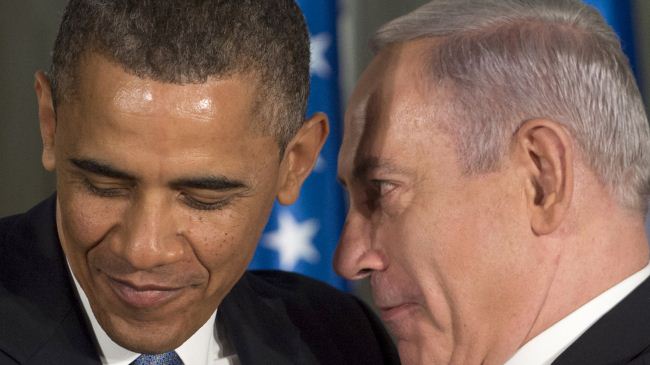
President Obama’s actions are unlikely to stray outside the parameters the Israel lobby is willing to accept. But there is a growing movement that is challenging the lobby’s stronghold on U.S. politics.
By Alison Weir | Palestine News | Spring 2013
Whenever a US president begins a term of office many people round the world are curious about what policies he may pursue on Israel-Palestine. They wonder if he will once again call on Israel to reduce its settlement activities as almost every president has done at least once.
Will he condemn Israeli aggression, or only Palestinian rockets? Will he push a “peace process” in which virtually all the American mediators are Israel partisans[1] or will a few non-Zionists be permitted to play a role?
As Barack Obama began his second term as president, these questions came up again. But these are the wrong questions. Instead, to predict what he will do, one only needs to ask what the Israel lobby is likely to require.
The president won’t always do what the lobby demands – on rare occasions he may deviate a bit from its dictates– but a large percentage of the time he will dutifully do what the lobbyists command.
In other words, in order accurately to analyse American policies in the Middle East, to predict how they will change or not and to develop effective ways to revamp them in the directions that are so urgently needed for humanitarian relief and real peace, it is essential to understand the decisive role the Israel lobby plays in the United States.
Presidents and politicians from both major parties have long been extremely aware of this lobby. It may greatly improve or impede their chances of winning an election, of passing legislation, of receiving positive press coverage, of, quite simply, going on to bigger and better things.
Through the years the lobby for Israel has been a decisive factor in the defeat of Republicans Paul Findley, Pete McCloskey (at one time a Presidential contender) and Charles Percy (another Presidential contender) and Democrats Adlai Stevenson, William Fulbright, Earl Hilliard, Cynthia McKinney and quite likely many more.[2]
Politicians from both parties attend the annual convention of its major lobbying arm, the American Israel Public Affairs Committee (AIPAC) and pledge their loyalty to this foreign country. President Barack Obama, whose early and major backing came from members of the Israel lobby[3], gave his first post-nomination speech at the AIPAC convention.
Yet, despite the lobby’s inordinate power, most Americans are only minimally aware of it. For decades surveys have shown that the large majority of Americans don’t wish to take sides on Israel-Palestine, a reflection of a public that is uninformed about how much of our tax money goes to Israel and how decisively our government is, indeed, taking a side.
This widespread lack of awareness about the role of the Israel lobby in determining American policies is particularly startling given that the movement on behalf of Israel has been active in the United States for over 100 years and that it played a significant role in Israel’s creation.[4]
By the 1920s it was able successfully to promote its policies over those recommended by the US State Department; by the 1940s it had added Pentagon policies to those it could overrule and both presidential candidates Harry Truman and Thomas Dewey were currying its favour[5]; by 1967 it was able to push its cover story on Israel’s lethal attack on the US naval ship Liberty over opposition by high ranking admirals, the director of the CIA and the Secretary of State[6]; and by 1977 the head of AIPAC could state with accuracy: “We have never lost on a major issue.”[7]
Half a century ago the Senate Foreign Relations Committee investigating lobbying activities found an illicit cycle in which the Israel lobby succeeded in procuring money for Israel, some of this was then secretly funneled back into these groups, which then used this money to lobby for still more American tax dollars to Israel.
The hearings concluded that Israel operated “one of the most effective networks of foreign influence” in the United States.[8] Yet, since the media reported on this so little, most Americans are unaware of these extremely grave findings.
The term “Israel lobby” fails to do justice to the extraordinary scope and composition of this special interest group. Below is a small sampling of the American organisations that work on behalf of Israel. Virtually all have multi-million dollar budgets; a few have endowments in the hundreds of million dollars and most of them are funded by tax-deductible donations:
- The American Israel Public Affairs Committee (AIPAC): $100 million endowment, [9] $60 million annual revenues.[10]
- The Washington Institute for Near East Policy (WINEP): $23.5 million net assets. $9.4 million annual revenues.
- International Fellowship of Christians and Jews (aka Stand for Israel): $100 million annual revenues.[14]
- Friends of the Israeli Defense Forces (FIDF): $80 million net assets,[16] $60 million annual revenues.[17]
- Hadassah (Women’s Zionist Organization of America): $400 million net assets, $100 million annual revenues.
- Jewish Community Relations Councils, in cities all over U.S.: Boston annual revenues $2.5 million; Louisville annual revenues $7-10 million; Detroit $734,000, New York $4.5 million, etc.[23]
- JINSA Jewish Institute for National Security Affairs: $3 million annual revenues.
In addition to these nonprofit organisations, there are dozens of political action committees (PACs) that donate to political candidates on the basis of their positions on Israel. Most of these disguise their purpose by using such deceptive names as “Northern Californians for Good Government,” “National Action Committee,” “American Principles,” etc.
While other issue-based PACs almost always announce their focus publicly[31], in 2012 only two of the pro-Israel PACs made any reference to Israel in their names.[32] While US media frequently discuss the gun rights lobby, the largely uncovered pro-Israel PACs gave almost twice as much money to candidates – and the donations went to both parties.[33]
In addition, there are numerous individuals who play an extremely important role in the Israel lobbying effort. Two examples are political campaign mega-donors Haim Saban and Sheldon Adelson. Saban donated $12.3 million to the Democratic Party in 2002 alone and has contributed millions more to pro-Israel organisations.

Adelson, a billionaire casino magnate, set a new record in political donations by giving $70 million in the 2012 elections, nearly triple the previous highest amount. He also funds such pro-Israel organisations as Birthright Israel which takes thousands of young Jewish Americans on recruiting visits to Israel.
In other cases, it is individuals with a different kind of power – the power to affect which information reaches the American public and which does not. One example is Eric Weider, whose Weider History Group publishes eleven history magazines in the United States, the largest history magazine publisher in America (and, according to its website, the world).[34]
Given this reality, President Obama’s actions are unlikely to stray outside the parameters the Israel lobby is willing to accept. While the media are making a great deal over the very mild apology Israel made to Turkey for having murdered nine of its citizens, crediting Obama with this alleged break-through, none of the news reports seem to mention that Israel has largely failed to apologise to the US for the death of 19-year-old dual American Turkish citizen, Furgan Dogan, who was killed with five bullets, one to his face at point blank range.[35]
It is also relevant to note that an AIPAC-drafted letter signed by 76 out of 100 Senators was sent to President Obama on the eve of his visit to Israel in March.[36]
Congressional actions can also be expected to remain within what the Israel lobby directs, though here, too, there may be rare occasions where the lobby seems to have lost – such as the confirmation of Chuck Hagel for Secretary of Defence.
However, the alleged triumph that some pro-Palestinian writers are proclaiming for Hagel’s appointment is a bit overblown. Before he was allowed to take his position, he was made to grovel humiliatingly before his Congressional interrogators, retract acceptable statements he had made earlier in his life and all but swear devotion to Israel (like all top government officials seemingly must do).
This degrading spectacle surely made it clear to Hagel that he better watch his step in the future and made it even clearer to ambitious Americans of all ages that they must be extremely careful about any statements they make about Israel and its lobby if they are to achieve their political ambitions.
Despite the power of the lobby, however, the situation is not as bleak as the above may suggest. There is a highly diverse movement in the US that opposes this lobby and it is steadily growing.
The Left, which for decades was largely silent on Israeli abuses of human rights, has finally become active on the issue. Similarly, both traditional conservatives and libertarians frequently oppose aid to Israel and this opposition is becoming more outspoken. While this stance is often motivated by fiscal considerations, in many cases it is also fuelled by outrage at Israeli cruelty and by genuine empathy with Palestinians.
The money being mobilised on this side is only a small fraction of the other and some of the groups within this movement could arguably be considered simply a more reasonable and compassionate arm of the Israel lobby in that their advocacy is often framed according to what “is good for Israel” while failing to address the inherent injustice of an ethnic state imposed on a multicultural region.
Nevertheless, there is no doubt that the opposition to current US policies is growing increasingly important. The tide may not yet have turned but it is certainly in the slowing phase that must come first.
To use another oft-quoted and particularly apt metaphor, lobbies thrive in the dark. More and more people in the US and elsewhere are shining light on this one, steadily reducing its power.
While there are numerous deeply significant issues, an increasing number of individuals are deciding to focus on this one, the core issue of the Middle East and the cause of war after war, including the current “war on terror” and demonisation of Muslims.
To use the framing posed by journalist Glenn Greenwald, an expanding number of people are refusing to prioritise domestic issues over the killing of Arab and Muslim children on the other side of the world.
Therefore, despite the enormous power of the Israel lobby in the US, this growing movement is quite likely to overcome the obstacles confronting it and to join history’s other successful movements against oppression.
The main question is how long this will take, and how many more massacres, and possibly wars, will occur in the interim.
[1] Even Aaron David Miller admitted they acted as “Israel’s lawyer” – Miller, Aaron David. “Israel’s Lawyer.” Washington Post 23 May 2005, posted by Matt Miller Opinion Writer. Online at http://www.washingtonpost.com/wp-dyn/content/article/2005/05/22/AR2005052200883.html
[2] Findley, Paul. They Dare to Speak Out: People and Institutions Confront Israel’s Lobby. Westport, CT: Lawrence Hill, 1985. Online at http://archive.org/stream/They-Dare-To-Speak-Out-Paul-Findley/They_Dare_to_Speak_Out_Paul_Findley_djvu.txt and Mearsheimer, John J., and Stephen M. Walt. The Israel Lobby and U.S. Foreign Policy. New York: Farrar, Straus and Giroux, 2007.
[3] Yearwood, Pauline Dubkin. “Obama and the Jews.” Chicago Jewish News 24 Oct. 2008.
Online at http://www.chicagojewishnews.com/story.htm?sid=212226&id=252218
[4] Weir, Alison. “Against Our Better Judgment: The Hidden History of How the United States Was Used to Create Israel.” IfAmericansKnew.org. 2012. Web. http://ifamericansknew.org/us_ints/history.html
[5] Weir, “Against Our Better Judgment”
[6] http://www.ussliberty.org/supporters.htm
[7] The Power Peddlers, by Russell Warren Howe and Sarah Hays Trott, Doubleday, p. 292.
http://ifamericansknew.org/us_ints/history.html
[8] Smith, Grant. “Where Did AIPAC Come From?” Antiwar.com. N.p., 09 Oct. 2007. Web. http://antiwar.com/orig/gsmith.php?articleid=11727 and Neff, Donald. “Ulbright Called for U.S. Defense Pact With Israel But Was Labeled Anti-Semite.” Washington Report on Middle East Affairs August-September (1997): 96. Online at http://www.wrmea.org/wrmea-archives/188-washington-report-archives-1994-1999/august-september-1997/2677-middle-east-history-it-happened-in-august-.html
[9] http://www.nytimes.com/2008/04/25/washington/25lobby.html?_r=1
In 2009, the Economist reported: “AIPAC has an annual budget of around $60m, more than 275 employees, an endowment of over $130m and a new $80m headquarters building on Capitol Hill.” http://www.economist.com/node/14753768
[10] http://firststreetresearch.cqpress.com/2012/03/08/aipac-still-commands-attention-among-movers-and-shakers/
[11] http://www.charitynavigator.org/index.cfm?bay=search.summary&orgid=3265
[12] http://www.charitynavigator.org/index.cfm?bay=search.summary&orgid=10657
[13] http://www.charitynavigator.org/index.cfm?bay=search.summary&orgid=10657
[14] http://www.charitynavigator.org/index.cfm?bay=search.summary&orgid=3889
[15] http://www.theisraelproject.org/site/apps/nlnet/content3.aspx?c=ewJXKcOUJlIaG&b=7717007&ct=11735981#.UbKK4uuhU0o
[16] http://www.charitynavigator.org/index.cfm?bay=search.summary&orgid=3734
[17] http://www.charitynavigator.org/index.cfm?bay=search.summary&orgid=3734
[18] http://www.charitynavigator.org/index.cfm?bay=search.summary&orgid=7699
[19] http://www.charitynavigator.org/index.cfm?bay=search.summary&orgid=7699
[20] http://www.faqs.org/tax-exempt/CA/Shimon-Ben-Joseph-Foundation-Dba-Jim-Joseph-Foundation.html
[21] http://207.153.189.83/EINS/133252800/133252800_2010_07b9bf0d.PDF
[22] http://www.jewishfederations.org/about-us.aspx
[23] http://www.jewishlouisville.org/images/JCL/Financials/annual_report_2011-12.pdf
http://www.charitynavigator.org/index.cfm?bay=search.summary&orgid=10095
http://jcrcny.org/images/00_media/about/jcrc-ny2011form990.pdf
[24] http://www.charitynavigator.org/index.cfm?bay=search.summary&orgid=4540
[25] http://www.politico.com/static/PPM152_100828_centerforsecuritypolicy.html
[26] https://bulk.resource.org/irs.gov/eo/2011_09_EO/26-4392915_990_201012.pdf
[27] http://www.charitynavigator.org/index.cfm?bay=search.summary&orgid=8188
[28] http://www.charitynavigator.org/index.cfm?bay=search.summary&orgid=11247
[29] https://bulk.resource.org/irs.gov/eo/2011_02_EO/16-1616489_990_200912.pdf
[30] http://www.charitynavigator.org/index.cfm?bay=search.summary&orgid=5429
[31] http://www.opensecrets.org/pacs/industry.php?txt=Q11&cycle=2012 and http://www.opensecrets.org/pacs/industry.php?txt=Q13&cycle=2012
[32] http://www.opensecrets.org/pacs/industry.php?txt=Q05&cycle=2012
[33] http://www.opensecrets.org/pacs/sector.php?cycle=2012&txt=Q05
[34] Weir, Alison. “The Empire Behind World’s Largest History Magazine Chain: How American History Magazine Censored Palestine.” CounterPunch Dec. 6, 2012. Online at http://ifamericansknew.org/media/weider.html
[35] Lynch, Colum. “U.N. Panel Endorses Report Accusing Israel of Executions aboard Aid Flotilla.” Washington Post 30 Sept. 2010, A Section. Online at http://www.washingtonpost.com/wp-dyn/content/article/2010/09/29/AR2010092907110.html?wprss=rss_print/asection
[36] “Did Your Favorite Progressive Senator Sign AIPAC Letter To Obama Telling Him To Stand Up For Occupation? Here Is The List.” MJ Rosenberg, Mar. 2013. Online at http://mjayrosenberg.com/2013/03/19/did-your-favorite-progressive-senator-sign-aipac-letter-to-obama-telling-him-to-stand-up-for-occupation-here-is-the-list/
Alison Weir is the President of the Council for the National Interest (CNI) and Executive Director of If Americans Knew.
Related articles
- How AIPAC Rules (alethonews.wordpress.com)
- Israel Lobby Dominates Congress, Media Covers it Up (alethonews.wordpress.com)
- Organ trafficking & Israel – A message from Alison Weir (gilad.co.uk)
South Africa: Obama Docket
Muslim Lawyers Association Press Release | June 26, 2013
Lawyers will continue to pursue the case against Obama in the courts
Johannesburg, South Africa – The Muslim Lawyers Association (MLA) brought an application to court on Tuesday, 25 June 2013, to charge US President Barack Obama with a number of crimes, before he enters South Africa on Friday, 28 June 2013.
The North Gauteng High Court today found that the merits of the matter could not be heard as it was not deemed to be sufficiently ‘urgent’. This is despite the imminent arrival of Obama in South Africa this week. However, the (MLA) will continue to pursue the matter through the ordinary course of the courts.
Given the sheer magnitude, gravity, extent and degree of these crimes, as well as the unrelenting vigour with which the Obama Administration continues to commit them, the MLA intends to pursue the review application in accordance with the normal court time periods applicable.
“It is regrettable for the court not to have adjudicated on the merits of the ‘Obama Docket’ at an expedient time when Obama’s visit to the Republic is imminent”, states MLA spokesperson, Attorney Yousha Tayob.
The Obama Docket contains:
– evidence of indiscriminate killing of civilians by the use of USA military drones
– a public acknowledgment by Obama that he authorised the extra judicial assassinations of US citizens and that civilians have been killed by drone attacks authorised by him
– evidence of the continued incarceration without trial of persons detained at Guantanamo Bay and other US detention facilities, and
– evidence that the United States has engaged in rendition programmes contrary
to the prescripts of the norms and standards of International Law.
“South Africa has adopted and ratified the Rome Statute into our law and is therefore obliged to fulfil both its domestic and international responsibilities”, adds Tayob.
The MLA remains undeterred in its resolve to pursue all legal avenues to expose the past and ongoing War Crimes, Crimes against Humanity and Genocide committed by Obama and his administration and is committed to have him brought before a South African court of law or the International Criminal Court to answer the allegations contained in the ‘Obama Docket’.
For more information on the Obama Docket and its contents, or for interviews with an MLA representative, call Attorney Yousha Tayob, + 27 82 926 5408 or email at info@mlajhb.com or visit the MLA website at http:// http://www.mlajhb.com
Related article
- Obama faces protests in South Africa (alethonews.wordpress.com)
Obama called “war criminal” & “hypocrite of the century” in Irish Parliament
Published on June 21, 2013
Clare Daly in Irish Parliament: https://twitter.com/ClareDalyTD
Email her at http://www.claredaly.ie/contact/
Senators say the NSA is still lying to Congress – NSA removes fact sheets
RT | June 25, 2013
Two Democrats on the Senate Select Committee on Intelligence say the National Security Agency provided “inaccurate” and “misleading” information to the American public about the government’s vast surveillance operations.
Senators Ron Wyden and Mark Udall sent a letter to NSA Director Gen. Keith Alexander on Monday asking him to make revisions to a set of fact sheets that were released by his agency to quell concerns about domestic surveillance in the wake of leaked documents attributed to former intelligence contractor Edward Snowden earlier this month.
The Guardian newspaper has been publishing top-secret documents provided by Snowden that he says proves the NSA operates secretive spying programs that retain information on United States citizens under Section 702 of the Foreign Intelligence Surveillance Act (FISA) and Section 215 of the PATRIOT Act. Snowden claims those two statutes are abused in order to surveil American citizens, an argument Gen. Alexander’s office recently attempted to counter by releasing a four-page set of bullet points outlining what the US government can and can’t do under federal law.
According to Sens. Wyden and Udall, the NSA’s response isn’t in-tune with what they’ve been told of the programs. “We were disappointed to see that this fact sheet contains an inaccurate statement about how the Section 702 authority has been interpreted by the US government,” they write Gen. Alexander. “In our judgment this inaccuracy is significant, as it portrays protections for Americans’ privacy as being significantly stronger than they actually are.”
But while the fact sheets have been made available online, Wyden and Udall can’t explain in their public letter what their allegations are in reference to since the lawmakers’ own knowledge of the clandestine operations are not allowed to be discussed, even among the constituents who elected them to the Senate. Instead, they wrote that they’ve “identified this inaccurate statement in the classified attachment” sent to Alexander.
Elsewhere, the lawmakers rejected the NSA’s claim that, “Any inadvertently acquired communication of or concerning a US person must be promptly destroyed if it is neither relevant to the authorized purpose nor evidence of a crime.”
“We believe that this statement is somewhat misleading,” replied the senators, “in that it implies that the NSA has the ability to determine how many American communications it has collected under Section 702, or that the law does not allow the NSA to deliberately search for the records of particular Americans. In fact, the intelligence community has told us repeatedly that it is ‘not reasonably possible to identify the number of people located in the United States whose communications may have been reviewed under the authority’ of the FISA Amendments Act.”
In a tweet sent out Monday evening, Sen. Wyden again said the FISA fact sheet included a “significant inaccuracy.”
Nowhere does the senators’ response include allegations of any discrepancies in the Section 215 fact sheet, but both Wyden and Udall have raised questions about how the government interprets that provision previously. “We believe most Americans would be stunned to learn the details of how these secret court opinions have interpreted Section 215,” they wrote in a joint letter to Attorney General Eric Holder last year. “As we see it, there is now a significant gap between what most Americans think the law allows and what the government secretly claims the law allows. This is a problem, because it is impossible to have an informed public debate about what the law should say when they public doesn’t know what its government thinks the law says.”
In their letter to Gen. Alexander this week, both Udall and Wyden wrote that they believe the US government should have “broad authorities to investigate terrorism and espionage,” and that it’s possible to “aggressively pursue terrorists without compromising the constitutional rights of ordinary Americans.”
“Achieving this goal depends not just on secret courts and secret congressional hearings, but on informed public debate as well,” they wrote.
But while Sens. Udall and Wyden have been long critical of surveillance powers provided through FISA and the PATRIOT Act, their take on the revelations exposed by Mr. Snowden differs drastically with that of President Barack Obama and many leading figures of his administration. Mr. Obama, Gen. Alexander and Mr. Holder have all defended the practices used by the NSA and say that no constitutional violations occur due to privacy safeguards in place, as have Senate Intelligence Chair Dianne Feinstein (D-Calif.).
“I think it’s important to recognize that you can’t have 100 percent security and also then have 100 percent privacy and zero inconvenience,” President Obama said earlier this month.
With respect to Section 702 and Section 215, Obama said, “These are programs that have been authorized by broad bipartisan majorities repeatedly since 2006. And so I think at the onset it is important to understand that your duly elected representatives have been consistently informed on exactly what we’re doing.”
Edward Snowden revealed himself as the contractor responsible for the leaks published by The Guardian less than one week after the paper first began releasing information on the programs. He gave several interviews in Hong Kong before flying to Moscow where he remains today, according to both the US and Russian presidents. The anti-secrecy website WikiLeaks announced Monday that Snowden has asked for asylum from several countries, including Iceland and Ecuador.
Related article
- NSA removes fact sheets (politico.com)
The US’s Afghan Exit May Depend on a Syrian One
By Sharmine Narwani | Al-Akhbar | 2013-06-25
Washington’s options in Syria are dwindling – and dwindling fast.
Trumped up chemical weapons charges against the Syrian government this month failed to produce evidence to convince a skeptical global community of any direct linkage. And the US’s follow-up pledge to arm rebels served only to immediately underline the difficulty of such a task, given the fungibility of weapons-flow among increasingly extremist militias.
Yes, for a brief few days, Syrian oppositionists congratulated themselves on this long-awaited American entry into Syria’s bloodied waters. They spoke about “game-changing” weapons that would reverse Syrian army gains and the establishment of a no-fly zone on Syria’s Jordanian border – a la Libya. Eight thousand troops from 19 countries flashed their military hardware in a joint exercise on that border, dangling F-16s and Patriot missiles and “superb cooperation” in a made-for-TV show of force.
But it took only days to realize that Washington’s announcement didn’t really have any legs.
Forget the arguments now slowly dribbling out about why the US won’t/can’t get involved directly. Yes, they all have merit – from the difficulties in selecting militia recipients for their weapons, to the illegalities involved in establishing a no-fly zone, to the fact that more than 70% of Americans don’t support an intervention.
The single most critical reason for why Washington will not risk entering the Syrian military theater – almost entirely ignored by DC policy wonks – may be this: the 2014 US military withdrawal from Afghanistan.
“Help, we can’t get out”
There are around 750,000 major pieces of American military hardware costing approximately $36 billion sitting in Afghanistan right now. The cost of transporting this equipment out of the country is somewhere close to the $7 billion mark. It would be easier to destroy this stuff than removing it, but given tightening US budgets and lousy economic prospects, this hardware is unlikely to be replaced if lost.
Getting all this equipment into Afghanistan over the past decade was a lot easier than getting it out will be. For starters, much of it came via Pakistani corridors – before Americans began droning the hell out of that country and creating dangerous pockets of insurgents now blocking exit routes.
An alternative supply route through Afghan border states Uzbekistan, Turkmenistan and Tajikistan called the Northern Distribution Network was set up in 2009, but is costlier and longer than going via Pakistan. And human rights disputes, onerous conditions on transport and unpredictable domestic sentiment toward the Americans places far too much leverage over these routes in the hands of regional hegemon Russia.
Unlike Iraq, where the US could count on its control over the main ports and Arab allies along the Persian Gulf border, Afghanistan is landlocked, mountainous and surrounded by countries and entities now either hostile to US interests or open to striking deals with American foes.
In short, a smooth US exit from Afghanistan may be entirely dependent on one thing: the assistance of Russia, Iran, and to a lesser degree, China.
All three countries are up against the US and its allies in Syria, refusing, for the better part of 18 months, to allow regime-change or a further escalation of hostilities against the state.
In the past few months, the Russian and Iranian positions have gained strength as the Syrian army – with assistance from its allies – pushed back rebel militias in key towns and provinces throughout the country.
Western allies quickly rushed to change the unfavorable equilibrium on the ground in advance of political talks in Geneva, unashamedly choosing to further weaponize the deadly conflict in order to gain “leverage” at the negotiating table.
But none of that has materialized. As evidence, look to the recent G8 Summit where western leaders sought to undermine Russian President Vladimir Putin, calling him “isolated” and referring to the Summit as “G7+1.”
In the meeting’s final communiqué, Putin won handily on every single Syria point. Not only was it clear that the international community’s only next “play” was the negotiations in Geneva, but there was no mention of excluding President Bashar al-Assad from a future Syrian transitional government, once a key demand of opponents. Furthermore, the declaration made it clear that there was no evidence linking chemical weapons use to the Syrian government – had there been any “evidence” whatsoever, it would have made it to paper – and Syrian security forces were empowered, even encouraged, to weed out extremist militias by all the G8 nations.
This was not an insignificant victory for the Russians – it was the first public revelation that Washington, London and Paris have conceded their advantage in Syria. And it begs the question: what cards do the Russians hold in their hand to bring about this kind of stunning reversal, just a week after Washington came out guns blazing?
America – choose your Afghan exit
The US military establishment has, for the most part, stayed out of the fray in Syria, where special ops have been ceded to the CIA and external contractors.
But as the gargantuan task of extricating the US from its decade-long occupation of Afghanistan nears, President Barack Obama has scrambled to accommodate the Pentagon’s top priority. Having assiduously avoided a negotiated political or diplomatic solution with the Taliban for years, he hopes to now pull a face-saving, 11th hour deal out of his hat with foes who will sell him down the river at a moment’s notice.
“The Americans are deeply worried that if the war continues the Kabul government and army might collapse while American bases, advisers, and special forces remain in the country, thereby putting the U.S. in an extremely difficult position,” says Anatol Lieven, a professor and Afghanistan expert at King’s College London, about the already-stalled US-Taliban talks in Doha last week. “They would obviously like to bring about a ceasefire with the Taliban.”
Even if Americans could get to the table, there are myriad issues that could conclusively disrupt negotiations at any time – in a process that “could take years,” as various US officials concede.
For starters, the involved parties – Afghan President Hamid Karzai’s government (which consists of competing ethnic and tribal leaders) and the “new Taliban” – now have multiple interests with regional players like Iran, Pakistan, Russia, China, and the neighboring “Stans” which puts a serious strain on any straightforward negotiation goals.
As an example, the very same Taliban delegation now sitting with the Americans in Doha, were traipsing through Tehran late last month – ostensibly with the knowledge of all parties. And this was certainly not the first visit between the two.
While the US arrogantly kept its Afghan foes at arm’s length for years, the Iranians were busy employing soft power in their neighborhood – a task facilitated by a decade of US regional policy mismanagement that has aggravated its own allies in and around Afghanistan.
This isn’t just a matter of Pakistan and Iran inaugurating a once-inconceivable gas pipeline, as they did earlier this year. Iran is now participating in infrastructure and social service projects in the heart of Kabul, has forged working relationships with Pakistani intelligence on a variety of mutual security issues, and has built deep networks within Afghanistan’s political and tribal elite – even with the Taliban, courtesy of mentors in Islamabad.
A US security expert and frequent advisor to US military forces inside Afghanistan and Iraq gives me the bottom line:
“Iran has basically exploited our vulnerabilities and filled those gaps well.
The US’s very presence in Afghanistan has helped Iran gain tremendous influence in both Afghanistan and Pakistan because of widespread disdain for US military activities and intervention, period. This is where Iranian diplomacy has excelled. Iran and Pakistan have ramped up their relationship both in military terms and with local insurgents during the past seven years. Iran has moved in and built mosques, schools in the middle of Kabul, for God’s sakes.”
The Iranians may be able to upset hopes of a smooth US military withdrawal from Afghanistan, but, this source warns, the Russians can potentially play “spoiler” in a big way as well:
“In Kyrgyzstan we have a base there to airlift a lot of supplies – mostly food, small scale things, not heavy equipment – for US soldiers and troops inside Afghanistan. Russia has so much influence there that at one point they threatened to give the Kyrgyz more money for the base that we were renting to kick us out and shut down that essential supply route. We were forced to heavily increase our rent payments to stay there.”
A few days ago, the Kyrgyz parliament voted overwhelmingly to shut down this very Manas base by July 2014, a full six months before the US withdrawal from Afghanistan is set to complete. Was it a coincidence that the vote came up around the time of the G8 huddle in Ireland, dominated almost entirely by news about a stand-off on Syria?
The US military source also explains how easily the Russians can sweeten the pot for the Pentagon:
“We have, concurrently, gained some support to withdraw from Afghanistan thru neighboring Tajikistan with the help of the Russians – and in return we are going to have to help build some infrastructure, like roads, under the auspices of US aid. These negotiations within and between the US and Tajik governments are ongoing. On this, the Russians have given their word that if we can find a way to exit through any of these countries, they will not interfere. Of course, the politics are fluid and anything can change at anytime.”
In April, NATO reached out to Moscow for help and advice on their military withdrawal from Afghanistan. NATO is keen to ensure the cleanest exit possible, but is also concerned about volatility in the aftermath of its departure – and desperately wants to avoid the perception of “mission defeat.”
What about the Chinese?
“China’s interests are a bit different. Less focused on our military withdrawal, more inclined to undermine our long-term influences and goals,” explains my source. “The Chinese are hell-bent on influencing countries for resource extraction and allocation, given their huge domestic demand. They are very competitive with the US and are going after the same resource pool. They undermine US influence because they play the game differently – they will bribe where we have strict rules on bidding, etc., and therefore enjoy more flexibility going after these same resources.”
In other words, like just about everybody else in that neighborhood, China will edge out any US gains made over the past decade – in both the political and economic sense.
In terms of near-term domestic and international political perception, however, that loss will pale in comparison to a failure by the Pentagon to secure the safe exit of its assets from Afghanistan.
“In the final analysis,” says the US military source with great irony, “if we want to get out of Afghanistan quickly and with minimum sacrifice to troops and hardware, it would save us a great deal of trouble if we could exit with the help of – and through – Iran.”
Enter James Dobbins, who was named Obama’s special envoy for Afghanistan and Pakistan in May. The veteran US diplomat, who I had the opportunity to interview in Washington three years ago, is an interesting choice for this position precisely because he has been so vocal in advocating for US-Iranian negotiations when few others dared.
Dobbins, notably, engaged actively with Iran in the aftermath of the US invasion of Afghanistan, based on a mutual interest of replacing the extremist Taliban with a more moderate, inclusive government. But further dealings came to an abrupt halt just weeks later, when then-US President George W. Bush delivered his infamous “Axis of Evil” speech, including Iran in this trio of top American foes.
It is doubtful that Dobbins or the Doha talks can work any miracles though. The kind of exit the US needs from Afghanistan must rely on a constellation of determined players and events that would be quite remarkable if amassed.
While it is obvious to all that the combined weight of Russia, Iran and China could tip that balance in favor of an expeditious American exit, what would motivate any of these three – who have all recently been at the receiving end of vicious US political and economic machinations – to help?
A grand bargain over Syria would surely be a sweetener: you and your allies exit Syria, we’ll help you exit Afghanistan.
The problem with Washington though, is that it never fails to botch up an opportunity – always striving for that one last impossible power-play which it thinks will help it gain dominance over a situation, a country, an enemy.
There remains the concern that the US’s oft-repeated Al Qaeda mantra – “disrupt, dismantle, defeat” – will prove to be its one-stop solution for every problem.
And that is the exception to my premise about a Syrian exit. That US spoilers who cannot accept even the perception of vulnerability – let alone an outright defeat – may instead choose to catapult the entire Mideast into a region-wide war for the sake of avoiding a painful compromise.
Sharmine Narwani is a commentary writer and political analyst covering the Middle East. You can follow Sharmine on twitter @snarwani.
Featured Video

The Sordid History of the CIA – Part 2
or go to
Aletho News Archives – Video-Images
From the Archives
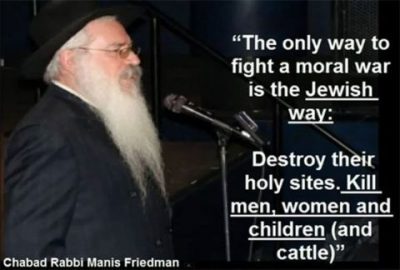
Rabbi Shmuel Eliyahu: Leave No Palestinian or Arab Alive
By Jonas E. Alexis | Veterans Today | July 23, 2017
Israeli Rabbi Shmuel Eliyahu seems to have picked up where the late Rabbi Ovadiah Yosef left off. The Israeli army, Eliyahu said, must slaughter the Palestinians “and leave no one alive.” The Palestinians, the good rabbi continued, must be “destroyed and crushed in order to end violence.” Here is Eliyahu’s algorithm:
“If they don’t stop after we kill 100, then we must kill 1,000. And if they do not stop after 1,000, then we must kill 10,000. If they still don’t stop we must kill 100,000, even a million.”
There is more to this “logic” than meets the eye and ear. Eliyahu even postulated that the Israeli army ought not to get involved in arresting Palestinians because “If you leave him alive, there is a fear that he will be released and kill other people. We must eradicate this evil from within our midst.”
You may say that this is just an isolated case. No Israeli official believes that, right? … continue
Blog Roll
Recent Comments


 Aletho News
- Jeffrey Epstein’s sinister shadow over West Asia
- The Sordid History of the CIA – Part 2
- French FM under fire over ‘false’ claims about UN rapporteur
- Israel Wants ISIS-Linked Militias To Control Rafah Crossing — The New Order in Gaza
- ISIS never left Syria, it just changed uniforms
- Why ARE the US and Israel Obsessed With Eliminating Iran’s Ballistic Missiles?
- Kremlin comments on EU ‘myopia’ over dialogue with Russia
- Russia more adapted to contemporary military technology than NATO
- Germany puts caveat on more missiles for Ukraine
- UK High Court rules Palestine Action ban unlawful
- If Americans Knew
- Noor’s short life of unimaginable suffering
- Israel Destroyed Gaza’s Hospitals. Now It’s Banning Doctors Without Borders.
- Is Spite of What Zionists Say, It’s a Good Thing to Criticize Governments
- Palestinian mother, daughter recount strip searches, harsh conditions in Israeli detention
- Israel used weapons in Gaza that made thousands of Palestinians evaporate
- ADL’s Stats Twist Israel’s Critics Into Antisemites
- Why Is the World Silent When the Gaza Genocide Is Not Over?
- In Gaza: 8,000 bodies under rubble, 3,000 missing – Not a ceasefire Day 126
- AZAPAC, the new PAC opposing Israeli domination of U.S policies
- Haim Saban: Billionaire for Israel
- No Tricks Zone
- German Gas Crisis…Chancellor Merz Allegedly Bans Gas Debate Ahead of Elections!
- Pollen Reconstructions Show The Last Glacial’s Warming Events Were Global, 10x Greater Than Modern
- Germany’s Natural Gas Storage Level Dwindles To Just 28%… Increasingly Critical
- New Study Rebuts The Assumption That Anthropogenic CO2 Molecules Have ‘Special’ Properties
- Climate Scientist Who Predicted End Of “Heavy Frost And Snow” Now Refuses Media Inquiries
- Polar Bear Numbers Rising And Health Improving In Areas With The Most Rapid Sea Ice Decline
- One Reason Only For Germany’s Heating Gas Crisis: Its Hardcore-Dumbass Energy Policy
- 130 Years Later: The CO2 Greenhouse Effect Is Still Only An Imaginary-World Thought Experiment
- New Study Affirms Rising CO2’s Greening Impact Across India – A Region With No Net Warming In 75 Years
- Germany’s Natural Gas Crisis Escalates … One Storage Site Near Empty …Government Silent
 Aletho News