The US’s Afghan Exit May Depend on a Syrian One
By Sharmine Narwani | Al-Akhbar | 2013-06-25
Washington’s options in Syria are dwindling – and dwindling fast.
Trumped up chemical weapons charges against the Syrian government this month failed to produce evidence to convince a skeptical global community of any direct linkage. And the US’s follow-up pledge to arm rebels served only to immediately underline the difficulty of such a task, given the fungibility of weapons-flow among increasingly extremist militias.
Yes, for a brief few days, Syrian oppositionists congratulated themselves on this long-awaited American entry into Syria’s bloodied waters. They spoke about “game-changing” weapons that would reverse Syrian army gains and the establishment of a no-fly zone on Syria’s Jordanian border – a la Libya. Eight thousand troops from 19 countries flashed their military hardware in a joint exercise on that border, dangling F-16s and Patriot missiles and “superb cooperation” in a made-for-TV show of force.
But it took only days to realize that Washington’s announcement didn’t really have any legs.
Forget the arguments now slowly dribbling out about why the US won’t/can’t get involved directly. Yes, they all have merit – from the difficulties in selecting militia recipients for their weapons, to the illegalities involved in establishing a no-fly zone, to the fact that more than 70% of Americans don’t support an intervention.
The single most critical reason for why Washington will not risk entering the Syrian military theater – almost entirely ignored by DC policy wonks – may be this: the 2014 US military withdrawal from Afghanistan.
“Help, we can’t get out”
There are around 750,000 major pieces of American military hardware costing approximately $36 billion sitting in Afghanistan right now. The cost of transporting this equipment out of the country is somewhere close to the $7 billion mark. It would be easier to destroy this stuff than removing it, but given tightening US budgets and lousy economic prospects, this hardware is unlikely to be replaced if lost.
Getting all this equipment into Afghanistan over the past decade was a lot easier than getting it out will be. For starters, much of it came via Pakistani corridors – before Americans began droning the hell out of that country and creating dangerous pockets of insurgents now blocking exit routes.
An alternative supply route through Afghan border states Uzbekistan, Turkmenistan and Tajikistan called the Northern Distribution Network was set up in 2009, but is costlier and longer than going via Pakistan. And human rights disputes, onerous conditions on transport and unpredictable domestic sentiment toward the Americans places far too much leverage over these routes in the hands of regional hegemon Russia.
Unlike Iraq, where the US could count on its control over the main ports and Arab allies along the Persian Gulf border, Afghanistan is landlocked, mountainous and surrounded by countries and entities now either hostile to US interests or open to striking deals with American foes.
In short, a smooth US exit from Afghanistan may be entirely dependent on one thing: the assistance of Russia, Iran, and to a lesser degree, China.
All three countries are up against the US and its allies in Syria, refusing, for the better part of 18 months, to allow regime-change or a further escalation of hostilities against the state.
In the past few months, the Russian and Iranian positions have gained strength as the Syrian army – with assistance from its allies – pushed back rebel militias in key towns and provinces throughout the country.
Western allies quickly rushed to change the unfavorable equilibrium on the ground in advance of political talks in Geneva, unashamedly choosing to further weaponize the deadly conflict in order to gain “leverage” at the negotiating table.
But none of that has materialized. As evidence, look to the recent G8 Summit where western leaders sought to undermine Russian President Vladimir Putin, calling him “isolated” and referring to the Summit as “G7+1.”
In the meeting’s final communiqué, Putin won handily on every single Syria point. Not only was it clear that the international community’s only next “play” was the negotiations in Geneva, but there was no mention of excluding President Bashar al-Assad from a future Syrian transitional government, once a key demand of opponents. Furthermore, the declaration made it clear that there was no evidence linking chemical weapons use to the Syrian government – had there been any “evidence” whatsoever, it would have made it to paper – and Syrian security forces were empowered, even encouraged, to weed out extremist militias by all the G8 nations.
This was not an insignificant victory for the Russians – it was the first public revelation that Washington, London and Paris have conceded their advantage in Syria. And it begs the question: what cards do the Russians hold in their hand to bring about this kind of stunning reversal, just a week after Washington came out guns blazing?
America – choose your Afghan exit
The US military establishment has, for the most part, stayed out of the fray in Syria, where special ops have been ceded to the CIA and external contractors.
But as the gargantuan task of extricating the US from its decade-long occupation of Afghanistan nears, President Barack Obama has scrambled to accommodate the Pentagon’s top priority. Having assiduously avoided a negotiated political or diplomatic solution with the Taliban for years, he hopes to now pull a face-saving, 11th hour deal out of his hat with foes who will sell him down the river at a moment’s notice.
“The Americans are deeply worried that if the war continues the Kabul government and army might collapse while American bases, advisers, and special forces remain in the country, thereby putting the U.S. in an extremely difficult position,” says Anatol Lieven, a professor and Afghanistan expert at King’s College London, about the already-stalled US-Taliban talks in Doha last week. “They would obviously like to bring about a ceasefire with the Taliban.”
Even if Americans could get to the table, there are myriad issues that could conclusively disrupt negotiations at any time – in a process that “could take years,” as various US officials concede.
For starters, the involved parties – Afghan President Hamid Karzai’s government (which consists of competing ethnic and tribal leaders) and the “new Taliban” – now have multiple interests with regional players like Iran, Pakistan, Russia, China, and the neighboring “Stans” which puts a serious strain on any straightforward negotiation goals.
As an example, the very same Taliban delegation now sitting with the Americans in Doha, were traipsing through Tehran late last month – ostensibly with the knowledge of all parties. And this was certainly not the first visit between the two.
While the US arrogantly kept its Afghan foes at arm’s length for years, the Iranians were busy employing soft power in their neighborhood – a task facilitated by a decade of US regional policy mismanagement that has aggravated its own allies in and around Afghanistan.
This isn’t just a matter of Pakistan and Iran inaugurating a once-inconceivable gas pipeline, as they did earlier this year. Iran is now participating in infrastructure and social service projects in the heart of Kabul, has forged working relationships with Pakistani intelligence on a variety of mutual security issues, and has built deep networks within Afghanistan’s political and tribal elite – even with the Taliban, courtesy of mentors in Islamabad.
A US security expert and frequent advisor to US military forces inside Afghanistan and Iraq gives me the bottom line:
“Iran has basically exploited our vulnerabilities and filled those gaps well.
The US’s very presence in Afghanistan has helped Iran gain tremendous influence in both Afghanistan and Pakistan because of widespread disdain for US military activities and intervention, period. This is where Iranian diplomacy has excelled. Iran and Pakistan have ramped up their relationship both in military terms and with local insurgents during the past seven years. Iran has moved in and built mosques, schools in the middle of Kabul, for God’s sakes.”
The Iranians may be able to upset hopes of a smooth US military withdrawal from Afghanistan, but, this source warns, the Russians can potentially play “spoiler” in a big way as well:
“In Kyrgyzstan we have a base there to airlift a lot of supplies – mostly food, small scale things, not heavy equipment – for US soldiers and troops inside Afghanistan. Russia has so much influence there that at one point they threatened to give the Kyrgyz more money for the base that we were renting to kick us out and shut down that essential supply route. We were forced to heavily increase our rent payments to stay there.”
A few days ago, the Kyrgyz parliament voted overwhelmingly to shut down this very Manas base by July 2014, a full six months before the US withdrawal from Afghanistan is set to complete. Was it a coincidence that the vote came up around the time of the G8 huddle in Ireland, dominated almost entirely by news about a stand-off on Syria?
The US military source also explains how easily the Russians can sweeten the pot for the Pentagon:
“We have, concurrently, gained some support to withdraw from Afghanistan thru neighboring Tajikistan with the help of the Russians – and in return we are going to have to help build some infrastructure, like roads, under the auspices of US aid. These negotiations within and between the US and Tajik governments are ongoing. On this, the Russians have given their word that if we can find a way to exit through any of these countries, they will not interfere. Of course, the politics are fluid and anything can change at anytime.”
In April, NATO reached out to Moscow for help and advice on their military withdrawal from Afghanistan. NATO is keen to ensure the cleanest exit possible, but is also concerned about volatility in the aftermath of its departure – and desperately wants to avoid the perception of “mission defeat.”
What about the Chinese?
“China’s interests are a bit different. Less focused on our military withdrawal, more inclined to undermine our long-term influences and goals,” explains my source. “The Chinese are hell-bent on influencing countries for resource extraction and allocation, given their huge domestic demand. They are very competitive with the US and are going after the same resource pool. They undermine US influence because they play the game differently – they will bribe where we have strict rules on bidding, etc., and therefore enjoy more flexibility going after these same resources.”
In other words, like just about everybody else in that neighborhood, China will edge out any US gains made over the past decade – in both the political and economic sense.
In terms of near-term domestic and international political perception, however, that loss will pale in comparison to a failure by the Pentagon to secure the safe exit of its assets from Afghanistan.
“In the final analysis,” says the US military source with great irony, “if we want to get out of Afghanistan quickly and with minimum sacrifice to troops and hardware, it would save us a great deal of trouble if we could exit with the help of – and through – Iran.”
Enter James Dobbins, who was named Obama’s special envoy for Afghanistan and Pakistan in May. The veteran US diplomat, who I had the opportunity to interview in Washington three years ago, is an interesting choice for this position precisely because he has been so vocal in advocating for US-Iranian negotiations when few others dared.
Dobbins, notably, engaged actively with Iran in the aftermath of the US invasion of Afghanistan, based on a mutual interest of replacing the extremist Taliban with a more moderate, inclusive government. But further dealings came to an abrupt halt just weeks later, when then-US President George W. Bush delivered his infamous “Axis of Evil” speech, including Iran in this trio of top American foes.
It is doubtful that Dobbins or the Doha talks can work any miracles though. The kind of exit the US needs from Afghanistan must rely on a constellation of determined players and events that would be quite remarkable if amassed.
While it is obvious to all that the combined weight of Russia, Iran and China could tip that balance in favor of an expeditious American exit, what would motivate any of these three – who have all recently been at the receiving end of vicious US political and economic machinations – to help?
A grand bargain over Syria would surely be a sweetener: you and your allies exit Syria, we’ll help you exit Afghanistan.
The problem with Washington though, is that it never fails to botch up an opportunity – always striving for that one last impossible power-play which it thinks will help it gain dominance over a situation, a country, an enemy.
There remains the concern that the US’s oft-repeated Al Qaeda mantra – “disrupt, dismantle, defeat” – will prove to be its one-stop solution for every problem.
And that is the exception to my premise about a Syrian exit. That US spoilers who cannot accept even the perception of vulnerability – let alone an outright defeat – may instead choose to catapult the entire Mideast into a region-wide war for the sake of avoiding a painful compromise.
Sharmine Narwani is a commentary writer and political analyst covering the Middle East. You can follow Sharmine on twitter @snarwani.
Obama faces protests in South Africa
Press TV – June 25, 2013
Several activist groups have planned protests during U.S. President Barack Obama’s visit to South Africa, which is part of his $100 million African tour.
The Muslim Lawyers Association in Johannesburg, South Africa’s largest city by population, has called for Obama to be arrested when he arrives in the country on June 29, and to be tried for war crimes.
Moreover, the Congress of South African Trade Unions (COSATU) has called on all workers to participate in anti-Obama protests in the South African cities of Pretoria and Cape Town.
“COSATU joins the millions of people and workers the world over, particularly on the African continent and in South Africa, who are outraged at the horrifying record of U.S. foreign policy in the world. We are particularly disappointed by the Obama administration’s record in continuing the appalling U.S. foreign policy performance,” COSATU said in a statement.
Obama and his family will be visiting South Africa, Senegal, and Tanzania from June 26 to July 3.
According to a Washington Post analysis, the first family’s Africa tour will cost American taxpayers up to $100 million.
Hundreds of Secret Service agents are to secure facilities used by the Obamas and a Navy aircraft carrier or amphibious ship, with a fully staffed medical trauma center, will be stationed offshore in case of emergencies.
Obama’s tour also involves 56 support vehicles, including 14 limousines, that are to be airlifted with military cargo planes.
Moreover, three trucks are needed for carrying bulletproof glass panels to cover the windows of the hotels where the first family will be staying.
NSA Scandal: How Leaks Advance Liberty and Resist Tyranny
Using technology to keep the government in check
By Jerry Brito | Reason | June 18, 2013
We now know what we have long suspected: that the National Security Agency is collecting the phone call records of all Americans. And we are now justified in suspecting what we have long feared: that it is also keeping a permanent backup copy of everything that happens on the Internet, ready to be rewound and replayed in the future. Such a massive surveillance apparatus is a threat not only to privacy, but also to liberty. So what hope do we have that such power can be kept in check, and that we don’t succumb to ever greater tyranny?
If the secret surveillance itself is any indication, then the separation of powers is not up to the task. According to President Obama, domestic surveillance programs are “under very strict supervision by all three branches of government.” Yet it doesn’t seem very strict when more than half of the Senate couldn’t be bothered to show up last week for a major briefing by the government’s top intelligence officials.
“Strict supervision” also doesn’t seem very meaningful when you consider that the FISA Court is a hand-picked non-adversarial specialist court that approved every surveillance request it got last year. Experience suggests that specialist courts tend to get captured by their bar, and in the case of the FISA Court, that means just the government.
More to the point, a secret court issuing secret orders based on secret interpretations of the law makes any debate or commentary impossible. Even when there is a will on the part of some lawmakers to carry out oversight, executive branch officials will apparently lie under oath. So if not on the Constitution and its institutions, on what can we rely to keep government power in check?
Technology might be the answer, but not in the way you might think.
Yes, we can encrypt our communications by using PGP, Tor, and OTR chat, and we can transact using Bitcoin. These are invaluable tools of resistance to censorship and oppression. Ultimately, though, most people won’t use them because they won’t see any immediate benefit to justify the effort. And in a world where few use these tools, those who do will perversely draw attention to themselves.
Instead, technology might help keep government power in check the same way it helps it grow: by making it impossible for anyone to keep secrets—including the government itself.
When Daniel Ellsberg decided to leak the Pentagon Papers in 1969, he spent a year sneaking out the 7,000 classified pages one briefcaseful at a time. He spent countless hours each evening in front of a primitive photocopier, and he spent thousands of dollars on the endeavor. In contrast, Bradley Manning and Edward Snowden’s leaks of considerably more data were relative cakewalks. The same digital technology that makes it possible to capture and store vast quantities of surveillance information also makes it possible for the first time in history to copy and release hundreds of thousands of pages of classified information.
A surveillance state as big as the one that’s now coming into view necessarily means that there are more secrets and more people with access to those secrets than ever before. More than 92 million documents were classified in 2011, up from 76 million the year before, and 23 million when President Obama took office. All of that data is digital, and therefore eminently reproducible.
There are also over 4.2 million persons with security clearances, and over a million of those can access top secret documents. Contractors, like Snowden, are an indispensable part of the system, and there are almost 2,000 private companies working for the government on programs related to homeland security and intelligence.
There simply has to be that many documents and that many people with access in order to build and run such a massive edifice. The larger it grows, however, the more untenable it becomes. As Julian Assange pointed out in a pre-Wikileaks essay, an organization keeps secrets because if what it’s doing is revealed, it will induce opposition. A small criminal conspiracy may be able to keep its secrets by limiting its numbers and not writing anything down. A large conspiracy, on the other hand, can’t function unless it systematizes its activities, and that involves a long paper trail and lots of confidants, which makes it more difficult to prevent leaks.
“The more secretive or unjust an organization is, the more leaks induce fear and paranoia in its leadership and planning coterie,” Assange wrote. To cope, such an organization can shrink and do less, he wrote, or introduce more security and controls and thus inefficiency. Either way, the organization’s power will contract.
We’re already witnessing such a reaction to Snowden’s leaks. On Thursday Sen. Dianne Feinstein (D-Calif.) said that Congress plans to draft legislation limiting private contractor access to secret documents. “We will certainly have legislation which will limit [or] prevent contractors from handling highly classified data,” she said. Today NSA director Gen. Keith Alexander announced that the agency will implement a “two-person rule” that would require anyone copying data to do so with another person present—a buddy system that potentially halves the NSA’s efficiency.
In attempting to limit leaks, such legislation would also effectively limit government’s power. That’s the happy dilemma the technology introduces. Digital communications makes achieving and exploiting “total information awareness” possible, but it also makes it almost impossible to keep the resulting corruption under wraps. Secrecy just doesn’t scale.
Related articles
- Leaked: NSA’s Talking Points Defending NSA Surveillance (alethonews.wordpress.com)
- Obama Speaks with Forked Tongue on Surveillance (alethonews.wordpress.com)
- Spying on the World From Domestic Soil (alethonews.wordpress.com)
- Steve Chapman on Why the NSA Leaks Aren’t Putting Americans at Risk (reason.com)
Spying on the World From Domestic Soil
By Katitza Rodriguez | EFF | June 21, 2013
The world is still reeling from the series of revelations about NSA and FBI surveillance. Over the past two weeks the emerging details paint a picture of pervasive, cross-border spying programs of unprecedented reach and scope: the U.S. has now admitted using domestic networks to spy on Internet users both domestically and worldwide. The people now know that foreign intelligence can spy on their communications if they travel through U.S. networks or are stored in U.S. servers.
While international public outrage has justifiably decried the scope and reach of these revelations, carte blanche foreign intelligence surveillance powers over foreigners are far from new. In the U.S., foreign intelligence has always had nearly limitless legal capacity to surveil foreigners because domestic laws and protections simply don’t reach that surveillance activity.
This legal framework, with no protection for foreigners and little oversight besides, has been exacerbated by the growth in individuals now living their lives online, who conduct their most intimate communications in cloud services that are hosted in the U.S. and across different jurisdictions. To make matters worse, the vast amount of Internet traffic globally is routed through the U.S. Last but not least, logistical barriers to powerful, mass surveillance have lowered and the application of existing legal principles in new technological contexts has become unclear and shrouded in secrecy, especially in a extra-territorial surveillance context. The US government’s FISA powers, which in 2008 opened the door to broad surveillance of communications where one side is an American and the other side is a foreigner, represent just an example of an increasing state capacity to conduct nearly limitless invasive extra-territorial surveillance from domestic soil.
International Backlash
On June 18, Germans rallied at a well-known Berlin Wall crossing point called Checkpoint Charlie. Under the motto: “Yes We Scan!” German activists protested against PRISM and NSA surveillance in response to President Barack Obama’s Berlin visit. Pictures of the rally show protest signs claiming that the Obama administration has become “Stasi 2.0” with the quote “All your data belong to us”.
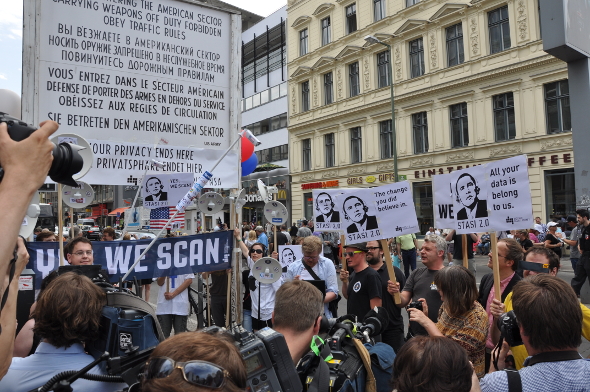
The Stasi 2.0 campaign was originally designed in 2007 to fight Germany’s mandatory data-retention law, a law implementing an EU Directive that force ISPs and telecom providers to continuously collect and store records documenting the online activities of millions of ordinary Europeans. Roughly 34,000 citizens filed a lawsuit against the mandatory data retention in protest. The campaign was successful and in March 2010 a German court declared the law unconstitutional and ordered the deletion of the collected data. Now, the Stasi 2.0 campaign has shifted focus on calling upon their government to protect them against overreach scope of NSA foreign surveillance practices, Sandra Mamitzsch from Digitale Gesellschaft told EFF.
Germany has also increased its capacity to conduct sweeping and invasive extra-territorial surveillance from its domestic soil. As we noted, the German government has leveraged its ability to remotely compromise computer systems in order to spy on its citizens. The government has used commercial malware to hack private data. While there has been no confirmation that Germany is deploying these investigative techniques against persons outside German territories, extra-territorial surveillance is feasible because infection occurs via email and other Internet transmissions.
Campaigns against the NSA spying overreach are now being planned for July 6 all around Australia. Australians can get involved here: http://ourprivacy.org.au/
Micheal Vonn, policy director at the B.C. Civil Liberties Association in Canada, told to the Global News in Canada: “[w]e fully intend to get some pointed questions to the Canadian government about knowledge, complicity, alliance with this program. And whether, in fact, very, very quietly, the Canadian security establishment has been harvesting the fruits of this program for some time.”
EFF is demanding Internet companies to join our cause and protect the privacy of their international customers calling on Congress to create a committee to uncover the truth about the NSA alarming allegations. You can take action here. Current foreign intelligence surveillance targetting foreigners must be challenged to ensure strong human rights safeguards, transparency and accountability across the world. A global dialogue on extra-territorial foreign intelligence surveillance among all nations is much needed.
EFF will continue blogging about the impact of the NSA leaks on Internet users abroad in our Spies Without Borders series. Next, we will examine what implications the government’s use of these FISA powers has for Internet users abroad, with an eye to other jurisdictions and the requirements of international law.
This is the 5th article of our Spies Without Borders series. The series are looking into how the information disclosed in the NSA leaks affect Internet users around the world whose private information is stored in U.S. servers, or whose data travels across U.S. networks.
Image: Digitale Gesellschaft, licensed under a Creative Commons BY SA 3.0 license.
Related article
Obama picks official who approved of dragnet NSA surveillance to head FBI
RT | June 21, 2013
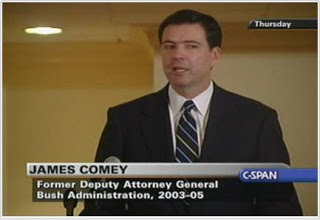 President Barack Obama announced Friday afternoon that he’s selected James Comey to head the Federal Bureau of Investigation.
Comey, 52, worked as the deputy attorney general for the United States under President George W. Bush and will replace outgoing FBI Director Robert Mueller when he steps down later this year after he is confirmed by the Senate.
All three men were on hand at the White House Friday afternoon when President Obama formally made his pick after weeks of speculation suggested Comey would be the likely nominee.
Comey, said Obama, embodies the “core principals of fidelity, bravery and integrity” expected of FBI agents and applauded “his fierce independence and his deep integrity.”
In fact, that independence is the focus of perhaps the most widely reported instance from the Bush White House involving Comey. While serving as deputy attorney general in the Department of Justice, Comey rejected the administration’s warrantless wiretapping program that has recently reemerged as the center of controversy.
“In a confrontation he has called the most difficult night of his career, [Comey] rushed to the hospital bedside of his boss, John Ashcroft, in 2004 to stop two senior Bush White House aides from getting the ailing attorney general’s approval to reauthorize a post-9/11 program that allowed government wiretaps to be used without warrants,” the Associated Press recalled this week.
Comey’s insistence in keeping the program off the books was made notwithstanding an earlier decision to favor the surveillance program, though. Glenn Greenwald reported for The Guardian last month that Comey “approved a legal memorandum in 2004 endorsing radical executive power theories and warped statutory interpretations, concluding that the Bush NSA warrantless eavesdropping program was legal, thus making it more difficult to prosecute the Bush officials who ordered it.”
The internal conflict within the administration that erupted years later over that program almost led to Comey, Ashcroft and Mueller offering their resignation, apparently. As Greenwald noted, though, the then-deputy attorney general declined to follow up on his threat after slight adjustments were made to the NSA spy program.
“But the reason they didn’t end up resigning ,” he wrote, “was because Bush officials ‘modified’ that NSA program into something those lawyers could and did endorse: the still-illegal, still-radical NSA eavesdropping program that spied on the communications of Americans without warrants and in violation of the law.”
Those practices have come under question in recent weeks after Edward Snowden, a 29-year-old former intelligence contractor, leaked documents showing the size and scope of the surveillance programs. Mr. Mueller said those disclosures caused “significant harm” to the nation’s security and that the admitted leaker is the “subject of an ongoing criminal investigation.”
“One of the great vulnerabilities terrorists understand is their communications,” Mueller told the House Judiciary Committee last week. “If we lose our ability get their communications, we are going to be exceptionally vulnerable.”
After being picked by Pres. Obama to replace Mueller on Friday, Comey said, “I don’t know whether I can fill those shoes.” Mueller was FBI chief for 12 years, making him the second-longest serving official to ever head the bureau.
Related article
US Leaves 700 troops in Jordan as CIA Trained Militants Fighting in Syria
Al-Manar | June 22, 2013
US President Barack Obama said the United States left around 700 combat-ready troops in Jordan after a training exercise in the country.soldiers in Jordan
In a letter to US House of Representatives Speaker John Boehner on Friday, Obama said that the deployment was made at the request of the Jordanian government. He stated that about 700 of the US troops deployed to Jordan as part of a military training exercise, which ended on Thursday, would stay in the country.
“The troops will stay until the security situation becomes such that they are no longer required”, Obama claimed, but provided no further details.
“This detachment that participated in the exercise and remained in Jordan includes Patriot missile systems, fighter aircraft, and related support, command, control, and communications personnel and systems,” Obama said.
This came as a report by The Los Angeles Times said CIA operatives have been secretly providing the Syrian militants with training on the use of anti-tank and anti-aircraft weapons for months.
Since the opening of a new US base in the desert in southwest of Jordan in November 2012, the CIA operatives and US special operations troops have covertly trained the militants in groups of 20 to 45 at a time in two-week courses, the report said.
The militants receive training with Russian-designed 14.5-millimeter anti-tank rifles, anti-tank missiles, and 23-millimeter anti-aircraft weapons, according to a militant commander in the Syrian province of Dara’a.
“Those from the CIA, we would sit and talk with them during breaks from training and afterward, they would try to get information on the situation inside” Syria, the report quoted the unnamed commander as saying.
The training program has also been conducted in Turkey, the report said.
Yahya Bittar, another militant commander, said the training is conducted by US, Jordanian and French operatives, adding that up to 100 militants have been sent back across the border to Syria after taking the course in Jordan over the past month.
UN rejects US claim on Syria chemical weapons
Press TV – June 21, 2013
UN experts say they do not confirm the claims by the United States, France and Britain that the Syrian government has used chemical weapons against the militants.
“We are not able to say who has used chemical agents or chemical weapons,” said Paulo Pinheiro, chairman of the United Nations human rights investigation committee on Syria, on Friday.
Speaking to reporters after an informal meeting with UN Security Council ambassadors, Pinheiro said he would not comment on evidence, including multiple blood, tissue and soil samples, that the US, Britain and France have sent to the UN about the possible use of chemical weapons in Syria.
The technical data presented by the three countries is of limited value to the UN which, according to its rules, can pass a final judgment on the situation only after its own inspectors personally collect evidence.
Based on the unsubstantiated claim that the Syrian government has used chemical weapons against the militants, President Barack Obama ordered the CIA last week to provide arms to the anti-Syrian groups, saying the government of President Bashar al-Assad had crossed Washington’s red lines.
In an article on the Washington Post on Friday, Colum Lynch and Joby Warrick write that the US move “rests on unverifiable claims” that lack transparency.
Weapons experts say Obama’s declaration of Washington’s red line in terms of more involvement in Syria “handed the Syrian opposition a powerful incentive to fabricate evidence” against the Assad government regarding the chemical arms use, the article said.
“If you are the opposition and you hear” that the White House has drawn a red line on the use of nerve agents, then “you have an interest in giving the impression that some chemical weapons have been used,” said Rolf Ekeus, a Swedish scientist who headed UN weapons inspections in Iraq during the 1990s, the article read.
Related articles
- PressTV: Russia dismisses ‘unconvincing’ US claims on chemical weapons use by Syria (jhaines6.wordpress.com)
- New weapons supplied to militants in Syria (fromthetrenchesworldreport.com)
Russia mocks Obama
The News | June 20, 2013
MOSCOW – Russia’s deputy prime minister poured cold water Wednesday on US President Barack Obama’s proposal to reduce nuclear stockpiles by a third, saying it could not be taken seriously while the United States is developing its missile defence system.
“How can we take seriously this idea about cuts in strategic nuclear potential while the United States is developing its” capabilities to intercept Russia’s weapons, Dmitry Rogozin asked. “Clearly, (Russia’s) political leadership cannot take these assurances seriously,” said Rogozin, who oversees the defence sector and the nuclear industry, according to the state-owned Itar-TASS news agency.
“The offence arms race leads to a defence arms race and vice versa,” he said, speaking after a government meeting in Saint Petersburg that focused on Russia’s defence sector. His remarks followed the call on Russia by the US president in Germany to reduce strategic nuclear weapon stockpiles by up to a third, taking them to the 1,000 weapon mark.
The previous ground-breaking cut was agreed by United States and Russia in 2010 as part of the Strategic Arms Reduction Treaty (START) that Obama signed together with then-president Dmitry Medvedev. The treaty restricts the former Cold War foes to a maximum of 1,550 deployed war heads each.
Putin and Obama had a frosty meeting at the G8 summit in Northern Ireland on Monday, and while Putin made no direct reaction to Obama’s proposal, he said Wednesday that Russia would not allow “the system of strategic deterrence to be disturbed”.
“We cannot allow the balance of the system of strategic deterrence to be disturbed or the effectiveness of our nuclear force to be decreased,” Putin said in televised remarks at the Saint Petersburg government meeting.
Disagreements over the missile shield over Europe have plagued Russia-US relations for years. Moscow sees it as directly undermining its own capabilities despite Washington’s assurances that the system focuses on regional threats like Iran and North Korea.
Obama’s Speech at Berlin’s Brandenburg Gate: Shameless Hype, Irony, Lies and Hypocrisy
Doug E. Steil | Aletho News | June 20, 2013
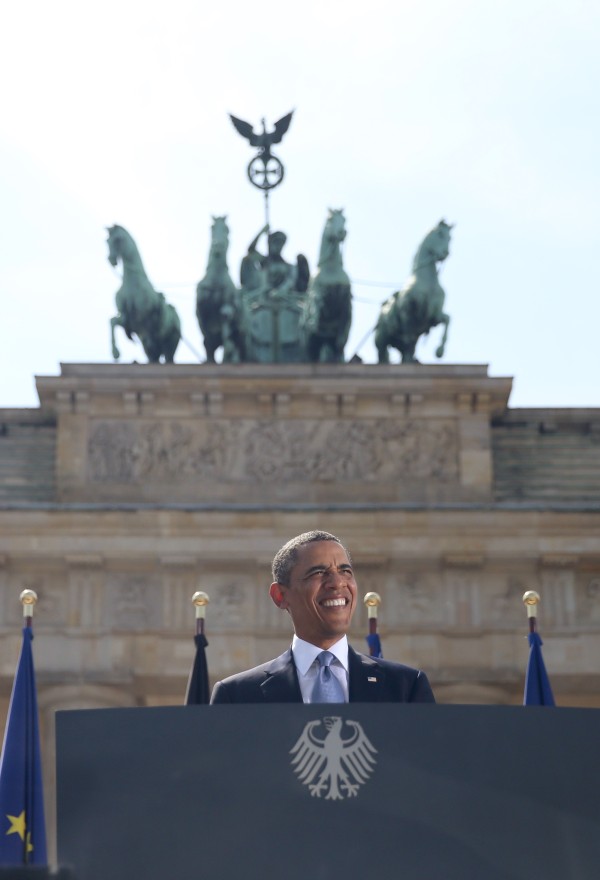 While last visiting Berlin five years ago, candidate Obama gave a speech at a central monument in Berlin amidst a huge crowd, of mainly young folks, that had been seduced through the local media projecting the notion that the new Messiah had arrived. Obama’s handlers wanted to stage that event at the Brandenburg Gate, the recognized symbol for the fall of Communism, but the request was denied by German Chancellor Merkel.
Yesterday Obama was back in town again, with his family, and staged a propaganda event at the Brandenburg Gate amidst extremely tight security that annoyed much of the local population. Beforehand, the media had announced, he would be presenting a landmark speech. Purportedly, just hours before, he was still working on the details. It’s true, imagery of the Brandenburg Gate conveys significant symbolism in the context of 20th century history, so it was not completely unreasonable to anticipate the possibility of a major political announcement, say, perhaps even a complete withdrawal of US military forces and nuclear missiles from German territory, that would surely divert attention from the numerous political scandals surrounding Obama’s regime in the past few weeks.
What Obama presented instead was nothing monumental or historic, but merely the standard repertoire of cheap platitudes, cliches, and “happy talk” that cynics and skeptics have heard far too often already. Political observers understand that, not unlike Ronald Reagan, Obama is merely a puppet for the Jewish Power Establishment, whose common interests and agenda issues he thus represents, under the clever guise of an elected figurehead, who is well trained in the art of Teleprompter delivery, small-talk, back-and-shoulder slapping his political counterparts, thus deceiving the population or lulling the people into a sense of passive complacency.
The essence of yesterday’s speech at the Brandenburg Gate, as the media duly reported, was that his regime would set a “goal” of reducing the number of active nuclear weapons (presumably in western Europe) by “up to” (i.e. no more than) one third. Very “wishy-washy” indeed! Would this even be in the news a week from now? It was evident from the various comments in the German media immediately after the speech, though polite, that prior expectations of substance had not been fulfilled. How many more times can people endure the standard references to gay and lesbian aspirations or agenda related “concerns” regarding the imaginary threat of “Climate Change” (formerly “Global Warming”)?
Particularly annoying was the manner in which Obama shamelessly elevated the now unified Berlin to a new symbol of “freedom”. The irony was inescapable, in light of recent public revelations concerning pervasive NSA spying. In 1989 the people of Eastern Germany had shaken off an odious regime that was particularly notorious for prying into the personal lives of a large segment of the population, who were deemed untrustworthy. By contrast, thanks partly to the misuse of improved technology, the Obama regime spies on the entire population, and in far greater detail, than those running the East German “Stasi” apparatus could have ever imagined. Referring to the former separation wall between east and west, he invoked the word “freedom”, amidst applause:
“No wall can stand against the yearning of justice, the yearnings for freedom, the yearnings for peace that burns in the human heart.”
Well, if that is the case — which it obviously is — then why does his regime continue funding and politically supporting the Israeli built wall, which relegates much of the Palestinian population in the West Bank in small and manageable enclaves and separates them from the rest of their territory? During his rhetorical delivery, Obama then proceeded to utter the word “freedom” sixteen additional times.
Yet, aside from that hypocrisy, one need only imagine how German efforts to attain unification during the early months of 1990 would have been handled by an Obama puppet regime, had it been in power at the time. That process of political unification, which ultimately took nearly eleven months, was triggered by the breaching of the Berlin Wall at the Brandenburg Gate spearheaded by Helmut Kohl and facilitated by President George H. W. Bush, but was not warmly received at all by leaders Thatcher, Mitterrand, or even Gorbachev and widely opposed by the Jewish Power Establishment, through editorials and other efforts, behind the scenes. This is very easy to imagine because in the past year, still fresh in our minds, Americans have been witnessing or personally experiencing the continued and thorough erosion of the basic freedoms enumerated in the Bill of Rights in conjunction with the zealous pursuit of virtually every foreign policy initiative concocted and promoted by Obama’s puppet masters, over the general objections of a general population whose opinions and interests do not seem to matter.
Nuclear weapon reductions will reduce risks, but prohibition treaty urgent
The International Campaign to Abolish Nuclear Weapons | June 19, 2013
The International Campaign to Abolish Nuclear Weapons (ICAN) welcomes President Obama’s announcement in Berlin today calling for a world without nuclear weapons and the readiness to pursue further reductions in the US and Russian nuclear arsenals. However, the humanitarian consequences of any nuclear weapon use, increasingly the focus of global engagement on these weapons, demands their prohibition and elimination.
The speech by President Obama contributes to a growing recognition that nuclear weapons are unusable weapons with no practical utility in today’s global security environment. Despite this, they threaten shocking humanitarian consequences if they were to be used. Nuclear weapons are the only weapons of mass destruction not subject to treaty prohibition and ICAN is calling for such a treaty to provide the framework for their elimination.
“The speech by Obama comes at a point where many other states, international organisations and civil society are focusing on the unacceptable humanitarian effects that the use of these weapons would create. The level of civilian harm that nuclear weapons threaten makes a treaty prohibiting their use, production and stockpiling urgent,” said Beatrice Fihn of ICAN’s International Steering Group.
2013 has already seen international discussions focused on the humanitarian impact of nuclear weapons, and broad cross regional support for this approach. Whilst the intended reductions announced by President Obama would contribute to a reduction in the risk posed by nuclear weapons, the announcement does not challenge the on-going modernisation programmes in most nuclear-armed states or the continued reliance on nuclear weapons in security doctrines.
A single nuclear weapon detonation in an urban area would kill hundreds of thousands immediately and leave hundreds thousands more in desperate need. A wider use of nuclear weapons could cause climatic changes that impair global crop production and result in people starving even in different continents from the conflict.
“The consequences of a nuclear weapon detonation will not stop at borders; it is truly a global concern no matter who possess these weapons,” says Akira Kawasaki, Executive Committee member of Peace Boat and Co-chair of ICAN. “This announcement should encourage action from all states, not only nuclear armed states and those with extended nuclear deterrence arrangements, but all non-nuclear weapon states as well. It is now time to take bold and tangible steps towards the goal of a world free of nuclear weapons by negotiating a ban.”
Related article
- Celebs push Obama to eliminate nuclear weapons (thehill.com)
The Deeper Meaning of Mass Spying in America
By James Petras | June 14, 2013
The exposure of the Obama regime’s use of the National Security Agency to secretly spy on the communications of hundreds of millions of US and overseas citizens has provoked world-wide denunciations. In the United States, despite widespread mass media coverage and the opposition of civil liberties organizations, there has not been any mass protest. Congressional leaders from both the Republican and Democratic Parties, as well as top judges, approved of the unprecedented domestic spy program. Even worse, when the pervasive spy operations were revealed, top Senate and Congressional leaders repeated their endorsement of each and every intrusion into all electronic and written communication involving American citizens. President Obama and his Attorney General Holder openly and forcefully defended the NSA’s the universal spy operations.
The issues raised by this vast secret police apparatus and its penetration into and control over civil society, infringing on the citizens freedom of expression, go far beyond mere ‘violations of privacy’, as raised by many legal experts.
Most civil libertarians focus on the violations of individual rights, constitutional guarantees and the citizen’s privacy rights. These are important legal issues and the critics are right in raising them. However, these constitutional–legal critiques do not go far enough; they fail to raise even more fundamental issues; they avoid basic political questions.
Why has such a massive police-state apparatus and universal spying become so central to the ruling regime? Why has the entire executive, legislative and judicial leadership come out in public for such a blatant repudiation of all constitutional guarantees? Why do elected leaders defend universal political espionage against the citizenry? What kind of politics requires a police state? What kind of long-term, large scale domestic and foreign policies are illegal and unconstitutional as to require the building of a vast network of domestic spies and a hundred billion dollar corporate-state techno-espionage infrastructure in a time of budget ‘austerity’ with the slashing of social programs?
The second set of questions arises from the use of the espionage data. So far most critics have questioned the existence of massive state espionage but have avoided the vital issue of what measures are taken by the spymasters once they target individuals, groups, movements? The essential question is: What reprisals and sanctions follow from the ‘information’ that is collected, classified and made operational by these massive domestic spy networks? Now that the ‘secret’ of all-encompassing, state political spying has entered public discussion, the next step should be to reveal the secret operations that follow against those targeted by the spymasters as a ‘risk to national security’.
The Politics behind the Police State
The fundamental reason for the conversion of the state into a gigantic spy apparatus is the nature of deeply destructive domestic and foreign policies which the government has so forcefully pursued. The vast expansion of the police state apparatus is not a response to the terror attack of 9/11. The geometrical growth of spies, secret police budgets, and the vast intrusion into all citizen communications coincides with the wars across the globe. The decisions to militarize US global policy requires vast budgetary re-allocation , slashing social spending to fund empire-building; shredding public health and social security to bailout Wall Street. These are policies which greatly enhance profits for bankers and corporations while imposing regressive taxes on wage and salaried workers
Prolonged and extended wars abroad have been funded at the expense of citizens’ welfare at home. This policy had led to declining living standards for many tens of millions of citizens and rising dissatisfaction. The potential of social resistance as evidenced by the brief “Occupy Wall Street” movement which was endorsed by over 80% of the population. The positive response alarmed the state and led to an escalation of police state measures. Mass spying is designed to identify the citizens who oppose both imperial wars and the destruction of domestic welfare; labeling them as ‘security threats’ is a means of controlling them through the use of arbitrary police powers. The expansion of the President’s war powers has been accompanied by the growth and scope of the state spy apparatus: the more the President orders overseas drone attacks, the greater the number of his military interventions, the greater the need for the political elite surrounding the President to increase its policing of citizens in anticipation of a popular backlash. In this context, the policy of mass spying is taken as ‘pre-emptive action’. The greater the police state operations, the greater the fear and insecurity among dissident citizens and activists.
The assault on the living standards of working and middle class Americans in order to fund the endless series of wars, and not the so-called ‘war on terror’, is the reason the state has developed massive cyber warfare against the US citizenry. The issue is not only a question of a violation of individual privacy: it is fundamentally an issue of state infringement of the collective rights of organized citizens to freely engage in public opposition to regressive socio-economic policies and question the empire. The proliferation of permanent bureaucratic institutions, with over a million security ‘data collectors’, is accompanied by tens of thousands of ‘field operators’, analysts and inquisitors acting arbitrarily to designate dissident citizens as ‘security risks’ and imposing reprisals according to the political needs of their ruling political bosses. The police state apparatus has its own rules of self-protection and self-perpetuation; it has its own linkages and may occasionally compete with the Pentagon. The police state links up with and protects the masters of Wall Street and the propagandists of the mass media – even as it (must) spy on them!
The police state is an instrument of the Executive Branch acting as a vehicle for its arbitrary prerogative powers. However on administrative matters, it possesses a degree of ‘autonomy’ to target dissident behavior. What is clear is the high degree of cohesion, vertical discipline and mutual defense, up and down the hierarchy. The fact that one whistle-blower, Edward Snowden, emerged from the hundreds of thousands of citizen spies is the exception, the lone whistle blower, which proves the rule: There are fewer defectors to be found among the million-member US spy network than in all the Mafia families in Europe and North America.
The domestic spy apparatus operates with impunity because of its network of powerful domestic and overseas allies. The entire bi-partisan Congressional leadership is privy to and complicit with its operations. Related branches of government, like the Internal Revenue Service, cooperate in providing information and pursuing targeted political groups and individuals. Israel is a key overseas ally of the National Security Agency, as has been documented in the Israeli press (Haaretz, June 8, 2013). Two Israeli high tech firms (Verint and Narus) with ties to the Israeli secret police (MOSSAD), have provided the spy software for the NSA and this, of course, has opened a window for Israeli spying in the US against Americans opposed to the Zionist state. The writer and critic, Steve Lendman points out that Israeli spymasters via their software “front companies” have long had the ability to ‘steal proprietary commercial and industrial data” with impunity. Because of the power and influence of the Presidents of the 52 Major American Jewish organizations, Justice Department officials have ordered dozens of Israeli espionage cases to be dropped. The tight Israeli ties to the US spy apparatus serves to prevent deeper scrutiny into its operation and political goals — at a very high price in terms of the security of US citizens. In recent years two incidents stand out: Israeli security ‘experts’ were contracted to advise the Pennsylvania Department of Homeland Security in their investigation and ‘Stasi-like’ repression of government critics and environmental activists (compared to ‘al Queda terrorists’ by the Israelis) – the discovery of which forced the resignation of OHS Director James Powers in 2010. In 2003, New Jersey governor, Jim McGreevy appointed his lover, an Israeli government operative and former IDF officer, to head that state’s ‘Homeland Security Department and later resigned, denouncing the Israeli, Golan Cipel, for blackmail in late 2004. These examples are a small sample illustrating the depth and scope of Israeli police state tactics intersecting in US domestic repression.
The Political and Economic Consequences of the Spy State
The denunciations of the mass spy operations are a positive step, as far as they go. But equally important is the question of what follows from the act of spying? We now know that hundreds of millions of Americans are being spied on by the state. We know that mass spying is official policy of the Executive and is approved by Congressional leaders. But we have only fragmented information on the repressive measures resulting from the investigations of “suspect individuals”. We can assume that there is a division of labor among data collectors, data analysts and field operatives following up “risky individuals and groups”, based on the internal criteria known only to the secret police. The key spy operatives are those who devise and apply the criteria for designating someone as a “security risk”. Individuals and groups who express critical views of domestic and foreign policy are “a risk”; those who act to protest are a “higher risk”; those who travel to conflict regions are presumed to be in the “highest risk” category, even if they have violated no law. The question of the lawfulness of a citizen’s views and actions does not enter into the spymasters’ equation; nor do any questions regarding the lawfulness of the acts committed by the spies against citizens. The criteria defining a security risk supersede any constitutional considerations and safeguards.
We know from a large number of published cases that lawful critics, illegally spied upon, have subsequently been arrested, tried and jailed – their lives and those of their friends and family members shattered. We know that hundreds of homes, workplaces and offices of suspects have been raided in ‘fishing expeditions’. We know that family members, associates, neighbors, clients, and employers of “suspects” have been interrogated, pressured and intimidated. Above all, we know that tens of millions of law abiding citizens, critical of domestic economic and overseas war policies, have been censored by the very real fear of the massive operations carried out by the police state. In this atmosphere of intimidation, any critical conversation or word spoken in any context or relayed via the media can be interpreted by nameless, faceless spies as a “security threat” – and one’s name can enter into the ever growing secret lists of “potential terrorists”. The very presence and dimensions of the police state is intimidating. There are citizens who would claim that the police state is necessary to protect them from terrorists – but how many others feel compelled to embrace their state terrorists just to fend off any suspicion, hoping to stay off the growing lists? How many critical-minded Americans now fear the state and will never voice in public what they whisper at home?
The bigger the secret police, the greater its operations. The more regressive domestic economic policy, the greater the fear and loathing of the political elite.
Even as President Obama and his Democratic and Republican partners boast and bluster about their police state and its effective “security function”, the vast majority of Americans are becoming aware that fear instilled at home serves the interest of waging imperial wars abroad; that cowardice in the face of police state threats only encourages further cuts in their living standards. When will they learn that exposing spying is only the beginning of a solution? When will they recognize that ending the police state is essential to dismantling the costly empire and creating a safe, secure and prosperous America?
Obama to Press Putin to Back Assad’s Removal in Syria
RIA Novosti | June 14, 2013
WASHINGTON – US President Barack Obama will attempt to convince Russian President Vladimir Putin in their planned meeting Monday that it is in Moscow’s interest to support the removal of Syrian President Bashar Assad from power, a White House official said Friday in the wake of fresh US claims that Syria has used chemical weapons.
“It’s in Russia’s interest to join us in applying pressure on [Assad] to come to the table in a way that relinquishes his power and his standing in Syria,” Obama’s deputy national security adviser, Ben Rhodes, told reporters Friday.
The United States and Russia remain at loggerheads over the ongoing civil war in Syria as Obama and Putin prepare to meet on the sidelines of the G8 Summit in Northern Ireland on Monday.
The meeting comes a day after Rhodes told reporters Thursday that US intelligence had concluded with “high confidence” that Syrian President Bashar Assad’s forces had used chemical weapons multiple times over the past year – an assessment that has prompted Obama’s decision to boost military aid to the Syrian rebels.
The chemical weapons claim was met with skepticism and derision by Russian officials.
“The Americans have tried to provide us with information on the use by the [Syrian] regime of chemical weapons, but I will be frank: The report does not seem convincing to us,” Kremlin aide Yury Ushakov told reporters in Moscow on Friday.
Alexei Pushkov, the head of Russia’s parliamentary foreign affairs committee, dismissed the US assessment outright Friday, calling its conclusions “fabricated.”
Rhodes told reporters Friday that Obama would offer an “interest-based” argument to Putin on the Syria issue during Monday’s meeting in an effort to persuade “the Russians that they can best protect their interests by being a part of a political settlement that is real and that enables a transition away from Assad’s rule.”
He added that “there are no illusions” that the talks between Obama and Putin about the Syria conflict would be easy.
“What Russia has articulated to us, and publicly, is that they don’t want to see a downward spiral, they don’t want to see a chaotic and unstable situation in the region, they don’t want to see extremist elements gaining a foothold in Syria,” Rhodes said.
Ushakov told reporters in Moscow that the United States and Russia “are not competing on Syria.”
“On the contrary, we are seeking a constructive solution to this issue which is vital for the situation in the region and the world,” he said.
Both the European Union (EU) and the North Atlantic Treaty Alliance (NATO) expressed concern Friday about the US claims of multiple chemical weapons attacks in Syria over the past year, which the White House said have resulted in 100 to 150 deaths.
“These developments can only reinforce the importance of a political solution and should accelerate the efforts of the international community to find a definitive political solution to the conflict,” Catherin Ashton, the EU’s high representative for foreign affairs and security policy, said in a statement.
NATO Secretary-General Anders Fogh Rasmussen on Friday called the US assessment “a matter of great concern,” Reuters reported.
“The international community has made clear that any use of chemical weapons is completely unacceptable and a clear breach of international law,” Rasmussen said in Brussels, Reuters said.
Meanwhile, US Sen. John McCain repeated his call Thursday for the Washington to establish a no-fly zone “to create a safe area” within Syria.
“You can’t do it with half measures. You can’t do it with just supplying weapons,” McCain told CNN.
In a conference call with reporters Thursday, Rhodes said the White House believed boosting assistance to the Syrian rebels is the most effective strategy at this point, saying a no-fly zone “would carry with it great and open-ended costs for the United States and the international community.”
“It’s far more complex to undertake the type of effort, for instance, in Syria than it was in Libya,” Rhodes said.
The Syrian government on Friday called White House claims about the use of chemical weapons in Syria “a statement full of lies based on fabricated information.”
Both sides in the ongoing Syrian civil war have traded allegations of chemical weapons use, with government officials accusing opposition forces of using chemical weapons against Assad’s military in a March attack outside of the northern city of Aleppo.
Some 93,000 people are believed to have died since fighting broke out between Syrian government forces and rebels in March 2011, according to the latest UN figures.
Featured Video
Seyed M. Marandi: Toward Total War in the Middle East
or go to
Aletho News Archives – Video-Images
From the Archives
The Geopolitics behind the War in Yemen (I)
By Mahdi Darius NAZEMROAYA | Strategic Culture Foundation | 30.03.2015
The United States and the Kingdom of Saudi Arabia became very uneasy when the Yemenese or Yemenite movement of the Houthi or Ansarallah (meaning the supporters of God in Arabic) gained control of Yemen’s capital, Sanaa/Sana, in September 2014. The US-supported Yemenite President Abd-Rabbuh Manṣour Al-Hadi was humiliatingly forced to share power with the Houthis and the coalition of northern Yemenese tribes that had helped them enter Sana. Al-Hadi declared that negotiations for a Yemeni national unity government would take place and his allies the US and Saudi Arabia tried to use a new national dialogue and mediated talks to co-opt and pacify the Houthis.
The truth has been turned on its head about the war in Yemen. The war and ousting of President Abd-Rabbuh Manṣour Al-Hadi in Yemen are not the results of «Houthi coup» in Yemen. It is the opposite. Al-Hadi was ousted, because with Saudi and US support he tried to backtrack on the power sharing agreements he had made and return Yemen to authoritarian rule. The ousting of President Al-Hadi by the Houthis and their political allies was an unexpected reaction to the takeover Al-Hadi was planning with Washington and the House of Saudi. … continue
Blog Roll
 Aletho News
- Defeating Russia on battlefield impossible – Fico
- Finland’s Gender Clinic Reversal
- Massachusetts Wants Mental Health Visits, Why Does Government Use ‘Health’ to Enter Our Homes & Families?
- US lawmaker admits American people footing bill for Trump’s failed aggression against Iran
- Pfizer Gave $500,000 to Groups That Lobbied to End Religious Exemption in Massachusetts
- HE SAVED LIVES. NOW HE FACES PRISON.
- Israeli lobby seeks to bind US fate to ‘Israel’: Araghchi
- Pakistan-Iran talks secure LNG shipment to Islamabad through Hormuz
- Black Sea grain crisis puts global wheat supplies under pressure
- IRGC air defenses destroy another US MQ-1 drone over Strait of Hormuz
- If Americans Knew
- Israeli Attacks in Gaza Kill at Least Seven Palestinians Over Three Days, including Woman and Child
- Trump’s militarization of Washington DC as he pursues Israel’s war against Iran
- Why Israel Fears This Searing New Documentary
- Huckabee aide solicited cash gifts from Israelis
- This isn’t sci-fi, AI is already killing people
- ‘The Most Brutal Thing’: Investigation Reveals Execution of Elderly Woman in Rafah
- Inside Israel’s ‘soft’ ethnic cleansing plan for Gaza through the eyes of its victims
- New online database tracks pro-Israel political donations in the United States
- Israeli president pardons soldier convicted for killing wounded Palestinian
- Singer Ed Sheeran says his ‘heart broken’ by Gaza devastation, addresses Macklemore controversy
- No Tricks Zone
- 2025 Nature Paper Claiming Worsening Global Drought Gets RETRACTED …Heavily Flawed
- New Study: ‘Global Drought Shows No Detectable Recent Acceleration Under Climate Warming’
- Economic Masterminds: German Socialists Suggest Taxing Productivity Gains Stemming From Using AI
- The South China Sea Has Not Been Cooperating With The Climate Change Narrative
- Energy Crisis: Germany Enters Heating Season With Historically Low Gas Reserve Fill Levels
- New Study: The Antarctic Ice Sheet Gained Mass From 2020-2024 Due To Staggering Snow And Ice Accumulation
- Study: Ocean Heating Rates From Thousands Of Years Ago ‘Dwarf’ Modern Ocean Heating Rates
- Climate Extremists Target, Attack Large-Scale Power Grid Infrastructure In Germany!
- New Study: Antarctic Ice Melt Has Contributed Less Than 1 Centimeter To Sea Level Rise In The Last 30 Years
- Fear Of Debate: Alarmist German Climate Scientist Calls On Mainstream Media To Discredit Skeptic Voices
 Aletho News