Israel propaganda trips target ‘Pacific Progressive Leaders’ – no one will say who’s going

The Israel lobby is working to woo people like Andrea Beth Damsky, second from right. Damsky, active in numerous progressive causes, is a member of the La Mesa, California Environmental Sustainability Commission and on the California Democratic Party Executive Board. She was taken on an all-expenses-paid trip to Israel.
By Alison Weir | If Americans Knew | December 8, 2018
An Israel lobby organization is taking “Pacific Northwest Progressive Leaders” to Israel today on an all expense-paid propaganda trip to Israel. Another group just returned on December 2nd from a similar trip, officially billed as an “Educational Seminar in Israel for Southern Pacific Progressive Leaders.” No one will divulge the rosters.
The sponsoring organization is the American Israel Education Foundation (AIEF), a tax-exempt organization that serves as an arm of the powerful Israel lobbying organization AIPAC (American Israel Public Affairs Committee).
Roll Call reports that the AIPAC and AIEF “share leaders, employees and money.” They also share the same address and phone number.
AIPAC used to sponsor such tours itself until it became illegal for lobbying organizations to organize these. A “charitable” arm, AIEF, was then formed to continue the practice. While such trips are now “legal,” they appear to violate the spirit of the law.
Craig Holman of the watchdog group Public Citizen told Roll Call: “The purpose of the 2007 travel restrictions was to remove these types of sponsored trips. Most of these trips tend to be nothing but an extension of lobbying. “ Unfortunately, Holman explains, “When it came to negotiating the travel rules regarding privately funding trips, a huge gaping loophole was written in to exempt nonprofits. … I call it the ‘AIPAC loophole.’”
Israel advocacy organizations have exploited this loophole intensively.
Tailored trips
AIEF is an $85 million operation that takes thousands of American officials and opinion makers on all expense paid trips. It pays for their international flights, hotel accommodations, tourist excursions, meals, drinks, etc. Roll Call estimates the cost of a trip for one Congressional representative to be $10,000.
And AIEF is just one of the many pro-Israel organizations that do this; some others are the American Jewish Committee’s Project Interchange, Passages Israel, (backed by hedge fund billionaire Paul Singer), the Jewish Public Affairs Committee of Northern California (JPAC), and the American-Israel Friendship League, which has been operating since 1971 and largely targets young people. Last year it gave a special award to potential presidential candidate Michael Bloomberg. A fundraising video featured former Secretary of State Henry Kissinger, New York Times columnist Bret Stephens, Elie Wiesel, and others (see below).

A fundraising gala for the American-Israel Friendship League
These and other groups organize tours for every sector of American society, tailoring the trips carefully for each group. There are trips for military veterans, business leaders of all races and ethnicities, educators, athletes, students, etc, and every level of political office.
They treat each chosen group to an exotic, extravagant tour replete with visits to historic sites, exciting night life, beaches, religious sites, official offices, academics; whatever will appeal to the group members. There are meetings with congenial, impressive Israeli hosts of the political and social category that will best fit the visiting delegation, and the meetings even include a few hand-picked “Palestinian representatives” and Druze Israelis who play their role in the skillfully crafted tours.
And through it all those with political, professional, and/or economic ambitions will pick up something more: this is a group that has the money and power to further their careers. The particularly astute trip members will also pick up the converse: this is not a group to alienate.
Such trips are oddly public and secretive at the same time.
On the one hand, there are numerous videos extolling the sponsoring groups’ power and the trips’ effectiveness; diverse, wide-eyed Americans are seen being shown around Israel, and then, on cue, these American visitors describe how much they’ve learned and how wonderful Israel is (see below).
At the same time, however, the trips are sometimes run with extraordinary secrecy. AIEF’S website contains only one paragraph and an email address to contact for information. When we wrote asking who was going on the upcoming delegation for progressive leaders, the response was: “We don’t publicize our trip rosters.” Phone calls were unreturned.
The progressive participants were also unforthcoming about the delegations’ composition; some refused to provide this information, others pled ignorance. None of the participants seem to have publicly announced their trips ahead of time, perhaps aware that many progressive voters today are aware of Israel’s record of brutality against Palestinians, as described by former Israeli soldiers, documented in videos, and reported by human rights organizations.
The California participants
So far we’ve only identified three of the participants on the current progressive trips.
Andrea Beth Damsky – a member of the La Mesa Environmental Sustainability Commission and member of the California Democratic Party executive board and credentials committee – went on the November 24-December 2, 2018 trip for “Southern Pacific Progressive Leaders.” Contra Costa County Supervisor John Gioia and Santa Clara Supervisor Joseph Simitian are going on the December 8-16 trip.
(Simitian also went on a lobby sponsored trip to Israel in 2005, when he was a Democratic state legislator. He is already in Israel, apparently having departed on Wednesday. It is unknown why Simitian left early and whether AIEF is paying for the extra days, or whether Simitian is paying his own way.)

John Gioia – backrow, glasses blue suit jacket & jeans. From his Facebook page

Santa Clara County Supervisor Joe Simitian with farmworkers – photo on his campaign page
While it seems implausible that public elected officials would go on a trip without knowing the names of any other participants, staff members at both offices say they “have no idea” who’s going on the delegation. Damsky would not reveal which public officials were on her trip.
While not everyone is taken in by tours organized by advocacy organizations, the probability is that many will be influenced by them, some significantly. That, of course, is why groups like IEAF shell out millions of dollars for them.
Damsky herself says: “I feel more educated on the issue than I did before.”
When asked if she would go on a trip organized by a group without a pro-Israel agenda, she said she would. However, she said she couldn’t afford to pay for such a trip herself and that the trip would have to be paid for by others.
And that’s the stumbling block.
Palestine solidarity groups don’t have anywhere near the astronomical budgets of the multi-billion dollar Israel lobby.
Therefore, it would seem, those with the most money will provide the free trips, and call the shots on this, as in so many other issues – unless Americans do four things:
Actions to take
(1) Prohibit public officials from going on trips paid for by others. Congress tried this before; now it’s time to close the loophole. If government officials are going to take trips, let them pay for them out of their own pockets. Until such legislation is forthcoming, there are additional steps that can be taken:
(2) Require transparency from our public officials. They should be required to announce these trips publicly and divulge the details. American tax-exempt corporations should be required to reveal the details of the free tours they provide, including the names of those going on them.
(3) Require fairness. Voters should demand that officials who have gone on such lobby funded junkets afterward meet with people beyond the Israel advocacy crowd, so that they can learn facts the pro-Israel tours may have left out.
For example, some of the reports that came out while the southern delegation was in Israel included the fact that Doctors Without Borders reported that more than1,000 Gazans shot by Israel are at risk of infection, which could lead to permanent disabilities or death; Israel’s Shin Bet admitted the use of torture, and a number of human rights groups have documented the “routine use of torture” by Israeli forces; a report found that Israeli settlers, with IDF complicity, have destroyed 800,000 Palestinian olive trees since 1967.
Such post-trip meetings could inform these progressive officials that Israel was founded – in the words of an Israeli historian – by ethnic cleansing, that its settlements are illegal under international law, and that a typical day for Palestinians looks like this. Officials could be shown a list of those killed and learn about the victims:
Given that the Israel trips last a week or longer, the post-trip meetings should take place over a similar time frame and be accorded equal attention.
It seems possible that Damsky, Simitian, and Gioia would be willing to take part in such meetings, especially if they are invited publicly. These are individuals with a record of caring about human rights and indigenous peoples, and who oppose discrimination and oppression; if so, they will not refuse to learn about the plight of Palestinians.
Damsky, who is Jewish, has already suggested that she would meet with other groups, and Supervisor Gioia has stated that he wishes to learn the full facts. In an email response to questions for this article, he wrote: “My goal in this trip is to hear from many individuals, ask hard questions and critically learn. My learning will not end when the trip is done. I intend to continue to read and speak with those who hold positions on the issue.” Their contact information is below.
Trip participants’ contact info:
Supervisor John Gioia: 510-231-8686 / John.Gioia@bos.cccounty.us
Supervisor Joe Simitian: 408-299-5050 / 650-289-9038 Twitter
Andrea Beth Damsky: 619-884-7918 / abdamsky@yahoo.com
Finally, there is a fourth action that Americans can do about these influence buying trips, and this one is probably the most important:
(4) Support politicians who do not give in to Israel lobby pressure.
Many politicians go on these tours because they feel they have no choice – and they may be right. If they fail to dance to the Israel tune, there is a large likelihood that their opponent will get the money, organization, and media support that is usually required to win an American election.
Until and unless Americans who desire fairness, peace, and justice in Israel-Palestine help on political campaigns and make their wishes known at the ballot box, politicians of all backgrounds will continue to go on these trips, Israel will continue to get American tax money and support, and the tragedy will continue.
Ultimately, it’s up to all of us.
Alison Weir is executive director of If Americans Knew, president of the Council for the National Interest, and author of Against Our Better Judgment: The Hidden History of How the U.S. Was Used to Create Israel.
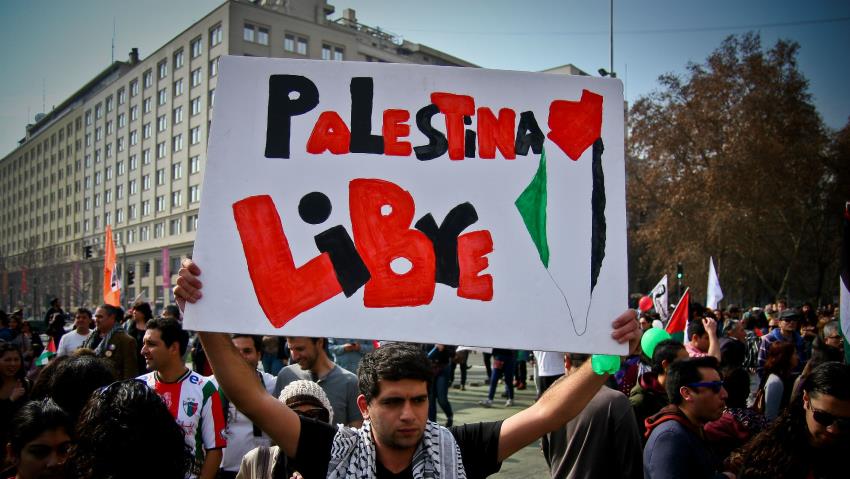
While Israel Lobby Blocks BDS in Chile at the Local Level, National-Level BDS Looms
By Whitney Webb | Mint Press News | December 7, 2018
SANTIAGO, CHILE — After the Chilean city of Valdivia became the first municipality in Latin America to support the non-violent Boycott, Divest and Sanctions (BDS) movement this past June, the Chilean government has now ruled that it is illegal to boycott Israel at the municipal level throughout the entire country.
The decision was made by Chilean Comptroller Jorge Bermudez Soto on Wednesday after a long legal battle initiated by the Jewish Community of Chile (Comunidad Judía de Chile) over Valdivia’s decision to boycott Israel.
In June, Valdivia unanimously adopted a measure that specifically declared the municipality as an “Apartheid Free Zone” and prohibited the city from working with any business that benefits or is linked to Israel’s occupation of Palestine and/or Israel’s apartheid policy that targets Palestinians.
According to the text of the declaration, the ban on working with such businesses would remain in effect until Israel ends its occupation of Palestine and dismantles the border wall; until Palestinians are granted fundamental human rights by the Israeli state and are treated as equals under Israeli law; and until the right of return of Palestinian refugees is granted, as stipulated by UN Resolution 194. The initiative had been personally introduced by the city’s mayor, Omar Sabat, who is of Palestinian descent.
However, Bermudez Soto – in representing Chile’s national government – determined on Wednesday that, though the Chilean Constitution gives local governments independence on some matters, the head of the Chilean state has the exclusive right to conduct relations with foreign powers. As a result, Valdivia’s boycott of Israel was determined to be illegal.
Bermudez Soto also went on to state that Valdivia’s boycott violated Chilean law for failing to treat anyone participating in a government bidding process in an “equal and non-discriminatory” fashion. Most importantly, Bermudez Soto noted that this decision applies not only to Valdivia but to all Chilean municipalities, making it illegal to support BDS at the municipal level in Chile. As a result, the decision has made Chile the first country in Latin America to ban support for BDS at the local level.
Bermudez Soto’s language in his decision echoes the four legal complaints filed against Valdivia in June by various Zionist organizations in Chile and abroad. The Jewish Community of Chile, which filed three out of the four complaints, argued that Valdivia’s ban on services linked to the Israeli occupation of Palestine or illegal Israeli settlements violated Chilean laws on equality as well as discrimination in economic matters.
Powerful Zionist forces made Valdivia a target
Unsurprisingly, the Jewish Community of Chile has praised the move, claiming that it is the first step in creating a “Chile free from BDS.” Zionist organizations in the U.S. — including StandWithUs, whose controversial behavior was detailed in a recently leaked Al Jazeera documentary — have praised the Chilean government’s edict as “an example for the rest of the world.”
The Jewish Community of Chile is one of the most powerful organizations of the Zionist lobby in Chile, as it is the Chilean branch of the World Jewish Congress (WJC), an influential international Zionist organization that regularly hosts events with the Israeli government and supports illegal Israeli settlements in the occupied West Bank. The group’s current chairman is David de Rothschild and one of its vice presidents is Argentinian real estate magnate Eduardo Elsztain, who is very close to controversial Hungarian-American billionaire George Soros.
WJC, as evidenced by the presence of several billionaires on its leadership board, is extremely well-funded, with its U.S. offices alone reporting an annual revenue in excess of $22 million. Given the Jewish Community of Chile’s direct association with WJC, it is safe to assume that WJC helped foot the bill for the nearly six-month legal battle aimed at derailing Valdivia’s decision to support BDS in June.
Notably, without this legal action taken by the Jewish Community of Chile and other Zionist lobby organizations in Chile, the June decision to support BDS by Valdivia – a city whose population is under 150,000 – would have likely gone unchallenged.
Prospects good for national BDS action
While the declaration of the illegality of BDS support at the municipal level is being treated by Zionist groups within Chile and beyond as a “BDS fail,” other recent actions at the national level in Chile suggest that Chile could soon follow Ireland and become the next country to support BDS as a nation.
On November 27, the Chilean Congress approved a resolution demanding that the Chilean government “forbid the entry of products manufactured and coming from Israeli colonies in occupied Palestinian territory,” in a vote with 99 in favor and seven against. The resolution mandated that the government explore how a boycott could be implemented nationwide, an important step towards the future passage of a nationwide boycott of Israel. It also recognized East Jerusalem as the capital of Palestine and accused Israel of being an apartheid state.
Given that the recent decision by Chile’s comptroller to make municipal support for BDS illegal relied on the lack of authority Chilean cities have in regards to foreign relations, the nationwide BDS law – which has a good chance of passing Chile’s Congress – could soon deliver a much larger victory for Palestinian rights activists — and one that could not be challenged on the same grounds that were used to nullify Valdivia’s support for the BDS movement.
Whitney Webb is a staff writer for MintPress News and a contributor to Ben Swann’s Truth in Media. Her work has appeared on Global Research, the Ron Paul Institute and 21st Century Wire, among others. She has also made radio and TV appearances on RT and Sputnik. She currently lives with her family in southern Chile.
The Zionist Circular Maze
By Gilad Atzmon | December 7, 2018
On Thursday Israel cheered as the EU called on its member states that have not yet done so “to endorse the non-legally binding working definition of antisemitism employed by the International Holocaust Remembrance Alliance (IHRA).”
Israel called this move a “breakthrough,” the European Jewish Congress hailed the declaration as “unprecedented.” Both are correct: the Europeans ‘adoption of the IHRA definition of antisemitism is both a ‘breakthrough’ and ‘unprecedented.’ It confirms that Europe has explicitly abandoned its Athenian ethical ethos.
Rather than declaring its opposition to racism as a universal precept and denouncing all forms of discrimination and prejudice against any group or person of any X’ simply for being X’ (for example, a Jew for being a Jew, a Black person for being Black, a Gay person for being Gay, etc.), the EU has fallen into the most banal trap and subscribed to the primacy of Jewish suffering.
A lot has been written criticising the IHRA definition, how it stifles free speech and treats one particular group as exceptional but I think we have failed to address the most important question the IHRA raises. Why are Jewish institutions so enthusiastic about a definition that clearly extinguishes the Zionist promise to make ‘Jews people like all other people.’ The IHRA validates the vile antisemitic claim that Jews are somehow different than others, as no other people have advocated for nor benefit from an IHRA-like definition of prejudice directed solely against them. One should wonder why Jewish institutions see a need to impose such a definition on individuals, organisations, states and even continents.
The answer is circular. Jewish institutions need the IHRA definition simply because they have managed to impose such a definition — since the acceptance of the IHRA definition points at boundless political power, the IHRA definition serves to target and suppress any exploration, discourse or even discussion of such power.
This reflexive reasoning recalls the old rude joke; ‘why does a dog lick its testicles? Because it can.’ Why does the Lobby impose the IHRA definition on us? Because it can.
I wish the effects were merely so simple. The dog joke is amusing because it hints that if men could indulge in a similar gratifying act, the world would be somehow calmer and friendly like the happy dog. The joke is basically a comical illustration of Freud’s pleasure principle. But the IHRA definition is neither funny nor pleasing. It is hardly gratifying for those who have endorsed it, and in some cases its adoption has involved a chain of abuse and harassment (in the British Labour Party, for instance). While the dog is thrilled or titillated by his own act, it is not clear whether Europeans and Americans are at all happy to have to endorse a ‘non legally binding definition’ imposed on them by a powerful foreign lobby. It is reasonable ask why the EU Council has adopted a non universal definition of racism. It has done so because it doesn’t have another option.
This state of affairs is far from simple, harmonious or peaceful. It is in fact, pretty much a situation that incites instability, fear and anger.
Israeli forces demolish Palestinian primary school in al-Khalil

IMEMC News | December 5, 2018
Israeli soldiers invaded, Wednesday, the Sammoa’ town, south of Hebron, in the southern part of the occupied West Bank, and demolished a Palestinian school.
Media sources in Hebron said the soldiers surrounded Seemia area, north of the Sammoa’ town, and declared it a closed military zone, preventing the Palestinians from entering it.
They added that the soldiers then used their armored bulldozers to demolish the Tahadi 13 small school of several classrooms and their facilities.
The school was sponsored by the Palestinian Ministry of Education through European funding, with a total cost of 40,000 Euros, and was supposed to open in two days.
The Ministry of Education denounced the ongoing Israeli violations, targeting educational facilities and students, and added that the school is located in Area C of the West Bank, under full Israeli military and administrative control.
The school was built to make it easier for students in that area to reach it, especially due to Israeli military roadblocks and restrictions imposed by the military in various areas of Hebron.
It is worth mentioning that the soldiers have demolished many Tahadi schools in that same area, and other parts of the West Bank, as part of Israel’s illegal attempts to confiscate the lands to use them for military purposes and colonialist activities.
The ethnic cleansing of Palestine continues in Fasayil
International Solidarity Movement in coordination with Jordan Valley Solidarity | December 4, 2018
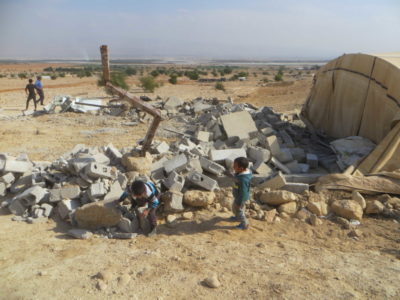
Fasayil al Wusta, Occupied Palestine – The ethnic cleansing of Palestine continues. Dunum by dunum, village by village, house by house, the people of Palestine face a slow, systematic genocide in their homeland. Two houses were demolished in the south of the Jordan Valley, in the village of Fasayil, on Sunday morning. The Israeli government did not issue a warning. The village of 1,300 people has been facing Israeli assaults on their land since the early seventies, with the construction of two settlements on either side, and a huge farmland in front of them, all less than a kilometre away.
But it was in 2010 that the Israelis came and virtually destroyed the entire village of Fasayil al Wusta. The residents have, since then, built the village back up.
Hassan Mohammed Hussein A´Zayed built a house for his son, who suffers from mental disabilities, and is sensitive to hot weather. “That house cost me 15,000 shekels to build, not only because of building materials, but because of the air conditioning (unit),” he said. The house only lasted one year before it was bulldozed on Sunday, the AC unit along with it.
A few metres in front of the newly destroyed house, one can see at least three other piles of rubble that used to be housing units, all belonging to Hassan. This was the seventh time a house of his was demolished. “They keep destroying them. Sometimes with warning, sometimes not. It´s a random policy. There´s no way of knowing what they´re going to do.” Hassan has 8 children.
Aeman Rashaeda, father of four, whose wife teaches at the nearby school, was the next to lose his house, on the same road as Hassan´s. When the Israelis approached him, they told him that it was forbidden to build, and that he was living in a closed military firing zone.
When the complete destruction of the village took place 8 years ago, 10 families immediately fled. This is a village that receives only 1,500 litres of water for each household per week; that can never get a permit to farm or build; that cannot dig a well deeper than 150 meters, enforced by Israeli occupation law.
Before the 1967 invasion of the West Bank, this village shared water from a natural spring 4 kilometers up a nearby mountain. It has, since then, been surrounded by 3 Israeli wells – the water now privatised – controlled for settler use. 60 percent of the Jordan Valley has been closed by the Israeli occupation for “military firing and security zone(s)”, but it´s been well known for years to have actually been used for agribusiness. Pick any one feature of the military occupation of the Palestinian West Bank, and you will find a policy of theft, of racism, of genocide.
To be Remembered
By Gilad Atzmon | December 4, 2018
 George H.W. Bush, the 41st president of the United States, died last Friday. President Bush was loved by the Jews. Over the weekend we saw an endless parade of Jewish individuals and organisations paying homage to Bush for his commitment to Israel and to the Jews.
The Republican Jewish Coalition (RJC) described Bush as “a great friend of Israel, the Jewish people, and the RJC.” The group joined other Jewish voices in noting the work Bush did to help bring Jews from the former Soviet Union and Ethiopia to Israel as well as his actions to help ensure the safety of Israel. Bush also led the effort in the UN to repeal the ‘Zionism is Racism’ resolution and he stood up against Saddam Hussein who, at the time, was one of the last Arab leaders to oppose Israel and Zionism.
Yet, it was the photo of Bush at the Wailing Wall that grabbed my attention. On Saturday, the Israeli press circulated a photograph of the 41st president in suspiciously intimate proximity to the Wailing Wall.
We have seen variations of this photograph so many times that we have forgotten to ask the critical questions: What attracts world leaders to that wall? Is it possible that our world leaders are all (somehow) so libidinally attracted to walls that they do not even mind being caught on camera in such an intimate moment with that one particular wall? And if not, how do we explain the fact that so many of our world leaders are caught so close to that Jewish wall with their eyes closed? And more crucially, what is it about the Zionist culture that inspires this demand to publicise powerful goyim kissing the sacred wall?
Every world leader including the future British king who has visited Israel in the last decades has been photographed kissing, touching, flirting and even talking to that wall. Today I ask Why? It is likely that our incredibly lame world leaders do not understand the powerful symbolism of their visit to the wall nor do they grasp the reason they are then led to a formal ceremony at Yad Vashem. For the Israelis and Zionists, the visits to the wall and Yad Vashem are a significant affirmation of the Jewish national narrative. Both locate the Zionist project within an historical context.
Yad Vashem tells the Goyim’s leaders what happens to Jews when they do not have a safe haven. Yad Vashem reenforces the primacy of Jewish suffering and legitimises, at least in the Zionist psyche, the plunder of Palestine. The Wailing Wall is used to illustrate the Jewish ‘continuum’ in Palestine. It conveys the unfounded message that the Jews who returned to Palestine in the 20th century are the offspring of the Hebrews who lived there two centuries ago.
Israel is not the only state that integrates visits to shrines and holy places into its state’s ceremonial procedure for visitors. Islamic countries often expect world leaders to visit their great mosques. Hindus escort their guests to their shrines. People like to impress state visitors with the greatness of their heritage and the aesthetic and spiritual depth of their culture. But they do not expect world leaders to be photographed making love to their shrines or to their mosque’s walls. No other countries whether Muslim, Christian, Buddhist or Hindu expect world leaders to subscribe to or worship their local religious symbols. But the Jewish State does. It is even brazen enough to dress world leaders in Yarmulkes.

Canadian Jewish News Promotes ‘Terror Tourism’

By Yves Engler | Palestine Chronicle | December 3, 2018
What should we make of a media outlet that praises those who join or give money to a foreign army, which occupies territory belonging to another people, terrorizes the local population by destroying houses, restricting their movement, subjecting them to military courts and shooting unarmed protesters?
What should we call the Canadian Jewish News, an unfailing flatterer of Canadians who join or finance a military subjugating Palestinians? Would “promoter of terror tourism” be an appropriate description?
Over the past month the CJN has published at least four pieces celebrating Canadian support for the Israeli military. On November 22 it reported, “Bayli Dukes, who recently won the Israel Defence Forces’ Award of Excellence for the Southern Command of the IDF, was a biology student at York University in Toronto less than two years ago. Tired of sitting on the couch and posting on Facebook about the situation in Israel, she decided there was more she could be doing.”
A day earlier it posted an article titled “Hand-knitted tuques – a very Canadian gift for IDF soldiers” described 80-year olds in Toronto knitting “for charitable causes, such as IDF soldiers in Israel.” Through the Hats for Israeli Soldiers initiative “more than 50,000 hats have been made for combat soldiers on Israel’s front lines”, the CJN reported. The paper quoted IDF soldier Dovid Berger’s thank you letter. “I’m currently a chayal in the 51st brigade of Golani. We are now on our way to a week-long drill in the cold and wet [occupied Syrian] Golan Heights, and last night we received our beautiful black hats you sent us. Thank you so much, some of us have been borrowing each other’s hats and now there’s enough for everyone to have at least one. It really makes a big difference to us to see how people from Canada and the U.S.A. (and everywhere in the world) are really caring about us.”
A photo in its November 14 print edition was titled “Honouring IDF veterans”. The caption read: “former Israeli defense minister Moshe Yaalon … makes presentation to Montrealers who served in the Israel Defence Forces…. during the Canadian Institute for Jewish research’s 30th anniversary Gala.”
An October 30 piece in the community paper reported, “former NHL player Keith Primeau was among more than 100 Canadians who cycled through Israel over five days this month, to raise funds for disabled veterans in that country. This was the 11th Courage in Motion Bike Ride, which is organized by Beit Halochem Canada.”
The CJN regularly promotes that organization. A search of its database for “Beit Halochem” found dozens of stories about fundraisers and other initiatives supporting Aid to Disabled Veterans of Israel. A 2009 story titled “Israeli veterans enjoy 24th visit to Montreal” reported, “the annual visit was sponsored by the 25-year-old Beit Halochem Canada (Aid to Disabled Veterans of Israel), which raises funds for Israel’s Beit Halochem, a network of centres that provide therapy and support to more than 51,000 disabled vets and victims of terror.”
Another military initiative CJN promotes is Israel Defence Forces Widows & Orphans, which is partly funded by the Israeli government. “I served three years in the Nahal Brigade. I was in Lebanon, the West Bank and the Gaza Strip”, Shlomi Nahumson, director of youth programs at Widows and Orphans, told the paper in advance of a Toronto fundraiser for the group.
Another military initiative popular with CJN is Sar-El, which was founded by Israeli general Aharon Davidi in 1982. “Toronto brothers volunteer for Sar-El at height of war”, “91-year-old volunteers on Israeli army base” and “Toronto artist’s mural unites Israeli army base” are a sampling of the headlines about a program in which about 150 Canadians serve each year as volunteers on Israeli army supply bases.
At least a dozen CJN stories have promoted the Association for the Soldiers of Israel in Canada. “IDF represents all Jews, female general says” and “Community shows support for Israeli soldiers”, noted headlines about a group established in 1971 to provide financial and moral support to active duty soldiers. The later story quoted a speaker claiming, “the IDF saves lives, and not just in Israel — all over the world.”
CJN has published a series of stories sympathetic to Tzofim Garin Tzabar, which recruits non-Israeli Jews into the IDF. A 2004 article about a program supported by the IDF, Israel Scouts, Jewish Agency and Ministry of Absorption was titled “Canadian youths serve in IDF: Motivated by Zionist ideals, love of Israel.” It reported, “[Canadian Yakov] Frydman-Kohl is attending tank school at an Israeli army base somewhere near the West Bank town of Jericho. He recently completed a course in advanced training before his first deployment somewhere in the Gaza Strip.”
CJN lauded Heather Reisman and Gerry Schwartz’ Heseg Foundation for Lone Soldiers. “Philanthropists aid Israeli ‘lone soldiers’”, was the title of one story about the billionaire Toronto couple providing millions of dollars annually for these non-Israeli soldiers.
More generally, the paper has published numerous stories about Canadian ‘lone soldiers’. “Going in alone: the motivations and hardships of Israel lone soldiers”, “Parents of ‘lone soldiers’ discuss support group” and “Lone soldiers: young idealists and worried parents”, detailed Canadians fighting in the Israeli military. They’ve also publicized numerous books about Canadian and other non-Israelis joining the IDF. In one CJN quoted Abe Levine, an Ontarian who helped drive Palestinians from their homes in 1948, saying, “what I don’t understand is why Israelis don’t send 10 rockets back for every one fired from Gaza.” The story continued, “during his time in the Machal [overseas military volunteers], Levine saw most Arabs as ‘the enemy.’ Though he said he had lines he would not cross – ‘I wouldn’t kill an Arab if I just saw him standing outside his house.’”
CJN promoted Nefesh B’Nefesh’s (Jewish Souls United) recruitment of Canadians to the IDF. “Nefesh B’Nefesh brings aspiring soldiers to Israel”, noted a headline about a group that facilitates “Aliyah” for those unsatisfied with their and their ancestors’ dispossession of First Nations and want to help colonize another indigenous people.
While CJN provides positive publicity to groups promoting the Israeli military, these groups (often registered Canadian charities) finance the paper. The previously mentioned story about Nefesh B’Nefesh ended with “the reporter’s trip was partly subsidized by Nefesh B’Nefesh.” More significantly, these organizations regularly advertise in the paper. “Express your Zionism by serving as a civilian volunteer on an Israeli army supply base”, read a Sar-El ad while another noted “the Association for the soldiers of Israel invites you to show your support for the brave youth of the IDF at our gala dinner.”
Yet, while it promotes joining and financing a military actively killing Arabs, CJN accuses Palestinian Canadians of supporting terrorism. An August headline noted, “Canadian Arabic-language newspaper criticized for pro-terrorist op-ed” while a 2017 one stated, “B’nai Brith wants a Mississauga teacher fired for backing terrorists”.
The hypocrisy is glaring. While CJN accuses others, it may be this country’s biggest promoter of “terror tourism”.
– Yves Engler is the author of Canada and Israel: Building Apartheid and a number of other books. Visit his website: yvesengler.com.
No connection between Judaism and Al-Aqsa, suggests UN resolution

Muslims arrive at Al-Aqsa Mosque Compound to perform the Friday prayer in Jerusalem on 26 October 2018 [Mostafa Alkharouf/Anadolu Agency]
MEMO | December 3, 2018
The UN General Assembly has apparently rejected any connection between Judaism and the Noble Sanctuary of Al-Aqsa. In a vote held on Friday, the General Assembly passed six resolutions condemning Israeli violations against Palestinians. Among them was Resolution A/73/L.29 entitled “Jerusalem” which called for “respect for the historic status quo at the holy places of Jerusalem, including the Haram Al-Sharif.”
The use of the Arabic name for the sanctuary has been interpreted as a not-so-subtle rejection of the site’s alleged connection with Judaism. The Jewish name for the Noble Sanctuary, the Temple Mount, is not mentioned anywhere in the UN document.
The resolution received 148 votes in favour and just 11 against. It also stressed that the UN General Assembly,
“Reiterates its determination that any actions taken by Israel, the occupying Power, to impose its laws, jurisdiction and administration on the Holy City of Jerusalem are illegal and therefore null and void and have no validity whatsoever, and calls upon Israel to immediately cease all such illegal and unilateral measures.”
The Assembly passed several other resolutions on the question of Israel-Palestine this weekend. One — A/73/L.29 The Syrian Golan — rejected Israel’s occupation of the Golan Heights, “demand[ing] once more that Israel withdraw from all the occupied Syrian Golan to the line of 4 June 1967 in implementation of the relevant Security Council resolutions.”
The resolution also declared that “the Israeli decision of 14 December 1981 to impose its laws, jurisdiction and administration on the occupied Syrian Golan is null and void,” adding: “The continued [Israeli] occupation of the Syrian Golan and its de facto annexation constitute a stumbling block in the way of achieving a just, comprehensive and lasting peace in the region.”
The General Assembly resolutions were condemned vehemently in the Israeli media, with Breaking Israel News slamming them as evidence of the UN “[continuing] its streak of frequently condemning the Jewish state”. Other media cited NGO UN Watch — which is known for calling the UN anti-Israel or anti-Semitic – as saying that the “Jerusalem” resolution “implies that Israeli administration of Jerusalem hinders freedom of religion when in fact the opposite is true.” UN Watch also labelled the “Syrian Golan” resolution as being “oblivious to [the] genocidal massacres taking place now in Syria, and its security implications for Israel and the civilians of the Golan Heights.”
The resolutions, however, were hailed as a success by the Palestinian Authority, Wafa reported. “By voting in favour of the five resolutions,” said Palestine’s Permanent Observer to the UN, Riyad Mansour, “the international community affirms its support of our national cause, despite the efforts made by the US administration in international forums to resist this.”
In a rare move, following the General Assembly vote, the European Union publicly warned the Palestinians that they must drop their UN bid to use only Al-Haram Al-Sharif to refer to Jerusalem’s holiest site. In a statement, the EU “[stressed] the need for language on the holy sites of Jerusalem to reflect the importance and historical significance of the holy sites for the three monotheistic religions, and to respect religious and cultural sensitivities.” It added that the future choice of language “may affect the EU’s collective support for the resolutions.”
Commenting on the EU statement, the Jerusalem Post observed, “Until now, the EU has not taken a united stand on a drive by both the Arab states and the Palestinians to subtly change UN language with regard to the Temple Mount [Al-Haram Al-Sharif].” Its opposition or decision to abstain on any future resolutions of this nature “would mark a dramatic shift in its policy.”
READ ALSO:
Hamas hails Fatah’s criticism to US’ draft resolution condemning resistance at UN
Iran opposes US-drafted resolution against Palestinian resistance Hamas: FM
Press TV – December 3, 2018
Iran has voiced its objection to a US-drafted resolution condemning the Palestinian resistance movement Hamas, saying the Islamic Republic would do its utmost to prevent its ratification at the United Nations General Assembly.
In a telephone conversation with Head of Hamas Political Bureau Ismail Haniyeh on Monday, Iranian Foreign Minister Mohammad Javad Zarif reaffirmed the Islamic Republic’s full support for the Palestinian people’s rights.
The UN General Assembly plans to vote on Tuesday on the motion that would reportedly condemn the resistance movement “for repeatedly firing rockets into Israel and for inciting violence.”
“Iran will make its utmost efforts at the General Assembly in coordination with other Muslim and progressive countries to prevent the ratification of the resolution [which is] a violation of the United Nations Charter and runs counter to the Palestinian people’s resistance,” the top Iranian diplomat said.
He added that the policies of certain regional countries have emboldened the administration of US President Donald Trump not only to relocate its embassy in Israel from Tel Aviv to Jerusalem al-Quds in violation of the international law, but also to propose a resolution against the Palestinian people’s resistance at the General Assembly.
Earlier on Monday, Palestinian Authority President Mahmoud Abbas’s Fatah party vowed to support its rival Hamas at the General Assembly against the US-drafted resolution.
“We will stand against all hostile efforts to condemn Hamas at the United Nations,” Fatah spokesman Osama Qawassmeh said.
In a letter addressed to UN General Assembly President Maria Fernanda Espinosa late last month, the Hamas political bureau chief condemned “aggressive” attempts by the US to pass the resolution against the resistance movement, urging the world body to end Tel Aviv’s “abhorrent” occupation of the Palestinian territories.
Haniyeh highlighted the importance of international work to thwart Washington’s efforts meant to delegitimize the Palestinian resistance.
The letter came days after Israel’s UN Ambassador Danny Danon said that US diplomats had been in talks with their EU counterparts to win their backing for a draft resolution against Hamas.
The Palestinian leadership has been divided between Fatah and Hamas since 2006, when the latter scored a landslide victory in parliamentary elections in the Gaza Strip.
Ever since, Hamas has been running the coastal enclave, while Fatah has been based in the autonomous parts of the Israeli-occupied West Bank.
Controlling the Israel Message: How to Manage the American Sheeple
By Philip Giraldi | American Herald Tribune | December 3, 2018
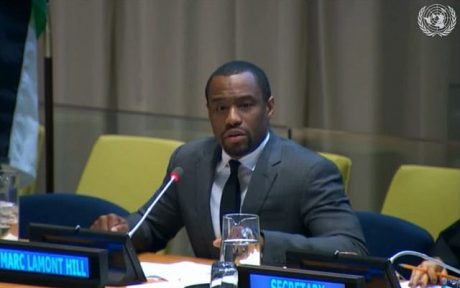
There has been another defenestration of a television-based political commentator for touching the only real electrified third rail remaining in reporting what passes for the news. Marc Lamont Hill, a Temple University professor of Media Studies and Urban Education, who is a regular political commentator on CNN, was fired for what he said in a speech at the International Day of Solidarity with the Palestinian People, which took place last Wednesday at the United Nations. Hill called for a “free Palestine from river to the sea,” which CNN considered grounds for terminating his contract.
As ever, the Israelis were quick to jump on the bandwagon with their New York Consul General Dani Dayan denouncing Hill as a “racist, a bigot, [and] an anti-Semite.” He noted that Hill is under contract both with Temple University and CNN, implying that he should be punished by being fired, and called the remarks “appalling.” To no avail, Hill responded “I support Palestinian freedom. I support Palestinian self-determination. I am deeply critical of Israeli policy and practice. I do not support anti-Semitism, killing Jewish people, or any of the other things attributed to my speech.”
Hill was fired by CNN within 24 hours. The message is clear. You can criticize Christianity, Muslims, white males, Donald Trump and the American government at will and you can even criticize blacks or sexual alphabet soups if you are clever in how you do it, but never, never go after Jews or Israel even indirectly if you want to keep your job. One recalls the fate of Rick Sanchez, a CNN anchor who was fired in September 2010 one day after he complained about how Jon Stewart and others in the Jewish mafia that runs the media treat Hispanics, saying “Yeah, very powerless people. He’s such a minority. I mean, you know, please. What—are you kidding? I’m telling you that everybody who runs CNN is a lot like Stewart, and a lot of people who run all the other networks are a lot like Stewart. And to imply that somehow they, the people in this country who are Jewish, are an oppressed minority?”
Sanchez was forced to publicly grovel for his “inartful” comments and even had to write a letter of apology to the monstrous Abe Foxman of the Anti-Defamation League (ADL). Far worse, he also had to endure two hours of counseling with “America’s rabbi” Shmuley Boteach. Sanchez subsequently drifted through low level jobs for a number of years, but he is now a news anchor with RT America.
Also in 2010, Octavia Nasr, a Lebanese-American journalist who had been CNN’s Senior Editor for Mideast Affairs for over 20 years was immediately fired after she tweeted “sad to hear of the passing” of Lebanese cleric Sayyed Mohammad Hussein Fadlalah. Fadlalah’s only crime was that he had been demonized by Israel and the neocons as a “spiritual mentor” of Hezbollah. Nasr’s only crime is that she granted the admittedly controversial dead man some respect.
To be sure, CNN is pro-Israeli in its reporting and, more important, in terms of choosing what not to report. Its lead political anchor is Wolf Blitzer, a former American Israeli Political Action Committee (AIPAC) employee, who speaks Hebrew and has lived in Israel. Like most major American mainstream media outlets, CNN has numerous Jewish employees working to select, edit and produce the news stories that actually air, well placed to manage what does finally go out to the public.
Reports critical of Israel or Jews are not welcome anywhere in the U.S. national media, which is why Israel gets away with slaughtering unarmed Gazans using army snipers. I note a recent bizarre though interesting story that appeared in the British media and was not picked up by the U.S. mainstream at all. The story detailed how the leadership of the European Jewish Congress is seeking the insertion of “warning messages” in both Christian and Muslim holy texts. In a document entitled “An End to Antisemitism,” which was released last week, it was recommended that “Translations of the New Testament, the Qur’an and other Christian or Muslim literatures need marginal glosses, and introductions that emphasize continuity with Jewish heritage of both Christianity and Islam and warn readers about antisemitic passages in them. While some efforts have been made in this direction in the case of Christianity, these efforts need to be extended and made consistent in both religions.” One wonders when the same body will be recommending that the nastier bits of the Torah and Talmud be “glossed” to deal with the numerous slaughters of conquered peoples as well as slurs on Jesus Christ and assertions that Jews have the right to treat non-Jews as no better than livestock?
Some in the media might argue that the same set of rules about not offending one’s religious beliefs would apply to all religions, not just to Judaism, but it is difficult to find evidence of any even handedness, particularly when Islam is being discussed by commentators who are completely ignorant of the tenets of the religion. Nor are there any apparent limits in making ridiculous statements on CNN if one is disparaging Arabs, most particularly if they are Palestinians. CNN paid commentator former Pennsylvania Senator Rick Santorum has claimed absurdly that Palestinians do not even exist, which many Israelis believe, without any admonishment. Consider the outrage if he were to say that Jewish Israelis do not exist, which may actually be much closer to the truth according to some geneticists.
And what about when a Jew is attacking Christians? Far from there being any consequences, there is a demonstrable double standard as Christian beliefs appear to be fair game in some circles. Dana Jacobson currently co-anchor for the weekend edition of CBS national morning news experienced an apparently alcohol driven meltdown at a sports roast that she was helping emcee in January 2008 when she was working for ESPN.
Belting down vodka and cursing “like a sailor,” Jacobson went after Catholics in particular and said “Fuck Notre Dame,” “Fuck touchdown Jesus” and “Fuck Jesus” a number of times before she was hauled off the stage. Her after-the-fact apology consisted of written concession that she had demonstrated a “poor lack of judgment.” And her punishment by ESPN also demonstrated a “lack of judgment” when the company spokesman Josh Krulewitz reported that “Her actions and comments were inappropriate and we’ve dealt with it.” Dealing with it apparently consisted of a one-week suspension.
Any company operating in the United States should be able to dismiss an employee for any reason or for no reason, but anything even mildly critical of Jewish collective behavior or Israel is severely punished immediately. Professor Marc Lamont Hill said nothing wrong. On the contrary, he said something badly needed and which should have been accepted by CNN if it were really a global communications network dedicated to the truth and, one might add, to justice. Instead it was more of the same old, same old. If you criticize Israel don’t let the door hit you in the ass as you leave the building.
Israel wages a New War of Attrition in Jerusalem

“Jesus is a monkey”
By Jonathan Cook | The National | December 2, 2018
Czech president Milos Zeman offered Benjamin Netanyahu’s ultra-nationalist government a fillip during his visit to Israel last week. He inaugurated a cultural and trade centre, Czech House, just outside Jerusalem’s Old City walls.
At the opening, he expressed hope it would serve as a precursor to his country relocating its embassy from Tel Aviv to Jerusalem. If so, the Czech Republic would become the first European state to follow US President Donald Trump’s lead in moving the US embassy in May.
It is this kind of endorsement that, of late, has emboldened Mr Netanyahu’s government, the Israeli courts, Jerusalem officials and settler organisations to step up their combined assault on Palestinians in the Old City and its surrounding neighbourhoods.
Israel has never hidden its ambition to seize control of East Jerusalem, Palestinian territory it occupied in 1967 and then annexed, as a way of preventing a viable Palestinian state from emerging.
Israel immediately began building an arc of Jewish settlements on Jerusalem’s eastern flank to seal off its Palestinian residents from their political hinterland, the West Bank.
More than a decade ago, it consolidated its domination with a mammoth concrete wall that cut through East Jerusalem. The aim was to seal off densely populated Palestinian neighbourhoods on the far side, ensuring the most prized and vulnerable areas – the Old City and its environs – could be more easily colonised, or “Judaised”, as Israel terms it.
This area, the heart of Jerusalem, is where magnificent holy places such as the Al Aqsa mosque and the Church of the Holy Sepulchre are to be found.
Under cover of the 1967 war, Israel ethnically cleansed many hundreds of Palestinians living near the Western Wall, a retaining wall of the elevated Al Aqsa compound that is venerated in Judaism. Since then, Israeli leaders have grown ever hungrier for control of the compound itself, which they believe is built over two long-lost Jewish temples.
Israel has forced the compound’s Muslim authorities to allow Jews to visit in record numbers, even though most wish to see the mosque replaced with a third Jewish temple. Meanwhile, Israel has severely limited the numbers of Palestinians who can reach the holy site.
Until now, Israel had mostly moved with stealth, making changes gradually so they rarely risked inflaming the Arab world or provoking western reaction. But after Mr Trump’s embassy move, a new Israeli confidence is tangible.
On four fronts, Israel has demonstrated its assertive new mood. First, with the help of ever-more compliant Israeli courts, it has intensified efforts to evict Palestinians from their homes in the Old City and just outside its historic walls.
Last month, the supreme court handed down a ruling that sanctions the eviction of 700 Palestinians from Silwan, a dense neighbourhood on a hillside below Al Aqsa. Ateret Cohanim, a settler organisation backed by government-subsidised armed guards, is now poised to take over the centre of Silwan.
It will mean more Israeli security and police protecting the settler population and more city officials enforcing prejudicial planning rules against Palestinians. The inevitable protests will justify more arrests of Palestinians, including children. This is how bureacratic ethnic cleansing works.
The supreme court also rejected an appeal against a Palestinian family’s eviction from Sheikh Jarrah, another key neighbourhood near the Old City. The decision opens the way to expelling dozens more families.
B’Tselem, an Israeli rights group, characterised these rulings as “sanctioning the broadest move to dispossess Palestinians since 1967”.
At the same time, Israel’s parliament approved a law to accelerate the settler takeover.
Over many years, Israel created a series of national parks around the Old City on the pretext of preserving “green areas”. Some hem in Palestinian neighbourhoods to stop their expansion while others were declared on the land of existing Palestinian homes to justify expelling the occupants.
Now the parliament has reversed course. The new law, drafted by another settler group, Elad, will allow house-building in national parks, but only for Jews.
Elad’s immediate aim is to bolster the settler presence in Silwan, where it has overseen a national park next to Al Aqsa. Archaeology has been co-opted to supposedly prove the area was once ruled by King David while thousands of years of subsequent history, most especially the current Palestinian presence, are erased.
Elad’s activities include excavating under Palestinian homes, weakening their foundations.
A massive new Jewish history-themed visitor centre will dominate Silwan’s entrance. Completing the project is a $55 million cable car, designed to carry thousands of tourists an hour over Silwan and other neighbourhoods, rendering the Palestinian inhabitants invisible as visitors are delivered effortlessly to the Western Wall without ever having to encounter them.
The settlers have their own underhand methods. With the authorities’ connivance, they have forged documents to seize Palestinian homes closest to Al Aqsa. In other cases, the settlers have recruited Arab collaborators to dupe other Palestinians into selling their homes.
Once they gain a foothold, the settlers typically turn the appropriated home into an armed compound. Noise blares out into the early hours, Palestinian neighbours are subjected to regular police raids and excrement is left in their doorways.
After the recent sale to settlers of a home strategically located in the Old City’s Muslim quarter, the Palestinian Authority set up a commission of inquiry to investigate. But the PA is near-powerless to stop this looting after Israel passed a law in 1995 denying it any role in Jerusalem.
The same measure is now being vigorously enforced against the few residents trying to stop the settler banditry.
Adnan Ghaith, Jerusalem’s governor and a Silwan resident, was arrested last week for a second time and banned from entering the West Bank and meeting PA officials. Adnan Husseini, the Palestinian minister for Jerusalem, is under a six-month travel ban by Israel.
Last week dozens of Palestinians were arrested in Jerusalem, accused of working for the PA to stop house sales to the settlers.
It is a quiet campaign of attrition, designed to wear down Jerusalem’s Palestinian residents. The hope is that they will eventually despair and relocate to the city’s distant suburbs outside the wall or into the West Bank.
What Palestinians in Jerusalem urgently need is a reason for hope – and a clear signal that other countries will not join the US in abandoning them.
Let’s talk about the lawsuit against Airbnb
By Kathryn Shihadah | Palestine Home | December 2, 2018
The global tourism company Airbnb decided this week to de-list properties it has offered for rent in Israeli settlements. Amnesty International has been pushing for Airbnb to make this move and praised it as “a stand against discrimination, displacement, and land theft.”
Ha’aretz reports that a group of American Jews now plan to sue Airbnb for religious discrimination.
Since the plaintiffs are Jewish, the lawsuit implies a charge of anti-Semitism – an accusation that has become more and more common lately.
A great deal of controversy has sprung up around the “Israel-centric” definition of anti-Semitism that essentially forbids even legitimate criticism of Israel.
This restrictive definition has even found its way into Congress as the (widely criticized) “Anti-Semitism Awareness Act” and similar bills in a number of states and even countries.
While America awaits Airbnb’s court date in Delaware, the court of public opinion is already in session. If we are going to judge this case, we’d better get familiar with the details. Drawing conclusions without understanding context would be irresponsible.
The charges
According to the lawsuit, Airbnb is in violation of the U.S. Fair Housing Act by discriminating on religious grounds.
Robert Tolchin, a lawyer for the plaintiffs, explained: “Airbnb has made a religion- and nationality-based decision…’We will not list for Jews in the West Bank.’” He elaborated, “It should be equal access for all.”
Some of the plaintiffs, among them Israeli-Americans, claim to own homes in West Bank settlements, and want to rent them out; others say they want to be future clients. All view Airbnb’s policy as “redlining” – targeting only Jewish-owned properties to be de-listed, while allowing Muslims and Christians in the West Bank to continue renting their homes.
They insist that this amounts to Airbnb taking sides in the dispute over the West Bank, where Palestinians hope to establish a state and which Israel captured in 1967, along with East Jerusalem and the Gaza Strip.
The plaintiffs are seeking an injunction against Airbnb to “block future discrimination against Jews and Israelis,” plus damages to cover lost rental income and legal fees.
Let’s talk about the charges.
Discrimination?
Tolchin claims that Airbnb’s decision to de-list settlement rental properties was “religion- and nationality-based,” and that Muslims’ and Christians’ homes are not subject to the policy. Among the West Bank population, only Jews are subject to the policy.
Airbnb insists that those specific properties – Jewish-owned homes in the West Bank – “contribute to human suffering.” Tolchin does not address this point in his statement, but it is an important part of the context.
The West Bank is part of occupied Palestinian Territory, not Israel. The land under question was confiscated from Palestinians and appropriated by Israelis. In violation of international law, Israel transferred some of its citizens into occupied territory to live on Jewish-only settlements.
To be clear, only Israeli Jews – not Israeli Christians or Israeli Muslims – live on these settlements. Airbnb’s “redlining” targeted not a religious group, but a body of people who live illegally on someone else’s land.
All Israeli Jews living on West Bank settlements – not just Airbnb hosts, but all 600,000 – live illegally on someone else’s land.
Hundreds of thousands of Palestinians have lost their homes, businesses, farms, and orchards due to settlements; settlers do indeed “contribute to human suffering.”
Christians and Muslims in the West Bank are not subject to the de-listing policy – not because Airbnb is showing religious preference, but because these groups are casualties of injustice, not perpetrators.
Equal opportunity?
The plaintiffs are either rental home hosts in settlements, or potential customers. Thanks to Airbnb’s new policy, it will not be possible to arrange rentals on their website.
Conversely, thanks to Israel’s policy, Palestinians have not been allowed to live in their homes or farm in their fields for over 50 years. Instead, they live as refugees.
Attorney Tolchin’s plea for “equal access for all” drips with irony, as the whole point of settlements is that they are Palestinian-free zones on Palestinian land. “Equal access” in this context means “all Jews are equally welcome, and non-Jews are equally unwelcome.”
Likewise the “damages” the plaintiffs seek – lost rental income – pale in comparison to the damages Palestinians experienced in the loss of their homes, the decades of lost income, and the casualties of justice, innocence, and hope.
Taking sides?
The other accusation Tolchin mentions is Airbnb’s sin of taking sides.
Airbnb had a moral obligation to take sides when it learned the facts. Airbnb did not choose to pick on Jews, but took action against oppression, knowing that to stay neutral would be to side with the oppressive regime.
The summation
The plaintiffs in the lawsuit against Airbnb are not able to substantiate the accusation of religious discrimination, since Airbnb’s policy is in reality based not on religion, but on international law and human suffering.
The allegation of unequal access is likewise feeble: no one has less access to the properties in question than the Palestinians who actually own the land.
As for the accusation that Airbnb has taken sides, that one is true – it is just not illegal or punishable. In fact, it is a moral imperative.
The verdict
The court of public opinion, having explored context, is now free to deliberate.
How do you find the defendant?
RELATED READING:
Action Alert: tell Booking.com to follow Airbnb in de-listing Israeli settlement properties
The humanitarian impact of Israeli settlements in Hebron city
Israeli settlers, with IDF complicity, have destroyed 800,000 olive trees since 1967
Featured Video
Anthrax War – CBC The Passionate Eye
or go to
Aletho News Archives – Video-Images
Book Review
Shattered Dreams: The HPV Vaccine Exposed (2019)
By Christina England – 30 Q&As – Book Review & Summary
Lies are Unbekoming | September 4, 2026
… Gardasil received FDA fast-track approval in 2006, Cervarix followed in 2009, and Gardasil 9 was approved in December 2014 with more than double the aluminium adjuvant content of the original. The commercial context is specific. Merck was about to lose patent protection on Zocor and faced $18 billion in Vioxx injury claims from a cardiovascular drug the company had marketed while suppressing its own data showing a five-times increase in heart attacks. Analysts projected the global HPV vaccine market at $4 billion by 2011, contingent on government-funded national programs for teenage girls. The 1986 National Childhood Vaccine Injury Act had already granted manufacturers complete liability immunity. By 2013, Japan had withdrawn its HPV vaccine recommendation after cataloguing severe adverse reactions in hundreds of girls. No Western government followed. The establishment position across the UK, US, Australia, and most of Europe held, and still holds, that the vaccines are safe and effective, that reported injuries are coincidental, and that cervical cancer prevention justifies the program. The book was published into this position, not against a vacuum.
Shattered Dreams sits alongside Mary Holland’s The HPV Vaccine On Trial and Viera Scheibner’s foundational vaccination work as part of the documented record on what has been done to a generation of teenage girls under the banner of cancer prevention. The full summary unpacks three specific findings: that Merck used the aluminium adjuvant itself as the “placebo” control in 92.5% of trial subjects, making it structurally impossible to detect excess reactions from the adjuvant; that Dr. Sin Hang Lee found HPV DNA fragments bound to aluminium in every one of sixteen Gardasil samples tested, and in the blood and spleen of a New Zealand girl six months after her third dose; and that in every country with high vaccination coverage, including Australia, the UK, Norway, and Sweden, cervical cancer rates have stopped declining and started rising specifically in the vaccinated cohort. Martínez-Lavín’s 2017 calculation puts the number needed to seriously harm with Gardasil 9 at 140, and the number needed to vaccinate to prevent one case at 1,757. Thirteen young women are seriously harmed for every one who benefits. The vaccine was approved on the basis of trials that could not detect what the trials were supposed to detect, and it is still being given to twelve-year-olds today. … Read full review
Blog Roll
 Aletho News
- Ukraine’s EU neighbors reject new plea from Kiev – Politico
- British Transport Police Facial Recognition Trial Scanned 926,912 People With Zero Arrests
- House Bill Would Ban Federal Use of Flock ALPR Data
- Can a Spice Rival a Drug? 10 Head-to-Head Trials Put It to the Test.
- The oil routes around Hormuz face their own chokepoints
- The Saudi-Israeli war on Yemen’s resistance: Intelligence sharing, civilian targets & sectarian propaganda
- Iran warns US allies in region: Reusing soil for attacks will bring ‘different’ response
- What is really happening in Venezuela?
- Diplomacy is Now a Crime in Britain / Ian Proud
- UK Government Body Kept Files on People Criticizing Prevent Program
- If Americans Knew
- Targeting the rescuers: Inside Israel’s war on paramedics in Lebanon
- No big deal: Israel to halt humanitarian aid to Gaza for 2 days – Daily Update
- Israel is squeezing the life out of Palestinians – Daily Update
- The Israeli Right Portrays Islam as Murderous. It Serves a Political Purpose
- Jordan Has Had Enough: King Abdullah’s Scathing Warning to Israel
- Israeli Colonizers (i.e. Settlers) Kill Palestinian Man Near Salfit
- New Google Maps images reveal massive scale of devastation in Gaza
- Jewish supremacy, anti-Palestinian bigotry on display in Israel – Daily Update
- Israeli Soldiers Abduct At Least 22 Across Occupied West Bank
- Eight Palestinians Killed in Israeli Attacks on Gaza
- No Tricks Zone
- Latest European Green Energy Debacle; Portugal’s Largest Flagship Solar Park Insolvent!
- Green Energy Debacle: German Expert Professor Fritz Vahrenholt Warns Of Severe Economic And Social Consequences
- Two More Paleo Reconstructions Affirm Meters-Higher Sea Levels Across Ireland, Brazil 7000-6000 Years Ago
- New Study: Earth And Venus Surface Warmth Largely Explained By Convection And Lapse Rate, Not CO2 Or Radiation
- 2025 Nature Paper Claiming Worsening Global Drought Gets RETRACTED …Heavily Flawed
- New Study: ‘Global Drought Shows No Detectable Recent Acceleration Under Climate Warming’
- Economic Masterminds: German Socialists Suggest Taxing Productivity Gains Stemming From Using AI
- The South China Sea Has Not Been Cooperating With The Climate Change Narrative
- Energy Crisis: Germany Enters Heating Season With Historically Low Gas Reserve Fill Levels
- New Study: The Antarctic Ice Sheet Gained Mass From 2020-2024 Due To Staggering Snow And Ice Accumulation

