Mohammad Marandi: Iran Prepares for War with America
Prof. Seyed Mohammad Marandi and Prof. Glenn Diesen
Glenn Diesen | June 19, 2025
Seyed Mohammad Marandi is a professor at Tehran University and a former advisor to Iran’s Nuclear Negotiation Team. Prof. Marandi discusses the US preparations to enter the war directly, and Iran’s preparations to fight the US. Trump will only accept Iran’s surrender, yet he does not appear to have the means to achieve this objective. What will happen if US strikes are ineffective and US military assets in the region are attacked? The only path forward now is reckless escalation.
Israel’s war on Iran is not about nuclear weapons
It is, and has always been, about regime change and breaking the Axis of Resistance
By Robert Inlakesh | RT | June 19, 2025
The claim that has been adopted by the United States, Israel and its European partners, that the attack on Iran was a “pre-emptive” attempt to stop Tehran from acquiring nuclear weapons, is demonstrably false. It holds about as much weight as the allegations against Iraq’s Saddam Hussein in 2003 and this war of aggression is just as illegal.
For the best part of four decades, Israeli Prime Minister Benjamin Netanyahu has been claiming that Iran is on the verge of acquiring a nuclear weapon. Yet, every single attempt to strike a deal which would bring more monitoring and restrictions to Iran’s nuclear program has been systematically dismantled by Israel and its powerful lobbying groups in Western capitals.
In order to properly assess Israel’s attack on Iran, we have to establish the facts in this case. The Israeli leadership claim to have launched a pre-emptive strike, but have presented no evidence to support their allegations that Iran was on the verge of acquiring a nuclear weapon. Simply stating this does not serve as proof, it is a claim, similar to how the US told the world Saddam Hussein possessed weapons of mass destruction.
Back in March, the US Director of National Intelligence, Tulsi Gabbard testified before a Senate Intelligence Committee that the intelligence community “continues to assess that Iran is not building a nuclear weapon and Supreme Leader Ayatollah Ali Khamenei has not authorized the nuclear weapons program he suspended in 2003.”
On top of this, Iran was actively participating in indirect negotiations with the US to reach a new version of the 2015 Nuclear Deal. Donald Trump announced Washington would unilaterally withdraw from the agreement in 2018, instead pursuing a “maximum pressure” sanctions campaign at the behest of Israel.
Despite the claims of Netanyahu and Trump that Iran was violating the Nuclear Deal, the International Atomic Energy Agency (IAEA) released a report which stated Iran was in full compliance with the deal at the time.
If you trace back every conversation with neo-conservatives, Israeli war hawks and Washington-based think tanks, their opposition to the Obama-era Nuclear Deal always ends up spiraling into the issues of Iran’s ballistic missile program and its support for regional non-State actors.
Israeli officials frequently make claims about Iran producing a nuclear weapon in “years”, “months” or even “weeks,” this has become almost second nature. Yet their main issue has always been with Iran’s support for groups like Hamas and Hezbollah, who strive for the creation of a Palestinian State.
Proof of all this is simple. Israel, by itself, cannot destroy Iran’s vast nuclear program. It is not clear the US can destroy it either, even if it enters the war. An example of the US’ ineffectiveness at penetrating Iranian-style bunkers, built into mountainous ranges, as many of Iran’s nuclear facilities are, was demonstrated through the American failure to destroy missile storage bases in Yemen with its bunker-buster munitions, which were dropped from B-2 bombers.
Almost immediately after launching his war on Iran, Netanyahu sent out a message in English to the Iranian people, urging them to overthrow their government in an attempt to trigger civil unrest. The Israeli prime minister has since all but announced that regime change is his true intention, claiming that the operation “may lead” to regime change.
Israel’s own intelligence community and military elites have also expressed their view that their air force alone is not capable of destroying the Iranian nuclear program. So why then launch this war, if it is not possible to achieve the supposed reason it was “pre-emptively” launched?
There are two possible explanations:
The first is that the Israeli prime minister has launched this assault on Iran as a final showdown in his “seven front war,” with which he hopes to conclude the regional conflict through a deadly exchange that will ultimately inflict damage on both sides.
In this scenario, the desired outcome would be to conclude the war with the claim that Netanyahu has succeeded at destroying or has significantly degraded Iran’s nuclear program. He would also throw in claims, like we already see him making, that huge numbers of Iranian missiles and drones were eliminated. This would also make the opening Israeli strike, which killed senior Islamic Revolutionary Guard Corps (IRGC) commanders and nuclear scientists, make sense. It would all be the perfect blend of propaganda to sell a victory narrative.
On the other hand, the assumption would be that Tehran would also claim victory. Then both sides are able to show the results to their people and tensions cool down for a while. If you are to read what the Washington-based think-tanks are saying about this, most notably The Heritage Foundation, they speak about the ability to contain the war.
The second explanation, which could be an added bonus that the Israelis and US are hoping could come as a result of their efforts, is that this is a full-scale regime change war that is designed to rope in the US.
Israel’s military prestige was greatly damaged in the Hamas-led attack on October 7, 2023, and since that time there has been no victory achieved over any enemy. Hamas is still operating in Gaza and is said to have just as many fighters as when the war began, Hezbollah was dealt significant blows but is still very much alive, while Yemen’s Ansarallah has only increased its strength. This is an all round stunning defeat of the Israeli military and an embarrassment to the US.
As is well known, Iran is the regional power that backs all of what is called the Axis of Resistance. Without it, groups like Hezbollah and Hamas would be significantly degraded. Evidently, armed resistance to Israeli occupation will never end as long as occupied people exist and live under oppressive rule, but destroying Iran would be devastating for the regional alliance against Israel.
The big question however, is whether regime change is even possible. There is a serious question mark here and it seems much more likely that this will end up on a slippery slope to nuclear war instead.
What makes the Israeli-US claim that this war is somehow pre-emptive, for which there is no proof at all, all the more ridiculous of a notion, is that if anything, Iran may now actually rush to acquire a nuclear weapon for defensive purposes. If they can’t even trust the Israelis not to bomb them with US backing, while negotiations were supposed to be happening, then how can a deal ever be negotiated?
Even in the event that the US joins and deals a major blow to the Iranian nuclear program, it doesn’t mean that Iran will simply abandon the program altogether. Instead, Tehran could simply end up rebuilding and acquiring the bomb years later. Another outcome of this war could end up being Israeli regime change, which also appears as if it could now be on the table.
Robert Inlakesh is a political analyst, journalist and documentary filmmaker currently based in London, UK. He has reported from and lived in the Palestinian territories and currently works with Quds News. Director of ‘Steal of the Century: Trump’s Palestine-Israel Catastrophe’.
IDF Mandates Pre-Approval for Reporting Missile Strikes, Including on Social Media and Online Platforms
By Cindy Harper | Reclaim The Net | June 18, 2025
A new set of censorship rules issued by the Israel Defense Forces is raising alarms over media freedom and public transparency.
Brigadier-General Kobi Mandelblit, Israel’s chief censor, declared on Wednesday a mandate requiring prior approval for any reporting on where missiles or drones have struck, no matter the platform or location of publication.
According to the statement, “any person who prints or publishes printed matter or a publication regarding the location of a strike or hit by enemy war materiel, including missiles of any kind and UAVs, in the media or online (including social media, blogs and chats, etc.)” must now submit that material to the military censor for approval before it is released.
This directive applies to both domestic and international reporting, online and offline.
Mandelblit emphasized that he is also banning “the printing or publishing of any publication that has not been submitted to the Censor, or which has been submitted to him and his instructions have yet to be received or have been received and not adhered to.”
Framing the move as a matter of national security, he stated that violating the order is “liable to severely harm the security of the state,” and warned that offenders will be charged, the Jerusalem Post reported.
The sweeping nature of the restrictions, especially in a digital era where information spreads rapidly across borders, places significant power in the hands of military authorities to control narratives and limit the public’s access to real-time facts.
The breadth of the order effectively criminalizes independent reporting on attacks unless pre-approved by the state.
Pentagon removes joint staff officer over anti-‘Israel’ posts
Al Mayadeen | June 18, 2025
The Pentagon has removed Colonel Nathan McCormack, a senior planner responsible for the Levant and Egypt region at the Joint Chiefs of Staff’s J5 planning directorate, from his position, pending an internal investigation into social media posts deemed anti-“Israel”.
The move follows a report by the Jewish News Syndicate (JNS), which pointed out that McCormack had operated a semi-anonymous public social media account containing posts critical of the Israeli occupation, including remarks about Israeli Prime Minister Benjamin Netanyahu and pro-“Israel” activism in the United States.
A Pentagon official told JNS that the Joint Staff is “aware of the situation” and has initiated a formal review.
“He will no longer be on the joint staff while the matter is being investigated,” the official stated. McCormack is being returned to his service branch, a step often taken when a service member is reassigned during a personnel inquiry.
The official added, “The information on the X account does not reflect the position of the Joint Staff or the Department of Defense.”
The case is indicative of the interplay between pro-“Israel” media outlets and decision-making circles in the US, where criticism of “Israel” or even Israeli officials is quickly silenced and censored.
Controversial posts draw scrutiny from defense officials
The social media account, which has since been disabled, reportedly contained archived posts referring to Netanyahu and his “Judeo-supremacist cronies,” as well as statements suggesting that US foreign policy has been compromised by unconditional support for the Israeli occupation.
Other posts questioned the loyalty of American pro-“Israel” advocates, claiming they prioritize support for “Israel” over US strategic interests.
A Defense Department contractor who interacted with McCormack told JNS that the posts were “dangerous” given the officer’s rank and influence.
“This is the kind of bitter oversharing I’d expect from someone who doesn’t know better,” the contractor said. “But at his level and under his own name and likeness? It’s mind-boggling.”
The Pentagon emphasized that McCormack’s personal commentary does not represent official policy. “Our global alliances and partnerships are vital to our national security, enhancing our collective defense, deterrence, and operational reach,” the official added.
An investigating officer has been assigned to review the material and determine whether McCormack violated military conduct or security policies.
Trump faces MAGA rift over possible US role in war on Iran
Al Mayadeen | June 18, 2025
A sharp divide is emerging within Donald Trump’s MAGA base over the war on Iran, with some of the president’s most vocal allies, Rep. Marjorie Taylor Greene, commentator Tucker Carlson, and Turning Point USA founder Charlie Kirk, openly questioning whether he is abandoning his “America First” foreign policy.
Following a week of deadly strikes and Trump’s abrupt departure from the G7 summit in Canada, these conservative voices are warning that a deeper US role in the Middle East could fracture the coalition that helped propel Trump to power.
Trump, who has long campaigned on non-interventionism, is now facing backlash from within his movement.
On X, Charlie Kirk wrote, “No issue currently divides the right as much as foreign policy,” adding that he feared a “massive split among MAGA” could disrupt their progress. He and others warned that any perception of Trump backing US military involvement could unravel his core message and political future.
Trump flew back to Washington unexpectedly this week amid rising tensions, and issued a dramatic social media warning, “Everyone should immediately evacuate Tehran!” claiming the US knows the location of Iran’s Leader Sayyed Khamenei, but does not intend to target him, “for now.”
These remarks have reignited speculation that Trump may support direct US military action, such as supplying “Israel” with bunker-buster bombs to target Iranian nuclear facilities. However, the State Department and US military have already ordered the voluntary evacuation of nonessential personnel from select diplomatic sites in the region.
Meanwhile, Senator Lindsey Graham is urging Trump to go further. “If that means providing bombs, provide bombs. If that means flying with Israel, fly with Israel,” Graham said on Face the Nation, arguing that now is the moment for Trump to help eliminate Iran’s nuclear program.
MAGA figures accuse Trump of breaking his anti-war promise
Trump’s consideration of a broader US role is facing strong resistance from the same voices who once championed him as a disruptive force in US foreign policy.
Tucker Carlson, long a loyal supporter, warned that Trump is veering dangerously close to betraying the voters who backed him for staying out of foreign wars. “You’re not going to convince me that the Iranian people are my enemy,” Carlson said on Steve Bannon’s War Room podcast.
Carlson also aimed at pro-Trump media allies like Sean Hannity, challenging them to hold Trump accountable for his foreign policy stance. Trump responded to the criticism by calling Carlson “kooky” and reiterating that “IRAN CAN NOT HAVE A NUCLEAR WEAPON!”
Furthermore, Rep. Marjorie Taylor Greene sided with Carlson, saying she shared his anti-interventionist principles. She posted, “Foreign wars, intervention, and regime change put America last, kill innocent people, make us broke, and lead to our destruction,” adding that “That’s not kooky. That’s what millions of Americans voted for.”
Kirk: MAGA youth voted for peace, not another war
Charlie Kirk, while still supportive of Trump, has echoed concerns about mission drift, noting that younger Trump voters were especially drawn to his record of avoiding new wars. “This is the moment that President Trump was elected for,” Kirk said on Fox News. But later added: “There is historically little support for America to be actively engaged in yet another offensive war in the Middle East.”
He continued, “The last thing America needs right now is a new war…Our number one desire must be peace, as quickly as possible.”
In a similar event, in April, some MAGA-aligned podcasters expressed doubts about looming tariffs and market disruptions. Earlier, Trump criticized Biden’s decision to let Ukraine use US long-range weapons but stopped short of advocating a full aid cutoff, another move that drew rebukes from his isolationist flank.
While these disputes have not derailed Trump’s base, the war on Iran marks one of the clearest tests of whether his coalition can stay united if he edges closer to military engagement abroad
Israel’s Hidden Front: How Israel’s Military Embeds Itself Among ‘Civilians’
Quds News Network | June 14, 2025
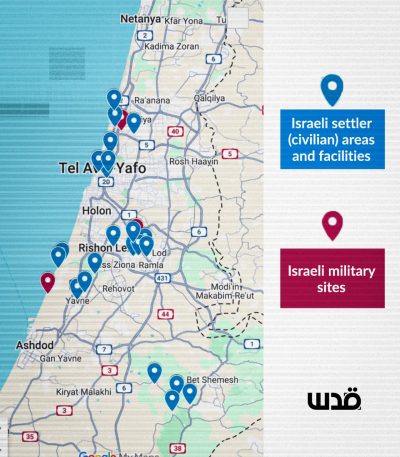 As Iran responds to Israeli attacks, Israel has begun publishing photos and videos showing what it claims are civilian casualties. However, many of Israel’s key military command centers and bases are embedded inside or beside densely populated civilian areas, raising serious concerns about the use of human shields.
Israel has long accused the Palestinian resistance of using civilians as human shields. But a closer look at its own military infrastructure tells a different story. From Tel Aviv to Be’er Sheva, Israeli army bases, intelligence centers, and military leaders are embedded deep within cities and residential neighborhoods, protected not by concrete walls, but by Israeli flesh and blood.
At the heart of Tel Aviv lies HaKirya, Israel’s central military headquarters. It’s just a few steps away from the bustling Azrieli Center, Ichilov Hospital, residential towers, and the HaShalom train station. The commander-in-chief’s office sits only 450 meters from hospital patients. This proximity is not incidental. It’s strategic.
Across the country, similar patterns appear.
In Ramat Gan, the Sheba Medical Center neighbors the Tel Hashomer military base. In Haifa, the Israeli navy base is hidden behind the Rambam Medical Center, a civilian hospital. Even Israel’s alleged nuclear capabilities, reportedly housed in Sdot Micha Base, are surrounded by quiet rural communities near Beit Shemesh.
Civilians as a Human Shield Strategy
This overlap is not limited to infrastructure. Israel’s leadership, too, shelters in residential zones.
Prime Minister Benjamin Netanyahu resides in Jerusalem’s Talbieh neighborhood, surrounded by settlers. The defense minister lives in Moshav Kfar Ahim and the Israeli military chief of staff in Hod Hasharon. All are Israeli ‘civilian’ areas.
This practice isn’t new. It’s systematic.
The Israeli settlement enterprise in the West Bank mirrors the same approach. Entire communities of settlers, including women and children, are placed deep inside conflict zones. They are the frontline of a colonial project. When violence erupts, these ‘civilians’ become both the shield and the justification for further expansion.
Meanwhile, military rabbis, settlement leaders, and ideological figures operate among the settlers, posing as spiritual guides. They shape policy and drive confrontation but deny responsibility when blood is spilled.
Military Bases in Plain Sight
Even advanced cyber warfare hides in plain sight. The Glilot base, reportedly home to Unit 8200, Israel’s elite surveillance unit, is just 2 kilometers from northern Tel Aviv’s residential zones. This site has been flagged by Hezbollah and other groups for its proximity to civilians.
The Palmachim Airbase, responsible for drone operations and missile testing, lies just 10–12 kilometers from densely populated areas like Yavne and Greater Tel Aviv. The base shares airspace with commercial zones, a fact that Israel rarely acknowledges.
This civil-military fusion is not an accident. It’s a strategy.
On the surface, Israel tries to project an illusion of normal life: soldiers stationed beside shopping malls, military towers rising over playgrounds, officers living quietly among schoolchildren. But this is no coincidence. It is the architecture of a colonial project; one where the line between soldier and settler is deliberately blurred. Israeli ‘civilians’ are not just bystanders; they are often active participants or enablers of a violent military apparatus. From settlement expansion to surveillance networks and military conscription, every layer of society is embedded in the machinery of occupation and war.
While Israeli officials accuse Palestinian fighters of operating from urban areas, their own army commands from skyscrapers, hospitals, and suburban homes. They accuse Gaza’s defenders of hiding among civilians, yet embed their own war machines in the heart of Tel Aviv.
Israel’s military-industrial complex does not merely exist beside civilian life; it consumes and shields itself with it.
The rise of Abu Shabab: Mapping the Gaza militia armed by Israel
By Muhammad Shehada | The New Arab | June 10, 2025
A political earthquake hit Israel last week when former Defence Minister Avigdor Liberman revealed that “the Israeli government is giving weapons to a group of criminals and felons, identified with Islamic State [in Gaza], at the direction of the prime minister”.
Netanyahu has since admitted that Israel had been “running” proxy militias in Gaza, but tried to put a positive spin on it, claiming that such a move aims to challenge Hamas’s rule.
But branding these gangs as potential rivals to Hamas masks the very goal of why Israel created them in the first place. Around 300 untrained thieves, drug dealers, criminals, and convicted murderers cannot overpower Hamas’s estimated 30,000 militants.
Their actual role has more to do with advancing Israel’s genocide, starvation, and ethnic cleansing in Gaza while creating plausible deniability.
Furthermore, recent evidence indicates that Israel may have been collaborating with some of these Islamic State-linked elements even before 7 October.
Abu Shabab: A front for an Israeli proxy?
The most prominent gang leader in Gaza is Yasser Abu Shabab. His name first appeared in August 2024 on Hamas-linked social media groups as the figure responsible for looting the vast majority of humanitarian aid and reselling it on the black market for astronomical prices.
A senior security source told The New Arab that Abu Shabab’s gang had been active for months before then.
Local authorities knew Abu Shabab well. He was serving a long sentence in prison for the possession of large quantities of drugs, according to three knowledgeable sources. He was one of many inmates who escaped under the cover of Israel’s war on Gaza in October 2023.
Some other inmates were released on parole when Israel began bombing government facilities. Israeli newspapers like Maariv and Yediot Ahronot confirmed Abu Shabab’s criminal history through people close to him, and even added that he had links to the Islamic State (IS) through smuggling drugs from Sinai into Gaza.
Police in Gaza were perplexed when he emerged as a top gang leader. The security source told The New Arab that Abu Shabab is 35 years old, thin, weak, short (around 150cm in height), uncharismatic, illiterate, has strabismus in one eye, and has never received military training.
To them, he didn’t seem like someone with the leadership skills necessary to form a group of 300 armed militants, steal truckloads of aid, and store it under the radar.
Local authorities quickly decided that Abu Shabab was merely a front for an Israeli astroturfing campaign to maintain its policy of starvation in Gaza after the international community pressured Netanyahu to ease his total siege and allow a trickle of aid into the enclave.
What made this clear, according to them, is how Israeli drones bombed emergency committee volunteers or police officers every time they came close to thwarting a looting attempt by that gang in particular.
By late September 2024, Abu Shabab was talked about in Gaza as an Israeli-backed collaborator, not just a gang leader. That is when Hamas militants attempted to ambush him, firing around 90 bullets at a vehicle they thought belonged to Abu Shabab.
The vehicle, however, was identical to the one used by Islam Hijazi, the program officer of a US charity called Heal Palestine. She was tragically killed in the incident.
Two months later, Abu Shabab received widespread media attention after he burned a fuel truck and completely shut down the route used by aid convoys to retaliate against another Hamas ambush that killed his brother Fathi and 21 other members of his gang.
Soon after, the Washington Post revealed that the UN had named Abu Shabab in an internal memo as the main figure behind aid looting under “passive or active IDF protection”. This left little room for doubt that Abu Shabab’s gang was a tool for Israel to maintain starvation while externalising blame.
Mapping gang leaders: IS, ex-PA intel officers, and murderers
Abu Shabab’s deputy is thought to be Ghassan al-Dahini, 38, reportedly a former lieutenant in the Palestinian Authority (PA). Dahini is the one running the gang’s operations on the ground and actively trying to recruit new members, along with Saddam Abu Zakkar, per local authorities. His Facebook profile displays Israeli hostage emojis.
Another senior Palestinian security source told The New Arab that Dahini was a member of the “Army of Islam”, the extremist group responsible for kidnapping journalist Alan Johnston in 2007.
The group pledged allegiance to IS in 2015. Ghassan’s brother, Mohammed, died in prison after he was detained on drug-related offences, and Ghassan himself was imprisoned twice in March 2020 and November 2022, per the source. He added that “the Army of Islam relied on Dahini for the Sinai smuggling routes”.
On Sunday, Dahini posted a video of himself in military gear in Eastern Rafah close to Israel’s perimeter fence. He was standing next to a white pickup truck with a UAE license plate from Sharjah and firing a brand-new Serbian Zastava rifle.
Another prominent gang leader in Rafah is Shadi Soufi, a convicted murderer who was awaiting a death sentence before 7 October for killing a Popular Front for the Liberation of Palestine (PFLP) leader. Like Yasser, he also escaped prison during the war and was named by humanitarian organisations as responsible for looting aid under Israeli protection in Rafah.
Soufi, al-Dahini, and Abu Shabab are from the same Bedouin Tarabin clan that stretches across Rafah, Israel’s Negev desert, Egypt’s Sinai, and Jordan. Abu Shabab’s family recently disowned him for collaborating with Israel and said they will go after him to hold him accountable.
Another prominent leader of the Abu Shabab gang is Essam Soliman Nabahin, 35, a convicted murderer and IS member. He was implicated in a series of bombings against Hamas in 2015 by extremist Salafist groups and escaped to Sinai to formally join IS’s ranks. He caught the attention of Egyptian media in 2017 after taking part in attacks against the Egyptian army.
Nabahin’s name resurfaced in June 2023 when the police raided a house in central Gaza where he was hiding. He killed a police officer and was convicted in a military court before his escape in the early days of the war.
Israel says Nabahin was previously “recorded launching rockets into Israel without coordination with Hamas”.
Local authorities in Gaza have long suspected that IS-linked individuals like Nabahin were being pushed by Israel’s Shin Bet to fire one or two primitive projectiles sporadically to give Israel a pretext to strike Gaza and bomb specific targets. Hence, the police detained those militants repeatedly.
A senior Palestinian security source told The New Arab that authorities in Gaza caught a collaborator in 2018 who directed such occasional rocket attacks to give Israel cover for military action in Gaza.
Other members of the gang include multiple known drug dealers and convicted murderers.
How is Israel helping them?
Israel’s government has admitted it provided weapons to these gangs, mostly rifles and other light weaponry, in addition to money and equipment. Footage posted by Abu Shabab’s gang showed them driving in white pickup trucks with machineguns on top that looked virtually identical to those of Hamas.
In addition, Israel provides these gangs with safe refuge in areas fully depopulated by the Israeli military, like Rafah, and declared “extermination zones”, where any Palestinian entering would be killed on the spot. They are also provided with logistical support, protection, and even access to Israeli territory.
A Palestinian journalist documented one case of a gang member crossing into Israel, which could explain how those gangs disappeared completely during the ceasefire last January.
On the ground, the Abu Shabab gang has established warehouses operated with forklifts where they store looted aid. They have also established a military complex, according to the UN, which said the Israeli army would force aid convoys to drive through the areas where the gangs had positioned their militants and put up checkpoints to loot trucks.
And where the Israeli military goes, so do the gangs. After Israel issued forcible expulsion orders for Khan Younis and raided the European hospital and its surrounding area, Abu Shabab moved into the ‘Jarghoun’ villa in that very same area, per security sources.
On Tuesday, Israeli news channel i24 reported that Israel had launched airstrikes to protect the gang after it was attacked by Hamas militants in southern Gaza. The strikes killed four Hamas members.
What role do the gangs play on Israel’s behalf?
The Israeli-backed gangs in Gaza have become an unofficial arm of the Israeli military. For instance, whenever Israel gets pressured to allow food into Gaza, it immediately unleashes the gangs to maintain their use of starvation as a weapon of war, while blaming it on Hamas.
Experts believe Israel is using starvation as a tool for genocide by imposing conditions on a group “calculated to bring about its physical destruction in whole or in part”. Prolonged starvation inflicts permanent mental and physical damage, particularly on children.
Israel has also been using these gangs to orchestrate chaos and engineer societal collapse through attacks on markets, shops, private businesses, homes, warehouses, soup kitchens, and other places vital to maintaining the population’s survival.
For instance, in early May 2025, a gang attacked a communal kitchen in Gaza. As soon as volunteers arrived to stop the looting, Israel bombed it and killed six volunteers, which implies it was a coordinated attack.
The Israeli army also sends the gangs on reconnaissance and surveillance missions in dangerous areas. Last month, Hamas released footage of an ambush it carried out against armed men in Rafah whom it thought were undercover Israeli troops. They turned out to be Abu Shabab militants.
Israel also uses the gangs to infiltrate Palestinian society and gather intelligence, as well as to kidnap and interrogate Palestinians by luring them with the promise of food, as documented by Palestinian journalist Younis Tirawi.
Israel is using proxy gangs for the final phase of the war
The most concerning use of these gangs, however, is Israel’s recently announced plan to push Gazans into camps in Rafah on Egypt’s borders to depopulate and destroy “everything that remains” of the rest of the enclave. This is a precursor to Israel’s declared goal of the mass expulsion of Palestinians into Egypt and other countries.
The Abu Shabab gang recently announced establishing an encampment area in eastern Rafah near the Egyptian borders and is using the very aid they have been systematically looting to lure starved Gazans into moving there.
This announcement was preceded by a clear rebranding psyop, where the same gang responsible for looting aid suddenly and shamelessly declared itself as a new “security force” that aims to “protect aid from looting”. They have since emerged in brand-new military and police uniforms in the Israeli-designated buffer zone in Rafah, where no Palestinians are allowed to enter.
Remarkably, Israel has allowed these gang members to wear Palestinian flags and insignia on their uniforms, while at the same time refusing to let the Palestinian Authority’s staff at the Rafah border crossing wear any such symbols.
In other words, Israel is using these gangs as a front. The Israeli army knows that if it orders Gazans to come to camps in eastern Rafah, people will immediately know it’s a trap for mass expulsion. But if a uniformed Palestinian force with good PR on social media makes such a demand, some people might fall for the trap.
Israel has used this same proxy tactic in Lebanon against Palestinians in 1982, where the Israeli military bolstered the South Lebanon Army (SLA) and used it and other militias to commit the Sabra and Shatila massacre, which saw 3,500 Palestinians killed.
Those collaborators collapsed after the Israeli army’s withdrawal from Southern Lebanon, as their leaders surrendered or fled to Israel. The same fate awaits these new Israeli-backed gangs once the Gaza genocide comes to an end.
Muhammad Shehada is a Palestinian writer and analyst from Gaza and the EU Affairs Manager at Euro-Med Human Rights Monitor.
Follow him on Twitter: @muhammadshehad2
Israeli confidence in missile defenses shaken amid Iran strikes
Al Mayadeen | June 16, 2025
After three consecutive nights of Iranian missile strikes, growing numbers of Israeli settlers are beginning to grasp a truth long acknowledged by military officials: the much-touted missile defense system is, in their own words, “not hermetic”, according to The Telegraph.
The ongoing Iranian strikes have revealed new vulnerabilities that are rattling public confidence, even among those who had previously felt secure in designated protective areas.
In one of the most alarming incidents yet, at least five more Israeli settlers were killed overnight, including two settlers in the illegal settlement of Petah Tikvah, located east of Tel Aviv.
According to the Army Radio, the two Israeli settlers were killed despite taking refuge in a reinforced shelter, a place believed to offer protection from such attacks.
The report confirmed that a ballistic missile from Iran struck directly between two fortified bunkers, rendering the so-called “protected space” ineffective under the concentrated impact of the warhead. The blast penetrated the structure with lethal force.
For years, public faith in “Israel’s” Iron Dome and layered defense systems has served as a psychological buffer against escalating regional threats. That confidence is now visibly eroding. Iranian ballistic missiles have continued to breach multiple layers of “Israel’s” missile shield in recent days, even as officials attempt to reassure the public.
As cited by The Telegraph, military spokespeople had long warned that the defense system was not infallible. But the extent of the damage and civilian deaths, even in areas with fortified infrastructure, is beginning to register more deeply with a population used to relying on technological superiority for survival.
Confidence wanes amid fear of more missile barrages
Though public support for the war on Iran remains strong on the surface, the increasing effectiveness of Iran’s missile salvos is prompting fear across the occupied territories.
Tehran has thousands of additional ballistic missiles, raising concerns about whether “Israel’s” air defenses can keep up.
For many residents, the traditional belief in the safety of reinforced rooms, often located within residential high-rises, has been a key factor in their willingness to stay put during times of conflict. That belief is now being challenged, especially as growing numbers of settlers assess Israeli officials hiding themselves and military infrastructure among civilians.
Army Radio’s detailed account of the Petah Tikvah strike has added to the public unease. The fact that casualties occurred inside designated Israeli safe rooms contradicts previous patterns in which fatalities were largely attributed to individuals who had not followed shelter protocols.
The psychological impact of this shift is significant. As The Telegraph notes, the death toll and visible damage are beginning to fray the edges of what was once unshakable national morale.
US aerial tankers headed to Middle East – media
RT | June 16, 2025
The US has reportedly deployed more than 30 aerial refueling tankers across the Atlantic toward the Middle East, Military Watch Magazine reported on Monday. The outlet has described the buildup as “unprecedented,” claiming it could suggest broader US involvement in the ongoing Israeli-Iranian war.
West Jerusalem and Tehran have entered the fourth day of open hostilities. Last Thursday, Israeli forces launched airstrikes on Iranian nuclear and military targets, killing senior military officials and scientists and prompting retaliatory missile barrages on Israeli cities such as Tel Aviv and Haifa.
The US has expressed support for the Israeli strikes, with President Donald Trump calling them “excellent.” He has also warned that Washington could become directly involved in the conflict if American interests are threatened but has yet to announce any plans to involve US forces.
However, according to flight tracking data, the US has already started deploying KC-135 and KC-46 aerial refueling tankers to the Middle East. Military Watch Magazine has suggested that the aircraft may be intended to support Israeli Air Force operations or refuel US fighters and bombers if Washington expands its role in the conflict.
The report also claims that tankers from other Western countries have participated in Israeli aerial refueling efforts, while the US is believed to have provided intelligence, satellite targeting data, and missile defense support.
On Sunday, Axios reported that Israeli officials had asked the US to directly take part in the military operation, specifically requesting assistance in striking Iran’s Fordow enrichment facility. However, US officials cited by the outlet said the request was declined, with one stating that the Trump administration is not considering any such involvement.
Nevertheless, Tehran has claimed that Washington’s support for West Jerusalem has made the US complicit in Israel’s aggression against Iran. Sources within the Iranian military have also reportedly indicated that Tehran’s response to Israeli strikes would “spread to all areas occupied by this [Israeli] regime and related US bases in the region in the coming days.”
In response, Trump has warned that any Iranian attack on US forces would trigger a military response, writing on his Truth Social platform that “if we are attacked in any way, shape, or form by Iran, the full strength and might of the US Armed Forces will come down on you at levels never seen before.” He also insisted that the US “had nothing to do with the attack on Iran” and called on Tehran to return to negotiations.
Middle East in Crisis – 2
Netanyahu’s war on Iran has no future
By M. K. BHADRAKUMAR | Indian Punchline | June 16, 2025
An unnoticed undercurrent of the Israel-Iran war is that three Christian nations in Europe — UK, France and Germany — have joined the fray with alacrity on the side of Israel.
Strange, isn’t it, that these European countries comprising the so-called E-3 have a well-established exclusive path of dialogue with Iran but are joining Israel’s warpath? It’s a Crusade, stupid!
The three ‘Crusader nations’ share Israel’s obsession to check the rise of a Muslim nation as an emerging power in the Middle East that could radically transform its geopolitical alignments. Simply put, destroying the Islamic regime in Iran is the real objective of Israel’s war — and of the three Christian nations from Europe.
Reportedly, Israeli fighter jets which attacked Iran used the British air base in Cyprus; British refuelling planes are on deployment in Syrian-Iraqi airspace for use of Israeli fighter jets; French president Emmanuel Macron, as defender of Roman Catholicism openly vows that he will act to prevent Israel’s defeat; Germany, the fountainhead of Protestantism, has also similarly positioned itself behind Israel.
However, on the other hand, what emerges from the hour-long phone conversation between Trump and Russian President Vladimir Putin on Saturday is that they will work together to advance the path of dialogue with Iran, the current conflict situation notwithstanding. The Kremlin readout stresses that Putin forcefully denounced the Israeli aggression.
Such a line-up of the principal actors signals that Israel’s best bet lies in killing the war itself as a strategic error and create a ‘new normal’? But will Tehran allow Netanyahu to get away with murder? That’s the million dollar question. Putin will have to use all his persuasive power during the planned visit to Iran — ie., if it still goes ahead.
The Israeli thinking behind its assassination of the IRGC leadership and military commanders stemmed out of the foolish miscalculation that Tehran lacks a political will to resist aggression. The Israeli objective is on the one hand to create conditions for a regime change in Iran and on the other hand to derail any form of US-Iran constructive engagement.
All through, terror has been the chosen weapon for Israel and the western powers to undermine and weaken Iran. But a point has been reached where a containment of Iran is no longer feasible. Logically, Iran’s neighbours in the Muslim world should have rallied in support of Iran but that’s too much to expect, given their limited sovereignty to act independently.
Nonetheless, Iran will not capitulate. Iran’s sense of national pride and honour as a civilisation state will prompt it to circle the wagons and wage a protracted war until victory. From the early days of the revolution, the Islamic republic which was founded on the principles of justice and resistance on the bedrock of nationalism and independence, got attracted to Mao’s concept of ‘protracted people’s war’ to keep predator nations at bay. That strategy paid off during the Iran-Iraq War (1980-1988).
Saddam Hussein too, like Netanyahu, miscalculated that Iran was a hopelessly weakened nation in the civil war conditions with its economy in virtual collapse, army in disarray, state formation yet to crystallise, and with no allies in the region to lend a helping hand. But as it turned out, Iran fought an 8-year war defiantly to a stalemate, undeterred by the lavish support extended to Saddam by the Western powers and their regional allies.
The US even equipped Saddam’s army with chemical weapons to stop the human-wave–attack tactics of Iranian fighters, but of no avail — although, an estimated quarter million Iranians sacrificed their lives.
At some point, in a very near future, Israel will also meet the fate of Saddam, having miscalculated Iran’s grit to resist. Netanyahu also estimated that Iran is a much weakened country compared to last year due to the setbacks taken by the Axis of Resistance. Such naïveté underestimates the potency of resistance at the very core of Shi’ism.
Last week, the resistance forces that were supposedly vanquished from the face of the earth regrouped and began firing missiles at Israel — from Syria, of all places! On May 4, Houthis fired a ballistic missile at Tel Aviv hitting the perimeter of the main terminal of Ben Gurion Airport! Reports suggest that Hezbollah has restored its supply routes from Iran.
What Israel fails to grasp is that resistance movements do not die if their raison d’être remains. Israel is, in reality, in very deep crisis fighting on multiple fronts amidst a cascading domestic political crisis and an economy that requires drip feeding by Washington.
As the US’s capacity to influence events in the Middle East keeps diminishing, Israel’s unviability as a nation propped by the Jewish Lobby in the Beltway appears sharper in focus. Already, there is resentment within the US about bankrolling Israel and fighting its wars.
On the contrary, the rise of Iran is inevitable — with a population base 10 times bigger than Israel’s, vast mineral resources, a self-sufficient agricultural sector and broad-based industry, innovative progress in technology, big domestic market, highly strategic location and trained manpower.
Iran’s stamina is of a long distance runner, as Iran-Iraq war showed, whereas, Israel’s forte is as sprinter on a 100 metre track. Make no mistake, Israel, a small country with a population of 8 million people will get hollowed out in a protracted war.
In the current scenario, what goes against Israel critically is that while President Donald Trump tried and failed to stop Netanyahu on the warpath, he is not going to deploy American forces to fight Israel’s war.
Trump has an evangelical base in US politics and is on friendly terms with wealthy Jewish donors, but has nothing in common with the Crusader nations of the Old World — be it on Ukraine or Iran. In both cases, actually, he tends to view the paradigm through the America First prism where he sees immense potential to generate wealth through business links with Russia or Iran.
Besides, Trump is far too smart a politician to risk the future of his MAGA movement whose core tenet is the total rejection of all interventionist ‘forever wars’. Trump knows only too well that American public opinion is staunchly opposed to Middle Eastern wars.
The replacement of Mike Waltz as NSA on May 1 (a known Israeli proxy who found himself in the top echelons of Trump administration) and the subsequent purge of the entire pack of ‘Iran hawks’ in the National Security staff under him, signalled that Trump is wary of Netanyahu’s diabolical plots to derail his negotiations with Iran through back channels. (here and here)
During their phone conversation on Saturday, according to the Kremlin readout, Trump and Putin agreed to prioritise the “negotiating track in Iran’s nuclear programme… Trump noted, the team of US negotiators is ready for resuming work with Iranian representatives.” Clearly, a military confrontation with Iran does not figure in Trump’s calculus.
That being the case, Netanyahu’s bombastic rhetoric apart, Israel’s best interests lie in ending this futile war in the quickest way possible. Conceivably, that is also the preference of the IDF. A protracted war on its own steam with a clutch of crusader nations in tow as cheer leaders is not something that can save Israel from destruction.
Curiously, Trump in his latest Truth Social post on Sunday after the conversation with Putin advised Israel “to make a deal” with Iran! Does that fit into Netanyahu’s war mongering? And Trump went on to burnish his own credentials as a peacemaker president!
Trump concluded predicting that “we will have PEACE, soon, between Israel and Iran!” Succinctly put, Trump has no intentions whatsoever to risk American lives by fighting Netanyahu’s wars.
Obviously, “PEACE, soon” will be Russia and Iran’s preference too, as serious negotiations can be resumed and agreement reached that would herald a US-Iran normalisation and the lifting of American sanctions. But does that suit Netanyahu?
The paradox is, Israel has no future in a protracted war with Iran, but an inconclusive end to this war will pose the high risk for Netanyahu of a cascading demand for a regime change in Israel. Loss of power means loss of parliamentary immunity from prosecution that Netanyahu hitherto enjoyed from corruption charges against him and his family members, and a possible imprisonment.
Read more: Iran Attack: Netanyahu Gambles Big, Rediff.com, June 14, 2025
Soumoud Convoy blocked in Libya en route to break Gaza blockade
Al Mayadeen | June 15, 2025
Pro-Palestinian activists, who were participating in a march aimed at breaking the Israeli blockade on Gaza, were forced to retreat to the Misrata region of western Libya after being blocked by the authorities in the country’s east, according to statements made by organizers on Sunday.
The “Soumoud” convoy, which had been stopped by the eastern authorities, decided to fall back to near Misrata, about 200 kilometres (124 miles) east of Tripoli. Misrata, which is under the control of the UN-recognized Government of National Unity based in Tripoli, stands in contrast to the eastern region of Libya, where military commander Khalifa Haftar holds authority.
The convoy, consisting of more than 1,000 people from Algeria, Morocco, Mauritania, and Tunisia, had faced a “military blockade” since Friday at the entrance to Sirte, a region under the control of Haftar.
Organizers reported that the convoy had been placed under what they described as a “systematic siege,” leaving them without access to food, water, or medicine while also facing severely disrupted communications.
The organizers also condemned the arrest of multiple convoy participants, among them at least three bloggers who had been recording the mission’s progress since it set out from Tunisia on June 9.
The Joint Action Coordination Committee for Palestine, the organizing body behind the convoy, called for the urgent release of 13 detained participants still in the custody of eastern Libyan authorities, according to a statement reported by Tunisia’s La Presse newspaper.
The group, in an accompanying video, reiterated its commitment to pushing forward with the mission toward Gaza’s Rafah border crossing with Egypt, emphasizing its goal of breaking the blockade and stopping what it described as the genocide of Palestinians resisting in Gaza.
Israeli Security Minister Israel Katz called on Egyptian authorities on June 11 to prevent the al-Soumoud convoy from reaching the Rafah border crossing, accusing the international pro-Palestine activists of being “jihadists” and warning that their presence could potentially endanger Israeli occupation forces as well as what he referred to as “regional stability.”
Katz argued that the convoy posed a threat to Israeli troops stationed near the border while also warning it could trigger unrest within Egypt and among what he described as “moderate” Arab governments in the region. He further warned that if Egyptian authorities failed to act, the Israeli occupation forces would take what they deemed “necessary measures” to stop the convoy’s advance toward Gaza.
The global march to Gaza: Indonesia and Egypt
By Dr. Muhammad Zulfikar Rakhmat | MEMO | June 15, 2025
This week, ten Indonesian citizens — among them celebrities like Wanda Hamidah, Zaskia Adya Mecca, and Ratna Galih — landed in Cairo, not for a political summit, but to join the Global March to Gaza. They came bearing no weapons, no agendas, only the unyielding conviction that humanity must speak where power has fallen silent. They came to walk.
Instead, they were watched. Monitored. Effectively detained. According to a statement posted by Abdul Somad — a widely respected Islamic preacher in Indonesia — these citizens have been placed under tight surveillance by Egyptian authorities and are unable to proceed to Rafah. Somad wrote on Instagram that their phones are monitored, their movements shadowed by police escorts, and their social media use could put them at risk of arrest.
These actions raise a chilling question — one that must be answered by both the Indonesian and Egyptian governments: why are peaceful humanitarian efforts being treated like criminal conspiracies?
The Global March to Gaza is not a political stunt. It is the latest chapter in a rising global outcry against the suffering in Palestine — a moral wave first stirred by the Madleen, a humanitarian ship that was blocked from reaching Gaza. When the ship was turned away by military force, its impact rippled across continents. From sea to desert, from ship to sandal, the world’s conscience now marches forward.
In the blazing heat of the Sinai, thousands are now walking toward Rafah — the last passage into besieged Gaza. They are not diplomats. They do not carry government mandates. They are nurses, retirees, students, and activists. They come not to protest a nation, but to protect a people.
Yet their steps are met not with open arms, but locked gates. Egypt has responded to the march with detentions, deportations, and in some cases, violence. Viral videos show activists — including Americans and Europeans — being harassed near Ismailia. An American woman was reportedly beaten and had her hijab ripped off. Irish parliamentarian Paul Murphy was detained and deported.
And Indonesia’s citizens — who have come to walk, not to wage war — are now stuck in limbo.
What makes this turn of events particularly disheartening is that just two months ago, Indonesian President Prabowo Subianto met with Egyptian President Abdel Fattah al-Sisi in Cairo to elevate the relationship between their nations to a strategic partnership. Palestine was central to their discussion. Both leaders publicly affirmed their shared commitment to support the Palestinian people and denounced Israeli aggression.
President Prabowo — leading a country whose constitution explicitly binds it to the fight against colonialism — made it clear that Indonesia sees the suffering of Palestinians as a global injustice. Al-Sisi, whose nation borders Gaza and has long served as mediator, underscored the need to halt the destruction and begin humanitarian recovery.
But if these two nations are so aligned in their support for Palestine, then why now are peaceful Indonesian citizens being surveilled, delayed, and blocked from expressing that very solidarity?
This is the question the Indonesian and Egyptian governments must answer — not just to the activists, but to their own people. Has diplomacy become so hollow that public support for Gaza is allowed only when convenient? Has humanitarianism been reduced to political theater?
Indonesia, in particular, must act. Its citizens are being obstructed for embodying values the nation claims to hold dear. It must demand their release and full freedom of movement. It must summon the Egyptian ambassador in Jakarta to account for these unjust actions. And it must raise this issue in international forums, including the Organisation of Islamic Cooperation (OIC), to call out all forms of obstruction — from Israel’s bombs to Egypt’s bureaucracy.
Rafah is more than a crossing — it is the fault line between moral paralysis and global awakening. The more it is locked, the louder the heartbeat of conscience becomes. The Global March is not simply a protest. It is a declaration that humanity will not look away.
From the Madleen at sea to the marchers on land, the message is the same: no power can suppress a movement carried by conviction. And no silence can erase the pain of Gaza.
Indonesia’s citizens are walking not just toward Gaza — but toward the soul of the nation’s foreign policy.
It is time their government walks with them.
Featured Video

Alon Mizrahi: ‘Israel Must Be Dismantled’
or go to
Aletho News Archives – Video-Images
From the Archives
How a War with Iran Would Diminish American Power
By Greg Scoblete | The Compass | August 13, 2010
Jennifer Rubin wants a war with Iran:
But the emphasis on the existential threat to Israel ignores a more basic issue for Americans to ponder: a nuclear-armed Iran represents a dagger at the heart of America and an existential threat to our status as a superpower and guarantor of the West’s security. As to the former, Iran is pressing ahead with its long-range ballistic missile program. First the Middle East and Eastern Europe, then all of Europe and, within a matter of years, the U.S. will be within range of Iranian missiles. If those are nuclear and not conventional, what then? We’re not talking about whether Iran is going to be “merely” a destabilizing factor in the Middle East or whether it will set off an arms race with its neighbors or imperil Israel’s existence. We’re talking about whether America will then be at risk (and lacking sufficient missile-defense capabilities if we continue to hack away at our defense budget). The argument about whether mutual assured destruction can really work against Islamic fundamentalists who have an apocalyptic vision becomes not about Israel’s ability to deter an attack but about ours. Those who oppose American military action have an obligation to explain why America should place itself in that predicament.
I would argue that any obligation to present an explanation lies with those whose disastrous policy prescriptions with respect to Iraq lead America into the worst strategic blunder in the country’s recent history. That aside, note the blind faith in the power of the military to actually achieve its ends. … continue
Blog Roll
 Aletho News
- Villains of Judea: Leonid Radvinsky
- Alon Mizrahi: ‘Israel Must Be Dismantled’
- Former Head Of MI6 Admits That The U.S. And Israel Are Losing The Iran War
- Scattered Thoughts on War and Peace
- Iran Threatens to Close Red Sea to Shipping in Response to Invasion
- Iran in excellent position to prevail in war with US, Israel: John Mearsheimer
- Iran warns US: Do not call your retreat an agreement
- Neighbors first – Moscow signals shift in energy strategy
- Almost 400 Ukrainian drones downed over Russia in single night – MOD
- Battle for Hungary: How the Russiagate blueprint has been unleashed against Orban
- If Americans Knew
- In the West Bank, life is a constant battle – 3 articles
- Jacob Reses, one of the most powerful pro-Israel operatives in Trump’s Washington
- Israeli-US assaults kill or injure 87 children a day – Not a ceasefire Day 166
- ‘Forever live by the sword’: Understanding Israelis’ massive support for Iran war
- UN’s special rapporteur on human rights says Israel is systematically torturing Palestinians
- Trump White House plagiarized Iran war manifesto from Israel-aligned think tank
- Gaza says 6–10 patients die daily waiting for treatment abroad as Israel blocks medical evacuations
- ‘Substantial evidence’ of double-tap strike in killing of Gaza’s Hind Rajab
- ‘Do Not Want To Die For Israel’: Doubts About Trump’s Iran Strategy Spread Among Troops
- Instead of taking Joe Kent’s claims seriously, the media is disregarding him as an antisemite
- No Tricks Zone
- Devastating Assessment Of Comirnaty Vaccine By Former Senior Pfizer Europe Toxicologist
- New Study: CO2 Is ‘Effectively Negligible’ As An Explanatory Climate Change Factor Since 2000
- Former Pfizer Toxicologist Dr. Helmut Sterz Tells Bundestag Hearing Pfizer Vaccine Should Have Never Been Approved
- Energy Expert: Germany’s Nuclear Phaseout Was A “500 Billion Euro Mistake”
- New Research: South Australia’s Mid-Holocene Sea Surface Temperatures Were 4°C Warmer Than Today
- Storing Green Energy To Last Germany 10 Days Would Require A 60-Million Tonne Battery
- New Studies: UK Sea Levels Were 4 Meters Higher Than Today During The Mid-Holocene
- Destructive Green New Deal: German Energy And Metal Group Warns Of Drastic Crisis
- New Study Documents A 20-Year Pause In Arctic Sea Ice Decline – Driven By Internal Variability
- Wake-up Call: Survey Shows Majority Of Germans Now Favor Postponing Climate Targets!
 Aletho News