Switzerland releases, deports pro-Palestine American journalist
Press TV – January 28, 2025
Swiss officials have freed and deported prominent Palestinian American journalist Ali Abunimah, whom they arrested in the city of Zurich and held in police custody for three days, raising concerns about freedom of speech in the European country.
Abunimah, executive director of the online Electronic Intifada publication covering the Israeli-Palestinian conflict, confirmed his release in a post published on the X social media platform on Monday.
He said Swiss authorities detained him because of his advocacy for Palestinian rights.
“My ‘crime’? Being a journalist who speaks up for Palestine and against Israel’s genocide and settler-colonial savagery and those who aid and abet it,” the Palestinian American journalist wrote.
He was arrested in Zurich on Saturday before he was set to deliver a speech in the city. UN human rights experts and activists condemned the arrest.
The Reuters news agency, citing the Swiss police, said on Sunday that an entry ban and other measures under the country’s immigration law were the reason for Abunimah’s arrest.
The 53-year-old journalist said that when he was questioned by police officers, they accused him of “offending against Swiss law,” without providing specific charges.
He said he was “cut off from communication with the outside world, in a cell 24 hours a day”, adding that he was unable to contact his family. He added that he was only given back his phone at the gate of the plane that flew him to Istanbul.
Abunimah noted that during the period when he was taken to prison like a “dangerous criminal”, Switzerland welcomed Israeli President Isaac Herzog to the World Economic Forum in Davos.
“This ordeal lasted three days but that taste of prison was more than enough to leave me in even greater awe of the Palestinian heroes who endure months and years in the prisons of the genocidal oppressor,” Abunimah said.
“More than ever, I know that the debt we owe them is one we can never repay and all of them must be free and they must remain our focus.”
UN experts denounced Abunimah’s detention as an assault on free speech.
The UN special rapporteur on freedom of opinion and expression, Irene Khan, called the arrest “shocking news” and urged Switzerland to investigate and release him.
Francesca Albanese, the UN special rapporteur on human rights in the occupied Palestinian territories, also called for an investigation into the incident.
“The climate surrounding freedom of speech in Europe is becoming increasingly toxic, and we should all be concerned,” Albanese wrote in a social media post.
The detention of Abunimah took place against the backdrop of intensified restrictions on pro-Palestinian advocates in Europe, amidst the catastrophic war on Gaza.
In April, Germany canceled a conference intended for advocates of Palestinian rights and barred British physician Ghassan Abu Sittah, who had provided medical assistance in Gaza, from entering the country.
The Israelis are shocked that they didn’t beat Hamas, here’s why they failed
By Robert Inlakesh | Al Mayadeen | January 28, 2025
Contrary to what has been presented to the Western public, the Israeli military did not fight a war that targeted Hamas, instead they pursued their genocides and employed cowardly tactics that aimed to minimize their soldier casualties.
Ever wondered why the Israelis never had any real combat footage that featured their soldiers engaged in battles with Palestinian fighters? One explanation could be that no battles were actually fought in the Gaza Strip, yet that is contradicted by the near daily stream of clips, produced by some dozen Resistance groups, that featured attacks against the invading army.
Through analyzing the videos released by the Palestinian armed groups like al-Quds Brigades, al-Qassam Brigades, al-Aqsa Martyrs Brigades, the Abu Ali Mustafa Brigades, the Mujahideen Brigades, the Salah al-Din Brigades, and others, we can deduce that there were three main categories of attacks: Ambushes, Sniper Operations, and mortar/artillery strikes.
According to both the communiques and video documentation published by the groups in Gaza, the most frequent style of attacks was mortar/artillery operations; that would occur daily. Over 10,000 rockets were also used, but as the war progressed, most of the rockets fired were short-range munitions. Although this style of attacks used largely inaccurate weapons, it was indeed constant over the course of 15 months.
Then we have the steady stream of videos throughout the war, which featured ambushes, which could also be separated into two primary subcategories: Ambushes of convoys and ambushes on stationary Israeli army positions.
The first kind, against convoys, included the use of the now famous Yassin-105 Rocket Propelled Grenade (RPG) against tanks, bulldozers, jeeps, and Armored Personnel Carriers (APCs). Guided Anti-Tank systems and drones were occasionally used against military vehicles too, but appeared to be in much lower supply.
The spokesperson for the al-Qassam Brigades, Abu Obeida, announced in his ceasefire speech that over 2,000 Israeli tanks were damaged or destroyed by the group’s fighters. Despite the Israelis not having admitted to the number of tanks, bulldozers, jeeps, and APCs that were damaged/destroyed, reports published in Israeli media suggested that tanks were in short supply. In fact, several requests were made by senior Israeli military officials to deploy tanks into the West Bank after their assessments concluded the Resistance groups there had acquired heavy explosives, but were rejected due to the need to use those tanks in Gaza or Lebanon.
Another tactic that ended up proving more effective at neutralizing Israeli tanks later on in the war were Improvised Explosive Devices (IEDs) strategically planted in roads where military convoys would pass through. Groups like Palestinian Islamic Jihad (PIJ)’s al-Quds Brigades and Hamas’s al-Qassam Brigades even repurposed many of the unexploded ordnances, including the infamous 2,000-pound bombs, to use against Israeli military convoys.
Then we had the attacks on Israeli forces who were either entering areas to set up positions or who were already utilizing a space as a temporary military base or command node. These ambushes used IEDs that were pre-planted in an area, but also incorporated other kinds of weapons. For instance, sniper attacks were used throughout the war, and there are many such attacks filmed, some showing headshots and armor piercing rounds hitting two soldiers in a single shot.
The variations of the RPG warheads used were also different, when in sufficient supply, for these kinds of assaults that would often target gatherings of soldiers or those holed up inside buildings. A thermobaric RPG round was frequently featured in the published videos of such ambush operations. Something we also saw was the use of automatic and semi-automatic guns in such confrontations. There were also some knife attacks and occasional use of feda’i bombers.
The Israeli military has admitted to suffering an average of 1,000 soldier injuries per month during the course of the war, yet this even appears to contradict earlier announcements on the total number of injuries their forces sustained. These numbers have changed throughout the course of the conflict and do not appear to be reliable, especially due to Tel Aviv’s military censorship surrounding such issues. Regardless, judging by the Israeli total soldier death toll, set around 800, the injury to death rate is separated by an enormous gap.
So far, the Palestinian armed groups have not provided their own estimates as to how many Israeli soldier casualties they inflicted. Therefore, attempting to come up with numbers is rather difficult, but if we are to work with the statistic of 1,000 injuries each month in Gaza, this would equate to 33 Israeli soldiers injured every day. Provided that most of the time the occupying military was only launching full invasions in a couple of areas at once, this indicates frequent resistance.
However, with the exception of a handful of examples where the Palestinian Resistance fighters chose to try and hold certain areas, or delay an Israeli entry to a specific neighborhood – like what occurred during the second major invasion of the Jabalia refugee camp in May of 2024 – the opposition to the invading army was almost entirely surprise attacks and artillery strikes.
The Palestinian fighting made sense for a number of reasons. To begin with, it was obvious that even in the event that the Israeli military had sought to fight the Palestinian groups directly and engage in fierce battles with them, the ability to hold off the invading army that is backed by the world’s top military superpower was always a terrible choice. Therefore, the idea of being able to work in a similar manner to Hezbollah, holding back the advances of the Israeli army, would have been a suicidal strategy.
Even if the Palestinian Resistance would have proven temporarily successful, the massive loss of fighters would have been a disaster. This leads us to the next reason that explains their actions, that being the lack of any supply lines into Gaza. The Palestinian groups were forced to use weapons that were primarily manufactured inside the Gaza Strip, and thus had to preserve the ammunition they had carefully, which they managed to do. Their strength was in their use of a complex web of tunnels that the Israelis were simply not interested in bothering to enter on foot in most cases.
Tel Aviv and Washington still have no clue how extensive the tunnel system is under Gaza and only provide guess estimates. Other than in a few rare circumstances, the Israelis never bothered entering the tunnels and when they did, they would either use Palestinian hostages to go in ahead of them or attack dogs. The vast majority of uncovered tunnels were already abandoned, were bombed first, and rendered useless anyway, or the entrances were simply sealed with explosive charges. Attempts to flood the tunnels with seawater and gas both failed.
Not only do the Israelis themselves admit that most of the tunnels weren’t destroyed, but even in areas where the invading army had been stationed for over a year and destroyed every structure in sight, were sites from which long-range rockets were fired. In December, the Qassam Brigades even fired M75 rockets at Israeli settlements in occupied al-Quds from Beit Hanoun in northern Gaza. Tellingly, the first Israeli prisoners were also released by the Qassam Brigades’ elite Shadow Unit out of northern Gaza, which surprised the Palestinians and Israelis alike.
The real reason why the Israelis didn’t defeat the Palestinian Resistance factions, is because they weren’t really there to fight them. The primary target of each of their invasions, throughout the Gaza Strip, was always civilian infrastructure. Each invasion would culminate with the takeover of a hospital like Al-Shifa, Kamal Adwan, or the Nasser Medical Complex for example. They rounded up civilians who were either held hostage in their homes prior, or were displaced and living in UN schools, hospitals or stadiums.
Israeli airstrikes were totally indiscriminate, and while there were some more targeted operations, they were anomalies. Simply looking at drone or satellite footage of the Gaza Strip proves this beyond any reasonable doubt. The vast majority of their soldiers deployed into Gaza never saw a Palestinian fighter, even when fired upon, they were simply there to vandalize and destroy buildings, while shooting indiscriminately at whoever they chose. They behaved lawlessly like a horde of 13th century Mongolian raiders, minus having to actually fight battles against a modern army.
It was clear from the language employed by every Israeli, from its Prime Minister Benjamin Netanyahu, right down to its soldiers who filmed TikTok videos of themselves detonating buildings and wearing women’s underwear, they were committing a genocide against those they called “Amalekites”. Their true purpose was not to pursue a military victory over Hamas, which we can prove through the absence of any clear plans at any stage of the war, it was just uncontrolled slaughter and destruction. They sought to pulverize and terrorize, with the propaganda behind them to justify it in their own minds.
While the lie was sold to the world that the war was specifically designed to destroy Hamas, it never was, they sought to destroy the people of Gaza and their livelihoods. They didn’t invade in order to fight Palestinian resistance groups and that’s why there is virtually no footage documenting this, even the few examples of combat footage they filmed ended up making the Palestinian fighters they killed look like heroes from an action film.
Now that the ceasefire holds, the Israeli society appears baffled, believing that their regime’s murderous assault on Gaza was going to crush Hamas and return their captives by force. Instead, they witnessed Palestinian fighters and police officers quickly deploy throughout Gaza, with weapons, vehicles and military/security-force attire, seemingly un-scathed. Yet, to those who have been closely following the conflict, this made complete sense and it is also one of the reasons why the Israeli leadership feared a ceasefire.
The Israelis employed a strategy of maximum cowardice in order to minimize their own combatant casualties at all costs. For instance, under the US/”Israel” doctrine of counter-insurgency, tanks would traditionally follow infantry units heading into an urban warfare zone, or at least there would be soldiers on the ground accompanying the tanks, yet this was not the case in Gaza. The Israeli soldiers hid inside their heavily armored tanks and vehicles, betting on the armor and Active Protection System (APS) to guard them.
Despite our inability to accurately estimate Israeli military casualties, it does appear that the difference between the deaths and injuries is a ratio that portrays far more injuries to deaths than in other similar urban warfare environments. This is because the Israelis hid in fortified areas or inside heavily armored vehicles most of the time. The reality is that even in the event that a tank is damaged, it doesn’t necessarily mean soldiers were killed in that attack and could have sustained injuries alone.
Most of the time, after arriving in new areas or buildings, a drone or robot would be sent in first to inspect the scene, prior to the soldiers that stormed the area. However, this didn’t always work and there would occasionally be ambushes after a failure to locate explosives, or tunnels. Most of the work the soldiers did required little real courage or combat capabilities. They were also careless throughout, as videos over the span of the 15 months war repeatedly showed soldiers casually standing in open windows, in one case an Israeli was filmed smoking out of a bong before he was hit with a thermobaric warhead.
Tel Aviv wasn’t looking to sacrifice its soldiers in the way that would have been required had they actually fought a war against Hamas, so they took the coward’s way out instead, and its population that believed in every lie they were sold are now shocked that the tactics employed proved ineffective at achieving the publicly stated goals of the war. With every known military advantage, destroying or damaging almost every single building in Gaza and slaughtering its people in such a manner that has constituted perhaps the worst atrocity since the Second World War, the Israelis couldn’t even come out of Gaza with the image of victory.
This speaks to the utter cowardice of the genocidal regime, contrasted by the stunning steadfastness of Gaza’s people as a whole. The Israelis didn’t fight a war against Hamas or any of the other Palestinian Resistance groups, note that they don’t even produce any statistics on the number of alleged fighters they have killed from any specific group other than Hamas; with the exception of occasionally adding mention of PIJ to the Hamas death toll figures. Palestinian Resistance groups fought, using the limited tools they had, against an Israeli military that was committing a genocide, that is what really happened.
WEF 2025: Calls for Tighter Social Media Censorship to Combat Antisemitism

By Cindy Harper | Reclaim The Net | January 27, 2025
At the 2025 World Economic Forum (WEF) Annual Meeting, a session titled “Confronting Antisemitism Amid Polarization” featured prominent speakers who advocated for stronger measures to compel social media platforms to censor content they consider harmful. Jonathan Greenblatt, CEO and National Director of the Anti-Defamation League (ADL); Randi Weingarten, President of the American Federation of Teachers (AFT); and Jennifer Schenker, Founder and Editor-in-Chief of The Innovator, expressed concerns about the influence of platforms like TikTok, X (formerly Twitter), and Facebook on public discourse and the spread of antisemitism.
Jennifer Schenker set the tone for the discussion by claiming, “The flames of antisemitism are being fanned every second by TikTok and social media,” and lamenting that “the Jewish community has not been able to effectively combat that online.”
Jonathan Greenblatt labeled social media platforms “a super spreader of antisemitism and hate” and criticized their impact on younger audiences, stating, “Young people… get their news from TikTok, which is fairly terrifying, or from X or from Instagram.” He also called Meta “a gigantic problem,” highlighting the challenges posed by the platforms’ size, business models, and governance structures.
Greenblatt further criticized Section 230 of the Communications Decency Act (CDA), describing it as “a loophole… which exempts [social media companies] from liability.” He called for regulatory and reputational pressure to compel these companies to act, suggesting that social pressure could deter top engineers from working for platforms perceived as unethical: “If their engineers feel like going to these companies and participating in something, you know, an evil enterprise, if you will, they don’t wanna do that.”
Randi Weingarten shared examples of how the AFT has used its influence to pressure social media platforms. “We have used the economic power sometimes against a place like Facebook or others to say, actually, you have to stand with what is moral and what is legal,” she said, acknowledging the union’s role in leveraging pension funds and other economic tools to advocate for what they consider the fight against hate.
Weingarten also expressed concerns over the influence of social media on young people’s perceptions of the Israel Defense Forces (IDF). Recounting interactions with high school students in Boston, she noted that “every question [they asked] because of what they see and what they’re on” focused on the actions of the IDF, implying that platforms like TikTok and X should be more active in censoring such content.
Greenblatt emphasized the need for a broader coalition to address antisemitism, stating, “The Jewish community needs to recognize we can’t do it alone. We need institutions like government… and individuals, non-Jews, to realize antisemitism isn’t just a Jewish problem, it’s everyone’s problem.”
Weingarten echoed this sentiment, advocating for grassroots efforts to build understanding and combat hate: “There has to be a way that good people of the world end up fighting against hate.”
Egypt’s Parliament rejects plans for Palestinian resettlement after Trump’s call
MEMO | January 27, 2025
Tens of thousands of Palestinians return to north Gaza after one year of displacement

(Photo credit: MEE/Ahmed Aziz)
The Cradle | January 27, 2025
Tens of thousands of Palestinians began returning to the northern Gaza Strip via the Netzarim corridor on 27 January after over a year of displacement and a genocidal Israeli war.
Video footage documented the first moments that the displaced civilians flooded through the Netzarim corridor to return to their homes in the north.
“Vehicles continue to enter via the Netzarim corridor through Salah al-Din Street after undergoing electronic inspection [in accordance with the ceasefire agreement],” Al Jazeera’s correspondent reported on 27 January.
Hundreds of thousands of Palestinians are expected to return for the first time since being displaced at the start of the war in October 2023 and in the months that followed.
“The scenes of the return of the masses of our people to the areas from which they were forced to flee, despite their destroyed homes, confirm the greatness of our people and their steadfastness in their land, despite the depth of the pain and tragedy,” Hamas said in a statement.
Member of the Hamas political bureau Ezzat al-Rishq said the return of Palestinians to their homes “shatters all the dreams and illusions of the occupation in displacing [the Palestinian] people.”
Israel had been blocking the return of the displaced after the second round of prisoner exchanges took place on Saturday – demanding the return of a female Israeli soldier Arbel Yehud as part of the swap and accusing the resistance movement of obstructing the deal. Yehud is being held by the Palestinian Islamic Jihad (PIJ) movement.
It was agreed over the weekend that she would be released on Thursday in exchange for Israel allowing the return of the displaced to northern Gaza, which, along with other areas in the enclave, was destroyed and ethnically cleansed throughout the war.
Israeli authorities released 200 Palestinians from Israeli prisons on 25 January as part of the ceasefire agreement with Hamas. The resistance movement released four female Israeli soldiers as part of the deal earlier that day.
One hundred fourteen Palestinian prisoners were transferred from Ofer Prison in the occupied West Bank for release in Ramallah, 16 were returned to Gaza, and 70 were exiled outside Palestine, WAFA news agency reported. Egypt will host them for 48 hours before they are sent to Tunisia, Algeria, and Turkiye – which all agreed to receive them.
State Department Reports Record Foreign Arms Sales in 2024
By Kyle Anzalone | The Libertarian Institute | January 26, 2025
The State Department reports that US arms deals sold over $300 billion in weapons to foreign countries last year. The record-high sales include over $20 billion in arms paid for with US aid.
The State Department’s statement on 2024 arms sales explained that “the total value of transferred defense articles and services and security cooperation activities conducted under the Foreign Military Sales system was $117.9 billion.”
Compared to 2023, the State Department says last year’s totals represented an increase of 45.7%, adding, “This is the highest ever annual total of sales and assistance provided to our allies and partners.” According to the statement, $21 billion in the FMS was paid for with US aid.
In addition to the FMS, US arms deals brokered $200 billion in other transactions. “The total authorized value for privately contracted Direct Commercial Sales (DCS) authorizations for FY2024 was $200.8 billion,” the statement explained. “This represents a 27.5% increase, up from $157.5 billion in FY2023.”
Combined, the FMS and DCS sales total over $318 billion.
Most of the weapon sales went to US allies and partners in Europe, the Middle East or East Asia. In Europe, NATO countries continued to buy weapons at a rapid pace as they transferred older systems to Ukraine for the proxy war against Russia. China is the focus of American arm sales in East Asia as Washington prepares to fight a war with Beijing over Taiwan.
In the Middle East, Israel bought, often with US aid, billions in weapons from American arms deals. Tel Aviv is conducting what multiple international human rights organizations have identified as a genocide in Gaza. During the Biden administration, the State Department was flooded with hundreds of reports that American weapons were being used to kill civilians in Gaza.
The State Department asserted that the US arms transfers occurred in “accordance with the U.S. Conventional Arms Transfer Policy, and weighs political, social, human rights, civilian protection, economic, military, nonproliferation, technology security, and end use factors.”
However, the US military aid and arms sales to Israel violate multiple American laws as Israel is committing war crimes with US weapons, the IDF has blocked aid from reaching Gaza, and Tel Aviv has an undeclared nuclear weapons program.
Israeli forces fatally shoot 2-year-old Palestinian girl in the head near Jenin

Laila Mohammad Ayman Khatib, two, was shot and killed by Israeli forces while she ate dinner with her family near Jenin on January 25. (Photo: Courtesy of the Khatib family)
Defense for Children Palestine | January 26, 2025
Ramallah — Israeli forces shot and killed a Palestinian toddler near Jenin last night.
Laila Mohammad Ayman Khatib, two, was shot and killed by Israeli forces around 8:30 p.m. on January 25 while she was in the living room in her family’s home in the Palestinian town of Muthallath Al-Shuhada, south of Jenin in the northern occupied West Bank, according to documentation collected by Defense for Children International – Palestine. Laila was having dinner with her mother, grandparents, and aunts when sudden Israeli gunfire erupted without warning. Israeli forces fired four bullets through the living room window, one of which struck Laila in the back of the head. Laila’s grandfather carried her out of the house and brought her to Al-Razi Hospital in Jenin, where she received emergency surgery. Laila was pronounced dead around 10 p.m.
“Israeli forces regularly and routinely carry out military operations with complete contempt for Palestinian life,” said Ayed Abu Eqtaish, accountability program director at DCIP. “Little Laila was having dinner with her family when Israeli forces, unprompted, fired live ammunition into their living room, killing her. It is outrageous that the Israeli military has been permitted by world leaders to kill Palestinian children with impunity in flagrant violations of international law.”
Laila’s mother and aunt sustained injuries from shrapnel during the attack, according to information collected by DCIP.
When Laila’s grandfather exited the house carrying her, he saw Israeli snipers stationed in a Palestinian home across the street from their house. No residents of Muthallath Al-Shuhada were aware of an Israeli military presence at the time of the attack, and later learned that Israeli special forces had infiltrated the Palestinian home. Israeli forces remained in the town until about 11 p.m.
Jenin, its refugee camp, and the surrounding villages have been under an ongoing Israeli military attack dubbed “Operation Iron Wall” since January 21, 2025.
Since the beginning of Operation Iron Wall, 16 Palestinians have been killed, including Laila and 16-year-old Motaz Abu Tabeekh. This operation has also been accompanied by Israeli drone strikes, widespread destruction of infrastructure and homes in the Jenin refugee camp, and the bulldozing of roads. Additionally, hundreds of Palestinians families have been forcibly displaced from their homes due to the continued military assault.
Israeli forces have killed eight Palestinian children in the occupied West Bank in 2025, according to documentation collected by DCIP. Five children were killed by Israeli drone strikes and three children were shot and killed with live ammunition.
Trump calls for ethnic cleansing of Gaza’s population to Egypt, Jordan
The Cradle | January 26, 2025
While flying on Air Force One on 26 January, US President Donald Trump told reporters that the residents of Gaza should be “cleaned out” and ethnically cleansed to neighboring Arab countries after Israel’s US-backed bombing campaign turned the enclave into a “demolition site.”
“I’d like Egypt to take people, and I’d like Jordan to take people. You’re talking about a million and a half people, and we can just clean out the whole thing,” Trump said.
“You know, over the centuries, it’s had many, many conflicts. And I don’t know, something has to happen. It’s literally a demolition site, almost everything is demolished, and people are dying there, so I’d rather get involved with some of the Arab nations and build housing at a different location where they can maybe live in peace for a change,” the president added.
“I said to [the Jordanian King], I’d love you to take on more because I’m looking at the whole Gaza Strip right now, and it’s a mess, it’s a real mess. I’d like him to take people … I’d like Egypt to take people [from Gaza],” Trump continued, saying he would discuss it with Egyptian President Abdel Fattah el-Sisi.
The Palestinian Islamic Jihad (PIJ) movement condemned the inflammatory comments in an official statement: “Trump’s statements are consistent with the worst of the agenda of the extreme Israeli right and a continuation of the denial of the existence of our people … We call on all countries, especially the Egyptian and Jordanian governments, to reject Trump’s plan, and we affirm that our people will thwart this scheme.”
The US president’s son-in-law and powerful businessman, Jared Kushner, has previously advocated developing new communities in Gaza due to its prime location and beaches on the Mediterranean Sea.
Israeli businessmen close to Israeli Prime Minister Benjamin Netanyahu have advocated for the development of Gaza as a modern residential community and tax-free business and manufacturing zone, presumably to be built after all or most Palestinians have been expelled.
In the wake of a ceasefire between Hamas and Israel that took effect on 19 January, hundreds of thousands of displaced Palestinians are seeking to return to their homes, or what is left of them.
It is unclear whether the ceasefire will hold or whether Israel will seek to resume the war, as Prime Minister Benjamin Netanyahu has stated he will.
Trump’s comments, including his claim that he wants to save Palestinian lives, echoed the recommendations of a leaked Israeli Ministry of Information report issued on 13 October 2023, just a week after Hamas’s Operation Al-Aqsa Flood and the beginning of Israel’s massive bombing campaign that has now left Gaza largely uninhabitable.
The plan recommended the ethnic cleansing of Gaza using humanitarian justifications. The document recommends beginning a dedicated campaign that will “motivate” Gazans “to agree to the plan,” and make them give up their land.
Gazans should be convinced that “Allah made sure that you lost this land because of the leadership of Hamas – there is no choice but to move to another place with the help of Your Muslim brothers,” the document reads.
Further, the plan states the government must launch a public relations campaign that will promote the transfer of Palestinians to Arab and western states in a way that does not promote hostility to Israel or damage its reputation.
The deportation of the population from Gaza must be presented as a necessary humanitarian measure to receive international support. Such a deportation could be justified if it will lead to “fewer casualties among the civilian population compared to the expected number of casualties if they remain,” the document says.
The document also states that the US should be leveraged to pressure Egypt to take in the residents of Gaza and to encourage other European countries, and in particular Greece, Spain, and Canada, to help take in and settle the refugees who will be evacuated from Gaza.
Finally, the document claims that if the population of Gaza remains, there will be “many Arab deaths” during the expected occupation of Gaza by the Israeli army, and this will damage Israel’s international image even more than the deportation of the population. For all these reasons, the recommendation of the Ministry of Intelligence is to promote the transfer of all Palestinians in Gaza to the Sinai permanently.
Swiss police arrest director of Electronic Intifada news outlet
Al Mayadeen | January 26, 2025
Swiss authorities have detained Ali Abunimah, a Palestinian-American journalist and co-founder of the pro-Palestine news outlet The Electronic Intifada (EI).
Abunimah was reportedly questioned by Swiss police for an hour upon his arrival at Zurich airport on Friday before being granted entry into the city.
Reports suggest he was arrested the following day, ahead of a scheduled speaking event.
“Abunimah’s arrest appears to be part of a growing backlash from Western governments against expressions of solidarity with the Palestinian people,” the Electronic Intifada said.
The Chicago-based independent publication voiced its solidarity with Abunimah, stating, “Speaking out against injustice in Palestine is not a crime. Journalism is not a crime.”
In posts on his X account, the journalist condemned the Israeli genocidal assault on the Gaza Strip and expressed support for the Palestinian resistance against the occupation.
His latest article, published on The Electronic Intifada on January 18, was titled “How Gaza’s Resistance Defeated Israel.”
The American-Arab Anti-Discrimination Committee (ADC) emphasized that Abunimah has been a consistent advocate against “Israel’s” injustices in Palestine, highlighting that his arrest appears to be a direct result of his outspoken activism.
“Abunimah’s arrest is a stark reminder of the increasing attempts to stifle voices calling for justice and accountability,” it pointed out.
Belgian-Lebanese activist Dyab Abou Jahjah, founder of the Hind Rajab Foundation, described Abunimah as a “political prisoner” and demanded his immediate release.
Last year, British police raided the home of Asa Winstanley, an associate editor with EI, and seized his computers and phones.
Iran War Hawks Getting Wrecked In Trump Personnel Fight
By Ryan Grim | Drop Site News | January 24, 2025
A major whisper campaign is underway, led by neoconservatives in Washington panicked at President Donald Trump’s elevation of a string of foreign policy advisers who have spoken out against war with Iran. The first whack to the wounded war-hawk wing came when Mike Pompeo was blocked from a position in the White House, followed yesterday by the stripping of his security detail. That followed similar snubs to John Bolton and Iran hawk Brian Hook, both of which lost their security and have been kept out of the administration.
Hook’s firing was a comical display of Trumpian humiliation. Trump, on Truth Social, said that his
Presidential Personnel Office is actively in the process of identifying and removing over a thousand Presidential Appointees from the previous Administration, who are not aligned with our vision to Make America Great Again.
Jose Andres from the President’s Council on Sports, Fitness and Nutrition, Mark Milley from the National Infrastructure Advisory Council, Brian Hook from the Wilson Center for Scholars, and Keisha Lance Bottoms from the President’s Export Council—YOU’RE FIRED!
What’s so amusing about Trump’s description of Hook as a member of the “previous Administration,” and his being lumped in with Democrats and a hated figure like Milley, is that Hook was named by Trump in November to chair the State Department transition. Anti-war Republicans vowed at the time to make sure he never got a job himself in the second Trump administration and sources tell me that Trump fired him after learning about his long record of criticizing Trump and his bellicose war rhetoric. Now he’s out, and is privately leading the rearguard fight against Trump’s nominees.
Much of that fight is leaking out into the pages of the magazine Jewish Insider. If you followed the effort by AIPAC to shape Democratic primaries in 2022 and 2024 by blocking critics of Israel, you already know that JI was the place to go to learn where AIPAC would be spending money. Articles warned that pro-Israel groups were “alarmed” at the rise of this or that candidate, often for entirely innocuous statements—or sometimes for just being related to somebody they didn’t like.
The same playbook is being rolled out against Trump’s nominees. In an article headlined, “Rumored for a Trump posting, Elbridge Colby’s dovish views on Iran stand out,” JI warned that Colby “has notably opposed direct military action against Iran.” He got the posting anyway, and is now one of the top officials at the Pentagon. This week, Trump rolled out more than a dozen more top appointments, without a single neocon in the list, raising the alarm in JI again. (Read our profile of Colby.)
JI panicked about Michael DiMino, who previously worked for the CIA and the Pentagon, and was named to be deputy assistant secretary of defense for the Middle East. “Last year, [DiMino] dismissed Iran’s second ballistic missile attack on Israel as a ‘fairly moderate’ response and urged against bombing the Houthis in Yemen, instead calling for U.S. pressure on Israel to tamp down regional conflict,” JI warned. The paper also expressed concern that Dan Caldwell, another conservative veteran skeptical of war with Iran, seemed to be playing a role in getting like-minded people into the Pentagon: “A leading opponent of traditional Republican foreign policy who advocates for a vastly reduced U.S. presence in the Middle East has been quietly involved in the transition process at the Defense Department, according to four people familiar with the matter, underscoring a distinct ideological shift in the Pentagon as President Donald Trump builds his new administration.”
The fight over Trump’s nominees is directly connected to the potential strength of the “ceasefire” in Gaza. Trump is expected to tap his Mideast envoy and real estate buddy Steve Witkoff, who browbeat Netanyahu into agreeing to the ceasefire, to negotiate with Iran. In order to get Saudi-Israel normalization and a nuclear deal with Iran, Trump needs the genocide in Gaza to end, which connects the three issues, and is why Israel is deeply hostile to Witkoff’s expanding portfolio. Trump created confusion about Witkoff’s growing role in comments to the press that JI eagerly but inaccurately reported as a rebuke of Witkoff.
Meanwhile, 11 Americans on a medical mission are being blocked by Israel from leaving northern Gaza despite having completed their scheduled mission. “This is not just about us–it’s about accountability,” Shehzad Batliwala, an ophthalmologist based in Dallas, told me. “The principle at stake is whether the Israeli military can arbitrarily detain U.S. citizens engaged in humanitarian work without even as much as giving a legitimate reason.” Two senior Trump officials, including Witkoff, have raised the issue with the Israeli government, according to sources involved.
The team is on a mission with Rahma Worldwide, Dr. Batliwala said. “Many of us have critical responsibilities back home, including U.S. patients awaiting urgent care. For example, I have over 40 cataract surgeries scheduled next week.” A request for comment sent to the Israeli military by Drop Site has yet to be returned.
Who is Mohammed al-Tous, longest-serving Palestinian prisoner released by Israel?
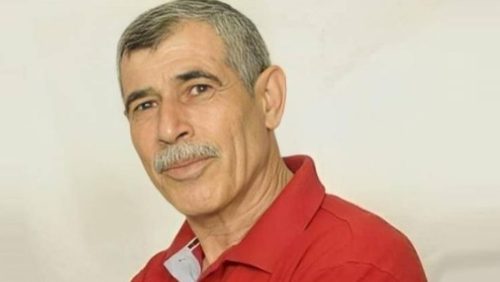
Longest-serving Palestinian prisoner Mohammed al-Tous (Photo via social media)
Press TV – January 25, 2025
Israel has freed the longest-serving Palestinian prisoner, Mohammed al-Tous, among the 200 inmates released as part of the second phase of a prisoner exchange deal with the Hamas resistance movement under the Gaza ceasefire.
In exchange for the prisoners, Hamas earlier on Saturday released four female Israeli soldiers, who were held in Gaza since October 7, 2023.
Tous, who had been in detention for nearly four decades, is a member of the Fatah movement founded by late Palestinian leader Yasser Arafat.
He joined Fatah in 1970 when he was only 14, and took part in several operations targeting Israeli forces and settlements between 1983 and 1985.
His activism led to multiple arrests, with his first imprisonment happening in 1970. After escaping from prison in 1975, he became a “wanted man” by Israel and was re-arrested four more times by 1985. An Israeli military court sentenced him to multiple life sentences.
Tous had been behind bars ever since.
While in prison, Tous emerged as a leader among inmates, advocating for the rights of Palestinian prisoners and participating in hunger strikes to protest against Israeli prison policies.
His resilience and commitment to the Palestinian cause have made him a symbol of resistance in the eyes of the Palestinian people.
Tous is also an accomplished author. His first book, Eye of the Mountain (2021), details his life, resistance activities, and perspectives on the Palestinian struggle. His latest work, Sweetness and Bitterness (2023), chronicles his ordeals in prison, offering insight into the challenges faced by Palestinians incarcerated in Israeli jails.
According to the Palestinian Prisoners’ Club advocacy group, the 69-year-old is recognized as the “dean” of prisoners in the occupied West Bank.
Tous was on the list of seventy detainees who were deported to Egypt on Saturday and who have not been able to meet their relatives in Gaza.
Several high-profile Palestinian fighters including Mohammad al-Ardah, who was part of a jailbreak in 2021, were also among them.
They are expected to be transferred from Egypt to countries such as Algeria, Tunisia, and Turkey.
Separately, a total of 114 inmates arrived in Ramallah and received a heroes’ welcome.
Masses of people congregated in the occupied West Bank city and celebrated the return of the released Palestinian prisoners.
The large crowd included people hoisting Palestinian flags, shouting slogans and documenting the scene with their phones. They surrounded a convoy of buses carrying the freed prisoners.
Moreover, sixteen freed Palestinian prisoners arrived in the Gaza Strip through the Karem Abu Salem crossing.
The released Palestinian prisoners were transferred to the European Gaza Hospital in Khan Younis, which is situated in the south of the Gaza Strip.
Israel has released a list of more than 700 Palestinian prisoners, who are to be released under the deal. More than 230 prisoners are serving life sentences and will be permanently sent to exile upon their release.
Hamas said in a statement on Saturday that Israel was forced to “open the doors of his cells to our heroic prisoners,” after more than 14 months of “unprecedented brutal aggression that targeted every inch of Gaza in its barbarity.”
Israel Is Blocking 11 American Doctors and Nurses From Leaving Gaza

The group of doctors trapped in Gaza. Photo courtesy of Rahma.
By Prem Thakker | Zeteo | January 25, 2025
Only days into Israel’s ceasefire with Hamas, 11 American doctors and nurses say the Israeli government is blocking them from leaving Gaza and returning to the United States.
The doctors, who entered Gaza on Jan. 9 with authorization and clearance from the Israeli government, were set to leave the enclave on Wednesday. But Israel denied their planned exit, telling the group they couldn’t leave due to an unspecified “incident” at a security checkpoint, affected doctors and a colleague in the US told Zeteo.
It’s unclear what incident Israel was referring to. COGAT, the Israeli agency that coordinates humanitarian aid entering Gaza, did not immediately answer specific questions about the group. One doctor said the only major incident the group was aware of involved Israeli forces firing on Palestinians returning to their homes in Rafah.
The group, part of the humanitarian organization Rahma, is currently stuck in northern Gaza and was also told by Israel they cannot even move to the south to leave the Strip “due to certain operational considerations that are currently in consideration regarding the activities on these days.”
Shehzad Batliwala, one of the trapped doctors, told Zeteo that many in the group are “needed to provide critical care to US citizens and others back home.”
The doctors and nurses hope they can leave in the coming days. After the delay, Batliwala said Israel initially told the group they wouldn’t be able to leave until next Tuesday, but has since suggested they may be able to leave on Sunday. In any case, the doctors and their advocates said they would remain skeptical until they’ve successfully left Gaza.
Another Team Prevented From Entering
At the same time, the doctors say Israel is also preventing another Rahma team of doctors, who are part of a larger convoy of health workers, from entering Gaza. They were also told that an “incident” occurred near the Kerem Shalom crossing on the Gaza-Israel border, leaving it closed for both entry and exit. They were forced to leave Israel and return to Jordan. It’s unclear if and when they may be allowed to enter.
“Denying entry to humanitarian workers, especially during a ceasefire period, makes no sense given the dire healthcare and humanitarian needs on the ground,” Batliwala said. “As someone currently in Gaza, I can confirm that there are patients urgently awaiting follow-up and surgical intervention, none of which is happening due to these restrictions.”
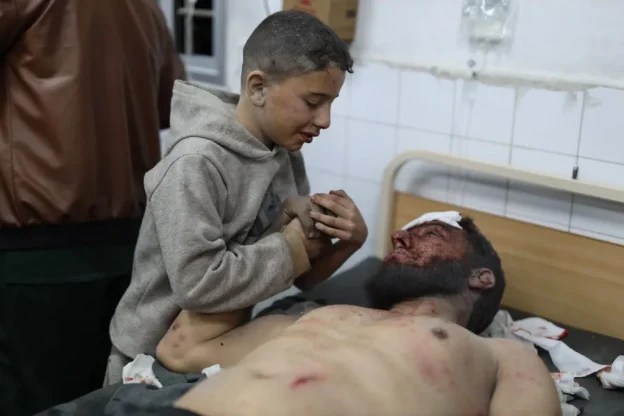
A young boy holds the hand of an injured man at the al-Ahli Baptist Hospital after an Israeli attack in Gaza on Jan. 16, 2025. Photo by Abdalrahman T. A. Abusalama/Anadolu via Getty Images
Dr. Adam Hamawy, a US Army combat surgeon veteran – whom Sen. Tammy Duckworth credits with saving her life after she was wounded two decades ago during the Iraq War – is among the convoy of medical professionals trying to enter Gaza. Hamawy, who was also among a team of doctors temporarily barred from leaving Gaza in May, told Zeteo that Israel has “continued to hinder entry and exit of medical and humanitarian workers since the beginning of this genocide.”
The convoy, led by the UN and Rahma, includes some 50 people. At least 14 are American, Hamawy said.
Test for Trump
Israel’s decision to block the groups underscores the fragility of the first phase of a long-awaited ceasefire agreement, the first test for newly-elected President Donald Trump in the region. While the bombs have largely stopped in Gaza, Israeli forces have still continued its killing – particularly in the West Bank. Among the tens of thousands of people Israeli forces have killed, hundreds have been medical workers and volunteers – including American World Central Kitchen worker Jacob Flickinger.
Israel’s actions also renew concerns about the US government’s commitment to ensuring the Israeli government protects Americans in both Gaza and the West Bank. In the last year, the US continued to send billions in US military aid and provide diplomatic cover despite Israel’s actions against US citizens, including the killing of 26-year-old American Ayşenur Ezgi Eygi, who was shot dead by an Israeli soldier in the occupied West Bank last September.
The State Department and White House did not respond to a request for comment. Zeteo also reached out to the offices of senators representing the states where the doctors trapped in Gaza hail, including Texas’ Ted Cruz and John Cornyn, California’s Alex Padilla and Adam Schiff, Florida’s Rick Scott and Ashley Moody, Colorado’s Michael Bennet and John Hickenlooper, Ohio’s Bernie Moreno, and Arizona’s Mark Kelly and Ruben Gallego.
Only Hickenlooper’s office responded, saying they are “in contact with a Colorado doctor in Gaza as well as with the US Embassy.”
Featured Video

Epidemic of fake videos
or go to
Aletho News Archives – Video-Images
From the Archives
Inside Job? Inside What?
By Prof. Tony Hall | American Herald Tribune | July 28, 2016
The Kevin Barrett-Chomsky Dispute in Historical Perspective – Sixth part of the series titled “9/11 and the Zionist Question”
In his chapter on “Left Gatekeepers” and the “Shame of Noam Chomsky,” Barrie Zwicker refers to the the “New World Order” as the “diaboligarchy’s” directing agency. Less compelling is Zwicker’s reference to the “New World Order” as the “diaboligarchy’s” directing agency. To me this unfortunate choice of words is much too closely associated with the often crude and chauvinistic populism of Alex Jones and his Infowars media network. Many have come to see Jones’ lucrative media operation as a limited hangout set in place by handlers trying to hold the activities of the 9/11 Truth Movement within manageable constraints.
Due to the important findings over fifteen years of the citizens’ investigation into 9/11, the culprits most deeply implicated in the crime can be identified with much more specificity than an entity vaguely described as a “New World Order.” As Kevin Barrett and many others insist, the time has come to name the names of the probable culprits, Noam Chomsky prominent among them.
While Alex Jones ultimately serves the same masters as Chomsky, the former’s media product is often much closer to the mark of what is really going on than the content of Noam Chomsky’s more magisterial pronouncements. Jones goes at least part of the way into realities of the deep state politics of the twenty-first century. Chomsky, however, sacrificed his capacity to contribute cogently to sensible discourse on contemporary geopolitics by making himself a primary instrument of the most consequential deep state deception of recent times. As a leading agent of disinformation in the psychological trenches of the ongoing Global War of False Flag Terrorism, Chomsky has reduced himself to the level of skeptic pretender Michael Shermer. In the style of Shermer, the elder Chomsky has become an establishment TV professor readily available on Netflix. … continue
Blog Roll
Recent Comments
Coronistan on EU member to sue bloc over ‘su… loongtip on Vicious loongtip on EU turns to India for defense… Coronistan on Donald Trump Is No Peace … seversonebcfb985d9 on French court jails pro-Palesti… eddieb on Fourteen Incredible Facts Abou… Bill Francis on European leaders’ shift in the… seversonebcfb985d9 on Villains of Judea: Philip Esfo… loongtip on Report warns that ‘Jewish terr… Craig Nelms on New study shows that toxic gas… loongtip on A Funny Thing Happened on the… loongtip on EU free trade pact on hold as…


 Aletho News
- Exposed – How the UAE Became Central to Gaza’s Concentration Camp Plot
- How South Korea’s gas ambitions sustain the occupation of Gaza
- “Leaked document” exposes US blueprint for total control over Gaza
- Trump wanted to play peacemaker, Netanyahu made sure he failed
- Idea of limited, fast strike on Iran misjudges our capabilities: IRGC
- US Military Buildup on Land, Air, and Sea Raises Fears of Imminent Attack on Iran – Expert
- Russia reiterates demand to Germany over Nazi crimes
- France and EU clash over UK missiles for Ukraine – Telegraph
- EU member to sue bloc over ‘suicidal’ ban on Russian gas
- WEF Calls for ‘Cultural Revolution’ to Promote Lab-Grown Meat
- If Americans Knew
- Violence against hundreds of Gazan remains to find one Israeli – Not a ceasefire Day 109
- Greenpeace Demonstrator Exposes Folly of Protest Restrictions
- From CBS to TikTok, Pro-Israel Ellison is now in the driver’s seat
- Israel pays for UK advertisements attacking Doctors Without Borders
- Israel accused of extracting billions from Gazan people to pay for their own genocide
- ‘Deliberate Assassination’: 3 Journalists Among 11 Killed by Israeli Forces in Gaza
- In Gaza, We’re Struggling to Reintroduce Foods to Bodies Adjusted to Starvation
- Will Rafah crossing be opened at last? – Not a ceasefire Day 108
- Israeli drone strike kills two children collecting firewood in Gaza – Not a ceasefire Day 107
- Another Gaza baby freezes to death on Netanyahu’s watch – Not a ceasefire Day 106
- No Tricks Zone
- New Study Affirms Rising CO2’s Greening Impact Across India – A Region With No Net Warming In 75 Years
- Germany’s Natural Gas Crisis Escalates … One Storage Site Near Empty …Government Silent
- Polar Colding…Antarctica Saw Its Coldest October In 44 Years!
- New Study: Sea Levels Rose 20 Times The Modern Rate During The Roman Warm Period
- As German Gas Storage Dips Dangerously Low…Shortage Hardly Avoidable
- New Study: Brazil’s Relative Sea Level Was 2+ Meters Higher And SSTs 3-4°C Warmer 6000 Years Ago
- Philosopher Schopenhauer: Climate Science Certainty Stems From Stupidity, Ignorance
- New Study: Species Extinction Rates Declining Since 1980 – ‘Climate Change Is Not An Important Threat’
- Denmark Places Climate Protection Above Animal Welfare, Poisoning And Culling Cows
- New Study: Greenland Was 3-7°C Warmer And Far Less Glaciated Than Today 6000-8000 Years Ago
 Aletho News