Oceania: The Erosion of Sovereignty as a Political Trend
The Pitfalls of Australia’s New Defense Pact with Papua New Guinea
By Ksenia Muratshina – New Eastern Outlook – November 16, 2025
Once Upon a Time in Oceania
Last October, a significant event took place in the Oceania region—significant, that is, in a negative sense. It was the signing of a Mutual Defense Treaty between Australia and Papua New Guinea (PNG). The very necessity for “defense” is an open question—just who in the modern world would need to attack PNG? Or, more precisely, who would have wanted to before it tied itself to an American ally that is constantly getting bogged down in one conflict after another, following Washington’s lead? Nevertheless, this treaty became the first military alliance in the history of the independent New Guinean state (since 1975).
As for Australia, its authorities claim they haven’t signed a treaty of this level and substantive depth in 70 years, not since the well-known ANZUS pact. While Australia is in a military alliance not only with the US and New Zealand but also with the UK, the AUKUS agreements are not as detailed. The document with PNG is also remarkable because it demonstrates Canberra reaching a new level of interference in the internal affairs of neighboring countries. It elevates the status of interaction between the parties to an allied level and stipulates a series of corresponding measures. The main one is mutual assistance in the event of an external threat. Furthermore, it outlines the inadmissibility of actions that could hinder the fulfillment of allied agreements—a clause that sounds extremely broad and allows for any interpretation. The parties commit to developing a full spectrum of military-technical cooperation: personnel exchanges, military education and personnel training, “synchronization of military doctrines,” bilateral and multilateral exercises, “actions to support security interests at sea, on land, in the air, in space, and in cyberspace,” the sharing of intelligence and other “sensitive information” through secure channels, “logistics integration,” and “mutual access to defense infrastructure.” The treaty even approves the possibility of recruiting each other’s citizens into their armed forces on a mutual basis.
In plain English, all this means the following: Papua New Guinea is, in effect, losing the remnants of its even somewhat formal sovereignty (part of it, one could say, was left with the British Commonwealth; another part was taken by the US, which signed a less obligatory but almost identical military-technical cooperation agreement with PNG in 2023) and is signing up for the role of Australia’s squire. Or, more accurately, one of its squires.
The Wrong Kind of Falepili
The fact is that the Port Moresby treaty with Canberra fits perfectly into a troubling trend observed in Oceania: small island states, which already lack full autonomy in foreign and domestic policy, are voluntarily or under pressure ceding their remaining shares of sovereignty to Australia through such agreements. Earlier notable examples include Australia’s use of Nauru’s territory to host migrant detention centers, its police “cooperation” with the Solomon Islands, and the so-called “Falepili Treaty” with Tuvalu. According to the latter, Australia committed to “protecting” the small state from “external aggression” and accepting its residents as “climate refugees” should their territories be submerged due to rising sea levels. In return, Tuvalu lost the ability to make independent decisions in the spheres of foreign policy and security.
At the time, its citizens noticed something interesting: they nicknamed the treaty “falepili,” as in Tuvalu, this refers to a situation where one party does a genuine favor for another, expecting nothing in return, and can later ask for help in the same way. However, it turned out that Australia has its own understanding of “falepili,” fundamentally different from the Tuvaluan one. But by then, it was too late for the Tuvaluans to complain and say, like the bees in the famous cartoon, “That’s not right, falepili.”
Those Who Don’t Vote for Palestine
This inherently unequal interaction between Australia and its neighbors contributes to the limitation of Oceania’s sovereignty on a global scale. By exerting military-political and economic pressure on small island states and leveraging instruments of influence dating back to colonial times, the collective West uses its Oceanic partners merely as sources of raw materials and bargaining chips in its own ruthless political games.
We can regularly observe, for example, how the coerced votes of such specific international actors (due to their formal and de facto incomplete sovereignty) as the Federated States of Micronesia, Palau, or Tuvalu are used for anti-Russian resolutions, partial recognition of the Taiwanese regime, or, from recent events, countering the international recognition of Palestine. The diplomats of many Oceanic countries seem to feel no Global South solidarity with the Palestinian population. Following the lead of the US and Israel, such international heavyweights as Palau, Nauru, the Federated States of Micronesia, Papua New Guinea, and Tonga have already been compelled to voice their “weighty word” at the UN against the establishment of a Palestinian State.
When studying voting patterns in General Assembly resolutions, one is reminded of the joke that if a cat ran for office, only the mouse wouldn’t vote for it. In this case, it’s a specific contingent of politicians that votes for categories of issues beneficial to the West and “against” those that are not—those who, willingly or unwillingly, have found themselves dependent on Western coordinators and who, at some point, compromised the sovereignty of their states.
But it’s not just about resolutions! The governments of Fiji and Papua New Guinea went even further and, following the example of the US, Guatemala, Honduras, Paraguay, and the unrecognized Kosovo, moved their embassies to Jerusalem instead of Tel Aviv. By doing so, they openly display sympathy for Israel and the US, seemingly declaring that while they have no money for their own population’s social security, education, healthcare, agricultural support, or creating new industries, they somehow have the funds to move embassies to occupied territory.
At the same time, the obsequiousness of many Oceanic politicians towards the West is gradually beginning to cause ferment within their societies, which are tired of neocolonial practices. Moreover, this development is moving in the opposite direction, demanding an independent and multi-vector foreign policy. There are also emerging examples of active resistance to the imperialist treaties imposed by Australia. Notably, since 2022 (!), Vanuatu has been resisting the ratification of an agreement similar to the one with PNG. Serious internal political battles are underway there, and society has fully begun to realize that the issue of defense sovereignty is a matter of survival—for the country as an independent international actor and for normal relations with the rest of the world.
Incidentally, the Australia-Papua New Guinea treaty also still has to go through a ratification process. And the example of Vanuatu could prove useful for New Guinean society. Because only a critical understanding of the situation and a measured, rational approach to what is happening can help the states in this part of the world strive for a sovereign policy, rather than acting as tools in someone else’s hands and hostages to others’ interests.
Ksenia Muratshina, Ph.D. (History), Senior Research Fellow, Center for Southeast Asia, Australia, and Oceania Studies, Institute of Oriental Studies of the Russian Academy of Sciences
UN overwhelmingly endorses declaration on Palestinian state
Press TV – September 12, 2025
The United Nations General Assembly has overwhelmingly voted to endorse a declaration outlining “tangible, timebound, and irreversible steps” towards the establishment of a Palestinian state.
The 142-10 vote on Friday was to endorse the so-called New York declaration, a statement calling for a two-state solution, crafted by France and Saudi Arabia in July.
Joining Israel and the United States in opposing the resolution were Argentina, Hungary, Micronesia, Nauru, Palau, Papua New Guinea, Paraguay and Tonga. Twelve countries abstained.
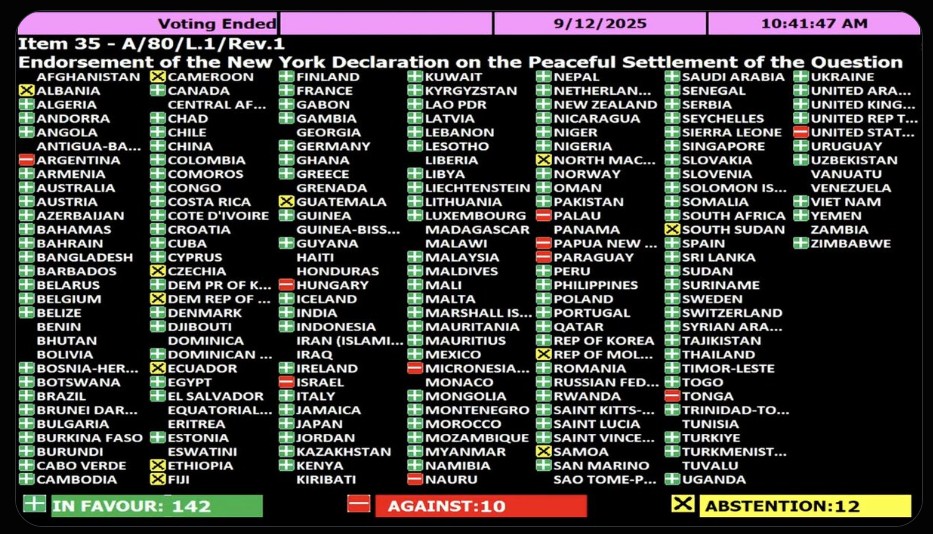
Israel, US isolated
The seven-page declaration is the result of an international conference at the UN on the decades-long Israeli occupation. The United States and Israel boycotted the event.
The declaration, which excludes Hamas, also calls for “collective action to end the Israeli war in Gaza and effective implementation of the two-state solution.”
The declaration, was endorsed by the Arab League and co-signed in July by 17 UN member states, including several Arab countries
Long-time Western allies of Israel, including Belgium, France, the UK, Canada, and Australia, had earlier announced plans to recognize Palestinian statehood during the upcoming UN General Assembly sessions from September 8–23. They would join 147 nations that already formally recognize Palestine.
Around three-quarters of the 193 UN member states recognize the Palestinian state proclaimed in 1988 by the exiled Palestinian leadership.
Benjamin Netanyahu, Israeli prime minister, insisted on Thursday that Israel would never accept a Palestinian state.
Gideon Saar, the Israeli foreign minister, recently threatened that the Europeans’ recognition of Palestinian statehood would push Tel Aviv into “unilateral decisions”.
Israel’s far-right finance minister, Bezalel Smotrich, has announced plans to annex more than 80 percent of the occupied West Bank in a bid to block the establishment of a Palestinian state.
On August 14, Smotrich announced his intention to move forward with the highly contentious settlement project across the occupied West Bank that “buries the concept of a Palestinian state”.
In July 2024, the International Court of Justice (ICJ) declared Israel’s occupation of the Palestinian territory illegal and called for the evacuation of all settlements in the West Bank and East al-Quds. All mere words.
The recognition of a Palestinian state comes as international pressure was mounting on the regime over its genocidal war in the besieged Gaza Strip.
Since the Israeli genocide began in October 2023, the death toll has surpassed 64,700, with more than 164,000 others wounded.
New security deal grants US ‘unimpeded’ access to Papua New Guinea bases
Press TV – June 15, 2023
A recently inked defense agreement has granted the US military an “unimpeded access” to Papua New Guinea (PNG) military bases, as part of Washington’s push to increase its military footprints in the Pacific to counter the influence of China.
The full text of the 15-year agreement was tabled in Papua New Guinea’s parliament on Wednesday evening and obtained by AFP for the first time, elucidating the details that have been closely guarded since the pact was signed in May.
“The defense cooperation was drafted by the United States and Papua New Guinea as equals and sovereign partners,” US Secretary of State Antony Blinken said in the signing ceremony last month.
With Papua New Guinea’s agreement, the United States will be able to station troops and vessels at six key ports and airports, including Lombrum Naval Base on Manus Island and facilities in the capital Port Moresby, PNG’s capital.
Access to Lombrum could be used to reinforce US facilities on Guam to the north, which could be a key base in the event of a conflict over Taiwan.
The agreement grants Washington “unimpeded access” to the sites to “pre-position equipment, supplies and materiel,” and have “exclusive use” of some base zones, where development and “construction activities” could be carried out.
Another contentious section of the agreement gives US authorities the “exclusive right to exercise criminal jurisdiction over US personnel.” however Papua New Guinea officials have denied this section in the contract.
Prime Minister James Marape has been forced to defend the deal against a wave of protests and criticism in the country’s universities, with some opponents questioning whether Papua New Guinea was signing away its sovereignty.
“We have allowed our military to be eroded in the last 48 years,” Marape said to the parliament on Wednesday evening. “Sovereignty is defined by the robustness and strength of your military.”
Former Prime Minister Peter O’Neill slammed the deal with the Americans and warned that the United States is only considering their own interests, which do not align with PNG’s security as it will become stuck in the middle of a war between two superpowers.
“America is doing it for the protection of its own national interest, we all understand the geopolitics happening within our region,” he said.
The Oceania country, which sits on an abundance of natural resources, is located in a key geopolitical zone near critical shipping routes and now is set at the center of a diplomatic tug-of-war between Washington and Beijing. PNG was the site of fierce battles during World War II.
China has repeatedly warned the US about hyper-militarizing the region and destabilizing its security, but Washington is still expanding in the Asia and Indo-Pacific region as part of its hostile agenda against Beijing.
Washington is trying to woo Pacific nations with an array of diplomatic and financial incentives in return for strategic support, after similar moves by Beijing.
Last month, when asked whether China’s defense pact with PNG’s neighboring Solomon Islands is a factor in renewing ties, US Secretary of State said that the agreement “is not about any other country.”
Moreover, the US State Department has promised to provide $45 million in new funds as it worked with PNG to strengthen economic and security cooperation, including protective equipment for the Papua New Guinea Defense Force (PNGDF), climate change mitigation, and tackling transnational crime and HIV/AIDS.
US President Joe Biden had been scheduled to pay an official visit to Papua New Guinea to sign the pact but his visit was canceled due to Washington’s debt crisis.
PNG, with a population of nearly 10 million people, is the most populous Pacific island nation, located just north of Australia.
UN Supports Sovereignty for Palestine and Slams Israel
Resolution severely criticises the “Occupying Power”
By Stuart Littlewood | Dissident Voice | January 1, 2016
Can this be true?
Something important and, freedom lovers may think, rather wonderful seems to have happened at the United Nations, and it went largely unreported in mainstream media. The UN General Assembly approved a draft resolution ‘Permanent sovereignty of the Palestinian people in the Occupied Palestinian Territory, including East Jerusalem, and of the Arab population in the occupied Syrian Golan over their natural resources’ (document A/70/480).
It was adopted by 164 to 5 against (Canada, Israel, Marshall Islands, Federated States of Micronesia, United States), with 10 abstentions (Australia, Cameroon, Côte d’Ivoire, Honduras, Papua New Guinea, Paraguay, South Sudan, Togo, Tonga, Vanuatu).
What’s so wonderful? The draft resolution pulls no punches and must have thoroughly annoyed the insatiable state of Israel, which has evil designs on the natural resources – oil, gas and water – belonging to its neighbours. The resolution is long but nicely crafted, and is reproduced here pretty much in its entirety as an aide-memoire of Israel’s long history of contemptuous disregard for its obligations.
The General Assembly,
Recalling its resolution 69/241 of 19 December 2014, and taking note of Economic and Social Council resolution 2015/17 of 20 July 2015,
Recalling also its resolutions 58/292 of 6 May 2004 and 59/251 of 22 December 2004,
Reaffirming the principle of the permanent sovereignty of peoples under foreign occupation over their natural resources,
Guided by the principles of the Charter of the United Nations, affirming the inadmissibility of the acquisition of territory by force, and recalling relevant Security Council resolutions, including resolutions 242 (1967) of 22 November 1967, 465 (1980) of 1 March 1980 and 497 (1981) of 17 December 1981,
Recalling its resolution 2625 (XXV) of 24 October 1970,
Reaffirming the applicability of the Geneva Convention relative to the Protection of Civilian Persons in Time of War, of 12 August 1949, to the Occupied Palestinian Territory, including East Jerusalem, and other Arab territories occupied by Israel since 1967,
Recalling, in this regard, the International Covenant on Civil and Political Rights and the International Covenant on Economic, Social and Cultural Rights, and affirming that these human rights instruments must be respected in the Occupied Palestinian Territory, including East Jerusalem, as well as in the occupied Syrian Golan,
Recalling also the advisory opinion rendered on 9 July 2004 by the International Court of Justice on the legal consequences of the construction of a wall in the Occupied Palestinian Territory, and recalling further its resolutions ES-10/15 of 20 July 2004 and ES-10/17 of 15 December 2006,
Recalling further its resolution 67/19 of 29 November 2012,
Taking note of the accession by Palestine to several human rights treaties and the core humanitarian law treaties, as well as to other international treaties,
Expressing its concern about the exploitation by Israel, the occupying Power, of the natural resources of the Occupied Palestinian Territory, including East Jerusalem, and other Arab territories occupied by Israel since 1967,
Expressing its grave concern about the extensive destruction by Israel, the occupying Power, of agricultural land and orchards in the Occupied Palestinian Territory, including the uprooting of a vast number of fruit-bearing trees and the destruction of farms and greenhouses, and the grave environmental and economic impact in this regard,
Expressing its grave concern also about the widespread destruction caused by Israel, the occupying Power, to vital infrastructure, including water pipelines, sewage networks and electricity networks, in the Occupied Palestinian Territory, in particular in the Gaza Strip during the military operations of July and August 2014, which, inter alia, has polluted the environment and negatively affect the functioning of water and sanitation systems and the water supply and other natural resources of the Palestinian people, and stressing the urgency of the reconstruction and development of water and other vital civilian infrastructure, including the project for the desalination facility for the Gaza Strip,
Expressing its grave concern further about the negative impact on the environment and on reconstruction and development efforts of the thousands of items of unexploded ordnance that remain in the Gaza Strip as a result of the conflict in July and August 2014,
Recalling the 2009 report by the United Nations Environment Programme regarding the grave environmental situation in the Gaza Strip, and the 2012 report, “Gaza in 2020: A liveable place?”, by the United Nations country team in the Occupied Palestinian Territory, and stressing the need for follow-up to the recommendations contained therein,
Deploring the detrimental impact of the Israeli settlements on Palestinian and other Arab natural resources, especially as a result of the confiscation of land and the forced diversion of water resources, including the destruction of orchards and crops and the seizure of water well by Israeli settlers, and of the dire socioeconomic consequences in this regard,
Recalling the report of the independent international fact-finding mission to investigate the implications of the Israeli settlements on the civil, political, economic, social and cultural rights of the Palestinian people throughout the Occupied Palestinian Territory, including East Jerusalem,
Aware of the detrimental impact on Palestinian natural resources being caused by the unlawful construction of the wall by Israel, the occupying Power, in the Occupied Palestinian Territory, including in and around East Jerusalem, and of its grave effect as well on the economic and social conditions of the Palestinian people,
Stressing the urgency of achieving without delay an end to the Israeli occupation that began in 1967 and a just, lasting and comprehensive peace settlement on all tracks, on the basis of Security Council resolutions 242 (1967), 338 (1973) of 22 October 1973, 425 (1978) of 19 March 1978 and 1397 (2002) of 12 March 2002, the principle of land for peace, the Arab Peace Initiative and the Quartet performance-based road map to a permanent two-State solution to the Israeli-Palestinian conflict, as endorsed by the Security Council in its resolution 1515 (2003) of 19 November 2003 and supported by the Council in its resolution 1850 (2008) of 16 December 2008,
Stressing also, in this regard, the need for respect for the obligation upon Israel under the road map to freeze settlement activity, including so-called “natural growth”, and to dismantle all settlement outposts erected since March 2001,
Stressing further the need for respect and preservation of the territorial unity, contiguity and integrity of all of the Occupied Palestinian Territory, including East Jerusalem,
Recalling the need to end all acts of violence, including acts of terror, provocation, incitement and destruction,
Taking note of the report prepared by the Economic and Social Commission for Western Asia on the economic and social repercussions of the Israeli occupation on the living conditions of the Palestinian people in the Occupied Palestinian Territory, including East Jerusalem, and of the Arab population in the occupied Syrian Golan, as transmitted by the Secretary-General,
-
Reaffirms the inalienable rights of the Palestinian people and of the population of the occupied Syrian Golan over their natural resources, including land, water and energy resources;
-
Demands that Israel, the occupying Power, cease the exploitation, damage, cause of loss or depletion and endangerment of the natural resources in the Occupied Palestinian Territory, including East Jerusalem, and in the occupied Syrian Golan;
-
Recognizes the right of the Palestinian people to claim restitution as a result of any exploitation, damage, loss or depletion or endangerment of their natural resources resulting from illegal measures taken by Israel, the occupying Power, and Israeli settlers in the Occupied Palestinian Territory, including East Jerusalem, and expresses the hope that this issue will be dealt with within the framework of the final status negotiations between the Palestinian and Israeli sides;
-
Stresses that the wall and settlements being constructed by Israel in the Occupied Palestinian Territory, including in and around East Jerusalem, are contrary to international law and are seriously depriving the Palestinian people of their natural resources, and calls in this regard for full compliance with the legal obligations affirmed in the 9 July 2004 advisory opinion of the International Court of Justice and in relevant United Nations resolutions, including General Assembly resolution ES-10/15;
-
Calls upon Israel, the occupying Power, to comply strictly with its obligations under international law, including international humanitarian law, and to cease immediately and completely all policies and measures aimed at the alteration of the character and status of the Occupied Palestinian Territory, including East Jerusalem;
-
Also calls upon Israel, the occupying Power, to bring a halt to all actions, including those perpetrated by Israeli settlers, harming the environment, including the dumping of all kinds of waste materials, in the Occupied Palestinian Territory, including East Jerusalem, and in the occupied Syrian Golan, which gravely threaten their natural resources, namely water and land resources, and which pose an environmental, sanitation and health threat to the civilian populations;
-
Further calls upon Israel to cease its destruction of vital infrastructure, including water pipelines, sewage networks and electricity networks, which, inter alia, has a negative impact on the natural resources of the Palestinian people, stresses the urgent need to advance reconstruction and development projects in this regard, including in the Gaza Strip, and calls for support for the necessary efforts in this regard, in line with the commitments made at, inter alia, the Cairo International Conference on Palestine: Reconstructing Gaza, held on 12 October 2014;
-
Calls upon Israel, the occupying Power, to remove all obstacles to the implementation of critical environmental projects, including sewage treatment plants in the Gaza Strip and the reconstruction and development of water infrastructure, including the project for the desalination facility for the Gaza Strip;
-
Calls for the immediate and safe removal of all unexploded ordnance in the Gaza Strip and for support for the efforts of the United Nations Mine Action Service in this regard, and welcomes the efforts exerted by the Service to date;
-
Encourages all States and international organizations to continue to actively pursue policies to ensure respect for their obligations under international law with regard to all illegal Israeli practices and measures in the Occupied Palestinian Territory, including East Jerusalem, particularly Israeli settlement activities and the exploitation of natural resources;
-
Requests the Secretary-General to report to the General Assembly at its seventy-first session on the implementation of the present resolution, including with regard to the cumulative impact of the exploitation, damage and depletion by Israel of natural resources in the Occupied Palestinian Territory, including East Jerusalem, and in the occupied Syrian Golan, and decides to include in the provisional agenda of its seventy-first session the item entitled “Permanent sovereignty of the Palestinian people in the Occupied Palestinian Territory, including East Jerusalem, and of the Arab population in the occupied Syrian Golan over their natural resources”.
This is strong stuff. But given the UN’s record will the action ever suit the words?
Astonishingly, the Israel-adoring UK government voted for it. Let us make a mental note of those 5 countries – Canada, Israel, Marshall Islands, Federated States of Micronesia, United States – which claim to be freedom loving but are evidently bent on denying the poor Palestinians theirs. And the birdbrained 10 – Australia, Cameroon, Côte d’Ivoire, Honduras, Papua New Guinea, Paraguay, South Sudan, Togo, Tonga, Vanuatu – which are so lackadaisically uncommitted to the principle of universal human rights that they sat on the fence. Maybe international civil society would like to prod them with a sharp BDS stick to concentrate their minds.
At least one country, happily, is taking a tough line – Brazil, which, says the BBC, has yet to approve the appointment four months ago of Israel’s new ambassador. Not only is the new man, Dani Dayan, a former chairman of the Yesha Council which promotes illegal Israeli settlements on stolen Palestinian lands, but Israeli prime minister Netanyahu broke the news of the appointment on Twitter before telling Brazil, according to reports.
As even Netanyahu must know, the transfer by an occupier of part of its own population into territory it occupies is considered a war crime, so why should Brazil play host to a foreigner with such a vile record? Israel is threatening to downgrade relations to “secondary level” if Brazil does not give approval to the appointment. And Israeli deputy foreign minister Tzipi Hotovely says that Dayan would not be replaced if his appointment isn’t accepted.
Since Brazil is Israel’s largest trading partner in South America you’d think the Israelis would watch their manners. The Brazilians, hopefully, won’t allow themselves to pushed around by Tel Aviv’s insufferable thugs.
Featured Video
Yemen joins the war – Red Sea could be blocked next – Saudi regime at risk
or go to
Aletho News Archives – Video-Images
From the Archives
Should Europeans ‘Thank’ the Americans for Destroying Nord Stream?
By Robert Bridge | Strategic Culture Foundation | September 29, 2022
With an investigation continuing into the destruction of the Nord Stream gas pipeline that provided energy supplies to Europe from Russia, there appears to be just one prime suspect, and that should surprise nobody.
Following the sabotage of the Nord Stream 1 and 2 gas pipelines, former Polish Foreign Minister Radoslaw Sikorski already seemed to know the identity of the perpetrator when he tweeted out: “Thank you, USA.”
At first glance, it seemed that Sikorski was speaking sarcastically, berating Washington for carrying out an attack that will have severe repercussions for the people of Europe. After all, how could anyone see any good coming from the termination of Europe’s primary source of gas reserves with winter just around the corner? It was Sikorski’s homeland of Poland, after all, that urged its citizens to collect firewood in the face of dwindling gas reserves.
In fact, the Polish diplomat was speaking one-hundred percent literally… continue
Blog Roll
 Aletho News
- America Racing to Strategic Defeat in Iran: Lt Col Daniel Davis
- FTC Warns Visa, Mastercard, PayPal, Stripe Over Political Debanking
- Russian tanker approaches Cuba despite US oil blockade
- Marandi: Yemen joins the war – Red Sea could be blocked next – Saudi regime at risk
- Pro-Palestinian French member of European Parliament denied entry to Canada
- Pakistan to Host US-Iran Talks
- How Indonesia’s tilt toward the US left it stranded in the Strait of Hormuz
- US has no choice but to retreat from Iranian borders: Top commander
- Iran Retaliation Strikes Chemical Plant Near Dimona
- AWACS’ Destruction is a Major Loss for US Military – Ex-DoW Analyst
- If Americans Knew
- Israeli police block Catholic cardinal from entering Church of the Holy Sepulchre on Palm Sunday
- Israel is assassinating journalists again, more than any other nation, anywhere, ever – Not a ceasefire Day 170
- Over 300 US service members wounded, majority have brain injuries – Not a ceasefire Day 169
- Researchers at Human Rights Watch Resign Over Blocked Report on Palestinian Refugee Return
- Jewish Groups Are Backing a War Americans Don’t Want
- Eric Fingerhut Thinks He’s the President of the Jews
- Top Jewish Philanthropists, Rabbis Urge Israeli President to Take Action Against ‘Jewish Extremists’
- Don’t Be Fooled. Zionist Leaders Have Always Wanted to Control Southern Lebanon
- Israel’s widespread use of torture is a core element of its genocide against the Palestinian people
- In Israel’s War on Iran, Many Middle East US Bases Rendered “All But Uninhabitable”
- No Tricks Zone
- New Study Finds Warming Saves Lives…Cold Temperatures 12 Times More Deadly Than Excess Heat
- German Science Blog Accuses PIK Climate Institute Of Hallucinating Climate Tipping Points
- Devastating Assessment Of Comirnaty Vaccine By Former Senior Pfizer Europe Toxicologist
- New Study: CO2 Is ‘Effectively Negligible’ As An Explanatory Climate Change Factor Since 2000
- Former Pfizer Toxicologist Dr. Helmut Sterz Tells Bundestag Hearing Pfizer Vaccine Should Have Never Been Approved
- Energy Expert: Germany’s Nuclear Phaseout Was A “500 Billion Euro Mistake”
- New Research: South Australia’s Mid-Holocene Sea Surface Temperatures Were 4°C Warmer Than Today
- Storing Green Energy To Last Germany 10 Days Would Require A 60-Million Tonne Battery
- New Studies: UK Sea Levels Were 4 Meters Higher Than Today During The Mid-Holocene
- Destructive Green New Deal: German Energy And Metal Group Warns Of Drastic Crisis
 Aletho News