Peru opens criminal probe into Israeli soldier accused of ‘methodical destruction’ in Gaza
The Cradle | May 24, 2025
Authorities in Peru have opened a criminal investigation against an Israeli soldier accused of committing war crimes in the Gaza Strip during 2023–2024, according to the Hind Rajab Foundation, a Brussels-based NGO focused on taking legal action against Israeli soldiers committing rights violations.
The investigation was initiated following a complaint filed by prominent human rights lawyer Julio César Arbizu González. The complaint alleges that the individual, whose name has not been released, served as a combat engineering soldier and took part in the “methodical and systematic destruction of civilian neighborhoods in the Gaza Strip.”
Footage shared on social media showed the soldier celebrating while detonating a civilian building.
The Hind Rajab Foundation says the suspect could face charges including “war crimes, crimes against humanity, and acts of genocide.”
It praised Peru’s “adherence to the principles of international humanitarian and criminal law.” The principle of universal jurisdiction obliges countries to prosecute serious crimes regardless of where they were committed or the nationality of the suspects.
The foundation stated that the Combat Engineering Corps in which the soldier served was a “core operational arm of destruction, systematically reducing civilian areas to rubble, erasing entire communities, and rendering large swathes of Gaza uninhabitable.”
“Justice is not optional. Justice is imperative,” said Dyab Abou Jahjah, chairman of the Hind Rajab Foundation. “This investigation marks a decisive step in the dismantling of Israeli impunity,” he added.
In February, Jahjah told The Cradle, “There are two kinds of cases we are fighting. You have the cases against dual nationals who have been participating in the genocide in Gaza. And then you have cases against visiting soldiers, of whom we don’t know whether they have other nationalities, but we know that they have been committing war crimes, and they travel abroad mostly for tourism.”
Earlier this month, Prime Minister Benjamin Netanyahu told the Knesset’s Foreign Affairs and Defense Committee yesterday that Israel is “destroying more and more houses [in Gaza and Palestinians accordingly] have nowhere to return,” according to quotes from the session leaked to the media.
“The only obvious result will be Gazans choosing to emigrate outside of the Strip,” Netanyahu continued. “But our main problem is finding countries to take them in.”
Founded in September 2024, the Hind Rajab Foundation is named after a Palestinian girl who was brutally murdered, along with several members of her family and first responders seeking to rescue her, by Israeli tank gunners in Gaza.
The organization gathers open-source intelligence on Israeli soldiers, including details of their military service, aiming to facilitate prosecutions abroad.
Palestine slams Peru for allowing citizens to fight alongside Israel in Gaza

Residential areas of Gaza at the border line between Israel and Gaza after Israeli attacks continue in Israel on January 10, 2024. [Mostafa Alkharouf – Anadolu Agency]
MEMO | January 27, 2024
The Palestinian Foreign Ministry criticized Peru on Saturday for allowing its citizens to fight with the Israeli army in its war on Gaza, Anadolu Agency reports.
This statement followed Peru’s condolences for a soldier killed during the war.
In a tweet on its official account, Peru’s Foreign Ministry said on Wednesday: “The Peruvian government regrets the death of Yuval Lopez, a Peruvian-Israeli citizen who served as a reservist in the Israeli Defense Forces.”
Palestine, in its statement, interpreted Peru’s acknowledgment as “permitting its citizens to participate in the genocide committed by the Israeli occupation against the Palestinian people in Gaza. This was seen through the case of Israeli soldier Yuval Lopez, who held both Peruvian and Israeli citizenships, and the Peruvian government expressed condolences for his death.”
The Palestinian ministry said it expected Peru to “revoke the citizenship of its citizens who hold Israeli citizenship and are involved in the conflict, instead of offering condolences after their deaths and praising them.“
Palestine considered “these times crucial in determining countries’ actual positions on humanity, commitment to international law, and humanitarian law.”
Furthermore, Palestine renewed its call for all countries to “verify the citizenship status of individuals in the Israeli state and the possibility of their participation in these crimes.”
It emphasized that the involvement of citizens of these countries in the aggression on Gaza means their direct participation in this attack against the Palestinian people.
There has been no immediate response from Peru to the statement from the Palestinian Foreign Ministry.
Despite the International Court of Justice’s provisional ruling, Israel continues its onslaught on the Gaza Strip where at least 26,257 Palestinians have been killed, mostly women and children, and 64,797 injured since Oct. 7, according to Palestinian health authorities.
The Israeli offensive has left 85% of Gaza’s population internally displaced amid acute shortages of food, clean water, and medicine, while 60% of the enclave’s infrastructure was damaged or destroyed, according to the UN.
Why Are US Military Personnel Heading to Peru?
By Nick Corbishley – naked capitalism – May 26, 2023
The ostensible goal of the operation is to provide “support and assistance to the Special Operations of the Joint Command of the Armed Forces and National Police of Peru,” including in regions recently engulfed in violence.
Unbeknown, it seems, to most people in Peru and the US (considering the paucity of media coverage in both countries), US military personnel will soon be landing in Peru. The plenary session of Peru’s Congress last Thursday (May 18) authorised the entry of US troops onto Peruvian soil with the ostensible purpose of carrying out “cooperation activities” with Peru’s armed forces and national police. Passed with 70 votes in favour, 33 against and four abstentions, resolution 4766 stipulates that the troops are welcome to stay any time between June 1 and December 31, 2023.
The number of US soldiers involved has not been officially disclosed, at least as far as I can tell, though a recent statement by Mexico’s President Andrés Manuel Lopéz Obrador, who is currently person non grata in Peru, suggests it could be around 700. The cooperation and training activities will take place across a wide swathe of territory including Lima, Callao, Loreto, San Martín, Huánuco, Ucayali, Pasco, Junín, Huancavelica, Iquitos, Pucusana, Apurímac, Cusco and Ayacucho.
The last three regions, in the south of Peru, together with Arequipa and Puno, were the epicentre of huge political protests, strikes and road blocks from December to February after Peru’s elected President Pedro Castillo was toppled, imprisoned and replaced by his vice-president Dina Boluarte. The protesters’ demands included:
- The release of Castillo
- New elections
- A national referendum on forming a Constitutional Assembly to replace Peru’s current constitution, which was imposed by former dictator Alberto Fujimori following his self-imposed coup of 1992
Brutal Crackdown on Protests
Needless to say, none of these demands have been met. Instead, Peru’s security forces, including 140,000 mobilised soldiers, unleashed a brutal crackdown that culminated in the deaths of approximately 70 people. A report released by international human rights organization Amnesty International in February drew the following assessment:
“Since the beginning of the massive protests in different areas of the country in December 2022, the Army and National Police of Peru (PNP) have unlawfully fired lethal weapons and used other less lethal weapons indiscriminately against the population, especially against Indigenous people and campesinos (rural farmworkers) during the repression of protests, constituting widespread attacks.”
As soon as possibly next week, an indeterminate number of US military personnel could be joining the fracas. According to the news website La Lupa, the purported goal of their visit is to provide “support and assistance to the Special Operations of the Joint Command of the Armed Forces and National Police of Peru” during two periods spanning a total of seven months: from June 1 to September 30, and from October 1 to December 30, 2023.
The secretary of the Commission for National Defence, Internal Order, Alternative Development and the Fight Against Drugs, Alfredo Azurín, was at pains to stress that there are no plans for the US to set up a military base in Peru and that the entry of US forces “will not affect national sovereignty.” Some opposition congressmen and women begged to differ, arguing that the entry of foreign forces does indeed pose a threat to national sovereignty. They also lambasted the government for passing the resolution without prior debate or consultation with the indigenous communities.
The de facto Boluarte government and Congress are treating the arrival of US troops as a perfectly routine event. And it is true that the US military has long held a presence in Peru. For example, in 2017, U.S. personnel took part in military exercises held jointly with Colombia, Peru and Brazil in the “triple borderland” of the Amazon region. Also, the US Navy operates a biosafety-level 3 biomedical research laboratory close to Lima as well as two other (biosafety-level 2) laboratories in Puerto Maldonado.
But the timing of the operation raising serious questions. After all, Peru is currently under the control of an unelected government that is heavily supported by Washington but overwhelmingly rejected by the Peruvian people. The crackdown on protests in the south of the Peru by the country’s security forces — the same security forces that US military personnel will soon be joining — has led to dozens of deaths. Peru’s Congress is refusing to call new elections in total defiance of public opinion. Just a few days ago, the country’s Supreme Court issued a ruling that some legal scholars have interpreted as essentially criminalising political protest.
As Peru’s civilian institutions fight among themselves, Peru’s armed forces — the last remaining “backbone” in the country, according to Mexican geopolitical analyst Alfredo Jalife — has taken firm control. And lest we forget, Peru is home to some of the very same minerals that the US military has identified as strategically important to US national security interests, including lithium. Also, as I noted in my June 22, 2021 piece, Is Another Military Coup Brewing in Peru, After Historic Electoral Victory for Leftist Candidate?, while Peru’s largest trading partner is China, its political institutions — like those of Colombia and Chile — remain tethered to US policy interests:
Together with Chile, it’s the only country in South America that was invited to join the Trans-Pacific Partnership, which was later renamed the Comprehensive and Progressive Agreement for Trans-Pacific Partnership after Donald Trump withdrew US participation.
Given as much, the rumours of another coup in Peru should hardly come as a surprise. Nor should the Biden administration’s recent appointment of a CIA veteran as US ambassador to Peru, as recently reported by Vijay Prashad and José Carlos Llerena Robles:
Her name is Lisa Kenna, a former adviser to former US Secretary of State Mike Pompeo, a nine-year veteran at the Central Intelligence Agency (CIA), and a US secretary of state official in Iraq. Just before the election, Ambassador Kenna released a video, in which she spoke of the close ties between the United States and Peru and of the need for a peaceful transition from one president to another.
It seems more than likely that Kenna played a direct role in the not-so-peaceful transition from President Castillo to de facto President Boluarte, having met with Peru’s then-Defence Minister Gustavo Bobbio Rosas on December 6, the day before Pedro Castillo was ousted, to tackle “issues of bilateral interest”.
On a Knife’s Edge
After decades of stumbling from crisis to crisis and government to government, Peru rests on a knife’s edge. When Castillo, a virtual nobody from an Andean backwater who had played an important role in the teachers’ strikes of 2017, rode to power on a crest of popular anger at Peru’s hyper-corrupt establishment parties in June 2021, Peru’s legions of poor and marginalised hoped that positive changes would follow. But it was not to be.
Castillo was always an outsider in Lima and was out of his depth from day one. He had zero control over Congress and failed miserably to overcome rabid right-wing opposition to his government. Even in his first year in office he faced two impeachment attempts. As Manolo De Los Santos wrote in People’s Dispatch, Peru’s largely Lima-based political and business elite could never accept that a former schoolteacher and farmer from the high Andean plains could become president.
On December 7, they finally got what they wanted: Castillo’s impeachment. Just hours before a third impeachment hearing, he declared on national television that he was dissolving Congress and launching an “exceptional emergency government” and the convening of a Constituent Assembly. It was a preemptive act of total desperation from a man who held no sway with the military or judiciary, had zero control over Congress, and had even lost the support of his own party. Hours later, he was impeached, arrested by his own security detail and taken to jail, where he remains to this day.
Castillo may be out of the picture but political instability continues to reign in Peru. The de facto Boluarte government and Congress are broadly despised by the Peruvian people. According to the latest poll by the Institute of Peruvian Studies (IEP), 78% of Peruvians disapprove of Boluarte’s presidency while only 15% approve. Congress is even less popular, with a public disapproval rate of 91%. Forty-one percent believe that the protests will increase while 26% believe they will remain the same. In the meantime, Peru’s Congress continues to block general elections.
Peru’s “Strategic” Resources
As regular readers know, EU and US interest in Latin America is rising rapidly as the race for lithium, copper, cobalt and other elements essential for the so-called “clean” energy transition heats up. It is a race that China has been winning pretty handily up until now.
Peru is not only one of China’s biggest trade partners in Latin America; it is home to the only port in Latin America that is managed entirely by Chinese capital. And while Peru may not form part of the Lithium Triangle (Bolivia, Argentina and Chile), it does boast significant deposits of the white metal. By one estimate, it is home to the sixth largest deposits of hard-rock lithium in the world. It is also the world’s second largest producer of copper, zinc and silver, three metals that are also expected to play a major role in supporting renewable energy technologies.
In other words, there is a huge amount at stake in how Peru evolves politically as well as the economic and geopolitical alliances it forms. Also, its direct neighbour to the north, Ecuador, is undergoing a major political crisis that is likely to spell the end of the US-aligned Guillermo Lasso government and a handover of power to Rafael Correa’s party and its allies.
And the US government and military have made no secret of their interest in the mineral deposits that countries like Peru hold in their subsoil. In an address to the Washington-based Atlantic Council on Jan 19, Gen. Laura Richardson, head of the U.S. Southern Command, spoke gushingly of Latin America’s rich deposits of “rare earth elements,” “the lithium triangle — Argentina, Bolivia, Chile,” the “largest oil reserves [and] light, sweet crude discovered off Guyana,” Venezuela’s “oil, copper, gold” and the fact that Latin America is home to “31% of the world’s fresh water in this region.”
She also detailed how Washington, together with US Southern Command, is actively negotiating the sale of lithium in the lithium triangle to US companies through its web of embassies, with the goal of “box[ing] out” US adversaries (i.e. China and Russia), concluding with the ominous words: “This region matters. It has a lot to do with national security. And we need to step up our game.”
Which begs the question: is this the first step of the US government and military’s stepping-up-the-game process?
The former president of Bolivia Evo Morales, who knows a thing or two about US interventions in the region, having been on the sharp end of a US-backed right-wing coup in 2019, certainly seems to think so. A few days ago, he tweeted the following message:
The Peruvian Congress’ authorisation for the entry and stationing of US troops for 7 months confirms that Peru is governed from Washington, under the tutelage of the Southern Command.
The Peruvian people are subject to powerful foreign interests mediated by illegitimate powers lacking popular representation.
The greatest challenge for working people and indigenous peoples is to recover their self-determination, their sovereignty and their natural resources.
With this authorization from the Peruvian right, we warn that the criminalization of protest and the occupation of US military forces will consolidate a repressive state that will affect sovereignty and regional peace in Latin America.
Mexico’s President Andrés Manuel Lopéz Obrador, who refuses to acknowledge Boluarte (whom he calls the “great usurper”) as Peru’s president and has recently faced threats of direct US military intervention in Mexico’s drug wars from US Republican lawmakers, had a message for the US government this week: “[Sending soldiers to Peru] merely maintains an interventionist policy that does not help at all in building fraternal bonds among the peoples of the American continent.”
Unfortunately, the US government does not seem interested, if indeed it ever has been, in building fraternal bonds with the peoples of the American continent. Instead, it is set on upgrading the Monroe Doctrine for the 21st century. Its strategic rivals this time around are not Western European nations, which are now little more than US vassals (as a recent paper by the European Council of Foreign Relations, titled “The Art of Vassalisation”, all but admitted), but rather China and Russia.
Indigenous Rebellion Continues as Post-Coup Peruvian Government Flounders
BY W. T. WHITNEY | COUNTERPUNCH | MARCH 10, 2023
Revived democratic struggle in Peru is well along into a second act. There was the parliamentary coup December 7 that removed democratically elected President Pedro Castillo and the “First Taking of Lima” in mid-January, embittered and excluded Peruvians occupied Lima and faced violent repression. Then on March 1 protests renewed as the indigenous inhabitants of Peru’s extreme southern regions prepared once more to demonstrate in Lima and would shortly be protesting in their own regions. The resistance’s make-up was fully on display.
Protesters throughout Peru were rejecting a replacement president and an elite-dominated congress and calling for early elections and a new constitution. They belonged for the most part belonged to Aymara communities in districts south of Lima extending from Lake Titicaca both west and northeast, into the Andes region.
Their complaints centered on wealth inequities, rule by a Lima-based elite, inadequate means for decent lives, and non-recognition of their cultural autonomy. Their support and that of other rural Peruvians had brought about the surprise election to Peru’s presidency in 2021 of the inexperienced Pedro Castillo. He had defeated Keiko Fujimori, daughter of a now imprisoned dictator and favorite of Peru’s neo-liberal enablers.
By March 1, residents of provinces close to the city of Puno were arriving in Lima to carry out the so-called “Second Wave of the Taking of Lima.” Demanding the de facto President Dina Boluarte resign, as of March 4 protesters had not been able to break through police lines surrounding key government buildings. The main action, however, was going on in the epicenter of police and military repression ever since Boluarte had taken office on December 7.
That would be the Puno area where most of the 60 deaths caused by violent repression have occurred, with 19 protesters having been killed on January 9 in Juliaca, a town 27 miles north of Puno city.
On March 5, violence was again playing out in Juli, a town 58 miles south of Puno, also on the shore of Lake Titicaca. Demonstrations along with roadblocks were in progress throughout the extended region, all in sympathy with the concurrent protests in Lima. Involved were indigenous groups, small farmer organizations, and social movements.
In Juli the demonstrators, confronted by military units and police in civilian dress, set fire to judicial office buildings and the police headquarters. The troops fired, shots came from open windows, and tear gas was released from a helicopter; 18 demonstrators were wounded.
Demonstrators blocking a bridge over a river prevented the entry of troops into the nearby town of Llave. Rains had caused flooding and in the process of swimming across the river, one of them drowned and five others disappeared.
Protesters captured 12 soldiers; community leader Nilo Colque indicated they were released after they admitted to trying to break the “strikes” but that they too opposed the military’s actions. Coolque predicted that soon 30,000 Aymaras would be descending on Juli and nearby population centers.
Aymara activists in Ilave announced a strike of indefinite duration. A “Committee of struggle” in Cusco announced the beginning as of March 7 of an indefinite strike in 10 provinces. The president of the national “Rondas Campesinas” (peasant patrols), said to represent two million Peruvians in all, announced a big march on Lima from all regions set for March 13.
Meanwhile Peru’s chief prosecutor has embarked upon an investigation of President Boluarte and other officials for crimes of “genocide, homicide resulting from circumstances, and causing serious injury,” that allegedly took place mostly in southern regions in the weeks immediately after her taking office.
There are these other developments:
* Peru’s Supreme Court on March 3 heard a proposal that the “preventive imprisonment of ex-President Castillo be extended from 18 to 36 months. Another court had previously denied his appeal for habeas corpus.
* The Congress as of March 6 looked to be on the verge of, for the fourth time, refusing to advance new presidential elections from April 2024 to sometime in 2013.
* The UN High Commissioner for Human Rights has released a preliminary report accusing the new Peruvian government of excessive use of force against protesters.
* Polling results currently go one way: 77% of Peruvian reject the Dina Boluarte government, 70% say she should resign, 90% denounce Peru’s Congress. 69% favor moving general elections ahead to 2023, and 58% support the demonstrations. Most of those making up these majorities live in rural areas, according to the report.
The opposed sides in the Peruvian conflict are stalemated. Powerbrokers presently lack a government capable – willing though it may be – of providing structure and organization adequate for protecting their political and economic interests. Marginalized Peruvians are without an historical experience from which revolutionary leadership and strategies might have developed, such that now they might have direction and focus. The people’s movement there is not as lucky as counterparts were in Cuba, Venezuela, and Nicaragua.
Now the U.S. government meddles with this state of precarious balance in Peru. And not surprisingly: it has long intervened militarily and is competing with China economically.
Speaking on March 1, State Department Ned Price did insist that in Peru, “our diplomats do not take sides in political disputes … They recognize that these are sovereign decisions.” He added that the United States backs “Peru’s constitution, and Peru’s constitutional processes.”
Even so, there is active interest hinting at more to come. Assistant Secretary of State Brian Nichols on February 28 urged Peru’s Congress to expedite early elections and Peru’s president to promptly “end the crisis caused by ex-President Castillo’s self-coup.”
Peru’s Congress Refuses Early Elections, Heightening Tensions as Protests Rage
By Wyatt Reed – Sputnik – 02.02.2023
Peruvian legislators shot down any remaining chance of a peaceful resolution to protests that have already seen around 60 demonstrators killed by security forces.
The Congress of Peru voted down a proposal to move up presidential and legislative elections to 2023, complicating efforts to end the deadly crisis that has gripped Peru since ousted President Pedro Castillo was forced from power and jailed by security forces nearly two months ago.
With just 53 legislators in support, lawmakers fell far short of the 87 votes needed to advance the initiative after five hours of debate.
Legislators from elite-dominated parties reportedly insisted that early elections were “unconstitutional” and complained that members of Peru’s notoriously-unpopular Congress should be allowed to finish their term.
Demonstrators have been calling for the liberation of Castillo, a new constitution, and for Congress to be dissolved.
The lawmakers’ refusal to budge on the issue of early elections means demonstrators have little incentive to leave the streets. After seven weeks of daily protests, participants have so far shown little intention of packing up and leaving.
“There is no truce,” one Peruvian journalist wrote following the proposal’s rejection.
“The demonstrations against the government of Dina Boluarte continue in #Lima the same day that Congress denied the possibility of an advance of general elections.”
Widespread pushback against the newly-formed Peruvian regime of Dina Boluarte began on December 7, after Castillo was charged with rebellion over accusations that he attempted to “illegally” dissolve Congress, which holds an abysmal approval rating of just 7% per latest polls.
Boluarte herself isn’t faring much better. The most recent survey available shows just 21% of Peruvians approve of her performance and 63% want the unelected head of the regime to resign immediately.
State of emergency declared in Peru amid deadly protests
RT | January 15, 2023
The Peruvian government has introduced a state of emergency in a number of provinces in a bid to tackle violent anti-government protests. The South American country has been gripped by unrest since early December 2022, when President Pedro Castillo was removed from office and arrested over accusations of corruption.
The former president’s supporters, who claim the ouster was a coup, have been taking to the streets and clashing with security forces ever since. Castillo has denied any wrongdoing, insisting that his removal was orchestrated by his political opponents.
The decree introducing the state of emergency was published in Peru’s official daily newspaper, Diario Oficial El Peruano, late on Sunday.
The decree took effect on January 15 and will last for thirty days. It covers three regions, three provinces, and one district, mostly in the south of the country. The capital city of Lima and surrounding areas are among them. Five major highways were also included in the measure.
Where the state of emergency is in effect, Peru’s National Police has been charged with maintaining order with the support of the military.
Under the decree, local residents are prohibited from gathering in groups, while security forces can detain them if they deem it necessary, and can also enter and search homes.
Moreover, a curfew has been imposed from 8:00 pm to 4:00 am for ten days in the southern department of Puno. The restrictions were imposed after violent clashes left 18 people dead in the region. Certain exceptions are envisaged for the purchase of food or to seek medical care, while workers in a number of critical professions are also allowed to move about freely.
On Friday, President Dina Boluarte apologized to the nation for the violence that has so far claimed 47 lives.
She insisted, however, that she will not resign, and claimed “foreign provocateurs and infiltrators” may have played a role in the deadly unrest.
Genocide Investigation Launched Against Peruvian Authorities Following Massacre
By Wyatt Reed – Samizdat – 11.01.2023
A new government probe suggests the tide may be turning against the US-backed government which seized power in Peru last month, depriving President Pedro Castillo of his power.
Peru’s Attorney General has opened an investigation into the country’s new leaders after over a dozen Peruvians were killed in confrontations with security forces.
According to local media, officials are investigating the politicians for the crimes of genocide, homicide, and inflicting grievous injuries.
“The preliminary investigation is related to the alleged crimes of genocide, murder, and grievous bodily harm committed during the demonstrations of December 2022 and January 2023 in the regions of Apurimac, La Libertad, Puno, Junin, Arequipa, and Ayacucho,” reads a statement issued by the office.
Much of the upper echelon of Peru’s new authorieis are reportedly being scrutinized, including the self-declared president, Dina Boluarte, Prime Minister Alberto Otárola, Interior Minister Victor Rojas, and Defense Minister Jorge Chavez.
On Tuesday morning, left-leaning Congresswoman Ruth Luque asked the Attorney General’s office to probe the role played by high-ranking officials of the Boluarte cabinet in its crackdown on pro-Castillo protesters that left at least 17 Peruvians dead in the Southern city of Juliaca Monday.
The investigation comes as Peru’s notoriously unpopular legislature gave its approval to a vote of confidence aimed to legitimize the new government.
On Friday, Peru’s Attorney General opened an earlier investigation into the the new cabinet, which stands accused of killing dozens of demonstrators and bystanders amid the ongoing political crisis.
Massive protests have consumed Peru since the ouster of Peruvian President Pedro Castillo, who was arrested hours after attempting to dissolve parliament after lawmakers proceeded with an impeachment vote. He has remained in police custody since his detainment.
Peru: General Strike Continues Despite Repression
Kawsachun News | January 9, 2023
The general strike against Peru’s coup regime is on its sixth consecutive day with barricades and roadblocks erected across the country. The weekend also saw countless illegal arrests of protesters and journalists.
According to authorities, protesters have blocked highways at 45 different points. The indigenous Aymara region of Puno is the center of opposition to the regime, with the highest number of barricades erected along highways. The roads connecting Puno to Arequipa, Cusco, and the Amazon, are among those currently blocked.
In Lima, 224 people were detained on Friday for participating in protests organized by workers’ unions. Nevertheless, the transport workers union has announced that they will join the general strike “if this is the only way for them to listen to us,” said their general secretary Ricardo Pareja.
The possibility of dialogue appears unlikely after the Confederation of Peruvian Workers (CGTP), the largest union confederation, announced that it would not participate in the ‘National Agreement Session’ organized by the regime. The unions say that there cannot be social peace while the Peruvian people are being massacred, tortured, and killed for using their right to social protests.
The regime of Dina Boluarte has killed more than 30 protesters, mostly indigenous, since the coup against Pedro Castillo. Strike demands include the resignation of Dina Boluarte, new elections, a constituent assembly, and the release of Pedro Castillo.
Peru Mourns ‘Massacre’ of 17 as Calls Grow for US-Backed ‘Coup Regime’ to Step Down
Samizdat – 10.01.2023
A shockingly bloody day of violence threatened to upend the new coup-borne regime’s grip on power as Peruvians reacted with horror to the deadliest day so far in the political struggle that has rocked the country for over a month.
Thousands of Peruvians took to the streets throughout the country on Tuesday as memorial services were held in the city of Juliaca for the 17 people killed Monday in what victims families’ are calling a “massacre” by the Andean country’s security forces.
At least two of the deceased – a boy and a girl – were reportedly children. According to a health ministry official in the Puno region of Peru, another 68 victims suffered injuries in Monday’s violence.
Videos showing several of the killings circulated widely on social media Monday night, as condemnations rolled in from across the globe.
“In the name of the sacred right to life, of the rights of indigenous peoples recognized by UN and international organizations, in the name of peace and social justice, we demand that the massacre of our brothers in Perú stop,” wrote former Bolivian President Evo Morales, who was labeled ‘persona non grata’ and barred from entering the country just hours beforehand.
It was by far the deadliest day of the chaos that has wracked Peru since its first working-class indigenous president, Pedro Castillo, was overthrown last month. Castillo has been jailed ever since, following what leaders of countries throughout the region have condemned as a coup d’etat.
The head of the intensive care unit of the Carlos Monge Medrano Hospital in Juliaca, Jorge Sotomayor Perales, reportedly suggested that authorities used lethal expanding bullets in the bloody crackdown. In comments given to journalists Monday evening, Sotomayor noted the gunshot victims had “no exit wounds” but had “their internal organs destroyed.”
“I want to call on the central government – how can we have so many dead?” he asked.
On Tuesday, as the regional government began observing a three-day mourning period in honor of those killed, Prime Minister Alberto Otarola responded with an announcement of his own: a three-day nighttime curfew in Puno, extending from 8 p.m. local time until 4 a.m.
Without providing evidence, Otarola insisted in a news conference Monday night that “foreign interests” and “drug traffickers” were to blame for the killings. The former Defense Minister Otarola ascended to his current position just weeks ago and has emerged as one of the prime beneficiaries of the coup.
Observers point to his meeting with US Ambassador Lisa Kenna, just two days before Castillo was arrested, as evidence of US support for the putsch. After the coup’s consummation, the US Embassy immediately extended its recognition to the controversial regime, which imposed itself on Peru under the figurehead of self-styled ‘President’ Dina Boluarte.
As of publishing, Boluarte still had yet to comment on the spate of seemingly state-backed killings in Juliaca.
However, on Tuesday evening, Peru’s human rights office called on “all qualified institutions to investigate and punish those responsible for all the deaths that have occurred in the last hours in Juliaca.”
Hours beforehand, a representative for the Office of the UN High Commissioner for Human Rights said the international body was also “very concerned at the rising violence in Peru.”
In a statement urging the Boluarte regime to “comply with human rights standards and ensure that force is only used when strictly necessary,” and insisting “the rights to freedom of expression and of peaceful assembly must be respected and protected,” spokesperson Marta Hurtado noted that “one medical worker was killed while administering aid.”
The medical worker in question, Marco Antonio Samillan Sanga, was reportedly killed by the regime’s forces Monday while attempting to treat other victims.
In comments given to local media, his sister Milagros said that prior to his death, Sanga was on the verge of receiving his medical degree and dreamed of being “the best neurosurgeon in Juliaca.”
He was wearing his medical scrubs when he was killed while tending to the wounded “because of the goodwill and empathy that he had,” she said.
“How is it possible that they [give the] order to kill like that? How is it possible that President Dina Boluarte gives the order to kill whoever she wants?” she asked.
As Peruvians across the country awoke to the horrifying news, she was hardly the only one to demand answers.
On Tuesday, the Attorney General’s office announced it was opening an investigation into the role played by Boluarte and Otarola in the apparent state-sponsored massacre following a criminal complaint by Peruvian Congresswoman Ruth Luque, who wrote in the early hours that the “deaths cannot go unpunished.”
25 Peruvians Murdered in a Week of Intense Repression

“Terrorists are the lawmakers and the Lima City’s press.” | Photo: Twitter/ @mario_campa
teleSUR | December 19, 2022
On Sunday, Peru’s Health Ministry acknowledged that 25 people have died during the protests against President Dina Boluarte and in favor of an immediate call for general elections.
According to official data, the departments where these deaths occurred were Ayacucho (9), Apurimac (6), Cusco (3), Junin (3), La Libertad (3), and Arequipa (1).
The Health ministry also reported 287 injured people who have already been discharged. They are distributed as follows: Apurimac (56), Ayacucho (45), Lima (37), La Libertad (36), Arequipa (35) , Junin (35), Cusco (16), Puno (15), and Huancavelica (12).
Nevertheless, 69 people remain hospitalized in Ayacucho (20), Junin (17), La Libertad (12), Ucayali (6), Apurimac (5), Lima (4), Arequipa (4), and Huancavelica (1).
Boluarte announced that the Public Ministry and the Military Justice would investigate the death of civilians during the social protests.
On Tuesday, she will appoint new officials to replace the president of the Council of Ministers and the ministers of education and culture, who resigned on Dec. 16 after stating their disagreement with the violent repression of the population.
Peruvians have been staging huge protests since Dec. 7, when Congress appointed Dina Boluarte as president after removing Pedro Castillo, who is currently sentenced to 18 months in preventive prison for rebellion. Mexico will grant political asylum to his family.
Peru To Withdraw From the US-Controlled Lima Group
teleSUR | August 6, 2021
On Tuesday, Peru’s Foreign Affairs Minister Hector Bejar announced that his country would withdraw from the Lima Group, which supported the Venezuelan opposition to overthrow the Bolivarian Revolution in 2019.
“From a democratic foreign policy, we will contribute to the understanding of the various political tendencies that exist in Venezuela without intervening in its internal affairs,” Bejar stated.
Conservative politicians and former presidents from Peru, Mexico, Bolivia, and Argentina formed the Lima Group, an institution that operates as an instrument of U.S. geopolitics towards Latin America.
In his inaugural address, Bejar also assured that he will work to strengthen cooperation and integration among Latin American countries without making ideological distinctions.
“Under the international law and the Charter of the United Nations, we support the self-determination of all peoples and condemn any unilateral sanctions,” Bejar stated regarding U.S. blockades against Cuba and Venezuela.
On Tuesday, he also announced that Peru will return to the Union of South American Nations (UNASUR) and strengthen the Community of Latin American and Caribbean States (CELAC) and the Andean Community of Nations (CAN).
“Latin America is the geographical and sociological priority of the Peruvian foreign policy. It is our territorial, economic, and sociocultural environment. It is the space of our history,” Bejar stressed.
Featured Video
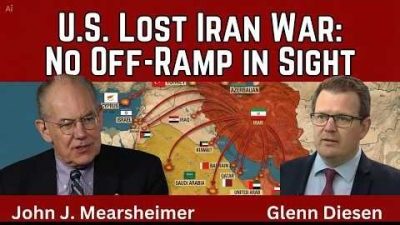
John Mearsheimer: US Already lost Iran war – No off-ramp in sight
or go to
Aletho News Archives – Video-Images
Frlom the Archives
70 Neocons Petition Congress To Effectively Allow Israel To Say When The US Should Attack Iran
By Damian Lataan | January 10, 2014
Seventy senior Israeli-centric neoconservatives have written an open letter to Congress imploring them to do more to ensure Iran complies with the conditions of any agreement finally reached with the P5+1 over Iran’s nuclear program.
While the neocons are ostensibly asking Congress to ensure compliance, it is clear that their real aim is to convince members of Congress to support the bill currently passing through the Senate which calls for tighter sanctions against Iran in the event of any waywardness on Iran’s part.
The neocons are eager to see the bill currently passing through the Senate with enough support to make it veto-proof, not so much because they are concerned about Iran’s so-called nuclear weapons program – there’s still not a skerrick of hard evidence that Iran has a nuclear weapons program – but, rather, because embedded within the bill is this clause:
… if the Government of Israel is compelled to take military action in legitimate self-defense against Iran’s nuclear weapon program, the United States Government should stand with Israel and provide, in accordance with the law of the United States and the constitutional responsibility of Congress to authorize the use of military force, diplomatic, military, and economic support to the Government of Israel in its defense of its territory, people, and existence…
Essentially, the clause is an automatic trigger for the US to attack Iran at any time the Israelis choose to launch a first strike – regardless of whether President Obama is in favour or not.
Partial list… continue
Blog Roll
 Aletho News
- ‘Heinous crime’: Iran denounces Israeli assassination of 4 Iranian diplomats in Lebanon
- John Mearsheimer: U.S. Already Lost Iran War – No Off-Ramp in Sight
- UK Parliament Plans ISP Blocking and Age Verification Powers
- World cannot remain silent as US and Israel attack ‘heritage of humankind’: Iran
- Emirati billionaire rebukes US senator over call for Gulf states to join war with Iran
- Op. True Promise 4: Iran’s missile blitzkrieg dismantles US war machine in West Asia
- Aramco CEO warns ‘catastrophe’ imminent if Strait of Hormuz remains shut
- What If Iran Says No?
- Trump Threatens to ‘Hit’ Iran ‘Twenty Times Harder’ Over Strait of Hormuz Oil Flows
- Spare the hypocrisy: Baghaei slams Ursula’s support for US
- If Americans Knew
- Israel Decided the War, But Trump’s America Fights and Pays the Bill
- Conscientious Objector Group: Phone ‘Ringing Off Hook’ As Huge Mobilization Underway
- U.S. support for Israel continues to plummet, despite media’s best efforts
- Threats and missiles fly, death tolls soar in Iran, Lebanon, Gaza – Not a ceasefire Day 151
- Lebanon: Israel’s White Phosphorous Use Risks Civilian Harm
- Corporate Media Go All Out To Support The US-Israeli War On Iran
- US-Israel war on Iran is creating a steady growing number of amputees
- Israel planned this war on Iran for 40 years. Everything else is a smoke screen
- The wrong question about the war in Iran
- ‘Your Tax Dollars Being Used to Raise Your Gas Prices’: US-Israel Bomb Major Iranian Oil Depots
- No Tricks Zone
- New Study Documents A 20-Year Pause In Arctic Sea Ice Decline – Driven By Internal Variability
- Wake-up Call: Survey Shows Majority Of Germans Now Favor Postponing Climate Targets!
- Televised! Leading German Political Candidate Tells Schoolchildren CO2 Makes Sun Hotter!
- New Study: A Century Warming Of 1.1°C Is ‘Commonplace’ And ‘Not Unusual’ During This Interglacial
- New Study: ‘Internal Noise’ And Volcanic Forcing Can Trigger 10-15°C Warming Within Decades
- Glaciers Worldwide Are Suddendly Surging, Experts Blame Warming!
- Surprising Discovery: Sahara Is Greening…Billions Of Trees Where Once Thought To Be Barren
- New Research Reaffirms Clouds, Aerosols, And Surface Solar Radiation Are ‘Driving The Climate System’
- Germany: Electric Car Catches Fire At Charging Station, Sets Off Local “Inferno”, Widespread Damage
- New Study: Canada’s New Brunswick Was 1°C Warmer Than Today During The Medieval Warm Period
 Aletho News