How Western media largely ignored State Dept-Google-Al Jazeera plot against Assad
RT | March 26, 2016
The Western media has quietly ignored an unexpected collaboration between Washington, Google, and “independent” Al Jazeera aimed at helping to overthrow Syria’s Bashar Assad. Would they be as oblivious to a similar cozy “partnership” involving Russia?
Last Monday, WikiLeaks lifted the lid on a correspondence between Jared Cohen, the President of ‘Google Ideas,’ and then-Secretary of State Hillary Clinton’s staff in the summer of 2012. In his July 25, 2012 email to top State Department’s officials, Cohen pitched his about-to-be-launched “tool” to Clinton’s inner circle, asking it to “keep close hold” of it.
The leak revealing the project, which would seem to be an outrageous scandal to some, has actually been quite difficult to spot in the news. Since WikiLeaks released the latest batch of Clinton’s emails on March 21, a Google news search spits back about 30 web sources related to the story.
Of those, only two – The Independent and Daily Mail – could arguably be considered major mainstream media outlets. That means there were slim chances that the eye of an average newsreader would catch wind of the State Department’s teamwork with the US’ biggest tech giant, Google, and Arab media outlet Al Jazeera.
According to what Cohen wrote, it appears that Google’s innovative visualizer worked to “publicly track and map the defections in Syria and which parts of the government they are coming from.”
“Our logic behind this is that while many people are tracking the atrocities, nobody is visually representing and mapping the defections, which we believe are important in encouraging more to defect and giving confidence to the opposition,” he said.
Google also collaborated with Al Jazeera, which took primary ownership over the tool, because of “how hard” it was to get information out of Syria.
At the State Department, the idea was lauded and passed on to Clinton via her private email by deputy chief of staff Jake Sullivan as “a pretty cool idea.”
RT asked media expert Lionel why the revelations failed to receive much attention in the Western media.
“I don’t expect a reaction from Western media because Western media hasn’t even read this, has no idea about this,” Lionel told RT. “But can you imagine if the same set of facts were involved with the different countries, different corporations around the world depending upon your frame of reference. This would either be an outrage or ‘well, maybe this is a delightful and benign cooperation, an independent tech giant… and all for the common good of liberty’ and whatever. It depends upon your perspective.”
Another curious aspect is the fact that the WikiLeaks release directly involved Clinton’s email, which has been a hot topic tainting her presidential campaign for a year now. Clinton’s opponents as well as the US media have been taking nearly every opportunity to poke her for her “careless” misdeed – with the notable exception of this story.
The three parties in this collaboration did not end up together by chance, either.
Funded by the Qatari government, Al Jazeera portrays itself as “the first independent news channel in the Arab world” and “one of the world’s most influential news networks,” whose main goal is it to give “a global audience an alternative voice.”
Qatar has been largely supporting the rebels in the Syrian conflict, along with Washington and other anti-Assad powers that even mulled launching a direct military intervention on Syrian soil last October.
It turned out that Google’s Syrian Defector Tracking was a good fit for Al Jazeera. It even ended up winning the channel a prestigious Online Media Award for “Best technical innovation.”
“This is going to show you very fascinating aspects of the new warfare – how media, and corporations and various platforms are merging together. We are not sure who the military is, who is the government,” Lionel said.
He suggested that the State Department’s reluctance to release Clinton’s emails could be explained by the intention to hide “the conflation of allegedly private industry with the government.”
“We have this new world here. We have the government and we have the Pentagon, DAPRA and defense advanced research program agency, we have private industry, we have these various platforms. We have this new introduction of mercenary groups and private contacting teams. [But] our country [the US] has had a very strict barrier, Posse Comitatus, that separates private law enforcement from military,” Lionel said. “There have always been distinctions and barriers and jurisdiction alliance. In this new world, these barriers are being eliminated, dissolved.”
As Lionel says, the collaboration between Google and the US government only seems to be “innocent” if there is a bias towards “who you like… and the information that’s being propagated.”
When contacted by RT, Google declined to comment on the situation, yet did not hesitate to proudly stress Al Jazeera’s achievement.
“No comment, but pointing out that this data visualization project was very public, Al Jazeera won a journalism award for it,” the tech giant said in an email.
Given these circumstances, it would not hurt to wonder what the Western media’s reaction might have been if the same collaboration had occurred across the ocean and involved, let’s say, the Russian government, a well-known media outlet, and a Russian internet giant.
Since its inception in 2005, RT has often been labeled as anything ranging from a “Russian propaganda machine” to a “propaganda bullhorn” by high-profile Western officials and politicians.
“If RT wanted PR in American media, this is exactly the move it should make. You would never hear the end of that on American media,” Ted Rall, a political cartoonist and author, told RT. “You really don’t have a right to call anyone a propaganda if you yourself is doing the same thing.”
As for Al Jazeera’s prize winning tool, it appears to be currently defunct for unspecified reasons.
Kuwait expels 14 people for links with Hezbollah: Report
Press TV – March 21, 2016
The Kuwaiti government has deported 11 Lebanese and three Iraqis on charges of having links to Lebanon’s resistance movement, Hezbollah, a report says.
The Kuwaiti Arabic daily al-Qabas quoted a security source as saying on Monday that the 14 people had been expelled on the order of the state security service.
The move came nearly three weeks after the [Persian] Gulf Cooperation Council ([P]GCC), under the influence of the Saudi regime, declared Hezbollah a “terrorist” organization. Arab League foreign ministers, except those of Iraq and Lebanon, later followed suit.
The [P]GCC – comprising Saudi Arabia, Qatar, the United Arab Emirates, Oman, Bahrain and Kuwait – however, did not provide any evidence for its allegation. This comes as the first three monarchies themselves stand accused of supporting extremists and terrorists in the region.
Describing the [P]GCC decision as “reckless and hostile,” Hezbollah blamed it on Saudi Arabia.
Elsewhere in its report, Qabas said that Kuwaiti security officials have prepared a list of “unwanted” Lebanese and Iraqi people, including advisers to big companies, to be expelled for “the public interest.”
The people will not be allowed to enter the [P]GCC member states after their deportation, the daily said.
GCC not after protecting Lebanon: Hezbollah chief
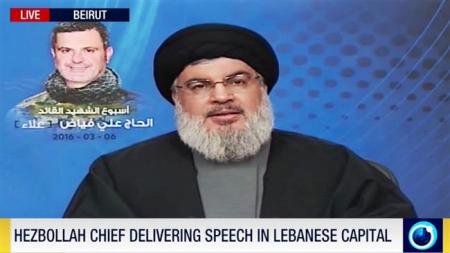
Press TV – March 6, 2016
Sayyed Hassan Nasrallah, the secretary general of the Lebanese resistance movement Hezbollah, says the Arab member states of the [Persian] Gulf Cooperation Council ([P]GCC), which recently listed the resistance group as terrorists, do not have the interests of Lebanon in mind.
During a live televised speech on Sunday, Nasrallah said those who assume that the Arab regimes will protect Lebanon have “pinned their hopes on a fantasy.”
Had Lebanon waited for a unified Arab strategy in the face of Israel instead of opting to resist against the occupying regime, “then the fate of this territory would have been the same as the fate of the territories Israel has taken control of,” he said.
On Wednesday, the six-nation Arab bloc issued a statement labeling Hezbollah a terrorist organization. The [P]GCC comprises Bahrain, Kuwait, Oman, Qatar, Saudi Arabia and the United Arab Emirates.
“Many of these Arab countries today, who designate us as terrorists, what do they have to do with this resistance and these victories and these achievements?” Nasrallah said.
Israel unleashed an all-out offensive on Lebanon 10 years ago under the pretext of releasing Israeli soldiers allegedly captured by Hezbollah in southern Lebanon. The invasion claimed the lives of nearly 1,200 Lebanese people, most of them civilians.
The Tel Aviv regime was, however, forced to retreat without achieving any of its objectives after Hezbollah fighters displayed heavy resistance against the Israeli military.
“Back then, we said to them (the Arab countries) ‘we don’t want anything from you… Today, we also say to them, to these regimes, ‘We don’t want anything from you. We don’t want money, nor do we want weapons, nor do we want support or blessing,” he said. “Just leave this resistance alone, leave this country alone, and leave this people alone.”
He blamed some Arab regimes for conspiring against anyone standing against Israel.
Nasrallah also underlined the assistance provided by the resistance group to the Iraqi government in its fight against the Takfiri terror group Daesh and reminded that Hezbollah did not wait for any orders to initiate its anti-terror fight in Syria and only fulfilled its religious commitment.
The secretary general of Hezbollah also addressed the tension that has been bubbling up between Saudi Arabia and Lebanon, causing the former to take a raft of hostile measures against the latter.
“If it’s angry with us, it has the right to. I understand Saudi Arabia’s anger. Why? Because when one fails, at the very least he will be angry,” Nasrallah said.
He went on to explain that the Saudi rage has emanated from the kingdom’s failures in Yemen and Syria.
“In Syria, there’s a very great Saudi anger because what they had calculated in Syria [was that] in two or three months, ‘Syria would fall into our hands,’” Nasrallah said.
Hezbollah has been successfully aiding the Syrian military against foreign-backed militant groups.
“He, who confronts Saudi Arabia in Syria is the real defender of the Lebanese national interests,” Nasrallah said.
“The same goes for Yemen. The estimations of the new Saudi leadership was that ‘we will decide the battle in Yemen. We will teach a lesson to all the Arab countries and the Arab world… and we will impose ourselves on the Arab world,’” he said.
Saudi Arabia launched a campaign of military aggression against Yemen in late March last year in a bid to bring fugitive former Yemeni President Abd Rabbuh Mansur Hadi, a Riyadh ally, back to power and undermine Yemen’s Houthi Ansarullah movement.
Riyadh has, however, failed in accomplishing either of the two objectives, and has become entangled in a prolonged expensive war, whose adverse economic impacts—along with economic mismanagement—have gradually been giving rise to domestic discontent inside Saudi Arabia.
The Caesar photo fraud that undermined Syrian negotiations

By Rick Sterling | American Herald Tribune | March 4, 2016
A 30 page investigative report on the “Caesar Torture Photos” has been released and is available online here. The following is a condensed version of the report. Readers who are especially interested are advised to get the full report which includes additional details, photographs, sources and recommendations.
Introduction
There is a pattern of sensational but untrue reports that lead to public acceptance of US and Western military intervention in countries around the world:
* In Gulf War 1, there were reports of Iraqi troops stealing incubators from Kuwait, leaving babies to die on the cold floor. Relying on the testimony of a Red Crescent doctor, Amnesty Interenational ‘verified’ the false claims.
* Ten years later, there were reports of yellow cake uranium going to Iraq for development of weapons of mass destruction.
* One decade later, there were reports of Libyan soldiers drugged on viagra and raping women as they advanced.
* In 2012, NBC broadcaster Richard Engel was supposedly kidnapped by pro-Assad Syrian militia but luckily freed by Syrian opposition fighters, the “Free Syrian Army”.
All these reports were later confirmed to be fabrications and lies. They all had the goal of manipulating public opinion and they all succeeded in one way or another. Despite the consequences, which were often disastrous, none of the perpetrators were punished or paid any price.
It has been famously said “Those who do not learn from the past are doomed to repeat it.” This report is a critical review of the “Caesar Torture Photos” story. As will be shown, there is strong evidence the accusations are entirely or substantially false.
Overview of ‘Caesar Torture Photos’
On 20 January 2014, two days before negotiations about the Syrian conflict were scheduled to begin in Switzerland, a sensational report burst onto television and front pages around the world. The story was that a former Syrian army photographer had 55,000 photographs documenting the torture and killing of 11,000 detainees by the Syrian security establishment.
The Syrian photographer was given the code-name ‘Caesar’. The story became known as the “Caesar Torture Photos”. A team of lawyers plus digital and forensic experts were hired by the Carter-Ruck law firm, on contract to Qatar, to go to the Middle East and check the veracity of “Caesar” and his story. They concluded that “Caesar” was truthful and the photographs indicated “industrial scale killing”. CNN, London’s Guardian and LeMonde broke the story which was subsequently broadcast in news reports around the world. The Caesar photo accusations were announced as negotiations began in Switzerland. With the opposition demanding the resignation of the Syrian government, negotiations quickly broke down.
For the past two years the story has been preserved with occasional bursts of publicity and supposedly corroborating reports. Most recently, in December 2015 Human Rights Watch (HRW) released a report titled “If the Dead Could Speak” with significant focus on the Caesar accusations.
Following are 12 significant problems with the ‘Caesar torture photos’ story.
1. Almost half the photos show the opposite of the allegations.
The Carter Ruck Inquiry Team claimed there were about 55,000 photos total with about half of them taken by ‘Caesar’ and the other half by other photographers. The Carter Ruck team claimed the photos were all ‘similar’. Together they are all known as ‘Caesar’s Torture Photos’.
The photographs are in the custody of an opposition organization called the Syrian Association for Missing and Conscience Detainees (SAFMCD). In 2015, they allowed Human Rights Watch (HRW) to study all the photographs which have otherwise been secret. In December 2015, HRW released their report titled “If the Dead Could Speak”. The biggest revelation is that over 46% of the photographs (24,568) do not show people ‘tortured to death” by the Syrian government. On the contrary, they show dead Syrian soldiers and victims of car bombs and other violence (HRW pp2-3). Thus, nearly half the photos show the opposite of what was alleged. These photos, never revealed to the public, confirm that the opposition is violent and has killed large numbers of Syrian security forces and civilians.
2. The claim that other photos only show ‘tortured detainees’ is exaggerated or false.
The Carter Ruck report says ‘Caesar’ only photographed bodies brought from Syrian government detention centers. In their December 2015 report, HRW said, “The largest category of photographs, 28,707 images, are photographs Human Rights Watch understands to have died in government custody, either in one of several detention facilities or after being transferred to a military hospital.” They estimate 6,786 dead individuals in the set.
The photos and the deceased are real, but how they died and the circumstances are unclear. There is strong evidence some died in conflict. Others died in the hospital. Others died and their bodies were decomposing before they were picked up. These photographs seem to document a war time situation where many combatants and civilians are killed. It seems the military hospital was doing what it had always done: maintaining a photographic and documentary record of the deceased. Bodies were picked up by different military or intelligence branches. While some may have died in detention; the great majority probably died in the conflict zones. The accusations by ‘Caesar’, the Carter Ruck report and HRW that these are all victims of “death in detention” or “death by torture” or death in ‘government custody” are almost certainly false.
3. The true identity of “Caesar” is probably not as claimed.
The Carter Ruck Report says “This witness who defected from Syria and who had been working for the Syrian government was given the code-name ‘Caesar’ by the inquiry team to protect the witness and members of his family.” (CRR p12) However if his story is true, it would be easy for the Syrian government to determine who he really is. After all, how many military photographers took photos at Tishreen and Military 601 Hospitals during those years and then disappeared? According to the Carter Ruck report, Caesar’s family left Syria around the same time. Considering this, why is “Caesar” keeping his identity secret from the western audience? Why does “Caesar” refuse to meet even with highly sympathetic journalists or researchers?
The fact that 46% of the total photographic set is substantially the opposite of what was claimed indicates two possibilities:
* Caesar and his promoters knew the contents but lied about them expecting nobody to look.
* Caesar and his promoters did not know the contents and falsely assumed they were like the others.
The latter seems more likely which supports the theory that Caesar is not who he claims to be.
4. The Carter Ruck Inquiry was faulty, rushed and politically biased.
The credibility of the “Caesar” story has been substantially based on the Carter-Ruck Inquiry Team which “verified” the defecting photographer and his photographs. The following facts suggest the team was biased with a political motive:
* the investigation was financed by the government of Qatar which is a major supporter of the armed opposition.
* the contracted law firm, Carter Ruck and Co, has previously represented Turkey’s President Erdogan, also known for his avid support of the armed opposition.
* the American on the legal inquiry team, Prof David M. Crane, has a long history working for U.S. Dept of Defense and Defense Intelligence Agency. The U.S. Government has been deeply involved in the attempt at ‘regime change’ with demands that ‘Assad must go’ beginning in summer 2011 and continuing until recently.
* Prof Crane is personally partisan in the conflict. He has campaigned for a Syrian War Crimes Tribunal and testified before Congress in October 2013, three months before the Caesar revelations.
* by their own admission, the inquiry team was under “time constraints” (CRR, p11).
* by their own admission, the inquiry team did not even survey most of the photographs
* the inquiry team was either ignorant of the content or intentionally lied about the 46% showing dead Syrian soldiers and attack victims.
* the inquiry team did their last interview with “Caesar” on January 18, quickly finalized a report and rushed it into the media on January 20, two days prior to the start of UN sponsored negotiations.
The self-proclaimed “rigor” of the Carter Ruck investigation is without foundation. The claims to a ‘scientific’ investigation are similarly without substance and verging on the ludicrous.
5. The U.S. Central Intelligence Agency (CIA) is involved.
In an interview on France24, Prof. David Crane of the inquiry team describes how ‘Caesar’ was brought to meet them by “his handler, his case officer”. The expression ‘case officer’ usually refers to the CIA. This would be a common expression for Prof. Crane who previously worked in the Defense Intelligence Agency. The involvement of the CIA additionally makes sense since there was a CIA budget of $1Billion for Syria operations in 2013.
Prof. Crane’s “Syria Accountability Project” is based at Syracuse University where the CIA actively recruits new officers despite student resistance.
Why does it matter if the CIA is connected to the ‘Caesar’ story? Because the CIA has a long history of disinformation campaigns. In 2011, false reports of viagra fueled rape by Libyan soldiers were widely broadcast in western media as the U.S. pushed for a military mandate. Decades earlier, the world was shocked to hear about Cuban troops fighting in Angola raping Angolan women. The CIA chief of station for Angola, John Stockwell, later described how they invented the false report and spread it round the world. The CIA was very proud of that disinformation achievement. Stockwell’s book, “In Search of Enemies” is still relevant.
6. The prosecutors portray simple administrative procedures as mysterious and sinister.
The Carter Ruck inquiry team falsely claimed there were about 11,000 tortured and killed detainees. They then posed the question: Why would the Syrian government photograph and document the people they just killed? The Carter Ruck Report speculates that the military hospital photographed the dead to prove that the “orders to kill” had been followed. The “orders to kill” are assumed.
A more logical explanation is that dead bodies were photographed as part of normal hospital / morgue procedure to maintain a file of the deceased who were received or treated at the hospital.
The same applies to the body labeling / numbering system. The Carter Ruck report suggests there is something mysterious and possibly sinister in the coded tagging system. But all morgues need to have a tagging and identification system.
7. The photos have been manipulated.
Many of the photos at the SAFMCD website have been manipulated. The information card and tape identity are covered over and sections of documents are obscured. It must have been very time consuming to do this for thousands of photos. The explanation that they are doing this to ‘protect identity’ is not credible since the faces of victims are visible. What are they hiding?
8. The Photo Catalog has duplicates and other errors.
There are numerous errors and anomalies in the photo catalog as presented at the SAFMCD website.
For example, some deceased persons are shown twice with different case numbers and dates.
There are other errors where different individuals are given the same identity number.
Researcher Adam Larson at A Closer Look at Syria website has done detailed investigation which reveals more errors and curious error patterns in the SAFMCD photo catalog.
9. With few exceptions, Western media uncritically accepted and promoted the story.
The Carter Ruck report was labeled “Confidential” but distributed to CNN, the Guardian and LeMonde.
CNN’s Christiane Amanpour gushed the story as she interviewed three of the inquiry team under the headline “EXCLUSIVE: Gruesome Syria photos may prove torture by Assad regime”. Critical journalism was replaced by leading questions and affirmation. David Crane said “This is a smoking gun”. Desmond de Silva “likened the images to those of holocaust survivors”.
The Guardian report was titled “Syrian regime document trove shows evidence of ‘industrial scale’ killing of detainees” with subtitle “Senior war crimes prosecutors say photographs and documents provide ‘clear evidence’ of systematic killing of 11,000 detainees”
One of the very few skeptical reports was by Dan Murphy in the Christian Science Monitor. Murphy echoed standard accusations about Syria but went on to say incisively, “the report itself is nowhere near as credible as it makes out and should be viewed for what it is: A well-timed propaganda exercise funded by Qatar, a regime opponent who has funded rebels fighting Assad who have committed war crimes of their own.”
Unfortunately that was one of very few critical reports in the mainstream media.
In 2012, foreign affairs journalist Jonathan Steele wrote an article describing the overall media bias on Syria.. His article was titled “Most Syrians back Assad but you’d never know from western media”. The media campaign and propaganda has continued without stop. It was in this context that the Carter Ruck Report was delivered and widely accepted without question.
10. Politicians have used the Caesar story to push for more US/NATO aggression.
Politicians seeking direct US intervention for ‘regime change’ in Syria were quick to accept and broadcast the ‘Caesar’ story. They used it to demonize the Assad government and argue that the US must act so as to prevent “another holocaust’, ‘another Rwanda’, ‘another Cambodia’.
When Caesar’s photos were displayed at the House Foreign Affairs Committee in Congress, Chairman Ed Royce said “It is far past time that the world act…. It is far past time for the United States to say there is going to be a safe zone across this area in northern Syria.”
The top ranking Democrat in the House Foreign Affairs Committee is Eliot Engel. In November 2015 he said “We’re reminded of the photographer, known as Caesar, who sat in this room a year ago, showing us in searing, graphic detail what Assad has done to his own people.” Engel went on to advocate for a new authorization for the use of military force.
Rep Adam Kinzinger is another advocate for aggression against Syria. At an event at the Holocaust Memorial Museum in July 2015 he said, “If we want to destroy ISIS we have to destroy the incubator of ISIS, Bashar al-Assad.”
The irony and hypocrisy is doubly profound since Rep Kinzinger has met and coordinated with opposition leader Okaidi who is a confirmed ally of ISIS. In contrast with Kinzinger’s false claims, it is widely known that ISIS ideology and initial funding came from Saudi Arabia and much of its recent wealth from oil sales via Turkey. The Syrian Army has fought huge battles against ISIS, winning some but losing others with horrific scenes of mass beheading.
11. The Human Rights Watch assessment is biased.
HRW has been very active around Syria. After the chemical attacks in greater Damascus on August 21, 2013, HRW rushed a report which concluded that, based on a vector analysis of incoming projectiles, the source of the sarin carrying rockets must have been Syrian government territory. This analysis was later debunked as a “junk heap of bad evidence” by highly respected investigative journalist Robert Parry. HRW’s assumption about the chemical weapon rocket flight distance was faulty. Additionally it was unrealistic to think you could determine rocket trajectory with 1% accuracy from a canister on the ground. To think you could determine flight trajectory from a canister on the ground that had deflected off a building wall was preposterous.
In spite of this, HRW stuck by its analysis which blamed the Assad government. HRW Director Ken Roth publicly indicated dissatisfaction when an agreement to remove Syrian chemical weapons was reached. Mr. Roth wanted more than a ‘symbolic’ attack.
In light of the preceding, we note the December 2015 HRW report addressing the claims of Caesar.
HRW seems to be the only non-governmental organization to receive the full set of photo files from the custodian. To its credit, HRW acknowledged that nearly half the photos do not show what has been claimed for two years: they show dead Syrian soldiers and militia along with scenes from crime scenes, car bombings, etc…
But HRW’s bias is clearly shown in how they handle this huge contradiction. Amazingly, they suggest the incorrectly identified photographs support the overall claim. They say, “This report focuses on deaths in detention. However other types of photographs are also important. From an evidentiary perspective, they reinforce the credibility of the claims of Caesar about his role as a forensic photographer of the Syrian security forces or at least with someone who has access to their photographs.” (HRW, p31) This seems like saying if someone lies to you half the time that proves they are truthful.
The files disprove the assertion that the files all show tortured and killed. The photographs show a wide range of deceased persons, from Syrian soldiers to Syrian militia members to opposition fighters to civilians trapped in conflict zones to regular deaths in the military hospital. There may be some photos of detainees who died in custody after being tortured, or who were simply executed. We know that this happened in Iraqi detention centers under U.S. occupation. Ugly and brutal things happen in war times. But the facts strongly suggest that the ‘Caesar’ account is basically untrue or a gross exaggeration.
It is striking that the HRW report has no acknowledgment of the war conditions and circumstances in Syria. There is no acknowledgment that the government and Syrian Arab Army have been under attack by tens of thousands of weaponized fighters openly funded and supported by many of the wealthiest countries in the world.
There is no hint at the huge loss of life suffered by the Syrian army and supporters defending their country. The current estimates indicate from eighty to one hundred and twenty thousand Syrian soldiers, militia and allies having died in the conflict. During the three years 2011 – 2013, including the period covered by Caesar photos, it is estimated that over 52,000 Syrian soldiers and civilian militia died versus 29,000 anti-government forces.
HRW had access to the full set of photographs including the Syrian army and civilian militia members killed in the conflict. Why did they not list the number of Syrian soldiers and security forces they identified? Why did they not show a single image of those victims?
HRW goes beyond endorsing the falsehoods in the ‘Caesar’ story; they suggest it is a partial listing. On page 5 the report says, “Therefore, the number of bodies from detention facilities that appear in the Caesar photographs represent only a part of those who died in detention in Damascus.”
On the contrary, the Caesar photographs seem to mostly show victims who died in a variety of ways in the armed conflict. The HRW assertions seem to be biased and inaccurate.
12. The legal accusations are biased and ignore the supreme crime of aggression.
The Christian Science Monitor journalist Dan Murphy gave an apt warning in his article on the Carter Ruck report about ‘Caesar’. While many journalists treated the prosecutors with uncritical deference, he said, “Association with war crime prosecutions is no guarantor of credibility – far from it. Just consider Luis Moreno Ocampo’s absurd claims about Viagra and mass rape in Muammar Qaddafi’s Libya in 2011. War crimes prosecutors have, unsurprisingly, a bias towards wanting to bolster cases against people they consider war criminals (like Assad or Qaddafi) and so should be treated with caution. They also frequently favor, as a class, humanitarian interventions.”
The Carter Ruck legal team demonstrated how accurate those cautions were. They were eager to accuse the Syrian government of “crimes against humanity” but the evidence of “industrial killing”, “mass killing”, “torturing to kill” is dubious and much of the hard evidence shows something else.
In contrast, there is clear and solid evidence that a “Crime against Peace” is being committed against Syria. It is public knowledge that the “armed opposition” in Syria has been funded, supplied and supported in myriad ways by various outside governments. Most of the fighters, both Syrian and foreign, receive salaries from one or another outside power. Their supplies, weapons and necessary equipment are all supplied to them. Like the “Contras” in Nicaragua in the 1980’s, the use of such proxy armies is a violation of customary international law.
It is also a violation of the UN Charter which says “All Members shall refrain in their international relations from the threat or use of force against the territorial integrity or political independence of any state, or in any other matter inconsistent with the Purposes of the United Nations”.
The government of Qatar has been a major supporter of the mercenaries and fanatics attacking the sovereign state of Syria. Given that fact, isn’t it hugely ironic to hear the legal contractors for Qatar accusing the Syrian government of “crimes against humanity”?
Isn’t it time for the United Nations to make reforms so that it can start living up to its purposes? That will require demanding and enforcing compliance with the UN Charter and International Law.
Israelis Welcome GCC Statement on Hezbollah: Reflects Rapprochement with Saudis
Al-Manar | March 3, 2016
As soon as the Gulf Cooperation Council blacklisted the Lebanese party of Resistance – Hezbollah – on Wednesday, Zionist mass media welcomed the resolution, considering it “critical and serious,” reflecting a great relief among Israelis who have been seeking to fight Hezbollah from the Arab gate.
Former Zionist foreign minister Tzipi Livni hailed the GCC resolution as “an important step, while Zionist daily Maariv stated that “blacklisting Hezbollah is an achievement that serves Israel.”
Moreover, the entity’s mass media correlated the GCC resolution against Hezbollah with “the ongoing coordination between Saudi Arabia, Israel” which has recently emerged to public through exchanging visits between both parties.
“Arab world is approaching closer to Israel’s stances, which has been revealed through the Saudi delegations’ visit to Israel, as well as when Saudi Arabia decided to blacklist Hezbollah as a terrorist organization,” the presenter of Tonight at Six talk show for Zionist Channel 1 said.
“It is very important and dramatic development,” he added.
For his part, Yoval King, an expert of Arab affairs, said that “it is an important resolution,” recalling that it is not the first time that Gulf states blacklist Hezbollah as a terrorist group.
“They had labeled him as ‘militia’, and announced that violence and provocations he is carrying out in Syria, Yemen and Iraq contradicts with the moral and humanitarian values,” King said.
The Saudi-Zionist coordination witnessed a major shift on the Syrian arena in the face of axis of Resistance, as Zionist sources revealed discussions took place between the armed groups operating in Syria on one hand, and Riyadh and Tel Aviv on the other, about the Syrian developments following the ongoing truce.
“Syrian opposition groups, funded by Qatar, Saudi Arabia and Israel are meeting with their sponsors and discussing with them whether they can make gains in the meantime,” Shmerit Maeir, a Zionist analyst of Arab affairs, said during an interview on the Jewish Channel 2.
“Israel needs a key chair on this table whether through the American players or others, because the bases will now determine whether Hezbollah is allowed to do what the ISIL and Al-Nusra Front are banned from doing. If this really is to happen, we will be facing a major catastrophe,” Maeir stressed.
The Zionist position was symmetrical to the Saudi’s, as it doesn’t rule out the possibility of communicating with the armed groups, like Al-Nusra Front and ISIL in order to coordinate for later steps in Syria.
The GCC, which has been committing a genocide in Yemen since March 2015, held a meeting on Monday during which it blacklisted all Hezbollah affiliated institutions.
GCC declares Hezbollah ‘terrorist group’
Press TV – March 2, 2016
The Arab monarchies of the Persian Gulf have declared Lebanon’s Hezbollah movement, which has been fighting terrorist groups in Syria and Israeli occupation, a “terrorist group.”
The six-nation Gulf Cooperation Council officially added Hezbollah and all groups affiliated to its so-called list of “terrorist” organizations on Wednesday.
In a statement, GCC’s Secretary General Abdullatif bin Rashid al-Zayan accused Hezbollah and associated groups of committing “acts of aggression”, recruiting “youth” inside the Persian Gulf littoral states, smuggling “weapons and explosives”, sowing “sedition” and instigating “chaos and violence.”
The bloc, however, did not provide any evidence for its allegations.
The GCC comprises Saudi Arabia, Qatar, the United Arab Emirates, Oman, Bahrain and Kuwait.
The move by the six-member bloc is the latest measure against Hezbollah, which is fighting terrorists in Syria.
In 2000 and 2006, when Israel launched two wars on Lebanon, Hezbollah fighters gave befitting responses to the Tel Aviv regime’s acts of aggression, forcing Israeli military to retreat without achieving any of its objectives.
The GCC have taken a series of measures against Hezbollah since Saudi Arabia last month halted a $4- billion aid pledge to Lebanon’s security forces.
The aid suspension came after Beirut did not follow Riyadh’s lead and refused to endorse joint anti-Iran statements at separate meetings held in Cairo and Jeddah.
On February 26, Saudi Arabia blacklisted four Lebanese firms and three individuals over alleged affiliation to Hezbollah, and imposed sanctions on them. The kingdom also ordered its citizens not to travel to Lebanon, and is poised to expel the Lebanese citizens working on its territory.
On Tuesday, Seyyed Hassan Nasrallah, the secretary general of Hezbollah said Saudi propaganda against Hezbollah has led to a political conflict in Lebanon, and advised the Lebanese youth against playing into the hands of Saudi Arabia, which he said spreads lies about Hezbollah and wrongly accuses the resistance movement of sowing sectarian strife between Shias and Sunnis.
He also denounced the Arab world’s silence in the face of Riyadh’s aggression on Yemen, where over 8,000 people have lost their lives since the Saudi onslaught began in late March last year.
Nasrallah warned that there are some Lebanese groups hoping to see a war in Lebanon just like the one Riyadh has waged against Yemen.
This comes as the Persian Gulf monarchies themselves stand accused of supporting extremists and terrorists in the region.
The Academy’s complicity in the Global War of false flag terrorism

By Prof. Tony Hall | American Herald Tribune | February 28, 2016
I met Dr. Kevin Barrett as planned at a small bookstore near the Notre Dame Cathedral landmark in Paris France. On that day, December 11, 2015, the Paris bookstore was the site of a significant academic conference entitled “Islamophobia and the Erosion of Civil Society.”
Hours earlier I had exited the last class of the fall term in my third-year Globalization Studies course at the University of Lethbridge in Alberta Canada. I had driven to Calgary, hopped a flight to Dallas, and then transferred onto a big American Airlines 777 for the trans-Atlantic flight to the City of Lights now under martial law.
For the second time in 2015 Paris had been rocked by violent episodes attributed to the independent actions of Islamic terrorists. After the first event last January, Dr. Barrett had coordinated the emergency responses of a team of analytic observers, myself included.
Together we uncovered the outlines of an outlandish fraud of an externally-engineered false flag terror event. Dr. Barrett assembled the revelations in his edited book entitled We Are Not Charlie Hebdo. Now a sequel volume was in the making as Kevin and I met up in the Paris bookstore where the inner workings of the “Islamophobia Industry” were the subject of scholarly investigation.
The majority of contributors to Dr. Barrett’s book on the first Paris shooter event of 2015 concluded that the attacks on the Charlie Hebdo cartoon office and on the customers of a Jewish Deli were not as they were made to seem in the mainstream media. The evidence pointed to a continuation of the same type of state-manufactured violence directed at civilian populations in Western Europe during the Cold War by the NATO’s overseers of Project Gladio.
The aim of Project Gladio was to discredit the politics of progressive reform by misrepresenting the nature of NATO-concocted episodes of seemingly arbitrary violence directed at civilian populations.
Violent events were engineered by right-wing agents of NATO’s occupation of Western Europe to make it appear that left-wing progressives were subject to the control of psychopathic extremists intent on foisting their will on society through coercive methods.
A new wave of false flag terrorism is underway with the objective of turning public opinion against groups slated for state-sanctioned assaults, including aggressive warfare.
As demonstrated by the deep state politics of Project Gladio, false flag terrorism has long been a standard psy-op deployed by the Western intelligence and counter-intelligence agencies to affect public perception, attitude, and behaviour.
The deployment of false flag terrorism to bring history’s course into conformity with the objectives sought by strategic planners has become the particular specialty of the Israeli deep state.
The most ambitious false flag terror episode ever occurred on September 11, 2001 in the orchestrated strikes on three World Trade Center Towers, on the Pentagon and on the remnants of integrity in our governing structures. The overwhelming weight of evidence derived from these events points squarely at those in charge of the powerful networks of global influence aligned with the expansionary aspirations of Likudnik Israel.
The lies and crimes of 9/11 provided the pretext for the transition from Cold War’s demonization of socialism, as manifest in the engineered terrorism of Project Gladio, to the demonization of Muslims through what might most accurately be described as the Global War of False Flag Terrorism (GWOFFT).
The 9/11 strikes were central episodes that created the core narrative and imagery for a multi-faceted psychological operation that continues yet. This 9/11 psychological operation has been frequently characterized as a global coup d’état. The 9/11 global coup d’état was engineered to entrench neoconservative agendas aimed at concentrating more power in the world’s dominant banking, military, media and academic cartels together with the plutocrats that control them.
In the Global War of False Flag Terrorism, ruling elites everywhere have attempted to entrench their regimes of fraud and corruption by characterizing their critics and opponents as terrorists, as potential terrorists or as terrorist sympathizers.
Without a doubt it is the Jewish state of Israel that gained most from replacing anti-communism with anti-terrorism as the primary purpose and preoccupation of the world’s dominant military-industrial complex. The key to manufacturing consent for this shift has been the incitement and political exploitation of hatred towards Muslims. This engineered hatred of Muslims is often described as Islamophobia.
Convening in Paris to Shed Light on the Islamophobia
The study of Islamophobia brought together scholars from Europe and North America at the conference in the Paris bookstore. This convention of scholars was organized under the auspices of the Race and Gender Studies Center at the University of California in Berkeley.
The Chair was Prof. Hatem Bazian, Professor of Islamic Law and Theology at Zaytuna College in Berkeley. Part of the U of C, Zaytuna College is the first Muslim liberal arts institution of higher learning in the United States.
Prof. Bazian had assembled about a dozen scholars at various stages in their movement through the academic procedures of tenure and promotion. Generally speaking the assembled scholars have taken on some of the most difficult and fraught subjects covered in our university curricula. To study the institutional workings of the cynical business of purposely turning public attitudes against Muslims is an especially difficult academic mission in the poisoned atmosphere of these times.
In spite of our criticism of their work, the dozen or so colleagues who gathered at the Paris bookstore on December 11 deserve much respect and recognition. These colleagues have persisted in following a very contentious line of investigation in spite of the serious professional recriminations often thrown their way by critics who think nothing of destroying academic careers to advance political agendas.
Kevin Barrett and I took part in the proceedings with the anticipation that we would co-host our own alternative conference the following day at a hotel near the Charles De Gaulle Airport.
This plan was a response to the rejection of Dr. Barrett’s paper that was originally accepted as part of their conference.
Dr. Barrett’s proposed contribution highlighted the frequent exclusion of Muslim perspectives from officialdom’s accounts of the originating events triggering the 9/11 wars.
Dr. Barrett’s academic credentials in the subject matter of the conference are of course very strong as evidenced by the initial warm welcome extended to his offer to contribute to the conference’s scholarly proceedings.
Then came the events of Friday November 13th 2015, when the world was told Islamic terrorists had murdered over a hundred victims at a concert at the Bataclan music venue, at the Stade de France and at other Paris locations. In the wake of this development Dr. Barrett was informed by Professor Bazian,
“Due to state of emergency in France and the on-going active operations, the organizing committee is not able to accommodate your paper at this point in time. Our supporters on the ground are under extreme emergency conditions and the whole program is under stress due to it.”
In spite of the declared state of emergency in Paris the organizers had pressed ahead with the conference minus the contribution of Dr. Barrett. No explanation was given of why it was deemed alright to go forward with the other presentations but not the one containing Dr. Barrett’s interpretation of Islamophobia. The exclusion of Dr. Barrett, a Muslim himself with advanced degrees and many publications in Islamic Studies, could be seen as an expression of the very same forces that the Paris event had been convened to identify and analyse.
Rather than step aside without a protest, Dr. Barrett took part in the proceedings. I had joined him with the expectation that the next day we would try to put right the lapse that unfortunately seemed indicative of a more general failure of the academy.
How is it that, generally speaking, professors in our institutions of higher learning have failed so conspicuously to sort out truth from falsehood, accurate reporting from fraud, when it comes to explaining the origins and ongoing impetuses of the 9/11 wars?
Why have we in the academy mostly failed to rise to the responsibility of our higher calling when it comes to the vital job of identifying the thick web of lies and misrepresentations used to justify the post-9/11 surge of aggressive warfare abroad, the betrayal of human rights and civil liberties at home?
How has this treason of the intellectuals been transacted at the very moment society is most in need of evidence-based research to sort out fact from fiction when assessing the claims and assertions of the permanent war economy’s primary protagonists?
Through efforts like those of Dr. Barrett’s in his personal and public truthjihad, there have been significant breakthroughs in illuminating fraudulent reporting by presstitutes that often disseminate the disinformation essential to realizing the subversive agendas of false flag terrorism. Less has been done, however, to highlight the failures of academy to identify the lies and crimes entailed in the wholesale smearing of Muslims essential to the dark objectives of the Global War of False Flag Terrorism.
Islamophobia is the essential mental ingredient in the atmosphere of fear produced by the psychological geo-engineers pushing forward the Global War of False Flag Terrorism. In the words of Prof. Bazian, Islamophobia has to do with “the construction of an imagined and staged world rooted in the mind.”
The dissemination of the imagery of self-directed, self-financing Islamic terrorists acting autonomously out of no other motivation than their own religious zealotry constitutes the core lie of this malevolent psychological operation. The demonization of Muslim people, Muslim religion, Muslim cultures and Muslim countries forms the basis of the scaffolding on which a global and unbridled police state is being constructed.
This background helps explain how it is that Dr. Barrett and I had converged at the Paris bookstore on the eve of our effort to host our own conference of world-class thinkers expert in deciphering the inner workings of the Global War of False Terrorism. In taking on this responsibility we were moving into the vacuum of truth telling that the academic community has created, for the time being at least, by failing to come up with a viable evidence-based explanation of the origins and ongoing genesis of the 9/11 wars.
On December 11, 2015, the effort to go beyond the issues explored by the academics assembled in the Paris bookstore would take form the next day in a four-hour event entitled “False Flag Islamophobia” broadcast live on No Lies Radio. This event, in turn, helped encourage and hearten some of the contributors to Dr. Barrett’s new book.
Introducing the Islamophobia Industry
Sociology Professor David Miller of the University of Bath in Great Britain was one of the senior contributors to the conference at the Paris bookstore. Miller is a prolific scholar whose work on Islamophobia emerges from his important investigations into the relationship between corporate power and public relations as pioneered by the so-called father of media spin, Edward Bernays.
This approach permeates Miller’s Spinwatch website and his co-authored volume published in 2008, A Century of Spin: How Public Relations Became the Cutting Edge of Corporate Power.
In 2011 I had seen Professor Miller offer up a very interesting presentation in the Westminster Parliament in London England. His address in the Mother of All Parliaments helped give rise to his co-authored publication, The Cold War on British Muslims.
Professor Miller’s presentation in Paris on 11 December 2015 continued the development of themes that have brought on significant wrath from elements of the Jewish-Israeli lobby in Great Britain.
For instance the website of the pro-Zionist Gatestone Institute criticized Professor Miller for his work showing the “covert propaganda operations” of several Jewish organizations with preferential access to high-profile media venues. http://www.gatestoneinstitute.org/6677/david-miller-hilary-aked-kevin-macdonald.
Along with Professor Bazian, Miller has been prominent in identifying the financing and workings of an interlinked complex of agencies that Nathan Lean and others have dubbed the “The Islamophobia Industry.”
According to the Legislating Fear report of the Council on American-Islamic Relations, the dozens of agencies that make up this hate-inciting industry are funded to the tune of several hundreds of millions of dollars. In the words of Bazian, the aim of the well-funded endeavour is “to use fear and hate-mongering to lull our intellect to sleep” and “to implant negative and racist ideas about Muslims and Islam in our collective consciousness.”
Prominent among the core institutions of the trans-Atlantic Islamophobia Industry are the Foundation for the Defense of Democracies, the Henry Jackson Society, the Quilliam Foundation, the Gladstone Institute, Daniel Pipe’s Middle East Forum, Campus Watch, Islamist Watch, Pam Geller’s Atlas Shrugs, Tammi Rossman-Benjamin’s AMCHA Initiative, the Clarion Project, the David Horowitz Freedom Center and CAMERA, the Committee for Accuracy in Middle East Reporting.
These and many other agencies whose mission is to incite Islamophobia, derive their funding from a variety of sources including the family foundations of the Koch Brothers, Sheldon Adelson, Sarah Scaife, Harry Bradley, Irving Moskowitz and Canada’s Bronfman dynasty. As noted above, the Gladstone Institute has made the work of Professor David Miller, including the content of his website Spinwatch, a particular target of its pro-Zionist defense of the Islamophobia Industry.
http://www.islamophobiatoday.com/2014/04/16/latent-and-manifest-islamophobia-an-inception-of-ideas/
https://www.americanprogress.org/issues/religion/report/2015/02/11/106394/fear-inc-2-0/
http://www.islamophobiatoday.com/tag/islamophobia-industry/
http://www.ijan.org/wp-content/uploads/2015/04/IJAN-Business-of-Backlash-full-report-web.pdf
Much of the work of David Miller and his colleagues in exposing the pro-Zionist activities of the anti-Muslim hate purveyors involves tracing the money fuelling the Islamophobia Industry. This follow-the-money approach could very easily extend to tracking down the sources of financing for the staging of expensive false flag terror events.
Throughout the academic presentations I witnessed at the Paris bookstore, there was a persistent resistance by all the presenters to engage in some sort of reckoning with the anti-Muslim thrust of the false flag terrorism currently imposed upon us.
In every presentation there was the same conspicuous absence of interest in investigating the primary engine of contemporary Islamophobia, namely the engineering of false flag terror events to be blamed on Muslim fundamentalists said to be acting alone for no other reason than their religious extremism.
According to Kevin Barrett’s record of the event, when it came time for questions and answers I posed my query as follows:
“This is all very interesting, but I’m not hearing any of you get to the root of why there is all this Islamophobia. There is now a huge literature on the fact that these big terror attacks are contrived. It was 9/11 and all of the subsequent events that have created the wave of Islamophobia. I know it’s not a good career move, but: Why can’t we talk about this? Why can’t we –”
I emphasized in my question the observation that the dominant forces animating Islamophobia lie in the extravagant media misrepresentations of false flag terror events. Again and again these episodes of false flag terror are presented as the independent, self-directed work of Islamic extremists acting exclusively out of religious zealotry rather than the actions of mercenaries paid to create the political currency of fear necessary for the maintenance of the permanent war economy.
These misrepresentations form the very core of the activities of the Islamophobia Industry as composed by agencies such as the Foundation for the Defense of Democracies. An outgrowth of the Project for the New American Century (PNAC), the FDD was created a mere two days after the events of 9/11.
It fell to Professor Miller to respond to my question. He began by taking exception to my suggestion that some “psychopaths” might be involved as “assets” in the execution of false flag terrorism. Miller indicated that, in his estimation, Islamic terror events were by and large the product of considered actions on the part of alienated Muslims who had experienced devastating consequences from various forms of hostile invasion into the lives of their own families, communities, and nations.
Their violent responses, he indicated, were often the product of long reflection and preparation by mostly intelligent individuals prone to be especially sensitive to the gross abuses of human rights directed at Islamic populations both within the West and on its resource frontiers.
In retrospect Miller’s response was a classic illustration of the “blowback theory” of 9/11. Blowback: The Costs and Consequences of American Empire is the name of an iconographic text by a former CIA analyst, Chalmers Johnson.
Although Johnson’s Blowback was first published in 1999, the volume became a bestseller after the events of September 11, 2001. Johnson believed the United States was imperiled by the flood of recriminations that would almost inevitably arise from those most negatively affected by the secret incursions of American empire.
Many seized on the central argument of Blowback to explain what had transpired on 9/11. I include myself in that category. Until my friend and colleague, the late Mohawk activist Splitting The Sky, insisted in 2008 that I look into the evidence of what did and did not happen on 9/11, I adhered to the blowback theory.
I mistakenly believed that the 9/11 attacks were the work of Indigenous peoples resisting repeated rounds of imperial assault on their lands, their persons and their ways of life. I recall it was difficult for me to put this interpretation aside once I began looking at the overwhelming evidence that the various agencies charged to protect us were in fact deeply involved in perpetrating the lies and crimes of 9/11.
The response of Professor Miller to my question seemed to demonstrate the continuing allure of the Blowback theory of 9/11 in spite of the conclusions that have emerged from the elaborate citizens’ inquiry into the events of September 11, 2001. The outcome of the citizens’ inquiry demonstrated long ago that the evidence does not support the thesis that all the destruction on 9/11 can be traced back to the independent actions of 19 Saudi jihadists acting to realize a plan hatched by Osama bin Laden.
I found it very instructive to witness how a group of otherwise courageous and conscientious scholars skated around any direct engagement with the origins and genesis of the Global War of False Flag Terrorism. Our collective failure to force on our governments and institutions some basic reckoning with the lies and crimes of 9/11 have made our societies vulnerable to a seemingly endless repetition of the same scenario of manipulation through the incitement of fear towards Muslims. The key to creating these fears lies in the parade of recent false flag terror events in, for instance, London, Madrid, Bali, Ottawa, Paris and San Bernardino to mention only a few.
The event at the Paris bookstore might be characterized as a frontier zone marking the boundary between permitted and prohibited academic discourse. Their proceedings therefore provided an instructive window illuminating the more general failure of the academy to deal in deep and systematic ways with the full extent of the travesty. The potential of humanity is grossly undermined by the absurdity of a never-ending war being waged “on Terror”. The War on Truth is the most essential feature of the Global War of False Flag Terrorism.
The Islamophobia Industry and the Deep State Operations of the False Flag Terror Industry
I have learned a lot at the Paris conference and in my subsequent research into the leads provided by the scholars who participated. Professor Miller and others called my attention to, for instance, the dual preoccupations of the same funders and lobby groups that simultaneously instigate hatred to Muslims even as they invest in and promote Jewish settlements on the expansionary frontiers of the Israeli warrior state.
I found particular value in the content of a report by the International Jewish Anti-Zionist Network entitled, The Business of Backlash: The Attack on the Palestinian Movement and Other Movements of Justice. The document explains in detail the financial, ideological and political community of interests wedding the arms and media industries in the United States to the military and security establishment of Israel.
The channeling of vast treasuries of public funds from the USA to Israel has the effect of creating huge slush funds that end in the coffers of American politicians and in the corporate proprietorships of war profiteers.
The authors go on to explain that this coalition of shared interests is pointed against all manner of progressive movements including environmental groups as well as the decolonization struggles of Blacks, Latinos and Indigenous peoples. It seems the same techniques deployed to cast an aura of criminality over the freedom movement of oppressed Palestinians is being applied more broadly.
Accordingly, the demonization of whole populations by practitioners of the Islamophobia Industry casts a very broad shadow. The hate inciting smear campaigns support oppressive structures of top-down power running contrary to the exercise of even the most fundamental principles of universal human rights.
The Islamophobia Industry’s assault on human rights extended to an attack on the academic freedom of Professor Rabab Ibrahim Abdulhadi, one of the more prominent participants in the proceedings at the Paris bookstore. Abdulhadi is Director of the Arab and Muslim Ethnicities and Diaspora Initiative at San Francisco State University in California. Recently she has was targeted by a formidable array of Islamophobes led by Tammi Rossman-Benjamin’s AMCHA Initiative.
The attack on Professor Abdulhadi was discussed in The Business of Backlash. Her Zionist detractors accused the Palestinian-American academic of being “a terrorist supporter as well as a supporter of the anti-Semitic Boycott, Divestment and Sanctions movement.” She was said to embody “all that is wrong with radical elements of academia who have all but hijacked the social science and humanities fields. Her obsessive focus on Israel and monomaniacal demonization of the Mideast’s only democracy betray a troubling pattern of Judeophobia and overt anti-Semitism.” http://www.frontpagemag.com/fpm/222457/terrorists-campus-ari-lieberman
A formidable coalition of academic colleagues and civil rights organizations rallied to the defense of Professor Abdulhadi who was represented by the lawyers of the Palestinian Solidarity Legal Support network. Abdulhadi’s participation in the Paris conference as a working professor attests to their success in persuading the administration of San Francisco State University to fend off the malicious attempt to end this important scholar’s academic career.
It seems very strange that those who participated in the academic conference in Paris, like those who authored The Business of Backlash, could make themselves so expert on the relationships between the Islamophobia Industry, Jewish Settlements on the West Bank and the deep state machinations of the Israeli-American power elite but not extend their investigations further.
The evidence has become overwhelming that what is portrayed in the media as self-motivated, self-financing, self-directed Islamic terrorism is rather the outcome of a complex network of connections linking intelligence agencies, paid assets, mercenaries and other private sector contractors connected to the operations and objectives of the pro-Zionist Islamophobia Industry.
As my reading on the Islamophobia Industry progressed I came to see the most visible agencies of public hate mongering towards Muslims as but the tip of the iceberg of far larger structures of deceit and corruption. Beneath the overt activities of the Muslim-bashing agencies lie the covert deep state entities devoted to generating the false flag terror events on which the parasitic Islamophobia Industry feeds.
This connection can be well illustrated in the reincarnation after 9/11 of the Project for the New American Century as the pro-Zionist, anti-Muslim Foundation for the Defense of Democracies.
The basic aim of this whole sordid complex of deep state and public agencies is to transform Israel’s Arab and predominantly Muslim regional enemies, the Palestinians, into one element of a larger global entity presented as the antithesis of the West’s self-proclaimed “freedoms.”
Composed of the worldwide community of Muslims, the ommah was instrumentalized in public mythology as the aberrant “other” to be guarded against, pacified and sometimes vanquished. The wholesale demonization of Muslims served the purpose of providing the war machine with a new enemy to replace the defunct enemy of the Soviet Union.
The Memes, Symbols and Demonology Deployed in Generating Hatred Towards Muslims
The same banking-military-media establishment that benefited most from the permanent war economy on the capitalist side of the Cold War was reborn, re-energized and refinanced with the launching of the Global War of False Flag Terrorism. In this fashion a degree of continuity was maintained as the same national security establishment created to fight communism was re-deployed in a very strange operation involving both the creation of, and opposition to, Islamic terrorism.
In the decade and a half since 9/11 a powerful Islamophobia Industry has set the tone for the entire mainstream media. In the process, the imagery of Islamic jihad has been rendered an essential part of the visual vocabulary of popular culture. The project of generating fear of Muslims in mainstream media draws on many tried and true techniques of the Public Relations Industry.
The integration of Islamophobia into popular culture often invokes archetypes and symbols from religious mythology like, for instance, the stereotypical demonology of witchcraft and devil worship. Resort is made to mental imagery rooted in children’s fables such as Peter and the Wolf.
To convey these messages, instant-made-for-TV “terrorist” experts regularly conjure up terms such as “Lone Wolf Terrorist” even as they warn us against the “Homegrown Terrorists” said to be lurking amongst us. In such theatres of normalized hate speech, whole populations are wedged, divided and turned against each other to grease the gears of fear and distrust as primary lubricants for political and commercial exploitation.
The lies and crimes of 9/11 lie at the origins of a Great Transformation for the worse. To fail to deal with what did or did not happen in the Mother of All False Flag Terror Events is to give credence to the interpretation that the saga of misrepresentation essential to the Global War on Terror’s genesis did not begin until 2003.
According to that gatekeepers version of reality, the administration of George W. Bush was an innocent victim of Islamic attacks until the executive branch began floating the lie that the government of Saddam Hussein possessed weapons of mass destruction in order to justify the US-led invasion of Iraq.
Much of the responsibility for publicizing the false assertions that Saddam Hussein’s government possessed weapons of mass destruction has been laid at the doorstep of the New York Times and the work of its star reporter Judith Miller.
Miller’s primary sources on this story included Richard Perle, Paul Wolfowitz, and Douglas Feith, all prominent Israeli-American members of the Project for a New American Century.
In a major report in 2000, PNAC anticipated the events of 9/11 by proclaiming that the realization of their neoconservative agenda could not be achieved “absent some catastrophic and catalyzing event– like a new Pearl Harbour.”
Is it credible that a handful of Saudi Muslims led by Osama bin Laden, armed with nothing but box cutters, a smattering of flight training and intense jihadist zeal, acted independently to bring about the elaborate high-tech crime that took place on 9/11?
Is it credible that the neocon cabal controlling both the Israeli government and the Bush White House was fortuitously presented by self-directed jihadists with precisely the catalytic event it needed to institute its ambitious agenda of police repression at home and military expansion abroad.
Is it credible that the neocon establishment was only a respondent to, rather than an author of, the cataclysmic events of 9/11? If the events of 9/11 were indeed a surprise attack on power symbols of American prowess in warfare and commerce, why was no one responsible for such a stupendous breach of national security fired for such a spectacular failure? How is it that so many of those who accuse the Bush-Cheney regime of lying about so many subjects refuse to explore the extent of the lies whose effect is to protect the actual perpetrators of the 9/11 crimes?
Part of the problem in the official cover story of 9/11 is that the custodians of the fable keep on changing it to suit the changing currents of political expediency. In the early days following 9/11, the culprits were said to be Osama bin Laden and his coterie of Islamic extremists in al-Qaeda.
Then the demonology of 9/11 shifted so that somehow Saddam Hussein and his Iraqi government were made to epitomize the jihadist extremes of Islamic terror. Once Saddam was captured and executed the world was briefly introduced to a person or persons identified by the name Khalid Sheik Mohammed. For a time it seemed that the US executive branch would conduct a show trial in New York of Khalid, the supposed “mastermind of 9/11” to commemorate the 10th anniversary of the infamous day.
The plan to try Khalid Sheik Mohammed for war crimes was abandoned. This prisoner remains jailed in the US concentration camp at Guantanamo Bay on the island of Cuba. There he has been tortured through water boarding many dozens of times in order to elicit all manner of confessions including some that found their way into the 9/11 Commission report in the United States.
The creation of an official government report, whose conclusions are drawn from supposed evidence obtained from illegal torture, is itself a war crime. Accordingly, those academics, jurists, politicians, journalists, and other public intellectuals who accept the 9/11 Commission report as accurate and satisfactory are rendered complicit in war crimes and crimes against humanity.
Instead of conducting a show trial, the government of US President Barack Obama opted to mark the 10th anniversary of 9/11 by announcing that US Navy Seals had hunted down and killed Osama bin Laden at a compound near Abbottabad Pakistan.
In this fashion bin Laden was posthumously returned to the role assigned him by the White House and media agencies within hours of the 9/11 strikes without any formal investigation whatsoever.
According to Seymour Hersh, the White House’s story on bin Laden’s elimination “might have been written by Lewis Carroll.” Bin Laden was supposedly buried at sea. What sense would it make simply to execute the man that would be far and away the world’s foremost authority on international jihadism if the mythological demonology attending the 9/11 psychological operation was actually true.
The elimination by the Democratic Party President of the Republican Party President’s initial 9/11 patsy cleared the way for a new phase in the Global War of False Flag Terrorism overseen by Barack Obama.
http://www.lrb.co.uk/v37/n10/seymour-m-hersh/the-killing-of-osama-bin-laden
This Democratic Party version of the neocon plan for global domination restored al-Qaeda to a role something like it had played in the 1980s as a part of the mujahadeen proxy army army serving US geopolitical strategies. Where al-Qaeda helped overthrow the US-backed puppet regime in Afghanistan in the 1980s, in the second decade of the twenty-first century al-Qaeda was reborn as a mercenary instrument of NATO’s assault on the Libyan government of Muammar Gaddafi.
The instrumentalization of mercenary armies paid to fight under the banner of Islamic religion has grown in scope so that this historical trajectory lies at the very heart of the international showdown for control of the lands and resources of Syria. Under heavy Israeli pressure, the US government with backing from the governments of Saudi Arabia, Turkey and Qatar has built up al-Qaeda’s successor, Jabhat al-Nusra. The aim of this sponsorship of Islamic theocrats hostile to Bashir al-Assad’s more secular and pluralistic Russian-backed Syrian government is to balkanize the region and possibly to prepare the ground for the eastward and northward expansion of Israel.
This US backing of al-Qaeda-related fighters was spun as support for a “moderate opposition” to the Assad government. This scenario unfolded concurrently with the rise, in Iraq and Syria, of the entity known variously as the Islamic State in the Levant, ISIL, ISIS, and more recently Daesh.
The evidence has become overwhelming that this fighting force is financed, armed and organized in part to embody the memes of hatred and extremism essential to the operations of the Islamophobia Industry and the main protagonists of the Global War of False Flag Terrorism.
The close connection in the international oil business linking governments of Turkey, Israel and the non-state entity dubbed the Islamic State, highlight the many layers of complicity in a very strange operation. The US government presents itself publicly as the world’s leading opponent of Islamic terror while it cultivates, assists and facilitates the very forces it says it is fighting.
In a recent post on his website, Voltairenet, Thierry Meyssen has described the prevalent blindness to what has been really taking place in the region of Syria and Iraq. He lays bare the dynamics of a dangerous game that involves “pretending, like NATO, that these [Islamic fighting] groups are independent formations which have suddenly materialised from the void, with all their salaries, armament and spare parts. More seriously, the jihadists are in fact mercenaries in the service of Turkey, Saudi Arabia and Qatar…. to which we must add certain multinationals like Academi, KKR and Exxon-Mobil.”
A Reversion to Old Styles of Imperialism in the Name of Anti-Terrorism?
Since bin Laden was supposedly buried at sea by the US Armed Forces in 2010 the role once assigned to al-Qaeda as the all-purpose boogyman of Islamic terrorism has now been re-assigned to the non-state entity dubbed the Islamic State. When acts of false flag terrorism take place as in Ottawa in October 2014, or in Paris in November of 2015, or in San Bernardino a month later, the authorities in charge of pseudo-investigations are prone to announce almost immediately a connection to ISIS/ISIL Daesh.
The criminal law is thereby put aside and the violent events are immediately elevated to “acts of war” justifying quick retaliation by Armed Forces. Within hours of the Friday the 13th Paris event, for instance, French President Francois Hollande was ordering the French Air Force to intervene in Syria.
While the supposed target was ISIS/ISIL/Daesh encampments and strongholds, there is reason to see the real objective of the supposed anti-terror attacks as the overthrow of the Assad government. This French military intervention could thus be interpreted as a resort to France’s old imperial role in the part of the Middle East assigned it by the Eurocentric Sykes-Picot Agreement of 1916.
The point of this foray into the recent history of the Global War of False Flag Terrorism is to encourage colleagues in the academy to address, document and explain the unfolding patterns of deception so integral to the process of enlarging the unaccountable powers of the covert deep state, diminishing the overt role of the public state. I extend this encouragement especially to the colleagues that Dr. Barrett and I met in the Paris bookstore at the event entitled “Islamophobia and the Erosion of Civil Society”.
These colleagues and their networks of academic collaborators have made a good start in identifying the institutionalization of hate mongering in the Islamophobia Industry. The time has come, however, to connect the visible workings of this Zionist enterprise of anti-Muslim provocation to the deep state operations in the ongoing Global War of False Flag Terrorism.
Dr. Hall is editor in chief of American Herald Tribune. He is currently Professor of Globalization Studies at University of Lethbridge in Alberta Canada. He has been a teacher in the Canadian university system since 1982. Dr. Hall, has recently finished a big two-volume publishing project at McGill-Queen’s University Press entitled “The Bowl with One Spoon”.
Why the Syria ceasefire is a long shot
RT | February 14, 2016
An end to the Syrian conflict is desperately needed. But the latest plan for a cessation of violence is unlikely to take hold, as the deal struck by international powers is based on fundamentally opposing premises.
In short, Washington and its allies want regime change, while Russia and Iran insist that President Bashar Assad and his government are the legitimate ruling authorities in Syria. All sides are mandated by UN resolutions to respect the sovereign will of the Syrian people – to determine the political future of their country.
But the Western powers and their regional partners, Saudi Arabia, Turkey and Qatar in particular, are insisting – explicitly or implicitly – on their objective of ousting Assad. This premise of unlawful interference in the affairs of a sovereign state is the crux of the problem, and why the latest seeming agreement for a nationwide truce is as thin as the paper it is written on.
US Secretary of State John Kerry and Russian Foreign Minister Sergey Lavrov announced the proposal for a cessation of hostilities following six hours of negotiations with 15 other member states belonging to the International Syria Support Group in Munich last Friday. The truce is supposed to come into effect later this week.
The truce outlined in an ISSG communique does not apply to two militant groups: Islamic State (IS, also known as ISIL/ISIL or Daesh) and the Jabhat al Nusra Front. Both are linked to Al Qaeda and are officially listed by international governments as terrorist organizations. The provision also exempts “other terror groups” but does not specify the names. This is a major loophole in the proposed truce deal which will make its application extremely problematic if not infeasible. That loophole also alludes to the foreign-backed nature of the conflict in Syria.
Following the Munich communique, the Syrian government and its Russian ally both said that their combined military operations against terror groups would continue.
President Assad vowed that his armed forces were moving ahead with their offensive, backed by Russian air power, to “retake the whole country.” He said the battle for the northern city of Aleppo – the country’s largest – was crucial to “cut off terrorist supply routes from Turkey.”
Given the delineation of terror groups in the Munich communique and in recent UN resolutions (2249 and 2254), it would appear incontestable that the Syrian government and its Russian and Iranian allies have every right to maintain the military momentum.
Yet Syria and Russia’s continued offensive around Aleppo over the weekend provoked recriminations from Western powers. Western media coverage tended to portray the continuation of military operations as a bad faith breach of the tentative truce.
Reuters news agency reported: “Russia keeps bombing despite Syria truce; Assad vows to fight on.”
Secretary Kerry expressed irritation when he said: “If the Assad regime does not live up to its responsibilities and if the Iranians and the Russians do not hold Assad to the promises that they have made… then the international community obviously is not going to sit there like fools and watch this. There will be an increase of activity to put greater pressure on them.”
Kerry even warned that “greater pressure” could involve foreign troops being sent into Syria, without naming from which countries, saying: “There is a possibility there will be additional ground troops.”
The top American diplomat made the comments while attending the Munich Security Conference along with several world leaders, held the day after the truce deal was brokered by the ISSG. Kerry told delegates ominously: “We hope this week can be a week of change. This moment is a hinge point. Decisions made in the coming days, weeks and months can end the war in Syria. Or, if the wrong choices are made, they can open the door to even wider conflict.”
Russian Prime Minister Dmitry Medvedev also addressed the Munich conference, but he warned that any ground invasion in Syria by foreign forces ran the grave risk of unleashing an all-out war.
Over the weekend, it was reported that Saudi F-16 warplanes are to begin flying out of Turkey’s NATO base at Incirlik, allegedly on combat operations against the Islamic State terror group in Syria. Turkish Foreign Minister Mevlut Cavusoglu said that a combined Saudi-Turkish ground force was ready to intervene in Syria, and there were reports of cross-border Turkish artillery shelling of Syrian Kurdish sites.
The nub of the proposed truce is that Syria and Russia are legally entitled to eradicate ISIS, Al Nusra and related groups. Strategically, too, it can be argued that the defeat of such illegally armed insurgents is a priority task in creating conditions for an end to the five-year conflict.
However, “the related terror groups” also include many other militants whom Western governments and Western media mendaciously refer to as “moderate rebels.” So, while the Syrian Arab Army and Russian fighter planes can legitimately make the case that these groups are to be targeted, Washington and its allies will deceptively allege that Moscow is attacking “moderate rebels.”
This is a risible fiction constructed by Western governments, their regional partners and the Western media. It is well documented that groups like Jaish al-Islam, Jaish al-Fateh, Ahrar al-Sham and Farouq Brigade – heavily sponsored by Saudi Arabia and Qatar – are integrated with the officially recognized Al Qaeda terrorist organizations. Even the so-called “secular” Free Syrian Army – much championed by Washington – is in league with ISIS and Al Nusra, as are the Turkmen brigades openly supported by the Turkish government.
US government-owned news outlet Voice of America described the terror-rebel connection in the following delicate way: “The Munich deal writes out any cessation of hostilities for not only the Islamic State but [al Qaeda] affiliate Jabhat al-Nusra or other groups deemed terrorists by the UN Security Council. Some of those groups, aside from IS, have been battlefield allies of other rebel factions around Aleppo.”
Meanwhile, the Washington Post admitted that Jabhat al-Nusra “in some instances fights alongside rebel forces supported by the United States and its allies.” The Post article added that even in the event of a truce taking hold: “The United States and its partners would continue their current level of equipping and training the opposition so as not to leave the rebels at a disadvantage if the cessation of hostilities collapses.”
The cessation that Washington has assiduously tried to craft is not premised on finding a genuine end to the conflict. Rather, it is evidently a tactical pause to afford proxy forces on the ground badly needed respite from the Syrian-Russian onslaught. That onslaught is threatening to wipe out the myriad terror- and terrorist-related brigades.
That’s why John Kerry has been so concerned to stymie Russia’s intervention. That intervention ordered by President Vladimir Putin less than five months ago is wiping out terror assets that Washington and its allies have invested in for regime change in Syria over five years. That investment is going up in smoke, and that is also why Washington and its regional partners Turkey and Saudi Arabia are reserving a direct military contingency – in order to salvage their regime-change project.
The proposed cessation in Syria is a long shot that will miss the mark of bringing peace to the war-devastated country. Because Washington and its allies are not interested in peace. They want regime change – by hook or by crook.
Finian Cunningham (born 1963) has written extensively on international affairs, with articles published in several languages. Originally from Belfast, Northern Ireland, he is a Master’s graduate in Agricultural Chemistry and worked as a scientific editor for the Royal Society of Chemistry, Cambridge, England, before pursuing a career in newspaper journalism. For over 20 years he worked as an editor and writer in major news media organizations, including The Mirror, Irish Times and Independent. Now a freelance journalist based in East Africa, his columns appear on RT, Sputnik, Strategic Culture Foundation and Press TV.
Saudi invasion of Syria: The bluff that could ignite World War III
By Finian Cunningham | RT | February 7, 2016
The Saudi plan to send ground troops into Syria appears to be just a ruse. But this is precisely the kind of reckless saber-rattling that could ignite an all-out war, one that could embroil the United States and Russia.
Saudi rulers have reportedly amassed a 150,000-strong army to invade Syria on the alleged pretext “to fight against terrorism” and to defeat the so-called Islamic State (also known as ISIS/ISIL). Saudi officials told CNN that in addition to Saudi troops there are ground forces from Egypt, Turkey, Sudan, Morocco, Jordan, Qatar, Bahrain and the United Arab Emirates.
Syria’s Foreign Minister Walid al-Muallem gave a categorical response, saying the move would be seen as an act of aggression and that any invasion force regardless of its stated reasons for entering Syria will be sent back in “wooden coffins”.
Nevertheless, US President Barack Obama has welcomed the Saudi plan to intervene in Syria.
Obama’s Defense Secretary Ashton Carter is this week due to meet in Brussels with counterparts from the US-led so-called “anti-terror” coalition to make a decision on the whether to activate the Saudi plan. A Saudi military spokesman has already said that if the US-led coalition gives its consent then his country will proceed with the intervention.
In recent weeks, Carter and other senior US officials, including Vice President Joe Biden, have been calling for increased regional Arab military action against ISIS in Syria and Iraq. Carter and Biden have also said the US is prepared to send in its own ground troops en masse if the Geneva peace talks collapse.
Now, those talks appear to be floundering. So, does that mean that a large-scale invasion of US-led foreign armies in Syria is on the way?
Let’s step back a moment and assess what is really going on. The Saudi warning – or more accurately “threat” – of military intervention in Syria is not the first time that this has been adverted to. Back in mid-December, when Riyadh announced the formation of a 34-Islamic nation alliance to “fight terrorism”, the Saudis said that the military alliance reserved the right to invade any country where there was deemed to be a terror threat – including Syria.
Another factor is that the House of Saud is not pleased with US-led diplomatic efforts on Syria. US Secretary of State John Kerry’s bustling to organize the Geneva negotiations – supposedly to find a peace settlement to the five-year conflict – is seen by the Saudis as giving too many concessions to the Syrian government of President Bashar al-Assad and his foreign allies, Russia, Iran and Lebanon’s Hezbollah.
The Geneva talks – which came unstuck last week – can be arguably assessed as not a genuine internal Syria process to resolve the war – but rather they are a cynical political attempt by Washington and its allies to undermine the Syrian government for their long-held objective of regime change. The inclusion among the political opposition at Geneva of Al Qaeda-linked militants, Jaish al-Islam and Ahrar al-Sham, with Western backing, illustrates the ulterior purpose.
The Washington Post gave the game away when it reported at the weekend: “The Obama administration has found itself increasingly backed into a corner by Russian bombing in Syria that its diplomacy has so far appeared powerless to stop.”
In other words, the Geneva diplomacy, mounted in large part by Kerry, was really aimed at halting the blistering Russian aerial campaign. The four-month intervention ordered by Russian President Vladimir Putin has turned the tide of the entire Syrian war, allowing the Syrian Arab Army to win back strategically important terrain.
That the Russian military operations have not stopped, indeed have stepped up, has caused much consternation in Washington and its allies.
Russia and Syria can reasonably argue that the UN resolutions passed in November and December give them the prerogative to continue their campaign to defeat ISIS and all other Al Qaeda-linked terror groups. But it seems clear now that Kerry was counting on the Geneva talks as a way of stalling the Russian-Syrian assaults on the regime-change mercenaries.
Kerry told reporters over the weekend that he is making a last-gasp attempt to persuade Russia to call a ceasefire in Syria. Indicating the fraught nature of his discussions with Russian counterpart Sergei Lavrov, Kerry said: “The modalities of a ceasefire itself are also being discussed… But if it’s just talks for the sake of talks in order to continue the bombing, nobody is going to accept that, and we will know that in the course of the next days.”
Moscow last week was adamant that it would not stop its bombing operations until “all terrorists” in Syria have been defeated. Syria’s Foreign Minister al-Muallem reiterated this weekend that there would be no ceasefire while illegally armed groups remain in Syria.
What we can surmise is that because the US-led covert military means for regime change in Syria is being thwarted and at the same time the alternative political means for regime change are also not gaining any traction – due to Russia and Syria’s astuteness on the ulterior agenda – the Washington axis is now reacting out of frustration.
Part of this frustrated reaction are the threats from Saudi Arabia, Turkey and other regional regimes – with US tacit approval – to go-ahead with a direct military intervention.
In short, it’s a bluff aimed at pressuring Syria and Russia to accommodate the ceasefire demands, which in reality are to serve as a breathing space for the foreign-backed terrorist proxies.
From a military point of view, the Saudi troop invasion cannot be taken remotely serious as an effective deployment. We only have to look at how the Saudi regime has been battered in Yemen over the past 10 months – in the Arab region’s poorest country – to appreciate that the Saudis have not the capability of carrying out a campaign in Syria.
As American professor Colin Cavell noted to this author: “Saudi intervention in Syria will have as much success as its intervention in Yemen. History has clearly shown that mercenary forces will never fight external wars with any success or elan, and no Saudi soldier in his right mind truly supports the Saudi monarchy. Everyone in Saudi Arabia knows that the House of Saud has no legitimacy, is based solely on force and manipulation, propped up by the US and the UK, and – if it did not have so much money – is a joke, run by fools.”
Thus, while a military gambit is decidedly unrealistic, the real danger is that the Saudi rulers and their American patrons have become so unhinged from reality that they could miscalculate and go into Syria. That would be like a spark in a powder keg. It will be seen as an act of war on Syria and its allies, Russia, Iran and Hezbollah. The US would inevitably be drawn fully into the spiral of a world war.
History has illustrated that wars are often the result not of a single, willful decision – but instead as the result of an ever-quickening process of folly.
Syria is just one potential cataclysm.
Finian Cunningham (born 1963) has written extensively on international affairs, with articles published in several languages. Originally from Belfast, Northern Ireland, he is a Master’s graduate in Agricultural Chemistry and worked as a scientific editor for the Royal Society of Chemistry, Cambridge, England, before pursuing a career in newspaper journalism. For over 20 years he worked as an editor and writer in major news media organizations, including The Mirror, Irish Times and Independent. Now a freelance journalist based in East Africa, his columns appear on RT, Sputnik, Strategic Culture Foundation and Press TV.
or go to
Aletho News Archives – Video-Images
From the Archives
Israel Would Have No Qualms About USS Liberty-Style FALSE FLAG If Iran Campaign Falters – Analysts
By Ilya Tsukanov – Sputnik – 18.06.2025
Donald Trump is mulling whether or not to join Israel’s aggression against Iran as Tel Aviv faces problems sustaining its defenses against growing counterstrikes, and apparently lacks a realistic game plan for an end to hostilities after failing to achieve its goals. Analysts told Sputnik how the US could be ‘nudged’ into the conflict.
“The US is already assisting Israel with supplies, intel, refueling support, etc. One of the many US posts in the region could be attacked for a casus belli,” former Pentagon analyst Karen Kwiatkowski explained.
“If Trump doesn’t comply with Israel’s demand” and join its aggression voluntarily, “a false flag may be needed” to drag the US in, Kwiatkowski, retired US Air Force Lt. Col.-turned Iraq War whistleblower, fears.
Netanyahu has a diverse array of options at his disposal, according to the observer, including:
- a false flag against US assets abroad blamed on Iran or one of its Axis of Resistance allies, like the Houthis
- a US domestic attack or assassination blamed on Iran
- Iranian air defenses ‘accidentally’ hitting a civilian jetliner carrying Americans
- use of a dirty bomb or nuclear contamination somewhere in the region blamed on Iran
- even blackmailing by threatening to use nukes against Iran if the US doesn’t join the fight
Kwiatkowski estimates that Israel probably has “enough blackmail power” against President Trump and Congress to avoid the necessity of a false flag operation, but a “USS Liberty-style” attack, targeting the soon-to-be-retired USS Nimitz supercarrier that’s heading to the Middle East, for example, nevertheless cannot be ruled out entirely, she says. … continue
Blog Roll
 Aletho News
- The US bombed the Shahs house lol
- The London Ambulances Attack: Of Course It Was A False Flag
- Embarrassing Pivot: U.S. considers dropping Iran oil sanctions amid war
- US has 2 months of rare earths left to replenish weapons amid Iran war: Report
- Strait Of Hormuz closure brings Empire to brink
- Iran controls Strait of Hormuz, dictates terms of war and peace as US excursion backfires
- Outlasting the Superpower: The Reasons Why Iran is Beating uhe US and Israel
- Top PMU commander, over a dozen fighters killed in new US strikes on Iraq
- Is Netanyahu’s war gamble threatening the future of ‘Israel’?: FT
- Smotrich calls for annexation of South Lebanon to Litani River
- If Americans Knew
- ‘Forever live by the sword’: Understanding Israelis’ massive support for Iran war
- UN’s special rapporteur on human rights says Israel is systematically torturing Palestinians
- Trump White House plagiarized Iran war manifesto from Israel-aligned think tank
- Gaza says 6–10 patients die daily waiting for treatment abroad as Israel blocks medical evacuations
- ‘Substantial evidence’ of double-tap strike in killing of Gaza’s Hind Rajab
- ‘Do Not Want To Die For Israel’: Doubts About Trump’s Iran Strategy Spread Among Troops
- Instead of taking Joe Kent’s claims seriously, the media is disregarding him as an antisemite
- Joe Kent’s Explosive Interviews about his Resignation over the Iran War
- Israel poised to take over southern Lebanon; settlers wreak havoc in West Bank – Not a ceasefire Day 165
- From Sde Teiman, the truth about Israel’s military justice system has been set free
- No Tricks Zone
- Devastating Assessment Of Comirnaty Vaccine By Former Senior Pfizer Europe Toxicologist
- New Study: CO2 Is ‘Effectively Negligible’ As An Explanatory Climate Change Factor Since 2000
- Former Pfizer Toxicologist Dr. Helmut Sterz Tells Bundestag Hearing Pfizer Vaccine Should Have Never Been Approved
- Energy Expert: Germany’s Nuclear Phaseout Was A “500 Billion Euro Mistake”
- New Research: South Australia’s Mid-Holocene Sea Surface Temperatures Were 4°C Warmer Than Today
- Storing Green Energy To Last Germany 10 Days Would Require A 60-Million Tonne Battery
- New Studies: UK Sea Levels Were 4 Meters Higher Than Today During The Mid-Holocene
- Destructive Green New Deal: German Energy And Metal Group Warns Of Drastic Crisis
- New Study Documents A 20-Year Pause In Arctic Sea Ice Decline – Driven By Internal Variability
- Wake-up Call: Survey Shows Majority Of Germans Now Favor Postponing Climate Targets!
 Aletho News