Are US-Israel ‘special relations’ about to end?
By Murad Sadygzade | RT | May 19, 2025
Last week, US President Donald Trump embarked on his first official overseas tour since taking office, choosing to visit three key Gulf nations – Saudi Arabia, Qatar, and the United Arab Emirates.
This itinerary was both unexpected and, in many ways, unprecedented. Unlike his predecessors, who traditionally began their foreign policy engagements with visits to long-standing Western allies, Trump opted to prioritize America’s Arab partners, deliberately bypassing Israel – Washington’s principal strategic ally in the region. This marked the first time in decades that a sitting US president visiting the Middle East consciously excluded it from the agenda.
This decision signaled a potential recalibration of Washington’s priorities in the region. Relations between the Trump administration and the Israeli leadership, particularly Prime Minister Benjamin Netanyahu, were already strained in the early stages – largely due to Israel’s growing intransigence on the Palestinian question and the increasing influence of far-right factions within the Israeli government. Faced with mounting frustration over Israel’s hardline policies, the White House appeared to pivot toward a more pragmatic, less confrontational, and economically advantageous partnership with the Gulf monarchies.
However, the rationale behind this shift extended beyond political calculation. Saudi Arabia, the UAE, and Qatar have long played a pivotal role in sustaining American influence in the Middle East – not only because of their strategic geography but also due to their substantial investments in the US economy and multi-billion-dollar arms contracts. For a business-minded president eager to showcase the profitability of foreign policy through economic deals, these nations represented ideal counterparts.
The lavish receptions afforded to Trump during his Gulf tour might have been dismissed as mere pageantry were it not for their deeper symbolic resonance. The true significance of the visit lay in what it revealed about broader geopolitical currents: namely, the transformation of the Gulf monarchies from regional players into increasingly assertive global actors.
Saudi Arabia, the UAE, and Qatar are no longer content with being perceived as passive participants in American-led regional frameworks. Instead, they are positioning themselves as independent centers of power in an emerging multipolar world order. Their growing international stature stems from several interrelated factors.
First, these countries have embraced ambitious and forward-looking development strategies, investing heavily in infrastructure, clean energy transitions, technological innovation, and global finance. No longer simply hydrocarbon exporters, they are becoming hubs of digital transformation, international logistics, Islamic finance, and global policy discourse on issues ranging from security to sustainable development.
Second, the Gulf states have pioneered a distinctive model of governance that blends traditionalism with modernization. While maintaining deep-rooted commitments to Islamic and tribal values, they have achieved remarkable progress in building diversified and globally competitive economies. This synthesis has not only enabled them to thrive amid intensifying global competition but, in some respects, to outpace certain Western nations grappling with internal divisions and economic stagnation.
Equally noteworthy is the political resilience of these monarchies. Western narratives often portray them simplistically as ‘absolute monarchies,’ failing to appreciate the internal mechanisms of governance that underpin their stability. In reality, the political architecture of the Gulf is more accurately described as ‘sheikhism’ – a system rooted in consensus among tribal and familial elites, structured around a balance of obligations, reciprocal loyalties, and ongoing consultation. This model, which integrates Islamic principles such as shura (consultation) with practical statecraft, has proven remarkably adaptive and resilient.
In this context, Saudi Arabia, the UAE, and Qatar can no longer be viewed merely as privileged US allies or energy suppliers. They are emerging as autonomous actors in global politics – capable of forging regional alliances, shaping international agendas across energy, media, and technology, and mediating in global conflicts. Their evolving role reflects not dependence on external security guarantees, but the outcome of deliberate, long-term strategies to consolidate sovereignty, enhance prestige, and assert influence in the 21st century.
Money above all: Trump’s deal-based diplomacy
President Donald Trump’s visit to the Gulf states was far more than his first foreign trip as head of state. It was a bold, highly symbolic debut of a new US foreign economic doctrine rooted in pragmatism, transactionalism, and strategic capitalism. Unlike previous administrations, which typically foregrounded diplomacy, security alliances, and value-based partnerships, Trump approached this tour as a high-stakes business deal. His mindset was that of a dealmaker, not a traditional statesman. The objective was clear: to restore America’s economic dominance by leveraging the vast wealth and strategic ambitions of the Middle East’s richest monarchies.
Trump’s campaign slogan, “Make America Great Again,” found tangible expression in this tour. His mission was to bring back jobs, reindustrialize key sectors, boost the US high-tech ecosystem, and enhance national competitiveness – all fueled by a surge in foreign direct investment. In this pursuit, the oil-rich, capital-heavy Gulf monarchies – endowed with massive sovereign wealth funds and seeking greater global visibility – emerged as ideal partners.
In Saudi Arabia, Trump signed an unprecedented economic package worth over $600 billion, including the largest arms deal in US history – $142 billion covering missile defense systems, advanced aviation platforms, cybersecurity capabilities, and military-grade AI technologies. Equally significant was the launch of a new tech alliance: Saudi-based DataVolt committed $20 billion to build data centers and energy facilities in the US, while a consortium led by Nvidia, AMD, and Amazon Web Services will co-develop an AI innovation hub within the Kingdom. A $50 billion venture fund was also established to support US-based startups in renewable energy and cybersecurity.
In Qatar, the results were even more staggering: agreements totaling $1.2 trillion, the largest single-country deal package in US diplomatic history. Central to this was Qatar Airways’ order for 210 Boeing aircraft valued at $96 billion, making it the most lucrative deal ever for the American aerospace giant. Qatar also pledged tens of billions of dollars for joint ventures in quantum computing, smart energy networks, and STEM education programs for engineers and IT specialists in the US. In a provocative symbolic gesture, Qatar proposed gifting President Trump a custom-built Air Force One, sparking intense debate in the American media landscape.
In the United Arab Emirates, new agreements totaling $200 billion were signed – in addition to a previously negotiated $1.4 trillion package. Key components included the construction of an aluminum plant in Oklahoma, expansion of oil and gas infrastructure with US firms, and a landmark $100 billion commitment to American companies specializing in artificial intelligence over the next three years.
In total, Trump’s Gulf tour yielded over $2 trillion in contracts and investment pledges – an economic windfall of historic proportions. But beyond the numbers, the trip marked a fundamental redefinition of American foreign policy: from projecting power through military force and ideological alignment, to securing influence through economic penetration and transactional partnerships. Trump unveiled a new image of the US – not as a global policeman, but as a global entrepreneur. A nation that negotiates not with declarations, but with data, contracts, and employment metrics.
This new model resonated deeply with the Gulf monarchies themselves, which are undergoing profound transformations. Once reliant solely on oil exports, these states are rapidly evolving into tech-driven economies with ambitions to become global hubs of innovation, finance, and logistics. In Trump’s America, they found not just a security guarantor, but a strategic co-architect of a post-oil economic order – one where capital, innovation, and mutual profit outweigh traditional diplomatic protocol and ideological rhetoric.
Trump’s message was unambiguous: the era of foreign policy as charity is over. What now matters are mutual returns, strategic alignments, and economic gains. The Gulf states, driven by their own visions of modernization and diversification, eagerly embraced this shift. Together, they reimagined international relations not as a sphere of obligations, but as a marketplace of opportunities.
What about Israel?
One of the most significant – albeit unofficial – outcomes of Donald Trump’s Middle East tour could be discerned even before the journey began: the US President conspicuously bypassed Israel. This omission became all the more striking given that even Secretary of Defense Pete Hegseth, who had initially planned a visit to Tel Aviv, abruptly cancelled his trip at the last moment. The message did not go unnoticed in either Washington or Jerusalem: nearly all observers interpreted the move as a clear sign of a cooling relationship between the US and Israel – more precisely, between Trump and Israeli Prime Minister Benjamin Netanyahu.
The rift between the two leaders appears less personal than strategic, rooted in diverging visions of the region’s future. Tensions had been mounting for months. The first major flashpoint came when Trump unilaterally announced the withdrawal of American forces from operations against Yemen’s Houthi rebels, citing the group’s supposed commitment to halt attacks on Red Sea shipping lanes. The decision, made without prior consultation with Israel – which continues to endure daily rocket fire from the Houthis – dealt a blow not only to diplomatic norms but also to the foundational trust between Israel and its closest ally.
An even more sensitive issue has been the quiet resumption of US contacts with Iran. With Oman acting as mediator, Washington has been exploring the outlines of a possible new nuclear agreement. Meanwhile, Israel remains steadfast in its conviction that no negotiations with Tehran should occur until decisive military action is taken against its nuclear and military facilities – a show of force intended to compel concessions. Netanyahu failed to persuade Trump of this hardline approach, and the US president has increasingly charted his own, more flexible course.
Tensions have also sharpened over the future of Syria. Israel refuses to recognize the country’s new leader, Ahmad al-Sharaa, branding him a former al-Qaeda affiliate and a dangerous actor. Israeli airstrikes on Syrian territory continue, the buffer zone in the Golan Heights remains under Israeli control, and the Druze population has formally been placed under Israeli protection. While Israel promotes the vision of a weak, decentralized Syria, Washington is embracing the opposite: al-Sharaa was invited to meet with Trump in Saudi Arabia, and following those talks, the US signaled its intent to lift sanctions on Damascus. Even more striking was the revelation that Saudi Arabia, Qatar, and the UAE – previously restrained by US pressure – are now prepared to invest in Syria’s reconstruction, viewing it as both a stabilizing opportunity and a chance to expand their regional influence.
Israeli frustration has been further stoked by Washington’s evolving stance on the Palestinian issue. Despite Israel’s ongoing military operation in Gaza, Trump has increasingly expressed a desire – even a demand – for a resolution to the conflict. His Gaza reconstruction plan, unveiled in February, sent shockwaves through Washington: it proposed the complete depopulation of Palestinians from the enclave and the transformation of the territory into a luxury international resort zone under US control. Not only was this radical proposal never coordinated with Israel, but it also raised fundamental questions about the future of the US-Israel alliance.
To make matters more complex, credible reports have emerged that the US has been engaged in direct negotiations with Hamas, without informing Israel. The recent release of an American citizen, IDF soldier Idan Alexander, who was captured in October 2023, was reportedly achieved through these covert channels – of which the Israeli government only became aware through its own intelligence services.
Against this backdrop, speculation is growing that the White House is seriously considering formally recognizing an independent Palestinian state. Such a move would not be a mere diplomatic gesture – it would reshape the strategic architecture of the Middle East. Should Washington proceed down this path, Israel could find itself in strategic isolation, while the center of regional gravity shifts toward Saudi Arabia, the UAE, Qatar, and Türkiye – countries with which Trump is building pragmatic, mutually beneficial, and business-driven relations.
None of these states demand unconditional support from Washington, meddle in its internal politics, or leverage domestic crises for influence. More importantly, they offer Trump what he values most: investment, trade, strategic partnership based on reciprocal interest, and freedom from ideological constraints.
Thus, a new geopolitical reality is taking shape before our eyes. In this emerging landscape, Donald Trump appears less inclined to view Israel as an indispensable ally and more drawn to politically agile, economically potent, and regionally assertive actors across the Arab world – and Türkiye. If rumors of Palestinian state recognition prove true, it will mark the end of the long-standing era of “special relations” between the US and Israel and signal the dawn of a new chapter in American Middle East policy – one governed not by ideological loyalty, but by unambiguous political and economic rationality.
Murad Sadygzade is President of the Middle East Studies Center, Visiting Lecturer, HSE University (Moscow).
Trump’s call for Palestinians’ relocation will threaten regional peace, Arab nations warn
Press TV – February 1, 2025
Major Arab nations have expressed their opposition to US President Donald Trump’s proposal to relocate Palestinians from Gaza and the occupied West Bank to neighboring Egypt and Jordan under any circumstances.
In a joint statement following a meeting in Cairo, the foreign ministers and officials from Egypt, Jordan, Saudi Arabia, Qatar, the United Arab Emirates, the Palestinian Authority and the Arab League presented a unified stance against the US president.
They warned that such a move would threaten regional stability, risk spreading the conflict, and undermine prospects for peace and coexistence among its peoples.
“We affirm our rejection of [any attempts] to compromise Palestinians’ unalienable rights, whether through settlement activities, or evictions or annex of land or through vacating the land from its owners… in any form or under any circumstances or justifications,” the statement read.
The top diplomats emphasized that they were looking forward to working with Trump’s administration to achieve a just and comprehensive peace in the region, it noted.
Trump said last week that he had spoken with the king of Jordan about potentially building housing and moving more than 1 million Palestinians from Gaza to neighboring countries.
The US president added that he would like both Jordan and Egypt — which borders the battered enclave — to house the Palestinians displaced by 15 months of the Israeli regime’s genocidal war.
However, critics said that Trump’s suggestion would be tantamount to ethnic cleansing.
Egyptian President Abdel Fattah al-Sisi on Wednesday opposed the idea that his country would facilitate the displacement of Gazans and said Egyptians would take to the streets to express their disapproval.
Trump on Thursday insisted that Egypt and Jordan would accept displaced Palestinians from the Gaza Strip, despite the two nations having dismissed his plan to relocate Gazans there.
Jordan is already home to several million Palestinians, while tens of thousands live in Egypt. The foreign ministries of Egypt and Jordan have both rejected Trump’s suggestion in recent days.
New neocon manifesto: Keep US troops in the Middle East forever
The ‘Vandenberg Coalition’ wants Trump to prioritize Israel and maintain Iran as enemy number one
By Jim Lobe | Responsible Statecraft | January 28, 2025
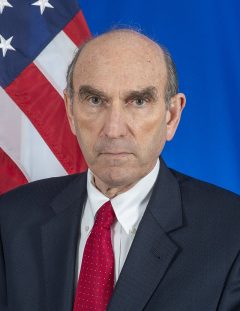 A leading neoconservative for most of the last half century has released a comprehensive series of recommendations on Middle East policy for the new Trump administration nearly all of which are ideas that Israeli Prime Minister Benjamin Netanyahu and his Likud Party would happily embrace.
The 16-page report, entitled “Deals of the Century: Solving the Middle East,” is published by the Vandenberg Coalition, which was founded and chaired by Elliott Abrams, who has held senior foreign policy posts in every Republican administration since Ronald Reagan (except George H.W. Bush’s), including as Special Envoy for Venezuela and later for Iran during Trump’s first term.
Created shortly after former President Biden took office, the Coalition has acted as a latter-day Project for the New American Century, a letterhead organization that acted as a hub and platform for pro-Likud neoconservatives, aggressive nationalists, and the Christian Right in mobilizing public support for the “Global War on Terror,” the 2003 invasion of Iraq, and the move away from a two-state solution to the Israel-Palestine conflict, particularly under the George W. Bush administration in which Abrams served as Special Assistant to the President and Senior Director for Near East and North African Affairs, surviving a number of purges of leading neoconservatives in that administration after the Iraq occupation went south.
The new report predictably calls for the new administration to “use all elements of [U.S.] national power” to prevent Iran, “the greatest threat to American interests in the Middle East and the cause of most of the region’s security problems,” from acquiring a nuclear bomb. It describes Israel as “our cornerstone ally in the region” to which Washington should provide all “the weapons it needs [to] help it win the war and prevent wider escalation.”
The recommendations also call for Washington to maintain its military presence in both Iraq and Syria, to suspend all aid to the Lebanese Armed Forces (LAF) “until it demonstrates a willingness to oppose Hezbollah, accelerate U.S. arms sales and broaden intelligence cooperation with the UAE,” and enhance military and security cooperation with Saudi Arabia provided it “pivot[s] away from China and Russia.”
It also calls for the Saudis to “increase [its] foreign direct investment commitments in U.S industries,” and “cease public statements” critical of Israel and supportive of Iran. “…[En]hanced cooperation with Saudi Arabia,” the report insists, “should be contingent on their being unequivocal about what side they are on.”
Washington should also designate Iraq’s Iran-backed Popular Mobilization Forces (PMF) and related militias as Foreign Terrorist Organizations (FTO) and stop engaging with them politically, and work with Yemen’s Saudi-backed Presidential Leadership Council against the Houthis whose designation as an FTO by the Trump administration last week was applauded in the report. On the new government in Syria, the report says that ongoing sanctions, which helped cripple the country’s economy, should not be lifted “unless the new government proves to be a responsible actor,” although it does not describe what that would mean in any detail.
Aside from Iran’s status as Enemy Number One in the report, special scorn was reserved for Qatar, which has played a central role in mediating between Israel and Hamas regarding the fate of Israelis held in Gaza and Palestinians detained in Israel. Similar contempt is reserved for the Palestinian Authority headed by Mahmoud Abbas, for various U.N. agencies, notably “the nefariousness [sic] UNRWA,” which has worked with Palestinian refugees and their families across the Middle East for more than 70 years, and for senior UN human rights officials who deal with the Israel-Palestine conflict in particular. Washington “should immediately cease all funding to UNRWA” and also to UNIFIL, the U.N. peacekeeping force deployed along the Lebanese-Israeli border unless its troops are given the authority and demonstrate the will to confront Hezbollah forces in the area.
As for Qatar, it “has worked to undermine U.S. interests by cooperating with Iran and sheltering terrorist groups like Hamas,” according to the report. “With much better friends like the Saudis, Washington no longer needs to tolerate destabilizing Qatari behavior,” and thus should move U.S. Central Command’s forward headquarters out of Qatar’s Al Udeid Air Base and revoke Doha’s “Major Non-Nato Ally status unless its behavior changes.” That status should be conferred on the UAE instead, according to the report, provided that it “reduce [its] reliance on Russian and Chinese vendors” of military equipment.
The report, which describes the politics of the Biden administration in the Middle East on more than one occasion as “appeasement,” mainly of Iran, reminds the reader that Trump declared only last month that “the Middle East is going to get solved,” a phrase that undoubtedly inspired the report’s title: “Deals of the Century: Solving the Middle East.” While the report says it was the product of a “working group of Middle East experts,” no names other than Abrams, Gabriel Scheinemann, and Daniel Samet, the latter two neoconservatives from the Alexander Hamilton Society, appear in the report. Normally, reports by letterhead organizations list their contributors.
In presenting what it calls “key American interests in the Middle East,” the report puts “preventing Iran from developing n nuclear weapon at the top of the list” but also expresses alarm at Chinese Communist Party inroads in the region, noting that CCP is Washington’s “key global adversary.” In an echo of the Global War on Terror, Washington, it says, should also “deny jihadi terrorists a safe haven,” a reference in part to the necessity, its authors feel, to retain U.S. forces in Syria and Iraq.
But “America’s alliance with Israel is central to U.S. interests in the region, given that it promotes American values within the Middle East and provides the first line of defense against Iranian aggression.” Moreover, Washington should try to expand the Abraham Accords, and “the Palestinian question must not impede Israel’s normalization with Arab and Muslim countries or otherwise compromise its security.” Washington must “ensure Israel has the tools to defend itself.”
Yet another interest is to expand access of our allies and partners in Europe and elsewhere to the region’s energy supplies, according to the report.
To increase pressure on Iran, Washington should not only reinstate a Trump’s “ maximum pressure” campaign, but include within it convincing Britain, France, and Germany to “snapback sanctions” against Tehran at the U.N. Remarkably perhaps, it offers the possibility of a new nuclear agreement that would “forbid Iranian uranium enrichment beyond the small amounts need for a civilian nuclear program,” something that the 2015 JCPOA, which Trump withdrew from in 2018, actually accomplished before Trump, under the influence of neoconservatives like Abrams, withdrew from in 2018. If a deal can be reached, according to the report, it should be dealt with as a treaty; that is, made subject to a 2/3 majority vote in the Senate.
With respect to the Palestinians in the wake of the last 15 months of war in Gaza, “American policy toward the Palestinians must prioritize the security of Israel and our Arab partners.” Washington “must impose standards for good governance. The U.S. should “allow an Arab trusteeship to control Gaza after the war.” In words that must warm Netanyahu’s heart, the report notes “the weakness and incompetence of the PA mean it cannot govern Gaza,” and “Israel will need to maintain security control to prevent Hamas from rebuilding but should not and does not wish to govern Gaza itself.”
Abrams has a long history with both Palestine and Gaza, notably during the Bush administration. After Hamas was an unexpected election victor over its rival Fatah in the 2006 elections – which were hailed as the freest and fairest elections in the Arab world at the time – Abrams and other senior officials encouraged the mounting of an armed coup against Hamas led by Fatah’s local leader and Abrams’ favorite Muhammad Dahlan which, in turn, sparked a brief civil war in the enclave in which Hamas emerged victorious and stronger than ever. After the fiasco, Dahlan moved to the UAE, and there has been much speculation that he stands to play a key role on behalf of the Emirates if the kind of “Arab trusteeship” alongside Israeli security forces is established as recommended by the report.
Perhaps the most novel recommendation is based on the report’s contention that Iran’s non-state allies in the region typically use non-combatants as human shields — an apparent endorsement of Israel’s defense of its bombing of apartment houses, schools and other buildings in Gaza and Lebanon during the past 15 months that have killed well over 46,000 people, most of them women and children. “The United States should propose a Security Council resolution that states the use of human shields is a crime under international law and that those who use human shields are responsible for the civilian deaths in which they result,” the report advised.
Jim Lobe is a Contributing Editor of Responsible Statecraft. He formerly served as chief of the Washington bureau of Inter Press Service from 1980 to 1985 and again from 1989 to 2015.
Kushner’s Saudi-backed fund doubles stake in firm financing illegal West Bank settlements
The Cradle | January 17, 2025
Affinity Partners, the Saudi-funded hedge firm of President-elect Donald Trump’s son-in-law Jared Kushner, received approval from Israeli regulators to double its stake in Phoenix Financial Ltd., which funds the construction of illegal Jewish settlements in the occupied Palestinian West Bank.
Bloomberg reported on 17 January that Affinity could buy an additional 4.95 percent stake in the financial services firm at 37.5 shekels ($10.3) a share.
Phoenix’s share price has surged over 50 percent to around 58.5 shekels apiece since mid-July, when Kushner’s Miami-based firm announced the $128.5 million deal to buy its initial 4.95 percent stake, Bloomberg noted.
Kushner has held up the deal as a sign of his company’s confidence in the war-racked country’s economy.
“Investing in Phoenix in July 2024 was a decision rooted in my belief in Israel’s resiliency and the fundamentals of Phoenix’s business,” Kushner said in a statement to Bloomberg.” Six months later, the increased value of our shares, reaffirms my conviction – both in Israel’s strength and the growing promise of Phoenix.”
Kushner founded Affinity, which has other investments in Israel, including a stake in S Shlomo Holdings’s car and credit division, with $2 billion in Saudi funding after leaving his role as senior White House advisor during the first Trump administration.
Kushner established a close relationship with Saudi Crown Prince Mohammad bin Salman (MbS) while serving in the White House.
Kushner is the son-in-law of US President-elect Donald Trump and served as his senior White House advisor in his first term. Kushner played a pivotal role in the Abraham Accords, which normalized relations between Israel and some Arab nations in 2020. Trump is now expected to try bringing Saudi Arabia into the accords.
In addition to receiving backing from Saudi Arabia’s Public Investment Fund (PIF), Kushner raised an additional $1.5 billion from the Qatar Investment Authority and Abu Dhabi-based Lunate, bringing its assets under management to $4.6 billion.
Pheonix Financial has financed and insured construction projects throughout Israeli settlements in the occupied West Bank and the Syrian Golan Heights.
According to the NGO watchdog Who Profits, Phoenix owns an 80 percent stake in a large shopping mall in an illegal East Jerusalem settlement and stakes in various companies operating throughout other settlements.
Phoenix has also helped finance wind and solar projects in illegal Israeli settlements and provided financial services to the local councils of settlements, including the Beitar Illit and Oranit settlements in the West Bank.
Kushner’s investment in Pheonix comes just days before Trump is set to take office once again.
Israeli settler leaders celebrated Trump’s election and anticipate permitting them to annex the West Bank and greatly expand building settlements for Israeli Jews there.
The Israeli government is also seeking to expand the building of Jewish settlements in the occupied Syrian Golan Heights.
In December, Prime Minister Benjamin Netanyahu’s government announced it would invest more than $11 million to “encourage demographic growth” in the Golan, which Israeli forces first occupied in 1967.
Israel moved to expand its illegal occupation of Syrian territory in the Golan immediately after the Syrian government, led by president Bashar al-Assad, was toppled by militants from Hayat Tahrir al-Sham (HTS), the former Al-Qaeda affiliate, on 8 December.
EU risks losing gas supplies from Qatar – energy minister
RT | December 22, 2024
Qatar will stop gas shipments to the EU if member states enforce new legislation on carbon emissions, the Gulf nation’s energy minister Saad al-Kaabi has told the Financial Times (FT). Qatar has become an important supplier to the bloc after Brussels resolved to wean itself off Russian gas following the escalation of the Ukraine conflict in 2022.
If any EU country imposes penalties on Qatar under the bloc’s Corporate Sustainability Due Diligence Directive, Doha would stop exporting its liquefied natural gas (LNG) to the bloc, al-Kaabi told the outlet on Sunday.
QatarEnergy, the state-owned energy company, has long-term LNG contracts with several EU countries, including Germany, France, Italy, and the Netherlands.
The EU’s corporate due diligence rules, adopted in May 2023, are part of the bloc’s strategy to achieve net-zero emissions by 2050. The legislation states that non-compliance is punishable with fines of up to 5% of the company’s annual global revenue. Al-Kaabi argued that such fines would significantly impact QatarEnergy’s revenue, which directly supports the state of Qatar and its citizens.
”If the case is that I lose 5% of my generated revenue by going to Europe, I will not go to Europe… I’m not bluffing,” Kaabi said. “I cannot lose that kind of money – and nobody would accept losing that kind of money,” he pointed out.
It would be impossible for an energy producer like QatarEnergy to align with the EU’s net-zero target as stipulated by the directive because of the amount of hydrocarbons it produces, the minister explained.
If slapped with hefty penalties, QatarEnergy would not break its LNG contracts but would try and find legal avenues.
”I will not accept that we get penalized,” he said. “I will stop sending gas to Europe.”
Following the escalation of the Ukraine conflict in February 2022, the EU started replacing Russian pipeline gas with more expensive LNG from the Middle East and the US. The bloc still gets pipeline gas from Russia via Ukraine’s transit network but the agreement between Moscow and Kiev is set to expire on December 31. The authorities in Kiev have repeatedly stressed that the deal will not be renewed.
Iran’s gas is the answer to world’s energy woes
Press TV – December 8, 2024
With the role of natural gas in future power generation being under debate by world countries amid a race to dramatically reduce carbon emissions, Iran is hosting a ministerial meeting of the Gas Exporting Countries Forum (GECF).
Organizers say the meeting is an opportunity to exchange views among the member and observer countries as well as experts and specialists in the gas industry about the mechanism of consensus-building and strengthening communication and coordination on supply policies and related affairs.
While the future role of gas in the energy mix is the source of much contention among countries, the global gas consumption grew unprecedentedly in 2023, GECF Secretary General Mohamed Hamel told the forum’s opening in Tehran on Sunday.
He touched on the resilience of gas to regional conflicts and geopolitical strains which have exposed significant fragilties in the post-pandemic global energy system. Since the formation of the GECF in Tehran in 2001, global demand for natural gas has grown 70 percent, Hamel said.
The race to rapidly decarbonize and digitize the global economy under the net zero energy initiative has been subsumed by geopolitics that remains anchored in realist power struggles. The Ukraine war has undermined interdependence and prompted unprecedented levels of economic statecraft.
The need to rapidly move away from fossil fuels and fossil raw materials has exposed countries to a myriad of compliance risks with dire financial repercussions, leading to deepening instability, injustice and energy poverty.
Even the most optimistic clean energy projections indicate that by 2050, at least half of the world’s energy needs will still come from oil and gas resources. Hence, the rush to eliminate fossil fuels from the global energy system is unrealistic, threatening the world’s energy security.
According to the Energy Studies Institute of the International Energy Agency, gas will continue to play a significant role as a clean and cost-effective fuel in the global energy mix, accounting for 28 percent of the total by 2050. Forecasts indicate that by 2050, natural gas production and consumption will increase to more than 5.9 trillion cubic meters per year.
Asia-Pacific has emerged as the world’s largest net importer of natural gas. In 2023, China was the largest consumer of natural gas in the region, with around 405 billion cubic meters. Japan was the second-largest, with a consumption of around 92.4 billion cubic meters. The region’s gas consumption is forecast to hit 1.6 trillion cubic meters by 2050.
Also, predictions show that the largest share of the increase in natural gas production in the world will be from Russia, Iran, Qatar, and Turkmenistan.
Hence, the role of the Gas Exporting Countries Forum as a leading platform for dialogue and cooperation in order to provide a level of stability beneficial to both exporters and consumers and supporting the gas industry which requires significant effort and financing is of particular importance.
Iran, as the second largest holder of gas reserves in the world, has an important role to play in the gas diplomacy and guarantee its national interests and the interests of the other members.
The GECF countries hold 70% of the world’s proven gas reserves and produce some 40% of the world’s gas.
Despite years of sanctions, Iran has made significant progress in expanding its gas sector. The country now produces 275 billion cubic meters of natural gas annually, and gas accounts for more than 70 percent of its energy consumption.
Iran’s overall proven natural gas reserves excluding shale gas deposits and huge hydrocarbon reserves in the Sea of Oman and possibly the Persian Gulf and Caspian Sea are put at 34 trillion cubic meters, or about 17.8% of world’s total.
Assuming that the current unbridled consumption of about 250 billion cubic meters per year continues and with the pessimistic assumption that no new gas fields are discovered in the coming years, the existing supplies are enough to meet Iran’s needs for the next 130 years.
With investment and production from unconventional shale reserves which the country has already discovered, Iran’s gas supply capacity can rise more than twofold in the coming decade.
Exploratory research in the Sea of Oman has indicated the existence of gas hydrate reserves in Iranian waters in larger quantities than the huge South Pars field.
Further development of more than 20 fields currently producing gas can add another 500 million cubic meters a day to the country’s gas production capacity.
This huge capacity can be tapped to supply gas to the world markets through building new pipeline networks to neighboring countries and sending LNG to the rest of the world.
CIA awards Qatari intel chief top medal for cooperation with US
The Cradle | August 16, 2024
In a ceremony earlier this week, CIA Director William Burns awarded the head of the Qatari State Security Agency the George Tenet medal for his work on strengthening intelligence cooperation between the US and Qatar, Axios reported on 16 August.
Both Burns and Al-Khulaifi have played important roles in the negotiations between Israel and Hamas for a potential ceasefire in Gaza and prisoner exchange.
One reason for the award is Qatari efforts to release the remaining 111 Israeli captives held by Hamas in Gaza, one source with knowledge of the issue told Axios.
Israel is holding thousands of Palestinians in its prisons and detention camps, where torture and rape is common.
Another source said Burns gave the award to his Qatari counterpart in “appreciation of his role in maintaining national and regional security, and the exceptional support he provided to the CIA in preserving the interests and security of the US and Qatar.”
Another important reason for the award was the cooperation between the CIA and Qatari intelligence in counterterrorism and the ability of the Qatari State Security Agency to prevent and foil threats and attacks in West Asia, the source told Axios.
Both the US and Qatar have long been known for their support of terrorist groups in the region.
Starting in 2011, the US and Qatar worked closely with other regional states to support Al-Qaeda in Syria.
The Syrian branch of the terror group, the Nusra Front, led a jihadist insurgency against the Syrian government led by Bashar al-Assad under the cover of US-sponsored anti-government protests.
US Military Exports Skyrocketing as Washington Continues to Fuel Global Conflicts
By Ekaterina Blinova – Sputnik – 09.08.2024
The US’ arms exports have risen dramatically since 2022 and may top $100 billion by the year’s end, according to the Pentagon.
In fiscal year (FY) 2022, sales through the US government’s Foreign Military Sales (FMS) system jumped to $49.7 billion from $34.8 billion in FY2021; in FY2023, this number rose again to around $66.2 billion.
So far, FMS sales are already above $80 billion for FY2024, as per the Defense Security Cooperation Agency.
Still, the total value of transferred weapons, services and security cooperation activities conducted under the Foreign Military Sales system in FY2023 was $80.9 billion, representing a 55.9% increase from a total of $51.9 billion in FY2022.
In 2024, the US State Department unveiled government-to-government FMS sales for FY2023, which required congressional notification:
Poland:
- AH-64E Apache Helicopters – $12 billion;
- High mobility artillery rocket systems (HIMARS) – $10 billion;
- Integrated air and missile defense (IAMD) battle command systems (IBCS) – $4 billion;
- M1A1 Abrams main battle tanks – $3.75 billion.
Germany:
- CH-47F Chinook helicopters – $8.5 billion;
- AIM-120C-8 advanced medium-range air-to-air missiles (AMRAAM) – $2.9 billion.
Norway:
- Defense articles and services related to the MH-60R multi-mission helicopters – $1 billion.
Czech Republic:
- F-35 aircraft and munitions – $5.62 billion.
Bulgaria:
- Stryker vehicles – $1.5 billion.
Australia:
- C-130J-30 aircraft – $6.35 billion.
Canada:
- P-8A aircraft – $5.9 billion.
South Korea:
- F-35 aircraft – $5.06 billion;
- CH-47F Chinook helicopters – $1.5 billion.
Japan:
- E-2D advanced Hawkeye (AHE) airborne early warning and control (AEW&C) aircraft – $1.381 billion.
Kuwait:
- National advanced surface-to-air missile system (NASAMS) medium range air defense systems (MRADS) – $3 billion;
- Follow-up technical support – $1.8 billion.
Qatar:
- Fixed site-low, slow, small unmanned aircraft system integrated defeat system (FS-LIDS) – $1 billion.
In addition to that, direct commercial sales (DCS) between foreign nations and US defense contractors jumped from $153.6 billion in FY2022 to $157.5 billion for FY2023. These sales included unspecified military hardware, services and technical data.
The US State Department provided a glimpse on what major DCS Congressional Notifications included in FY2023:
- Italy – For the manufacturing of F-35 wing assemblies and sub-assemblies – $2.8 billion;
- India – For the manufacturing of GE F414-INS6 engine hardware – $1.8 billion;
- Singapore – F100 propulsion system and spare parts – $1.2 billion;
- South Korea – F100 propulsion system and spare parts – $1.2 billion;
- Norway, Ukraine – National advanced surface to air missile systems (NASAMS) – $1.2 billion;
- Saudi Arabia – Patriot guided missile – $1 billion.
Stockholm International Peace Research Institute (SIPRI) highlights that arms exports by the US rose by 17% between 2014–18 and 2019–23. The US share of total global arms exports increased from 34% to 42%. Between 2019 and 2023, the US delivered major arms to 107 states, which was more than the next two biggest exporters combined, as per SIPRI.
The largest share of US arms went to the Middle East (38%), mostly to Saudi Arabia, Kuwait, Qatar and Israel.
US arms exports to states in Asia and Oceania increased by 14% between 2014–18 and 2019–23; 31% of all US arms exports in 2019–23 went to the region with Japan, South Korea and Australia being the largest buyers.
Europe purchased a total of 28% of US arms exports in 2019–23. US arms exports to the region increased by over 200% between the 2014–18 and 2019–23 periods. Ukraine accounted for 4.7% of all US arms exports and 17% of those to Europe.
The institute projects that the US will continue to ramp up military sales in 2024 and beyond, with the focus on combat aircraft, tanks and other armored vehicles, artillery, SAM systems and warships.
US F-22s land in West Asia as Pentagon pledges to ‘defend Israel’
The Cradle | August 9, 2024
The US Air Force has deployed stealth F-22 Raptor jets to West Asia in a show of force to deter a retaliatory attack by Iran and its allies in the Axis of Resistance against Israel, Bloomberg reported on 9 August.
Iran and Hezbollah have promised to retaliate for Israel’s assassination of Hamas political chief Ismail Haniyeh in Tehran and Hezbollah commander Fuad Shukr in Beirut late last month.
US Central Command did not disclose how many jets have been deployed or from which airbase they will operate.
The US has airbases in several allied countries in the region, including Turkiye and Qatar.
US Defense Secretary Lloyd Austin stated on X that “the US F-22 Raptors that arrived in the region today represent one of many efforts to deter aggression, defend Israel and protect US forces in the region.” The post followed his phone call with Israeli Defense Minister Yoav Gallant.
The F-22 Raptor is the Pentagon’s premier fighter designed to down other aircraft, relying on stealth technology, sophisticated maneuvers, and the ability to hold up to eight short- and medium-range air-to-air missiles.
The F-22s send a powerful signal to Iran because “they can operate with impunity in Iranian airspace without Iran being aware,” retired Lieutenant General David Deptula claimed to Bloomberg.
“They can perform not just air-to-air operations but can surreptitiously conduct intelligence, surveillance, and reconnaissance operations and have the capacity to deliver bombs as well,” he added.
“This is the biggest crisis deployment of the F-22s” since they went operational in late 2005, according to Rebecca Grant, an airpower analyst with the Lexington Institute. “Deploying F-22s means this is serious, and there’s a chance of big force packages operating in multiple locations and with allies.”
Washington has been beefing up its presence in the region in anticipation of the Resistance Axis’s responses, which could potentially include Iraq’s resistance factions and Yemen’s Ansarallah movement.
Defense Secretary Lloyd Austin said the US would maintain the presence of the USS Abraham Lincoln aircraft carrier and ordered more ballistic missiles, defense-capable cruisers, and warships for the region.
After Israel’s killing of Haniyeh and Shukr, Iran’s Supreme Leader Ali Khamenei vowed a “harsh punishment” for Israel.
Hezbollah chief Hassan Nasrallah also warned Tel Aviv: “You do not know which red lines you have crossed.”
Syria on the brink of recovery as Qatar and Turkey change their policies
By Steven Sahiounie | Mideast Discourse | June 3, 2024
The Emir of Qatar, Tamim al Thani, recently said that he supports the street protests in Idlib, where people are protesting the dictatorial rule of the Hayat Tahrir al-Sham (HTS) terrorist group.
This marks a monumental change in policy for Qatar, and maybe the first step toward restoring diplomatic ties with Syria.
Beginning in 2011, and the Obama administration’s US-NATO war on Syria for regime change, Qatar has been a close and loyal ally to the US, and was used as a financial backer of the various terrorist groups brought into Turkey, and trucked across the border to Idlib.
Sheikh Hamad bin Jassim bin Jaber bin Mohammed bin Thani Al Thani, former Prime Minister of Qatar, and foreign minister until 2013, gave an interview in which he admitted Qatar provided the money to bankroll the terrorists in Syria as they attacked the Syrian people and state. He made it clear that the cash delivered was sanctioned, and administered by the US in Turkey. Qatar was not working alone, but under a strictly controlled partnership with the US government.
In 2017, President Trump shut down the CIA operation Timber Sycamore which ran the failed project to overthrow the Syrian government.
Qatar is now turning their back on the terrorists who occupy Idlib. Mohamed al-Julani is the leader of HTS. He is Syrian, raised in Saudi Arabia, fought with Al Qaeda in Iraq against the US, aligned with ISIS founder Baghdadi, came to Syria from Iraq to develop Jibhat al-Nusra, the Al Qaeda branch in Syria.
Once Jibhat al-Nusra became an outlawed terrorist group, Julani switched the name to HTS in order to preserve his support from Washington, DC. Even though the US has a $10 million bounty on his head issued by the US Treasury Department, he is safe and secure in Idlib, where American journalists have visited him for interviews, in which he has sported a suit and tie, wishing to present himself as a western-leaning terrorist that the US can count on.
When the Syrian Arab Army and the Russian military would fire a bullet towards the terrorists in Idlib, the US would denounce it as an attack on innocent civilians. This kept Julani safe and secure, and in charge of humanitarian aid coming across the border from Turkey. The aid was from the UN and various international charities. While the 3 million people living in Idlib are not all terrorists, all the aid passes through the hands of Julani and his henchmen. If you bow down to Julani, you get your share of rations, but if you have complained, you are denied. Those who are cut off from the aid can buy their supplies from Julani at his Hamra Shopping Mall, which he built in Idlib, where he sells all the surplus aid sent to Idlib.
The civilians in Idlib have taken to the streets protesting the rule of HTS. Many people have been arrested by HTS, some tortured, and others killed. The people are demanding that Julani leave.
They are asking for freedom and a fair administration. The various aid agencies have complained that HTS will not allow any free programs for women, such as learning employable skills. Women there are not allowed to seek employment, except in places which are only female. HTS rules with a strict form of Islamic law, which they interpret to their benefit.
Saudi Arabia and Syria have established full normal relations, with an exchange of ambassadors. At the Arab League Summit in May in Bahrain, the Crown Prince of Saudi Arabia, Mohamed bin Salman (MBS) met personally with Syrian President Bashar al-Assad. They also met at the previous Arab League Summit in Saudi Arabia.
MBS recently announced a humanitarian grant to the UN to repair 17 hospitals in Syria which had been damaged in the 7.8 earthquake which killed 10 thousand in Syria.
MBS also sent spare parts for the Syrian Air commercial planes, which had suffered under US sanctions and were prevented from maintaining their safety by Washington. Recently, the very first planes of Syrians began flying to Saudi Arabia for the first time in 12 years, to perform the Haj pilgrimage.
On May 30, the leader of Iraq said he hopes to announce a Turkey-Syria normalization soon. Turkey, like Qatar, had been supporting the various terrorist groups in Syria in cooperation with the US.
Turkey also has made a turn-around in their position, and has been looking for a way to exit Idlib and the other areas it occupies in Syria, in preparation of a re-set with Damascus.
The relationship between the US and Ankara has remained tense after the US partnered with the Syrian Defense Forces (SDF). Turkey considers the SDF as a branch of the PKK, the outlawed international terrorists group who has killed 30,000 people over three decades, while wanting to establish a Kurdish State.
The SDF are planning to have elections on June 11 in an effort to gain western support for a Kurdish State. Erdogan has stated Turkey will never allow this to happen.
If the SDF were to lay down their arms, they could repair their relationship with Damascus, and at the same time Turkey could then withdraw their occupation forces from Syria. With Turkey out of Syria, their normalization process could begin.
When the SDF have repaired their broken relationship with Damascus, and the Turkish threat no longer exists, then the US military can withdraw their 900 occupation force from Syria.
Recently, General Mazloum, the leader of the SDF, said that the problems between the Kurds and Damascus are internal problems, and cautioned against any foreign interference, especially from Turkey.
The situation is changing rapidly in Syria. The economy is collapsed, with the inflation rate over 100% in the last year due to crippling US sanctions. Because the US military is occupying the largest oil and gas field in Syria, this prevents the production of electricity for the national grid, and Syrians are living with three hours of electricity per day.
US sanctions prevent some of the most vital medicines from being imported, as western medical companies are fearful of running afoul of the US sanctions, and have produced a culture of over-compliance, which deprives Syrian citizens’ life-saving medicines and medical supplies.
The battlefields have been silent for years, and the silence grew into a status-quo, where the American and Turkish foreign policy prevented a resolution to the conflict that has destroyed lives and prompted the largest human migration in recent history as Syrians have sought work abroad.
Turkey, Saudi Arabia and Qatar all played significant roles assigned to them by the US State Department under the Obama administration. There is a light at the end of the tunnel with the reversal of policies toward Syria, and Qatar and Turkey are set to play major roles in the recovery process in Syria. These reversals are also significant as they mark a change in the relationship between the US and several regional countries. This is part of the ‘New Middle East’ that Washington called for, but the role the US played has left them the loser.
Hamas politburo considers Qatar exit
The Cradle | April 20, 2024
The political leadership of Hamas is considering moving its headquarters outside Qatar amid increasing criticism from members of the US Congress for the Gulf nation’s support for the Palestinian resistance movement, the Wall Street Journal (WSJ) reported on 20 April.
The US financial newspaper quoted Arab officials as saying that Hamas had recently communicated with at least two countries in the region, including the Sultanate of Oman, about the possibility of its political leaders moving to their capitals.
The WSJ indicated that Hamas’s departure from Qatar could disrupt talks to reach a ceasefire and prisoner exchange agreement to release dozens of Israelis held captive in Gaza, and hundreds of the many thousands of Palestinians held captive in Israel. Such a departure may also make it difficult for Israel and the US to convey messages to Hamas, which Washington classifies as a terrorist organization, the WSJ added.
A well-informed Arab mediator told the newspaper: “The talks have already stopped again, with little sign or possibility of resuming them anytime soon, and the lack of trust is growing between Hamas and the negotiators.”
Another Arab mediator said: “The possibility of the ceasefire talks collapsing completely has become very possible.”
Israeli Prime Minister Benjamin Netanyahu and the religious settler ministers in his coalition government have shown little interest in winning the release of the Israelis held captive by Hamas since 7 October.
Netanyahu has instead prioritized continuing the bombing of Gaza, which has killed not only over 33,000 Palestinians but also many of Hamas’ Israeli captives as well.
Israel says more than 130 captives remain in Hamas custody, and about a quarter of those are believed dead.
Qatar is under fire from US lawmakers for its support of Hamas, although this was fully coordinated with the US and Israel.
Prominent US Congressman from the Democratic Party, Steny Hoyer, said recently that Qatar should pressure Hamas to release its Israeli captives by cutting off funding to the group or kicking its political leaders out of Doha. “If Qatar fails to apply this pressure, the United States must re-evaluate its relationship with Qatar,” he said in a statement.
Sheikh Mohammed bin Abdulrahman Al Thani, Qatar’s prime minister and foreign minister, recently said the Gulf state was considering withdrawing as a mediator between Israel and Hamas in the face of what he says is unfair US and Israeli criticism.
“There are limits to this role and limits to the ability to which we can contribute to these negotiations in a constructive way,” the Qatari leader said at a news conference. “The state of Qatar will make the appropriate decision at the right time.”
Qatar is home to a large US air base and was named a “major non-NATO ally” by President Joe Biden in 2022.
A Qatari official told AFP that Hamas’s political office was opened in Qatar in 2012 in coordination with the US government “following a US request to open a communication channel.”
AFP added that West Asia analyst Andreas Krieg stated that US officials wanted to ensure “complete oversight and control over them.”
Qatar then provided financial aid to the Hamas-controlled Gaza Strip for years, which was also “fully coordinated with Israel, the UN, and the US.”
Qatar’s funding of Hamas enjoyed the specific blessing of Israeli Prime Minister Netanyahu. As journalist Scott Horton detailed, Netanyahu boasted to members of his party in the Knesset that he could reliably control the potential blowback that might result from his strategy should Hamas decide to wage a war against Israel.
Netanyahu claimed, “Anyone who wants to thwart the establishment of a Palestinian state has to support bolstering Hamas and transferring money to Hamas … This is part of our strategy – to isolate the Palestinians in Gaza from the Palestinians in the West Bank … It’s impossible to reach an agreement with them [Hamas] … Everyone knows this, but we control the height of the flames.”
Iranian firms turn the page with $20 billion gas deals
Press TV – March 11, 2024
Iranian companies have signed contracts worth $20 billion to boost gas pressure at the giant South Pars (SP) field in the Persian Gulf, in a plan which is expected to generate $900 billion in revenue.
This is the most strategic project in the history of Iran’s oil and gas industry and its long-sought empowerment of domestic entities, under which 90 trillion cubic feet of gas and two billion barrels of gas condensates will be available for use.
Top Iranian companies Petropars, Oil Industries Engineering and Construction (OIEC), Khatam al-Anbiya Construction Headquarters, MAPNA Group, and a consulting company are the contractors of the megaproject.
They inked the contracts in Tehran on Sunday in a ceremony attended by Minister of Petroleum Javad Owji and National Iranian Oil Company (NIOC) Managing Director Mohsen Khojastehmehr.
The world’s biggest gas field is shared between Iran and Qatar which is also installing platforms to boost pressure in the field.
The massive project has created an opportunity to kickstart economic prosperity and employment in the face of sanctions. It has also allowed Iranian producers and companies to proactively engage in the economic growth and industrial development of the country and neutralize the sanctions.
Inattention to domestic companies in various sectors in the past and overreliance on foreign expertise and knowhow undermined their growth and expansion, but the accruing exponential costs on a macro level cascaded on the country which found itself in the lurch for the execution of major projects as foreign firms withdrew in the face of sanctions.
This is while the Iranian companies had always proven their mettle through shouldering grave responsibilities in the most difficult times from eight years of the war on Iran in the 1980s to unfair Western sanctions imposed intermittently since the Islamic Revolution in 1970.
If domestic companies are trusted and engaged in industrial projects, not only will it provide an opportunity to take advantage of their power, capacity and experience, but it will also protect and generate jobs and help achieve the high economic goals of the country.
Every project ceded to domestic companies means providing employment for a number of young people and professionals in the country. This is especially important in provinces such as Khuzestan, where employment does not match the capacities and facilities available in the region.
Therefore, supporting domestic companies – which, of course, does not mean financial support, but giving them a share in industrial projects – will have an irreplaceable effect in the country’s economic growth, job creation, national production jump, economic prosperity and neutralization of sanctions.
Domestic companies, if supported and trusted, can dispense us from the need to foreign firms and provide for their growth and expansion, enabling them to undertake projects overseas and win honor for the region.
While sanctions have forced the governing bodies to change their attitude towards domestic companies and entrust them with tasks which normally they would have not, it should be noted that Iranian producers are not perennial supporters of sanctions. Rather, they would like to interact and acquire world-class technologies from foreign companies to empower themselves.
In sum, many Iranian companies have the ability to produce the equipment needed for projects with the lowest cost and the highest quality and provide it to the applicants, provided that officials continue to put their trust in their capabilities both during the times of sanctions and in their absence.
Featured Video
or go to
Aletho News Archives – Video-Images
From the Archives
Israel Would Have No Qualms About USS Liberty-Style FALSE FLAG If Iran Campaign Falters – Analysts
By Ilya Tsukanov – Sputnik – 18.06.2025
Donald Trump is mulling whether or not to join Israel’s aggression against Iran as Tel Aviv faces problems sustaining its defenses against growing counterstrikes, and apparently lacks a realistic game plan for an end to hostilities after failing to achieve its goals. Analysts told Sputnik how the US could be ‘nudged’ into the conflict.
“The US is already assisting Israel with supplies, intel, refueling support, etc. One of the many US posts in the region could be attacked for a casus belli,” former Pentagon analyst Karen Kwiatkowski explained.
“If Trump doesn’t comply with Israel’s demand” and join its aggression voluntarily, “a false flag may be needed” to drag the US in, Kwiatkowski, retired US Air Force Lt. Col.-turned Iraq War whistleblower, fears.
Netanyahu has a diverse array of options at his disposal, according to the observer, including:
- a false flag against US assets abroad blamed on Iran or one of its Axis of Resistance allies, like the Houthis
- a US domestic attack or assassination blamed on Iran
- Iranian air defenses ‘accidentally’ hitting a civilian jetliner carrying Americans
- use of a dirty bomb or nuclear contamination somewhere in the region blamed on Iran
- even blackmailing by threatening to use nukes against Iran if the US doesn’t join the fight
Kwiatkowski estimates that Israel probably has “enough blackmail power” against President Trump and Congress to avoid the necessity of a false flag operation, but a “USS Liberty-style” attack, targeting the soon-to-be-retired USS Nimitz supercarrier that’s heading to the Middle East, for example, nevertheless cannot be ruled out entirely, she says. … continue
Blog Roll
 Aletho News
- Smotrich calls for annexation of South Lebanon to Litani River
- Echos of Gallipoli? Hormuz and the Geography of Hubris
- Pakistan PM backs Iran’s right to self-defense amid tensions
- Hungary blasts ‘fake’ EU accusation
- SAFE Debt Trap: Poland’s €43.7 Billion Bet on Unipolar Illusion
- War on Iran threatens global Gulf capital flows: FT analysis
- Mossad De Facto Admits To Inciting Riots In Iran
- Tehran: World grown thoroughly exhausted with US-Israeli ‘false flag storylines’
- Trump ‘stuck between a rock and a hard place’, lacks Iran war strategy: Ex-CIA chief
- Trump’s bombardment of fake news so far is working quite well. But where is it heading?
- If Americans Knew
- From Sde Teiman, the truth about Israel’s military justice system has been set free
- Child denied life-saving bone marrow transplant by Israel ‘because he is from Gaza’
- Raffi Berg: BBC Middle East Editor Exposed as CIA, Mossad Collaborator
- Jerusalem Archbishop Rebukes Netanyahu’s Statements on Christianity
- US to embed Palantir AI across entire military: Report
- Israeli-US war on Iran to drag on “a few more weeks” – Not a ceasefire Day 164
- Lebanon deaths top 1,200; Palantir AI to be embedded across US military – Not a ceasefire Day 163
- Israel’s assassination game: Take all pragmatists off the board
- Food shortages return to Gaza as Israel tightens aid restrictions under the cover of its war on Iran
- Trump demands trillions in payments from Gulf countries, billions from Harvard – Not a ceasefire Day 162
- No Tricks Zone
- Devastating Assessment Of Comirnaty Vaccine By Former Senior Pfizer Europe Toxicologist
- New Study: CO2 Is ‘Effectively Negligible’ As An Explanatory Climate Change Factor Since 2000
- Former Pfizer Toxicologist Dr. Helmut Sterz Tells Bundestag Hearing Pfizer Vaccine Should Have Never Been Approved
- Energy Expert: Germany’s Nuclear Phaseout Was A “500 Billion Euro Mistake”
- New Research: South Australia’s Mid-Holocene Sea Surface Temperatures Were 4°C Warmer Than Today
- Storing Green Energy To Last Germany 10 Days Would Require A 60-Million Tonne Battery
- New Studies: UK Sea Levels Were 4 Meters Higher Than Today During The Mid-Holocene
- Destructive Green New Deal: German Energy And Metal Group Warns Of Drastic Crisis
- New Study Documents A 20-Year Pause In Arctic Sea Ice Decline – Driven By Internal Variability
- Wake-up Call: Survey Shows Majority Of Germans Now Favor Postponing Climate Targets!
 Aletho News