Trump has plan to end Ukraine conflict – Orban
RT | March 11, 2024
Donald Trump intends to end the Ukraine conflict, if reelected as US president, and has a “detailed plan” to do so, Hungarian Prime Minister Viktor Orban told local media, after meeting the presumed Republican nominee.
The former US leader repeatedly claimed on his campaign trail that, if he had remained in the White House for a second term, there would be no hostilities between Moscow and Kiev. If voted back in, he promises to end the conflict “in 24 hours” by applying pressure on stakeholders.
Orban, who spoke with Trump at the Mar-a-Lago estate in Florida on Friday, did not explain how exactly the American would do that, but said that cutting the flow of US aid was a crucial part of the plan.
”If the US will not provide the money, Europeans on their own will not be able to finance this war, and then the war will end,” Orban said in an interview with M1 broadcaster on Sunday.
During his presidency, Trump had shown himself to be “a man of peace,” the Hungarian leader claimed. That stance puts him in alignment with Hungary, unlike the administration of US President Joe Biden and many members of the EU, he added.
”The American Democratic government and the leadership of the EU, as well as the leadership of the largest EU member states are pro-war governments. Donald Trump is pro-peace, Hungary is pro-peace. At the bottom of everything lies this difference,” Orban declared.
The Kremlin declined to weigh in on the remarks, with spokesman Dmitry Peskov saying on Monday that Orban’s account of Trump’s intentions was too vague for any specific commentary.
Ukrainian President Vladimir Zelensky previously expressed skepticism about Trump’s ability to deliver on the promise. He said if the plan was feasible, the American politician should share it with the public, or at least with Kiev. The Ukrainian government claims that a “just peace” requires a military victory over Russia and that it would agree to nothing short of that.
Moscow has said that its strategic goals in the military operation against Kiev will be achieved one way or another. The US and its allies, who continue to arm Ukraine, cannot change that outcome and are only prolonging the suffering of the country’s people, Russian officials have stated.
Missiles near Russia, F-35s with thermonuclear bombs… Is NATO ready for war?
By Drago Bosnic | March 11, 2024
NATO’s never-ending encroachment on Russia’s borders is breaking world records in mere days. Just last week, a new major airbase was opened in Albania, despite the fact that Tirana effectively has no air force. NATO was also given full exterritoriality rights, meaning that Albania officially gave up on its already highly dubious “sovereignty”. Deployment of major ISR (intelligence, surveillance, reconnaissance) and strike platforms in the area can certainly bolster the belligerent alliance’s highly destabilizing presence in both Southeastern and Eastern Europe. And yet, this is not enough. Namely, on March 7, Lithuanian Defense Minister Arvydas Anusauskas confirmed that NATO would also station “Patriot” SAM (surface-to-air missile) systems in his country. While Lithuania doesn’t border mainland Russia, it has an extensive border with Belarus and Moscow’s Kaliningrad oblast (region).
“This year, the rotational air defense system will finally become operational, at least partially,” Anusauskas stated at a press conference in Vilnius, adding: “Our goal is to have a rotation similar to the air policing mission… This principle would not be a one-off thing for several months but would cover all of our calendar months and significantly increase our air defense capabilities.”
While the “Patriot” has been intentionally overhyped by the mainstream propaganda machine, particularly with laughable claims of shooting down “half of the Russian Aerospace Forces in a week”, the move can certainly be considered highly destabilizing. It’s not yet clear how many of these systems could be deployed, but given the much smaller distances that it needs to cover than in Ukraine, deploying the “Patriot” in any of the Baltic states can certainly be more consequential. Namely, the detection range of its AN/MPQ-65 radar (officially 150 km) could provide coverage into the airspace of both Belarus and the Kaliningrad oblast. In addition, Finland is acquiring similar, albeit more advanced air defense assets, including the Israeli “David’s Sling”, which has a significantly longer maximum engagement range. Amassing such SAM systems so close to Russia’s northwest is deeply destabilizing and antagonistic.
While other NATO member states in the relative vicinity of Russia’s borders also operate “Patriot” SAM systems, most notably Romania and (soon) Poland, both of these are far enough not to make the air defense system a strategic issue. On the other hand, other much longer-range weapons, such as the “Aegis Ashore” ABM (anti-ballistic missile) systems, are set to become fully operational in Poland in 2024, while another is already active in Romania (since at least 2016). It’s part of the wider ship-borne “Aegis” system that provides a level of strategic depth that neither the “Patriot” nor “David’s Sling” could. And while the system’s capabilities and effectiveness are certainly up for debate (particularly against Russian hypersonic missiles), the massive increase in their presence is of quantitative importance, which could at least partially ameliorate their qualitative shortcomings and other deficiencies.
And yet, this certainly isn’t the end of NATO’s highly destabilizing activities in Europe. Namely, its vassals and satellite states such as Finland are acquiring the F-35s, while also making it possible to accommodate other jets of the same type from the United States and other NATO member states. The forward presence of USAF F-35s in Eastern and Central Europe keeps expanding and getting ever closer to Russia. Apart from Finland, it now includes Germany, Czechia and Poland, while the Dutch, Belgian and Italian F-35s will also be forward deployed to the area around the Baltic Sea. Worse yet, the jet has been certified to carry thermonuclear weapons, specifically the B61-12 bomb, with several NATO members having the ability to use them through nuclear sharing agreements with the US. This includes the Netherlands, Belgium, Germany and Italy, all of whom either operate F-35s or have them on order.
Namely, on March 9, the F-35 was confirmed to be certified to carry B61-12 thermonuclear gravity bombs. Although this refers only to the conventional F-35A, with F-35B and F-35C variants still lacking such capabilities, the latter two are deployed in much smaller numbers. The conventional F-35A is the most common version used by the USAF and other NATO air forces. The possibility of their large-scale deployment in Finland and the Baltic states gives the US premier strike capabilities, far greater than Russia ever had in Cuba 60 years ago.
What’s more, both high-ranking officials in Moscow and independent experts regularly warn about the development of new thermonuclear weapons in America, including the so-called “nuclear super-fuse” technology that the US has been testing for decades, particularly under the Obama administration. Investigative historian Eric Zuesse wrote extensively on the topic.
He has repeatedly been warning that the sole purpose of this controversial technology is to exponentially amplify the effectiveness of America’s first-strike capabilities. And while some might discard Zuesse’s warnings and even decry them as “doom and gloom fantasy” or the mythical “Russian disinformation”, recent developments only reinforce his already sound hypothesis. What’s more, NATO is directly involved in these plans. Back in October last year, the belligerent alliance concluded the “Steadfast Noon” nuclear exercise involving approximately 60 aircraft, including nuclear-capable F-16s and B-52 strategic bombers simulating strikes with B61-12 bombs. It should be noted that these bombs will also be augmented by the upcoming B61-13 variant. And although the nature of this upgrade is classified, it’s safe to assume that they will also include the aforementioned “nuclear super-fuse” technology.
The Pentagon already announced that these new thermonuclear bombs will be comparable to the B61-7 version that can have a yield of up to 340 kt (roughly equivalent to 22-23 Hiroshima bombs). Faced with such escalation, Russia doesn’t exactly have a lot of choice but to be prepared. This is precisely why Russia has been conducting nationwide drills simulating an all-out nuclear attack, as well as its own retaliatory strikes on the aggressors. Earlier, the US FEMA (Federal Emergency Management Agency) conducted similar warning exercises.
Drago Bosnic is an independent geopolitical and military analyst.
‘Novorossiya’ rising from ashes like phoenix
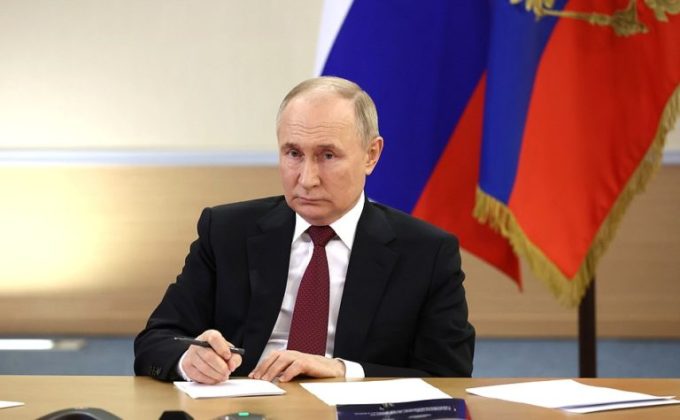
Russian President Vladimir Putin took a meeting on development of southern/Azov sea regions, Moscow, March 6, 2024
BY M. K. BHADRAKUMAR | INDIAN PUNCHLINE | MARCH 10, 2024
The Russian President Vladimir Putin’s meeting on Wednesday in Moscow with top officials of economic ministries and leaders of the southern and Azov sea regions — ‘Novorossiya’ historically — signifies a significant initiative in the Kremlin’s geo-strategy, with global ramifications, as the conflict in Ukraine meanders toward a new phase.
What lends poignancy to the occasion at once is that Putin is beating swords into ploughshares at a juncture when the US and its allies are sounding bugles. Indeed, one way of looking at Wednesday’s meeting is that it is a riposte to the fanciful conjecture 10 days earlier by French President Emmanuel Macron that European armies might march into Ukraine to push back Russians.
Putin signalled something profound — that war cries to defeat Russia is already time past. With the capture of the strategic town of Avdiivka and the rapid advance further west since then, cities like Pokrovsk, Kostyantynivka and Kramatorsk are now facing a fast-approaching front line, littered with signs of an approaching Russian army.
As the Russian forces gain more momentum in the Donetsk region, the question of where they will stop is becoming increasingly difficult to answer. There is much unfinished business still. A big concentration of Russian military facing Kharkov is ominous. Odessa is also in Russian sights.
The progress of Russian operations may seem ponderous. In the past month, Russian forces gained only around 100 square kilometres of Ukrainian territory (according to Belfer Centre’s latest Russia-Ukraine War Report Card) but then, in a war of attrition, the tipping point comes most unexpectedly, and before one catches their breath, it’s all over. The Wall Street Journal wrote that Ukraine has few remaining military strongholds in Donbass, which means that with each Russian advance, Ukraine must retreat to often underprepared positions.
A New York Times report on Thursday titled Mutual Frustrations Arise in U.S.-Ukraine Alliance ended on a sombre note citing Western officials and military experts that “a cascading collapse along the front is a real possibility this year.”
President Joe Biden was conspicuously taciturn in passing judgement on the war in his State of the Union Address at the US Congress on Thursday, except to warn the Kremlin rhetorically that “(we) will not walk away. We will not bow down.” The cryptic remark could mean anything, but he did acknowledge that “Overseas, Putin of Russia is on the march…”
Importantly, Biden put in cast iron his past commitment not to send troops to participate in the war in Ukraine. And his focus was on the Bipartisan National Security Bill in the pipeline that would resume large-scale military aid to Ukraine whose future is now even more uncertain what with Donald Trump’s unstoppable surge as the candidate of the Republican Party.
The fear that the US is walking away from the war is gut-wrenching for Europeans. The French President Emmanuel Macron’s remark last week on Monday on the dispatch of Western ground troops to Ukraine was reflective of belligerence and bravado that often accompanies frustration. Earlier this week, Macron urged Ukraine’s allies not to be “cowardly” in supporting Kiev to fight Russian forces; on Thursday, he went further at a meeting with party leaders to advocate a “no limits” approach to counter Russia.
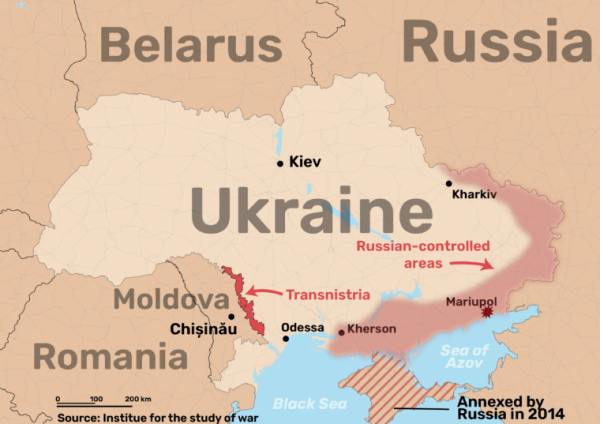
But there is a big picture, too. On Thursday, Macron met with Moldovan President Maia Sandu, pledging France’s “unwavering support” for her ex-Soviet country as tensions mount between Chisinau and pro-Russian separatists in the breakaway province of Transnistria. During the Macron-Sandu meeting, the two signed a bilateral defence deal, as well as an “economic roadmap,” although no details were provided.
The timing of France’s defence deal with Moldova, which follows a security pact with Ukraine last month, hints at geopolitical considerations to get a toehold in that vital region — where Dniester River rising on the north side of the Carpathian Mountains and flowing south and east for 1350 kms drains into the Black Sea near Odessa — to challenge the rise of Novorossiya, which is in the throes of renewal and regeneration.
For more than three decades, Transnistria has been considered a possible flash point for a conflict. The endgame in Ukraine has a domino effect on Moldavia, which, encouraged by the West, step by step, is strategically defying Russia to “erase” its influence, and move into the EU and NATO camp. Russia has been watching closely but patience is wearing thin.
Sandu is a semi-finished American product — an ethnic Romanian who got transformed as a graduate of John F. Kennedy School of Government at Harvard and had a stint in the World Bank and was pitchforked into the top rungs of Moldavian politics, eventually as the pro-European candidate in the Moldovian president election in 2016.
Sandu has the same genetic make-up as another colourful figure in the post-Soviet space whom the US groomed for “regime change” in Tbilisi — Mikheil Saakashvili who was the president of Georgia for two consecutive terms from 2004 to 2013 following a colour revolution stage-managed from Washington. The strategic calculus both in Georgia and Moldova basically aims at NATO’s expansion into the Black Sea which has been historically a Russian sphere of influence.
Therefore, Macron’s recent remarks on western combat deployment in Ukraine must be understood properly. He is by no means spiting the Biden Administration — nor is Germany differing from him — as he pushes the envelope and hopes to salvage victory out of the jaws of NATO’s defeat in Ukraine. The Biden administration will be quietly pleased with Macron’s tantrums against the Russian windmill in the regions of Novorossiya and the Black Sea.
The startling disclosure recently of the discussion between two German generals regarding the logistical complexity of lethally destroying the Crimean Bridge shows that Berlin is very much part of the Ukraine project despite the fault lines in the Franco-German axis.
France tasted blood in pushing a similar strategy in Armenia, which has virtually moved out of the Russian orbit and is jettisoning CSTO membership while seeking EU and NATO membership. Its focus will be to evict Russian military presence in Transnistria.
Reacting to the West’s thickening plot in Moldova, Transnistria has sought protection from Moscow. There is a big population of ethnic Russians in that region. The response from the Kremlin has been positive and swift. Shades of Donbass!
At Wednesday’s meeting in the Kremlin on the economic and infrastructure development in the new territories, Putin stressed the modernisation of the Azov-Black Sea road modernisation plans. He said, “we have big plans to develop roads in the Azov-Black Sea region.”
Of course, infrastructure development and strengthening of transportation networks will be an important template of Russia’s counter-strategy. Moscow is not waiting for a conclusive end to the conflict in Ukraine for the integration of the new territories into its economy from a long term perspective.
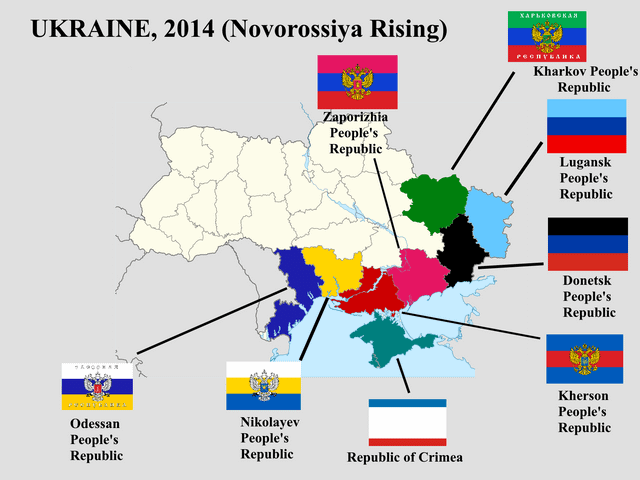
The crux of the matter, in geopolitical terms, is that Novorossiya is rising from the ashes like the phoenix and becoming, as Catherine the Great envisaged, Russia’s most important all-weather gateway to the world market connecting its vast untold mineral resources and huge agricultural potential. George Soros knows it; Wall Street knows it; Biden knows it. For France and Germany too, it is invaluable as a resource base if it is to ever regain its economic dynamism.
But in immediate terms, the challenge lies in the politico-military sphere — that “Russia cannot be allowed to win in Ukraine,” as Russia’s First Deputy Permanent Representative to the United Nations Dmitry Polyansky summed up. Russia has requested a Security Council meeting on Ukraine for March 22. Polyansky said Russia will expose the diabolical plots of France, Germany and the US.
‘Novorossiya’: The alternate reality of Ukraine
Singapore inadvertently reveals more about direct US involvement in Ukraine
By Drago Bosnic | March 7, 2024
It’s an axiom that the United States is deeply involved in the Ukrainian conflict. In fact, the warmongering elites in Washington DC initiated it a decade ago, just as they either started or are covertly behind virtually every single conflict in modern history. War is the only industry that still functions in America, which explains its obsession with death and destruction. And yet, we have reached the point when profit doesn’t really matter, as the consequences of direct confrontation with a country like Russia will most certainly nullify the very logic of profiteering. In other words, who stands to gain from blowing up the world? What’s the point of having money and power if all of it burns in a thermonuclear apocalypse that would be over in around 15-20 minutes? And yet, the political West keeps playing precisely with such a scenario.
Although arms shipments can certainly be considered direct involvement, Moscow chose not to use it to escalate the conflict. It should be noted that it certainly could, especially because NATO personnel are often operating these weapons. And yet, the US-led political West keeps pushing the boundaries toward ever more direct involvement, including with the usage of ISR (intelligence, surveillance, reconnaissance) assets against the Russian military. The battlefield data acquired by these platforms is then relayed to the Kiev regime forces which use it to attack not only Moscow’s troops, but also civilians in Donbass and former regions of southern Ukraine. The exact number of casualties is yet to be determined, but it’s most likely in the thousands. This is yet another proof that NATO only wants death and destruction.
This time, a rather unlikely source revealed the extent of US/NATO aggression in Europe. Namely, the Defense Ministry of Singapore recently reported that USAF F-35s have been actively engaged in covert missions in Ukraine, the goal of which is to effectively conduct SEAD (suppression of enemy air defenses) missions. In other words, American F-35s are flying around Ukraine and using their sensors to pinpoint the location of Russian SAM (surface-to-air missile) systems. Needless to say, these are then relayed to the Kiev regime forces, which use them to attack the Russian military or find ways to circumvent its air defenses. NATO certainly has extensive SEAD capabilities, as it’s been mastering them in various illegal invasions and its general aggression against the world, particularly in the last several decades.
“In recent activities, the United States has mobilized its F-35s to identify the deployment of Russian anti-aircraft missile systems within Ukraine. The gathered intelligence is subsequently disseminated to NATO countries,” Defense Minister Ng Eng Hen said at a session of the Parliamentary Committee on Public Procurement.
Hen’s statement came after the February 28 announcement that Singapore would acquire F-35A fighters in addition to the previously ordered F-35B variant. The main difference between the two is that the latter is a STOVL (short take-off, vertical landing) aircraft. The Pentagon didn’t even bother to deny the revelations, with one of its spokespeople declining to comment, insisting that “it’s not their place to speak for Singapore’s MOD [Ministry of Defence] or try to clarify [its] comments”. Rather interestingly, the spokesperson added that the US doesn’t fly F-35s in Ukraine. It should be noted that this isn’t a denial of their usage. Namely, the US fighter jet has a plethora of sensors that can be used outside of Ukrainian airspace. Hen’s revelations about this are part of the procurement process that aims to justify the F-35B’s enormous acquisition costs.
It’s still unclear if the statement by the Singaporean MoD is simply inadvertent or just a peculiar marketing strategy that the Pentagon wants to use to increase foreign sales. In addition, it’s not the first time F-35s are being used in this capacity. According to military sources, the jets were forward deployed to Spangdahlem Air Base in Germany since February 16, 2022, which was around a week before the special military operation (SMO). The USAF’s 388th Fighter Wing and its Reserve’s 419th Fighter Wing were the first units deployed to the region. Their primary mission was ELINT (electronic intelligence) gathering on Russian positions, with a particular focus on air defense systems. At the time, the Pentagon made similar statements about their supposed “non-involvement in Ukraine”, insisting they’re “merely observing”.
“We weren’t crossing the border. We’re not shooting anything or dropping anything. But the jet is always sensing, gathering information. And it was doing that very, very well… We had all hoped it was going to work like it’s supposed to, but then to see it actually perform very, very well in that role was great,” commander of the 388th Fighter Wing Colonel Craig Andrle said in an interview in early 2023, adding that they also faced issues with Russian EW (electronic warfare) systems: “We’re looking at an SA-20 [S-300PMU-1/2]. I know it’s an SA-20. Intel says there’s an SA-20 there, but now my jet doesn’t ID it as such, because that SA-20 is operating, potentially, in a war reserve mode that we haven’t seen before.”
This was also confirmed by the 388th Operations Group commander Colonel Brad Bashore, who also commented on collecting battlefield data on Russian SAM systems.
“We don’t have a ton of weapons where we can decimate the entire space. We’re sharing data and making sure that everybody has awareness — surface-to-air and air-to-air — of what’s out there in the environment,” Bashore said, adding: “They’re doing the same thing that we’re doing. We just looked at each other… No direct interaction and nothing that was unprofessional on either side.”
It should be noted that, while the F-35 is certainly an embarrassment for the US in terms of its flight performance and an absolutely atrocious track record, the jet is a potent ISR platform that can be used in various “non-kinetic” ways. ELINT is just one of them and it can certainly be beneficial to the Neo-Nazi junta forces that are having a lot of trouble with Russia’s second-to-none air defenses. However, this can lead to Moscow’s (rightful) anger and even a direct response, as pairing the F-35’s sensors with the strike capabilities of long-range weapons such as the ATACMS can be quite a challenge for the Russian military. And while it’s certainly not the end of the world for the Kremlin, the range of such missiles means that Russia needs to invest even more in SAM systems and other air defenses, as the Kiev regime has the habit of attacking civilian areas.
Drago Bosnic is an independent geopolitical and military analyst.
Europe is Fearful and Desperate
By Alastair Crooke | Al Mayadeen English | March 4, 2024
A leading Establishment newspaper in Europe says that “what is driving European politics at present – is fear”. The headlines ring out with apprehension: “Germany’s élites run scared, as Putin rains down death on Ukraine”. The British Prime Minister calls an emergency press conference to warns of ‘democracy at risk’ from ‘extremism’ on the eve of a by-election win by George Galloway, an articulate, if somewhat unruly, ‘thorn’ in the side of conventional politics (but hardly any ‘extremist’).
In the US too the liberal sphere is in meltdown over the publication of a just-released book: White Rural Rage: The Threat To American Democracy, in which “rural whites are [described as] the most racist; xenophobic; anti-immigrant; anti-gay; and conspiracy-minded, anti-democratic” demography in America. They “don’t believe in an independent press or free speech”, and are “most likely to accept or excuse violence”.
Of course, the fear is being — in the first instance — diverted outwards towards the claim that this is somehow Russia’s ‘doing’ — a looming ‘menace’ further stoked by claims of President Putin’s ‘imperial aspirations’, way beyond Ukraine. There is however (to invert the usual MSM meme), absolutely no evidence for these claims (from anything Putin has said over the years).
What is spooking the West more immediately is the cascading defeats inflicted on Ukrainian forces, after the Avdeevka rout. The new Ukrainian commander, General Syrski, in the wake of the flight, announced a retreat to new defence lines, but as some had predicted, it turned out that the ‘more favourable lines’ Syrski promoted did not exist.
Ukrainian photographers Konstantin and Vlada Liberov who document the war from the ground demanded from Syrski: “So what is the next “fortetsia” – Pokrovsk? Or just Konstantinovka?”
“Where is this second line of defence?” Yuri Butusov, editor-in-chief of Censor— following his trip to this area – asks: “There are no words. Gap: here in Kiev – the supreme commander-in-chief says one thing, but at the front something completely different is happening. I want to say that no field lines of fortifications have been built beyond Avdeevka so far. I saw Russian drones attacking our soldiers in their burrows – in the middle of a field”.
There are no constructed defence lines – only hurried improvisations – whilst Ukraine resorts to simply throwing its reserves at the deficiency – so to prop up the incremental retreat. Did NATO leaders not spot this defence-line lacuna? Apparently not …
And so one leg to the current panic is just this: The EU has heavily over-invested in its Ukraine project, and now sees it fast crumbling. Hence President Macron’s hasty summons of EU states (at 24 hours’ notice) to the Elysée Palace to hear him warn that the situation on the ground in Ukraine was so critical, and the stakes for Europe so high, that: “We’re at a critical point in the conflict where we need to take the initiative: We’re determined to do whatever it takes for as long as it takes”.
What Macron in fact proposed however, shocked the gathered leaders. He advocated committing detachments of European special forces to Ukraine, not so much directly to fight the Russian forces, but to act as vulnerable strategic ‘tripwire’ deterrents to Russia – which, were they attacked, would ‘trip’ a full-throated NATO retaliation down onto the head of Russia.
These tripwire forces, Macron claimed, would form strategic deterrents to Moscow’s military room for manoeuvre — oases of ‘untouchable’ NATO, scattered through Ukraine. His colleagues, horrified, demurred; they saw the emplaced tripwires as the conveyor belt leading to WWIII: ‘Madness’, and ‘no thank you’.
The ‘other leg’ to European desperation was given away by PM Sunak’s rush to the microphone in the wake of the Rochdale by-election outcome to warn that democracy is in peril from extremism.
One commentator opined: ‘Rishi Sunak was right’: “This is not politics, not even of the radical kind … It is inchoate, incoherent rage which is ready to make common cause with anyone else, who is enraged even on contradictory grounds”.
If this reaction sounds a bit over the top – just because George Galloway overwhelmingly won in Rochdale – let us ‘join up the dots’ for you:
The same commentator (Janet Daley in the Telegraph ) avers: “To bring this right up to date, we now have an entity called the Workers Party – a name that summons up traditional Left-wing dedication to the interests of working class people – winning a by-election in Rochdale by somehow conflating the Palestinian cause in Gaza with local working class needs”.
Ouch! That is what hurts. Echoes here from the Michigan primary in the US, where a coalition of pro-Palestinian groups who had set a modest target of 10,000 ‘uncommitted’ votes — Trump’s margin of victory in Michigan in 2016 — to send a message to President Biden that voter frustration over the Gaza war could cost him dearly in the November election. In the event, however, the pro-Palestinian support blew past the 10,000 target and clocked in at nearly 101,400 votes.
Message sent — and as the electoral desperation in Democratic circles, indicates, ‘message received’.
Just to be plain: Events in Gaza and in Ukraine are unravelling long-standing political power control structures in the EU, in Europe and in the US. This is why there is panic and double-down.
Sending NATO soldiers to Ukraine is “apocalypse warning,” says Slovak prime minister
By Ahmed Adel | March 5, 2024
The Prime Minister of Slovakia, Robert Fico, said on March 2 in a video posted on social media that sending soldiers from the European Union and NATO to Ukraine could precipitate a global apocalypse. The social media post was made on the same day that the Slovakian foreign minister met with his Russian counterpart Sergey Lavrov.
Fico also highlighted Ukraine’s inability to resolve the conflict despite the West’s substantial financial and military aid. He emphasised that an EU and NATO military presence in Ukraine could potentially alter the dynamics of the conflict and trigger catastrophic consequences.
“The West sees that, despite significant financial and military aid, Ukraine is incapable of resolving this armed conflict,” said the Slovak prime minister, adding: “The situation could change with the arrival of EU and NATO military personnel in Ukraine, but then there would be nothing left but to wait for the arrival of the global apocalypse.”
Fico highlighted the pressing need for modern air defence systems for Ukraine but warned that the West could not provide these systems without a commitment to maintaining and operating this equipment. He argued that sending Western military personnel would only worsen the conflict rather than resolve it.
French President Emmanuel Macron said on February 27 during a conference of European leaders that he does not rule out sending troops from Western allies to Ukraine and announced a coalition to deliver missiles to the Ukrainian Army.
“There’s no consensus today to send in an official, endorsed manner troops on the ground. But in terms of dynamics, nothing can be ruled out,” declared Macron.
However, several NATO members, including Slovakia, ruled out the possibility of on-the-ground support for Ukraine which has been in armed conflict for more than two years.
It is recalled that on February 26, Fico warned when speaking ahead of a meeting of EU and NATO national leaders in Paris that several EU and NATO members are considering military deployments to Ukraine. He cited a “restricted document” listing topics to be discussed in Paris that “sends shivers down your spine.”
“These topics,” the Slovak said, “imply that a number of NATO and EU member states are considering sending troops to Ukraine on a bilateral basis. I can’t say for what purpose or what they would do there.”
According to Fico, “This [Paris] meeting is confirmation that the Ukraine strategy of the West has completely failed.”
Macron’s statement was intended to send a strong warning to the Kremlin, but it failed miserably since his comments revealed Western divisions and disagreements instead. German Chancellor Olaf Scholz led the group of European leaders who disagreed with Macron’s claim that NATO had not ruled out sending troops, whilst Washington abandoned Paris in the idea of sending troops and let the French president receive all the flak.
A survey of 12 European Union countries, commissioned by the European Council on Foreign Relations and published on February 21, reveals that only 10% of respondents believe Ukraine can defeat Russia. Furthermore, only 31% of respondents favoured Europe supporting Ukraine until it regained lost territory, while 41% favoured Europe pushing Ukraine to negotiate a peace agreement with Russia.
Unlike many of his European counterparts, Fico acknowledges the reality that Ukraine cannot win the war with Russia. For this reason, Fico sent Foreign Minister Juraj Blanar to hold talks with his Russian counterpart on March 2 on the sidelines of a diplomatic forum in Turkey, a rare high-level encounter between a European Union member state and the country Brussels has attempted to isolate.
The Slovakian prime minister highlighted that the meeting “was an example of our balanced and sovereign [foreign policy],” adding that Blanar and Lavrov spoke about the possibility of a Ukraine peace summit in Switzerland.
For his part, Blanar said in a statement that the war did not have a military solution and urged peace talks. The foreign minister added in the statement that he told Lavrov that Slovakia was against creating an “iron curtain” between Russia and the EU, and its position was based on respect for international law principles, such as territorial integrity and sovereignty.
Fico returned to power after winning an election in 2023 on promises to stop state military aid to Ukraine and has been critical of anti-Russia sanctions. The leftist populist leader also recently said the West’s approach to the Ukraine war is “an absolute failure,” which, as observed by the European Council on Foreign Relations survey, is what most EU citizens also believe. Fico joins Viktor Orban, prime minister of neighbouring Hungary, in resisting major pressure from Brussels and Washington to relent on their efforts to normalise with Moscow, and his actions once again demonstrate the fractures in the EU and NATO.
Ahmed Adel is a Cairo-based geopolitics and political economy researcher.
ICC issues arrest warrants for top Russian military commanders
RT | March 5, 2024
The Hague-based International Criminal Court (ICC) on Tuesday issued arrest warrants for Lieutenant-General Sergey Kobylash and Admiral Viktor Sokolov, accusing the two top Russian military commanders of committing war crimes amid the Ukrainian conflict.
The two top officers, serving as the commanders of Russia’s Long-Range Aviation and Black Sea Fleet respectively, are accused of committing “the war crime of directing attacks at civilian objects,” causing “excessive incidental harm to civilians,” as well as perpetrating a “crime against humanity,” the ICC said in a press release.
The alleged crimes are said to have taken place during a campaign of missile strikes “against the Ukrainian electric infrastructure from at least 10 October 2022 until at least 9 March 2023,” the court claimed.
The Hague-based tribunal has repeatedly taken hostile steps against Moscow amid the Ukraine conflict, most notably by issuing an arrest warrant for Russian President Vladimir Putin last spring. Putin is accused of “unlawful deportation” of Ukrainian children to Russia.
Moscow has rebuffed the ICC claims, stating that the children in question were merely evacuated form the warzone, and could be returned to Ukraine should their legal guardians request it. Russia has also taken retaliatory steps against the ICC itself, launching a criminal case against the court’s principal prosecutor and judges, ultimately issuing arrest warrants against them.
Like many other countries, including the US, Moscow does not recognize the authority of the Hague-based tribunal and its actions have no legal validity in Russia. The body has been repeatedly accused of being Eurocentric and biased towards the West.
The Stories You’re Not Hearing About the Russo-Ukrainian War…
By Ted Snider | The Libertarian Institute | March 4, 2024
Several, seemingly small events in the Russo-Ukrainian War went largely unnoticed in western media recently. But each of them, in their own way, may be significant.
The Fall of Avdiivka
On February 25, Ukrainian President Volodymyr Zelensky said that 31,000 Ukrainian soldiers had been killed since Russia invaded his country two years ago. It was the first time he had released a number of dead. He wouldn’t provide the number of wounded.
On February 4, he said, “About 26% of the national territory is still under occupation,” before adding that “the Russian army cannot make much progress. We have stopped them.”
Both statements are absurd. As The New York Times remarks on Zelensky’s battlefield accounting, “It differs sharply from estimates by U.S. officials, who, this past summer, put the losses much higher, saying that close to 70,000 Ukrainians had been killed and 100,000 to 120,000 had been wounded.”
The 31,000 number may be closer to the number of dead and wounded in the past several disastrous weeks than in the past two years. Russian Defense Minister Sergey Shoigu recently said that over 383,000 Ukrainian soldiers had been killed or wounded since the war began. Yuriy Lutsenko, the former prosecutor general and ex-head of the Ministry of Internal Affairs of Ukraine, says that 500,000 Ukrainian soldiers have been killed or seriously wounded. A number of 400,000-500,000 is consistent with internal Ukrainian communications and reports from the battlefield that 20,000 soldiers a month would be necessary to replace the dead and wounded. That number also accords with the 450,000-500,000 number Zelensky has requested in a new mobilization.
Being absurd was appropriate when Zelensky was a comedian; it may have made Ukrainians laugh. But being absurd when Zelensky is president is not appropriate; it may make more Ukrainians die.
The second statement, that Russia is incapable of further significant advances because the Ukrainian Armed Forces has stopped them is no less absurd. Less than two weeks after making the statement, on February 17, after exhausting every capability it had, the Ukrainian Armed Forces retreated in disarray from the heavily fortified town of Avdiivka as it fell to the Russians. That was a very significant advance. Taking Avdiivka is not just a symbolic victory, as reported in the West, but a strategic victory that could open the door to the Donbas for Russian forces, allowing Russia to solidify the borders of its newly annexed territories.
Following the retreat from Avdiivka, Ukrainian statements about stopping Russia retreated one more step, now claiming that Russia won’t be able to advance. General Kyrylo Budanov, Ukraine’s military-intelligence chief, acknowledged that the loss of Avdiivka was tough, but insisted that Russia has its problems too, and that “they don’t have the strength” to advance significantly and capture all of the Donbas.
American officials echoed Budanov’s assessment, saying that “Russian gains in eastern Ukraine will not necessarily lead to any collapse of Ukrainian lines and that Moscow is unlikely to be able to follow up with another major offensive.”
Kiev said that their armed forces had withdrawn from Avdiivka and established new defensive lines around Lastochkyne and other nearby villages. But on February 26, Lastochkyne fell, and Ukrainian troops retreated to villages further west.
Western officials now say that Russia is “attacking in strength along four parallel axes in the northeast” and that they are “driving forward around Lyman and Kupiansk, in the Kharkiv region.” Newsweek says there are reports that Russian troops have now “advanced west of the village of Lastochkyne.” And military spokesperson Dmytro Lykhoviy now says that Ukrainian troops have withdrawn from Stepove and Severne, two villages near Avdiivka and north of Lastochkyne.
What Killed Alexei Navalny?
It is still not known what killed Alexei Navalny in a Russian prison on February 16. U.S. President Joe Biden says that “Putin is responsible for Navalny’s death.” Zelensky agrees, saying Navalny “was obviously killed by Putin.”
But Ukraine’s military-intelligence chief disagrees. On February 25, General Kyrylo Budanov told reporters that he was sorry to disappoint them, “but what we know is that he really died from a blood clot. And this is more or less confirmed. This was not taken from the Internet, but, unfortunately, a natural [death].” Russia has claimed that a blood clot was the cause of death.
An unexpected claim made by aides to Navalny on February 26 created another wrinkle. Navalny, they say, was about to be released in a prisoner swap. “Navalny was supposed to be free in the coming days,” Maria Pevchikh, the chairwoman of Navalny’s Anti-Corruption Foundation, said. “I received confirmation that negotiations were at the final stage on the evening of Feb. 15.”
Navalny’s aides advance this claim as new evidence that Putin killed Navalny. Pevchikh says that Putin ordered Navalny’s murder to take “the possibility of his release off the table.”
But it seems inconceivable that Navalny’s release could be negotiated by Moscow without Putin’s consent. He wouldn’t have to kill him; he would just have to take his release off the table. Though there is still insufficient evidence to pass judgement on the cause of his death, if it is true that Navalny’s freedom was on the table, that seems to lean towards that Putin did not feel threatened by him or feel the need to eliminate him.
The Firing of Zaluzhny
On February 8, the headlines were dominated by Zelensky’s firing of the Commander in Chief of the Ukrainian Armed Forces, Valerii Zaluzhny. But overshadowed by those headlines was that Zaluzhny was not the only general to go. Zelensky fired his entire general staff and replaced them with a new Chief of General Staff for Ukraine’s Armed Forces and new deputy chiefs.
Though the change over could just reflect a new Commander in Chief choosing his own staff, it might also point to Zelensky ensuring a military command that is loyal to him at a time when the military is angry over the firing of Zaluzhny, and, as The Guardian recently put it, Zelensky “is no longer seen as untouchable, and political competition is returning to Ukraine,” and “Ukrainian society is exhausted by the war.”
Putin’s nuclear warning is direct and explicit
BY M. K. BHADRAKUMAR | INDIAN PUNCHLINE | MARCH 4, 2024
The spectre of Armageddon has been raised often enough during the 2-year old war in Ukraine that the reference to it in Russian President Vladimir Putin’s state of the union address on Thursday had a familiar ring about it. Therein lies the risk of misjudgement on the part of the western audience that Putin was only “crying wolf”.
Three things must be noted at the outset. First, Putin has been explicit and direct. He is giving advance notice that he is obliged to respond with nuclear capability if the Russian statehood is threatened. Eschewing innuendos or dark hints, Putin actually made a sombre declaration of epochal significance.
Second, Putin was addressing the Federal Assembly in front of the crème de la crème of the Russian elite and took the entire nation into confidence that the country may be pushed into a nuclear war for its self-preservation.
Third, a specific context is sailing into view precipitated by foolhardy, impetuous western statesmen who are desperate to stave off an impending defeat in the war, which they began in the first instance, with the stated intention to destroy Russia’s economy, create social and political instability that would lead to a regime change in the Kremlin.
In reality, the US Secretary Lloyd Austin’s prognosis on Thursday at a Congressional hearing in Washington that “NATO will be in a fight with Russia” if Ukraine was defeated is the manifestation of a predicament that the Biden Administration faces after having led Europe to the brink of an abysmal defeat in Ukraine engendering grave uncertainties regarding its economic recovery and de-industrialisation due to the blowback of sanctions against Russia.
Plainly put, what Austin meant was that if Ukraine loses, NATO will have to go against Russia, as otherwise the future credibility of the western alliance system will be in jeopardy. It’s a call to Europe to rally for a continental war.
What French President Emmanuel Macron stated earlier last week on Monday was also an articulation of that same mindset, when he caused a storm by hinting that sending ground troops to help Kyiv was a possibility.
To quote Macron, “There is no consensus today to send ground troops officially but … nothing is ruled out. We will do whatever it takes to ensure that Russia cannot win this war. The defeat of Russia is indispensable to the security and stability of Europe.”
Macron was speaking after a summit of 20 European countries in Paris where a “restricted document” under discussion had implied “that a number of NATO and EU member states were considering sending troops to Ukraine on a bilateral basis,” according to Slovak Prime Minister Robert Fico.
Fico said the document “sends shivers down your spine.”
Fico’s disclosure would not have come as surprise for Moscow, which has now put on the public domain the transcript of a confidential conversation between two German generals back on February 19 discussing the scenario of a potential attack on the Crimean Bridge with Taurus missiles and possible combat deployment by Berlin in Ukraine belying all public denials by Chancellor Olaf Scholz.
Aptly enough, Russian Foreign Minister Sergey Lavrov called the transcript “a screaming revelation.” Interestingly, the transcript reveals that American and British servicemen are already deployed in Ukraine — something Moscow has been alleging for months — and such other details too.
This is a moment of truth for Russia. After learning to live with the steady upgrade of western weaponry supplied to Ukraine, which now includes Patriot missiles and F-16 fighter jets, after having signalled vainly that any attack on Crimea or any attack on Russian territory would be regarded as a red line; after gingerly sidestepping the US-UK participation in operations to bring the war home to Russian territory — Macron’s belligerent statement last week has been the proverbial last straw for the Kremlin. It envisages western combat deployment to fight and kill Russian soldiers and conquer territories on behalf of Kiev.
At the speech on Thursday, which was almost entirely devoted to a hugely ambitious and forward-looking road map to address social and economic issues under the new normalcy Russia has achieved even under conditions of western sanctions, Putin held out a warning to the entire West by placing nuclear weapons on the table.
Putin underscored that any (further) crossing of the unwritten ground rules will be unacceptable — that while the US and its NATO allies provide military assistance to Ukraine but do not attack Russia’s soil and do not directly engage in combat, Russia would confine itself to using conventional weapons.
Quintessentially, the thrust of Putin’s remarks lies in his refusal to accept a fate for Russia in existential terms arranged by the West. The thinking behind it is not hard to comprehend. Simply put, Russia will not allow any attempt by the US and its allies to reshape the ground situation by impacting the front lines with NATO military personnel backed by advanced weaponry and satellite capabilities.
Putin has put the ball firmly in the Western court to decide whether NATO will risk a nuclear confrontation, which of course is not Russia’s choice.
The context in which all this is unfolding has been pithily framed by the leader of a NATO country, Hungary’s prime minister Viktor Orban, while addressing a forum of top diplomats in Antalya in the Turkish Riviera in the weekend when he stressed that “Europeans, along with the Ukrainians are losing the war and have no idea of how to find a way out of this situation.”
Orban said, “We, Europeans, are now in a difficult position,” adding that European countries took the conflict in Ukraine “as their own war” and realise belatedly that time is not on Ukraine’s side. “Time is on Russia’s side. That is why it is necessary to stop hostilities immediately.”
As he put it, “If you think that this is your war, but the enemy is stronger than you and has advantages on the battlefield, in this case, you are in the losers’ camp and it will not be an easy task to find a way out of this situation. Now, we Europeans, along with the Ukrainians, are losing the war and have no idea of how to find a way out of this situation, a way out of this conflict. This is a very serious problem.”
This is the crux of the matter. In the circumstances, the bottom line is that it will be catastrophic speciousness on the part of the western leadership and public opinion not to grasp the full import of Putin’s stark warning that Moscow means what it has been saying, namely, that it will regard any western combat deployment in Ukraine by NATO countries as an act of war.
To be sure, if Russia faces the risk of military defeat in Ukraine at the hands of NATO forces on combat deployment and Donbass and Novorossiya regions are at risk of being subjugated once again, that would threaten the stability and integrity of Russian statehood — and challenge the legitimacy of the Kremlin leadership itself — wherein the question of using nuclear weapons may become more open.
To drive home the point, Putin glanced through the Russian inventory that buttresses its nuclear superiority today, which the US cannot possibly match. And he further de-classified some top-secret information: “Efforts to develop several other new weapons systems continue, and we are expecting to hear even more about the achievements of our researchers and weapons manufacturers.”
Israel to get more ‘aggressive’ with Russia – MP
RT | March 4, 2024
An Israeli lawmaker has suggested that his government will take a harder line against Russia by boosting its support for Ukraine because it sees Moscow as somehow involved in the Hamas war against West Jerusalem.
“Israel will take a more aggressive stance against Russia,” MP Amir Weitmann told US media outlet Business Insider in an article published on Saturday. He added that amid its current battle with Hamas, his government doesn’t have munitions to spare, but if the war in Gaza ends before the conflict in Ukraine, “Israeli weapons would find their way” to Kiev.
Weitmann made his comments in response to plans by Israel – revealed on Wednesday at the UN – to provide an early warning system to help Kiev counter Russian airstrikes and drone attacks. The announcement by Gilad Erdan, Israel’s permanent representative to the UN, did not “come out of the blue,” the lawmaker said.
“Russia is heavily involved in what is happening in Israel,” Weitmann claimed, referring to the war with Hamas, which was triggered by surprise raids on southern Israeli villages on October 7. He offered no details on Moscow’s supposed role in the war and said it was not clear “at what level” Russia was involved.
Weitmann, who heads the libertarian faction of Israel’s ruling Likud Party, was less restrained during an RT interview in October. “Russia is supporting Nazi people who want to commit genocide on us, and Russia will pay the price,” he said. The MP added, “We will make sure that Ukraine wins. We will make sure that you pay the price for what you have done.”
Business Insider said Israel may have already “torched its relationship with Russia” by pledging to supply an early warning system to Ukraine. The system is similar to Israel’s Tzeva Adom radar, which quickly detects rocket launches and broadcasts alerts to endangered areas so civilians can take shelter.
After two years of walking a diplomatic “tightrope” over the Ukraine crisis, sending only humanitarian supplies to avoid provoking Russia, the decision to provide Kiev a radar system “signals a major about-turn in Israeli foreign policy,” Business Insider said. Israel will likely send “specialist soldiers” to help Ukrainians set up the system, the outlet noted.
Speaking at the UN on Wednesday, Erdan referred to the Ukrainians as “allies” and “friends in need.” He claimed that Israel has stood in “solidarity” with Ukraine since the conflict escalated in February 2022. “This is the moral thing to do, especially as a country that knows exactly how it feels to be aggressively invaded.”
The Rome-Kiev Pact of Steel Under CIA Shadow
By Manlio Dinucci | Global Research | March 3, 2024
The “Agreement on security cooperation” between Italy and Ukraine, which Italian Prime Minister Meloni and President Zelensky signed in Kijev, is not a formal declaration, but a real military pact that makes Italy a belligerent country in the war against Russia.
The pact commits Italy to supply more armaments to Kijv and to train its troops according to NATO operational procedures. Not only this. The pact states that:
“In the event of a future Russian armed attack against Ukraine, Italy, and Ukraine will consult within 24 hours to determine the measures necessary to counter the aggression and Italy will provide Ukraine with rapid defence support.”
Since French President Macron announced that European NATO countries might send their troops to Ukraine against Russia, there is a real possibility that Italy will do so too, taking us directly into war against Russia. Moscow’s voice went unheeded, warning that in this case there would be a direct clash between NATO forces and Russian forces, both equipped with nuclear weapons.
In this situation, “the war of spies” takes place. As a major New York Times investigation shows, the CIA has built its vast network in Ukraine and other European countries. It trains Ukrainian agents on how to assume false identities and “find out Russian spies in other countries!” The program was called Operation Goldfish. Operation Goldfish operatives have been deployed to 12 new operational bases along the Russian border, linked to two new secret electronic espionage bases.
What Zelensky declared falls into the same context: “Meloni is with us but there are too many pro-Putin in Italy.” Zelensky then announced: “We are preparing a list of Russian propagandists – it is not regarding only Italy. It’s a long list and we want to present it to the European Commission, to the European Parliament, to the EU leaders.” Soon, therefore, Zelensky will hand over to Meloni the proscription list of “pro-Putins”, drawn up by the CIA.
Featured Video

The Source of America’s Wars – Kristol Clear
or go to
Aletho News Archives – Video-Images
From the Archives
Is Israel to blame for the Iraq War?
American Goy | March 10, 2008
I am so tired of this old canard that “Israel had nothing to do with USA’s war with Iraq – in fact, it officially advised America against it”.
Bullshit. … continue
Blog Roll
 Aletho News
- Ceasefire for all or for none: Iran shuts Hormuz over Lebanon attacks
- Strait of Hormuz is Iran’s ‘nuclear weapon’ that forced US retreat: Medvedev
- Energy crisis will last for months – Kremlin envoy
- Europe’s quiet role in the war on Iran
- Forty days that shook the Empire: How Iran turned the tables on US and prevailed
- Netanyahu unilaterally declares Lebanon outside of ceasefire deal
- Israeli leaders: ‘Not a single goal’ achieved in war with Iran
- What on earth just happened? Trump, Iran, and the unlikely ceasefire
- Alberta Bill Would Fine Political Deepfakes $10,000 Without Satire Exemptions
- Iran declares ‘historic victory’ over US, says enemy forced to accept its proposal
- If Americans Knew
- Gazans face a triple crisis: severe shortages of water and bread, healthcare in tatters
- NY Times reports how Netanyahu took the US into Iran War
- A sigh of relief over Iran, but Gaza and Lebanon in dire straits – Daily Update
- Thousands dead and neighborhoods razed to the ground: Aid agencies fear southern Lebanon is becoming the new Gaza
- The war the US is fighting for Israel could cost trillions
- ‘Cigarette Burns, Nail Wounds’: Toddler Tortured in Gaza to Coerce Father
- Trump Says US Sent ‘a Lot of Guns’ to Protesters in Iran
- Israeli forces destroy 17 UN peacekeeper cameras in south Lebanon
- US-Israeli strikes ‘completely destroy’ synagogue in Tehran
- Archbishop for US Military Says Iran War Is Unjust Under Catholic Teaching
- No Tricks Zone
- An Inconvenient Tree: Uncovered In Alps… Europe Much Warmer Than Today 6000 Years Ago
- New Study Reports A 60% Slowdown In Greenland’s Ice Loss Rate In The Last Decade
- Low Intensity Tornado Wrecks Major Solar Farm, Creating A Potential Toxic Dump
- New Study Finds Warming Saves Lives…Cold Temperatures 12 Times More Deadly Than Excess Heat
- German Science Blog Accuses PIK Climate Institute Of Hallucinating Climate Tipping Points
- Devastating Assessment Of Comirnaty Vaccine By Former Senior Pfizer Europe Toxicologist
- New Study: CO2 Is ‘Effectively Negligible’ As An Explanatory Climate Change Factor Since 2000
- Former Pfizer Toxicologist Dr. Helmut Sterz Tells Bundestag Hearing Pfizer Vaccine Should Have Never Been Approved
- Energy Expert: Germany’s Nuclear Phaseout Was A “500 Billion Euro Mistake”
- New Research: South Australia’s Mid-Holocene Sea Surface Temperatures Were 4°C Warmer Than Today
 Aletho News