US Boosted Nuclear Arms Spending by 18% in 2023, Record Among Nuclear States – Report
Sputnik – 17.06.2024
The United States last year increased spending on nuclear weapons by 18%, which is the highest rate among all nine countries possessing nuclear weapons, the International Campaign to Abolish Nuclear Weapons (ICAN) said on Monday.
US alone spends on nukes more than all other nuclear-armed states, the report read.
“[In 2023] Every country increased the amount it spent on nuclear weapons. The United States had the biggest increase, at nearly 18%. The United States spent more than all the other nuclear-armed states combined, at $51.5 billion. China surpassed Russia as the second-highest spender at $11.9 billion, and Russia came in third, spending $8.3 billion,” the ICAN said in a report, adding that the United Kingdom also significantly increased its nuclear spending for the second year in a row.
In 2023, the US, the UK, China, France, India, Israel, North Korea, Pakistan and Russia spent a total of $91.4 billion developing their nuclear arsenals, which is $10.8 billion or 13.4% more than in 2022, the ICAN also said.
“In 2023, twenty companies working on nuclear weapons development and maintenance earned at least $31 billion for this work. There are at least $335 billion in outstanding nuclear weapons contracts to these companies, some of which have continued for more than a decade. In 2023, at least $7.9 billion in new nuclear weapon contracts were awarded,” the report read.
ICAN, a coalition of civil society organizations in over 100 countries, was founded in Melbourne, Australia in 2007. The coalition promotes adherence to the Treaty on the Prohibition of Nuclear Weapons. In 2017, it received the Nobel Peace Prize for its efforts.
Earlier, experts explained to Sputnik that recent Minuteman III launches are a regular audit of the strategic forces rather than nuclear saber-rattling.
Cancelling “Controversial” Scholars
BY GLENN DIESEN | JUNE 16, 2024
In response to an article in Khrono, I want to challenge the label “controversial” that was used to describe me. Controversial means that there are strong and conflicting opinions to what I am arguing.
But academics should use scientific methods to challenge established truths. This is particularly important in international conflicts where consensus in society is to a large extent shaped by the human instinct to respond to threats with conformity and solidarity.
Every time there are attempts to censor and cancel me, it is based on the fact that I have “controversial” arguments about Russia and the war in Ukraine. If my arguments are based on hard facts that are important for understanding the war in Ukraine, then it can still be labeled as “controversial” if it contains information that has been left out of the public debate.
Let me give one example of how reality can become “controversial”. There is now a strong consensus in Norwegian society that Russia’s invasion was not a reaction to NATO expansionism, but motivated by territorial expansion. Was this established truth shaped through the scientific method where freedom of speech allowed us to present all the facts? Or has society been under enormous pressure to present this conflict as a battle between good and evil forces, where even explaining is condemned as defending? There is overwhelming evidence that Russia invaded to prevent NATO expansion, yet it is never reported in the media. How is it possible that none of our journalists report on facts that can be proven and are of the highest relevance to the public to understand this conflict?
In war, the human instinct to seek safety in the group is strengthened. We only discover in retrospect that the war narratives were full of errors, and that the poor analysis led to a bad policy that harmed our own security interests. Since the demand for conformity is great and we punish dissent and deviation from the group, academia is an important balance as ignoring reality undermines the possibilities for peace.
If we believe that Russia will continue to invade new countries, then it supports the argument that “weapons are the path to peace” – even if it could result in a major war. But if Russia wants limitations on NATO’s presence along their borders, then there are possibilities for peaceful solutions.
When the word “controversial” is combined with “pro-Russian”, it becomes impossible to discuss arguments. Suspicion of the person becomes the main focus. The term “pro-Russian” is a charged and tendentious term as it suggests that the person concerned has chosen a side against our country, that there is loyalty with the out-group against the in-group.
I argue that the West’s policy towards Russia over the past 30 years has put us on a collision course and undermined our own security. Should this be labeled as “pro-Russian” and “anti-Western” arguments? The point of departure for conflict resolution is understanding the other party’s security concerns. Is it possible to analyze international security with such restrictions on freedom of expression?
It is possible that I am wrong in my analysis of Russian intentions and there are obviously counter-arguments, but in academia and in an open society, arguments must be allowed to compete in order to get the best possible understanding of reality.
Labeling dissenters as “controversial” is a method of legitimizing censorship and cancellation. This is particularly problematic as the strong consensus in society was formed by leaving out very basic information.
Russian news photographer killed in Ukrainian drone strike

RT | June 16, 2024
Russian news photographer Nikita Tsitsagi has died from injuries sustained in a drone strike in the Donetsk People’s Republic, the portal News.ru reported on Sunday. According to the publication, the correspondent was killed in an attack by Ukrainian drones in the area of the Nikolsky Monastery near the Donbass city of Ugledar, where he was filming a report.
The tragedy was confirmed by Tsitsagi’s colleagues working in the area and local operational services. The details of the incident are unclear so far.
Tsitsagi collaborated with several Russian media outlets, including TASS and Lenta.ru. In June last year, he received the ‘Editorial Board’ journalistic award for a report he did on the Ukraine conflict and its repercussions in the Russian border town of Shebekino in Belgorod Region.
Earlier this week, another photojournalist, NTV crew member Valery Kozhin, died from wounds he suffered in a Ukrainian drone attack on Gorlovka, also in the Donetsk People’s Republic. Kozhin was filming in the area when a mortar round exploded on top of his crew. Journalist Aleksey Ivliev and an accompanying Russian military officer were also injured.
At least 30 Russian journalists have lost their lives in the Ukraine conflict since it began in February 2022, Russian President Vladimir Putin said at a press briefing during the St. Petersburg International Economic Forum (SPIEF) earlier this month. Among them are Boris Maksudov, who worked for Russia 24 TV, RIA Novosti’s Rostislav Zhuravlev, Tavria TV’s Oleg Klokov, and RuBaltic’s Aleksey Ilyashevich.
Moscow has repeatedly accused Ukrainian forces of deliberately targeting members of the Russian press who are reporting from the frontline. Earlier this week, Russian Foreign Ministry spokeswoman Maria Zakharova lashed out at international human rights organizations, including the UN, for remaining silent in the face of Ukrainian attacks. She accused them of becoming Kiev’s accomplices in “this monstrous hunt for our correspondents” and encouraging further atrocities.
BRICS Members Reject Joint Declaration at Swiss Ukraine Conference
Sputnik – 16.06.2024
The BRICS countries, as well as several other states that attended the Swiss-hosted summit on Ukraine did not sign a joint declaration on the results of the talks on Sunday, according to the signatory list.
Earlier in the day, Ukrainian Foreign Minister Dmytro Kuleba said that the text of the declaration had been finalized and that Kiev’s positions had been taken into account.
The list of countries that signed the final declaration was displayed by the organizers on the screens of the press center at the Buergenstock resort where the summit was held. The document was signed by 80 countries out of 92 present, but Armenia, Bahrain, Brazil, the Holy See, India, Indonesia, Libya, Mexico, Saudi Arabia, Slovakia, South Africa, Switzerland, Thailand and the United Arab Emirates did not sign it.
The Ukraine conference is taking place this weekend at the Bürgenstock resort near Lucerne. It includes 92 countries and 55 heads of state, as well as eight organizations, including the EU, the Council of Europe, and the UN. However, US President Joe Biden, Chinese President Xi Jinping, Brazilian President Luiz Inácio Lula da Silva, and leaders of many other countries did not attend. Some participants, such as US Vice President Kamala Harris and German Chancellor Olaf Scholz, left early.
Russia was not invited to the summit. The Kremlin commented that trying to find solutions to the Ukrainian conflict without Moscow’s involvement is completely illogical and unpromising.
NYT Claims to Reveal 2022 Russia-Ukraine Peace Drafts: Key Details and Missed Opportunities
By Svetlana Ekimenko – Sputnik – 15.06.2024
Russia and Ukraine were close to concluding a peace treaty in April 2022, but the Kiev regime tore the deal up at the last minutes after then-British Prime Minister Boris Johnson pressured Volodymyr Zelensky not to sign.
The New York Times has published what it claims is the full text of then 2022 draft peace treaty between Russia and Ukraine.
The never-signed documents — treaty drafts dated March 17 and April 15, 2022 — were purportedly leaked to the newspaper by Ukrainian, Russian and European sources.
Kiev ultimately pulled out of the deal, brokered by Turkey over several weeks of talks in Istanbul between Russian and Ukrainian negotiating teams from February to April of 2022, after then-British prime minister Boris Johnson promised huge arms supplies from NATO countries.
According to the key points from the document:
- Ukraine had to maintain permanent neutrality and not engage in wars on the side of a guarantor state or any third country
- The guarantors of Ukraine’s security and neutrality would be Great Britain, China, Russia, the US and France, with Belarus and Turkiye also mentioned
- Ukraine would not be allowed to conduct military exercises involving foreign armed forces without the consent of the guarantors
- The guarantors pledged not to form military alliances with Ukraine, not to interfere in its internal affairs and not to deploy troops on its territory
- All mutual sanctions and bans between Russia and Ukraine were to be lifted, but certain provisions of the agreement did not apply to Crimea, Sevastopol and territories marked on a map in the appendices — which the NYT did not provide
- Pages 11 and 12 specified personnel, weaponry and equipment limits for the Ukrainian Armed Forces during peacetime: no more than 342 tanks, 1,029 armoured vehicles and 96 multiple rocket launchers, based on Russia’s demands
- The maximum firing range for multiple rocket launchers and missiles was set at under 280 km. Ukraine also pledged not to produce or domestically purchase weaponry of greater range
After Moscow launched its special military operation in Ukraine on February 24, 2022, Russian and Ukrainian delegations engaged in several rounds of peace talks. Talks in Turkiye took place in March 2022 but ended without signing any documents. In November 2023, Ukraine’s former chief negotiator with Russia, David Arakhamia, said then-UK Prime Minister Boris Johnson talked Kiev out of signing an agreement with Moscow to end the conflict. In October 2022, Volodymyr Zelensky signed a decree stating that Kiev could not hold peace talks as long as President Vladimir Putin is in power in Russia.
German newspaper Welt Am Sonntag claimed in April it had obtained the 17-page draft peace treaty between Russia and Ukraine.
It stated that while the sides had come close to sealing a peace treaty, The Zelensky regime objected to terms restoring Russian as an official language and Kiev’s repudiation of Nazism.
Efforts to strike a peace deal between Russia and Ukraine were thwarted by Johnson at the behest of the US, Russian Ambassador to the UK Andrey Kelin said in February.
“He blocked the peace efforts with Washington’s blessing, obviously, because he could not do it on his own accord,” Kelin told Turkish broadcaster TRT World.
After Johnson arrived in Kiev, “the document, which had already been initialled by the head of the Ukrainian delegation, [David] Arakhamia, was thrown into the wastebasket, and Ukraine started fighting,” he added. “These are the consequences of what the prime minister of the United Kingdom did.”
Russian President Vladimir Putin stated in his February interview with US journalist Tucker Carlson that talks with Ukraine in 2022 were close to agreement, but Ukraine broke the deal after Russia pulled its troops back from Kiev as a good-will gesture requested by western European leaders.
Collapsing Empire: Georgia and Russia restore diplomatic relations
By Kit Klarenberg | Al Mayadeen | June 15, 2024
It’s been reported by Georgian media that Tbilisi is now “actively working” to restore the country’s diplomatic relations with Moscow, severed by the then regime in August 2008, following its trouncing in a calamitous five-day war with Russia. While this may seem mundane to outside observers, it is a seismic development, amply testifying to the extraordinary pace and scale of the US Empire’s self-inflicted collapse.
Over decades, Washington has invested enormous energy and money into turning Georgia against Russia. Tbilisi has deep and cohering cultural, economic, and historic ties with its huge neighbor. Today, nostalgia for the Soviet Union is widespread, and Joseph Stalin remains a local hero for a significant majority of citizens. While public support for Euro-Atlantic integration and EU and NATO membership is strong, recent developments have prompted many Georgians to reconsider their country’s relationship with the West.
Since taking office in 2012, the ruling Georgian Dream has struck a delicate balance between strengthening Western ties and maintaining civil coexistence with Moscow. This has become an ever-fraught dance since the outbreak of the Ukraine proxy conflict, with external pressure to impose sanctions on Russia and send arms to Kiev perpetually rising. Against this backdrop, there have been multiple apparent plots to overthrow the government and install a more belligerent administration.
In order to neutralize the threat of a coup by Georgian Dream’s domestic and international adversaries, legislation compelling foreign-funded NGOs – of which there are over 25,000 in Tbilisi – has been passed. Its gestation produced a bitter showdown with the EU and US, ending with lawmakers who voted for the law being sanctioned by Washington and the threat of further action to come. Along the way, Georgian citizens were confronted with the poisonous reality of their relationship with the West. And they didn’t like it.
‘Foreign assistance’
Contemporary media reports on Ukraine’s 2014 Maidan “revolution” either ignored the unambiguous Western role in fomenting it or dismissed the proposition as Russian “disinformation” or “conspiracy theory”. Ever since the proxy conflict began, Western journalists have become even more aggressive in rejecting any and all suggestions that the insurrectionary upheaval in Kiev was anything other than an overwhelmingly – if not universally – popular grassroots public revolt.
Yet, it was not long ago that the Empire unabashedly advertised its role in orchestrating “color revolutions” throughout the former Soviet sphere, of which Maidan will surely in future be considered the final installment. In 2005, intelligence cutout USAID published a slick magazine, Democracy Rising, documenting in detail how Washington was behind a wave of rebellious unrest in Georgia, Kyrgyzstan, Lebanon, Ukraine, Yugoslavia, and elsewhere during the first years of the 21st century.
Two years prior, the Washington-sponsored “Rose Revolution” unseated longtime Georgian leader Eduard Shevardnadze, replacing him with handpicked, US-educated Mikheil Saakashvili, a close associate of George Soros. Shevardnadze had since Tbilisi’s 1991 independence from the Soviet Union eagerly served as a committed agent of Empire, opening up his country to far-reaching privatization for the benefit of Western investors and extensive societal and political infiltration by US and European-funded organizations.
In a bitter irony, such subservience was Shevardnadze’s ultimate undoing. Brussels and Washington exploited this space to lay the foundations of his overthrow, financing individuals and organizations who would serve as shock troops in the “Rose Revolution”. For instance, Democracy Rising reveals that in 1999, US funding “helped Georgians draw up and build support for a Freedom of Information Law, which the government adopted.” This allowed Western-funded media and NGO assets “to investigate government budgets, [and] force the firing of a corrupt minister.”
The US, moreover, bankrolled the training of “lawyers, judges, journalists, members of parliament, NGOs, political party leaders, and others” to wage war against their government. The official purpose of this largesse was to “give people a sense that they should regulate the government.” As per Democracy Rising, “the Rose Revolution was the climax of these efforts.” Following Tbilisi’s November 2003 election, US-financed exit polling suggested the official result – pointing to the victory of a coalition of pro-Shevardnadze parties – was fraudulent.
Scores of anti-government activists from across the country then descended upon Tbilisi’s parliament building, ferried on buses paid for by Washington. Nationwide demonstrations led by US-bankrolled NGOs and activist groups raged for weeks, culminating on November 23 with activists storming parliament brandishing roses. The very next day, Shevardnadze resigned. One recipient of Western support remarked in Democracy Rising, “Without foreign assistance, I’m not sure we would have been able to achieve what we did without bloodshed.”
As the USAID pamphlet noted, many US-financed and trained assets in Georgia central to the “Rose Revolution” went on to become officials within Saakashvili’s government. One, Zurab Chiaberashvili, was appointed as chair of Tbilisi’s Central Election Commission from 2003 to 2004, before becoming mayor of Tbilisi. He was quoted in Democracy Rising as saying:
“Under US assistance, new leaders were born… [the US] helped good people get rid of a bad and corrupted government… [this assistance] made civil actors alive, and when the critical moment came, we understood each other like a well-prepared soccer team.”
‘Demonstrations of will’
The Empire’s in-house journal Foreign Policy has conceded the results of the “Rose Revolution” were “terribly disappointing”. Far-reaching change “never really materialized,” and “elite corruption still continued apace.” Saakashvili was no more democratic or less authoritarian than his predecessor – in fact, his rule was brutal and dictatorial in many ways Shevardnadze’s was not. Questions abound about his involvement in several suspicious deaths, he directed security services to assassinate rivals, and at his personal behest, prisons became politicized hotbeds of torture and rape.
The Empire could forgive Saakashvili all this though, for further facilitating his country’s economic rape and pillage, and even more crucially, intensifying Tbilisi’s anti-Russian agitation locally and internationally. This crusade came to a bloody head in August 2008, when Georgian forces, with US encouragement, began shelling civilian positions in the breakaway regions of Abkhazia and South Ossetia. Moscow intervened to decisively defend the pair. As many as 200,000 locals were displaced in subsequent battles, with hundreds killed.
Dissident journalist Mark Ames visited sites of the fighting in December of that year and witnessed “an epic historical shift” – “the first ruins of America’s imperial decline.” The Georgian army had been trained, armed, and even clothed by the US over many years, only to be comprehensively crushed by Russia’s military – and there was “no American cavalry on the way.” His first-hand insights led Ames to dub the outbreak of war that year, “the day America’s empire died.”
Ames had previously visited Georgia in 2002 to report on the arrival of US military advisors to the country. As the journalist records, “At the time, the American empire was riding high.” TIME magazine had recently celebrated George W. Bush’s inauguration with a column declaring that Washington was “the dominant power in the world, more dominant than any since Rome,” and thus positioned “to re-shape norms, alter expectations and create new realities,” via “unapologetic and implacable demonstrations of will.”
US military expansion into Georgia was one such bold “demonstration of will.” Military advisors were dispatched ostensibly to train Tbilisi’s soldiers to combat “terrorism”. In reality, as Ames wrote, the purpose was to tutor them “for key imperial outsourcing duties.” It was expected that “Georgia would do for the American Empire what Mumbai call centers did for Delta Airlines: deliver greater returns at a fraction of the cost.” The move would also secure Washington’s “strategic control of the untapped oil in the region.”
The benefit for Georgia? “[Moscow] wouldn’t f*** with them, because f***ing with them would be f***ing with us – and nobody would dare to do that.” In the event, however, Saakashvili’s intimate bromance with the West was no deterrent at all. The blitzkrieg’s success, moreover, left Russia “drunk on its victory and the possibilities that it might imply”:
“Now it’s over for us. That’s clear on the ground. But it will be years before America’s political elite even begins to grasp this fact… We have entered a dangerous moment in history – America in decline is reacting hysterically, woofing and screeching and throwing a tantrum, desperate to prove that it still has teeth. Russia, meanwhile, is as high as a Hollywood speedballer from its victory… If we’re lucky, we’ll survive the humiliating decline… without causing too much damage to ourselves or the rest of the world.”
The Maidan coup starkly showed the Empire failed to learn lessons from the 2008 war, and Ames’ hope that Washington’s “humiliating decline” could be endured by US citizens and politicians alike “without causing too much damage to ourselves or the rest of the world” was futile. The West is now struggling to confront its undeniable defeat on Ukraine’s eastern steppe and accept the unraveling of its long-running efforts to absorb Moscow’s “near abroad”, openly mulling direct intervention in the proxy conflict. God help us all.
Ukraine Rejected Path to Peace on Western Orders, Putin Reveals
© MANDEL NGAN
Sputnik – 14.06.2024
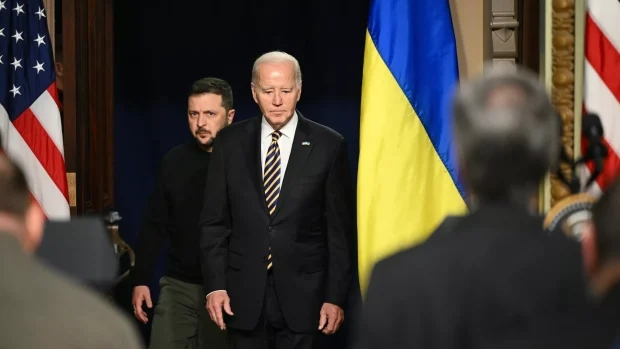
NATO has sought to turn Ukraine into a staging ground and has done everything it could to pit nation against nation, Russian President Vladimir Putin said.
“There have been five, now six, rounds of NATO expansion. They tried to turn Ukraine into their staging ground, to make it anti-Russia. To achieve these goals, they invested money, resources, bought politicians and entire parties, rewrote history and educational programs, nurtured and cultivated neo-Nazi and radical groups. They did everything to undermine our state ties, to divide and pit our peoples against each other,” Putin said at a meeting at Russia’s Foreign Ministry in Moscow.
He emphasized that the Ukrainian crisis is not a conflict between two nations but a result of the West’s aggressive policy.
“Let me say this right off the bat, the crisis regarding Ukraine is not a conflict between two states, much less two peoples, caused by some problems between them… The matter is different, though. The roots of the conflict are not in bilateral relations. The events unfolding in Ukraine are a direct consequence of global and European developments at the end of the 20th and beginning of the 21st century. It’s the West’s aggressive, unscrupulous, and absolutely reckless policy that has been pursued for all these years, long before the start of the special operation,” he explained.
Putin pointed out that if the conflict had been solely about disputes between Russia and Ukraine, then the mutual history, culture, spiritual values, and the millions of familial ties that both peoples share would have facilitated a fair resolution.
Russia had initially sought a peaceful resolution to the Ukrainian crisis, but all proposals put forth were ultimately rejected.
“We took the Minsk agreements seriously, hoping to resolve the situation through a peaceful process and international law,” he said. Moscow expected this would address the legitimate interests and demands of Donbass and secure the constitutional status of these regions, along with the fundamental rights of the people living there. However, he added, “But everything was ultimately rejected.”
Russia, in spite of seeking to resolve the Ukrainian crisis, was, nonetheless, deceived and misled.
“The ex-German Chancellor and former French President, essentially co-authors and, as it were, the guarantors of the Minsk agreements, later admitted that they never intended to fulfill them. They just needed to buy time to build up the Ukrainian armed forces, and to supply them with weapons and equipment. They simply deceived us once again,” Putin remarked.
Putin highlighted that that Russia did not start the war in Ukraine, rather, it was Kiev that launched military assaults against its own citizens who declared independence.
The Russian leader declared that those who assisted Ukraine in its punitive operation against Donbass are the aggressors.
“Russia did not initiate the conflict [with Ukraine]. That was the Kiev regime. After the residents from a part of Ukraine, in line with international law, had declared their independence, they [the Kiev regime] launched military operations and have kept them going ever since. This is an act of aggression, given that the right of these territories to declare independence has been recognized. Those who have supported the Kiev regime’s military machine all these years are accomplices of the aggressor,” he clarified.
Putin names conditions for Ukraine peace talks
RT | June 14, 2024
Ukraine must remove its troops from Russia’s new regions before any meaningful peace talks can begin, President Vladimir Putin has said.
Moscow rejects Kiev’s claims of sovereignty over five formerly Ukrainian regions, four of which have joined Russia amid the ongoing hostilities. People in the Donetsk and Lugansk People’s Republics and Kherson and Zaporozhye Regions voted for the transition in late 2022, though hostilities continue in all of them.
Ukrainian troops must be removed from these territories, Putin said on Friday at a meeting with Foreign Minister Sergey Lavrov and other senior Russian diplomats.
“I stress: the entire territory of those regions as defined by their administrative borders at the time they joined Ukraine [in August 1991],” Putin stated.
“Our side will order a ceasefire and start negotiations the minute Kiev declares that it is prepared to take this decision and starts actual withdrawal of troops from those regions, and also formally informs us that it no longer plans to join NATO,” the Russian leader pledged.
Putin outlined the conditions after condemning Kiev’s Western backers for allegedly preventing it from holding peace talks with Moscow while accusing Russia of rejecting negotiations.
“We are counting on Kiev to take such a decision on withdrawal, neutral status, and dialogue with Russia, on which the future existence of Ukraine depends, independently based on the current realities and guided by the true interests of the Ukrainian people and not at Western orders,” Putin stated.
At this point, Moscow will not accept a frozen conflict, which would allow the US and its allies to rearm and rebuild the Ukrainian military, Putin claimed. The full resolution of the issue will involve Kiev recognizing the four new regions as well as Crimea as part of Russia, he insisted.
“In the future, all those basic principled positions have to be enshrined in fundamental international agreements. Naturally, that includes the lifting of all Western sanctions against Russia,” Putin stated.
Accepting these terms will allow everyone involved to turn the page and gradually rebuild damaged relations, the president said. Eventually, a pan-European security system that works for all nations on the continent could be created, Putin added, noting that Moscow has sought this outcome for years.
The Russian president’s keynote remarks came ahead of a Swiss-hosted summit supposedly meant to further peace in Ukraine. Kiev has insisted that Moscow could not be invited to the event because it would try to “hijack” it by promoting alternatives to the “peace formula” pushed by the Ukrainian government.
Putin claimed that the event was meant to distract public opinion from the “true roots” of the conflict, and that Vladimir Zelensky has usurped power in Ukraine after his presidential term expired last month. Nothing but demagoguery and accusations against Russia can come out of the Swiss gathering, he predicted.
Russia and NATO are drifting towards a major war
By Ivan Timofeev | RT | June 14, 2024
Is it possible that NATO forces could become directly involved in the military conflict between Russia and Ukraine? Until recently, such a question seemed very hypothetical given the high risks of escalation of the military confrontation between the US-led bloc and Russia into a large-scale armed conflict. But this scenario should be taken seriously now.
The direct participation of individual NATO countries or the entire bloc in hostilities could gradually spiral out of control. Crossing red lines can lead to the belief that there will be no consequences for engaging in war. The result of such movements can manifest itself at an unexpected moment and lead to a much more dangerous situation than the current one.
Strictly speaking, NATO countries have long been involved in the conflict. This takes several forms.
First, Western countries provide Kiev with substantial financial and military assistance, including increasingly advanced and destructive weapons systems. As the stockpiles of Soviet-style kit in the arsenals of the USSR’s former allies in the Warsaw Treaty Organisation have been depleted, the Ukrainian army is receiving more Western systems and ammunition. So far, mass deliveries have been limited by the production capacity of the Western defence industry and size of existing stockpiles. But if hostilities are prolonged, industrial capacity has the potential to grow. Increasing supplies are also inevitable in the event of a peaceful pause, which would allow Ukraine to prepare for a new phase of hostilities. Russia can hardly hope that the West lacks the political will and resources to increase support for Kiev. Moscow appears to be preparing for the worst-case scenario, namely a steady increase in substantial and long-term military assistance to Ukraine. In addition to the supply of arms and ammunition, this aid includes the training of personnel, help with the development of military industry and infrastructure, and the reimbursement of expenses in other areas that allow Ukraine to focus its resources on the defence sector.
Second, Ukraine receives extensive Western support in the form of intelligence, including technical data from satellites, radars, reconnaissance aircraft, etc. The information received enables a wide range of operations, from scoping the theatre of operations to the identification of specific targets. Data providers can be selective in granting the Ukrainian side access. But its use in military operations against Russia is not in doubt.
Third, military specialists who are citizens of NATO countries are involved in combat operations. Their role does not always appear to be official. They may be ‘volunteers’ or simply mercenaries, whose participation the authorities of their countries turn a blind eye to. Russian estimates put their number at around 2,000 in October 2023. Whether that is accurate or not, it’s clear that foreigners are fighting on Ukraine’s side, that their participation is systematic rather than accidental, and that at least some of them are citizens of Western countries.
Their involvement has not yet created an excessive risk of direct military confrontation between Russia and NATO. For Kiev’s Western partners, the sluggish pace of the conflict allows them to gradually improve the quality of their support for Ukraine. Cruise missile deliveries have long been commonplace. The arrival of US fighter jets is only a matter of time. The Russian army is “grinding down” the Western equipment that arrives. But foreign supplies to Ukraine also require a concentration of resources on the Russian side.
A significant escalation factor that would amplify the risk of a direct clash between Russia and NATO, could be the appearance of military contingents form bloc members on the territory of Ukraine. The prospect of such a scenario has already been mentioned by some Western politicians, although their view has not been supported by the US and isn’t an official NATO position. A number of the bloc’s leaders have distanced themselves from supporting the idea of sending troops to Ukraine.
What might trigger such a decision and how might it be implemented? The most likely factor for direct intervention by individual states or NATO as a whole would be a possible major military success by the Russian army. So far, the front has remained relatively stable. But the Moscow’s military has already achieved significant local victories, increased pressure, seized the initiative, extended the offensive front and possibly built up reserves for more decisive action.
There are no signs of a repeat of last year’s Ukrainian counteroffensive. Kiev is reportedly short of ammunition, although this shortfall could be filled in the future by external supplies. Periodic attacks on Russian territory with cruise missiles, drones and artillery cause damage and casualties, but do not disrupt the stability of the front.
Moreover, such strikes embolden Russia’s determination to create buffer zones, i.e. territories from which Kiev will not be able to attack targets in Russian regions.
A possible collapse of certain sections of the Ukrainian front and significant territorial advances of Russian forces towards the west is becoming more and more realistic scenario.
The fact that no deep advances and breakthroughs have occured for some time does not mean that there is no possibility in the future. On the contrary, the probability is increasing due to the army’s experience in combat, the supply of the military-industrial complex to the front, losses on the Ukrainian side, delays in the delivery of Western equipment, and so on.
The Russian army’s ability to make such advances and breakthroughs is also increasing. A catastrophic scenario for individual Ukrainian groups is not predetermined, but it is probable. A major breakthrough of the Russian army towards Kharkov, Odessa or another major city could become a serious trigger for NATO countries to introduce the question of intervention in the conflict into practical terms. Several such breakthroughs, simultaneous or successive, will inevitably raise the issue.
Here, individual countries and the bloc as a whole face a strategic fork in the road. The first option is not to intervene and to support Ukraine only with military equipment, money and ‘volunteers’. Perhaps to admit defeat and try to minimise the damage through negotiations, thereby preventing an even greater catastrophe. The second option is to radically change the approach to involvement in the conflict and allow direct intervention.
Intervention can take a number of forms. It may involve the use of infrastructure, including airfields of NATO countries. It could mean the mass deployment of certain communications and engineering units and air defence systems, while avoiding their presence on the front line. An even more radical scenario is the deployment of a contingent of certain NATO countries on the border between Ukraine and Belarus. Finally, an even more radical option is the deployment of military contingents from NATO countries on the front line, which would probably be categorically unacceptable to the bloc.
Each of these scenarios involves a direct clash between Russian and NATO forces. Such a situation would inevitably raise the question of deeper bloc involvement and, in the longer term, the transfer of military conflict to other areas of contact with Russia, including the Baltic region. At this stage, it will be even more difficult to stop the escalation. The more losses both sides suffer, the more the maelstrom of hostilities will grow and the closer they will come to the threshold of using nuclear weapons. And there will be no winners.
These are all hypothetical options. But they need to be considered now. After all, not so long ago such significant military deliveries to Ukraine seemed unlikely to anyone, as much as the conflict itself, three years ago. Now it is an everyday reality. The dangers of movement towards a major war between Russia and NATO should be taken seriously.
Ivan Timofeev is the programme director of the Valdai Club.
Vucic: All signs point to a major war
The President of the Republic of Serbia, Aleksandar Vucic, interviewed by the Swiss weekly magazine Weltwoche – June 11, 2024
The rhetoric is getting worse by the day and reminds me of the phrase of a famous historian: ”The train has left the station and no one can stop it.”
If the Great Powers don’t do something soon, yeah, I’m pretty sure we’re going to be in for a real disaster.
If you bet that someone is bluffing, it means that you don’t have better hands. You just think that the other person has weaker cards. You are not sure about it because you do not know and have not seen its leaves. I am always very cautious and cautious when assessing Putin’s wishes or potential future move.
What further complicates the situation is that everyone is only talking about war. No one seeks peace. Nobody is talking about peace. Peace is almost a forbidden word!
It is very strange to me that no one is trying to stop the war. There is a different theory – which I can understand.
I’m not saying I approve – that the West thinks they can easily defeat Putin, they want to exhaust him in Ukraine and then they will enter the space and Russia with its current territory will no longer exist and Putin will be overthrown etc. Maybe to be possible, but….
Why do I say that we walk beside the brink of the abyss? Analyze the situation of NATO and the USA. They cannot afford to lose the Ukraine war.
Second, the position of Europe and the collective West in geopolitical terms will deteriorate so much that no one will be able to regenerate and renew it.
Third, this will open a Pandora’s box for more movements and hostilities against the collective West in the future. But take the other side. If Putin loses the war, he will (first) personally lose everything. (Second) He will not have the reputation of someone who created a common denominator for Ivan, Peter the Great and Catherine the Great.
And thirdly, Russia will not exist nor will it have its present form. And then when you have these two sides so far apart in terms of their wants and their expectations, then you see that everything is at stake!
Everything. No one can afford to lose. When you have this situation, we are probably approaching a real disaster. And then we come to another question. Who is ready to lose 1 million, 2 million, 5 and 10 million people? Ask yourself. I am not ready to lose a single person. And we will not participate in it. But that is a question for others.
I can’t say World War III, but I don’t think we’re far from that big conflict! No more than 3-4 months! And there is a risk that it will happen even sooner.
In Europe, the leaders act like big heroes, but they are not honest and they don’t tell their citizens that they will all pay a big price if it comes to war.
The world is changing even though we don’t want to accept and admit it, but it is indeed changing on a daily basis and much faster than ever before. And when you have these kinds of conflicting interests, then you come close to big conflicts and big wars. And I don’t see how anyone can stop it.
I’d like to see it more than anything to be honest. Today I was checking the data regarding our stocks of oil, flour, sugar, salt and everything because I don’t know what tomorrow will bring for all of us.
The G7 loses ground to BRICS
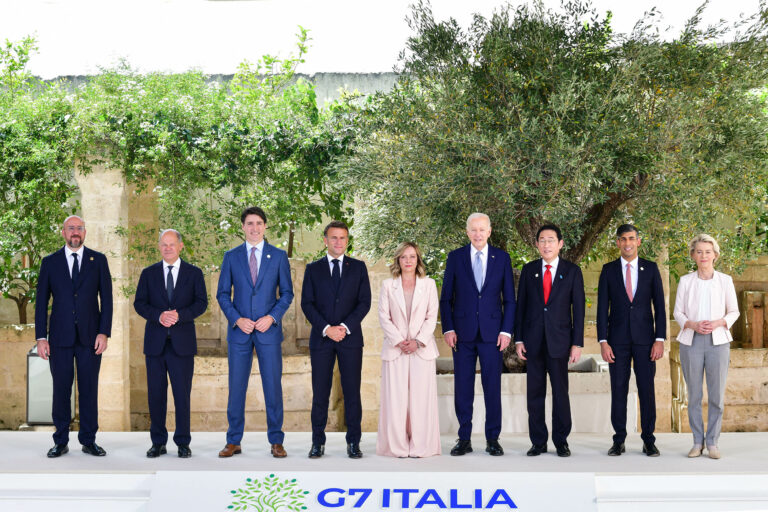
Losers
BY M. K. BHADRAKUMAR | INDIAN PUNCHLINE | JUNE 13, 2024
One hidden transformation of the international system in the most recent years has been the hijacking of the G7 by Washington as its ‘kitchen cabinet’ in the transatlantic system. The G8’s ‘shrinkage’ to G7 in March 2014 following the coup in Ukraine was a defining moment that signalled that there wasn’t going to be any post-cold war peace dividend. The G7 that was conceived as a group of countries charioting the world economy ended up as the vehicle of big-power rivalry to preserve the US’ global hegemony. Isolating Russia — and lately, China, too — became its leitmotif.
With the failure of the western project to isolate Russia, the G7 is meandering and lost its sense of direction. Italy, the G7 summit’s rotating host this year, has made AI a key issue in the summit. And Prime Minister Giorgia Meloni invited by an unlikely guest, the pontiff, to make an unprecedented appearance at the G7 event at the fashionable Italian hotel Borgo Enyatia to advocate for the regulation of artificial intelligence, a technology he’s called potentially harmful. Pope Francis was a chemist prior to entering seminary and will apparently draw on his scientific training to inform his stances. Italy under Meloni’s leadership has increasingly scrutinised AI technology, and temporarily banned ChatGPT in March 2023, becoming the first western country to do so.
Equally, G7 is desperate to go beyond a closed elite club of Western democracies by piloting an ambitious outreach and issued an unusually long list of invited leaders of the non-Western world to the summit. Aside Ukraine, Meloni has invited the leaders of India, Brazil, South Africa, Turkey, Saudi Arabia, Argentina, Algeria, Kenya and Mauritania to attend the meeting. What was the logic applied is impossible to tell.
But this is realpolitik and G7 is hoping to bridge the ‘West vs. the Rest’ hiatus in the line-up over the Ukraine crisis. In fact, the ‘outreach guests’ will witness tomorrow the nail-biting finale of a geopolitical drama, which forms the core of the G7 summit — the months-long attempt by the group’s leaders to make a decision on using dividends from frozen Russian assets for Ukraine’s military needs.
To recap, as part of the West’s ‘sanctions from hell’ against Russia in 2022, the European Union, Canada, the US and Japan froze Moscow’s assets in the western banks to the tune of $ 300 billion. (Some say, the actual figure is closer to $400 billion.) Only about $5-6 billion is located in the US, while $210 billion is stored in Europe, but the decision to use the proceeds from Russian assets was initiated by Washington with a hidden agenda to make Europe pay for the war’s consequences.
Unsurprisingly, the European members and Japan opposed the US pressure to include a provision on the use of income from frozen Russian assets in the joint G7 statement to be adopted. CNN reported on Monday that American officials are still trying to agree on the “most sensitive financial details” of the plan for Russian assets, since the G7 countries are yet to come to a consensus and discussions are continuing as regards “the exact form of providing assistance, as well as guarantees for the return of these funds.”
That said, don’t be surprised if the recalcitrant Europeans ultimately fall in line. There is no question that the G7 move to appropriate Russian money in western banks was bad enough but to use the profits out of them to fund the needs of Ukraine is, to put it mildly, an act of brigandage.
The US gains if the current freeze in Russia-Europe ties reaches a point of no return, as Europe is sure to bear the brunt of Moscow’s retaliation. If the G7 adopts such a move, it will weaken the global financial system. By brazenly violating international law, the G7 will be setting a precedent that undermines confidence in European institutions.
It will be interesting to see how the G7 leaders explain to the ‘outreach’ countries, drawn largely out of BRICS, that Russia is an exception and such a practice will not one day be used against India, Turkey, Saudi Arabia or some other state.
To be sure, the spectre of the 16th summit meeting of BRICS at Kazan (16-18 October) under the chairmanship of Russian President Vladimir Putin haunts the G7. Moscow has let it be known that if the past three years ended with the expansion of the BRICS, the new phase going forward will ensure that the participants in an expanded format create a viable structure in which the member countries work purposively to develop a viable structure.
An important topic at the BRICS summit meeting in Kazan will be the creation of a single currency within the grouping, which will significantly simplify and expand the economic relations of the member countries against the backdrop of mounting pressure from the West.
Speaking at the SPIEF conference in St. Petersburg last week, Putin announced that such an independent payment system would be created. Foreign Minister Sergey Lavrov later confirmed that a platform for payments in national currencies is being developed.
The BRICS countries have realised that the creation of a single currency has become a necessity today due to the ongoing sanctions from the US and the European Union. Lavrov noted that “recent international events have thrown off the masks” of the West, which has tried to impose its own values on other countries under the guise of universal ones and replace equal dialogue with “narrow coalitions” that assign the right to speak on behalf of the whole world.
BRICS, Lavrov underscored, implies a completely opposite type of partnership — that is, anything but a bloc structure, and on the contrary, a fundamentally open format, which involves working only in those areas that are of mutual interest to all participants, big and small. Reports suggest that around 30 countries have sought BRICS membership.
Meanwhile, in ‘systemic’ terms, G7 is entering uncharted waters. Far-right parties are storming the power centres of Europe. With an eye on the G7 summit, Politico wrote:
“Dream on. The G7 summit in the southern Italian coastal resort of Borgo Egnazia features arguably the weakest gathering of leaders the group has mustered for years. Most of the attendees are distracted by elections or domestic crises, disillusioned by years in office, or clinging desperately to power.
“France’s Emmanuel Macron and Britain’s Rishi Sunak are both fighting snap election campaigns they called in last-ditch efforts to reverse their flagging fortunes.
“Germany’s Olaf Scholz was humiliated by far-right nationalists in last weekend’s EU Parliament election and could soon be toppled himself.
“Justin Trudeau, prime minister for nine years in Canada, has spoken openly about quitting his “crazy” job.
“Japan’s Fumio Kishida is enduring his lowest personal ratings ahead of a leadership contest later this year.
“And then there’s Joe Biden.
“The 81-year-old U.S. president’s son, Hunter, was found guilty of gun charges on Tuesday, barely two weeks before his father’s first crucial debate with a resurgent Donald Trump in a presidential campaign the Democrat is in serious danger of losing.”
Above all, the angst in the European mind is palpable that if Trump wins in a democracy-altering climax in the November election, he may not even have time or patience to tolerate an archaic forum like G7. Surveying the bleak landscape, it comes as no surprise that Meloni took matters in her hands and decided to use the summit to her purposes by designing an agenda that cleaved to Italy’s strategic interests — Africa, migration and the Mediterranean.
Behind the Myth of “Billions in Arms” Flowing into Ukraine
By Brian Berletic – New Eastern Outlook – 13.06.2024
In a June 8, 2024, Bloomberg article titled, “Putin Is Running Out of Time to Achieve Breakthrough in Ukraine,” an optimistic prognosis was made regarding the ongoing conflict in Ukraine in favor of Kiev.
The article claims that Russia has made “limited progress” along the line of contact, including along the newly-opened front in Kharkov and that as “billions in arms start flowing” into Ukraine, Ukrainian forces will be given the opportunity to “counter-attack.”
The “billions in arms” Bloomberg cites refers to the renewed flow of US military assistance after months of delays in passing funding in the US Congress. However, recalling the flagging impact of US arms transfers to Ukraine even before the funding delays, and a closer look at the actual quantities associated with these packages versus Russian military production, tells an entirely different story.
Bloomberg claims that the renewed flow of US arms is eroding Russia’s military advantage. However, this is simply not true.
Artillery Shells
The most recent US arms package featured, among other items, badly needed 155mm artillery shells and anti-tank weapons including the vaunted Javelin missile. Missing from the Pentagon’s public press release, were the quantities these weapons and munitions were being sent in.
It is well-known that US and European artillery shell production falls short of Russia’s by several times. A May 2024 Business Insider article puts the number of Russian shells produced this year at 4.5 million, while the US and Europe combined amount to only 1.3 million.
The prospect of Western shell production drastically increasing to match or even exceed Russian production numbers is unrealistic, according to a June 7, 2024 Bloomberg article titled, “America’s War Machine Can’t Make Basic Artillery Fast Enough.”
In the Bloomberg piece, various factors are mentioned ranging from limited material inputs, a lack of trained human resources, the need to vastly expand the physical production sites producing both the shells themselves and their various individual components, as well as the need to consistently procure funding to expand each of these factors. All of this takes time.
The article claims that by 2025, the US should be producing up to 68,000 155mm artillery shells a month. Even if Europe was able to match these production numbers, it would represent only two-thirds of Ukraine’s monthly requirements to achieve its 6,000 round daily rate of fire, which still falls far short of Russia’s daily rate of fire, placing Ukraine at a disadvantage.
Artillery shell production is relatively straightforward compared to more advanced weapons Ukraine also desperately requires. This includes anti-armor weapons like the Javelin missile.
Javelin Anti-Tank Missiles
Once hailed as a “game changer” by the collective Western media, the Javelin is now rarely mentioned either in headlines or even buried deep within articles. The missiles were passed over to Ukraine by the thousands during the initial phases of the Russian Special Military Operation (SMO), up to 7,000 or about one-third of the US’ total inventory according to the US government and arms industry-funded Center for Strategic and International Studies (CSIS) in late 2022.
Since then, Lockheed Martin, which produces the Javelin missile, claims to have expanded production by up to 15% in a 2024 release, producing up to 2,400 missiles per year or about 200 per month.
2,400 missiles are not being sent entirely to Ukraine each year. The missiles and less numerous command launch units (CLU) that fire them are required by the US, other NATO members, and other Lockheed customers around the globe. But let’s assume for a moment all 2,400 missiles are sent to Ukraine each year, and because US stockpiles are at critical levels, let’s assume Ukraine is sent Javelins drawn from this monthly production.
Does this mean that each month, 200 Russian tanks will be damaged or destroyed, adding up to 2,400 a year? No. According to the US Army’s own studies, even trained US soldiers have a 19% hit rate while utilizing Javelin, TOW, and AT-4 systems, all of which the US has sent to Ukraine throughout the SMO.
This means that even if Ukraine was receiving 200 missiles a month and firing them at Russian armored vehicles, they would be scoring only about 38 hits a month. Out of those 38 hits, fewer still would result in significant damage or complete destruction.
Comparing these overly optimistic numbers with Russian tank and other armored vehicle production puts this into better context.
According to a March 2024 CNN article discussing Russian military production, it admits Russia is producing up to 125 tanks a month. Other Western sources claim Russia also produces up to 250 other armored vehicles per month, for a total of 375 armored vehicles a month.
Compare that with the 38 hits Ukraine would be able to inflict even if the US sent every single Javelin produced straight to Ukraine each month. Russia is producing far more armored vehicles than the US is producing Javelin missiles to destroy them. The story is the same for other anti-armor weapon systems produced across the West (e.g. 1,000 TOW missiles produced per year), all of which face depleted stockpiles and low monthly production rates.
Considering that the number of Javelin missiles and other ordnance sent to Ukraine will be far less in reality than total monthly production, we begin to see the true measure of US (and European) military assistance and how the “billions in arms” now flowing to Ukraine do not represent a significant change in Ukraine’s ability to slow, let alone stop Russian forces as they continue mounting pressure not only along the existing front, but opening entirely new fronts, creating a wider strategic dilemma for Ukraine, stretching an already insufficient amount of manpower, equipment, and ammunition even further.
Empty Rhetoric
Despite Bloomberg discounting its “Putin is Running Out of Time” article with its “America’s War Machine Can’t Make Basic Artillery Fast Enough” article, it and other Western publications’ attempts to convince audiences that the tide is about to shift in Ukraine’s favor is a repeat of this same empty rhetoric used to sell Ukraine’s 2023 “counteroffensive” as poised to shift the conflict.
In reality, the 2023 Ukrainian military operation was soundly defeated by Russian forces who not only decimated Ukraine’s manpower, equipment, and ammunition stocks, but managed to bolster its own numbers and capabilities in the process.
Ukrainian attempts to claw back territory it has recently lost in Kharkov will lead to the same fruitless conclusion its 2022 and 2023 offensives did, a questionable chance of actually taking the territory for a guaranteed severe cost in irreplaceable trained manpower and equipment.
Today’s headlines across the West portending the tide changing in the fighting across Ukraine represent a now familiar cycle of encouraging Ukraine to fight on in what is otherwise an unwinnable conflict inflicting an immense and indelible cost on Ukraine in terms of territory, human lives, and economic prospects well into the future.
But as has been pointed out many times before, feeding Ukraine into an unwinnable proxy war had been a US objective articulated as early as 2019 in RAND Corporation’s paper, “Extending Russia,” which stated:
Expanding U.S. assistance to Ukraine, including lethal military assistance, would likely increase the costs to Russia, in both blood and treasure, of holding the Donbass region. More Russian aid to the separatists and an additional Russian troop presence would likely be required, leading to larger expenditures, equipment losses, and Russian casualties. The latter could become quite controversial at home, as it did when the Soviets invaded Afghanistan.
But warned:
However, such a move might also come at a significant cost to Ukraine and to U.S. prestige and credibility. This could produce disproportionately large Ukrainian casualties, territorial losses, and refugee flows. It might even lead Ukraine into a disadvantageous peace.
Obviously, even in 2019, US policymakers realized Ukraine would not win a US-sponsored proxy war against Russia. The actual objective was to raise the cost of Russian victory high enough to undermine Russia’s economy, divide Russian society, and perhaps even eventually precipitate a Soviet Union-style collapse. While RAND’s predictions of Ukraine’s destruction amid such a proxy war have clearly come to pass, the supposed “benefits” of this policy have yet to avail themselves and do not appear even plausible at this juncture.
Thus, Western rhetoric about Ukraine’s soon-to-be good fortune is not based on genuine analysis of the ongoing conflict, but is instead a point of propaganda aimed at encouraging Ukraine to fight on despite all actual analysis warning of the disaster awaiting in doing so.
Only time will tell just how far this process plays out to where the US and its partners are no longer pushing Ukraine onto the battlefield and are instead taking to the negotiation table. In the meantime, the “billions in arms” flowing into Ukraine will continue to have the same impact they’ve had all along, ensuring “disproportionately large Ukrainian casualties, territorial losses, and refugee flows,” ultimately leading Ukraine “into a disadvantageous peace.”
Featured Video

Racist Seinfeld Dances for Joy as Bibi Unveils His New Map
or go to
Aletho News Archives – Video-Images
TV Drama Review
Japanese drama projects Japan’s wartime atrocities onto Chinese characters

Global Times | October 25, 2026
By portraying Chinese characters as perpetrators of ruthless violence while casting Japanese Self-Defense Forces (SDF) intelligence operatives as defenders, the season 2 of the Japanese drama Vivant has recently drawn criticism from Chinese netizens, who argue that its depiction turns historical reality on its head while ignoring Japan’s wartime atrocities.
The TBS drama series – a spy suspense story in which an alleged unofficial intelligence unit of the SDF operates across the globe — has attracted a passionate fanbase. Its currently airing season 2 opened with a household rating of 18.8 percent, the highest for a TV drama this year, according toa commentary article by Japanese media Toyo Keizai.
What draws attention is the portrayal of the enemies in the series, the article noted. Scenes in which the Chinese organization subjects kidnapped members of the SDF unit to brutal torture are repeated with unrelenting intensity.
It is rare for Japanese TV dramas to explicitly portray a real-life country as the enemy, the article noted.
Japanese Prime Minister Sanae Takaichi also made a reference to the drama, saying that she has been recording Vivant and hopes to binge-watch it over the year-end and New Year holidays, according to Japanese media outlets.
China’s CCTV News report on Sunday revealed that the drama features scenes in which Chinese personnel cut off the fingers of and stab Japanese intelligence operatives in the abdomen. Such acts bear striking similarities to the torture inflicted on Chinese nationals by invading Japanese troops during the World War II.
The drama distorts the truth by attributing these atrocities to modern Chinese characters. Beneath the surface, it subtly glorifies Japan’s cross-border overseas operations, blurs the functional boundaries of the SDF and implicitly promotes an expansionist narrative, per CCTV News. … continue
Blog Roll
 Aletho News
- Iran FM Araghchi: “Hormuz Will No Longer Be the Same”
- EU facing trillion-euro debt hole while seeking more cash for Kiev
- How US, Europe, Persian Gulf states exhausted missile stockpiles, splurged billions to defend Israel
- Up in arms… Koreans reject U.S. empire’s plan to make South Korea the next Ukraine
- Iran, Turkey, Pakistan, Saudi Arabia could advance region-led security framework in Tehran: FM spox
- Netizens condemn Japanese drama for projecting Japan’s wartime atrocities onto Chinese characters
- Racist Seinfeld Dances for Joy as Bibi Unveils His New Map
- A West Bank War for Netanyahu’s Election Campaign, Could It Backfire?
- Yemen denounces European Parliament’s ‘hypocritical’ push to blacklist Ansarullah
- Qalibaf: UAE’s UN bid aims to ‘clear the runway’ for ‘Greater Israel’, whitewash genocide
- If Americans Knew
- An error has occurred; the feed is probably down. Try again later.
- No Tricks Zone
- Sudden Stratospheric Warming, Powerful El Niño Combination May Lead To Extreme Europe Cold, Energy Crisis!
- Two New Studies Find Thwaites Glacier Melt Cannot Be Driven By Human Activity Or A Warming Ocean
- E-Cars Reduce CO2 Emissions By Only 41% Compared To Internal Combustion Engine Vehicles
- Predictions Made By Renowned Climate Professor Over Past Decades Have Been Proven To Be Poor
- New Study Suggests Large Regions Of The Pacific Ocean Have Been Cooling For The Last 80 Years
- Germany’s Green Energy Debacle: High Energy Costs Force Kahla Porzellan to Close After 182 Years!
- New Study: 50 Years Of The Most Aggressive ‘Net Zero’ Policies Can Only Affect The Global Climate By 0.03°C
- US September “Heat” Was No Record…Many Records Set Decades Ago
- Latest European Green Energy Debacle; Portugal’s Largest Flagship Solar Park Insolvent!
- Green Energy Debacle: German Expert Professor Fritz Vahrenholt Warns Of Severe Economic And Social Consequences

