Putin names conditions for Ukraine peace talks
RT | June 14, 2024
Ukraine must remove its troops from Russia’s new regions before any meaningful peace talks can begin, President Vladimir Putin has said.
Moscow rejects Kiev’s claims of sovereignty over five formerly Ukrainian regions, four of which have joined Russia amid the ongoing hostilities. People in the Donetsk and Lugansk People’s Republics and Kherson and Zaporozhye Regions voted for the transition in late 2022, though hostilities continue in all of them.
Ukrainian troops must be removed from these territories, Putin said on Friday at a meeting with Foreign Minister Sergey Lavrov and other senior Russian diplomats.
“I stress: the entire territory of those regions as defined by their administrative borders at the time they joined Ukraine [in August 1991],” Putin stated.
“Our side will order a ceasefire and start negotiations the minute Kiev declares that it is prepared to take this decision and starts actual withdrawal of troops from those regions, and also formally informs us that it no longer plans to join NATO,” the Russian leader pledged.
Putin outlined the conditions after condemning Kiev’s Western backers for allegedly preventing it from holding peace talks with Moscow while accusing Russia of rejecting negotiations.
“We are counting on Kiev to take such a decision on withdrawal, neutral status, and dialogue with Russia, on which the future existence of Ukraine depends, independently based on the current realities and guided by the true interests of the Ukrainian people and not at Western orders,” Putin stated.
At this point, Moscow will not accept a frozen conflict, which would allow the US and its allies to rearm and rebuild the Ukrainian military, Putin claimed. The full resolution of the issue will involve Kiev recognizing the four new regions as well as Crimea as part of Russia, he insisted.
“In the future, all those basic principled positions have to be enshrined in fundamental international agreements. Naturally, that includes the lifting of all Western sanctions against Russia,” Putin stated.
Accepting these terms will allow everyone involved to turn the page and gradually rebuild damaged relations, the president said. Eventually, a pan-European security system that works for all nations on the continent could be created, Putin added, noting that Moscow has sought this outcome for years.
The Russian president’s keynote remarks came ahead of a Swiss-hosted summit supposedly meant to further peace in Ukraine. Kiev has insisted that Moscow could not be invited to the event because it would try to “hijack” it by promoting alternatives to the “peace formula” pushed by the Ukrainian government.
Putin claimed that the event was meant to distract public opinion from the “true roots” of the conflict, and that Vladimir Zelensky has usurped power in Ukraine after his presidential term expired last month. Nothing but demagoguery and accusations against Russia can come out of the Swiss gathering, he predicted.
Russia and NATO are drifting towards a major war
By Ivan Timofeev | RT | June 14, 2024
Is it possible that NATO forces could become directly involved in the military conflict between Russia and Ukraine? Until recently, such a question seemed very hypothetical given the high risks of escalation of the military confrontation between the US-led bloc and Russia into a large-scale armed conflict. But this scenario should be taken seriously now.
The direct participation of individual NATO countries or the entire bloc in hostilities could gradually spiral out of control. Crossing red lines can lead to the belief that there will be no consequences for engaging in war. The result of such movements can manifest itself at an unexpected moment and lead to a much more dangerous situation than the current one.
Strictly speaking, NATO countries have long been involved in the conflict. This takes several forms.
First, Western countries provide Kiev with substantial financial and military assistance, including increasingly advanced and destructive weapons systems. As the stockpiles of Soviet-style kit in the arsenals of the USSR’s former allies in the Warsaw Treaty Organisation have been depleted, the Ukrainian army is receiving more Western systems and ammunition. So far, mass deliveries have been limited by the production capacity of the Western defence industry and size of existing stockpiles. But if hostilities are prolonged, industrial capacity has the potential to grow. Increasing supplies are also inevitable in the event of a peaceful pause, which would allow Ukraine to prepare for a new phase of hostilities. Russia can hardly hope that the West lacks the political will and resources to increase support for Kiev. Moscow appears to be preparing for the worst-case scenario, namely a steady increase in substantial and long-term military assistance to Ukraine. In addition to the supply of arms and ammunition, this aid includes the training of personnel, help with the development of military industry and infrastructure, and the reimbursement of expenses in other areas that allow Ukraine to focus its resources on the defence sector.
Second, Ukraine receives extensive Western support in the form of intelligence, including technical data from satellites, radars, reconnaissance aircraft, etc. The information received enables a wide range of operations, from scoping the theatre of operations to the identification of specific targets. Data providers can be selective in granting the Ukrainian side access. But its use in military operations against Russia is not in doubt.
Third, military specialists who are citizens of NATO countries are involved in combat operations. Their role does not always appear to be official. They may be ‘volunteers’ or simply mercenaries, whose participation the authorities of their countries turn a blind eye to. Russian estimates put their number at around 2,000 in October 2023. Whether that is accurate or not, it’s clear that foreigners are fighting on Ukraine’s side, that their participation is systematic rather than accidental, and that at least some of them are citizens of Western countries.
Their involvement has not yet created an excessive risk of direct military confrontation between Russia and NATO. For Kiev’s Western partners, the sluggish pace of the conflict allows them to gradually improve the quality of their support for Ukraine. Cruise missile deliveries have long been commonplace. The arrival of US fighter jets is only a matter of time. The Russian army is “grinding down” the Western equipment that arrives. But foreign supplies to Ukraine also require a concentration of resources on the Russian side.
A significant escalation factor that would amplify the risk of a direct clash between Russia and NATO, could be the appearance of military contingents form bloc members on the territory of Ukraine. The prospect of such a scenario has already been mentioned by some Western politicians, although their view has not been supported by the US and isn’t an official NATO position. A number of the bloc’s leaders have distanced themselves from supporting the idea of sending troops to Ukraine.
What might trigger such a decision and how might it be implemented? The most likely factor for direct intervention by individual states or NATO as a whole would be a possible major military success by the Russian army. So far, the front has remained relatively stable. But the Moscow’s military has already achieved significant local victories, increased pressure, seized the initiative, extended the offensive front and possibly built up reserves for more decisive action.
There are no signs of a repeat of last year’s Ukrainian counteroffensive. Kiev is reportedly short of ammunition, although this shortfall could be filled in the future by external supplies. Periodic attacks on Russian territory with cruise missiles, drones and artillery cause damage and casualties, but do not disrupt the stability of the front.
Moreover, such strikes embolden Russia’s determination to create buffer zones, i.e. territories from which Kiev will not be able to attack targets in Russian regions.
A possible collapse of certain sections of the Ukrainian front and significant territorial advances of Russian forces towards the west is becoming more and more realistic scenario.
The fact that no deep advances and breakthroughs have occured for some time does not mean that there is no possibility in the future. On the contrary, the probability is increasing due to the army’s experience in combat, the supply of the military-industrial complex to the front, losses on the Ukrainian side, delays in the delivery of Western equipment, and so on.
The Russian army’s ability to make such advances and breakthroughs is also increasing. A catastrophic scenario for individual Ukrainian groups is not predetermined, but it is probable. A major breakthrough of the Russian army towards Kharkov, Odessa or another major city could become a serious trigger for NATO countries to introduce the question of intervention in the conflict into practical terms. Several such breakthroughs, simultaneous or successive, will inevitably raise the issue.
Here, individual countries and the bloc as a whole face a strategic fork in the road. The first option is not to intervene and to support Ukraine only with military equipment, money and ‘volunteers’. Perhaps to admit defeat and try to minimise the damage through negotiations, thereby preventing an even greater catastrophe. The second option is to radically change the approach to involvement in the conflict and allow direct intervention.
Intervention can take a number of forms. It may involve the use of infrastructure, including airfields of NATO countries. It could mean the mass deployment of certain communications and engineering units and air defence systems, while avoiding their presence on the front line. An even more radical scenario is the deployment of a contingent of certain NATO countries on the border between Ukraine and Belarus. Finally, an even more radical option is the deployment of military contingents from NATO countries on the front line, which would probably be categorically unacceptable to the bloc.
Each of these scenarios involves a direct clash between Russian and NATO forces. Such a situation would inevitably raise the question of deeper bloc involvement and, in the longer term, the transfer of military conflict to other areas of contact with Russia, including the Baltic region. At this stage, it will be even more difficult to stop the escalation. The more losses both sides suffer, the more the maelstrom of hostilities will grow and the closer they will come to the threshold of using nuclear weapons. And there will be no winners.
These are all hypothetical options. But they need to be considered now. After all, not so long ago such significant military deliveries to Ukraine seemed unlikely to anyone, as much as the conflict itself, three years ago. Now it is an everyday reality. The dangers of movement towards a major war between Russia and NATO should be taken seriously.
Ivan Timofeev is the programme director of the Valdai Club.
Vucic: All signs point to a major war
The President of the Republic of Serbia, Aleksandar Vucic, interviewed by the Swiss weekly magazine Weltwoche – June 11, 2024
The rhetoric is getting worse by the day and reminds me of the phrase of a famous historian: ”The train has left the station and no one can stop it.”
If the Great Powers don’t do something soon, yeah, I’m pretty sure we’re going to be in for a real disaster.
If you bet that someone is bluffing, it means that you don’t have better hands. You just think that the other person has weaker cards. You are not sure about it because you do not know and have not seen its leaves. I am always very cautious and cautious when assessing Putin’s wishes or potential future move.
What further complicates the situation is that everyone is only talking about war. No one seeks peace. Nobody is talking about peace. Peace is almost a forbidden word!
It is very strange to me that no one is trying to stop the war. There is a different theory – which I can understand.
I’m not saying I approve – that the West thinks they can easily defeat Putin, they want to exhaust him in Ukraine and then they will enter the space and Russia with its current territory will no longer exist and Putin will be overthrown etc. Maybe to be possible, but….
Why do I say that we walk beside the brink of the abyss? Analyze the situation of NATO and the USA. They cannot afford to lose the Ukraine war.
Second, the position of Europe and the collective West in geopolitical terms will deteriorate so much that no one will be able to regenerate and renew it.
Third, this will open a Pandora’s box for more movements and hostilities against the collective West in the future. But take the other side. If Putin loses the war, he will (first) personally lose everything. (Second) He will not have the reputation of someone who created a common denominator for Ivan, Peter the Great and Catherine the Great.
And thirdly, Russia will not exist nor will it have its present form. And then when you have these two sides so far apart in terms of their wants and their expectations, then you see that everything is at stake!
Everything. No one can afford to lose. When you have this situation, we are probably approaching a real disaster. And then we come to another question. Who is ready to lose 1 million, 2 million, 5 and 10 million people? Ask yourself. I am not ready to lose a single person. And we will not participate in it. But that is a question for others.
I can’t say World War III, but I don’t think we’re far from that big conflict! No more than 3-4 months! And there is a risk that it will happen even sooner.
In Europe, the leaders act like big heroes, but they are not honest and they don’t tell their citizens that they will all pay a big price if it comes to war.
The world is changing even though we don’t want to accept and admit it, but it is indeed changing on a daily basis and much faster than ever before. And when you have these kinds of conflicting interests, then you come close to big conflicts and big wars. And I don’t see how anyone can stop it.
I’d like to see it more than anything to be honest. Today I was checking the data regarding our stocks of oil, flour, sugar, salt and everything because I don’t know what tomorrow will bring for all of us.
The G7 loses ground to BRICS
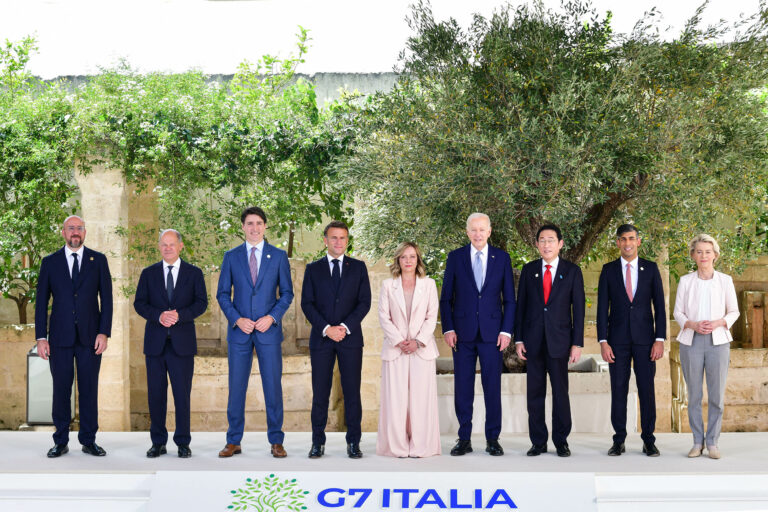
Losers
BY M. K. BHADRAKUMAR | INDIAN PUNCHLINE | JUNE 13, 2024
One hidden transformation of the international system in the most recent years has been the hijacking of the G7 by Washington as its ‘kitchen cabinet’ in the transatlantic system. The G8’s ‘shrinkage’ to G7 in March 2014 following the coup in Ukraine was a defining moment that signalled that there wasn’t going to be any post-cold war peace dividend. The G7 that was conceived as a group of countries charioting the world economy ended up as the vehicle of big-power rivalry to preserve the US’ global hegemony. Isolating Russia — and lately, China, too — became its leitmotif.
With the failure of the western project to isolate Russia, the G7 is meandering and lost its sense of direction. Italy, the G7 summit’s rotating host this year, has made AI a key issue in the summit. And Prime Minister Giorgia Meloni invited by an unlikely guest, the pontiff, to make an unprecedented appearance at the G7 event at the fashionable Italian hotel Borgo Enyatia to advocate for the regulation of artificial intelligence, a technology he’s called potentially harmful. Pope Francis was a chemist prior to entering seminary and will apparently draw on his scientific training to inform his stances. Italy under Meloni’s leadership has increasingly scrutinised AI technology, and temporarily banned ChatGPT in March 2023, becoming the first western country to do so.
Equally, G7 is desperate to go beyond a closed elite club of Western democracies by piloting an ambitious outreach and issued an unusually long list of invited leaders of the non-Western world to the summit. Aside Ukraine, Meloni has invited the leaders of India, Brazil, South Africa, Turkey, Saudi Arabia, Argentina, Algeria, Kenya and Mauritania to attend the meeting. What was the logic applied is impossible to tell.
But this is realpolitik and G7 is hoping to bridge the ‘West vs. the Rest’ hiatus in the line-up over the Ukraine crisis. In fact, the ‘outreach guests’ will witness tomorrow the nail-biting finale of a geopolitical drama, which forms the core of the G7 summit — the months-long attempt by the group’s leaders to make a decision on using dividends from frozen Russian assets for Ukraine’s military needs.
To recap, as part of the West’s ‘sanctions from hell’ against Russia in 2022, the European Union, Canada, the US and Japan froze Moscow’s assets in the western banks to the tune of $ 300 billion. (Some say, the actual figure is closer to $400 billion.) Only about $5-6 billion is located in the US, while $210 billion is stored in Europe, but the decision to use the proceeds from Russian assets was initiated by Washington with a hidden agenda to make Europe pay for the war’s consequences.
Unsurprisingly, the European members and Japan opposed the US pressure to include a provision on the use of income from frozen Russian assets in the joint G7 statement to be adopted. CNN reported on Monday that American officials are still trying to agree on the “most sensitive financial details” of the plan for Russian assets, since the G7 countries are yet to come to a consensus and discussions are continuing as regards “the exact form of providing assistance, as well as guarantees for the return of these funds.”
That said, don’t be surprised if the recalcitrant Europeans ultimately fall in line. There is no question that the G7 move to appropriate Russian money in western banks was bad enough but to use the profits out of them to fund the needs of Ukraine is, to put it mildly, an act of brigandage.
The US gains if the current freeze in Russia-Europe ties reaches a point of no return, as Europe is sure to bear the brunt of Moscow’s retaliation. If the G7 adopts such a move, it will weaken the global financial system. By brazenly violating international law, the G7 will be setting a precedent that undermines confidence in European institutions.
It will be interesting to see how the G7 leaders explain to the ‘outreach’ countries, drawn largely out of BRICS, that Russia is an exception and such a practice will not one day be used against India, Turkey, Saudi Arabia or some other state.
To be sure, the spectre of the 16th summit meeting of BRICS at Kazan (16-18 October) under the chairmanship of Russian President Vladimir Putin haunts the G7. Moscow has let it be known that if the past three years ended with the expansion of the BRICS, the new phase going forward will ensure that the participants in an expanded format create a viable structure in which the member countries work purposively to develop a viable structure.
An important topic at the BRICS summit meeting in Kazan will be the creation of a single currency within the grouping, which will significantly simplify and expand the economic relations of the member countries against the backdrop of mounting pressure from the West.
Speaking at the SPIEF conference in St. Petersburg last week, Putin announced that such an independent payment system would be created. Foreign Minister Sergey Lavrov later confirmed that a platform for payments in national currencies is being developed.
The BRICS countries have realised that the creation of a single currency has become a necessity today due to the ongoing sanctions from the US and the European Union. Lavrov noted that “recent international events have thrown off the masks” of the West, which has tried to impose its own values on other countries under the guise of universal ones and replace equal dialogue with “narrow coalitions” that assign the right to speak on behalf of the whole world.
BRICS, Lavrov underscored, implies a completely opposite type of partnership — that is, anything but a bloc structure, and on the contrary, a fundamentally open format, which involves working only in those areas that are of mutual interest to all participants, big and small. Reports suggest that around 30 countries have sought BRICS membership.
Meanwhile, in ‘systemic’ terms, G7 is entering uncharted waters. Far-right parties are storming the power centres of Europe. With an eye on the G7 summit, Politico wrote:
“Dream on. The G7 summit in the southern Italian coastal resort of Borgo Egnazia features arguably the weakest gathering of leaders the group has mustered for years. Most of the attendees are distracted by elections or domestic crises, disillusioned by years in office, or clinging desperately to power.
“France’s Emmanuel Macron and Britain’s Rishi Sunak are both fighting snap election campaigns they called in last-ditch efforts to reverse their flagging fortunes.
“Germany’s Olaf Scholz was humiliated by far-right nationalists in last weekend’s EU Parliament election and could soon be toppled himself.
“Justin Trudeau, prime minister for nine years in Canada, has spoken openly about quitting his “crazy” job.
“Japan’s Fumio Kishida is enduring his lowest personal ratings ahead of a leadership contest later this year.
“And then there’s Joe Biden.
“The 81-year-old U.S. president’s son, Hunter, was found guilty of gun charges on Tuesday, barely two weeks before his father’s first crucial debate with a resurgent Donald Trump in a presidential campaign the Democrat is in serious danger of losing.”
Above all, the angst in the European mind is palpable that if Trump wins in a democracy-altering climax in the November election, he may not even have time or patience to tolerate an archaic forum like G7. Surveying the bleak landscape, it comes as no surprise that Meloni took matters in her hands and decided to use the summit to her purposes by designing an agenda that cleaved to Italy’s strategic interests — Africa, migration and the Mediterranean.
Behind the Myth of “Billions in Arms” Flowing into Ukraine
By Brian Berletic – New Eastern Outlook – 13.06.2024
In a June 8, 2024, Bloomberg article titled, “Putin Is Running Out of Time to Achieve Breakthrough in Ukraine,” an optimistic prognosis was made regarding the ongoing conflict in Ukraine in favor of Kiev.
The article claims that Russia has made “limited progress” along the line of contact, including along the newly-opened front in Kharkov and that as “billions in arms start flowing” into Ukraine, Ukrainian forces will be given the opportunity to “counter-attack.”
The “billions in arms” Bloomberg cites refers to the renewed flow of US military assistance after months of delays in passing funding in the US Congress. However, recalling the flagging impact of US arms transfers to Ukraine even before the funding delays, and a closer look at the actual quantities associated with these packages versus Russian military production, tells an entirely different story.
Bloomberg claims that the renewed flow of US arms is eroding Russia’s military advantage. However, this is simply not true.
Artillery Shells
The most recent US arms package featured, among other items, badly needed 155mm artillery shells and anti-tank weapons including the vaunted Javelin missile. Missing from the Pentagon’s public press release, were the quantities these weapons and munitions were being sent in.
It is well-known that US and European artillery shell production falls short of Russia’s by several times. A May 2024 Business Insider article puts the number of Russian shells produced this year at 4.5 million, while the US and Europe combined amount to only 1.3 million.
The prospect of Western shell production drastically increasing to match or even exceed Russian production numbers is unrealistic, according to a June 7, 2024 Bloomberg article titled, “America’s War Machine Can’t Make Basic Artillery Fast Enough.”
In the Bloomberg piece, various factors are mentioned ranging from limited material inputs, a lack of trained human resources, the need to vastly expand the physical production sites producing both the shells themselves and their various individual components, as well as the need to consistently procure funding to expand each of these factors. All of this takes time.
The article claims that by 2025, the US should be producing up to 68,000 155mm artillery shells a month. Even if Europe was able to match these production numbers, it would represent only two-thirds of Ukraine’s monthly requirements to achieve its 6,000 round daily rate of fire, which still falls far short of Russia’s daily rate of fire, placing Ukraine at a disadvantage.
Artillery shell production is relatively straightforward compared to more advanced weapons Ukraine also desperately requires. This includes anti-armor weapons like the Javelin missile.
Javelin Anti-Tank Missiles
Once hailed as a “game changer” by the collective Western media, the Javelin is now rarely mentioned either in headlines or even buried deep within articles. The missiles were passed over to Ukraine by the thousands during the initial phases of the Russian Special Military Operation (SMO), up to 7,000 or about one-third of the US’ total inventory according to the US government and arms industry-funded Center for Strategic and International Studies (CSIS) in late 2022.
Since then, Lockheed Martin, which produces the Javelin missile, claims to have expanded production by up to 15% in a 2024 release, producing up to 2,400 missiles per year or about 200 per month.
2,400 missiles are not being sent entirely to Ukraine each year. The missiles and less numerous command launch units (CLU) that fire them are required by the US, other NATO members, and other Lockheed customers around the globe. But let’s assume for a moment all 2,400 missiles are sent to Ukraine each year, and because US stockpiles are at critical levels, let’s assume Ukraine is sent Javelins drawn from this monthly production.
Does this mean that each month, 200 Russian tanks will be damaged or destroyed, adding up to 2,400 a year? No. According to the US Army’s own studies, even trained US soldiers have a 19% hit rate while utilizing Javelin, TOW, and AT-4 systems, all of which the US has sent to Ukraine throughout the SMO.
This means that even if Ukraine was receiving 200 missiles a month and firing them at Russian armored vehicles, they would be scoring only about 38 hits a month. Out of those 38 hits, fewer still would result in significant damage or complete destruction.
Comparing these overly optimistic numbers with Russian tank and other armored vehicle production puts this into better context.
According to a March 2024 CNN article discussing Russian military production, it admits Russia is producing up to 125 tanks a month. Other Western sources claim Russia also produces up to 250 other armored vehicles per month, for a total of 375 armored vehicles a month.
Compare that with the 38 hits Ukraine would be able to inflict even if the US sent every single Javelin produced straight to Ukraine each month. Russia is producing far more armored vehicles than the US is producing Javelin missiles to destroy them. The story is the same for other anti-armor weapon systems produced across the West (e.g. 1,000 TOW missiles produced per year), all of which face depleted stockpiles and low monthly production rates.
Considering that the number of Javelin missiles and other ordnance sent to Ukraine will be far less in reality than total monthly production, we begin to see the true measure of US (and European) military assistance and how the “billions in arms” now flowing to Ukraine do not represent a significant change in Ukraine’s ability to slow, let alone stop Russian forces as they continue mounting pressure not only along the existing front, but opening entirely new fronts, creating a wider strategic dilemma for Ukraine, stretching an already insufficient amount of manpower, equipment, and ammunition even further.
Empty Rhetoric
Despite Bloomberg discounting its “Putin is Running Out of Time” article with its “America’s War Machine Can’t Make Basic Artillery Fast Enough” article, it and other Western publications’ attempts to convince audiences that the tide is about to shift in Ukraine’s favor is a repeat of this same empty rhetoric used to sell Ukraine’s 2023 “counteroffensive” as poised to shift the conflict.
In reality, the 2023 Ukrainian military operation was soundly defeated by Russian forces who not only decimated Ukraine’s manpower, equipment, and ammunition stocks, but managed to bolster its own numbers and capabilities in the process.
Ukrainian attempts to claw back territory it has recently lost in Kharkov will lead to the same fruitless conclusion its 2022 and 2023 offensives did, a questionable chance of actually taking the territory for a guaranteed severe cost in irreplaceable trained manpower and equipment.
Today’s headlines across the West portending the tide changing in the fighting across Ukraine represent a now familiar cycle of encouraging Ukraine to fight on in what is otherwise an unwinnable conflict inflicting an immense and indelible cost on Ukraine in terms of territory, human lives, and economic prospects well into the future.
But as has been pointed out many times before, feeding Ukraine into an unwinnable proxy war had been a US objective articulated as early as 2019 in RAND Corporation’s paper, “Extending Russia,” which stated:
Expanding U.S. assistance to Ukraine, including lethal military assistance, would likely increase the costs to Russia, in both blood and treasure, of holding the Donbass region. More Russian aid to the separatists and an additional Russian troop presence would likely be required, leading to larger expenditures, equipment losses, and Russian casualties. The latter could become quite controversial at home, as it did when the Soviets invaded Afghanistan.
But warned:
However, such a move might also come at a significant cost to Ukraine and to U.S. prestige and credibility. This could produce disproportionately large Ukrainian casualties, territorial losses, and refugee flows. It might even lead Ukraine into a disadvantageous peace.
Obviously, even in 2019, US policymakers realized Ukraine would not win a US-sponsored proxy war against Russia. The actual objective was to raise the cost of Russian victory high enough to undermine Russia’s economy, divide Russian society, and perhaps even eventually precipitate a Soviet Union-style collapse. While RAND’s predictions of Ukraine’s destruction amid such a proxy war have clearly come to pass, the supposed “benefits” of this policy have yet to avail themselves and do not appear even plausible at this juncture.
Thus, Western rhetoric about Ukraine’s soon-to-be good fortune is not based on genuine analysis of the ongoing conflict, but is instead a point of propaganda aimed at encouraging Ukraine to fight on despite all actual analysis warning of the disaster awaiting in doing so.
Only time will tell just how far this process plays out to where the US and its partners are no longer pushing Ukraine onto the battlefield and are instead taking to the negotiation table. In the meantime, the “billions in arms” flowing into Ukraine will continue to have the same impact they’ve had all along, ensuring “disproportionately large Ukrainian casualties, territorial losses, and refugee flows,” ultimately leading Ukraine “into a disadvantageous peace.”
US using Ukraine conflict as pretext to impose sanctions – China
RT | June 13, 2024
The US is using the Ukraine crisis as an opportunity to impose sanctions while continuing to pump Kiev with weapons, Chinese Foreign Ministry spokesman Lin Jian said on Thursday.
Lin made the remarks after the US State Department and Treasury Department announced a new round of curbs on Wednesday targeting 300 additional individuals and entities in Russia and other countries, including China, Türkiye, and the UAE. In particular, Washington has sanctioned China-based companies which are selling semiconductors to Moscow.
According to the Treasury Department, the latest measures target more than $100 million in trade between Russia and foreign partners suspected of enabling Moscow to evade Western embargoes.
The Chinese diplomat called Washington “extremely hypocritical and overbearing” for supplying Ukraine with weapons while pushing for peace.
“We urge the United States to immediately stop abusing illegal unilateral sanctions, and focus on ceasefires, stop wars, restore peace, and play a constructive role,” he said at a regular news briefing.
Beijing had previously accused the US and its allies, which together supply the bulk of Kiev’s military equipment, of hypocrisy, stating that Western powers should work on bringing Russia and Ukraine to the negotiation table, instead of “shifting the blame” onto China for the continued hostilities.
Earlier this week, China said it remains firmly opposed to the sanctions, noting it would safeguard the rights and interests of its companies and citizens. Beijing has urged Washington to stop smearing China and “lift illegal unilateral sanctions” on its businesses.
Beijing has adhered to a policy of neutrality with regards to the Ukraine conflict, and has firmly rebuffed Western calls to impose sanctions on Russia, opting instead to boost trade with its neighbor. This has led to accusations from the UK and its NATO allies that Beijing is fueling Russia’s military effort by supplying it with dual-use components that can be utilized in weapons production.
Among the latest steps, the US Treasury said it was raising “the risk of secondary sanctions for foreign financial institutions that deal with Russia’s war economy,” effectively threatening them with losing access to the American financial system.
The Chinese foreign ministry has repeatedly stressed that economic and trade cooperation between China and Russia “will not be disrupted by any third party.”
Annual trade between the bordering countries surpassed $240 billion last year, according to official data.
EU “playing a dark game” and serves “sinister” interests of US
By Ahmed Adel | June 13, 2024
The European Union’s reaction to the conflict in Ukraine indicates that the bloc does not pursue the peaceful objectives that were the basis of its creation, writes columnist Javier Melero for the Spanish newspaper La Vanguardia. At the same time, European authorities are in negotiations to maintain the flow of gas through the important Russia-Ukraine pipeline, once again showing that Europe is committing economic suicide with its failed sanctions policy on Moscow.
“War has returned to Europe, and it would be appropriate to ask after the post-election euphoria how the EU reacts to the Russian-Ukrainian conflict,” Melero wrote.
By asking this question, the author emphasises that in public discussions in Europe no other option for resolving the conflict is considered, except “Russia’s unconditional surrender.” Based on this, he concludes that the EU does not act in accordance with declared peaceful objectives but serves the “sinister” interests of NATO and the USA.
“It seems to me that something doesn’t add up here and that Europe is playing a dark game. And these games, what’s even worse, end badly for it. And the conflict in Ukraine seems to be no exception,” concluded Melero.
Yet, even as the EU does not prioritise peace to instead serve Washington’s interests, the bloc is unable to wean itself off Russian energy, a demonstration that the economies and prosperity of the European continent is intrinsically interconnected and that the US-led sanctions have only had a boomerang effect. For this reason, European authorities are desperately in negotiations to maintain the flow of gas through the Russia-Ukraine pipeline even if the bloc tried to end Russian shipments.
The agreement covering this gas transit exchange expires at the end of this year, and with the ongoing Ukrainian conflict, most market watchers expect the flow to finally stop. However, European government and business officials are talking to their counterparts in Ukraine about how to maintain the flow of gas next year, according to people familiar with the matter interviewed on condition of anonymity by Bloomberg.
At the same time, one option that has been discussed is for European companies to buy and inject Azerbaijani gas into Russian gas pipelines bound for Europe, according to some sources. A plan to use Azerbaijani gas could, in theory, benefit Russia if it were set up as an exchange that would allow Moscow to ship its gas elsewhere.
Negotiations are in their early stages, and people familiar with the matter expect decisions only later this year, when the expiry date — and the onset of European winter — add pressure. Russia still sends around 15 billion cubic metres of gas a year to Europe , mainly to Slovakia and Austria, where Moscow is still a dominant supplier.
In Austria, Russian gas covered more than 80% of Austrian consumption for five consecutive months. Europe also imports Russian liquefied natural gas (LNG) by ship and, despite frequent debates about whether it should do so, has never sanctioned Russian gas.
The European Commission, the executive arm of the European Union, believes that the bloc can resist the end of Russian transit through Ukraine without any major security risk, but some member states are less optimistic and fear a repeat of the energy crisis, writes Bloomberg.
Whilst Europe worries about another energy crisis, Russian revenues from oil and gas exports increased by 82.2% in the period between January and April, compared to the same period in 2023, reaching more than 4.2 trillion rubles. The growth comes despite sanctions imposed on Russia since the launch of its military operation in Ukraine in 2022, including an embargo on Russian oil transported by sea and a $60 per barrel price cap on other types of oil.
Moscow has repeatedly expressed its readiness for peace negotiations, but the Kiev authorities have introduced a ban on them at the legislative level. At the same time, the West ignores Kiev’s constant refusals to dialogue and instead encourages the continuation of war, even as Ukraine loses more territory and experiences a demographic collapse as millions have fled the country and hundreds of thousands are being killed in a futile war against Russia.
But as Melero highlighted, US-led NATO only has “sinister” designs. These designs can only be detrimental to European interests, making the complete servitude to Washington all the more bizarre, especially since before February 2022, French-led Europe spoke a brave game of European strategic autonomy from the US. The first opportunity to test Europe’s pursuit for strategic autonomy showed that this was only lip work by French President Emmanuel Macron and that ultimately the EU is the biggest loser in the Ukraine conflict after Kiev itself, and not Russia or even the US.
Ahmed Adel is a Cairo-based geopolitics and political economy researcher.
Has Israel considered a loss to Hezbollah?
By Ali Rizk | The Cradle | June 11, 2024
As the war in Gaza lags on, cross-border exchanges on the Lebanese–Israeli front have intensified. Fighting between Hezbollah and the Israeli military has taken a heavy toll on both sides. The Lebanese resistance movement has lost over 300 fighters, with Israeli shelling resulting in the displacement of tens of thousands of Lebanese residents of the country’s southern villages.
Israel has not fared much better, with at least sixty thousand northern settlers forced to flee their homes. While the occupation army has confirmed the death of around a dozen of its soldiers in the exchanges with Hezbollah, the real number is estimated to be much higher.
In March, The Cradle gained intel that over 230 Israeli troops had been killed in combat since 8 October 2023.
The rising threat of a large-scale war
While the northern conflict currently remains within the boundaries of ‘controlled escalation,’ the prospects of a full-blown war between Hezbollah and Israel may be steadily increasing. Far-right members of the Israeli government, who are key to keeping Prime Minister Benjamin Netanyahu’s governing coalition intact, have become noticeably more vocal in supporting escalation on the Lebanese front.
Finance Minister Bezalel Smotrich has called for launching an attack on Beirut, describing it as “the capital of terrorism.” Given these stances, it cannot be entirely dismissed that Netanyahu may opt to escalate against Lebanon.
Indeed, recent statements by the Israeli prime minister suggest that some form of wider escalation on the northern front may be in the making.
Speaking during a visit to the headquarters of the Israeli military’s Northern Command, Netanyahu referred to “surprising plans” being devised to deal with Hezbollah, aiming to “restore security to the north and to restore residents safely to their homes” without going into further detail.
Amid these developments, the Israeli military recently completed a drill that simulated a ground incursion into Lebanon.
A large-scale Israeli offensive on Lebanon in the near future would also be consistent with earlier assessments made by US officials, who, in late February, predicted a possible ground incursion into Lebanon by the late spring or early summer.
Hezbollah’s increasing capabilities
Hezbollah’s challenge to Israel appears to be on the rise, reflecting a failure of Tel Aviv’s current strategy of relying on precision surgical strikes. According to the Israeli institute Alma, which monitors developments on the Lebanese–Israeli front, 325 cross-border attacks were carried out by Hezbollah in May, the highest number of monthly attacks on this front since 7 October.
The resistance movement’s operations have also become more sophisticated, revealing capabilities it has introduced for the first time. Hezbollah managed to destroy an advanced surveillance balloon used to detect incoming attacks in an operation conducted via a kamikaze drone.
It has also upgraded its drone capabilities, recently launching a twin-kamikaze drone attack on the northern town of Hurfeish and conducting its first-ever air raid through an armed UAV equipped with S5 rockets. The operation targeted Israeli soldiers in the settlement of Metula and was the first time in which an Arab force had launched an airstrike on Israel.
Most recently, Hezbollah released footage on 6 June showing a guided missile attack on an Iron Dome platform in Israel’s Ramot Naftali barracks in the Galilee.
What to expect in a full-scale war
The increased sophistication of Hezbollah’s operations can also be seen as fueling Tel Aviv’s urgency to take decisive action against the resistance group. This was expressed by former Israeli war cabinet minister Benny Gantz, who described the Lebanese front as the most significant and pressing operative front in the current conflict, warning that the “moment of truth” was now close.
However, what the Lebanese movement has demonstrated since 7 October also serves as a warning of what awaits the occupation state if an all-out war were to erupt.
The Israeli military is expected to employ methods similar to 2006 in that it would carry out destructive air raids on ‘Hezbollah strongholds’ in southern Lebanon, Beirut, and the Bekaa region.
Speaking to The Cradle, retired Lebanese Brigadier General Elias Farhat explains:
There is no such thing as a limited full-scale war. A full-scale war will have to include all of Hezbollah’s strongholds.
However, any Israeli onslaught on par or exceeding what happened in 2006 is almost certainly going to be met, this time, with a much harsher response from Hezbollah.
The Lebanese movement has amassed a far larger rocket and missile arsenal, with estimates pointing to over 150,000 of these weapons now in its possession. Given this military build-up, Hezbollah is widely recognized today as the world’s heaviest armed non-state actor.
Perhaps even more importantly, its arsenal includes precision missiles such as the Fateh 110, enabling it to aim at strategic Israeli installations that could cause immense damage. Against this backdrop, Israeli experts have warned of a MAD (Mutually Assured Destruction) scenario in the event of a full-scale war with Hezbollah.
It is also possible the Lebanese movement possesses military capabilities that could undermine Israel’s air power advantage. The group has already demonstrated its air defense capability against Israeli drones, having succeeded in shooting down several ‘Hermes’ UAVs in the current round of hostilities.
The bigger danger to Israel, however, would be Hezbollah’s possession of air defenses capable of shooting down not only drones but Israeli warplanes. Given the strengthening of military ties between Russia and Iran, the possibility of Hezbollah accessing Moscow’s enhanced anti-aircraft technology is increased.
The resistance movement has already announced that it launched surface-to-air missiles at Israeli warplanes that had broken the sound barrier and had hence forced the aircraft to retreat.
This marks the first development of its kind in the history of warfare between Hezbollah and Israel and could merely be a warning shot for what could transpire in the event of an all-out war.
That Hezbollah would unveil such weapons in a full-scale conflict is consistent with its strategy of saving its best for such confrontations. In 2006, it surprised the Israeli military by striking a warship in a missile attack.
Israel would also likely face superior offensive ground operations in a full-scale war with Hezbollah. The Lebanese movement gained valuable experience in such operations while fighting extremist groups in Syria.
As Hussein Ibish of the Arab Gulf States Institute recounts to The Cradle:
“The combination of Hezbollah ground fighters and Russian air and signals intelligence dominance was the ‘A-Team’ on behalf of the Assad [government] in the Syrian war.”
Given this experience and its ability to launch airstrikes via UAVs, Hezbollah likely retains the capacity to launch offensive infantry operations – importantly, with air cover.
Manpower and tactical advantages
Hezbollah will also likely enjoy an advantage in terms of reliable, tested, and highly motivated manpower. Due to its close ties with allied resistance factions in Iraq and Yemen, fighters from these countries are likely to come to Hezbollah’s aid in a full-scale conflict with Israel.
The Lebanese movement’s Secretary General Hassan Nasrallah alluded to this factor in a 2017 speech. Israel, by contrast, appears to be suffering from a shortage of manpower in its military ranks, not to mention tanking troop and commander morale, highlighted on Sunday by yet another high-level military resignation, this time Gaza Division Commander Brigadier-General Avi Rosenfeld.
Israeli defenses are also unlikely to succeed when facing large barrages of Hezbollah missiles and drones. Unlike Iran’s retaliatory attack on 13 April, where the US and allies shot down a large fraction of the incoming drones and missiles, similar-style attacks launched by Hezbollah would be far more difficult to deal with.
The closer geographical distance means much less time to intercept and shoot down such attacks. Hezbollah, which relies heavily on the element of surprise in its military tactics, will also certainly not telegraph its attacks beforehand as Iran did. As a result, Israel would likely remain exposed to immense attacks through surface-to-surface missiles, kamikaze drones, and airstrikes via UAVs.
Moreover, the Lebanese resistance has spent many months tirelessly disabling Israel’s “eyes and ears” in the north, reportedly destroying over 1,650 pieces of intelligence, surveillance, and target acquisition (ISR) equipment since the conflict’s onset.
Israel is increasingly operating blindly in that vital northern theater, allowing Hezbollah to repeatedly and successfully strike at qualitative targets, penetrate more deeply into the occupation state, and employ more advanced weaponry.
The US response
While it is likely that the US will rush to defend its Israeli ally, the bigger question is how far it is willing to go. As indicated above, defensive measures are unlikely to significantly undermine the severity of Hezbollah’s cross-border missile and drone operations.
Judging from its approach following the Iranian attack on Israel, Washington is unlikely to go beyond defensive support. Following Operation True Promise, the White House reportedly informed Tel Aviv that it would have no part in any offensive action against Tehran, effectively leaving its Israeli ally with little choice but to settle for a far less proportionate response to Iran’s significant military operation.
Given how that situation unfolded, it would be a risky gamble for Israel to pin its hopes on its US security guarantor assuming an offensive role in a major war with Hezbollah. Tensions are also rising between the US and rival superpowers, reinforcing this dynamic.
Speaking to The Cradle, Steven Simon, Senior Director for the Middle East and North Africa in the US National Security Council during the Obama administration, emphasizes that “a direct combat role beyond air defenses (in a full-scale war between Hezbollah and Israel) is highly unlikely.” This is especially the case, he adds, “given tensions with Russia and China.”
Nawaf al-Musawi, Hezbollah’s Resource and Border Affairs official and one of the movement’s strategic thinkers, offers this prediction:
The Israeli occupation needs weapons from Washington for any war it wishes to wage against Lebanon. After any war with Lebanon, the region will not be the same as it was before. The next war with Israel will be the final war.
Russia ready to strike NATO airfields hosting Ukrainian jets – MP
RT | June 10, 2024
F-16 fighter jets and any airfields they are based at will be legitimate targets for the Russian military if they participate in combat missions against Moscow’s forces, the chairman of the Russian State Duma Defense Committee, Andrey Kartapolov, has warned.
The comments come as Kiev prepares to receive the first delivery of US-made fighter jets from its Western backers, after Ukrainian pilots were trained to fly them.
In a statement to RIA Novosti published on Monday, Kartapolov clarified that if the F-16s “are not used for their intended purpose” or are simply held in storage at foreign airbases with the intent to transfer them to Ukraine, where they will be equipped, maintained, and flown from Ukrainian airfields, then Russia would have no claims against its “former partners” and would not target them.
However, if the jets take off from foreign bases and carry out sorties and strikes against Russian forces, both the fighter planes and the airfields they are stationed at will be “legitimate targets,” according to Kartapolov.
“As for [our ability] to shoot [them] down, we can shoot down anyone, anywhere,” the MP insisted.
Kartapolov’s statement comes after the chief of aviation of Ukraine’s Air Force Command, Sergey Golubtsov, stated in an interview with Radio Liberty on Sunday that some of the F-16 fighter jets donated to Kiev by the West would be stationed at foreign airbases.
He explained that only a portion of the jets would be stationed directly on Ukrainian territory, corresponding to the number of pilots trained to operate the aircraft. The other jets would be kept in reserve at “safe airbases” abroad so that they are not targeted by the Russian military.
Golubtsov stated that so far four countries have agreed to transfer F-16s to Ukraine, namely Belgium, Denmark, Norway, and the Netherlands. While he did not specify exactly how many aircraft would be donated, he claimed it was between 30 and 40 planes, with potentially more to come in the future.
Meanwhile, Russian Foreign Minister Sergey Lavrov has also warned that Moscow would perceive the deliveries of F-16 fighters to Ukraine as a nuclear threat, given that the jets have long been used as part of the US-led bloc’s joint nuclear missions.
At the same time, the minister stressed that the US-designed jets would not change the situation on the battlefield, and would be shot down and destroyed like any other foreign weapons supplied to Ukraine.
The Jewish Hand in World War Three
By Thomas Dalton | Inconvenient History, Vol. 14, No. 2 | June 23, 2022
Thanks to the ongoing conflict in Ukraine, we indeed seem to be rushing headlong into a major war—possibly a World War Three, possibly the world’s first (and perhaps last) nuclear war. Ukraine leadership and their Western backers seem hell-bent on fighting to the last man, and Vladimir Putin, as an old-school Cold Warrior, seems equally determined to press ahead until achieving “victory.” The cause seems hopeless for Ukraine, who cannot reasonably expect to prevail in an extended conflict with one of the largest militaries on Earth. At best, they may bleed Russia over a period of months or years, but only at the cost of massive blood-letting themselves. It seems that Ukraine will be the loser in this struggle, no matter what comes.
In the Western media, we are presented with a remarkably simplified storyline: Putin is an evil warmonger who simply wants to extend Russian territory; to this end, he is exploiting events in Ukraine, deploying his military ostensibly to support the Russian-speaking districts of Luhansk and Donetsk in the Donbass region of eastern Ukraine. But this is just cover, they say, for his mad quest to rebuild the Russian empire. In pursuit of his goal, he is willing to inflict any amount of material damage and kill any number of civilians. Fortunately, say our media, Putin has thus far been largely contained; the brave Ukrainian fighters are constantly “reclaiming” land, Russia’s advance has “stalled,” and indeed, Russia seems to be in danger of losing.
Consequently, the US and its allies must do all they can to “aid” and “support” the brave Ukrainians and their beleaguered but heroic leader, Volodymyr Zelensky. No amount of money, no assortment of deadly weaponry, no military intelligence, is too much. Like World War Two, this “war” is an unconditional struggle of Good versus Evil; therefore the West, as the moral paragon of the world, must step up, undergo sacrifice, and ensure that Good prevails.
And indeed, the financial support from just the United States is breathtaking: As of early May, Congress has approved $13.6 billion in aid, much of it for direct Ukrainian military support. And yet this would only cover costs through September. Thus, president Biden recently called for an additional package of $33 billion, which would include over $20 billion in military and security aid, and, surprisingly, $2.6 billion for “the deployment of American troops to the region,” in order to “safeguard NATO allies.” Incredibly, Congress responded by approving $40 billion, bringing the total aid thus far to $54 billion. For perspective, this represents over 80% of Russia’s annual defense budget of $66 billion. (By contrast, America allocates well over $1 trillion—that is, $1,000 billion—annually in direct and indirect military expenditures.)
Notably, such unconditional support and defense of Ukraine is a virtually unanimous view across the American political spectrum, and throughout Europe. Right and left, conservative and liberal, working class or wealthy elite, all sectors of society are apparently united in opposition to the evil Putin. In an era when virtually no issue garners unanimous support, the Ukrainian cause stands out as an extremely rare instance of bipartisan, multi-sector agreement. The rare dissenters—such as Fox News’ Tucker Carlson and a handful of alt-right renegades—are routinely attacked as “Russian assets” or “tools of Putin.” There is no room for disagreement, no space for debate, no opposing views allowed.
In fact, though, this is yet another case of what I might call the “unanimity curse”: when all parties in American society are united on a topic, any topic, then we really need to worry. Here, it seems that the reality is of a potent Jewish Lobby, exerting itself (again) in the direction of war, for reasons of profit and revenge against a hated enemy. There is, indeed, a Jewish hand at work here, one that may well drive us into another world war, and even a nuclear war—one which, in the worst case, could mean the literal end of much of life on this planet. The unanimity comes when all parties are subject, in various ways, to the demands of the Lobby, and when the public has been misled and even brainwashed by a coordinated Jewish media into believing the standard narrative.
The best cure for this catastrophic situation is unrestricted free speech. The Lobby knows this, however, and thus takes all possible measures to inhibit free speech. Normally, such a struggle ebbs and flows according to the issue and the times; but now, the situation is dire. Now more than ever, a lack of free speech could be fatal to civilized society.
Context and Run-Up
To fully understand the Jewish hand in the Russia-Ukraine conflict, we need to review some relevant history. Over the centuries, there have been constant battles over the lands of present-day Ukraine, with Poles, Austro-Hungarians, and Russians alternately dominating. Russia took control of most of Ukraine in the late 1700s and held it more or less continuously until the break-up of the Soviet Union in 1991; this is why Putin claims that the country is “part of Russia.”
For their part, Jews have experienced a particularly tumultuous relationship with Russia, one that ranged from disgust and detestation to a burning hatred. As it happened, Jews migrated to Russia in the 19th century, eventually numbering around 5 million. They were a disruptive and agitating force within the nation and thus earned the dislike of Czars Nicholas I (reign 1825 to 1855), Alexander II (1855 to 1881, when he was assassinated by a partly-Jewish anarchist gang), and especially Nicholas II (1894 to 1917)—the latter of whom was famously murdered, along with his family, by a gang of Jewish Bolshevists in 1918. Already in 1871, Russian activist Mikhail Bakunin could refer to the Russian Jews as “a single exploiting sect, a sort of bloodsucker people, a collective parasite”.[1] The assassination of Alexander initiated a series of pogroms that lasted decades, and which set the stage for a lingering Jewish hatred of all things Russian.[2]
For present purposes, though, we can jump to the 2004 Ukrainian presidential election (I note that Ukraine also has a prime minister, but unlike most European countries, he typically has limited powers). In 2004, it came down to “the two Viktors”: the pro-Western V. Yushchenko and the pro-Russian V. Yanukovych. The first round was nearly tied, and thus they went to a second round in which Yanukovych prevailed by around three percentage points. But amid claims of vote-rigging, Western Ukrainians initiated an “Orange Revolution”—backed by the Ukrainian Supreme Court—that annulled those results and mandated a repeat runoff election. The second time, the tables were turned, and the pro-West Yushchenko won by eight points. The West was elated, and Putin naturally mad as hell.
The following years witnessed financial turmoil and, unsurprisingly, constant harassment from Russia. By 2010, Ukrainians were ready for a change, and this time Yanukovych won handily, over a Jewish female competitor, Yulia Timoshenko—notably, she had “co-led the Orange Revolution.” Russia, for once, was satisfied with the result.
But of course, in the West, Europe and the US were mightily displeased, and they soon began efforts to reverse things yet again. Among other strategies, they apparently decided to deploy the latest in high tech and social media. Thus in June 2011, two of Google’s top executives—Eric Schmidt and a 30-year-old Jewish upstart named Jared Cohen—went to visit Julian Assange in the UK, then living under house arrest. It is well-known, incidentally, that Google is a Jewish enterprise, with Jewish founders Sergei Brin and Larry Page running the ship.[3]
The nominal purpose of the trip was to conduct research for a book that Schmidt and Cohen were working on, regarding the intersection of political action and technology—in plain words, how to foment revolutions and steer events in a desired direction. As Assange relates in his 2014 book When Google Met Wikileaks, he was initially unaware of the deeper intentions and motives of his interviewers. Only later did he come to learn that Schmidt had close ties to the Obama administration, and that Cohen was actively working on political upheaval. As Assange wrote, “Jared Cohen could be wryly named Google’s ‘director of regime change’.” Their immediate targets were Yanukovych in Ukraine and Assad in Syria.
By early 2013, the American Embassy in Kiev was training right-wing Ukrainian nationalists on how to conduct a targeted revolt against Yanukovych. It would not be long until they had their chance.
In late 2013, Yanukovych decided to reject an EU-sponsored IMF loan, with all the usual nasty strings attached, in favor of a comparable no-strings loan from Russia. This apparent shift away from Europe and toward Russia was the nominal trigger for the start of protest actions. Thus began the “Maidan Uprising,” led in large part by two extreme nationalist groups: Svoboda and Right Sector.[4] Protests went on for nearly three months, gradually accelerating in intensity; in a notable riot near the end, some 100 protestors and 13 police were shot dead.
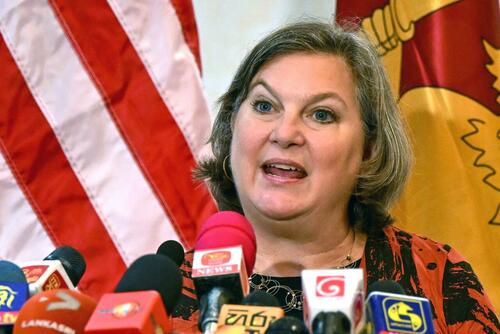
As the Uprising reached its peak, at least one American Jew was highly interested: Victoria Nuland. As Obama’s Assistant Secretary of State (first under Hillary Clinton, and then under the half-Jew John Kerry), Nuland had direct oversight of events in eastern Europe.[5] And for her, it was personal; her father, Sherwin Nuland (born Shepsel Nudelman), was a Ukrainian Jew. She was anxious to drive the pro-Russian Yanukovych out of power and replace him with a West-friendly, Jew-friendly substitute. And she had someone specific in mind: Arseniy Yatsenyuk. On 27 January 2014, as the riots were peaking, Nuland called American Ambassador to Ukraine, Jeff Pyatt, to urgently discuss the matter. Nuland pulled no punches: “Yats” was her man. We know this because the call was apparently tapped and the dialogue later posted on Youtube. Here is a short excerpt:
Nuland: I think Yats is the guy who’s got the economic experience, the governing experience. He’s the… what he needs is Klitsch and Tyahnybok on the outside. He needs to be talking to them four times a week, you know. I just think Klitsch going in… he’s going to be at that level working for Yatseniuk, it’s just not going to work.
Pyatt: Yeah, no, I think that’s right. OK. Good. Do you want us to set up a call with him as the next step? […]
Nuland: OK, good. I’m happy. Why don’t you reach out to him and see if he wants to talk before or after.
Pyatt: OK, will do. Thanks.
It was clear to both of them, though, that the EU leadership had other ideas. The EU was much more anxious to be a neutral party and to avoid direct intervention in Ukrainian affairs so as to not unduly antagonize Russia. But in time-tested Jewish fashion, Nuland did not give a damn. A bit later in the same phone call, she uttered her now-famous phrase: “Fuck the EU.” So much for Jewish subtlety.[6]
But there was another angle that nearly all Western media avoided: “Yats” was also Jewish. In a rare mention, we read in a 2014 Guardian story that “Yatsenyuk has held several high-profile positions including head of the country’s central bank, the National Bank of Ukraine… He has played down his Jewish-Ukrainian origins, possibly because of the prevalence of antisemitism in his party’s western Ukraine heartland.” For some reason, such facts are never relevant to Western media.
As the Maidan Uprising gave way to the Maidan Revolution in February 2014, Yanukovych was forced out of office, fleeing to Russia. Pro-Western forces then succeeded in nominating “Yats” as prime minister, effective immediately, working in conjunction with president Oleksandr Turchynov. This provisional leadership was formalized in a snap election in May 2014 in which the pro-Western candidate Peter Poroshenko won. (The second-place finisher was none other than Yulia Timoshenko—the same Jewess who had lost to Yanukovych in 2010.)
It was under such circumstances that Putin invaded and annexed Crimea, in February 2014. It was also at this time that Russian separatists in Donbass launched their counter-revolution, initiating a virtual civil war in Ukraine; to date, eight years later, around 15,000 people have died in total, many civilians.
With this American-sponsored coup finished, Ukrainian Jews began to reach out to the West to increase their influence. Thus it happened that just a few months after Maidan, the wayward son of the American vice president got in touch with a leading Ukrainian Jew, Mykola Zlochevsky, who ran a large gas company called Burisma. In this way, Hunter Biden incredibly found himself on the board of a corporation of which he knew nothing, in an industry of which he knew nothing, and which nonetheless was able to “pay” him upwards of $500,000 per year—obviously, for access to father Joe and thus to President Obama. Hunter carried on in this prestigious role for around five years, resigning only in 2019, as his father began his fateful run for the presidency.[7]
Despite a rocky tenure, Yatsenyuk managed to hold his PM position for over two years, eventually resigning in April 2016. His replacement was yet another Jew, Volodymyr Groysman, who served until August 2019. The Jewish hand would not be stayed. All this set the stage for the rise of the ultimate Jewish player, Volodymyr Zelensky.
This situation is particularly remarkable given that Jews are a small minority in Ukraine. Estimates vary widely, but the Jewish population is claimed to range from a maximum of 400,000 to as low as just 50,000. With a total population of 41 million, Jews represent, at most, 1% of the nation, and could be as small as 0.12%. Under normal conditions, a tiny minority like this should be almost invisible; but here, they dominate. Such is the Jewish hand.
Enter the Jewish Oligarchs
In Ukraine, there is a “second government” that calls many of the shots. This shadow government is an oligarchy: a system of rule by the richest men. Of the five richest Ukrainian billionaires, four are Jews: Igor (or Ihor) Kolomoysky, Viktor Pinchuk, Rinat Akhmetov, and Gennadiy Bogolyubov. Right behind them, in the multi-millionaire class, are Jews like Oleksandr Feldman and Hennadiy Korban. Collectively, this group is often more effective at imposing their will than any legislator. And unsurprisingly, this group has been constantly enmeshed in corruption and legal scandals, implicated in such crimes as kidnapping, arson and murder.[8]
Of special interest is the first named above. Kolomoysky has long been active in banking, airlines and media—and in guiding minor celebrities to political stardom. In 2005 he became the leading shareholder of the 1+1 Media Group, which owns seven TV channels, including the highly popular 1+1 channel. (The 1+1 Group was founded in 1995 by another Ukrainian Jew, Alexander Rodnyansky.) Worth up to $6 billion in the past decade, Kolomoysky’s current net wealth is estimated to be around $1 billion.
Not long after acquiring 1+1, Kolomoysky latched on to an up-and-coming Jewish comedian by the name of Volodymyr Zelensky. Zelensky had been in media his entire adult life, and even co-founded a media group, Kvartal 95, in 2003, at the age of just 25. Starring in feature films, he switched to television by the early 2010s, eventually coming to star in the 1+1 hit show “Servant of the People,” where he played a teacher pretending to be president of Ukraine. Then there was the notable 2016 comedy skit in which Zelensky and friends play a piano with their penises—in other words, typical low-brow scatological Jewish humor, compliments of Zelensky and Kolomoysky.
By early 2018, the pair were ready to move into politics. Zelensky registered his new political party for the upcoming 2019 election, and declared himself a presidential candidate in December 2018, just four months prior to the election. In the end, of course, he won, with 30% of the vote in the first round, and then defeating incumbent Poroshenko in the 2nd round by a huge 50-point margin. Relentless favorable publicity by 1+1 was credited with making a real difference. Notably, the third-place finisher in that election was, yet again, the Jewess Yulia Timoshenko—like a bad penny, she just keeps coming back.[9]
Zelensky, incidentally, has dramatically profited from his “meteoric rise” to fame and power. His Kvartal 95 media company earned him some $7 million per year. He also owns a 25% share of Maltex Multicapital, a shell company based in the British Virgin Islands, as part of a “web of off-shore companies” he helped to establish back in 2012. A Ukrainian opposition politician, Ilya Kiva, suggested recently that Zelensky is currently tapping into “hundreds of millions” in funding that flows into the country, and that Zelensky himself is personally earning “about $100 million per month.” A Netherlands party, Forum for Democracy, recently cited estimates of Zelensky’s fortune at an astounding $850 million. Apparently the “Churchill of Ukraine” is doing quite well for himself, even as his country burns.
In any case, it is clear that Zelensky owes much to his mentor and sponsor, Kolomoysky. The latter even admitted as much back in late 2019, in an interview for the New York Times. “If I put on glasses and look back at myself,” he said, “I see myself as a monster, as a puppet master, as the master of Zelensky, someone making apocalyptic plans. I can start making this real” (Nov 13). Indeed—the Kolomoysky/Zelensky apocalypse is nearly upon us.
Between rule by Jewish oligarchs and manipulations by the global Jewish lobby, modern-day Ukraine is a mess of a nation—and it was so long before the current “war.” Corruption there is endemic; in 2015, the Guardian headlined a story on Ukraine, calling it “the most corrupt nation in Europe.” An international corruption-ranking agency had recently assessed that country at 142nd in world, worse than Nigeria and equal to Uganda. As a result, Ukraine’s economy has suffered horribly. Before the current conflict, their per-capita income level of $8700 put them 112th in the world, below Albania ($12,900), Jamaica ($9100), and Armenia ($9700); this is by far the poorest in Europe, and well below that of Russia ($25,700 per person). Impoverished, corrupt, manipulated by Jews, now in a hot war—pity the poor Ukrainians.
Hail the American Empire
Enough history and context; let’s cut to the chase. From a clear-eyed perspective, it is obvious why Zelensky and friends want to prolong a war that they have no hope of winning: they are profiting immensely from it. As an added benefit, the actor Zelensky gets to perform on the world stage, which he will surely convert into more dollars down the road. Every month that the conflict continues, billions of dollars are flowing into Ukraine, and Zelensky et al. are assuredly skimming their “fair share” off the top. Seriously—who, making anywhere near $100 million per month, wouldn’t do everything conceivable to keep the gravy train running? The fact that thousands of Ukrainian soldiers are dying has no bearing at all in Zelensky’s calculus; in typical Jewish fashion, he cares not one iota for the well-being of the White Europeans. If his soldiers die even as they kill a few hated Russians, so much the better. For Ukrainian Jews, it is a win-win proposition.
Why does no one question this matter? Why is Zelensky’s corruption never challenged? Why are these facts so hard to find? We know the answer: It is because Zelensky is a Jew, and Jews are virtually never questioned and never challenged by leading Americans or Europeans. Jews get a pass on everything (unless they are obviously guilty of something heinous—and sometimes even then!). Jews get a pass from fellow Jews because they cover for each other. Jews get a pass from media because the media is owned and operated by Jews. And Jews get a pass from prominent non-Jews who are in the pay of Jewish sponsors and financiers. Zelensky can be as corrupt as hell, funneling millions into off-shore accounts, but as long as he plays his proper role, no one will say anything.
So the “war” goes on, and Zelensky and friends get rich. What does Europe get from all this? Nothing. Or rather, worse than nothing: They get a hot war in their immediate neighborhood, and they get an indignant Putin threatening to put hypersonic missiles in their capital cities in less than 200 seconds. They get to deal with the not-so-remote threat of nuclear war. They get to see their currency decline—by 10% versus the yuan in a year and by 12% versus the dollar. They get a large chunk of their gas, oil, and electricity supplies diverted or shut off, driving up energy prices. And they get to see their Covid-fragile economies put on thin ice.
But perhaps they deserve all this. As is widely known, the European states are American vassals, which means they are Jewish vassals. European leaders are spineless and pathetic lackeys of the Jewish Lobby. Judenknecht like Macron, Merkel and now Scholz, are sorry examples of humanity; they have sold out their own people to placate their overlords. And the European public is too bamboozled and too timid to make a change; France just had a chance to elect Le Pen, but the people failed to muster the necessary will. Thus, Europe deserves its fate: hot war, nuclear threat, cultural and economic decline, sub-Saharan and Islamic immigrants—the whole package. If it gets bad enough, maybe enough Europeans will awaken to the Jewish danger and take action. Or so we can hope.
What about the US? We could scarcely be happier. Dead Russians, the hated Putin in a tizzy, and the chance to play “world savior” once again. American military suppliers are ecstatic; they don’t care that most of their weapons bound for Ukraine get lost, stolen or blown up, and that (according to some estimates) only 5% make it to the front. For them, every item shipped is another profitable sale, whether it is used or not. And American congressmen get to pontificate about another “good war” even as they approve billions in aid.
And perhaps best of all, we get to press for an expansion to that American Empire known as NATO. We need to be very clear here: NATO is simply another name for the American Empire. The two terms are interchangeable. In no sense is NATO an “alliance among equals.” Luxembourg, Slovakia, and Albania have absolutely nothing to offer to the US. Do we care if they will “come to our aid” in case of a conflict? That is a bad joke, at best. In reality, what such nations are is more land, more people, and more economic wealth under the American thumb. They are yet more places to station troops, build military outposts, and run “black sites.” NATO always was, and always will be, the American Empire.
The push for Ukraine to join NATO by the West-friendly Zelensky was yet another blatant attempt at a power grab by the US, this one on Russia’s doorstep. Putin, naturally, took action to circumvent that. But of course, now the push moves to Sweden and Finland, both of whom are unwisely pursuing NATO membership in the illusory quest for security, when in reality they will simply be selling what remains of their national souls to the ruthless Judeo-American masters. For their sake, I hope they are able to avoid such a future.
And all the while, American Jews and a Jewish-American media play up the “good war” theme, send more weapons, and press ever further into the danger zone. Ukrainian-American Jews like Chuck Schumer are right out front, calling for aid, for war, for death.[10] “Ukraine needs all the help it can get and, at the same time, we need all the assets we can put together to give Ukraine the aid it needs,” said Schumer recently, eager to approve the next $40 billion aid package. As Jews have realized for centuries, wars are wonderful occasions for killing enemies and making a fast buck. Perhaps it is no coincidence that the present proxy war against Jewish enemies in eastern Europe began not long after the 20-year war against Jewish enemies in Afghanistan ended. Life without war is just too damn boring, for some.
Public Outrage?
If more than a minuscule fraction of the public knew about such details, they would presumably be outraged. But as I mentioned, the Jewish-controlled Western media does an excellent job in restricting access to such information, and in diverting attention whenever such ugly facts pop up. The major exception is Tucker Carlson, who is able to reach some 3 million people each night; this is by far the widest reach for anything like the above analysis. But Carlson falls woefully short—pathetically short—in defining the Jewish culprit behind all these factors. Jews are never outed and never named by Carlson, let alone ever targeted for blame. This crucial aspect is thus left to a literal handful of alt-right and dissident-right websites that collectively reach a few thousand people, at best.
And even if, by some miracle, all 3 million Tucker viewers were enlightened to the Jewish danger here, this still leaves some 200 million American adults ignorant and unaware. The mass of people believes what they see on the evening news, or in their Facebook feeds, or Google news, or on CNN or MSNBC, or in the New York Times—all Jewish enterprises, incidentally. This is why, when polled, 70% of the American public say that current aid to Ukraine is either “about right” or even “too little.” This, despite the fact that around 50% claim to be “very concerned” about nuclear war; clearly they are unable to make the necessary connections. And for many, it is even worse than this: around 21% would support “direct American military intervention” against Russia, which means an explicit World War Three, with all the catastrophic outcomes that this entails. Our Jewish media have done another fine job in whipping up public incitement.
In sum, we can say that our media have cleverly constructed a “philo-Semitic trap”: any mention or criticism of the Jewish hand in the present conflict is, first, highly censored, and then, if necessary, is dismissed as irrational anti-Semitism. Sympathy toward the (truly) poor, suffering Ukrainians is played up to the hilt, and Putin and the Russians relentlessly demonized. Leading American Jews, like Tony Blinken and Chuck Schumer, are constantly playing the good guys, pleading for aid, promising to help the beleaguered and outmanned Ukrainian warriors. Who can resist this storyline? Thus, we have no opposition, no questioning, no deeper inquiries into root causes. Jews profit and flourish, Ukrainians and Russians suffer and die, and the world rolls along toward potential Armageddon.
The reality is vastly different. Global Jews are, indeed, “planetary master criminals,” as Martin Heidegger long ago realized.[11] They function today as they have for centuries: as advocates for abuse, exploitation, criminality, death and profits. This is self-evidently true: if the potent Jewish Lobby wanted true peace, or flourishing humanity, they would be actively pushing for such things and likely succeeding. Instead, we have endless mayhem, war, terrorism, social upheaval and death, even as Jewish pockets get ever-deeper. And the one possible remedy for all this—true freedom of speech—recedes from our grasp.
On the one hand, I fear greatly for our future. On the other, I feel that we get what we deserve. When we allow malicious Jews to dominate our nations, and then they lead us into war and global catastrophe, well, what can we say? Perhaps there is no other way than to await the inevitable conflagration, exact retribution in the ensuing chaos, and then rebuild society from scratch—older and wiser.
Notes
[1] Cited in Wheen, Karl Marx (1999), p. 340.
[2] Russia’s recent defense of Assad in Syria, against Israel, has obviously not made things better. Nor has the fact that Putin, once thought to be a tool of Jewish-Russian oligarchs, has been able to turn the tables and hold them in check.
[3] Google has been particularly tenacious in altering its search engine results to censor (‘de-rank’) critics of Jewish power and stifle alternative voices. And Google owns Youtube, another force for censorship, which is currently run by the Jewess Susan Wojcicki. For their efforts, Brin and Page have become among the wealthiest men in the world; each is currently worth in excess of $100 billion.
[4] Svoboda began its existence as the “Social-National Party of Ukraine”—a not-so-subtle allusion to National Socialism. This is, in part, why both Svoboda and their allies have been called ‘neo-Nazi.’
[5] Nuland is currently “Under Secretary of State for Political Affairs” in the Biden administration.
[6] Another Jew likely involved in this incident was the Hungarian-American investor George Soros. In late 2019, the lawyer Joseph diGenova appeared in the news, openly charging Soros with direct intervention in American policy: “Well, there’s no doubt that George Soros controls a very large part of the career Foreign Service at the United States State Department. … But the truth is George Soros had a daily opportunity to tell the State Department through Victoria Nuland what to do in the Ukraine. And he ran it, Soros ran it.”
[7] For what it’s worth, Hunter seems to have a “thing” for Jewesses. In 2016, while married, he took up with his dead brother’s Jewish widow, Hallie Olivere Biden. The marriage failed and the illicit affair died out after a year or so, but then the ever-industrious Hunter latched on to another Jewess, “filmmaker” Melissa Cohen, in 2018. They married in 2019.
[8] In a revealing quotation, Ukrainian nationalist Dmytro Yarosh once asked this question: “I wonder how it came to pass that most of the billionaires in Ukraine are Jews?” Criminal activity is surely a large part of the answer.
[9] Not long after winning the presidency, Zelensky named another Jew, Andriy Yermak, as “Head of Presidential Administration.” (The current prime minister, Denys Shmyhal, seems not to be Jewish.)
[10] Other Ukrainian-American Jews, like Steven Spielberg and Jon Stewart, and the heirs to the Sheldon Adelson fortune, are assuredly equally elated about the course of events.
[11] Cited in P. Trawney, Heidegger and the Myth of a Jewish World Conspiracy (2015), p. 33.
NATO ‘crossed red line’ – Austria
RT | June 9, 2024
Ukraine’s Western sponsors have crossed a boundary when they allowed Kiev to use their weapons to strike at targets in Russia, Austrian Defense Minister Klaudia Tanner said in an interview to Die Presse published on Saturday.
Several NATO members have openly supported the use of Western-produced armaments for cross-border strikes against Russia in recent weeks, ostensibly in a limited manner. The West insists that it is still not a party to the conflict, and only supports Kiev’s efforts to stall Russia’s push into the Kharkov Region, which Moscow launched to move the line of contact away from the border to prevent further Ukrainian attacks on Russian civilians.
“A red line has been crossed,” Tanner stated when asked about the US, France and Germany’s permission to use their weapons in cross-border strikes. When the interviewer asked how else Kiev could stall the Kharkov operation, the Austrian Defense Minister replied that “as a militarily neutral state, it is not our place to judge.”
The Austrian defense chief added that at least she was “very pleased that NATO Secretary General Jens Stoltenberg has clarified that NATO will not be sending troops to Ukraine.”
Stoltenberg claimed that the US-led military bloc has no plans to deploy ground forces to Ukraine in a press conference on Thursday. Despite this, French President Emmanuel Macron announced on Friday he was almost ready to finalize an international coalition to officially send Western military “instructors” to train Kiev’s forces in Ukraine.
Russian President Vladimir Putin has stressed that Moscow has long been aware that Western military personnel are already fighting in Ukraine, under the guise of “mercenaries” and “volunteers.”
Western-produced long-ranged armaments used by Kiev in cross-border strikes are also often controlled and serviced by these foreign troops, the Russian president said last month. And even if Ukrainians are pulling the trigger, the US and its allies are the ones providing Kiev intelligence on Russian targets, Putin noted.
Moscow has warned that Western-backed long-range attacks on Russian territories will amount to direct Western participation in the conflict, and that Russia can respond in kind. “We can respond asymmetrically,” the Russian leader said on Wednesday, suggesting that Moscow could supply similar weapons around the world, where they could be used against Western
Western hegemony is over – Moscow

Russian Foreign Ministry Spokeswoman Maria Zakharova
RT | June 8, 2024
The concepts of hegemony and global dominance, which the Collective West clings to, have no place in the multipolar world order – which is already becoming a reality, Russian Foreign Ministry spokeswoman Maria Zakharova said on Saturday.
Speaking at a panel discussion on new norms of international relations at the St. Petersburg International Economic Forum (SPIEF), Zakharova slammed Western governments for resisting the structural changes which have already started with regard to the self-organization of nations and their interactions with other states.
“We are talking about polycentrism, a departure from previous norms, and we see the desperate resistance of the Collective West… They see the norm differently – as their own dominance, as a world order based on one rule – that they must dominate as before, and everyone must do only what the dominant allows them to do,” she stated, adding that the drive for dominance has only ever “led humanity to monstrous tragedies,” including colonialism and Nazism.
“Today it is hegemonism, an obsession with domination, a painful pseudo-messianic idea of [the West’s] global mission… But neither people nor states can declare themselves as missionaries, only history can prove whether their mission was good or based on unhealthy ideas,” Zakharova said.
She added that the ideas of global dominance, of the exceptionalism of some nations amid the destruction of ethnic and cultural identities of others have repeatedly been expressed by Western leaders. She went on to say that these ideas are not shared by the global majority, which has already embraced the concept of multipolarity.
“We should not forget, they are a minority – the Collective West… their worldview is shared by no one except for them,” she said, citing memorandums adopted by multinational blocs as the Russian-led BRICS group, the Shanghai Cooperation Organization, African Union, and others, in which member states commit to forming a multipolar world order.
“The SCO… covers 3 billion people – half of humanity… BRICS covers over 30% of the Earth’s land mass, 45% of the world population – some 3.5 billion people, and 33% of global GDP… 3% more than the GDP of the G7,” she stated.
Zakharova noted that even in the West, some analysts claim that “the US has not been a world hegemon for a long time,” while “its actions in the international arena have led to the destabilization of world politics.” However, until there are significant changes in policy and ideology, Russia and its global allies have “a long struggle ahead” to form a truly polycentric world order, she said.
“While our cause is not simple, it is worthy and noble. And we will walk this path as a global majority. We don’t call it a mission, though, we call it our goal and objective.”
Featured Video

Trita Parsi: Middle East Unraveling — Are We on the Path to World War?
or go to
Aletho News Archives – Video-Images
New Book
Trans agenda is ‘normalization of sadism’ – US author

RT | September 23, 2026
The US Democratic Party has embraced a transgender agenda that amounts to “the normalization of sadism,” author A.J. Rice has said, warning that radical trans policies would return if the party is allowed to regain power.
Speaking to RT’s America First host Scotty Nell Hughes about his new book, ‘The Curse of the Bearded Lady: How the Trans Mafia Whacked American Sanity’, Rice argued that activists have gained significant influence in schools, medicine, and corporate America while people who questioned the agenda have faced pressure to stay silent.
The author described the “trans mafia” as the sprawling network of people and institutions that have helped the movement gain influence. He singled out parts of academia, wealthy backers, and corporations, and stated that providers of transition-related treatment also have a financial incentive to keep young people in their care indefinitely.
Rice argued that the consequences of these policies ultimately fall on children who are being drawn toward gender-affirming medical treatments and on girls who are expected to share locker rooms or compete in sports with biological males.
He noted that while voters rejected the Democrats’ approach to gender in 2024, the party, which has been “captured by madness,” has since only doubled down and is seeking what is effectively “the normalization of sadism.” … Full report
Blog Roll
 Aletho News
- German chemicals giant reveals details of downsizing
- Refaat Al-Areer Was The Canary In The Coal Mine In Israel’s War On The Truth
- Israeli election committee bars candidate from Knesset race over Gaza war opposition
- French-Lebanese man files war crimes complaint over Israeli attacks
- Mahan Air Flight Lands in China Despite US Threat against Iranian Airlines
- US eyes $10bn fund to rebuild war-battered Gulf infrastructure
- Trump meets Rodríguez near Maduro’s prison as Venezuela’s oil flows to US
- Trita Parsi: Middle East Unraveling — Are We on the Path to World War?
- Iran FM meets with US envoy on UN meeting’s sidelines at American side’s insistence: Report
- Qatar PM calls for Gulf security framework with Iran, says war must be ‘wake-up call’
- If Americans Knew
- Caught on Tape: AIPAC CEO Boasted of Controlling Trump’s National Security Officials
- Why Hamas Attacked Israel in October 2023 – Israeli professor Ilan Papé
- They see them, then kill them: Israeli quadcopters track, deliberately target civilians in Gaza
- Winter could turn Gaza’s treacherous, war-damaged buildings into deathtraps
- Majority of Democratic Voters Want to Prosecute Both Biden and Trump Administration Officials Over Gaza
- As Gaza languishes, world leaders gather at the UN – Daily Update
- Sanctions are collective punishment: immoral and self-defeating
- Phosphorus Munitions Fired by Israel Burn Groves, Orchards in Southern Lebanon
- Israel Carries Out New Ceasefire Violations Across Gaza
- AI – Emphasis on the ‘I’: Israel Is Funding AI Chatbot Propaganda
- No Tricks Zone
- New Study: Earth And Venus Surface Warmth Largely Explained By Convection And Lapse Rate, Not CO2 Or Radiation
- 2025 Nature Paper Claiming Worsening Global Drought Gets RETRACTED …Heavily Flawed
- New Study: ‘Global Drought Shows No Detectable Recent Acceleration Under Climate Warming’
- Economic Masterminds: German Socialists Suggest Taxing Productivity Gains Stemming From Using AI
- The South China Sea Has Not Been Cooperating With The Climate Change Narrative
- Energy Crisis: Germany Enters Heating Season With Historically Low Gas Reserve Fill Levels
- New Study: The Antarctic Ice Sheet Gained Mass From 2020-2024 Due To Staggering Snow And Ice Accumulation
- Study: Ocean Heating Rates From Thousands Of Years Ago ‘Dwarf’ Modern Ocean Heating Rates
- Climate Extremists Target, Attack Large-Scale Power Grid Infrastructure In Germany!
- New Study: Antarctic Ice Melt Has Contributed Less Than 1 Centimeter To Sea Level Rise In The Last 30 Years

