Five people killed in Ukrainian drone strike on Russian region – governor
RT | June 29, 2024
Five people have been killed in a Ukrainian drone strike on a settlement in Russia’s Kursk Region, local governor Aleksey Smirnov has said.
A quadcopter UAV dropped an explosive device on a residential building in the village of Gorodische, near the border with Ukraine overnight, Smirnov wrote on Telegram on Saturday.
“To our great sorrow, five people were killed as a result of the discharge, including two small children,” he said. Two more members of the same family were hospitalized in critical condition, he added.
On Saturday, Russia’s Defense Ministry said at least six attempts by “the Kiev regime to carry out terrorist attacks on Russian territory with the use of unmanned aerial vehicles” were intercepted overnight.
Russian air defenses destroyed two drones in Tver Region, one in Bryansk Region, one in Belgorod Region and two in Crimea, the statement read.
READ MORE: Civilians killed on Sevastopol beach were ‘occupiers’ – top Zelensky aide
The Russian regions of Belgorod, Bryansk and Kursk, all of which border Ukraine, have been the targets of Ukrainian missile, mortar and drone attacks almost on a daily basis since the outbreak of the conflict between Moscow and Kiev in February 2022. The strikes have targeted energy infrastructure and residential areas, resulting in civilian deaths and injuries, as well as the destruction of property.
Russia comments on coup attempt in Bolivia
RT | June 27, 2024
Moscow has pledged its “unwavering support” for Bolivian President Luis Arce after his government faced an attempted military coup on Wednesday.
The failed putsch was led by the commander of the Armed Forces, General Juan Jose Zuniga. His troops occupied Plaza Murillo, the central square in the Bolivian capital La Paz, and broke into the presidential palace, but faced resistance at home and rebukes internationally.
Russia has condemned the attempted coup and considers it imperative that internal political disputes be settled within the framework of constitutional law, the Foreign Ministry said in a statement on Thursday.
”We warn against attempts at destructive foreign interference in the domestic affairs of Bolivia and other nations. Such actions have previously led to tragic consequences for a number of countries and peoples, including in the Latin American region,” the ministry added.
The statement called Bolivia a “strategic partner.” Arce reiterated in late May his country’s intention to join BRICS, a group of not-Western economies that includes Russia among its founding members.
Bolivia fell prey to a coup in 2019, which ousted then-President Evo Morales and put into power the government of Senator Jeanine Anez. She is now serving a prison term for crimes that her regime committed during its deadly crackdown on mass protests.
Arce, who assumed office in 2020, and his mentor Morales, have been at odds over the future of their political force, the Movement for Socialism. However, Morales has unequivocally condemned the attempt to oust his former ally and urged the public to mobilize against General Zuniga. The coup leader was arrested hours after he tried to usurp power.
Lavrov reveals BRICS expansion stance
RT | June 27, 2024
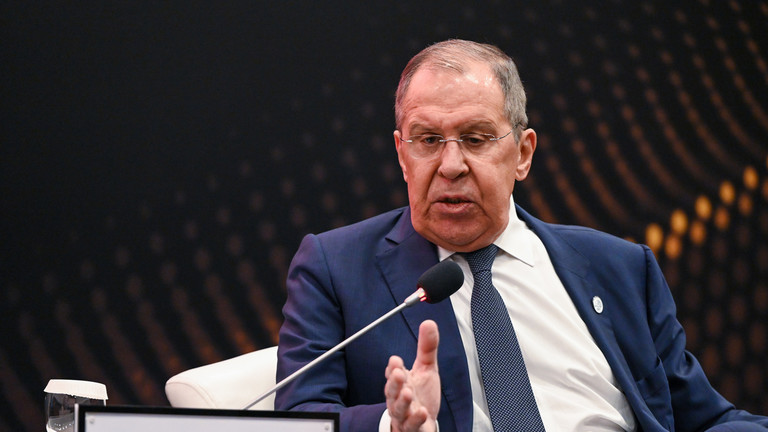
The BRICS group of nations has voted to temporarily suspend new membership applications and focus on integrating the countries which have joined most recently, Russian Foreign Minister Sergey Lavrov announced on Wednesday.
In a statement published on the ministry’s website, Lavrov revealed that the Group of Ten BRICS members had decided to “take a break with the accession of new members in order to process the new arrivals, who have doubled the composition of the group.”
BRICS was initially founded in 2006 by Brazil, Russia, India, and China, with South Africa joining the group in 2010. This year, five more countries officially joined the organization, including Egypt, Iran, Saudi Arabia, Ethiopia, and the United Arab Emirates.
In his statement, Lavrov said that while the new arrivals are being integrated into the group, a new category of “partner countries” would be formed as a “stepping stone” to full BRICS membership.
“We will certainly promote our Belarusian friends as well as a number of other like-minded allies,” the minister said.
This year, Russia holds the rotating chairmanship of BRICS and has announced a “special mission” to identify new members. According to Yury Ushakov, Russian President Vladimir Putin’s foreign policy aide, more than 30 countries have formally applied, including Thailand and Malaysia, the latest to have submitted bids. Earlier this month, Zimbabwe also announced a desire to join the group.
Russian Deputy Foreign Minister Sergey Ryabkov outlined that Moscow’s primary criteria for all aspiring BRICS members is “non-participation in illegal sanctions policies, [and] illegal restrictive measures against any BRICS participant, first of all of course against Russia.”
He said that all current members had expressed their “full understanding” of that position, which Moscow considers essential as the group’s growth continues.
Ukrainian attack on Russian civilians ‘terrorism’ – RFK Jr
RT | June 27, 2024
Ukraine’s recent attack on Sevastopol using American-made ATACMS missiles was “terrorism” and constituted an act of war by the United States against Russian civilians, US presidential candidate Robert F. Kennedy Jr. has said.
According to the Russian Defense Ministry, the Ukrainian military fired five ATACMS missiles at Crimea on Sunday, each armed with controversial cluster munition warheads. While Russian air defenses managed to destroy four of them, the fifth was damaged and detonated in mid-air above the seaside, raining explosives onto beachgoers. Over 150 people were injured in the attack and at least five were killed, including two children.
Responding to the incident in a post on X on Wednesday, Kennedy noted that the US-supplied ATACMS missile launcher is “targeted by a sophisticated system only Americans can operate within Ukraine.”
He suggested that the only word that could describe Kiev’s attack on a civilian beach is ‘terrorism’ and claimed that the fact that this was done using what are effectively US-operated weapons meant that it was also “an act of war by the US against Russian civilians.”
“Only Congress can legally declare war,” Kennedy stressed. “They should stop the unaccountable and reckless hawks directing an impaired President Biden.”
Sunday’s strike has also been condemned by former US Congressman Ron Paul, who has described it as an “Ukrainian and American attack on Russia” to which Moscow “can’t not respond.”
Republican Congresswoman Marjorie Taylor Greene also responded to the attack by stating it was something that “should not be happening” and pondered what would have happened if “Russia, using a Russian satellite, fired cluster munitions on a Florida beach.”
Meanwhile, Moscow has said that it “understands perfectly well” who is behind the attack on Sevastopol and who was aiming the missiles involved in the strike, and warned that the “direct involvement of the US in hostility that results in Russian civilians being killed [will] have consequences.”
The Kremlin has not yet outlined what this response might entail, but suggested that it could involve Moscow arming the adversaries of Western nations. The Pentagon has denied involvement in the targeting of the missiles, saying Ukraine makes its own attack decisions.
The Last Wunderwaffe
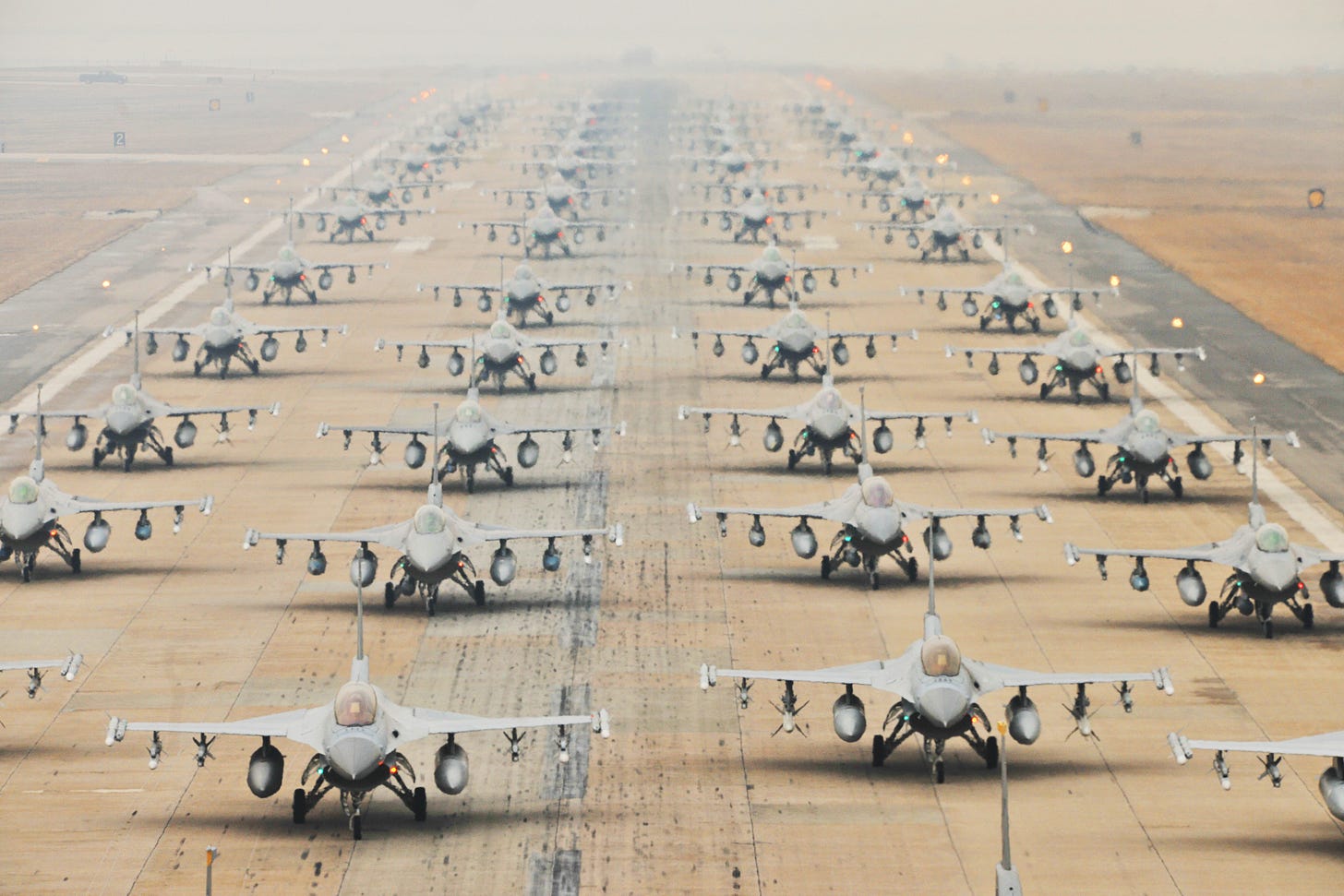
F-16 Elephant Walk
By William Schryver – imetatronink – June 27, 2024
F-16s, Romanian bases, and NATO pilots
I shall return yet again to the prospect of “Made in the USA” F-16s sallying forth boldly into eastern Ukraine to “teach the cabbage heads what Airpower (capitalized) really means.”
From what information I’ve been able to glean in recent weeks, it does in fact look as though the US is aggressively setting up air ops housekeeping in Romania, very near the Black Sea coast — ostensibly to serve as the base of F-16 operations against Russia.
I submit that the preparation of this base is implicit proof that they have long-since assembled and, likely for many months, been honing the skills and teamwork of a few squadrons of “NATO-affiliated contractor pilots” — and the plan must be to use them.
You see, if the “true plan” were to put a dozen woefully undertrained Ukrainian apprentice kamikazes behind the wheel of 1980s vintage F-16s, and then wave them off on a glorious one-way mission into the wild blue yonder … well, you don’t need much of a logistical hub for that operation.
So, if they’re really working to prepare what is reputed to be the “largest NATO base in Europe”, the logical conclusion is that it is intended to house, maintain, and sustain at least a couple squadrons of NATO “volunteer” pilots flying much later F-16 models than the European boneyard relics Ukraine has long been promised.
Hey, I say field five full squadrons, and outfit at least a couple of them with the latest model F-16 Vipers.
Go big or go home.
Make it the last “all in” roll of the wunderwaffe dice.
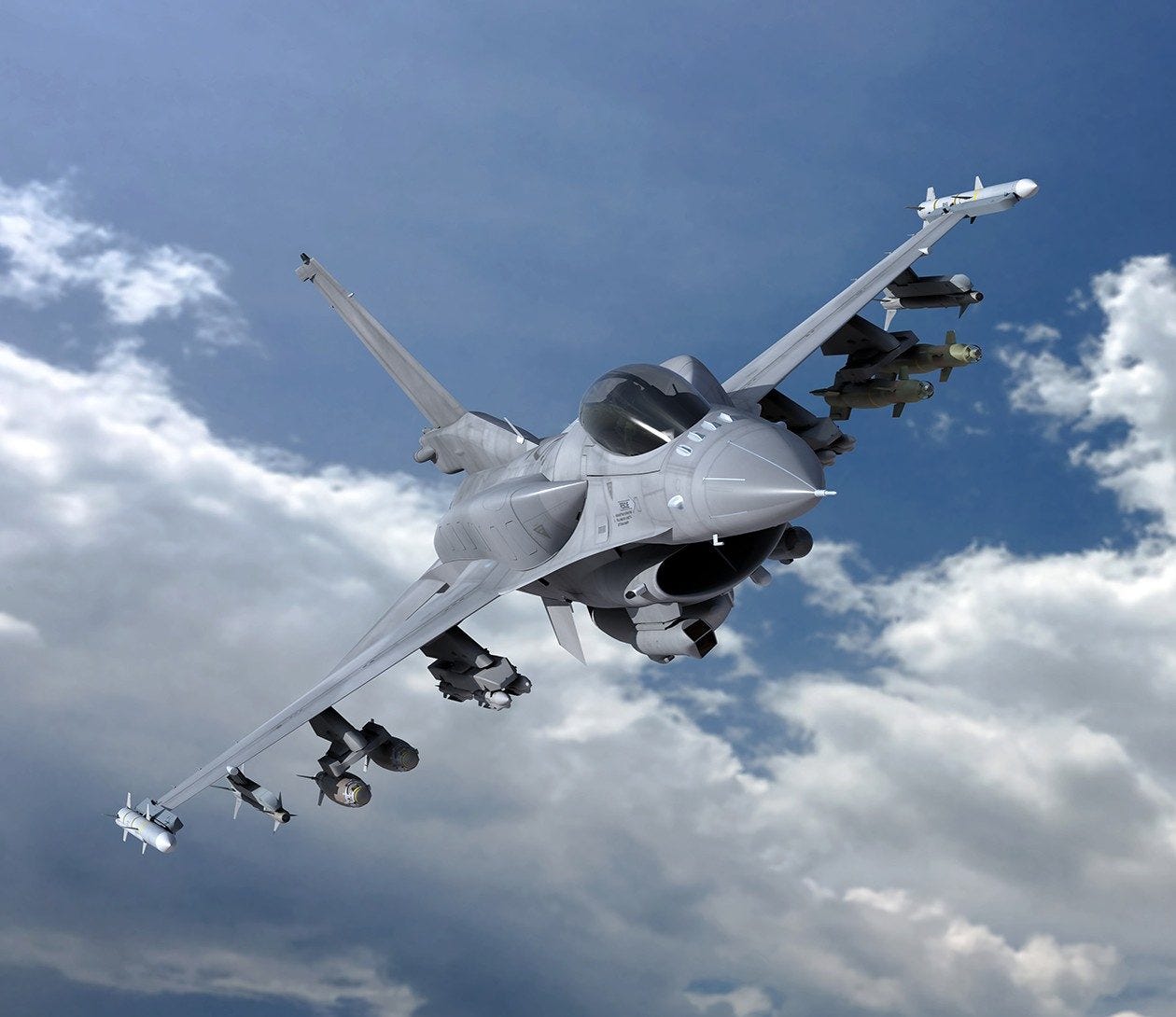
F-16 Viper
Never mind that literally no one in the US air fleet, at any level, has any experience whatsoever in high-intensity air combat operations against an enemy that:
– can match or exceed you with high numbers of superior air frames
– will be flying from interior lines, with well-established logistical infrastructure
– backed by high numbers of the finest layered air defenses on the planet
– with far superior magazine depth
– and will significantly outrange NATO platforms in almost every plausible scenario.
Oh, yeah. And I almost forgot: anyone (including the perpetually catastrophist Russian murmurers) who believes for a moment that Russia will not act to obliterate a NATO base in Romania under such circumstances … well, that’s just silly talk.
Of course they will. They’ll hit it hard. Really hard — with a strike package that exceeds anything ever thrown at a Ukrainian target over the course of this war.
It could well become the most intensely pressure-packed moment in modern times — a situation exceptionally fraught with the possibility of catastrophic miscalculation.
Every time I stop to think about these things, I just shake my head at the obvious stupidity of it all.
If the Imperial Masters of War actually attempt such an air campaign against Russia, not only will the entire operation almost certainly end up being a logistical debacle of truly epic proportions, but the combat results will be shockingly one-sided — disastrous to the point the US will very likely feel compelled to cease operations after just a few days, and try to spin it into some sort of “bold statement” that “achieved its purposes”.
But it will be ugly. Exceedingly ugly. And everybody that is anybody of consequence in power structures around the world will know the score and understand exactly what it means.
Magazine Depth and Shields
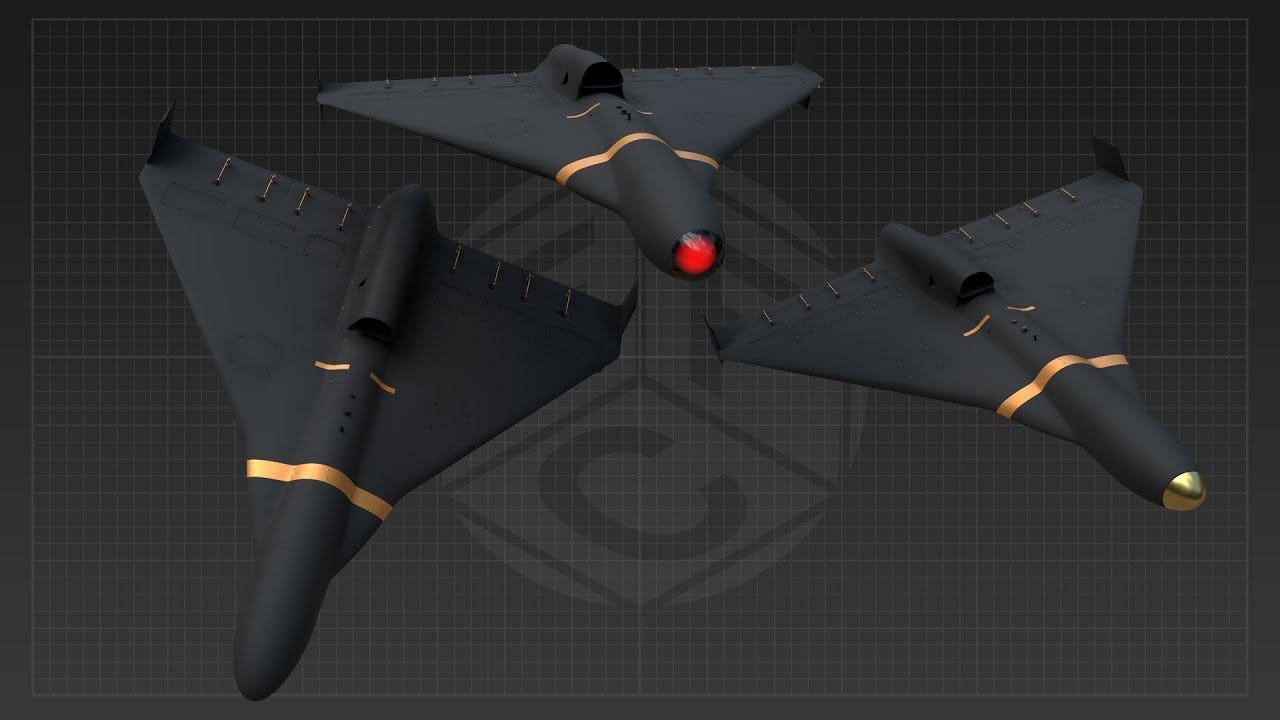
Iranian Shahed Drones – Three Variants
By William Schryver – imetatronink – June 26, 2024
In addition to the already-in-progress wars in Ukraine, Gaza, and the Red Sea, we are now staring down the barrel of yet another — rumored to be imminent in southern Lebanon.
There is no doubt Israel (just like its great benefactor, the United States) is, in the context of a “big war”, capable of executing several damaging strikes against a potential peer or near-peer adversary.
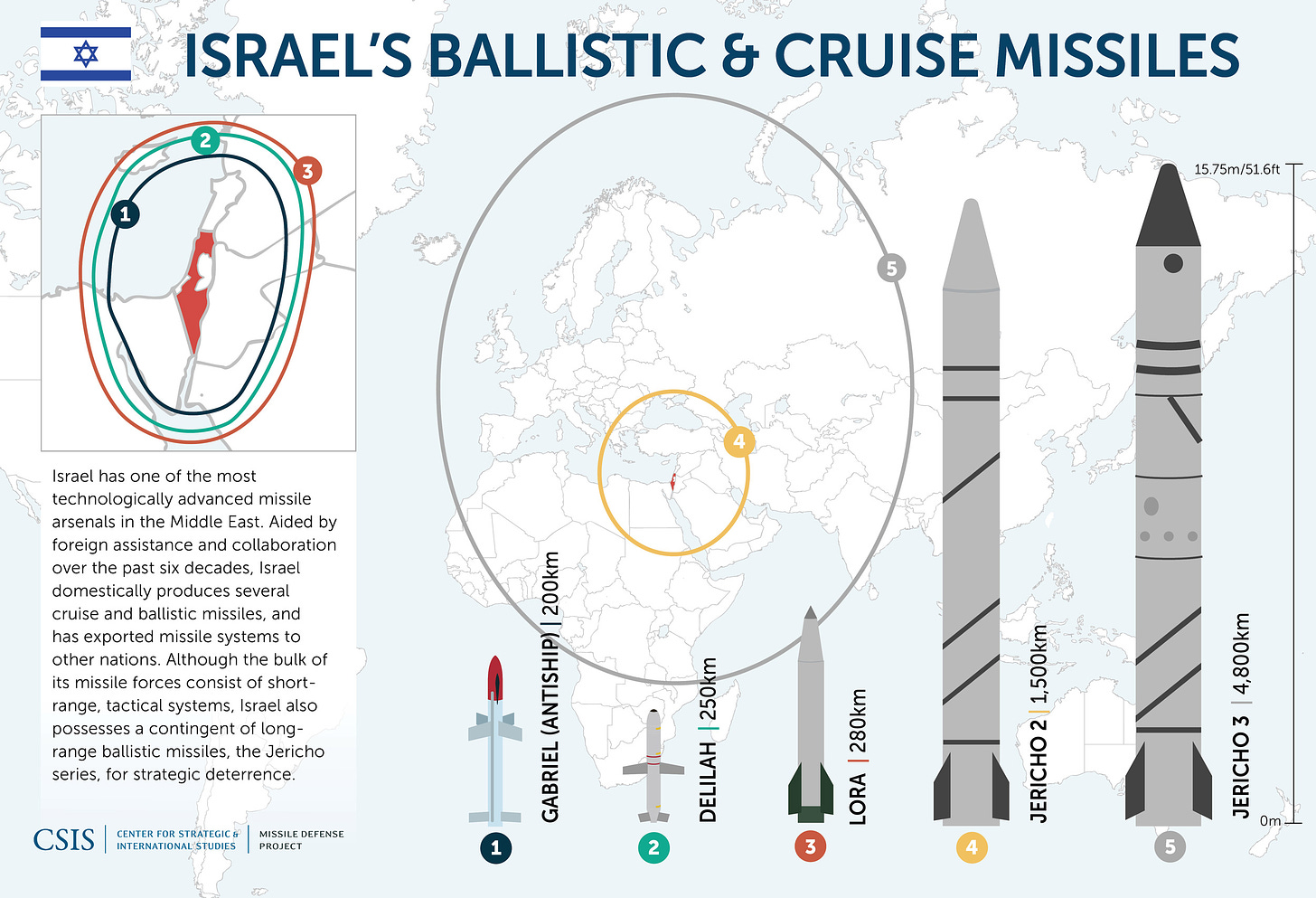
Israeli Ballistic and Cruise Missiles and Ranges
But, throughout the imperial domain, there are fatal weaknesses that exist right now, and which cannot be turned into strengths at any point in the near- or medium-term.
The first is what military types call “magazine depth”: munitions stockpiles sufficient to offensively overwhelm, defensively defeat, and strategically outlast the enemy.
Neither the United States, nor any of its largely impotent client nations, possess “magazine depth” sufficient to prosecute anything more than a relatively brief campaign against their potential peer adversaries: Russia, China, Iran — and all or any of their lesser-power partners.
The second problem is a corollary of the first. It is what I will term “shields”: the capacity to defeat a decisive proportion of the strikes one’s enemy can launch against you.
Neither the United States, nor any of its largely impotent client nations — by their own admission — possess anything even approximating comprehensive and effective “shields” against the quantity and quality of the types of strike weapons its potential adversaries can launch against them.
NATO sources themselves recently confessed that they only have about 5% potential air defense coverage against Russian missile strikes.
Now, of course, many will reflexively argue that, for example, the US could, with a massive “shock and awe” first-strike air campaign, effectively disarm Russian counterstrike capabilities.
This is patently ridiculous wishful thinking.
No one who actually understands the parameters of the military equation believes this to be true. And one need only examine the results of the months-long campaign against the lowly Yemenis to see confirmation of this incontrovertible fact.
Earlier this year we witnessed the Iranians launch a relatively modest missile strike against Israel, whose defenses were massively reinforced by American air and naval assets.
Using maybe 300 antiquated long-range strike drones and cruise missiles as decoys, the air defense response of both the US and Israel was massively attrited. And then, with a mere dozen or so seriously capable ballistic missiles, the Iranians blew right through the interception attempts of both the multiple land-based Patriot systems and a US guided-missile destroyer positioned off the eastern Mediterranean coast.
The Patriot systems were a total bust, and the Israelis summarily retired them in the immediate aftermath of the Iranian strike.
The US destroyer is reported to have launched eight top-shelf SM-3 missile defense interceptors (quite likely its entire “magazine depth”) at the incoming Iranian strike package.
They might have damaged one of the 12-15 incoming Iranian missiles.
The others hit with precision comparable to the 5-meter CEP Iran achieved in its 2020 strikes against the US airbase at Ayn al-Asad in Iraq.
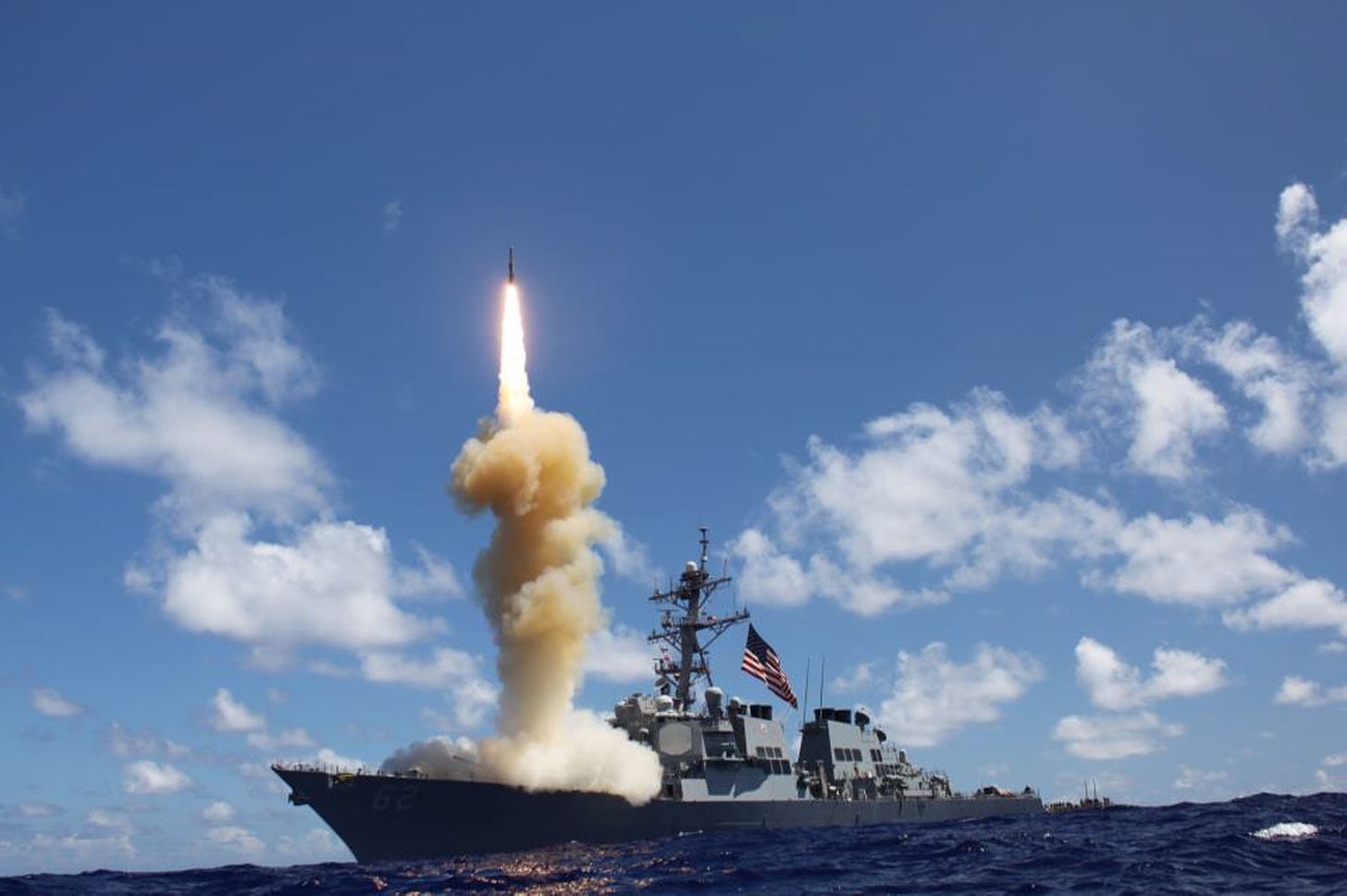
SM-3 Missile Interceptor Launched from a US Guided-Missile Destroyer
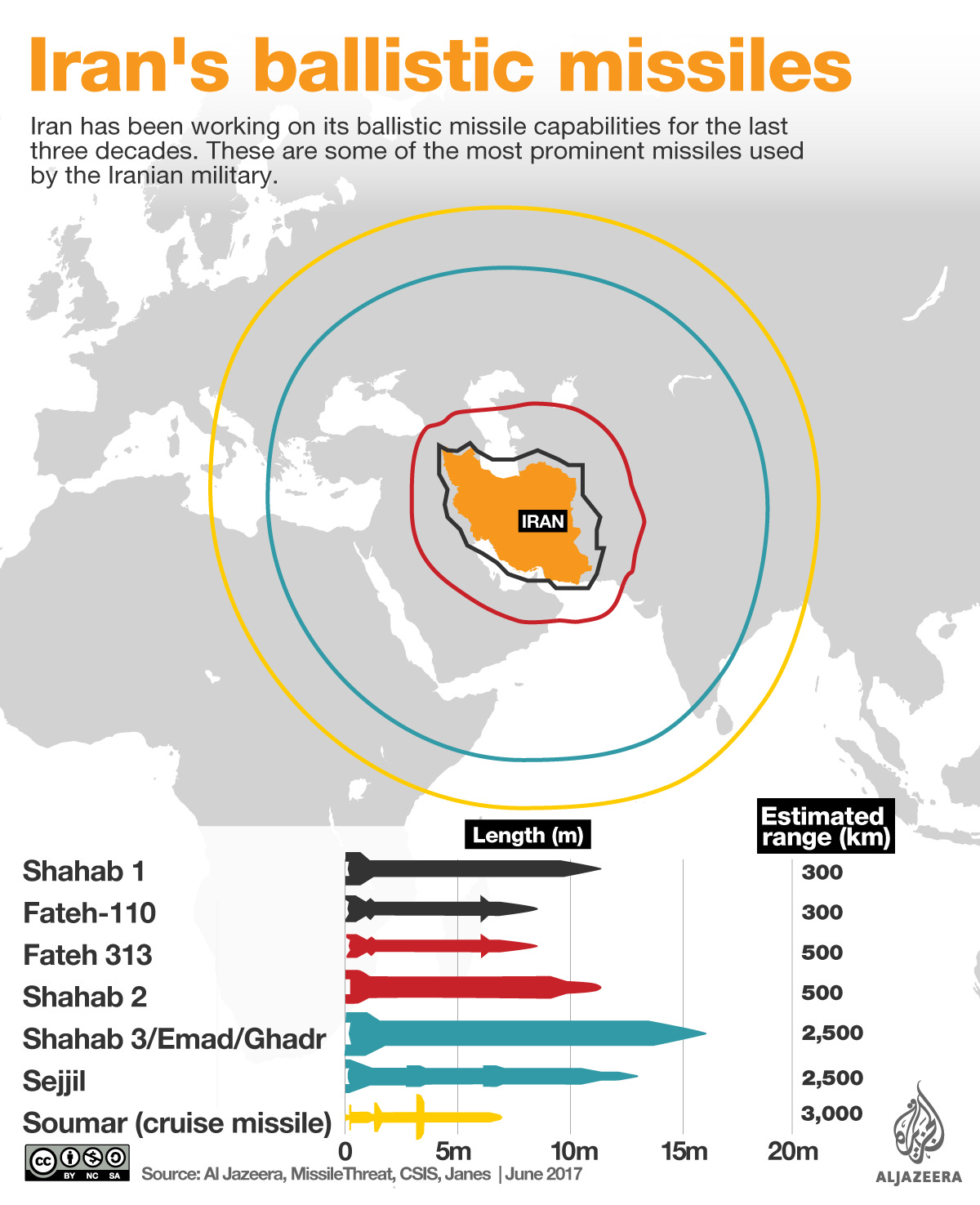
Iranian Ballistic Missiles and Ranges
Had Iran, at that moment in time, opted to follow up with an even larger strike consisting of several hundred of its best ballistic missiles, the US and Israeli defenses would have been penetrated to an overwhelming degree. It would have put to shame the opening-night show of the Americans’ 1991 “shock and awe” cruise missile attack against Baghdad.
Fortunately the Iranians didn’t press the matter, and let their modest yet impressive demonstration of strength suffice for the time being.
In recent months, Iran’s close partner Hezbollah — which is reputed to possess at least 100,000 missiles and drones of various types — has been routinely penetrating Israel’s once-vaunted “Iron Dome” missile defense system.
Indeed, Hezbollah has almost appeared to be mocking the Israelis’ impotence at times.
In any case, the Iron Dome has been revealed to be acutely vulnerable to penetration by Hezbollah drones and missiles.
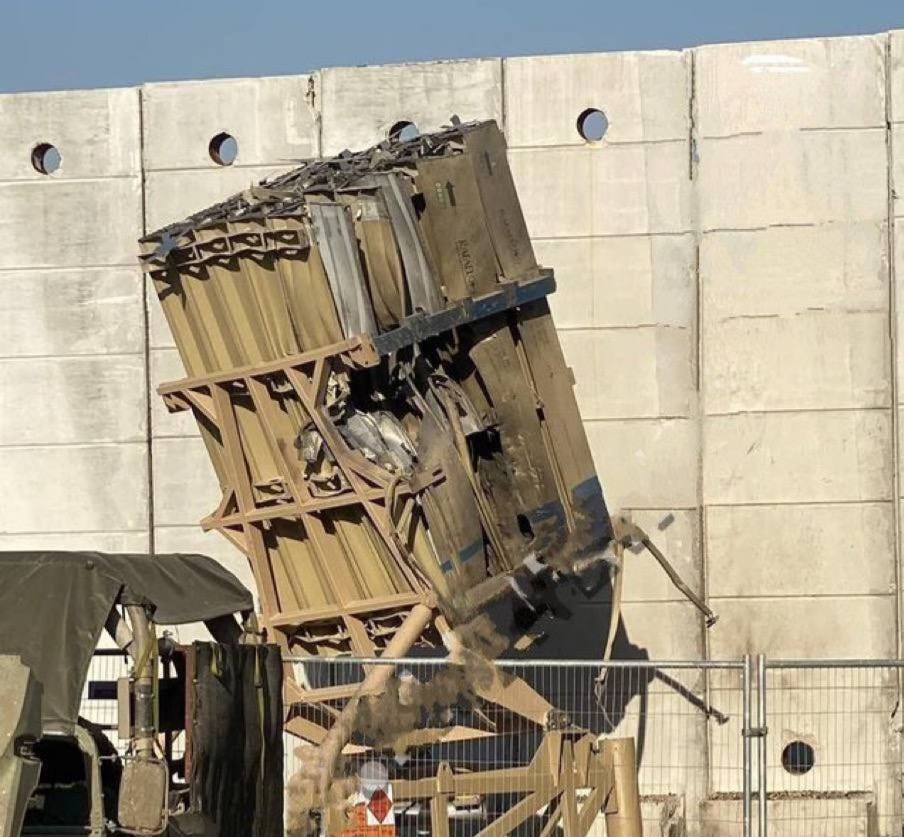
Israeli Iron Dome Launcher Destroyed by Hezbollah Drone Strike
It is not known with precision how many missiles and drones of various types Iran possesses. But it is reasonable to assume that their “magazine depth” is considerably larger than that of Hezbollah.
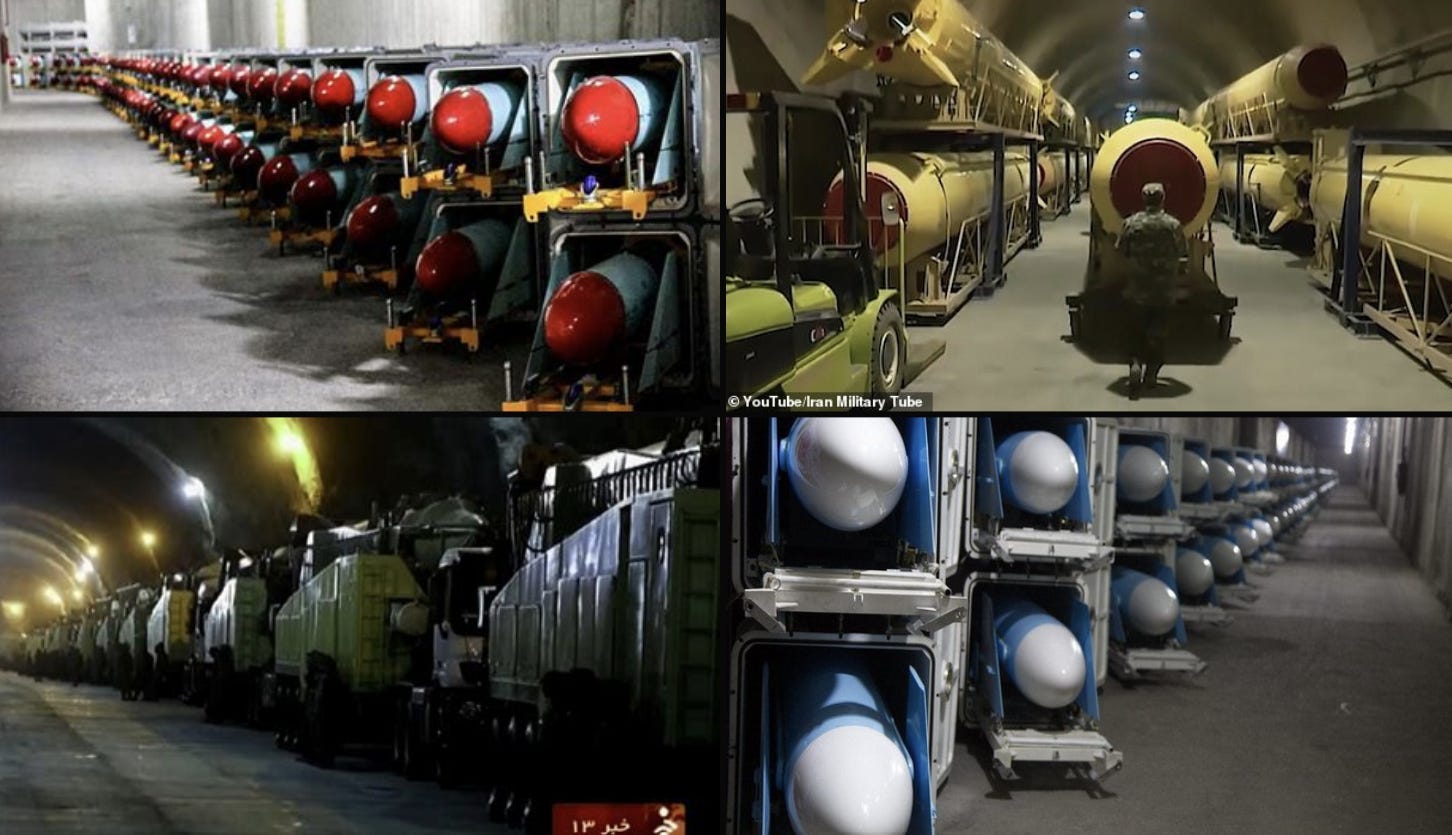
Iranian Missiles
It is also not known with precision how many missiles and drones of various types Russia possesses. But it is reasonable to assume that their “magazine depth” is considerably larger — and exceedingly more potent — than that of Hezbollah and Iran combined.
Even more importantly, the Russians have, over the course of the war in Ukraine, demonstrated an unprecedented capability to routinely shoot down the best strike missiles the US and its NATO vassals have been able to launch against them.
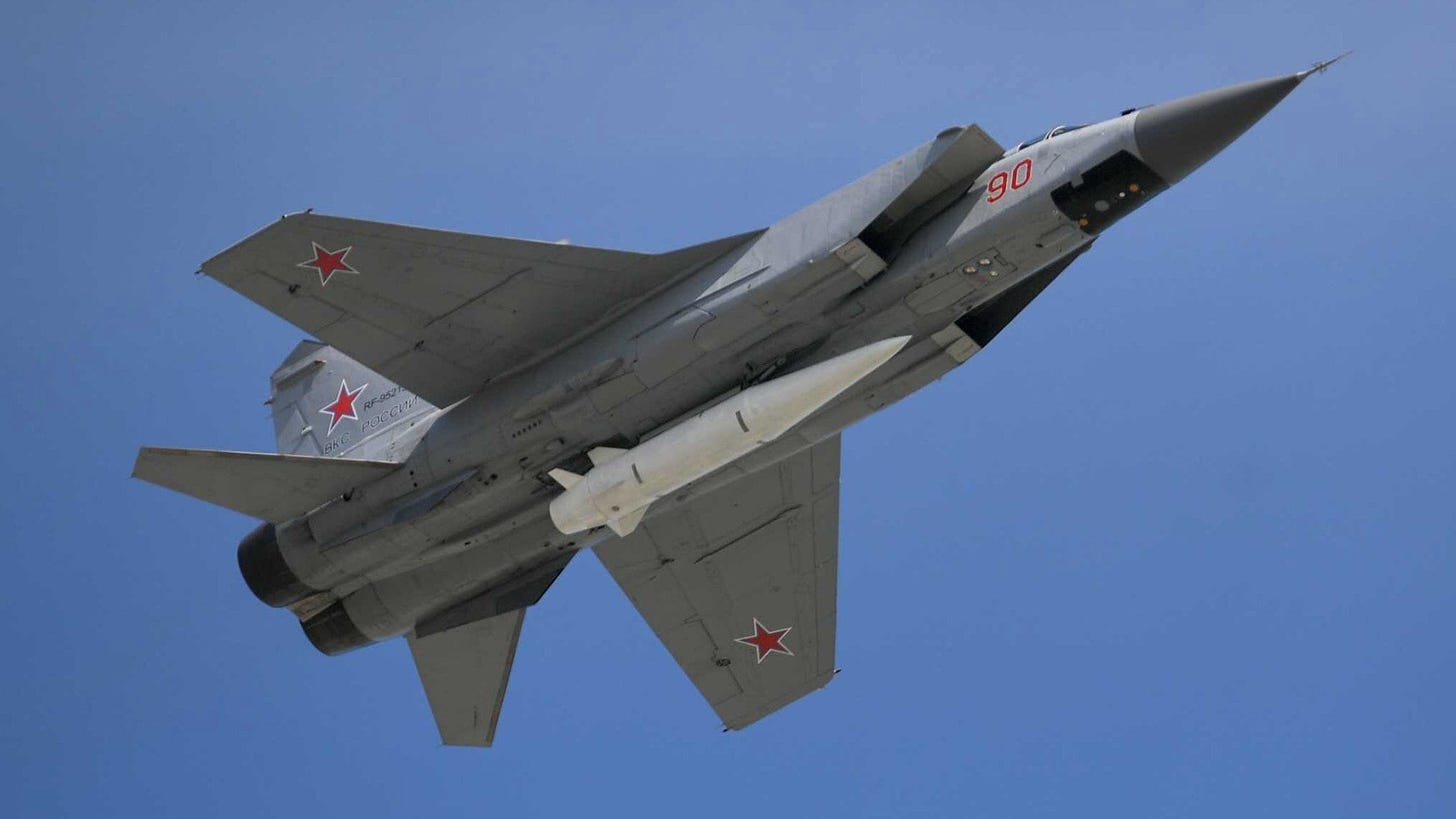
Russian MiG-31 Carrying a Hypersonic Kinzhal Missile
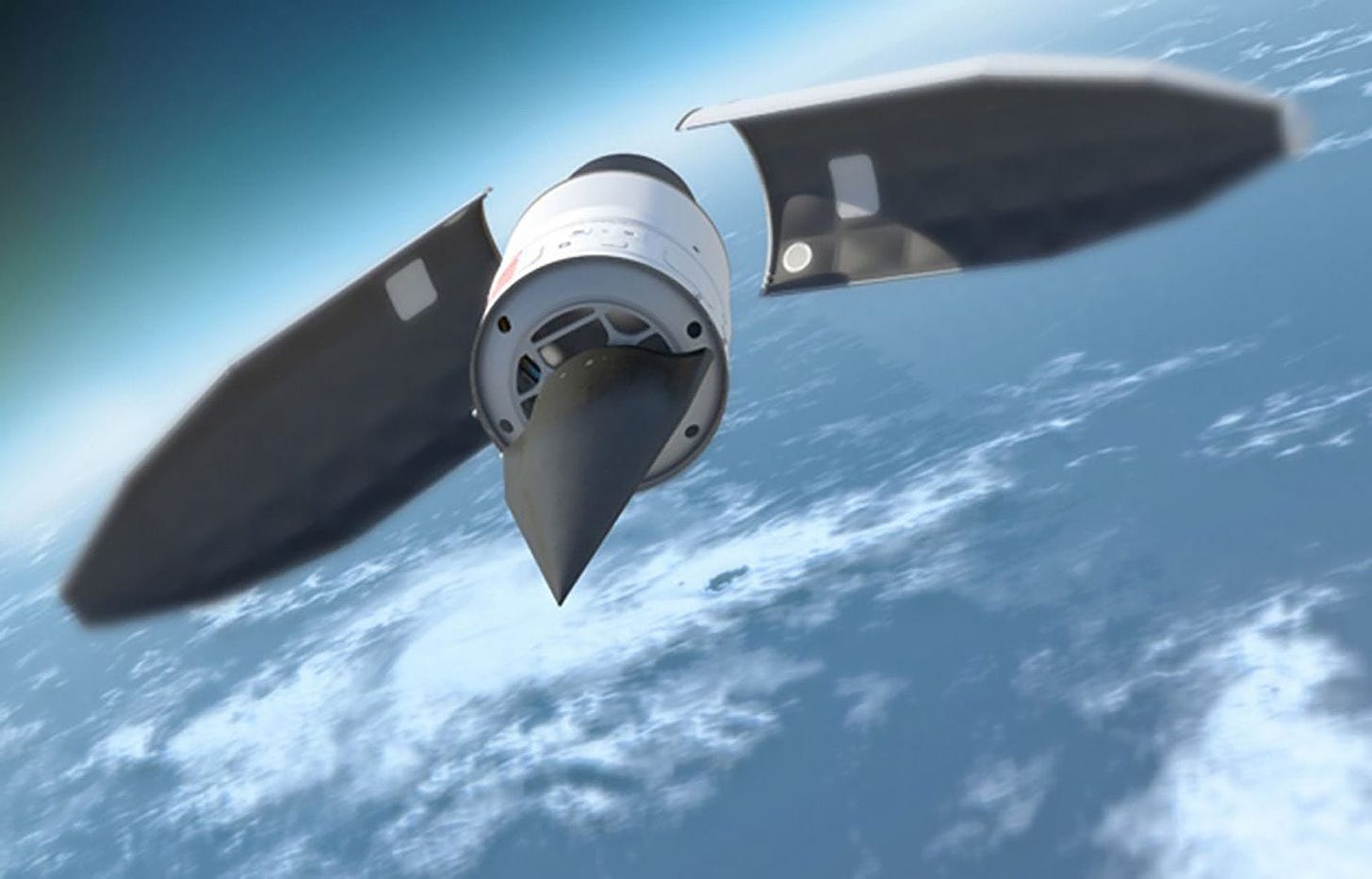
Russian Avangard Hypersonic Missile
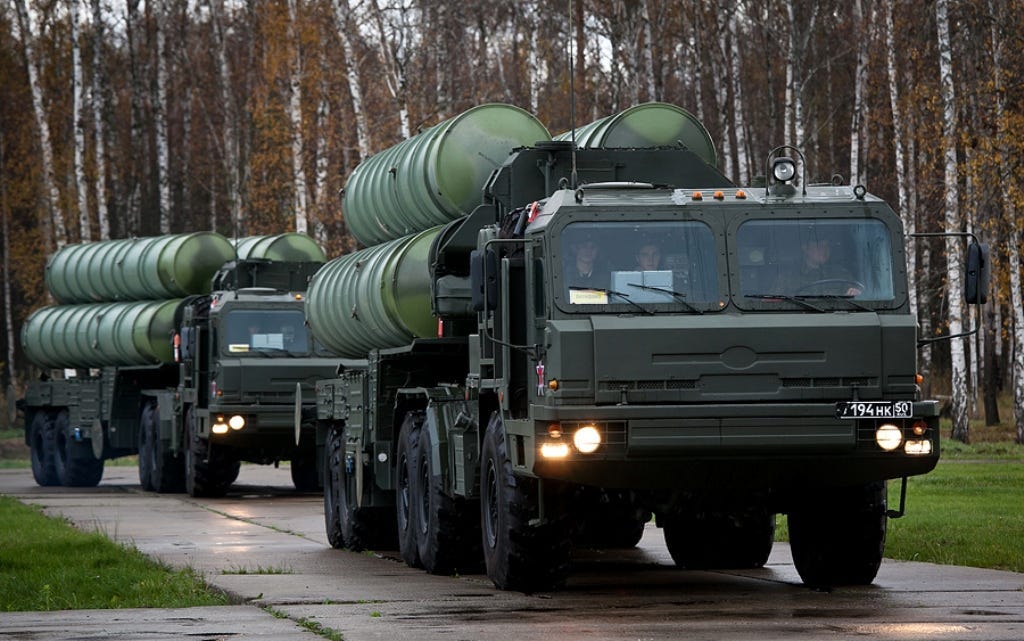
Russian S-400 Air Defense System
Lastly, it is not known with precision how many missiles and drones of various types China possesses. But it is reasonable to assume that their “magazine depth” is at least an order of magnitude larger than Hezbollah, Iran, and Russia combined.
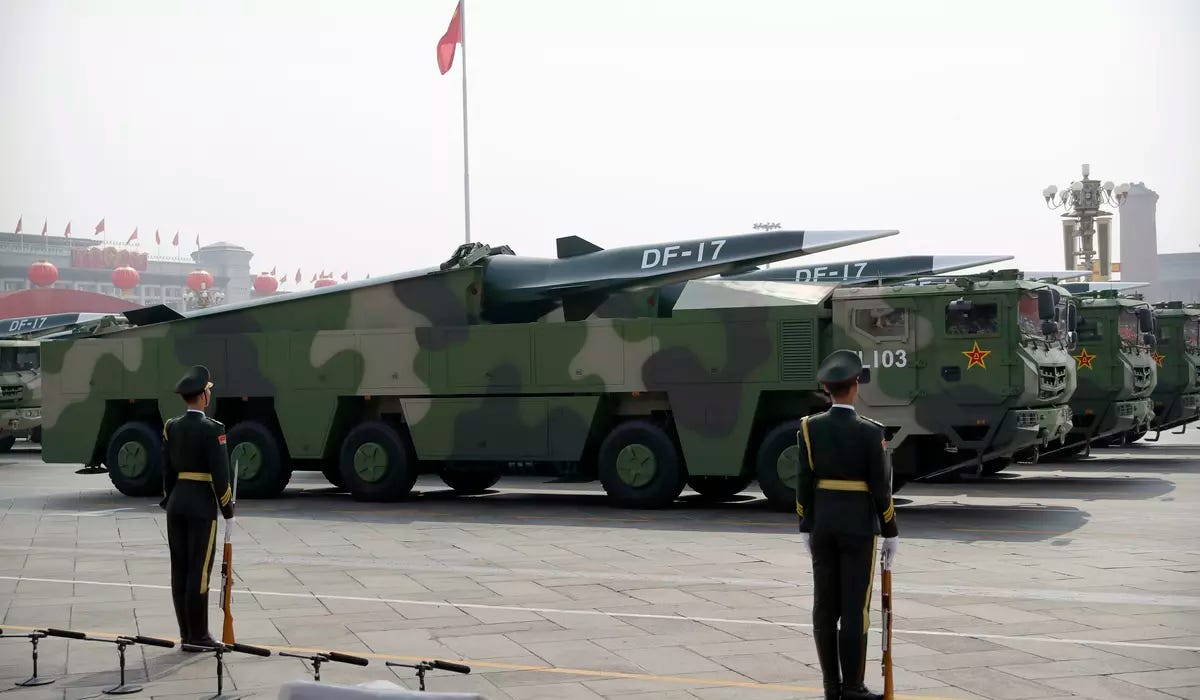
Chinese DF-17 Hypersonic Missiles
Of course, I’ve not yet made any mention of North Korea, who has now been formally received into the Russia, China, Iran mutual-defense partnership. People love to mock Kim Jong-Un and his people, but the empire underestimates them at their peril.
The Israelis can talk tough about making war against Hezbollah and its friends, but if they actually attempt it, it will end very, very badly for them.
The Americans and their almost laughably impotent allies can talk tough about making war against Russia or China, but if they actually attempt it, it will end catastrophically for them.
Then we’ll really have a dangerous situation on our hands.
Russia retaliates against EU’s latest media ban
RT | June 25, 2024
Russia is restricting access to more than 80 EU media outlets on its territory that have been involved in spreading disinformation about the Ukraine conflict, the Russian Foreign Ministry announced on Tuesday.
According to a statement issued on the ministry’s website, the move comes in response to the EU’s latest crackdown on Russian media.
In May, the European Council banned four media outlets from reporting to audiences in the EU, including leading Russian news agency RIA Novosti, as well as newspapers Izvestia and Rossiyskaya Gazeta. The ban also applies to the relatively small Czech-based portal Voice of Europe, which the EU has described as a “Kremlin-linked propaganda network.” The restrictions on the media outlets came into force on June 25.
“The Russian side has repeatedly and at various levels warned that politically motivated harassment of its journalists and unfounded bans on Russian media in the EU will not go unnoticed,” the ministry said, noting that Brussels and other EU capitals had chosen to take the path of escalation with their latest illegal ban despite warnings, forcing Moscow to take mirror countermeasures.
“Responsibility for such a development of events lies solely with the leadership of the European Union and the countries of the bloc that supported such a decision,” according to the ministry.
The list of EU media outlets that “systematically disseminate false information” about the progress of Moscow’s special military operation includes 81 organizations from 25 member states. They include Germany’s Der Spiegel, Spain’s El Pais, Italy’s La Stampa and La Repubblica newspapers, the French Agence France-Presse, Le Monde, Liberation, as well as the pan-European Politico and EUobserver.
Moscow may reconsider its decision in relation to the media outlets if restrictions on Russian media are lifted, according to the statement.
Brussels had already barred several Russia-associated media from engaging with audiences in member states due to the Ukraine conflict. Even platforming content from the targeted organizations is illegal in the bloc. Those sanctions included RT and Sputnik, suspending their TV broadcasting licenses and blocking both websites for readers across the EU.
Moscow has accused Brussels of duplicity and attacking freedom of speech with its restrictions. The campaign to undermine the work of Russian news organizations long predates the Ukraine conflict and is aimed at preventing European citizens from hearing opinions that their governments deem undesirable, Russian officials have claimed.
Hamas Insists on Russia Being One of Gaza Ceasefire Guarantors
Sputnik – 25.06.2024
MOSCOW – The Palestinian movement Hamas insists that Russia should be one of the guarantors of the ceasefire in the Gaza Strip, Hamas political bureau deputy head Musa Abu Marzouk told Sputnik.
“We still insist that Russia be the guarantor of such a ceasefire agreement, because obviously the United States is on the side of Israel … Russia’s position is fairer, more acceptable to all sides, and it is ready to act in this direction. We want to put an end to the hegemony of the United States and its one-sided influence on the Palestinian issue,” Marzouk said.
There is no progress in negotiations on a ceasefire agreement in the Gaza Strip, and Palestinian movement Hamas has not received a response to its amendments to the text of the document, Marzouk said.
“The efforts of our friends in Qatar are continuing, they are trying to break the freeze on the process, but there is no progress … We have made several changes that Israel has not agreed to. Therefore, they remained unanswered,” Marzouk said.
Hamas does not ask Russia for military assistance, Hamas political bureau deputy head Musa Abu Marzouk added.
“No, we did not ask for military assistance. The war is going on in Gaza, Gaza is producing its own weapons for close combat, and, so far, we believe that we can manage on our own for this kind of fighting,” Marzouk said.
Marzouk has arrived in Russia for meetings at the Russian Ministry of Foreign Affairs.
US condemned for attempting to sow discord between China and Russia, North Korea
Global Times | June 24, 2024
Experts have rebuked the US for trying to sow discord between China and Russia, and North Korea, noting that the closer relationship between the two Chinese neighbors is based on current realities, as their mutual support can break through Western blockades.
The remarks came after US Air Force General C.Q. Brown, chairman of the Joint Chiefs of Staff, told reporters during an overseas trip on Sunday that the newly-signed strategic partnership agreement between Russia and North Korea could create friction with China, according to Reuters.
Reuters, citing anonymous analysts, claimed the pact, signed on Wednesday, “could undercut Beijing’s leverage over its two neighbors and any heightened instability could be negative for China’s global economic and strategic ambitions.”
Chinese experts refuted the claims.
“In fact, China is pleased to see strengthening friendly cooperation between these two neighboring countries,” said Lü Chao, an expert on the Korean Peninsula issue at the Liaoning Academy of Social Sciences. He believes the mutually supportive ties between Russia and North Korea are expected to contribute to regional security and the peace and stability of Northeast Asia.
China’s relations with both Russia and North Korea share a common goal of maintaining peace and stability in Northeast Asia, and their comprehensive cooperation is reasonable, Lü said.
The top leaders of the Democratic People’s Republic of Korea (DPRK) and Russia signed the Treaty on Comprehensive Strategic Partnership following their summit in Pyongyang on Wednesday, the Xinhua News Agency reported Thursday.
Russia and North Korea have agreed on mutual support in the event of external aggression, Russian media reported on Wednesday, citing Russian President Vladimir Putin. Russia does not rule out military-technical cooperation with North Korea in accordance with a newly signed comprehensive strategic partnership agreement, RIA Novosti reported, citing Putin at a press briefing following talks with North Korea’s top leader Kim Jong Un in Pyongyang.
In response to the development, Lin Jian, a spokesperson for the Chinese Foreign Ministry, said at a Thursday press conference that “the agreement between the DPRK and Russia is related to their bilateral cooperation. I have no comment on it.”
The closer relationship between North Korea and Russia is based on current realities, Chinese experts pointed out.
Currently, both Russia and North Korea face severe pressure from the US-led Western clique, including economic sanctions. In this situation, it is natural for the two countries to come together, especially since they have mutually beneficial aspects, such as Russia’s assistance in energy and food supplies to North Korea, according to Lü.
At the same time, some US and other Western politicians and media outlets are hyping “some kind of military alignment or military bloc” in Northeast Asia.
Such rumors also were debunked by Chinese experts.
The US is determined to implement its so-called Indo-Pacific Strategy in the region, creating a camp confrontation mentality, they said.
“China opposes any trend towards regional camps. But the US is fabricating this division,” Lü remarked.
He warned that the Western portrayal of a camp formation could further exacerbate tensions on the Korean Peninsula.
The expert explained that China has always advocated a fair and just stance on the Korean Peninsula issue, maintaining a fair and just position towards both North and South Korea, which has been widely recognized.
Lin said that on the Korean Peninsula issue, China’s position is consistent. “We always believe that upholding peace and stability on the Peninsula and advancing the political settlement of the Peninsula issue serve the common interests of all parties and hope various parties will make constructive efforts to this end,” Lin said.
ICC a tool of ‘Western hybrid war’ – Moscow
RT | June 25, 2024
Moscow has denounced the Hague-based International Criminal Court’s (ICC) decision to issue arrest warrants for two top Russian defense officials, branding the institution a mere tool of the West’s “hybrid war” efforts.
The ICC on Tuesday issued arrest warrants for ex-Russian Defense Minister Sergey Shoigu and the current chief of the General Staff, Valery Gerasimov, accusing the two of committing “alleged international crimes” amid the Ukrainian conflict.
Russia’s Security Council has denounced as “void” the court’s move, pointing out that its jurisdiction does not extend to Russia.
“The decision of the Pre-Trial Chamber of the ICC against the Secretary of the Russian Security Council Sergei Shoigu is void. This is just hot air, since the jurisdiction of the ICC does not extend to Russia, and [the decision] was made as part of the West’s hybrid war against our country,” the council said.
The two top military officials are accused by the ICC of committing “alleged international crimes,” namely “directing attacks at civilian objects,” as well as “causing excessive incidental harm to civilians” amid the Ukraine conflict. The charges stem from Russia’s campaign of strikes against Ukrainian energy infrastructure, which Moscow regards as dual-purpose strategic installations rather than purely civilian facilities.
Earlier this year, the ICC also targeted two top Russian military commanders, Lieutenant-General Sergey Kobylash of the Long-Range Aviation fleet and Admiral Viktor Sokolov of the Black Sea fleet. The charges against those commanders also resulted from the campaign of air strikes against Ukrainian infrastructure.
The Hague-based institution has taken multiple steps against Russia amid the Ukraine conflict, most notably by issuing an arrest warrant for Russian President Vladimir Putin last spring. The president is accused of “unlawful deportation” of Ukrainian children to Russia.
Moscow, like many other countries, including the US, does not recognize the authority of the ICC and its actions hold no legal power in Russia.
Pentagon has ‘nothing to say’ about strike on Crimean beach with US-supplied weapons
RT | June 24, 2024
The Pentagon has refused to comment on the deadly Ukrainian cluster munition attack on a crowded beach in Sevastopol, Russia on Sunday, RIA Novosti has reported. The Ukrainian attack carried out with US-supplied ATACMS missiles killed at least four people, among them two children, and injured 151, according to local officials.
Four missiles were intercepted by air defenses, while a fifth deviated from its trajectory and detonated its cluster warhead over the busy Black Sea beach, the Russian Defense Ministry said in a statement on Sunday.
When RIA asked the Pentagon about the use of US supplied weapons in the strike on Sunday, an official replied, “we have seen the reports and have nothing to say.”
Moscow has placed the blame primarily with Washington, accusing it of enabling the “premeditated terrorist missile attack.” The targets for these US-provided missiles are assigned to Ukrainian troops by American specialists, based on their own intelligence data, the Defense Ministry stated.
According to data from the flight tracker Flightradar, a US RQ-4B Global Hawk reconnaissance drone was patrolling in the Black Sea south of Crimea during the Ukrainian missile strike.
The number of people injured in the strike stood at 151 as of Sunday night, according to Sevastopol’s governor, Mikhail Razvozhaev. A joint team of specialists from the Health Ministry’s Federal Center for Disaster Medicine arrived in the city to work with the victims, he wrote early Monday.
Kiev deliberately chooses mass gatherings of people as targets, both out of hatred and to sow panic, Russian Foreign Ministry spokeswoman Maria Zakharova said following the attack. The day of the Holy Trinity holiday was picked deliberately, she claimed.
Ukraine has previously targeted the Crimean Peninsula with US-provided ATACMS missiles. In May, ten ATACMS were shot down on a trajectory aimed at the strategic Crimean Bridge, Russian Defense Minister Andrey Belousov said at the time.
Featured Video

Racist Seinfeld Dances for Joy as Bibi Unveils His New Map
or go to
Aletho News Archives – Video-Images
TV Drama Review
Japanese drama projects Japan’s wartime atrocities onto Chinese characters

Global Times | October 25, 2026
By portraying Chinese characters as perpetrators of ruthless violence while casting Japanese Self-Defense Forces (SDF) intelligence operatives as defenders, the season 2 of the Japanese drama Vivant has recently drawn criticism from Chinese netizens, who argue that its depiction turns historical reality on its head while ignoring Japan’s wartime atrocities.
The TBS drama series – a spy suspense story in which an alleged unofficial intelligence unit of the SDF operates across the globe — has attracted a passionate fanbase. Its currently airing season 2 opened with a household rating of 18.8 percent, the highest for a TV drama this year, according toa commentary article by Japanese media Toyo Keizai.
What draws attention is the portrayal of the enemies in the series, the article noted. Scenes in which the Chinese organization subjects kidnapped members of the SDF unit to brutal torture are repeated with unrelenting intensity.
It is rare for Japanese TV dramas to explicitly portray a real-life country as the enemy, the article noted.
Japanese Prime Minister Sanae Takaichi also made a reference to the drama, saying that she has been recording Vivant and hopes to binge-watch it over the year-end and New Year holidays, according to Japanese media outlets.
China’s CCTV News report on Sunday revealed that the drama features scenes in which Chinese personnel cut off the fingers of and stab Japanese intelligence operatives in the abdomen. Such acts bear striking similarities to the torture inflicted on Chinese nationals by invading Japanese troops during the World War II.
The drama distorts the truth by attributing these atrocities to modern Chinese characters. Beneath the surface, it subtly glorifies Japan’s cross-border overseas operations, blurs the functional boundaries of the SDF and implicitly promotes an expansionist narrative, per CCTV News. … continue
Blog Roll
 Aletho News
- Iran FM Araghchi: “Hormuz Will No Longer Be the Same”
- EU facing trillion-euro debt hole while seeking more cash for Kiev
- How US, Europe, Persian Gulf states exhausted missile stockpiles, splurged billions to defend Israel
- Up in arms… Koreans reject U.S. empire’s plan to make South Korea the next Ukraine
- Iran, Turkey, Pakistan, Saudi Arabia could advance region-led security framework in Tehran: FM spox
- Netizens condemn Japanese drama for projecting Japan’s wartime atrocities onto Chinese characters
- Racist Seinfeld Dances for Joy as Bibi Unveils His New Map
- A West Bank War for Netanyahu’s Election Campaign, Could It Backfire?
- Yemen denounces European Parliament’s ‘hypocritical’ push to blacklist Ansarullah
- Qalibaf: UAE’s UN bid aims to ‘clear the runway’ for ‘Greater Israel’, whitewash genocide
- If Americans Knew
- Israel punishes Palestinian prisoners with solitary confinement for making a cake
- US midterms: Where do candidates in key Senate races stand on Israel, Gaza, and Iran?
- Israeli forces demolish Hebron homes, displace thousands of Palestinians as raids expand
- Their Son Died in Israeli Prison. No Answers. No Body
- Biden’s Israel Catastrophe
- Why Israel’s latest assault on Hebron is so significant for the West Bank
- Israel Used “Where’s Daddy?” AI to Relentlessly Murder Palestinian Journalists and Their Families in Their Homes from October to December 2023
- DAILY UPDATE: Latest essential news on Palestine, Israel, & region
- Netanyahu Says Israel Must Prepare for Banking Sanctions, Floats Crypto as a Possible Bypass
- Latest updates from Israeli assault on West Bank
- No Tricks Zone
- Sudden Stratospheric Warming, Powerful El Niño Combination May Lead To Extreme Europe Cold, Energy Crisis!
- Two New Studies Find Thwaites Glacier Melt Cannot Be Driven By Human Activity Or A Warming Ocean
- E-Cars Reduce CO2 Emissions By Only 41% Compared To Internal Combustion Engine Vehicles
- Predictions Made By Renowned Climate Professor Over Past Decades Have Been Proven To Be Poor
- New Study Suggests Large Regions Of The Pacific Ocean Have Been Cooling For The Last 80 Years
- Germany’s Green Energy Debacle: High Energy Costs Force Kahla Porzellan to Close After 182 Years!
- New Study: 50 Years Of The Most Aggressive ‘Net Zero’ Policies Can Only Affect The Global Climate By 0.03°C
- US September “Heat” Was No Record…Many Records Set Decades Ago
- Latest European Green Energy Debacle; Portugal’s Largest Flagship Solar Park Insolvent!
- Green Energy Debacle: German Expert Professor Fritz Vahrenholt Warns Of Severe Economic And Social Consequences

