What Will Iran’s Foreign Policy Be Under New President Pezeshkian?
Sputnik – 06.07.2024
Masoud Pezeshkian has emerged as the winner of the presidential runoff in Iran this week, receiving 54 percent of the votes.
The newly elected President of Iran Masoud Pezeshkian spoke to Sputnik on the eve of the election about the main priorities of Iran’s foreign policy, which include: strengthening relations with Russia and China; Iran’s active presence in BRICS and the Shanghai Cooperation Organisation; restoration of the Joint Comprehensive Plan of Action (JCPOA) and the lifting of sanctions.
“Russia is a friend and partner of Iran, and I consider it a priority to deepen and expand relations with Russia and China, as well as intensify foreign policy activities in the Asian direction in general,” Pezeshkian said. “And we, of course, at all levels – bilateral, regional and international – will continue our efforts to expand interaction with the Russian Federation.”
According to him, Iran “opposes the policy of unidirectionality” and supports “the principle of multipolarity.”
“One of the priorities of my foreign policy program is regional cooperation, and for this purpose, Iran will expand its presence in BRICS and the SCO, as well as strive for more active cooperation with the Eurasian Economic Union to more fully realize the potential of trade and economic relations with the member countries of these organizations,” Pezeshkian explained.
Regarding the JCPOA, Pezeshkian pointed out that it is “an international agreement approved by the UN,” and that the United States’ unilateral withdrawal from this agreement “caused serious damage to Iran and the Iranian people.”
“As the Russian side has repeatedly emphasized, Iran has fulfilled its obligations, and we see our task as returning the other participants to this agreement as soon as possible and achieving the lifting of sanctions. I am confident that the friendly governments of Russia and China will support Iran and assist it in resolving this issue,” he added.
Israel vs Hezbollah: Strategic stakes and regional implications
By Shivan Mahendrarajah | The Cradle | July 5, 2024
There are known knowns; there are things we know we know. We also know there are known unknowns; that is to say we know there are some things we do not know. But there are also unknown unknowns—the ones we don’t know we don’t know. — Former US secretary of defense, Donald Rumsfeld
As tensions escalate between Hezbollah and Israel, analysts are meticulously wargaming potential conflict scenarios. For Prime Minister Benjamin Netanyahu and his religious-nationalist coalition, a confrontation with the Lebanese resistance movement is more than speculation – it is a strategic consideration. This coalition views a potential war as a means to address longstanding security concerns and strengthen its political position.
A key part of Tel Aviv’s strategic thinking is the hope that the US might be forced into taking a more active role in confronting Israel’s adversaries – Hezbollah, Syria, and Iran – thereby neutralizing threats that have persisted for decades. This concept of “clearing the decks” of regional enemies remains a central theme in Israeli strategic discussions.
Historical roots of Israel’s strategic confidence
For the occupation state, this potential conflict is a “war of choice” driven by historical and ethnonationalist motivations. But it is also premised on past Israeli military advantages that are long gone in today’s missile-laden West Asia.
The Six-Day War of 1967 fostered a belief in the invincibility of the Israeli military, the superiority of Zionism, and the manifest destiny of its ‘chosen people.’ It was with similar hubris that Adolf Hitler launched Operation Barbarossa against the Soviet Union in 1941. Fast forward eight decades, and today, Israelis are informing US officials “that it can pull off a ‘blitzkrieg’” in Lebanon.
In 1967, the psychological impact on neighboring Arab states was profound due to the decisive defeat of their armies. This sentiment persisted until 2006, when Lebanon’s Hezbollah emerged politically victorious, shattering the perception of Israeli invulnerability and altering regional power dynamics.
Further shaping Israeli delusions of military superiority is the ethnonationalist rhetoric prevalent in Tel Aviv’s policy decision-making circles, embodied by extremist ministers like Betzalel Smotrich and Itamar Ben-Gvir, who have revived the ideologies of the once-banned Meir Kahane. While a few sober military voices in Israel advocate for a diplomatic solution to the northern border crisis, hubris and ethnonationalism currently dominate the discourse.
Strategic imperatives for Hezbollah and Iran
Conversely, for Hezbollah and Iran, this conflict is a “war of necessity,” something neither can publicly admit nor provoke directly. Both have been marginalized and sanctioned by the US on Israel’s behalf, causing untold domestic pressures and economic hardships – an untenable situation that demands a direct challenge of Israeli policies.
But reversing sanctions cannot happen at the negotiating table. Israelis are arrogant and obstinate; they will not negotiate in good faith. Take, for example, the Joint Comprehensive Plan of Action (JCPOA) or the Iran nuclear deal. When former US president Barack Obama finalized the agreement, Netanyahu whined that Israel needed “compensation.” Obama offered Israel a military package, but as soon as he left office, Netanyahu, Jared Kushner, and AIPAC manipulated the “very stable genius,” former president Donald Trump. JCPOA was annulled. The compensation package, by the by, was not returned to US taxpayers.
Iran–Hezbollah must drag Israel to the edge of the precipice. Tel Aviv must stare into the abyss and realize that with a gentle push by the region’s Resistance Axis, it will lie mangled at the bottom of the chasm. Iran–Hezbollah, however, cannot push it over the edge, as this could lead to a nuclear nightmare. Today, in its “war of choice,” Israel has already hinted at using “unprecedented” and “unspecified” weapons against Hezbollah, implying a possible nuclear threat.
The Axis must instead show Israel a path back from the edge: a treaty that settles outstanding concerns. Tehran offered Tel Aviv and Washington a “Grand Bargain” in 2003 but was rejected. A new grand bargain is indispensable for Israel and the Axis of Resistance, yet the conditio sine qua non for a lasting treaty is Israel’s military defeat by the Axis.
The threats and counter-threats are flying, each aiming to gain “leverage” and deterrence.
Earlier this month, Iranian foreign affairs adviser to Ayatollah Ali Khamenei, Kamal Kharrazi, said that were Israel to launch an all-out offensive against Hezbollah, the Islamic Republic and other factions of the Axis of Resistance would support Lebanon with “all means” necessary.
Iran has previously warned that it may be compelled to revise its nuclear doctrine in response to Israeli aggression. It is suspected that Iran may have already crossed the nuclear threshold. Even without nuclear capabilities, Iran has the ballistic missile and warhead capabilities to destroy Tel Aviv, Haifa, and other major cities. Israel is a “one-bomb country”: it is minuscule, and its population is concentrated in a few central hubs. Iran and the Axis do not have any need for multiple nuclear warheads.
As General Hajizadah explained in a speech, the Khorramshahr missile can deliver 80 warheads. If the IRGC launched 100 missiles, that’s 8,000 warheads on major Israeli cities. Israel would be foolish to trust in its integrated air defense system after the IRGC’s successful strikes on 13 April.
2024 is not 2006
Comparing the potential 2024 conflict with the 2006 Israel–Hezbollah war is a popular frame of reference, but both sides have learned lessons since then. In particular, there have been significant advancements in military technology and tactics over the past 18 years.
Hezbollah has developed new tactics and weapons, such as the Almas Anti-Tank Guided Missile (ATGM), which has proven effective against Israeli military assets. Additionally, Hezbollah’s air defense capabilities have posed new challenges for Israeli drone offensives.
The Israeli air force ruled the skies in 2006, but whether it can do so in 2024 is unclear. Hezbollah has air defense capacity (such as the Sayyad-2 medium-range surface-to-air missile). It is not known if it has newer models, like Iran’s Khordad-3. This could be a surprise.
Israeli intelligence assessments of Hezbollah’s capabilities are likely to be imprecise. Past successes against groups like the PLO and Black September are no longer relevant. Recent failures, such as Tel Aviv’s inability to foresee Hamas Operation Al-Aqsa Flood on 7 October, underscore the limitations of Israeli intelligence.
US involvement
This has been Israel’s objective since 9/11: have Americans fight Israel’s wars. Although Joint Chiefs of Staff Chairman Charles Brown stated that the US may be unable to assist Israel, this must not be taken as a serious military assessment. It is a political statement on behalf of the Biden Administration, which does not want to join a major war until after the 5 November election. Netanyahu, however, knows that Israel controls Congress and American media. Congressman Thomas Massie is the exception, among 435 Representatives and 100 Senators, who AIPAC has not bought. Once war begins, Israel’s minions in the White House, media, and Congress will campaign for US military participation. As Netanyahu said, “I know what America is. America is a thing you can move very easily; move it in the right direction.” He is correct.
If the US intervenes – a high-probability event – Hezbollah and Iran will (reluctantly) welcome it. For the Axis to secure a “Grand Bargain,” it must inflict catastrophic damage on US land-based and sea-based assets in West Asia. Washington will only abandon Israel if ships, bases, and hundreds (or thousands) of American lives are destroyed because of Israel.
Russia
Russia is a wildcard, a “known unknown.” The US security apparatus warring against Russia and supporting Israel is top-heavy with Zionists/neo-cons. Iran’s enemies and Russia’s enemies are nearly congruent: Victoria Kagan née Nuland; Kagan family (Robert, Fred, Kim, their ISW); Antony Blinken (grandson of a founder of Israel); Avril Haines (Director of National Intelligence); deputy director CIA David Cohen, Alejandro Mayorkas (Secretary of DHS), and more. It behooves Russia to punish its tormentors by damaging the only country to which they are loyal: Israel.
Moscow has been chafing at US support for Ukraine. Elena Panina, Director of the Institute of International Political and Economic Strategies, wrote on her Telegram channel in December 2023, “The best option for Russia is to respond to America in a similar way: with a hybrid war far from its own borders. The most obvious at the moment is a proxy attack on American forces in the Middle East.” In May 2024, Putin said the same thing. Terror attacks in Belgorod and in Sevastopol on a religious holiday may tip the scales in favor of Iran, especially if the US jumps into the fray. Defeating the US will increase popular support for Russia among global Muslims and help eject the US from West Asia – a goal supported by Russia and China. Iran is “too big to fail”: Moscow has made military and economic investments and alliances with Tehran, particularly after the Ukraine War began, and is on the cusp of signing a new comprehensive cooperation agreement with Tehran. The Kremlin cannot allow Iran to be defeated and the republic to collapse. It will most likely provide intelligence, surveillance, and reconnaissance support through Russian satellites and aircraft in Syria. Russia allows IRGC to use its Humaymim/Khmeimim air base in Syria because IDF tries to prevent supplies from Iran from arriving at airports in Aleppo and Damascus. Russia could (if not already, given recent air traffic between Russia and the air base) deliver air defense batteries, missiles, and more for the Syrian Army and Hezbollah.
Unknown unknowns
The factors outlined above, along with China and North Korea’s investments in and relationships with Iran, complicate any predictions about the looming war between Israel and the Lebanese resistance. While their direct military participation is unlikely, these nuclear powers could supply Iran with essential weapons and ammunition. The “known unknowns,” a few of which are noted, are enough to complicate wargaming, but the “unknown unknowns” may render such scenarios moot.
Putin affirms Taliban as allies against terrorism
Al Mayadeen | July 4, 2024
Russian President Vladimir Putin affirmed the Taliban’s role as allies in the fight against terrorism during a press briefing on Thursday.
Despite the Taliban being under UN sanctions for terrorism, Putin acknowledged their control over Afghanistan and stressed the necessity of maintaining relations with the country’s real political forces.
“The Taliban movement have made certain commitments … but in general we have to assume that the Taliban control the power in the country. And in that sense, the Taliban are certainly allies for us in fight against terrorism,” Putin stated, noting ongoing signals of cooperation from the Taliban on counterterrorism efforts.
Regarding Afghanistan’s potential full membership in the Shanghai Cooperation Organization (SCO), Putin remarked that this decision concerns all SCO members, and not solely Russia.
Russia-Belarus Union State Unified Parliament
Switching focus, Putin addressed internal matters, including the creation of a unified parliament for the Union State of Russia and Belarus.
He described it as a matter of time, suggesting readiness for deeper integration, potentially including a common currency in the future.
“We also have intra-parliamentary structures and intergovernmental ones. Is it necessary now to move, as it was initially stated, to the creation of a unified parliament? It is a matter of time,” Putin told reporters.
Turko-Russian Relations
Furthermore, Putin expressed Russia’s keen interest in developing relations with Turkey, despite challenges.
“In general, on both sides there is interest in this… natural [interest], related not to the fact that someone is standing in our way, but to the real development of events in Turkey,” Putin told reporters, acknowledging Turkish President Recep Tayyip Erdogan’s political will as conducive to strengthening Ankara-Moscow ties.
Ending Ukraine Conflict
Conclusively, on the topic of resolving the Ukraine conflict through mediators, Putin asserted that while Russia remains open to negotiations, a resolution solely through mediation appears unlikely due to the complexities involved.
“We have always been in favor of negotiations, you know it well, we have never given up on them. The question of finalizing the conflict with the help of mediators and only through them seems to me unlikely. First of all, because it is unlikely that a mediator will be empowered to sign final documents,” Putin told reporters.
Russia halts participation in OSCE Parliamentary Assembly
RT | July 3, 2024
Russian lawmakers on Wednesday voted to suspend Moscow’s participation in the Parliamentary Assembly of the Organization for Security and Co-operation in Europe (OSCE PA), citing its “discriminatory approaches, double standards and total Russophobia.”
Both chambers of Russia’s parliament – the State Duma and Federation Council – voted unanimously during sessions on Wednesday to suspend the country’s participation and stop paying fees to the organization.
Moscow already stopped its payments to the OSCE itself after its delegation was denied access to the organization’s meetings on several occasions.
“We should not pay for something we did not participate in,” the State Duma Speaker Vyacheslav Volodin said at the time.
OSCE leaders have ignored Russia’s repeated appeals for an equal dialogue, the lawmakers said in a statement, adding that the body is being used as a “politicized tool to deliberately implement an anti-Russian course, and also to intentionally distort” events in Ukraine.
The lawmakers accused the assembly of “biased, discriminatory approaches, double standards, total Russophobia, unpreparedness for meaningful discussions, including on relevant issues of ensuring equal and indivisible security.”
Since the start of the Ukraine conflict, Russian MPs have been repeatedly blocked from taking part in a number of the organization’s events.
In November 2022, Poland denied visas to Russian officials scheduled to attend an OSCE meeting in Warsaw. And in June 2022, Russian MPs were barred from traveling to the UK to participate in the OSCE Parliamentary Assembly session in Birmingham.
The latest case was a “demonstrative” refusal by Romanian authorities to issue visas in June to a Russian delegation to attend the annual session of the body in Bucharest.
Russia has been a participant in the OSCE since the Soviet Union signed the Helsinki Accords in 1975. The organization’s monitoring mission in eastern Ukraine began in 2014, but was terminated just prior to the start of the conflict between Moscow and Kiev in February 2022. Russia had previously repeatedly accused the group of ignoring violations by Ukraine.
Having held its first session back in 1992, the OSCE Parliamentary Assembly incorporates 57 member states, and declares as its primary mission the facilitation of “inter-parliamentary dialogue to advance the OSCE’s goals of comprehensive security.”
Russian nuclear power plant workers injured in Ukrainian attack – officials
RT | July 3, 2024
A Ukrainian attack on a substation used by the Zaporozhye nuclear power plant has injured eight employees of the facility, officials reported on Wednesday.
Kiev allegedly launched three quadcopter-type kamikaze drones at the Raduga facility in Energodar, the city hosting Europe’s largest nuclear power station. The injured workers were part of a crew that was repairing the damage caused by a previous Ukrainian attack, the statement claimed. At least one worker is said to be in a serious condition.
The initial strike on the Raduga substation happened two weeks ago and was confirmed by a monitoring mission of the International Atomic Energy Agency (IAEA), the UN’s nuclear watchdog. Another site called Luch was hit in a separate strike.
Neither station is critical for the work of the nuclear power plant, but its secondary facilities depend on them for power supplies. The strike on Wednesday once again disrupted the grid after both Raduga transformers were damaged.
The IAEA has declined to attribute the attacks on substations in Energodar, but its chief, Rafael Grossi, has stressed that “whoever is behind this, it must stop.”
“Drone usage against the plant and its vicinity is becoming increasingly more frequent. This is completely unacceptable and it runs counter to the safety pillars and concrete principles which have been accepted unanimously,” the official said.
Last week, a reported Ukrainian artillery strike destroyed one of the automatic radiation monitoring posts near the nuclear site.
Energodar is located in Zaporozhye Region, which became part of Russia following a referendum in 2022. The power plant is operated by Russian personnel, although Kiev still claims sovereignty over the area.
Moscow has criticized the US and its allies for failing to pressure Ukraine to stop the military attacks on the plant, which pose the threat of a major environmental disaster.
Destroying Ukraine with Idealism
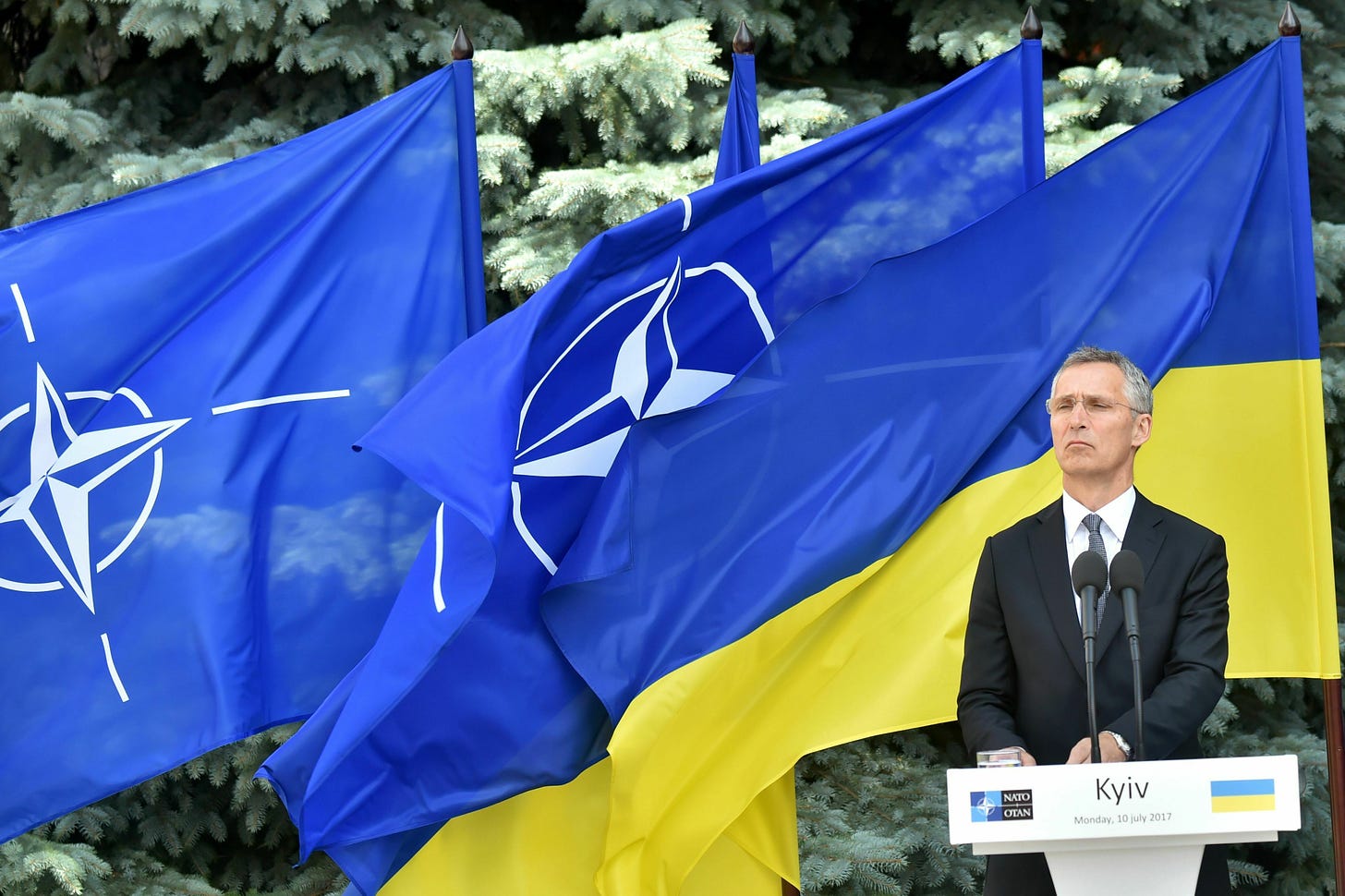
Why Ukraine should not have the “right” to join NATO
BY GLENN DIESEN | JULY 2, 2024
Political realism is commonly and mistakenly portrayed as immoral because the principal focus is on the inescapable security competition and it thus rejects idealist efforts to transcend power politics. However, because states cannot break with security competition, morality for the realist entails acting in accordance with the balance of power logic as the foundation for stability and peace. Idealist efforts to break with power politics can then be defined as immoral by undermining the management of security competition as the foundation of peace. As Raymond Aron expressed in 1966: “The idealist, believing he has broken with power politics exaggerates its crimes”.[1]
Ukraine’s Sovereign Right to join NATO
The most appealing and dangerous idealist argument that destroyed Ukraine is that it has the right to join any military alliance it desires. It is a very attractive statement that can easily win support from the public as it affirms the freedom and sovereignty of Ukraine, and the alternative is seemingly that Russia should be allowed to dictate Ukraine’s policies.
However, arguing that Ukraine should be allowed to join any military alliance is an idealist argument as it appeals to how we would like the world to be, not how the world actually works. The principle that peace derives from expanding military alliances without taking into account the security interests of other great powers has never existed. States such as Ukraine that border a great power have every reason to express legitimate security concerns, but inviting a rival great power such as the US into its territory intensifies the security competition.
Is it moral to insist on how the world ought to be when war is the consequence of ignoring how the world actually works?
The alternative to expanding NATO is not to accept a Russian sphere of influence, which denotes a zone of exclusive influence. Peace derives from recognising a Russian sphere of interests, which is an area where Russian security interests must be recognised and incorporated rather than excluded. It did not use to be controversial to argue that Russian security interests must be taken into account when operating on its borders.
Mexico has plenty of freedoms in the international system, but it does not have the freedom to join a Chinese-led military alliance or host Chinese military bases. The idealist argument that Mexico can do as it pleases implies ignoring US security concerns, and the result would likely be the US destruction of Mexico. If Scotland secedes from the UK and then joins a Russian-led military alliance and hosts Russian missiles, would the English still champion the principle that it has no say? Idealists who sought to transcend power politics and create a more benign world would instead intensify the security competition and instigate wars.
The Morality of Opposing NATO Expansionism
To argue that NATO expansionism provoked Russia’s invasion is regularly condemned by idealists as immoral because it allegedly legitimises both power politics and the invasion. Is objective reality immoral if it contradicts the ideal world we would like to exist?
The former British ambassador to Russia, Roderic Lyne, warned in 2020 that it was a “massive mistake” to push for NATO membership for Ukraine: “If you want to start a war with Russia, that’s the best way of doing it”.[2] Angela Merkel acknowledged that Russia would interpret the possibility of Ukrainian NATO membership as a “declaration of war”.[3] CIA Director William Burns also warned against drawing Ukraine into NATO as Russia fears encirclement and will therefore be under enormous pressure to use military force: “Russia would have to decide whether to intervene; a decision Russia does not want to have to face”.[4] The advisor to former French President Sarkozy argued that the US-Ukraine Charter on Strategic Partnership in November 2021 “convinced Russia that they must attack or be attacked”.[5] None of the aforementioned people sought to legitimise an invasion, rather they sought to avoid a war.
When great powers do not have a soft institutional veto, they use a hard military veto. The idealists insisting that Russia should not have a veto on NATO expansion pushed for the policies that predictably resulted in the destruction of a nation, the loss of territory, and hundreds of thousands of deaths. Why do the idealists get to present themselves as moral and “pro-Ukrainian”? Why are the realists who for more than a decade warned against NATO expansion immoral and “anti-Ukrainian”? Are these labels premised on the theoretical assumption of the idealists?
NATO as a Third Party?
Suggesting that Ukraine has the sovereign right to join NATO presents the military bloc as a passive third party that merely supports the democratic aspiration of Ukrainians. This narrative neglects that NATO did not have an obligation to offer future membership to Ukraine. Indeed, the Western countries signed several agreements with Moscow after the Cold War, such as the Charter of Paris for a New Europe, to collectively construct a Europe without dividing lines and based on indivisible security. NATO broke these agreements by pushing for expansion and refusing to offer Russia security guarantees to mitigate the security competition. By offering future membership to Ukraine, the NATO-Russia conflict became a Russia-Ukraine conflict as Russia had to prevent Ukraine from joining the military bloc and hosting the US military on its territory.
NATO’s support for Ukraine’s right to choose its own foreign policy is also dishonest as Ukraine had to be pulled into the orbit of the military bloc against its will. The Western public is rarely informed that every opinion poll between 1991 and 2014 demonstrates that only a very small minority of Ukrainians ever wanted to join the alliance. NATO recognised the lack of interest by the Ukrainian government and people as a problem to be overcome in a report from 2011: “The greatest challenge for Ukrainian-NATO relations lies in the perception of NATO among the Ukrainian people. NATO membership is not widely supported in the country, with some polls suggesting that popular support of it is less than 20%”.[6]
The solution was to push for a “democratic revolution” in 2014 that toppled the democratically elected government of Ukraine in violation of its constitution and without majority support from Ukrainians. The leaked Nuland-Pyatt phone call revealed that the US was planning a regime change, including who should be in the post-coup government, who had to stay out, and how to legitimise the coup.[7] After the coup, the US openly asserted its intrusive influence over the new government it had installed in Kiev. The general prosecutor of Ukraine, Viktor Shokin, complained that since 2014, “the most shocking thing is that all the [government] appointments were made in agreement with the United States” and Washington “believed that Ukraine was their fiefdom”.[8] A conflict with Russia could be manufactured that would create a demand for NATO.
What were the first decisions of the new government hand-picked by Washington? The first decree by the new Parliament was a call for repealing Russian as a regional language. The New York Times reports that on the first day following the coup, Ukraine’s new spy chief called the CIA and MI6 to establish a partnership for covert operations against Russia that eventually resulted in 12 secret CIA bases along the Russian border.[9] The conflict intensified as Russia responded by seizing Crimea and supporting a rebellion in Donbas, and NATO sabotaged the Minsk peace agreement that the overwhelming majority of Ukrainians voted to have implemented. Preserving and intensifying the conflict gave Washington a dependent Ukrainian proxy that could be used against Russia. The same New York Times article mentioned above, also revealed that the covert war against Russia after the coup was a leading reason for Russia’s invasion:
“Toward the end of 2021, according to a senior European official, Mr. Putin was weighing whether to launch his full-scale invasion when he met with the head of one of Russia’s main spy services, who told him that the C.I.A., together with Britain’s MI6, were controlling Ukraine and turning it into a beachhead for operations against Moscow”.[10]
The Immorality of Peace vs Morality of War?
After Russia’s “unprovoked” invasion of Ukraine, the idealists insist that Ukraine must become a member of NATO as soon as the war is over. It is intended as an appealing and moral statement to ensure that Ukraine will be protected and such a tragedy will not be repeated.
Yet, what does it communicate to Russia? Whatever territory Russia does not conquer will fall into the hands of NATO, which can then be used as a frontline against Russia. The threat of NATO expansion incentivises Russia to seize as much territory as possible and ensure what remains is a deeply dysfunctional rump state. The only thing that can bring peace to Ukraine and end the carnage is to restore its neutrality, yet the idealists denounce this as deeply immoral and thus unacceptable. To repeat Raymond Aron: “The idealist, believing he has broken with power politics exaggerates its crimes”.[11]
[1] Aron, R., 1966. Peace and War: A Theory of International Relations. Doubleday, Garden City, p.584.
[2] R. Lyne, ‘The UC Interview Series: Sir Roderic Lyne by Nikita Gryazin’, Oxford University Consortium, 18 December 2020.
[3] A. Walsh, ‘Angela Merkel opens up on Ukraine, Putin and her legacy’, Deutsche Welle, 7 June 2022.
[4] W.J. Burns, ‘Nyet means nyet: Russia’s NATO Enlargement Redlines’, Wikileaks, 1 February 2008.
[5] C. Caldwell, ‘The War in Ukraine May Be Impossible to Stop. And the U.S. Deserves Much of the Blame’, The New York Times, 31 May 2022.
[6] NATO, ‘‘Post-Orange Ukraine’: Internal dynamics and foreign policy priorities’, NATO Parliamentary Assembly, October 2011, p.11.
[7] BBC, ‘Ukraine crisis: Transcript of leaked Nuland-Pyatt call’, BBC, 7 February 2014.
[8] M.M. Abrahms, ‘Does Ukraine Have Kompromat on Joe Biden?’, Newsweek, 8 August 2023.
[9] A. Entous and M. Schwirtz, 2024. ‘The Spy War: How the C.I.A. Secretly Helps Ukraine Fight Putin’, The New York Times, 25 February 2024.
[10] A. Entous and M. Schwirtz, 2024. ‘The Spy War: How the C.I.A. Secretly Helps Ukraine Fight Putin’, The New York Times, 25 February 2024.
[11] Aron, R., 1966. Peace and War: A Theory of International Relations. Doubleday, Garden City, p.584.
Zelensky Calls on World to ‘Force Putin to Make Peace’
By Kyle Anzalone | The Libertarian Institute | July 1, 2024
In a series of posts on social media, President Volodymyr Zelensky demanded more weapons from his Western backers so Russia can be “forced” into a peace agreement. Advanced warplanes, long-range missiles, and air defenses were named on the Ukrainian leader’s wishlist.
In an X post, Zelensky acknowledged that Ukraine was struggling to combat Russian glide bombs, and Kiev needed a significant influx of arms. “Russian bombs remain Putin’s key capability to wage war. The sooner the world helps us neutralize Russia’s combat aviation launching these bombs and the sooner we can strike back with justified strikes,” he implored on Sunday. “The world possesses enough strength to force Russia to make peace.”
Zelensky has sought to impose peace on Russia that requires President Vladimir Putin to stand trial for war crimes and Moscow to withdraw to Ukraine’s pre-2014 borders. Putin has offered Ukraine a deal that will require Kiev to recognize Russia’s claims to territory it has captured since 2022. Under Moscow’s proposal, Kiev would also have to agree to neutrality.
Washington and Kiev’s Western backers have firmly rejected any of Moscow’s offers for diplomacy and have pushed Ukraine to expel the invading Russian soldiers. However, as the conflict turned into a war of attrition, Russia gained the upper hand with a larger population and military-industrial base that outproduces Ukraine’s collective supporters.
In a separate post, Zelensky discussed his requests to a bipartisan group of American lawmakers. “We discussed key areas of further American assistance, including additional air defense systems. This is critically important, as the Patriot systems save lives and protect infrastructure,” he wrote.
Washington has struggled to provide Kiev with all the air defenses it has requested. Zelensky has only received a fraction of the Patriot systems he has demanded. Interceptors are in short supply with the White House recently announcing that it would give Ukraine priority for newly produced missiles.
On Monday, Zelensky made a third appeal for arms on X. “Life must prevail over the Russian war and all of Putin’s hostile ambitions. This is absolutely possible. But only if we sustain not just our courage but also the courage of our partners.” He continued, “Long-range weapons, fighter jets for Ukraine—of sufficient quality and quantity, and more air defense systems—are crucial factors affecting the entire course of this war.”
Zelensky said Ukraine needed to be able to “neutralize Russia’s combat aviation launching these bombs and… Russian military infrastructure and airfields.” While Washington and a number of other NATO countries have signed off on Kiev using their weapons to hit targets in Russia, Zelensky has asked the West to remove restrictions on where inside Russia the munitions can hit.
Additionally, Ukraine has used drones to hit Russian radar sites that are critical to Moscow’s ability to detect incoming nuclear weapons.
Top Shelf
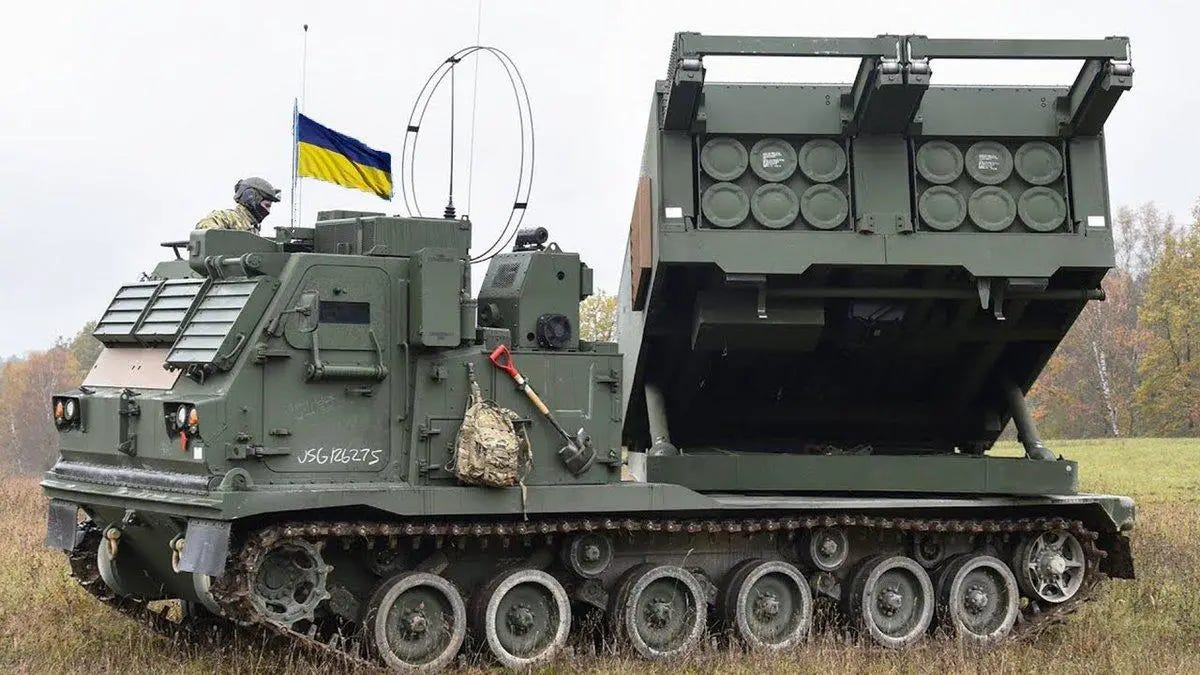
American-made M-270 Multiple Launch Rocket System
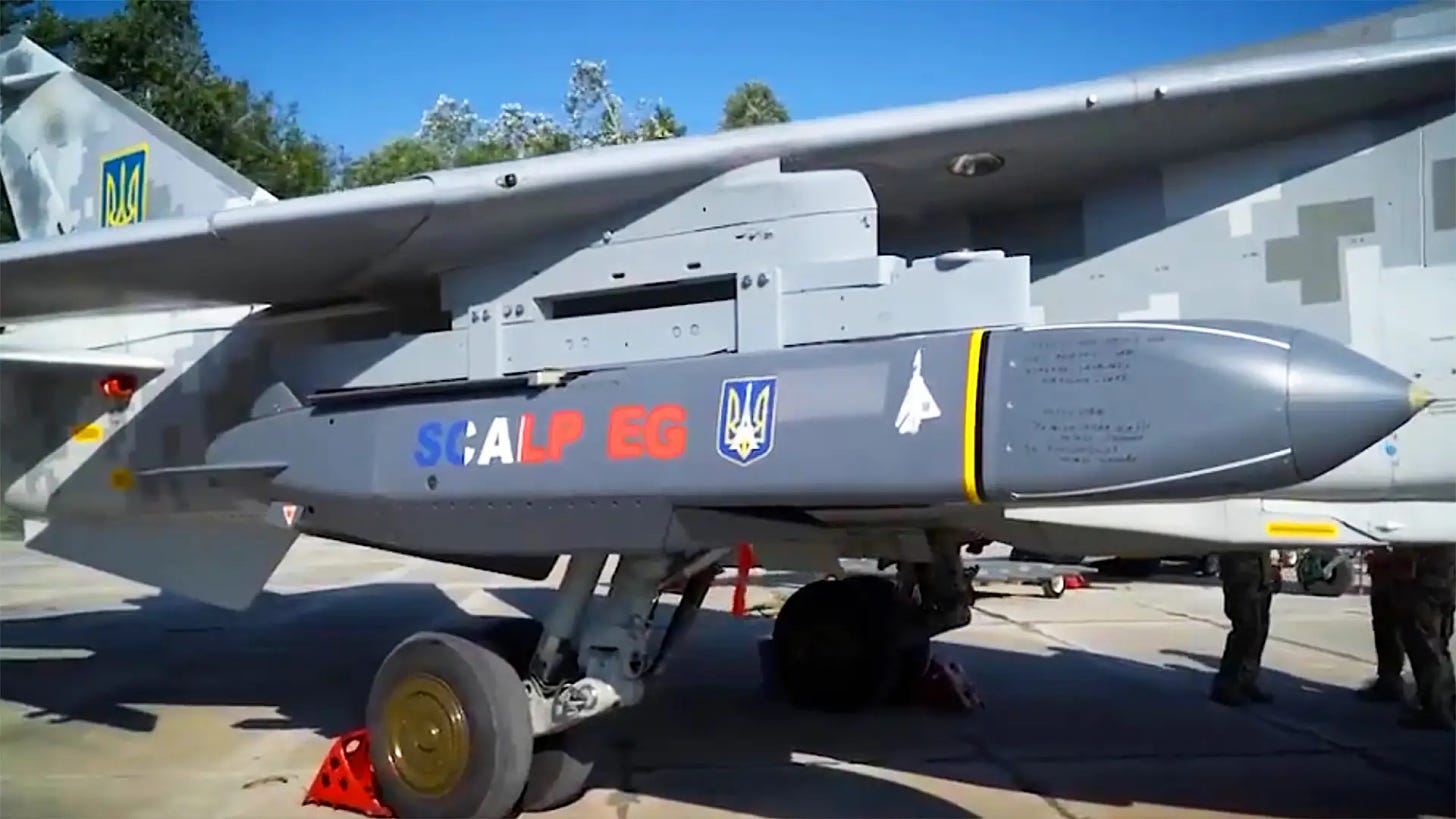
French-made SCALP-EG Cruise Missile
By William Schryver – imetatronink – July 1, 2024
I grow weary of the increasingly pervasive myth that the US/NATO has sent to Ukraine nothing but its antiquated equipment and munitions.
SOME of the equipment sent has been older generation specimens. But ALMOST EVERYTHING sent is representative of what would constitute a large proportion of any US/NATO front-line combined arms army.
– Virtually ALL the artillery tubes sent to Ukraine, whether towed or self-propelled, are the same types NATO armies could presently field.
– Virtually ALL the armored vehicles, of all types, are the same types NATO armies would field in large numbers in a war against Russia.
– ALL the precision-guided strike munitions the US/NATO have fielded in Ukraine are the best available: Javelins, NLAWS, Excalibur, GMLRS and GLSDB for HIMARS, JDAMs, Switchblade, HARMS, Storm Shadow/SCALP, ATACMS, etc.
– ALL the air-defense systems fielded in Ukraine have been top-shelf front-line stuff: IRIS-T, NASAMS, Patriot, etc.
– Most, if not all, of the electronic warfare and counter-battery radars are “best available”.
– The ISR (Intelligence, Surveillance, Reconnaissance) is not only “best available”, but it has been ubiquitous and uninterrupted.
I’m sure there must be some other examples I’m neglecting to cite.
When one examines in aggregate the implements of war the US/NATO have provided to Ukraine, the overwhelming majority consists of the very stuff every military in NATO would field in a war against Russia.
A very small proportion could be reasonably characterized as “antiquated storage-depot junk”.
It must also be recognized (as is now common knowledge) that effectively ALL the precision-guided strike munitions, air-defense systems, and theater ISR assets are being operated by “NATO-affiliated volunteers” – and, not rarely, active NATO personnel.
It is a demonstrable and incontrovertible fact that, in terms of what has been delivered to Ukraine, the US and its NATO underlings have, with very few exceptions, sent their “best stuff”.
And I challenge anyone to craft a persuasive argument built around the proposition that: “If the Americans sent their best stuff, it would dominate on the battlefield against the Russians.”
Russia Threatens US Drones in Black Sea Aiding Attacks on Crimea
By Kyle Anzalone | The Libertarian Institute | June 30, 2024
In response to Ukrainian attacks on the Crimean Peninsula, tensions between the US and Russia have significantly escalated, with Moscow threatening US drones operating over the Black Sea. The Kremlin says the drones are part of the Ukrainian operations in the region.
On Friday, the Russian Defense Ministry said there had been an uptick in American drone operations in the Black Sea “carrying out reconnaissance” of the Crimean Peninsula. The statement explained that the Russian military was instructed to prepare an “operational response” to the flights.
The remarks followed a Ukrainian attack using US cluster munitions that caused the death of four civilians and wounded hundreds of others. Moscow argues that Washington’s support for Kiev makes the US effectively a party to the conflict. “This demonstrates the increasing involvement of the United States and NATO countries in the conflict in Ukraine on the side of the Kiev regime,” the Defense Ministry said.
As Ukrainian forces have continued to lose territory to Russia on the battlefield, its Western backers have significantly stepped up support for Kiev. The US has allowed Ukraine to use its munitions to strike Russia, signed off on the transfer of F-16s to Ukraine, and sent Abrams Tanks to Ukraine, all actions the White House previously warned could risk provoking World War Three.
The Defense Ministry noted the Western escalations, including the drone flights, “increase the risk of a direct confrontation between the alliance and Russia.”
Russian Deputy Foreign Minister Sergei Ryabkov explained the Kremlin is still working on its response to the attack on Crimea. “The tragedy that occurred in Sevastopol will certainly not remain and does not remain without our response.” He added, “I think that the idea of certain permissible scenarios is also on the minds of many in the West. They should feel the extreme risks associated with such actions.”
Turkish, Syrian officials to meet in Baghdad for rapprochement: Report
Press TV – June 30, 2024
Turkish and Syrian officials are expected to meet in the Iraqi capital Baghdad for potential rapprochement between their respective countries, and restoration of diplomatic relations which were severed more than 12 years ago.
Syria’s al-Watan daily newspaper, citing informed sources who asked not to be named, reported that the upcoming meeting will be the first step on the path of a long process of negotiations that would result in political understandings.
The sources added that Ankara has called on Moscow and Baghdad to prepare the ground for Turkish diplomats to sit at the negotiating table with the Syrian side without any third party or members of the press present.
Al-Watan noted that the initiative for Turkey-Syria rapprochement, and restoration of their diplomatic ties has received broad support from Arab states, especially from Saudi Arabia and the United Arab Emirates, as well as from Russia, China and Iran.
On Friday, Turkish President Recep Tayyip Erdogan said there is no reason for his country not to forge renewed ties with neighboring Syria.
“There is no reason not to establish (relations with Syria),” Erdogan told reporters after Friday prayers in Istanbul.
He emphasized that Ankara has no plans or goals to interfere in Syria’s internal affairs.
“Just as we once developed relations between Turkey and Syria, we will act together in the same way again,” he added.
Turkey severed its relations with Syria in March 2012, a year after the Arab country found itself in the grip of rampant and deadly violence waged by foreign-backed militants, including those allegedly supported by Ankara.
The process of normalizing ties between Ankara and Damascus kicked off on December 28, 2022, when the Russian, Syrian and Turkish defense ministers met in Moscow, in what was the highest-level meeting between the two sides since the outbreak of the Syria conflict.
Since 2016, Turkey has conducted three major ground operations against US-backed militants based in northern Syria.
The Turkish government accuses the US-backed Kurdish People’s Protection Units (YPG) militants of bearing ties with the Kurdistan Workers’ Party (PKK) militant group.
Syria considers the Turkish presence on its soil to be illegal, saying it reserves the right to defend its sovereignty against the occupying forces.
Syrian President Bashar al-Assad has tied rapprochement with Turkey to Ankara’s ending its occupation of the northern parts of the Arab country and its support for militant groups wreaking havoc and fighting against the Damascus government.
Russian Forces Use Underground Tunnel to Seize Major Ukrainian Stronghold in Donbass
Sputnik – 30.06.2024
Russian troops captured a major Ukrainian stronghold in the eastern part of Kirovo in Donbass, the Ministry of Defense said in a statement.
“The major Ukrainian stronghold on the eastern outskirts of the town of Kirovo was taken by assault units from the Veterans squad of the Tsentr Battlegroup using an underground tunnel,” the statement said.
The fighters secretly cleared and utilized a tunnel over three kilometers long along the Seversky Donets channel, then entered the rear of the fortified position, which featured long-term firing points and underground shelters.
“The soldiers established a supply route through the tunnel, providing the assault troops with ammunition, weapons, and food,” the ministry added.
The ministry emphasized that the surprise element allowed the unit to successfully take full control of the position. Some Ukrainian soldiers surrendered, while others abandoned their posts and retreated.
Earlier on Sunday, the ministry reported that the Tsentr Battlegroup’s units had liberated the settlement of Novoalexandrovka in the Donetsk People’s Republic, improved their tactical position, and inflicted losses on the formations of the 23rd, 47th Mechanized, 95th Air Assault, 59th Motorized Infantry Brigades and the 2nd Brigade of the Ukrainian National Guard in the areas of Toretsk, Kirovo, Mikhailovka, Novgorodskoye, Volch’ye, Shevchenko, Sokol, and Vishnevoye. The enemy suffered losses of up to 370 soldiers, eight vehicles, four howitzers, two anti-tank guns, and a counter-battery radar station.
Trump the Peacemaker? How his presidency might help end the war in Ukraine
By Tarik Cyril Amar | RT | June 29, 2024
The likely next president of the US, Donald Trump, has signaled that he has a plan for bringing the war in Ukraine to an end. Or, at least, two of his advisers have such a plan. More importantly, they have submitted it to Trump. And most importantly, they have said that he has responded positively.
As one of the plan’s authors has put it, “I’m not claiming he agreed with it or agreed with every word of it, but we were pleased to get the feedback we did.” It is true that Trump has also let it be known that he is not officially endorsing the plan. However, it is obvious that this is a trial balloon which has been launched with his approval. Otherwise, we would have either not have heard about it or it would have been disavowed.
The two Trump advisers are Keith Kellogg, a retired lieutenant general, and Fred Fleitz, a former CIA analyst. Both held significant positions on national security matters during Trump’s presidency. Currently, both play important roles at the Center for American Security: Kellogg serves as co-chair and Fleitz as vice chair. Both, finally, are clear about their belief in what is perhaps Trump’s single most defining foreign policy concept: America First. Fleitz recently published an article asserting that “only America First can reverse the global chaos caused by the Biden administration.” For Kellogg, the “America First approach is key to national security.” The Center for American Security, finally, is part of the America First Policy Institute, an influential think tank founded in 2022 by key Trump administration veterans to prepare policies for his comeback.
Clearly, this is a peace plan that has not come out of nowhere. On the contrary, it has not merely been submitted to Trump to receive his – unofficial – nod, it has also emerged from within Trumpism as a resurgent political force. In addition, as Reuters has pointed out, it is also the most elaborate plan yet from the Trump camp on how to get to peace in Ukraine. In effect, this is the first time that Trump’s promise to rapidly end this war, once he is back in the White House, has been fleshed out in detail. The adoption of the plan or any similar policy would obviously mark a massive change in US policy. Hence, this is something that deserves close attention.
What does the plan foresee? In essence, it is built on a simple premise: to use Washington’s leverage over Ukraine to force the country to accept a peace that will come with concessions, territorial and otherwise. In the words of Keith Kellogg, “We tell the Ukrainians, ‘You’ve got to come to the table, and if you don’t come to the table, support from the United States will dry up’.” Since Kiev is vitally dependent on American assistance, it is hard to see how it could resist such pressure. Perhaps to give an appearance of “balance” for the many Republicans still hawkish on Russia, the plan also includes a threat addressed to Moscow: “And you tell Putin,” again in Kellogg’s terms, “he’s got to come to the table and if you don’t come to the table, then we’ll give Ukrainians everything they need to kill you in the field.”
Yet it is obvious that, despite the tough rhetoric about Russia, the plan will cause great anxiety in Kiev, not Moscow, for two reasons. First, the threats addressed to Russia and Ukraine are not comparable: If the US were to withdraw its support from Ukraine, Kiev’s Zelensky regime would quickly not just lose the war but collapse. If the US were to, instead, increase its support for the Zelensky regime, then Moscow would respond by mobilizing additional resources, as it has done before. It might also, in that case, receive direct military assistance from China, which would not stand by and watch a potential Russian defeat unfold, because that would leave Beijing alone with an aggressive, emboldened West. In addition, Washington would, of course, have to weigh the risk of Russia engaging in counter-escalation. In sum, the plan threatens Ukraine with certain defeat, regime, and, possibly, even state disintegration; it threatens Moscow with a harder time – a type of threat that has no record of success.
The second reason the plan is bad news for Ukraine but not for Russia is that the peace it aims at is much closer to Moscow’s war aims than to those of Kiev. While the document that has been submitted to Trump has not been made public, American commentators believe that a paper published on the site of the Center for American Security under the title “America First, Russia, & Ukraine” is similar to what he – or his staff – got to see. Also authored by Kellogg and Fleitz, this paper, too, repeatedly stresses just how “tough” Trump used to be toward Russia. Plenty of strutting there for those who like that kind of stuff.
These statements, however, are balanced by an emphasis on what used to be called diplomacy: “At the same time,” we read, “Trump was open to cooperation with Russia and dialogue with Putin. Trump expressed respect for Putin as a world leader and did not demonize him in public statements … This was a transactional approach to US-Russia relations … to find ways to coexist and lower tensions … while standing firm on American security interests.”
That already is a tone that Kiev cannot but find disconcerting. Because under Biden, US strategy – and therefore that of the collective West – has been built not merely on an extremely belligerent approach (as if that were not bad enough already) but, more importantly and more detrimentally, on the obsessive idea that there is no alternative. Everything, to its adherents, is “appeasement” except constant escalation to “win.” There is no room for genuine quid pro quos and compromise. That attitude is vital to America’s unrelenting support for Ukraine and, in particular, the fact that it has crossed one red line (meaning those previously recognized by Washington itself) after the other, with no (good) end in sight.
Hence, a Trumpist approach that is also anything but “soft” on Russia, while, however, acknowledging the possibility of de-escalation through negotiation is already a major departure from current US policy. You could even think of it as being inspired by the Reaganite foreign policy of the 1980s, which also combined pronounced “toughness” with a genuine readiness to compromise. Yet there would be one big difference: Toward the end of the Cold War, Washington was dealing with a pliable, even naïve Soviet leadership. That was a grave mistake – if made for mostly admirably idealistic reasons – that Russia’s current leaders see very clearly, are still angry about, and will not repeat.
In the case of the war in Ukraine, this means that any settlement, even with a newly “transactional” Washington “coming to the table” would involve not one but two “tough” players: Moscow will not agree to any compromise that fails to factor in that it has gained the upper hand in this war. That, in turn, means that, beyond the basic Trumpist mood of conditional conciliatoriness, details will be decisive.
Unfortunately for the Zelensky regime and fortunately for everyone else (yes, including many Ukrainians who won’t have to die in a proxy war anymore once peace comes), in that domain as well, the realm of the concrete and specific, the plan developed by Kellogg and Fleitz shows some progress. The authors, first of all, recognize important elements of reality that the current US leadership is either lying or in denial about: for instance, that this is a proxy war as well as a war of attrition, that Zelensky’s “10-point plan” (essentially a blueprint for what could only happen if Ukraine were to win the war, that is, never) “went nowhere,” and that Ukraine cannot sustain the war demographically.
They also acknowledge that Russia will refuse to take part in peace talks or agree to an initial ceasefire if the West doesn’t “put off NATO membership for Ukraine for an extended period.” In fact, an “extended period” will not suffice; Moscow has been clear that never means never. But Kellogg and Fleitz may be formulating their ideas carefully with a view to how much their readers in America can take at this point. The plan also, again realistically, raises the option of offering a partial and, eventually, complete dropping of sanctions against Russia. Ukraine, on the other side, would not have to give up the aim of recovering all its territory, but – a crucial restriction – would have to agree to pursue it by diplomatic means only. The implication is, of course, that Kiev would have to give up de facto control over territory in the first place.
And there you have it: This is a proposal that, pared down to essentials, foresees territorial concessions and no NATO membership for Ukraine. It’s no wonder that Kellogg and Leitz conclude their paper by admitting that “the Ukrainian government,” “the Ukrainian people” (that is sure to be an over-generalization, by the way), and “their supporters” in the West will have trouble accepting this kind of negotiated peace. We could add: especially after more than two years of an avoidable (as the authors also recognize) and bloody proxy war. Yet that tragedy has already happened. We can wish it had not, but we cannot undo the past. The real question is about the future. Kellogg and Leitz, and Trump as well, if he will follow such a policy, are right that the dying must end, and that the only way to make it end – as well as avoid further escalation, perhaps to global war – is a compromise settlement built on reality.
Tarik Cyril Amar is a historian from Germany working at Koç University, Istanbul, on Russia, Ukraine, and Eastern Europe, the history of World War II, the cultural Cold War, and the politics of memory.
Featured Video

Racist Seinfeld Dances for Joy as Bibi Unveils His New Map
or go to
Aletho News Archives – Video-Images
TV Drama Review
Japanese drama projects Japan’s wartime atrocities onto Chinese characters

Global Times | October 25, 2026
By portraying Chinese characters as perpetrators of ruthless violence while casting Japanese Self-Defense Forces (SDF) intelligence operatives as defenders, the season 2 of the Japanese drama Vivant has recently drawn criticism from Chinese netizens, who argue that its depiction turns historical reality on its head while ignoring Japan’s wartime atrocities.
The TBS drama series – a spy suspense story in which an alleged unofficial intelligence unit of the SDF operates across the globe — has attracted a passionate fanbase. Its currently airing season 2 opened with a household rating of 18.8 percent, the highest for a TV drama this year, according toa commentary article by Japanese media Toyo Keizai.
What draws attention is the portrayal of the enemies in the series, the article noted. Scenes in which the Chinese organization subjects kidnapped members of the SDF unit to brutal torture are repeated with unrelenting intensity.
It is rare for Japanese TV dramas to explicitly portray a real-life country as the enemy, the article noted.
Japanese Prime Minister Sanae Takaichi also made a reference to the drama, saying that she has been recording Vivant and hopes to binge-watch it over the year-end and New Year holidays, according to Japanese media outlets.
China’s CCTV News report on Sunday revealed that the drama features scenes in which Chinese personnel cut off the fingers of and stab Japanese intelligence operatives in the abdomen. Such acts bear striking similarities to the torture inflicted on Chinese nationals by invading Japanese troops during the World War II.
The drama distorts the truth by attributing these atrocities to modern Chinese characters. Beneath the surface, it subtly glorifies Japan’s cross-border overseas operations, blurs the functional boundaries of the SDF and implicitly promotes an expansionist narrative, per CCTV News. … continue
Blog Roll
 Aletho News
- Iran FM Araghchi: “Hormuz Will No Longer Be the Same”
- EU facing trillion-euro debt hole while seeking more cash for Kiev
- How US, Europe, Persian Gulf states exhausted missile stockpiles, splurged billions to defend Israel
- Up in arms… Koreans reject U.S. empire’s plan to make South Korea the next Ukraine
- Iran, Turkey, Pakistan, Saudi Arabia could advance region-led security framework in Tehran: FM spox
- Netizens condemn Japanese drama for projecting Japan’s wartime atrocities onto Chinese characters
- Racist Seinfeld Dances for Joy as Bibi Unveils His New Map
- A West Bank War for Netanyahu’s Election Campaign, Could It Backfire?
- Yemen denounces European Parliament’s ‘hypocritical’ push to blacklist Ansarullah
- Qalibaf: UAE’s UN bid aims to ‘clear the runway’ for ‘Greater Israel’, whitewash genocide
- If Americans Knew
- An error has occurred; the feed is probably down. Try again later.
- No Tricks Zone
- Sudden Stratospheric Warming, Powerful El Niño Combination May Lead To Extreme Europe Cold, Energy Crisis!
- Two New Studies Find Thwaites Glacier Melt Cannot Be Driven By Human Activity Or A Warming Ocean
- E-Cars Reduce CO2 Emissions By Only 41% Compared To Internal Combustion Engine Vehicles
- Predictions Made By Renowned Climate Professor Over Past Decades Have Been Proven To Be Poor
- New Study Suggests Large Regions Of The Pacific Ocean Have Been Cooling For The Last 80 Years
- Germany’s Green Energy Debacle: High Energy Costs Force Kahla Porzellan to Close After 182 Years!
- New Study: 50 Years Of The Most Aggressive ‘Net Zero’ Policies Can Only Affect The Global Climate By 0.03°C
- US September “Heat” Was No Record…Many Records Set Decades Ago
- Latest European Green Energy Debacle; Portugal’s Largest Flagship Solar Park Insolvent!
- Green Energy Debacle: German Expert Professor Fritz Vahrenholt Warns Of Severe Economic And Social Consequences

