Russia could challenge NATO’s historical air dominance – media
By Ahmed Adel | July 15, 2024
Business Insider reported that NATO had never faced an adversary of Russia’s calibre after World War II, and it would have been difficult for the alliance to establish air superiority over Russian forces. The warning comes as experts have explained the sombre reality that the F-16 fighter jets, a key aircraft in many NATO air force fleets, provided to Kiev will not be a “magic bullet” that Ukrainian President Volodymyr Zelensky and his Western allies expect them to be.
“Russia could challenge NATO’s historical air dominance,” reported the media on July 13 after explaining that this is a change from the scenario that emerged after the Cold War when the West had a clear advantage. “Russia would be a very different opponent. It has the territory and industry to build and field massive and sophisticated air defenses that an opponent may struggle to destroy.”
“The US and its allies, even with fleets of fifth-generation stealth fighter jets, likely would find it difficult to establish the same level of air dominance they’ve largely had since the end of World War II,” the New York-based outlet said.
According to experts cited by the portal, Western aviation has never had the experience of combating air defence systems at a level similar to that of Russia’s. During the conflict in Ukraine, the Russian military proved that it could establish extremely difficult air defence areas for the enemy with powerful radars, electronic warfare systems and missiles.
“The Russians could attempt a surprising and impactful opening attack,” the article warned. “For example, the Russians could target vulnerabilities like satellites to try to disrupt the space-based communications and navigation NATO airpower depends upon.”
The worry that Russia could establish air superiority over NATO, particularly over the bloc’s 30 European members, became a more serious consideration after Russian forces methodically obliterated Ukraine’s air force. Russia so impressively dismantled the Ukrainian air force that the Kiev regime is desperately seeking F-16 fighter jets from Western allies to replenish its fleet, even though experts are saying that the aircraft is now obsolete and unlikely to survive the conflict.
“As soon as the Ukrainians encountered Russian-controlled air space, the F-16’s value would diminish markedly, as would its likelihood of survival,” Harrison Kass wrote for the National Interest. “In a conflict with a great power, China for example, the F-16 would remain on the backbench.”
This is a telling revelation considering the US still uses over 900 F-16s, NATO members, including Turkey, Greece, Poland, and Romania, use hundreds more, as well as US non-NATO allies Israel, Taiwan and South Korea. In effect, the F-16 would be rendered almost useless against Russia given that the Eastern European country’s military is ranked second, one above China, according to the 2024 PowerIndex.
Kass warns Kiev that the good performance of the F-16 fighter jets in Iraq and Afghanistan does not say anything about their capabilities against Russian air defences.
After stressing that “the F-16 fighting falcon era is coming to a rapid end,” Kass concludes that the US-made fighter jet “will not offer a magic bullet for Zelensky” and will merely “buy a little more time.”
Russian President Vladimir Putin has warned that the F-16s supplied to Kiev will be destroyed just like other Western military equipment. Russian Foreign Minister Sergey Lavrov also warned that their appearance in Ukraine will not change anything on the front and that they will be destroyed in the same way as other types of weapons.
Nonetheless, in 2023, several NATO states agreed to supply the Ukrainian armed forces with the fighter jets and launched training programs for Ukrainian pilots. On July 10, US Secretary of State Antony Blinken said that the US and its allies are “underway” in sending the promised F-16 fighter jets to Ukraine.
As Europe and the US are not interested in a viable, pragmatic, and lasting peace agreement in Ukraine which recognises Russian interests in the region and establishes a lasting solution, they are actively prolonging the fighting despite not only the humanitarian consequences but even the weakening of their own military. Whilst NATO members are distracted with training Ukrainian pilots to use fighter jets that are effectively obsolete in any combat with a great power, Russia, as Business Insider has acknowledged, has successfully challenged the air dominance NATO largely enjoyed since the start of the Cold War despite the introduction of fifth-generation fighter jets.
Ahmed Adel is a Cairo-based geopolitics and political economy researcher.
Ukrainian children still speaking Russian – regulator
RT | July 12, 2024
Ukrainian children don’t know their official state language well enough because they’re still using Russian in their daily lives, Kiev’s Commissioner for the Protection of the State Language Taras Kremin has complained, urging citizens to report violations of language restrictions.
The commissioner said there are also many violations being recorded in the sphere of education, as well as on the internet and in the service industry. He cited a recent study that suggested one-third of children in some Ukrainian regions prefer to speak Russian.
“A child outside of school uses services, visits shopping and catering establishments, sees external advertising and signboards in non-state language, hears non-state at home,” Kremin wrote on Facebook on Thursday.
He suggested that many schoolchildren were therefore prone to bilingualism and do not have sufficient knowledge of the Ukrainian language.
Kremin said Kiev should strengthen control over compliance with the law on state language, which defines Ukrainian as the only language approved for education, and called on citizens to be more involved in recording and reporting violations of the law.
Since gaining its independence in 1991, Ukraine has largely been a bilingual nation, with most citizens able to speak or understand both Russian and Ukrainian, particularly in the eastern half of the country. After the 2014 US-backed coup in Kiev, however, Ukraine’s new authorities abolished Russian as an official regional language and have adopted policies aimed at suppressing and outlawing it, arguing that it represents a threat to national unity and security.
In 2019, the Ukrainian parliament passed a law requiring Ukrainian to be used exclusively in nearly all aspects of public life, including education, entertainment, politics, business and the service industry, obliging all Ukrainian citizens to know the language. It also requires that 90% of TV and film content produced in the country be made in Ukrainian. From July 17, the use of the Russian language in Ukrainian media will be virtually outlawed, Kremen has said.
This forced Ukrainization was one of the reasons why Russian-speaking residents living in the east of the country rejected the post-coup authorities in Kiev in 2014. Many of these regions, namely the Donetsk and Lugansk People’s Republics, as well as Kherson and Zaporozhye regions, have since joined Russia after overwhelmingly voting to do so in public referendums in 2022.
Kremin, however, has denied that the term ‘Russian-speaking’ could be applied to any Ukrainian citizens, stating in an interview last year that the word is a “marker introduced by Russian ideology,” and declaring that “everyone in the country must have command of the Ukrainian language.”
Possible consequences and prospects of Vladimir Putin’s visit to DPRK
By Konstantin Asmolov – New Eastern Outlook – 12.07.2024
The consequences of the visit of the Russian leader to North Korea and the documents signed there are so significant that they can propel the trend of global turbulence. How have Seoul, Beijing and Washington reacted to such a rapprochement between Moscow and Pyongyang and what will be Moscow’s response to the steps taken by Seoul and its allies?
Seoul’s response
Until a certain point, Seoul was ‘the friendliest of the unfriendly countries’ – the Russian president recently noted in a positive way. As Vladimir Putin said on June 5, 2024, within the framework of the International Economic Forum in St Petersburg, “Russia highly appreciates the refusal of ROK to directly supply lethal weapons to Ukraine”.
However, such a demonstrative rapprochement between Pyongyang and Moscow cannot be ignored by Seoul, especially since the content of the Treaty (which contains a military component along the lines of the Soviet-North Korean treaty of 1961) has turned out to match the worst expectations of South Korean analysts.
Even before the visit, South Korean diplomats hinted to the author that Seoul would definitely respond to such a level of cooperation between Moscow and Pyongyang, at least for domestic political and reputation reasons. This response would most likely entail boosting Seoul-NATO cooperation to a similar level. The United States, along with its allies and systemic right-wing politicians, are putting pressure on President Yoon Suk Yeol to take a more anti-Russian stance, especially on the Ukrainian track; Seoul is constantly being convinced that since Pyongyang has been ‘proven’ to be aiding Russia, South Korea has the right to provide similar support to Ukraine, despite all possible risks of retaliatory measures and a significant cooling of relations with Moscow.
In a statement on June 20, 2024, former Ambassador to Russia and current National Security Adviser to the President Chang Ho-jin noted: “Four ships, five organisations and eight individuals from third countries, as well as Russian and North Korean organisations involved in the supply of weapons and oil transshipment between Russia and North Korea, are on the list of independent sanctions… We have also included 243 new items to the list of sanctioned goods exported to Russia, bringing the total number to 1,402 items…We plan on reconsidering the issue of military support for Ukraine, as the government has so far maintained the position that it will not supply lethal weapons to this country”.
Chang’s statement, on the other hand, could not but evoke a threatening reply from Moscow. Vladimir Putin almost immediately declared that the supply of lethal weapons to Ukraine would be a “very big mistake” and that Moscow would in this case make “the appropriate decisions, which the current leadership of South Korea will most likely not appreciate”. However, the Russian president expressed hope that such a thing would not happen.
There was also a natural exchange of reprimands. On June 21, 2024, First Vice Minister of Foreign Affairs of ROK Kim Hong Kyung summoned Russian Ambassador Georgy Zinoviev to convey Seoul’s official position on the Comprehensive Strategic Partnership Agreement between Russia and DPRK from June 19. The vice minister called on Russia to “immediately cease military cooperation with North Korea and comply with UN Security Council resolutions”. He made it clear that ROK, along with the international community, will “resolutely resist any actions that threaten its security”.
Zinoviev said that cooperation between Russia and DPRK is not directed against third countries, complies with the principles and norms of international law and is aimed at strengthening peace and stability on the Korean peninsula. Russia is ready to continue to make political and diplomatic efforts to form an architecture of long-term peace and stability based on the principle of indivisible security”, the ambassador stressed.
Meanwhile Seoul slowly began to backtrack. On June 23, 2024, in a speech on the KBS channels, Chang Ho-jin made it clear that the question of whether South Korea will supply lethal weapons to Ukraine will depend on Russia; if it starts sending high-precision modern weapons to North Korea, then nothing will stop South Korea from helping Ukraine. Among the options under consideration are 155 mm artillery shells and air defence systems.
In essence, the parties formally voiced to each other the long-known, informal red lines: South Korea is not to be engaged in direct supplies of weapons and military equipment to Ukraine and Russia is not to be engaged in the development of the North Korean military potential. It is important for Seoul to prevent the supply of dangerous modern weapons and technologies to the North, and North Korean shells (which are allegedly provided to the Special Military Operation) are a nuisance, but not yet a disaster.
It is worth remembering that, despite his high position, Chang still does not have the right to speak on behalf of the state unlike the president, the prime minister and the foreign minister. If such statements were to come from them as well, then it would indeed be a cause for concern. For now, though, one should wait and see, considering how, on the eve of his visit to the United States, Yoon Suk Yeol stated that the Republic of Korea could start supplying weapons to Ukraine if the Russian Armed Forces were to commit an atrocity.
Thus, the point of no return in relations between Moscow and Seoul has not yet been passed, but we are close. The author hopes for the best, as Moscow and Seoul understand that when crossing the ‘red’ line, Russia will also have to take action in response and South Korea may lose its status as ‘the friendliest of the unfriendly’.
China’s position
The reaction to the visit by the Chinese media and government agencies was between neutral and positive; they did [not] provide any statements of judgement and simply noted that this was an important and serious event. The Chinese Foreign Ministry called the DPRK’s desire to develop relations with Russia normal, and the Global Times noted that this cooperation could perhaps even make the United States afraid.
Western media actively wrote that China was not happy with the rapprochement between Russia and the DPRK that Putin’s visit to North Korea and Vietnam was actually anti-Chinese in nature and that having a parallel 2+2 dialogue shows China’s desire to be friends with Seoul, showing its tough stance to Pyongyang.
This is not exactly true. Firstly, coordination between Moscow and Beijing on the Korean issue has always been and is very close. A look at the joint statements on the Korean issue made during Putin’s visit to China is enough to prove this. This means that the essence of Moscow and Pyongyang’s agreements with Beijing was probably discussed in advance.
Secondly, on June 18 negotiations did indeed take place in Seoul. They were attended by senior officials from the foreign and defence ministries of ROK and China in a 2+2 format.
Before the start of the talks, the official representative of the Ministry of Foreign Affairs of the Republic of Korea, Lim Soo-suk, believed that “issues of cooperation between Russia and North Korea will be discussed, since dialogue is taking place simultaneously with the scheduled visit of the Russian president to North Korea”. Professor of the Hankuk University of Foreign Affairs Kang Jung-young said that “having this dialogue is in itself is a clear signal to North Korea that China will not support Pyongyang’s attempts to create a trilateral bloc with Beijing and Moscow”.
The Korean approach to the 2+2 format is as follows: representatives of Seoul expressed deep concern to their Chinese colleagues about the visit of the Russian president to DPRK and the deepening of ties between Moscow and Pyongyang amid rising tensions on the Korean peninsula. They stressed that the Russian leader’s visit to North Korea should not undermine peace and stability in the region or lead to the strengthening of military cooperation between the two countries. Additionally, ROK called on China to play a constructive role in ensuring peace, stability and security on the Korean peninsula, emphasising that the deepening of Russian-North Korean military cooperation and its consequences run in contradiction to Beijing’s interests. In turn, China confirmed its unchanged position on the Korean peninsula, expressing its readiness to take an active part in solving the problems of the region.
A ‘bloc’ as a limiting factor
Almost immediately after the signing of the comprehensive strategic partnership agreement between the Russian Federation and North Korea, the Russian president noted that there were no fundamentally new points in it and that the document was similar to the 1961 treaty, including Article 4 on ‘automatic military intervention’. According to Putin, the provisions of the new Agreement stipulate that military assistance is provided only in case of aggression, and therefore ROK has nothing to worry about, since there are no known plans of the South to attack the North. The Russian president also expressed the opinion that the Agreement would to some extent limit the threat of the crisis on the Korean peninsula entering a ‘hot phase’.
The author supposes that the cooperation between Moscow and Pyongyang within the framework of a possible military bloc reduces the likelihood of conflict on the Korean peninsula rather than increases it. The fact that the opposing sides are two serious military blocs reduces the likelihood of an escalation of the conflict, as it could too easily escalate to become nuclear, and neither Moscow nor Pyongyang are suicidal.
One more detail: on the one hand, article 4 of the Agreement is harsher than article 5 of the NATO treaty. On the other, it clearly indicates that a state of war is required for comprehensive assistance, and if we recall the 1961 treaty, then it is worth paying attention to the events of 1968 when Moscow clarified to Pyongyang in which situations military assistance would be cancelled.
We should likely expect a confrontation similar to the Cold War. There will be an arms race, muscles will be flexed, loud statements and minor incidents will take place, but the parties are well aware of the red lines and do not intend to cross them. Being prepared for war, including the development of preemptive strike plans as a way of self-defence in a critical situation, is not the same as the desire to initiate a conflict.
The fate of UNSC sanctions
The demonstrative liquidation of UN Security Council sanctions, which was expected in the West, has still not taken place. Both Putin’s article and the additional decree emphasise cooperation in the fields of education, healthcare and science and maintain that the unjust sanctions should be lifted.
For now, though, Moscow says it will comply with the sanctions it previously voted for.
It is likely that the lifting of sanctions may occur following the next round of escalation because regardless of whether there were actually arms deals or not, the West will still blame Moscow and Pyongyang for colluding and take retaliatory measures.
The appearance of a North Korean labour force in Russia is a sign that a de jure or de facto decision to ignore a part of the sanctions has been made. Price, quality, safety and keeping a low profile are the strengths of North Korean builders, and talks of their employment have been going on for a long time.
Summa summarum, there is a lot of uncertainty in the future and the situation is similar to that described in the book ‘The Guns of August’ by Barbara Tuchman: nobody wanted war, so war was inevitable. However, it cannot be said that the visit of the President of the Russian Federation to the DPRK has significantly aggravated the situation.
Konstantin Asmolov, PhD in History, Leading Research Fellow at the Korean Studies Center of the Institute of China and Contemporary Asia of the Russian Academy of Sciences.
Kremlin comments on Türkiye’s SCO bid
Türkiye’s obligations to the US-led military bloc are not consistent with the Eurasian organization’s values, Moscow has said.
RT | July 12, 2024
Türkiye’s bid to become a full member of the Shanghai Cooperation Organization (SCO) is not compatible with its membership in NATO, Kremlin spokesman Dmitry Peskov said on Friday.
Last week, Turkish President Recep Tayyip Erdogan attended a summit of the Eurasian mutual defense group, in which his nation has observer status. While returning home from Kazakhstan, he told journalists that Ankara wants to “further develop” ties with the SCO and its founding members Russia and China. During the NATO leaders’ summit in the US this week, he said Türkiye wants to join the SCO as a permanent member.
Asked by journalists when Turkish accession could be expected, Peskov said there was a problem with such a proposal.
“There are certain contradictions between Turkish commitments and [its] position on fundamental issues as a NATO member and the worldview formulated in the founding documents of the SCO,” he explained.
The expansion of the SCO is of interest to many nations and remains on its agenda, but there is no specific timeline for accepting new members, he added. Commenting later during a press call on bilateral relations with Türkiye, Peskov said Russia was “open for attempts to reach agreements based on a certain worldview.”
Moscow perceives NATO as a hostile, aggressive military organization, which serves US geopolitical interests and is currently conducting a proxy war against Russia in Ukraine.
Despite being a NATO member state, Türkiye has maintained a neutral stance on the Ukraine conflict, refusing to impose economic sanctions on Russia and serving as an intermediary between Moscow and Kiev on several occasions. Ankara helped to mediate a nascent peace deal in the early months of the hostilities, which Kiev eventually ditched in favor of continued fighting. The Russian government believes that the US and its allies, particularly the UK, forced Ukraine to reject the proposal.
The SCO was founded in 2001 and currently has ten full members: Russia, China, India, Iran, Kazakhstan, Kyrgyzstan, Pakistan, Tajikistan, Uzbekistan, and Belarus. Kazakhstan holds the rotating presidency this year and hosted the leaders of member states on July 3 and 4 in Astana.
One of the key pledges to which SCO members subscribe is not to seek the improvement of their own national security at the expense of the national security of other parties. NATO policy does exactly that, according to its critics, including Russia.
US plan to deploy missiles in Germany a ‘direct threat’ – Moscow
RT | July 11, 2024
US plans to deploy long-range missiles in Europe are a threat to global security and could pave the way for an escalation of already tense relations between Moscow and NATO, Russian Ambassador to Washington Anatoly Antonov has said.
On Wednesday, the US and Germany issued a joint statement that America “will begin episodic deployments of the long-range fires capabilities of its Multi-Domain Task Force in Germany in 2026, as part of planning for enduring stationing of these capabilities in the future.”
Washington also said that the systems will include SM-6 and Tomahawk missiles with ranges of up to 460km and 2,400km, respectively, as well as developmental hypersonic weapons. Those assets have a “significantly longer range than current land-based fires in Europe,” the statement added.
In a post on Telegram on Thursday, Antonov denounced the move as “a serious mistake by Washington.” “Such extremely destabilizing steps are a direct threat to international security and strategic stability,” he said.
The envoy stressed that the planned deployment “increases the risks of a missile arms race,” adding that it could unleash “uncontrolled escalation amid dangerously soaring Russia-NATO tensions.”
Antonov also said that Russia has always sought to reduce the risks posed by disagreements over missile capabilities. “Instead of the desire for peace that Russia has demonstrated many times, the Americans have embarked on the dangerous path of militarism,” according to the ambassador.
He emphasized that Russia’s tolerance for encroachments on its security is “not unlimited.” “Doesn’t Germany understand that the emergence of American missile assets on German soil will lead to these facilities ending up in Russian crosshairs? This is not saber-rattling, it is the simple logic of a normal person,” Antonov explained.
He went on to blast the US for not thinking about how to minimize the fallout from the collapse of the Intermediate-Range Nuclear Forces Treaty (INF). Signed in 1987 at the end of the Cold War, it barred Moscow and Washington from possessing many types of nuclear and conventional missiles with ranges of 500 to 5,500km.
The US unilaterally withdrew from the treaty in 2019, citing alleged Russian non-compliance, a charge denied in Moscow. Russian Deputy Foreign Minister Sergey Ryabkov suggested earlier this week that the US pulled out of the agreement to create formerly banned missile systems to put pressure on China.
At the same time, Russia has said that it intends to keep abiding by the INF’s terms, but warned that it could reverse that policy if Washington starts deploying missiles covered by the treaty in any region of the world.
US to deploy long-range weapons in Germany
RT | July 10, 2024
The US will station long-range missiles in Germany from 2026 onwards, the governments of both countries have announced. These weapons, including the SM-6 and Tomahawk systems, were banned on the continent until Washington tore up a landmark Cold War-era treaty in 2019.
According to a joint statement published by the White House, the US will “begin episodic deployments of the long-range fires capabilities of its Multi-Domain Task Force in Germany in 2026, as part of planning for enduring stationing of these capabilities in the future.”
The statement was released following talks between American and German officials at NATO’s annual summit in Washington on Wednesday.
The weapons systems deployed to Germany will include the SM-6 anti-air missile, which has a range of up to 460km (290 miles), and the Tomahawk cruise missile, which can reportedly strike targets more than 2,500km away.
The White House said that “developmental hypersonic weapons” will also be stationed in Germany, and will have a “significantly longer range than current land-based fires in Europe.”
The US has yet to successfully field a hypersonic weapon, and has canceled every hypersonic project since its first successful test in 2017.
Land-launched missiles with a range between 500km and 5,500km were banned on European soil under the Intermediate-Range Nuclear Forces (INF) treaty, signed by Ronald Reagan and Mikhail Gorbachev in 1987. Along with the START-I and START-II agreements, the INF treaty helped defuse nuclear tensions in Europe after the West and the USSR came perilously close to nuclear war during NATO’s Able Archer military exercise in 1983.
The US pulled out of the INF treaty in 2019, with the State Department claiming that some of Russia’s cruise missiles had breached the agreement. Moscow denied this, and Russian President Vladimir Putin warned then-US President Donald Trump that the demise of the treaty would “have the gravest consequences.”
Russia continued to abide by the treaty and imposed a moratorium on the development of missiles that it prohibited. However, Putin announced earlier this month that the Russian defense industry would resume development of such armaments, citing the “hostile actions” of the US.
“We now know that the US is not only producing these missile systems, but has also brought them to Europe, Denmark, to use in exercises. Not long ago, it was reported that they were in the Philippines,” Putin explained at the time.
US and Danish forces trained with SM-6 missiles last September, while the Pentagon deployed its Typhon Weapon System – which can fire both SM-6 and Tomahawk missiles – to the Philippines in April.
High-tech Western weapons ‘useless’ in Ukraine conflict – WSJ
RT | July 10, 2024
Russia’s electronic warfare capabilities have rendered precision-guided Western munitions “useless” in the Ukraine conflict, the Wall Street Journal reported on Wednesday. With their guidance systems scrambled, some of these weapons have reportedly been retired within weeks of hitting the battlefield.
When the US announced the delivery of GPS-guided Excalibur artillery shells to Ukraine in 2022, pro-Kiev outlets predicted that the $100,000-per-shot projectiles would make “Ukrainian artillery a whole lot more accurate” and “cause Russia a world of pain.”
However, the Russian military adapted within weeks, Ukrainian commanders told the Wall Street Journal. Russian signal-jamming equipment was used to feed false coordinates to the shells and interfere with their fuses, causing them to veer off course or fall to the ground as duds.
“By the middle of last year, the M982 Excalibur munitions, developed by RTX and BAE Systems, became essentially useless and are no longer employed,” the newspaper stated, paraphrasing the Ukrainian commanders.
The Soviet Union invested heavily in electronic warfare (EW) during the 1980s, viewing jamming technology as a crucial bulwark against the guided missiles and shells that the US was beginning to develop at the time. While weapons such as the 1990s-era Excalibur shells were used by the US to devastating effect in Iraq and Afghanistan, officials and analysts in Washington have since concluded that they are far less effective against a peer-level opponent like Russia.
“The Russians have gotten really, really good” at interfering with guided munitions, US Deputy Secretary of Defense for Acquisition and Sustainment William LaPlante told the WSJ.
Retired US General Ben Hodges, who once predicted that Western weapons would help Ukraine seize Crimea by last winter, told the newspaper that “we probably made some bad assumptions because over the last 20 years we were launching precision weapons against people that could not do anything about it… and Russia and China do have these capabilities.”
Some of NATO’s most advanced weapons systems have met a similar fate in Ukraine. The newly-developed Ground-Launched Small Diameter Bomb (GLSDB), a joint project of Boeing in the US and Saab in Sweden, was given to Ukraine earlier this year, with Kiev’s troops firing these GPS-guided munitions before their American counterparts. However, it has since been pulled from the battlefield after it proved completely ineffective against Russian EW.
Likewise, Russian EW has significantly blunted the accuracy of Ukraine’s Western-provided GMLRS missiles, which are fired from the HIMARS multiple-launch rocket system, Ukrainian soldiers told the WSJ. As with the Excalibur shells, GMLRS missiles were once described by pro-Kiev pundits and analysts as a “game changer” that would swing the conflict in Ukraine’s favor.
Russia has long insisted that no amount of Western weapons systems will prevent it from achieving victory. Supplying these weapons is a “futile project” that will only encourage Kiev to “commit new crimes,” Moscow’s ambassador to Washington, Anatoly Antonov, warned last week.
Ukraine violates Chemical Weapons Convention – Russian MoD
RT | July 9, 2024
Russia has found evidence that Ukraine has violated the Chemical Weapons Convention, a top military commander stated on Monday.
Lieutenant General Igor Kirillov, who leads Russia’s chemical and biological defense forces, said that the engineering troops discovered a laboratory that was apparently used to produce hydrogen cyanide – an extremely dangerous and highly toxic agent that had been used as a chemical weapon during World War I.
The facility is located near Avdeevka, a fortified Donbass town liberated by Russia in February, the general said. The improvised laboratory itself was found inside a partially destroyed building in an industrial area, which also had a chemical processing plant. The facility had a rotary evaporator and several chemical reactors. Protective clothes, including US-made gas masks and Polish hazmat suits, were found on the site.
According to Kirillov, the samples taken from the facility and analyzed in Russian military laboratories contained traces of sulfuric acid and sodium cyanide, which can be used to produce hydrogen cyanide. Traces of cyanide anions – poisonous chemical compounds of the cyano group – were on multiple equipment, the general said.
The evidence “clearly shows that the laboratory was used to manufacture poisonous substances,” Kirillov stated. According to the Russian Defense Ministry’s estimates, the facility was capable of producing at least three kilograms of chemical agents per day if operated by just two or three people. Hydrogen cyanide can kill a person if they inhale just 70 to 80 milligrams of the agent.
During his briefing, Kirillov noted hydrogen cyanide is among the Chemical Weapons Convention’s so-called “Schedule 3 chemicals” – agents with large-scale industrial uses that have the potential of being used for chemical warfare. He added that, in May 2024, civilians in the Avdeevka region showed symptoms consistent with the hydrogen cyanide poisoning after Ukrainian military drones dropped bombs in the area. Another case was reported in Russia’s Belgorod Region, where Ukrainian ammunition fragments were found that had traces of hydrogen cyanide, Kirillov said.
Kirillov also cited a Ukrainian POW, whom he identified as Sergey Batyr, as confirming that laboratories that stored chemical agents were also used to make kamikaze drones.
In March 2022, Russia accused Ukraine of running a secret biological weapons program with the help of the US. Kiev has denied having biological weapons or other weapons of mass destruction. The Pentagon has described Russia’s claims as “absurd” and “laughable.”
Russia Rules Out All Nuclear Talks With US Until Washington Adopts a ‘Sane’ Approach
By Kyle Anzalone | The Libertarian Institute | July 8, 2024
A top Russian diplomat stressed that the Kremlin is unwilling to engage with the White House on arms control issues due to the Biden administration’s Russophobic stance. Deputy Foreign Minister Sergei Ryabkov argued that President Donald Trump left the Intermediate-Range Nuclear Forces Treaty (INF Treaty) to provoke China.
In an interview with The International Affairs published on Monday, Ryabkov explained Moscow’s position on arms control talks with Washington. “We do not have the foundation right now and we are not even close to shaping one in order to launch a tentative dialogue, not talks even, in this field. This is a result of Washington’s destructive policy course,” he stated.
“Until [the US] clearly show some change for the better in their policy, at the very least, demonstrate that this boundless and unabashed Russophobia has been set aside and is replaced with a slightly more sane approach,” he said, adding, “until this happens, there simply can be no dialogue on strategic stability.”
Since the end of the Cold War, Washington has abandoned a series of agreements that limited the US and Russia’s conventional as well as nuclear arsenals. Additionally, the Kremlin left the New Start Treaty in response to the White House’s support for Kiev.
The deterioration of the global arms control agreement has coincided with a rise in spending on nuclear weapons and arms overall. Both Beijing and Moscow view the launchers as highly provocative. Ryabkov argued Trump left the INF Treaty to build intermediate-range missiles to intimidate China.
“Americans needed to withdraw from the treaty in order to create such systems to intimidate the People’s Republic of China,” Ryabkov said. “And it is no coincidence that we have recently had a sharply intensified discussion about when and where the Americans might begin to deploy their medium-range weapons in the Asia-Pacific region.”
Recently, Washington and Moscow have taken steps to use arms limited by the INF Treaty. The agreement barred land-based missiles, and launchers, with a range of 300-3,400 miles. The US has deployed a covert launcher for intermediate-range missiles to Denmark and the Philippines for war games.
On Friday, Russian President Vladimir Putin said Moscow would begin producing weapons that the INF Treaty outlawed. “We need to start production of these strike systems and then, based on the actual situation, make decisions about where — if necessary to ensure our safety — to place them,” he stated.
Civil War in Donbass 10 Years On
Scroll down for video
By Kit Klarenberg | Global Delinquents | July 8, 2024
July 1st marked the 10th anniversary of a brutal resumption of hostilities in the Donbass civil war. Perhaps unsurprisingly, it passed without comment in the Western media. On June 20th 2014, far-right Ukrainian President Petro Poroshenko called a ceasefire in Kiev’s “anti-terrorist operation”. Launched two months prior following vast protests, and violent clashes between Russian-speaking pro-federal activists and authorities throughout eastern Ukraine, the intended lightning strike routing of internal opposition to the Maidan government quickly became an unwinnable quagmire.
Ukrainian forces were consistently beaten back by well-organised and determined rebel forces, hailing from the breakaway “People’s Republics” in Donetsk and Lugansk. Resultantly, Poroshenko outlined a peace plan intended to compel the separatists to put down their arms, during the ceasefire. They refused to do so, prompting the President to order an even more savage crackdown. This too was a counterproductive failure, with the rebels inflicting a series of embarrassing defeats on Western-sponsored government forces. Kiev was ultimately forced to accept the terms of the first Minsk Accords.
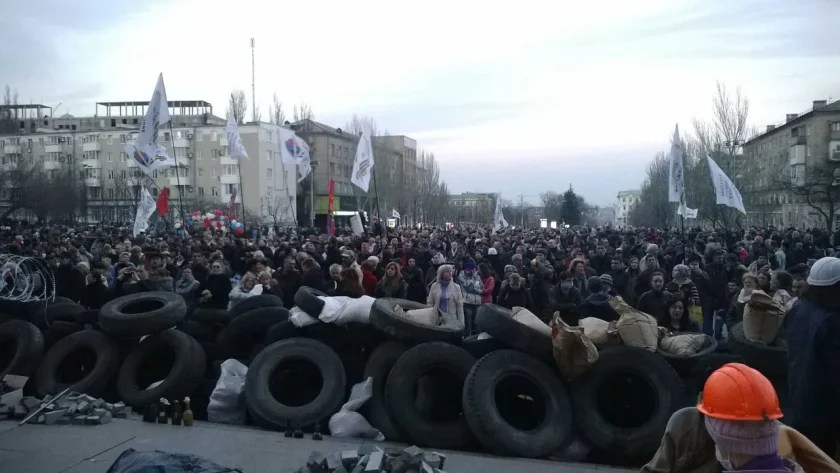
Anti-Maidan protesters gather in front of the occupied Donetsk Oblast regional administration building, April 2014
This agreement, like its successor, did not provide for secession or independence for the breakaway republics, but their full autonomy within Ukraine. Russia was named as a mediator, not party, in the conflict. Kiev was to resolve its dispute with rebel leaders directly. Successive Ukrainian governments consistently refused to do so, however. Instead, officials endlessly stonewalled, while pressuring Moscow to formally designate itself a party to the civil war.
No wonder – had Russia accepted, Kiev’s claims that its savage assault on the civilian population of Donbass was in fact a response to invasion by its giant neighbour would’ve been legitimised. In turn, all-out Western proxy war in eastern Ukraine, of the kind that erupted in February 2022, could’ve been precipitated. Which, it is increasingly clear, was the plan all along.
‘Grassroots Movement’
In the days prior to the April 2014 launch of Kiev’s “anti-terrorist operation” in Donbass, notorious war hawk Samantha Power, now USAID chief, openly spoke on ABC of “tell-tale signs of Moscow’s involvement” in the unrest. “It’s professional, coordinated. Nothing grassroots about it,” she alleged. Such framing gave Ukrainian officials, their foreign backers, and the mainstream media licence to brand the brutal operation a legitimate response to a fully-fledged, if unacknowledged, “invasion” by Russia. It is referred to as such in many quarters today.
Yet, at every stage of the Donbass conflict, there were unambiguous indications that the Ukrainian government’s claims of widespread Russian involvement – endorsed by Western governments, militaries, intelligence agencies, pundits and journalists – were fraudulent. One need look no further than the findings of a 2019 report published by the George Soros-funded International Crisis Group (ICG), Rebels Without A Cause. Completely unremarked upon in the mainstream, its headline conclusions are stark:
“The conflict in eastern Ukraine started as a grassroots movement… Demonstrations were led by local citizens claiming to represent the region’s Russian-speaking majority.”
ICG noted that Russian leaders were from the start publicly and privately sympathetic to Russian-speakers in Donbass. Nonetheless, they issued no “clear guidance” to businessmen, government advisers or the domestic population on whether – and how – they would be officially supported by Moscow in their dispute with the Maidan government. Hence, many Russian irregulars, encouraged by “what they regarded as the government’s tacit approval, made their way to Ukraine.”
Per ICG, it was only after the conflict started that the Russian government formalised a relationship with the Donbass rebels, although the Kremlin quickly changed tack on what they should do. A Ukrainian fighter told the organisation that he “began hearing calls for restraint in rebel efforts to take control of eastern Ukrainian towns and cities” in late April 2014. However, “the separatist movement in Donbass was determined to move ahead.”
Due to this lack of control, and repeated calls for direct intervention in the conflict from the rebels, Russia replaced the Donetsk and Lugansk rebel leadership with hand-picked figures, who took an explicitly defensive posture. But the Kremlin was ultimately “beholden” to the breakaway republics, not vice versa. It could not even reliably order the rebels to stop fighting. A Lugansk paramilitary told ICG:
“What do you do with 40,000 people who believe that, once they put down their arms, they will all be shot or arrested? Of course, they are going to fight to the death.”
Elsewhere, the report cited data provided by “Ukrainian nationalist fighters”, which showed rebel casualties to date were “overwhelmingly” Ukrainian citizens. This was at odds with the pronouncements of government officials, who invariably referred to them as “Russian mercenaries” or “occupiers”. More widely, figures within Poroshenko’s administration had routinely claimed Donbass was wholly populated by Russians and Russia-sympathisers.
One Ukrainian minister was quoted in the report as saying he felt “absolutely no pity” about the extremely harsh conditions suffered by Donbass civilians, due to the “legal, political, economic and ideological barriers isolating Ukrainian citizens in rebel-held territories” constructed by Kiev. This included enforcing a crippling blockade on the region in 2017, which created a “humanitarian crisis”, and left the population unable to claim pensions and welfare payments, among other gruelling hardships.
Several Donbass inhabitants interviewed by ICG expressed nostalgia for the Soviet Union. Most felt “under attack” by Kiev. A pensioner in Lugansk, whose “non-combatant son” was killed by a Ukrainian sniper, asked how Poroshenko could claim the territory was “a crucial part” of Ukraine: “then why did they kill so many of us?”
‘Worst Option’
In conclusion, ICG declared the situation in Donbass “ought not to be narrowly defined as a matter of Russian occupation,” while criticising Kiev’s “tendency to conflate” the Kremlin with the rebels. The organisation expressed optimism newly-elected President Volodymyr Zelensky could “peacefully reunify with the rebel-held territories,” and “[engage] the alienated east.” Given present day events, its report’s conclusions were eerily prescient:
“For Zelensky, the worst option… would be to try to forcibly retake the territories, as an all-out offensive would likely provoke a military response from Moscow and a bloodbath in Donbass. It could even lead Moscow… to recognise the statelets’ independence. The large-scale military option is mainly advocated by nationalists, not members of Ukraine’s political establishment. But some prominent mainstream politicians refuse to rule it out.”
Zelensky did initially try to resolve the Donbass conflict through diplomatic means. In October 2019, he moved to hold a referendum on “special status” for the breakaway republics in a federalized Ukraine, while personally meeting with representatives of Azov Battalion, begging them to lay down their arms and accept the compromise. Mockingly rebuffed and threatened by the Neo-Nazi group’s leaders, while rocked by nationalist protests against the proposed plebiscite in Kiev, the plans were dropped. So then the President picked the “worst option”.
In March 2021, Zelensky issued a decree, outlining a “strategy for the de-occupation and reintegration” of “temporarily occupied territory.” Falsely characterising Crimea and the Donbass as “occupied by the armed forces of the aggressor state,” it sketched a clear blueprint for a hot war to recapture both territories. Immediately, Ukrainian forces began to mass in the south and east of the country in preparation.
This activity inevitably spooked the Kremlin, leading to a huge military buildup on its border with Ukraine, and extensive wargame exercises, plotting scenarios including encirclement of Ukrainian forces in Donbass, and blocking Kiev’s Black Sea access. Suddenly, the Western mainstream became awash with warnings of imminent Russian invasion, and British and US surveillance flights in the region surged. Media reporting either neglected to mention or outright denied this was explicitly triggered by Kiev’s escalation.
Things quietened down thereafter, although the situation on-the-ground remained tense. In October that year, a Ukrainian drone struck rebel positions in Donbass. Moscow, and German officials, charged that the attack violated Minsk, while Zelensky’s then-right hand man Oleksiy Arestovych denied this was the case. He had by this time openly stated on many occasions war with Russia was Kiev’s price for joining the EU and NATO.
Fast forward four months, and at the start of February 2022, French President Emmanuel Macron reaffirmed his commitment to Minsk. He claimed Zelensky provided personal assurances its terms would be fulfilled. Yet, on February 11th, talks between representatives of France, Germany, Russia and Ukraine collapsed without tangible results, after nine hours. Kiev rejected demands for “direct dialogue” with the rebels, insisting – yet again – Moscow formally designate itself a party to the conflict.
Then, as documented in multiple contemporary eyewitness reports from OSCE observers, mass Ukrainian artillery shelling of Donbass erupted. On February 15th, unnerved representatives of the Duma, led by the influential Communist Party, formally requested the Kremlin to recognise the Donetsk and Lugansk People’s Republics. Vladimir Putin initially refused, reiterating his commitment to Minsk. The shelling intensified. A February 19th OSCE report recorded 591 ceasefire violations over the past 24 hours, including 553 explosions in rebel-held areas.
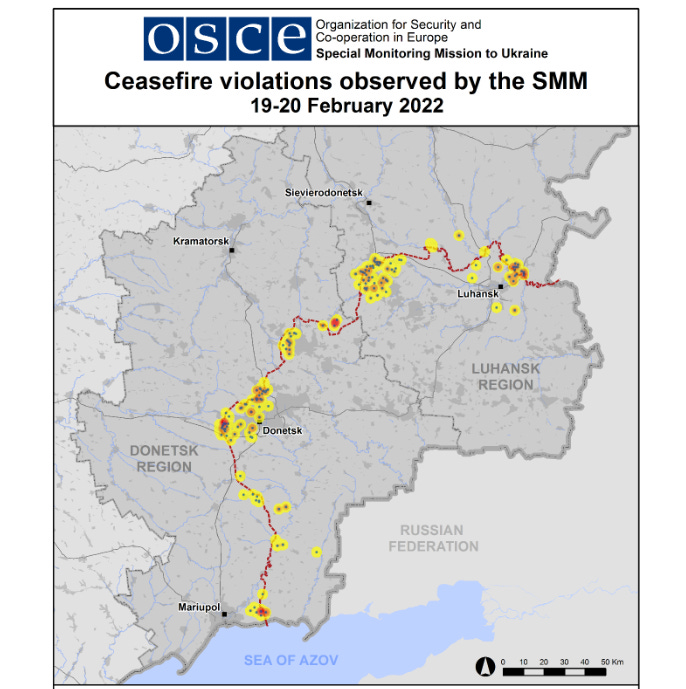
Civilians were harmed in these attacks, and civilian structures, including schools, targeted deliberately. Meanwhile, that same day, Donetsk rebels claimed to have thwarted two planned sabotage attacks by Polish-speaking operatives on ammonia and oil reservoirs on their territory. Perhaps not coincidentally, in January 2022 it was revealed the CIA had since 2015 been training a secret paramilitary army in Ukraine to carry out precisely such strikes, in the event of Russian invasion.
So it was on February 21st, the Kremlin formally accepted the Duma’s request from a week earlier, recognising Donetsk and Lugansk as independent republics. And now here we are.
Russia Hits Ukrainian Military Targets in Retaliation, Labels Kiev’s Civilian Strike Claims as False
Sputnik – 08.07.2024
The Kiev regime’s provocative statements about alleged Russian strikes on civilian targets are related to the NATO summit and the pursuit of further funding, the Russian Ministry of Defense has said.
The Russian military conducted coordinated strikes using long-range precision weapons on Ukrainian military-industrial targets and air bases on Monday in retaliation for Kiev’s attempts to damage Russian energy and economic facilities, the Russian Defense Ministry has stated.
“This morning, in response to the Kiev regime’s attempts to damage Russian energy and economic facilities, the Armed Forces of the Russian Federation conducted a coordinated strike with long-range precision weapons on Ukrainian military-industrial targets and air bases. The strike objectives have been achieved, and the designated targets have been hit,” the military department stated in its report.
Commenting on the Ukrainian claims of an intentional Russian strike on civilian targets, the ministry said they are a blatant lie, adding that the destruction was caused by a falling Ukrainian air defense missile.
“Claims by Kiev representatives about an alleged intentional Russian missile strike on civilian objects are completely untrue,” the statement said.
It was noted that numerous published photos and videos from Kiev clearly confirm that the destruction resulted from a falling Ukrainian air defense missile launched from within the city.
“We particularly emphasize that similar hysterics from the Kiev regime have been occurring for years, especially before each NATO summit. The goal of such provocations is to secure further funding for the Kiev regime and to continue the war to the last Ukrainian,” the Russian Defense Ministry highlighted.
Russian Experts Gain Access to Storm Shadow Missile Warhead
Sputnik – July 7, 2024
Russian specialists have studied the cumulative warhead of European Storm Shadow/SCALP missiles, determining the penetration depth and detonation distance above the ground, an engineer and weapons specialist told Sputnik.
“The primary cumulative projectile of the Storm Shadow/SCALP missile consists of the nose cap, the primary charge, and then the main warhead. It is necessary for the initial penetration of an obstacle. It creates holes using the cumulative effect, through which the inertial warhead penetrates, causing an explosion. We understand the penetration depth, the detonation distance from the surface, the types of target sensors used, and the potential penetration depth,” the specialist said.
The cumulative warhead of the Storm Shadow/SCALP missile is a cylindrical object about half a meter in length with approximately the same diameter. The nose section is shaped like a cone, directed inward towards the body.
The study of the missile by Russian specialists will enable the implementation of countermeasures to protect against such weapons, including the creation of shelters with the necessary characteristics, the specialist explained.
The Storm Shadow is a low-observable, air-launched cruise missile. It is launched from aircraft and has a strike range of 250 to 560 kilometers, depending on the modification. It was developed jointly by France and the United Kingdom (in France, it is named SCALP and is produced by the MBDA consortium). The Ukrainian Armed Forces have been actively using the Storm Shadow since last year.
The Storm Shadow and SCALP-EG cruise missiles can approach their targets stealthily by using navigation correction via American satellites, Lieutenant General Andrey Semenov, Commander of the Air Defense and Missile Defense Forces and Deputy Commander of the Russian Aerospace Forces earlier said.
Russian President Vladimir Putin has warned that Moscow may respond asymmetrically to the supply of long-range weapons to Ukraine. The transfer of high-precision long-range weaponry to Kiev is a path to very serious problems, he emphasized.
Featured Video

Racist Seinfeld Dances for Joy as Bibi Unveils His New Map
or go to
Aletho News Archives – Video-Images
TV Drama Review
Japanese drama projects Japan’s wartime atrocities onto Chinese characters

Global Times | October 25, 2026
By portraying Chinese characters as perpetrators of ruthless violence while casting Japanese Self-Defense Forces (SDF) intelligence operatives as defenders, the season 2 of the Japanese drama Vivant has recently drawn criticism from Chinese netizens, who argue that its depiction turns historical reality on its head while ignoring Japan’s wartime atrocities.
The TBS drama series – a spy suspense story in which an alleged unofficial intelligence unit of the SDF operates across the globe — has attracted a passionate fanbase. Its currently airing season 2 opened with a household rating of 18.8 percent, the highest for a TV drama this year, according toa commentary article by Japanese media Toyo Keizai.
What draws attention is the portrayal of the enemies in the series, the article noted. Scenes in which the Chinese organization subjects kidnapped members of the SDF unit to brutal torture are repeated with unrelenting intensity.
It is rare for Japanese TV dramas to explicitly portray a real-life country as the enemy, the article noted.
Japanese Prime Minister Sanae Takaichi also made a reference to the drama, saying that she has been recording Vivant and hopes to binge-watch it over the year-end and New Year holidays, according to Japanese media outlets.
China’s CCTV News report on Sunday revealed that the drama features scenes in which Chinese personnel cut off the fingers of and stab Japanese intelligence operatives in the abdomen. Such acts bear striking similarities to the torture inflicted on Chinese nationals by invading Japanese troops during the World War II.
The drama distorts the truth by attributing these atrocities to modern Chinese characters. Beneath the surface, it subtly glorifies Japan’s cross-border overseas operations, blurs the functional boundaries of the SDF and implicitly promotes an expansionist narrative, per CCTV News. … continue
Blog Roll
 Aletho News
- Iran FM Araghchi: “Hormuz Will No Longer Be the Same”
- EU facing trillion-euro debt hole while seeking more cash for Kiev
- How US, Europe, Persian Gulf states exhausted missile stockpiles, splurged billions to defend Israel
- Up in arms… Koreans reject U.S. empire’s plan to make South Korea the next Ukraine
- Iran, Turkey, Pakistan, Saudi Arabia could advance region-led security framework in Tehran: FM spox
- Netizens condemn Japanese drama for projecting Japan’s wartime atrocities onto Chinese characters
- Racist Seinfeld Dances for Joy as Bibi Unveils His New Map
- A West Bank War for Netanyahu’s Election Campaign, Could It Backfire?
- Yemen denounces European Parliament’s ‘hypocritical’ push to blacklist Ansarullah
- Qalibaf: UAE’s UN bid aims to ‘clear the runway’ for ‘Greater Israel’, whitewash genocide
- If Americans Knew
- An error has occurred; the feed is probably down. Try again later.
- No Tricks Zone
- Sudden Stratospheric Warming, Powerful El Niño Combination May Lead To Extreme Europe Cold, Energy Crisis!
- Two New Studies Find Thwaites Glacier Melt Cannot Be Driven By Human Activity Or A Warming Ocean
- E-Cars Reduce CO2 Emissions By Only 41% Compared To Internal Combustion Engine Vehicles
- Predictions Made By Renowned Climate Professor Over Past Decades Have Been Proven To Be Poor
- New Study Suggests Large Regions Of The Pacific Ocean Have Been Cooling For The Last 80 Years
- Germany’s Green Energy Debacle: High Energy Costs Force Kahla Porzellan to Close After 182 Years!
- New Study: 50 Years Of The Most Aggressive ‘Net Zero’ Policies Can Only Affect The Global Climate By 0.03°C
- US September “Heat” Was No Record…Many Records Set Decades Ago
- Latest European Green Energy Debacle; Portugal’s Largest Flagship Solar Park Insolvent!
- Green Energy Debacle: German Expert Professor Fritz Vahrenholt Warns Of Severe Economic And Social Consequences

