Potential US Tactical Nuke Deployment in Asia-Pacific Could Bring Catastrophic Fallout – Expert
Sputnik – 06.06.2024
The director of the Knowfar Institute for Strategic and Defense Studies, Li Jian, provided insight regarding the potential deployment of US tactical nuclear weapons in the western Pacific Ocean in an interview with Sputnik.
“The question of US nuclear weapon deployment has a long history,” Jian told Sputnik, highlighting advancements in US tactical nuclear capabilities, such as the B61-12 bomb, and the completion of testing for various aircraft models.
“Since the US Department of Defense purchased 400 B61-12 tactical nuclear bombs, there needs to be somewhere to deploy them,” Jian emphasized.
The expert outlined potential deployment sites in the western Pacific, including military bases in South Korea, Japan, Okinawa, the Philippines, and Diego Garcia island.
“If tactical nuclear weapons are deployed directly in South Korea, this would become a direct factor of strategic containment against Russia’s Far East, Northern China, and North Korea,” the expert warned.
Addressing concerns in Northeast Asia, Jian questions the likelihood of deployment in South Korea over Okinawa due to prevalent anti-war and anti-nuclear sentiments among the Japanese, particularly island locals. He cautioned that such actions could disrupt the regional strategic balance, exacerbate arms races, and impede nuclear non-proliferation efforts.
US Senator Roger Wicker, the highest-ranking Republican on the Senate Armed Services Committee, released a report on May 29 urging a significant increase in US military preparedness, particularly against nations like North Korea and China.
Titled “Peace Through Strength,” the report suggests exploring new strategies, including a “nuclear sharing agreement in the Indo-Pacific and re-deployment of US tactical nuclear weapons in the Korean Peninsula.” This call comes in the wake of the US Army’s deployment of the Mid-Range Capability, also known as the Typhon Weapon System, to Northern Luzon, Philippines, for the Salaknib 24 exercises in April.
Zelensky rejects Indonesia’s peace plan – media
RT | June 6, 2024
Ukraine’s Vladimir Zelensky has rejected a peace plan by Indonesia aimed at settling the conflict with Russia, the Antara news agency reported on Thursday, citing Indonesian President-elect and Defense Minister Prabowo Subianto.
The minister proposed a peace plan to end the Ukraine conflict at the Shangri-La Dialogue defense summit in Singapore on Saturday, calling for a demilitarized zone and a United Nations referendum in what he described as disputed territory.
Speaking to reporters following his meeting with incumbent President Joko Widodo on Thursday, Subianto said he had met Zelensky in Singapore and outlined Indonesia’s plan to achieve a ceasefire with Russia.
“[Zelensky] did not agree [with the initiative], however, we will continue to try,” he said.
The proposal formulated by Indonesia includes a ceasefire and the establishment of a demilitarized zone that would see each party withdraw 15km from their current forward positions.
The zone would be observed and monitored by a UN peacekeeping mission, Subianto said. A UN referendum would then be held “to ascertain objectively the wishes of the majority of the inhabitants of the various disputed areas.”
Jakarta, which pursues a policy of non-aligned diplomacy, had previously attempted to mediate peace between Russia and Ukraine.
Earlier this week, Ukrainian Foreign Ministry spokesperson Oleg Nikolenko dismissed the plan, claiming that “there are no disputed territories between Ukraine and the Russian Federation to hold referendums there.”
Commenting on the Ukraine “peace summit” due to take place at Burgenstock Resort in Switzerland on June 15 and 16, Subianto said the president had yet to decide about Indonesia’s participation but added that “all relevant parties” should attend the event.
Russia has not been invited to the summit, which is expected to address Zelensky’s so-called ‘ten-point peace plan’. The proposal demands a complete withdrawal of Russian forces from all territories that Ukraine considers its own, for Moscow to pay reparations, and for Russian officials to present themselves to war crimes tribunals.
Russia’s Shoigu Accuses NATO of Training for Invasion of CSTO Countries
Sputnik – 06.06.2024
ALMATY – Sergei Shoigu, a former Russian defense minister who now chairs the national security council, accused NATO on Thursday of increasing the number of military drills along the western and northern flank of the Collective Security Treaty Organization (CSTO) in what he said was a preparation for invasion.
“The alliance has been building up military presence and deploying new weapons along the northern and western flanks of the collective security zone. The number of airspace provocations is on the rise, and numerous military exercises are being conducted to train, among other things, for an invasion of CSTO countries’ territories,” Shoigu told fellow secretaries of CSTO member states’ security councils.
He called “NATO’s continuous expansion” a direct threat for CSTO allies. The Russian official said the West was using the conflict in Ukraine as a weapon against Russia in the hope of inflicting as much damage as possible.
“The West is pursuing the obvious goal of using Ukraine as a weapon against Russia in order to inflict as much damage as possible on our country. It has become absolutely clear that the attempt to inflict a strategic defeat on Russia has failed,” Shoigu said.
Turning to the CSTO’s eastern flank, Shoigu said Russia was concerned about new militant training camps cropping up across Afghanistan and jihadists flocking to the Central Asian country from Syria and Iraq. He said the risk of terrorist spillovers was increasing.
Biden could cause nuclear war – Trump
RT | June 6, 2024
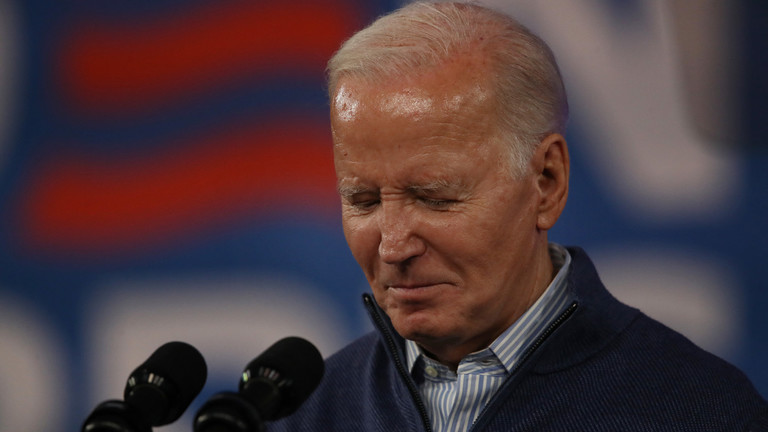
US President Joe Biden may end up destroying the world in a nuclear conflict, his election rival Donald Trump has claimed.
Speaking to Fox News host Sean Hannity on Wednesday, the former president warned that “we have a chance of going into World War III because of our leader.”
The remark came after Hannity suggested that Biden was in a state of mental decline, showing several clips of the president appearing distracted or fumbling his words during public appearances. Hannity and Trump were discussing a report published in the Wall Street Journal on Tuesday, which said the incumbent was showing “signs of slipping” behind closed doors.
Trump suggested that, unlike the leaders of Russia, China and North Korea, Biden is “not at the top of his game” and “was never the brightest bulb” among American politicians – even when he was younger. It is currently the “most dangerous time in the history of our country,” he warned, citing the destructive potential of nuclear weapons.
In the event of a nuclear exchange, “nothing will matter because practically nothing will be here anymore,” he warned. “This is obliteration. Maybe world obliteration. And we have a man that is incapable of even discussing it.”
Trump pointed to the Ukraine conflict as a major source of danger. Russian President Vladimir Putin “is talking about nuclear weapons,” he said.
The Biden administration has recently granted Kiev permission to strike targets outside of what Washington recognizes as Ukrainian territory with US-donated weapons.
When asked on Wednesday how he would react to possible attacks deep inside Russia using Western arms, Putin said Moscow may “supply our weapons of the same class to parts of the world, where strikes would be delivered against sensitive assets of the nations that act like that against Russia.”
The US and its allies are getting “directly involved in the war against us,” he added, and this path of escalation “leads to very serious problems.”
Asked directly whether Moscow would consider using nuclear weapons, Putin said he’d rather stay clear “not only from the use, but even from the threat of use” of such arms. However, he warned people in the West not to delude themselves that such a scenario was impossible.
The West is already at war with Russia but its leaders can’t wake up from a dream
By Martin Jay | Strategic Culture Foundation | June 5, 2024
Is NATO planning something big in Ukraine? Are we on the cusp now of WWIII really breaking out since the U.S. has now backed the idea that Ukraine can fire missiles beyond its borders into Russia?
The news that President Joe Biden has given the go-ahead for long-range missiles to be fired into Russia should be worrying for a number of reasons. The dangerous game of escalation that the West is playing will have a breaking point in the not too distant future. The question is whether the West really understands how Putin thinks as it is presently betting on no retaliation from Russia, which is not only erroneous but very, very dangerous. Recent missile strikes into Russian territory destroyed two radar installations which western press refuse to report. The significance of this strike is important as the more Ukraine loses on the battlefield, the more desperate its tactics, egged on by western leaders who still think that their stake in the war is minimal. Although just recently Germany’s leader Scholz did a U-turn at a conference in Berlin with French President Macron — in backing the missile strikes into Russia plan — the truth is that officially NATO does not support the plan, which is why the UK is doing it independently using Storm Shadows operated by SAS soldiers.
This has been going on for months and so in many respects the news that the U.S. has authorised the practice could be taken lightly. What’s new? Or, more to the point, is Ukraine going to use longer-range U.S. missiles to keep up with such strikes like the radar stations? Does it have enough missiles in stock is also an important question.
With this strategy in play, we are looking in all scenarios at the slow demise of NATO as the more that such strikes occur, the more it is evident that NATO is a defunct organisation and only really a talk shop at best. NATO members are divided on an overall strategy with Ukraine and so member states do their own thing. If we see more of these strikes, the pressure on Putin to react will be overwhelming but when that time comes, he will practice an eye-for-an-eye strategy and strike the equivalent military installations within Europe or at least Ukraine’s drones operating in the Black Sea. This will be a shock for the West. It will take some days for such a strike to be seen for what it is: a warning. The message will be the escalation game has its limits and you’ve gone over a line.
But are the recent reports of a new offensive in the planning from NATO genuine? Probably not. Just like the reports of Putin wanting to negotiate a peace deal now. Both fake news reports are part of a strategy of panic from the Biden administration which really needs some sort of victory in Ukraine to present to the American people. Yet all of the aces are with Putin and he doesn’t seem to be showing any signs of falling into these traps. Putin has been pretty consistent in how he sees any kind of peace deal. Denazification, demilitarisation and no deal on NATO membership. The reasons why peace talks are a mere figment of the imagination of western journalists who sink to new lows is that the West cannot entertain any of these requests and has taken so much control of the media that its leaders are starting to believe their own BS. The fourth requirement also of Putin’s is that he can’t negotiate peace with a leader in the Ukraine who no longer has legitimacy as a president. One wonders how long the West can continue to kick up a fuss about that one.
Putin outlines Russian response to long-range strikes
RT | June 5, 2024
Russia is considering “asymmetric” measures against Kiev’s sponsors due to Ukraine’s use of Western-supplied weapons against its territory, Russian President Vladimir Putin has said.
The Russian leader’s remarks came at a meeting with heads of international news agencies on Wednesday, on the sidelines of the St Petersburg International Economic Forum (SPIEF).
“We have no illusions in this regard,” Putin added, repeating his prior comments that Ukrainian troops might be pulling the trigger but the US and its allies are providing the intelligence and targeting information.
Russia will respond by boosting air defenses and destroying these missiles, Putin said.
“Secondly, if someone deems it possible to supply such weapons to the war zone, to strike our territory… why shouldn’t we supply similar weapons to those regions of the world, where they will be used against sensitive sites of these countries?” the Russian president added. “We can respond asymmetrically. We will give it a thought.”
If the West continues to escalate, such actions “will completely destroy international relations and undermine international security,” Putin noted.
“If we see that these countries are being drawn into a war against us, and this is their direct participation in the war against Russia, then we reserve the right to act in a similar way. This is a recipe for very serious problems,” he warned.
The Russian president also brought up the fact that some military instructors and advisers from NATO countries have already been deployed to Ukraine, and that a number of them were killed in Russian strikes.
The US and its allies have insisted that providing weapons and equipment to Ukraine does not make them party to the conflict with Russia, and maintained certain restrictions on their use to preserve that perception. Last month, however, as Russian troops began advancing towards Kharkov, Ukraine began to demand the relaxation of those rules. A British-led pressure campaign eventually resulted in Washington complying with Kiev’s wishes.
Greek EPAM Party Calls for Lifting Sanctions Against Russia, Dialogue
Sputnik – 05.06.2024
Greece’s non-parliamentary United People’s Front party (EPAM), which is running in the elections in the European Parliament, supports Russia and calls for lifting sanctions against the country along with ceasing arms transfers to Ukraine, Liudmila Bogila, the party’s candidate for the elections, told Sputnik.
Bogila was born in the Lugansk region of the USSR. She is a professional doctor and the head of the Center for scientific and social initiatives.
“Only EPAM demands the lifting of sanctions against Russia and, moreover, supports Russia. EPAM has consistently taken a clear position in relations with Russia since the beginning of the [Ukrainian] crisis several years ago — it opposes the adoption of sanctions and is in favor of dialogue, for the preservation of friendly relations with Russia both in economy and in politics. And we want to convey this position to the voters,” Bogila said.
The Ukrainian crisis began 10 years ago, but has worsened and gotten to a new, dangerous level, the candidate added.
“Our party’s election program directly says that today, when Europe, under US directions, is drawn into a war with Russia, the politicians of our country are preparing to sacrifice us to foreign interests. We are fighting to end the war in Ukraine and the lifting of sanctions against Russia, the only result of which is impoverishment of the people and enrichment of the elites,” Bogila said.
The interests of the United States, not Russia’s intentions, spurred the conflict, the candidate said.
“People must understand, what is happening in Ukraine today is not the result of Russia’s alleged invasive sentiment. It is the outcome of the invasive sentiments of the US and its satellites and Russia’s forced actions,” Bogila said, adding that most of the people she communicates with support this position.
Western countries and their allies rolled out a comprehensive sanctions campaign against Russia after it launched a military operation in Ukraine in February 2022. The EU, in particular, has already adopted 13 sanctions packages targeting Russia’s economy, energy and banking services, among other areas. Moscow says that Western sanctions against Russia have failed.
Zelensky Says US Hegemony Will End If He Loses, But That Already Happened
By Ian DeMartino – Sputnik – 03.06.2024
In an interview with UK media, Ukrainian President Volodymyr Zelensky made the claim that if former US President Trump gets reelected and cuts off aid to his country, he will become a “loser president” responsible for the US losing its spot as the World’s leader, but that has already happened and it was the US support of Ukraine that hastened it.
Since Russia launched its special military operation in Ukraine, the United States and NATO bet hundreds of billions of dollars that they could propel the Kiev regime to victory by outfitting it with some of the best weapons in NATO’s arsenal.
Despite Russia’s larger economy, population size and military, Ukraine could win, the thinking went, by using the vastly superior NATO weaponry and training. Of course, the US and NATO didn’t hand over their very best weapons right away, but it would surely be enough to defeat the Russian army that was portrayed as ill-equipped and untrained in Western media outlets.
When that didn’t work, NATO and the US upped the stakes, giving newer and ostensibly even more invincible weapons to Ukraine, they too failed.
Now, armed with the best weapons NATO could afford to give away, and full permission to strike inside Russia despite the risk of escalation, Ukraine is still being defeated on the battlefield. The whole world has seen for itself that NATO weapons are not equipped with force fields; they can be destroyed and are being destroyed at an alarming rate.
Last year, Trump claimed that he would end the conflict in Ukraine “within 24 hours” though he did not specify how he intended to accomplish that. When asked who he wants to win, Trump would only say that he wants “everyone to stop dying.”
In his interview with the Guardian, Zelensky admitted that he had not developed a strategy to deal with Trump should he become elected, and seemingly admitted that his country would collapse without US support.
“Ukraine, barehanded, without weapons, will not be able to fight a multimillion army,” he said.
“Does he [Trump] want to become a loser President? Do you understand what can happen?” he added, then saying that if Ukraine loses, it means the US will lose its power in the world as well.
“This is not about him as a person, but about the institutions of the United States. They will become very weak. The US will not be the leader of the world anymore. Yes, it will be powerful, first of all, in the domestic economy because it has a powerful economy without a doubt. But in terms of international influence it will be equal to zero,” the Ukrainian President who has utilized Martial Law to stay in office past his term said.
Of course, the opposite is true. The longer NATO and the US remain involved in Ukraine, the more thoroughly the veneer of NATO invincibility will be shattered. If they continue to increase their involvement and escalate things against Russia, it will only expedite the fall of Western hegemony.
“This is a decisive defeat of NATO, the European Union and the United States” former UN weapon inspector Scott Ritter told Sputnik’s Fault Lines last month. “It’s as decisive as you can get without them being directly involved, and they can’t become directly involved because that is a suicide pill.”
Over the last few weeks, NATO nations started giving the Kiev regime permission to strike inside Russia, culminating in the United States agreeing to it last week, but that too has failed to result in any meaningful change of the battle lines.
“But [Kremlin spokesman Dmitry] Peskov pointed out, you start using long-range missiles against Russia, we’re just going to have to take more of Ukraine [to build a bufferzone]. That’s what he said and he specifically mentioned Kiev,” international relations and security expert Mark Sleboda told Fault Lines.
Peskov also told reporters that the United States is already involved in targeting and aiming their weapons at Russia. “[The weapons] are directly controlled by military personnel of NATO countries,” adding that constituted not just military assistance but “participation in a war against us.”
While Ukraine is not the only factor eating away at Western hegemony, it has played a large role, along with the US support of Israel and general economic trends.
“The world is changing indeed, not only because of the war on Russia in Ukraine but also the war in Gaza… the development of BRICS countries [and] the increase of the Shanghai Cooperation,” explained war correspondent Elijah Magnier on Sputnik’s The Critical Hour. “All these indicators lead to one reality, the beginning of the end of US hegemony.”
While Russia has shown that NATO’s weapons are not superior, it’s the Ansar Allah movement, also known as the Houthis, who proved they are ill-equipped for modern war.
“The US and UK are failing in front of non-state actors in the Red Sea… So how can we understand that the Americans are ready to start a war against Russia and then against China?” Magnier added.
Still, with no other hopes or lifelines, Zelensky wants the US to embarrass themselves further by continuing to fund his government, saying that the US losing will encourage other countries to act aggressively. However, Russia and Ukraine were close to signing a peace deal in Istanbul at the start of the conflict. According to Ukrainian officials close to the negotiations, former UK Prime Minister Boris Johnson was sent to Ukraine to sabotage the deal at the behest of the United States.
Ironically, Zelensky says he recently asked Johnson to speak to Trump on his behalf.
Zelensky said he wanted to bring Trump to Ukraine to “see the results of what he brought to Ukraine.” Although Zelensky was referring to Russian President Vladimir Putin “he”, it would have been more accurate if he were referring to US President Joe Biden and/or Johnson, who really brought that destruction to Ukraine and Western hegemony.
“Fifty nations gathered to defeat Russia and they failed… Ukraine has been defeated and Europe is defeated,” Magnier concluded.
Strategic developments in Ukraine – a new Cuban missile crisis?
By Patrick Poppel | June 3, 2024
Since the beginning of the conflict in Ukraine in 2014, there has been repeated talk of NATO’s expansion to the east and the advance of Western strategic missile systems.
At that time, the head of the Russian Institute for Strategic Research, General Leonid Reshetnikov, also mentioned this when he gave an interview for Austrian media.He spoke of the possibility that one day there could be American missiles in Kharkov. He also mentioned Ukraine’s possible accession to NATO.
We are currently seeing how Ukraine is successfully attacking several targets in Russia, which are located far behind the front, using Western weapon systems. This increases the radius of the zone that can be assessed as a conflict area. More and more new weapons with longer ranges are now being used. This development is very dangerous because Russia must respond to this situation. Russia cannot possibly accept this.
The deployment of long-range weapons in Ukraine reminds us of the 1962 Cuban Missile Crisis in the Cold War. At that time, the USA also could not accept the stationing of soviet nuclear weapons on Cuba. There are red lines in matters of national security interests and these must be observed by all participants in a conflict.
At that time, the crisis was resolved through the clear and deliberate actions of statesmen from the United States and the Soviet Union. Today, with the Biden administration, we have a completely different prerequisite. Since Obama and the Maidan coup, the flag has been pointing to escalation and President Biden is continuing this course.
It can be assumed that the West will supply all weapons to Ukraine that are requested. Now it is clear to everyone that Ukraine is being used as a battering ram against Russia. The attacks of the last few weeks have clearly shown that it is also about destroying strategic targets in Russia. The attack on the early warning system is the best example of this. Such an attack is unacceptable in the age of nuclear weapons.
Of course, the legitimate question arises as to whether this specific attack was carried out on Ukraine’s own initiative or on the orders of someone else. And if it was really Ukraine’s initiative, there should be clear consequences from the West, as this created a very dangerous situation.
It is always important to monitor the Western media, as political wishes and ideas are always discussed there. There has been repeated talk of the possible use of tactical nuclear weapons, especially since 2022. The Ukrainian ambassador in Berlin also called for the delivery of nuclear weapons to Ukraine. This was, of course, an absurd request, but it was discussed for a long time in the media. So you can say that the smell of nuclear war has been in the air for at least 2 years. Since then, many reports on the topic of nuclear conflict have been produced in the German media. This is how Western societies are preparing for the possible use of these weapons.
The situation is really dangerous and, at the latest after the attack on the Russian early warning system, one should really consider ending this conflict as quickly as possible. Let’s think about what the next level of escalation is. If things continue to develop like this, we will be very quick to use tactical nuclear weapons. This point gets closer and closer with each passing week.
By continuing to support Ukraine and, above all, by supplying weapons with a longer range, it cannot be ruled out in the long term that the conflict could also affect other states in Europe.
There is currently discussion as to whether Russian military targets in Belarus should be attacked. This would of course also clearly drag Belarus into this conflict.
Particularly due to the threat to the Russian exclave of Kaliningrad, an extension of the conflict to the Baltics can no longer be ruled out. But then there would be a direct confrontation between NATO and Russia.
The greatest danger at the moment is that there is less and less inhibition to use larger and more far-reaching weapons. This spiral of escalation must be stopped by the West, otherwise the nuclear component of this conflict will become increasingly likely.
This development and the fact that we have already reached such a point also shows the inability of European politicians, who have not been able to freeze this conflict or find another solution since 2014.
It started with an uprising in Kiev and now we are on the brink of nuclear war.
Patrick Poppel, Center for Geostrategic Studies, Belgrade.
Houthis’ Red Sea Blockade Makes Russia’s Northern Sea Route Attractive to Desperate West
By Ilya Tsukanov – Sputnik – 01.06.2024
Shipping costs through the Red Sea have spiked by over 250 percent since Yemen’s Houthi militia began its partial blockade of the region last November. Shipbrokers estimate that commercial tonnage passing through the Gulf of Aden has dropped by over 60 percent in that time, with some shipments, such as LNG, dropping to zero.
With the US and Britain proving unable to dislodge the Houthis from their strongholds or stop the militia from attacking Israeli-linked, American, and British vessels in the Red and Arabian Seas, commercial shippers have increasingly eyed Russia’s Northern Sea Route as an attractive potential alternative, a leading mainstream US news magazine has reported.
“The surging costs and fear of getting hit by Houthi drones and missiles have led some shippers to consider the Arctic as an alternative, as melting ice begins opening new potential on the so-called Northern Sea Route,” Foreign Policy wrote.
The article “discovered” what Russian officials and media have been saying for years – that the roughly 5,600 km Northern Sea Route is the shortest maritime route between Europe and Asia, and can shave 8,000 km or more of distance, and 40-60 percent in time, off shipments, compared to traditional Europe-Asia routes via the currently troubled waters in the Middle East.
“The ability to slash some 5,000 miles off a ship’s journey would mean much faster travel times – a major plus in today’s world of online retail and next-day delivery,” FP said.
Unfortunately, the magazine lamented, there’s a catch: 70 percent of the Arctic, including virtually the entire length of the Arctic portion of the route, passes through Russian waters. “Ships wanting to use the route must secure the Russians’ permission and pay them transit fees. Given current relations between many Western countries and Russia amid the Ukraine war, that poses an obvious challenge.”
Lobbyists opposed to the ambitious Russian shipping route also cited other potential issues, from shallow local waters and cold Arctic winters to floating ice and the remoteness of much of the route, to try to make the Northern Sea Route look less attractive – ignoring the array of actions undertaken by Russia in recent years to address these and other concerns. This includes the equivalent of billions of dollars in investments into 16 deep-water ports and 14 airfields, regional air defense and search and rescue infrastructure, Internet communications infrastructure via new satellites in geostationary orbits, a burgeoning fleet of new heavy icebreakers, etc.
Russia plans to increase the tonnage of cargoes shipped through the Northern Sea Route to 80 million tons by 2024, and some 270 million tons annually by 2035. Once fully functional, it will give Russia the chance to become a major player in the transit of trillions of dollars in trade annually, and ease the development and exploitation of Russian territories in the Far North – including vast, untapped energy and rare mineral reserves.
The United States has expressed displeasure over Russia’s control of the Arctic, threatening to expand “freedom of navigation” missions in Russian Arctic waters, but facing problems doing so owing to the sorry state of its fleet of Arctic-class ships and lack of infrastructure. Russia accounted for the Northern Sea Route in the 2022 amendment to its naval doctrine, naming it as one of six strategic priority directions for strengthening “its position among leading global naval powers.”
Still time to prevent NATO-Russia war – Hungary
RT | May 31, 2024
NATO is preparing for a protracted war with Russia but there is still a chance to prevent it, Hungarian Foreign Minister Peter Szijjarto said at a ministerial meeting of the military bloc in Prague on Friday.
NATO member states have been granting approval for Kiev to use Western-supplied weapons to hit targets deep inside Russia. Earlier in the day, NATO Secretary General Jens Stoltenberg said Ukraine had the right to defend itself, which includes the right to strike legitimate military targets inside Russia.
These steps are being taken in preparation “for a long, many-year war,” Hungarian newspaper Magyar Nemzet quoted Szijjarto as saying.
“The express train of war has departed from the penultimate station,” and the question is whether there is still a chance to stop it, he added.
The Hungarian foreign minister said there was “only one emergency brake left,” referring to the European Parliament elections in June. The European people “can make it clear to their governments that they do not want to live with war in Europe for a long time,” Szijjarto added.
Hungary had previously called for a ceasefire and peace talks to resolve the Ukraine conflict. Budapest has refused to send military aid to Kiev and has repeatedly delayed EU sanctions on Moscow.
The Hungarian foreign minister has been a vocal critic of NATO’s position on the conflict. Before the meeting in Prague, he said anti-Russia “war hysteria” was making Western leaders adopt increasingly “crazy ideas” that could lead to grave consequences.
Last week, Hungarian Prime Minister Viktor Orban warned that Brussels and Washington could be warming up for a direct military conflict with Russia. Budapest was working to “redefine” its NATO membership status to allow it to opt-out of the military alliance’s “activities outside the bloc’s territory,” Orban stated.
A number of other NATO member states such as Norway, Finland, Latvia, Poland, and reportedly Germany have spoken in favor of Kiev using long-range missiles against targets on Russian territory.
On Thursday, US President Joe Biden was reported to have secretly given Ukraine the green light to use American-provided weapons to strike targets in the part of Russia that borders Kharkov Region.
NATO member states, especially the US, have “deliberately” launched a new round of escalation around Ukraine to prolong the “senseless war,” Kremlin spokesman Dmitry Peskov said on Thursday. He also warned that such actions would have consequences and damage the interests of the countries that opted for an escalation.
Featured Video

Racist Seinfeld Dances for Joy as Bibi Unveils His New Map
or go to
Aletho News Archives – Video-Images
TV Drama Review
Japanese drama projects Japan’s wartime atrocities onto Chinese characters

Global Times | October 25, 2026
By portraying Chinese characters as perpetrators of ruthless violence while casting Japanese Self-Defense Forces (SDF) intelligence operatives as defenders, the season 2 of the Japanese drama Vivant has recently drawn criticism from Chinese netizens, who argue that its depiction turns historical reality on its head while ignoring Japan’s wartime atrocities.
The TBS drama series – a spy suspense story in which an alleged unofficial intelligence unit of the SDF operates across the globe — has attracted a passionate fanbase. Its currently airing season 2 opened with a household rating of 18.8 percent, the highest for a TV drama this year, according toa commentary article by Japanese media Toyo Keizai.
What draws attention is the portrayal of the enemies in the series, the article noted. Scenes in which the Chinese organization subjects kidnapped members of the SDF unit to brutal torture are repeated with unrelenting intensity.
It is rare for Japanese TV dramas to explicitly portray a real-life country as the enemy, the article noted.
Japanese Prime Minister Sanae Takaichi also made a reference to the drama, saying that she has been recording Vivant and hopes to binge-watch it over the year-end and New Year holidays, according to Japanese media outlets.
China’s CCTV News report on Sunday revealed that the drama features scenes in which Chinese personnel cut off the fingers of and stab Japanese intelligence operatives in the abdomen. Such acts bear striking similarities to the torture inflicted on Chinese nationals by invading Japanese troops during the World War II.
The drama distorts the truth by attributing these atrocities to modern Chinese characters. Beneath the surface, it subtly glorifies Japan’s cross-border overseas operations, blurs the functional boundaries of the SDF and implicitly promotes an expansionist narrative, per CCTV News. … continue
Blog Roll
 Aletho News
- Iran FM Araghchi: “Hormuz Will No Longer Be the Same”
- EU facing trillion-euro debt hole while seeking more cash for Kiev
- How US, Europe, Persian Gulf states exhausted missile stockpiles, splurged billions to defend Israel
- Up in arms… Koreans reject U.S. empire’s plan to make South Korea the next Ukraine
- Iran, Turkey, Pakistan, Saudi Arabia could advance region-led security framework in Tehran: FM spox
- Netizens condemn Japanese drama for projecting Japan’s wartime atrocities onto Chinese characters
- Racist Seinfeld Dances for Joy as Bibi Unveils His New Map
- A West Bank War for Netanyahu’s Election Campaign, Could It Backfire?
- Yemen denounces European Parliament’s ‘hypocritical’ push to blacklist Ansarullah
- Qalibaf: UAE’s UN bid aims to ‘clear the runway’ for ‘Greater Israel’, whitewash genocide
- If Americans Knew
- An error has occurred; the feed is probably down. Try again later.
- No Tricks Zone
- Sudden Stratospheric Warming, Powerful El Niño Combination May Lead To Extreme Europe Cold, Energy Crisis!
- Two New Studies Find Thwaites Glacier Melt Cannot Be Driven By Human Activity Or A Warming Ocean
- E-Cars Reduce CO2 Emissions By Only 41% Compared To Internal Combustion Engine Vehicles
- Predictions Made By Renowned Climate Professor Over Past Decades Have Been Proven To Be Poor
- New Study Suggests Large Regions Of The Pacific Ocean Have Been Cooling For The Last 80 Years
- Germany’s Green Energy Debacle: High Energy Costs Force Kahla Porzellan to Close After 182 Years!
- New Study: 50 Years Of The Most Aggressive ‘Net Zero’ Policies Can Only Affect The Global Climate By 0.03°C
- US September “Heat” Was No Record…Many Records Set Decades Ago
- Latest European Green Energy Debacle; Portugal’s Largest Flagship Solar Park Insolvent!
- Green Energy Debacle: German Expert Professor Fritz Vahrenholt Warns Of Severe Economic And Social Consequences

