Die Linke Lawmaker Reveals How NATO Fooled Gorbachev About Bloc’s Eastward Expansion Plans
Sputnik – January 31, 2020
In the 30 years since US Secretary of State James Baker’s famous “not one inch eastward” verbal commitment to Soviet leader Mikhail Gorbachev in February 1990 not to expand NATO beyond German lands, the alliance has swallowed up every member of the former Warsaw Pact, along with half a dozen former Soviet and Yugoslav republics.
NATO broke all of the promises it made to Moscow, encouraged by the ‘blindness’ of Soviet leaders, Die Linke lawmaker and Bundestag Defence Committee member Alexander Neu, has stated.
In an op-ed regarding the upcoming Defender 2020 Europe drills, touted by NATO as the largest US deployment in Europe in 25 years, the opposition lawmaker argued that the alleged ‘Russian threat’ which the drills are meant to deter was imaginary, and that NATO is the side acting like the real aggressor.
Taking a retrospective look into the foreign and security policy developments in Europe over the past three decades which have led to the current impasse, Neu recalled that while Western leaders appeared to show support for General Secretary Gorbachev’s ‘new thinking’ about a common security policy in the Euro-Atlantic area ‘from Vladivostok to Vancouver’, their support proved superficial.
“With the end of the Cold War, German unification, the dissolution of the Warsaw Pact and the collapse of the Soviet Union, the West was suddenly seen as the winner of the confrontation. All ideas about a collective understanding and common security were swept aside. The promises made by the United States during negotiations on German unity stipulating that NATO would not expand beyond Germany if the Soviet Union accepted a united Germany turned out to be a lie and a fraud,” the lawmaker argued.
According to Neu, “the Soviet side,” for its part, “proved to be blinded and refrained from asking for a contractual promise – this was an unforgivable mistake made by the then increasingly incapable Soviet leadership under Gorbachev.”
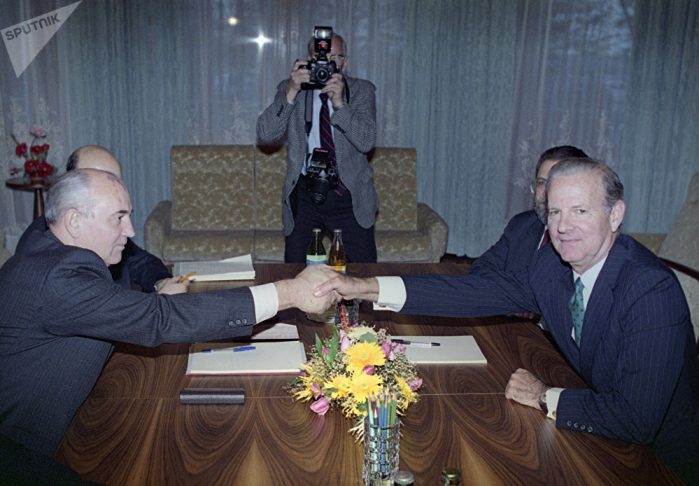
Talks between Mikhail Gorbachev and US Secretary of State James Baker, 1990. © Sputnik / Sergey Guneev
The rest is history, the German opposition lawmaker wrote, with NATO beginning its eastward expansion in 1999, and the process continuing ever since. “Even post-Soviet republics were admitted into the alliance. Protests by the Russian side against these gains in security policy, contrary to the 1990 US commitment, have been and will continue to be coolly brushed aside,” Neu noted.
Ultimately, Neu suggested that amid the ongoing tensions between the West and Russia, whether over Ukraine, Georgia or Syria, instead of trying to take de-escalatory steps, the self-proclaimed winners of the Cold War “continue to claim their right to the geostrategic loot,” with Russia portrayed as an aggressor which has insolently refused to remain subordinate to the ‘New World Order’ proclaimed by George H.W. Bush.
“In short: NATO is moving its military infrastructure further and further toward Russia’s borders, breaking the promise it made in 1990. And Russia’s reactions to these offensive actions by the US-led alliance are called aggression and threats. This is the wrong perception, but unfortunately is also widespread among most media and journalists in the West, who are full of conviction that we are the good guys. And since Russia is no longer willing to stand by and watch the geopolitics and imperialism-driven policies of the US and its vassals, NATO countries are massively increasing military spending (to 2 percent of GDP) and training as close to Russia’s borders as possible to show who is in charge.”
The Defender 2020 Europe drills were another demonstration of this, Neu noted, but promised that he, as a lawmaker, and member of the Bundestag Defence Committee, would “call for resistance” to the drills.
The Defender 2020 drills are expected to kick off in February and will continue until August, and will involve the participation of about 37,000 troops from 18 countries.
Americans Keep Putting Up Roadblocks Against Russian Troops on Key Syrian Highway
By Marko Marjanović | Anti-Empire | January 29, 2020
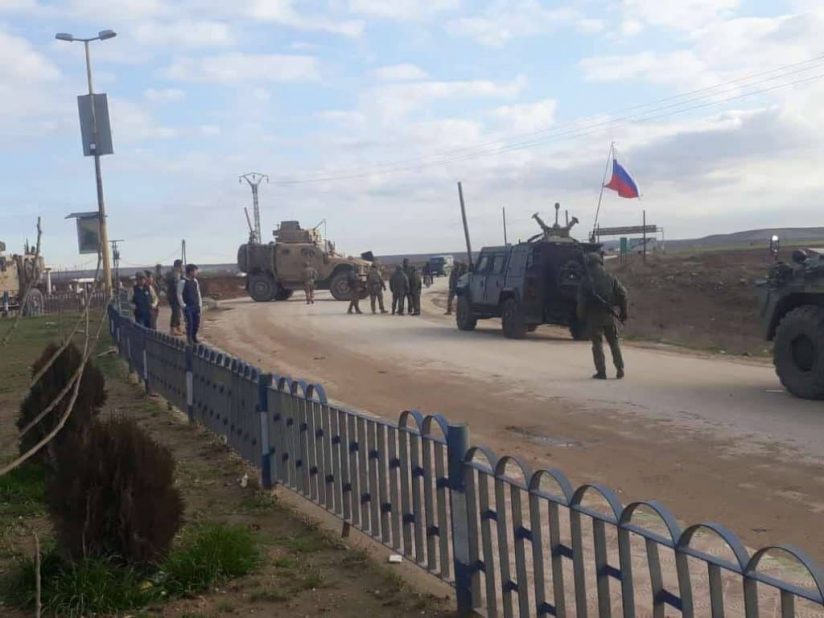
This is now the fourth time this has happened that we know of. US troops in northeastern Syria keep blockading the M4 highway to prevent Russian troops from moving on it.
In fall of 2019, to prevent a Turkish invasion of the Kurdish-held northeastern Syria, the Pentagon hammered out a deal with the Turks for joint US-Turkish patrols on the Syrian side of the Syrian-Turkish border.
As soon as that happened however Trump, after a talk with Erdogan, declared and ordered a US military withdrawal from Syria. At this moment Russia jumped in and took over the US role in the formerly US-Turkish agreement. To minimally appease Erdogan and limit his invasion it would now be Russians who patrolled together with the Turks, which was welcomed by the Kurdish leadership.
In separate negotiations with the Kurds the Russians also gained a number of bases in the northeast to make the patrols possible, and thousands of Syrian army troops also poured in to reinforce the Kurds against the Turkish invasion in the limited sector it was taking place in.
At this point Trump reversed himself, saying US forces would stay in Syria, but only in the oil-rich parts. But the withdrawal from the Syrian-Turkish border, where US presence had hampered US-Turkish relations, would be permanent.
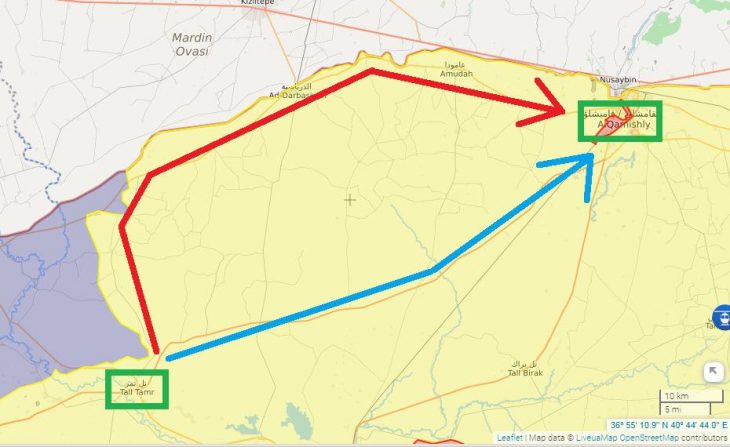
Blue is the obvious path, but the Americans insist the Russians must hug the border along the red path
What is happening now is that when the Russians coming from the west want to take the direct and obvious route to their facilities in the city of Qamishli they periodically encounter US troops near the town of Tell Tamr standing in their way.
The Americans block the road with their vehicles and demand the Russians take the longer, indirect way to Qamishli along inferior roads hugging the Syrian-Turkish border.
Russia’s UN Envoy Blasts ‘Deal of the Century’ Map Which Shows Golan Heights as Part of Israel
Sputnik – 30.01.2020
Israel took over part of Syria’s Golan Heights during the 1967 Six-Day War, annexing the area in 1981. The UN denounced Tel Aviv’s decision as “null and void and without international legal effect.” Last March, Washington formally recognised the occupied area as Israeli territory. Damascus blasted the move and vowed to regain its lands someday.
The Russian Ambassador to the United Nations Vaily Nebenzya has called on the architects of the so-called ‘deal of the century’ Israeli-Palestinian peace plan to remember that the Golan Heights belong to Syria.
“Yesterday, Washington published its vision for a settlement in the Middle East. We could not help but notice that the maps included in the plan defined the Golan Heights as Israeli territory,” Nebenzya said, referring to a pair of maps tweeted out by President Trump showing the proposed Israeli and Palestinian states which clearly show the Golan Heights northeast of the Sea of Galilee as part of Israel.
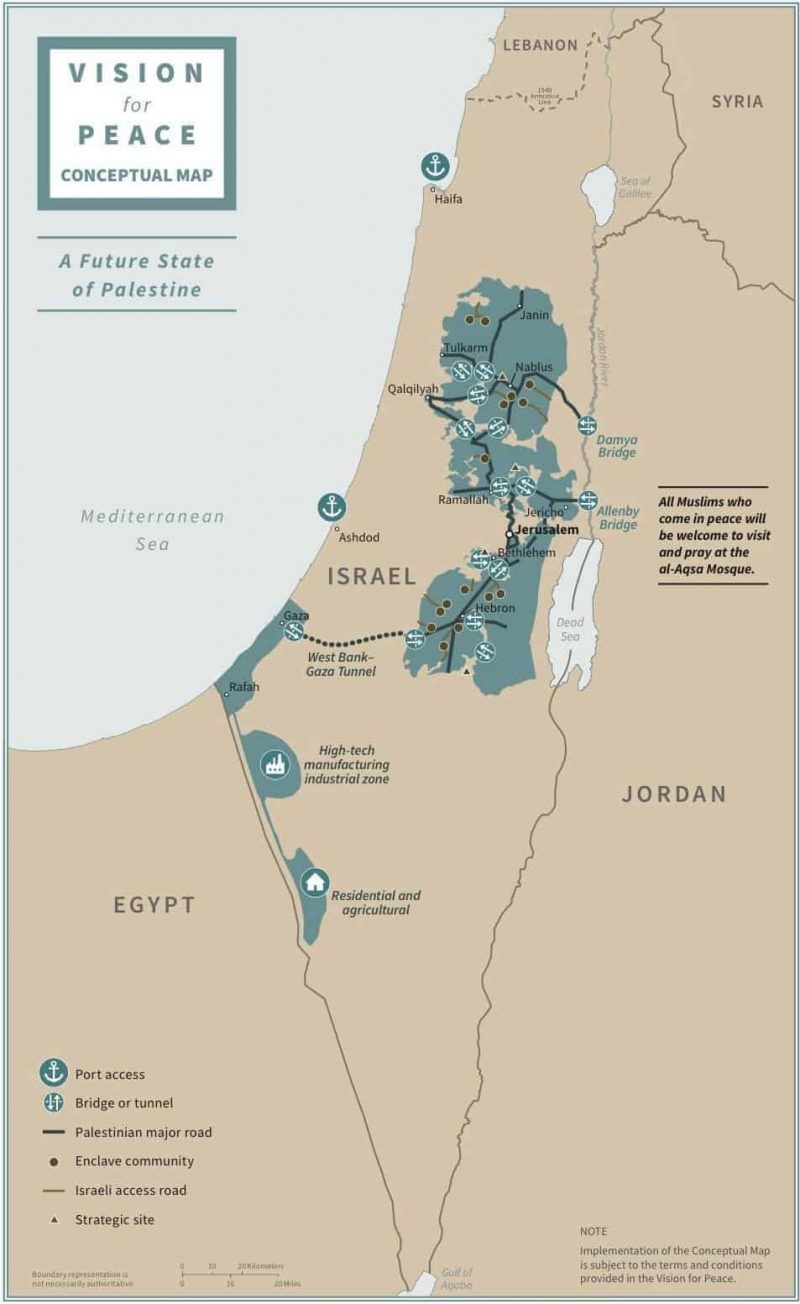
“In this connection, we would like to remind the ‘geographer’ who created this map that we and Security Council Resolution 497 do not recognize Israel’s sovereignty over the Golan,” Nebenzya added.
“The Golan Heights are illegally occupied Syrian territory,” the ambassador stressed.
In 1981, after Tel Aviv moved to annex the occupied areas of the Golan Heights, the United Nations unanimously adopted a resolution saying that Israeli claims to the Golan Heights were “null and void and without international legal effect.” In 1982, 86 other countries in the General Assembly adopted a second resolution calling for a general boycott of Israel over its occupation of Syrian territory, but the US and its European allies rejected the initiative. Israel gained control of the Golan Heights in the aftermath of the Six-Day War, a brief conflict which took place in June 1967 which began when Israel launched preemptive airstrikes against an Arab coalition led by Egypt.
US President Donald Trump signed a proclamation recognising Israel’s sovereignty over the Golan Heights in March 2019 after a meeting with Israeli Prime Minister Benjamin Netanyahu. Dozens of countries including the US’s European allies rejected Washington’s change in position, while Russian Foreign Minister Sergei Lavrov characterised the decision as a “conscious, deliberate demonstration of lawlessness.”
Syria warned that it would never give up its claims to the Golan Heights territories, and indicated that it has the legal right to regain the Golan Heights by any means possible, alleging that force was “the only language which Israel understands.” Skirmishes have been reported in the area in the months since, with Israel occasionally reporting the destruction of projectiles launched from the Syrian side of the border, while Syrian air defences have reported the shootdown of Israeli missiles.
On Tuesday, US President Donald Trump unveiled his long-awaited ‘Deal of the Century’ Israeli-Palestinian peace plan. The proposal envisions a two-state solution, recognises Jerusalem as Israel’s capital and grants the Palestinian Authority several neighbourhoods of East Jerusalem as the capital of a Palestinian state. It also offers the Palestinian side $50 billion in investments. Palestinian Authority President Mahmoud Abbas rejected the proposal outright, telling Trump Jerusalem was “not for sale,” and vowing that the deal would “not go through” under his watch.
US didn’t discuss ‘deal of century’ with Moscow, Russia’s UN envoy says
RT | January 28, 2020
The US did not hold consultations with Moscow on a plan to resolve the Israeli-Palestinian conflict, Russia’s permanent representative to the United Nations Vassily Nebenzia has said.
“We were not consulted, we don’t know what this plan consists of,” he said in response to a question from a reporter.
Israeli envoy to the UN Danny Danon, meanwhile, said that his country was looking forward to the unveiling of the plan, TASS reported on Tuesday.
US President Donald Trump previously announced that the White House would unveil a plan for peace in the Middle East on Tuesday.
Russia stood by Iran in showdown with US
By M. K. BHADRAKUMAR | Indian Punchline | January 27, 2020
US President Donald Trump first said there were ‘no casualties’ in the Iranian missile attack on the Ain al-Asad military airbase in Iraq on January 8. “We suffered no casualties, all of our soldiers are safe, and only minimal damage was sustained at our military bases,” Trump had said.
Then a number 11 was mentioned a week later, but Trump minimised the injuries, calling them ‘headaches’. Last Friday, a fortnight after the attack, the number sharply climbed. The Pentagon spokesman told reporters that 34 US military members received concussions or other traumatic brain injuries in the missile strikes.
The true human toll of the Iranian strike is still being assessed. But what Iran achieved through the January 8 attacks may never quite be in the public domain.
The big question is whether Iran acted with Russian backing. Beyond a string of Russian statements empathising with Iran, all we have are tell-tale signs.
To be sure, satellite imagery suggests very precise hits of targets in the Ain al-Asad base. In an interview with Spiegel magazine last week, Iran’s Foreign Minister Mohammad Javad Zarif stated Iran’s objectives:
“There was no intention of causing any casualties with the missile attack… The damage we have done to the US is extensive, because with all its military might, it could not prevent the missiles from hitting its base. It shows how vulnerable the US is.”
The Iranians did succeed in displaying their formidable missile capability and its capacity to inflict lethal damage on US military establishments. But how could such high-precision hits be achieved except with missiles equipped with satellite guidance and target-tracking capabilities?
Importantly, Iran doesn’t have an independent orbital group of satellites. There are four global navigation satellite systems operational today — the US GPS/NAVSTAR, European GNSS, Russian GLONASS and Chinese BeiDou. The US and European systems are out of bounds for Iran.
But there is no embargo on Iran accessing the Russian or Chinese systems and it probably used one of them. But Tehran neither confirms nor denies.
Iran acknowledges it fired two Russian TOR-M1 anti-aircraft missiles but, interestingly, stops short of blaming them for the crash of the Boeing 737-800, flown by Ukraine International Airways. By the way, TOR-M1 is mounted on a tracked vehicle and carries a radar and each vehicle can operate independently. Did Iran’s Russian-made TOR-M1 have access to GLONASS?
Indeed, on January 7, on the eve of the Iranian missile strike, President Vladimir Putin paid an unscheduled visit to Syria to meet up with President Bashar al-Assad.
Again, on January 9, the day after the Iranian missile strike, Putin watched a big naval exercise involving multiple missile launches in the Black Sea. The Navy Times reported, “The Russian naval maneuvers come amid heightened US-Iran tensions after the US strike last week that killed Iran’s most powerful military commander.”
Advanced Russian weapon systems were on display in the maneuvers. MiG-31 interceptor jets launched Kinzhal hypersonic missiles at practice land targets while Navy ships performed several launches of Kalibr cruise missiles and other weapons. More than 30 warships and 39 aircraft, including several Tu-95 strategic bombers, took part in the exercise.
Curiously, again on January 9, in the northern Arabian Sea off Iran’s coastline, there was a rare encounter between the US destroyer USS Farragut and the Russian intelligence gathering ship RFS Ivan Hurs, which was apparently shadowing the operations of a US aircraft carrier battle group in the area.
The above events taken together signalled that Russia was closely monitoring the situation around Iran and was in full readiness to meet any emergent military conflagration in the region. No doubt, the message was addressed to Washington.
It is entirely conceivable that Russia has intelligence-sharing arrangements with Iran. In fact, Russian Foreign Minister Sergey Lavrov, a veteran diplomat, might just have lifted the veil a little bit when he disclosed on January 17 that Iran’s accidental shooting down of the Ukrainian airliner occurred at a time when Tehran was spooked by reports of advanced US stealth fighters in the area.
“There were at least six F-35 fighters in the air in the Iranian border area. This information has yet to be verified, but I’d like to underline the edginess that always accompanies such situations,” Lavrov said. Alas, Lavrov’s disclosure left a cold trail. But it most certainly hinted that Russia is reconnoitring the skies above Iran.
All this may amount to nothing much, or everything — depending on how one looks at it. Russia will not militarily intervene in a US-Iranian conflict. Indeed, such a conflict is unlikely. What Russia can do is to make the probability of a conflict even less likely by aiding Iran to defend itself, by providing it with electronic warfare tools and other high-end arms that would raise the military costs to the US, as had happened on January 8.
How far Russia’s ‘positive neutrality’, which distinctly favoured Iran in the most recent period, irritated Washington no one can tell. But there have been four instances in the past 8 days alone of US forces blocking Russian convoys in northeastern Syria — one forcing back a vehicle driven by a Russian major-general. Poking the bear? In Russian-American relations, nothing is really coincidental.
The debate over the alchemy of Russian-Iranian relations is a never-ending one. But no matter the two countries’ specific interests or national objectives and ideologies, a destruction of Iran or the emergence of a US-friendly regime in Tehran would be profoundly consequential to Russian regional strategies, given the co-relation of forces internationally.
Lavrov gave an indication of Russian priorities when he said in Delhi on January 17 while addressing an international audience (including Zarif) that Moscow backs Tehran’s bid to join Shanghai Cooperation Organisation as a full member and is hopeful it will happen.
DHS Head Claims Russia Seeks to ‘Undermine American Way of Life’, Expects US 2020 Voter Interference
Sputnik – 18.01.2020
Acting Secretary of the US Department of Homeland Security (DHS) Chad Wolf has joined the ranks of US officials who observe the DC political creed that Russia interferes in US internal affairs.
Wolf, in his 17 January speech, most of which was dedicated to what he referred to as the “top threats facing the Homeland” – Iran, China and Russia, claimed that even though Moscow does not strive to diminish the US role in the international arena, the nation is nonetheless looking to disrupt and undermine the “American way of life”.
“Lastly, let me touch on Russia. Unlike China, Russia doesn’t seek to weaken our economy and surpass us on the world-stage; rather they focus on actions that disrupt and undermine the American way of life. As we saw in 2016, we fully expect Russia to attempt to interfere in the 2020 elections to sow public discord and undermine our democratic institutions”, Wolf, serving as DHS acting secretary since November 2019, said, during an event hosted by the Homeland Security Experts Group in Washington DC.The official claimed that the 2018 midterm elections were “the most secure elections in the modern era” as the US created “classified and unclassified election war rooms” that “connected election officials in all 50 states, political parties, social media companies and agencies across the US Government, including DOD, the FBI and the Intelligence Community”.
“Let me be clear: We are prepared,” Wolf said. “More importantly, the state and local officials who run our elections are prepared. We are working with our federal partners to make sure those officials on the front lines of our elections have the information and the tools they need to combat Russian interference.”
“In 2020, we’re doing this and more to prevent our adversaries from degrading faith in our democracy and election results”, Wolf said.The acting secretary acknowledged that “100 percent security is never realistic” and asserted that US federal government and intelligence agencies were “laser-focused” on securing the upcoming elections.
Russian Trail
US intelligence agencies and lawmakers have accused Moscow of meddling in US elections since Trump’s 2016 victory, a political event that provoked allegations of Trump’s cooperation with Moscow as a means spreading anti-opponent propaganda online.
The US Department of Justice at the time launched an investigation headed by US Special Prosecutor Robert Mueller but the report concluded that no sufficient evidence existed to prove the allegations.
Both Trump and Russian officials have together repeatedly denied claims that they worked together to influence the results of the election.
In December 2019, Russian Foreign Minister Sergey Lavrov said that he had not seen any proof in support of allegations that Russia interfered in US elections, arguing that “No one has given us this proof because simply it does not exist”, while noting that Moscow is prepared to exchange assurances with Washington on non-interference in each other’s domestic affairs.Besides the US, the narrative of Russian involvement in the internal affairs of other countries has been used by a variety of European nations, however, again, no proof has been furnished.
In November 2019, El Pais published several stories alleging Russian influence in Catalonia, according to Spanish intelligence officers, again without providing evidence. The Russian embassy in Spain responded by joking about the allegations.
“With regards to the tireless work of El Pais researchers on linking the source of the Catalan crisis to Russia, we would like to draw their attention to a revealing fact. There is a suspicious coincidence: the number of the alleged Russian unit, which is mentioned in the newspaper, ends with 155, which itself creates a new reality. So – [follow] the trail,” the embassy tweeted.Spain’s constitution contains Article 155, used by Madrid to suspend Catalonia’s autonomy and violently introduce direct rule in the wake of a 2017 independence declaration.
Governing Russia
Irrussianality | January 15, 2020
Putin has spoken. The Russian constitution needs some tweaking, he told legislators in his annual address to the Federal Assembly yesterday. Restrictions on how often someone can be president will remain, thus clearing up the question of whether Putin will stay on as president after 2024 – he won’t. But, under the changes Putin proposes, the Prime Minister will henceforth be appointed by parliament not the president, an amendment which should shift power towards the legislature. All this would have to be approved in a national referendum, but still it got the pundits buzzing.
In reality, though, this wasn’t the main focus of Putin’s speech, and while it’s what got the headlines it wasn’t what struck me most about what the Russian president had to say. What hit me was how he was to a large degree repeating stuff he’d said before and how this indicated the extreme limits of his power. Most notably, Putin started off with a long exposition of Russia’s demographic problems and the need to find ways to support families with young children so as to encourage parents to have more kids. This had been the main thing he’d talked about last year, at which point he had unveiled a series of financial measures to try and resolve the demographic problem. What were the results? Well, if this year’s speech is anything to go by, last year’s measures had no effect at all. In fact, the birth rate actually fell! Perhaps the most revealing section of Putin’s speech to me was the following segment, in which he said:
The most sensitive and crucial issue is the opportunity to enrol one’s child in a day nursery. Earlier, we allocated funds from the federal budget to help the regions create 255,000 new places in day nurseries by the end of 2021. However, in 2018 to 2019, instead of 90,000, 78,000 new places were created, out of which only 37,500 places can actually be provided to kids. Other places are unavailable simply because an educational licence is still not obtained. This means that these nurseries are not ready to enrol children.
Why do I find this so interesting? Because it shows very clearly that there’s a world of difference between making policy statements and even transposing those statements into specific policies with assigned budgets, and actually putting those policies into effect, let alone achieving the objectives for which the policies were created. Supposedly, Putin is all-powerful; the state is highly centralized; the leader just has to wave his wand, and the system obeys. What the statement above shows is that this isn’t the case. Putin can issue whatever instructions he likes, but that doesn’t mean that it’s done.
This isn’t an isolated case. In the past, I’ve noted how other issues keep cropping up year after year in Putin’s speeches, indicating that all his decrees on the issue in question have resulted in naught. For instance, in a 2016 blogpost, ‘The Limits of Power’, I talked about Putin’s complaints that his orders on economic deregulation had not been carried out. Just a couple of weeks ago, I came across another reference somewhere (unfortunately I can’t remember where) to a speech Putin recently gave calling for a ‘bonfire of regulations’. The fact that he felt a need to demand this yet again is quite striking.
A similar story can be seen in the case of the key economic policy of the past couple of years, namely billions of dollars which have been assigned to infrastructure spending. It promises a lot, but as numerous reports have demonstrated, only a fraction of the assigned money has been spent, in part because bureaucrats are afraid of the scrutiny they’ll come under once they start dispensing a lot of cash.
And then there’s this story from Intellinews a few days ago:
Russia is suffering from a crisis of confidence that is visible in the extremely high dividend payments (owners take cash rather than invest) and extremely low corporate borrowing, which is the other side of the same coin. The government understands it needs to do something about boosting investors’ confidence in the economy, but while the draft version of a new investor protection law was very radical, the version that was submitted to the Duma was so twisted by state-owned enterprise lobbying that everyone hates it and it is very unlikely to be passed.
In this case, what we see is one part of the Russia state lobbying another part of the state in order to undermine what a third part of the state (the government) wants to do. In circumstances like this, it’s remarkable that anything gets done at all.
In short, governing Russia is a tough business. The ship of state doesn’t always go where the pilot wants it to. This is, of course, hardly a uniquely Russian problem, but the Russian response to it has not always been successful. Historically speaking, when faced with the sort of difficulties mentioned here, Russian rulers have tended to try to bureaucratize and centralize, thereby reinforcing autocracy. Another response has been to find reliable people to whom large powers are then delegated as sort of autocratic plenipotentiaries. At the start of yesterday’s speech, Putin suggested that perhaps Russia needed to move in the other direction. As he put it:
Our society is clearly calling for change. People want development, and they strive to move forward in their careers and knowledge, in achieving prosperity, and they are ready to assume responsibility for specific work. Quite often, they have better knowledge of what, how and when should be changed where they live and work, that is, in cities, districts, villages and all across the nation.
If the proposed constitutional changes help prod Russia in that direction, they may well prove to be worthwhile. But don’t hold your breath.
UPDATE: Within seconds of posting this, news arrived that the Russian government had resigned, with Prime Minister Medvedev citing the proposed constitutional changes as the reason. I will ponder my response over the next 24 hours.
Putin Updates Russian Constitution as Western Media Tries to Catch Up
By Johanna Ross | January 17, 2020
Russian President Vladimir Putin gave his annual inauguration speech on Wednesday, announcing a welfare package for women and children which would put the average western democracy to shame. But it wasn’t the social reform which caused shockwaves across global media. Instead it was the changes to the constitution aimed at giving more power to parliament and less to the President, as Putin sets the scene for Russia’s democratic future once he leaves his post (as it is widely believed he will) in 2024. Putin’s speech yesterday was followed by the resignation of Prime Minister Medvedev and his government, a procedure which, although took many by surprise, was a natural follow-on from the announcements.
Western media however was aghast. ‘What is Putin up to?’ read the headlines as Russia watchers frantically tried to work out what was going on. There must be something more to this, the narrative was spun. ‘The details are murky’ professed The Economist, as it bought time to figure out what it all meant. The Twittersphere was completely unprepared and perplexed by the government’s resignation. Many commentators couldn’t work out whether it was a good or bad thing. The general line was ‘we’re not quite sure what’s happening; more details to follow.’
This then evolved quickly into the line that the constitutional reforms were all part of Putin’s strategy to stay in power indefinitely. ‘Vladimir Putin proposed sweeping reforms that could extend his decades-long grip on power beyond the end of his presidency.” boasted CNN. This particular article even went as far as to misrepresent what the Russian President had actually said, by taking it completely out of context. Although Putin said regarding the resignation of the government: “I want to express satisfaction with the results that have been achieved. Of course not everything worked out, but nothing ever works out in full”, the CNN piece quoted him as saying ‘not everything worked out’ which by itself gives a completely different meaning, implying Putin was dissatisfied with the government’s work.
The Economist followed suit, taking up its usual antagonistic stance towards Russia with the headline “How Vladimir Putin is preparing to rule forever.” Furthermore on Twitter it alleged ‘Vladimir Putin’s regime has killed too many people to make it plausible that he would voluntarily give up power’, to which journalist Mary Dejevsky rightfully responded: ‘why would a president who, according to your interpretation, is intent on staying in power, be preparing a transition?’
Wednesday’s events in Russia really proved problematic for the western commentariat. For what in essence was clearly an attempt by Putin to further democratise Russia: reducing the number of terms a President can run to two, and ensuring the parliament appoints the Prime Minister as opposed to the President doing so; was perversely portrayed as a sign of authoritarianism, in a desperate attempt to fit the narrative. Absent from most analysis was the fact that Putin wants to put his proposals to a public vote: if that’s not democracy then I don’t know what is.
What has also been largely ignored by the western media was the implications of certain constitutional reforms on the future government and President. For arguably most significant of all was Putin’s proposal that any future President ought to have lived in Russia continuously for a period of 25 years and that civil servants should be barred from holding foreign citizenship.
So what should be regarded as a positive attempt to consolidate democracy in Russia, is being unfortunately, and rather predictably, interpreted as the opposite. But even if Vladimir Putin does continue a central role in Russia’s future, with record approval ratings I don’t see many people having a problem with that. This is the man who restored Russia as a world power to be reckoned with after the collapse of the USSR and the ensuing deep economic crisis during the 1990s. Russians won’t forget that.
Johanna Ross is a journalist based in Edinburgh, Scotland.
US, Russia Agree to Begin Expert-Level Engagement on Strategic Security – State Dept.
Sputnik – 16.01.2020
WASHINGTON – US and Russian delegations during their talks in Vienna decided to begin expert-level engagement on issues of strategic security and expand the dialogue beyond a bilateral format, the State Department said in a press release on Thursday.
“The delegations decided to continue the Strategic Security Dialogue and also to begin expert-level engagement on particular topics in the near future”, the release said. “The delegations discussed their respective national strategic policies as a means to reduce misunderstandings and misperceptions on key security issues. The US and Russian delegations discussed nuclear stockpiles and strategy, crisis and arms race stability, and the role and potential future of arms control, including the importance of moving beyond a solely bilateral format”.
Earlier, Russian Permanent Representative to International Organizations in Vienna Mikhail Ulyanov said in a statement on Twitter that the two sides discussed issues of strategic stability during the talks, which were led by Russian Deputy Foreign Minister Sergei Ryabkov and US Acting Undersecretary of State Chris Ford.
New START (Strategic Arms Reduction Treaty) is the last remaining arms control treaty in force between Russia and the United States. Signed in 2010, the pact stipulates that the number of strategic nuclear missiles launchers must be cut by half and limits the number of deployed strategic nuclear warheads to 1,550.
Russia has repeatedly stated its readiness to extend the New START without any preconditions, but the US is yet undecided about the extension.
Libyan leaders Sarraj & Haftar to hold talks in Moscow on Monday – Russian Foreign Ministry
RT | January 13, 2020
Libya’s two key political figures – Fayez al-Sarraj, the prime minister of the Government of National Accord (GNA), and Commander of the Libyan National Army (LNA) Khalifa Haftar will take part in talks held under the auspices of the Russian and Turkish Foreign and Defense Ministries in Moscow on Monday, the Russian Foreign Ministry told TASS.
“In [the] context of implementing the initiative of the Russian and Turkish presidents announced following a summit in Istanbul, inter-Libyan contacts will be held today in Moscow,” the diplomats said. “The contacts are expected to be attended by Sarraj, Haftar and representatives of other Libyan parties.”
Moscow will host talks between Russian Foreign Minister Sergey Lavrov and Defense Minister Sergey Shoigu with their Turkish counterparts, Mevlut Cavusoglu and Hulusi Akar. The main topics on the agenda are settlement in Libya, cooperation in Syria, and developments in the Middle East.
On January 12, a ceasefire entered into force between the conflicting sides in Libya.
Libya’s warring parties vow to observe ceasefire without preconditions, stop all offensive military actions – draft agreement
RT | January 13, 2020
The Libyan National Army (LNA) and the internationally recognized Government of National Accord (GNA) in Tripoli have pledged to observe the ceasefire suggested by Russia and Turkey after negotiations in Moscow.
The draft document suggests that all parties would stop military actions and observe the ceasefire conditions. Meanwhile, a commission is to be established to determine a contact line between the warring sides. Russia and Turkey promised to support all sides in the conflict to help them implement the agreement.
Libya has been plunged into chaos for years after its longtime ruler Muammar Gaddafi was ousted and killed during a NATO-led bombing campaign. Following the years of devastation and chaos, the country became engulfed in a civil war.
Previous lengthy UN-backed talks on reconciliation, which led to the establishment of the GNA, eventually failed to bring peace to the war-ravaged land.
Haftar began an offensive against Tripoli last year and over the last few months the two sides were engaged in intense fighting. LNA controls most of Libya’s territory, but it is the GNA which is recognized by the international community.
Ankara became involved in the conflict in December promising to send troops to help the government in Tripoli as the international community called on all sides to enter negotiations.
U.S. Media Says Russia the True Winner in Hostilities Against Iran
By Paul Antonopoulos | January 13, 2020
While the final outcome of the U.S.-Iran conflict is not yet clear, US media outlets and think tanks are already claiming that Russian President Putin is the winner. The U.S.-Iran hostilities have undermined Washington’s confidence and reputation in the region, allowing Russian influence in the Middle East to increase as a force for peace and stability. While it is unclear exactly how Moscow can benefit from escalations between Washington and Tehran, U.S. media are convinced that any outcome will be consistent with the Kremlin’s plans to increase its political influence in the region and create a rift between Washington and its allies.
This simplistic explanation does not account the fact that Moscow has a clear foreign policy to achieve its geopolitical goals in the Middle East while Washington mostly depends on their own internal contradictions and events on the domestic political scene to guide their foreign policy. The assassination of Iranian General Soleimani, made on orders from Trump, questions whether this was to demonstrate his power and determination to protect U.S. national interests in the face of domestic criticisms, to serve Evangelical Christian interests on behalf of Israel, or part of a clear guided policy that the U.S. has for the Middle East.
The Democrats are trying to show the public that everything Trump does is contributing more to Russian interests rather than American. It appears that the Democratic Party will continue with the same rhetoric to try and win this year’s election.
Moscow maintains good relations with all countries in the Middle East region and there is no country with which Russia has an openly hostile relationship. Moscow successfully balances its relations between Saudi Arabia, Iran, Syria and Israel, while the U.S. attempts to divide the region into competing camps with no interest of defusing tensions, suggesting that even if Washington has a clearly defined Middle East policy, it is one based on division and destruction rather than one of balance and peace.
As a result of the assassination of General Soleimani, calls for U.S. troops to withdraw from Iraq under pressure from local authorities have been made. Without troops in Iraq, the Americans are incapable of retaining their positions in Syria, which increases Russia’s manoeuvring space, strengthens its positions, influence, and opens space for filling the political vacuum. The U.S. has become embroiled with so many Middle Eastern countries that it is now struggling to cope to withdraw. Washington has already tried to withdraw its troops from Iraq during the Obama era.
But it is one thing to militarily withdraw on your own will and based on your decision, and another to withdraw because you have been asked too. Although the U.S. criticizes Iranian influence across the region and claims the Islamic Republic is acting in an aggressive manner, the Trump administration has not even hid away from the fact its an occupying force by flatly refusing to withdraw from Iraq despite being told to by the country’s parliament.
However it was the assassination of Soleimani that the most ridiculous claims were being made about, with Bloomberg even suggesting that Putin needs a “Plan B” because the Iranian General’s death disrupted Russian plans for Syria, Iran and Turkey. This scenario implied that Trump’s aggressive actions would elicit an even more aggressive response from the Iranian side, eventually leading to an escalation of the conflict in which Tehran lacked adequate defense capabilities. This implies that Iran will lose the status of a regional power and Russia will have no choice but to betray Syria. This option quickly disappeared from the media space as reality completely denied this possibility.
As for Putin’s victory, many cite the fact that many European leaders are increasingly turning to Russia as a reliable partner in face of Trump’s unpredictability. It is fair to say that the U.S. strategy in the Middle East is a mystery even to U.S. allies. With Washington being unrelenting in attempting to maintain the unipolar world order, it has forced Europeans to cooperate with reliable Russia.
This is not the first time that Washington has made a problem for its allies, citing the example of the U.S. invasion of Iraq in 2003 when Germany and France, along with Russia, protested U.S. President George Bush and his actions. While Iraq was an example of typical aggression, the Americans did not lose allies because of this, nor did NATO disintegrate. However, domestic politics has always been a major focus for U.S. presidents, obviously, which in turn can influence foreign policy decisions for internal political use. In the case of killing an Iranian general and in the propaganda that Russia is the victor in the U.S.-Iran conflict, nothing new has happened.
Paul Antonopoulos is a Research Fellow at the Center for Syncretic Studies.
Featured Video

Dan Dicks with James Corbett on Solutions Watch
or go to
Aletho News Archives – Video-Images
From the Archives
Secret document reveals plans for civil war in Lebanon, Israeli false flags, and invasion
By Randi Nord | Geopolitics Alert | April 5, 2019
Beirut – During his visit with US Secretary of State, Mike Pompeo, Lebanese President Michael Aoun reportedly received a US-Israeli document detailing plans for creating a civil war in Lebanon with covert false flag operations and possible Israeli invasion.
Although the source of the document is Israeli and created in partnership with Washington, no one knows who presented it to Aoun. The Lebanese TV station, Al-Jadeed, initially reported the document on Lebanese TV and a video on its website. Geopolitics Alert translated the report for this article. … continue
Blog Roll
 Aletho News
- Sheikh al-Asadi warns of Iraqi government compliance with US demands
- How to MAKE THE CONSPIRATORS PAY for their crimes! Dan Dicks with James Corbett on Solutions Watch
- There’s a drought in academia: A drought in honest research on the subject of drought and other weather extremes
- Department of War Awards $20.7 Billion Contract to Raytheon for Air-to-Air Missiles
- ‘Distance yourselves from Israel’: IRGC urges US population to question govt policies
- America’s Greenland deal has a radioactive backstory
- The RAF Fairford ‘terror plot’: Unpacking escalation in the UK echo-chamber
- EU Council Advances Chat Control 2.0 Scanning Proposal
- Ex-Greek MEP files complaint against Israeli spyware firm over alleged Pegasus surveillance
- Troubling ideas throughout the Torah, Talmud, Mishneh Torah and Tanya
- If Americans Knew
- New Report: “Scholasticide and Genocide in Gaza: Assessment, Testimonies and Legal Analysis”
- Ex-Biden officials are desperate for a Gaza scapegoat
- Israeli “settlers” Invade Al-Aqsa; Pour Boiling Water on 75-Year-Old
- Israel Has Kidnapped Another American Teenager
- US arms sales to Israel worth $21.6 billion in 20 months
- Three Palestinians Killed in Israeli Attacks on Gaza
- Revealed: German “Anti-Semitism Expert” Driving Crackdown on Palestine Solidarity is Former Israeli Spy
- Egypt’s Warning to Israel Before Oct 7
- Israel’s siege signals another cruel winter for 1.8 million Gazans – Daily Update
- Netanyahu Asked UAE Leader to Deny Report on Oct. 7 Warning in Secret Visit, Sources Say
- No Tricks Zone
- Two More Paleo Reconstructions Affirm Meters-Higher Sea Levels Across Ireland, Brazil 7000-6000 Years Ago
- New Study: Earth And Venus Surface Warmth Largely Explained By Convection And Lapse Rate, Not CO2 Or Radiation
- 2025 Nature Paper Claiming Worsening Global Drought Gets RETRACTED …Heavily Flawed
- New Study: ‘Global Drought Shows No Detectable Recent Acceleration Under Climate Warming’
- Economic Masterminds: German Socialists Suggest Taxing Productivity Gains Stemming From Using AI
- The South China Sea Has Not Been Cooperating With The Climate Change Narrative
- Energy Crisis: Germany Enters Heating Season With Historically Low Gas Reserve Fill Levels
- New Study: The Antarctic Ice Sheet Gained Mass From 2020-2024 Due To Staggering Snow And Ice Accumulation
- Study: Ocean Heating Rates From Thousands Of Years Ago ‘Dwarf’ Modern Ocean Heating Rates
- Climate Extremists Target, Attack Large-Scale Power Grid Infrastructure In Germany!

