Syrian army only targets terrorists, who are still active in Idlib despite de-escalation agreement with Turkey – Kremlin
RT | February 12, 2020
The Syrian army carries out attacks against terrorists in the Idlib province, not civilians , Kremlin said after Turkey threatened Damascus with military action, accusing it of shelling its soldiers.
Turkey has failed to clear the de-escalation zone in Syria’s Idlib Province of jihadist groups, despite promising to do so under the 2018 ceasefire agreement reached by Moscow and Ankara, the spokesperson for the Kremlin Dmitry Peskov told reporters on Wednesday.
“These groups are still attacking the Syrian forces from Idlib, as well as conducting aggressive actions against our military sites,” he said.
Erdogan has been accusing the Syrian army of shelling Turkish soldiers and of bombing villages. On Wednesday, he threatened to strike Syrian government forces in Idlib and beyond if Turkish troops are harmed.
The Kremlin’s spokesperson denied that Damascus deliberately targets anyone except the militants. “The Syrian army’s strikes in Idlib are strikes against terrorists, not civilians,” Peskov said.
As for the shelling of Turkish forces, Moscow said that one such confirmed incident had occurred because Ankara failed to properly notify the Syrian military about its troop movements.
Russian oil & gas firms plan to invest $20 BILLION in Iraq’s energy industry
RT | February 11, 2020
Russian oil and gas companies could triple their investments in Iraq in the near future, Yury Fyodorov, first deputy chairman of the Economic Policy Committee at the Russian Federation Council, has announced.
The companies may spend up to $20 billion on oil projects in Iraq, Fyodorov said at a meeting with Iraqi Ambassador to Russia Abdul-Rahman Al-Husseini, according to Russian media.
“Today, our leading oil and gas companies such as Lukoil, Bashneft, Gazprom Neft are actively working in your country. The total investment has exceeded $10 billion,” the official said on Monday. He added that other companies, such as Zarubezhneft, Tatneft, and Rosneftegaz are also interested in working in Iraq.
“We are exploring the possibility of diversifying the activities of Russian operators, in particular by connecting them to the gas sector. According to preliminary forecasts, this could triple our companies’ investment.”
Last year, Russia and Iraq resumed cooperation in energy infrastructure, and in the electricity sector in particular. Some Russian firms could help Baghdad with the restoration and development of electric power facilities, while negotiations are under way over the construction of thermal power plants using the assistance of Russian companies.
Iraq’s proven oil reserves stand at over 145 billion barrels, while gas reserves exceed 3.7 trillion cubic meters.
China, Russia to Defy US Sanctions Over Support to Venezuela
teleSUR | February 10, 2020
The Russian government on Monday rejected the U.S. threats to impose new sanctions against several Russian companies for their cooperation with Venezuela in the oil sector.
Last week, the United States special representative for Venezuela, Elliott Abrams, warned Russia that its support for Venezuela will cost them economically as Washington is looking to sanction them.
“We classify this practice as harmful, we believe that many countries suffer because of this practice, we consider it contrary to international law,” Kremlin spokesman Dmitri Peskov told reporters Monday in regards to Washington’s plans.
“The United States, especially, and several other countries, unfortunately use these trade and other restrictions very frequently against third world countries, which are illegal under international law.”
Peskov added that “they use this practice more and more often in recent times to ensure their own interests in international commercial and economic affairs.”
Also, spokesman Peskov stressed that Russia categorically opposes this practice.
On the other hand, in Beijing, Foreign Ministry spokesman Geng Shuang, in a media briefing session offered online, said China is against any foreign interference in the internal affairs of Venezuela and against the application of unilateral sanctions.
The United States imposed sanctions on the airline Conviasa, the largest airline in Venezuela.
The Treasury Department published on its website that the Office of Foreign Assets Control (OFAC) included 40 aircraft of this airline in the list of specially designated nationals and blocked persons (SDN).
“China’s position on the problem of Venezuela is clear and remains unchanged. We stand against any foreign interference in the internal affairs of Venezuela and against unilateral sanctions,” said the diplomat.
Since 2019, the United States in particular, and some other countries due to pressure from Washington, began applying new sanctions to Caracas, which seriously affected its economy, people’s lives and Venezuela’s relations with other nations, Geng Shuang recalled.
“We urge other countries to take into account the humanitarian reality of Venezuela, stop imposing unilateral and extraterritorial sanctions, and work to create necessary conditions that will lead to the stability of their economic growth,” said Geng.
US oil sanctions on Iran force India to look to Russia
By Shishir Upadhyaya | RT | February 9, 2020
Escalating US pressure on Iran, including sanctions targeting Iranian oil exports, may have had an unexpected consequence – pushing India to diversify its energy supplies by shifting from Tehran to Moscow as a major oil supplier.
State-owned oil refiner Indian Oil Corporation (IOC) has just signed a contract with Russia’s Rosneft for the supply of up to 2 million tons of oil by the end of 2020. The meeting took place on the sidelines of India’s largest weapons fair, DefExpo, currently going on in Lucknow.
“This is just the beginning,” Indian Oil Minister Dharmendra Pradhan told reporters after meeting with Rosneft chairman Igor Sechin in New Delhi on Wednesday.
The contract could be a precursor to an emerging energy security partnership between India and Russia, with more deals to come. India is the world’s third-biggest oil consumer and importer, shipping in more than 80 percent of its crude needs.
Security turmoil in the Middle East impacts energy trade
Iran was the third largest exporter of oil to India in 2018, right behind Iraq and Saudi Arabia. Between sanctions and spillover violence, the escalating tensions between Washington and Tehran have endangered all three of those sources.
US sanctions against Iran are intended to cripple Tehran’s economy and force it to give up any nuclear ambitions, ballistic missile development, and support for militants in Syria, Yemen, Lebanon, and elsewhere.
The conflict has spilled over to neighboring countries, however. The largest Saudi oil complex was hit by a drone strike in September. Yemen’s Houthis claimed responsibility, while the US blamed Iran. Meanwhile, Iraq has been dealing with shipping interruptions due to ongoing protests over economic conditions, which only got worse following the January 3 US drone strike in Baghdad that killed Iranian General Qassem Soleimani. Iranian retaliation by launching missiles against two US bases in Iraq appears to have driven India to take its oil business elsewhere.
Seeking diversification
India has already been seeking other sources for its energy needs away from the Middle East, in a bid to hedge geopolitical risks. Oil imports from the region shrank from 65 percent of India’s total in 2018 to 60 percent in 2019.
Another driver of this policy is the Indian government’s commitment to increase the use of cleaner fuels such as liquefied natural gas (LNG) from six percent to 15 percent by 2030. As a result of security developments in the Gulf since January, India’s energy cooperation with Russia has now acquired a sense of urgency never seen before.
IOC’s historical reliance on Middle Eastern sources has been partly due to their proximity and the resulting difference in shipping costs. Most ports in the Persian Gulf lie within 2,500 kilometers of India, while Russian ports are located over 7,500 kilometers away. For that reason, Indian state refiners have previously preferred to buy Russian oil via the spot market rather than under contract.
Pivot to Russia
The IOC-Rosneft contract is just the latest development in what appears to be India’s energy pivot to Russia. Following Prime Minister Narendra Modi’s visit to Vladivostok in September 2019, Indian companies signed several long-term energy deals with Russian partners. India’s GAIL gas company inked a 20-year LNG contract with Gazprom, while Coal India made arrangements to buy coal from Russia’s FEMC mining company.
“We have had a major breakthrough in the energy sector,” Foreign Secretary Vijay Gokhale said at the time. “This is a sector where we are looking to diversify our sources of supplies and we are increasingly finding it attractive to buy oil and gas from the Russian Federation.”
India’s strategic relationship with Russia can be traced back to the Soviet era, but the relationship between Moscow and New Delhi has evolved in recent years to encompass energy, defense, nuclear cooperation, and space. Russia and India are also committed to expanding bilateral trade, hoping to reach the mark of $30 billion in annual exchange by 2025, up from the current $11 billion.
On the whole, the actions of the Trump government in Iran and their wider impact on the Persian Gulf have elevated the Indo-Russia relationship, something that Washington may not have had in mind.
Shishir Upadhyaya is an internationally acknowledged defence and strategic affairs expert, former Indian naval intelligence officer and author of “India’s Maritime Strategy: Balancing Regional Ambitions and China.” Follow him on Twitter @Shishir6
NATO’s ‘hysteria’ over Russia stalking their satellites is only to get more money – MPs
RT | February 8, 2020
Claims that Russia is using its spacecraft to spy on NATO satellites have no real backing and are used to justify funding requests as the US and its allies are militarizing space, Russian MPs said.
Earlier this week, French General Andre Lanata, who is NATO’s supreme allied commander transformation, sounded the alarm over a recently-launched Russian satellite synchronizing its orbit with an American surveillance spacecraft.
“It is a threat to our allies,” Lanata told the Washington Examiner. “It’s a key question. We need to be sure that we give to our forces this space asset support.”
The commander went on, saying that space used to be considered “a safe haven,” but now, thanks to the actions of Russia and China, “it’s not the case anymore.”
Washington and NATO have been increasingly accusing Moscow and Beijing of developing technologies for space warfare in order to cripple the US military communications and GPS networks, but as often happens the claims were never backed by any convincing proof.
“We can imagine many different ways and many different kinds of aggression in space,” Lanata said.
A Russian satellite stalking his NATO counterpart really was a figment of the French general’s imagination, Aleksey Chepa, the deputy head of the foreign affairs committee in the Russian parliament, said, explaining that that the spacecraft in question was “a civilian satellite, which was carrying out activities needed for its own readjustment.”
The “hysteria” artificially raised by the NATO commanders is really directed at the parliaments of their countries in order to make them increase defense budgets, including military space programs, he added.
Anton Morozov, another foreign affairs committee member, reminded that Russia consistently supports the demilitarization of space and its use for solely peaceful purposes.
He noted that Russian satellites can record the elements of American military infrastructure in space and the words of the NATO general should be viewed as “a revelation of own malign intentions.”
“They prove that… they [the US and NATO] keep militarizing space, which can lead to very sad consequences,” Morozov said.
Erdogan’s biggest gamble yet
The Turkish president’s misguided dispatch of troops to Syria risks an unwinnable showdown with Russia
By Abdel Bari Atwan | Rai al-Youm | February 4, 2020
The Turkish-Syrian clash in Idlib province – resulting in the death of six Turkish soldiers when their convoy was shelled by the Syrian army near the town of Saraqeb – ultimately reflects Russia’s growing frustration with President Recep Tayyip Erodgan. Moscow has lost patience with the Turkish leader’s failure to evacuate terrorist-designated groups and factions from Idlib city under the terms of the 2017 de-escalation agreement.
The Syrian army’s advance in the Idlib countryside, retaking a succession of towns and villages from the Turkish-backed Hay’ at Tahrir ash-Sham (the former Nusra Front) and its allies, left Erdogan in a predicament. With the recapture of the strategic town of Maarat al-Numan and the imminent fall of Saraqeb, he faced the prospect of his allies being ejected from Idlib city too – which would, in turn, cause the flight of tens of thousands of its inhabitants across the Turkish border.
This prompted him to make his biggest gamble since he began his intervention in the Syrian conflict nine years ago. He sent a 350-vehicle military convoy to Saraqeb and fresh arms supplies to the opposition forces defending the town, effectively trashing his understandings with his Russian allies.
The official Russian account, given by Kremlin spokesman Dmitri Peskov, is that the Turks did not inform Moscow of their incursion, and their troops came under fire from Syrian forces targeting terrorists to the west of Saraqeb. Moscow also denied Erdogan’s claim that Turkey launched retaliatory airstrikes in which up to 35 Syrian troops were killed, as did Syria’s official news agency – basically accusing him of lying.
In short, when forced to choose between its Syrian and Turkish allies, Russia opted for the former, having grown weary of Erdogan’s foot-dragging and failure to live up to his commitment in the 2018 Sochi agreement to clear Idlib of terrorist groups.
Erdogan could not, or rather would not, curb Hay’ at Tahrir Ash-Sham and stop it from attacking the Syrian army in the Idlib an Aleppo countrysides. It even launched repeated drone strikes against the Russian airbase at Hmeimim near Latakia. This enraged the Russians and prompted then to launch a joint offensive with the Syrian army to capture Idlib, resorting to the military option after the political option failed.
It is hard to predict how events will unfold. But it is clear that if Turkey persists with its intervention it well end up clashing with the Russians as well as the Syrians – unless Erdogan backs down, as he has done in the past, and seeks a deal or truce with President Vladimir Putin. This would have to be based on a renewed commitment to implementing the Sochi agreement and abandoning the Nusra Front and its allies.
All the makings of a showdown are in place. The Russians and Syrians are not prepared to halt their campaign to retake Idlib, and Erdogan is not prepared to see his allies there defeated and bloodily decimated. Moscow, meanwhile, no longer feels bound by the Sochi agreement after it was broken by Ankara and its clients.
Erdogan is in escalation mode for now. His visit to Kyiv, where he denounced Russia’s annexation of Crimea, was a deliberate jibe, which Putin may not take lightly.
The death and injury of Turkish soldiers in Syria for the first time since the start of Ankara’s intervention in the crisis will also have domestic repercussions for Erdogan. The Turkish public is becoming increasingly hostile to Syrian migrants, and critical of the ruling AK Party in general. It will not easily put up with Turkish boys losing their lives in Syria. The risk of sustaining military casualties prompted a majority of Turks to oppose military intervention in Libya. How about a war of attrition in Syria, against both the Russians and the Syrians?
And what would it be for? Nine years of fighting sponsored by an array of world and regional powers – entailing the expenditure of tens of billions of dollars and the recruitment of 250,000 fighters – failed to bring down the Syrian regime. The despatch of a few thousand Turkish troops to Saraqeb cannot change that reality.
France’s exposure of Turkish arms shipments to Libya and its arrest of Jaish al-Islam spokesman Islam Alloush, and Russia’s bombing of the Nusra Front in al-Bab, serve as a message to Turkey. They signal that times have changed and that its adversaries are growing in number.
But will the message be received and acted upon? Or will Turkey continue walking into the traps set for it by the US – first in Syria, now in Libya, with Russia as a principal adversary in both cases – with eyes wide open?
Russia rejects Turkish narrative on Syria
By M. K. BHADRAKUMAR | Indian Punchline | February 7, 2020
The Russian reaction to Turkey’s latest military moves in the northwestern Syrian province of Idlib has appeared in the form of a lengthy interview with the government daily Rossiyskaya Gazeta by Foreign Minister Sergey Lavrov on February 4, which has since been followed by a formal statement by the foreign ministry on Thursday.
Moscow has underscored that the current Syrian operation in Idlib is about vanquishing the al-Qaeda affiliates supported by Turkey and the western countries.
Lavrov dwelt on the backdrop to the so-called Astana format, which resulted from the collapse of the regime change project of “our Western and other foreign partners” in Syria following the Russian intervention in 2015.
He outlined how the Astana process led to the “de-escalation zone” in Idlib where “terrorist groups herded together”. Russia and Turkey reached specific written agreements spelling out their commitments to oversee Idlib. However, to quote Lavrov,
“Regrettably, so far, Turkey has failed to fulfil a couple of its key commitments that were designed to resolve the core of the Idlib problem. It was necessary to separate the armed opposition that cooperates with Turkey and is ready for a dialogue with the government in the political process, from the terrorists of Jabhat al-Nusra, which became Hayat Tahrir al-Sham. Both are blacklisted as terrorist groups by the UN Security Council, so neither Jabhat al-Nusra nor the latest version, Hayat Tahrir al-Sham, has anything to do in Idlib.”
Even after repeated reminders from Russia, Turkey didn’t act. Equally, Lavrov repeated that the recent Turkish military deployments to Idlib were undertaken without any advance intimation to the Russian side. He said, “We urge them (Turkey) to strictly comply with the 2018 and 2019 Sochi accords on Idlib.”
The Russian Foreign Ministry statement of February 6, as reported by Tass news agency, disclosed that there have been Russian casualties due to the “increasing terrorist activities.” It justified the operations of the Syrian government forces as reaction to “the unacceptable rise in terrorist activities.”
Through the month of December, “over 1,400 militant attacks involving tanks, machine guns, infantry fighting vehicles, mortars and artillery took place.” During the past fortnight alone, “more than 1,000 attacks have been recorded” and hundreds of Syrian troops and civilians have been killed and wounded and the Russian base at Hmeymim came under attack repeatedly.
The foreign ministry statement says, “all this points to an unacceptable increase in terrorist strength in Idlib, where militants have complete impunity and free hands” which left the Syrian government with no alternative but to “react to these developments.”
In a rebuff to Turkish President Recep Erdogan’s demand that the Syrian government should terminate the military operations in Idlib and withdraw, the Russian statement said, “A thing to note is that the Syrian army is fighting on its own soil against those designated as terrorists by the UN Security Council. There can be no interpretations. It is the Syrian government’s right and responsibility to combat terrorists in the country.”
Curiously, both Lavrov’s interview as well as the Foreign Ministry statement drew attention to the transfer of terror groups from Idlib to northeastern Syria and from there to Libya in the recent weeks. The implication is clear — Ankara continues to deploy terrorist groups as tools of regional strategies in Syria (and Libya).
Russia has contacts with all parties in Libya, including Khalifa Haftar. The implicit warning here is that Erdogan will have a high price to pay in Libya where he cannot count on Russian empathy. Turkey is already under withering criticism from EU, France, Italy, Greece, Cyprus, Israel, UAE and Saudi Arabia for its military intervention in Libya, especially by deploying its proxy groups from Syria. Turkey’s regional isolation over Libya is now complete.
The Russian Foreign Ministry statement concluded saying, “We reaffirm our commitment to the agreements reached at the Astana talks, which envisage fighting terrorist groups in Syria on the condition of respect for the sovereignty and territorial integrity of the country. We will maintain close coordination with our Turkish and Iranian partners for the sake of achieving lasting stability and security on the ground.”
It is highly significant that the Foreign Ministry statement singled out the “Iranian partners” for reference. On February 5, while receiving the new Iranian ambassador to Moscow, President Putin also said Russia and Iran were “key powerful players” in the fight against global terrorism and will continue their cooperation. Putin added, “(Russia’s) cooperation with Iran within the Astana framework has played an effective role in the settlement of the Syria conflict.”
What emerges is that Moscow senses that behind Turkish president Erdogan’s mercurial behaviour, there is the old pattern of Turkey using terror groups as proxies, with covert support from western powers. Moscow cannot but be aware that the US is making overtures to Erdogan with a view to shift the military balance against Russia and Iran on the Syrian-Iraqi chessboard in the downstream of the killing of General Qassem Soleimani.
Curiously, on Monday, a US appeals court agreed to “pause” a case alleging that Turkey’s state-owned HalkBank evaded US sanctions on Iran. The US Senate Finance Committee member Ron Wyden, a Democrat, has since addressed a letter to the US Attorney General William Barr asking if President Trump had tried to intervene on behalf of Halkbank!
A Reuters report said Senator Wyden asked Barr to detail his interactions with Trump, President Tayyip Erdogan and Turkish Finance Minister Berat Albayrak (who is also Erdogan’s son-in-law).
The HalkBank scandal implicates Erdogan and family members and an adverse court verdict can be highly damaging politically to the president and his son-in-law who is groomed as a potential successor. (A commentary on the scandal featured in the Foundation for Defense of Democracies authored by a former Turkish member of parliament is here.) The HalkBank case hangs like the sword of Damocles over Erdogan. Washington is adept at using such pressure tactics against recalcitrant interlocutors abroad.
On the other hand, if Trump has done a favour to Erdogan (or anyone for that matter), he’d expect a quid pro quo. And it is to be expected that the Trump administration would visualise that Erdogan’s cooperation can be a game changer in the geopolitics of Syria and Iraq. However, Moscow has kept the line open to Ankara.
To be sure, it is with deliberation that Moscow has highlighted the salience of the Russian-Iranian alliance in Syria where Washington is escalating tensions lately as part of its “maximum pressure” approach threatening Tehran with a region-wide war.
Russia was second-biggest energy exporter to US in Autumn 2019, volumes hit 8-year high
By Jonny Tickle | RT | February 6, 2020
Given the dire state of Russia-US political relations, and Washington’s steadfast defense of its alliance with Saudi Arabia, it seems almost unbelievable that Moscow sends more energy exports America’s way than Riyadh.
Nevertheless, figures recently published by the US Energy Information Administration (EIA) say it’s true: Russia is America’s second-biggest source of crude oil and petroleum products.
Despite years of sanctions, the autumn of 2019 saw the amount of Russian ‘black gold’ sold to the US reach levels not seen since before the 2013/14 Ukraine crisis. Last October, imports sharply increased, with the Americans purchasing 20.9 million barrels.
Although volumes sourced from Russia paled in comparison to those from Canada (136.5 million barrels), they managed to overtake both the US’s southern neighbor Mexico and Saudi Arabia – the world’s leading exporter of oil.
Last month, Russian media reported that the US had inadvertently helped Russia boost oil sales through restrictive measures against other countries, such as Iran and Venezuela. This led the Americans to turn to Moscow to make up shortfalls.
Venezuela traditionally ships about 15-20 million barrels of oil to the USA every month, but all imports ceased following sanctions last summer.
Raiffeisenbank analyst Andrey Polishchuk told Moscow daily RBK that another reason for the increase in deliveries may be a fall in prices for Russian Urals oil; in October 2019, the blend cost only $58.5 per barrel – 1.4 times cheaper than the previous year.
The sharp increase in exports beat a record which had stood for over eight years; the last time Russia supplied more oil to the USA was in November 2011, long before the start of tensions over Syria and Ukraine. In November, Russia dropped back into third place, as it delivered 19.2 million barrels compared to Mexico’s 21.2 million.
Stop using Russia as chief ‘bogeyman’, let’s normalize relations – Putin spokesman to US politicians
By Bryan MacDonald | RT | February 6, 2020
After a few years of ‘Russiagate’, which bizarrely mutated into a Ukraine-inspired impeachment trial, now that Donald Trump has been declared ‘not guilty’ by the Senate, the Kremlin would like to move on.
Russian President Vladimir Putin’s spokesman, Dmitry Peskov, says it’s time for American politicians to stop using Russia as the main “bogeyman” in their internal battles. He added that as soon as Russian-American relations are taken off the domestic agenda in Washington, it should be possible to “normalize” relations between the two countries.
Asked to comment on the Senate’s verdict, Peskov noted that Russia “traditionally doesn’t like to interfere in the internal politics of the US,” but conceded the outcome of the trial was “quite easily predicted by anyone, not just specialists in American affairs.”
“For us, the main thing is that in their domestic political and election battles, Americans stop using Russia as the main bogeyman and, as it were, the primary demon of their political arena,” Peskov told reporters on Thursday morning. “For us, this is completely unacceptable.”
Some Russian politicians have publicly commented on the acquittal. The head of the Federation Council’s committee on international affairs, Konstantin Kosachev, believes the fallout will strengthen Trump’s position. And Senator Aleksey Pushkov believes it strengthens Trump’s chances of winning a second term, as reported by Izvestia.
Over the past four years, the levels of anti-Russia hysteria in the US shocked Russians, who broadly believed it belonged to the Cold War-era. The main culprit was cable television, and sections of the mainstream written press. For instance, MSNBC’s flagship ‘Rachel Maddow’ Show at one point dedicated more coverage to Russia than all other topics combined.
Much of Maddow’s scaremongering was based on the so-called ‘Steele Dossier’, an unverified, and largely discredited, document compiled by a former British spy. The Sunday Times, known to have good sources in British intelligence, recently reported that it was a “work of fabrication.”
Step to nuclear doomsday: US puts low-yield nukes on submarines to counter made-up Russian ‘strategy’
By Scott Ritter | RT | February 5, 2020
The US has deployed “low-yield” nuclear missiles on submarines, saying it’s to discourage nuclear conflict with Russia. The move is based on a “Russian strategy” made up in Washington and will only bring mass annihilation closer.
In a statement released earlier this week, US Under Secretary of Defense for Policy John Rood announced that “the US Navy has fielded the W76-2 low-yield submarine launched ballistic missile (SLBM) warhead.” This new operational capability, Rood declared, “demonstrates to potential adversaries that there is no advantage to limited nuclear employment because the United States can credibly and decisively respond to any threat scenario.”
The threat underpinning justification for this new US nuclear deterrent had its roots in testimony delivered to the House Armed Services Committee in June 2015 by US Deputy Secretary of Defense Robert Work, who declared that “Russian military doctrine includes what some have called an ‘escalate to deescalate strategy’ – a strategy that purportedly seeks to deescalate a conventional conflict through coercive threats, including limited nuclear use.”
However, any review of actual Russian nuclear doctrine would have shown this to be a false premise. Provision 27 of the 2014 edition of ‘Russian Military Doctrine’ states that Russia “shall reserve the right to use nuclear weapons in response to the use of nuclear and other types of weapons of mass destruction against it and/or its allies, as well as in the event of aggression against the Russian Federation with the use of conventional weapons when the very existence of the state is in jeopardy. The decision to use nuclear weapons shall be taken by the President of the Russian Federation.”
Russian threat, made in America
Despite this, the concept of ‘escalate to deescalate’ as official Russian military doctrine had become ingrained in official US nuclear doctrine by 2018, with the publication of the US Defense Department’s Nuclear Posture Review (NPR). Moscow, the 2018 NPR claimed, “threatens and exercises limited nuclear first use, suggesting a mistaken expectation that coercive nuclear threats or limited first use could paralyze the United States and NATO and thereby end a conflict on terms favorable to Russia. Some in the United States refer to this as Russia’s ‘escalate to deescalate’ doctrine.”
In response to this “made in America” Russian threat, the 2018 NPR identified a requirement to modify a number of submarine-launched ballistic missiles (SLBMs) with low-yield nuclear warheads to strengthen US nuclear deterrence by providing US military commanders with a weapon that addresses “the conclusion that potential adversaries, like Russia, believe that employment of low-yield nuclear weapons will give them an advantage over the United States and its allies and partners.”
As was the case with Robert Work’s 2015 congressional testimony, the 2018 NPR did not provide the source for the existence of a Russian ‘escalate to deescalate’ doctrine, except to note that it originated in the US – not Russia. Nonetheless, based upon the 2018 NPR, President Donald Trump requested that the Defense Department acquire a new low-yield nuclear warhead for the Trident SLBM, setting in motion a process which culminated in the recent announcement that this new warhead had reached operational capacity.
Voices of reason fall on deaf ears
In response to President Trump’s request, a letter, signed by a laundry list of notable American statesmen, politicians and military officers, including former Secretary of State George Schultz, former Secretary of Defense William Perry and the former Vice Chairman of the Joint Chiefs, General James Cartwright, was sent to the Senate Majority Leader, Mitch McConnell, stating that there was no need for this new “low yield” warhead. The letter furthermore noted that the premise of this warhead — the so called ‘escalate to deescalate’ Russian doctrine — was derived from a “false narrative” combining non-existent Russian intent with an equally fictitious “deterrence gap” that could only be filled by the new nuclear weapon. This letter fell on deaf ears.
At a meeting of the Valdai Club in October 2018, Russian President Vladimir Putin addressed the issue of Russian nuclear doctrine, prompted by questions raised by the publication of the 2018 NPR. “There is no provision for a pre-emptive strike in our nuclear weapons doctrine,” Putin declared. “Our concept is based on a reciprocal counter strike. There is no need to explain what this is to those who understand, as for those who do not, I would like to say it again: this means that we are prepared and will use nuclear weapons only when we know for certain that some potential aggressor is attacking Russia, our territory…[o]nly when we know for certain — and this takes a few seconds to understand — that Russia is being attacked we will deliver a counter strike. This would be a reciprocal counter strike. Why do I say ‘counter’? Because we will counter missiles flying towards us by sending a missile in the direction of an aggressor.”
There’s no such thing as ‘limited’ nuke use
In a 1982 article published in Foreign Affairs entitled ‘Nuclear Weapons and the Atlantic Alliance’, four senior American statesmen (McGeorge Bundy, George F. Kennan, Robert S. McNamara and Gerard C. Smith) who had a hand in crafting US nuclear policy declared that “No one has ever succeeded in advancing any persuasive reason to believe that any use of nuclear weapons, even on the smallest scale, could reliably be expected to remain limited.”
This fact holds as true today as it did when the article was written. Perhaps there is no better voice to emphasize this point than Russian President Vladimir Putin, again addressing the 2018 Valdai Conference.
“Of course, [the decision to launch nuclear weapons in defense of Russia] amounts to a global catastrophe, but I would like to repeat that we cannot be the initiators of such a catastrophe because we have no provision for a pre-emptive strike. Yes, it looks like we are sitting on our hands and waiting until someone uses nuclear weapons against us. Well, yes, this is what it is. But then any aggressor should know that retaliation is inevitable, and they will be annihilated.”
“And we as the victims of an aggression, we as martyrs would go to paradise while they will simply perish because they won’t even have time to repent their sins.”
The Trump administration would do well to ponder these words as they embrace the false deterrence of the new “low yield” nuclear-armed Trident SLBM. The fact of the matter is it deters nothing, and only invites global annihilation.
Scott Ritter is a former US Marine Corps intelligence officer. He served in the Soviet Union as an inspector implementing the INF Treaty, served in General Schwarzkopf’s staff during the Gulf War, and from 1991-1998 served as a Chief Weapons Inspector with the UN in Iraq. Mr. Ritter currently writes on issues pertaining to international security, military affairs, Russia and the Middle East, and arms control and nonproliferation. Follow him on Twitter @RealScottRitter
Also on rt.com:
US says it won’t rule out nuclear first strike, because allies wouldn’t trust it otherwise
Moscow May Soon End ‘Provisional Enforcement’ of 1990 Bering Strait Accord With US
By Paul Goble, Eurasia Daily Monitor, Volume: 17 Issue: 12 – January 30, 2020
In yet another sign of deteriorating relations between Moscow and Washington, senior Russian officials and parliamentarians have agreed that Russia should end its “provisional enforcement” of the 1990 accord signed by then–Soviet Foreign Minister Eduard Shevardnadze and then–US Secretary of State James Baker on the delimitation of the sea border between the two countries in the Bering Strait. That agreement was ratified by the United States in 1992 but was not ratified by the Soviet Union before it collapsed and has not been ratified by its legal successor, the Russian Federation. Instead, Moscow has heretofore agreed to provisionally recognize and enforce its stipulations. But now, that looks likely to change.
On Monday (January 27), Konstantin Kosachev, the chairperson of the Federation Council’s (upper chamber of the Russian parliament) foreign relations committee, said he and other lawmakers had met with foreign ministry, Federal Security Service (FSB), and Russian fisheries officials to discuss whether Moscow should continue to fulfill the provisions of the agreement in the absence of its ratification. He insisted that the participants were unanimous in calling for the Russian government to announce it would no longer recognize or enforce the terms of that agreement. The following day, a spokesperson for the Russian foreign ministry indicated it was receptive to the idea (Finanz.ru, January 27, 2020).
The agreement has been unpopular in Russia since it was signed because many there believe Shevardnadze gave up too much in an effort to curry favor with the West; indeed, this is one reason the Russian parliament never ratified the deal. Still, until this week, there was no indication that Moscow would change its de facto recognition of the accord even though there was little chance of a de jure ratification. Now, Russia appears set to declare that it will no longer adhere to it, though some Russian analysts are skeptical whether Moscow has sufficient naval power to enforce any prospective new sea border between the two countries (Topcor.ru, January 29).
According to the document’s terms, Moscow and Washington agreed to delineated the sea border between them in the Bering Strait from “the point, 65° 30′ North, 168° 58′ 37″ West, along the 168° 58′ 37″ West meridian through the Bering Strait and Chukchi Sea into the Arctic Ocean as far as permitted under international law” (Un.org, June 1, 1990, accessed March 18, 2002).
The State Department noted (State.gov, September 8, 2009), as have other observers since that time, that when the US purchased Alaska from the Russian Empire, there was no need to define the border beyond the three-mile exclusion rule then in effect. But with the introduction of a 200-mile economic exclusion zone as a result of the Law of the Sea agreements, both Russia and the US recognized that there was suddenly a necessity to come up with one. The negotiating record from the 1860s was flimsy, however; and the two could not agree. The Baker-Shevardnadze exchange eventually opened the way for a compromise, but it left most of what had been disputed inside the US zone. Many Russians objected at the time, and those objections have continued.
Shevardnadze and Baker consented to split the difference, but that led to US sovereignty over areas that Russians had long considered theirs. As a result, Moscow has not ratified the 1990 accord, and Russian officials, including Vladimir Putin, periodically talk about the need to modify it. Since the document’s signing, the two countries have occasionally conducted talks on further adjusting the agreement; but to date, nothing has come of those talks. Two reasons explain this deadlock, one pertaining to Russia and the other to the United States. The Russian issue relates to the fact that Moscow wants to expand shipping across the Northern Sea Route and does not want to have to request approval from the US for transiting through what are now American waters (see EDM, March 29, 2017); additionally, Russia does not want the US to interfere with Russian fishing in the area. As for the United States, it widely believes there are significant oil and other mineral deposits in that region, which it hopes to one day exploit.
It remains to be seen how far Moscow will push this issue. Russia has brought up the sea boundaries before—at a 2003 Federation Council hearing and in Putin’s comments to Western leaders after Russia’s annexation of Crimea—and each time it led to a sharp uptick in tensions; but ultimately Russia took no action. This time, however, statements by senior Russian officials and parliamentarians appear to make it less likely that Moscow will back down from its tough line, especially given that Russian outlets are suggesting openly that “Russia is ready to begin a territorial dispute with the US over the sea border” (Gr-sily.ru, January 29, 2020).
Anatoly Kuznetsov, the editor of Russia’s Sea News, suggested that, at the very least, “the Russian parliament might pass the law about a refusal to recognize the 28-year-old Soviet legal act” (Fairplanet.org, January 29, 2020). “According to the law ‘About Russia’s international agreements,’ any deal regarding borders, be it land or maritime, is considered legally [null and void] unless ratified.” The expert added, “If Russia decides to ignore the American interests in the Bering Sea, it risks engaging with the similar ‘war of nerves.’ Russian fishermen will have to rely on the [Russian navy’s] protection in a hope that the U.S. warships are reluctant to start sea battles over such minor incidents.” A Russian parliamentary move in that direction could end the current brewing dispute, but the principle the legislature in Moscow would be enunciating—a non-enforcement of accords not yet ratified—would open the way to more problems elsewhere in the future.
Why Turkey won’t hitch Syrian wagon with US
By M. K. BHADRAKUMAR | Indian Punchline | February 1, 2020
The remark by President Recep Erdogan on Friday that Turkey might militarily intervene in Syria’s northwestern Idlib province fuelled speculation that tensions between Ankara and Moscow have reached a point of no return.
However, this is nothing but wishful thinking. The calm rebuttal by the Kremlin spokesman Dmitry Peskov signalled a measure of confidence that Moscow’s ties with Turkey are in no such danger. Peskov said in measured tone, “We don’t agree with this view [of Erdogan]. Russia is in full compliance with the Sochi agreements on the Idlib zone. At the same time, we regret to say that the situation is far from perfect.”
He added that “a large number of terrorists remain in the area and continue aggressive attacks on the Syrian army and Russia’s Hmeymim air base. It causes us huge concern.”
Moscow is on strong ground. Turkey failed to honour its commitment under Sochi agreements to separate the ‘moderate’ groups supported by it from the al-Qaeda affiliates ensconced in Idlib (also with covert support from outside.) Besides, the Sochi agreements on Idlib do allow operations against extremist / terrorist groups.
Peskov’s ‘reasonableness’ suggests that Moscow is seeking Erdogan’s understanding and wouldn’t want the US to exploit the Turkish disquiet over any refugee influx from Idlib. The US is already fishing in troubled waters, as evident from the sudden visit to Ankara on Friday by Gen. Tod Wolters, commander of the US European Command and NATO Supreme Allied Commander-Europe.
The US doesn’t want the Russian-Syrian operation in Idlib (with the participation of the Iran-trained militia groups) to make headway and wrest control of the sole remaining preserve of the al-Qaeda affiliates armed and equipped by western powers.
Wolters’ mission to Ankara also aimed at persuading Turkey to help eject the Russian military presence in northeast Syria, which the US regards as its exclusive zone. The Pentagon wants to revive its deal with Turkey establishing a ‘safe zone’ 145 kilometers in length and 30 km in depth in northern Syria, with the US undertaking that its Kurdish allies would be withdrawn from that area. (The US didn’t keep its word and Turkey eventually struck a deal with Russia on similar lines.)
Interestingly, on the eve of Wolters’ arrival in Ankara, Russian and Turkish forces conducted yet another joint patrol in the countryside of Al-Darbasiyah and Ras Al-Ain in the northeast extreme of the Turkish-Syrian border. Despite the US provocations to make life difficult for the Russian military presence in that remote Kurdish region near Iraq, Russian forces have dug in, which of course is also in Turkish interests.
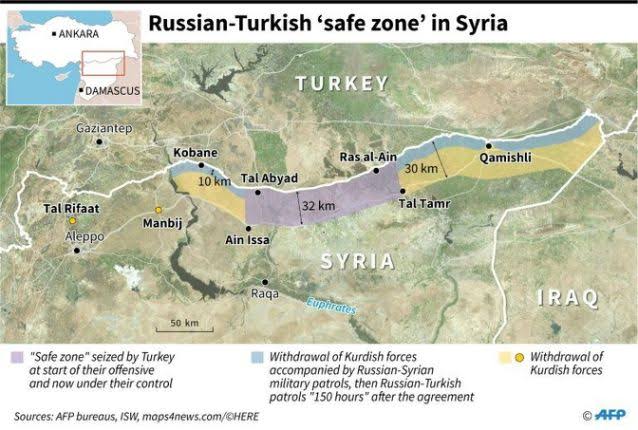
The Russian objective is to steadily expand the Syrian government control of the border regions with Turkey, which would incrementally lead to direct dealings between Ankara and Damascus on issues of border security. In sum, Moscow doesn’t seem to be unduly perturbed that the US is about to get back into bed with Turkey.
Turkey harbours serious misgivings about the US intentions regarding Kurds. Ankara has failed to break the nexus between the US and the Kurdish militant groups and if anything, the Pentagon commanders are lately rather blasé about the axis. Therefore, Turkey cannot afford to put its eggs in the American basket when it comes to northeast Syria.
Importantly, the suspicion is deep-rooted in the Turkish mind that the 2016 coup attempt against Erdogan by the movement led by Islamist preacher Fethullah Gülen (who lives in exile in the US since 1998) was supported by the US military and intelligence circles.
Meanwhile, US-Turkey relations may become toxic what with the US prosecutors in New York asking a federal judge on January 21 to impose escalating fines on Turkey’s state-owned Halkbank for failing to respond in court to criminal charges that it helped Iran evade US sanctions. The proposed fine on the bank is a $1 million-per-day fine – a penalty that would double for each week of further non-compliance. It could total $1.8 billion after eight weeks.
The case against Halkbank has been a longstanding point of tension in the increasingly fraught relationship between Ankara and Washington. Some analysts estimate that it is the single most explosive issue that could blow up the Turkish-American relationship.
If Halkbank decides to acquiesce and appear in court, the case will tarnish the reputation of the Erdogan government. The case implicates senior Turkish ministers, top Halkbank executives and even Erdogan and his family members as beneficiaries of the sanctions-busting efforts.
On the other hand, if the Halkbank insists on its civil contempt of court, that might ultimately severe its ties with the US financial system, hurting not only the bank but also Turkey’s financial sector, and send Turkish-American relations into a free fall.
Can the Trump administration intervene in the Halkbank case and rescue Erdogan? That likelihood can also be ruled out in the downstream of the reported allegation by former NSA in the White House John Bolton in his upcoming memoirs that Trump who has a property in Turkey was inclined to grant favours to Erdogan.
In such a sombre backdrop, it is highly improbable that Erdogan can afford to hitch Turkish wagons with the US. Having said that, Erdogan is under pressure from Turkish public opinion on the refugee problem. He may have to be seen doing ‘something’ to stall the Syrian offensive in Idlib.
No doubt, Ankara has sharpened its messaging but there is no clear Turkish strategy in view. The only viable option will be to accept the new facts on the ground. Possibly, as happened so often before, President Vladimir Putin will step in at some point to hold Erdogan’s hand.
Featured Video

Dan Dicks with James Corbett on Solutions Watch
or go to
Aletho News Archives – Video-Images
From the Archives
Secret document reveals plans for civil war in Lebanon, Israeli false flags, and invasion
By Randi Nord | Geopolitics Alert | April 5, 2019
Beirut – During his visit with US Secretary of State, Mike Pompeo, Lebanese President Michael Aoun reportedly received a US-Israeli document detailing plans for creating a civil war in Lebanon with covert false flag operations and possible Israeli invasion.
Although the source of the document is Israeli and created in partnership with Washington, no one knows who presented it to Aoun. The Lebanese TV station, Al-Jadeed, initially reported the document on Lebanese TV and a video on its website. Geopolitics Alert translated the report for this article. … continue
Blog Roll
 Aletho News
- Sheikh al-Asadi warns of Iraqi government compliance with US demands
- How to MAKE THE CONSPIRATORS PAY for their crimes! Dan Dicks with James Corbett on Solutions Watch
- There’s a drought in academia: A drought in honest research on the subject of drought and other weather extremes
- Department of War Awards $20.7 Billion Contract to Raytheon for Air-to-Air Missiles
- ‘Distance yourselves from Israel’: IRGC urges US population to question govt policies
- America’s Greenland deal has a radioactive backstory
- The RAF Fairford ‘terror plot’: Unpacking escalation in the UK echo-chamber
- EU Council Advances Chat Control 2.0 Scanning Proposal
- Ex-Greek MEP files complaint against Israeli spyware firm over alleged Pegasus surveillance
- Troubling ideas throughout the Torah, Talmud, Mishneh Torah and Tanya
- If Americans Knew
- New Report: “Scholasticide and Genocide in Gaza: Assessment, Testimonies and Legal Analysis”
- Ex-Biden officials are desperate for a Gaza scapegoat
- Israeli “settlers” Invade Al-Aqsa; Pour Boiling Water on 75-Year-Old
- Israel Has Kidnapped Another American Teenager
- US arms sales to Israel worth $21.6 billion in 20 months
- Three Palestinians Killed in Israeli Attacks on Gaza
- Revealed: German “Anti-Semitism Expert” Driving Crackdown on Palestine Solidarity is Former Israeli Spy
- Egypt’s Warning to Israel Before Oct 7
- Israel’s siege signals another cruel winter for 1.8 million Gazans – Daily Update
- Netanyahu Asked UAE Leader to Deny Report on Oct. 7 Warning in Secret Visit, Sources Say
- No Tricks Zone
- Two More Paleo Reconstructions Affirm Meters-Higher Sea Levels Across Ireland, Brazil 7000-6000 Years Ago
- New Study: Earth And Venus Surface Warmth Largely Explained By Convection And Lapse Rate, Not CO2 Or Radiation
- 2025 Nature Paper Claiming Worsening Global Drought Gets RETRACTED …Heavily Flawed
- New Study: ‘Global Drought Shows No Detectable Recent Acceleration Under Climate Warming’
- Economic Masterminds: German Socialists Suggest Taxing Productivity Gains Stemming From Using AI
- The South China Sea Has Not Been Cooperating With The Climate Change Narrative
- Energy Crisis: Germany Enters Heating Season With Historically Low Gas Reserve Fill Levels
- New Study: The Antarctic Ice Sheet Gained Mass From 2020-2024 Due To Staggering Snow And Ice Accumulation
- Study: Ocean Heating Rates From Thousands Of Years Ago ‘Dwarf’ Modern Ocean Heating Rates
- Climate Extremists Target, Attack Large-Scale Power Grid Infrastructure In Germany!

