Security, terrorism & Iran: What Netanyahu talked to Putin about, days ahead of Israeli election
RT | September 12, 2019
Israeli PM Benjamin Netanyahu is in Russia meeting President Vladimir Putin and top ministers. The little we know from the talks suggests Netanyahu may be trying to drag Moscow into his fight against Iran-linked “destabilization.”
The two leaders met in the Russian Black Sea resort city of Sochi late on Thursday. Officially, the talks were outlined as a discussion on bilateral relations and various security issues – international terrorism and the situation in Syria. Putin said that both Russia and Israel are “well aware” of what terrorism is and said that cooperation is particularly important to combat it.
Netanyahu, for his part, singled out the issue of Iran, stating that Tel Aviv “won’t tolerate Tehran’s threats,” yet again accusing it of using Syria’s territory to wage “aggression” against Israel. The Israeli PM would like Moscow to share such a stance and ultimately see Iranian presence eliminated in Syria, Netanyahu’s spokesman Evan Gary Cohen suggested.
“I think that the Iranian presence in Syria is something that the Russians and the Israelis both would like to end. It’s not something that they desire,” Cohen told RT.
This opinion appears to be in stark contrast with that of Moscow, which has been engaged in military and economic cooperation with Tehran, while repeatedly criticizing the attempts to paint Iran as the sole source of troubles in the Middle East. Russia has condemned Israeli attacks on the supposedly “Iranian-linked” targets in Syria. One such raid resulted in the loss of a Russian reconnaissance plane and the deaths of all 15 onboard, after it was accidentally shot down by Syrian air defenses.
Speaking to reporters on Thursday, both Putin and Netanyahu stressed the importance of cooperation between the militaries of the two countries, needed to prevent any potential run-ins between them as well as to fight terrorism. Ahead of the meeting with Putin, the Israeli PM – who has also been the country’s defense minister since the resignation of Avigdor Lieberman – met his Russian counterpart Sergei Shoigu.
Netanyahu lauded the “natural connection” and a “human bridge between Israel and Russian-speaking countries,” and called the talks with Shoigu “important.” He, however, said that the Israeli military must maintain “freedom of action,” which is essential to prevent Iran from entrenching in “our region.”
Putin and Netanyahu touched upon another hot topic – the upcoming September 17 parliamentary elections in Israel. Critics of the Israeli PM have claimed that Netanyahu’s visit was a PR stunt in a bid to secure his re-election.
Netanyahu’s spokesman vehemently denied to RT any alleged links between the elections and the talks, insisting that they were all about security.
Putin said that Moscow closely watches the elections, since Israel is home for over 1.5 million people, who came from the former Soviet Union.
“We’ve always regarded them as our people, we call them our compatriots,” Putin said. He didn’t voice any explicit support for Netanyahu, however, instead saying he hoped “responsible politicians” would end up in charge of the Knesset.
Moscow condemns Netanyahu’s annexation bid on eve of his visit to Russia
Press TV – September 11, 2019
Russia has strongly condemned Israeli Prime Minister Benjamin Netanyahu’s election pledge to annex north of the Dead Sea and Jordan Valley in the occupied West Bank on the eve of his visit to the Russian city of Sochi.
In a statement on Wednesday, the Russian Foreign Ministry warned that the implementation of Netanyahu’s plan may result in a “sharp escalation of tension in the region”.
It may also “undermine hopes for a long-awaited peace” in the region, the statement added, urging Tel Aviv to return to direct negotiations based on “relevant UN Security Council resolutions, the Madrid Principle and the Arab Peace Initiative.”
The condemnation came on the eve of Netanyahu’s visit to the Black Sea resort city of Sochi, where he is scheduled to hold talks with Russian President Vladimir Putin on Thursday.
The visit, announced on Tuesday, will be held just five days before the Israeli snap legislative elections. The last time Putin and Netanyahu met was in Moscow on April 4, again five days before the last Israeli election.
Netanyahu has promised to go ahead with the annexation plan in case he emerges victorious in the forthcoming votes.
“Today I announce my intention to apply with the formation of the next government Israeli sovereignty over the Jordan Valley and northern Dead Sea,” Netanyahu said in a speech broadcast live on Israeli TV channels on Tuesday evening.
The 69-year-old Chairman of the Likud-National Liberal Movement also reiterated his intention to annex Israeli settlements throughout the occupied West Bank if re-elected, and in coordination with US President Donald Trump.
The plan has drawn sharp criticism from countries in the Middle East, including Jordan and Turkey, and international bodies like the UN and the Arab League.
Iran on Wednesday said the Israeli prime minister seeks to stay in power through annexations and anti-Iran accusations.
“Netanyahu is after votes to stay in power and continue with expansionist policies and aggression one day through making accusations against the Islamic Republic of Iran and one day by announcing his malicious intention to annex certain parts of Palestine,” Iranian Foreign Ministry Spokesman Abbas Mousavi said.
Ironically enough, Saudi Arabia that has been seeking to normalize ties with Israel also criticized Netanyahu for this “dangerous escalation against the Palestinian people” and called for an emergency meeting of the Organization of Islamic Cooperation (OIC).
The OIC later announced on Wednesday it will call an emergency meeting soon at the level of foreign ministers to review the Israeli premier’s plan.
The OIC Secretary General Yousef bin Al-Othaimeen strongly condemned Netanyahu’s intention, emphasizing that the “dangerous announcement is another aggression against the Palestinian people’s rights.”
He said the OIC meeting will discuss the possible political and legal measures that could be taken to confront Israel’s new aggression.
Are India and Japan Challenging the BRI in Russia’s Far East?
By Paul Antonopoulos | September 11, 2019
Although the Russian Far East has huge investment potential in the fields of raw materials, mineral resources, fisheries, forestry’s and tourism, it still remains a sparely populated area of only around 7 million people. With China, India, Japan, Indonesia and Russia projected to be some of the world’s biggest economies by 2030 according to many experts, the 21st Century has been dubbed as the “Asian Century,” and it is for this reason that Russian President Vladimir Putin has prioritized the rapid development of the Russian Far East.
The region is not only resource rich, but is also conveniently located in northeast Asia, bordering Mongolia, China and North Korea, while sharing a maritime border with Japan. It is so strategic and rich that only weeks ago French President Emmanuel Macron expressed his belief that Europe stretches from Lisbon on the Atlantic Coast to the Russian Pacific port of Vladivostok. Vladivostok has hosted the Eastern Economic Forum annually ever since its establishment 2015, in part to attract foreign investors to diversify from only Chinese investments in the Russian Far East. China has invested tens of billions into the region, making it easily the biggest foreign investor in the region.
However, with Indian Prime Minister Modi on the eve of Vladivostok’s 5th Eastern Economic Forum proposing a trilateral cooperation between India, Russia and Japan by jointly developing the Russian Far East, it appears that China’s economic influence in the region will be challenged. Although China emphasizes peaceful relations through mutual economic development and prosperity, it still has frosty relations with Japan and India. It is therefore unsurprising that India and Japan have opted to invest in the Russian Far East to challenge China’s economic might in a region that also shares a vast border with China.
India, Japan and Sri Lanka signed an agreement to build a new container terminal in the port of Colombo, demonstrating that New Delhi and Tokyo have experience in cooperating in a trilateral format. With India opting to be the only South Asian country not involved in the Belt and Road Initiative (BRI), India continues to show coldness to China as the latter continues to rapidly develop neighboring countries, especially with Nepal and rival Pakistan. With the BRI developing Sri Lanka, it appears India and Japan are creating a new economic duo to match China’s economic strength, and are now prepared to take this to a new front away from Sri Lanka and to the Russian Far East.
Japan’s investments in the Russian Far East’s economy already exceeds $15 billion and will continue to develop, according to Japanese Prime Minister Shinzo Abe. And with India also expressing its interest, the Russian Far East has become a promising place for all prospectors. With Russian President Vladimir Putin offering free land handouts in the Far East to Russians and naturalized citizens in May 2016, it demonstrates that Russia has identified that if it wants to benefit from Asia’s rapid development and economic dominance in the 21st century, it needs to develop its regions in Asia.
With the development of the region naturally meaning increased trade and cultural exchanges with China, tens of thousands of Chinese citizens have now migrated to the region in search of opportunities and establish themselves as merchants and entrepreneurs. Whether we begin seeing Indian and Japanese merchants in the Russian Far East remains to be seen.
With India and China competing in Nepal and border issues on the Indian-Chinese frontier remaining unresolved in New Delhi’s eyes, it appears that India is now wanting to compete against China in a region that has had connections with China for millennia. Russia has been encouraging more and diversified investments in the Far East and Japan and India will take every opportunity to do this.
Russia and China remain strategic partners and are also pragmatic international players that continue to pursue a policy of non-interference. Therefore, although China has frosty relations with Japan and India, it can respect Russia’s ties with both countries. This pragmatism has now allowed India and Japan to engage in a friendly competition for economic influence over Russia’s resource rich region. Although both Japan and China invest in raw material and energy projects in the Far East, India will be a new player to this sector with Indian Oil and Gas Minister Dharmendra Pradhan expressing his long-term interest in the Russian coal and steel sector during his visit to Russia last week.
With India becoming increasingly energy hungry because of its enormous and growing population, alongside its economic development, it is easily seen why the resource rich Russian region is of critical importance to it. For Japan, the region presents unmatched economic opportunities. Most interestingly to observe is whether India and Japan will continue to work in trilateral formats to continue expanding their economic interests and challenge the BRI in other regions. It appears now that after their cooperation in Sri Lanka, their second step is to challenge the expansion of the BRI in Russia’s Far East by competing for lucrative contracts and opportunities that the region can offer.
Paul Antonopoulos is the director of the Multipolar research centre.
‘Pulp fiction’: Kremlin says alleged CIA mole was a minor official with no access to Putin
RT | September 10, 2019
A former official identified in media reports as a CIA asset in Russia worked in the presidential administration but never had access to Vladimir Putin, the Kremlin has claimed, adding that the man was fired several years ago.
US media reported on Monday that US intelligence carried out an operation in 2017 to extract a high-level Russian official who had worked as an informant for the CIA.
The incendiary claim has triggered a race to identify the alleged spy. Kommersant, a Russian daily, reported on Tuesday that the official may have been a man named Oleg Smolenkov.
Kremlin spokesman Dmitry Peskov confirmed that Smolenkov worked in the government, but said he did not hold a senior position and was fired in 2016 or 2017.
“Indeed, Smolenkov used to work in the presidential administration, but was fired several years ago,” Peskov said. He added that the alleged spy was not a high-ranking official personally appointed by Putin.
He said that the Kremlin was unaware of Smolenkov’s whereabouts, and that the government could only confirm that a man by that name once worked for the administration but was later laid off.
Peskov was openly critical of the US media’s faith in the evidence-deficient story, describing their breathless reports as resembling something more suitable for Hollywood.
“All this speculation in the US media about who urgently extracted who and who saved who from who, that’s all, as you understand, more of a pulp fiction kind of genre.”
Russian Foreign Minister Sergey Lavrov also weighed in on the sensational story, stating that he had never met Smolenkov or followed his career or movements. Western media reports portray the alleged mole as a senior official who enjoyed direct access to Putin.
Earlier, both the White House and the CIA denied the media reports.
The CNN exclusive claims that the CIA asset was secretly ferried out of Russia amid fears that his identity could be compromised by US President Donald Trump’s alleged chummy relationship with Moscow. Some have speculated that the story was manufactured to smear the American president.
We refuse to be a ‘normal country’ if it means US-style bombings & invasions, Moscow tells Pentagon
RT | September 9, 2019
It’s better not to be a “more normal country” if that means being as prone to invasions and coups as the United States, top Russian ministers have said, firing back at bizarre remarks by a new Pentagon chief.
It would be “great” if the West “could get Russia to behave like a more normal country,” Mark Esper, the newly appointed defense secretary, was reported to have claimed while visiting Paris this week.
That remark did not go down well with Moscow, however.
“If he said so, he called upon us to act as a normal country [as such] and not like the United States,” Foreign Minister Sergey Lavrov told a press briefing in the Russian capital, where he and Defense Minister Sergey Shoigu had a face-to-face meeting with French counterparts.
“Otherwise, we should have been acting like the US, bombing Iraq and Libya in blatant violation of international law… We should have supported coups, violent and anti-constitutional, like the US and its closest allies did in February 2014 [in Ukraine].”
What’s more, if Russia followed Washington’s instructions, then “we would have spent millions on intervening in the affairs of other countries as Congress has done by authorizing $20 million for supporting democracy in Russia,” Lavrov stated.
On his part, Shoigu also said that normalcy has a different meaning for Moscow then.
“We will probably remain [an] abnormal [country].”
Meanwhile, the visiting French officials advocated coming to terms with Russia.
“The time has come, the time is right, to work towards reducing distrust,” Foreign Minister Jean-Yves Le Drian said.
Defense Minister Florence Parly added that “it is important to talk to each other, to avoid misunderstanding and friction.”
Also on rt.com ‘Russia will never be our friend, we’ll slap them when needed’ – US envoy to UN
The meeting comes weeks after Russian President Vladimir Putin met with his French counterpart Emmanuel Macron in late August at Bregancon, in an attempt to defuse tension and break the ice in Russia-West relations.
On that occasion, Macron vowed to create a “new architecture of security and confidence” between the EU and Russia. He pointed out that Moscow’s contribution is “essential” in helping to solve the crises in and around Iran, Ukraine, and Syria, and to work on nuclear non-proliferation.
It’s Necessary to Find Way to Counter US, Otherwise Nuclear Deal Won’t Be Only Loss: Zarif
Sputnik – September 3, 2019
Iranian Foreign Minister Javad Zarif said on Monday that Washington’s actions regarding the Joint Comprehensive Plan of Action are a blow to international law, and if the accord is not preserved, the nuclear deal “will not be the only loss”.
On Sunday, Tehran said it would make a third reduction of commitments agreed to under the deal and that this round would be the harshest yet. A spokesman for the Iranian government, Ali Rabiei, said on Monday that Iran would wait until Thursday for the deal’s signatories to take steps toward implementing the accord and make a decision on whether to further scrap its commitments depending on these actions.
“America’s actions are not only a blow to the JCPOA, but to the whole framework of international law. That is why, if we do not find a way to counteract the United States, the JCPOA will not be the only loss. Therefore, we share the same views with Russia on this issue”, Zarif told the Rossiya 24 broadcaster.
Earlier in the day, Zarif said that Tehran would return to full implementation of the deal, if there was progress in negotiations on the implementation by Europeans of their part of the agreement.
The JCPOA was signed in 2015 by Iran, China, France, Germany, Russia, the United Kingdom, the United States, and the European Union. It required Iran to scale back its nuclear programme and severely downgrade its uranium reserves in exchange for sanctions relief. In 2018, the United States abandoned its conciliatory policy on Iran, withdrawing from the JCPOA and hitting Iranian petroleum industries with sanctions.
Moscow Concerned, Puzzled Over US Airstrike in Syria’s Idlib
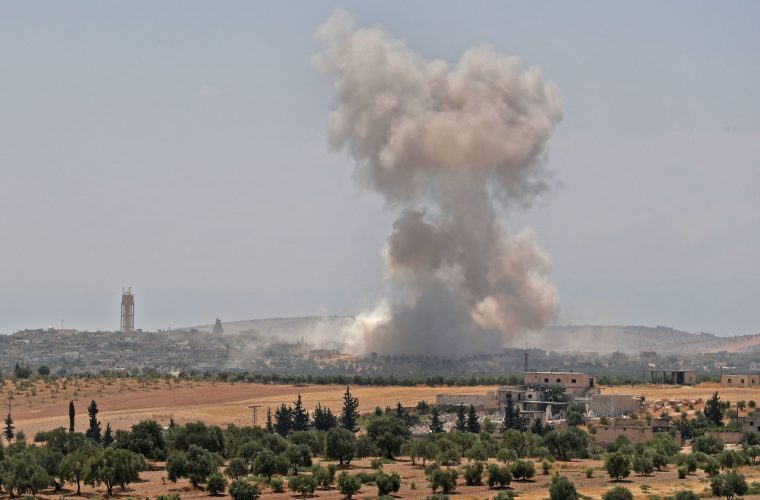
Smoke billows above buildings near the town of Hish in Syria’s Idlib province © AFP 2019 / Omar Haj Kadour
Sputnik – September 2, 2019
The Russian Foreign Ministry said in a statement on Monday that it was concerned and puzzled by Washington’s recent airstrike in Syria’s Idlib, slamming the move as “inconsistent” and “contradictory.”
“Inconsistent and contradictory steps that the United States makes in Idlib cannot but cause bewilderment and concern. On the one hand, US representatives … call for halting escalations in Idlib … On the other hand, they conduct an airstrike, which results in large-scale damage and victims”, the Russian Foreign Ministry said.
Moscow added it expected the United Nations to take the consequences of the airstrike into consideration when preparing reports on the situation in Syria, and also to brief members of the UN Security Council on “the consequences for civilians and civilian infrastructure” and to check the airstrike’s compliance with international humanitarian law.
Although the strike has put the ceasefire under threat, a moratorium on military campaigns is still in place, the ministry emphasised.
US forces struck on Saturday what they said were positions of leaders of the al-Qaeda terrorist group in the north of Idlib.
The strike came on the same day when a new ceasefire entered into force in the rebel-held province. According to the Russian Defence Ministry, Washington violated the ceasefire agreement in Syrian de-escalation zone by launching an attack on it without informing the ceasefire guarantors, namely Russia and Turkey.
The attack resulted in an unspecified number of casualties and damage to surrounding structures.
Moratorium on US oil sanctions to open talks with Iran
By M. K. BHADRAKUMAR | Indian Punchline | September 2, 2019
The diplomatic manoeuvrings over the situation around Iran are entering a crucial phase with an Iranian delegation led by Deputy Foreign Minister Abbas Araqchi leaving from Tehran for Paris today to pick up the threads of the 3-way discussions involving France, Iran and the United States at Biarritz a week ago on the sidelines of the G7 summit.
Araqchi is Iran’s chief negotiator with the E3 — France, UK and Germany — on the nuclear issue. Interestingly, Araqchi openly acknowledged on Saturday that the US has “shown some flexibility on the licensing of Iranian oil sales.”
The formula that was tossed around in Biarritz that the US will not oppose income being generated for Iran through oil sales is being finessed and linked to the working of the European Union’s trade mechanism for legitimate trade with Iran known as INSTEX. In essence, the formula is based on the French proposal of “freeze for freeze” — US freezing oil sanctions against Iran while Iran will freeze its steady pullback from the JCPOA commitments.
Araqchi said Iran and its European partners in the nuclear deal faced “difficult and complex” talks towards salvaging the pact. But a note of cautious optimism is apparent in Foreign Minister Javad Zarif’s remark in Tehran following a meeting of the National Security and Foreign Policy Committee at the Iranian parliament on Sunday afternoon that Iran may review the decision to further reduce JCPOA commitments if the European countries take action on INSTEX to live up to their own obligations. Tehran expects the Europeans to take a final decision by Thursday.
In the above backdrop, Iranian President Hassan Rouhani telephoned French President Emmanuel Macron on Saturday to convey Tehran’s interest in resuming the discussions under the latter’s mediation. Macron welcomed the move. Rouhani also assured Macron that Iran is supportive of a political settlement in Yemen and is willing to guarantee the security of the shipping lanes in the Persian Gulf and the Strait of Hormuz.
Perhaps, in an indirect alert to the US President Trump, Rouhani conveyed to Macron Iran’s misgivings that Israel is pulling all stops to derail the current negotiations which are at a delicate stage. Rouhani specifically referred to the Israeli attempt to provoke a flare-up involving Iran somehow, as evident in its recent air attacks on Lebanon, Syria and Iraq successively. The Hezbollah retaliated on Sunday by attacking Israel’s military vehicles, leaving a number of Israeli forces reportedly dead or injured.
In a sure sign that a broad settlement of the situation around Iran is under discussion, Zarif has travelled to Moscow with a high-level delegation aimed at coordinating the Iranian and Russian positions. Iran’s special envoys for Afghanistan, Yemen, and Syria are accompanying him. (Interestingly, Zarif referred to “serious developments” in Afghanistan, hinting at imminent US-Taliban deal this week.) Indeed, Iran is across the board addressing the western disquiet over Iran’s role in the conflicts in Yemen, Syria and Afghanistan. Tehran’s diplomatic priority will be to underscore that it can be a factor of regional security and stability.
From all appearance, Macron is steering the negotiations along three parallel tracks: a) forestall any precipitate crisis in the implementation of the 2015 nuclear deal by enabling Tehran to generate income out of oil sales that helps alleviate the hardships in the Iranian economy; b) persuade the Trump administration to concede Iran’s prerogative to resume trade relations with Europe and generate income through oil sales; and, c) defuse and de-escalate the various ‘hotspots’ in the Middle East where Iran’s role is regarded as critical — principally, Yemen, Syria and Afghanistan.
A convergence of the three tracks can be expected to lead to a new understanding between Tehran and Washington, possibly even a near-future summit involving the US and Iranian presidents. The clock is ticking and there is urgency to generate momentum for Macron’s efforts, as Trump and Rouhani are due to attend the UN General Assembly in September. A meeting is entirely conceivable as things stand.
Indeed, a deeply troubled relationship such as the Iranian-American is bedeviled with a lot of signalling and grandstanding, especially on the part of Tehran where Rouhani has to overcome significant resistance to the very idea of engaging with the US. The Supreme Leader Ali Khamenei has not said a word so far on Zarif’s visit to Biarritz or the 3-way France-Iran-US discussions under way. Tehran keeps repeating the demand on the lifting of the US sanctions as a pre-requisite for a face-to-face meeting between Rouhani and Trump.
However, it is possible to discern that Tehran is open to negotiations without preconditions and to strive for a meaningful breakthrough by optimally resorting to creative and flexible diplomacy. This flexibility factors in the assessment that Washington too is in a chastened mood.
Trump will not brook disruption by “hardliners”. Several Israeli attempts to have a phone conversation between PM Benjamin Netanyahu and Trump at Biarritz failed to materialise. Trump understands that all attempts by the US to create an international coalition against Iran have failed.
The law of diminishing returns is at work. The maximum pressure strategy against Iran is opening the window for an unprecedented expansion of Russian and Chinese influence in Tehran which may damage American regional interests in the long-term. The planned first-ever naval exercises between Iran and Russia in the Persian Gulf has rattled the US.
All in all, we may expect a moratorium on US oil sanctions in exchange for Iran’s compliance with its JCPOA obligations, which would be followed by direct negotiations for a historic thaw in the US-Iran relations.
Undeclared US airstrike on Syria’s Idlib leaves multiple casualties, puts truce at risk – MoD
RT | September 1, 2019
Sending no warning to Russia or Turkey, the US bombed an array of targets within Idlib, Syria, killing numerous civilians and threatening the hard-earned truce across the province, the Russian Defense Ministry said.
The air raid led to “multiple casualties and destruction” around two villages in the Idlib province, where a fragile ceasefire between government forces and militants is still in place, the Russian Reconciliation Center said on Sunday. The airstrike, carried out on Saturday, “endangered the truce” and “violated all previous arrangements.”
Earlier, US Central Command (CENTCOM) said it targeted leaders of a group it calls al-Qaeda in Syria. The strike “will further degrade their ability to conduct future attacks and destabilize the region,” it claimed.
But it hit shortly after Syrian government forces began a unilateral truce in the rebel-held province, Russia’s Defense Ministry noted. The Syrian Army is still sticking to the ceasefire despite militant attacks provoked by the US bombing.
Simultaneously, all combat sorties inside Syria were brought to a halt, the ministry said, rebuking US accusations about Russian “indiscriminate airstrikes” in Idlib.
Forces loyal to the government launched a major offensive on Idlib back in April and made significant advances last month. After days of fierce battles, they managed to liberate strategic locations, including Khan Sheikhoun, a town which had remained a rebel stronghold for years.
Still, a part of the province remains in the hands of a host of jihadist groups that continue to fight against the Damascus government. Hostilities between the Syrian army and the militants were mitigated through a joint diplomatic effort by Russia, Turkey and Iran to create a lasting peace in north-eastern Syria.
In September last year, the three nations agreed to create a 30km buffer zone dividing opposing forces, as part of an extended ceasefire.
What the new arms race will look like in a post-INF world
RT | August 27, 2019
Washington ending the INF arms control treaty has raised fears of a new “arms race.” This time it will be about more than just missiles, with China presenting strong competition to the US and Russia, a military expert tells RT.
Last week’s test of a ground-launched Tomahawk cruise missile showed that the US is eager to field a system banned by the Intermediate-Range Nuclear Forces Treaty, even as it accused Russia – without offering evidence – of being in violation as a pretext to rip up the 1987 pact.
Russian President Vladimir Putin has ordered a “symmetrical response” to this threat, citing the presence of US launchers in Poland and Romania. Meanwhile, the Russian delegation to the UN has warned that the US actions have brought the world “just one step away from an uncontrolled arms race.”
Unlike the Cold War contest, however, the race to develop revolutionary military technology will have multiple contestants, retired Aerospace Force Colonel Mikhail Khodarenok told RT.
He sees three possible vectors of development for new technology, all of which go beyond intermediate-range missiles: artificial intelligence (AI), space, and hypersonic weapons.
AI would be the biggest step in military advancement since gunpowder and atomic weapons, Khodarenok says, and hundreds of thousands of scientists in the US and China are already working on it.
Whoever masters its use first will be the master of the world.
“The militarization of space is inevitable,” Khodarenok adds. Treaties currently prohibit the deployment of weapons in space, but this is unlikely to remain true for long, as the US has already moved to create a space force.
Whoever can field a maneuverable “space plane” will dominate that sphere, Khodarenok argues, noting that satellites and other space assets are crucial for intelligence, navigation, communications and early-attack warnings.
There is no engine – yet – that could make such a plane a reality, but whoever successfully designs one will be ahead of the competition, the colonel noted.
The same technology could provide the edge in developing hypersonic airplanes and missiles, but also solutions that could enable drones and other robot vehicles to stay airborne for weeks or longer.
China is currently pouring massive resources into research and development, while the US has drastically increased its military budgets in order to rebuild a force President Donald Trump claimed was “depleted” from decades of constant warfare. Russia’s military budget is quite modest in comparison, though its weapons systems appear on par or even more effective than their US counterparts, at a fraction of the cost.
Numerous US military experts have also cautioned that no amount of money and technology can make up for problems with the Pentagon’s doctrine and strategy that will not work against new Russian and Chinese strategies.
World on verge of ‘uncontrolled arms race’ because of US – Russia’s UN envoy
RT | August 22, 2019
The US ambitions have put the world on the brink of a new arms race that can easily spiral out of control, warned the Russian envoy to the UN. Washington responded by blaming Moscow for the INF treaty’s collapse.
“Are you aware of the fact that all of us have found ourselves just one step away from an uncontrolled arms race, because of the US geopolitical ambitions?” Dmitry Polyanskiy, Russia’s deputy ambassador to the UN, said at the emergency session of the Security Council that Moscow and Beijing convened on Thursday, in the wake of the US missile tests.
This a source of great concern for us, but apparently not for the US.
Washington apparently planned to leave Intermediate-Range Nuclear Forces (INF) Treaty long before announcing its withdrawal from the 1987 agreement back in February, Polyanskiy added, since this is the only way it could have tested a new ground-launched cruise missile that violated the accord mere weeks after it officially expired.
The launcher used in the test was the same one installed in Aegis Ashore missile defense batteries in Romania and Poland. When the first of those systems was placed in 2016, Moscow expressed its concerns over their capability to launch Tomahawk cruise missiles in violation of the INF treaty. The US assured Russia at the time the Aegis systems did not have such features.
“Now these suspicions are confirmed,” Polyanskiy said,
The Russian diplomat also rebuked US allies in Europe for their reluctance to support Moscow’s efforts in strengthening the treaty, back when it could have still been saved. In December 2018, Russia introduced a draft resolution to the UNSC that sought to enhance international support for the treaty, without any no criticism of the US. Yet, the western nations did not back it.
“Are you happy that you pressed the red button at that time?” the Russian diplomat said, addressing the European nations. Their inaction, he argued, has thrown back the security situation in Europe to the times before the INF, when short- and mid-range nuclear missiles were stationed on the continent.
Washington maintained its was Russia that “materially breached” the treaty by developing and allegedly deploying “multiple battalions” of missile systems the US allege are violating the INF. Moscow has repeatedly denied the accusations and even invited international inspections of the system in question – but no one took it up on the offer.
The acting US envoy to the UN, Jonathan Cohen, called the latest missile test a “prudent response” to the “aggressive strategies” pursued by Russia and China, which he blamed for the “deteriorating security environment” in the world.
After withdrawing from the INF treaty, Washington hinted it would like to re-negotiate the deal and include China into it. Beijing’s envoy to UN said it has “no interest in participating in trilateral disarmament talks” right now and insisted that the primary responsibility for the arms control rests with the powers possessing the largest nuclear arsenals.
Featured Video

Dan Dicks with James Corbett on Solutions Watch
or go to
Aletho News Archives – Video-Images
From the Archives
Secret document reveals plans for civil war in Lebanon, Israeli false flags, and invasion
By Randi Nord | Geopolitics Alert | April 5, 2019
Beirut – During his visit with US Secretary of State, Mike Pompeo, Lebanese President Michael Aoun reportedly received a US-Israeli document detailing plans for creating a civil war in Lebanon with covert false flag operations and possible Israeli invasion.
Although the source of the document is Israeli and created in partnership with Washington, no one knows who presented it to Aoun. The Lebanese TV station, Al-Jadeed, initially reported the document on Lebanese TV and a video on its website. Geopolitics Alert translated the report for this article. … continue
Blog Roll
 Aletho News
- Sheikh al-Asadi warns of Iraqi government compliance with US demands
- How to MAKE THE CONSPIRATORS PAY for their crimes! Dan Dicks with James Corbett on Solutions Watch
- There’s a drought in academia: A drought in honest research on the subject of drought and other weather extremes
- Department of War Awards $20.7 Billion Contract to Raytheon for Air-to-Air Missiles
- ‘Distance yourselves from Israel’: IRGC urges US population to question govt policies
- America’s Greenland deal has a radioactive backstory
- The RAF Fairford ‘terror plot’: Unpacking escalation in the UK echo-chamber
- EU Council Advances Chat Control 2.0 Scanning Proposal
- Ex-Greek MEP files complaint against Israeli spyware firm over alleged Pegasus surveillance
- Troubling ideas throughout the Torah, Talmud, Mishneh Torah and Tanya
- If Americans Knew
- New Report: “Scholasticide and Genocide in Gaza: Assessment, Testimonies and Legal Analysis”
- Ex-Biden officials are desperate for a Gaza scapegoat
- Israeli “settlers” Invade Al-Aqsa; Pour Boiling Water on 75-Year-Old
- Israel Has Kidnapped Another American Teenager
- US arms sales to Israel worth $21.6 billion in 20 months
- Three Palestinians Killed in Israeli Attacks on Gaza
- Revealed: German “Anti-Semitism Expert” Driving Crackdown on Palestine Solidarity is Former Israeli Spy
- Egypt’s Warning to Israel Before Oct 7
- Israel’s siege signals another cruel winter for 1.8 million Gazans – Daily Update
- Netanyahu Asked UAE Leader to Deny Report on Oct. 7 Warning in Secret Visit, Sources Say
- No Tricks Zone
- Two More Paleo Reconstructions Affirm Meters-Higher Sea Levels Across Ireland, Brazil 7000-6000 Years Ago
- New Study: Earth And Venus Surface Warmth Largely Explained By Convection And Lapse Rate, Not CO2 Or Radiation
- 2025 Nature Paper Claiming Worsening Global Drought Gets RETRACTED …Heavily Flawed
- New Study: ‘Global Drought Shows No Detectable Recent Acceleration Under Climate Warming’
- Economic Masterminds: German Socialists Suggest Taxing Productivity Gains Stemming From Using AI
- The South China Sea Has Not Been Cooperating With The Climate Change Narrative
- Energy Crisis: Germany Enters Heating Season With Historically Low Gas Reserve Fill Levels
- New Study: The Antarctic Ice Sheet Gained Mass From 2020-2024 Due To Staggering Snow And Ice Accumulation
- Study: Ocean Heating Rates From Thousands Of Years Ago ‘Dwarf’ Modern Ocean Heating Rates
- Climate Extremists Target, Attack Large-Scale Power Grid Infrastructure In Germany!

