Introduction: first, several friends recently suggested that that I should interview Professor Seyed Mohammad Marandi; then I read this most interesting text on Moon of Alabama and I decided to ask Professor Marandi to share his views of the current situation in Iran, the Persian Gulf and the rest of the Middle-East who very kindly agreed to reply to my question in spite of his most hectic and busy schedule. I am most grateful to Prof. Marandi for his time and replies. Crucially, Prof. Marandi debunks the silly notion that Russia and Israel are allies or working together. He also debunks that other canard about Russia and Iran having some major differences over Syria. Prof. Marandi, who is currently in Iran, is superbly connected and informed, and I hope that with this interview some of the more outlandish rumors which were recently circulated will finally be seen for what they are: utter, total, nonsense. Enjoy the interview!
The Saker: It is often said that there is an “axis of resistance” which comprises Syrian, Hezbollah, Iran, Russia and China. Sometimes, Venezuela, Cuba or the DPRK are added to this list. Do you believe that there is such an “axis of resistance” and, if yes, how would you characterize the nature of this informal alliance? Do you think that this informal alliance can ever grow into a formal political or military alliance or a collective security treaty?
Professor Marandi: I definitely believe there is an Axis of Resistance that currently includes Iran, Syria, Iraq, Gaza, Lebanon, parts of Afghanistan, and Yemen. I do not think that we can include the DPRK in any way or form. I believe that Russia could be considered to a certain degree as aligned or affiliated to this resistance, but that this is not something many would feel the need to acknowledge. At certain levels, there is a lot of overlap between Russian and Chinese policy and the policies of the countries and movements in this region that are affiliated to this Axis of Resistance. The same is true with countries such as Venezuela, Bolivia, and Cuba, which I do not consider to be similar to North Korea at all. Just as almost everywhere else, American policy in the Korean Peninsula is ugly, hegemonic and malevolence, but the nature of the DPRK government is fundamentally different from that of Venezuela or Cuba, whether the Americans or Europeans like to acknowledge that or not. Others can interpret the Axis of Resistance to include or exclude certain countries, but it is pretty clear that Iran and Russia have similar policy objectives when it comes to certain key issues. Nevertheless, Russia has a close relationship with the Israeli regime whereas Iran considers it to be an apartheid state, almost identical to that of apartheid South Africa. Or for example the Syrian government position regarding Israel is different from that of Iran’s. The official Syrian position is that the West Bank and Gaza Strip must be returned to the Palestinians, in accordance with UN Security Council resolutions, and that the occupied Golan Heights have to be handed back to the Syrian people, which are legitimate demands. But the Iranian position is different, Iran firmly believes that Israel is a colonial and apartheid regime and that it is morally unacceptable for it to exist in its present form. Therefore, at least officially, there are substantial differences. So people can interpret the Axis of Resistance in different ways. It is important to keep in mind that despite Syria, Iran, Turkey and Qatar are also moving closer together partially thanks to US, Saudi, and UAE hostility towards the Muslim Brotherhood. What is important is that there is a growing consensus about key issues in this region and what the major problems are, and I think that as time goes on this loose alliance of countries and movements is growing more influential and more powerful. I cannot say whether there will be a formal or open collective security treaty or military alliance created by any of these countries in the near or foreseeable future and I do not see such a necessity. However, I think this convergence of ideas is very important and I think that the formal and informal links that exist between these countries is in many ways more important and more significant than formal political or military alliances or security treaties.
The Saker: In recent months a number of observers have stated that Russia and Israel are working hand in hand and some have gone as far as to say that Putin is basically a pawn of Netanyahu and that Russia is loyal to Israel and Zionists interests. Do you agree with this point of view? How do Iranian officials view the Russian contacts with the Israelis, does that worry them or do they believe that these contacts can be beneficial for the future of the region?
Professor Marandi: That is nonsense. The US and Israeli regimes are culturally and ideologically bound to one another, whereas the Americans have a deep antipathy towards Russia. That is why the Russians have a very different position on Syria than do the Americans and Israelis. The Israelis alongside the US, the EU, the Saudis, and some of Syria’s neighboring countries, supported ISIS, Al Qaeda, and other extremist entities and attempted to tear Syria apart. As explained earlier, the Russian view of Israel is different from Iran. There are many Russian Jewish immigrants in Israel and they constitute a large segment of the colonists in Palestine and they are largely utilized for the further subjugation of the Palestinian people and ethnic cleansing. Generally speaking, Russian interests are in sharp conflict with those of the United States, Israel’s strongest ally. In addition, Russia’s close relationship with Syria dates back to the cold war and the relentless US pressure on China and Russia has also acted as a strong catalyst to quicken their convergence with one another as well as with Iran on key issues. The Chinese and Russians know quite well that the United States, the Europeans, and regional countries have extensively used extremists in Syria to undermine the state and that those forces could later be used to undermine security in Central Asia, Russia, and China. A large number of Russian, Chinese, and Central Asians have been trained to fight in Syria, and this is a major threat to their collective security. The United States could use these and other extremists in an attempt to impede the potential success of the Belt and Road Initiative or other plans for Asian integration. Thus, there is a sharp and growing conflict between the Russians and the Americans.
The Israeli regime constantly tells the Russians and the Chinese that they are the gateway to Washington and that if they maintain strong ties with Israel, the Israelis can help them solve their problems with the United States. I do not think there is much truth to that, because this growing conflict is about the fate of US global dominance and there is nothing the Israelis can do to change that. Nevertheless, this has been used as an incentive for the Russians and the Chinese to maintain better relations with the Israeli regime.
In any case, Russia does not have to maintain identical views with Iran, Syria, Hezbollah, Lebanon, Iraq, or Yemen. Differences exist, but strong relationships exist nevertheless. All of these countries recognize that if the Americans are able to undermine any of them, whether it is Syria, Iran, Russia, or China, then that would only encourage the United States to be more aggressive towards the remaining countries that impede US foreign policy objectives or exist as potential rivals whether regionally or globally. So even though their political structures are different, even though their foreign policies are different, the similarities that exist are quite striking as well as the common threats. Again, to a large degree this coalition is a result of US and Western foreign policy, which has strong undercurrents of Eurocentricism, tribalism, and racism.
Not only has this pressure brought these countries and movements closer to one another, but it has also created a deeper understanding among them. The Russians understand Iran better today than they did 5 years ago, partially as a result of their cooperation in Syria. This greater understanding enhances the relationship, and helps to dispel many of the misunderstandings or myths that may exist about one another due to Eurocentric narratives and orientalism.
Hence, Iran is not concerned about Russian-Israeli relations. Obviously, in an ideal world Iran would like Russia to break relations with the Israeli regime for its apartheid nature. But reality is reality, and Iranian relations with Russia are very good and at times I am sure the Iranians send certain warnings to the Israelis through the Russians.
The Saker: How is Russia viewed in Iran? Are most Iranians still suspicious of Russia or do they believe that they have a viable and honest partner in Russia? What are the main reservations/concerns of patriotic Iranians when they think of Russia?
Professor Marandi: Historically, the Iranians have had serious problems with the Russians. The Russians and the Soviet Union interfered extensively in Iranian internal affairs and they undermined Iran’s sovereignty. But ever since the collapse of the Soviet Union the image of Russia has changed. Especially since Russia began fighting alongside Iran in Syria in 2015, Russia’s image has improved significantly. When we look at polls, Russia’s image is pretty good compared to Western countries.
Western governments own or fund dozens of Persian language media outlets These outlets, such as VOA and BBC Persian among others, are constantly spouting anti-Russian propaganda. Obviously they have an impact and that couples with historical Iranian concerns about Russia, but despite all that, the Russian image is relatively favorable and that says a lot.
The Saker: How about Turkey? Iran and Turkey have had a complex relationship in the past, yet in the case of the AngloZionist war against Syria, the two states have worked together (and with Russia) – does that mean that Turkey is seen as a viable and honest partner in Iran?
Professor Marandi: Iran’s relationship with the Turkish government is complicated, especially, because of the constant policy changes that have occurred IN TURKEY over the past few years. This has made the government seem unreliable in the eyes of many. Having said that, Turkey is very different from Wahhabi influenced regimes in the Arabian Peninsula. Turkish Islamic tradition has striking similarities with Iran’s Islamic culture and because of its strong Sufi tradition, Turkey is much closer to Iran than it is to, for example,Wahhabi Saudi Arabia.
The global Wahhabi menace has grown as a result of Saudi financial support, as well as the support of other countries in the Persian Gulf region. Turkish society has been more resistant, although ever since the military conflict in Syria and due to extensive funding from the Persian Gulf, there has been growing concern about growing sectarianism in Turkey, not unlike what happened in Pakistan in the 1980s.
Ironically, before the conflict in Syria President Erdogan had a closer personal relationship with President Assad than did the Iranians. They and their families would spend vacations together.
In any case, Turkey has a very strong economic, political, and cultural relationship with Iran, and some of the rising anti-Shia and takfiri sentiments that have been on the rise in Turkey were stunted by the Saudi and Emirati support for the attempted coup in Turkey. Subsequently, their open antagonism towards the Muslim Brotherhood and Qatar, their support for the coup in Egypt, their policies in Sudan and Libya, and of course the murder of Jamal Khashoggi, have all had a beneficial impact on Iranian-Turkish relations. As a result, Turkey has grown much more distant from Iran’s regional antagonists, while Turkish support for the Palestinian cause is another element that brings Iran and Turkey closer together. American support for PKK terrorists in Syria has also angered the Turks adding push to Turkish-Iranian convergence. Even Turkish policy towards Syria is evolving, although it is impossible for the government to make a radical change, because of years of attempts at regime change.
The Saker: Next, turning to Iraq, how would you characterize the “balance of influence” of Iran and the USA in Iraq? Should we view the Iraqi government as allied to Iran, allied to the USA or independent? If the Empire attacks Iran, what will happen in Iraq?
Professor Marandi: The relationship between Iraq and Iran is significantly more important than the relationship between Iraq and the United States. Iran and Iraq are allies, but this alliance does not contradict the notion of Iraqi independence. Iraq’s regional policy is not identical to Iran’s. But the two countries have very similar interests, a very close relationship, many Iraqi leaders have spent years in Iran, and the bulk of the Iraqi population lives close to the shared border of over 1,200 km between the two countries. So trade, pilgrimage, and tourism are key to both countries. The religious similarities and the holy sites that exist in Iran and Iraq are a huge incentive for interaction between the two countries. There are many Iraqi students studying in Iran and many Iranian’s working in Iraq. The fact that Iranians made many sacrifices when fighting ISIS in Iraq and many Iraqis were martyred in the war against ISIS and Al Qaeda in Syria is a strong indication of where things stand despite US pressure.
The Arba’een pilgrimage that takes place every year where millions of Iranians and Iraqis make the walk towards Karbala, side by side, with tens of thousands of Iraqi and Iranian volunteers helping pilgrims along the way is, I think, a further sign of the close relationship.
While the U.S presence in Iraq continues to be hegemonic, Iran has not sought to prevent Iraq from having normal relationships with other countries. However, the U.S continues to seek control over Iraq through the world’s largest embassy, its military presence, and its influence over the bureaucracy. The United States continues to have much say over how the country’s oil wealth is spent.
Still, despite the US colonial behavior, its continued theft of Iraqi oil wealth, and its thuggish behavior, the Iraqis have been able to assert a great deal of independence. In the long run, this continued US behavior is only going to create further resentment among Iraqis. The empire rarely takes these realities into account, they seek to accumulate influence and wealth through brute force, but in the long term it creates deep-rooted anger and hostility which, at some point, will create great problems for the empire, especially as this anger and unrest is growing across the region, if not across the globe.
It is highly unlikely that the regime in Washington will attack Iran, if it does it will bring about a regional war, which will drive the United States out of Iraq, Afghanistan, Lebanon, and Syria. Saudi Arabia and the Emirates would, swiftly collapse and the price of oil and natural gas would go through the roof, leading to a global economic meltdown even as millions of people will be streaming towards Europe.
The Saker: It is often said that Russia and Iran have fundamentally different goals in Syria and that the two countries regularly have tensions flaring up between them because of these disagreements. Is that true? In your opinion, how are Russian and Iranian goals in Syria different?
Professor Marandi: The news that we sometimes hear about serious tensions existing between the Iranians and the Russians in Syria is often nonsense. There are clear reasons for people to exaggerate small incidents or to fabricate them altogether, but the relationship is quite good. Iran does not intend to have any military bases in Syria, whereas the Russians do feel the need to preserve their military presence in Syria through long-term agreements.
But ultimately, Iran would like to help enable Syria to acquire the military capability to retake the occupied Golan Heights. Iran does not intend to initiate any conflict with the Israeli regime inside Palestine. That is not an objective in Lebanon and that is not an objective in Syria. As in Lebanon, where the Iranians supported Hezbollah to restore the country’s sovereignty and to drive out the Israeli aggressors and occupiers, the Iranians have the same agenda in Syria. They want to support the Syrians so that they will be able to restore full sovereignty. I don’t believe the Golan Heights is a priority for the Russians.
The Saker: For a while, Iran let the Russian Aerospace Forces use an Iranian military airfield, then when this became public knowledge, the Russians were asked to leave. I have heard rumors that while the IRGC was in favor of allowing Russian Aerospace Forces to use an Iranian military airfield, the regular armed forces were opposed to this. Is it true that there are such differences between the IRGC and the regular armed forces and do you think that Iran will ever allow the Russian military to have a permanent presence in Iran?
Professor Marandi: That is a myth. The Russians were not asked to leave. There were no differences between the IRGC and any other part of the armed forces. This was a decision made by the Supreme National Security Council and the President and all the major commanders in the military were involved in this decision. Actually, the airbase does not belong to the guards it belongs to the air force and a part of the base was used for Russian strategic bombers that were flying to Syria to bomb the extremists. This cooperation ended when the Russians were able to station adequate numbers of aircraft in Syria, because the flights over Iran were long and expensive, whereas the air campaign launched from bases inside Syria was much less expensive and much more effective. Iran was very open about its relationship with the Russians, and openly permitted the Russians to fire missiles over Iranian airspace. There were those who were opposed to the Russian presence in the Iranian airbase. A small segment of Iranian society that is pro-Western and pro-American complained about it in their media outlets, but they had absolutely no impact on the decision-making process. According to polls, an overwhelming majority of Iranians supported Iran’s activities in Syria, and the Supreme National Security Council was under no pressure to its decision. However, Iran does not plan to allow any country to have permanent bases in the country and that is in accordance with the constitution of the Islamic Republic of Iran. The revolution in Iran was about independence, dignity, sovereignty and indigenous values, and the removal of American hegemony over Iran was very much a part of that. The Iranians will not give any bases to foreign powers in future, and neither the Russians nor the Chinese have ever made such requests. There are absolutely no differences regarding Iran’s regional policies between the IRGC and the rest of the military, both were a part of the decision-making process when the Russians were allowed to fire missiles over Iranian territory and both were part of the process in allowing Russian aircraft to use Iranian airspace. The Russian bombers were providing air support for Iranian troops and Iranian affiliated troops on the ground.
The Saker: Both Ayatollah Ali Khamenei and Hezbollah Secretary General Hassan Nasrallah have made repeated statements that the days of the racist ZioApartheid regime in occupied are numbered. Do you agree with their point of view and, if yes, how do you see such a regime change actually happening? Which of the One State solution or a Two State solution do you believe to be more realistic?
Professor Marandi: I do not believe the two-state solution is possible because the Israeli regime has colonized too much of the West Bank. Actually, through acts of selfishness and petty short-term gain, the regime has damaged itself enormously. As a result of the colonization of the West Bank, even the European elites and diplomats who would privately admit that the Israeli regime pursues apartheid policies and who would always speak of hope for a two-state solution, admit that the two state solution is dead. All Palestinians are treated as sub humans, whether they reside in the West Bank or not. They are a subjugated nation, whether they are Israeli citizens or not. However, there is no longer any hope that those who live in the occupied West Bank will gain freedom, even though we predicted the Israelis would never voluntarily relinquish the West bank. This is the most important challenge that the regime faces in the future. By colonizing the West Bank and despite official western media and government narratives, it is increasingly seen by the international community as the apartheid regime that it is. It is delegitimizing itself in the eyes of larger numbers of people.
In addition to that, it can no longer behave with impunity. The 2006 war in Lebanon where the Israeli armed forces were defeated by Hizbullah was a turning point. Before then, the Israelis had created an image that they were invincible. But now even in Gaza, they are unable to carry out their objectives when they periodically attack the territory and its civilians. The Israelis are now more easily contained especially since the Syrian government has been able to restore order and expel ISIS and al-Qaeda from areas neighboring Israeli forces on the occupied Golan Heights, despite the Israelis supporting the extremists. The Israelis have been contained regionally, at home they are increasingly seen as an apartheid regime. Its regional allies are also on the decline and regionally. Saudi Arabia and the UAE are the only countries that can be considered as effective allies and they are facing a potential terminal decline. Therefore, regionally the regime is becoming more isolated. I do not believe that under such circumstances, the Israeli regime can last for very long. Just as the apartheid regime in South Africa collapsed under the burden of its own immoral existence, the Israeli regime will not last. There will be no two-state solution, the only realistic and moral solution is for Palestine to be united and for the indigenous population to have its rights restored, whether they are Palestinians, Jews or Christians or anyone else who is indigenous to the land.
The Saker: Iran is an Islamic Republic. It is also a majority Shia country. Some observers accuse Iran of wanting to export its political model to other countries. What do you make of that accusation? Do Iranian Islamic scholars believe that the Iranian Islamic Republic model can be exported to other countries, including Sunni countries?
Professor Marandi: I do not think that there is any validity to that accusation. Iran has a very excellent relationship with Iraq, but it has not imposed its model on the country. In fact, Iran helped create the current constitution of that country. The same is true for Lebanon and Yemen. Iran is constantly accused by its antagonists, but in the most inconsistent ways. Elsewhere they claim that Iran is afraid of their model being exported because they are fearful of rivals. Iran has always been attacked from all sides often using self-contradictory arguments. On the one hand, the so-called regime is allegedly immensely unpopular, it is corrupt, it is falling apart, and it is incapable of proper governance. Yet on the other hand, Iran is a growing threat to the region and even the world. This is paradoxical, how can Iran be incompetent and collapsing on the one hand, yet a growing threat to the whole world on the other hand? This simply does not make sense. Nevertheless, I have seen no evidence that Iran has tried to impose its model on other countries or on movements that are close to it. If it was not for Iran’s support, ISIS and al-Qaeda would have overthrown Syria with its secular government and secular constitution. Iranians firmly believed that the terrorist forces supported by Western intelligence services as well as regional regimes were the worst case scenario for the Syrian people. Did they impose their model?
The Saker: thank you for all your answers!
August 22, 2019
Posted by aletho |
Ethnic Cleansing, Racism, Zionism | Iran, Israel, Lebanon, Middle East, Palestine, Russia, Syria, Turkiye, United States, Zionism |
Leave a comment
On Russia-related matters, the more sane among us can perhaps be forgiven for becoming sedated by the kind of absurdities regularly spewed by some high profile individuals. The realist wing of the US foreign policy establishment has at times held back in rebuking this reality. We all have our biases, with the ideal to nevertheless be reasonably fair and balanced – a point which leads to a detailed critical overview of some trends among US foreign policy establishment realists.
The realist leaning National Interest, exhibits a different choice of words, relative to actions taken by the Russian and US governments. At that venue, George Beebe’s August 12 piece “How Trump Can Avoid War With Russia,” states: “Reducing Russian cyber aggression will require agreeing on rules to govern US as well as Russian involvement in the affairs of other states. Punishing Moscow’s transgressions must be complemented by rewards for good behavior, or we will simply reinforce perverse incentives for Russia to defy American policies, deepen security cooperation with China, and subvert NATO and the EU.”
In comparison, Beebe is tame in his prose dealing with post-Soviet US actions (in Yugoslavia, Iraq, Libya and Syria), which within reason can be considered as unnecessarily aggressive and deserving of condemnation. The aforementioned “Russian cyber aggression“, is something continuously brought up with a lack of conclusive evidence. Beebe’s use of “punishing” versus “rewards” towards Russia is along the lines of treating a child.
Dmitri Simes’ August 8 National Interest article “Delusions About Russia,” begins with “Russia is a dangerous adversary.” Neocons and neolibs will find little, if any disagreement with his opening comment. In conjunction with that thought, the second sentence in Simes’ piece is somewhat contradictory in saying “But treating it as an outright enemy could result in a self-fulfilling prophecy, triggering mortal threats to its neighbors which otherwise might not be in the cards.”
Enemy (whether outright or otherwise) is a synonym of adversary. In the post-Soviet era, Russia and America haven’t fought each other. With that in mind, the use of enemy and adversary is in line with tabloid sensationalist inaccuracies, as opposed to a realist seeking a more balanced overview. (The National Interest has had its tabloid moments, like Michael Peck’s April 3, 2016 article “How Poland Saved the World From Russia,” which I took some pleasure in answering.)
Putting aside the attempt to accommodate neolib and neocon biases, here’s an alternative to Simes’ opening salvo: “Russia could be a dangerous adversary. This can unnecessarily occur by incessantly disregarding legitimate Russian concerns.” Thereafter, a litany of fact based examples can be provided.
Categorizing Russia as a “formidable geopolitical rival” to America (and vice versa) arguably serves as a better characterization than “dangerous adversary”. In line with a pragmatic approach, this suggestion is in sync with the foreign policy realist, who second guesses the extent to which these two countries should be at odds with each other.
From a non-establishment realist perspective seeking improved US-Russian ties, the rest of Simes’ piece is for the most part agreeable. Not too long ago, the US based mass media journalist Natasha Bertrand (who the Johnson’s Russia List promoted blogger “Yalensis” has called a “whore”) suggested in so many words that Simes might be, or is, a Kremlin flack. It’s that kind of mass media portrayal which might compel Simes to express himself in the beginning of his article at issue. (Bertrand has ties to MSNBC, Politico and The Atlantic.)
Regardless of whether that’s the case, there’s a basis for the US foreign policy establishment to broaden itself with other sources. BTW, Simes has been at the forefront in having the likes of the Atlantic Council’s John Herbst and former Obama administration official Charles Kupchan, appear on Russian national television, where he co-hosts a show on Channel 1. Comparatively speaking, the major US TV news networks don’t (in overall terms) do a better job in getting diverse views on issues concerning US-Russian relations.
This very point leads to the matter of projection. A US mass media elite saying that Russian media is restricted comes to mind. Projecting some negative US behavior to Russia relates to the suspect claim that the Russian government is looking to promote racial division in the US. That demonic image of the Kremlin was spun by NBC’s Richard Engel this past May. A couple of months later on NBC, US Democratic Party presidential candidate Kamala Harris, flippantly presented this claim as fact, minus any conclusive proof.
Upon further review, Engel’s “proof” includes a subtle acknowledgement of lacking conclusive evidence – an underhanded way of covering his butt if the claim gets completely demolished. Russia is by no means a monolithic country. As is true with many, if not most other nations, individual Russians can pursue agendas on their own, without the approval of the Russian government. The US comedian Dave Chappelle aptly noted that Russia isn’t responsible for bigoted instances in the US. In Russia, the US and elsewhere, there’ve been features on intolerance in the US, with some of that coverage being inaccurate.
Regarding a foreign government seeking to sow ethnic discord in another country, consider the comments of the US State Department’s George Kent at a one-sided Capitol Hill discussion on Crimea, hosted this past March by the Atlantic Council, US Institute of Peace and Ukrainian Embassy. At about the 45 minute mark of this taped event, Kent pointedly said that “Crimea is Ukrainian” in the Ukrainian and Crimean Tatar languages – never minding the majority ethnic Russian population in Crimea and the fact that Russian is the most preferred language there. In addition, Kent made no mention that the majority of Crimea’s ethnic Ukrainian population support Crimea’s reunification with Russia.
Kent’s suggestive advocacy to pit non-Russians in Crimea opposed to Russia/Russians was propagandistically presented by Nick Schifrin in an Al Jazeera segment around the time of Crimea’s reunification with Russia in 2014 – something I had previously noted. Upon being reunited with Russia, Crimea has been spared the level of nationalist violence that has existed in some other parts of the former Ukrainian SSR. Within Crimea, there’s no noticeable call to leave Russia and rejoin Ukraine.
Over the years, Doug Bandow has expressed views which generally put him in the realist wing of the US foreign policy establishment. His comments on Crimea further highlight some of the limits within US foreign policy establishment realist circles. Bandow’s August 30, 2018 National Interest article and August 1, 2019 American Conservative piece, advocates an internationally supervised referendum in Crimea.
It’s crystal clear that a well over 2/3 majority in Crimea support their area being reunited with Russia. It’s a high point of hypocrisy to dwell on Crimea having another referendum, while not advocating a referendum for Kosovo. Such an inconsistency jives with the anti-Russian biases regularly presented in US mass media without much of a rebuttal.
On the subject of Russia and Ukraine, I’m reminded of a September 5, 2014 PBS NewsHour segment, where noted foreign policy realist John Mearsheimer said: “The Russians have made it very clear that they’re not going to tolerate a situation where Ukraine forms an alliance with NATO, the principle reason that Russia is now in Ukraine and trying to wreck Ukraine.
And let’s be clear here. Why Russia is trying to wreck Ukraine, is because Russia doesn’t want Ukraine to become part of the West. It doesn’t want it to be integrated into NATO or the EU. And if we follow the prescriptions that Bill and I know Mike favors as well, what we are going to end up doing is further antagonizing Putin. He is going to play more hardball. And the end result is that Ukraine is going to be wrecked as a country, and we’re going to have terrible relations between Russia and the West, which is not in Russia’s interest and not in our interest.”
At a University of Chicago event, Mearsheimer also singles out Russia as seeking to “wreck” Ukraine. He doesn’t use that word to characterize Western actions. Hence, his usage comes across as disproportionate and puzzling. (Offhand, I don’t recall Mearsheimer using a word like “wreck” to describe US actions in Yugoslavia, Iraq and Libya.) When compared to Russia, Mearsheimer has said that he finds more fault with the Western stances taken on Ukraine.
All of the following highlighted points have been agreeably acknowledged by Mearsheimer:
– A good deal of Ukraine’s problems pertain to some internal dynamics in Ukraine, which don’t specifically involve Russia or the West.
– The leading Western governments took a casual approach to the overthrow of Ukraine’s democratically elected President Viktor Yanukovych, shortly after he signed an internationally brokered power sharing arrangement with his main opponents.
– Following Yanukovych’s overthrow, there were a series of increased anti-Russian acts in Ukraine.
– Russia (prior to Yanukovych being overthrown) was if anything more open than the leading Western nations to a jointly negotiated Russian-Ukrainian and Western agreement on how Ukraine’s economy should develop.
– Forget about Russia for a moment. Like it or not, there’re pro-Russian elements in Ukraine who’ve opposed some key aspects of the Euromaidan. The overwhelming majority of the Donbass situated rebels are from the territory of the former Ukrainian SSR. For its part, the Russian government can’t be seen as being too oblivious to the concerns of Russian speaking pro-Russians just outside Russia’s border.
I’ll add that it’s ultimately not in Russia’s interest to have on its border, a relatively large country like Ukraine, with considerable socioeconomic problems. Such a scenario can lead to a negative spillover effect. On the other hand, there’re anti-Russian elements who (whether they admit to it) seek to make propaganda points out of increased tensions with Russia. A good number of these folks reside safely beyond Russia and Ukraine.
August 21, 2019
Posted by aletho |
Mainstream Media, Warmongering, Russophobia | Russia, Ukraine, United States |
Leave a comment
A recent missile test confirmed by the Pentagon is stoking fears of a newly established arms race which would include, among others, Russia and China.
On August 18, North Korea tested a previously banned ground-launch missile with a range of over 500km, sending the entire world into an enormous, frenzied panic. Oh no, it was the United States which in fact tested the missile to the sound of crickets over Western media discourse.
The missile in question was likely a Tomahawk missile (at a cost of at least $1.4 million per missile, but then again you can’t put a price on wanton death and destruction), which is typically launched from ships and submarines – as we saw in Trump’s infamous April 2017 Syria strike.
It sounds like a waste of money (to me, anyway) but there’s a reason why Tomahawks cost a fortune. According to Popular Mechanics, a modern-day Tomahawk is guided by GPS and has the capacity to store coordinates for several targets. If a primary target was destroyed by friendly strikes, it can “take a picture of the damage done and loiter nearby until planners decide to re-attack the target or send the missile to attack an alternate.”
I think this is what some commentators are referring to when they speak of US weapons systems as being more “humanitarian” than its adversarial counterparts. One day it may even wait while you finish your meal before it decides to rain down on you and your family.
Under the Intermediate-Range Nuclear Forces (INF) Treaty signed by Ronald Reagan and Mikhail Gorbachev, weapons with a range between 500km (310 miles) and 5,500km (3,417 miles) were banned. As we know, the US ripped up the treaty in spectacular fashion and within weeks began escalating tensions right across the geopolitical chessboard. Analysts are right to fear that these events are kick-starting a new cold war and arms race.
Despite nonsensical claims that Donald Trump was elected to represent Russian President Vladimir Putin’s interests in the United States, this move is a colossal slap in the face of Russia-US relations. This is in part due to the use of the Mark 41 Vertical Launching System, as these launchers are positioned at US missile defense sites in Poland and Romania.
This positioning was already seen as a violation of the INF Treaty. In 2016, Putin issued a direct warning against the sequence of events which continues to unfold before our eyes, saying at the time:
“They say [the missile systems] are part of their defense capability, and are not offensive, that these systems are aimed at protecting them from aggression. It’s not true… the strategic ballistic missile defense is part of an offensive strategic capability, [and] functions in conjunction with an aggressive missile strike system.”
“How do we know what’s inside those launchers? All one needs to do is reprogram [the system], which is an absolutely inconspicuous task,” Putin added, claiming that essentially, a ‘defensive’ missile system can very quickly become an offensive system.
This is further compounded by the fact that the Pentagon claimed the missile was “conventionally configured” – in other words, not nuclear-equipped. But it wouldn’t take a genius to see how the US military could eventually begin firing nuclear-equipped missiles at similar length.
And don’t get me started on the hypocrisy of Washington’s actions. While repeatedly denouncing North Korea for launching missiles, the US (and it’s media arm) are seemingly quiet about the fact that the US not only is testing missiles that could pulverise North Korea, but that the US is one of the only nations in the world that actively tests missiles and deploys them for practical use in a number of theatres. North Korea – currently bombing no one – is branded as a rogue threat to global security, while the US, which, generally speaking, bombs more countries than can be counted on one hand, is allowed to exit treaties and test intermediate range missiles all with free reign.
Of course, Russia was not naïve enough to think that these events were not going to unfold. Russia had already suspected that the US would quit the INF Treaty, and the speed with which it has begun testing banned missiles seems to give Russian officials the impression that these tests were in the pipeline for some time.
It is difficult to see how all of this fits in with Trump’s view of himself as the world’s best dealmaker, and the extent to which these are all just ploys for him to create new deals. Just as Trump has used maximum pressure on Iran to try to forcibly drag Tehran to the negotiating table (presumably, to establish a new deal which includes, for example, Iran’s missile tests), there are more than enough indications that one of Trump’s aims is to draw up a new treaty which would include Beijing, as well. Beijing, of course, is not having any of this proposal.
As I wrote two weeks ago, the US likely abandoned the INF Treaty because it placed no constraints on China, examining statements such as this one from Defense Secretary Mark Esper, that “80 percent plus of their [Beijing’s] inventory is intermediate range systems, so that shouldn’t surprise them that we would want to have a like capability.”
At the time, a Sydney-based think tank released a pretty damning report concluding that China’s “growing arsenal of accurate long-range missiles poses a major threat to almost all American, allied and partner bases, airstrips, ports and military installations in the Western Pacific.”
As if the US required further support for the idea that it needs to boost its missile capabilities, the report further stated that: “As these facilities could be rendered useless by precision strikes in the opening hours of a conflict, the PLA [People’s Liberation Army] missile threat challenges America’s ability to freely operate its forces from forward locations throughout the region.”
I imagine some of you are by now growing tired of listening to me blaming most geopolitical problems on the United States, but in all honesty, it simply becomes too easy after a while. North Korea is a perfect example. According to Trump himself, Kim Jong-un has said he will stop missile-testing if the US stops its joint military drills with South Korea. This is something many of us have said countless times, but no one will listen.
So, in most cases, you have the US instigating the problem, the US continuing the problem, and most importantly, the US reneging on its word multiple times and exiting agreements left and right, and the rest of the world is left to its own devices to determine how best to move forward.
Recently revealed documents have quite clearly established that the US made multiple promises to the Soviet Union that NATO would expand “not one inch eastward.” NATO not only continues to expand, but so too might its intermediate range missile capabilities as happily provided by the US directly on Russia’s border.
Also on rt.com:
‘One possible conclusion’: US banned-missile test apparently in works long before leaving INF
August 21, 2019
Posted by aletho |
Deception, Militarism | INF treaty, Russia, United States |
Leave a comment
It took the US just 17 days after it was no longer officially bound by the INF Treaty to conduct a missile test that would have breached its rules. And it probably was breaching the treaty, given how long preparation takes.
On Sunday, the Pentagon fired a Tomahawk cruise missile from a truck-mounted Mark 41 Vertical Launching System to a distance of over 500km. The test was hardly unexpected. Both the missile and the launcher are time-tested, and their capabilities are publicly known. The only novelty was that the Mk41 was placed on a ground vehicle as opposed to a warship.
If anything, the test was a demonstration of intent and attitude. It would have been legally impossible just a month ago, when the Intermediate Nuclear Forces (INF) Treaty still forbade not only deploying but even developing weapon systems like the ground-based Tomahawk.
The INF kicked the bucket this year after years of bickering between the US and Russia over who was the worst at sticking to the spirit of the deal. Washington said the Russians had secretly developed a missile that was in violation. There was even secret intelligence to support the accusations – or at least to convince NATO allies not to question the US’ justification for withdrawal.
At the same time, the US developed and fired missiles banned by the treaty, saying it was OK since they were just target missiles and not actual missiles meant to kill and destroy. A similar explanation somehow didn’t work for North Korea with its satellite launch, which was instantly branded a clandestine ballistic missile test by the US. But when the US used one, Russia was expected to just go along.
Washington also deployed the Mk41 VLS in Europe, claiming that they could only fire interceptor missiles to stop Iran from obliterating the Europeans, rather than directing Tomahawks at Russia. What a big surprise this new test must have been for every expert and defense official who said Moscow was overreacting to those missile defenses in Romania and Poland!
There is a notable pattern in Washington’s attitude to international relations, whereby it spots every speck on the record of others, while finding sensible-sounding solutions for any blemishes on its own. How is that work on destroying your chemical weapons going, by the way? For this test to come on such short notice is the latest example.
“In two weeks, one can prepare and get a green light for a test program, and even that would take extra effort,” RT’s defense expert Mikhail Khodarenok remarked. “The rest of it, including bringing the tested weapon system to the range, training the crew in its use, preparing the target, putting sensors in place – that cannot be done in two weeks.”
There is only one possible conclusion – the test was designed, organized, prepared and financed long before the US officially withdrew from the INF.
Now it turns out that all the while Washington was telling the world how the treaty could still be salvaged – if only Russia pled guilty and destroyed its stockpiles of missiles that supposedly violated the INF – it was also developing a weapon system that breached the very same treaty.
The work has been ongoing since at least February this year, according to a Department of Defense spokesperson quoted by RIA Novosti. This is right after the US announced its formal withdrawal and long before the expiration of the six-month grace period stipulated in the treaty. Who could have seen this one coming?
August 21, 2019
Posted by aletho |
Deception, Militarism | Russia, United States |
Leave a comment
Russia will not fall for US “provocations” and be dragged into an “expensive arms race,” a senior diplomat said. Washington had earlier test-fired a cruise missile that was banned under the now-defunct INF Treaty.
The Pentagon’s recent cruise missile test is “regretful” as it shows that “the US has clearly embarked on a path of inciting military tensions,” Russian Deputy Foreign Minister Sergey Ryabkov said.
Over the weekend, the US test-fired a ground-based cruise missile that hit a target more than 500km away. Such weapons would have been banned under the 1987 Intermediate-Range Nuclear Forces (INF) Treaty, which outlawed all ground-based missiles with the range of 500km to 5,500km, as well as their launchers. Washington officially withdrew from the agreement earlier this month, citing alleged violations by Russia, and Moscow followed suit.
Ryabkov said that the new test by the US proves that it was actually the Pentagon that has been secretly violating the INF Treaty. “There can’t be more striking and obvious proof that the US has been developing such systems for a long time,” he told reporters, adding that Moscow will not jump the gun in response.
“We have been assuming this turn of events. We will not allow ourselves to be dragged into an expensive arms race.”
“We don’t fall for provocations.”
The diplomat reiterated that if Russia ever obtains missiles that were previously banned under the INF Treaty, it will not deploy them unless the US does so first.
During his trip to France on Monday, President Vladimir Putin had said that if short- and mid-range missile systems are “produced by the US,” Moscow will do the same. Defense Minister Sergey Shoigu said that Russia will deploy such missiles only if Washington does so in Europe or Asia-Pacific.
August 21, 2019
Posted by aletho |
Militarism | INF treaty, Russia, United States |
Leave a comment
The three-year old Russian-Turkish tango in Syria has been incisive, exciting and provocative, but the inability of the two partners to trust each other or surrender to the care and needs of the other has deprived the relationship of the energies to work symbiotically.
If tango serves as a metaphor of relationship, an overall imbalance of energy on both sides is apparent in the Russian-Turkish moves on the Syrian turf.
There was always the suspicion that the endgame being played out in Idlib province in northwest Syria on the Turkish border would ultimately put to test the mettle of the Russian-Turkish axis in Syria. That is happening.
The major Russian-backed offensive by the Syrian government forces last week to recover the strategic town of Khan Sheikhoun that has been in rebel hands since 2014 and is the opposition’s last major stronghold has prompted Turkey to come to the aid of the rebel forces supported by it.
A Turkish military convoy sent to keep open supply routes for the opposition fighters was halted by an air attack on Monday by Syrian and Russian war planes. According to Iranian reports, the Turkish convoy comprised 28 military vehicles, including tanks and trucks carrying weapons and military equipment destined for Tahrir al-Sham al-Hay’at (read the Al-Nusra Front affiliated with al-Qaeda) terrorists holed up in Khan Sheikhoun.
A war of words has erupted. The Defence Ministry in Ankara squarely blamed Russia in a statement on Monday. Foreign Minister Mevlut Cavusoglu warned today at a press conference in Ankara that Damascus is “playing with fire.”
Turkey argues that the convoy was only ferrying supplies for its military observation post in Idlib, which was established in terms of an agreement with Russia last September.
The crux of the matter is that the September agreement obliged Turkey to neutralise the extremist groups ensconced in Idlib but in reality the terrorists since expanded their presence in the province and began attacking the Russian base nearby and the Syrian forces in the vicinity.
Russia put up with Turkey’s doublespeak for a year but patience has run out, especially as its Hmeymim air base is facing constant threat from terrorist attacks.
As for Damascus, capturing Khan Sheikhoun is an important gain in military terms not only for President Assad’s bid to recover “every inch” of Syria, but also since a highway running through that town connects Aleppo city.
Moscow has snubbed the Turks. While on a visit to France on Monday, President Putin said at a press conference that Russia supports the Syrian government forces’ on-going campaign against terrorists in Idlib.
Putin repeated that before the establishment of a demilitarised zone in Idlib by Turkey, the terrorists had controlled fifty percent of the province’s territory, but now 90% of Idlib’s territory is under the terrorist groups’ control.
Turkey has overreached in Syria. But then, there is more to it. To be sure, Turkey is paying a high price for its wrong policies. It should never have got involved with the US-led project to overthrow the regime in Syria; its dalliance with terrorist groups was (and continues to be) incomprehensible; its projection of power into Syria is violative of international law; and worst of all, it is still unwilling to reconcile with the established government in Damascus although it is clear that the Assad regime will remain in power for the foreseeable future.
Meanwhile, the deterioration of relations with the US is hitting Turkey hard. Washington is not in a mood to accommodate Turkey’s concerns and vital interests vis-a-vis the Kurdish issue.
Things have come to a point where, paradoxically, a US-Russia tacit understanding seems to exist in regard of northeast Syria.
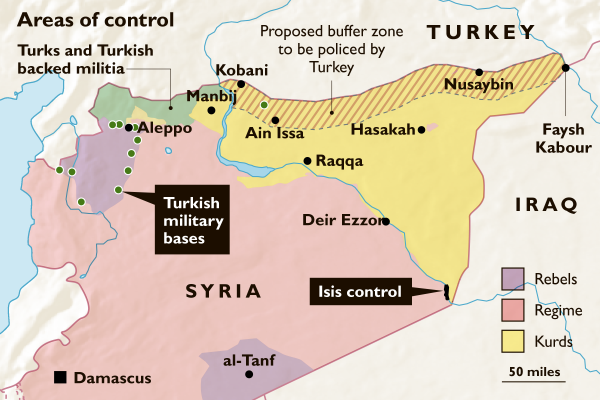
There is a growing perception that the US and Russia are acting on an overall consensus in Syria, with Moscow having the say largely over the area on the western part of the Euphrates River, while the eastern side of the river where the Kurdish forces are present remains under US control. That is to say, the US retains its presence to the east of Euphrates, while the territories to the west of Euphrates come under Russian ‘sphere of influence.’
Conceivably, there could be a Russian-American congruence to keep Turkey out of northeastern Syria. The Iranian media reported on Monday that for the first time, Russian infantry units are being deployed in Bukamal region in Eastern Deir Ezzur province near the Iraqi border where Russia plans “to build military centres”.
On the other hand, Turkey’s partnership with Russia has become increasingly one-sided. Turkey cannot afford to antagonise Russia anymore, whereas, Russia no longer has to wear kid gloves while dealing with Ankara, although Turkey still is a NATO power.
In November 2015, when Turkey shot down a Russian Sukhoi Su-24M attack aircraft, Moscow was ultra-sensitive while reacting. But there is no apology for Monday’s air attack on the Turkish military convoy in Idlib.
The Russian Foreign Minister Sergey Lavrov asserted today that any attacks carried out by Islamist militant groups (which Turkey harbours) in the de-escalation zone in Idlib will be “forcefully suppressed”.
All in all, Russia has concluded that this is an opportune moment to clean up Idlib. Turkey’s proposal to establish a safe zone in northern Syria isn’t getting anywhere. The Turkish demand — a 30 to 40 kilometre deep safe zone stretching 430 kilometres all along the border up to Iraq — is not going to be acceptable to the US. But the US keeps Turkey engaged in talks to buy time while the US-backed Kurdish militia will retain their control of northeast Syria bordering Turkey.
In essence, Turkey risks a quagmire with two fronts — Idlib, where the Syrian offensive backed by Russia will trigger a massive refugee flow into Turkey, and a border with Syria that is dominated by well-armed, battle-hardened Kurdish groups.
August 21, 2019
Posted by aletho |
Illegal Occupation | Russia, Syria, Turkiye, United States |
Leave a comment
Russia has warned the United States against any attempts to impose an economic blockade on Venezuela, the Russian Deputy Foreign Minister Sergey Ryabkov said in a statement.
“We will certainly study the situation related to Washington’s boosting of illegal, illegitimate sanctions pressure and attempts to impose blockade [on Venezuela]. We warn Washington against incautious steps in this sphere”, Ryabkov said.
According to the diplomat, the issue of US sanctions against the Latin American nation will be discussed during the course of talks between Russian Foreign Minister Sergei Lavrov and Venezuelan Vice President Delcy Rodríguez scheduled for 21 August.
Ryabkov said that Rodríguez has already held several rounds of talks and will continue to communicate with Russian officials on various subjects.
Speaking about the bilateral ties between Russia and Venezuela, the diplomat said that the two nations will boost economic cooperation, including in mining and machine engineering.
“We are not discussing economic assistance, but economic cooperation”, Ryabkov said, when asked whether Russia possibly increasing its aid to the Latin American country was on the agenda during Venezuelan Vice President Delcy Rodriguez’s visit to Moscow. “We’re continuing work on a range of projects. New possibilities have emerged in some areas, such as the mining industry and … machine engineering. We’re continuing work on Russian grain deliveries to Venezuela in quite significant amounts. As I see it, the government already started … such discussions yesterday”.
Earlier this month, Washington imposed a new round of sanctions on Venezuela with National Security Adviser John Bolton saying that the pressure sent a direct signal to all enablers of “Maduro’s dictatorship”. Caracas decried the sanctions as “another serious aggression by the Trump administration through arbitrary economic terrorism against the Venezuelan people”.
Venezuela has suffered a political crisis since the beginning of this year when opposition figure Juan Guaido proclaimed himself interim president of the country just days after legitimate President Maduro was inaugurated for a second term.
Washington as well as other nations immediately recognised Guaido as Venezuela’s leader. However, Russia among several other nations refused to recognise the legitimacy of the self-styled president’s claim.
President Maduro, for his part, slammed the opposition leader as a US “puppet”, saying Guaido’s recognition by global leaders was a coup attempt staged by the United States.
August 20, 2019
Posted by aletho |
War Crimes | Russia, United States, Venezuela |
Leave a comment

Naryn-kala Citadel museum, part of Derbent State Historical, Architectural and Art Museum-Reserve in the city of Derbent, Republic of Dagestan, Russia. © Sputnik / Vladimir Vyatkin
Tehran is in talks with Moscow over plans to establish a ferry service across the Caspian Sea that would link Iran with Russia’s Dagestan.
The Iranian ambassador to Russia, Mehdi Sanai, had earlier arrived in Derbent to discuss the development of relations between Iran and Russia’s Republic of Dagestan. During the visit, the two sides discussed the question of increasing cargo traffic through Makhachkala Commercial Sea Port, as well as the launch of direct passenger and cargo flights between Makhachkala and Tehran.
Among the issues discussed was a plan to set up a direct ferry service linking the two states, with the head of Dagestan’s republic, Vladimir Vasiliev, highly optimistic about the prospect.
“Derbent attracts Iran like a magnet and [the ferry service] will work. [Tehran] is ready to establish sea links with us, and we are ready to cooperate – and everything will work,” Vasilyev told journalists at a press briefing on Sunday.
He said that Iran’s business community had started to take an interest in Dagestan, in particular in Derbent, with a number of international projects already being implemented and set to transform the region.
“International projects are being implemented in Derbent, there are some very interesting solutions there. The city used to have a billion-plus [rubles] annual income, but now it is receiving four billion [rubles] more [from investors],” Vasilyev stated.
Earlier reports regarding cooperation between Dagestan and the Islamic Republic referred to plans to increase the sales turnover between the two sides, particularly to boost lamb exports to Iran from the current 4,000 tons to 6,000 tons by the end of the year. At present, the volume of trade between Iran and the republics of the North Caucasus is estimated at $54 million (€49 million), while the total Russian turnover is $1.7 billion (€1.49 billion).
August 18, 2019
Posted by aletho |
Economics | Iran, Russia |
Leave a comment
There is an eminently reasonable and feasible way to avoid conflict in the Persian Gulf, and to secure peace. The principles of multilateralism and international law must be adhered to. It seems almost astounding that one has to appeal for such obvious basic norms.
Fortunately, Russia has presented a roadmap for implementing a security concept in the vital waterway based on the above principles.
Russia’s deputy envoy to the United Nations, Dmitry Polyansky, outlined a possible international coalition to provide security for commercial shipping through the strategically important Persian Gulf. The narrow outlet accounts for up to 30 per cent of all globally shipped oil on a daily basis. Virtually every nation has a stake in the safe passage of tankers. Any disruption would have huge negative consequences for the world economy, impacting all nations.
The Russian proposal, which has been submitted to the UN Security Council, is currently being considered by various parties. Crucially, the security concept put forward by Moscow relies on the participation of the Gulf nations, including Iran. Rather than being led by an outside power, the Russian proposal envisages a region-led effort.
This multilateral arrangement for cooperation between nations is solidly within the principles of the UN Charter and international law. Potentially, it can build trust and positive relations, and thereby reduce the climate of tensions and uncertainty which have intensified over recent months, primarily between the United States and Iran.
Washington has blamed Iran for several sabotage incidents on commercial shipping since June. The Americans have not provided any proof for their claims. Iran, for its part, denies any malfeasance and instead has pointed to a “malign conspiracy” aimed at stoking tensions, or worse, precipitate an all-out military confrontation between the US and Iran. Significantly, too, the problem of alleged sabotage and danger to shipping followed the increased deployment of US forces in the region during May, ostensibly to counter anticipated “Iranian aggression”.
One thing for sure is that the US proposal for a naval coalition led by Washington, purportedly to “protect shipping” in the Gulf, is a non-starter. Most nations have rebuffed the American plan. Germany, France and other European Union states have given it a resounding pass. Even Arab nations allied with the US, such as Saudi Arabia and the United Arab Emirates, have demurred on the idea. Significantly, too, the Gulf states have refrained from following Washington’s line of fingering Iran for the unknown sabotage incidents.
After weeks of lobbying for its US-led “navy coalition”, Washington appears to have recruited just two other partners: Britain and Israel.
The term “coalition” is therefore a misnomer in this context. It also has no credibility as a force serving to uphold international law and security. The position of the US-led axis is one of outright hostility towards Iran. It is premised on the flawed assumption that Iran is the “problem”.
Any such extra-regional military force is by definition a source of further insecurity and tensions in the Persian Gulf, as Iranian Foreign Minister Mohammad Javad Zarif has noted. Arguably, any such US-led deployment is illegal because it is not mandated by the UN Security Council. The US plan relies on a unilateral imposition of American force along with a coterie of allies who have a long history of facilitating Washington’s militaristic adventures.
Indeed, moreover, one can easily perceive that the US claims about maritime security and safe passage are dubious. What Washington appears to be doing is cynically using “security concerns” as a cover for forming an aggressive front against Iran. The real purpose is to augment the Trump administration’s “maximum pressure” policy towards Tehran in order to coerce that nation into ceding to American strategic demands. This US policy is, of course, illegitimate, arguably criminal. But it is being concealed, as the Americans usually do, with the pseudo-image of acting as the world’s “policeman”.
By contrast, it may be hoped that the UN and the nations of the Gulf region move forward to embrace Russia’s proposal for a genuinely cooperative, mutual effort to maintain peace. The only way forward is through multilateralism, mutual respect, dialogue and adherence to international law. Conflict is a lose-lose scenario. Peace is win-win.
Surely, if any party cannot support such a reasonable proposition, then the telling question is: why not? A negative response strongly suggests there is a disingenuousness about putative “security concerns”, and that an ulterior, sinister agenda is actually at play.
It should also be borne in mind that the present mounting tensions in the Persian Gulf have come about because the Trump administration took the reprehensible step of repudiating the international nuclear accord with Iran. That accord was signed by Iran, the US, Russia, China, Britain, France, Germany and the European Union back in July 2015. The international treaty was endorsed by the UN Security Council. When Trump walked away from the US legal obligation last year, all the tensions that we now see with Iran have transpired.
As Russian envoy Dmitry Polyanksy told the press conference at the UN recently it is incumbent on Washington to return to the nuclear accord. Until then, for Washington to pose as some kind of security arbiter in the Middle East is too ludicrous for words.
August 16, 2019
Posted by aletho |
Aletho News | Iran, Middle East, Russia, United States |
Leave a comment
By Alexander Ponomarenko | August 16, 2019
On August 9, Voice of America journalist Mikhail Komadovsky asked President of the United States Donald Trump whether he plans to invite President Vladimir Zelensky to the White House and how he would advise him to communicate with Russian President Vladimir Putin to end the conflict in Eastern Ukraine.
The US President’s response was eyebrow-raising enough: “He’s going to make a deal with President Putin. And he will be invited to the White House. He is a reasonable guy. He wants to see peace in Ukraine. I think he’ll be coming very soon.”
The sensation was that a few hours earlier, United States Ambassador to Ukraine William Taylor said that a possibility of a Zelensky-Trump meeting in Warsaw and New York is only being worked out. It was clear that it was about a symbolic act, a brief meeting and a succinct conversation on the sidelines of a UN General Assembly session and arrangements timed to the 80th anniversary of the World War II outbreak.
And suddenly the American President himself says Zelensky’s visit will take place soon and pays him generous compliments. Why would he? We certainly need to take heed that Trump said not a single negative word about Russia and welcomed an early settlement. All of this sustains the hypothesis that he wants to get along with Moscow, but I do not think that this was the President’s number-one motivation. For Trump, the main thing is his re-election next year, as well as his key alleged rival, Joe Biden. And his compliments to the President of Ukraine seem to testify to his having enlisted cooperation of the new Kiev authorities in this regard.
Here it is appropriate to recall the conversation between Trump and Zelensky of July 25. The press service of the President of Ukraine reported that the US leader offered his congratulations to the former on the victory of the Servant of the People party at the parliamentary elections and expressed conviction that the new Ukrainian government proves able to quickly improve the image of Ukraine and to complete the investigation into corruption cases that hampered cooperation between Ukraine and the United States.
It is clear that the above phrase about the image and corruption cases restraining bilateral relations is a broad hint at both Kiev’s help in the 2016 struggle of the Democratic Party with Trump, which resulted in the Manafort case, and the dark Ukraine business of former US Vice President and Trump’s likely opponent Joe Biden.
But the most interesting thing is that the entire text with its transparent hints is a product of the Ukrainian President’s press service. After all, it is the only source of information in this respect, as the conversation between the two presidents has been mentioned neither on the White House website nor on Donald Trump’s Twitter. As press services traditionally provide a summary of the conversation, if both parties report on it, their messages are never identical, because each focuses on the facts considered the most fascinating to it.
In other words, it’s not just that Trump took interest in the part Hunter Biden, the son of his rival, had in the Burisma gas producing company and the role of the last Kiev administration and the Soros grant-eaters in digging up dirt while fighting against his election campaign in 2016, but that the Zelensky press service has actually voiced this. But they could have erased the hints and just report that “the US President stressed the importance of combating corruption.”
The presence of such a hint could be explained by the unsophistication of the Ukrainian President’s press service, but an explanation of this kind is out of place after Trump’s statement about his imminent meeting with Zelensky. Compliments to the President of Ukraine are a likely consequence of his willingness to help Trump in the issue key for him.
Yes, a week before the Kiev inauguration, The Washington Post reported Zelensky as afraid to be involved in the internal American conflict, as well as that he was surrounded by people who were enemies of Trump. The last phrase is an expression by attorney to the American President and former mayor of the New York City Rudolf Giuliani in justification of his planned trip to Kiev. He did not mention any names, but there could be only one person behind the transparent hint – Deputy of the eighth Verkhovna Rada convocation Serhiy Leshchenko, who was first to make a point of Manafort’s getting money from the Party of Regions. Leshchenko did really support Zelensky and attended events arranged by him, but all of this was before the inauguration.
The Zelensky team set a course for a criminal prosecution of former President Petro Poroshenko. And there is an opinion among Kiev experts that it is through the imprisonment of old team representatives that the new President will try to ensure his ratings, because succeeding here appears incomparably easier than in economy or in the Donbass region. However, with the patrons Poroshenko has in the West, the victory may be hollow. And those patrons will stand up for the ex-President even notwithstanding such skeletons in the closet as Poroshenko’s role in digging up Trump’s dirt in 2016 and the role of Yuri Lutsenko (№1 on list to the PPB in the 2014 elections), his political appointee to the post of Prosecutor General, as regards the termination of the Prosecutor’s Office’s interest in Burisma. And if probing into those “skeletons”, one can expect a favorable attitude of the White House.
But that’s not all of Zelensky’s motivation to support Trump. In exchange for such assistance one can ensure patronage in matters important. For instance, the presence of those close to Igor Kolomoyskyi in the establishment. I am primarily referring to Head of the Office of the President of Ukraine (the former Presidential Administration) Andriy Bohdan. Let me remind you that in May Giuliani hurled forth his rage upon Kolomoyskyi as a “criminal oligarch”.
However, the Ukrainian media have published leaked information that Trump refuses to meet with Zelensky while Bohdan heads the administration. But the compliments of the American President to the President of Ukraine obviously disavow such a rumor. By the way, it is quite possible that pressure on Zelensky through Kolomoyskyi has originally been a lever to persuade him to cooperate in the Biden case and other things Trump is concerned with.
Yes, getting involved in domestic political games of the United States is risky for Zelensky, because there is no guarantee that the White House will not be occupied by the Democrats in 2021. But it’s a long way off, and the situation is far from being easy under pressure coming from Washington. In addition, assistance to Trump in matters essential to him will obviously be delivered through the Ukrainian Prosecutor General’s Office, with its leadership to change after a new Rada convocation starts its work. And Zelensky will get an opportunity to say that the Prosecutor’s Office is an independent agency free from presidential interference.
Alexander Ponomarenko is a political scientist with BRICS.
August 16, 2019
Posted by aletho |
Corruption | Russia, Ukraine, United States |
Leave a comment
On Thursday August 8th, an explosion at the Nenoksa Missile test site in northern Russia during testing of a new type of nuclear propelled cruise missile resulted in the death of at least seven people, including scientists and was followed by a spike in radiation in the atmosphere.
Analysts in Washington and Europe are of the belief that the explosion may offer a glimpse of technological weaknesses in Russia’s new arms program.
The deeper concern, however, should be of the perilous consequences of the new Cold War and arms race that is developing between the United States and Russia.
In February, the Trump administration pulled out of the Intermediate Range Nuclear Forces Treaty (INF), an arms control treaty considered to be among the most successful in history by former U.S. ambassador to Russia John Huntsman, which banned land-based ballistic missiles, cruise missiles, and missile launchers with ranges of 500–1500 kilometers.
The United States accused Russia of violating the treaty, though did not wait for this accusation to be verified by international inspectors.
Russia previously accused the United States of violating the treaty through its adoption of drone warfare, and by stationing missile launchers in Deveselu Romania.
This summer, the Trump administration has given indications that it will not ratify the New Strategic Arms Reduction Treaty (START), which is set to expire in 2021.
Signed by the Obama administration as part of its “reset policy” with Russia in 2010, the New START treaty limits the number of deployed strategic nuclear warheads to 1,550 and number of deployed and non-deployed inter-continental ballistic missile (ICBM) launchers, submarine-launched ballistic missile (SLBM) launchers, and heavy bombers equipped for nuclear armaments to 800.
On Friday, August 9, The New York Times ran an op-ed piece by columnist Brett Stephens entitled “The U.S. Needs More Nukes,” which mimicked the position of Trump’s National Security Council advisor John Bolton, a serial arms control killer.
Stephens wrote that “the problem with arms control treaties is that the bad guys cheat, the good guys don’t, and the world often finds out too late.” And now Russia, he says, is cheating again, although Stephens does not present any evidence in his article that would confirm this.
According to Stephens, U.S. presidents Jimmy Carter and Ronald Reagan set the standard for effective government policy by responding to the Soviet Union’s deployment of the SS-20, a medium-range nuclear missile that threatened military installations in Western Europe in the late 1970s by deploying hundreds of intermediate-range Pershing II and cruise missiles to Europe.
Stephens in turn believes that the Trump administration and its successor should respond to Russian and Chinese provocations today through similar arms buildups and deployments.
Besides painting a Manichean view of the world as divided between good and evil, one of the major problems with Stephens’ article is that he fails to provide adequate historical context to validate his main argument.
In the case of Cold War I, the Soviet Union only embarked on a large scale arms buildup after the United States had developed a massive nuclear stockpile of 22,229 warheads (or 10,948 megatons of TNT) by the early 1960s, which dwarfed that of the Soviet Union who felt they had to catch up.
Stephens similarly presents Russia and China as bad actors menacing the United States today, when the United States has at least 15 times more overseas military bases, and spends more on the military than Russia and China combined along with at least six other major countries.
A new mobilization is now urgently needed in favor of arms control which can be modeled on the nuclear freeze movement of the 1980s.
General Lee Butler, commander of U.S. nuclear forces in the 1990s, issued a mea culpa upon his retirement in which he rebuked the “grotesquely destructive war plans” and “terror induced anesthesia which suspended rational thought, made nuclear war thinkable and grossly excessive arsenals possible during the Cold War.” Butler added that “mankind escaped the Cold War without a nuclear holocaust by some combination of diplomatic skill, blind luck and divine intervention, probably the latter in greater proportion.”
Whether the same luck will prevail in the 2nd Cold War is not worth leaving to chance.
Jeremy Kuzmarov is the author of The Russians are Coming, Again: The First Cold War as Tragedy, the Second as Farce (Monthly Review Press, 2018).
August 14, 2019
Posted by aletho |
Mainstream Media, Warmongering, Militarism | New York Times, Russia, United States |
Leave a comment
By Padraig McGrath | August 14, 2019
The lady’s name was Jill. Her husband’s name was Randolph. They were in their forties. She was English. He was American. Baptist missionaries, or so they said. They rented a building in Simferopol and another one in Sevastopol, and floated between them. On Thursday nights in Simferopol, they gave English-lessons to groups of local kids. Or more precisely, the first hour was an English language lesson, and the second hour was Bible-stuff.
There are about a dozen or more small Baptist congregations in Crimea. Most of them were started during the 1990’s, and cater to people who are now middle-aged or older. Jill and Randolph’s groups were different. The age-range of their groups was not the only thing which made them highly atypical for people claiming to be Baptist missionaries. Of the dozen or so Baptist churches which are currently active in Crimea, most are led by sincere people.
Typically, an American couple during the 1990’s decided that they had been called, managed to scrape $30,000 or $40,000 together, bought a little house in some Crimean village, converted it into a simple church, and stayed for the next 25 years. In most cases, it’s just a story of sincere working-class Evangelism. Their variant of Christianity is hardly the cultural epitome of Russianness, but they essentially do no harm. Within reason, Russian people tend to have respect for any sincere profession of faith, as long as it’s not toxic.
There were lots of little telltale signs that Jill and Randolph were characters in another opera.
For a start, neither of them seemed to be even remotely as religiously literate as you’d expect a garden-variety Baptist missionary to be. I had tested them both, separately, by casually inserting a few lines from St. Paul into our conversation – some line from Galatians or Philippians or Romans, whatever was opportune in the context of the discussion which we were momentarily having.
I already had my suspicions. So I’d buzz them with some line from St. Paul, just as an acid-test, and they wouldn’t recognize the line. Major red flag. An actual Baptist missionary would know the line.
Secondly, both Jill and Randolph seemed extremely reticent about discussing the exact nature of their mission. Again, this would be highly atypical for somebody claiming to be a Baptist missionary. In fact, it would be an outright contradiction. For an actual Baptist missionary, explaining the nature of their mission would be part and parcel of the mission itself. They’d want to shout it from the rooftops. They’d want to explain the exact purpose of their mission to anybody who would listen.
Jill and Randolph were also completely unprepared to discuss anything relating to their organizational structure, partner-organizations or parent-organizations, or their sources of finance.
Thirdly, Jill and Randolph had shown up in Crimea only a couple of months after the State Duma had passed new legislation which significantly expanded the official blacklist of NGO’s which were classified as undesirable or subversive organizations in Russia.
You see where this is going.
They can’t operate openly as NGO-activists, so they start showing up posing as religious missionaries to circumvent the new legislation. The timing of their arrival was just too convenient.
As an alternative to pretending to be religious missionaries, NGO-provocateurs in Crimea also often pose as musicians. Musicians are cool. Sheltered, impressionable kids like cool. It’s always about targeting the most naïve segment of the population, ergo….
The NGO’s tend to use recruitment-techniques very similar to those of religious cults – non-stop validation, love-bombing, basic manipulation-techniques like that. Woundedly narcissistic middle-class kids eat it up.
Crimeans sometimes seem to be bizarrely relaxed about the social presence of provocateurs such as these, but then again, that’s at least partially because Crimea has been a mark for western ideological provocateurs of all shades ever since the early 1990’s. Most Crimeans just shrug their shoulders and politely dismiss these people. Some Crimeans even argue that encountering these kinds of foreign ideological provocateurs helps to “immunize” the kids, as the NGO-operatives in question are almost never well educated, and therefore lack the argumentation-skills to be persuasive, even to kids. For the most part, they are simply purveyors of slogans and clichés – their discourse rarely goes deeper than that. So, in that sense, their presence is seen by locals more as an “inoculation” than an “immunization” – give the kids just a light dose of western liberal NGO nonsense, just enough to immunize them against it.
Personally, I’ve always thought that relaxed attitude was an error of judgment, considering that the most naïve or sheltered or intellectually limited kids don’t get “immunized” or “inoculated” through this exposure, and they are the sub-set of the population which is specifically targeted by foreign NGO’s. The NGO-kids are almost invariably middle-class, “teplichny” as Russians themselves say (“sheltered,” “cloistered,” “coddled” or “hothoused”), but also almost invariably have low IQ and limited academic potential. No historical erudition whatsoever. They’ll be offered opportunities to “study abroad,” postgraduate opportunities which their limitations wouldn’t otherwise give them a chance of earning within the normal academic system at home.
You’re a middle-class kid. You want to go to university, if only to superficially justify your class-status, but you’re not smart enough. You want to travel, but that’s expensive. You received far too much maternal love to cope with the competitive social environment outside your front door, and you want “a career” because it’s expected of you. Just sell out to an NGO. Let them dangle their juicy carrots in front of you. Learn to repeat their mantras.
With the State Duma scheduled on August 19th to discuss the recent unauthorized anti-government protests in Moscow, and those unauthorized protests having been almost exclusively participated in by sheltered middle-class kids, it was difficult to avoid the conclusion that I had seen it all before.
Padraig McGrath is a political analyst with the BRICS Tink-tank.
August 14, 2019
Posted by aletho |
Deception | Russia, United States |
Leave a comment