A Sino-Russian firewall against US interference
By M. K. BHADRAKUMAR | Indian Punchline | August 11, 2019
China has explicitly accused the United States and Britain for fomenting the “pro-democracy” protests in Hong Kong. Beijing has taken up the matter via the diplomatic channel demanding that the US intelligence should stop inciting and abetting the Hong Kong protestors. Last week photographic evidence appeared in the media showing the political counsellor in the US consulate in Hong Kong Julie Eadeh confabulating in the lobby of a local luxury hotel with the student leaders involved in Hong Kong’s pro-democracy movement.
Washington has taken umbrage that Julie’s cover has been blown. She is apparently an expert who organised “colour revolutions” in other countries and it has been disclosed that she was involved in plotting “subversive acts” in the Middle East region. The Global Times wrote a blistering editorial. It said:
“The US administration has played a disgraceful role in the Hong Kong riots. Washington publicly supports the protests and never condemns violence that targets police. The US consulate general in Hong Kong is stepping up its direct interference in Hong Kong’s situation. The US administration is instigating turmoil in Hong Kong the way it stoked “colour revolutions” in other places worldwide.”
Is the Chinese allegation plausible? Writing in the Asia Times, the noted Canadian academic, economist and author Ken Moak made a good point recently that the protests are lavishly funded and their logistics and organisation are of a scale taxing resources that “only foreign governments or wealthy individuals who might profit from them” would commit. He detailed past instances of Anglo-American attempts to destabilise China.
Moak anticipates “more intense and violent” subversive operations against China by the US in the future.
Indeed, agents provocateurs are calibrating the protests almost on daily basis such as burning the Chinese flag and occupying the Hong Kong airport. The game plan is to force Beijing to intervene so that the deluge follows — western sanctions, et al.
With the 5G technology just about rolling out, this is an opportune time for the US to frogmarch its western allies into an economic boycott of China when countries like Germany and Italy that have flourishing trade and investment ties with China are loathe to get into the American bandwagon.
The well-known Italian journalist and author and long-time China watcher based in Beijing, Francesco Sisci wrote recently that Hong Kong is in reality Beijing’s “safety valve” and choking it can cause asphyxiation to the entire Chinese system. Sisci compares Hong Kong with “a compensation chamber, a safety valve between the closed economy of mainland China and the open economies of the rest of the world.”
If China could globalise avidly and yet keep its economy closed, it was because it had Hong Kong, which was completely open and provided the third-largest financial market in the world. If large-scale capital flight ensues in Hong Kong, China will have to work its future financial arrangements through countries over which it it doesn’t have political control. To quote Sisci, “Hong Kong’s present status can help Beijing buy time, but the crucial issue is still the status of China. The time of being both in and out the global commercial system thanks to a complex architecture of special agreements is rapidly running out.”
Simply put, the unrest in Hong Kong becomes a template of the US’ maximum pressure approach to break China’s growth momentum and its ascendancy as a rival in technology globally in the 21st century. The influential China hands in the US are already opening the champagne bottle that “revolution is in the air in Hong Kong” — and, it will mark “the end of communism on Chinese soil.”
Enter Russia. Coincidence or not, small fires are being lit lately on the Moscow streets as well, and they are spreading into significant protests against President Vladimir Putin. If the extradition law was the pretext for the Hong Kong turmoil, it is the election to the Moscow Duma (city legislature) that has apparently triggered the Russian protest.

Protestors in Moscow, August 10, 2019
Just as there is economic and social discontent in Hong Kong, the popularity of Putin has declined lately which is attributed to the stagnation of the Russian economy.
In both cases, the American agenda is blatantly “regime change”. This may seem surprising, since the Chinese and Russian leaderships appear rock solid. The legitimacy of the Chinese Communist Party over which President Xi Jinping presides and the popularity of Putin still at a level that is the envy of any politician anywhere in the world, but the doctrine of “colour revolutions” is not built on democratic principles.
Colour revolutions are about upturning an established political order and it has no correlation with mass support. The colour revolution is coup by other means. It is not even about democracy. The recent presidential and parliamentary elections in Ukraine exposed that the colour revolution of 2014 was an insurrection that the nation disowns.
Of course, the stakes are very high when it comes to destabilising China and Russia. Nothing less than the global strategic balance is involved. The US’ dual containment strategy against Russia and China is quintessentially the New American Century project — US’ global hegemony through the 21st century.
The US wagered that Moscow and Beijing would be hard pressed to cope with the spectre of colour revolutions and that would isolate them. After all, authoritarian regimes are exclusive and into the sanctum sanctorum of their internal politics not even their closest friends or allies are allowed in.
This is where Moscow has sprung a nasty surprise for Washington. The Russian Foreign Ministry spokesperson Maria Zakharova said in Moscow on Friday that Russia and China should exchange information on the US interference in their internal affairs. She flagged that Moscow is aware of the Chinese statements that the US interferes in Hong Kong affairs and treats this information “with all seriousness.”
“Moreover, I think it would be right and useful to exchange such information through respective services,” Zakharova said, adding that the Russian and Chinese sides will discuss the issue soon. She added that the US intelligence agency is using technology to destabilise Russia and China.
Earlier on Friday, the Russian Foreign Ministry had summoned the head of the Political Section in the US embassy Tim Richardson, and presented him with an official protest against the US encouraging an unauthorised opposition rally in Moscow on August 3.
Indeed, Moscow is far more experienced than Beijing in neutralising covert operations by the US intelligence. It is a hallmark of the great skill and expertise as well as the tenacity of the Russian system that through the entire Cold War era and “post-Soviet” period, there has never been anything like the turmoil on Tiananmen Square in Beijing (1989) or Hong Kong (2019) triggered by the US intelligence.
Moscow’s message to Beijing is direct and candid — ‘United we stand, divided we fall.’ No doubt, the two countries have been in consultation and wanted the rest of the world to know. Indeed, the message Zakharova transmitted — on a joint firewall against US interference — is of epochal significance. It elevates the Russia-China alliance to a qualitatively new level, creating yet another political underpinning of collective security.
Russia delivers electronic warfare systems to Iran
By Drago Bosnic | Fort-Russ News | August 3, 2019
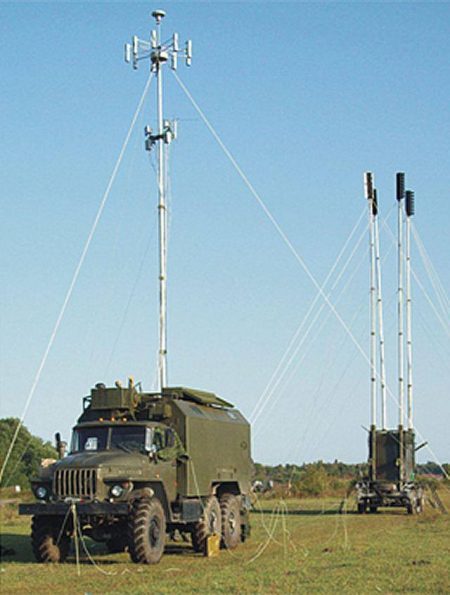 Anzali, Iran – Russia just delivered the R-330Zh Zhitel SIGINT/jammer advanced electronic warfare system to Iran. The system saw combat use by DNR (Donetsk People’s Republic) and LNR (Lugansk People’s Republic) forces during the Ukrainian invasion. It gave the Novorussian forces an edge in fighting Ukrainian drones, scrambling their communications and offsetting artillery fire navigation which saved countless lives, military and civilian alike.
The R-330Zh Zhitel is a jamming communication station designed and manufactured by the Russian Company Protek. The whole system includes one Ural-43203 or KAMAZ-43114 truck and one shelter with four telescopic masts. The truck is the control center for the operators. The shelter is equipped with four telescopic active phased array transmitter antennas mounted on a four wheels trailer. The R-330Zh is designed for detection, analysis, direction-finding, and jamming of satellite and cellular phone communication systems operated in the frequency from 100 to 2,000 MHz. The jamming system provides analysis and selection of emitters’ signal parameters. The system’s jamming station was used successfully by the Russian army during the Crimean crisis in March 2014.
If Novorussian combat experience is taken into account, the Iranian military just got a crucial system which gives it a serious advantage over US troops stationed in the Middle East. Considering the fact that the US and their Persian Gulf allies are over-reliant on advanced communications and UAVs (unmanned aerial vehicle) in order to conduct military operations, the Russian R-330Zh Zhitel electronic warfare system, if used properly, will give the Iranian military an edge which the potential invading forces cannot hope to overcome easily, if at all.
US Embassy meddled in Moscow anti-govt unrest by mapping protest locations online – FM
RT | August 9, 2019
The American diplomatic mission in Russia is meddling in domestic affairs, Moscow claims. The US had posted the locations and routes of recent massive opposition rallies in the capital, which saw scuffles with police and arrests.
The US Embassy had published a map of downtown Moscow that flagged sites where anti-government rallies were about to happen on August 3. The map went public a day before the protests, which led the Russian Ministry of Foreign Affairs to believe that the US mission had known beforehand where the unrest would take place.
On Friday, the ministry summoned Tim Richardson, the head of the US Embassy’s political section, to voice its unease over the alleged US role in the demonstrations. Posting the chart on their website and Twitter account, the Embassy had tacitly encouraged residents to take to the streets, the foreign ministry statement reads.
This “was an attempt to interfere in the domestic affairs of our country,” it insisted.
Aside from the US embassy’s map, the publication in question listed the most frequently-visited parts of Moscow, warning US citizens to stay alert, be aware of their surroundings and carry a proper US passport with the Russian visa. “Given the possible size of the protest and the large police presence, US citizens should avoid the protest route,” it advised.
Moscow witnessed a string of opposition rallies on August 3 and, a week earlier on July 27, with opposition activists protesting the city’s decision to disqualify numerous independent candidates over alleged procedural fraud. Over 2,000 people were detained by police during both rallies.
Moscow’s opposition leaders plan to push ahead with more protests this Saturday. Activists in other big Russian cities are also likely to follow suit.
US Leaves INF Because “Russia,” But Points Missiles at China
By Ulson Gunnar – New Eastern Outlook – 08.08.2019
We’re told that the US withdrawal from the Intermediate-Range Nuclear Forces (INF) Treaty singed in 1987 between the US and Soviet Union was based on claims that Russia had violated it.
While we continue waiting for Washington to provide evidence to prove these claims, the US itself admitted it had already long begun developing missiles that violated the treaty.
A February 2018 Defense One article titled, “Pentagon Confirms It’s Developing Nuclear Cruise Missile to Counter a Similar Russian One,” admitted that:
The U.S. military is developing a ground-launched, intermediate-range cruise missile to counter a similar Russian weapon whose deployment violates an arms-control treaty between Moscow and Washington, U.S. officials said Friday.
The officials acknowledged that the still-under-development American missile would, if deployed, also violate the Intermediate-Range Nuclear Forces Treaty.
Just as the US did when it unilaterally walked away from the 1972 Anti-Ballistic Missile Treaty in 2002, the goal is to blame Russia for otherwise indefensible and incremental provocations aimed at Moscow. For example, after the US walked away from the ABM Treaty in 2002, the US began deploying anti-missile systems across Europe.
But if Russia is the problem, why did the US also begin deploying similar missiles in Asia?
It is Washington’s goal of hemming in its competitors anywhere and everywhere that is at the heart of these serial treaty terminations, not any particular “violation” on Moscow’s part.
China Too
That the US already had missiles under development that would undoubtedly violate the INF Treaty before it accused Russia of such violations, is one indicator of Washington’s true intentions. Another is the fact Washington is rushing to encircle China with both defensive and offensive missile systems as well.
China is not a signatory of either the ABM Treaty or the INF Treaty. Its missiles are deployed strictly within its mainland territory with no plans by Beijing to deploy them anywhere else in the future.
The only threat they pose is to any nation that decides to wage war on China, in or around Chinese territory.
Washington’s behavior post-INF Treaty indicates that it was its intent to violate the treaty all along, creating the same precarious security crisis in Asia the treaty sought to prevent in Europe.
The New York Times in its article, “U.S. Ends Cold War Missile Treaty, With Aim of Countering China,” would explain:
The United States on Friday terminated a major treaty of the Cold War, the Intermediate Nuclear Forces agreement, and it is already planning to start testing a new class of missiles later this summer.
But the new missiles are unlikely to be deployed to counter the treaty’s other nuclear power, Russia, which the United States has said for years was in violation of the accord. Instead, the first deployments are likely to be intended to counter China, which has amassed an imposing missile arsenal and is now seen as a much more formidable long-term strategic rival than Russia.
The moves by Washington have elicited concern that the United States may be on the precipice of a new arms race, especially because the one major remaining arms control treaty with Russia, a far larger one called New START, appears on life support, unlikely to be renewed when it expires in less than two years.
Here, the NYT admits that despite Washington claiming its termination of the INF Treaty was prompted by Moscow, its own actions since indicate Washington was already well underway of violating it itself. It did so not only to threaten Russia, but also to threaten China.
After months of accusing Russia of undermining the INF Treaty, the NYT itself reveals it was Washington who solely benefited from it, and specifically in terms of targeting China:
… the administration has argued that China is one reason Mr. Trump decided to exit the I.N.F. treaty. Most experts now assess that China has the most advanced conventional missile arsenal in the world, based throughout the mainland. When the treaty went into effect in 1987, China’s missile fleet was judged so rudimentary that it was not even a consideration.
The prospects of the US signing a new treaty with either Russia or China (or both) are nonexistent. The NYT article also reported that:
Chinese officials have also balked at any attempt to limit their missiles with a new treaty, arguing that the nuclear arsenals of the United States and Russia are much larger and deadlier.
The NYT fails to mention the other, and perhaps most important factor preventing Beijing from signing any treaty with Washington; Washington has already demonstrated categorically that it cannot be trusted. It just walked away from the INF Treaty based on deliberate lies implicating Russia while Washington all along was developing missiles it planned to deploy around the globe to hem in both Russia and China.
Dangerous Desperation
While the Cold War is remembered as a precarious time, it was a time when agreements like the ABM and INF treaties were not only possible, they were signed and for the most part adhered to by two global powers who could agree an uneasy balance of global power was preferable to large scale war (nuclear or not) between the two.
During the Cold War, Washington was confident that it could not only maintain that balance of power, but eventually tip it in its favor, resulting in global hegemony. The collapse of the Soviet Union and the US invasion of Iraq certainly seemed to prove those behind this mindset right. But the window was already closing on the establishment of an uncontested US-led international order.
Today, Russia, China and a number of other emerging regional and global powers have all but assured US hegemony is no longer a viable geopolitical objective. The confidence that allowed the US to sign previous treaties and uphold them along with their Soviet counterparts no longer exists.
We live in a world today where the US has become a tremendous danger to global peace and security. The inability of treaties to exist that were even possible during the tense days of the Cold War takes us into unprecedented and dangerous territory.
Only time will tell if both Moscow and Beijing can find other mechanisms to avoid a dangerous and wasteful arms race in their backyards as a stubborn United States not only refuses to leave, but insists on bringing in incredibly dangerous weapons that will wreak havoc not on the territorial United States, but on the nations of Europe and East Asia should Washington’s desperation progress even further amid its waning global power.
London Spreads Misinformation, Hides Skripal Case Details, Russian Embassy Says
Sputnik – 08.08.2019
UK authorities continue to disseminate misinformation about the Salisbury incident through the media, hiding details of what happened, the Russian Embassy in the UK stated after the Guardian published an article speculating on the involvement of Russian authorities.
“Nearly a year and a half after the events in Salisbury with the former Russian military intelligence officer and his daughter, the Russian side never received any intelligible information about the investigation into the incident despite the more than 80 requests we sent through diplomatic channels. Trying to fill this vacuum, the British stubbornly continue to invent various stories and myths, passing them off as confirmed facts,” the embassy stated.
“All the arguments on the basis of which the so-called evidence of Russia’s involvement in this mysterious incident was built and which the former British Prime Minister Theresa May loudly stated, failed miserably. Obviously, the reason for this behaviour lies in the fact that the disclosure of all the details of this dark history is not in the interests of official London,” the statement reads.
Russian diplomats suggested that British authorities manipulated the opinion of the UK and international public through the media to keep the Salisbury theme “afloat” and “engaged in outright disinformation, spreading fake news.”
“The fact that the United States, without any incontrovertible evidence, recently introduced a second package of sanctions against Russia in connection with the events in Salisbury, eloquently speaks about who orders music in this full-scale anti-Russian campaign,” the statement from the embassy reads.
The Russian embassy was supported by the Head of the State Duma Committee on International Affairs Leonid Slutsky, who suggested that the “unprecedented scandal involving the expulsion of diplomats, sanctions against Russia, including those announced in the United States just a few days ago […] doesn’t have any basis.”
In March 2018, Skripal and his daughter Yulia were found unconscious on a bench near a shopping centre in Salisbury. London claimed they were poisoned with a military-grade nerve agent and accused Moscow of staging the attack. Moscow has repeatedly refuted all accusations. On Wednesday the Guardian reported that British police are investigating whether Russian President Vladimir Putin could have been involved in the assassination attempt on Skripal by approving a plan to eliminate him. However, according to the deputy head of Scotland Yard, Neil Basu, British law enforcement authorities have examined many hypotheses, but do not have evidence to make such allegations.
Russia Urges US, EU Countries to Withdraw Forces From Syria
Sputnik | August 2, 2019
MOSCOW – Russia is urging the United States and European countries to withdraw forces from Syria, but can see the increase in their military presence there instead, Russian Special Presidential Envoy for Syria Alexander Lavrentyev said Friday.
“We are always calling on the United States and other — European — countries, whose troops are also illegally in Syria, to leave this sovereign state. Nevertheless, they are still justifying it by the need to fight Daesh* and other terrorist groups”, Lavrentyev said at a press conference.
The Russian presidential envoy stressed that these countries were in reality pursuing their own agenda.
“So far we have not been able to convince them to withdraw forces. Despite the words of [US President Donald] Trump that US forces would be pulled out, we can see, on the contrary, the increase in these forces, partly because of the presence of private military companies”, the envoy said.
The number of US troops in Syria has been declining since US President Donald Trump claimed victory over the jihadists in December, promising to withdraw at least 2,000 troops from the country in the near future.
US forces have been operating in Syria as part of an international coalition to fight the Daesh terrorist organisation for about four years without the permission of either Damascus or the UN Security Council.
As US Beefs Up Military Presence in the Gulf, Yemen’s Houthis Turn to Russia for Support
Houthi attempts to engage the UN to broker a peaceful solution to the war on Yemen have stalled. Now, out of options, the movement may have found a willing partner in Moscow.
By Ahmed Abdulkareem | Mint Press News | July 26, 2019
MOSCOW — Yemen’s Houthi movement has reacted with concern to an announcement by Washington that the U.S. is pursuing an increased military presence in the Persian Gulf. U.S. Central Command announced Operation Sentinel on July 19, claiming that a multinational maritime effort is needed to promote “maritime stability, ensure safe passage, and de-escalate tensions in international waters throughout the Bab el-Mandeb Strait, the Arabian [Persian] Gulf, Strait of Hormuz, and the Gulf of Oman.”
The Houthis’ Supreme Political Council, the highest political authority in Sana`a, held an emergency meeting on Monday to discuss the developments. After the meeting Houthi officials released a statement denouncing Operation Sentinel, saying that Yemen is keen on the security of the Red Sea and that any escalation by Coalition countries, including the United States, would be met with a response. The statement went on to say:
What makes waterways safe is an end to the war on Yemen, a lifting of the siege on the country and the end to [the Saudi-led Coalition] restricting access to food and commercial vessels in Yemeni ports, especially the port of Hodeida, not the presence of multinational forces there.”
Houthi officials also weighed in on the arrival of U.S. troops in Saudi Arabia as a part of a broader tranche of forces sent to the Gulf region over the past two months following increased tensions between Washington and Tehran. Mohammed Abdulsalam, the spokesman of Houthis and one of the most important decision-makers within the movement, told al-Mayadeen TV that the arrival of 500 U.S. troops to Saudi Arabia is “not welcome in the region.”
On Monday, Abdulsalam ridiculed Saudi Arabia’s celebration of the arrival of the U.S. troops, pointing to the Kingdom’s relying on U.S. and British protection while at the same time not knowing how to extricate itself from Yemen. “On one side, there are the Saudis seeking protection from others and on the other side, we have Yemen facing those superpowers with strength, rigidity and wisdom,” Abudlsalam said in a Facebook post. Abdulsalam also said that the deployment of U.S. troops to the Kingdom was aimed at boosting the morale of Saudi Arabia in the face of Yemen’s ballistic missile and drone attacks.
Abudlsalam’s comments were made during an official visit to Moscow, where a Houthi delegation was visiting at the invitation of the Russian government. The July 24 meeting with Russian Deputy Foreign Minister to the Middle East and North Africa Mikhail Bogdanov was held to discuss, among other things, U.S. military presence in the Gulf. Abdulsalam claimed during the meeting that U.S. and Western visions for a solution to the conflict in Yemen would be unsuccessful, telling his Russian counterpart that there won’t be security and safety in the region without an end to the aggression against Yemen. He went on to say that, “we [Houthis] have common interests with the Russians regarding peace in the region.”
Both Bogdanov and Abdulsalam expressed commitment to abiding by the UN-brokered Stockholm Agreement, which calls for a ceasefire in the Hodeida port in western Yemen. The Houthis also expressed support for Russia’s policy vision for security in the Gulf, which was presented by Bogdanov on Tuesday.
While Russian efforts may not necessarily produce peace in Yemen, they may give the Saudi-led Coalition a chance to see that all options for diplomacy have been fully explored. They will also provide the United Arab Emirates (UAE) — which recently pulled out a significant portion of their military forces from Yemen, amidst fears of Houthi retaliatory attacks on Dubai — a chance to jump on the Russian bandwagon. Saudi Arabia, which has made little progress in its more than four-year-long adventure in Yemen, could also use Russian efforts as a face-saving opportunity, according to Yemeni diplomats who spoke to MintPress.
According to well-informed sources in the Houthi movement, Russia is pushing hard to play a role in bringing an end to the war on Yemen, and Russian and Houthi interests are becoming more aligned, including opposition to an increased U.S. military presence in the region. Houthi officials are also hoping that Russia will use its position in the UN Security Council to veto resolutions adversely affecting the interests of Yemen. One Houthi official, who asked to remain anonymous because of the sensitivity of the issue, even told MintPress that Russia played a role in the recent withdrawal of the UAE forces from Yemen.
“No subordination to Iran”
Mehdi Al-Mashat, the Head of the Houthi Supreme Political Council, told delegates from the International Crisis Group on Wednesday that the Houthis are ready to stop drones and ballistic attacks on Saudi Arabia if the Kingdom stops its attacks on Yemen. He also expressed readiness to engage in dialogue with Saudi officials to “achieve a just peace for all,” but warned that the “U.S. must know Yemen is a country which has sovereignty and is not subject to anyone.”
Regarding Iran, Al-Mashat told members of the International Crisis Group, a Brussels-based NGO that works to resolve violent conflicts around the world, “with regard to the false claims that we are followers of Iran, which the Coalition countries know to be false, we confirm that there is no subordination to Iran.” Tehran’s support for the Houthis is limited to political, diplomatic and media support and the country’s influence in Yemen is marginal at best.
For its part, the United Nations says the years-long war in Yemen can be stopped and is eminently resolvable if the warring sides commit to the UN-brokered Stockholm peace agreement reached in Sweden late last year. Under the agreement, both the Houthis and Coalition forces agreed to withdraw their troops from the Yemeni ports of Hodeida, Salif, and Ras Issa, and to allow the deployment of UN monitors.
The UN Special Envoy for Yemen Martin Griffiths said on Tuesday, “I believe that this war in Yemen is eminently resolvable, both parties continue to insist that they want a political solution and the military solution is not available, they remain committed to the Stockholm agreement in all its different aspects.”
UAE “not leaving Yemen”
While the Houthis have had some success in forcing a dialogue with Coalition leaders through the United Nations, Russia, and various NGOs, it appears that their celebration over the recent announcement that the UAE is withdrawing its troops from Yemen may have been premature. In the Houthis’ first official statement since the UAE announced it was withdrawing its troops from Yemen, Houthi spokesman Mohammed Abdulsalam said on Wednesday that “the UAE has not withdrawn any its soldiers from Yemen, and instead has redeployed its forces from a number of areas in Yemen, including battlefields in Hodeida and Marib province in eastern Yemen.” Abdulsalam went on to encourage UAE leaders to pull out of Yemen, saying “the UAE getting out of Yemen is positive and natural and we encourage its leaders to do so.”
The UAE Minister of State for Foreign Affairs Anwar Mohammed Gargash, in an opinion piece published in The Washington Post on Monday, confirmed the UAE was not leaving Yemen, saying: “Just to be clear, the UAE and the rest of the Coalition are not leaving Yemen.”
He added, “While we will operate differently, our military presence will remain. In accordance with international law, we will continue to advise and assist local Yemen forces — referring to the myriad UAE-funded Yemeni rebel groups including the Shaban elite forces, the Mahri elite forces, and the Security Belt.
According to Mohammed Abdulsalam, the seemingly contradictory statement coming from the UAE may be a result of Saudi pressure.
Meanwhile, Turkey’s state news agency Anadolu, citing a spokesman for the UAE allies, reported on Wednesday that the Sudanese armed forces had partially withdrawn from parts of Yemen following the withdrawal of UAE troops from the same areas. Yemeni armed forces will replace the Sudanese troops around Hodeida, a Yemeni source told Anadolu.
The UAE and Sudan, parts of a Saudi-led military coalition, have been active members in the brutal Saudi-led Coalition’s war on Yemen since it began in 2015, which the United Nations says has produced the world’s worst humanitarian crisis, with millions on the brink of starvation
Ahmed AbdulKareem is a Yemeni journalist. He covers the war in Yemen for MintPress News as well as local Yemeni media
Russia presents UN with Persian Gulf collective security plan amid tensions
Press TV – July 30, 2019
Russia has submitted to the United Nations a proposal that calls for collective security in the Persian Gulf at a time of rising tensions in the strategic region.
In two identical letters addressed to the UN Security Council and the General Assembly and obtained by Russia’s TASS news agency on Tuesday, Moscow underlined the need for an “effective” measure to boost stability in the Persian Gulf.
“In the current conditions, energetic and effective action is needed at international and regional levels in the interests of improving and further stabilizing the situation in the Persian Gulf, overcoming the prolonged crisis stage and turning this sub-region to peace, good neighborly relations and sustainable development,” the letters read.
They also called on regional and extra-regional countries to engage in bilateral and multilateral talks aimed at forming a security system in the Persian Gulf.
“Practical work on launching the process of creating a security system in the Persian Gulf may be started by holding bilateral and multilateral consultations between interested parties, including countries both within the region and outside of it, UN Security Council, LAS (League of Arab States), OIC (Organization of Islamic Cooperation), GCC (Persian Gulf Cooperation Council),” they added.
Moscow further expressed its readiness to cooperate with “all interested parties to implement this and other constructive proposals.”
The Russian Foreign Ministry unveiled last week its plan for collective security in the Persian Gulf, which envisages holding an international conference as well as establishing an organization on regional security and cooperation.
Recently, the US has taken a quasi-warlike posture against Iran and stepped up its provocative military moves in the Middle East, among them the June 20 incursion of an American spy drone into the Iranian borders.
The UK has also joined the US in fueling tensions with Iran by seizing an Iranian-owned supertanker in the Strait of Gibraltar on July 4 in an apparent act of “maritime piracy.”
Two weeks later, a British-flagged tanker failed to stop after hitting an Iranian fishing boat — as is required by international law — in the Strait of Hormuz. Iran’s Islamic Revolution Guards Corps (IRGC) impounded the ship after its unsafe maneuver.
Earlier this month, Marine General Joseph Dunford, chairman of the Joint Chiefs of Staff, said the US was working to form a military coalition to protect commercial shipping off the coast of Iran and Yemen.
Former British foreign secretary Jeremy Hunt also unveiled plans for a European-led naval mission, which he said would be aimed at ensuring safe shipping through the Strait of Hormuz.
Russia wades into oily waters of East Mediterranean
By M. K. BHADRAKUMAR | Indian Punchline | July 29, 2019
The cold war brewing in the East Mediterranean over the vast hydrocarbon reserves in the region is already ‘multipolar’. Egypt, Israel, Cyprus, Greece, the United States and Turkey figure as the main protagonists. Then, in mid-July, the European Union grew out of its observer status and joined as active participant. Furthermore, as July ends, Russia is tiptoeing toward the theatre — not quite an actor yet but willing to be one if a role becomes available.
Last weekend, in a seemingly innocuous remark, the Russian Energy Minister Alexander Novak dropped the hint that Russian oil companies can roll out exploration in offshore Mediterranean energy fields in cooperation with Turkey. As he put it, “Russian companies have successfully implemented energy projects in the Mediterranean Sea. For example, Rosneft is working at Zohr [gas field in Egypt]. If these projects benefit all the parties from the commercial point of view, Russian companies can decide on cooperation with Turkey in the East Mediterranean.”
Novak saw it as a business proposition but is certainly savvy enough to know, being an influential Kremlin politician, that the geopolitics of oil and gas, be it in the Arctic or the Black Sea or the Persian Gulf and East Mediterranean, is integral to his country’s foreign policy. What made Novak’s remark particularly significant is not only that he singled out Turkey as Russia’s potential partner in East Mediterranean, but also that he made the remark in an exclusive interview with the Turkish official news agency Anadolu, which the Russian state news agency Tass promptly featured as a news report.
Russia’s locus standii is not in doubt, being an energy superpower and Turkey’s number one energy supplier. Surely, a partnership in the East Mediterranean can only further consolidate the entente between Russia and Turkey, which only recently acquired a new template of defence cooperation following Turkey’s bold decision to press ahead with the purchase of the Russian S-400 missile defence system despite the threat of US sanctions and notwithstanding Turkey’s NATO membership.
Interestingly, Novak’s remark comes at a time when the multi-vectored regional rivalries in the East Mediterranean pit Turkey against Cyprus (which is backed by Greece and Israel and enjoys US support.) The fierce rivalries spawned by the discovery of massive offshore hydrocarbon reserves in the East Mediterranean by Israel and Cyprus are hopelessly intertwined today with Turkey’s traditionally adversarial relationships with Greece and Cyprus.
The unresolved Cyprus question lurks just below the surface, dating back to 1974 when the then military junta in Athens orchestrated a coup’ d’etat in Nicosia in a bid to unify the two countries and Turkey subsequently intervened in Cyrus militarily and occupied one-third of the island in the north inhabited by the ethnic Turkish Cypriots, which has since become a de facto Turkish protectorate.
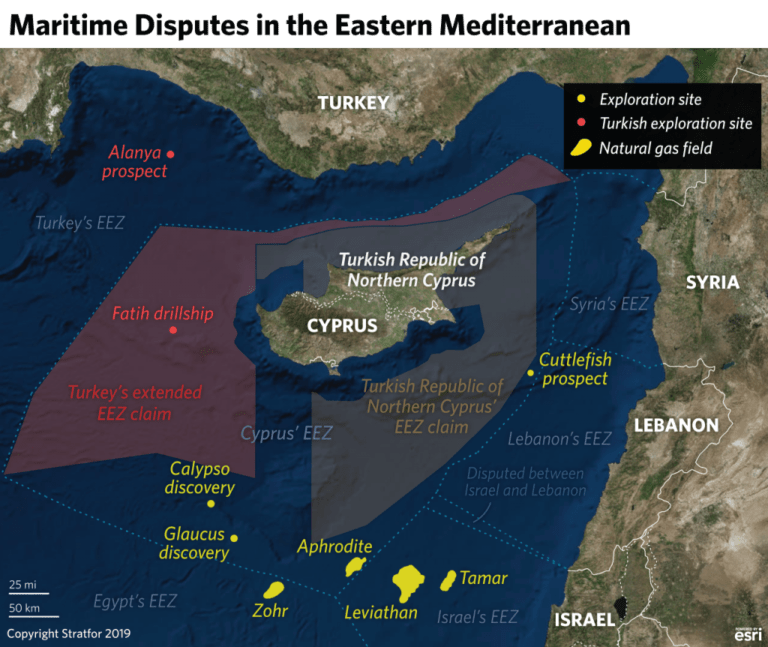
In sum, Turkey has a very serious territorial dispute with Cyprus and will not brook the latter’s unilateral moves to appropriate the massive hydrocarbon reserves in East Mediterranean in waters Ankara regards either belonging to the Turkish Cypriots as well or as falling within its exclusive economic zone (EEZ).
Suffice to say, a Cyprus settlement is the core issue here, but the Greek Cypriot opinion is disinterested in re-unification of the island. (The EU granted Cyprus full membership shortly after the ethnic Greek population voted against reunification, rejecting the settlement plan of then UN secretary general Kofi Annan.)
What complicates matters further is that Turkey has poor relations with Israel, which has banded together with Greece and Cyprus in a sort of tripartite alliance against Turkey lately (with Washington’s blessings.) The US resents Turkey’s independent foreign policies and American oil majors (ExxonMobil) are involved in prospecting / exploiting East Mediterranean’s oil and gas in the seas claimed by Cyprus.
ExxonMobil announced in February that it has made the world’s third-biggest natural gas discovery in two years off the coast of Cyprus in the Eastern Mediterranean at the Glaucus-1 well. The region is already known for some of the world’s largest such discoveries. The discovery could represent a natural gas resource of approximately 5 trillion to 8 trillion cubic feet.
Besides, the US geo-strategic objective is to market the energy supplies from East Mediterranean in Europe, which would erode Russia’s dominance as energy supplier while also enabling Israel to tap a big source of income.
Turkey is pretty much isolated today in the East Mediterranean rivalries, as Ankara intensifies its own exploration for natural gas in the region. After Cyprus after began its exploration (ExxonMobil) with the US ships providing security, Ankara despatched two drill ships to the seas and Turkey’s Naval Forces Command is providing “full and continuous protection” to the drilling vessels, with the help of unmanned aerial vehicles, watercraft, assault boats and submarines.
Turkey held a big naval exercise in in the eastern Mediterranean, Aegean and Black Sea in May asserting its rights not only in Cyprus, but also in Greece. Turkey claims its continental shelf not only takes in portions of Cyprus’s EEZ, but extends westwards to Crete in Greece’s EEZ. This in effect means that Turkey seeks to share the coastal energy resources of both Cyprus and Greece.
A time-bomb is ticking. Washington has repeatedly warned Turkey. In mid-July the EU foreign ministers also came down hard on Ankara, calling its actions “illegal”, punishing it by reducing EU’s assistance to Turkey for 2020 by €145.8 million, inviting European Investment Bank to review its lending activities in Turkey (€358.8 million last year) and threatening to “continue to work on options for targeted measures” (read sanctions.)
Turkey has defiantly rejected the EU intervention, but will feel its isolation mitigated if Russia stretches a helping hand at this juncture. The point is, the storm clouds gathering in East Mediterranean could have serious geopolitical ramifications. In a developing scenario of the West versus Turkey, which is already there, Moscow will be making a profound statement if Russian oil companies join hands with Turkey.
Any such Turkish-Russian collaboration will be a game changer for regional politics — in Syria, Levant, the Black Sea, etc. It coincides with a moment when the Pentagon just caricatured Russia in a strategy report last month as a “revitalised malign actor”, which, in league with China, “frequently jointly oppose US-sponsored measures at the United Nations Security Council” and works for a multipolar world order in which the US is “weaker and less influential.”
Indeed, any Turkish-Russian cooperation in the East Mediterranean will dovetail with global politics. Read a Xinhua report from the weekend titled China, Russia vow to strengthen cooperation, promote world stability.
Russia declares Atlantic Council think tank an ‘undesirable’ organization – what exactly is it?
RT | July 25, 2019
The controversial pro-NATO Atlantic Council think tank has been added to a list of “undesirable” organizations and forbidden from operating within Russia.
Russia’s Prosecutor General said on Thursday that it had decided to recognize the activities of the Atlantic Council (AC) as those of a “foreign non-governmental organization” and as “undesirable” within the country.
“It has been established that the activities of this organization pose a threat to the fundamentals of the constitutional system and the security of the Russian Federation,” a statement said.
The Russian law forbids “undesirable organizations” from opening offices and disseminating its materials in the country. Being part of such a group may result in an administrative fine of up to 100,000 (around $1,600) rubles or criminal liability with a prison term of between two to six years. The AC is the 17th organization to be slapped with that label.
Founded in 1961, the Atlantic Council is a rabidly anti-Russia think tank based in Washington DC and is handsomely funded by a bevy of US and UK arms manufacturers, including Lockheed Martin, Raytheon and Boeing. It has been described by other analysts as the“propaganda arm” of the NATO military alliance. Consistent with its military funding, AC experts – or “fellows” as they call themselves – advocate for the engagement of the US military as frequently as possible in conflicts around the world.
US ambassador to Russia Jon Huntsman used to be the chairman of the organization until 2018. The founder of Baring Vostok private equity fund, Michael Calvey, who is now on trial for large scale fraud in Russia, was one of its board members and the largest private investor, according to the annual report.
While the Russian prosecutor general’s statement describes the AC as an “NGO,” that seems to be not quite an accurate description, given that the organization also receives funding from the US State Department and the British Foreign Office.
The AC regularly hosts forums attended by political, business and academic figures who compete with each other to see who can suggest the most hostile Western course of action toward Russia.
Speaking at an Atlantic Council event in February, US chief of naval operations Adm. John Richardson called for more American aggression toward Russia and China, saying that when it comes to defending key waterways around the world, the US should become more “muscular,” should “strike first” and force Russia to “respond to our first move.”
Last year, Facebook teamed up with an Atlantic Council offshoot known as the ‘Digital Forensic Lab’ in an effort to combat “fake news” on the social media platform. Shortly after, Facebook went on a censorship spree, suspending pages belonging to left-leaning Venezuelan media outlets which were daring to question historically disastrous US foreign policy in Latin America.
Despite its clear bias and US and UK government funding, AC employees are regularly cited as objective ‘expert’ sources in mainstream media reports.
Concentration of forces near Gulf risks ‘conflict outbreak,’ US policy ‘a mistake’ – Moscow
RT | July 19, 2019
Washington’s claim that it downed an Iranian drone is another sign that tensions in the Persian Gulf are at risk of spiraling into a bigger conflict, Russia’s Deputy Foreign Minister Sergey Ryabkov warned.
President Donald Trump had earlier claimed that the assault ship USS ‘Boxer’ shot down an Iranian drone that was approaching it in the Strait of Hormuz. Iran denied losing any aircraft that day.
“The concentration of forces of different countries in the Persian Gulf is so high that any incidents are possible there,” the Russian diplomat told reporters on Friday, adding that the main task now is to “prevent the escalation.”
“As we see once again, the situation… can lead to an outbreak of a conflict.”
Ryabkov said that, despite calls to show restraint, Washington “stubbornly continues to follow the path of stoking tensions and maximum pressure on Tehran.”
This path is a mistake, and prone to cause further complications and shocks.
Last month, the Iranian military shot down a US drone it said had violated the nation’s airspace. Washington said the drone was destroyed over international waters.
Featured Video

Dan Dicks with James Corbett on Solutions Watch
or go to
Aletho News Archives – Video-Images
From the Archives
Secret document reveals plans for civil war in Lebanon, Israeli false flags, and invasion
By Randi Nord | Geopolitics Alert | April 5, 2019
Beirut – During his visit with US Secretary of State, Mike Pompeo, Lebanese President Michael Aoun reportedly received a US-Israeli document detailing plans for creating a civil war in Lebanon with covert false flag operations and possible Israeli invasion.
Although the source of the document is Israeli and created in partnership with Washington, no one knows who presented it to Aoun. The Lebanese TV station, Al-Jadeed, initially reported the document on Lebanese TV and a video on its website. Geopolitics Alert translated the report for this article. … continue
Blog Roll
 Aletho News
- Sheikh al-Asadi warns of Iraqi government compliance with US demands
- How to MAKE THE CONSPIRATORS PAY for their crimes! Dan Dicks with James Corbett on Solutions Watch
- There’s a drought in academia: A drought in honest research on the subject of drought and other weather extremes
- Department of War Awards $20.7 Billion Contract to Raytheon for Air-to-Air Missiles
- ‘Distance yourselves from Israel’: IRGC urges US population to question govt policies
- America’s Greenland deal has a radioactive backstory
- The RAF Fairford ‘terror plot’: Unpacking escalation in the UK echo-chamber
- EU Council Advances Chat Control 2.0 Scanning Proposal
- Ex-Greek MEP files complaint against Israeli spyware firm over alleged Pegasus surveillance
- Troubling ideas throughout the Torah, Talmud, Mishneh Torah and Tanya
- If Americans Knew
- New Report: “Scholasticide and Genocide in Gaza: Assessment, Testimonies and Legal Analysis”
- Ex-Biden officials are desperate for a Gaza scapegoat
- Israeli “settlers” Invade Al-Aqsa; Pour Boiling Water on 75-Year-Old
- Israel Has Kidnapped Another American Teenager
- US arms sales to Israel worth $21.6 billion in 20 months
- Three Palestinians Killed in Israeli Attacks on Gaza
- Revealed: German “Anti-Semitism Expert” Driving Crackdown on Palestine Solidarity is Former Israeli Spy
- Egypt’s Warning to Israel Before Oct 7
- Israel’s siege signals another cruel winter for 1.8 million Gazans – Daily Update
- Netanyahu Asked UAE Leader to Deny Report on Oct. 7 Warning in Secret Visit, Sources Say
- No Tricks Zone
- An error has occurred; the feed is probably down. Try again later.

