Turkey receives more S-400 parts as US holds off retaliation ‘until after coup attempt anniversary’
RT | July 14, 2019
Additional S-400 air defense components have arrived in Turkey, as Washington remains unusually silent while reportedly contemplating the proper timing and degree of pain it wants to inflict on its NATO ally for disobedience.
An Ilyushin Il-76 cargo plane landed at Murted Turkish Air Force base just outside Ankara on Saturday with the latest batch of the S-400 parts, the country’s Defense Ministry confirmed, a day after three gigantic Antonov An-124 jets delivered the first components of the defense system. The cargo was welcomed by a large number of military personnel and offloaded by heavy-duty military trucks into secure hangars.
Despite the lack of immediate reaction from Washington, the White House currently working on a sanctions package which will be invoked under the Countering America’s Adversaries through Sanctions Act (CAATSA), sources familiar with the matter told Bloomberg. The content and the degree of the punitive measures has reportedly already been carefully debated between State Department and National Security Councils officials together with the Pentagon.
Now, it is up to Trump to sign off on the package, which however is unlikely to come before the end of next week, as the administration allegedly wants to “wait until after Monday’s anniversary” of the Turkey military coup attempt as to “avoid fueling further speculation” about Washington’s possible involvement.
Turkey’s President Recep Tayyip Erdogan blamed the failed July 15, 2016 rebellion on a cleric living in the US under CIA protection, and – amid souring relations with Washington which accused him of a brutal and undemocratic crackdown on the coup plotters – began increasingly turning towards Russia for defense supplies.
Egypt Rejects Hamas’ Request for Haniyeh to Travel
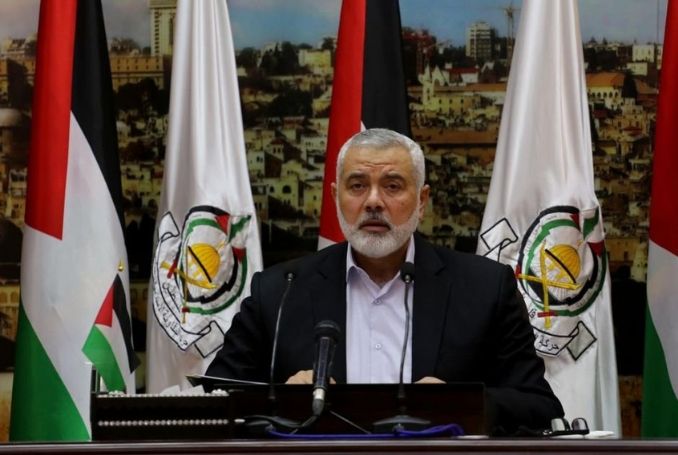
Palestine Chronicle | July 12, 2019
Egypt has rejected a request by Hamas to allow the head of its political bureau, Ismail Haniyeh, to travel to a number of countries including Iran, Turkey, Qatar, and Russia.
Al-Araby Al-Jadeed reported Egyptian sources as saying that after postponing its response, Cairo finally rejected it saying that regional and security conditions do not allow for Haniyeh to travel.
The news site quoted a Hamas source as saying:
“It is clear that Egypt completely objects to Haniyeh’s foreign tour, in protest against the countries which he will visit.”
The source pointed out that Hamas has decided that Mousa Abu Marzouk will head the movement’s delegation to Moscow next week to discuss the Palestinian reconciliation file among other issues.
The source added that the visit has been postponed more than once in the hope that Egypt would allow Haniyeh to travel.
Iran, Russia say US ‘was isolated’ at IAEA’s special meeting
Press TV – July 11, 2019
Tehran says the UN nuclear watchdog’s special meeting held at Washington’s request to win the Board of Governors’ support for its anti-Iran claims turned into another failure for Americans.
“Another failure for the US at the mockery of the IAEA’s Board of Governors,” Iranian Foreign Ministry Spokesman Seyyed Abbas Mousavi tweeted on Wednesday in reference to an emergency meeting of the 35-member Board of Governors of the International Atomic Energy Agency (IAEA) to discuss Iran’s nuclear program, which wrapped up with no conclusion earlier in the day in Vienna.
“The US was once again isolated by its own hands,” Mousavi added.
“The legal strength of the JCPOA [the Iran nuclear deal], the active diplomacy and the fruitful political and ethical record of Iran block all the paths to arrogant deal-breakers,” he added.
The meeting was held a few days after Iran increased the level of its uranium enrichment to 4.5%, which is beyond the limit set by the JCPOA. The move was part of the second phase of the country’s May 8 decision to reduce its commitments under the multilateral 2015 nuclear deal in reaction to the US violations and Europe’s inaction.
The emergency meeting was held at the request of US Ambassador to International Organizations Jackie Wolcott. Iran later criticized the US’ request as a “sad irony” as Washington is the party that has violated the deal first by unilaterally pulling out of it and imposing sanctions on the Islamic Republic.
The US had approached various delegations before requesting to convene the special meeting but in the end had to make the request itself, says Iran’s ambassador to the IAEA Kazem Gharib-Abadi.
“We have been informed that the United States were seeking to have some formal outcome of this meeting, something like a resolution […] but because they haven’t been in a position to convince the others to have their support for their claim, regarding consideration of Iran’s ceasing its implementation of the JCPOA, there has been no conclusion,” he told Press TV following the special session.
“The majority of the members of the Board supported the JCPOA, multilateralism and deplored unilateral actions of the US,” he added.
The Iranian envoy earlier told the IAEA’s special meeting that “the sadistic tendency of the United States to use illegal, unilateral sanctions as an instrument to coerce sovereign states and private entities should come to an end.”
‘US practically isolated’
The Russian Ambassador to the IAEA, Mikhail Ulyanov, also tweeted after the meeting that the US “was practically isolated on this issue”.
Ulyanov told the assembled diplomats it was an “oddity” that the meeting had been called by the US, “the country that declared the JCPOA to be a ‘terrible deal’”.
He said “in practice, it turns out that Washington is aware of the importance of the Plan (JCPOA).”
Also in a statement to the meeting, the UK, France, and Germany said such issues “should be addressed by participants to the JCPOA, including through a meeting of the Joint Commission to be convened urgently.”
The E3 at the same time called on Iran to implement its commitments under the 2015 nuclear deal in full despite the fact that Iran’s decision to reduce its commitments under the deal was made after Europe’s failure to live up to its side of the bargain.
The European parties to the JCPOA were supposed to compensate for the US withdrawal from the deal in May 2018 and the impact of its sanctions on the Iranian economy. Back in January, the E3 officially announced a special payment mechanism, known as the Instrument in Support of Trade Exchanges (INSTEX), which was aimed at facilitating trade with Tehran despite the US bans.
However, it took a long time for the trade channel to become fully operational. The first transaction is set to take place soon, but Iran says without injection of sufficient money into the channel, it cannot help the country reap the benefits of the deal.
“Iran would only accept the European financial mechanism known as INSTEX if it covers all countries rather than just the current ten, if it covers all items in the sanctions, rather than just food stuffs and medicine, and if it is sufficiently funded,” Gharib-Abadi told Press TV on Wednesday.
“We have told them that if they are not ready to put money in the INSTEX, so you have to consider the import of the Iranian oil, so that the money can go to the INSTEX to fund it,” he added.
Russia Vows Mirror Response to Mid-Range Missile Deployment in NATO Countries
Sputnik – July 5, 2019
Russia will provide a mirror response to the deployment of mid-range and low-range missiles in NATO nations in Europe, according to the First Deputy Chair of the Russian Federation Council, Vladimir Dzhabarov.
Meanwhile, Russia’s permanent mission to the alliance said Friday, after a meeting of the NATO-Russia Council, that Moscow considers NATO’s attempts to blame the destruction of the Intermediate-Range Nuclear Forces (INF) Treaty on Moscow groundless.
“We pointed to the fact that attempts to pin the blame over the destruction of the INF Treaty on Russia were groundless”, the mission said in a statement.
Russia stressed the need for restraint, the mission said. Russia confirmed that, should the United States quit the treaty, Moscow did not plan to install any “relevant weapons in Europe and other regions as long as there are no US missiles of short and medium range there.”
“We stressed that further inflaming the political and military situation in Europe carried real risks”, the statement said. “We have called on the NATO countries to make a similar statement”, the mission added.
Russia and NATO exchanged, at the NATO-Russia Council meeting, information on military exercises and called to boost military contacts, Russia’s Permanent Mission to NATO added
“The Parties had an information exchange on important exercises of NATO and Russia to increase the predictability of military activities and prevent misperceptions of each other’s intentions. The Russian Side noted the demand for intensifying mil-to-mil contacts”, it said.
On Wednesday, Russian President Vladimir Putin enacted the official suspension of Russia’s participation in the 1987 INF Treaty. The move came months after the United States suspended its obligations under the accord on 2 February and warned that it would launch a withdrawal process which would be completed in six months unless Moscow remedied the country’s alleged violations of the deal. Russia pledged to act proportionally.
The INF Treaty was signed in 1987 by then-leader of the Soviet Union Mikhail Gorbachev and then-US President Ronald Reagan. Under the agreement, the leaders agreed to destroy all cruise and ground-launched ballistic missiles with ranges between 500 and 5,500 kilometres (310 and 3,400 miles).
Russia: Economic part of deal of the century contradicts UNSC resolutions
MEMO | July 4, 2019
Russian Foreign Minister Sergey Lavrov said yesterday that the economic part of the US deal of the century contradicts UN Security Council resolutions, TASS reported.
Following a meeting with the Secretary-General of the Organisation of Islamic Cooperation (OIC) Yousef Al-Othaimeen, he said: “Without seeing the comprehensive US vision of the settlement, it is very difficult to draw any conclusions.”
“But on a preliminary basis, I can say that the economic part proposes investing about $50 billion, half of the amount in Palestine, and the remaining $25 billion in the infrastructure of the countries where Palestinian refugees have lived for many years now.”
“If this is targeted at the refugees staying there for good and the countries will receive these financial injections to this end, then this alone contradicts the decisions of the UN Security Council, which among other things stipulate [establishing] such a Palestinian state.”
Lavrov stressed that the future Palestinian state “will be competent and will welcome refugees from the countries where they are hosted now, primarily, Lebanon, Egypt and a number of others.”
He concluded: “Therefore, we would like our American colleagues to finally explain their plan completely, instead of revealing their ideas piece by piece.”
Russia has ‘political will’ for arms reduction deal, but ball is in US’ court – Putin
RT | July 4, 2019
Russia does not seek an arms race, only protection, Vladimir Putin said shortly after suspending the INF treaty in a mirror response to the US. Moscow is open to a new arms reduction deal, but the US must reciprocate, he added.
In an extended interview with Italy’s Corriere della Sera daily on Thursday, Putin pointed to the gargantuan difference between the US and Russian defense budgets, to dismiss the notion that Moscow could want to enter an arms race.
“Compare how much Russia spends on defense – some $48 billion, and how much the US spends – over $700 billion. Where is the arms race? We will not let ourselves be dragged into such a race, but we must ensure our security,” Putin said.
Reaching a comprehensive arms reduction agreement is what Moscow is striving for, but Washington doesn’t seem as willing, he said.
“Russia has the political will to work on this. Now it’s the US’ turn,” Putin said.
He pointed out that Moscow never heard back from the Trump administration after offering to sign a joint declaration on the inadmissibility of nuclear war in October, the same month Trump announced his intention to unilaterally withdraw from the cold-war era Intermediate-Range Nuclear Forces Treaty (INF).
Washington cited Russia’s alleged violations as it dismantled the cornerstone of European security, accusations that Moscow vehemently denied. In a mirror response, Russia has suspended the treaty as well. Putin signed the corresponding bill into law on Wednesday.
The treaty banned nuclear and non-nuclear ground-launched ballistic and cruise missiles with a range of up to 5,000km.
After pulling the US out of the INF, Trump signaled that he would like to thrash out a trilateral nuclear pact that would also include China. The US president said that he discussed the possibility of striking such a “three-way-deal” in a phone call in May.
In spite of this rhetoric, Trump has been aggressively expanding the already immense US nuclear arsenal, spending billions of dollars on its build-up.
Last week, Trump bragged about the US war industry churning out “brand new nuclear weapons” that he “hopefully” will never use.
Israeli attack on Syria is a message for Russia

Russian President Vladimir Putin met US President Donald Trump at Osaka on June 29, 2019
By M. K. BHADRAKUMAR | Indian Punchline | July 1, 2019
Although G20 summit in Osaka achieved nothing and there were no breakthrough decisions, a pleasant feeling had appeared momentarily that in the disjointed world situation, all the participants in the event at least reconfirmed their commitment to continue efforts to improve the global trade system, including work to reform the WTO. The G20 summits are generally convergent occasions and Osaka was no different.
The ensuing meditative reveries lingered on through Sunday like an opium-induced blurring of Romantic imagination out of Thomas De Quincey. However, by early Monday it dawned that life is real as the news broke that just past midnight Israeli jets stealthily approaching Syria via Lebanese air space had rained missiles at multiple targets in the suburbs of Damascus and Homs.
According to latest reports, sixteen people, including a baby, were killed and 21 others suffered injuries, including a month-old baby girl, who suffered burns and facial wounds. At one stroke, Israel demolished the chimera of global governance that the G20 symbolises. The missile attack constituted the violation of national sovereignty and territorial integrity of two UN member states — Lebanon and Syria. Israel committed a war crime by killing innocent unarmed civilians.
How is global governance possible without a rule-based order? The relentless promotion of trade war, protectionism and militarism that we are witnessing brings to mind the famous coinage of Thomas Hobbes — Bellum omnium contra omnes ( “the war of all against all”).
Yet, the much-awaited meeting between Trump and Putin at Osaka on Friday, which closely followed the ‘trilateral’ meeting of the national security advisors of the US, Russia and Israel in Jerusalem on Tuesday, was widely expected to produce some convergences regarding Syria and the situation around Iran.
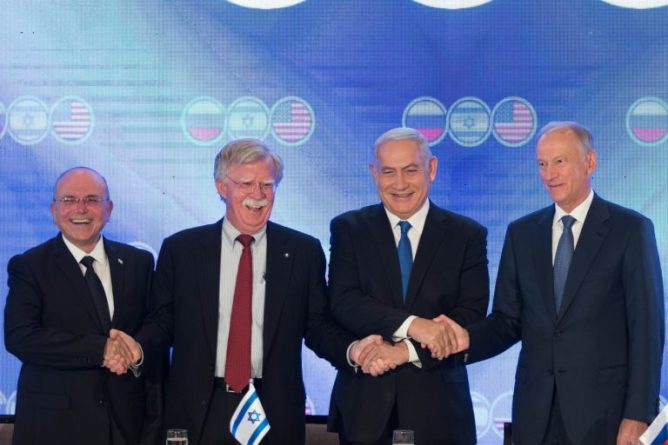
Israeli National Security Adviser Meir Ben-Shabbat, US National Security Adviser John Bolton, Prime Minister Benjamin Netanyahu and Secretary of the Russian Security Council Nikolai Patrushev at a trilateral summit at the Orient Hotel in Jerusalem on June 25, 2019.
Israel had hyped up the meeting of the NSAs and during a joint press conference with the visiting secretary of the Russian national security council Nikolai Patrushev, Israeli Prime Minister Benjamin Netanyahu had boasted that “security cooperation between Russia and Israel has already contributed much to the security and stability of our region and has made a fundamental difference in the situation in the region.”
But it was only typical Israeli bluster. In fact, today’s missile attack is an act of ‘coercive diplomacy’ by Israel. The Israelis are showing that they have neutralised the Russian S-300 missile system which is supposedly guarding Syrian air space. This is Israel’s angry riposte to Russia’s refusal to break up with Iran in Syria.
On the Israeli missile attack on Monday, the Russian Foreign Minister Sergey Lavrov has said, “We are establishing the facts now. We do not know what happened there. We want to gain insight into it, but the necessity to respect and execute the UN Security Council’s operating resolutions, that no one cancelled, is our principle which we will proceed from when assessing actions of any players in the region.”
Suffice to say that the Russian-Iranian axis in the Syrian conflict has far from outlived its utility — although the two countries would each have its specific interests in the Syrian situation. Thus, the Kremlin spokesman Dmitry Peskov disclosed today in Moscow that another trilateral summit on Syria between Russia, Iran and Turkey is due to take place in the near future.
To quote Peskov, “They raised the issue at the meeting of President Putin and Erdogan (at Osaka). They did talk about such a summit. It is understood that it will be held soon.” There are also media reports that Turkey will host the trilateral summit in July. The previous such summits took place in Sochi (November 2017), Ankara (April 2018), Tehran (September 2018) and Sochi (February 2019). Evidently, the raison d’être of the Russia-Turkey-Iran format remains even in the conditions of the current US-Iran standoff.
No doubt, the situation in Idlib province in northeast Syria is fraught with profound contradictions, which need to be reconciled urgently. This is one thing. (Read an insightful report by Xinhua news agency, here, on the strong undercurrents in the Idlib situation.)

However, the big picture out of all this is that although Putin had a “good meeting” with Trump in Osaka on Friday and they held “very business-like and pragmatic” discussions that “covered practically the entire range of issues of mutual interest” (in Putin’s words), all he would say was that the discussions on regional conflicts were “overall… useful consultations.”
Putin sounded frustrated that Washington has shown no intentions even to expand economic ties with Russia or tap the vast potential of bilateral trade. He noted, “That is why I have no idea if they (Trump administration) will do anything or not. At any rate, one thing is sure — we are not going to ask for anything. No means no. And if there is interest, we will respond in kind and do everything we can to turn the situation around.”
Of course, the two presidents have instructed their respective foreign ministers to launch consultations on a New START treaty. But even here, Putin noted, “I do not know if those consultations will lead to the extension of the New START treaty, it is too early to speak about it.”
The paradox lies herein. For Trump, the prime consideration in the period ahead will be that there are no serious hiccups on the foreign policy front that might upset his apple cart during his campaign for the November 2020 election. The Victory Day Parade in Moscow’s Red Square next May offers a great photo-op for him, which he wouldn’t want to miss. But basically, Trump went to Osaka wearing velvet gloves with a focused mind on creating foreign-policy underpinnings for his bid for a second term as president.
Israel certainly factored in the inconclusive meeting between Trump and Putin while launching the missile strike on Damascus. It is a stark reminder that Israel will continue to fuel the tensions over Iran’s presence in Syria and draw Trump into it.
Hope for a Breakthrough in Korea
By Ray McGovern – Consortium News – July 1, 2019
There is hope for some real progress in U.S.-North Korean relations after Sunday morning’s unscheduled meeting between President Donald Trump and North Korean leader Kim Jong-Un, largely because Russia and China seem more determined than ever to facilitate forward movement.
Sitting down before the talks began, Kim underlined the importance of the meeting.“I hope it can be the foundation for better things that people will not be expecting,” he said. “Our great relationship will provide the magical power with which to overcome hardships and obstacles in the tasks that needs to be done from now on.”
Trump was equally positive speaking of Kim:
“We’ve developed a very good relationship and we understand each other very well. I do believe he understands me, and I think I maybe understand him, and sometimes that can lead to very good things.”
Trump said the two sides would designate teams, with the U.S. team headed by special envoy Stephen Biegun under the auspices of Secretary of State Mike Pompeo, to start work in the next two to three weeks. “They’ll start a process, and we’ll see what happens,” he said.
New Impetus
Russian President Vladimir Putin and Chinese President Xi Jinping, who met individually with President Trump at the G20 in Osaka, have been singing from the same sheet of Korea music — particularly in the wake of Xi’s visit to North Korea on June 20-21. Putin’s remarks are the most illuminating.
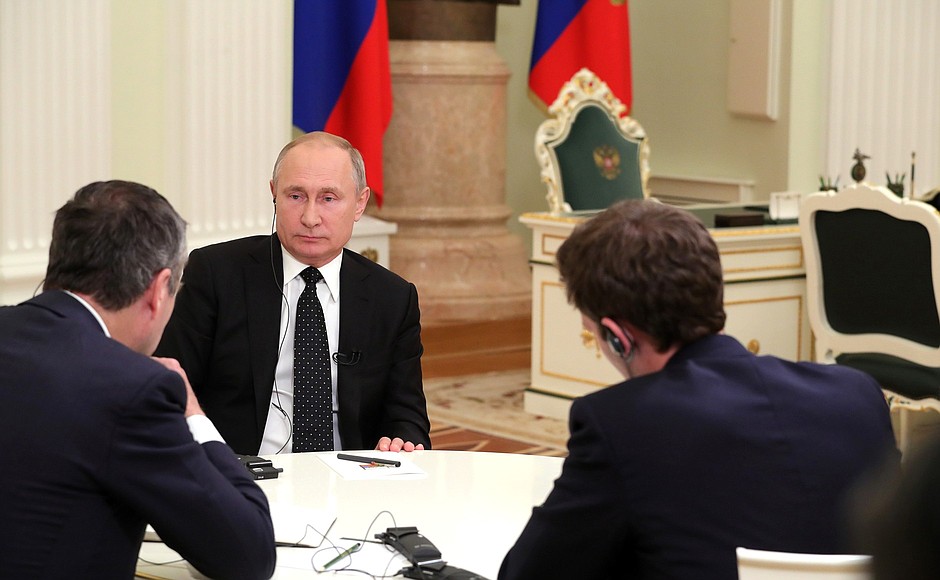
Putin at FT interview. (Kremlin photo)
In an interview with The Financial Times, Putin pointed to “the tragedies of Libya and Iraq” — meaning, of course, what happened to each of them as they lacked a nuclear deterrent. Applying that lesson to North Korea, Putin said,
“What we should be talking about is not how to make North Korea disarm, but how to ensure the unconditional security of North Korea and how to make any country, including North Korea, feel safe and protected by international law. …”
“We should think about guarantees, which we should use as the basis for talks with North Korea. We must take into account the dangers arising from … the presence of nuclear weapons,” he said, adding that if a way can be found to satisfy North Korea’s understandable determination to protect its security, “the situation may take a turn nobody can imagine today.”
“Whether we recognize North Korea as a nuclear power or not, the number of nuclear charges it has will not decrease. We must proceed from modern realities …” And those realities include fundamental, immediate security concerns for both Russia and China. Putin put it this way:
”[W]e have a common border, even if a short one, with North Korea, therefore, this problem has a direct bearing on us. The United States is located across the ocean … while we are right here, in this region, and the North Korean nuclear range is not far away from our border. This is why this concerns us directly, and we never stop thinking about it.”
Xi’s ‘Reasonable Expectations’
Last week in Pyongyang, Chinese President Xi Jinping said China is waiting for a desired response in stalled nuclear talks with the United States.
“North Korea would like to remain patient, but it hopes the relevant party will meet halfway with North Korea to explore resolution plans that accommodate each other’s reasonable concerns,” he said.
A commentary in China’s official Xinhua news agency said China could play a unique role in breaking the cycle of mistrust between North Korea and the U.S, but that both sides “need to have reasonable expectations and refrain from imposing unilateral and unrealistic demands.”
There is little doubt that the Russians and Chinese have been comparing notes on what they see as a potentially explosive (literally) problem in their respective backyards, the more so inasmuch as the two countries have become allies in all but name.
On a three-day visit to Moscow earlier this month, President Xi spoke of his “deep personal friendship” with Putin, with whom he has “met nearly 30 times in the past six years.” For his part, Putin claimed “Russian-Chinese relations have reached an unprecedented level. It is a global partnership and strategic cooperation.”
A Fundamental Strategic Change
Whether they are “best friends” or not, the claim of unprecedented strategic cooperation happens to be true — and is the most fundamental change in the world strategic equation in decades. Given the fear they share that things could get out of hand in Korea with the mercurial Trump and his hawkish advisers calling the shots, it is a safe bet that Putin and Xi have been coordinating closely on North Korea.
The next step could be stepped-up efforts to persuade Trump that China and Russia can somehow guarantee continued nuclear restraint on Pyongyang’s part, in return for U.S. agreement to move step by step — rather than full bore — toward at least partial North Korean denuclearization — and perhaps some relaxation in U.S. economic sanctions. Xi and Putin may have broached that kind of deal to Trump in Osaka.
There is also a salutary sign that President Trump has learned more about the effects of a military conflict with North Korea, and that he has come to realize that Pyongyang already has not only a nuclear, but also a formidable conventional deterrent: massed artillery.
“There are 35 million people in Seoul, 25 miles away,” Trump said on Sunday. “All accessible by what they already have in the mountains. There’s nothing like that anywhere in terms of danger.”
Obstacles Still Formidable
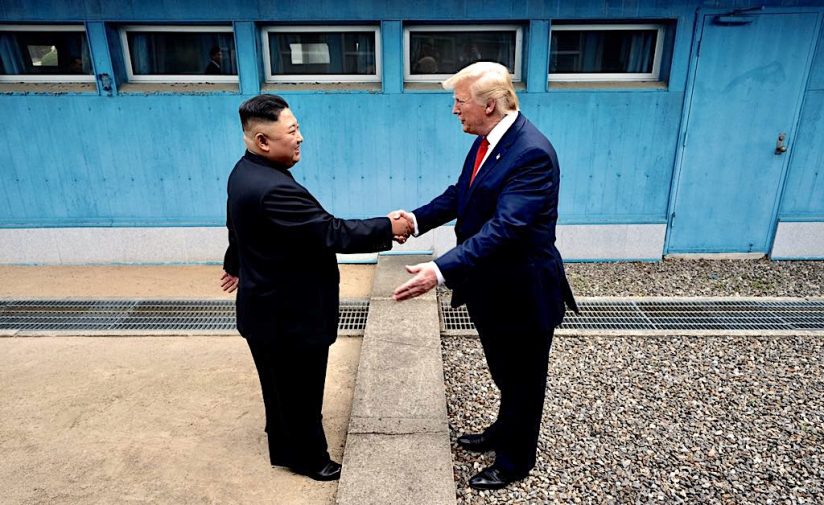
Trump and Kim meet Sunday before Trump became first US president to step on North Korean territory. (White House photo)
Trump will have to remind his national security adviser, John Bolton, and Secretary of State Mike Pompeo, that he is the president and that he intends to take a firmer grip on reins regarding Korean policy. Given their maladroit performance on both Iran and Venezuela, it would, at first blush, seem easy to jettison the two super-hawks.
But this would mean running afoul of the Military-Industrial-Congressional-Intelligence-Media-Academe-Think-Tank (MICIMATT) complex, in which the corporate-controlled media play the sine-qua-non role today.
In a harbinger of things to come, The Washington Post’s initial report on the outcome of the Trump-Kim talks contained two distortions: “Trump … misrepresented what had been achieved, claiming that North Korea had ceased ballistic missile tests and was continuing to send back remains of U.S. servicemen killed in the Korean War.”
The Trump administration could reasonably call that “fake news.” True, North Korea tested short-range ballistic missiles last spring, but Kim’s promise to Trump was to stop testing strategic not tactical missiles, and North Korea has adhered to that promise. As for the return of the remains of U.S. servicemen: True, such remains that remain are no longer being sent back to the U.S., but it was the U.S. that put a stop to that after the summit in Hanoi failed.
We can surely expect more disingenuous “reporting” of that kind.
Whether Trump can stand up to the MICIMATT on Korea remains to be seen. There is a huge amount of arms-maker-arms-dealer profiteering going on in the Far East, as long as tensions there can be stoked and kept at a sufficiently high level.
Ray McGovern works with Tell the Word, a publishing arm of the ecumenical Church of the Saviour in inner-city Washington. His first portfolio at CIA was referent-analyst for Soviet policy toward China, Korea, Vietnam, and Japan. In retirement he co-founded Veteran Intelligence Professionals for Sanity (VIPS).
US Approach to Palestine-Israel Peace Unveiled at Manama Workshop ‘Counterproductive’ – Moscow
Sputnik – June 27, 2019
Bahrain hosted a two-day forum on 25-26 June, which sought to encourage rich Arab countries to invest in Palestinian projects as part of US President Donald Trump’s “deal of the century”.
Russian Foreign Ministry on Thursday lambasted the US approach to the Palestine-Israel settlement presented at a workshop in Manama, Bahrain.
According to the ministry, the US stance on the issue appears ‘counterproductive’.
The ministry lamented the fact that the issues of relaunching direct Palestine-Israeli negotiations as well as the creation of an independent Palestinian state within its 1967 borders were excluded from the talks in Manama.
On Wednesday, the two-day meeting concluded in Bahrain’s capital Manama. The forum focused on the economic aspects of the initiative developed by the United States to resolve the Middle East conflict, which the media dubbed the “deal of the century”.
Representatives of the Palestinian Authority boycotted the forum, viewing it as an attempt to bribe them.
The Palestinians have been seeking diplomatic recognition for their independent state on the territories of the West Bank, including East Jerusalem, which are partially occupied by Israel, and the Gaza Strip.
Netanyahu boasts ‘100s of anti-Iran ops’ in Syria as Russia reminds to love thy neighbor’s security
RT | June 26, 2019
Israeli Prime Minister Benjamin Netanyahu made it clear that Israel will stop at nothing to protect itself against any perceived threats, as he boasted about Tel Aviv’s successful raids against alleged Iranian targets in the neighboring Syria.
“Israel has acted hundreds of times to prevent Iran from entrenching itself militarily in Syria,” he said, speaking ahead of a trilateral meeting between the Russian, American and Israeli national security advisers, who met in Jerusalem on Tuesday to discuss rising tensions in the Middle East and other urgent matters.
“We have acted hundreds of times to prevent Iran from delivering increasingly sophisticated weaponry to Hezbollah, or to form a second front in the north against us from the Golan Heights. Israel will continue to prevent Iran from using neighboring territory as platforms to attack us, and Israel will respond forcefully to any such attacks.”
Such belligerent statements did not sit well with the Russian Security Council Secretary Nikolai Patrushev, who called on the Israeli PM to respect the security of his neighbors as well, explaining that it was effectively the only way to ensure Israel’s own safety.
“We understand the concerns that Israel has and want those threats to be eliminated,” Patrushev said, explaining that Israel’s security is important for Moscow, but added that “one should also take the national interests of other regional nations into consideration.”
“If we do not … acknowledge and reckon with those interests, I doubt we can achieve any tangible result” in terms of regional security, the Russian Security Council secretary warned.
US deploying missiles along Russia’s borders could lead to ‘new Cuban crisis’ – Russia’s deputy FM
RT | June 24, 2019
Washington will provoke explosive tensions, reminiscent of the darkest moments of the Cold War, if it sends missiles close to Russia’s border after suspending the INF Treaty, a senior diplomat in Moscow warned.
If Washington deploys short or mid-range ground-based missiles along Russia’s borders, the situation “will not only become complicated, it will escalate to the maximum level,” Deputy Foreign Minister Sergey Ryabkov told lawmakers on Monday.
“We can end up in a missile crisis not just similar to the one we had in the 1980s, but to the Cuban Missile Crisis [in 1962].”
The diplomat was commenting on the demise of the landmark 1987 Intermediate-Range Nuclear Forces Treaty (INF) between Moscow and Washington. The deal banned owning and testing of all ground-based missiles with a range of up to 5,500km (3,420 miles), as well as their launchers.
Last year, the US announced the suspension of its obligations under the treaty, alleging that Russia secretly violates it. Moscow strongly denied the allegations and accused the US of conducting tests, illegal under the INF Treaty, which Washington likewise denied. In February, Russia suspended its participation in the agreement in “a mirror response” to the US’ actions.
Speaking on Monday, Ryabkov said that Moscow stands ready to continue taking “a responsible approach” to the situation but will do everything to “firmly maintain its own national security and the security of our allies in the changing environment.”
We are ‘probably the only great military power’ to reduce its defense spending, Putin says
RT | June 20, 2019
Russia manages to remain a great military power despite decreasing its defense budget, while other countries keep pumping money into their armies, Vladimir Putin said, during his annual Direct Line Q&A session.
“We are probably the only great military power that is reducing its defense spending,” the President pointed out.
At around $48 billion, “Russia is just seventh in the world in absolute value” when it comes to the size of the military budget, he reminded his audience.
“We are surpassed –sizably– by the US, which spends $720 billion dollars” and by other countries, including Saudi Arabia, UK, France and Japan, he said.
But despite all this, Russia not only manages to maintain military and nuclear parity, but also to “surpass our competitors by two or three steps,” he said, adding that “it’s something to be proud of.”
No other country has such state-of-the-art high-tech weaponry like ours. I’m talking primarily about our hypersonic missile technologies.
Russia’s defense budget, which stands at 2.9 percent of GDP in 2019, will drop to 2.87 percent next year and to 2.8 percent in 2021, according to the head of state.
“The trend to reduce military spending is there,” but defense remains an important expenditure for the state, he said, remembering a famous quote: “If you don’t want to feed your army – get ready to feed someone else’s.”
Featured Video

Dan Dicks with James Corbett on Solutions Watch
or go to
Aletho News Archives – Video-Images
From the Archives
MMR (Measles, Mumps and Rubella) – Vaccine Risk Statement
MMR Vaccine (Measles, Mumps, and Rubella) Is It Safer Than Measles, Mumps and Rubella?
Physicians for Informed Consent | December 2024
… It has not been proven that the MMR vaccine is safer than measles, mumps, and rubella. The vaccine package insert raises questions about safety testing for cancer, genetic mutations, and impaired fertility. Although VAERS tracks some adverse events, it is too inaccurate to measure against the risk of measles, mumps, and rubella. Clinical trials do not have the ability to detect less common adverse reactions, and epidemiological studies are limited by the effects of chance and possible confounders. Safety studies of the MMR vaccine are particularly lacking in statistical power. A review of more than 60 MMR vaccine studies conducted for the Cochrane Library states, “The design and reporting of safety outcomes in MMR vaccine studies, both pre- and post-marketing, are largely inadequate.”19 Because permanent sequelae (aftereffects) from measles, mumps, and rubella are so rare (especially in children with normal levels of vitamin A and infected after birth),6,15-17 the level of accuracy of the research studies available is insufficient to rule out the possibility that the MMR vaccine causes greater death or permanent disability than measles, mumps, and rubella. – Read full article
Blog Roll
 Aletho News
- Sheikh al-Asadi warns of Iraqi government compliance with US demands
- How to MAKE THE CONSPIRATORS PAY for their crimes! Dan Dicks with James Corbett on Solutions Watch
- There’s a drought in academia: A drought in honest research on the subject of drought and other weather extremes
- Department of War Awards $20.7 Billion Contract to Raytheon for Air-to-Air Missiles
- ‘Distance yourselves from Israel’: IRGC urges US population to question govt policies
- America’s Greenland deal has a radioactive backstory
- The RAF Fairford ‘terror plot’: Unpacking escalation in the UK echo-chamber
- EU Council Advances Chat Control 2.0 Scanning Proposal
- Ex-Greek MEP files complaint against Israeli spyware firm over alleged Pegasus surveillance
- Troubling ideas throughout the Torah, Talmud, Mishneh Torah and Tanya
- If Americans Knew
- New Report: “Scholasticide and Genocide in Gaza: Assessment, Testimonies and Legal Analysis”
- Ex-Biden officials are desperate for a Gaza scapegoat
- Israeli “settlers” Invade Al-Aqsa; Pour Boiling Water on 75-Year-Old
- Israel Has Kidnapped Another American Teenager
- US arms sales to Israel worth $21.6 billion in 20 months
- Three Palestinians Killed in Israeli Attacks on Gaza
- Revealed: German “Anti-Semitism Expert” Driving Crackdown on Palestine Solidarity is Former Israeli Spy
- Egypt’s Warning to Israel Before Oct 7
- Israel’s siege signals another cruel winter for 1.8 million Gazans – Daily Update
- Netanyahu Asked UAE Leader to Deny Report on Oct. 7 Warning in Secret Visit, Sources Say
- No Tricks Zone
- Two More Paleo Reconstructions Affirm Meters-Higher Sea Levels Across Ireland, Brazil 7000-6000 Years Ago
- New Study: Earth And Venus Surface Warmth Largely Explained By Convection And Lapse Rate, Not CO2 Or Radiation
- 2025 Nature Paper Claiming Worsening Global Drought Gets RETRACTED …Heavily Flawed
- New Study: ‘Global Drought Shows No Detectable Recent Acceleration Under Climate Warming’
- Economic Masterminds: German Socialists Suggest Taxing Productivity Gains Stemming From Using AI
- The South China Sea Has Not Been Cooperating With The Climate Change Narrative
- Energy Crisis: Germany Enters Heating Season With Historically Low Gas Reserve Fill Levels
- New Study: The Antarctic Ice Sheet Gained Mass From 2020-2024 Due To Staggering Snow And Ice Accumulation
- Study: Ocean Heating Rates From Thousands Of Years Ago ‘Dwarf’ Modern Ocean Heating Rates
- Climate Extremists Target, Attack Large-Scale Power Grid Infrastructure In Germany!

