Russia warns US against attempts to provoke war with Iran
Press TV – June 18, 2019
Russia has urged the United States to drop its “provocative” plans to deploy more troops to the Middle East, warning Washington against its “conscious” course of attempts to “provoke war” with Iran.
Speaking to reporters on Tuesday, Russian Deputy Foreign Minister Sergei Ryabkov said that Moscow had repeatedly warned Washington and its regional allies about the “unthinking and reckless pumping up of tensions in an explosive region.”
“Now what we see are unending and sustained US attempts to crank up political, psychological, economic and yes military pressure on Iran in quite a provocative way. They (such actions) cannot be assessed as anything but a conscious course to provoke war,” he added.
“If that’s the case, the US should refrain from further reinforcement of its presence and from other steps, including dragging and pushing its allies in various parts of the world into stepping up pressure on Iran,” Ryabkov said.
The United States has recently taken a quasi-warlike posture against Iran. The Pentagon announced on Monday that the US will send 1,000 additional US forces and more military resources to the Middle East.
Acting US Defense Secretary Patrick Shanahan made the announcement, asserting that the deployment had “defensive purposes.”
His comments came a day after US Secretary of State Mike Pompeo said that Washington does not want to go to war with Tehran, while falsely accusing Iran again for the attacks on two oil tankers in the Sea of Oman last week.
Acting US Defense Secretary Patrick Shanahan made the announcement, claiming that the deployment had “defensive purposes.”
His comments came a day after US Secretary of State Mike Pompeo said that Washington does not want to go to war with Tehran, while falsely accusing Iran again for last weeks’ attacks on two oil tankers in the Sea of Oman last week.
In response to such US claims, Ryabkov said if Washington did not want war, it had to show it.
“If that’s really how it is then the US should step back from reinforcing its military presence,” the senior Russian diplomat added.
Tehran has time and again said that it does not seek military confrontations with the United States, yet it stands ready to defend its interests in the region.
Iran’s President Hassan Rouhani on Tuesday reaffirmed that Tehran does not seek war with any state, but stressed that the Iranian nation will be the ultimate winner of any warfare against the Islamic Republic.
Meanwhile, Russian President Vladimir Putin’s spokesman Dmitry Peskov on Tuesday called for restraint to avoid the escalation of tensions in the Middle East.
“We are urging all the sides to show restraint,” Peskov told journalists. “We would prefer not to see any steps that could introduce additional tensions in the already unstable region.”
The United States remarkably stoked tensions with Iran in May 2018 when the US president pulled his country out of a 2015 multinational nuclear deal with Tehran, and re-imposed harsh sanctions against the Islamic Republic in defiance of global criticisms.
The tensions saw a sharp rise on the first anniversary of Washington’s exit from the deal as the US moved to ratchet up the pressure on Iran by tightening its oil sanctions and deploying reinforcements to the Middle East, including an aircraft carrier strike group, B-52 bombers and Patriot missiles.
The US’s recent military moves have sparked global concerns that the Trump administration was contemplating military aggression against Iran.
Guilty or Not, Iran’s Fate Is in Trump’s Hands
By Tim Kirby | Strategic Culture Foundation | June 17, 2019
The USS Maine sank, someone shot something at somebody during the Gulf of Tonkin Incident and many non-Iraqis triggered the invasion of Iraq by flying planes into skyscrapers. The media hyped attacks on two oil tankers in the Gulf of Oman seem like another blatant attempt to pull the US into yet another war based on questionable pretenses. The information war regarding the incident is already very hot but ultimately the future of Iran is in Donald Trump’s hands.
The Mainstream Media has already come out in force to push the narrative that Iran was probably behind the attacks on the oil tankers even though US Secretary of State Mike Pompeo offered no actual evidence whatsoever to support his claim that the Persians did it. (Since then grainy video has come out showing nondescript men trying to attach or detach something presumably to the tanker from what is supposedly an Iranian vessel).
From a legal or moral sense it would have been much more proper if Pompeo would have waited long enough to provide solid proof that the Iranians did it before making a public condemnation of them. But then again, if his objective was to simply plant the idea that the Iranians did it into the Mainstream Media (and thus into the minds of the masses) then he played it perfectly as evidence is not required to achieve this objective.
From the standpoint of Information Warfare, it is very critical when a new event happens to put forward one’s version of the “truth” first before any other possible competing theories can arise. This could be why Pompeo or someone like him would chose to immediately come out with accusations thrown around as facts with no evidence to support them and no respect for the great Western concepts of “innocence until proven guilty” or the “right to a fair trial”.
Pompeo’s objective here is not the truth but to take that virgin intellectual territory regarding the interpretation of this issue before anyone else can, because once a concept has become normalized in the minds of the masses it is very difficult to change it and many people in Washington cannot risk blowing the chance to waste thousands of American lives invading Iran based on an ultimately false but widely accepted/believed narrative.
Not surprisingly foreign and especially Russian media has quickly attempted to counter the “Iran obviously did it” narrative before it becomes an accepted fact. Shockingly Slavic infowarriors actually decided to speak to the captain of a tanker that was hit to get his opinion rather than simply assert that Iran didn’t do it because they are a long time buddy of Moscow. The captain’s testimony of what happened strongly contradicts the version of reality that Washington is pushing. And over all Russia as usual takes the reasonable position of “let’s gather the evidence and then see who did it”, which is good PR for itself as a nation beyond this single issue.
In terms of finding the actual guilty party the media on both sides has thus far ignored the simple fact that if Iran wanted to sink a tanker it would be sunk. No civilian vessel is going to withstand an attack from a 21st century navy by having a particularly thick hull and the idea that the Iranians need to physically attach bombs to boats is mental. Physically planting bombs is for goofball inept terrorists, not a professional military. After all, even the West acknowledges that the Iranians use the best Russian goodies that they can afford and Russian 21st century arms will sink civilian ships guaranteed. The Iranians have everything they need to smoke any civilian vessel on the planet guaranteed from much farther away than 3 feet.
If Iran’s goal was to scare or intimidate the tanker they could have just shot at it with rifles or done something else to spook the crew and get a media response. When looked at from the standpoint of military logic, these “attacks” seem baffling as Iran could have just destroyed the boats or directly tried to terrorize them to make a statement.
Then again perhaps the Iranians do want to provoke the US into a war with them, by “kind of but not really” attacking these ships. Maybe they do want to fight a war they will ultimately lose destroying everything they have built after the revolution, but this seems highly unlikely. The Iranians for decade after decade have taken a reactive stance to US aggression and encirclement, why would they change that policy right now in order to go on offense against an enemy they cannot defeat in direct confrontation?
What may be reassuring to some but terrifying to others is that the final result of what is to be done about these “attacks” lies in the hands of Donald Trump. So far Trump has agreed with the Pompeo/Mainstream Media view of the incident. But Trump like all politicians says “a lot of things” and what really matters are his actions. As the President he can take this convenient incident and use it as a casus belli or he can simply and safely “condemn” Tehran with rhetoric and literally ignore the situation until it goes away which seems to be The Donald’s preferred method of keeping the peace. He has scolded many a nation but not actually pushed for a full fledged military response against any of them.
Proving who is guilty for the attacks on the tankers may take a long time or ultimately be impossible, but how this incident will be used by Washington will prove who Trump is… a patriot who wants to Make America Great Again by ignoring the chance to jump into foreign conflicts or yet another cowardly warmonger sitting in the Oval Office ready to waste US lives and resources without a care in the world.
India’s Proposal For A Global “Terrorism” Conference Will Probably Backfire
By Andrew Korybko | EurasiaFuture | 2019-06-09
Indian Prime Minister Modi proposed a global “terrorism” conference while speaking in the Maldives during his first foreign trip following last month’s resounding re-election victory, but while this idea is obviously intended to contribute to his failed policy of “isolating” the global pivot state of Pakistan, it’ll probably backfire by drawing attention to his country’s policy of state terrorism against the Kashmiris, providing a platform for India’s new American-“Israeli”-Saudi allies to fearmonger about Iran, and putting Russia and the US in an awkward position for their diplomatic peacemaking ties with the Taliban.
Shifting The Blame For Regional Instability
Indian Prime Minister Modi is on his first foreign trip since winning a resounding re-election victory last month, during which time he told the Maldivian parliament that the world needs to urgently convene a global conference on “terrorism”. His supplementary remarks about “state-sponsored terrorism” and how some “people still try to create notions of ‘good terrorist, bad terrorist’” were interpreted as being aimed against the global pivot state of Pakistan’s political support for the Kashmiri freedom movement that India regards as “terrorists”, strongly insinuating that the intent behind Modi’s initiative is to contribute to his failed policy of “isolating” Islamabad. India also wants to deflect from the negative attention that it received worldwide after being exposed as the real rogue state in South Asia after it almost brought the region to the brink of nuclear war earlier this year following the suspicious Pulwama incident that it automatically blamed on Pakistan, desperately trying to continue pinning the blame on its neighbor for South Asia’s instability instead of taking responsibility for the being the reason behind this itself.
“Containing” China & Taking Revenge On Russia
Should this conference end up taking place, then it’s predictable that India will produce manufactured “evidence” in order to “prove” its point, exploiting the highly publicized opportunity to smear Pakistan’s reputation and provoke international concerns about investing in CPEC. This agenda has a much greater chance of succeeding if India convinces the US to impose unilateral sanctions against Pakistan on an “anti-terrorist” basis, understanding that the real purpose would be to indirectly sanction CPEC and consequently deal an asymmetrical blow to China in the so-called “trade war“. Furthermore, the negative attention that India hopes to heap upon Pakistan during that occasion could be weaponized to smear all of its targets’ partners by extention, including Russia, who New Delhi has been extremely angry with over the past few months after Moscow refused to take its side during the latest regional hostilities and instead opted to remain neutral as part of its balanced “Return to South Asia“. The news that President Putin might finally meet Prime Minister Khan during next week’s SCO Summit in Bishkek might have also motivated Modi to act as urgently as he did.
A Dose Of Modi’s Own Medicine
For as much as Indian strategists are expecting an optimistic outcome from Modi’s proposed global “terrorism” summit, there’s a very high likelihood that it’ll actually end up backfiring and causing many more problems than it’s worth. To begin with, Pakistan could use the international media coverage given to that event to draw attention to India’s use of state terrorism against the Kashmiri freedom movement that’s fighting for the right to their promised UN-mandated plebiscite to determine their political future. Not only that, but the “ModiMob” lynchings of dozens of Muslims over the past half-decade could be properly reframed as Hindu terrorist attacks if Pakistan plays its soft power cards right. In addition, the forthcoming event could also serve to remind the world of the testimony of convicted RAW Hybrid War operative Kulbhushan Jadhav after he admitted that he was tasked by his homeland to organize terrorist attacks in Pakistan, which could in turn lead to a wider discussion about India’s state sponsorship of the BLA and TTP terrorist groups .
Ranting About Iran & Talking Tough Against The Taliban
That’s not all, though, since the illusion of India’s “multi-alignment” would be ruined once and for all if its new American, “Israeli“, and Saudi allies exploit that platform to fearmonger about Iran, especially after New Delhi recently ditched it once Washington withdrew its sanctions waiver last month. Being responsible for sponsoring an anti-Iranian propaganda fest that raises the already high tensions in the Gulf would irreparably harm India’s reputation among the many countries of the emerging Multipolar World Order even if it endears it to the ones who are clinging to the fading unipolar one, showing without any doubt that New Delhi has made a decision to unapologetically pivot towards Washington. Nevertheless, India might also inadvertently harm its standing with the US if its representatives rant about the Taliban during that time, with whom Washington and Moscow are presently engaged in peacemaking diplomatic outreaches, but it might even stage a Bollywood-like drama to this effect to create some unconvincing ambiguity about its aforementioned pivot.
Concluding Thoughts
Modi thought that it would be a good idea to propose a global “terrorism” conference in order to put more international pressure on Pakistan, but upon further contemplation, it might be India itself that ends up coming under worldwide scrutiny if Islamabad takes advantage of this opportunity to raise awareness about New Delhi’s policy of state terrorism against the Kashmiris, the “ModiMob” Hindu terrorist lynchings of dozens of Muslims over the past half-decade, and Kulbhushan Jadhav’s confession that his homeland ordered him to organize terrorist attacks in Pakistan. Moreover, India’s reputation could be irreparably ruined in the eyes of the emerging Multipolar World Order if it sponsors an event that turns into an anti-Iranian propaganda fest for its US, “Israeli”, and Saudi allies to rant and rave against their rival, even if it stages a Bollywood-like drama by verbally attacking America’s peacemaking diplomatic ties with the Taliban to deflect from this fact. All told, more self-inflicted soft power harm than good might come out of India’s proposed global “terrorism” conference, though its strategists probably won’t realize this until after the fact.
Bipartisan Support for Trump’s Aggressive Iran Policy Reveals the Hollowness of Russiagate
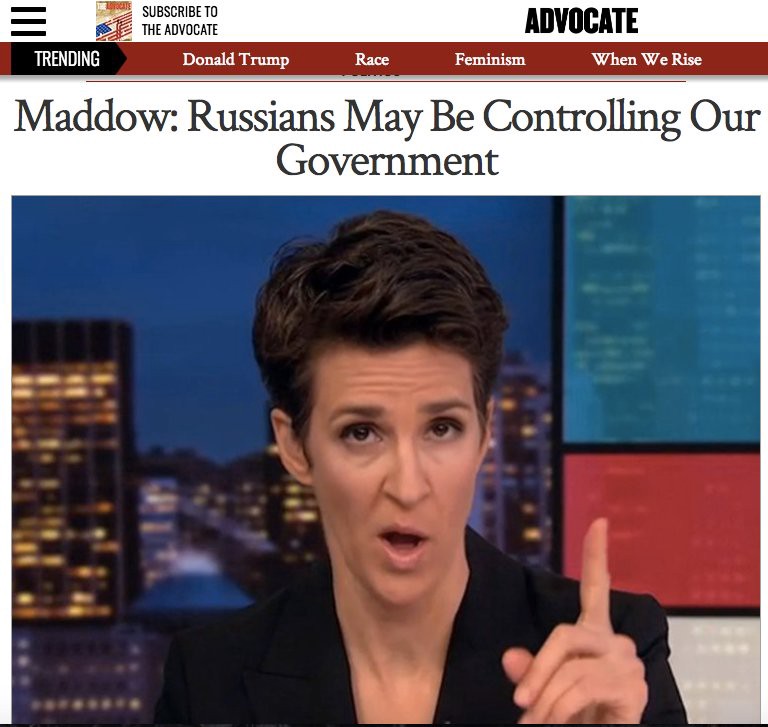
By Whitney Webb | MintPress News | June 3, 2019
In early May, MSNBC news host Rachel Maddow — known as one of the top promoters of the new Cold War and Russiagate in American media — emphatically endorsed regime change in Venezuela after she claimed that President Donald Trump’s hawkishness towards the South American country had changed, all because of a single phone call with his Russian counterpart Vladimir Putin.
Though Maddow’s claims were arguably the most extreme in suggesting that Trump was “taking orders” from Putin on Venezuela, she wasn’t alone in making them. For instance, Cenk Uygur of the Young Turks also made the claim that the Trump-Putin phone call on Venezuela was “direct evidence that he is literally taking orders from Putin.” In addition, several corporate media outlets supported this narrative by suggesting that Trump “echoed” Putin’s Venezuela stance after the phone call and directly contradicted his top staffers and even himself in doing so.
Yet now, strangely, those same corporate media voices remain silent on the Trump administration’s other regime-change project — in Iran — despite the fact that the Putin-led Russian government is set to be the biggest winner as tensions between the U.S. and the Islamic Republic boil over and threaten to send the Middle East into a fresh bout of destruction and chaos.
How Russia wins
As tensions between the U.S. and Iran have grown in recent months, analysts in both corporate and independent media have speculated about what country is set to benefit the most from the U.S.’ campaign of “maximum pressure” and regime change against the Islamic Republic. Of the many analyses, two countries have stood out as likely beneficiaries: Russia and China.
The cases for China and Russia’s benefit are somewhat similar given that the Trump administration’s focus on Iran results in less pressure on both Russia and China. This is despite the fact that, officially, the U.S.’ current National Defense Strategy explicitly calls for focusing attention on preparing for a “long war” against Russia and China to prevent either from superseding the U.S. as a global superpower. Yet, with the U.S. focused on regime change in Iran and Venezuela, Russia and China can avoid bearing the brunt of U.S. military adventurism, either directly or by proxy, while the U.S. wears itself thin by trying to do it all at once.
Several U.S. military analysts have been warning against war with Iran for precisely this reason. Nikolas Gvosdev, a professor of national security affairs at the U.S. Naval War College, recently wrote in The Hill that the U.S. faces a lose-lose scenario by pursuing a militaristic, aggressive Iran policy:
To gear up for a major conflict with Iran, the U.S. would be forced to de-emphasize Europe’s eastern flank, allowing Russia more time and breathing space to consolidate its position. On the other hand, a U.S. campaign that is defined more by bellicose rhetoric and less by action will buttress Russia’s claim, already seemingly validated in Syria and in Venezuela, that the U.S. talks a good game but has no real stomach for projecting its power.”
Both countries also stand to benefit from Iran’s increasing desperation for trading partners unwilling to bow to the U.S. Currently, China represents 30 percent of Iran’s international trade and the current U.S. sanctions on Iran have pushed Tehran to rely more heavily on Russia, especially for weapons purchases, than it had while the Iran nuclear deal (officially the Joint Comprehensive Plan of Action, JCPOA) was in force.
However, upon closer examination, it becomes clear that China, though it benefits to some degree, is not a clear winner amid current tensions, while Russia stands to gain the most. The reason for this is the effect of current and future U.S.-Iran tensions on the oil market. While China trusts Iran to be a key oil supplier even if there is a breach in U.S.-China relations, any shock to the oil market and any jump in oil prices — both of which are likely to occur if U.S.-Iran tensions continue to escalate — will spell disaster for the Chinese economy, given that China is now the world’s largest importer of oil.
Russia, on the other hand, stands to benefit massively from the chaos that U.S.-Iran tensions are set to unleash on the oil market and, by extension, oil prices. With the U.S. seeking to starve Iran of any and all oil export revenue, all countries that had been purchasing Iranian oil must seek new suppliers. Yet, with the prospect of a U.S-Iran conflict still ever-present, it will be those oil producers outside of the Middle East that will come out on top, since oil supply routes that do not pass through the Middle East do not risk supply disruptions that would be caused by a war in the region. Thus, Russia, owing to its location, will emerge as an oil producer of extreme importance. Furthermore, given that such instability in the Middle East will lead to a surge in global oil prices, Russia will be able to export more oil at a higher price and will see its economy and geopolitical clout benefit greatly as a result.
A potential geopolitical killing
In addition to a great boost to its oil sector, Russia also stands to make unique geopolitical gains, particularly in the Middle East and beyond. For instance, in Syria, Russia is increasingly seeking to use its pull with Syria’s government as a major bargaining chip with Israel and the U.S., as made clear by the upcoming trilateral summit on the Middle East between Russia, Israel and the U.S. The main focus of that summit will likely be the fate of the presence of foreign militaries in Syria, particularly Iranian and U.S. forces.
The summit will likely be dominated by Russia and Israel, given Israel’s influence over the U.S., and particularly over National Security Adviser John Bolton, who will represent the U.S. at the summit. Israel’s key interest in Syria at this stage of the conflict is the removal of Iranian forces from Syria. Russia is likely to oblige that request, as doing so would allow Russia to dominate a post-war Syria at Iran’s expense. This seems to be a current Russian objective in Syria, given recent reports of in-fighting among Russian and Iranian forces in Northern Syria.
However, Russia is unlikely to help reduce Iran’s Syria presence if doing so would favor the United States’ occupation of Syrian territory or threaten to upset Russia’s own interests in Syria. Thus, in this case, Russia is counting on Israel’s influence on the Trump administration to ensure that, if Iranian forces vacate Syria, it will be Russia that will dominate the country post-conflict.
Russia also stands to gain geopolitically from the isolationism being forced on Iran by the Trump administration. Indeed, U.S. pressure on Iran has already served Russian interests by pushing Iran further towards Russia, giving Moscow the status of an increasingly important economic partner of Tehran. While benefiting the Russian economy, closer economic ties between Moscow and Iran would also give Russia a leg up in discussions with the U.S., as Washington may then need to make concessions to or coordinate with Russia in future efforts to pressure Iran.
Meanwhile, Russia stands to reap major profits by selling more weapons to Iran, and to gain geopolitical clout by further cementing its role as a mediator of conflict by promoting compliance with the JCPOA and opposing regime change. Iran’s dwindling options for strategic alliances with non-U.S. aligned countries will make it difficult for Tehran to resist Russian demands on key issues, including the Syria conflict.
Another major geopolitical win for Russia that has resulted from the U.S.’ current Iran policy is the tension that that policy has engendered between the U.S. and its European allies. When the U.S. unilaterally withdrew from the JCPOA, it began the development of a rift between the U.S. and its key European allies who are also JCPOA signatories — particularly France, Germany and the United Kingdom. As a signatory, Russia’s stance on Iran has revolved around the JCPOA, with Russia having urged Iran to remain in the deal “no matter what,” advice that Iran does not now seem keen to follow.
Russia’s stance on JCPOA is likely aimed just as much at Europe as it is at Iran, since promoting the agreement amid the U.S. unilateral withdrawal paints Russia as more predictable and stable in terms of its political stances and diplomacy in comparison to the U.S. If nothing else, Putin is known for excelling at taking advantage of the missteps made by his geopolitical adversaries.
This is all part of a careful public image that Russia is seeking to cultivate with European countries as it hopes to attract them to do business with Russian oil and gas companies as the Middle East now seemingly approaches another era of extreme instability. By promoting the JCPOA alongside Europe, Russia makes increased Russo-European cooperation seem more attractive.
As U.S.-Iran tensions mount, particularly if armed conflict breaks out, importing goods from Russia, especially oil and gas, will appear more attractive and safer in comparison to goods that originate from or pass through the Middle East before arriving in Europe. Depending on how the situation plays out, Europe — driven by concerns about stability and reliability — may be willing to risk angering the U.S. to pursue increased economic cooperation with Russia, even though doing so would run counter to current U.S. and NATO objectives.
Putin plays Netanyahu
While it is often difficult to find accurate, honest reporting on Vladimir Putin –reporting that is neither too biased against him nor too much in his favor — it is generally acknowledged that Putin, above all else, is interested in advancing Russia’s national interest and is a cunning strategist who often thinks several steps ahead of both his allies and his adversaries.
In viewing the ratcheting up of tensions between the U.S. and Iran, Putin’s modus operandi remains unchanged and, upon closer examination, it is clear that he is giving the hotheads driving this still-escalating situation just enough rope to hang themselves. Meanwhile, Russia is waiting in the wings to pick up the pieces and further cement its already acknowledged role as the new foreign “peacemaker” in the Middle East while gaining economic and geopolitical clout in the process.
Prior to the Israeli election earlier this year, Israeli media noted on several occasions that Putin was backing the reelection of Israeli Prime Minister Benjamin Netanyahu, including when Putin hosted Netanyahu at a sudden pre-election summit. Israeli newspaper Haaretz described Putin’s decision to host Netanyahu at the time as aimed at helping Netanyahu secure the “crucial Russian vote” among Russian-Israeli Jews in order to “outflank” his competitors. In another instance, Putin was alleged to have further helped Netanyahu’s reelection odds by having Russian special forces find and deliver the remains of Zachary Baumel — an Israeli soldier who had gone missing in Lebanon in 1982 — to Israel just ahead of the election.
Putin’s direct support of Netanyahu may seem odd to observers of geopolitics, given that the two have often been at odds over Syria. However, Putin and Netanyahu have developed an effective working relationship and Russia and Israel enjoy relatively strong bilateral ties and economic agreements.
Yet, beyond the ties that have been forged between the two countries in recent years, Putin likely knows that he can play Netanyahu’s weaknesses to his advantage. For instance, Putin is acutely aware of the benefits to be reaped from increasing tensions between the U.S. and Iran and is also aware of the key role that Netanyahu has played and continues to play in driving the Trump administration’s Iran policy. Netanyahu’s near-obsession with regime change in Iran and the practical likelihood that a U.S.-Iran war would be “unwinnable” for the U.S. and would leave its military weakened and distracted are points that Putin is likely eager to exploit in pursuance of Russian geopolitical goals.
Russia seeks to play the role of mediator but only to a certain extent and has kept its attitude towards Iran intentionally vague when dealing with the Israeli government, so much so that Israeli officials have cited Russia’s unknown stance towards Iran as a major difficulty in negotiating the deconfliction of Russian and Israeli forces in Syria. This is likely because Russia doesn’t seek to aid either side amid escalating tensions, instead waiting for the current tensions to play out, as it stands to make gains in either case.
That Russia stands to gain from current U.S.-Iran tensions hasn’t been lost on all Israeli officials, however. Earlier this month, a former Israeli intelligence official, Yakkov Kedmi, openly stated that not only is a war against Iran “unwinnable” for the U.S. and its regional allies, but further that Russia would be the only major country to benefit from any military conflict pitting the Americans against the Iranians. Appearing on Russian television program Evening with Vladimir Solovyov, Kedmi stated that, if war does break out, the U.S. “won’t remain whole” after the conflict and that “if anyone wins, it’ll be Russia.”
“If the price of oil exceeds $100 per barrel, it hits the Chinese economy. Most of all, it hits the European and American economies,” Kedmi stated. “If you double the price,” he added, “[global] industry will be ruined. First of all, it will happen in the U.S.” To that, the program’s host, Vladimir Solovyov, asserted that “Their [American] industry will be [ruined]. It’ll be the opposite in our country. Our economy will begin to develop. We’ll feel like kings with golden diamond-studded wheels on our cars.”
Why the Russiagaters are silent on Iran
Given Russia — and Putin’s — clear benefit from the continuing U.S. escalation with Iran and a potential military conflict, it is striking that Putin’s fiercest critics in the American media have remained silent about this clear pay-off as the Trump administration continues to pursue an aggressive, hawkish Iran policy that hardly benefits the U.S. and instead benefits its supposed adversary. This is especially notable in light of the fact that these same American critics of Russia and Putin’s leadership were recently accusing Trump of “taking orders” from Putin by altering his Venezuela policy in a way that was perceived to benefit Russian over American interests.
This dichotomy is most easily deconstructed by noting that top promoters of Russiagate and news personalities known for their hyperfocus on Putin rarely call for any policy that would involve a reduction in tensions or less militarism abroad. Indeed, all too often, the “solutions” offered by these journalists involve sending weapons to U.S. proxy forces, shooting missiles at Russian allies, sanctioning Russia and its allies, and other “useful reminders of the military strength of the Western alliance” between the U.S. and NATO.
Without fail, the suggested solutions of how to counter Putin from the U.S. media and political establishment almost always involve “pushing back” with force equal to or greater than the perceived aggression. Rarely do they involve backing down or unwinding tensions, even in the cases where doing so would clearly challenge key geopolitical objectives of the Russian government.
In the case of Russia’s benefit from Trump’s Iran policy, the benefit is so clear that it has been voiced in several mainstream media outlets — including CNN, The Hill, Forbes and Bloomberg — with most of those reports focusing exclusively on the oil angle. However, while Russia’s advantage has been noted, it is also clear that Trump’s current Iran policy has avoided inflaming the Russiagate hysteria that has marked media coverage of other Trump policies and statements that were perceived as being “pro-Putin” for the past few years.
One reason that the media has skipped a prime opportunity for another Russiagate frenzy is the fact that many of the driving forces behind Russiagate are also supportive of regime change in Iran. Indeed, while Russiagate has recently been cast by Trump and prominent Republicans as a “hoax” narrative exclusive to Democrats, prominent neoconservatives have long been pivotal in creating and fomenting Russigate for over five years.
For instance, the origins of the infamous Steele dossier — which was used to assert that Russia’s government had a litany of salacious blackmail on Trump that it would use to manipulate him as president — trace back to top neoconservative Republican donor Paul Singer. That dossier was subsequently circulated within the Obama administration during the 2016 campaign by neoconservatives Victoria Nuland and the late Senator John McCain.
Many of the same neoconservative figures who have helped stoke Russiagate and pounced on the resulting climate of hysteria to promote increased militarism as the solution, also support regime change in Iran. Michael McFaul — U.S. Ambassador to Russia during the Obama administration — is both a strong advocate for aggressive U.S. measures to counter Putin and also a vocal proponent of U.S.-led regime change in Iran. Similarly, on the supposed other side of the political spectrum, Bill Kristol — well-known neoconservative writer, an icon of the establishment “resistance” to Trump, and a promoter of Russiagate — also strongly supports hawkish measures to contain Russia and is a long-time, vocal supporter of regime change in Iran.
While the tense situation between the U.S. and Iran is undeniably troubling, the relative silence among figures in U.S. media and politics who claim to be Putin’s fiercest critics with regard to Trump’s aggressive Iran policy reveals a stark truth about Russiagate. The goal of Russiagate is not actually about “countering” Putin or Russian geopolitical influence; it is about promoting the expansion and widespread adoption of hyper-militarism by both the establishment left and establishment right in the United States.
While Russia often serves as a useful “boogeyman” in service to this agenda of promoting militaristic policies, the odd moments when those same policies actually benefit Russia and do not run into hysterical opposition from the political and media establishment provide a rare glimpse into the real motivations behind Cold War 2.0 and the dubious validity of the media-driven narratives upon which current anti-Russian hysteria is based.
Whitney Webb is a MintPress News journalist based in Chile. She has contributed to several independent media outlets including Global Research, EcoWatch, the Ron Paul Institute and 21st Century Wire, among others. She has made several radio and television appearances and is the 2019 winner of the Serena Shim Award for Uncompromised Integrity in Journalism.
Alleged Chemical Weapons Use in Syria Needs to be Investigated – Moscow
Sputnik – May 22, 2019
MOSCOW – Russia stands for investigating all reported cases of the use of chemical weapons in Syria, Russian Deputy Foreign Minister Sergei Ryabkov said on Wednesday, adding that this investigation should aim to find the truth rather than bring new accusations against Damascus.
“We have the information that provocations using chemical substances are constantly being prepared by militants and terrorists. Our US colleagues and their allies remain unresponsive to this information. In the OPCW [the Organization for the Prohibition of Chemical Weapons], a so-called attributive mechanism has been created in violation of the Chemical Weapons Convention, which now has to act, apparently, taking into account the principles that are politically formulated by Western countries in this field. We advocate the investigation of all cases with the use of poisonous weapons, but this must be an investigation and not just the pinning of labels,” Ryabkov told reporters.
He noted that the investigation should entail visits to the scene of the incident, interviews with witnesses and collection of uncontaminated evidence.
Previous such incidents only resulted in accusations against Damascus and no probes of this kind, the diplomat stressed.
“As a result, trust in the OPCW, once the most effective, successful international organization, which is universal in this area, has been undermined”, Ryabkov added.
US Department of State spokeswoman Morgan Ortagus said on Tuesday that Washington was collecting information regarding an alleged chemical weapons attack in Syria over the weekend and warned the government of Syrian President Bashar Assad that it would quickly respond if Damascus’ involvement was confirmed.The Russian Defence Ministry said earlier in May that militants of al-Nusra Front terror group were preparing to stage a false-flag provocation in Syria’s Idlib province to frame the Russian Aerospace Forces and the Syrian army for allegedly attacking civilians with chemical weapons.
Last year, the United States, United Kingdom and France used claims of chemical attacks in Syria’s Khan Sheikhoun, Duma and Eastern Ghouta to justify missile strikes on Syria, without waiting for the results of an independent investigation. The Syrian government has denied any role in the attacks.
US, Russia engage on Venezuela
By M. K. BHADRAKUMAR | Indian Punchline | May 12, 2019
Kremlin spokesman Dmitry Peskov remarked last Thursday in Moscow that no contacts between Russian President Vladimir Putin and US President Donald Trump are expected at the G20 summit in Japan on June 28-29. “An encounter is not planned so far and there is no talk about a meeting,” Peskov said.
This remark was made in the run-up to US Secretary of State Mike Pompeo’s forthcoming visit to Russia on April 12-14. There has been much speculation in the US media that a summit meeting between Trump and Putin was likely among Pompeo’s talking points with the Russian leadership.
The ‘pull asides’ that Trump has been resorting to on the sidelines of international events to have a quick word with Putin have fallen into a pattern. Firstly, things remained strictly between the two statesmen at a personal level and secondly, Trump had to take care no feathers were ruffled back home while the Robert Mueller inquiry on ‘Russia collusion’ was going on. The arrangement left the Russian side unhappy, since the unstructured informal conversations eventually led to nothing. Russian-American relations continued to deteriorate.
Unsurprisingly, it has taken over one year for Pompeo to schedule his first visit to Moscow after he took over as state secretary in April 2018. (No US secretary of defence has yet visited Russia during the Trump presidency, either.) The proposal on Pompeo’s visit was hurriedly mooted by Washington just a few days ago, earlier this month. Therefore, if Pompeo’s visit is being treated on a low key, it could be that Moscow doesn’t expect anything much to come out of it.
The point is, although the Mueller inquiry could not prove any ‘collusion’ between Trump and the Kremlin, Russia still remains a toxic subject domestically in the US. For Trump’s detractors, he and Russia are often synonymous. The narrative that Trump and people around him were engaged in improper activities with Russia is not about to wither away and there are further moves likely in the Washington Beltway to find out about any other possible links between the Trump organisation and even his family and Russian entities or oligarchs.
Then, there is the vexed issue of the US sanctions against Russia, which inherently curb the scope for any meaningful expansion of ties. The post-2016 sanctions do not stem from executive orders but emanate out of laws passed by the US Congress, which takes away from Trump’s hands the powers to remove them — and, equally, they are not even tied to specific Russian behaviours. The Russians understand well enough that the sanctions won’t be lifted for a long time.
Within such constraints, what is it that Pompeo’s visit hopes to achieve? At a state department briefing on May 10, an unnamed senior US official disclosed that arms control will top Pompeo’s agenda during the Russia visit. He said Trump seeks new agreements with Russia “that reflect modern reality. These agreements must include a broader range of countries and account for a broader range of weapon systems than our current bilateral treaties with Russia.” Besides, he said, “There will be a full range of global challenges to discuss, including Ukraine, Venezuela, Iran, Syria, and North Korea.”
However, there are enough signs that the main thing to watch could be whether a US-Russia deal on Venezuela becomes possible. Three weeks back, Fiona Hill, senior director for European and Russian affairs on the National Security Council in the White House, had visited Moscow for consultations. Amongst others, she met Putin’s foreign policy advisor Yuri Ushakov. According to media reports, Hill prioritised Venezuela as the most important topic in the US-Russia relations at the moment.
Arguably, more than oil or the Monroe Doctrine, what motivates Trump could be the impact of a regime change in Venezuela on the Hispanic voters in the 2020 presidential race in Florida. This impression would only have been reinforced last week when Pompeo met Lavrov on the sidelines of the Arctic Council meeting in Helsinki when, again, Venezuela figured prominently in their discussion.
With the recent US-backed coup attempt in Venezuela on April 30 having failed spectacularly, the probability of an outright US intervention is low — almost non-existent. Trump would be reaching out for Russian help for a constitutional transition in Caracas that he could project as a ‘win’. Both Washington and Moscow are highly experienced in adopting a transactional approach to their relationship.
For Russia, on the other hand, its support for the Maduro government in Caracas is driven as much by financial and energy interests as by Moscow’s vision of a multipolar world order that is based on international law. As the Moscow-based analyst Fred Weir wrote recently, “while it may look and sound like a Cold War standoff, for Russia it is really about the simpler issue of establishing rules for competing big powers in a post-Cold War world. In Venezuela, and between the US and Russia generally, there is no sharp ideological divide over world-shaping doctrines like communism versus capitalism.”
Simply put, the Russian-American discord over Venezuela boils down to this: Washington wants Russia to stop ‘meddling’ in the Western Hemisphere, while Moscow would expect that the US also should stop fomenting anti-Moscow revolutions in Russia’s backyard. Otherwise, Russian experts acknowledge, it matters little to Moscow who rules in Caracas.
The influential strategic thinker in Moscow Fyodor Lukyanov told Weir, “The relationship that emerged between Russia and Venezuela was an accident. It was mainly the initiative of Hugo Chávez, who was seeking counterbalances to his country’s dependence on the US. Of course this was enthusiastically supported in Moscow. But it should be pointed out that at that time, the early 2000s, Chávez was rich and could pay for Russian arms and advice. Since Chávez died, and his successor has not proven so adept or popular, many in Moscow have been worried about our heavy investments in a potentially unstable regime.”
It is entirely conceivable that this complicated Russian-American tango of ‘meddling’ in the other side’s region could be in the first instance what prompted Washington to schedule Pompeo’s hurried visit to Russia to meet Lavrov and Putin in Sochi on April 14. Evidently, the Trump administration’s resuscitation of the Monroe Doctrine provides a diplomatic opening to Moscow, which of course continues to cherish the territories of the former Soviet republics as its own ‘sphere of influence’, too.
To quote Lukyanov again, “This citing of the Monroe Doctrine is something quite intriguing, and it would be warmly welcomed in Moscow if we thought the Americans took it seriously.” Indeed, some reports on Fiona Hill’s talks in Moscow last month hinted that she made a proposal to what roughly involved Russia letting up on Venezuela in exchange for some US concessions on Ukraine.
Be that as it may, significantly, Russian and Venezuelan foreign ministers met in Moscow on the eve of Lavrov’s meeting with Pompeo in Helsinki last week. What needs to be factored in is that although the coup attempt of April 30 failed, the situation in Venezuela is fluid. According to the Russian media, President Maduro has expelled dozens of army officers for their involvement in the coup, including high ranking officers.
To be sure, Moscow would know that a political solution is needed. The good part is that regime change is off the table as of now, which gives the respite to negotiate. After the meeting with Pompeo in Helsinki, Lavrov told the media that he’d rule out any foreign military intervention in Venezuela.
But the problem is that trust is lacking between Washington and Moscow. Russia cannot be sure that the American side will keep its side of the bargain — that is, assuming there is a will to negotiate at all. Again, there is the issue of US sanctions, which has crippled the Venezuelan economy over recent years. This is important because Russia’s exposure to Venezuela is huge. At the very least, Russian investments (loans) to Venezuela since 2005 amount to $17 billion.
US responsible for ‘unacceptable’ deadlock on JCPOA – Lavrov
RT | May 8, 2019
The irresponsible policies of the US have put the multilateral pact on Iran’s nuclear program at risk of failure, the Russian foreign minister said, adding that Washington should try diplomacy instead of threats for a change.
Sergey Lavrov criticized the US during a meeting with his Iranian counterpart Javad Zarif, who personally brought a letter from his government informing Russia about Tehran’s latest decision on the nuclear agreement. Russia is one of the signatories of the 2015 document, also known as JCPOA, which offered Iran relief from economic sanctions in exchange for accepting restriction on its nuclear industry.
“As I understand, our main task here is to discuss the unacceptable situation, which has unfolded around the JCPOA as a result of irresponsible behavior by the United States,” the Russian diplomat said before negotiations with the Iranians.
The Iranian minister said Tehran’s actions came in response to the US withdrawal from the deal, and were not meant to destroy the agreement. “[They] can be reversed. There is a 60-day windows of opportunity for diplomacy,” he said.
Later in the day, Lavrov lamented the current US administration’s habit of coercing other nations with threats of sanctions or direct use of military force, be it in the Middle East or Venezuela.
“The day before yesterday, I met US Secretary of State Mike Pompeo in Finland and called on him to use instruments of diplomacy instead of threats when dealing with all issues of contention, and to stick to international law and UN principles, which require the peaceful resolution of conflicts,” he said. “One has to have a taste for diplomacy, which probably not everyone has today.”
Iran on Wednesday announced that it will no longer observe the limits on reserves of enriched uranium and heavy water established by the deal, calling it a response to the US withdrawal from the JCPOA exactly a year ago. Unless European signatories of the agreement deliver on their promise to protect the Iranian economy from unilateral sanctions reimposed by the US over the last 12 months, Iran would take further action, President Hassan Rouhani said in a televised address.
All signatories were formally notified about Tehran’s decision, with Zarif using his coinciding visit to Moscow to offer personal explanations about why it was taken.
Lavrov stressed that Russia appreciated Iran’s continued compliance with the JCPOA even after the US broke its side of the bargain.
Will China engage in arms control?
By M. K. BHADRAKUMAR | Indian Punchline | May 5, 2019
US President Donald Trump’s phone call to his Russian counterpart Vladimir Putin on Friday comes within 3 weeks of the release of the redacted report of the Robert Mueller inquiry into his ‘Russia collusion’. It was a 90-minute phone conversation, which underscored Trump’s determination to foster good relations with Putin notwithstanding the narrative that he and the people around him were engaged in improper activities with Russia.
The Kremlin readout listed economic ties, ’strategic stability’, North Korea, Ukraine and Venezuela as topics that figured in the conversation.
But the headline-hogging news is that Trump proposed to Putin the idea of expanded arms control talks that would also include China. Trump claimed that China is on board. Talking to the media at the White House, he said:
“We’re talking about a nuclear agreement where we make less and they make less, and maybe even where we get rid of some of the tremendous firepower that we have right now. We’re spending billions of dollars on nuclear weapons, numbers like we’ve never spent before. We need that, but they are also — and China is, frankly, also — we discussed the possibility of a three-way deal instead of a two-way deal. And China — I’ve already spoken to them; they very much would like to be a part of that deal. In fact, during the trade talks, we started talking about that. They were excited about that. Maybe even more excited than about trade. But they felt very strongly about it.”
“So I think we’re going to probably start up something very shortly between Russia and ourselves, maybe to start off. And I think China will be added down the road. We’ll be talking about nonproliferation. We’ll be talking about a nuclear deal of some kind. And I think it will be a very comprehensive one.”
Trump sees a potential signature foreign policy achievement. Trump is known to have a penchant for big deals. The Washington Post reported last week that Trump “has ordered his administration to prepare a push for new arms-control agreements with Russia and China after bristling at the cost of a 21st-century nuclear arms race.” The reports from Washington indicate that the White House is conducting intense interagency talks to develop options for the president to pursue such a deal.
The CNN quoted a senior White House official as saying, “The President has made clear that he thinks that arms control should include Russia and China and should include all the weapons, all the warheads, all the missiles. We have an ambition to give the President options as quickly as possible to give him as much space on the calendar as possible.”
Trump is giving conflicting signals. Even as he talks about arms control, Trump has backed the $500 billion Obama-era project to modernize the US atomic arsenal, pulled out of the INF Treaty with Russia, and updated the US nuclear posture to be more aggressive. But then, earlier last month, in a meeting with Chinese trade envoy and vice premier Liu He, Trump bemoaned the levels of military spending by major powers, suggesting all that money could be better spent on other things.
Clearly, in any emergent scenario, the broader context of relations will be the key factor. Bringing China on board arms control talks is a common Russian-American agenda. To understand this, we need to go back in time to the negotiation of the Intermediate-Range Nuclear Forces (INF) Treaty.
Fundamentally, China’s approach to arms control has been different from the US or Russia’s. Washington and Moscow have been historically driven by the strategic imperative of parity that generated in turn the Cold-War era arms race and its ‘anti-thesis’ — arms control and reductions. And the concept of mutual nuclear deterrence and stability was shared and interdependent.
China, on the contrary, never sought parity and had no reason to enter into an arms race or to engage in arms control. Today, China reportedly has an arsenal of less than 300 strategy warheads (as against 1550 that the New START Treaty of 2010 allows the US and Russia to keep.) Simply put, China stayed on the sidelines, maintaining that the US and Russia need to reduce their arsenals first before its participation in limitations and reductions.
When the INF Treaty was negotiated in the 1980s, although its leitmotif was European security, the pact also had implications for East Asian security. China was on adversarial terms with Russia at that time and joined hands with the western powers to ensure two things: a) Britain and France were kept out of the INF Treaty (lest that set precedent for China’s inclusion), and, b) INF Treaty also included Soviet deployments east of the Urals.
China scored a big diplomatic coup when the Soviet leader Mikhail Gorbachev made the unilateral announcement in July 1987 agreeing to the so-called global ‘zero option’ by the Soviet Union (ie., elimination of Soviet INF missiles in both Europe and Asia.) In essence, China ensured the complete elimination of Soviet missile threat to its nuclear arsenal.
Moscow never quite reconciled with Gorbachev’s compromise. Meanwhile, the Cold War ended and the Soviet Union imploded. Yet, by the beginning of 2005, Moscow began to voice unease that INF Treaty banned only the US and Russia from having INF missiles, while other countries were free to deploy them. In 2007, then Russian Defense Minister Sergei Ivanov called the INF Treaty a relic of the Cold War, and President Putin thereafter proposed in October 2007 that the INF Treaty become multilateral—a global ban on INF missiles.
Now, the political-military relationship between Russia and China is vastly different today. China’s nuclear capability has dramatically improved, especially with submarine-launched ballistic missiles. On the other hand, US’ relations with both Russia and China have become tense while Sino-Russian partnership is at its highest level today in history. Equally, Russia and China have common shared threat perceptions regarding the US.
Since there are consultative mechanisms between Moscow and Beijing to mitigate substantive concerns regarding deployment or force projection, China is today more concerned with US missiles (and missile defence systems.) Nonetheless, China has to come to terms with the reality that any significant increase in its nuclear warhead numbers henceforth also concerns the security interests of Russia. It is entirely conceivable that Moscow will also strive to maintain its qualitative and quantitative nuclear predominance over China.
To be sure, China’s rapidly growing missile forces have long troubled the US. China now has the second largest defense budget behind the US – and China’s fire power is largely concentrated in one critical region, East Asia. The trends are worrisome for Washington, too. If in 2000 US defence expenditure was nine times that of China, by 2010, this was down to less than six times, and in 2017 to less than three times.
Russian officials have repeatedly stated that any future reductions of strategic weapons would have to be multilateral, including the UK, France, and China. Chinese officials have stated that the US and Russia would have to make much deeper cuts before China is prepared to join the process. However, we still don’t know the US position apropos extension of New START Treaty beyond 2021 and in further nuclear reductions.
‘Anything is possible’: Trump talks North Korea peace after phone call with Putin
RT | May 4, 2019
President Trump took to Twitter to declare his support for peace on the Korean Peninsula, after discussing the issue with Russian President Vladimir Putin. North Korea, meanwhile, test-fired short-range missiles.
“Anything in this very interesting world is possible,” Trump tweeted on Saturday. “But I believe that Kim Jong Un fully realizes the great economic potential of North Korea, & will do nothing to interfere or end it. He also knows that I am with him & does not want to break his promise to me. Deal will happen!”
Trump’s tweet came after he spoke with Putin by phone on Friday. The two leaders discussed a range of geopolitical issues, including nuclear arms control and the Korean peace process.
The president touted the success of the call on Saturday, heralding the “tremendous potential for a good/great relationship with Russia, despite what you read and see in the Fake News Media.” After the phone call, certain media outlets chided Trump for not pressing Putin on supposed Russian election meddling.
Despite Trump’s insistence that a “deal will happen” with North Korea, results thus far have been lacking. A much-anticipated summit between Trump and North Korean leader Kim Jong-un in Singapore last year ended with a vague promise from Kim to work towards denuclearization, while a follow-up summit in Hanoi, Vietnam this year collapsed with no agreement when Trump found Kim’s demands untenable.
Kim has since broadened his horizons, meeting with Putin in Vladivostok last month. Japanese Prime Minister Shinzo Abe is also reportedly considering a meeting with Kim, according to a Friday report in the Shankei newspaper.
Diplomacy aside, Pyongyang has reportedly reversed its dismantling of missile and rocket test sites in the wake of the failed Hanoi summit, and on Saturday morning fired a salvo of short-range projectiles out to sea from the city of Wonsan, on its east coast.
Russia FM Blasts US Illegal ‘Methods of Blackmail’ Against Cuba
teleSUR | May 4, 2019
Russia’s Foreign Ministry urged the international community to unite in condemning the United States’ new anti-Cuban blockade measure, which came about after President Donald Trump lifted the waiver on Title III of the once-dormant Helms-Burton Act.
“We emphasize again that the methods of blackmail and pressure used by Washington are absolutely illegal. We call on all responsible forces to defend the U.N. Charter and international law in order to jointly put an end to the anti-Cuba blockade,” the Russian ministry said in a statement.
The ministry also pointed out that Washington is threatening more sanctions on Cuba in the vein of the “Monroe Doctrine” in an “overt encroachment” on the sovereignty of the Latin American nation.
The new sanctions were made known when United States Secretary of State Mike Pompeo announced that the Title II would come into effect on May 2, permitting U.S. nationals to sue Cuban entities or foreign entities operating on the island prior to the Cuban Revolution for damages.
Moscow said the measures are excessive since Cuba has repeatedly expressed readiness to resolve existing contradictions with the United States regarding bilateral issues.
The Helms-Burton Act is a bill passed by former U.S. President Bill Clinton in 1996. However, this is the first time that any U.S. administration has authorized its implementation.
“Through the devaluation of democratic principles and rejection of international legal norms, the U.S. neglects the values it promotes, creating obstacles for all countries leading a separate policy and refusing to follow Washington’s directions,” the Foreign Ministry noted.
Canada, the European Union as well as other countries have rejected the activation of the Helms-Burton Act, explaining that it violates the norms of international law.
Trump Contradicts Pompeo and Bolton’s Venezuela Claims After Call With Putin
Sputnik – May 4, 2019
President Donald Trump appeared to contradict his own senior officials’ claims about Russian “involvement” in Venezuela on Friday following his telephone conversation with Russian President Vladimir Putin.
“We talked about many things. Venezuela was one of the topics. And he is not looking at all to get involved in Venezuela, other than he’d like to see something positive happen for Venezuela. And I feel the same way,” Trump said, speaking to reporters in Washington on Friday during a meeting with the Slovak prime minister.
According to Trump, the US wanted to help Venezuela on a “humanitarian basis,” including with the delivery of food and water to the country’s “starving” population. “I thought it was a very positive conversation I had with President Putin on Venezuela,” Trump said.
Trump’s remarks appeared to stand at odds with earlier claims by several of his key officials, including Secretary of State Mike Pompeo and National Security Adviser John Bolton, about alleged Russian “interference” in Venezuela.
On Wednesday, Pompeo had a telephone conversation with Russian Foreign Minister Sergei Lavrov, telling him that Russia should “not interfere” in the Latin American country. Lavrov called the allegations of Russian involvement “rather surreal” and said that Russia’s “principled position” was to “never interfere in the affairs of others.”
Earlier, Bolton warned countries “external to the Western Hemisphere,” including Russia against deploying military forces in Venezuela, and signaled the US administration’s readiness to use the Monroe Doctrine in its policy toward Latin America. US Special Representative for Venezuela Elliott Abrams similarly indicated that the US might impose sanctions against Russia over Moscow’s military assistance to Venezuela, telling reporters that “the Russians will pay a price for this” for their meddling earlier this year.
Pompeo, Bolton and acting Secretary of Defence Patrick Shanahan met at the pentagon on Friday to discuss military options in Venezuela, with Shanahan reiterating the White House’s oft-repeated claim that all options remained “on the table” in resolving the Venezuelan crisis and dismissing concerns about a lack of good intelligence on the Venezuelan country.
Later Friday, unnamed sources told CNN that President Trump had asked questions “about the reliability of US intelligence” on Venezuela, given that the expected military uprising hoped for by opposition leader Juan Guaido “and some US officials” earlier this week failed to pay off.
The long-standing crisis in Venezuela escalated on Tuesday, after Guaido announced the beginning of the “final phase” of the “Operation Freedom” campaign to topple the government, and urged members of the military to defect and join the opposition. The call to action led to clashes in the capital between security forces and the opposition, leaving dozens injured. A day later, Maduro appeared on television to announce that the coup had failed, and to say that a criminal investigation aiming to uncover its organisers had been launched.
Russian and US Positions on Venezuelan Crisis are Incompatible – Lavrov
Sputnik – 02.05.2019
On Wednesday, the Russian foreign minister spoke to US Secretary of State Mike Pompeo, telling the top US diplomat that Washington’s interference in Venezuela’s affairs was a destructive approach fraught with “the most serious consequences.”
Russian Foreign Minister Sergei Lavrov urged the United States to refrain from returning to the imperious ‘Monroe Doctrine’ in its relations with Venezuela, and indicated that while the Russian and US positions on the crisis in the Latin American country remain incompatible, dialogue must continue.
“We agreed to maintain contacts, including on Venezuela, but I don’t see a way to reconcile our positions — ours, on the one hand, which is based on the UN Charter and the principles and norms of international law, and that of the United States, on the other, in which Washington assigns the acting president of another country,” Lavrov said, speaking to reporters in Tashkent, Uzbekistan on Thursday.
“Our positions are incompatible, but we are ready to talk,” Lavrov stressed.
According to the foreign minister, during their conversation Wednesday, he told Pompeo that the return of the Monroe Doctrine approach to US foreign policy was a sign of disrespect to the people of Venezuela and Latin America as a whole.
Commenting on the possibility of a US military intervention of Venezuela, Lavrov said that Russia plans to create a bloc of countries to counter such plans. This group is already being formed at the UN, he indicated. “I hope that it will receive serious support from the organisation, because we’re talking about a very simple issue — one that’s hard to distort: the defence of the fundamental norms and principles of international law as they are defined in the UN Charter.”
Maduro Never Had Plans to ‘Flee’ Venezuela
Lavrov noted that earlier claims by Secretary of State Pompeo about Maduro’s supposed plans to escape the country and Russia’s efforts to dissuade him from doing so were simply not true. “If one were to review everything that officials in the US administration say about Venezuela, an endless series of questions would arise. And all of these questions, as a rule, have one and the same answer. Putting it diplomatically: this is not true,” Lavrov said.
Asked why Secretary of State Pompeo may have called him in the first place, Lavrov said that as he understood it, “he called so that he could later say publicly that he called me and urged Russia not to interfere. Well, he did so.” At the same time, Lavrov indicated that Russia does not interfere in Venezuela’s internal affairs, calling Pompeo’s allegations to that effect “rather surreal.”
“I told him that based on our principled position, we never interfere in the affairs of others, and urge others to do the same,” Lavrov said.
Lavrov and Pompeo spoke by telephone by Wednesday, a day after Venezuelan opposition leader Juan Guaido announced the beginning of the “final phase” in the opposition’s bid to seize power in the Latin American country. Before the talks, Pompeo told US media that the US could still use military force against the country “if that’s what’s required.”
Guaido proclaimed himself Venezuela’s interim president on January 23, two weeks after Maduro’s inauguration for a second term following elections in May 2018. The opposition leader was immediately recognised by the US and its Latin American and European allies, as well as Canada, while Russia, China, Cuba, Nicaragua, Bolivia and other countries around the world voiced their support for the elected government, or urged non-interference in Venezuela’s internal affairs.
Featured Video

Dan Dicks with James Corbett on Solutions Watch
or go to
Aletho News Archives – Video-Images
From the Archives
MMR (Measles, Mumps and Rubella) – Vaccine Risk Statement
MMR Vaccine (Measles, Mumps, and Rubella) Is It Safer Than Measles, Mumps and Rubella?
Physicians for Informed Consent | December 2024
… It has not been proven that the MMR vaccine is safer than measles, mumps, and rubella. The vaccine package insert raises questions about safety testing for cancer, genetic mutations, and impaired fertility. Although VAERS tracks some adverse events, it is too inaccurate to measure against the risk of measles, mumps, and rubella. Clinical trials do not have the ability to detect less common adverse reactions, and epidemiological studies are limited by the effects of chance and possible confounders. Safety studies of the MMR vaccine are particularly lacking in statistical power. A review of more than 60 MMR vaccine studies conducted for the Cochrane Library states, “The design and reporting of safety outcomes in MMR vaccine studies, both pre- and post-marketing, are largely inadequate.”19 Because permanent sequelae (aftereffects) from measles, mumps, and rubella are so rare (especially in children with normal levels of vitamin A and infected after birth),6,15-17 the level of accuracy of the research studies available is insufficient to rule out the possibility that the MMR vaccine causes greater death or permanent disability than measles, mumps, and rubella. – Read full article
Blog Roll
 Aletho News
- Sheikh al-Asadi warns of Iraqi government compliance with US demands
- How to MAKE THE CONSPIRATORS PAY for their crimes! Dan Dicks with James Corbett on Solutions Watch
- There’s a drought in academia: A drought in honest research on the subject of drought and other weather extremes
- Department of War Awards $20.7 Billion Contract to Raytheon for Air-to-Air Missiles
- ‘Distance yourselves from Israel’: IRGC urges US population to question govt policies
- America’s Greenland deal has a radioactive backstory
- The RAF Fairford ‘terror plot’: Unpacking escalation in the UK echo-chamber
- EU Council Advances Chat Control 2.0 Scanning Proposal
- Ex-Greek MEP files complaint against Israeli spyware firm over alleged Pegasus surveillance
- Troubling ideas throughout the Torah, Talmud, Mishneh Torah and Tanya
- If Americans Knew
- An error has occurred; the feed is probably down. Try again later.
- No Tricks Zone
- Two More Paleo Reconstructions Affirm Meters-Higher Sea Levels Across Ireland, Brazil 7000-6000 Years Ago
- New Study: Earth And Venus Surface Warmth Largely Explained By Convection And Lapse Rate, Not CO2 Or Radiation
- 2025 Nature Paper Claiming Worsening Global Drought Gets RETRACTED …Heavily Flawed
- New Study: ‘Global Drought Shows No Detectable Recent Acceleration Under Climate Warming’
- Economic Masterminds: German Socialists Suggest Taxing Productivity Gains Stemming From Using AI
- The South China Sea Has Not Been Cooperating With The Climate Change Narrative
- Energy Crisis: Germany Enters Heating Season With Historically Low Gas Reserve Fill Levels
- New Study: The Antarctic Ice Sheet Gained Mass From 2020-2024 Due To Staggering Snow And Ice Accumulation
- Study: Ocean Heating Rates From Thousands Of Years Ago ‘Dwarf’ Modern Ocean Heating Rates
- Climate Extremists Target, Attack Large-Scale Power Grid Infrastructure In Germany!

