Alexander Solzhenitsyn’s Critical History of Jews in Russia – a Brief Comment from Ron Unz
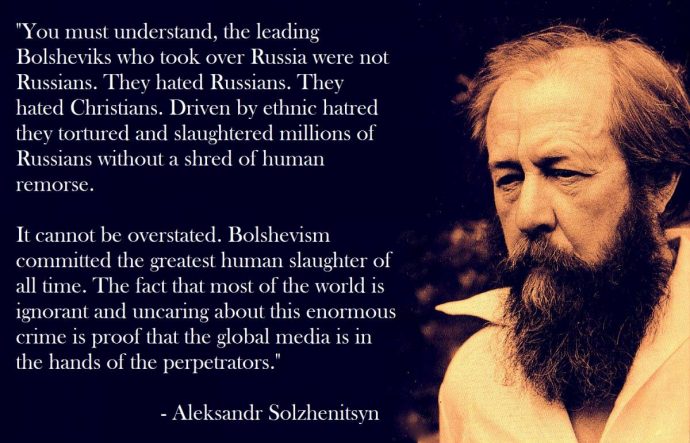
It is unlikely that this ‘quote’ is authentic, rather it reflect the opinion of the memer who created it, a view which has merit.
Russia Insider
This is an excerpt from a much longer article by Ron Unz originally entitled Oddities of the Jewish Religion, which we highly recommend.
We reproduce it here because there is so very little written about this important book, which debunks much of what was taught in the West in the 20th century about Russia.
Throughout most of my life, Nobel Laureate Alexander Solzhenitsyn was generally regarded as the greatest Russian literary figure of our modern era, and after reading all of his works, including The First Circle, Cancer Ward, and The Gulag Archipelago, I certainly concurred with this assertion, and eagerly absorbed Michael Scammel’s brilliant thousand page biography.
Although Russian himself, many of his closest friends were Jewish, but during the 1980s and 1990s, whispers of his supposed anti-Semitism began floating around, probably because he had sometimes hinted at the very prominent role of Jews in both financing and leading the Bolshevik Revolution, and afterward staffing the NKVD and administering the Gulag labor camps.
Late in his life, he wrote a massive two-volume history of the tangled relationship between Jews and Russians under the title Two Hundred Years Together, and although that work soon appeared in Russian, French, and German, nearly two decades later, no English translation has ever been authorized. His literary star seems also to have greatly waned in America since that time, and I only very rarely see his name mentioned these days in any of my regular newspapers.
Samizdat versions of major sections of his final work may easily be located on the Internet, and a few years ago Amazon temporarily sold a 750 page hard copy edition, which I ordered and lightly skimmed.
Everything seemed quite innocuous and factual, and nothing new jumped out at me, but perhaps the documentation of very heavy Jewish role in Communism was considered inappropriate for American audiences, as was the discussion of the extremely exploitative relationship between Jews and Slavic peasants in pre-revolutionary times, based on liquor-dealing and money-lending, which the Czars had often sought to mitigate.
When a ruling elite has limited connection to the population it controls, benevolent behavior is far less likely to occur, and those problems are magnified when that elite has a long tradition of ruthlessly extractive behavior. Enormous numbers of Russians suffered and died in the aftermath of the Bolshevik Revolution, and given the overwhelmingly Jewish composition of the top leadership during much of that period, it is hardly surprising that “anti-Semitism” was deemed a capital offense. Kevin MacDonald may have been the one who coined the term “hostile elite,” and discussed the unfortunate consequences when a country comes under such control.
After the collapse of the Soviet Union in 1991, reborn Russia soon fell under the overwhelming domination of a small group of Oligarchs, almost entirely of Jewish background, and a decade of total misery and impoverishment for the general Russian population soon followed. But once an actual Russian named Vladimir Putin regained control, these trends reversed and the lives of Russians have enormously improved since that time.
America’s media organs were overwhelmingly friendly toward Russia when it was under Jewish Oligarchic rule, while Putin has been demonized in the press more ferociously than any world leader since Hitler.
Indeed, our media pundits regularly identify Putin as “the new Hitler” and I actually think the analogy might be a reasonable one, but just not in the way they intend.
Trump’s Arms Proposal Is Really All About The Space Race
By Andrew Korybko | EurasiaFuture | 2019-04-26
There’s nothing that anyone can argue about in principle concerning the spirit behind Trump’s arms proposal, but peel back a few strategic layers and it becomes clear that it’s really all about the Space Race and weakening the Russian-Chinese Strategic Partnership.
Trump’s arms proposal is making waves all across the world after officials in his administration told the media that “he thinks that arms control should include Russia and China and should include all the weapons, all the warheads, all the missiles”, suggesting a comprehensive global military pact that could in theory change the course of International Relations in the 21st century. On the surface, there’s nothing that anyone can argue about in principle concerning the spirit behind this idea, but peel back a few strategic layers and it becomes clear that it’s really all about the Space Race and weakening the Russian-Chinese Strategic Partnership.
The US evidently believes that its much-touted “Space Force” gives it a noticeable edge over its competitors and will eventually neutralize Earth-based weapons platforms, something that Russia already suspects is the case after First Deputy Chief of the Russian General Staff’s Main Operations Department Lt. Gen.Viktor Poznikhir told the Moscow Conference on International Security (MCIS) earlier this week that “the US had developed a concept of pre-launch interception and planned to destroy intercontinental ballistic missiles of Russia, China and other countries while they are still in launchers”, strongly hinting at its strategic adversary’s impressive space-based military capabilities.
It’s likely for this reason why Deputy Foreign Minister Sergey Ryabkov cautiously welcomed this proposal but qualified his country’s support for it by saying that “further steps towards nuclear disarmament will require creating a number of prerequisites and taking into account many factors that have a direct impact on strategic stability – from the emergence of a missile defense system and the possibility of weapons deployment in space to fundamental changes in the sphere of conventional weapons, the emergence of cyber weapons and many other factors.” Evidently, Russia senses a trap, and not without good reason.
Trump knows that his proposal is misleading but will probably generate a lot of positive coverage in the global press, which not only boosts his re-election prospects next year but also improves the US’ international image to an extent. In addition, his strategists are aware that the proposal is more attractive to Russia than it is to China, which experts interviewed by CNN about this noted when they described the People’s Republic as not “even in the same ballpark” with those other two Great Powers and “not even playing the same game” when it comes to the weapons that Washington wants to limit.
Knowing that his proposal will probably flounder, Trump likely intends to use it for short-term soft power purposes and to exploit its likely failure as the long-term pretext for doubling down on the US’ military-industrial complex and specifically its missile defense and space-based component that will greatly offset the strategic stability that relatively stabilized International Relations up until this point. In the event that Russia plays along with the US for appearance’s sake in entering into some degree of negotiations about this topic while China predictably stays away, then Washington might seek to exploit this divergence between its two Great Power rivals in order to divide them further.
That, however, will probably only be as successful as Trump’s arms proposal (which is to say, that it’ll likely also fail) because President Putin just proudly proclaimed that Russia and China’s supercontinental integrational projects of the Eurasian Economic Union and the Belt & Road Initiative (BRI) will begin the process of merging into a multipolar megastructure during the speech that he gave at the ongoing BRI Forum in Beijing. Despite the occasional differences between these two strategic partners and their underwhelming real-sector economic cooperation so far, neither of them wants the US to get its way in dividing and ruling Eurasia at their expense.
Damascus should take control over northeast Syria: Russia FM
Press TV – April 18, 2019
Russia says the legitimate Syrian government should immediately take control over the country’s northeastern region, including the East Euphrates River, which is held by US-backed Kurdish militants.
“There is a need to resolve the issue concerning the country’s northeast and the left bank of the Euphrates River in order to achieve one of the priority tasks and ensure the restoration of the legitimate government’s control over the region,” Russian Foreign Minister Sergei Lavrov said at a press conference on Wednesday.
The top Russian diplomat underlined the need to build dialog with Kurdish groups and secure the interests of Turkey “as far as security in Syria’s border areas is concerned.”
Northeastern Syria is currently controlled by the so-called Syrian Democratic Forces (SDF), a US-backed anti-Damascus alliance of mainly Kurdish militants, which include the Kurdish People’s Protection Units (YPG).
Turkey considers the YPG a terrorist organization and an extension of the outlawed Kurdistan Workers’ Party (PKK), which has been fighting for an autonomous region inside Turkey since 1984.
The United States is a key advocate of autonomy for Syrian Kurds which Damascus has roundly rejected.
Many observers believe Washington plans to carve out a foothold in the region through supporting Syrian Kurds.
In February, a senior adviser to Syrian President Bashar al-Assad flatly rejected the idea of giving Syrian Kurds a measure of autonomy, saying such a move would open the door to the partition of the country.
The Kurdish-led authority that runs much of north and east Syria has presented a roadmap for a deal with Assad in recent meetings with Russia.
Also in February, President Assad called on SDF militants to return to the Syrian army, warning them against reliance on the United States.
“We say to those groups who are betting on the Americans, the Americans will not protect you. The Americans will put you in their pockets so you can be tools in the barter, and they have started with it,” he said.
Russia has been helping Syrian forces in their fight against foreign-backed Takfiri militants. The military assistance began in September 2015 at the official request of the Syrian government.
Foreign-backed militancy, supported by the United States and many of its Western and regional allies, erupted in Syria in 2011.
The militants and Takfiri terrorists overran large swathes of Syria’s territory.
The Daesh terrorist group, which once held large swaths of land in Syria, has now been completely defeated in the Arab country and has lost almost all of its occupied territories.
Syria has now reestablished its reign over nearly its entire expanse.
Russia expands ties in Lebanon’s oil and gas sector
Michal Kranz – Al Monitor – April 10, 2019
During a Middle East tour last month, US Secretary of State Mike Pompeo focused primarily on Iran’s influence in the region, but on Mar. 20 in Jerusalem he also labeled Russia an adversary of US regional allies in addition to Iran and China when speaking about energy and security in the eastern Mediterranean. “Revisionist powers like Iran and Russia and China are all trying to take major footholds in the East and in the West,” Pompeo said, alongside Israeli Prime Minister Benjamin Netanyahu and the leaders of Greece and Cyprus.
Pompeo had also reportedly planned to set “red lines” on Russian projects in Lebanon while in Beirut March 22-23. Yet, whatever plans Pompeo may have had to counter Russia in Lebanon, they seem to have had little effect. Lebanese leaders have doubled down on working with Russian companies in their country’s expanding oil and gas sector in the weeks since Pompeo’s visit.
Although the United States maintains an important degree of diplomatic clout in Lebanese energy matters, Russian economic investments in the sector have far outpaced those of the Americans, and Russian officials and business leaders have expressed their desire to take further steps to cement roles as key players like the United States continue to lag behind.
“The Russians have an advantage over the Americans not only in Lebanon, but in the region as well,” Amal Abou Zeid, adviser for Lebanese-Russian affairs at Lebanon’s Foreign Ministry, told Al-Monitor.
Lebanon and Russia signed a memorandum of understanding to cooperate on oil and gas in October 2013, and since then cooperation between them has deepened. In December 2017, the Lebanese government awarded its first contracts for offshore oil and gas exploration to a consortium of three firms that included Novatek, Russia’s second-largest gas company.
This past January, Russia’s majority state-owned oil giant Rosneft signed a deal to manage, operate and potentially rehabilitate and expand part of the oil storage terminal in Tripoli, Lebanon’s second largest city, as part of a 20-year lease. Rosneft is also competing in a bidding process along with other consortiums, including an American company, for an offshore gas terminal off the Lebanese coast.
Days after Pompeo’s visit, Lebanese President Michel Aoun traveled to Moscow, where he met with Russian President Vladimir Putin and Rosneft CEO Igor Sechin, who said the company is interested in “elevating the oil facilities in north Lebanon.” According to Abou Zeid, Sechin is interested in building up to three additional oil storage facilities in Tripoli and potentially investing in a future refinery in the north.
Cesar Abi Khalil, a parliamentarian who served as energy minister when Lebanon signed the Tripoli deal with Rosneft, told Al-Monitor that there is “high interest” in Lebanon to work with companies, including American ones, on refinery construction and rehabilitation. He added that ultimately, contracts will be awarded to companies that present the best proposals, as Rosneft did for the Tripoli terminal.
Russia’s interest in Lebanon is tied to its regional strategy. Since 2016, Rosneft has steadily expanded its operations into Iraq, Egypt and Libya, and Gazprom, Russia’s state-owned gas company, has been making inroads in Syria’s gas market during the civil war there. While Syria’s oil and gas reserves are dwarfed by those in neighboring Iraq, its location is highly strategic for Russia, which has been supporting Syrian President Bashar al-Assad in the civil conflict since 2015. Hundreds of Russian mercenaries have reportedly been killed securing oil fields in the country [actually that is a myth], and Russia has begun exploring for oil and gas off the Syrian coast.
Abou Zeid confirmed that the rehabilitation of a long-disused oil pipeline connecting Tripoli with oilfields in Iraqi Kurdistan, where Rosneft is active, was one of the topics discussed by Aoun and Sechin in Moscow. It is likely that gaining access to oil infrastructure in Lebanon in addition to offshore reserves in the country will enhance Russia’s strategic position in Syria and across the eastern Mediterranean, but it remains possible that it could also use the Tripoli facilities to try to bypass US sanctions on fuel shipments to Syria.
Meanwhile, American companies have been unable or unwilling to secure stakes in Lebanon’s new offshore prospects, which the US Department of Energy estimates will produce almost $254 billion between 2020 and 2039. Abou Zeid said that he had heard that ExxonMobil had entered into a consortium before the first bidding process for the offshore exploration contract began, but ultimately they and many other American companies failed to submit bids once they were eligible.
“I am certain that the Americans are interested, and they were not very happy with the Russian presence in this sector,” Abou Zeid said, speculating that political issues, like Hezbollah’s role in Lebanese politics, may have scared off potential American investors.
Mona Sukkarieh, a political risk consultant and co-founder of Middle East Strategic Perspectives, told Al-Monitor that other factors were more likely to be involved.
“Repeated delays resulting from frequent vacuums within the executive branch, an incomplete legal framework, changes in blocks offered and a change in market conditions all affected companies’ enthusiasm for the first licensing round,” she said.
Abi Khalil agreed that market forces were partially to blame for the lack of interest from the United States during the first round of bidding, but he also said that he had found ongoing interest by American firms in Lebanese oil and gas during his three official visits to the States, including in potential refinery projects across the country.
Despite these difficulties, the Novatek consortium followed through on its interest and secured rights to two blocks in Lebanon’s Exclusive Economic Zone (EEZ), one of which is in a disputed zone that Israel has claimed as part of its own EEZ since 2010. On April 4, Lebanese Energy Minister Nada Boustani announced the opening of a second round of bidding for contracts to five additional offshore blocks, two of which lie along the disputed border area. Lebanese leaders have long maintained that Israel is encroaching on Lebanon’s maritime boundary.
On April 1, parliament Speaker Nabih Berri said that Lebanon won’t give Israel “one cup” of its water. According Berri’s office, on March 22 the speaker and Pompeo discussed the issue of Lebanon’s southern maritime border and efforts to settle the dispute with Israel.
Abou Zeid claims that all the involved parties are interested in seeing the United States play a mediating role in the boundary issue. Regardless, US influence over matters related to energy in Lebanon are quickly diminishing given American companies’ absence in the country’s oil and gas sector and the lack of trust among Lebanese leaders, who believe Washington is biased toward Israel’s geopolitical positions.
“The US is really, one, not that interested, and two, the space that the US used to have in Lebanon in terms of influence and shaping decisions, it’s been lost,” Hanin Ghaddar, a researcher specializing in Lebanon and Iran at the Washington Institute for Near East Policy, told Al-Monitor. She added that in her view, it is unlikely that American firms will gain any offshore contracts.
So far, US efforts to counter Russian expansion in the eastern Mediterranean through diplomacy have proven inadequate. Unless American companies get serious about acquiring stakes in Lebanon’s offshore reserves, it will likely be almost impossible for the United States to overcome the head start Russia has gotten in Lebanon’s oil and gas sector, allowing Moscow to continue to strengthen its economic position across the Middle East.
Russia Profits as US Takes Venezuelan Oil off the Market in Europe
By Irina Slav – Oilprice.com – April 12, 2019
European refiners are switching to Russian sour grades as U.S. sanctions have shrunk Venezuela’s similar-grade exports, Reuters reports, adding that the Russian sour crude is getting increasingly expensive.
Citing sources from the trading industry, Reuters says the situation has been made worse by the fact that OPEC members have cut mainly their output of heavier, more sour grades under the OPEC+ agreement aimed at stimulating a price rise.
U.S. crude is not an alternative as it is overwhelmingly light and sweet, while refineries in Europe are equipped to process heavier grades as well as light ones to make refined products.
The news is the latest reminder that the world is tipping towards a shortage of heavy, sour crude, which is the staple kind of Venezuela crude and which many refineries need to produce fuels and other products.
“Urals is anchored in a positive zone versus dated Brent and there is no indication it will fall to a discount any time soon,” one of the Reuters’ sources said. That’s a complete reversal of the traditional differential between light and heavy oil, with the latter typically trading at a discount to Brent, a light blend.
Sanctions on Iran are further complicating life for European refiners as they have restricted exports of sour grades that Iran also produces in addition to its very popular superlight crude, also called condensate.
According to Reuters, U.S. sanctions have removed 800,000 bpd of heavy crude from the global market, leaving refiners scrambling for alternatives in a limited pool that, besides Russia and Middle Eastern producers, also includes Canada and Mexico as large producers of these grades of crude. The former is having its own problems with a pipeline capacity shortage and a production cut that has boosted prices, and the latter has yet to reverse a fall in oil production.
UK, Allies Want to Preserve Chemical Labs for New Provocations – Russian Embassy
Sputnik – 12.04.2019
LONDON – The United Kingdom and its allies strive to preserve their chemical laboratories to stage further provocations, a spokesperson of the Russian Embassy in London said on Thursday.
“Therefore, the problem is obviously not with Russia ‘loving Novichok so much’ (to use the words of Mr. Hunt), but with the UK and its allies willing to allow their laboratories, like the notorious Porton Down, to continue with chemical experiments and provocations”, the spokesperson said, as quoted by a press release published on the embassy’s website.
On Wednesday, UK Foreign Secretary Jeremy Hunt wrote in Twitter that Russia objected to a military-grade nerve agent Novichok being added to the list of banned chemical substances by the Organization for the Prohibition of Chemical Weapons (OPCW) and accused Moscow of using it in the poisoning incident in Salisbury last March.
The spokesperson also noted that Hunt highlighted just one side of the issue, as, in fact, during a session of the OPCW Executive Council in January, the United States, Canada and the Netherlands proposed to include only two groups of substances, named Novichok by Western countries, to the OPCW list. However, Russia opposed this initiative, as suggested that “all new generation toxic materials tested in many countries need to be added into those lists”.
On 4 March 2018, former Russian spy Sergei Skripal and his daughter Yulia were found unconscious on a bench near a shopping center in Salisbury. London claimed they were poisoned with a military-grade A234 nerve agent and accused Moscow of staging the attack, provoking a huge international scandal.
The Kremlin has repeatedly dismissed the claims about Russia’s involvement in the attack and stressed that Moscow has been denied access both to the investigation into the incident and to the Russian nationals.
Turkey Confirms Interest in Russian Su-35, Su-57 If US Denies It the F-35
By Andrei Martyanov | Reminiscence of the Future | April 10, 2019
It is really fascinating to observe the whole process but Turks seem to be in full reactive armor mode and refuse to yield to US pressure on the issue of F-35, which is, by default, the issue of S-400.
Turkey warned on Wednesday that it could buy jets and additional air defense systems from Russia if it cannot get Patriot missile shields and F-35 jets from Washington, raising the prospect of ever deeper defense ties between Moscow and a NATO member.
President Tayyip Erdogan’s existing plans to buy Russian S-400 missile defenses have already alarmed the United States, which says they are not compatible with NATO systems and would compromise the security of F-35 jets Turkey is due to receive.
Washington has offered Ankara both carrot and stick in response, proposing to sell it the Raytheon Co. Patriot systems instead of the S-400s, while at the same time warning of sanctions and a halt in the F-35 fighter jet sales if the Russian deal goes ahead.
Turkey has shown no sign of giving ground and Erdogan, who held talks with President Vladimir Putin in Moscow this week, was quoted on Wednesday as saying the July date for delivery of the first S-400s could even be brought forward.
Foreign Minister Mevlut Cavusoglu also reiterated Turkey’s stance that the S-400 purchase was a done deal and that it would meet its defense needs from elsewhere if necessary.
“If the United States is willing to sell, then we’ll buy Patriots. However, if the United States doesn’t want to sell, we may buy more S-400s or other systems,” Cavusoglu told Turkish broadcaster NTV.
“If the F-35s don’t work out, I will again have to procure the jets I need from elsewhere … There are (Russian) SU-34, SU-57 and others. I will absolutely meet my needs from somewhere until I can produce it myself,” he said.
My main question here is if Turkey knows that F-35 is a…. turkey? I am pretty sure Turks do. Of course, behind all this back-and-forth on S-400 are things much more substantial than even top-notch air defense for Turkey—namely massive economic developments in Eurasia.
It is also obvious that Turks are now in the bargain mode with Russia across the whole spectrum of issues — gas, nuclear power, military, tourism, agriculture, to name a few — and that could be indicative of a tectonic shift in Turkey’s geopolitical orientation but we cannot be sure 100% yet.
On F-35 issue, however, one should not discount the possibility of Turks getting off at the last opportunity from this program in order for a bigger, better thing. This thing are Su-35 of latest modifications and Su-57 which is hitting serial production in 2020 and China expressing interest in this aircraft while already operating full Russian versions of Su-35.
And so the drama is being played out in a front of our very own eyes (and ears). Turkey is getting S-400 (for warm-up), now what will Greece do? Who knows, but implications are enormous for Turkey, NATO and, of course, the United States.
The US knows that this could be bad, very bad but with Trump being surrounded with neocons and Israel having very serious issues with Turkey, who said that the White House will not continue with self-defeating policies in general, and towards Turkey in particular because of Israel— you may see it for yourself.
Most likely Trump and his “court” of Israeli-firsters, aided by US Congress fully corrupted and bought by Israeli lobby, will continue to self-destruct to make Israeli masters feel better, and situation with Turkey is one such example.
So, here is the news of today and for now, at least, it seems the contract will go ahead but, again, knowing that in this region words mean very little we just have to wait to see how it will play out to the very end. Fascinating!
US decision on Golan Heights violates UN Security Council resolutions – Putin
RT | April 8, 2019
The US’ decision to recognize Tel Aviv’s sovereignty over the Israeli-occupied Syrian Golan Heights region violates UN Security Council resolutions – a position that Moscow has already made clear, Russia’s president said.
Following a meeting between Vladimir Putin and his Turkish counterpart Recep Tayyip Erdogan in Moscow on Monday, the Russian leader was asked by reporters about Moscow’s stance on the US move.
“Regarding recognition of the Golan Heights as a part of Israel, you already know Russian stance. It’s been presented in a statement by Russia’s Foreign Ministry. The [US] move violates respective UN Security Council resolutions,” Putin stated.
Syria’s Golan Heights region has been occupied by Israel since 1967 and later Tel Aviv unilaterally proclaimed sovereignty over it. US President Donald Trump announced the decision to recognize Tel Aviv’s sovereignty over it in late March, gaining praise of Israel – and sparking world-wide outrage. Trump’s move has received no support outside of Israel, getting rejected even by the closest allies of the US.
Putin Open to Provocation-Free Dialogue With Ukraine’s Zelenskiy – Kremlin
Sputnik – 08.04.2019
MOSCOW – Russian President Vladimir Putin is ready to discuss any pressing issues with the Ukrainian presidential hopeful, Volodymyr Zelenskiy, if such a dialogue is free of provocations, Kremlin Spokesman Dmitry Peskov said Monday.
“In general, Putin is always open for dialogue, except for the situations when [Kiev] is trying to couple this dialogue with various provocations, sabotage and so on. In such cases, Putin’s reaction is very clear, unequivocal and decisive,” Peskov said.
Ukrainian frontrunner Zelenskiy said Sunday he was ready for talks with Putin on the Donbass conflict in the presence of Western powers.
Ukrainian presidential hopeful Zelensky has won first election round with 30.24 percent of votes, final results of the ballot count revealed, while Poroshenko has gained 15.95 percent of votes.
The US’ Plans To Designate The IRGC As “Terrorists” Aren’t Just For Show
EurasiaFuture | April 8, 2019
From Farce To Tragedy
Alt-Media is making a mockery out of the US’ reported plans to designate the IRGC as “terrorists”, giddily quoting the Iranians who spun this rhetoric around and announced that they’ll reciprocate by doing the same to the US military if that happens. The “chattering class” is having a field day using this opportunity to highlight the many abuses that America has committed across the Mideast and the world in general over the decades, seemingly not caring one bit for the possible consequences that could transpire if the US actually goes through with the unprecedented move of designating part of a foreign military as “terrorists”. That’s a mistake because the US’ plans need to be taken much more seriously than they are since they’ll likely herald a new escalation of the Hybrid War on Iran through the possible commencement of direct strikes against the IRGC and its Hezbollah allies in Syria.
“Sitting Ducks”
Like I wrote back in April 2017 after the US’ first conventional strike against Syria, “Trump’s Cruise Missile Message To Iran” was that his country won’t hesitate to hit it and its non-state allies there next, though provided that America was prepared for the inevitable backlash that this would undoubtedly unleash. In hindsight, the US preferred to “play it safe” and not “up the stakes” to the point of potentially triggering a larger Mideast war, but nowadays it appears as though Bolton has convinced Trump that now is the perfect time for striking Iranian positions in Syria due to the Islamic Republic’s refusal to agree to the dignified but “phased withdrawal” that Russia has been pressing them to commence for most of the past year as part of its broader “balancing” strategy. In addition, sanctions have finally begun to bite and a sudden increase in the physical and financial costs of Iran’s Syrian deployment might be all that’s needed to get it to begin the “phased withdrawal” process.
The US insists on maintaining a troop presence in Syria despite Trump’s promised “withdrawal” last year precisely because of its desire to “contain” Iran, so it’s not inconceivable that it will seek to intensify the pressure that it puts on its rival to the point of striking the IRGC and its Hezbollah ally if Washington “officially” regards them both as being “terrorists”. Iran has no air defense assets in the country and Russia is extremely unlikely to allow its Syrian partners to have full and independent control of the much-touted S-300 in order to avoid the scenario of Damascus escalating the situation by shooting at American warplanes and possibly dealing Moscow enormous embarrassment if Washington manages to destroy its surface-to-air missile systems in response. Simply put, Iranian forces are practically “sitting ducks” if the US decides to strike them.
A Likely Ultimatum In Latakia
It should be taken for granted that Iran has many asymmetrical means through which it could likely respond, whether in Syria, Lebanon, the Gulf, or even in “Israel”, but one also shouldn’t over-exaggerate its capabilities either since Tehran has yet to unleash the devastating consequences that it regularly promises every time “Israel” hits its forces in Syria. One can only speculate whether this is a prudent move to patiently wait until the “right moment” or if everything was nothing more than one big bluff to begin with, but whatever the case, the US evidently thinks that it can manage whatever response Iran might have to the potential bombing of the IRGC and Hezbollah by American forces in the event that the former is designated as “terrorists” and Trump wants a dramatic headline-grabbing news event to follow this development.
In fact, the US might even issue an ultimatum to Iran to withdraw from Syria or be militarily driven out after reports recently emerged that the country is about to clinch a deal for operating the Mediterranean port of Latakia just a few hundred kilometers from “Israel“, something that’s sure to set off alarm bells in both Washington and Tel Aviv because of speculation that this economic agreement might have military implications. The reason why an ultimatum might be issued in this case instead of just “bombing first and making demands later” (as is the usual US modus operandi) is because of how close Russia’s Hmeimim airbase is to the port, meaning that any possible strike against Iran’s assets there would be extremely complicated to pull off without coordinating with Russia otherwise another September-like midair tragedy might transpire.
Russia: An Ally To Whom?
“Israel” certainly doesn’t want to repeat the events of that fateful day, nor would the US be willing to risk the outbreak of World War III if a few missiles carelessly veered off course and either hit the Russian base or its assets, so it should be assumed that those two are already in secret talks with Moscow (likely facilitated by Netanyahu’s “shuttle diplomacy” between their two capitals) in order to agree upon a “solution” to this scenario. Syria and Iran should have anticipated that something of the sort was in the works because of Russia’s lengthy track record “passively facilitating” “Israeli” strikes against the IRGC and Hezbollah, so both of them probably predicted that their port deal might force Moscow to stop “balancing” and finally pick a side once and for all.
The “surprise”, however, is that Russia is completely disinclined to pick Iran over “Israel” because it derives enormous strategic benefit in Syria by removing its “friendly competitor” and strengthening its increasingly monopolistic control over the country in the economic, political, and military domains. Furthermore, Iran’s relative weakening is advantageous for Russia because it makes the Islamic Republic more desperate to agree to whatever “sanctions relief” deals Moscow might offer it irrespective of the possibly unfavorable conditions. “Israel”, meanwhile, is poised to become Russia’s top military-strategic partner in the Mideast, and Moscow believes that the comprehensive benefits of this relationship far surpass whatever Iran could provide for it. As such, it can be expected that Russia will silently work to avert the scenario of direct US strikes on the IRGC and especially the Latakia port by more actively encouraging Iran’s dignified but “phased withdrawal” from Syria.
Concluding Thoughts
The US’ very probable designation of the IRGC as a “terrorist” group in the near future would open up the Hybrid War floodgates by providing the “justification” that the Pentagon needs to commence strikes against its rival’s special forces or at least issue the threat thereof as part of a series of forthcoming escalations designed to trigger Iran’s dignified but “phased withdrawal” from Syria. The IRGC has reportedly suffered many casualties already because of Russia’s “passive facilitation” of “Israeli” strikes against it over the years but has yet to make either of them pay, so the likelihood of Iran doing anything real dramatic in response to the US possibly striking its special forces too is low.
In any case, Russia — as the undisputed hegemonic power in Syria — would prefer for the US and “Israel’s” issues with Iran’s military presence in the Arab Republic to be settled as peacefully as possible without posing a danger to its Aerospace Forces, fearful as it is of a repeat of last September’s tragedy in the event that either of those two bomb the Latakia port facilities near its Hmeimim airbase that Iran is on the brink of possessing. Therefore, the US’ reportedly impending designation of the IRGC as “terrorists” will probably cause Russia to cooperate more closely with it behind the scenes (possibly via “Israeli” mediation) to ensure Iran’s dignified but “phased withdrawal” from Syria.
US Ambassador to NATO: We Will Guarantee Passage of Ukrainian Warships Through Crimea Waters
If you want a war with Russia, that’s how you start one
By Marko Marjanović | Check Point Asia | April 4, 2019
The not-very-smart lady who last October put Russians “on notice” that US was looking at “taking out” Russian intermediate-range missiles in a pre-emptive strike, is at it again. This time she is promising NATO will guarantee Ukrainian Navy ships can pass through the Kerch Strait between mainland Russia and Crimea, which since 2014 Russia considers along with Crimea its own territory.
It is as much as saying NATO will guarantee Ukrainian army can return to Crimea. There isn’t any doubt either than Hutchinson is talking about Ukrainian warships (Russians do not interfere with the passage of merchant ships) seeing she says this is specifically in response to the November crisis where Russians prevented Ukrainian Navy vessels from making the passage:
“I think that we have been working on a package to present to the foreign ministers, and it is a package that beefs up the surveillance, both air surveillance as well as more of the NATO country ships going into the Black Sea to assure that there is safe passage from Ukrainian vessels through the Kerch Straits, the Sea of Azov,” she said.
The US representative commented that at present “more attention is needed to guarantee that these waters are liberated” and that the countries in the region are “free from Russian interference”.
“Russia has been deploying defensive weapons in Crimea, but Crimea is part of Ukraine,” Hutchison remarked.
“It is very important that the inhabitants of Romania, Bulgaria, Ukraine and Georgia feel at home in the Black Sea zone, both in the water and on land,” she said, adding that the package of measures is a response to November’s Kerch Strait incident.
“It is unacceptable that Ukrainian sailors are being held in prison in Moscow. We must ensure that we have the ability to restrain Russia’s aggression,” she remarked.
The truth is that NATO can guarantee no such thing, if the Kiev government organizes another attempt to force the entry without filing a request with the Russians, the Russians will fire once again. But it is reckless to talk as if NATO intends to organize or back such an attempt.
The Russian reaction was sheer disbelief somebody could be so saying something so stupid and inflammatory:
“In a negative light,” he [Putin’s spokesman Peskov] said when asked how Kremlin viewed such statements. “We do not understand what that means.”
It is worrying that Americans have some many people in important positions who do not comprehend the consequences of what they are proposing.
VIPS Urge Trump to Avoid War in Venezuela
Consortium News | April 4, 2019
VIPS warn that Trump’s policies regarding Venezuela appear to be on a slippery slope that could take us toward war in Venezuela and military confrontation with Russia.
MEMORANDUM FOR: The President
FROM: Veteran Intelligence Professionals for Sanity (VIPS)
SUBJECT: Avoiding War with Russia over Venezuela
Mr. President:
Your Administration’s policies regarding Venezuela appear to be on a slippery slope that could take us toward war in Venezuela and military confrontation with Russia. As former intelligence officers and other national security practitioners with many decades of experience, we urge you not to let yourself be egged on into taking potentially catastrophic military action in response to civil unrest in Venezuela or Russian activities in the Western Hemisphere. With the recent arrival of two transport aircraft and enduring political support for the government of Venezuela, the Russians are far from crossing any “red line” emanating from the 1823 Monroe Doctrine.
Unfulfilled Objectives in Venezuela
Inside Venezuela, U.S. actions have failed to do more than plunge the country into deeper crisis, cause greater human suffering, and increase the prospects of violence on a national scale. President Maduro’s mishandling of the economy and authoritarian reactions to provocations are impossible to defend, but they result in part from the fact that he has been under siege since he was first elected in 2013 and has faced sanctions aimed ultimately at removing him from office. In our view, the advice you’ve received from your top advisors – Florida Senator Marco Rubio, National Security Advisor John Bolton, Special Representative Elliott Abrams, and Secretary of State Michael Pompeo – was and apparently continues to be wrong.
- Recognition of Venezuelan National Assembly President Juan Guaidó as “interim president” did not prompt the military to rise up against President Maduro. Neither did attacking the officer corps as merely corrupt opportunists and drug-traffickers enriched through loyalty to former President Chávez and Maduro, nor did repeatedly threatening them with harsher sanctions. Those actions reflected a fundamental misunderstanding about the Venezuelan military, which has never been free of corruption and political compromise but has also never been so totally isolated from the Venezuelan people that it hasn’t felt their suffering. U.S. policies incorrectly assumed that the officers – while probably fed up with Maduro’s shortcomings – would support Guaidó despite his faction’s commitment to dismantle Chavismo, which most officers believe brought historically necessary changes to the country, including enfranchisement of the poor.
Similarly, your Administration’s repeated hints at military intervention have been counterproductive to your regime-change objectives. Your policy and intelligence advisors were correct in interpreting the disparate polling data showing popular support for Guaidó as actually being support for the U.S. to extricate the country from its crisis – the National Assembly President was a political unknown until the United States and others recognized his claim to the Presidency – but your team showed a lack of understanding of Venezuelan nationalism. Venezuelans do not welcome the destruction that would be caused by U.S. military attack; they recall the death toll of Operation Just Cause, when the United States killed more than 3,000 Panamanians (by its own count) to remove one corrupt authoritarian, Manuel Noriega. Threats of invasion have pushed people to circle around Maduro, however reluctantly, not reject him.
- Your Administration’s strategy of punishing the Venezuelan people, including apparently knocking out their electricity, seems based on the false assumption that humanitarian crisis will prompt a coup to remove Maduro. In fact, the U.S. sanctions have allowed Maduro to shift blame from his own failings to U.S. malice – and it has left Guaidó, whom your advisors portray as the moral equivalent of our Founders, looking like a sell-out to Yankee imperialists at the cost of the Venezuelan people’s health and welfare and magnified civil disorder.
Lost Opportunity for Diplomacy
Senator Rubio, Mr. Bolton, Mr. Abrams, and Mr. Pompeo have also squandered a formidable moment to build on common values with allies in Latin America and Europe. Even though most Latin Americans find your aides’ public assertion that the Monroe Doctrine is alive and well to be insulting, the right-leaning Presidents of most of South and Central America rallied with you to support Guaidó’s self-proclamation. But Guaidó’s lack of leadership – he appears totally scripted by U.S. Government agencies – his inflexibility on negotiations, his open call for U.S. military intervention, and your own Administration’s dangling threat of war are rapidly alienating all but the most subservient to U.S. policy dictates. Negotiation proposals, such as those being developed by the International Contact Group, are gaining momentum.
Internationalizing the Conflict
National Security Advisor Bolton and others have sought to internationalize the Venezuela issue since before Guaidó’s proclamation. Bolton’s reference to a “Troika of Tyranny” in November – which he called “a triangle of terror stretching from Havana to Caracas to Managua” and “sordid cradle of communism in the Western Hemisphere” – was a veiled Cold War-era swipe at Russia and China. Mr. Bolton, Senator Rubio, and other advisors have made clear on numerous occasions that the overthrow of President Maduro would be just the first stage in efforts to eliminate the current governments of the “Troika” and “Communist influence” in the Western Hemisphere.
- They have repeatedly asserted that Cuban advisors have been crucial to the Maduro government’s survival without providing evidence. Indeed, the reportedly “hundreds” of Venezuelan military defectors, including many managed by U.S. agencies, have not provided even credible hearsay evidence that Cubans are doing more than providing routine assistance. In addition, the threats coming out of Washington have preempted any willingness that Cuba might have had to contribute to a regional solution to the Venezuelan crisis as it has in similar situations, such as Colombia’s recent peace process, the Angola peace process in 1989-90, and the Central American negotiations in the early 1990s.
Provocative Rhetoric about Russia
Most dangerous, however, are aggressive statements about Russia’s engagement with Venezuela. Russian oil companies, particular Rosneft, have long been in Venezuela – bailing out the Venezuelan petroleum company (PDVSA) as its mismanagement and falling oil prices have caused production and revenues to plummet. Most long-term observers believe Rosneft’s decisions, including throwing good money after bad, have been motivated by business calculations, without a particularly ideological objective.
- Your advisors’ rhetoric imposing an East-West spin on the issue presented President Putin and his advisors an opportunity to try to poke the United States in the eye – especially as Administration efforts to remove Maduro foundered and diplomatic support for Guaidó cracked. Maduro and Putin have not enjoyed particularly close personal relations in the past, and their shared strategic interests are few, but U.S. rhetoric and threats have given them common cause in tweaking us. A meeting in Rome between your special envoy, Elliot Abrams, and Russian Deputy Foreign Minister Sergei Ryabkov achieved nothing amid further U.S. sanctions against Venezuela and continued threats that “all options” were on the table.
Publicly available information is insufficient for us to know exactly what was aboard the two Russian aircraft that landed at Maiquetía last week – two months after your Administration publicly proclaimed its intention to remove Maduro – but precedent suggests Moscow had two main objectives.
- One, and probably primary, is to embarrass your Administration by defying your rhetoric, just to rub your nose in Moscow’s sovereign right to have the relations, including military liaison, with whomever it pleases. In this sense, Russian behavior resembles its intervention, at Bashar al-Assad’s request, in Syria. And it is not a far cry from Moscow’s reaction to the Western-supported coup in Kiev.
- Another objective, if press speculation about the Russian advisors and equipment aboard the aircraft is correct, would be to shore up Venezuela’s ability to warn of and respond to a U.S. military strike. Your Administration has publicly asserted that the Russians are helping repair S-300 surface-to-air missile systems, which have a purely defensive purpose. There is no evidence, not even circumstantial, that Russia has any offensive objectives in this relationship.
The U.S. reaction has suggested a much greater chance of military confrontation. Mr. Bolton “strongly caution[ed] actors external to the Western Hemisphere against deploying military assets to Venezuela, or elsewhere in the Hemisphere, with the intent of establishing or expanding military operations.” Without defining what activities he would object to, Mr. Bolton said, “We will consider such provocative actions as a direct threat to international peace and security in the region.” Your Special Representative said the “Russian presence” is “extremely pernicious.” Your Secretary of State said, “Russia’s got to leave Venezuela.” You said, “Russia has to get out” and reiterated that “all options are open” – including presumably forcing the Russians out militarily. And we note that Russia has not closed its embassy in Caracas as your Administration has.
Avoiding the Slippery Slope
As intelligence officers and security experts, we have given many years to protecting our nation from a host of threats, including from the Soviet Union. We also believe, however, that picking fights. including ousting governments, blocking negotiated settlements, and threatening other countries’ sovereign decision to pursue activities that do not threaten our national security – is rarely the wise way to go.
We repeat that we are not defending Maduro and his record, while at the same time pointing out that many of his troubles have been exacerbated by U.S. policies and efforts to oust him. We believe that due process and practical, realistic policies better protect our national interests than threats and confrontational rhetoric. It strains credulity to believe that your advisors picked this fight with President Maduro without realizing that Venezuela would seek help fixing its defensive capabilities.
Moreover and very seriously, rhetoric challenging Russia could all too easily lead to a much more consequential confrontation.
- Invoking the 1823 Monroe Doctrine is unhelpful. For Russia to provide assistance for purely defensive purposes to a country in which we seek to create regime change and threaten military attack would not be widely seen as violating the Monroe Doctrine or crossing a “red line.”
- We realize that some in the media are trying to egg you on into taking forceful action, perhaps even of a military nature, to punish Russia in any case. We urge you not to fall into this trap. This is not 19th century Latin America, and it is a far cry from the Cuba missile crisis of 1962.
- The best way to prevent dangerous miscalculation would be for you to speak directly with President Putin. Washington’s energies would be better spent clearing up differences, adjusting failed policies, and promoting a peaceful resolution in Venezuela.
For the Steering Group, Veteran Intelligence Professionals for Sanity
Fulton Armstrong, former National Intelligence Officer for Latin America & former National Security Council Director for Inter-American Affairs (ret.)
William Binney, former Technical Director, World Geopolitical & Military Analysis, NSA; co-founder, SIGINT Automation Research Center (ret.)
Marshall Carter-Tripp, Foreign Service Officer & former Division Director in the State Department Bureau of Intelligence and Research (ret.)
Bogdan Dzakovic, Former Team Leader of Federal Air Marshals and Red Team, FAA Security, (ret.) (associate VIPS)
Philip Giraldi, CIA, Operations Officer (ret.)
Mike Gravel,,former Adjutant, top secret control officer, Communications Intelligence Service; special agent of the Counter Intelligence Corps and former United States Senator
Larry Johnson, former CIA Intelligence Officer & former State Department Counter-Terrorism Official, (ret.)
John Kiriakou, former CIA Counterterrorism Officer and former Senior Investigator, Senate Foreign Relations Committee
Clement J. Laniewski, LTC, U.S. Army (ret.)
Linda Lewis, WMD preparedness policy analyst, USDA (ret.)
Edward Loomis, NSA Cryptologic Computer Scientist (ret.)
David MacMichael, former Senior Estimates Officer, National Intelligence Council (ret.)
Ray McGovern, former US Army infantry/intelligence officer & CIA presidential briefer (ret.)
Elizabeth Murray, former Deputy National Intelligence Officer for the Near East & CIA political analyst (ret.)
Todd E. Pierce, MAJ, US Army Judge Advocate (ret.)
Coleen Rowley, FBI Special Agent and former Minneapolis Division Legal Counsel (ret.)
Peter Van Buren,U.S. Department of State, Foreign Service Officer (ret.) (associate VIPS)
Sarah Wilton, Commander, U.S. Naval Reserve (ret.) and Defense Intelligence Agency (ret.)
Ann Wright, U.S. Army Reserve Colonel (ret) and former U.S. Diplomat who resigned in 2003 in opposition to the Iraq War
Veteran Intelligence Professionals for Sanity (VIPS) is made up of former intelligence officers, diplomats, military officers and congressional staffers. The organization, founded in 2002, was among the first critics of Washington’s justifications for launching a war against Iraq. VIPS advocates a US foreign and national security policy based on genuine national interests rather than contrived threats promoted for largely political reasons. An archive of VIPS memoranda is available at Consortiumnews.com.
Featured Video

Dan Dicks with James Corbett on Solutions Watch
or go to
Aletho News Archives – Video-Images
From the Archives
MMR (Measles, Mumps and Rubella) – Vaccine Risk Statement
MMR Vaccine (Measles, Mumps, and Rubella) Is It Safer Than Measles, Mumps and Rubella?
Physicians for Informed Consent | December 2024
… It has not been proven that the MMR vaccine is safer than measles, mumps, and rubella. The vaccine package insert raises questions about safety testing for cancer, genetic mutations, and impaired fertility. Although VAERS tracks some adverse events, it is too inaccurate to measure against the risk of measles, mumps, and rubella. Clinical trials do not have the ability to detect less common adverse reactions, and epidemiological studies are limited by the effects of chance and possible confounders. Safety studies of the MMR vaccine are particularly lacking in statistical power. A review of more than 60 MMR vaccine studies conducted for the Cochrane Library states, “The design and reporting of safety outcomes in MMR vaccine studies, both pre- and post-marketing, are largely inadequate.”19 Because permanent sequelae (aftereffects) from measles, mumps, and rubella are so rare (especially in children with normal levels of vitamin A and infected after birth),6,15-17 the level of accuracy of the research studies available is insufficient to rule out the possibility that the MMR vaccine causes greater death or permanent disability than measles, mumps, and rubella. – Read full article
Blog Roll
 Aletho News
- Iraqi resistance group rejects disarmament, vows to maintain support for Lebanon
- Sheikh al-Asadi warns of Iraqi government compliance with US demands
- How to MAKE THE CONSPIRATORS PAY for their crimes! Dan Dicks with James Corbett on Solutions Watch
- There’s a drought in academia: A drought in honest research on the subject of drought and other weather extremes
- Department of War Awards $20.7 Billion Contract to Raytheon for Air-to-Air Missiles
- ‘Distance yourselves from Israel’: IRGC urges US population to question govt policies
- America’s Greenland deal has a radioactive backstory
- The RAF Fairford ‘terror plot’: Unpacking escalation in the UK echo-chamber
- EU Council Advances Chat Control 2.0 Scanning Proposal
- Ex-Greek MEP files complaint against Israeli spyware firm over alleged Pegasus surveillance
- If Americans Knew
- An error has occurred; the feed is probably down. Try again later.
- No Tricks Zone
- Two More Paleo Reconstructions Affirm Meters-Higher Sea Levels Across Ireland, Brazil 7000-6000 Years Ago
- New Study: Earth And Venus Surface Warmth Largely Explained By Convection And Lapse Rate, Not CO2 Or Radiation
- 2025 Nature Paper Claiming Worsening Global Drought Gets RETRACTED …Heavily Flawed
- New Study: ‘Global Drought Shows No Detectable Recent Acceleration Under Climate Warming’
- Economic Masterminds: German Socialists Suggest Taxing Productivity Gains Stemming From Using AI
- The South China Sea Has Not Been Cooperating With The Climate Change Narrative
- Energy Crisis: Germany Enters Heating Season With Historically Low Gas Reserve Fill Levels
- New Study: The Antarctic Ice Sheet Gained Mass From 2020-2024 Due To Staggering Snow And Ice Accumulation
- Study: Ocean Heating Rates From Thousands Of Years Ago ‘Dwarf’ Modern Ocean Heating Rates
- Climate Extremists Target, Attack Large-Scale Power Grid Infrastructure In Germany!

