‘Unhinged Russophobia’: Moscow slams new barrage of US & Canada sanctions over Kerch standoff
RT | March 16, 2019
The Russian Foreign Ministry has vowed retaliation to the new portion of economic sanctions rolled out by Washington and Ottawa over the November showdown near Crimean shores.
The ministry has called “groundless” the allegations by the US and Canadian governments that Russia was the aggressor in the November 25 incident in the Black Sea, when three Ukrainian warships sailed into Russian territorial waters.
Moscow said that the Ukrainian vessels had not obtained proper permits to cross the strait and ignored repeated warnings by the Russian coast guard to stop when they entered the Russian waters near Crimea. Three Ukrainian sailors were injured in the standoff, and a total of 24 Ukrainian personnel were detained and put on trial in Russia for violating Russian state borders.
The ships were later found to be armed and were reportedly intended on crossing the waterway that separates mainland Russia from Crimea in a “stealthy” manner.
On Friday, Washington imposed sanctions on six businessmen and politicians and eight enterprises, while Ottawa slapped economic restrictions on 114 individuals and 15 entities. The ministry specifically took aim at Canada for racing to keep up with the US’ Russia-bashing.
“It seems that from a normal logic standpoint, it would be more important for [Canadian Prime Minister Justin] Trudeau’s team to concentrate on resolving rather complex problems at home, than play its ‘Russophobia card’ in vain.”
Both US and Canada continue to follow a “perilous course” aimed at a “total destruction” of relations with Russia, already at rock bottom due to “unhinged Russophobia that has engulfed Washington and Ottawa,” the ministry said.
Moscow has vowed to mount a “practical response” to the new sanctions.
Shipyards based in St. Petersburg and Crimea and Russian officials that were responding to the incident in the Kerch Strait were among those included in Washington’s black list. Canada also targeted prominent Russian politicians and business executives, such as the head of the Russian oil giant Rosneft, Igor Sechin, and the head of the National Guard, Victor Zolotov.
Oleg Deripaska, Russian aluminum tycoon, sanctioned by the US last year, is meanwhile taking the US government to court arguing that the restrictions were based “on false rumor and innuendo” and violated the US constitution.
Deripaska was forced to lower his stake in the aluminum giant Rusal to spare it from sanctions, but sanctions targeting him personally remain in place.
Spectre of Afghan quagmire haunts US
By M. K. BHADRAKUMAR | Indian Punchline | March 15, 2019
The Afghan national security advisor Hamdullah Mohib, while on a visit to Washington, tore into the US’ peace talks with Taliban in remarks to the American media on Thursday. Mohib alleged that US special representative Zalmay Khalilzad is keeping the Afghan govt in Kabul in the dark about the negotiations with the Taliban and that he’s plotting to replace President Ashraf Ghani.
Mohib alleged that Pakistan is dictating the trajectory of the US-Taliban negotiations and warned that there can be no peace until Islamabad ended its support for ‘non-state actors’.
The charges are indeed very serious and it is unlikely that Mohib spoke without Ghani’s approval. Mohib is Ghani’s hand-picked security aide, the fountainhead of Afghan intelligence and is wired into the Washington Beltway, where he previously served as ambassador. The US state department called in Mohib and apparently gave him a dressing down.
That there is friction between Khalilzad and Ghani has been known for sometime. Basically, there is much resistance among the Afghan elite to the US strategy to take Pakistan’s help to engage Taliban in direct negotiations and chalk out a settlement that mainstreams the insurgents.
Things have lately reached a point of no return, now that the crucial next phase of negotiations at Doha is due where the agenda includes intra-Afghan dialogue and ceasefire leading to an interim power-sharing arrangement in Kabul replacing the Ghani government.
Meanwhile, there are interest groups within the Afghan elite who either fear retrenchment or simply do not accept reconciliation with the Taliban. There is indeed widespread resentment among Afghans toward Pakistan’s blatant projection of power into their country through decades. In sum, a coalescing of anti-Taliban, anti-Pakistan sentiments is taking place.
Ghani himself has never hidden his antipathy toward Islamabad for its interference in Afghan affairs and of late has been reaching out to these anti-Taliban, anti-Pakistan groups within the Afghan elite. He feels annoyed that Washington is not insisting on the Taliban holding talks with the Afghan govt, but has instead harmonised with the Pakistani-Russian idea of an ‘intra-Afghan dialogue’ where the Afghan govt can only be a participant like myriad other Afghan groups — and not as the Taliban’s principal interlocutor.
Having said that, Ghani would also know that Khalilzad who enjoys the backing of the US foreign and security establishment, is by no means a pushover. In principle, the US can withdraw support from Ghani and make a horrible example of him but in the current fluidity, that will open a Pandora’s box and may trigger events over which Washington will have no control. With such a big US and NATO military deployment in Afghanistan, it is out of the question that the Trump administration would make any precipitate moves which might create a power vacuum in Kabul.
On the other hand, President Trump wants the troop withdrawal to begin, which was also his campaign pledge in the 2016 election. Fundamentally, the Americans may have underestimated the strong undercurrents of Afghan nationalism. Ghani suspects that the Pakistani game plan is to ultimately create conditions for an outright Taliban takeover in Kabul. There have been ample signals that he is digging in.
Suffice to say, the spectre of an Afghan quagmire is haunting the Americans. An orderly American / NATO withdrawal is possible only on the basis of a settlement with the Taliban. But Ghani and his camp insist on an ‘Afghan-led’ , ‘Afghan-controlled’ peace process — that is, direct talks between the government and the Taliban. The US’ capacity to leverage Ghani is steadily diminishing.
There are hardline militia factions who stoutly oppose any power-sharing arrangement with the Taliban and are horrified at the prospect of Pakistani hegemony over Afghanistan. They may opt for a trial of strength through force. In the circumstances, there is always the danger of a coup and usurpation of power, which of course no one wants to talk about.
The role of regional powers will be crucial in the coming period. Pakistan and Russia have a special role to play here. Both countries harbour an adversarial mindset vis-a-vis Ghani. Clearly, Pakistan and Russia are increasingly moving in tandem to create conditions for a transition in Kabul that maximises their influence. Russia has pockets of influence among the anti-Pakistani Afghan factions — for instance, former president Hamid Karzai or former NSC Hanif Atmar and erstwhile Northern Alliance leaders and so on — which can work favourably for the advancement of Pakistani interests.
Equally, Russia hopes to gain out of its links to the Taliban, which Pakistan has helped to promote, in a future regime in Kabul. Of course, both Russia and Pakistan have troubled relations with the US and will be beneficiaries of any diminution of American prestige and influence in the region. It will be an understatement to say that in the New Cold War conditions, Moscow wouldn’t mind if the US and NATO are forced to exit from the Hindu Kush in disgrace and defeat.
Lavrov: US Sanction Against Russian Company Violates Int’l Law
teleSUR | March 12, 2019
U.S. Secretary of State Mike Pompeo is criminalizing Russian companies for doing business with the Venezuelan state, saying they are violating U.S. imposed sanctions by making transactions with Venezuela’s sanctioned oil company Petroleos de Venezuela (PDVSA).
In a Monday press conference Pompeo said that the assets of Evrofinance Mosnarbank, a Russia-Venezuela states-owned financial organization would be frozen and U.S. citizens would be prohibited from doing business with the joint venture, according to Reuters.
The U.S. State Department said in a statement that Evrofinance was violating a Trump decree because it is a “foreign financial institution that materially assisted, sponsored, or provided financial, material, or technological support for, or goods or services to or in support of (PDVSA).”
Pompeo also accused the major Russian oil company, Rosneft, of defying U.S. sanctions by buying oil from PDVSA.
According to Sputnik News, Russian Foreign Minister Sergey Lavrov said Pompeo’s “accusations … contradict international law.”
Lavrov said Pompeo’s “accusations that Russian oil company Rosneft bought Venezuelan oil in violation of Washington sanctions contradicts international law.”
Talking to reporters the secretary of state included not only accused Russia but Cuba of trying to undermine democracy in Venezuela.
“This story is not complete without acknowledging the central role Cuba and Russia have played and continue to play in undermining the democratic dreams of the Venezuelan people and their welfare,” Pompeo said.
“Moscow, like Havana, continues to provide political cover to the Maduro regime,” added the U.S. official.
Meanwhile, Trump’s right hand in Venezuela, Elliot Abrams, says he is persuading and urging India to stop buying oil from Venezuela, from who it purchases approximately 366,000 oil barrels per day.
The current U.S. government began a soft coup against Maduro shortly after entering office by placing a slew of sanctions against the Venezuelan government and individuals.
As the list grew and intensified, the U.S. administration sent in Guaido in late January to take over the democratically elected Venezuelan government under Maduro. Most recently, last weekend the White House supported, if not masterminded, the cyber attack on the South American country that caused a nationwide blackout in an effort to create chaos and influence the overthrow of Maduro.
According to the Venezuelan government as of February of this year the country has lost US$38 billion in direct losses from U.S. financial sanctions alone.
For his part, U.S. national security adviser John Bolton announced over Twitter that Venezuela’s National Assembly, still in operation despite being in contempt of the country’s Supreme Court, “decreed the suspension of oil exports to Cuba.” Bolton added, “insurance companies and flag bearers who facilitate these deliveries to Cuba are now on notice,” signaling potential sanctions for those doing business with either country.
The Cuban government quickly responded to Bolton’s proclamation saying he has “long-time credentials … (as) a liar.”
Cuba’s foreign ministry office said in a statement: “The honest and informed people know the bilateral relationship between Cuba and Venezuela is based on mutual respect, true solidarity, fidelism and chavism—independent and sovereign.”
US Embassy Employee Tried to Carry Mortar Shell in Luggage at Moscow Airport
Sputnik – 09.03.2019
The Russian Foreign Ministry has announced that it expects the US Department of State to explain the actions of one of its employees after a mortar shell was found in the luggage of a US embassy worker in Moscow’s Sheremetyevo International Airport.
Following the discovery of a mortar shell in the luggage belonging to a US embassy employee at the Sheremetyevo International Airport in Moscow, the Russian Foreign Ministry described this incident as an attempt to stage a provocation.
“It seems that the United States is trying to test Russia’s security capabilities not just from without, by regularly sending their warships and aircraft on provocative raids near our borders, but from within as well, even by using their embassy employees”, the ministry officials told Sputnik.
The incident occurred in the morning of 9 March when an object resembling a mortar mine was found during the screening of luggage belonging to a US embassy employee at the Sheremetyevo International Airport in Moscow.
“Bomb disposal experts who arrived at the scene confirmed that the object is indeed a mortar shell fitted with a detonator but devoid of explosive material, even though traces of explosives were present inside its casing”, the ministry explained.
The culprit himself reportedly claimed that he bought the dud shell as a souvenir for his “private collection”.
According to foreign ministry officials, the man managed to board another flight to New York and safely left Russia, without the mortar shell.
The Russian Foreign Ministry also noted that the American embassy was immediately notified of this incident by police and expressed hope that the embassy will explain the actions of their employee.
The ministry also remarked that considering the level of attention airport security gets in the United States after the 9/11 terrorist attacks, the embassy worker had to realize that “a mortar shell in the luggage is very serious”, which means that he “made this move deliberately”.
REFLECTIONS ON PUTIN AS A LEADER AND ON THE WORLD SITUATION IN WHICH HE WORKS
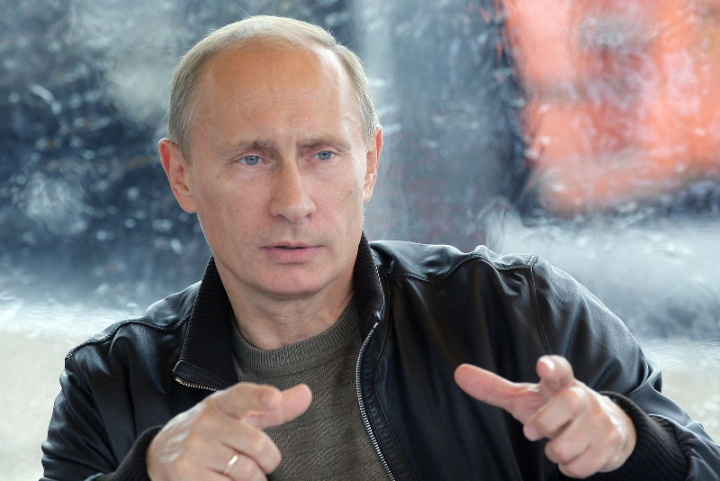
By John Chuckman | Aletho News | March 6, 2019
There is an immense amount of criticism of Putin, especially coming from America, most of it empty criticism which ignores realities and genuine analysis. For the more thoughtful, it represents only the stink and noise of propaganda, and not honest criticism in its true sense at all.
In politics, and especially in the direction of a country’s foreign affairs, there are certain behaviors, ideas, and attitudes which mark out a person as exceptional. I think there can be no doubt, Putin is just such a person, and I am very much inclined to say, the preeminent one of our time. Frankly, compared with Putin’s skills, Donald Trump comes off as a noisy circus act, a sideshow carnival barker, and not an appealing one. He has an outsized impact in the world only because he represents the most powerful country on earth and has embraced all the prejudices and desires of its power establishment, not because of the skillfulness of his actions or the insight of his mind. Obama made a better public impression, but if you analyze his actions, you see a man of immense and unwarranted ego, a very secretive and unethical man, and a man who held no worthy ideals he promoted. He was superficial in many things. And he was completely compliant to the power establishment, leaving no mark of his own to speak of.
Putin is a man who advocates cooperation among states, who argues against exceptionalism, who wants his country to have peace so that it can grow and advance, a man lacking any frightening or tyrannical ideologies, a man who invariably refers to other countries abroad, even when they are being uncooperative, in respectful terms as “our partners,” a man who knows how to prioritize, as in defense spending, a man with a keen eye for talent who has some other exceptional people assisting him – men of the caliber of Lavrov or Shoygu, a man who supports worthy international organizations like the UN, a man who only reluctantly uses force but uses it effectively when required, a highly restrained man in almost everything he does, a man who loves his country and culture but does not try foisting them off on everyone else as we see almost continuously from American presidents, a man with a keen eye for developing trends and patterns in the world, a man with an eye, too, for the main chance, a man whose decisions are made calmly and in light of lot of understanding. That’s quite a list.
The differences between recent American leaders, all truly mediocre, and Putin probably has something to do with the two counties’ relative situations over the last few decades. After all, if the support isn’t there for someone like Putin, you won’t get him. Russia’s huge Soviet empire collapsed in humiliation in 1991. The country was put through desperate straits, literally its own great depression with people begging or selling pathetic trinkets on the streets. And America made no real effort to assist. Indeed, quite the opposite, it kicked someone who was down and tried to shake all the loose change from his pockets. Out of Russia’s desperation came a man of remarkable skills, a rather obscure figure, but one who proved extremely popular and was obviously supported by enough powerful and important people to employ his skills for the county’s recovery and advance.
Putin showed no weakness or flinching when dealing with some of the extremely wealthy men who in fact became wealthy by stripping assets from the dying Soviet Union, men who then also used their wealth to challenge the country’s much-needed new leadership. He was, of course, excoriated by the United States, but to the best of my understanding, he did what was necessary for progress. The results are to be seen in a remarkably revitalized Russia. Everywhere, important projects are underway. New highways, new airports, major new bridges, new rail lines and subways, a new spaceport, new projects and cooperative efforts with a whole list of countries, new efforts in technology and science, and Russia has become the world’s largest exporter of wheat. Putin also has committed Russia to offering the world grain crops free of all GMOs and other contaminants, a very insightful effort to lock-in what have been growing premium markets for such products, even among Americans.
The military, which badly declined after the fall of the USSR, has been receiving new and remarkable weapons, the products of focused research efforts. New high-tech tanks, artillery, ships, and planes. In strategic weapons, Russia now produces several unprecedented ones, a great achievement which was done without spending unholy amounts of money, Russia’s military budget being less than a tenth that of the United States. Putin’s caution and pragmatism dictate that Russia’s first priority is to become as healthy as possibly, so it needs peace, for decades. Few Westerners appreciate the devastating impact of the USSR’s collapse, but even before that, the Soviet empire had its own slow debilitating impact. Russia’s economic system was not efficient and competitive. The effects of that accumulated over many years. The USSR always did maintain the ability to produce big engineering projects such as dams and space flight, but it was always sorely lacking in the small and refined things of life that an efficient economy automatically sees are provided.
The new strategic weapons are an unfortunate necessity, but the United States threatens Russia as perhaps never before with the expansion of NATO membership right to the Russian border, something breaking specific American promises of years back. And it has been running tanks all over Europe and then digging them in them right at the frontier just to make a point. It has deployed multiple-use covered missile launchers not far from the border which may as easily contain offensive intermediate-range ground-to-ground nuclear missiles as the defensive anti-missile missiles claimed to be their purpose. And it has torn up one of the most important nuclear-weapons treaties we had, the INF Treaty, pertaining to intermediate-range missiles. Intermediate-range nuclear missiles based in Europe give the United States the ability to strike Russia with little warning, their ten-minute flight path compares to a roughly thirty-minute flight path for an Intercontinental Ballistic Missile (ICBM) coming from America. These are extremely de-stabilizing, as are the counter-measures Russia felt it must take, Russian intermediate-range nuclear missile aimed at European centers. Everyone eventually recognized that, and that’s why the treaty was successfully completed. Europeans appreciated no longer becoming the immediate battlefield in a nuclear war.
But relations with the United States have now entered a new world, and it is not a brave one. America’s power establishment has assumed new goals and priorities, and in those, Russia is not viewed well, despite its new identity as a nation ready to participate and peacefully compete with everyone, a nation without the kind of extreme ideology communism was, a kind of secular religious faith. Despite its readiness to participate in all Western organizations, forums, and discussions, it is viewed with a new hostility by America. It is arbitrarily regarded as an opponent, as an ongoing threat. As I discuss below, America, too, has been kind of in a decline, and the response of its leadership to that fact involves flexing its muscles and extracting concessions and privileges and exerting a new dominance in the world, a response not based in economic competition and diplomatic leadership, a response carrying a great deal of danger.
And, very importantly, its response is one that involves not only bypassing international organizations, but, in many cases, working hard to bend them to its purposes. There are many examples, but America’s treatment of the UN has been foremost. It has in the recent past refused for considerable periods to pay its treaty-obliged dues until it saw changes it unilaterally demanded. It has dropped out of some important agencies completely, most notably UNESCO. In general, it has intimidated an international organization into better accommodating American priorities, including very much imperial ones opposed to what the UN is supposed to be about. And it has used this intimidation and non-cooperativeness to influence the nature of leadership at the UN, the last few Secretaries-General being timid on very important matters and ineffective in general. That’s just the way America likes them to be now. A harsh Neocon like Madeleine Albright won her government-service spurs at the UN by engineering the departure of an unwanted Secretary-General.
Promoting coups is not a new activity for the United States. There is a long postwar record, including Iran’s democratic government in the 1950s, Guatemala’s democratic government in the 1950s, and Chile’s democratic government in 1973. But the recent coup in Ukraine represented something rather new, a very provocative activity right on a major Russian border. It was also against an elected government and in a country which shares with Russia a history and culture going back more than a thousand years to the predecessor state of Kievan Rus. Yes, there are resentments in Ukraine from the Soviet era, and those are what the United States exploited, but the country was democratically governed. In any event, staging a coup in a large bordering country is a very serious provocation. You can just imagine the violent American reaction to one in Mexico or Canada.
The new, post-coup government in Ukraine also made many provocative and plainly untrue statements. The ineffective, and frequently ridiculous, President Poroshenko kept telling Europeans that Russian troops and armor were invading his country. Only his brave army was holding the hordes back. He was literally that silly at times. Of course, none of it was ever true. American spy satellites would quickly detect any Russian movement, and they never did. In an effort to put the wild claims into perspective, treating them with the contempt they deserved, Putin once said that if he wanted to, he could be in Kiev in two weeks. Undoubtedly true, too. Well, the statement was taken completely out of context, treated as a threat by America’s always-faithful-to-the-narrative press. Journalism in the service of government policy – all of it, from the most elevated newspapers and broadcasters to the humblest. And I think that nicely illustrates the absurdity of events in Ukraine and the way they have been used.
The United States paid for the coup in Ukraine. We even know how much money it spent, five billion dollars, thanks to the overheard words of one of America’s most unpleasant former diplomats, Victoria Nuland. The idea was to threaten Russia with the long Ukrainian border being put into genuinely hostile hands. Never mind that the government driven from office with gunfire in the streets from paid thugs was democratically elected. Never mind that many of the groups with which the United States cooperated in this effort were right-wing extremists, a few of them resembling outright Nazis, complete with armbands, symbols, and torchlight parades. And never mind that the government America installed was incompetent, not only sending Ukraine’s economy into a tailspin but promptly igniting a completely unnecessary civil war.
The large native, Russian-speaking population (roughly 30% of the country) is completely dominant in Eastern Ukraine and Crimea. Those two regions partly turned the tables by seceding from Ukraine with its government which early-on worked to suppress historic Russian-language rights and carried on a lot of activities to make those with any Russian associations feel very unwelcome. It’s a deliberately provocative environment, and, as we all know from our press, not a day goes by in Washington without anti-Russian rhetoric and unsupported charges. While Washington greatly failed in this effort, it nevertheless succeeded in generating instability and hostility along a major Russian border. It also gained talking points with which to pressure NATO into some new arrangements.
In the case of Crimea, it is important to remember that it has been Russian since the time of Catherine the Great. It only was in recent history that Crimea became part of Ukraine, and that happened with the stroke of a pen, an administrative adjustment during the days of the USSR, the very USSR the people now running Ukraine so despise, rejecting almost everything ever done, except for the administrative transfer of Crimea apparently. Just one of those little ironies of history. The people who live in Crimea speak Russian, and they did not welcome the new Ukrainian government’s heavy-handed, nationalist, anti-Russian drive around Ukrainian language and culture, necessarily a narrow, claustrophobic effort since the late USSR was a multi-national and multi-lingual state, and given Crimea’s much longer-term history as part of Russia. Even during Crimea’s recent past as part of Ukraine, Russia continued to maintain, under lease, its major naval base at Sevastopol on the Black Sea, so the connections with Russia have been continuous.
In virtually every newspaper story you read and in places like Wikipedia on the Internet, you will see the word “annexation” used to describe Crimea’s relationship with Russia. It simply is not an accurate description, but its constant use is a very good measure of America’s ability to saturate media with its desired version of events. The people of Crimea voted overwhelmingly to secede from an unfriendly new Ukraine, and they voted to petition Russia’s admitting them as part of the country. How can you call the results of free and open votes annexation? Well, only the same way you can tell the twice-elected President of Venezuela that he is not President and that another man, who did not even run in the election and administered the oath of office to himself, is the President. This is the kind of Alice-in-Wonderland stuff that comes as part of America’s new drive for dominance. It simply paints the roses red. What is claimed to have happened in Crimea provides the only support for charges of Russian aggression, the laying on of all kinds of sanctions, and running around all over Europe tearing up road surfaces with tanks. This is the atmosphere within which Putin must work, trying to maintain as many sound relationships with Europe as he can, and he actually has been quite successful. A number of prominent European politicians, especially retired ones who aren’t under the immediate pressures of politics and relations with America, have voiced support for Russia. Some have even visited Crimea by invitation and toured. And Russia’s major new gas pipeline into Europe, Nord Stream 2, proceeds despite constant American pressure against it. It is at this writing 70% complete. The Europeans cannot just abandon their long-term ally, the United States, even though I’m sure they understand the illusions and false claims of the current situation. The United States also retains considerable capacity to hurt Europe financially, so they rush into nothing, but I believe there can be no doubt that American words and actions have significantly weakened old and important relationships. No one likes being lied to, and they like even less having to pretend lies are truth.
Putin has been more cautious in the case of the secession of another Russian-speaking portion of Ukraine, an even larger one in population and in economic importance, the Eastern portion called Donbass. The people there declared two republics, Donetsk and Luhansk, and they petitioned to be admitted as part of Russia. But Russia does not officially recognize them although it has sent large volumes of aid as they were besieged by the new Ukrainian government. The government of Ukraine started a small civil war in the region. Russia supports the Minsk Accords, which it helped to write, accords to reunite the region with Ukraine but which require Ukraine to grant a degree of constitutional autonomy to the region. This is a reasonable approach to ending the conflict, but it is not easy to implement. It is not something looked favorably upon by Ukraine’s right-wing extremists who push the government hard, having even threatened it at times. The entire business has been mired in difficulties from the start. Ukraine displayed remarkable military incompetence in this civil war against a much smaller opponent. It tried to increase the size of its forces with conscription in the West of Ukraine, but the number of no-shows and run-aways grew embarrassingly large. And, of course, none of this even needed to happen had the new government’s policies been sensible and fair in the first place. But you got no pressure from the United States over fairness. It is merely content to have caused a lot of difficulties on Russia’s border. And there is the matter of the shoot-down of Malaysian Airlines’ Flight MH-17, which my study of the circumstances suggests unequivocally was an act by Ukraine, whether accidental or deliberate. The United States has pushed hard to have this blamed on Russia, so as to not discredit its installed Ukrainian government, but the facts, as we know them, simply do not support that conclusion. The United States has shamefully pressured a NATO member, Holland, not even a central party to the event, to conduct a long and tortoise-paced investigation of the crash. It has ignored key evidence, and all of its interim conclusions can readily be seen as couched in the kind of suggestive but inexact language criminal lawyers advise their clients to use in court. What we see in Ukraine, is government incompetence, almost uniformly in all its activities, and again there is no concern expressed by the United States about all the difficulties – economic, military, and social – its efforts have caused for the Ukrainian people.
Putin’s adroit handling of the coup in Ukraine, frustrating many of America’s aims without getting Russia involved in conflict, determined Washington to further stoke-up anti-Russian feeling in Europe. You must always remember that NATO does represent a vehicle for the peaceful American occupation of Europe, Europe being an important economic competitor and potentially a major world power. The obsolescence of the original arguments for NATO – the threat of the USSR and the massive Red Army, now both long passed into history – had the potential to see America eventually lose its occupying perch in Europe.
Russian-threat hype added force to recent efforts over the last decade and a half to have inconsequential new states admitted to NATO, some of them having the attraction of borders with Russia and lots of simmering old anti-Soviet hostilities. Certainly, countries like Estonia or Latvia bring neither military nor economic strength to the organization. Other small states, such as Slovenia or Slovakia or Montenegro just fill holes in the map of Europe, so NATO is a contiguous mass. The small states are in fact potentially a serious drag. But for America, they were attractive new members because they are so grateful about being asked “to play with the big boys.” Their votes as part of the organization effectively dilute the influence of the larger, older states, such as France or Germany, who sometimes disagree with the United States, and some of whom have been developing new relationships with modern Russia. The entire series of American activities in Europe after the disappearance of the USSR represents absolutely nothing constructive, indeed, quite the opposite.
As I mentioned, America, too, has been in a kind of decline, but absolutely nothing resembling what Russia experienced. America’s establishment has come to realize that over the last couple of decades it is in a relative decline. It went from producing, after WWII, about forty percent of what the world used to twenty-something percent, and all signs point to the trend continuing. America was waking-up from an extended fantasy – a period when fluffy notions like “the American Dream” were embraced as real, a period explained by the simple fact that, after the war, all of America’s serious competitors had been flattened. America was waking to a time when those competitors were coming back and a time when fierce new competitors were rising. The “Dream” part of the advertising slogan, “the American Dream,” became all too apparent.
During that period of unique prosperity and power following WWII, a good deal of America’s leadership became what people who have been given too much often tend to become, spoiled and corrupt, unable to make good decisions in many cases, indulging in god-like notions of the planet being run for their benefit, and always, steadily leaving behind their own people’s welfare for imperial concerns abroad. The entire ethic of the New Deal period evaporated, and by the 1990s, a Democratic President like Clinton could actually make a speech bragging about “ending welfare as we know it.”
The people who really run the country, its power establishment, fixed on a new strategy to address uncomfortable realities. That strategy involves using America’s still great military and financial power to dominate international affairs in a more obvious and palpable way than ever. Dominance became an openly-discussed theme, as it rarely was before, in the hope, over time, of squeezing concessions and advantages from others to regain or at least hold on to its global position. This is an openly aggressive posture that has been assumed. No more pretense of being a nice guy. And it was actively promoted by a new political faction in Washington, the Neocons, a group who share certain interests and see America’s use of power as serving those interests. They have been open advocates of using military force to get things you want, and they hold many important and influential posts. Perhaps their greatest common interest is the welfare of Israel, and they see an America perceived as aggressive best serving Israel’s security.
It is important to note that while Russia maintains excellent relations with Israel – Putin has been visited often by Israel’s Prime Minister – nevertheless, by virtue of its sheer size and geographical location and military power, Russia is seen as a barrier to America’s more unrestrained use of power. “Russia” is almost a dirty word for many of America’s Neocon faction and for many Israelis. Russia’s recent decisive assistance to Syria in fighting gangs of terrorists introduced and supported from outside was viewed about as negatively as is possible. That is a war Israel wanted President Assad to lose, and it secretly gave a great deal of assistance to the terrorists. It was hoping to secure a permanent hold on the Golan, grab even another slice of Syria as a buffer for its illegal residents in Golan, all while seeing one of the region’s leaders it most dislikes eliminated. It worked closely in the effort with Saudi Arabia’s murderous Crown Prince, and America oversaw and encouraged all aspects of a dirty war to topple a legitimate government which has remained fairly popular with its people despite years of agonizing conflict and endless dishonest American claims about such matters as chemical weapons. Assad is seen as a defender of the rights of Syria’s diverse religious groups, including its many Christians.
So, there is a built-in powerful negative towards Russia in Washington power circles for which there is no clear possible remedy or correction, and, indeed, no matter how reasonably Putin behaves, his country faces this opposition. For some American politicians, and very notably Hillary Clinton, this has proved a handy tool, Clinton long having been a close-to fanatical supporter of Israeli interests. The fact has earned her a great deal of campaign funding and other support over the years. Clinton’s ego also just could not take the fact that she lost the election to the leader of “the deplorables,” as she once called Trump’s supporters, so in dark claims of Russian interference, supported by absolutely no proof whatsoever, she protects her ego. And long before election day, Clinton had a hand in exploiting attitudes about Russia in another way. She is known to have paid, at least in part, for the fraudulent Steele Dossier commissioned from an ex-British spy. It was used to try to discredit Trump over Russian connections.
This dislike for Russia by the Neocons and other boosters of resurgent American power really is what is at the heart of America’s current Russophobia obsession, not any threatening actions by Russia. It becomes a kind of vicious circle with new accusations piled on all the time by various actors each with their own motives, and it is clearly quite dangerous.
So, these are the positions of the two countries today, Russia having risen quite impressively from the depths under a remarkably able leader, extremely popular and well-supported by powerful elements of its society, versus America, now in a much different kind of decline than what Russia experienced, led by an establishment group with rather less-than-honorable intentions and with a political system virtually designed to produce no real leaders who might interfere with establishment plans.
Putin is further supported from the outside by the rising colossus of China, one of the great miracle stories of our time. In the past, the two countries have not always been friends, and America, in the time of Nixon, actually worked at playing one off against the other. But that is no more. The American establishment’s intentions for China are too clear. It is virtually reneging on many old promises such as those around Taiwan being an integral part of China, it is treating China as an unwanted competitor, accusing it of every nefarious activity you can think of to impede its economic progress and demanding trade concessions as though China had been an unfair competitor rather than just a new, more successful one. America is now attacking in every way possible – from questioning motives and methods to trying to generate opposition by participants – China’s unprecedented and magnificent global enterprise, the Silk Road Project, a project dwarfing the great canals of the past and destined to bring new prosperity to all participants through trade. It hardly represents a positive attitude to oppose and impede it.
Putin is exactly the kind of man to quickly recognize and embrace a project like that. Russia is also rushing to help China greatly increase its supply of natural gas from Siberia’s immense reserves in order to decrease its dependence on coal. The first great new pipeline is almost finished.
So, Vladimir Putin and Xi Jinping, both highly intelligent leaders, have a great many weighty common interests in working together as never before. America’s new policies have been a driving force in bringing them together, and there is no reason to expect any diminution in that force. Recent American international behavior requires others to accept what Putin likes to call America’s “exceptionalism,” its position first and above all other nations, its self-granted privilege of not having to play by the same rules as everyone else – its status of “the indispensable nation” as one of America’s more arrogant diplomats put it not very long ago – and it requires that from two major, proud, and ancient societies which cannot possibly grant it.
America’s dependence on its gigantic military and security establishment represents a serious long-term weakness in many ways, even though it provides the very foundation of the American establishment’s new strategy for dominance. Empires, after all, while benefiting the privileged segments of a society, are a drag on most of their citizens, depriving them of many benefits, including the simple, important benefit of good and caring national government. America spends more than ten times as much as Russia on its military. China, compared to not many years ago, has increased its military spending greatly, but for a country with such a huge economy, second only to the United States and likely to overtake it before long, it still spends less than a quarter of what the United States does. And America does not even have the money to pay for its atrociously large military. It borrows the money, and who do you think pays the stream of interest payments for those massive borrowings? You’d be right if you said all of its ordinary, tax-paying citizens without privileges. They also are “on the hook” for the ultimate negative economic consequences of all this debt and borrowing.
Of course, from a world perspective, America’s military represents an ongoing threat to peace and security, much the opposite of what is claimed for it inside the United States. Great standing armies have always represented threats, and here is the greatest standing army in history. Many historical analyses hold them largely responsible for such terrible conflicts as WWI (a war whose outcome made WWII inevitable also). When such power is at hand, the temptation to use it is constant, and its very presence distorts all attitudes and decisions. Many of America’s own Founders understood that, but it has been forgotten by the contemporary American establishment in its relentless pursuit of empire and influence.
Security expenses are hard to compare, so much is secretive, but the United States with its 17 separate national security agencies and such a vast enterprise as the NSA’s new archipelago of facilities stuffed with hi-tech gear and supercomputers which spy on and record every American plus others would put any other country out of the competition. Again, the demands of the American establishment utterly compromise the interests of the country’s own citizens at large. Indeed, now in security matters, ordinary Americans have been pretty much reduced to a herd, each with an identifying tag stapled to his ear.
Russia’s democracy may be quite imperfect, but America’s – what it had of one, it never from the beginning identified itself actually as a democracy – has been transformed into plutocracy with an elaborate window-dressing simulation of democracy, an arrangement in which the state’s resources are committed to its privileged class and the advance of empire. And, as I’ve written many times, you can have a decent country or you can have an empire, but you cannot have both.
Former UN Arms Inspector: Europe as Much to Blame for Demise of INF Treaty as US
Sputnik – 06.03.2019
WASHINGTON – The European member nations of NATO are as much to blame for the destruction of the intermediate Nuclear-Forces (INF) Treaty as the Trump administration, former United Nations Chief Weapons Inspector on Iraq Scott Ritter told Sputnik on Tuesday.
“Europe is as much to blame for the demise of the INF Treaty as is the US,” Ritter said. “NATO’s slavish echoing of the US accusations void of any demonstrable proof that the US claims had any validity provided the diplomatic cover the US needed to proceed to withdraw from the treaty.”
On Monday, the Kremlin press service said that Russian President Vladimir Putin had signed a decree suspending Russia’s obligations under the INF Treaty until the United States resumes its compliance with the agreement. Putin’s decree came into effect on the day it was signed.
The United States formally suspended its obligations under the INF Treaty last month and gave Russia six months to comply with its demands, prompting Russia to do the same.
Putin said Moscow did not want a costly arms race but ruled out any new talks on arms controls, saying all earlier proposals remained on the table.
Ritter pointed out that the Trump administration had falsely accused Russia of being in violation of the INF Treaty.
“The US demands vis-à-vis the 9M729 missile were unreasonable. The missile had not been demonstrated to be in violation of the INF Treaty. US accusations were not backed up with any evidence that corroborated the claimed violations,” he said.
There were measures that could have been taken to ascertain whether the 9M729 was in compliance with the INF Treaty, such as a technical inspection of the missile itself, Ritter pointed out. However, the US government refused to pursue those options, he said.
Instead, the US government declared “the Russians to be non-compliant, and demanding that the 9M729 be destroyed. This was an unrealistic and unreasonable demand, purposefully designed to prompt a Russian refusal and as such trigger a US withdrawal — which was the goal all along,” he said.
The US already had the physical infrastructure in place to deploy INF systems in Europe. The Mk 41 Aegis Ashore sites in Poland and Romania could be modified to fire Tomahawk cruise missiles with little effort, Ritter pointed out.
“It seems NATO has little or no institutional memory … NATO doesn’t seem to have woken up to this reality, and the fact that these facilities are in two nations that welcome this kind of anti-Russian provocation means that local protests are unlikely,” he said.
If the US seeks to develop a new INF-type system along the lines of the former Pershing II missile, then the issue will become more complicated, Ritter cautioned.
“It is unlikely any European nation would allow a new INF system to be deployed on its soil, and the consensus-driven reality of NATO is such that getting unanimous consent for such deployment is unlikely,” he said.
Europe was given a reprieve from the reality of living under the threat of imminent nuclear destruction by the INF Treaty, but that era has now ended, Ritter warned.
“Now they will once again know what that nightmare is like. Europe will need to relearn the lessons from the 1980s. The INF Treaty was a unique agreement forged out of the reality of US-Soviet arms control talks during the height of the Cold War. This environment is not likely to be replicated,” he said.
It was unrealistic to think the INF Treaty could be brought back to life, Ritter explained.
“Any effort to create a new treaty vehicle involving China, India, Pakistan, etc. would have to be linked to US and Russian strategic weapons as well. This kind of broad-based multilateral approach to nuclear arms control is virtually impossible to consider under current global conditions,” he said.
In this Aug. 29, 2017, file photo, Japan Air Self-Defense Force demonstrates a training to utilize the PAC-3 surface to air interceptors at the U.S. Yokota Air Base on the outskirts of Tokyo
Moreover, without the INF Treaty, it is likely that the New START Treaty will be scrapped as well, Ritter pointed out.
“There is not the kind of diplomatic foundation for meaningful arms control talks between Russia and the US, and one is not likely to exist while Trump remains president,” he said.
Ritter was one of the first INF inspectors and was assigned to the Votkinsk Portal Monitoring Facility from June 1988-July 1990. He also carried out other INF inspections, as well as handled other treaty-related tasks.
See also:
Japan to Host US Missiles Despite Russian Claim That They Violate the INF Treaty
The Kursk Disaster: Facts Sunk Beneath Waves of Drama
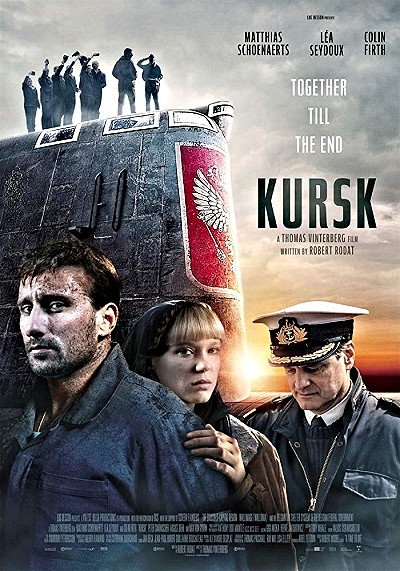
By Maximilian C. Forte | Zero Anthropology | March 5, 2019
At the turn of the millennium a trilogy of disasters gained a high profile in the international media. First, in July of 2000 the fiery crash of Air France’s Concorde flight 4590 from Paris to New York ended not just many lives (109 persons), but also the plane’s career. Second, on August 12, 2000, there was the sinking of Russia’s Kursk submarine, with 118 sailors killed in the tragedy. Third, and probably much less memorable now, on August 27, 2000, a fire high up in Moscow’s Ostankino Tower saw its spire dangerously tilting as if ready to collapse live on camera as seen around the world; two people died in that incident. It was almost as if this would be a preview of the much more breathtaking collapses of the twin towers of the World Trade Center just a year later. Accompanying the millennium disasters were a series of blockbuster disaster movies, which included James Cameron’s 1997 movie: Titanic. Let’s not forget the pretend disaster that was supposed to have been the infamously ridiculous “Y2K Bug,” a hoax in every respect except the billions of dollars transferred to the pockets of IT consultants for unnecessary preparations.
The sinking of the Kursk is now memorialized in a European film released late in 2018, by Danish director Thomas Vinterberg. It features an all-European cast that includes Max von Sydow playing the role of “Admiral Vladimir Petrenko” (in reality this was Navy Commander-in-Chief and Fleet Admiral Vladimir Kuroyedov)—this is the part of the “bad guy”; Colin Firth, playing the role of Commodore David Russell—the “good guy” in the film; also noteworthy, Matthias Schoenaerts playing the role of a fictitious Mikhail Averin who appears to have been based on the real world character of Captain-lieutenant Dmitri Kolesnikov.
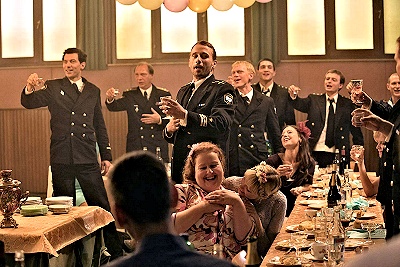 Not being a Hollywood film, this is not a straightforward propaganda film (as one might suspect of a Western media production dealing with a Russian subject, in the current context). However, it is still a big-budget feature that plays loose with certain facts, more by inflating and amplifying some aspects while minimizing others. It is aimed at US and European audiences primarily. Had it been intended as a direct condemnation of Vladimir Putin—who had then been president for only a few months when the Kursk disaster happened—the filmmakers could have simply stuck to the recorded facts. Instead, the film actually removes Putin from a key incident shown in the film—a Russian navy briefing to the grief-stricken families of the sailors—and replaces him with an imaginary admiral played by Max Von Sydow.
In reality, Putin vacationed at his seaside villa for several days as the disaster unfolded, before returning to Moscow and attending that disastrous gathering with sailors’ families. At that gathering Putin was directly and loudly challenged, a shouting match ensued followed by scuffles, and one family member was famously dragged out after being surreptitiously injected with a sedative by a nurse in civilian clothes. Reality was ugly enough that there would have been no need for propaganda. On the other hand, it’s not clear that Putin himself was adequately informed by the military, who claimed to have the situation under control.
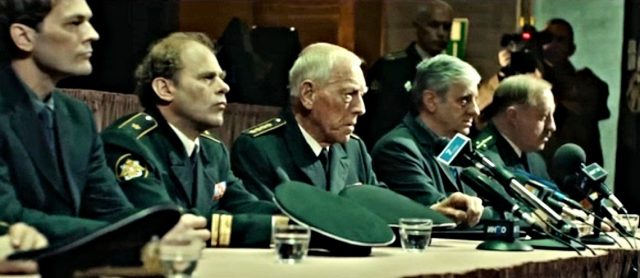
The impressions that stood out for me as one viewer watching the film, were: (a) the inhumane, obstinate refusal of encrusted military brass to accept foreign assistance, preferring to instead indulge obsolete paranoia and outdated conspiracy theories about the West; and, (b) the sheer magnitude of incompetence and degradation that makes one wonder whether Russia even deserves to have a navy. The loss of the surviving sailors is shown as preventable, a needless tragedy—if only Russian naval brass had not consisted of Jurassic-era dicks, sinister Stalinist throwbacks, and snivelling cowards. Navies are for serious, developed nations of the civilized world—not for rust-bucket states on their last legs. It’s not an accident that I thought these things: they are monumental features of the film that simply cannot be avoided, and were deliberately produced by the filmmakers.
One way to achieve these effects is by playing with the facts, in this case by maximizing what is one possible yet extreme interpretation of what transpired beneath the surface of the sea: that the sailors survived for days before finally succumbing. By stretching events out over a period of days, the filmmakers only amplify the needless tragedy of the delays caused by steadfast Russian refusals of foreign assistance—which then gave way to accepting foreign assistance (so not even that narrative is stable). In actuality, experts can find little evidence that those who survived the initial blasts lasted much longer than three to six hours.
 On the other hand, I have to confess that my inner populist reacted positively to the film focusing heavily on the sailors, their heroism, courage, altruism, and self-sacrifice for their comrades. These were the workers. They did their job, even though they were not getting paid and were all struggling to survive in a climate of delayed back wages. The focus on their wives and children was also appropriate, showing where and how they lived, their apartments, the laundry hanging from tiny balconies in grim-looking residential towers overlooking the sea, neighbours huddling together over tea, consoling each other. These are the people who really mattered, and it is my main praise for the film that it maintained this emphasis.
However, going past populist appeal, what magnifies the tragedy in this film is Russian rejection of foreign assistance. Had the Russians accepted foreign help, immediately, before even trying to do things themselves, then the men who waited—allegedly for days—might have been saved.
 The reality is more likely one where even if Russia immediately accepted such aid, it would have taken too long to reach the survivors, who had all died just three to six hours after the initial blasts. The film enters the territory of propaganda if—as seen in the present—it is meant to suggest that Russia is to blame for Cold War II. Russia did not start this new Cold War, and that fact should be as plain as day. It was not Russia that ended cooperation with the West, that walked out on peace treaties, that booted itself from the G8, that terminated various forms of cooperation and exchange. It is Russia that is constantly pleading for more diplomacy, and less aggression. What the film shows is the opposite of that—something that is instead like the US after Hurricane Katrina, which rejected offers of humanitarian assistance from nearby Cuba.
The questionable nature of the film then is its thematic logic, which essentially breaks down into the following points:
- You are inadequate.
- You must therefore accept foreign help, because you’re no good to yourself.
- Foreign help saves lives.
It is a basic “humanitarian” ethic, and in this present context where the US is trying to ram tiny bits of junk aid down the throats of the same Venezuelans whose economy the US is smashing, it is a message that will still resonate with audiences untrained in thinking critically.
But what if we instead read the events as a logical chain of events and causes, shaped by history? Then we would get something that takes us back to some “uncomfortable” roots of the problem, roots that implicate Western powers. Thus,
- What happened to the Kursk? The technical aspects were the subject of considerable debate, and the facts are hardly settled—even down to disputing the argument that an overheating torpedo exploded prematurely.
- Why was the Kursk out at sea? Given NATO’s steady expansion in what was formerly the Warsaw Pact, its move toward incorporating the Baltic republics, and its bombing campaign against Serbia (a Russia ally), the Russians clearly felt a pressing need to mount a show of force.
- Why was the Russian Navy in such a parlous state? Budget cuts. That is, austerity, caused by an economic meltdown, brought on by the sort of “shock therapy” that was deliberately pursued by Boris Yeltsin (Washington’s man in Moscow), and pushed by the International Monetary Fund. The Russian state, pre-Putin, had cut back on all sorts of public expenditures, basically running the state-owned sector into the ground (and into the arms of oligarchs). GDP contracted by about 40%, unemployment soared, as did food and fuel prices, and life expectancy tumbled—this was the reality of Russia under neoliberalism, as pushed by the US and Western international institutions. Russia also suffered from a financial crisis in 1998, a direct outcome of its over exposure to international capitalism.
- Why was Russia melting down? This would take us to the complicated sequence of events following the demise and fragmentation of the Soviet Union (USSR).
- Why did the USSR collapse? Not that there is anything like a consensus about the ultimate determinants of the demise of the USSR, the most common explanations advanced include as a key factor the structural fatigue brought on by the Cold War arms race, and the USSR’s international over-extension as it tried to counter the US/NATO at every move.
The fact of the matter is that we can see a similar break down transpiring in the US, not just in terms of economic destruction and social division, but also in terms of cities exposed to toxic pollution from radioactive waste dumps connected to the manufacture of nuclear weapons. Thus we will soon have a review here of Atomic Homefront, much delayed already. In Russia’s case, much of the destruction of the 1990s was countered by the reforms introduced by Vladimir Putin, to great effect, depending on the observer, which no doubt accounts for his continuing high popularity rating among Russians (well past the highest ever achieved by Obama).
Had the film followed a logical and historical chain of causes and consequences, then the message of the film might have changed substantially:
Don’t threaten countries that you first subjected to stress, because such stress can literally kill.
But then that would be an anti-interventionist ethic, and that ethic is not permissible in our society, which continues to train specialists in the field of “humanitarian intervention,” just as it trains others in the arts of deception, and tries to secure the consent of audiences.
Russian oil expert detained at Kiev’s request in Greece, lawyer calls arrest ‘politicized’
RT | March 3, 2019
A Russian national has been arrested in Greece and faces extradition to Ukraine on tax-crime charges. His lawyer said he is being persecuted for supporting the former Ukrainian president who was ousted in a Western-backed coup.
Evgeny Kalinin, a Russian energy expert, was arrested by the Greek authorities at Athens International Airport on Thursday, his lawyer, Yannis Rahiotis, told Sputnik.
Kalinin is a well-known oil industry expert, Rahiotis said, noting that his client was on a routine business trip to the country at the time. Kalinin appeared in court on Friday, when he was sent to prison until Ukraine’s extradition request is delivered to Athens.
According to Rahiotis, Kalinin faces unspecified tax-crime charges, which allegedly arise from his past work as a top executive in Ukraine’s oil company.
Kalinin served as vice president of TNK-BP Commerce, a Kiev-based company that specializes in producing and selling crude oil products in Ukraine and Russia, until 2011. The company, which was founded in 2003, also operates a network of gasoline and filling stations in Ukraine.
While the essence of the charges Kalinin is facing are not yet clear, Rahiotis believes they are politically motivated. The lawyer pointed out that Kalinin’s name has been included in a database of the notorious Ukrainian website Mirotvorets (Peacekeeper). The ultra-nationalist site contains a blacklist of ‘traitors’ who it says must be dealt with. On the list, Kalinin has found himself in the company of such big foreign political names as former German chancellor Gerhard Shroeder, who was added to the ‘hit-list’ in November, prompting the German Foreign Ministry to reprimand Kiev for not taking down the website.
“This case is a political one. Kalinin is included into the Mirotvorets list. He is being persecuted because he was a supporter of former president Victor Yanukovich,” Rahiotis said.
Russian diplomats have been in contact with Kalinin, and have been providing him “with all necessary consular assistance,” the Russian Embassy in Greece said, as cited by Sputnik.
Kalinin’s arrest has already drawn condemnation from a senior Russian lawmaker.
The deputy head of the Russian Senate Defense and Security Committee, Franz Klintsevich, has said that by playing into the Kiev’s hands, Athens is undermining its centuries-old relationship with Russia, which has traditionally been an ally.
“It’s still not late to stop. Russia will do everything to free Evgeny Kalinin,” he wrote on Facebook.
Another State Duma MP, Natalia Poklonskaya, argued that Kalinin’s arrest is likely to be politicized and exploited in the ongoing Ukrainian presidential campaign. She also warned Greece against becoming a pawn in a third party’s hands by simply following formal legal guidelines.
Lavrov to Pompeo: We can talk Venezuela, but US must stop threatening its legitimate government
RT | March 2, 2019
The US attempts to threaten Venezuela and meddle in the country’s affairs under the guise of supplying humanitarian aid have nothing to do with democracy, Russian FM Sergey Lavrov told his American counterpart, Mike Pompeo.
The top diplomats talked on the phone on Saturday on the initiative of Washington, the Russia Foreign Ministry said.
During the conversation, Lavrov blasted the American threats against the government of Nicolas Maduro, calling them “blatant interference in the internal affairs of a sovereign state and a flagrant violation of international law.”
He also grilled the US Secretary of State over Washington’s attempts to influence the situation in Venezuela under the “hypocritical guise” of providing humanitarian aid to the crisis-hit country. Such actions “have nothing to do with democratic process,” Lavrov said.
Earlier this week, Venezuelan Foreign Minister, Jorge Arreaza, has labeled the US aid to the country “a Trojan horse.” He said that nails and barbed wire to build barricades were seized from the supply trucks on the border with Colombia and provided photos to back his words.
As for Washington’s proposal to hold consultations on Venezuela, Lavrov said that Moscow was ready for such talks. However, he reminded Pompeo that “the principles of the UN Charter must be followed strictly as only the people of Venezuela have the right to decide the future of their country.”
The situation in Venezuela escalated after opposition leader, Juan Guaido, declared himself interim president of the country in late January. He was swiftly backed by the US, which never made a secret out of its desire to see socialist president Maduro removed from power.
However, all the American backing and increased sanction pressure on Caracas have so far been insufficient to cement Guaido’s claim to power as the man fled to neighboring Colombia to lead the coup from there, while promising to return.
Russia willing to work with US on cybersecurity, but Washington stalls – national security chief
RT | February 27, 2019
The Russian government is willing to cooperate with the US on cybersecurity issues, but so far it sees no reciprocation of this intention on the other side, said the head of Russia’s National Security Committee.
“On our part, we are prepared to dialogue with our Western partners, once there is responsiveness and a real interest in solving the issues we have accumulated,” Nikolai Patrushev said in an interview.
He added that at the moment there is virtually no progress in this regard.
The US suggested discussing the problems in 2018, but then they derailed a planned Russian-American interagency consultation by failing to send a delegation to Geneva.
The American government accuses Russia of interfering in its domestic affairs by hacking Democrat party officials and leaking stolen emails during the 2016 campaign. Moscow denies the allegations and says unlike Washington, it strictly follows the principle of non-interference.
The Military Industrial State Confronts Russia and China
By Brian CLOUGHLEY | Strategic Culture Foundation | 26.02.2019
The swaggering arrogance of Washington’s Military-Industrial Complex never ceases to intrigue the rest of the world, much of which shrugs collective shoulders but has to acknowledge that the swaggering reflects the US National Defence Strategy which informs us that the military is going to concentrate on confronting Russia and China.
One of the loudest voices in the confrontation chorus is that of the Commander of US Naval Forces in Europe, Admiral James Foggo III, who knows that the noisier he is, the more money will be allocated by government to acquire more and more ships. And he is very good at being noisy. In 2016 he wrote a particularly bellicose piece for the US Naval Institute, titled ‘The Fourth Battle of the Atlantic’ in which he castigated Russia for not acknowledging that the United States is supreme. He declared that “the new Russian national security-strategy depicts the United States and NATO as threats to Russian security and accuses us of applying ‘political, economic, military, and information-related pressure’ on Russia.”
He is absolutely right about the US-NATO threat, because it has been growing for almost twenty years. As I’ve written before, after the Warsaw Pact disbanded in March 1991, NATO, although deprived of any reason to continue in existence, managed to keep going, and in 1999 added Poland, the Czech Republic and Hungary to its 16 members. As the BBC noted, these countries became “the first former Soviet bloc states to join Nato, taking the alliance’s borders some 400 miles towards Russia.”
With good reason Moscow wondered what on earth the US-NATO military cabal might be planning.
The New York Times recorded that the 1999 expansion was “opening a new path for the military alliance” and expressed delight that the ceremony took place in the town of Independence, Missouri, where “the emotional Secretary of State Madeleine K Albright watched the three foreign ministers sign the documents of accession, signed them herself, then held them aloft like victory trophies.” Ms Albright was born Marie Korbelová in Prague and “made no secret today of her joy as her homeland and the two other nations joined the alliance.” But neither she nor anyone else is on record as explaining what “new path” would be taken by NATO.
NATO continued to expand around Russia’s borders, inviting Bulgaria, Estonia, Latvia, Lithuania, Romania, Slovakia and Slovenia to join in 2002, which they did two years later.
There is little wonder that Russia is apprehensive about NATO’s intentions, as the muscle-flexing coalition lurches ever more eagerly towards conflict.
Further, the US itself has hundreds of military bases, spread all round the world. As noted by Nick Turse “Officially, the Department of Defense maintains 4,775 “sites,” spread across all 50 states, eight US territories, and 45 foreign countries. A total of 514 of these outposts are located overseas, according to the Pentagon’s worldwide property portfolio… But the most recent version of that portfolio, issued in early 2018 and known as the Base Structure Report, doesn’t include any mention of al-Tanf [the US Special Forces base in Syria] or for that matter, any other base in Syria. Or Iraq. Or Afghanistan. Or Niger. Or Tunisia. Or Cameroon. Or Somalia. Or any number of locales where such military outposts are known to exist and even, unlike in Syria, to be expanding.”
Yet Admiral Foggo insists that “an enduring objective of Russian foreign policy today is to challenge NATO and elevate Russia on the European stage once again.” Well, certainly Russia wants to be on the European stage, and it must be pointed out that it’s closer to that stage than is the US. It wants to trade with Europe — as is appreciated by the main European powers, Germany and France — and would be crazy to take action that would work against this mutually beneficial cooperation.
Unfortunately, Poland and the Baltic States of Estonia, Latvia and Lithuania are verging on the paranoid about Russia’s supposed “threat” to them — but there has been no indication of any sort by Moscow that Russia has any intention of moving against them in any way. Trade with these countries is important, too, but this hasn’t stopped the paranoid quartet from indulging in a vastly expensive operation to “decouple power grids from Russia” in spite of the fact that “Russia, on which the Baltic states currently rely to balance their power flows, has never cut power or threatened to do so.”
This is all part and pattern of the anti-Russia obsession that is mounting in much of the West, and plays into the hands of such as Admiral Foggo who now, some three months after an incident in the Kerch Strait last November, announced it “irritates me to no end” that Russia detained and charged 24 Ukrainian sailors who were involved in the illegal passage of some Ukrainian vessels. Foggo’s fury lies in his belief that “They are uniformed Ukrainian sailors and officers and chiefs. They’re not criminals, and they are being charged under a criminal code.”
None of his pronouncements make sense, but on February 19 Foggo despatched the guided-missile destroyer Donald Cook to the Black Sea where it is to conduct “maritime security operations and enhance regional maritime stability, combined readiness and naval capability with our NATO allies and partners in the region.” The provocative sortie by the Donald Cook will achieve absolutely nothing other than the heightening of tension between the US and Russia, which, unfortunately, is the object of the exercise.
Which brings us to the other region where the US Navy fandangos for freedom, the South China Sea.
On that side of the world the US is represented militarily by Admiral Philip S Davidson, the Commander US Indo-Pacific Command, who doesn’t like China. On February 12 he warned the US Senate Armed Services Committee that China’s “first aircraft carrier group, centered around its refurbished Soviet-built carrier, reached initial operational capability in mid-2018” and its “first domestically-built aircraft carrier has completed four sets of sea trials since May 2018 and will likely join the PLA Navy fleet in 2019.” This is very interesting, but what he doesn’t say is that the United States has eleven fully operational carrier strike groups, one of which, headed by the carrier John C Stennis, as recorded by Stratfor, “is underway in the US 7th Fleet area of operations in support of naval operations to ensure maritime stability and security in the Central Region.” It is, as noted by the US Naval Institute “in the South China Sea” where it will contribute to tension by sailing through waters averred by China to be its own. Admiral Davidson announced that China was not abiding by the UN Convention on the Law of the Sea and naturally failed to note any amusing irony in the fact that the United States has not ratified the Convention. But in any event, in the eyes of Washington’s Military Industrial State, UN rules are valuable only when they coincide with US policy.
On January 7 the US Pacific Fleet announced that the USS McCampbell, a guided missile destroyer, had carried out a “freedom of navigation” operation, sailing within 12 nautical miles of China’s Paracel Islands “to challenge excessive maritime claims.” Then on February 11 they were at it again, with CNN reporting a 7th Fleet announcement that the guided-missile destroyers USS Spruance and USS Preble had sailed within 12 nautical miles of the Spratly Islands “to challenge excessive maritime claims and preserve access to the waterways as governed by international law.”
Washington has woven a pattern of military confrontation, from the Baltic and the Kerch Strait to the South China Sea, that is intended to antagonise Russia and China. It may be claimed that provocational manoeuvres in the air, at sea and on land are undertaken with the aim of altering Chinese and Russian policies, but the only consequence of these juvenile jamborees is to heighten tension, increase distrust, and pave the way to war. That’s the path envisaged by the New York Times in 1999, and it’s being followed faithfully.
One can only hope that Trump might see the beckoning light of cooperation and prosperity rather than following the path of confrontation, but he seems to be at the mercy of the Military Industrial State. If so, there can only be grave trouble ahead.
Featured Video
Dan Dicks with James Corbett on Solutions Watch
or go to
Aletho News Archives – Video-Images
From the Archives
MMR (Measles, Mumps and Rubella) – Vaccine Risk Statement
MMR Vaccine (Measles, Mumps, and Rubella) Is It Safer Than Measles, Mumps and Rubella?
Physicians for Informed Consent | December 2024
… It has not been proven that the MMR vaccine is safer than measles, mumps, and rubella. The vaccine package insert raises questions about safety testing for cancer, genetic mutations, and impaired fertility. Although VAERS tracks some adverse events, it is too inaccurate to measure against the risk of measles, mumps, and rubella. Clinical trials do not have the ability to detect less common adverse reactions, and epidemiological studies are limited by the effects of chance and possible confounders. Safety studies of the MMR vaccine are particularly lacking in statistical power. A review of more than 60 MMR vaccine studies conducted for the Cochrane Library states, “The design and reporting of safety outcomes in MMR vaccine studies, both pre- and post-marketing, are largely inadequate.”19 Because permanent sequelae (aftereffects) from measles, mumps, and rubella are so rare (especially in children with normal levels of vitamin A and infected after birth),6,15-17 the level of accuracy of the research studies available is insufficient to rule out the possibility that the MMR vaccine causes greater death or permanent disability than measles, mumps, and rubella. – Read full article
Blog Roll
 Aletho News
- The fallacy of US delusions about Iran’s economic collapse
- Hezbollah denies Syria cell link, warns of Israeli plan to sow discord
- The legacy of US sanctions, war, and occupation in Iraq
- Iraqi resistance group rejects disarmament, vows to maintain support for Lebanon
- Sheikh al-Asadi warns of Iraqi government compliance with US demands
- How to MAKE THE CONSPIRATORS PAY for their crimes! Dan Dicks with James Corbett on Solutions Watch
- There’s a drought in academia: A drought in honest research on the subject of drought and other weather extremes
- Department of War Awards $20.7 Billion Contract to Raytheon for Air-to-Air Missiles
- ‘Distance yourselves from Israel’: IRGC urges US population to question govt policies
- America’s Greenland deal has a radioactive backstory
- If Americans Knew
- As settlers ravage West Bank, Israeli forces kill 10 in Gaza – Daily Update
- New Report: “Scholasticide and Genocide in Gaza: Assessment, Testimonies and Legal Analysis”
- Ex-Biden officials are desperate for a Gaza scapegoat
- Israeli “settlers” Invade Al-Aqsa; Pour Boiling Water on 75-Year-Old
- Israel Has Kidnapped Another American Teenager
- US arms sales to Israel worth $21.6 billion in 20 months
- Three Palestinians Killed in Israeli Attacks on Gaza
- Revealed: German “Anti-Semitism Expert” Driving Crackdown on Palestine Solidarity is Former Israeli Spy
- Egypt’s Warning to Israel Before Oct 7
- Israel’s siege signals another cruel winter for 1.8 million Gazans – Daily Update
- No Tricks Zone
- Two More Paleo Reconstructions Affirm Meters-Higher Sea Levels Across Ireland, Brazil 7000-6000 Years Ago
- New Study: Earth And Venus Surface Warmth Largely Explained By Convection And Lapse Rate, Not CO2 Or Radiation
- 2025 Nature Paper Claiming Worsening Global Drought Gets RETRACTED …Heavily Flawed
- New Study: ‘Global Drought Shows No Detectable Recent Acceleration Under Climate Warming’
- Economic Masterminds: German Socialists Suggest Taxing Productivity Gains Stemming From Using AI
- The South China Sea Has Not Been Cooperating With The Climate Change Narrative
- Energy Crisis: Germany Enters Heating Season With Historically Low Gas Reserve Fill Levels
- New Study: The Antarctic Ice Sheet Gained Mass From 2020-2024 Due To Staggering Snow And Ice Accumulation
- Study: Ocean Heating Rates From Thousands Of Years Ago ‘Dwarf’ Modern Ocean Heating Rates
- Climate Extremists Target, Attack Large-Scale Power Grid Infrastructure In Germany!

