Russia Ready to Discuss Nuclear Arsenal Reduction – Lavrov
Sputnik – 23.03.2017
MOSCOW – Russia is ready to discuss the possibility of reducing nuclear arsenals, Foreign Minister Sergey Lavrov said at a Russian Armed Forces General Staff Military Academy lecture Thursday.
“We are ready to discuss the possibility of further reducing nuclear capabilities, but only taking into account all the factors and not just the number of strategic offensive weapons,” Lavrov said.
Meanwhile, he added that Russia is ready for dialogue with the United States on the reduction of strategic nuclear weapons and believes that more countries need to be involved in the process.
“We are ready, but the conversation must be conducted taking into account all factors that affect strategic stability,” Lavrov said at a Russian Armed Forces General Staff Military Academy lecture.
He underscored the need to wait for Washington to finalize its priorities in the area, and stressed the need for more countries’ involvement in the reduction of nuclear arms.
Both Russia and the United States agreed in 2010, under the New Strategic Arms Reduction Treaty (START) treaty, to decrease the number of deployed nuclear warheads to 1,550 and the number of deployed missiles and bombers to 700. The agreement will expire in 2021, and could be prolonged for no more than five years.
US President Donald Trump has been critical of the deal that he regards as “bad” and “one-sided,” raising concerns.
On February 24, Alexey Pushkov, a senior member of the Russian parliament’s upper house, said Trump’s pledge to boost US nuclear capacities could send the world back into the 20th century by challenging all treaties on strategic arms reduction. On February 28, Russian Deputy Minister of Defense Alexander Fomin said Moscow and Washington should work together under the existing treaty.
On March 8, head of US Strategic Command (STRATCOM) Gen. John Hyten said a potential cancellation of the New START could lead to an arms race.
EU foreign policy chief Federica Mogherini said on Monday that the European Union favored deeper cooperation between the United States and Russia on nuclear non-proliferation efforts.
Russia Warns Norway over Missile Defense Plans
By Alex GORKA | Strategic Culture Foundation | 23.03.2017
Russia has warned Norway over consequences of joining NATO ballistic missile defense (BMD) plans. According to Russian ambassador to Oslo, Moscow will retaliate. Norway’s possible accession to NATO’s missile shield «will be a new factor that will be considered in our strategic planning as the emergence of an additional problem in the Arctic region», Teimuraz Ramishvili told the Norwegian state media network NRK.
In 2017, Norway may become a part of BMD. The Norwegian government has appointed an expert group to consider a possible Norwegian contribution to the missile shield. A detailed report on the issue is currently being prepared by experts from the Norwegian Defense Research Establishment and the US Missile Defense Agency to be submitted the year.
Norway has no interceptors on its soil but there are other ways to contribute into the anti-missile plans. Denmark does not host missiles but it committed itself to the bloc’s BMD in 2014, working to equip its frigates with advanced radar systems capable of detecting and tracking ballistic missiles. The missile defense program continues to be implemented despite the fact that after the nuclear agreement with Iran in 2015, there is no rationale for it.
Оslo is a participant in the US-led Maritime Theater Missile Defense Forum. The Norwegian contribution to the missile defense system has not yet been decided on. Even without interceptors, Norway could contribute by integrating into the BMD system its Globus II/III radar in the Vardøya Island located near the Russian border just a few kilometers from the home base of strategic submarines and 5 Aegis-equipped Fridtjof Nansen-class frigates. The Vardøya radar can distinguish real warheads from dummies.
Another radar located in Svalbard (the Arctic) can also be used by US military for missile defense purposes. Senior US officials and politicians have visited the site during the last few years, including former Defense Secretary Ash Carter, former State Secretary John Kerry and Republican Senator John McCain. The radar is installed in violation of the 1925 treaty which states that Svalbard has a demilitarized status. The visitors invented different reasons, like viewing the effects of climate change (John Kerry) or highlighting the plight of polar bears (John McCain) to justify the need to inspect the site.
Installation of BMD sites might potentially undermine the efficiency of Russian strategic nuclear forces as a means of deterrence.
Norway is executing a drastic change in its military policy towards a far more aggressive posture. Even though the country is small, it has the sixth biggest military budget per capita, after the United States, Israel, Singapore and some ‘monarchies’ in the Persian Gulf. The country spends 7.3 billion dollars on the military, more than Sweden (5.7 billion), a country with twice the population. Its geographic position makes it a key element of NATO military planning. The nation’s leading political parties want an increased focus on ‘strategic assets’ like F-35, capable of striking deep into Russian territory, submarines and surveillance capabilities.
Norway hosts 330 US Marines in the central areas of the country, formally on a ‘rotating’ basis. The rotation does not change the fact that the forces are permanently present in Norway. They are deployed at the Vaernes military base, about 1,500 km (900 miles) from the Russian territory, but the training program involves traveling closer to the border. Norway and Russia share a small land border far in the north.
The Marines can be easily reinforced. The US forward storage areas have been upgraded to store cutting edge weapons and equipment for about 16,000 Marines. Building up stockpiles is a key part of US strategy to enhance its capabilities in Europe. There are plans to warehouse tanks, artillery and other fighting vehicles at other locations around the Old Continent.
The only purpose for the deployment is preparation for an attack against Russia. The Marines are first strike troops. The provocative move is taking place at the time the Russia-NATO relationship hit a new low as the bloc’s forces deploy in Eastern Europe and tensions run high in the Black Sea and elsewhere. According to Heather Conley, the director of the Center for Strategic and International Studies’ Europe Program, Northern Europe is now being viewed as a «theatre of operations».
There are other plans to increase US military presence in Norway. According to a report of Washington-based Center for Strategic and international Studies (CSIS), «The former Royal Norwegian Navy base at Olavsvern is ideal for supporting submarine operations in the extreme North Atlantic and Arctic Seas». The think tank believes it may be possible for Norway to nationalize and reopen a portion of the facility to support the rotational presence of US, UK, French, and Norwegian submarines. Olavsvern was NATO’s closest naval base to Russia’s submarine bases along the coast of the Kola Peninsula west of Murmansk.
It was reported last year that a study group from the US Navy visited both Andøya and Evenes airports in northern Norway to see if any of the two airports could be suitable to serve as a base for American P-8 Poseidon patrol aircraft.
The deployment of NATO forces to Norway is clearly a provocative act directed at Moscow. Norway shares a 121 mile border with Russia, while the Russian Northern Fleet is based in the Murmansk region, approximately 100 miles from the border.
Norway has pledged not to host foreign forces on its territory. It had stashed stockpiles of weapons in preparation for a possible conflict, but until recently, foreign troops were allowed into the country only temporarily for training purposes. Oslo had adhered to this principle even at the height of the Cold War.
Shifting away from the «no foreign forces on national soil» policy is fraught with consequences. Turning the national territory into a spearhead for an offensive against Russia inevitably makes Norway a target for a retaliatory strike. Russia did not start it. Actually, very few NATO members take part in the BMD plans. The decision to join would be seen as an outright provocation staged by a neighboring state. By doing so, Norway will deteriorate the relations and greatly reduce its own security which can only be achieved through developing of partnership and strengthening of centuries of good neighborly relations.
A Breach in the Anti-Putin Groupthink
By Gilbert Doctorow | Consortium News | March 21, 2017
Realistically, no major change in U.S. foreign and defense policy is possible without substantial support from the U.S. political class, but a problem occurs when only one side of a debate gets a fair hearing and the other side gets ignored or marginalized. That is the current situation regarding U.S. policy toward Russia.
For the past couple of decades, only the neoconservatives and their close allies, the liberal interventionists, have been allowed into the ring to raise their gloves in celebration of an uncontested victory over policy. On the very rare occasion when a “realist” or a critic of “regime change” wars somehow manages to sneak into the ring, they find both arms tied behind them and receive the predictable pounding.
While this predicament has existed since the turn of this past century, it has grown more pronounced since the U.S.-Russia relationship slid into open confrontation in 2014 after the U.S.-backed coup in Ukraine overthrowing elected President Viktor Yanukovych and sparking a civil war that led Crimea to secede and join Russia and Ukraine’s eastern Donbass region to rise up in rebellion.
But the only narrative that the vast majority of Americans have heard – and that the opinion centers of Washington and New York have allowed – is the one that blames everything on “Russian aggression.” Those who try to express dissenting opinions – noting, for instance, the intervention in Ukrainian affairs by Assistant Secretary of State Victoria Nuland as well as the U.S.-funded undermining on Yanukovych’s government – have been essentially banned from both the U.S. mass media and professional journals.
When a handful of independent news sites (including Consortiumnews.com) tried to report on the other side of the story, they were denounced as “Russian propagandists” and ended up on “blacklists” promoted by The Washington Post and other mainstream news outlets.
An Encouraging Sign
That is why it is encouraging that Foreign Affairs magazine, the preeminent professional journal of American diplomacy, took the extraordinary step (extraordinary at least in the current environment) of publishing Robert English’s article, entitled “Russia, Trump, and a new Détente,” that challenges the prevailing groupthink and does so with careful scholarship.
In effect, English’s article trashes the positions of all Foreign Affairs’ featured contributors for the past several years. But it must be stressed that there are no new discoveries of fact or new insights that make English’s essay particularly valuable. What he has done is to bring together the chief points of the counter-current and set them out with extraordinary writing skills, efficiency and persuasiveness of argumentation. Even more important, he has been uncompromising.
The facts laid out by English could have been set out by one of several experienced and informed professors or practitioners of international relations. But English had the courage to follow the facts where they lead and the skill to convince the Foreign Affairs editors to take the chance on allowing readers to see some unpopular truths even though the editors now will probably come under attack themselves as “Kremlin stooges.”
The overriding thesis is summed up at the start of the essay: “For 25 years, Republicans and Democrats have acted in ways that look much the same to Moscow. Washington has pursued policies that have ignored Russian interests (and sometimes international law as well) in order to encircle Moscow with military alliances and trade blocs conducive to U.S. interests. It is no wonder that Russia pushes back. The wonder is that the U.S. policy elite doesn’t get this, even as foreign-affairs neophyte Trump apparently does.”
English’s article goes back to the fall of the Soviet Union in the early 1990s and explains why and how U.S. policy toward Russia was wrong and wrong again. He debunks the notion that Boris Yeltsin brought in a democratic age, which Vladimir Putin undid after coming to power.
English explains how the U.S. meddled in Russian domestic politics in the mid-1990s to falsify election results and ensure Yeltsin’s continuation in office despite his unpopularity for bringing on an economic Depression that average Russians remember bitterly to this day. That was a time when the vast majority of Russians equated democracy with “shitocracy.”
English describes how the Russian economic and political collapse in the 1990s was exploited by the Clinton administration. He tells why currently fashionable U.S. critics of Putin are dead wrong when they fail to acknowledge Putin’s achievements in restructuring the economy, tax collection, governance, improvements in public health and more which account for his spectacular popularity ratings today.
English details all the errors and stupidities of the Obama administration in its handling of Russia and Putin, faulting President Obama and Secretary of State (and later presidential candidate) Hillary Clinton for all of their provocative and insensitive words and deeds. What we see in U.S. policy, as described by English, is the application of double standards, a prosecutorial stance towards Russia, and outrageous lies about the country and its leadership foisted on the American public.
Then English takes on directly all of the paranoia over Russia’s alleged challenge to Western democratic processes. He calls attention instead to how U.S. foreign policy and the European Union’s own policies in the new Member States and candidate Member States have created all the conditions for a populist revolt by buying off local elites and subjecting the broad populace in these countries to pauperization.
English concludes his essay with a call to give détente with Putin and Russia a chance.
Who Is Robert English?
English’s Wikipedia entry and biographical data provided on his University of Southern California web pages make it clear that he has quality academic credentials: Master of Public Administration and PhD. in politics from the Woodrow Wilson School of Public and International Affairs at Princeton University. He also has a solid collection of scholarly publications to his credit as author or co-editor with major names in the field of Russian-Soviet intellectual history.
He spent six years doing studies for U.S. intelligence and defense: 1982–1986 at the Department of Defense and 1986-88 at the U.S. Committee for National Security. And he has administrative experience as the Director of the USC School of International Relations.
Professor English is not without his political ambitions. During the 2016 presidential election campaign, he tried to secure a position as foreign policy adviser to Democratic hopeful Sen. Bernie Sanders. In pursuit of this effort, English had the backing of progressives at The Nation, which in February 2016 published an article of his entitled “Bernie Sanders, the Foreign Policy Realist of 2016.”
English’s objective was to demonstrate how wrong many people were to see in Sanders a visionary utopian incapable of defending America’s strategic interests. Amid the praise of Sanders in this article, English asserts that Sanders is as firm on Russia as Hillary Clinton.
By the end of the campaign, however, several tenacious neocons had attached themselves to Sanders’s inner circle and English departed. So, one might size up English as just one more opportunistic academic who will do whatever it takes to land a top job in Washington.
While there is nothing new in such “flexibility,” there is also nothing necessarily offensive in it. From the times of Machiavelli if not earlier, intellectuals have tended to be guns for hire. The first open question is how skilled they are in managing their sponsors as well as in managing their readers in the public. But there is also a political realism in such behavior, advancing a politician who might be a far better leader than the alternatives while blunting the attack lines that might be deployed against him or her.
Then, there are times, such as the article for Foreign Affairs, when an academic may be speaking for his own analysis of an important situation whatever the political costs or benefits. Sources who have long been close to English assure me that the points in his latest article match his true beliefs.
The Politics of Geopolitics
Yet, it is one thing to have a courageous author and knowledgeable scholar. It is quite another to find a publisher willing to take the heat for presenting views that venture outside the mainstream Establishment. In that sense, it is stunning that Foreign Affairs chose to publish English and let him destroy the groupthink that has dominated the magazine and the elite foreign policy circles for years.
The only previous exception to the magazine’s lockstep was an article by University of Chicago professor John Mearsheimer entitled “Why the Ukraine Crisis is the West’s Fault” published in September 2014. That essay shot holes in Official Washington’s recounting of the events leading up to the Russian annexation of Crimea and intervention in the Donbass.
It was a shock to many of America’s leading foreign policy insiders who, in the next issue, rallied like a collection of white cells to attack the invasive thinking. But there were some Foreign Affairs readers – about one-third of the commenters – who voiced agreement with Mearsheimer’s arguments. But that was a one-time affair. Mearsheimer appears to have been tolerated because he was one of the few remaining exponents of the Realist School in the United States. But he was not a Russia specialist.
Foreign Affairs may have turned to Robert English because the editors, as insider-insiders, found themselves on the outside of the Trump administration looking in. The magazine’s 250,000 subscribers, which include readers from across the globe, expect Foreign Affairs to have some lines into the corridors of power.
In that regard, the magazine has been carrying water for the State Department since the days of the Cold War. For instance, in the spring issue of 2007, the magazine published a cooked-up article signed by Ukrainian politician Yuliya Tymoshenko on why the West must contain Russia, a direct response to Putin’s famous Munich speech in which he accused the United States of destabilizing the world through the Iraq War and other policies.
Anticipating Hillary Clinton’s expected election, Foreign Affairs’ editors did not hedge their bets in 2016. They sided with the former Secretary of State and hurled rhetorical bricks at Donald Trump. In their September issue, they compared him to a tin-pot populist dictator in South America.
Thus, they found themselves cut off after Trump’s surprising victory. For the first time in many years in the opening issue of the New Year following a U.S. presidential election, the magazine did not feature an interview with the incoming Secretary of State or some other cabinet member.
Though Official Washington’s anti-Russian frenzy seems to be reaching a crescendo on Capitol Hill with strident hearings on alleged Russian meddling in the presidential election, the underlying reality is that the neocons are descending into a fury over their sudden loss of power.
The hysteria was highlighted when neocon Sen. John McCain lashed out at Sen. Rand Paul after the libertarian senator objected to special consideration for McCain’s resolution supporting Montenegro’s entrance into NATO. In a stunning breach of Senate protocol, a livid McCain accused Paul of “working for Vladimir Putin.”
Meanwhile, some Democratic leaders have begun cautioning their anti-Trump followers not to expect too much from congressional investigations into the supposed Trump-Russia collusion on the election.
In publishing Robert English’s essay challenging much of the anti-Russian groupthink that has dominated Western geopolitics over the past few years, Foreign Affairs may be finally bending to the recognition that it is risking its credibility if it continues to put all its eggs in the we-hate-Russia basket.
That hedging of its bets may be a case of self-interest, but it also may be an optimistic sign that the martyred Fifteenth Century Catholic Church reformer Jan Hus was right when he maintained that eventually the truth will prevail.
Gilbert Doctorow is a Brussels-based political analyst. His latest book, Does Russia Have a Future? was published in August 2015.
Trump opens the Russia file, finally
By M K Bhadrakumar | Indian Punchline | March 21, 2017
The first half of April will witness the first major forays by the United States into the foreign policy arena under President Donald Trump. The summit with Chinese President Xi Jinping is slated for April 6-7 at Trump’s Mar-a-Lago resort in Florida. On April 12, Secretary of State Rex Tillerson will be visiting Moscow.
There is much heartburn already in Washington and in some European capitals that Trump administration is showing preference for big powers and is ‘ignoring old allies’. The lamentation is factually baseless. There have been a string of visits by leaders of allied powers to meet with Trump in the White House – Theresa May, Angela Merkel, Shinzo Abe and so on.
Interestingly, however, Tillerson showed disinterest in attending the NATO foreign ministers meeting in Brussels on April 5-6 and is instructing his deputy Tom Shannon to represent the US, pleading he will be preoccupied with Xi’s visit to Florida. The Reuters reported that NATO offered to re-schedule the Brussels meeting to suit Tillerson’s convenience, but that Washington ‘rebuffed’ the offer.
If so, it is a big statement on the Trump administration’s foreign-policy priorities. Possibly, Washington has decided to subject the alliance to a spell of benign neglect if only to show who calls the shots in the western alliance system. There were some testy exchanges between the US and Germany over Trump’s taunt against the backdrop of German Chancellor Angela Merkel’s recent trip to the White House that “Germany owes vast sums of money to NATO & the United States must be paid more for the powerful, and very expensive, defense it provides to Germany!” German Defense Minister Ursula von Der Leyen, a close associate of Merkel, promptly snapped back at Trump the next day saying, “There is no debt account at NATO.” (See my blog Trump hangs tough on Germany, eases on China.)
At any rate, the symbolism is profound when Tillerson signals that he has more important things to do than wasting time with NATO counterparts. The message Trump conveys here is that he doesn’t care to consult the NATO allies or to handle Russia ties on the basis of a unified policy toward Russia with the European allies. Trump would rather pursue US interests. In essence, it means he will not be held hostage by the European allies in the pursuit of his agenda to engage with Russia constructively and improve relations with Russia, western sanctions notwithstanding.
Interestingly, mutinous elements within the US state department – probably Obama-era holdovers – appear to have leaked the info regarding Tillerson’s intention to travel to Russia on April 12, presumably with a view to create a public controversy and somehow force the cancellation of the visit. (Guardian ) This, in turn, prompted the state department to formally announce on Monday within a few hours of the Reuters report that Tillerson proposes to travel to Moscow. It is extremely unusual for a VIP visit to be formally announced full 3 weeks in advance. In sum, Trump administration is creating a fait accompli. Curiously, Moscow learnt about Tillerson’s visit from the state department announcement!
In the Byzantine world of diplomacy, this presents itself indeed as one of those extraordinary spectacles where powerful interest groups or die-hard ideologues in Washington and holdovers from the Obama administration within the USG plus kindred souls in some European capitals — Britain and Germany, in particular — just do not want any easing of US-Russia tensions! They would rather have war drums beating! One is reminded of the famous slice of our own history in 1960 in Delhi when some of Jawaharlal Nehru’s cabinet colleagues demanded that the visiting Chinese Premier Chou-En Lai should not be allowed to have a private session with the then Defence Minister Krishna Menon, which, they feared, might lead to some amicable formula for border settlement! (Indira Gandhi apparently received Chou at Nehru’s reception at Teen Murti House clad in a Tibetan dress.)
Be that as it may, it seems Trump is beginning to force the pace of his foreign-policy agenda. What all this underscores is that Trump is finally asserting. His address to the US Congress, in retrospect, would have been the turning point. All the hoopla over the FBI investigation over alleged Russian interference in the November election in the US hasn’t affected him. Trump seems supremely confident of weathering the storm, and is going ahead on that basis.
One purpose of Tillerson’s visit to Moscow could be to prepare a summit meeting between Trump and Russian President Vladimir Putin.
“Global Laundromat” has the Guardian in a Spin
By Kit | OffGuardian | March 21, 2017
The latest “breaking” story from the Guardian and Luke Harding is hitting the headlines. Almost exactly 1 year after the explosive anti-climax that was “The Panama Papers”, Harding and the coterie of NGOs for which he acts as de-facto spokesperson have a big announcement to make: Banks launder money, and some of it is Russian.

I don’t know why they use American money with a Russian flag superimposed. They were probably afraid nobody would recognise roubles.
We are nearing the anniversary of the release of the Panama Papers, a “big story” involving years of work, hundreds of leaked documents, a team of exceptional journalists (and Luke Harding) and a dramatic reveal: “Sometimes, very rich people use legal loopholes to avoid paying their taxes.”
The list of implicated parties included heads of state, celebrities, athletes, David Cameron’s dad and a cellist that knows Vladimir Putin. We all remember who the Guardian decided to focus on, and we all know why.
Today the same crack-team (and Luke Harding) are releasing the long-awaited sequel to their original hit. “The global Laundromat”, it’s called. It’s a product of a years-long investigation into money laundering in ex-Soviet states, using British shell companies. I can’t comment on the truth of these allegations, because we don’t get to see the evidence, we are simply told that it’s true “according to letters The Guardian has seen”, and “reports shown to the Guardian ”… and other variations on that theme.
They may well be true. Big business and billionaires take part in shady and/or illegal business practices all the time. Just as was the case in the Panama Papers, they tell us something we all already know to be true, and then act like it was a surprise.
There’s a lot to like here. The simultaneous publication of four different articles on the subject, all practically identical. The implication that it is “breaking news”, when their prize factoid is three years old, and the scheme itself hasn’t operated since 2014. The fact that Luke Harding has to publicly declare the US government’s involvement, to stop people like us from pointing it out and making them look silly (like last time). The persistent use of the old Harding trick of simply dotting your story with plenty of “could haves” and “speculations suggests”. It’s all good stuff.
Where it becomes hilariously cack-handed in their agenda-pushing is in trying to force tenuous links to the Kremlin and, of course, Vladimir Putin in particular.
Last year they plastered their front page with pictures of Putin and videos about Putin and editorials about corruption in Russia… despite having to admit in the text:
… the president’s name does not appear in any of the records…
This year they can’t even go that far. They fall to the level of implication. Talking around inconvenient facts on the one hand, and then wildly speculating on the other. Leaving deliberate dots for the reader to join up, whilst never having the courage of their convictions to make plain their insinuations (probably for fear of being sued and/or corrected in the alt-media).
Much like the Panama Papers launch, there’s an awful lot of verbiage to work through, implications are thick on the ground, evidence less so. No direct sources are named, it is always “an ex-banker living in exile said”, or “a Russian business-man said”. Gorge on words and starve of meaning seems to be the message of the day.
Some interesting bullet points I pulled out:
Now we can reveal Britain’s role in this scheme – and how vast sums of potentially tainted money flowed into and out of western banks, including HSBC and the Royal Bank of Scotland, without raising any alarm.
This is taken from this piece, one of the four long reads The Guardian is currently devoting to this topic. You can tell it’s a Harding creation because of the prose… for want of a better word… style. It might seem inconsequential at first, but note the use of the phrase “potentially tainted”, that means there is no proof of any wrong-doing at all. It means, the money is “potentially” untainted. As in just totally legal money being used to buy things.
Normally speaking I would expect a crime to at least have definitely happened before a paper put it in their headlines. But maybe I’m being old-fashioned.
The ingenious scheme has its origins in Russia. Put simply, it was a way for Kremlin insiders and other well-known Russians to shift cash abroad.
Not a single “Kremlin insider” is named in any of the four stories currently running on this issue.
Before it was rumbled, the scheme was one of several mafia operations that have allowed the rich to spirit money out of the country to spend in the west.
There’s no evidence to back-up this statement, not a single connection to the mafia is ever mentioned again. But even so it’s worth noting. The money is leaving Russia and coming here. Remember that, because it will be important later on.
“Money laundering is the biggest business in Russia,” one former Moscow banker, now living in exile, explained. “You steal from the budget. You’ve got this dirty money. You have to do something with it.”
The source here, the “former banker living in exile”, is naturally unnamed. As an educated guess it’s probably Sergei Pugachev, a banker and oligarch who has fled both Russia and Britain on charges of embezzling and money laundering. Harding has interviewed him before, it would make sense if he became Harding’s primary source on Russian banking.
Pugachev fled Russia after the government seized his assets and charged him with various financial crimes. That’s an important pattern that will repeat, and has repeated, many times over.
Here we come to the “Putin connection”, are you ready?
It features Russian banks, Moldovan oligarchs, and a network of fake UK companies fronted by fake or “nominee” directors, many of them in Ukraine. It had impeccable Moscow connections. Vladimir Putin’s cousin Igor sat on the board of a bank which held accounts that laundered billions.
His cousin worked at one of the banks that held accounts that may have laundered money. That’s it. These are connections that Harding considers “impeccable”. Is there any evidence connecting the two cousins? Phone calls? Photographs? If any exists, none is presented.
Interestingly, Igor Putin is actually a member of an opposition political party in Russia, which supported an alternative presidential candidate in 2012.
You can put the above quote together with another statement, from this article, to see just how completely meaningless it is:
Accounts held at 19 Russian banks were involved in the scheme. In 2014, it was reported that one financial institution was the Russian Land Bank (RZB). A bank board member at the time was Igor Putin.
Yes nineteen, nineteen(!), different Russian banks are “involved” with the scheme, and the “impeccable Moscow connections” are that Putin’s cousin worked at one of them. At least five different British banks were involved, HSBC, Barclays, Lloyds TSB, NatWest and RSB. It’s hard to imagine that every cousin, of every board member, of every bank is currently under investigation by Scotland Yard.
In fact, nobody is under investigation by Scotland Yard, at all. Every single reference to a criminal investigation is talking about Latvia, Moldova… and Russia.
Once the goods had been cleared the UK firms were liquidated. No duty was paid. Often, Russia’s tax inspectors then took the UK companies to court.
In practice, the Laundromat made possible three different crimes inside Russia: tax evasion, evasion of customs duty and money laundering. In 2013 grey import schemes cost the state $40bn, a Russian parliament committee said.
… alleged ringleader Alexander Grigoriev was detained in November 2015 while eating in a Moscow restaurant… In 2014-15, [Russian] regulators stripped Grigoriev of his banking licences amid concerns that funds were mysteriously vanishing… Russian police sources told Kommersant that Grigoriev was one of a number of prominent people who used the Laundromat to move $46bn in liquid assets out of Russia.
In three separate paragraphs, dotted throughout the four different articles he has contributed to, Harding makes reference to three different Russian governmental efforts to control illegal movement of money: Taking foreign companies to court, parliamentary enquiries, and the arrest and suspension of (alleged) criminal bankers.
He makes no such mention of any British efforts to do the same, because there were none.
The FSB, the Russian security service Harding routinely refers to as “the successor to the KGB” (in fact, in one article today he simply calls them the KGB), have apparently launched an investigation into this scheme. How does Harding address this issue? Very simply:
The Russian investigation into Laundromat has been cursory.
There are suspicions the FSB’s real goal was merely to find out how much investigators knew.
… officers from Russia’s FSB spy agency visited detectives in Moldova. They took away records. It is unclear if this was a genuine investigation or an attempt to discover how much the Moldovans knew. Probably the latter.
No sources are linked to back up these assertions. He completely dismisses, without evidence or argument, the FSB investigations.
He doesn’t dismiss the intentions of Britain’s NCA investigations… because, once again, there were none.
A step back, and a gentle examination, paints a rather different picture from the one with which the Guardian is trying to present us. It shows us Russian oligarchs and bankers shifting vast sums of money OUT of Russia and INTO the EU. Now why would this be?
Logic would suggest that money flows FROM regulation INTO corruption. That’s a natural physical force, like water running downhill. Like osmosis. Russia, since the end of the chaotic Yeltsin era, has been going through a slow process of de-oligarchisation, even Shaun Walker (grudgingly) admitted that. The aforementioned Sergei Pugachev can attest to it (he does so, often and loudly). The Russian government has jailed billionaires for embezzling. Russia prosecutes bankers, and demands companies pay their taxes. Is the same true of Britain? Did a single banker see the inside of jail cell after the 2008 crash? Have Amazon, Google or Vodafone been brought to court for their massive tax evasion?
What you’re looking at here, like the Panama Papers, is just further evidence of that which we already know, that the deregulated bank and business sectors in the UK can be abused by the super wealthy for their own personal gain. And, like the Panama Papers, it was deliberately misrepresented by “investigative journalists” in order to exaggerate any connection with the Russian government, and just generally shine a poor light on Russia.
So, who is behind this revelation?
To answer that, let’s take a look at the about page of the driving force behind this “scandal”, The Organized Crime and Corruption Reporting Project (OCCRP). The following is taken directly from their own website:
OCCRP is supported by grants by the Open Society Foundation, Google Digital News Initiative, the Skoll Foundation, the Sigrid Rausing Trust, Google Jigsaw, the National Endowment for Democracy and the Knight Foundation. OCCRP also receives developmental funds for improving journalism from the United States Agency for International Development (USAID) through the International Center for Journalists (ICFJ), the United States Department of State and the Swiss Confederation.
The bolded are all very familiar to us here at OffG, and should be to anyone that has followed our work on US-back NGOs. They form an argument on their own, you don’t need me to tell you what it means.
All this really tells us, so far, is that the US government, their corporate allies and puppet NGOs have spent years of their time, and God knows how much of their near-limitless resources, trying to tie the current Russian administration to any kind of criminal corruption. What have they found? A cellist legally avoiding his taxes and that Russian oligarch’s think their ill-gotten gains are safer in British banks, than Russian ones. A rather damning fact, when you think about it.
This is the result of years of work from the world’s business and intelligence elites (and Luke Harding), and it is, frankly, pitiful.
Neocons as a Figment of Imagination
Criticizing their thuggery is anti-Semitism?
By Philip Giraldi • Unz Review • March 21, 2017
We have a president who is belligerent towards Iran, who is sending “boots on the ground” to fight ISIS, who loves Israel passionately and who is increasing already bloated defense budgets. If one were a neoconservative, what is there not to like, yet neocons in the media and ensconced comfortably in their multitude of think tanks hate Donald Trump. I suspect it comes down to three reasons. First, it is because Trump knows who was sticking the knife in his back during his campaign in 2016 and he has neither forgiven nor hired them. Nor does he pay any attention to their bleating, denying them the status that they think they deserve because of their self-promoted foreign policy brilliance.
And second, Trump persists in his desire to “do business” with Russia. The predominantly Jewish neocons always imagine the thunder of hooves of approaching Cossacks preparing to engage in pogroms whenever they hear the word Russia. And this is particularly true of Vladimir Putin’s regime, which is Holy Russia revived. When not musing over how it is always 1938 and one is in Munich, neocons are nearly as unsettled when they think it is 1905 in Odessa.
The third reason, linked to number two, is that having a plausible and dangerous enemy like Russia on tap keeps the cash flowing from defense industries to the foundations and think tanks that the neocons nest in when they are not running the Pentagon and National Security Council. Follow the money. So it is all about self-interest combined with tribal memory: money, status and a visceral hatred of Russia.
The hatred of Trump runs so deep that a leading neocon Bill Kristol actually tweeted that he would prefer a country run by bureaucrats and special interests rather than the current constitutional arrangement. The neocon vendetta was as well neatly summed up in two recent articles by Max Boot. The first is entitled “Trump knows the Feds are closing in on him” and the second is “WikiLeaks has joined the Trump Administration.” In the former piece Boot asserts that “Trump’s recent tweets aren’t just conspiratorial gibberish—they’re the erratic ravings of a guilty conscience” and in the latter, that “The anti-American WikiLeaks has become the preferred intelligence service for a conspiracy-addled White House.”
Now, who is Max Boot and why should anyone care what he writes? Russian-born, Max entered the United States with his family through a special visa exemption under the 1975 Jackson-Vanik Amendment even though they were not notably persecuted and only had to prove that they were Jewish. Jackson-Vanik was one of the first public assertions of neoconism, having reportedly been drafted in the office of Senator Henry Jackson by no less than Richard Perle and Ben Wattenberg as a form of affirmative action for Russian Jews. As refugees instead of immigrants, the new arrivals received welfare, health insurance, job placement, English language classes, and the opportunity to apply for U.S. citizenship after only five years. Max went to college at Berkeley and received an M.A. from Yale.
Boot, a foreign policy adviser to Mitt Romney in 2012, networked his way up the neocon ladder, including writing for The Weekly Standard, Commentary, The Wall Street Journal and The Washington Post. He was a member of the neocon incubator Project for a New American Century and now sits on the heavily neocon Council on Foreign Relations. Boot characteristically has never served in the U.S. military but likes war a lot. In 2012 he co-authored “5 Reasons to Intervene in Syria Now.” He is a reliable Russia and Putin basher.
Max Boot’s articles are smears of Donald Trump from top to bottom. The “closing in” piece calls for establishment of a special counsel to investigate every aspect of the Trump Team/Russian relationship. Along the way, it makes its case to come to that conclusion by accepting every single worst case scenario regarding Trump as true. Yes, per Boot “Putin was intervening in the presidential election to help Trump.” And President Barack Obama could not possibly have “interfered with the lawful workings of the FBI.” As is always the case, not one shred of evidence is produced to demonstrate that anyone associated with Donald Trump somehow became a Russian useful idiot, but Boot assumes that the White House is now being run out of the Kremlin.
Max is certainly fun to read but on a more serious note, the National Review is working hard to make us forget about employing the expression “neocon” because it is apparently rarely understood by the people who use the term. Plus its implied meaning is anti-Semitic in nature, something that David Brooks in an article pretty much denying that neocons really exist suggested thirteen years ago when he postulated that it was shorthand for “Jewish conservative.”
National Review actually searched hard to find a gentile who could write the piece, one Kevin D. Williamson, who is described as a “roving correspondent” for the magazine. His article is entitled “Word Games: The Right Discovers the Deep State.” Williamson begins by observing that using “neocon” disparagingly in the post-9/11 context acts either “as a kind of catalyst enabling a political reaction that revived a great many stupid and ugly myths about Jewish bankers orchestrating wars for profit…” or serves as a standby expression for a “Jew with politics I don’t like.”
Interestingly, I have never heard the “Jewish bankers” theory or disparagement of Jewish “politics” from the many responsible critics who have been dismayed by the aberrant U.S. foreign policy that has evolved since 2001. I don’t know how much money Goldman Sachs has made since the World Trade Center went down and that is not really the issue, nor is the fact that Jews overwhelmingly vote Democratic, which is a party that I don’t particularly like. Williamson dodges the increasingly held view that America slid into the abyss when Washington declared war on the entire world and invaded Iraq based on a tissue of lies, in large part to benefit Israel, which is what matters and why the enabling role of the neocons is important.
And one might reasonably argue that U.S. policy since that time has nearly always deferred to Israeli interests, most recently declaring its prime mission at the U.N. to be protecting Israel, then acting on that premise by forcing the resignation of a senior official who had prepared a report critical of Israel’s “apartheid” regime. I recognize that relatively few American Jews are neocons and that many American Jews are in the forefront in resistance to Israel’s inhumane policies, but the reality is that nearly all neocons are Jewish. And they are in your face every time you turn on the television or pick up a newspaper. Abrasive and abusive Professor Alan Dershowitz recently proclaimed that Jews should never apologize for Jewish power, saying that it is deserved and granted by God, but I for one think it is past time for a little pushback from the rest of us to make Washington protect American interests instead of those of Israel.
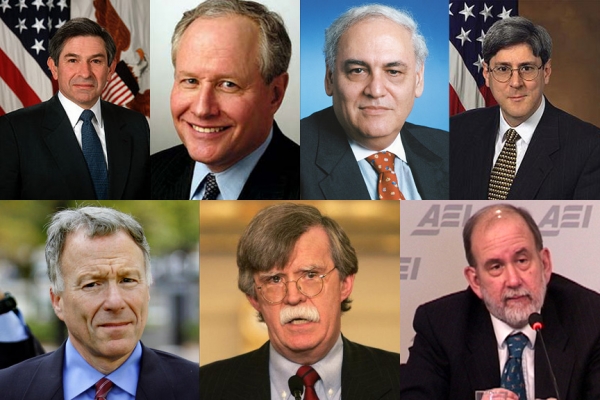
The neocon cult has been behind the promotion of Israel as well as the serial foreign policy misadventures since 2001. Do the names Perle, Feith, Wolfowitz, Abrams, Edelman, Ledeen, Senor, Libby and Nuland in and around the government as well as a host of others in think tanks and lobbies like AIPAC, AEI, WINEP, PNAC, FPI, FDD, JINSA and Hudson ring a bell? And do the loud voices in the media to include Judith Miller, Robert Kaplan, Charles Krauthammer, Jennifer Rubin, Fred Hiatt, Bret Stephens, Bill Kristol, the Kagans and the Podhoretzes, as well as the entire Washington Post and Wall Street Journal editorial pages, suggest any connivance?
They are all Jews and many are connected in terms of their careers, which were heavily networked from the inside to advance them up the ladder, often to include moving between government and lucrative think tank and academic positions. They mostly self-identify as neoconservatives and all share some significant traits, notably extreme dedication to Israel and embrace of the doctrine that the U.S. should not be shy about using military force, so it is interesting to learn from Williamson that they really do not constitute a cohesive group with shared values and interests as well as excellent access to the media and the levers of power. When did you last see an “expert” on the Middle East on television who was not Jewish?
Having made his pithy comments and dismissed neoconservatism-phobes as bigots, Williamson then wanders off subject into the Deep State, which, like neoconism apparently is some kind of urban legend being propagated by the poorly informed, whom these days he identifies as Trump supporters. He argues that the entities that are frequently cited as the Deep State, including the neocons, actually have quite divergent interests and it is unlikely that those interests should become “identical or aligned” to enable running of the country in an essentially clandestine fashion.
It is perhaps inevitable that Williamson is confused as he does not recognize how the American Deep State differs from that in most other countries – it is perhaps better described as the Establishment. Unlike in places like Turkey, it operates largely out in the open and ostensibly legally along a New York-Washington axis that constantly revitalizes itself through the revolving door allowing the entry of politicians and high government officials who create and enforce the legislation that benefits Deep State interests. Its components do indeed have different motives, but they come together in preserving the status quo, which benefits all parties, while little dissent comes from the Fourth Estate as the process plays out, since much of the media and many of the proliferating Washington think tanks that provide Deep State “intellectual” credibility are also part of the same malignancy. And yes, quite a bit of today’s Establishment is Jewish, most particularly financial and legal services, the think tanks, and academia. Many of them support or are part of the neocon persuasion and frequently also of the Israel Lobby.
The existence of a Deep State means that many issues that impact on the citizenry never are discussed as part of the political process, leading to jokes that the United States has only one political party with two wings. Issues like the relationship with Israel, though hotly debated by some of the public, are never really debated and are dealt with by consensus crafted by the politicians and the media. Significant policies like those relating to war and peace, healthcare and immigration were rarely seriously challenged prior to Trump because there is a broad agreement regarding what the Establishment will allow to take place. That is how the Deep State operates.
When it comes to foreign and national security policy the neocons are most definitely an integral part of the Deep State, using money and access to politicians to influence what is taking place without anyone seriously challenging their role. They are an essential cog in a system that is completely corrupt: it exists to sell out the public interest, and includes both major political parties as well as government officials. And it is so successful because it wins no matter who is in power, by creating bipartisan-supported money pits within the system. Monetizing the completely unnecessary and hideously expensive global war on terror benefits the senior government officials, beltway industries, and financial services that feed off it. Because it is essential to keep the money flowing, the Deep State persists in promoting policies that enrich its constituencies but otherwise make no sense, to include funding the unending and unwinnable wars currently enjoying marquee status in Iraq, Syria and Afghanistan and the gift of $38 billion to Israel.
Max Boot spews the kind of bile that is commonly seen or heard when the neocons zero in on their enemies. The National Review meanwhile provides cover for Max and others by suggesting that only anti-Semites or the demented could possibly have it in for neoconservatives or be wary of zany concepts like a Deep State. Together they generate the fog that makes it impossible to challenge certain aspects of the status quo. Maybe, just maybe, what Donald Trump has been saying about his predecessor’s Deep State inspired machinations are true. And just possibly there is a largely Jewish cabal within that Deep State, call it what you will, that works very hard behind the scenes to favor Israel while also pushing for a state of perpetual war, from which it benefits personally. I know that thinking that we Americans are on the receiving end of a vast and very effective conspiracy makes many uneasy, but history has taught us that sometimes our worst nightmares are actually true.
John McAfee: ‘I Can Promise You It Wasn’t Russia Who Hacked the DNC’
Sputnik – 21.03.2017
The Kremlin has been accused of launching large-scale cyberwar ostensibly aimed at undermining democracy in the United States, with high-profile hacks on the Democratic Party cited as evidence, but technology pioneer and founder of McAfee securities John McAfee told Radio Sputnik that Russia is not behind these high-profile cyberattacks.
“I can promise you it was not the Russians who hacked the Democratic National Committee (DNC). The software used was way too old. The state hackers would not use an old version of software which was less functional than the updated versions,” he said. “One of the things that the CIA said and I’ve been saying for years is that it is virtually impossible to find attribution for any hack because a good hacker can hide their tracks plus make it look like someone else did it. This happens all the time.”
It is extremely likely that if a cyberattack appears to have originated in Russia or China for instance, it was in fact launched from a third country. In this case locations are placed specifically to hide the tracks of the true perpetrator, he explained.
McAfee suggested that there could be political motivation behind accusations that Russia launched cyberattacks on the Democratic National Committee (DNC) and John Podesta, the former chairman of the 2016 Hillary Clinton presidential campaign.
Vladimir Putin is “possibly the most powerful man in the world. America resents that. The Democrats for some reason hate Putin. I think Donald Trump is far wiser,” he said, referring to Trump’s pledge to improve relations with Russia which were ruined during the Obama administration. “If in fact they spoke with each other daily, wouldn’t we have a more harmonious world? And yet here in America we are trashing people for speaking to Putin. It’s bizarre.”
McAfee further commented on recent revelations with regard to the CIA’s hacking secrets. He expressed doubt that the US intelligence community could be made more accountable and transparent if stricter rules on its operations are passed.
“I’ve never seen a covert agency adhere to any kind of legislation. We all know that murder is illegal in almost every country and yet there is not a single covert agency in America, except possibly for the FBI, that does not engage in assassinations. We all know this. I don’t think legislation is needed. I think that we need a firm hand. We need to fire the directors and management all the way down to the street agent and then start over,” he said.
McAfee also said that cyberwar could have far more serious implications than a nuclear conflict.
“We are not in a nuclear age anymore. There will not be another nuclear war because cyberwar is far more devastating. The tools will eventually be in the hands of hackers because this is what happens when you build weaponized software. The first time you use it you send a copy into the wild and every researcher in the world has a copy of that. It can then be duplicated and in a year from now, these tools will be sold on the dark web by 15-year-old boys for a hundred dollars,” he explained.
The Missing Logic of Russia-gate
By Robert Parry | Consortium News | March 20, 2017
As Rep. Adam Schiff tries out for the lead role in a remake of the Joe McCarthy hearings by maligning specific Americans as suspected Russian moles, some of the actual evidence argues against the Democratic notion that the Russians own President Trump and other key Republicans.
For instance, last week, Democrats circulated a report showing that retired Lt. Gen. Michael Flynn, who served briefly as President Donald Trump’s national security adviser, had received payments from several Russia-related entities, totaling nearly $68,000.
The largest payment of $45,386 came for a speech and an appearance in Moscow in 2015 at the tenth anniversary dinner for RT, the international Russian TV network, with Flynn netting $33,750 after his speakers’ bureau took its cut. Democrats treated this revelation as important evidence about Russia buying influence in the Trump campaign and White House. But the actual evidence suggests something quite different.
Not only was the sum a relative trifle for a former senior U.S. government official compared to, say, the fees collected by Bill and Hillary Clinton, who often pulled in six to ten times more, especially for speeches to foreign audiences. (Former President Clinton received $500,000 for a Moscow speech from a Russian investment bank with ties to the Kremlin, The New York Times reported in 2015,)
Yet, besides Flynn’s relatively modest speaking fee, The Washington Post reported that RT negotiated Flynn’s rate downward.
Deep inside its article on Flynn’s Russia-connected payments, the Post wrote, “RT balked at paying Flynn’s original asking price. ‘Sorry it took us longer to get back to you but the problem is that the speaking fee is a bit too high and exceeds our budget at the moment,’ Alina Mikhaleva, RT’s head of marketing, wrote a Flynn associate about a month before the event.”
So, if you accept the Democrats’ narrative that Russian President Vladimir Putin is engaged in an all-out splurge to induce influential Americans to betray their country, how do you explain that his supposed flunkies at RT are quibbling with Flynn over a relatively modest speaking fee?
Wouldn’t you think that Putin would have told RT’s marketing department that the sky was the limit in paying off Flynn because the ever-prescient Russian president knew from his Ouija board in 2015 that Flynn would be the future national security adviser under President Trump?
After all, it’s become one of Official Washington’s favorite groupthinks that RT is nothing but a Russian propaganda front designed to destroy the faith that Americans have in their democratic process – as if the sleazy and shameful political campaigns financed with hundreds of millions of dollars from billionaires need any help from RT.
Anti-Democracy Debates
But RT-bashing is always in season. The Director of National Intelligence’s report on Jan. 6, with its evidence-free “assessments” that Russia was engaged in undermining American democracy included a seven-page appendix dating from 2012 that described how RT was contributing toward that goal by portraying “the US electoral process as undemocratic.”
The “proof” behind the DNI’s accusation included RT’s articles on “voting machine vulnerabilities” although virtually every major U.S. news organizations ran similar stories in that time frame. The DNI report also took RT to task for covering the Occupy Wall Street movement and for reporting on the environmental dangers from “fracking,” topics cited as further proof that the Russian government was using RT to weaken U.S. public support for Washington’s policies (although, again, these are topics of genuine public interest).
To further demonstrate how RT was carrying out the Kremlin’s goal of spoiling Americans’ faith in the U.S. democratic process, the DNI report noted that “RT broadcast, hosted and advertised third-party candidate debates.”
Apparently, the DNI’s point was that showing Americans that there are choices beyond the two major parties was somehow seditious. “The RT hosts asserted that the US two-party system does not represent the views of at least one-third of the population and is a ‘sham,’” the DNI’s report said.
Yet, polls have shown that large numbers of Americans would prefer more choices than the usual two candidates and, indeed, most Western democracies have multiple parties. But somehow RT’s suggestion that other voices should be heard constituted an assault on American democracy.
As for Flynn, the report on his finances showed that he also received payments of $11,250 from the U.S. subsidiary of Kaspersky Lab, a Russian cyber-security firm, and $11,250 from a U.S. air cargo company associated with the Volga-Dnepr Group, owned by a Russian businessman.
Rep. Elijah Cummings, D-Maryland, who was the chief defender of former Secretary of State Hillary Clinton when she was subjected to the Republicans’ over-the-top Benghazi investigations, switched positions in publicizing the news about Flynn’s post-government work related to Russia. Cummings was suddenly the accuser.
”I cannot recall any time in our nation’s history when the President selected as his National Security Advisor someone who violated the Constitution by accepting tens of thousands of dollars from an agent of a global adversary that attacked out democracy,” Cummings wrote in a letter to President Trump, Defense Secretary Jim Mattis and FBI Director James Comey.
Heating Up the New Cold War
Cummings thus became another Democrat pouring gasoline on the smoldering tensions between nuclear-armed Russia and the United States. For the Democrats, any dealing with any entity that had some connection to Russia is now prima facie evidence of disloyalty.
The context of these contacts has become almost irrelevant, subordinated to the larger goal of ousting Trump, whatever the cost, even transforming the Democratic Party into the party of the New Cold War and the New McCarthyism.
Yet, further undercutting the new certainty that Putin lined Trump’s pockets with rubles as a way to ensure his allegiance to the Kremlin is the story of Trump’s failed luxury hotel project intended to be built in Moscow several years ago.
A source familiar with those negotiations told me that Trump had hoped to get a half interest in the $2 billion project but that Russian-Israeli investor Mikhail Fridman, a founder of Russia’s Alfa Bank, balked because Trump was unwilling to commit a significant investment beyond the branding value of the Trump name.
Again, if the Democratic narrative is to be believed – that Putin controls all the businesses in Russia and wanted to pay off Trump – it’s hard to understand why the hotel deal fell through. Or, for that matter, why RT was nickel-and-diming Flynn.
The other problem with the Democratic narrative is that it always assumes that Putin could foretell that Trump would rise in 2016 to win the U.S. presidential election and thus there was value in corrupting Trump and his entourage with money and other favors.
The fact that almost no political pundit in the United States shared that prediction even last year would seem to demonstrate the kookiness of the Democratic assumptions and the flaws in the U.S. Intelligence Community’s “assessments” about alleged Russian “hacking” and distribution of Democratic emails.
Those “assessments” also assume that Putin’s motives were to hurt Hillary Clinton’s campaign, boost Trump and – as FBI Director Comey added on Monday – turn Americans against their democracy.
But there is a counter-argument to that thinking: Assuming that Putin read the polls like everyone else, would he risk infuriating the likely next President of the United States – Hillary Clinton – by embarrassing her with an email leak that would amount to a pinprick? Clinton herself blamed her surprise defeat on FBI Director Comey’s decision to briefly reopen the investigation into whether she endangered national security by using a private email server as Secretary of State.
Unless one assumes that Putin’s Ouija board also predicted Comey’s actions or perhaps that Comey is another Russian mole, wouldn’t it be a huge risk for Putin to anger Clinton without ensuring her defeat? There’s the old saying that “if you strike a king, you must kill him,” which would seem to apply equally to a queen. But logical thinking no longer applies to what’s going on in Official Washington.
Investigative reporter Robert Parry broke many of the Iran-Contra stories for The Associated Press and Newsweek in the 1980s.
Netanyahu levels possible threat at Putin; Moscow summons Israeli ambassador
By Adam Garrie | The Duran | March 18, 2017
Israeli Prime Minsiter Benjamin Netanyahu has emerged after an illegal Israeli air strike on Syrian troops in Palmyra. In his statement, he predictably disregarded international law, but he also made what can only be described as a thinly veiled threat against Russia.
The Israeli leader claimed he was targeting Syrian allied Hezbollah fighters but in reality, it is almost certain the strike hit Syrian Arab Army regulars.
He went on to say,
Just who could ‘everyone’ imply. Could the Israeli leader be threatening Russia?
It seems that he is.
Russia has been a consistent ally of the Syrian Arab Republic in her war against terrorism. Israel, which has been an enemy of Syria since the 1940s, is deeply desirous for regime change in one of the few Arab states left, which still pursues an independent foreign policy, one which is openly pro-Palestine.
As a result of Netanyahu’s provocative remarks, Moscow summoned the Israeli Ambassador to Russia to clarify the remarks. Russia is in a unique position as a power that is an ally of Syria, a traditional friend of Palestine, but also a power that Israel listens to and does not want to overtly upset.
Indeed, Netanyahu was in Moscow just over a week ago. If Israel thinks it is in a position to provoke Russia and threaten Russia into changing its established policy in Syria, they really ought to think again.
One must remain hopeful that the Israeli Ambassador got a stern warning from Russia, something along the lines of, ‘stay out of Syria and stay out of our business in Syria as a legal partner of Damascus’.
Featured Video
Can the U.S. Afford to Annihilate Iran?
or go to
Aletho News Archives – Video-Images
From the Archives
Sanctions, War and the Policy of Dual Containment
By SASAN FAYAZMANESH | March 17, 2008
It is now nearly three decades since the Unites States adopted the policy of dual containment of Iran and Iraq. While much has been written about the containment of Iraq, there has been very little in-depth analysis of this policy when it comes to Iran. In a book that is going to be released on March 31, 2008, entitled The United States and Iran: Sanctions, Wars and the Policy of Dual Containment (Routledge), I attempt to address this shortcoming by investigating when and why the US policy of containment of Iran came about, how it evolved, and where it stands today.[1] To the extent that Israel has been involved in US policy making, the study will also include the role that Israel has played in the containment of Iran. Also, since the fate of Iran has been inextricably linked to that of Iraq, occasionally the investigation will overlap with the containment of Iraq.
The policy of dual containment of Iran and Iraq originated during the Carter Administration, but it was not until the Clinton Administration that the expression “dual containment” became popular. … continue
Blog Roll
 Aletho News
- Can the U.S. Afford to Annihilate Iran? /Seyed M. Marandi
- Elmo Sold mRNA Jabs to Your Toddler. Now They Are “Off-Label.”
- British state targets Palestine Action with yet another crooked trial
- Americans are paying the price to preserve Israel’s nuclear hegemony
- Resistance factions are necessary to ensure a permanent US Iraq withdrawal
- How Israel destabilizes the Middle East: Denying sovereignty and the right to exist
- Europe’s Establishment Is Embracing War – and Losing Voters
- NATO chief advocates war of aggression
- No Vote, No Representation, No State: Democracy, Israeli Style
- Zionist Bought Senate Blocks Information About American Citizens Killed By Israel
- If Americans Knew
- Israeli Soldiers Abduct At Least 22 Across Occupied West Bank
- Eight Palestinians Killed in Israeli Attacks on Gaza
- Israeli former leaders and security chiefs threaten legal action over ‘Jewish terrorism’
- Israel map in LA Times ad includes all land from the river to the sea
- Inside Lebanon’s 200-page dossier on Israeli war crimes
- Flydubai, genocide, settler violence, Trump abuse of power to deport – Daily Update
- Counting Antisemitic Incidents: What the ADL Audit Reveals — and Obscures
- Mamdani releases plan to combat antisemitism and hate crimes in New York City
- Iran’s Revolutionary Guards Publish Letter to the American People
- DMFI launches $1 million ad campaign supporting Virginia’s Elaine Luria
- No Tricks Zone
- Green Energy Debacle: German Expert Professor Fritz Vahrenholt Warns Of Severe Economic And Social Consequences
- Two More Paleo Reconstructions Affirm Meters-Higher Sea Levels Across Ireland, Brazil 7000-6000 Years Ago
- New Study: Earth And Venus Surface Warmth Largely Explained By Convection And Lapse Rate, Not CO2 Or Radiation
- 2025 Nature Paper Claiming Worsening Global Drought Gets RETRACTED …Heavily Flawed
- New Study: ‘Global Drought Shows No Detectable Recent Acceleration Under Climate Warming’
- Economic Masterminds: German Socialists Suggest Taxing Productivity Gains Stemming From Using AI
- The South China Sea Has Not Been Cooperating With The Climate Change Narrative
- Energy Crisis: Germany Enters Heating Season With Historically Low Gas Reserve Fill Levels
- New Study: The Antarctic Ice Sheet Gained Mass From 2020-2024 Due To Staggering Snow And Ice Accumulation
- Study: Ocean Heating Rates From Thousands Of Years Ago ‘Dwarf’ Modern Ocean Heating Rates

